×
Hero Background
English
Chinese
French
Japanese
Korean
German
Spanish

Klinefelter Syndrome Treatment Market Analysis

ID: MRFR/Pharma/5302-HCR
90 Pages
Rahul Gotadki
October 2025

klinefelter syndrome treatment market Research Report: by treatment (Testosterone Replacement Therapy, Fertility Treatment, Breast tissue removal and others, by end-users (hospital and clinics, ambulatory surgeries and others)—Forecast till 2035

Share:
Download PDF ×

We do not share your information with anyone. However, we may send you emails based on your report interest from time to time. You may contact us at any time to opt-out.

Klinefelter Syndrome Treatment Market Infographic
Purchase Options

Market Analysis

In-depth Analysis of Klinefelter Syndrome Treatment Market Industry Landscape

Klinefelter syndrome awareness has been increasing which is impacting positively towards diagnosis influencing market dynamics positively. The advancement in medical understanding together with diagnostic tools has seen a rise in the number of KS cases which is pushing for inventive treatment approaches and expansion of Klinefelter Syndrome Treatment Market.

Research & development is crucial in shaping the dynamics in Klinefelter Syndrome Treatment Market. To better understand the genetic/hormonal basis of KS, pharmaceutical companies, doctors specializing on reproductive system disorders etc., conduct large-scale studies aimed at developing target oriented therapies. Trials and studies are focused on improving hormonal replacement therapies such as clinical trials aimed at fertility treatments or addressing associated health issues, showing that the competitive landscape is dedicated to innovations. The market remains very dynamic with continuous pursuit of new solutions for improvement of the lives of people suffering from Klinefelter Syndrome.

Klinefelter Syndrome’s treatment approach is holistic and individualized such that it encompasses managing testosterone deficiency through hormone replacement therapy; fertility treatments among those willing to become parents along with other health problems related to this disease. Personalized medicine now gains more attention due advances in clinical research because there has been an increasing focus on tailoring treatments based on specific requirements of patients having Klinefelter Syndrome. This change has revolutionized the market dynamics around how best to address various aspects concerning this genetic disorder thus emphasizing comprehensive approach taking into consideration every aspect about patient’s life.

Market trends in the treatment of Klinefelter’s syndrome are influenced by economic factors such as health care spending, insurance coverage and cost effectiveness of procedures used. These economic concerns can influence accessibility of hormonal therapies, supportive interventions and fertility treatments hence affecting their uptake and availability across larger populations affected by KS.


Author
Rahul Gotadki
Assistant Manager

He holds an experience of about 7+ years in Market Research and Business Consulting, working under the spectrum of Life Sciences and Healthcare domains. Rahul conceptualizes and implements a scalable business strategy and provides strategic leadership to the clients. His expertise lies in market estimation, competitive intelligence, pipeline analysis, customer assessment, etc. In addition to the above, his other responsibility includes strategic tracking of high growth markets & advising clients on the potential areas of focus they could direct their business initiatives

Leave a Comment

FAQs

At what CAGR is the Klinefelter syndrome treatment market projected to grow during the forecast period?

The Klinefelter syndrome treatment market is projected to grow at a 4.25% CAGR between 2024-2032.

Which region is projected to command the largest share in the Klinefelter syndrome treatment market?

North America is projected to command the largest share in the Klinefelter syndrome treatment market.

What are the key factors that are driving the Klinefelter syndrome treatment market?

Growing awareness about the disease is boosting market growth.

Which factors may limit the Klinefelter syndrome treatment market?

Adverse side effects may limit market growth.

What are the end use industries of Klinefelter syndrome treatment market?

End use industries of Klinefelter syndrome treatment market include academic institutes, hospitals and clinics, and others.

Market Summary

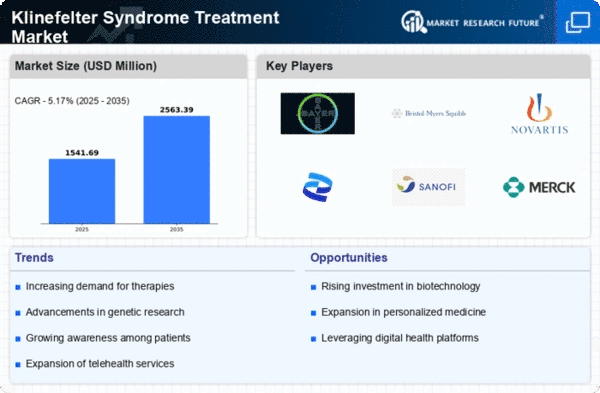
As per MRFR analysis, the Klinefelter Syndrome Treatment Market Size was estimated at 1465.9 USD Million in 2024. The Klinefelter Syndrome Treatment industry is projected to grow from 1558.48 USD Million in 2025 to 2563.39 USD Million by 2035, exhibiting a compound annual growth rate (CAGR) of 5.17 during the forecast period 2025 - 2035.

Key Market Trends & Highlights

The Klinefelter Syndrome Treatment Market is experiencing a shift towards personalized and technologically advanced treatment options.

  • Personalized treatment approaches are becoming increasingly prevalent in the Klinefelter Syndrome Treatment Market.
  • The integration of digital health solutions is enhancing patient engagement and treatment adherence in North America.
  • Increased awareness and education regarding Klinefelter Syndrome are driving demand for effective treatment options, particularly among adults.
  • Rising prevalence of Klinefelter Syndrome and advancements in genetic research are key drivers propelling growth in the hormone replacement therapy and fertility treatment segments.

Market Size & Forecast

2024 Market Size 1465.9 (USD Million)
2035 Market Size 2563.39 (USD Million)
CAGR (2025 - 2035) 5.17%
Largest Regional Market Share in 2024 North America

Major Players

<p>Bayer AG (DE), Bristol-Myers Squibb Company (US), Novartis AG (CH), Pfizer Inc. (US), Sanofi S.A. (FR), Merck & Co., Inc. (US), AstraZeneca PLC (GB), Teva Pharmaceutical Industries Ltd. (IL), Eli Lilly and Company (US)</p>

Market Trends

The Klinefelter Syndrome Treatment Market is currently experiencing a notable evolution, driven by advancements in medical research and increased awareness of the condition. Klinefelter Syndrome, characterized by the presence of an extra X chromosome in males, often leads to various health challenges, including infertility and hormonal imbalances. As healthcare providers and patients become more informed about the syndrome, there is a growing demand for effective treatment options. This market is witnessing a shift towards personalized medicine, where therapies are tailored to individual patient needs, enhancing treatment efficacy and patient satisfaction. Moreover, the landscape of the Klinefelter Syndrome Treatment Market is being shaped by the integration of innovative technologies. Telemedicine and digital health solutions are becoming increasingly prevalent, allowing for better patient monitoring and access to specialists. This trend not only improves patient outcomes but also streamlines the treatment process. As research continues to uncover the complexities of Klinefelter Syndrome, the market is poised for further growth, with potential new therapies on the horizon that may address the underlying genetic factors of the condition. Overall, the Klinefelter Syndrome Treatment Market appears to be on a promising trajectory, reflecting a commitment to improving the quality of life for affected individuals.

Personalized Treatment Approaches

The Klinefelter Syndrome Treatment Market is witnessing a trend towards personalized treatment strategies. Healthcare providers are increasingly focusing on tailoring therapies to meet the unique needs of each patient. This approach may enhance treatment effectiveness and improve overall patient satisfaction.

Integration of Digital Health Solutions

The rise of digital health technologies is transforming the Klinefelter Syndrome Treatment Market. Telemedicine and mobile health applications are facilitating better patient engagement and monitoring, allowing for timely interventions and improved management of the condition.

Increased Awareness and Education

There is a growing emphasis on raising awareness about Klinefelter Syndrome among healthcare professionals and the general public. Enhanced education initiatives are likely to lead to earlier diagnosis and intervention, ultimately benefiting patients and their families.

Klinefelter Syndrome Treatment Market Market Drivers

Supportive Government Policies

Government initiatives aimed at improving healthcare access and treatment options are positively impacting the Global Klinefelter Syndrome Treatment Market Industry. Policies that promote research funding, subsidized treatments, and public health campaigns are essential in facilitating better healthcare outcomes for individuals with Klinefelter Syndrome. Such supportive measures not only enhance the availability of treatment options but also encourage healthcare providers to adopt best practices in managing the syndrome. As governments continue to prioritize rare genetic conditions, the market is likely to see sustained growth, aligning with the projected increase in market value.

Advancements in Treatment Options

Innovations in treatment methodologies are driving the Global Klinefelter Syndrome Treatment Market Industry forward. Recent advancements include hormone replacement therapies and assisted reproductive technologies, which have shown promising results in managing symptoms and improving quality of life for affected individuals. These developments not only enhance patient care but also attract investment into research and development. As new therapies emerge, the market is likely to witness a significant increase in demand, with projections indicating a growth to 2.63 USD Billion by 2035. This growth underscores the importance of continuous innovation in treatment options.

Integration of Telemedicine in Treatment

The integration of telemedicine into the management of Klinefelter Syndrome is transforming the Global Klinefelter Syndrome Treatment Market Industry. Telehealth services provide patients with easier access to specialists, particularly in remote areas, thereby improving treatment adherence and follow-up care. This shift towards digital health solutions is particularly relevant in the context of ongoing advancements in technology. As telemedicine becomes more widely accepted, it is expected to enhance patient engagement and satisfaction, ultimately contributing to market growth. The convenience and accessibility offered by telemedicine may play a crucial role in shaping future treatment paradigms.

Rising Incidence of Klinefelter Syndrome

The Global Klinefelter Syndrome Treatment Market Industry is influenced by the rising incidence of Klinefelter Syndrome, which is estimated to affect approximately 1 in 600 males. This increasing prevalence is prompting healthcare systems to prioritize the development of effective treatment strategies. As more individuals are diagnosed, the need for specialized care and management solutions becomes evident. Consequently, this trend is expected to drive market growth significantly. The anticipated compound annual growth rate of 16.94% from 2025 to 2035 reflects the urgency to address the needs of this growing patient population.

Increasing Awareness of Klinefelter Syndrome

The Global Klinefelter Syndrome Treatment Market Industry is experiencing a surge in awareness regarding Klinefelter Syndrome, particularly among healthcare professionals and patients. This heightened awareness is crucial as it leads to earlier diagnosis and intervention, which can significantly improve patient outcomes. Educational initiatives and campaigns by health organizations are playing a pivotal role in disseminating information about the syndrome. As awareness grows, it is anticipated that the demand for treatment options will increase, contributing to the market's expansion. The industry is projected to reach 0.47 USD Billion in 2024, reflecting the impact of these awareness efforts.

Market Segment Insights

By Treatment Type: Hormone Replacement Therapy (Largest) vs. Fertility Treatment (Fastest-Growing)

<p>In the Klinefelter Syndrome Treatment Market, Hormone Replacement Therapy (HRT) remains the largest segment, reflecting its foundational role in managing the symptoms associated with the condition. This treatment type encompasses testosterone therapy that is critical for improving outcomes related to physical development and psychological health in affected individuals. On the other hand, Fertility Treatment has been gaining significant attention, primarily due to the increasing recognition of reproductive issues among men with Klinefelter syndrome, leading to a progressive shift in market dynamics. Examining growth trends, HRT is projected to maintain its dominance as new formulations and delivery methods are developed. Nevertheless, the rising awareness of family planning and advancements in reproductive technologies bolstered the Fertility Treatment segment, indicating it as the fastest-growing area within the market. Factors such as improving social attitudes towards seeking help for fertility issues and increased access to assisted reproductive technologies are expected to drive further growth in this segment, making it a focal point for healthcare providers and patients alike.</p>

<p>Hormone Replacement Therapy (Dominant) vs. Psychological Counseling (Emerging)</p>

<p>Hormone Replacement Therapy (HRT) is recognized as the dominant treatment modality within the Klinefelter Syndrome Treatment Market, primarily due to its essential role in addressing the hormonal imbalances typical of the condition. HRT is pivotal in enhancing the quality of life for patients by alleviating symptoms such as fatigue, mood changes, and physical development challenges. Meanwhile, Psychological Counseling is an emerging segment that is increasingly being integrated into treatment plans. This form of therapy addresses the emotional and psychological impact of Klinefelter syndrome, helping patients navigate challenges related to self-esteem, identity, and psychological well-being. With a growing emphasis on holistic care, the importance of psychological support is becoming prevalent, as mental health plays a crucial role in the overall treatment of individuals diagnosed with this syndrome.</p>

By Patient Age Group: Adults (Largest) vs. Adolescents (Fastest-Growing)

<p>In the Klinefelter Syndrome Treatment Market, the distribution of patient age groups indicates a significant presence of adults, who represent the largest segment due to the onset of symptoms being typically diagnosed later in life. Adults are the primary consumers of therapeutic interventions, leading to a stronger market position compared to children, adolescents, and the elderly. Each of these age groups contributes to a smaller share, with adolescents quickly growing in importance as awareness increases and early diagnosis becomes more common. The growth trends within these patient age groups reveal a dynamic market with adolescents emerging as the fastest-growing segment owing to advancements in genetic testing and increased awareness of Klinefelter Syndrome. As healthcare providers focus on early intervention strategies, there is also a potential for enhanced treatment options tailored specifically toward each age demographic, demonstrating the need for innovative solutions catering to their unique developmental and health needs.</p>

<p>Adults (Dominant) vs. Children (Emerging)</p>

<p>Adults represent a dominant segment in the Klinefelter Syndrome Treatment Market due to their established need for treatment in managing the long-term effects of the condition. They often require a wide array of interventions, such as hormone replacement therapy and fertility treatments, allowing for tailored care plans that enhance their quality of life. In contrast, the children’s segment is emerging as a crucial focus area as awareness grows and more cases are diagnosed at a younger age. Treatment options for children are being adapted to facilitate early intervention and management to improve developmental outcomes. This divergence in focus highlights the need for specialized approaches for both adults and younger patients, driving innovation in treatment methodologies.</p>

By Diagnosis Method: Genetic Testing (Largest) vs. Hormonal Assessment (Fastest-Growing)

<p>In the Klinefelter Syndrome Treatment Market, Genetic Testing holds the largest market share among diagnosis methods, reflecting its critical role in accurate diagnosis and early detection. Hormonal Assessment, while comparatively smaller, is emerging rapidly due to increased awareness of hormonal imbalances and their implications in Klinefelter Syndrome, appealing to a growing number of healthcare providers and patients seeking comprehensive evaluations. As the market evolves, advancements in genetic testing technologies and methodologies boost Genetic Testing's prominence, while Hormonal Assessment experiences significant growth driven by a push for personalized medicine. This shift emphasizes the importance of tailored treatment plans, making Hormonal Assessment a vital contender in the segment as demand for integrated diagnostic approaches rises.</p>

<p>Genetic Testing (Dominant) vs. Hormonal Assessment (Emerging)</p>

<p>Genetic Testing stands as the dominant method in diagnosing Klinefelter Syndrome, capitalizing on its ability to precisely identify chromosomal abnormalities. This technique is crucial for not only confirming the diagnosis but also for guiding subsequent treatment decisions. Genetic Testing is widely embraced by healthcare professionals, positioning itself as a standard of care in this field. In contrast, Hormonal Assessment is emerging as a vital method, concentrating on evaluating testosterone levels and other hormonal markers, which are pivotal in understanding the syndrome's impact on patients. Its growth is propelled by increasing recognition of the importance of hormone levels in disease management, making it an attractive option for both physicians and patients. The synergy of these two methods provides a comprehensive diagnostic framework, enhancing treatment efficiency.</p>

By Severity of Condition: Moderate (Largest) vs. Severe (Fastest-Growing)

<p>In the Klinefelter Syndrome Treatment Market, the distribution of market share among the severity of condition segments reveals that the Moderate category accounts for the largest share, reflecting a significant portion of diagnosed cases. This prevalence is attributed to a higher level of public awareness and improved diagnostic capabilities, allowing for early identification and treatment of individuals with Moderate severity. On the other hand, the Severe segment, though not as large in market share, is experiencing rapid growth due to increasing acknowledgment of the condition's impact on quality of life, leading to the development of focused therapies for this demographic. The growth trends in the Klinefelter Syndrome Treatment Market are significantly influenced by advancements in medical technologies and a rise in healthcare budgets, promoting research and development for effective interventions. The Severe segment is gaining traction, driven by a greater emphasis on personalized medicine, which tailors treatment approaches based on the severity of the condition. Additionally, increased advocacy from patient support groups is fostering deeper understanding and acceptance of severe cases, propelling the demand for targeted treatments designed to address the more complex challenges faced by this group.</p>

<p>Moderate (Dominant) vs. Severe (Emerging)</p>

<p>The Moderate severity segment in the Klinefelter Syndrome Treatment Market is characterized by a balanced approach to management, often involving hormone replacement therapies and counseling. This segment represents the majority of cases, benefiting from established treatment protocols that have evolved over the years. As understanding of the condition has improved, moderate cases have become the focal point for healthcare providers. In contrast, the Severe segment is emerging, driven by the increasing need for specialized care and innovative therapies aimed at addressing the more profound challenges associated with severe manifestations of Klinefelter Syndrome. This segment often faces more complex treatment regimens, highlighting a growing imperative for research targeted at developing novel interventions that can enhance patient outcomes and quality of life.</p>

Get more detailed insights about Klinefelter Syndrome Treatment Market Research Report - Global Forecast till 2035

Regional Insights

North America : Market Leader in Treatment

North America is poised to maintain its leadership in the Klinefelter Syndrome treatment market, holding a significant share of $800.0M in 2024. The region benefits from advanced healthcare infrastructure, increasing awareness, and a growing patient population. Regulatory support and favorable reimbursement policies further drive market growth, making it a hub for innovative treatment solutions. The United States stands out as the primary market, with key players like Pfizer Inc., Merck & Co., and Eli Lilly leading the charge. The competitive landscape is characterized by robust R&D investments and strategic partnerships aimed at enhancing treatment efficacy. As the market evolves, the presence of established pharmaceutical companies ensures a steady supply of innovative therapies, catering to the diverse needs of patients.

Europe : Emerging Market Dynamics

Europe is witnessing a notable expansion in the Klinefelter Syndrome treatment market, valued at $400.0M in 2024. Factors such as increasing healthcare expenditure, rising awareness of genetic disorders, and supportive regulatory frameworks are driving this growth. The region's focus on personalized medicine and advanced therapeutic options is expected to further enhance market dynamics. Leading countries like Germany, France, and the UK are at the forefront, with a competitive landscape featuring major players such as Bayer AG and Novartis AG. The presence of strong healthcare systems and ongoing clinical trials contribute to a vibrant market environment. As regulatory bodies emphasize patient access to innovative treatments, the European market is set for sustained growth in the coming years.

Asia-Pacific : Rapidly Growing Market

The Asia-Pacific region is emerging as a significant player in the Klinefelter Syndrome treatment market, currently valued at $200.0M in 2024. Factors such as increasing healthcare investments, rising awareness of genetic conditions, and improving access to healthcare services are driving this growth. The region's diverse population and varying healthcare needs present unique opportunities for tailored treatment solutions. Countries like Japan, Australia, and China are leading the charge, with a competitive landscape that includes both local and international players. Companies like Teva Pharmaceutical and AstraZeneca are actively involved in developing innovative therapies. As regulatory frameworks evolve to support new treatments, the Asia-Pacific market is expected to witness substantial growth in the coming years.

Middle East and Africa : Emerging Treatment Opportunities

The Middle East and Africa region is gradually developing its Klinefelter Syndrome treatment market, currently valued at $65.9M in 2024. Factors such as increasing awareness of genetic disorders, improving healthcare infrastructure, and rising healthcare expenditure are contributing to market growth. The region's focus on enhancing patient access to treatments is expected to drive further developments in this area. Countries like South Africa and the UAE are leading the market, with a competitive landscape that includes both local and international pharmaceutical companies. The presence of key players such as Sanofi S.A. and Merck & Co. highlights the growing interest in this market. As healthcare systems continue to evolve, the region is poised for gradual growth in Klinefelter Syndrome treatment options.

Key Players and Competitive Insights

The Klinefelter Syndrome Treatment Market is characterized by a competitive landscape that is increasingly shaped by innovation, strategic partnerships, and a focus on patient-centric solutions. Key players such as Bayer AG (DE), Bristol-Myers Squibb Company (US), and Pfizer Inc. (US) are actively engaged in enhancing their market positions through various strategic initiatives. Bayer AG (DE) has been focusing on expanding its therapeutic portfolio, particularly in hormonal therapies, which are crucial for managing Klinefelter Syndrome. Meanwhile, Bristol-Myers Squibb Company (US) is leveraging its expertise in immunotherapy to explore novel treatment avenues, indicating a shift towards more personalized medicine. Pfizer Inc. (US) is also investing in research and development to innovate treatment protocols, thereby contributing to a more dynamic competitive environment.

The business tactics employed by these companies reflect a concerted effort to optimize supply chains and localize manufacturing processes. The market appears to be moderately fragmented, with several players vying for market share, yet the influence of major companies is substantial. This competitive structure allows for a diverse range of treatment options, which may enhance patient access and outcomes. The collective strategies of these key players suggest a trend towards collaboration and resource sharing, which could further strengthen their market positions.

In November 2025, Bayer AG (DE) announced a strategic partnership with a leading biotechnology firm to co-develop a new hormonal therapy specifically targeting Klinefelter Syndrome. This collaboration is expected to accelerate the development timeline and enhance the therapeutic options available to patients. The strategic importance of this partnership lies in its potential to combine Bayer's extensive market reach with innovative biotechnological advancements, thereby positioning the company as a leader in this niche market.

In October 2025, Pfizer Inc. (US) launched a new clinical trial aimed at evaluating the efficacy of a combination therapy for Klinefelter Syndrome. This trial is particularly noteworthy as it represents Pfizer's commitment to advancing treatment options through rigorous scientific inquiry. The implications of this initiative are significant, as successful outcomes could lead to new standards of care and reinforce Pfizer's reputation as a pioneer in the field.

In September 2025, Bristol-Myers Squibb Company (US) expanded its research capabilities by establishing a dedicated unit focused on genetic disorders, including Klinefelter Syndrome. This move underscores the company's strategic intent to deepen its understanding of the genetic underpinnings of the syndrome, which may facilitate the development of targeted therapies. The establishment of this unit is likely to enhance Bristol-Myers Squibb's competitive edge by fostering innovation and attracting top-tier talent in genetic research.

As of December 2025, the Klinefelter Syndrome Treatment Market is witnessing trends that emphasize digitalization, sustainability, and the integration of artificial intelligence in treatment protocols. Strategic alliances among key players are increasingly shaping the competitive landscape, fostering an environment where collaboration is paramount. Looking ahead, it is anticipated that competitive differentiation will evolve, with a pronounced shift from price-based competition to a focus on innovation, technological advancements, and supply chain reliability. This evolution may ultimately lead to improved patient outcomes and a more robust market framework.

Key Companies in the Klinefelter Syndrome Treatment Market market include

Industry Developments

Future Outlook

Klinefelter Syndrome Treatment Market Future Outlook

<p>The Klinefelter Syndrome Treatment Market is projected to grow at a 5.17% CAGR from 2024 to 2035, driven by advancements in hormone therapies and increased awareness.</p>

New opportunities lie in:

  • <p>Development of personalized treatment plans leveraging genetic profiling.</p>
  • <p>Expansion of telehealth services for remote patient monitoring.</p>
  • <p>Investment in educational programs to raise awareness among healthcare providers.</p>

<p>By 2035, the market is expected to achieve substantial growth, reflecting enhanced treatment options and increased patient engagement.</p>

Market Segmentation

Klinefelter Syndrome Treatment Market Treatment Type Outlook

  • Hormone Replacement Therapy
  • Psychological Counseling
  • Fertility Treatment
  • Physical Therapy

Klinefelter Syndrome Treatment Market Diagnosis Method Outlook

  • Genetic Testing
  • Hormonal Assessment
  • Physical Examination
  • Imaging Techniques

Klinefelter Syndrome Treatment Market Patient Age Group Outlook

  • Children
  • Adolescents
  • Adults
  • Elderly

Klinefelter Syndrome Treatment Market Severity of Condition Outlook

  • Mild
  • Moderate
  • Severe

Report Scope

MARKET SIZE 20241465.9(USD Million)
MARKET SIZE 20251558.48(USD Million)
MARKET SIZE 20352563.39(USD Million)
COMPOUND ANNUAL GROWTH RATE (CAGR)5.17% (2024 - 2035)
REPORT COVERAGERevenue Forecast, Competitive Landscape, Growth Factors, and Trends
BASE YEAR2024
Market Forecast Period2025 - 2035
Historical Data2019 - 2024
Market Forecast UnitsUSD Million
Key Companies ProfiledBayer AG (DE), Bristol-Myers Squibb Company (US), Novartis AG (CH), Pfizer Inc. (US), Sanofi S.A. (FR), Merck & Co., Inc. (US), AstraZeneca PLC (GB), Teva Pharmaceutical Industries Ltd. (IL), Eli Lilly and Company (US)
Segments CoveredTreatment Type, Patient Age Group, Diagnosis Method, Severity of Condition
Key Market OpportunitiesAdvancements in personalized medicine enhance treatment options in the Klinefelter Syndrome Treatment Market.
Key Market DynamicsRising demand for personalized therapies drives innovation in Klinefelter Syndrome treatment options and competitive market dynamics.
Countries CoveredNorth America, Europe, APAC, South America, MEA

FAQs

At what CAGR is the Klinefelter syndrome treatment market projected to grow during the forecast period?

The Klinefelter syndrome treatment market is projected to grow at a 4.25% CAGR between 2024-2032.

Which region is projected to command the largest share in the Klinefelter syndrome treatment market?

North America is projected to command the largest share in the Klinefelter syndrome treatment market.

What are the key factors that are driving the Klinefelter syndrome treatment market?

Growing awareness about the disease is boosting market growth.

Which factors may limit the Klinefelter syndrome treatment market?

Adverse side effects may limit market growth.

What are the end use industries of Klinefelter syndrome treatment market?

End use industries of Klinefelter syndrome treatment market include academic institutes, hospitals and clinics, and others.

  1. Definition
    1. Scope of the Study
      1. Assumptions
      2. Limitations
    2. Primary Research
    3. Secondary Research
    4. Drivers
    5. Opportunities
    6. Challenges
    7. Macroeconomic Indicators
    8. Technology Trends & Assessment
  2. Market Factor Analysis
    1. Porter’s
      1. Bargaining Power of Suppliers
      2. Bargaining Power of Buyers
      3. Threat
      4. Intensity of Rivalry
    2. Five Forces Analysis
    3. Threat of New Entrants
    4. of Substitutes
    5. Value Chain Analysis
    6. Investment
    7. Feasibility Analysis
    8. Pricing Analysis
    9. Chapter 6. Global Klinefelter Syndrome Treatment
  3. Market, by Treatmant
    1. Introduction
    2. Testosterone Replacement Therapy
    3. Market Estimates & Forecast, by
    4. Region, 2020–2027
    5. Market Estimates & Forecast,
    6. by Country, 2020–2027
    7. Fertility Treatment
  4. Market Estimates & Forecast, by Region, 2020–2027
  5. Market Estimates & Forecast, by Country, 2020–2027
    1. Surgeries
  6. Market Estimates & Forecast, by Region, 2020–2027
  7. Market Estimates & Forecast, by Country, 2020–2027
    1. Market Estimates & Forecast,
    2. by Region, 2020–2027
    3. Market Estimates & Forecast,
    4. by Country, 2020–2027
    5. Market
    6. Estimates & Forecast, by Region, 2020–2027
    7. Market
    8. Estimates & Forecast, by Country, 2020–2027
    9. Tissue Removal
  8. Hormone Treatments
  9. Others
    1. Breast
  10. Market Estimates & Forecast, by Region, 2020–2027
  11. Market Estimates & Forecast, by Country, 2020–2027
    1. Others
  12. Market Estimates & Forecast, by Region,
  13. Market Estimates & Forecast, by Country,
    1. Chapter 7. Global Klinefelter Syndrome
  14. Treatment Market, by End-Users
    1. Introduction
    2. Hospital
    3. and Clinics
  15. Market Estimates & Forecast, by Region, 2020–2027
  16. Market Estimates & Forecast, by Country, 2020–2027
    1. Ambulatory Surgeries
    2. Market Estimates & Forecast,
    3. by Region, 2020–2027
    4. Market Estimates & Forecast,
    5. by Country, 2020–2027
    6. Medical Research Centers
  17. Market Estimates & Forecast, by Region, 2020–2027
  18. Market Estimates & Forecast, by Country, 2020–2027
    1. Academic Institutes
  19. Market Estimates & Forecast, by Region, 2020–2027
  20. Market Estimates & Forecast, by Country, 2020–2027
    1. Others
  21. Market Estimates & Forecast, by Region,
  22. Market Estimates & Forecast, by Country,
    1. Chapter 8. Global Klinefelter
  23. Syndrome Treatment Market, by Region
    1. Introduction
    2. Americas
      1. North America
      2. South
    3. US
    4. America
    5. Europe
      1. Western Europe
      2. Eastern
    6. Italy
    7. Europe
    8. Asia-Pacific
      1. Japan
      2. China
      3. India
      4. South Korea
    9. Australia
    10. Rest of Asia-Pacific
    11. Middle East & Africa
      1. Middle East
      2. Africa
    12. Chapter 9 Company Landscape
    13. Introduction
    14. Market
    15. Share Analysis
    16. Key Development &
    17. Strategies
    18. Chapter 10. Company
    19. Profiles
    20. Lupin Pharmaceutical
      1. Company Overview
      2. Financials
      3. Key Developments
    21. Product Overview
    22. Overview
    23. SWOT Analysis
    24. Allergan plc
      1. Company Overview
      2. Financial
      3. Key Developments
      4. SWOT Analysis
      5. Company Overview
      6. Product Overview
      7. Key Development
      8. SWOT Analysis
      9. Company Overview
      10. Product Overview
      11. Key Development
      12. SWOT Analysis
      13. Company Overview
      14. Product Overview
      15. Key Developments
      16. SWOT Analysis
    25. Product Overview
    26. Overview
    27. AbbVie, Inc
    28. Financial Overview
    29. Endo Pharmaceuticals, Inc
    30. Financial Overview
    31. Kyowa Kirin International plc
    32. Financial overview
    33. Eli Lilly and Company
      1. Company
      2. Product Overview
      3. Financial Overview
      4. SWOT Analysis
    34. Overview
    35. Key Developments
    36. Pfizer Inc
      1. Overview
      2. Product Overview
      3. Financials
      4. Key Developments
    37. 10.7..1 Overview
    38. 10.7..2 Product Overview
    39. 10.7..3
    40. Financial Overview
    41. 10.7..4 Key Developments
    42. 10.7..5 SWOT Analysis
    43. Mylan N.V.
    44. SWOT Analysis
    45. Chapter 11 MRFR Conclusion
    46. Key Findings
      1. From CEO’s View point
    47. Unmet Needs of the Market
    48. Key
    49. Companies to Watch
    50. Predictions for
    51. the Klinefelter Syndrome Treatment Market
    52. Chapter 12.
    53. Appendix
  24. LIST OF TABLES
    1. Table 1
    2. Global Klinefelter Syndrome Treatment Market Synopsis,
  25. Global Klinefelter Syndrome Treatment
    1. Market Estimates and Forecast, 2020–2027 (USD Million)
    2. Table 3
  26. Global Klinefelter Syndrome Treatment Market, by Region,
  27. Global
  28. Klinefelter Syndrome Treatment Market, by Treatmant, 2020–2027 (USD Million)
  29. Global Klinefelter Syndrome Treatment
  30. Market, by End-Users, 2020–2027 (USD Million0
  31. North
  32. America: Klinefelter Syndrome Treatment Market, by Treatment, 2020–2027 (USD
    1. Million)
  33. North America: Klinefelter Syndrome Treatment
  34. Market, by End-Users , 2020–2027 (USD Million)
    1. Table 8
  35. US: Klinefelter Syndrome Treatment Market, by Treatment, 2020–2027 (USD
    1. Million)
  36. US: Klinefelter Syndrome
  37. Treatment Market, by End-Usesr, 2020–2027 (USD Million)
    1. Table 10
  38. Canada: Klinefelter Syndrome Treatment Market, by Treatment, 2020–2027
    1. (USD Million)
    2. Table
  39. Canada: Klinefelter Syndrome Treatment Market, by End-Users,
    1. Table 12
  40. South America: Klinefelter Syndrome Treatment Market, by Treatment, 2020–2027
    1. (USD Million)
  41. South America:
  42. Klinefelter Syndrome Treatment Market, by End-Usesr, 2020–2027 (USD Million)
    1. Table 14
  43. Europe: Klinefelter Syndrome Treatment Market, by Treatment, 2020–2027
    1. (USD Million)
  44. Europe: Klinefelter Syndrome
  45. Treatment Market, by End-Usesr, 2020–2027 (USD Million)
    1. Table
  46. Western Europe: Klinefelter Syndrome Treatment Market, by Treatment,
  47. Western Europe:
  48. Klinefelter Syndrome Treatment Market, by End-Users, 2020-202(USD Million)
  49. Eastern Europe: Klinefelter Syndrome Treatment Market,
    1. by Treatment, 2020–2027 (USD Million)
    2. Table 19
  50. Eastern Europe: Klinefelter Syndrome Treatment Market, by End-Usesr, 2020–2027
    1. (USD Million)
  51. Asia-Pacific:
  52. Klinefelter Syndrome Treatment Market, by Treatment, 2020–2027 (USD Million)
  53. Asia-Pacific: Klinefelter Syndrome Treatment Market,
    1. by End-Usesr, 2020–2027 (USD Million)
  54. Middle
  55. East & Africa: Klinefelter Syndrome Treatment Market, by Treatment, 2020–2027
    1. (USD Million)
  56. Middle East & Africa: Klinefelter Syndrome Treatment
  57. Market, by End-Usesr, 2020–2027 (USD Million)
    1. LIST
  58. OF FIGURES
  59. Research Process
  60. Segmentation for Global Klinefelter Syndrome Treatment
    1. Market
  61. Segmentation Market Dynamics for Global Klinefelter
    1. Syndrome Treatment Market
  62. Global Klinefelter Syndrome
  63. Treatment Market Share, by Treatment, 2020.
  64. Global
  65. Klinefelter Syndrome Treatment Market Share, by End-Users, 2020.
    1. Figure 6
  66. Global Klinefelter Syndrome Treatment Market Share, by Region, 2020.
    1. Figure
  67. North America: Klinefelter Syndrome Treatment Market Share,
    1. by Country, 2020.
  68. Europe: Klinefelter Syndrome Treatment
  69. Market Share, by Country, 2020.
  70. Asia-Pacific: Klinefelter
  71. Syndrome Treatment Market Share, by Country, 2020.
  72. Middle
  73. East & Africa: Klinefelter Syndrome Treatment Market Share, by Country, 2020.
  74. Global Klinefelter Syndrome Treatment Market: Company
    1. Share Analysis, 2020. (%)
  75. Lupin Pharmaceutical:
    1. Key Financials
  76. Lupin Pharmaceutical: Segmental
    1. Revenue
  77. Lupin Pharmaceutical:
    1. Geographical Revenue
  78. Allergan plc: Key Financials
  79. Allergan plc: Segmental Revenue
    1. Figure 17
    2. Allergan plc: Geographical Revenue
  80. AbbVie,
    1. Inc: Key Financials
  81. AbbVie, Inc: Segmental Revenue
  82. AbbVie, Inc: Geographical Revenue
    1. Figure 21
    2. Endo Pharmaceuticals, Inc: Key Financials
  83. Endo
    1. Pharmaceuticals, Inc: Segmental Revenue
  84. Endo Pharmaceuticals,
    1. Inc : Geographical Revenue
  85. Kyowa Kirin International
    1. plc: Key Financials
  86. Kyowa Kirin International plc:
    1. Segmental Revenue
  87. Kyowa Kirin International plc.
    1. Geographical Revenue
  88. Eli Lilly and Company: Key
    1. Financials
  89. Eli Lilly and Company: Segmental Revenue
  90. Eli Lilly and Company: Geographical
    1. Revenue
  91. Pfizer Inc: Key Financials
    1. Figure
  92. Pfizer Inc: Segmental Revenue
    1. Figure 32
    2. Pfizer Inc: Geographical Revenue
  93. Mylan N.V.:
    1. Key Financials
  94. Mylan N.V.: Segmental Revenue
  95. Mylan N.V.: Geographical Revenue

Klinefelter Syndrome Treatment Market Segmentation

Market Segmentation Overview

  • Detailed segmentation data will be available in the full report
  • Comprehensive analysis by multiple parameters
  • Regional and country-level breakdowns
  • Market size forecasts by segment
Infographic

Free Sample Request

Kindly complete the form below to receive a free sample of this Report

Get Free Sample

Customer Strories

Compare Licence

×
Features License Type
Single User Multiuser License Enterprise User
Price $4,950 $5,950 $7,250
Maximum User Access Limit 1 User Upto 10 Users Unrestricted Access Throughout the Organization
Free Customization
Direct Access to Analyst
Deliverable Format
Platform Access
Discount on Next Purchase 10% 15% 15%
Printable Versions