Request Free Sample ×

Kindly complete the form below to receive a free sample of this Report

* Please use a valid business email

Leading companies partner with us for data-driven Insights

clients tt-cursor
Hero Background
English
Chinese
French
Japanese
Korean
German
Spanish

Kinesio Tape Market Size

ID: MRFR/MED/0842-CR
53 Pages
Satyendra Maurya
February 2017

MEA Kinesio Tape Market Research Report Information, by Type (roll form, precuts) by application (sports protection, medical rehabilitation) by End User (hospital, rehab center, athletes, and Others) - Growth & Industry Forecast 2025 To 2035

Share:
Download PDF ×

We do not share your information with anyone. However, we may send you emails based on your report interest from time to time. You may contact us at any time to opt-out.

Kinesio Tape Market Infographic
Purchase Options

Kinesio Tape Size

Kinesio Tape Market Growth Projections and Opportunities

The Kinesio Tape market in the Middle East and Africa locale has seen reliable growth, with a rising accentuation on sports and wellness related exercises. The demand for Kinesio Tape, a remedial tape utilized for muscle backing and pain support, has provoked organizations to take on essential market share situating methodologies to gain an upper hand. The overflow in sports exercises across the Middle East and Africa contributes altogether to the demand for Kinesio Tape. Competitors and wellness aficionados progressively depend on these tapes for injury anticipation, execution improvement, and recovery. The MEA district encounters a prominent pervasiveness of outer muscle issues, driving the demand for remedial arrangements like Kinesio Tape. As a painless and smart choice, Kinesio Tape gains foothold in overseeing such problems. Continuous development in Kinesio Tape items is an essential component. Market players in the MEA district persistently put resources into innovative work to present tapes with further developed highlights, like improved grip, breathability, and strength. The ascent of web-based business stages in the MEA locale works with simple admittance to Kinesio Tape items. Buyers can helpfully buy these tapes web based, cultivating market growth, and guaranteeing a more extensive reach. The social acknowledgment of elective treatments in the MEA area, including Kinesio Taping, impacts market elements. Customary recuperating rehearses line up with painless techniques like Kinesio Taping, prompting expanded acknowledgment. Monetary growth and expanding optional cashflow in certain MEA nations add to the reasonableness of Kinesio Tape items. As individuals have really buying power, they are probably going to put resources into sports and healthcare-related items.

Kinesio Tape Market Size Graph
Author
Author Profile
Satyendra Maurya
Research Analyst

An accomplished research analyst with high proficiency in market forecasting, data visualization, competitive benchmarking, and others. He holds a pronounced track record in research and consulting projects for sectors such as life sciences, medical devices, and healthcare IT. His capabilities in qualitative and quantitative analysis have resulted in positive client outcomes. Working on niche market trends, opportunities, sales, and forecasted value is part of his skill set.

Leave a Comment

FAQs

What is the current market valuation of the Kinesio Tape Market?

<p>The Kinesio Tape Market was valued at 342.02 USD Million in 2024.</p>

What is the projected market size for the Kinesio Tape Market by 2035?

<p>The market is expected to reach 735.75 USD Million by 2035.</p>

What is the expected CAGR for the Kinesio Tape Market during the forecast period 2025 - 2035?

<p>The expected CAGR for the Kinesio Tape Market is 7.17% during the forecast period.</p>

Which application segments are driving the Kinesio Tape Market?

<p>Key application segments include Pain Management, Rehabilitation, Sports Medicine, and Preventive Care.</p>

What are the projected valuations for the Pain Management segment by 2035?

<p>The Pain Management segment is projected to reach 200.0 USD Million by 2035.</p>

Which end-use segments are significant in the Kinesio Tape Market?

Significant end-use segments include Hospitals, Clinics, Home Care, and Fitness Centers.

What is the expected valuation for the Fitness Centers segment by 2035?

The Fitness Centers segment is expected to reach 305.75 USD Million by 2035.

What materials are commonly used in Kinesio Tape production?

Common materials include Cotton, Synthetic, Elastic, and Non-Elastic types.

What is the projected valuation for the Synthetic material segment by 2035?

The Synthetic material segment is projected to reach 200.0 USD Million by 2035.

Who are the key players in the Kinesio Tape Market?

Key players include Kinesio, RockTape, TheraBand, Mueller Sports Medicine, and KT Tape.

Market Summary

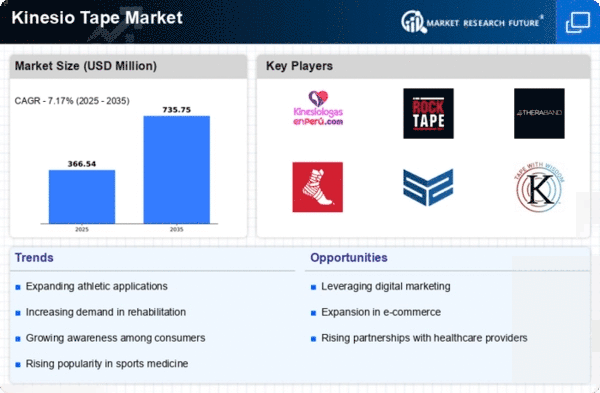
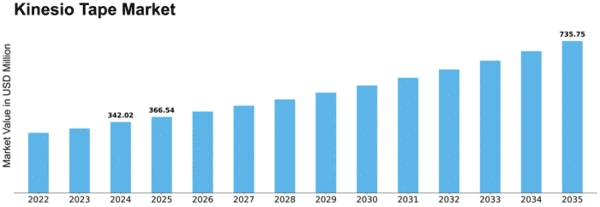
As per MRFR analysis, the Kinesio Tape Market Size was estimated at 342.02 USD Million in 2024. The Kinesio Tape industry is projected to grow from 370.47 USD Million in 2025 to 735.75 USD Million by 2035, exhibiting a compound annual growth rate (CAGR) of 7.17% during the forecast period 2025 - 2035.

Key Market Trends & Highlights

The Kinesio Tape Market is experiencing robust growth driven by diverse applications and increasing consumer awareness.

  • The market is witnessing increased adoption in sports medicine, particularly in North America, which remains the largest market. Product innovation is a key trend, with manufacturers focusing on enhancing the effectiveness and usability of kinesiology tape. In Asia-Pacific, the market is rapidly expanding, driven by rising popularity among fitness enthusiasts seeking non-pharmaceutical pain management solutions. Growing awareness of kinesiology taping benefits and the expansion of rehabilitation services are significant drivers propelling market growth.

Market Size & Forecast

2024 Market Size 342.02 (USD Million)
2035 Market Size 735.75 (USD Million)
CAGR (2025 - 2035) 7.17%
Largest Regional Market Share in 2024 North America

Major Players

<a title="Kinesio" href="https://kinesiotape.com/" target="_blank" rel="noopener">Kinesio</a> (JP), RockTape (US), TheraBand (US), Mueller Sports Medicine (US), SpiderTech (CA), Kinesiology Tape (US), BodyHelix (US), StrengthTape (US), PhysioTape (DE)

Market Trends

The Kinesio Tape Market is currently experiencing a notable evolution, driven by increasing awareness of its therapeutic benefits among athletes and the general population. This market appears to be expanding as more individuals seek non-invasive methods for pain relief and injury prevention. The growing acceptance of Kinesio tape in various sports disciplines suggests a shift towards integrating such products into regular training and rehabilitation routines. Furthermore, the rise in fitness consciousness and the emphasis on holistic health approaches may contribute to the market's growth, as consumers become more inclined to explore alternative therapies that complement traditional medical practices. In addition, the Kinesio Tape Market seems to be influenced by advancements in product technology and design. Manufacturers are likely focusing on enhancing the quality and effectiveness of their offerings, which may include the development of hypoallergenic and water-resistant tapes. This innovation could cater to a broader audience, including those with sensitive skin or those who engage in water sports. As the market continues to evolve, it is essential to monitor consumer preferences and emerging trends that may shape the future landscape of Kinesio tape usage.

Increased Adoption in Sports Medicine

The Kinesio Tape Market is witnessing a surge in adoption within sports medicine, as practitioners increasingly recognize its benefits for injury management and recovery. This trend indicates a growing reliance on Kinesio tape as a supportive tool for athletes, enhancing performance while minimizing the risk of further injuries.

Focus on Product Innovation

Innovation appears to be a driving force in the Kinesio Tape Market, with manufacturers investing in research and development to create advanced products. This focus on innovation may lead to the introduction of new materials and designs that enhance usability and effectiveness, appealing to a wider consumer base.

Rising Popularity Among General Consumers

The Kinesio Tape Market is not limited to professional athletes; it is also gaining traction among general consumers. This trend suggests that more individuals are seeking Kinesio tape for everyday use, whether for exercise, rehabilitation, or general wellness, reflecting a broader acceptance of alternative health solutions.

Kinesio Tape Market Market Drivers

Expansion of E-commerce Platforms

The expansion of e-commerce platforms is transforming the Kinesio Tape Market by providing consumers with easier access to a variety of products. Online retailing has gained traction, allowing customers to purchase Kinesio Tape from the comfort of their homes. This shift towards online shopping is particularly appealing to younger demographics who prefer the convenience of digital transactions. Market analysis suggests that e-commerce sales of Kinesio Tape are projected to increase significantly, driven by the growing trend of online health and wellness shopping. As more consumers turn to e-commerce for their Kinesio Tape needs, the market is likely to experience accelerated growth, reflecting the changing purchasing behaviors of consumers.

Rising Demand in Rehabilitation Centers

The rising demand for Kinesio Tape in rehabilitation centers is a crucial driver for the Kinesio Tape Market. Rehabilitation facilities are increasingly utilizing Kinesio Tape as part of their treatment protocols for patients recovering from injuries or surgeries. The tape's ability to provide support while allowing for a full range of motion makes it an attractive option for rehabilitation professionals. Industry expert's indicate that the rehabilitation segment is expected to witness substantial growth, as more centers recognize the benefits of Kinesio Tape in enhancing recovery processes. This trend is likely to contribute to the overall expansion of the Kinesio Tape Market, as rehabilitation centers become key consumers of this innovative product.

Integration in Physical Therapy Practices

The integration of Kinesio Tape into physical therapy practices serves as a significant driver for the Kinesio Tape Market. Physical therapists are increasingly incorporating Kinesio Tape into their treatment regimens, recognizing its potential to enhance recovery and improve patient outcomes. This trend is supported by various studies that suggest Kinesio Tape can aid in reducing pain and swelling, thereby facilitating a quicker return to normal activities. As physical therapy practices continue to adopt Kinesio Tape, the demand for this product is likely to increase. The market data indicates that the physical therapy segment is expected to account for a substantial share of the Kinesio Tape Market, highlighting the importance of this driver in shaping market dynamics.

Growing Awareness of Kinesio Tape Benefits

The increasing awareness regarding the benefits of Kinesio Tape is a notable driver in the Kinesio Tape Market. Healthcare professionals, athletes, and fitness enthusiasts are becoming more informed about the advantages of using Kinesio Tape for injury prevention and rehabilitation. This heightened awareness is likely to lead to a surge in demand, as individuals seek effective solutions for pain management and muscle support. Reports indicate that the market for Kinesio Tape is projected to grow at a compound annual growth rate of approximately 5.5% over the next few years, reflecting the rising interest in this therapeutic tool. As more individuals recognize the efficacy of Kinesio Tape, the market is expected to expand, further solidifying its position within the broader healthcare and sports sectors.

Increased Participation in Sports Activities

The increased participation in sports activities is a driving force behind the Kinesio Tape Market. As more individuals engage in sports, the likelihood of injuries rises, leading to a greater demand for effective injury management solutions. Kinesio Tape is often utilized by athletes to prevent injuries and support recovery, making it a popular choice among sports enthusiasts. Market projections suggest that the sports segment will continue to grow, fueled by the rising number of participants in various athletic activities. This trend not only enhances the visibility of Kinesio Tape but also solidifies its role as an essential tool for athletes, thereby propelling the overall growth of the Kinesio Tape Market.


Market Segment Insights

By Application: Sports Medicine (Largest) vs. Rehabilitation (Fastest-Growing)

<p>The The market is primarily segmented into Sports Medicine, Rehabilitation, Pain Management, and Preventive Care. is primarily segmented into Sports Medicine, Rehabilitation, Pain Management, and Preventive Care. Among these, Sports Medicine holds the largest share, reflecting the widespread adoption of Kinesio tape by athletes for performance enhancement and injury prevention. Rehabilitation follows closely, showing significant contributions to the market as healthcare professionals increasingly incorporate Kinesio tape in recovery protocols. Pain Management and Preventive Care, while essential, occupy relatively smaller market shares as their applications remain more niche in comparison to their larger counterparts. The growth trends within the Kinesio Tape Market are promising, particularly in the Rehabilitation segment, which is recognized as the fastest-growing area. This rapid expansion is largely attributed to increasing awareness regarding the benefits of Kinesio taping in physical therapy. Additionally, rising sports participation and heightened focus on injury prevention in both amateur and professional sports contribute to the sustained demand for Kinesio tape in Sports Medicine. The market is further driven by innovative product developments and endorsements from sports professionals, bolstering consumer confidence and acceptance of Kinesio taping techniques.</p>

<p>Sports Medicine: Dominant vs. Rehabilitation: Emerging</p>

<p>Sports Medicine stands as the dominant application within the Kinesio Tape Market, leveraging its significant visibility in athletic circles and proven efficacy in enhancing athletic performance and supporting recovery. Athletes utilize Kinesio tape to improve muscle stability and reduce discomfort, which has been a key driver in its popularity. On the other hand, the Rehabilitation segment is emerging rapidly as healthcare providers embrace Kinesio taping as an adjunct to traditional therapies. This shift is fueled by clinical evidence supporting its effectiveness in aiding recovery post-injury. As practitioners increasingly recognize its benefits in reducing pain and improving functional outcomes, the Rehabilitation segment is set to gain further traction, representing a vital area of growth for the Kinesio Tape Market.</p>

By End Use: Hospitals (Largest) vs. Fitness Centers (Fastest-Growing)

<p>In the The distribution of end-use segments shows that hospitals represent the largest share., the distribution of end-use segments shows that hospitals represent the largest share due to their extensive use of kinesiology taping in rehabilitation and physical therapy applications. Clinics also hold a significant market share as they adopt kinesio tape for their diverse patient needs, while home care settings are increasingly utilizing these products for self-management of pain and injuries. Fitness centers are witnessing a growing adoption of kinesio tape, catering to athletes and fitness enthusiasts seeking enhanced performance and recovery support. The growth trends in the Kinesio Tape Market are largely driven by the increasing awareness of the benefits of kinesiology taping among health professionals and consumers alike. The hospital segment benefits from strong recommendations by medical personnel, contributing to steady demand. Meanwhile, the fitness centers segment is projected to grow at a rapid pace due to the rising popularity of sports and fitness activities, where kinesio tape is often employed to prevent injuries and support athletic performance, making it an essential tool for trainers and athletes alike.</p>

<p>Hospitals (Dominant) vs. Fitness Centers (Emerging)</p>

<p>Hospitals remain the dominant end-use segment in the Kinesio Tape Market, primarily utilized in rehabilitation programs for patients recovering from injuries or surgeries. The professional expertise present in hospitals ensures that kinesiology tape is applied correctly, maximizing its benefits. Clinics represent a similar yet slightly smaller segment, where a variety of therapies employ kinesio tape for conditions such as sports injuries, sprains, and inflammation. On the other hand, fitness centers are emerging as a significant segment, increasingly adopting kinesio tape to enhance athletic performance and recovery among gym-goers and athletes. The growing trend towards preventive care in fitness is paving the way for kinesio tape to become a staple tool in these settings, appealing to a broader audience seeking fitness and wellness solutions.</p>

By Material Type: Cotton (Largest) vs. Synthetic (Fastest-Growing)

In the Kinesio Tape Market, the material type segmentation reveals a clear distinction in market share. Cotton-based kinesio tapes dominate the market due to their natural fibers that ensure excellent breathability and comfort during physical activity. Synthetic materials, while currently holding a smaller share, demonstrate rapid adoption, particularly among athletes seeking enhanced durability and moisture-wicking properties. This duality indicates varied consumer preferences and applications in kinesiology taping. As the market evolves, growth trends showcase an increasing shift towards synthetic kinesio tapes, driven by advancements in material technology and a growing preference among sports professionals. Additionally, the rising awareness of sports injuries and a focus on rehabilitation are fueling the demand for both cotton and synthetic tapes. Consumers are looking for tapes that offer the right combination of support and flexibility, propelling the growth of these materials further into mainstream sports medicine practices.

Cotton (Dominant) vs. Synthetic (Emerging)

Cotton kinesio tapes are recognized for their comfort and breathability, which makes them the preferred choice for everyday users, including amateur athletes and individuals undergoing rehabilitation. Their hypoallergenic properties and adherence capabilities contribute to their dominant market position. In contrast, synthetic kinesio tapes are emerging as a popular alternative, particularly for those engaged in high-intensity sports. These tapes are designed to provide superior elasticity and moisture management, catering to the demands of competitive athletes. As consumers seek materials that offer greater durability and performance, synthetic options are gaining traction, indicating a shift towards more innovative solutions in the kinesio tape market.

By Distribution Channel: Online Retail (Largest) vs. Pharmacy (Fastest-Growing)

<p>In the The distribution of market share among various channels shows a clear dominance of online retail., the distribution of market share among various channels shows a clear dominance of online retail. This channel accounts for a significant portion of sales, driven by the increasing preference for convenience and the growing popularity of e-commerce platforms. Following online retail, pharmacies are emerging as key players, appealing to consumers seeking immediate access and professional recommendations. <a href="https://www.marketresearchfuture.com/reports/supermarket-market-28474" target="_blank" title="supermarket">Supermarkets</a> and specialty stores, while important, capture a smaller share of the overall market, primarily serving localized consumer needs.</p>

<p>Online Retail (Dominant) vs. Pharmacy (Emerging)</p>

<p>Online retail is characterized by its extensive reach and accessibility, making it the dominant distribution channel in the Kinesio Tape market. Consumers appreciate the convenience of online shopping, coupled with the ability to compare products and read reviews. This channel is supported by robust logistics and delivery systems. On the other hand, pharmacies are considered the emerging channel, increasingly recognized for their role in providing healthcare solutions. They cater to health-conscious consumers looking for immediate purchases and professional advice, thus gaining traction as trusted sources for Kinesio Tape products.</p>

By User Type: Athletes (Largest) vs. Healthcare Professionals (Fastest-Growing)

<p>In the The user type segment is predominantly comprised of Athletes., the user type segment is predominantly comprised of Athletes, who contribute significantly to the sales and usage of kinesiology tape. This group values performance enhancement and injury prevention, leading to a strong market share. In contrast, Healthcare Professionals, including physical therapists and chiropractors, are witnessing a rapid increase in adoption, driven by a growing recognition of the tape's therapeutic benefits in patient recovery and rehabilitation.</p>

<p>Athletes: Dominant vs. Healthcare Professionals: Emerging</p>

<p>Athletes represent the dominant user group in the Kinesio Tape Market, leveraging the tape for its efficacy in enhancing performance and preventing injuries during training and competition. This segment includes professional athletes and fitness enthusiasts who rely on kinesiology tape to support muscular and joint function. On the other hand, Healthcare Professionals are an emerging user group, increasingly integrating kinesiology tape into their treatment regimens. As they seek innovative solutions for patient care, this segment is rapidly expanding, highlighting the tape's role in rehabilitation and pain management. Overall, the interplay between these segments indicates a healthy demand landscape, with athletes opting for performance benefits and professionals embracing therapeutic applications.</p>

Get more detailed insights about Kinesio Tape Market Research Report- Middle East & Africa Forecast To 2035

Regional Insights

North America : Market Leader in Kinesio Tape

North America continues to lead the Kinesio Tape market, holding a significant share of 171.0 million in 2025. The growth is driven by increasing awareness of sports injuries and the rising popularity of kinesiology taping among athletes and physiotherapists. Regulatory support for sports health initiatives further fuels demand, making it a robust market for Kinesio Tape products. The United States and Canada are the primary contributors to this market, with key players like RockTape, TheraBand, and Mueller Sports Medicine dominating the landscape. The competitive environment is characterized by innovation and a focus on quality, with companies investing in research and development to enhance product efficacy. This competitive edge ensures that North America remains a pivotal region for Kinesio Tape.

Europe : Emerging Market with Growth Potential

Europe's Kinesio Tape market is valued at 85.0 million in 2025, showcasing a growing interest in sports medicine and rehabilitation. Factors such as an aging population and increased participation in sports are driving demand. Regulatory frameworks in various countries are also evolving to support the use of kinesiology tape in therapeutic settings, enhancing market growth prospects. Leading countries like Germany, the UK, and France are at the forefront of this market, with companies such as PhysioTape and other local brands gaining traction. The competitive landscape is marked by a mix of established players and new entrants, all vying for market share. The focus on quality and compliance with EU regulations is crucial for success in this region.

Asia-Pacific : Rapid Growth in Sports Medicine

The Asia-Pacific Kinesio Tape market, valued at 70.0 million in 2025, is experiencing rapid growth driven by rising sports participation and awareness of injury prevention. Countries like Japan, Australia, and China are leading this trend, supported by government initiatives promoting sports health and wellness. The increasing number of sports events and fitness activities is further propelling demand for kinesiology tape products. The competitive landscape is evolving, with both local and international brands like Kinesio and BodyHelix making significant inroads. The market is characterized by a growing emphasis on product innovation and quality, as consumers become more discerning. This dynamic environment positions Asia-Pacific as a key player in The Kinesio Tape.

Middle East and Africa : Niche Market with Growth Opportunities

The Middle East and Africa Kinesio Tape market, valued at 16.02 million in 2025, is still in its nascent stages but shows promising growth potential. Factors such as increasing awareness of sports injuries and a growing fitness culture are driving demand. Regulatory bodies are beginning to recognize the importance of kinesiology tape in rehabilitation, which could catalyze market expansion in the coming years. Countries like South Africa and the UAE are emerging as key markets, with local players and international brands starting to establish a presence. The competitive landscape is gradually evolving, with a focus on educating consumers about the benefits of kinesiology tape. This region presents unique opportunities for growth as awareness and acceptance of sports medicine increase.

Key Players and Competitive Insights

The Kinesio Tape Market exhibits a dynamic competitive landscape characterized by innovation and strategic positioning among key players. Companies such as Kinesio (JP), RockTape (US), and TheraBand (US) are at the forefront, leveraging their brand recognition and product efficacy to capture market share. Kinesio (JP) focuses on continuous product innovation, enhancing the therapeutic benefits of its tapes, while RockTape (US) emphasizes a strong community engagement strategy, fostering brand loyalty through educational initiatives. TheraBand (US) adopts a multi-channel distribution approach, ensuring accessibility across various healthcare settings, which collectively shapes a competitive environment that is both collaborative and competitive.The market structure appears moderately fragmented, with several players vying for dominance. Key business tactics such as localizing manufacturing and optimizing supply chains are prevalent among these companies. For instance, RockTape (US) has recently expanded its manufacturing capabilities within the US, aiming to reduce lead times and enhance product availability. This strategic move not only strengthens its market position but also reflects a broader trend of companies seeking to mitigate supply chain vulnerabilities.
In November Kinesio (JP) launched a new line of eco-friendly kinesiology tapes, aligning with the growing consumer demand for sustainable products. This initiative not only enhances Kinesio's product portfolio but also positions the company as a leader in sustainability within the kinesiology tape segment. The strategic importance of this launch lies in its potential to attract environmentally conscious consumers, thereby expanding Kinesio's market reach.
In October RockTape (US) announced a partnership with a leading sports rehabilitation clinic to develop specialized kinesiology tape for athletes recovering from injuries. This collaboration is significant as it allows RockTape to leverage clinical insights to enhance product efficacy, thereby reinforcing its reputation as a trusted brand among professional athletes. Such partnerships are indicative of a trend where companies are increasingly aligning with healthcare professionals to validate their products.
In September TheraBand (US) introduced a digital platform that integrates kinesiology tape application techniques with virtual training sessions. This innovative approach not only enhances user experience but also positions TheraBand at the intersection of technology and healthcare. The strategic importance of this digital transformation lies in its potential to engage a broader audience, particularly among tech-savvy consumers seeking comprehensive solutions for injury management.
As of December current competitive trends in the Kinesio Tape Market are increasingly defined by digitalization, sustainability, and the integration of advanced technologies. Strategic alliances are shaping the landscape, enabling companies to pool resources and expertise. Looking ahead, competitive differentiation is likely to evolve from traditional price-based competition to a focus on innovation, technology, and supply chain reliability. This shift underscores the importance of adaptability in a rapidly changing market environment.

Key Companies in the Kinesio Tape Market include

Industry Developments

July 2017 - The Proudfoot Company, a trailblazer in clamor control items for concrete-based applications arranged in Connecticut, the U.S., was obtained by Sound Seal for entering new verticals of the acoustic protection area.

November 2019 - The assembling office of Superglass situated in Stirling, Scotland, was extended for expanding the yearly creation limit of glass fleece protection up to 60 KT. For this extension, the organization contributed about $48 million to help the interest for protection items across Europe.

Report Overview:

The report offers a complete assessment of the MEA kinesio tape market outlook. It does as such by means of inside and out subjective bits of knowledge, authentic information, and certain projections about market size. The projections highlighted in the report have been inferred utilizing demonstrated research approaches and suppositions. Thus, the examination report fills in as a storehouse of investigation and data for each feature of the market, including but not restricted to Regional business sectors, innovation, types, and applications.

Key Segments: By Type

    • Precut Strips
    • Single Rolls
    • Bulk Rolls
    • Others

By Application

    • Rehabilitation
    • Alignment
    • Pain Management
    • Others

By Distribution Channels

    • Franchised Store
    • Supermarket
    • Online Shop
    • Sport Team
    • Clinical

By End Users

    • Hospitals
    • Rehab Centers
    • Professional Athletes
    • Others

Future Outlook

Kinesio Tape Market Future Outlook

The Kinesio Tape Market is projected to grow at a 7.17% CAGR from 2025 to 2035, driven by increasing sports participation, rising awareness of therapeutic benefits, and advancements in product technology.

New opportunities lie in:

  • <p>Expansion into emerging markets through targeted marketing campaigns. Development of specialized kinesiology tapes for specific sports injuries. Partnerships with healthcare providers for integrated rehabilitation solutions.</p>

By 2035, the Kinesio Tape Market is expected to achieve substantial growth and innovation.

Market Segmentation

Kinesio Tape Market End Use Outlook

  • Athletes
  • Physical Therapists
  • Chiropractors
  • Fitness Enthusiasts

Kinesio Tape Market Application Outlook

  • Sports
  • Rehabilitation
  • Pain Management
  • Preventive Care

Kinesio Tape Market Material Type Outlook

  • Cotton
  • Synthetic
  • Elastic
  • Latex

Kinesio Tape Market Distribution Channel Outlook

  • Online Retail
  • Pharmacies
  • Sports Stores
  • Health and Wellness Stores

Report Scope

MARKET SIZE 2024 342.02(USD Million)
MARKET SIZE 2025 370.47(USD Million)
MARKET SIZE 2035 735.75(USD Million)
COMPOUND ANNUAL GROWTH RATE (CAGR) 7.17% (2025 - 2035)
REPORT COVERAGE Revenue Forecast, Competitive Landscape, Growth Factors, and Trends
BASE YEAR 2024
Market Forecast Period 2025 - 2035
Historical Data 2019 - 2024
Market Forecast Units USD Million
Key Companies Profiled Kinesio (JP), RockTape (US), TheraBand (US), Mueller Sports Medicine (US), SpiderTech (CA), Kinesiology Tape (US), BodyHelix (US), StrengthTape (US), PhysioTape (DE)
Segments Covered Application, End Use, Material Type, Distribution Channel
Key Market Opportunities Growing demand for Kinesio Tape in rehabilitation and sports performance enhancement presents significant market opportunities.
Key Market Dynamics Rising consumer awareness and demand for therapeutic benefits drive innovation and competition in the Kinesio Tape market.
Countries Covered North America, Europe, APAC, South America, MEA

FAQs

What is the current market valuation of the Kinesio Tape Market?

<p>The Kinesio Tape Market was valued at 342.02 USD Million in 2024.</p>

What is the projected market size for the Kinesio Tape Market by 2035?

<p>The market is expected to reach 735.75 USD Million by 2035.</p>

What is the expected CAGR for the Kinesio Tape Market during the forecast period 2025 - 2035?

<p>The expected CAGR for the Kinesio Tape Market is 7.17% during the forecast period.</p>

Which application segments are driving the Kinesio Tape Market?

<p>Key application segments include Pain Management, Rehabilitation, Sports Medicine, and Preventive Care.</p>

What are the projected valuations for the Pain Management segment by 2035?

<p>The Pain Management segment is projected to reach 200.0 USD Million by 2035.</p>

Which end-use segments are significant in the Kinesio Tape Market?

Significant end-use segments include Hospitals, Clinics, Home Care, and Fitness Centers.

What is the expected valuation for the Fitness Centers segment by 2035?

The Fitness Centers segment is expected to reach 305.75 USD Million by 2035.

What materials are commonly used in Kinesio Tape production?

Common materials include Cotton, Synthetic, Elastic, and Non-Elastic types.

What is the projected valuation for the Synthetic material segment by 2035?

The Synthetic material segment is projected to reach 200.0 USD Million by 2035.

Who are the key players in the Kinesio Tape Market?

Key players include Kinesio, RockTape, TheraBand, Mueller Sports Medicine, and KT Tape.

  1. SECTION I: EXECUTIVE SUMMARY AND KEY HIGHLIGHTS
    1. | 1.1 EXECUTIVE SUMMARY
    2. | | 1.1.1 Market Overview
    3. | | 1.1.2 Key Findings
    4. | | 1.1.3 Market Segmentation
    5. | | 1.1.4 Competitive Landscape
    6. | | 1.1.5 Challenges and Opportunities
    7. | | 1.1.6 Future Outlook
  2. SECTION II: SCOPING, METHODOLOGY AND MARKET STRUCTURE
    1. | 2.1 MARKET INTRODUCTION
    2. | | 2.1.1 Definition
    3. | | 2.1.2 Scope of the study
    4. | | | 2.1.2.1 Research Objective
    5. | | | 2.1.2.2 Assumption
    6. | | | 2.1.2.3 Limitations
    7. | 2.2 RESEARCH METHODOLOGY
    8. | | 2.2.1 Overview
    9. | | 2.2.2 Data Mining
    10. | | 2.2.3 Secondary Research
    11. | | 2.2.4 Primary Research
    12. | | | 2.2.4.1 Primary Interviews and Information Gathering Process
    13. | | | 2.2.4.2 Breakdown of Primary Respondents
    14. | | 2.2.5 Forecasting Model
    15. | | 2.2.6 Market Size Estimation
    16. | | | 2.2.6.1 Bottom-Up Approach
    17. | | | 2.2.6.2 Top-Down Approach
    18. | | 2.2.7 Data Triangulation
    19. | | 2.2.8 Validation
  3. SECTION III: QUALITATIVE ANALYSIS
    1. | 3.1 MARKET DYNAMICS
    2. | | 3.1.1 Overview
    3. | | 3.1.2 Drivers
    4. | | 3.1.3 Restraints
    5. | | 3.1.4 Opportunities
    6. | 3.2 MARKET FACTOR ANALYSIS
    7. | | 3.2.1 Value chain Analysis
    8. | | 3.2.2 Porter's Five Forces Analysis
    9. | | | 3.2.2.1 Bargaining Power of Suppliers
    10. | | | 3.2.2.2 Bargaining Power of Buyers
    11. | | | 3.2.2.3 Threat of New Entrants
    12. | | | 3.2.2.4 Threat of Substitutes
    13. | | | 3.2.2.5 Intensity of Rivalry
    14. | | 3.2.3 COVID-19 Impact Analysis
    15. | | | 3.2.3.1 Market Impact Analysis
    16. | | | 3.2.3.2 Regional Impact
    17. | | | 3.2.3.3 Opportunity and Threat Analysis
  4. SECTION IV: QUANTITATIVE ANALYSIS
    1. | 4.1 Healthcare, BY Application (USD Million)
    2. | | 4.1.1 Sports Medicine
    3. | | 4.1.2 Rehabilitation
    4. | | 4.1.3 Pain Management
    5. | | 4.1.4 Preventive Care
    6. | 4.2 Healthcare, BY End Use (USD Million)
    7. | | 4.2.1 Hospitals
    8. | | 4.2.2 Clinics
    9. | | 4.2.3 Home Care
    10. | | 4.2.4 Fitness Centers
    11. | 4.3 Healthcare, BY Material Type (USD Million)
    12. | | 4.3.1 Cotton
    13. | | 4.3.2 Synthetic
    14. | | 4.3.3 Elastic
    15. | | 4.3.4 Non-Elastic
    16. | 4.4 Healthcare, BY Distribution Channel (USD Million)
    17. | | 4.4.1 Online Retail
    18. | | 4.4.2 Pharmacy
    19. | | 4.4.3 Supermarket
    20. | | 4.4.4 Specialty Stores
    21. | 4.5 Healthcare, BY User Type (USD Million)
    22. | | 4.5.1 Athletes
    23. | | 4.5.2 Physically Active Individuals
    24. | | 4.5.3 Patients
    25. | | 4.5.4 Healthcare Professionals
    26. | 4.6 Healthcare, BY Region (USD Million)
    27. | | 4.6.1 North America
    28. | | | 4.6.1.1 US
    29. | | | 4.6.1.2 Canada
    30. | | 4.6.2 Europe
    31. | | | 4.6.2.1 Germany
    32. | | | 4.6.2.2 UK
    33. | | | 4.6.2.3 France
    34. | | | 4.6.2.4 Russia
    35. | | | 4.6.2.5 Italy
    36. | | | 4.6.2.6 Spain
    37. | | | 4.6.2.7 Rest of Europe
    38. | | 4.6.3 APAC
    39. | | | 4.6.3.1 China
    40. | | | 4.6.3.2 India
    41. | | | 4.6.3.3 Japan
    42. | | | 4.6.3.4 South Korea
    43. | | | 4.6.3.5 Malaysia
    44. | | | 4.6.3.6 Thailand
    45. | | | 4.6.3.7 Indonesia
    46. | | | 4.6.3.8 Rest of APAC
    47. | | 4.6.4 South America
    48. | | | 4.6.4.1 Brazil
    49. | | | 4.6.4.2 Mexico
    50. | | | 4.6.4.3 Argentina
    51. | | | 4.6.4.4 Rest of South America
    52. | | 4.6.5 MEA
    53. | | | 4.6.5.1 GCC Countries
    54. | | | 4.6.5.2 South Africa
    55. | | | 4.6.5.3 Rest of MEA
  5. SECTION V: COMPETITIVE ANALYSIS
    1. | 5.1 Competitive Landscape
    2. | | 5.1.1 Overview
    3. | | 5.1.2 Competitive Analysis
    4. | | 5.1.3 Market share Analysis
    5. | | 5.1.4 Major Growth Strategy in the Healthcare
    6. | | 5.1.5 Competitive Benchmarking
    7. | | 5.1.6 Leading Players in Terms of Number of Developments in the Healthcare
    8. | | 5.1.7 Key developments and growth strategies
    9. | | | 5.1.7.1 New Product Launch/Service Deployment
    10. | | | 5.1.7.2 Merger & Acquisitions
    11. | | | 5.1.7.3 Joint Ventures
    12. | | 5.1.8 Major Players Financial Matrix
    13. | | | 5.1.8.1 Sales and Operating Income
    14. | | | 5.1.8.2 Major Players R&D Expenditure. 2023
    15. | 5.2 Company Profiles
    16. | | 5.2.1 Kinesio (JP)
    17. | | | 5.2.1.1 Financial Overview
    18. | | | 5.2.1.2 Products Offered
    19. | | | 5.2.1.3 Key Developments
    20. | | | 5.2.1.4 SWOT Analysis
    21. | | | 5.2.1.5 Key Strategies
    22. | | 5.2.2 RockTape (US)
    23. | | | 5.2.2.1 Financial Overview
    24. | | | 5.2.2.2 Products Offered
    25. | | | 5.2.2.3 Key Developments
    26. | | | 5.2.2.4 SWOT Analysis
    27. | | | 5.2.2.5 Key Strategies
    28. | | 5.2.3 TheraBand (US)
    29. | | | 5.2.3.1 Financial Overview
    30. | | | 5.2.3.2 Products Offered
    31. | | | 5.2.3.3 Key Developments
    32. | | | 5.2.3.4 SWOT Analysis
    33. | | | 5.2.3.5 Key Strategies
    34. | | 5.2.4 Mueller Sports Medicine (US)
    35. | | | 5.2.4.1 Financial Overview
    36. | | | 5.2.4.2 Products Offered
    37. | | | 5.2.4.3 Key Developments
    38. | | | 5.2.4.4 SWOT Analysis
    39. | | | 5.2.4.5 Key Strategies
    40. | | 5.2.5 KT Tape (US)
    41. | | | 5.2.5.1 Financial Overview
    42. | | | 5.2.5.2 Products Offered
    43. | | | 5.2.5.3 Key Developments
    44. | | | 5.2.5.4 SWOT Analysis
    45. | | | 5.2.5.5 Key Strategies
    46. | | 5.2.6 Dynatape (US)
    47. | | | 5.2.6.1 Financial Overview
    48. | | | 5.2.6.2 Products Offered
    49. | | | 5.2.6.3 Key Developments
    50. | | | 5.2.6.4 SWOT Analysis
    51. | | | 5.2.6.5 Key Strategies
    52. | | 5.2.7 SpiderTech (CA)
    53. | | | 5.2.7.1 Financial Overview
    54. | | | 5.2.7.2 Products Offered
    55. | | | 5.2.7.3 Key Developments
    56. | | | 5.2.7.4 SWOT Analysis
    57. | | | 5.2.7.5 Key Strategies
    58. | | 5.2.8 Bamboo (US)
    59. | | | 5.2.8.1 Financial Overview
    60. | | | 5.2.8.2 Products Offered
    61. | | | 5.2.8.3 Key Developments
    62. | | | 5.2.8.4 SWOT Analysis
    63. | | | 5.2.8.5 Key Strategies
    64. | | 5.2.9 PhysioTape (DE)
    65. | | | 5.2.9.1 Financial Overview
    66. | | | 5.2.9.2 Products Offered
    67. | | | 5.2.9.3 Key Developments
    68. | | | 5.2.9.4 SWOT Analysis
    69. | | | 5.2.9.5 Key Strategies
    70. | 5.3 Appendix
    71. | | 5.3.1 References
    72. | | 5.3.2 Related Reports
  6. LIST OF FIGURES
    1. | 6.1 MARKET SYNOPSIS
    2. | 6.2 NORTH AMERICA MARKET ANALYSIS
    3. | 6.3 US MARKET ANALYSIS BY APPLICATION
    4. | 6.4 US MARKET ANALYSIS BY END USE
    5. | 6.5 US MARKET ANALYSIS BY MATERIAL TYPE
    6. | 6.6 US MARKET ANALYSIS BY DISTRIBUTION CHANNEL
    7. | 6.7 US MARKET ANALYSIS BY USER TYPE
    8. | 6.8 CANADA MARKET ANALYSIS BY APPLICATION
    9. | 6.9 CANADA MARKET ANALYSIS BY END USE
    10. | 6.10 CANADA MARKET ANALYSIS BY MATERIAL TYPE
    11. | 6.11 CANADA MARKET ANALYSIS BY DISTRIBUTION CHANNEL
    12. | 6.12 CANADA MARKET ANALYSIS BY USER TYPE
    13. | 6.13 EUROPE MARKET ANALYSIS
    14. | 6.14 GERMANY MARKET ANALYSIS BY APPLICATION
    15. | 6.15 GERMANY MARKET ANALYSIS BY END USE
    16. | 6.16 GERMANY MARKET ANALYSIS BY MATERIAL TYPE
    17. | 6.17 GERMANY MARKET ANALYSIS BY DISTRIBUTION CHANNEL
    18. | 6.18 GERMANY MARKET ANALYSIS BY USER TYPE
    19. | 6.19 UK MARKET ANALYSIS BY APPLICATION
    20. | 6.20 UK MARKET ANALYSIS BY END USE
    21. | 6.21 UK MARKET ANALYSIS BY MATERIAL TYPE
    22. | 6.22 UK MARKET ANALYSIS BY DISTRIBUTION CHANNEL
    23. | 6.23 UK MARKET ANALYSIS BY USER TYPE
    24. | 6.24 FRANCE MARKET ANALYSIS BY APPLICATION
    25. | 6.25 FRANCE MARKET ANALYSIS BY END USE
    26. | 6.26 FRANCE MARKET ANALYSIS BY MATERIAL TYPE
    27. | 6.27 FRANCE MARKET ANALYSIS BY DISTRIBUTION CHANNEL
    28. | 6.28 FRANCE MARKET ANALYSIS BY USER TYPE
    29. | 6.29 RUSSIA MARKET ANALYSIS BY APPLICATION
    30. | 6.30 RUSSIA MARKET ANALYSIS BY END USE
    31. | 6.31 RUSSIA MARKET ANALYSIS BY MATERIAL TYPE
    32. | 6.32 RUSSIA MARKET ANALYSIS BY DISTRIBUTION CHANNEL
    33. | 6.33 RUSSIA MARKET ANALYSIS BY USER TYPE
    34. | 6.34 ITALY MARKET ANALYSIS BY APPLICATION
    35. | 6.35 ITALY MARKET ANALYSIS BY END USE
    36. | 6.36 ITALY MARKET ANALYSIS BY MATERIAL TYPE
    37. | 6.37 ITALY MARKET ANALYSIS BY DISTRIBUTION CHANNEL
    38. | 6.38 ITALY MARKET ANALYSIS BY USER TYPE
    39. | 6.39 SPAIN MARKET ANALYSIS BY APPLICATION
    40. | 6.40 SPAIN MARKET ANALYSIS BY END USE
    41. | 6.41 SPAIN MARKET ANALYSIS BY MATERIAL TYPE
    42. | 6.42 SPAIN MARKET ANALYSIS BY DISTRIBUTION CHANNEL
    43. | 6.43 SPAIN MARKET ANALYSIS BY USER TYPE
    44. | 6.44 REST OF EUROPE MARKET ANALYSIS BY APPLICATION
    45. | 6.45 REST OF EUROPE MARKET ANALYSIS BY END USE
    46. | 6.46 REST OF EUROPE MARKET ANALYSIS BY MATERIAL TYPE
    47. | 6.47 REST OF EUROPE MARKET ANALYSIS BY DISTRIBUTION CHANNEL
    48. | 6.48 REST OF EUROPE MARKET ANALYSIS BY USER TYPE
    49. | 6.49 APAC MARKET ANALYSIS
    50. | 6.50 CHINA MARKET ANALYSIS BY APPLICATION
    51. | 6.51 CHINA MARKET ANALYSIS BY END USE
    52. | 6.52 CHINA MARKET ANALYSIS BY MATERIAL TYPE
    53. | 6.53 CHINA MARKET ANALYSIS BY DISTRIBUTION CHANNEL
    54. | 6.54 CHINA MARKET ANALYSIS BY USER TYPE
    55. | 6.55 INDIA MARKET ANALYSIS BY APPLICATION
    56. | 6.56 INDIA MARKET ANALYSIS BY END USE
    57. | 6.57 INDIA MARKET ANALYSIS BY MATERIAL TYPE
    58. | 6.58 INDIA MARKET ANALYSIS BY DISTRIBUTION CHANNEL
    59. | 6.59 INDIA MARKET ANALYSIS BY USER TYPE
    60. | 6.60 JAPAN MARKET ANALYSIS BY APPLICATION
    61. | 6.61 JAPAN MARKET ANALYSIS BY END USE
    62. | 6.62 JAPAN MARKET ANALYSIS BY MATERIAL TYPE
    63. | 6.63 JAPAN MARKET ANALYSIS BY DISTRIBUTION CHANNEL
    64. | 6.64 JAPAN MARKET ANALYSIS BY USER TYPE
    65. | 6.65 SOUTH KOREA MARKET ANALYSIS BY APPLICATION
    66. | 6.66 SOUTH KOREA MARKET ANALYSIS BY END USE
    67. | 6.67 SOUTH KOREA MARKET ANALYSIS BY MATERIAL TYPE
    68. | 6.68 SOUTH KOREA MARKET ANALYSIS BY DISTRIBUTION CHANNEL
    69. | 6.69 SOUTH KOREA MARKET ANALYSIS BY USER TYPE
    70. | 6.70 MALAYSIA MARKET ANALYSIS BY APPLICATION
    71. | 6.71 MALAYSIA MARKET ANALYSIS BY END USE
    72. | 6.72 MALAYSIA MARKET ANALYSIS BY MATERIAL TYPE
    73. | 6.73 MALAYSIA MARKET ANALYSIS BY DISTRIBUTION CHANNEL
    74. | 6.74 MALAYSIA MARKET ANALYSIS BY USER TYPE
    75. | 6.75 THAILAND MARKET ANALYSIS BY APPLICATION
    76. | 6.76 THAILAND MARKET ANALYSIS BY END USE
    77. | 6.77 THAILAND MARKET ANALYSIS BY MATERIAL TYPE
    78. | 6.78 THAILAND MARKET ANALYSIS BY DISTRIBUTION CHANNEL
    79. | 6.79 THAILAND MARKET ANALYSIS BY USER TYPE
    80. | 6.80 INDONESIA MARKET ANALYSIS BY APPLICATION
    81. | 6.81 INDONESIA MARKET ANALYSIS BY END USE
    82. | 6.82 INDONESIA MARKET ANALYSIS BY MATERIAL TYPE
    83. | 6.83 INDONESIA MARKET ANALYSIS BY DISTRIBUTION CHANNEL
    84. | 6.84 INDONESIA MARKET ANALYSIS BY USER TYPE
    85. | 6.85 REST OF APAC MARKET ANALYSIS BY APPLICATION
    86. | 6.86 REST OF APAC MARKET ANALYSIS BY END USE
    87. | 6.87 REST OF APAC MARKET ANALYSIS BY MATERIAL TYPE
    88. | 6.88 REST OF APAC MARKET ANALYSIS BY DISTRIBUTION CHANNEL
    89. | 6.89 REST OF APAC MARKET ANALYSIS BY USER TYPE
    90. | 6.90 SOUTH AMERICA MARKET ANALYSIS
    91. | 6.91 BRAZIL MARKET ANALYSIS BY APPLICATION
    92. | 6.92 BRAZIL MARKET ANALYSIS BY END USE
    93. | 6.93 BRAZIL MARKET ANALYSIS BY MATERIAL TYPE
    94. | 6.94 BRAZIL MARKET ANALYSIS BY DISTRIBUTION CHANNEL
    95. | 6.95 BRAZIL MARKET ANALYSIS BY USER TYPE
    96. | 6.96 MEXICO MARKET ANALYSIS BY APPLICATION
    97. | 6.97 MEXICO MARKET ANALYSIS BY END USE
    98. | 6.98 MEXICO MARKET ANALYSIS BY MATERIAL TYPE
    99. | 6.99 MEXICO MARKET ANALYSIS BY DISTRIBUTION CHANNEL
    100. | 6.100 MEXICO MARKET ANALYSIS BY USER TYPE
    101. | 6.101 ARGENTINA MARKET ANALYSIS BY APPLICATION
    102. | 6.102 ARGENTINA MARKET ANALYSIS BY END USE
    103. | 6.103 ARGENTINA MARKET ANALYSIS BY MATERIAL TYPE
    104. | 6.104 ARGENTINA MARKET ANALYSIS BY DISTRIBUTION CHANNEL
    105. | 6.105 ARGENTINA MARKET ANALYSIS BY USER TYPE
    106. | 6.106 REST OF SOUTH AMERICA MARKET ANALYSIS BY APPLICATION
    107. | 6.107 REST OF SOUTH AMERICA MARKET ANALYSIS BY END USE
    108. | 6.108 REST OF SOUTH AMERICA MARKET ANALYSIS BY MATERIAL TYPE
    109. | 6.109 REST OF SOUTH AMERICA MARKET ANALYSIS BY DISTRIBUTION CHANNEL
    110. | 6.110 REST OF SOUTH AMERICA MARKET ANALYSIS BY USER TYPE
    111. | 6.111 MEA MARKET ANALYSIS
    112. | 6.112 GCC COUNTRIES MARKET ANALYSIS BY APPLICATION
    113. | 6.113 GCC COUNTRIES MARKET ANALYSIS BY END USE
    114. | 6.114 GCC COUNTRIES MARKET ANALYSIS BY MATERIAL TYPE
    115. | 6.115 GCC COUNTRIES MARKET ANALYSIS BY DISTRIBUTION CHANNEL
    116. | 6.116 GCC COUNTRIES MARKET ANALYSIS BY USER TYPE
    117. | 6.117 SOUTH AFRICA MARKET ANALYSIS BY APPLICATION
    118. | 6.118 SOUTH AFRICA MARKET ANALYSIS BY END USE
    119. | 6.119 SOUTH AFRICA MARKET ANALYSIS BY MATERIAL TYPE
    120. | 6.120 SOUTH AFRICA MARKET ANALYSIS BY DISTRIBUTION CHANNEL
    121. | 6.121 SOUTH AFRICA MARKET ANALYSIS BY USER TYPE
    122. | 6.122 REST OF MEA MARKET ANALYSIS BY APPLICATION
    123. | 6.123 REST OF MEA MARKET ANALYSIS BY END USE
    124. | 6.124 REST OF MEA MARKET ANALYSIS BY MATERIAL TYPE
    125. | 6.125 REST OF MEA MARKET ANALYSIS BY DISTRIBUTION CHANNEL
    126. | 6.126 REST OF MEA MARKET ANALYSIS BY USER TYPE
    127. | 6.127 KEY BUYING CRITERIA OF HEALTHCARE
    128. | 6.128 RESEARCH PROCESS OF MRFR
    129. | 6.129 DRO ANALYSIS OF HEALTHCARE
    130. | 6.130 DRIVERS IMPACT ANALYSIS: HEALTHCARE
    131. | 6.131 RESTRAINTS IMPACT ANALYSIS: HEALTHCARE
    132. | 6.132 SUPPLY / VALUE CHAIN: HEALTHCARE
    133. | 6.133 HEALTHCARE, BY APPLICATION, 2024 (% SHARE)
    134. | 6.134 HEALTHCARE, BY APPLICATION, 2024 TO 2035 (USD Million)
    135. | 6.135 HEALTHCARE, BY END USE, 2024 (% SHARE)
    136. | 6.136 HEALTHCARE, BY END USE, 2024 TO 2035 (USD Million)
    137. | 6.137 HEALTHCARE, BY MATERIAL TYPE, 2024 (% SHARE)
    138. | 6.138 HEALTHCARE, BY MATERIAL TYPE, 2024 TO 2035 (USD Million)
    139. | 6.139 HEALTHCARE, BY DISTRIBUTION CHANNEL, 2024 (% SHARE)
    140. | 6.140 HEALTHCARE, BY DISTRIBUTION CHANNEL, 2024 TO 2035 (USD Million)
    141. | 6.141 HEALTHCARE, BY USER TYPE, 2024 (% SHARE)
    142. | 6.142 HEALTHCARE, BY USER TYPE, 2024 TO 2035 (USD Million)
    143. | 6.143 BENCHMARKING OF MAJOR COMPETITORS
  7. LIST OF TABLES
    1. | 7.1 LIST OF ASSUMPTIONS
    2. | | 7.1.1
    3. | 7.2 North America MARKET SIZE ESTIMATES; FORECAST
    4. | | 7.2.1 BY APPLICATION, 2025-2035 (USD Million)
    5. | | 7.2.2 BY END USE, 2025-2035 (USD Million)
    6. | | 7.2.3 BY MATERIAL TYPE, 2025-2035 (USD Million)
    7. | | 7.2.4 BY DISTRIBUTION CHANNEL, 2025-2035 (USD Million)
    8. | | 7.2.5 BY USER TYPE, 2025-2035 (USD Million)
    9. | 7.3 US MARKET SIZE ESTIMATES; FORECAST
    10. | | 7.3.1 BY APPLICATION, 2025-2035 (USD Million)
    11. | | 7.3.2 BY END USE, 2025-2035 (USD Million)
    12. | | 7.3.3 BY MATERIAL TYPE, 2025-2035 (USD Million)
    13. | | 7.3.4 BY DISTRIBUTION CHANNEL, 2025-2035 (USD Million)
    14. | | 7.3.5 BY USER TYPE, 2025-2035 (USD Million)
    15. | 7.4 Canada MARKET SIZE ESTIMATES; FORECAST
    16. | | 7.4.1 BY APPLICATION, 2025-2035 (USD Million)
    17. | | 7.4.2 BY END USE, 2025-2035 (USD Million)
    18. | | 7.4.3 BY MATERIAL TYPE, 2025-2035 (USD Million)
    19. | | 7.4.4 BY DISTRIBUTION CHANNEL, 2025-2035 (USD Million)
    20. | | 7.4.5 BY USER TYPE, 2025-2035 (USD Million)
    21. | 7.5 Europe MARKET SIZE ESTIMATES; FORECAST
    22. | | 7.5.1 BY APPLICATION, 2025-2035 (USD Million)
    23. | | 7.5.2 BY END USE, 2025-2035 (USD Million)
    24. | | 7.5.3 BY MATERIAL TYPE, 2025-2035 (USD Million)
    25. | | 7.5.4 BY DISTRIBUTION CHANNEL, 2025-2035 (USD Million)
    26. | | 7.5.5 BY USER TYPE, 2025-2035 (USD Million)
    27. | 7.6 Germany MARKET SIZE ESTIMATES; FORECAST
    28. | | 7.6.1 BY APPLICATION, 2025-2035 (USD Million)
    29. | | 7.6.2 BY END USE, 2025-2035 (USD Million)
    30. | | 7.6.3 BY MATERIAL TYPE, 2025-2035 (USD Million)
    31. | | 7.6.4 BY DISTRIBUTION CHANNEL, 2025-2035 (USD Million)
    32. | | 7.6.5 BY USER TYPE, 2025-2035 (USD Million)
    33. | 7.7 UK MARKET SIZE ESTIMATES; FORECAST
    34. | | 7.7.1 BY APPLICATION, 2025-2035 (USD Million)
    35. | | 7.7.2 BY END USE, 2025-2035 (USD Million)
    36. | | 7.7.3 BY MATERIAL TYPE, 2025-2035 (USD Million)
    37. | | 7.7.4 BY DISTRIBUTION CHANNEL, 2025-2035 (USD Million)
    38. | | 7.7.5 BY USER TYPE, 2025-2035 (USD Million)
    39. | 7.8 France MARKET SIZE ESTIMATES; FORECAST
    40. | | 7.8.1 BY APPLICATION, 2025-2035 (USD Million)
    41. | | 7.8.2 BY END USE, 2025-2035 (USD Million)
    42. | | 7.8.3 BY MATERIAL TYPE, 2025-2035 (USD Million)
    43. | | 7.8.4 BY DISTRIBUTION CHANNEL, 2025-2035 (USD Million)
    44. | | 7.8.5 BY USER TYPE, 2025-2035 (USD Million)
    45. | 7.9 Russia MARKET SIZE ESTIMATES; FORECAST
    46. | | 7.9.1 BY APPLICATION, 2025-2035 (USD Million)
    47. | | 7.9.2 BY END USE, 2025-2035 (USD Million)
    48. | | 7.9.3 BY MATERIAL TYPE, 2025-2035 (USD Million)
    49. | | 7.9.4 BY DISTRIBUTION CHANNEL, 2025-2035 (USD Million)
    50. | | 7.9.5 BY USER TYPE, 2025-2035 (USD Million)
    51. | 7.10 Italy MARKET SIZE ESTIMATES; FORECAST
    52. | | 7.10.1 BY APPLICATION, 2025-2035 (USD Million)
    53. | | 7.10.2 BY END USE, 2025-2035 (USD Million)
    54. | | 7.10.3 BY MATERIAL TYPE, 2025-2035 (USD Million)
    55. | | 7.10.4 BY DISTRIBUTION CHANNEL, 2025-2035 (USD Million)
    56. | | 7.10.5 BY USER TYPE, 2025-2035 (USD Million)
    57. | 7.11 Spain MARKET SIZE ESTIMATES; FORECAST
    58. | | 7.11.1 BY APPLICATION, 2025-2035 (USD Million)
    59. | | 7.11.2 BY END USE, 2025-2035 (USD Million)
    60. | | 7.11.3 BY MATERIAL TYPE, 2025-2035 (USD Million)
    61. | | 7.11.4 BY DISTRIBUTION CHANNEL, 2025-2035 (USD Million)
    62. | | 7.11.5 BY USER TYPE, 2025-2035 (USD Million)
    63. | 7.12 Rest of Europe MARKET SIZE ESTIMATES; FORECAST
    64. | | 7.12.1 BY APPLICATION, 2025-2035 (USD Million)
    65. | | 7.12.2 BY END USE, 2025-2035 (USD Million)
    66. | | 7.12.3 BY MATERIAL TYPE, 2025-2035 (USD Million)
    67. | | 7.12.4 BY DISTRIBUTION CHANNEL, 2025-2035 (USD Million)
    68. | | 7.12.5 BY USER TYPE, 2025-2035 (USD Million)
    69. | 7.13 APAC MARKET SIZE ESTIMATES; FORECAST
    70. | | 7.13.1 BY APPLICATION, 2025-2035 (USD Million)
    71. | | 7.13.2 BY END USE, 2025-2035 (USD Million)
    72. | | 7.13.3 BY MATERIAL TYPE, 2025-2035 (USD Million)
    73. | | 7.13.4 BY DISTRIBUTION CHANNEL, 2025-2035 (USD Million)
    74. | | 7.13.5 BY USER TYPE, 2025-2035 (USD Million)
    75. | 7.14 China MARKET SIZE ESTIMATES; FORECAST
    76. | | 7.14.1 BY APPLICATION, 2025-2035 (USD Million)
    77. | | 7.14.2 BY END USE, 2025-2035 (USD Million)
    78. | | 7.14.3 BY MATERIAL TYPE, 2025-2035 (USD Million)
    79. | | 7.14.4 BY DISTRIBUTION CHANNEL, 2025-2035 (USD Million)
    80. | | 7.14.5 BY USER TYPE, 2025-2035 (USD Million)
    81. | 7.15 India MARKET SIZE ESTIMATES; FORECAST
    82. | | 7.15.1 BY APPLICATION, 2025-2035 (USD Million)
    83. | | 7.15.2 BY END USE, 2025-2035 (USD Million)
    84. | | 7.15.3 BY MATERIAL TYPE, 2025-2035 (USD Million)
    85. | | 7.15.4 BY DISTRIBUTION CHANNEL, 2025-2035 (USD Million)
    86. | | 7.15.5 BY USER TYPE, 2025-2035 (USD Million)
    87. | 7.16 Japan MARKET SIZE ESTIMATES; FORECAST
    88. | | 7.16.1 BY APPLICATION, 2025-2035 (USD Million)
    89. | | 7.16.2 BY END USE, 2025-2035 (USD Million)
    90. | | 7.16.3 BY MATERIAL TYPE, 2025-2035 (USD Million)
    91. | | 7.16.4 BY DISTRIBUTION CHANNEL, 2025-2035 (USD Million)
    92. | | 7.16.5 BY USER TYPE, 2025-2035 (USD Million)
    93. | 7.17 South Korea MARKET SIZE ESTIMATES; FORECAST
    94. | | 7.17.1 BY APPLICATION, 2025-2035 (USD Million)
    95. | | 7.17.2 BY END USE, 2025-2035 (USD Million)
    96. | | 7.17.3 BY MATERIAL TYPE, 2025-2035 (USD Million)
    97. | | 7.17.4 BY DISTRIBUTION CHANNEL, 2025-2035 (USD Million)
    98. | | 7.17.5 BY USER TYPE, 2025-2035 (USD Million)
    99. | 7.18 Malaysia MARKET SIZE ESTIMATES; FORECAST
    100. | | 7.18.1 BY APPLICATION, 2025-2035 (USD Million)
    101. | | 7.18.2 BY END USE, 2025-2035 (USD Million)
    102. | | 7.18.3 BY MATERIAL TYPE, 2025-2035 (USD Million)
    103. | | 7.18.4 BY DISTRIBUTION CHANNEL, 2025-2035 (USD Million)
    104. | | 7.18.5 BY USER TYPE, 2025-2035 (USD Million)
    105. | 7.19 Thailand MARKET SIZE ESTIMATES; FORECAST
    106. | | 7.19.1 BY APPLICATION, 2025-2035 (USD Million)
    107. | | 7.19.2 BY END USE, 2025-2035 (USD Million)
    108. | | 7.19.3 BY MATERIAL TYPE, 2025-2035 (USD Million)
    109. | | 7.19.4 BY DISTRIBUTION CHANNEL, 2025-2035 (USD Million)
    110. | | 7.19.5 BY USER TYPE, 2025-2035 (USD Million)
    111. | 7.20 Indonesia MARKET SIZE ESTIMATES; FORECAST
    112. | | 7.20.1 BY APPLICATION, 2025-2035 (USD Million)
    113. | | 7.20.2 BY END USE, 2025-2035 (USD Million)
    114. | | 7.20.3 BY MATERIAL TYPE, 2025-2035 (USD Million)
    115. | | 7.20.4 BY DISTRIBUTION CHANNEL, 2025-2035 (USD Million)
    116. | | 7.20.5 BY USER TYPE, 2025-2035 (USD Million)
    117. | 7.21 Rest of APAC MARKET SIZE ESTIMATES; FORECAST
    118. | | 7.21.1 BY APPLICATION, 2025-2035 (USD Million)
    119. | | 7.21.2 BY END USE, 2025-2035 (USD Million)
    120. | | 7.21.3 BY MATERIAL TYPE, 2025-2035 (USD Million)
    121. | | 7.21.4 BY DISTRIBUTION CHANNEL, 2025-2035 (USD Million)
    122. | | 7.21.5 BY USER TYPE, 2025-2035 (USD Million)
    123. | 7.22 South America MARKET SIZE ESTIMATES; FORECAST
    124. | | 7.22.1 BY APPLICATION, 2025-2035 (USD Million)
    125. | | 7.22.2 BY END USE, 2025-2035 (USD Million)
    126. | | 7.22.3 BY MATERIAL TYPE, 2025-2035 (USD Million)
    127. | | 7.22.4 BY DISTRIBUTION CHANNEL, 2025-2035 (USD Million)
    128. | | 7.22.5 BY USER TYPE, 2025-2035 (USD Million)
    129. | 7.23 Brazil MARKET SIZE ESTIMATES; FORECAST
    130. | | 7.23.1 BY APPLICATION, 2025-2035 (USD Million)
    131. | | 7.23.2 BY END USE, 2025-2035 (USD Million)
    132. | | 7.23.3 BY MATERIAL TYPE, 2025-2035 (USD Million)
    133. | | 7.23.4 BY DISTRIBUTION CHANNEL, 2025-2035 (USD Million)
    134. | | 7.23.5 BY USER TYPE, 2025-2035 (USD Million)
    135. | 7.24 Mexico MARKET SIZE ESTIMATES; FORECAST
    136. | | 7.24.1 BY APPLICATION, 2025-2035 (USD Million)
    137. | | 7.24.2 BY END USE, 2025-2035 (USD Million)
    138. | | 7.24.3 BY MATERIAL TYPE, 2025-2035 (USD Million)
    139. | | 7.24.4 BY DISTRIBUTION CHANNEL, 2025-2035 (USD Million)
    140. | | 7.24.5 BY USER TYPE, 2025-2035 (USD Million)
    141. | 7.25 Argentina MARKET SIZE ESTIMATES; FORECAST
    142. | | 7.25.1 BY APPLICATION, 2025-2035 (USD Million)
    143. | | 7.25.2 BY END USE, 2025-2035 (USD Million)
    144. | | 7.25.3 BY MATERIAL TYPE, 2025-2035 (USD Million)
    145. | | 7.25.4 BY DISTRIBUTION CHANNEL, 2025-2035 (USD Million)
    146. | | 7.25.5 BY USER TYPE, 2025-2035 (USD Million)
    147. | 7.26 Rest of South America MARKET SIZE ESTIMATES; FORECAST
    148. | | 7.26.1 BY APPLICATION, 2025-2035 (USD Million)
    149. | | 7.26.2 BY END USE, 2025-2035 (USD Million)
    150. | | 7.26.3 BY MATERIAL TYPE, 2025-2035 (USD Million)
    151. | | 7.26.4 BY DISTRIBUTION CHANNEL, 2025-2035 (USD Million)
    152. | | 7.26.5 BY USER TYPE, 2025-2035 (USD Million)
    153. | 7.27 MEA MARKET SIZE ESTIMATES; FORECAST
    154. | | 7.27.1 BY APPLICATION, 2025-2035 (USD Million)
    155. | | 7.27.2 BY END USE, 2025-2035 (USD Million)
    156. | | 7.27.3 BY MATERIAL TYPE, 2025-2035 (USD Million)
    157. | | 7.27.4 BY DISTRIBUTION CHANNEL, 2025-2035 (USD Million)
    158. | | 7.27.5 BY USER TYPE, 2025-2035 (USD Million)
    159. | 7.28 GCC Countries MARKET SIZE ESTIMATES; FORECAST
    160. | | 7.28.1 BY APPLICATION, 2025-2035 (USD Million)
    161. | | 7.28.2 BY END USE, 2025-2035 (USD Million)
    162. | | 7.28.3 BY MATERIAL TYPE, 2025-2035 (USD Million)
    163. | | 7.28.4 BY DISTRIBUTION CHANNEL, 2025-2035 (USD Million)
    164. | | 7.28.5 BY USER TYPE, 2025-2035 (USD Million)
    165. | 7.29 South Africa MARKET SIZE ESTIMATES; FORECAST
    166. | | 7.29.1 BY APPLICATION, 2025-2035 (USD Million)
    167. | | 7.29.2 BY END USE, 2025-2035 (USD Million)
    168. | | 7.29.3 BY MATERIAL TYPE, 2025-2035 (USD Million)
    169. | | 7.29.4 BY DISTRIBUTION CHANNEL, 2025-2035 (USD Million)
    170. | | 7.29.5 BY USER TYPE, 2025-2035 (USD Million)
    171. | 7.30 Rest of MEA MARKET SIZE ESTIMATES; FORECAST
    172. | | 7.30.1 BY APPLICATION, 2025-2035 (USD Million)
    173. | | 7.30.2 BY END USE, 2025-2035 (USD Million)
    174. | | 7.30.3 BY MATERIAL TYPE, 2025-2035 (USD Million)
    175. | | 7.30.4 BY DISTRIBUTION CHANNEL, 2025-2035 (USD Million)
    176. | | 7.30.5 BY USER TYPE, 2025-2035 (USD Million)
    177. | 7.31 PRODUCT LAUNCH/PRODUCT DEVELOPMENT/APPROVAL
    178. | | 7.31.1
    179. | 7.32 ACQUISITION/PARTNERSHIP
    180. | | 7.32.1

Healthcare Market Segmentation

Healthcare By Application (USD Million, 2025-2035)

  • Sports Medicine
  • Rehabilitation
  • Pain Management
  • Preventive Care

Healthcare By End Use (USD Million, 2025-2035)

  • Hospitals
  • Clinics
  • Home Care
  • Fitness Centers

Healthcare By Material Type (USD Million, 2025-2035)

  • Cotton
  • Synthetic
  • Elastic
  • Non-Elastic

Healthcare By Distribution Channel (USD Million, 2025-2035)

  • Online Retail
  • Pharmacy
  • Supermarket
  • Specialty Stores

Healthcare By User Type (USD Million, 2025-2035)

  • Athletes
  • Physically Active Individuals
  • Patients
  • Healthcare Professionals
Infographic

Free Sample Request

Kindly complete the form below to receive a free sample of this Report

Get Free Sample

Customer Strories

Compare Licence

×
Features License Type
Single User Multiuser License Enterprise User
Price $4,950 $5,950 $7,250
Maximum User Access Limit 1 User Upto 10 Users Unrestricted Access Throughout the Organization
Free Customization
Direct Access to Analyst
Deliverable Format
Platform Access
Discount on Next Purchase 10% 15% 15%
Printable Versions