×
Hero Background
English
Chinese
French
Japanese
Korean
German
Spanish

Isopropyl Esters Market Share

ID: MRFR/CnM/2691-HCR
138 Pages
Chitranshi Jaiswal
October 2025

Isopropyl Esters Market Research Report Information - by Application (Emollient, Flavoring Agent, Plasticizer, Solvent, Engine Fuel, and Others), by End Use Industry (Lubricant, Surfactant & Detergent, Food, Cosmetics and Personal Care, Pharmaceutical and Others) and by Region- Forecast till 2035

Share:
Download PDF ×

We do not share your information with anyone. However, we may send you emails based on your report interest from time to time. You may contact us at any time to opt-out.

Isopropyl Esters Market Infographic
Purchase Options

Market Share

Isopropyl Esters Market Share Analysis

The Isopropyl Esters market has a variety of strategies that allows it to position itself properly and increase its market share. This involves them having an edge over other competitors through differentiating their isopropyl esters for instance through developing special formulations, optimizing chemical properties or creating specific kinds of esters tailored for certain industrial uses. By accentuating these features that distinguish them from others, companies tend to draw those customers who are seeking better performance or particular attributes hence increasing their market coverage.

Pricing strategies play a pivotal role in shaping the market positioning of Isopropyl Esters. This means they can capture a wider market by providing cost-effective solutions for consumers who are price conscious using competitive pricing methods. Attracting higher paying buyers will not be possible without considering these products’ quality within this kind of pricing strategy while targeting those customers who want to pay more due to value perceptions about such goods being high-quality ones that meet industry standards accordingly. It should be noted here that there is need for brands to find out how to balance between prices value terms so that they can effectively position themselves thus competing effectively with other brands within this given industry and thereby gaining substantial sharing opportunities.

The positioning of Isopropyl Esters in market share depends on Distribution channels. Strong distributor, manufacturer and end-user relationships ensure increased availability of these esters thus making them more accessible to customers who want to buy isopropyl esters enabling the firm gain market share. In addition, firms can use digital platforms and other online tools to help them reach out to a large number of potential customers that may be outside their supply chain territory for Isopropyl Esters that shall increase their market penetration away from traditional distribution methods.

Brand awareness and marketing strategies form key elements of market share positioning in the case of Isopropyl Esters industry. Developing a good brand image as well as creating positive associations with these esters can greatly influence customer preferences toward choosing them. Industry targeted advertising, participating in trade shows and online promotions are some of the marketing investments companies make which makes sure that they become easily identifiable by clients hence can recall it with ease later on doing this leads to more shares.

Innovation and adaptability are required to thrive in a dynamic Isopropyl Esters Market. Keeping up with technological advances and industry trends enables firms to position themselves as industry leaders through innovative solutions. Continuous improvement, development of new isopropyl ester derivatives having better properties and introduction of environment-friendly formulations enhance competitive landscape attracting customers who look for advanced or green chemical solutions.

Author
Chitranshi Jaiswal
Research Analyst Level I

In her 3 years of experience in the market research field, she has handled critical cross-domain projects. She has an in-depth knowledge of market estimation & analysis, problem-solving, primary as well as secondary research, and team management.She holds an engineering degree and is an MBA professional from a well-known university, capable of evaluating the market and competitive conditions. An exceptional strategist with excellent communication skills and a passion for delivering cutting-edge & practical insights for the market. Proficient in multi-tasking, and can successfully deal with competing demands, while maintaining complete confidentiality. Generated business through active client and project development, networking, and high-quality responses. Her knowledge and skills have helped in making solid business decisions, securing funding from investors, and avoiding business failures.

Leave a Comment

FAQs

At what CAGR is the Isopropyl Esters Market predicted to grow during the forecast period?

Isopropyl Esters Market is predicted to grow at Substantial CAGR through forecast period of 2025-2035.

What is the forecast period of Isopropyl Esters Market research report?

The forecast period for Isopropyl Esters Market Research report is 2025-2035.

Which region will lead the global Isopropyl Esters Market?

Isopropyl Esters Market is dominated by APAC region.

What are the key factors driving the Isopropyl Esters Market ?

Increasing usage as a flavoring agent in food industry

Who are the key players in the Isopropyl Esters Market ?

BASF SE (Germany), Procter & Gamble (U.S.), Oleon NV (Belgium), Sigma-Aldrich Co. LLC (U.S.), Hangzhou Dayangchem Co. Limited (China), Alfa Aesar, Thermo Fisher Scientific (U.S), Musim Mas Holdings. (Singapore), Shodhana Laboratories Ltd (India) and others.

Market Summary

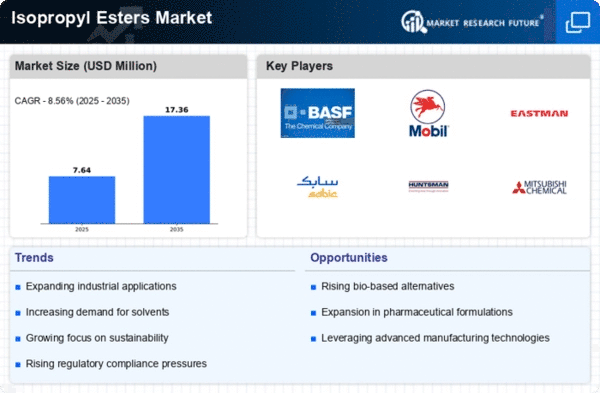
As per MRFR analysis, the Isopropyl Esters Market Size was estimated at 7.04 USD Million in 2024. The Isopropyl Esters industry is projected to grow from 7.64 in 2025 to 17.36 by 2035, exhibiting a compound annual growth rate (CAGR) of 8.56 during the forecast period 2025 - 2035.

Key Market Trends & Highlights

The Isopropyl Esters Market is currently experiencing a robust growth trajectory driven by sustainability and innovation.

  • The market is witnessing a pronounced shift towards sustainability, influencing production and consumption patterns.
  • Technological advancements are enhancing the efficiency and quality of isopropyl esters, particularly in the cosmetics segment.
  • Customization trends are becoming increasingly prevalent, allowing for tailored solutions in personal care products and cleaning agents.
  • Rising demand in personal care products and regulatory support for eco-friendly solutions are key drivers propelling market expansion.

Market Size & Forecast

2024 Market Size 7.04 (USD Million)
2035 Market Size 17.36 (USD Million)
CAGR (2025 - 2035) 8.56%
Largest Regional Market Share in 2024 North America

Major Players

<p>BASF SE (DE), ExxonMobil Chemical (US), Eastman Chemical Company (US), SABIC (SA), Huntsman Corporation (US), Mitsubishi Chemical Corporation (JP), Solvay S.A. (BE), LG Chem (KR), INEOS Group (GB)</p>

Market Trends

The Isopropyl Esters Market is currently experiencing a notable transformation, driven by various factors that influence demand and supply dynamics. The increasing utilization of isopropyl esters in diverse applications, such as cosmetics, pharmaceuticals, and industrial processes, appears to be a primary catalyst for market growth. Furthermore, the rising awareness regarding the benefits of using biodegradable and environmentally friendly products is likely to propel the adoption of isopropyl esters, as they are perceived as safer alternatives to traditional solvents. This shift towards sustainability may encourage manufacturers to innovate and develop new formulations that align with consumer preferences. In addition to sustainability, the Isopropyl Esters Market is also witnessing advancements in production technologies. These innovations may enhance efficiency and reduce costs, thereby making isopropyl esters more accessible to a broader range of industries. Moreover, the growing trend of personalization in consumer products could lead to an increased demand for customized isopropyl ester formulations. As industries continue to evolve, the Isopropyl Esters Market is poised for further expansion, with potential opportunities emerging in untapped regions and sectors. Overall, the market landscape appears to be shifting towards a more sustainable and innovative future, reflecting changing consumer values and technological advancements.

Sustainability Focus

The emphasis on environmentally friendly products is reshaping the Isopropyl Esters Market. Consumers increasingly prefer biodegradable options, prompting manufacturers to prioritize sustainable practices in production.

Technological Advancements

Innovations in production methods are enhancing the efficiency of isopropyl ester manufacturing. These advancements may lead to cost reductions and improved product quality, benefiting various industries.

Customization Trends

The growing demand for personalized products is influencing the Isopropyl Esters Market. Industries are likely to seek tailored formulations to meet specific consumer needs, driving innovation.

Isopropyl Esters Market Market Drivers

Market Growth Projections

The Global Isopropyl Esters Market Industry is poised for substantial growth, with projections indicating a market value of 4500 USD Million by 2035. This growth trajectory is underpinned by a compound annual growth rate of 5.49% from 2025 to 2035, suggesting a robust expansion phase. The increasing adoption of isopropyl esters across diverse applications, coupled with technological advancements and regulatory support, positions the market favorably for future developments. As industries continue to recognize the benefits of isopropyl esters, the market is likely to evolve, reflecting changing consumer preferences and technological innovations.

Growth in Pharmaceutical Applications

The Global Isopropyl Esters Market Industry benefits from the expanding pharmaceutical sector, where these compounds are utilized as solvents and excipients in drug formulations. The increasing prevalence of chronic diseases necessitates the development of innovative pharmaceutical products, thereby driving demand for isopropyl esters. Their compatibility with various active ingredients enhances drug efficacy and stability. As the pharmaceutical market evolves, the Global Isopropyl Esters Market is likely to witness significant growth, contributing to the overall market value projected to reach 4500 USD Million by 2035. This upward trend underscores the importance of isopropyl esters in modern pharmaceutical applications.

Rising Demand in Personal Care Products

The Global Isopropyl Esters Market Industry experiences a notable surge in demand driven by the personal care sector. Isopropyl esters serve as effective solvents and emollients in cosmetics and skincare formulations. As consumer preferences shift towards natural and organic products, manufacturers increasingly incorporate isopropyl esters to enhance product performance. This trend is evidenced by the projected market value of 2500 USD Million in 2024, reflecting a robust growth trajectory. The industry's adaptability to evolving consumer needs positions it favorably for sustained expansion, particularly as the personal care market continues to flourish.

Technological Advancements in Production

Technological advancements in the production of isopropyl esters significantly influence the Global Isopropyl Esters Market Industry. Innovations in manufacturing processes enhance efficiency and reduce production costs, making isopropyl esters more accessible to various industries. The adoption of green chemistry principles further aligns with sustainability goals, appealing to environmentally conscious consumers. As production techniques evolve, the market is expected to experience a compound annual growth rate of 5.49% from 2025 to 2035. This growth reflects the industry's commitment to improving product quality while meeting the increasing demand across diverse applications.

Expanding Applications in Industrial Sectors

The Global Isopropyl Esters Market Industry is witnessing an expansion of applications across various industrial sectors, including paints, coatings, and adhesives. Isopropyl esters serve as effective solvents, enhancing the performance and stability of formulations. The growing construction and automotive industries contribute to this trend, as they increasingly utilize isopropyl esters in their products. This diversification of applications not only broadens the market scope but also indicates a potential for increased revenue generation. As these sectors continue to grow, the demand for isopropyl esters is likely to rise, further solidifying their role in industrial applications.

Regulatory Support for Sustainable Practices

The Global Isopropyl Esters Market Industry benefits from regulatory support promoting sustainable practices and environmentally friendly products. Governments worldwide are implementing stringent regulations to reduce the environmental impact of chemical products, encouraging manufacturers to adopt greener alternatives. Isopropyl esters, derived from renewable resources, align with these regulatory frameworks, making them an attractive option for companies seeking compliance. This regulatory landscape not only fosters innovation but also enhances market competitiveness. As sustainability becomes a priority, the demand for isopropyl esters is expected to grow, reflecting a shift towards eco-friendly solutions in various industries.

Market Segment Insights

By Application: Cosmetics (Largest) vs. Pharmaceuticals (Fastest-Growing)

<p>In the Isopropyl Esters Market, the application segment showcases diverse utilities, with the cosmetics sector capturing the largest market share. This segment primarily benefits from the broad utilization of isopropyl esters in personal care products, where they act as solvents and emollients enhancing product texture. Following closely is the pharmaceuticals application, which is gaining considerable traction as a crucial ingredient in the formulation of various medicinal products, reflecting a growing trend towards efficient and sustainable solutions in healthcare. As the market continues to evolve, the pharmaceuticals application is identified as the fastest-growing segment, driven by increasing demand for advanced drug formulations and the need for high-purity solvents. Innovations in pharmaceutical manufacturing and a greater emphasis on health and wellness are propelling the use of isopropyl esters within this field, solidifying its position as a key player in the future of the Isopropyl Esters Market.</p>

<p>Cosmetics: Dominant vs. Pharmaceuticals: Emerging</p>

<p>The cosmetics application plays a dominant role in the Isopropyl Esters Market, characterized by the wide-ranging use of isopropyl esters for both functional and aesthetic purposes. These esters serve as effective skin conditioning agents and emulsifiers, contributing to the stability and performance of cosmetic formulations. With consumers increasingly seeking high-quality and natural beauty products, the cosmetics segment is experiencing robust demand, compelling manufacturers to invest in innovative formulations. Conversely, the pharmaceuticals application is emerging as a significant force in the market, recognized for its role in the synthesis of active pharmaceutical ingredients (APIs) and excipients. The growing pharmaceutical research and development initiatives, coupled with advancements in manufacturing processes, are ushering in a new era for isopropyl esters in drug delivery systems and therapeutic applications.</p>

By End Use: Personal Care Products (Largest) vs. Cleaning Agents (Fastest-Growing)

<p>The Isopropyl Esters Market exhibits diverse applications, with Personal Care Products being the largest segment. This sector benefits from the increasing demand for cosmetic and personal care formulations that require effective solvents and emollients. Following close are Cleaning Agents, which also command a significant share due to the growing need for effective cleaning solutions across residential and commercial sectors. Paints and Coatings and Adhesives serve vital roles in niche applications but hold lesser shares comparatively.</p>

<p>Personal Care Products (Dominant) vs. Cleaning Agents (Emerging)</p>

<p>Personal Care Products represent the dominant segment within the Isopropyl Esters Market, driven by their essential role in formulating skin care, hair care, and cosmetic formulations that require high-quality ingredients. Their ability to provide moisturizing properties and enhance product stability makes them highly sought after. In contrast, Cleaning Agents are emerging rapidly, propelled by the rising awareness of hygiene, the increased use of household and industrial cleaning products, and a shift towards eco-friendly formulations. The compatibility of isopropyl esters with various active ingredients positions them as an attractive option for developing innovative cleaning solutions.</p>

By Type: Isopropyl Myristate (Largest) vs. Isopropyl Palmitate (Fastest-Growing)

<p>The Isopropyl Esters Market demonstrates a significant distribution among its key components, notably Isopropyl Myristate, Isopropyl Palmitate, Isopropyl Stearate, and Isopropyl Laurate. Isopropyl Myristate holds the largest market share, attributed to its extensive use in personal care products and pharmaceuticals, where it acts as a solvent and emollient. Meanwhile, Isopropyl Palmitate is gaining traction due to its emerging applications in cosmetic preparations, indicating a healthy rise in interest among manufacturers.</p>

<p>Isopropyl Myristate (Dominant) vs. Isopropyl Laurate (Emerging)</p>

<p>Isopropyl Myristate stands out as the dominant player in the Isopropyl Esters Market, largely due to its excellent skin feel and versatility in various topical formulations. This ester is widely utilized in the cosmetic industry for its emollient properties, aiding in product stability and enhancing absorption. In contrast, Isopropyl Laurate, while considered an emerging segment, is also making its mark due to its suitability in modern formulations focusing on skin health and natural sources. Its lower greasy feel compared to other esters makes it appealing for lighter formulations, catering to consumer demand for less oily products.</p>

By Formulation Type: Emulsions (Largest) vs. Suspensions (Fastest-Growing)

<p>The formulation type segment in the Isopropyl Esters Market showcases a diverse distribution among its key values, namely Emulsions, Solutions, and Suspensions. Emulsions account for the largest share within this market segment, driven by their versatility in various applications, including cosmetics and pharmaceuticals. Solutions also hold a significant portion, appealing due to their ease of use in multiple formulations. Meanwhile, Suspensions, while currently smaller in share, are rapidly gaining traction among manufacturers looking for innovative delivery systems. The growth trends within this segment reflect a shift towards more specialized formulations that meet consumer demands for efficacy and stability. As industries recognize the unique attributes of each formulation type, the shift is evident, with Suspensions emerging as the fastest-growing category. Key drivers of this growth include the rising demand for sustainable and high-performance formulations, which are often facilitated by advanced technologies enhancing the stability and delivery of active ingredients.</p>

<p>Emulsions (Dominant) vs. Suspensions (Emerging)</p>

<p>Emulsions currently dominate the Isopropyl Esters Market due to their broad applicability in various industries, particularly cosmetics and pharmaceuticals. These formulations are characterized by their ability to blend oil and water, resulting in a stable mixture that enhances product performance and user experience. The versatility of emulsions allows them to cater to a wide range of consumer needs, resulting in significant market presence and preference. On the other hand, Suspensions represent an emerging category that is gaining popularity due to their innovative applications, especially in the pharmaceutical sector where they facilitate the delivery of poorly soluble drugs. As manufacturers explore new formulation techniques, the appeal of suspensions is bolstered by advancements that improve their stability and efficacy, making them a key focus area for future growth.</p>

By Distribution Channel: Direct Sales (Largest) vs. Online Sales (Fastest-Growing)

<p>In the Isopropyl Esters Market, the distribution of sales channels reveals that Direct Sales currently holds the largest market share, catering to established relationships between manufacturers and end-users. This traditional method is prevalent among large-scale customers who prefer robust supply chain agreements that ensure reliability. Conversely, Online Sales, while smaller in share, have rapidly gained traction among emerging customers, particularly in niche markets, owing to the growing acceptance of e-commerce platforms and the need for convenience.</p>

<p>Direct Sales (Dominant) vs. Online Sales (Emerging)</p>

<p>Direct Sales in the Isopropyl Esters Market remains a dominant channel, primarily due to its long-standing trust among manufacturers and customers. Businesses often rely on direct sales for bulk orders, benefiting from negotiated rates and personalized service. On the other hand, Online Sales are emerging as a critical channel, particularly appealing to small and medium enterprises. The shift towards digital purchasing platforms allows customers to access a broader range of products and prices. This growth is fueled by increasing digital literacy and the demand for more convenient purchasing options. As the market evolves, the role of these channels may further shift, influenced by advancements in technology and changing consumer behavior.</p>

Get more detailed insights about Isopropyl Esters Market Research Report- Forecast to 2035

Regional Insights

North America : Market Leader in Isopropyl Esters

North America is poised to maintain its leadership in the Isopropyl Esters market, holding a significant share of 3.52 in 2024. The region's growth is driven by increasing demand in sectors such as automotive and pharmaceuticals, alongside stringent regulations promoting the use of eco-friendly solvents. The push for sustainable practices is further catalyzing market expansion, as companies seek to innovate and comply with environmental standards. The United States stands out as the primary market, with key players like ExxonMobil Chemical and Eastman Chemical Company leading the charge. The competitive landscape is characterized by a mix of established firms and emerging players, all vying for market share. The presence of major chemical manufacturers ensures a robust supply chain, facilitating growth and innovation in the sector.

Europe : Emerging Market with Growth Potential

Europe's Isopropyl Esters market is on a growth trajectory, with a market size of 1.76. The region benefits from a strong regulatory framework that encourages the use of bio-based solvents, aligning with the EU's Green Deal objectives. This regulatory support, combined with rising demand in cosmetics and personal care, is driving market growth. The focus on sustainability and eco-friendly products is reshaping consumer preferences, further propelling the market forward. Germany and France are leading the charge in this market, with significant contributions from companies like BASF SE and Solvay S.A. The competitive landscape is marked by innovation and collaboration among key players, enhancing product offerings. The presence of established chemical manufacturers ensures a steady supply of high-quality isopropyl esters, catering to diverse industrial applications.

Asia-Pacific : Rapid Growth in Emerging Economies

The Asia-Pacific region is witnessing rapid growth in the Isopropyl Esters market, with a size of 1.26. This growth is fueled by increasing industrialization and urbanization, particularly in countries like China and India. The demand for isopropyl esters in various applications, including coatings and adhesives, is on the rise, supported by favorable government policies promoting manufacturing and exports. The region's expanding middle class is also driving consumption in personal care products, further boosting market potential. China is the dominant player in this market, with significant contributions from local manufacturers and multinational corporations. The competitive landscape is evolving, with companies like Mitsubishi Chemical Corporation and LG Chem investing in capacity expansion and innovation. This dynamic environment is fostering a competitive edge, positioning the region for sustained growth in the coming years.

Middle East and Africa : Emerging Market with Untapped Potential

The Middle East and Africa region is emerging as a potential market for Isopropyl Esters, with a market size of 0.5. The growth is driven by increasing industrial activities and a rising demand for solvents in various applications, including paints and coatings. The region's rich natural resources and strategic location are also contributing to its attractiveness for investment in chemical manufacturing. However, challenges such as regulatory hurdles and market fragmentation remain. Countries like South Africa and Saudi Arabia are at the forefront of this market, with local players and international companies exploring opportunities. The competitive landscape is characterized by a mix of established firms and new entrants, all aiming to capture market share. The presence of key players like SABIC and Huntsman Corporation is vital for driving innovation and expanding the market footprint in this region.

Key Players and Competitive Insights

The Isopropyl Esters Market is currently characterized by a competitive landscape that is both dynamic and multifaceted. Key growth drivers include increasing demand from the personal care and cosmetics sectors, as well as the expanding applications in pharmaceuticals and agrochemicals. Major players such as BASF SE (Germany), ExxonMobil Chemical (US), and Eastman Chemical Company (US) are strategically positioned to leverage these trends. BASF SE (Germany) focuses on innovation and sustainability, emphasizing the development of bio-based isopropyl esters, which aligns with the growing consumer preference for environmentally friendly products. ExxonMobil Chemical (US) is enhancing its operational efficiency through digital transformation initiatives, while Eastman Chemical Company (US) is pursuing strategic partnerships to expand its product offerings and market reach. Collectively, these strategies contribute to a competitive environment that is increasingly shaped by sustainability and technological advancements.

In terms of business tactics, companies are localizing manufacturing to reduce lead times and optimize supply chains, which is particularly crucial in a market that is moderately fragmented. The competitive structure allows for both established players and new entrants to coexist, with key players exerting considerable influence over pricing and product availability. This localized approach not only enhances responsiveness to market demands but also fosters innovation through closer collaboration with regional stakeholders.

In November 2025, BASF SE (Germany) announced the launch of a new line of bio-based isopropyl esters, which are derived from renewable resources. This strategic move is significant as it positions BASF at the forefront of the sustainability trend, catering to a growing consumer base that prioritizes eco-friendly products. The introduction of these products is expected to enhance BASF's market share and reinforce its commitment to sustainable practices.

In October 2025, ExxonMobil Chemical (US) unveiled a state-of-the-art digital platform aimed at optimizing its supply chain operations. This initiative is crucial as it enhances operational efficiency and reduces costs, allowing ExxonMobil to remain competitive in a market where margins are increasingly pressured. The integration of advanced analytics and AI into their supply chain processes could potentially lead to improved decision-making and responsiveness to market fluctuations.

In September 2025, Eastman Chemical Company (US) entered into a strategic partnership with a leading agricultural firm to develop specialized isopropyl esters for agrochemical applications. This collaboration is indicative of Eastman's strategy to diversify its product portfolio and tap into the growing demand for agricultural solutions. By aligning with a key player in the agricultural sector, Eastman is likely to enhance its competitive positioning and drive growth in this segment.

As of December 2025, the Isopropyl Esters Market is witnessing trends that emphasize digitalization, sustainability, and the integration of AI technologies. Strategic alliances are increasingly shaping the competitive landscape, enabling companies to pool resources and expertise to innovate more effectively. The shift from price-based competition to a focus on innovation, technology, and supply chain reliability is becoming evident. Moving forward, competitive differentiation will likely hinge on the ability to adapt to these trends, with companies that prioritize sustainability and technological advancement poised to lead the market.

Key Companies in the Isopropyl Esters Market market include

Industry Developments

Future Outlook

Isopropyl Esters Market Future Outlook

<p>The Isopropyl Esters Market is projected to grow at an 8.56% CAGR from 2024 to 2035, driven by increasing demand in pharmaceuticals, cosmetics, and industrial applications.</p>

New opportunities lie in:

  • <p>Expansion into bio-based isopropyl esters for sustainable product lines.</p>
  • <p>Development of customized formulations for niche applications in personal care.</p>
  • <p>Investment in advanced manufacturing technologies to enhance production efficiency.</p>

<p>By 2035, the Isopropyl Esters Market is expected to achieve robust growth, solidifying its position in diverse industries.</p>

Market Segmentation

Isopropyl Esters Market Type Outlook

  • Isopropyl Myristate
  • Isopropyl Palmitate
  • Isopropyl Stearate
  • Isopropyl Laurate

Isopropyl Esters Market End Use Outlook

  • Personal Care Products
  • Cleaning Agents
  • Paints and Coatings
  • Adhesives

Isopropyl Esters Market Application Outlook

  • Cosmetics
  • Pharmaceuticals
  • Food and Beverage
  • Industrial Solvents

Isopropyl Esters Market Formulation Type Outlook

  • Emulsions
  • Solutions
  • Suspensions

Isopropyl Esters Market Distribution Channel Outlook

  • Direct Sales
  • Online Sales
  • Retail Sales

Report Scope

MARKET SIZE 20247.04(USD Million)
MARKET SIZE 20257.64(USD Million)
MARKET SIZE 203517.36(USD Million)
COMPOUND ANNUAL GROWTH RATE (CAGR)8.56% (2024 - 2035)
REPORT COVERAGERevenue Forecast, Competitive Landscape, Growth Factors, and Trends
BASE YEAR2024
Market Forecast Period2025 - 2035
Historical Data2019 - 2024
Market Forecast UnitsUSD Million
Key Companies ProfiledBASF SE (DE), ExxonMobil Chemical (US), Eastman Chemical Company (US), SABIC (SA), Huntsman Corporation (US), Mitsubishi Chemical Corporation (JP), Solvay S.A. (BE), LG Chem (KR), INEOS Group (GB)
Segments CoveredApplication, End Use, Type, Formulation Type, Distribution Channel
Key Market OpportunitiesGrowing demand for bio-based solvents in the Isopropyl Esters Market presents significant opportunities.
Key Market DynamicsRising demand for eco-friendly solvents drives innovation and competition in the Isopropyl Esters Market.
Countries CoveredNorth America, Europe, APAC, South America, MEA

FAQs

At what CAGR is the Isopropyl Esters Market predicted to grow during the forecast period?

Isopropyl Esters Market is predicted to grow at Substantial CAGR through forecast period of 2025-2035.

What is the forecast period of Isopropyl Esters Market research report?

The forecast period for Isopropyl Esters Market Research report is 2025-2035.

Which region will lead the global Isopropyl Esters Market?

Isopropyl Esters Market is dominated by APAC region.

What are the key factors driving the Isopropyl Esters Market ?

Increasing usage as a flavoring agent in food industry

Who are the key players in the Isopropyl Esters Market ?

BASF SE (Germany), Procter &amp; Gamble (U.S.), Oleon NV (Belgium), Sigma-Aldrich Co. LLC (U.S.), Hangzhou Dayangchem Co. Limited (China), Alfa Aesar, Thermo Fisher Scientific (U.S), Musim Mas Holdings. (Singapore), Shodhana Laboratories Ltd (India) and others.

  1. Executive Summary
  2. Scope of The Report
    1. Market Definition
    2. Scope of The
      1. Research Objectives
      2. Assumptions & Limitations
    3. Study
    4. Markets Structure
    5. Market Research Methodology
    6. Research
    7. Process
    8. Secondary Research
    9. Primary Research
    10. Forecast Model
  3. Market Landscape
    1. Five Forces Analysis
      1. Bargaining
      2. Threat of substitutes
      3. Segment rivalry
    2. Threat of New Entrants
    3. power of buyers
    4. Value Chain/Supply Chain of Global Isopropyl Esters Market
  4. Industry Overview of Global Isopropyl Esters Market
    1. Introduction
    2. Growth Drivers
    3. Impact analysis
    4. Market Challenges
    5. Impact analysis
  5. Market Trends
    1. Introduction
    2. Growth Trends
    3. Impact analysis
  6. Global Isopropyl Esters Market by Application
    1. Introduction
    2. Emollient
    3. Flavoring Agent
    4. Plasticizer
    5. Solvent
    6. Engine Fuel
    7. Others
  7. Global Isopropyl Esters Market by End Use Industry
    1. Introduction
    2. Lubricant
    3. Surfactant
    4. & Detergent
    5. Food
    6. Cosmetics
    7. and Personal care
    8. Pharmaceutical
    9. Other
  8. Global Isopropyl Esters Market by Region
    1. Introduction
    2. North
      1. US
      2. Canada
      3. Germany
      4. France
      5. Italy
      6. Spain
    3. America
    4. Europe
    5. UK
    6. Asia Pacific
      1. China
      2. India
      3. Japan
      4. New Zealand
    7. Australia
    8. Rest of Asia Pacific
    9. Middle East & Africa
      1. Turkey
      2. Israel
      3. North Africa
      4. GCC
      5. Rest of Middle East & Africa
      6. Brazil
      7. Argentina
      8. Rest of Latin America
    10. Latin America
  9. Company Landscape
  10. Company Profiles
    1. BASF SE
    2. Product/Business Segment Overview
    3. Updates
    4. & Gamble
    5. Product/Business Segment Overview
    6. Updates
    7. N.V
    8. Segment Overview
    9. Key Developments
    10. Company Overview
    11. Company Overview
    12. Company Overview
    13. Overview
    14. Financial Updates
    15. Shodhana Laboratories Ltd
    16. Financial Updates
    17. Conclusion
    18. LIST OF TABLES:
  11. Company Overview
  12. Financial
  13. Key Developments
    1. Procter
      1. Company Overview
      2. Financial
      3. Key Developments
    2. Oleon
      1. Company Overview
      2. Product/Business
      3. Financial Updates
    3. Sigma-Aldrich Co. LLC
      1. Product/Business Segment Overview
      2. Financial Updates
      3. Key Developments
    4. Hangzhou Dayangchem Co.Limited
      1. Product/Business Segment Overview
      2. Financial Updates
      3. Key Developments
    5. Alfa Aesar, Thermo Fisher Scientific
      1. Product/Business Segment Overview
      2. Financial Updates
      3. Key Developments
    6. Musim Mas Holdings
      1. Company
      2. Product/Business Segment Overview
      3. Key Developments
      4. Company Overview
      5. Product/Business Segment Overview
      6. Key Developments
  14. World Population by Major Regions (2020-2027)
  15. Global Isopropyl Esters Market: By Region, 2020-2027
  16. North America Isopropyl Esters Market: By
    1. Country, 2020-2027
  17. Europe Isopropyl Esters
    1. Market: By Country, 2020-2027
  18. Asia-Pacific
    1. Isopropyl Esters Market: By Country, 2020-2027
  19. Middle
    1. East & Africa Isopropyl Esters Market: By Country, 2020-2027
    2. Table
  20. Latin America Isopropyl Esters Market: By Country, 2020-2027
  21. Global Isopropyl Esters by Application Market:
    1. By Regions, 2020-2027
  22. North America Isopropyl
    1. Esters by Application Market: By Country, 2020-2027
  23. Europe
    1. Isopropyl Esters by Application Market: By Country, 2020-2027
    2. Table
  24. Asia-Pacific Isopropyl Esters by Application Market: By Country, 2020-2027
  25. Middle East & Africa Isopropyl Esters by Application Market:
    1. By Country, 2020-2027
  26. Latin America Isopropyl Esters by Application
    1. Market: By Country, 2020-2027
  27. North America Isopropyl
    1. Esters for End use Industry: By Country, 2020-2027
  28. Europe Isopropyl
    1. Esters for End use Industry: By Country, 2020-2027
  29. Asia-Pacific
    1. Isopropyl Esters for End use Industry: By Country, 2020-2027
    2. Table 17
    3. Middle East & Africa Isopropyl Esters for End-use Industry: By Country, 2020-2027
  30. Latin America Isopropyl Esters for End-use Industry: By Country,
  31. Global Application Market: By Region, 2020-2027
  32. Global End Use Industry Market: By Region, 2020-2027
  33. North America Isopropyl Esters Market, By Country
    1. Table 22
  34. North America Isopropyl Esters Market, By Application
  35. North America
  36. Isopropyl Esters Market, By End Use Industry
  37. Europe: Isopropyl Esters
  38. Market, By Country
  39. Europe: Isopropyl Esters Market, By Application
  40. Europe: Isopropyl Esters Market, By End use Industry
    1. Table
  41. Asia-Pacific: Isopropyl Esters Market, By Country
  42. Asia-Pacific:
  43. Isopropyl Esters Market, By Application
  44. Asia-Pacific: Isopropyl Esters
  45. Market, By End use Industry
  46. Middle East & Africa: Isopropyl
  47. Esters Market, By Country
  48. Middle East & Africa Isopropyl
  49. Esters Market, By Application
  50. Middle East & Africa: Isopropyl
  51. Esters Market, By End use Industry
  52. Latin America: Isopropyl
  53. Esters Market, By Country
  54. Latin America Isopropyl Esters Market,
    1. By Application
  55. Latin America: Isopropyl Esters Market, By End use
    1. Industry
    2. LIST
    3. OF FIGURES:
  56. Global Isopropyl Esters Market segmentation
  57. Forecast Methodology
  58. Five Forces Analysis of
    1. Global Isopropyl Esters Market
  59. Value Chain of Global Isopropyl
    1. Esters Market
  60. Share of Global Isopropyl Esters Market in 2020,
    1. by country (in %)
  61. Global Isopropyl Esters Market, 2020-2027,
  62. Sub segments of End Use Industry
  63. Global Isopropyl
    1. Esters Market size by End Use Industry, 2020
  64. Share of Global
    1. Isopropyl Esters Market by End Use Industry, 2020-2027
  65. Global Isopropyl
    1. Esters Market size by Application, 2020
  66. Share of Global Isopropyl
    1. Esters Market by Application, 2020-2027

Isopropyl Esters Market Segmentation

Market Segmentation Overview

  • Detailed segmentation data will be available in the full report
  • Comprehensive analysis by multiple parameters
  • Regional and country-level breakdowns
  • Market size forecasts by segment
Infographic

Free Sample Request

Kindly complete the form below to receive a free sample of this Report

Get Free Sample

Customer Strories

Compare Licence

×
Features License Type
Single User Multiuser License Enterprise User
Price $4,950 $5,950 $7,250
Maximum User Access Limit 1 User Upto 10 Users Unrestricted Access Throughout the Organization
Free Customization
Direct Access to Analyst
Deliverable Format
Platform Access
Discount on Next Purchase 10% 15% 15%
Printable Versions