×
Request Free Sample ×

Kindly complete the form below to receive a free sample of this Report

* Please use a valid business email

Leading companies partner with us for data-driven Insights

clients tt-cursor
Hero Background
English
Chinese
French
Japanese
Korean
German
Spanish

Isopropyl Esters Market Size

ID: MRFR/CnM/2691-HCR
138 Pages
Chitranshi Jaiswal
October 2025

Isopropyl Esters Market Research Report Information - by Application (Emollient, Flavoring Agent, Plasticizer, Solvent, Engine Fuel, and Others), by End Use Industry (Lubricant, Surfactant & Detergent, Food, Cosmetics and Personal Care, Pharmaceutical and Others) and by Region- Forecast till 2035

Share:
Download PDF ×

We do not share your information with anyone. However, we may send you emails based on your report interest from time to time. You may contact us at any time to opt-out.

Isopropyl Esters Market Infographic
Purchase Options

Isopropyl Esters Size

Isopropyl Esters Market Growth Projections and Opportunities

The dynamics of the Isopropyl Esters market are controlled by a variety of factors. One of them is the increasing need from sectors like personal care, pharmaceuticals and agrochemicals as a driving force. In these areas, isopropyl esters which are versatile as solvents, emollients and carriers find wide applications. Manufacturing processes in several industries rely on the performance and growth rates of these sectors that make their demand for isopropyl esters very important.

Regulatory considerations and environmental awareness play a pivotal role in the Isopropyl Esters market. Therefore, isopropyl ester used in personal care products, pharma formulations, etc., have to meet regulatory requirements that ensure product safety and environmental sustainability. To satisfy those conscious with green products producers have to follow such instructions being very important for regulations purposes. This has led to sustainable bio-based alternatives including bio-based isopropyl esters that meet present-day environmentally conscious demands.

One of the critical aspects affecting the Isopropyl Esters market is supply chain dynamics involving raw material availability as well as pricing issues. Most of these ester’s main ingredients are made out of different organic acids and iso-propanol that could be termed primary raw materials. When prices for these materials fluctuate then it increases total production costs thereby causing overall implications for this sector at large scale level. An unimaginable incidence would however undermine this stability meaning an effective, unchanging flow should be available via global supply chains.

Global trade policies plus geopolitical factors also affect the direction taken by Isopropyl Esters markets. Tariffs or trade agreements including political tensions can influence movement internationally when it comes to chemicals thus affecting demand in return too. Thus companies operating within this market must innovate or respond accordingly if they are going to successfully manage world trade intricacies.

This makes some relevance to how much share will be occupied by key players, strategic initiatives and market share in competitive dynamics of the Isopropyl Esters. In order to strengthen their position in the market, companies often place emphasis on product innovation, expanding their product portfolios as well as forming strategic partnerships. A merger or acquisition is one of the common ways used to improve market presence in order to get a lead over competitors.
Isopropyl Esters Market Size Graph
Author
Chitranshi Jaiswal
Research Analyst Level I

In her 3 years of experience in the market research field, she has handled critical cross-domain projects. She has an in-depth knowledge of market estimation & analysis, problem-solving, primary as well as secondary research, and team management.She holds an engineering degree and is an MBA professional from a well-known university, capable of evaluating the market and competitive conditions. An exceptional strategist with excellent communication skills and a passion for delivering cutting-edge & practical insights for the market. Proficient in multi-tasking, and can successfully deal with competing demands, while maintaining complete confidentiality. Generated business through active client and project development, networking, and high-quality responses. Her knowledge and skills have helped in making solid business decisions, securing funding from investors, and avoiding business failures.

Leave a Comment

FAQs

At what CAGR is the Isopropyl Esters Market predicted to grow during the forecast period?

Isopropyl Esters Market is predicted to grow at Substantial CAGR through forecast period of 2025-2035.

What is the forecast period of Isopropyl Esters Market research report?

The forecast period for Isopropyl Esters Market Research report is 2025-2035.

Which region will lead the global Isopropyl Esters Market?

Isopropyl Esters Market is dominated by APAC region.

What are the key factors driving the Isopropyl Esters Market ?

Increasing usage as a flavoring agent in food industry

Who are the key players in the Isopropyl Esters Market ?

BASF SE (Germany), Procter & Gamble (U.S.), Oleon NV (Belgium), Sigma-Aldrich Co. LLC (U.S.), Hangzhou Dayangchem Co. Limited (China), Alfa Aesar, Thermo Fisher Scientific (U.S), Musim Mas Holdings. (Singapore), Shodhana Laboratories Ltd (India) and others.

Market Summary

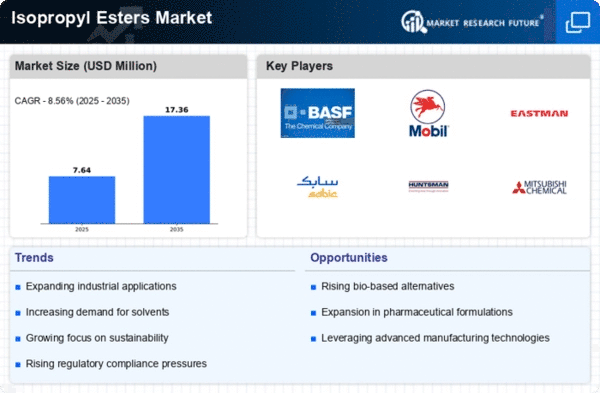
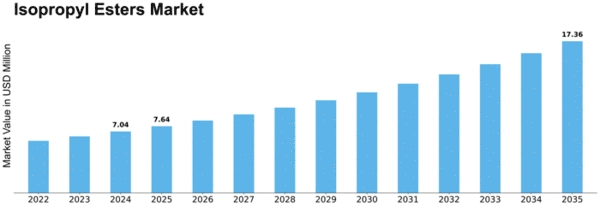
As per MRFR analysis, the Isopropyl Esters Market Size was estimated at 7.04 USD Million in 2024. The Isopropyl Esters industry is projected to grow from 7.64 in 2025 to 17.36 by 2035, exhibiting a compound annual growth rate (CAGR) of 8.56 during the forecast period 2025 - 2035.

Key Market Trends & Highlights

The Isopropyl Esters Market is poised for growth driven by sustainability and technological advancements.

  • The market is witnessing a pronounced shift towards sustainability, influencing production and consumption patterns.
  • North America remains the largest market, while Asia-Pacific is emerging as the fastest-growing region for isopropyl esters.
  • In the cosmetics segment, isopropyl esters are widely utilized, whereas the pharmaceuticals segment is experiencing rapid growth.
  • Key market drivers include sustainability initiatives and rising demand in emerging markets, particularly in personal care products.

Market Size & Forecast

2024 Market Size 7.04 (USD Million)
2035 Market Size 17.36 (USD Million)
CAGR (2025 - 2035) 8.56%
Largest Regional Market Share in 2024 North America

Major Players

BASF SE (DE), ExxonMobil Chemical (US), Eastman Chemical Company (US), SABIC (SA), Huntsman Corporation (US), Mitsubishi Chemical Corporation (JP), Solvay S.A. (BE), LG Chem (KR), INEOS Group (GB)

Market Trends

The Isopropyl Esters Market is currently experiencing a notable evolution, driven by various factors that influence demand and supply dynamics. The increasing utilization of isopropyl esters in diverse applications, such as solvents, coatings, and personal care products, appears to be a primary catalyst for market growth. Additionally, the rising awareness regarding eco-friendly and sustainable products may lead to a shift towards bio-based isopropyl esters, which could further enhance market prospects. As industries seek to comply with stringent environmental regulations, the demand for these esters is likely to rise, indicating a potential shift in production methodologies. Moreover, the Isopropyl Esters Market seems to be influenced by technological advancements that enhance production efficiency and product quality. Innovations in manufacturing processes may result in cost-effective solutions, thereby attracting a broader customer base. Furthermore, the expansion of end-use industries, including pharmaceuticals and agriculture, suggests a promising outlook for isopropyl esters. As these sectors continue to grow, the market may witness increased investments and research initiatives aimed at developing new applications and formulations, which could ultimately reshape the competitive landscape of the Isopropyl Esters Market.

Sustainability Focus

There is a growing emphasis on sustainability within the Isopropyl Esters Market. Manufacturers are increasingly exploring bio-based alternatives to traditional petroleum-derived esters, driven by consumer demand for environmentally friendly products. This trend suggests a potential shift in production practices, as companies aim to align with global sustainability goals.

Technological Advancements

Technological innovations are playing a crucial role in the Isopropyl Esters Market. Enhanced production techniques and improved formulations are likely to lead to higher efficiency and product quality. This trend indicates that companies investing in research and development may gain a competitive edge.

Diverse Applications

The versatility of isopropyl esters is contributing to their growing adoption across various industries. From personal care to pharmaceuticals, the expanding range of applications suggests that the market may continue to thrive as new uses are discovered and developed.

Isopropyl Esters Market Market Drivers

Market Growth Projections

The Global Isopropyl Esters Market Industry is poised for substantial growth, with projections indicating a market value of 4500 USD Million by 2035. This growth trajectory is underpinned by a compound annual growth rate of 5.49% from 2025 to 2035, suggesting a robust expansion phase. The increasing adoption of isopropyl esters across diverse applications, coupled with technological advancements and regulatory support, positions the market favorably for future developments. As industries continue to recognize the benefits of isopropyl esters, the market is likely to evolve, reflecting changing consumer preferences and technological innovations.

Growth in Pharmaceutical Applications

The Global Isopropyl Esters Market Industry benefits from the expanding pharmaceutical sector, where these compounds are utilized as solvents and excipients in drug formulations. The increasing prevalence of chronic diseases necessitates the development of innovative pharmaceutical products, thereby driving demand for isopropyl esters. Their compatibility with various active ingredients enhances drug efficacy and stability. As the pharmaceutical market evolves, the Global Isopropyl Esters Market is likely to witness significant growth, contributing to the overall market value projected to reach 4500 USD Million by 2035. This upward trend underscores the importance of isopropyl esters in modern pharmaceutical applications.

Rising Demand in Personal Care Products

The Global Isopropyl Esters Market Industry experiences a notable surge in demand driven by the personal care sector. Isopropyl esters serve as effective solvents and emollients in cosmetics and skincare formulations. As consumer preferences shift towards natural and organic products, manufacturers increasingly incorporate isopropyl esters to enhance product performance. This trend is evidenced by the projected market value of 2500 USD Million in 2024, reflecting a robust growth trajectory. The industry's adaptability to evolving consumer needs positions it favorably for sustained expansion, particularly as the personal care market continues to flourish.

Technological Advancements in Production

Technological advancements in the production of isopropyl esters significantly influence the Global Isopropyl Esters Market Industry. Innovations in manufacturing processes enhance efficiency and reduce production costs, making isopropyl esters more accessible to various industries. The adoption of green chemistry principles further aligns with sustainability goals, appealing to environmentally conscious consumers. As production techniques evolve, the market is expected to experience a compound annual growth rate of 5.49% from 2025 to 2035. This growth reflects the industry's commitment to improving product quality while meeting the increasing demand across diverse applications.

Expanding Applications in Industrial Sectors

The Global Isopropyl Esters Market Industry is witnessing an expansion of applications across various industrial sectors, including paints, coatings, and adhesives. Isopropyl esters serve as effective solvents, enhancing the performance and stability of formulations. The growing construction and automotive industries contribute to this trend, as they increasingly utilize isopropyl esters in their products. This diversification of applications not only broadens the market scope but also indicates a potential for increased revenue generation. As these sectors continue to grow, the demand for isopropyl esters is likely to rise, further solidifying their role in industrial applications.

Regulatory Support for Sustainable Practices

The Global Isopropyl Esters Market Industry benefits from regulatory support promoting sustainable practices and environmentally friendly products. Governments worldwide are implementing stringent regulations to reduce the environmental impact of chemical products, encouraging manufacturers to adopt greener alternatives. Isopropyl esters, derived from renewable resources, align with these regulatory frameworks, making them an attractive option for companies seeking compliance. This regulatory landscape not only fosters innovation but also enhances market competitiveness. As sustainability becomes a priority, the demand for isopropyl esters is expected to grow, reflecting a shift towards eco-friendly solutions in various industries.

Market Segment Insights

By Application: Cosmetics (Largest) vs. Pharmaceuticals (Fastest-Growing)

The isopropyl esters market is characterized by significant applications in cosmetics, pharmaceuticals, food and beverage, and industrial solvents. Among these, the cosmetics sector holds the largest market share, driven by the rising demand for personal care products and formulations that offer improved skin penetration and texture feel. Following closely, the pharmaceuticals sector is experiencing rapid growth due to the increasing use of isopropyl esters as solvents and excipients in drug formulations, contributing to their adoption in various therapeutic areas.

Cosmetics (Dominant) vs. Pharmaceuticals (Emerging)

Cosmetics represent a dominant application of isopropyl esters, utilized for their solubilizing properties and skin-conditioning benefits. These esters enhance the sensory profile of cosmetic products, making them smoother and more appealing for consumers. Brands leverage isopropyl esters to align with consumer preferences for clean labels and natural ingredients. In contrast, the pharmaceuticals sector is emerging, with increasing research and development paving the way for innovative formulations. Isopropyl esters are becoming essential in drug delivery systems, improving bioavailability and patient compliance. Their multifunctional roles in formulations, combined with regulatory support for safer excipients, position pharmaceuticals as a growing frontier in the isopropyl esters market.

By End Use: Personal Care Products (Largest) vs. Cleaning Agents (Fastest-Growing)

The End Use segment of the Isopropyl Esters Market is characterized by a broad distribution of applications, with Personal Care Products holding the largest market share. This category includes a variety of products such as cosmetics and skincare items that benefit from isopropyl esters due to their excellent skin-feel and emulsifying properties. Meanwhile, Cleaning Agents are emerging rapidly, capturing attention with their versatile applications in both household and industrial cleaning, thus contributing significantly to the segment's evolution.

Personal Care Products (Dominant) vs. Cleaning Agents (Emerging)

Personal Care Products remain the dominant category, leveraging isopropyl esters for their safe and effective performance in formulations. These esters enhance the texture and stability of products, making them a preferred choice for manufacturers in the cosmetics and skincare industries. On the other hand, Cleaning Agents represent an emerging segment in this market, showing robust demand driven by increased awareness of hygiene and cleanliness, as well as innovations in formulation that emphasize eco-friendliness and performance. The growing trend towards sustainable cleaning products further supports the emergence of isopropyl esters in this area, expanding their application across various products.

By Type: Isopropyl Myristate (Largest) vs. Isopropyl Palmitate (Fastest-Growing)

In the Isopropyl Esters Market, Isopropyl Myristate is the largest segment, commanding a significant share due to its widespread use in cosmetics and personal care products. Following closely is Isopropyl Palmitate, known for its growing popularity among manufacturers as a skin-conditioning agent and solvent. Isopropyl Stearate and Isopropyl Laurate complete the segment, with each serving specific niche applications, yet contributing to the overall balanced distribution of the market share among these esters.

Isopropyl Myristate (Dominant) vs. Isopropyl Laurate (Emerging)

Isopropyl Myristate remains the dominant player in the Isopropyl Esters Market due to its effective emollient properties, making it a favored ingredient in various formulations. In contrast, Isopropyl Laurate, although considered an emerging segment, is gaining traction thanks to its functional characteristics that cater to evolving consumer demands for natural and biodegradable ingredients. The shift toward sustainable products is likely to amplify the growth prospects of Isopropyl Laurate, as it aligns with the market's trend towards cleaner, eco-friendly formulations. Both esters play crucial roles in improving product performance and consumer satisfaction.

By Formulation Type: Emulsions (Largest) vs. Solutions (Fastest-Growing)

In the Isopropyl Esters Market, the formulation type segment showcases a diverse distribution among three primary categories: emulsions, solutions, and suspensions. Emulsions hold the largest share due to their widespread use in cosmetic and pharmaceutical applications, offering excellent stability and performance. Solutions are not far behind, known for their versatility and ease of use, but suspensions continue to occupy a smaller niche in the market. In terms of growth trends, solutions are emerging as the fastest-growing formulation type, driven by an increasing demand for high-performance products in various industries, including personal care and pharmaceuticals. Factors such as innovation in product formulations and the rising popularity of eco-friendly formulations are propelling growth in the emulsions segment, while solutions capitalize on flexibility and adaptability to market needs.

Emulsions (Dominant) vs. Suspensions (Emerging)

Emulsions in the Isopropyl Esters Market are recognized as a dominant formulation type, particularly favored for their ability to stabilize mixtures of immiscible liquids. They are extensively used in cosmetic and personal care products due to their excellent skin compatibility and efficacy. Emulsions cater to consumer demands for high-quality formulations that deliver robust performance. On the other hand, suspensions represent an emerging formulation type, gaining traction as industries seek more effective delivery methods for active ingredients. These formulations provide unique advantages, such as enhanced stability and controlled release of active agents, making them increasingly attractive for applications in pharmaceuticals and agrochemicals. As companies explore innovations in this area, suspensions are poised to capture a larger market share.

By Distribution Channel: Online Retail (Largest) vs. Direct Sales (Fastest-Growing)

Within the Isopropyl Esters Market, the distribution channel segment showcases an even breadth of options, with Online Retail leading the way, capturing a substantial share due to the growing consumer preference for online shopping. Direct Sales follows closely, appealing to clients who prioritize personalized service and direct interaction with suppliers. Wholesale also plays a crucial role, particularly in bulk transactions and catering to larger businesses, yet it does not dominate like Online Retail. Recent trends indicate a shift in consumer behavior, with Online Retail presenting exponential growth as more businesses embrace e-commerce platforms for accessing isopropyl esters. Conversely, the Direct Sales segment is emerging as the fastest-growing distribution channel, resonating with clientele seeking tailored solutions while establishing strong relationships with suppliers. This dynamic showcases the diverse avenues for reaching customers in the Isopropyl Esters Market and the innovation driving these channels forward.

Online Retail (Dominant) vs. Wholesale (Emerging)

Online Retail stands out as the dominant distribution channel in the Isopropyl Esters Market, leveraging the rise of e-commerce to streamline procurement processes and enhance customer accessibility. Its ability to reach a broader audience, combined with user-friendly online platforms, makes it a preferred choice for many consumers. In contrast, Wholesale is emerging as a significant channel, servicing bulk requirements for industries that necessitate large quantities of isopropyl esters for production processes. While it has historically been overshadowed by direct sales and online options, the resurgence of wholesale is driven by businesses seeking efficiency and cost-effectiveness, making it an appealing choice for large-scale operations.

Get more detailed insights about Isopropyl Esters Market Research Report- Forecast to 2035

Regional Insights

North America : Market Leader in Isopropyl Esters

North America is poised to maintain its leadership in the Isopropyl Esters market, holding a significant share of 3.52 in 2024. The region's growth is driven by increasing demand in various applications, including pharmaceuticals and cosmetics, alongside stringent regulations promoting the use of eco-friendly solvents. The push for sustainable products is further catalyzing market expansion, as companies adapt to consumer preferences for greener alternatives. The competitive landscape in North America is robust, featuring key players such as BASF SE, ExxonMobil Chemical, and Eastman Chemical Company. These companies are investing heavily in R&D to innovate and enhance product offerings. The U.S. remains the largest market, supported by a strong manufacturing base and advanced technological capabilities. The presence of established firms ensures a dynamic market environment, fostering competition and growth.

Europe : Emerging Regulatory Frameworks

Europe's Isopropyl Esters market is projected to grow, with a market size of 1.76. The region is experiencing a shift towards sustainable practices, driven by stringent regulations aimed at reducing environmental impact. The European Union's REACH regulations are pivotal in shaping market dynamics, encouraging manufacturers to adopt safer and more sustainable chemical processes. This regulatory landscape is expected to boost demand for isopropyl esters in various sectors, including automotive and personal care. Leading countries in this region include Germany, France, and the UK, where major players like Solvay S.A. and INEOS Group are actively involved. The competitive environment is characterized by innovation and collaboration among companies to meet regulatory standards. As the market evolves, firms are focusing on developing bio-based alternatives to traditional isopropyl esters, aligning with the EU's sustainability goals.

Asia-Pacific : Rapid Growth in Emerging Markets

The Asia-Pacific region is witnessing significant growth in the Isopropyl Esters market, with a size of 1.26. This growth is fueled by rising industrialization and increasing demand from sectors such as automotive and electronics. Countries like China and India are leading this expansion, driven by their growing manufacturing capabilities and urbanization trends. Additionally, favorable government policies supporting chemical production are acting as catalysts for market growth in the region. The competitive landscape is becoming increasingly dynamic, with key players like Mitsubishi Chemical Corporation and LG Chem making substantial investments in production capacity. The presence of these companies is enhancing the region's market competitiveness. As demand continues to rise, the focus on innovation and sustainable practices is expected to shape the future of the Isopropyl Esters market in Asia-Pacific, ensuring long-term growth.

Middle East and Africa : Emerging Market Opportunities

The Middle East and Africa region is gradually emerging in the Isopropyl Esters market, with a market size of 0.5. The growth is primarily driven by increasing industrial activities and a rising demand for solvents in various applications, including paints and coatings. The region's rich natural resources and ongoing investments in the chemical sector are expected to further enhance market opportunities. Additionally, government initiatives aimed at diversifying economies are fostering a conducive environment for market growth. Leading countries in this region include Saudi Arabia and South Africa, where companies are beginning to establish a foothold in the Isopropyl Esters market. The competitive landscape is evolving, with local and international players vying for market share. As the region continues to develop its industrial base, the Isopropyl Esters market is expected to witness significant growth, driven by both domestic and export demands.

Key Players and Competitive Insights

The Isopropyl Esters Market is currently characterized by a dynamic competitive landscape, driven by increasing demand across various applications, including solvents, coatings, and personal care products. Key players such as BASF SE (Germany), ExxonMobil Chemical (US), and Eastman Chemical Company (US) are strategically positioned to leverage their extensive product portfolios and innovative capabilities. BASF SE (Germany) focuses on sustainability and innovation, aiming to enhance its product offerings while reducing environmental impact. ExxonMobil Chemical (US) emphasizes operational efficiency and technological advancements, which bolster its competitive edge. Eastman Chemical Company (US) is actively pursuing strategic partnerships to expand its market reach and enhance its product development capabilities, thereby shaping the competitive environment.In terms of business tactics, companies are increasingly localizing manufacturing and optimizing supply chains to enhance responsiveness to market demands. The market structure appears moderately fragmented, with several key players exerting considerable influence. This fragmentation allows for niche players to thrive, while larger corporations leverage economies of scale to maintain competitive pricing and innovation.

In November BASF SE (Germany) announced the launch of a new line of bio-based isopropyl esters, which aligns with its sustainability goals and responds to the growing consumer demand for eco-friendly products. This strategic move not only enhances BASF's product portfolio but also positions the company as a leader in sustainable chemical solutions, potentially attracting environmentally conscious customers.

In October ExxonMobil Chemical (US) unveiled a significant investment in its production facilities aimed at increasing capacity for isopropyl esters. This expansion is expected to enhance supply chain reliability and meet the rising global demand, thereby solidifying ExxonMobil's market position. The investment reflects a proactive approach to capitalize on market growth and reinforces the company's commitment to maintaining a competitive edge through operational excellence.

In September Eastman Chemical Company (US) entered into a strategic partnership with a leading technology firm to develop advanced applications for isopropyl esters in the automotive sector. This collaboration is anticipated to drive innovation and create new market opportunities, showcasing Eastman's commitment to leveraging technology for product development and market expansion.

As of December current competitive trends indicate a strong focus on digitalization, sustainability, and the integration of AI technologies within the Isopropyl Esters Market. Strategic alliances are increasingly shaping the landscape, enabling companies to pool resources and expertise for enhanced innovation. The shift from price-based competition to a focus on technological advancement and supply chain reliability is evident, suggesting that future competitive differentiation will hinge on the ability to innovate and respond to evolving market demands.

Key Companies in the Isopropyl Esters Market include

Industry Developments

Future Outlook

Isopropyl Esters Market Future Outlook

The Isopropyl Esters Market is projected to grow at an 8.56% CAGR from 2025 to 2035, driven by increasing demand in pharmaceuticals, cosmetics, and industrial applications.

New opportunities lie in:

  • Expansion into bio-based isopropyl esters for sustainable product lines.
  • Development of customized formulations for niche applications in personal care.
  • Investment in advanced manufacturing technologies to enhance production efficiency.

By 2035, the Isopropyl Esters Market is expected to achieve robust growth, solidifying its position in diverse industries.

Market Segmentation

Isopropyl Esters Market Type Outlook

  • Isopropyl Myristate
  • Isopropyl Palmitate
  • Isopropyl Stearate
  • Isopropyl Laurate

Isopropyl Esters Market End Use Outlook

  • Personal Care Products
  • Cleaning Agents
  • Paints and Coatings
  • Adhesives

Isopropyl Esters Market Application Outlook

  • Cosmetics
  • Pharmaceuticals
  • Food and Beverage
  • Industrial Solvents

Isopropyl Esters Market Formulation Type Outlook

  • Emulsions
  • Solutions
  • Suspensions

Isopropyl Esters Market Distribution Channel Outlook

  • Online Retail
  • Direct Sales
  • Wholesale

Report Scope

MARKET SIZE 20247.04(USD Million)
MARKET SIZE 20257.64(USD Million)
MARKET SIZE 203517.36(USD Million)
COMPOUND ANNUAL GROWTH RATE (CAGR)8.56% (2025 - 2035)
REPORT COVERAGERevenue Forecast, Competitive Landscape, Growth Factors, and Trends
BASE YEAR2024
Market Forecast Period2025 - 2035
Historical Data2019 - 2024
Market Forecast UnitsUSD Million
Key Companies ProfiledBASF SE (DE), ExxonMobil Chemical (US), Eastman Chemical Company (US), SABIC (SA), Huntsman Corporation (US), Mitsubishi Chemical Corporation (JP), Solvay S.A. (BE), LG Chem (KR), INEOS Group (GB)
Segments CoveredApplication, End Use, Type, Formulation Type, Distribution Channel
Key Market OpportunitiesGrowing demand for bio-based solvents in the Isopropyl Esters Market presents significant growth opportunities.
Key Market DynamicsRising demand for eco-friendly solvents drives innovation and competition in the Isopropyl Esters Market.
Countries CoveredNorth America, Europe, APAC, South America, MEA

FAQs

At what CAGR is the Isopropyl Esters Market predicted to grow during the forecast period?

Isopropyl Esters Market is predicted to grow at Substantial CAGR through forecast period of 2025-2035.

What is the forecast period of Isopropyl Esters Market research report?

The forecast period for Isopropyl Esters Market Research report is 2025-2035.

Which region will lead the global Isopropyl Esters Market?

Isopropyl Esters Market is dominated by APAC region.

What are the key factors driving the Isopropyl Esters Market ?

Increasing usage as a flavoring agent in food industry

Who are the key players in the Isopropyl Esters Market ?

BASF SE (Germany), Procter & Gamble (U.S.), Oleon NV (Belgium), Sigma-Aldrich Co. LLC (U.S.), Hangzhou Dayangchem Co. Limited (China), Alfa Aesar, Thermo Fisher Scientific (U.S), Musim Mas Holdings. (Singapore), Shodhana Laboratories Ltd (India) and others.

  1. SECTION I: EXECUTIVE SUMMARY AND KEY HIGHLIGHTS
    1. | 1.1 EXECUTIVE SUMMARY
    2. | 1.1.1 Market Overview
    3. | 1.1.2 Key Findings
    4. | 1.1.3 Market Segmentation
    5. | 1.1.4 Competitive Landscape
    6. | 1.1.5 Challenges and Opportunities
    7. | 1.1.6 Future Outlook
  2. SECTION II: SCOPING, METHODOLOGY AND MARKET STRUCTURE
    1. | 2.1 MARKET INTRODUCTION
    2. | 2.1.1 Definition
    3. | 2.1.2 Scope of the study
    4. |-- 2.1.2.1 Research Objective
    5. |-- 2.1.2.2 Assumption
    6. |-- 2.1.2.3 Limitations
    7. | 2.2 RESEARCH METHODOLOGY
    8. | 2.2.1 Overview
    9. | 2.2.2 Data Mining
    10. | 2.2.3 Secondary Research
    11. | 2.2.4 Primary Research
    12. |-- 2.2.4.1 Primary Interviews and Information Gathering Process
    13. |-- 2.2.4.2 Breakdown of Primary Respondents
    14. | 2.2.5 Forecasting Model
    15. | 2.2.6 Market Size Estimation
    16. |-- 2.2.6.1 Bottom-Up Approach
    17. |-- 2.2.6.2 Top-Down Approach
    18. | 2.2.7 Data Triangulation
    19. | 2.2.8 Validation
  3. SECTION III: QUALITATIVE ANALYSIS
    1. | 3.1 MARKET DYNAMICS
    2. | 3.1.1 Overview
    3. | 3.1.2 Drivers
    4. | 3.1.3 Restraints
    5. | 3.1.4 Opportunities
    6. | 3.2 MARKET FACTOR ANALYSIS
    7. | 3.2.1 Value chain Analysis
    8. | 3.2.2 Porter's Five Forces Analysis
    9. |-- 3.2.2.1 Bargaining Power of Suppliers
    10. |-- 3.2.2.2 Bargaining Power of Buyers
    11. |-- 3.2.2.3 Threat of New Entrants
    12. |-- 3.2.2.4 Threat of Substitutes
    13. |-- 3.2.2.5 Intensity of Rivalry
    14. | 3.2.3 COVID-19 Impact Analysis
    15. |-- 3.2.3.1 Market Impact Analysis
    16. |-- 3.2.3.2 Regional Impact
    17. |-- 3.2.3.3 Opportunity and Threat Analysis
  4. SECTION IV: QUANTITATIVE ANALYSIS
    1. | 4.1 Chemicals and Materials, BY Application (USD Million)
    2. | 4.1.1 Cosmetics
    3. | 4.1.2 Pharmaceuticals
    4. | 4.1.3 Food and Beverage
    5. | 4.1.4 Industrial Solvents
    6. | 4.2 Chemicals and Materials, BY End Use (USD Million)
    7. | 4.2.1 Personal Care Products
    8. | 4.2.2 Cleaning Agents
    9. | 4.2.3 Paints and Coatings
    10. | 4.2.4 Adhesives
    11. | 4.3 Chemicals and Materials, BY Type (USD Million)
    12. | 4.3.1 Isopropyl Myristate
    13. | 4.3.2 Isopropyl Palmitate
    14. | 4.3.3 Isopropyl Stearate
    15. | 4.3.4 Isopropyl Laurate
    16. | 4.4 Chemicals and Materials, BY Formulation Type (USD Million)
    17. | 4.4.1 Emulsions
    18. | 4.4.2 Solutions
    19. | 4.4.3 Suspensions
    20. | 4.5 Chemicals and Materials, BY Distribution Channel (USD Million)
    21. | 4.5.1 Online Retail
    22. | 4.5.2 Direct Sales
    23. | 4.5.3 Wholesale
    24. | 4.6 Chemicals and Materials, BY Region (USD Million)
    25. | 4.6.1 North America
    26. |-- 4.6.1.1 US
    27. |-- 4.6.1.2 Canada
    28. | 4.6.2 Europe
    29. |-- 4.6.2.1 Germany
    30. |-- 4.6.2.2 UK
    31. |-- 4.6.2.3 France
    32. |-- 4.6.2.4 Russia
    33. |-- 4.6.2.5 Italy
    34. |-- 4.6.2.6 Spain
    35. |-- 4.6.2.7 Rest of Europe
    36. | 4.6.3 APAC
    37. |-- 4.6.3.1 China
    38. |-- 4.6.3.2 India
    39. |-- 4.6.3.3 Japan
    40. |-- 4.6.3.4 South Korea
    41. |-- 4.6.3.5 Malaysia
    42. |-- 4.6.3.6 Thailand
    43. |-- 4.6.3.7 Indonesia
    44. |-- 4.6.3.8 Rest of APAC
    45. | 4.6.4 South America
    46. |-- 4.6.4.1 Brazil
    47. |-- 4.6.4.2 Mexico
    48. |-- 4.6.4.3 Argentina
    49. |-- 4.6.4.4 Rest of South America
    50. | 4.6.5 MEA
    51. |-- 4.6.5.1 GCC Countries
    52. |-- 4.6.5.2 South Africa
    53. |-- 4.6.5.3 Rest of MEA
  5. SECTION V: COMPETITIVE ANALYSIS
    1. | 5.1 Competitive Landscape
    2. | 5.1.1 Overview
    3. | 5.1.2 Competitive Analysis
    4. | 5.1.3 Market share Analysis
    5. | 5.1.4 Major Growth Strategy in the Chemicals and Materials
    6. | 5.1.5 Competitive Benchmarking
    7. | 5.1.6 Leading Players in Terms of Number of Developments in the Chemicals and Materials
    8. | 5.1.7 Key developments and growth strategies
    9. |-- 5.1.7.1 New Product Launch/Service Deployment
    10. |-- 5.1.7.2 Merger & Acquisitions
    11. |-- 5.1.7.3 Joint Ventures
    12. | 5.1.8 Major Players Financial Matrix
    13. |-- 5.1.8.1 Sales and Operating Income
    14. |-- 5.1.8.2 Major Players R&D Expenditure. 2023
    15. | 5.2 Company Profiles
    16. | 5.2.1 BASF SE (DE)
    17. |-- 5.2.1.1 Financial Overview
    18. |-- 5.2.1.2 Products Offered
    19. |-- 5.2.1.3 Key Developments
    20. |-- 5.2.1.4 SWOT Analysis
    21. |-- 5.2.1.5 Key Strategies
    22. | 5.2.2 ExxonMobil Chemical (US)
    23. |-- 5.2.2.1 Financial Overview
    24. |-- 5.2.2.2 Products Offered
    25. |-- 5.2.2.3 Key Developments
    26. |-- 5.2.2.4 SWOT Analysis
    27. |-- 5.2.2.5 Key Strategies
    28. | 5.2.3 Eastman Chemical Company (US)
    29. |-- 5.2.3.1 Financial Overview
    30. |-- 5.2.3.2 Products Offered
    31. |-- 5.2.3.3 Key Developments
    32. |-- 5.2.3.4 SWOT Analysis
    33. |-- 5.2.3.5 Key Strategies
    34. | 5.2.4 SABIC (SA)
    35. |-- 5.2.4.1 Financial Overview
    36. |-- 5.2.4.2 Products Offered
    37. |-- 5.2.4.3 Key Developments
    38. |-- 5.2.4.4 SWOT Analysis
    39. |-- 5.2.4.5 Key Strategies
    40. | 5.2.5 Huntsman Corporation (US)
    41. |-- 5.2.5.1 Financial Overview
    42. |-- 5.2.5.2 Products Offered
    43. |-- 5.2.5.3 Key Developments
    44. |-- 5.2.5.4 SWOT Analysis
    45. |-- 5.2.5.5 Key Strategies
    46. | 5.2.6 Mitsubishi Chemical Corporation (JP)
    47. |-- 5.2.6.1 Financial Overview
    48. |-- 5.2.6.2 Products Offered
    49. |-- 5.2.6.3 Key Developments
    50. |-- 5.2.6.4 SWOT Analysis
    51. |-- 5.2.6.5 Key Strategies
    52. | 5.2.7 Solvay S.A. (BE)
    53. |-- 5.2.7.1 Financial Overview
    54. |-- 5.2.7.2 Products Offered
    55. |-- 5.2.7.3 Key Developments
    56. |-- 5.2.7.4 SWOT Analysis
    57. |-- 5.2.7.5 Key Strategies
    58. | 5.2.8 LG Chem (KR)
    59. |-- 5.2.8.1 Financial Overview
    60. |-- 5.2.8.2 Products Offered
    61. |-- 5.2.8.3 Key Developments
    62. |-- 5.2.8.4 SWOT Analysis
    63. |-- 5.2.8.5 Key Strategies
    64. | 5.2.9 INEOS Group (GB)
    65. |-- 5.2.9.1 Financial Overview
    66. |-- 5.2.9.2 Products Offered
    67. |-- 5.2.9.3 Key Developments
    68. |-- 5.2.9.4 SWOT Analysis
    69. |-- 5.2.9.5 Key Strategies
    70. | 5.3 Appendix
    71. | 5.3.1 References
    72. | 5.3.2 Related Reports

Chemicals and Materials Market Segmentation

Chemicals and Materials By Application (USD Million, 2025-2035)

  • Cosmetics
  • Pharmaceuticals
  • Food and Beverage
  • Industrial Solvents

Chemicals and Materials By End Use (USD Million, 2025-2035)

  • Personal Care Products
  • Cleaning Agents
  • Paints and Coatings
  • Adhesives

Chemicals and Materials By Type (USD Million, 2025-2035)

  • Isopropyl Myristate
  • Isopropyl Palmitate
  • Isopropyl Stearate
  • Isopropyl Laurate

Chemicals and Materials By Formulation Type (USD Million, 2025-2035)

  • Emulsions
  • Solutions
  • Suspensions

Chemicals and Materials By Distribution Channel (USD Million, 2025-2035)

  • Online Retail
  • Direct Sales
  • Wholesale
Infographic

Free Sample Request

Kindly complete the form below to receive a free sample of this Report

Get Free Sample

Customer Strories

Compare Licence

×
Features License Type
Single User Multiuser License Enterprise User
Price $4,950 $5,950 $7,250
Maximum User Access Limit 1 User Upto 10 Users Unrestricted Access Throughout the Organization
Free Customization
Direct Access to Analyst
Deliverable Format
Platform Access
Discount on Next Purchase 10% 15% 15%
Printable Versions