Request Free Sample ×

Kindly complete the form below to receive a free sample of this Report

* Please use a valid business email

Leading companies partner with us for data-driven Insights

clients tt-cursor
Hero Background
English
Chinese
French
Japanese
Korean
German
Spanish

IoT Consumer Electronics Market Share

ID: MRFR/SEM/0491-HCR
145 Pages
Aarti Dhapte
December 2024

IoT in Consumer Electronics Market Size, Share and Research Report By Product (Smart TV, Smartphones, Wearable Devices, Kitchen Appliances, and Others), By Connectivity (Bluetooth, NFC, Wi-Fi, and Others), And By Region (North America, Europe, Asia-Pacific, And The Rest Of The World) –Industry Forecast Till 2035

Share:
Download PDF ×

We do not share your information with anyone. However, we may send you emails based on your report interest from time to time. You may contact us at any time to opt-out.

IoT Consumer Electronics Market Infographic
Purchase Options

Market Share

IoT Consumer Electronics Market Share Analysis

Within the rapidly expanding Internet of Things (IoT) in the consumer electronics market, businesses employ various techniques to map out their share of the market and investigate a compelling scenario. This might include speech recognition, smart home integration, or a unified network across devices. Organizations hope to attract educated customers who are interested in smart and related home appliances by providing innovative and distinctive IoT features. Businesses that provide reasonably priced IoT devices put themselves in a position to attract a wider range of customers, including budget-conscious shoppers who seek out the benefits of related innovation without having to pay a premium price. Maintaining cost management demands constant efforts to stay abreast with shrewd estimation and adapt to cost-effective advancements. By providing specialized features and programs, this specified technique enables firms to fulfill the unique preferences and needs of diverse customer gatherings. Through understanding and meeting the unique needs of different customer segments, businesses may identify significant opportunities for internal specialist markets and build brand loyalty. Through the utilization of important partners' expertise, enterprises may provide comprehensive solutions that cater to a wider variety of customer demands and maintain a competitive edge in the serious IoT market. This might involve advancements in computer-based intelligence computations, enhancements to information security protocols, or the development of sustainable and maintainable components. Staying ahead of the curve in terms of mechanical innovation ensures that businesses can meet evolving customer demands and stay on top of management in the rapidly evolving and dynamic IoT in the consumer electronics market.

Author
Aarti Dhapte
AVP - Research

A consulting professional focused on helping businesses navigate complex markets through structured research and strategic insights. I partner with clients to solve high-impact business problems across market entry strategy, competitive intelligence, and opportunity assessment. Over the course of my experience, I have led and contributed to 100+ market research and consulting engagements, delivering insights across multiple industries and geographies, and supporting strategic decisions linked to $500M+ market opportunities. My core expertise lies in building robust market sizing, forecasting, and commercial models (top-down and bottom-up), alongside deep-dive competitive and industry analysis. I have played a key role in shaping go-to-market strategies, investment cases, and growth roadmaps, enabling clients to make confident, data-backed decisions in dynamic markets.

Leave a Comment

FAQs

What is the current valuation of the IoT in Consumer Electronics Market as of 2024?

<p>The market valuation was 63.1 USD Billion in 2024.</p>

What is the projected market size for the IoT in Consumer Electronics Market by 2035?

<p>The market is projected to reach 310.92 USD Billion by 2035.</p>

What is the expected CAGR for the IoT in Consumer Electronics Market during the forecast period 2025 - 2035?

<p>The expected CAGR is 15.6% during the forecast period 2025 - 2035.</p>

Which companies are considered key players in the IoT in Consumer Electronics Market?

<p>Key players include Apple, Samsung, Amazon, Google, Microsoft, Sony, LG Electronics, Xiaomi, and Philips.</p>

How do Smart TVs perform in the IoT in Consumer Electronics Market?

<p>Smart TVs had a valuation of 15.0 USD Billion in 2024 and are projected to reach 70.0 USD Billion by 2035.</p>

What is the market performance of smartphones in the IoT sector?

<p>Smartphones were valued at 20.0 USD Billion in 2024 and are expected to grow to 100.0 USD Billion by 2035.</p>

What is the valuation trend for wearable devices in the IoT market?

Wearable devices had a valuation of 10.0 USD Billion in 2024, with projections reaching 50.0 USD Billion by 2035.

What is the expected growth for kitchen appliances in the IoT market?

Kitchen appliances were valued at 8.0 USD Billion in 2024 and are anticipated to grow to 40.0 USD Billion by 2035.

How does the connectivity segment perform in the IoT in Consumer Electronics Market?

The connectivity segment, particularly Wi-Fi, was valued at 25.23 USD Billion in 2024 and is projected to reach 123.12 USD Billion by 2035.

What are the projected valuations for Bluetooth and NFC in the IoT market?

Bluetooth was valued at 9.43 USD Billion in 2024, expected to grow to 45.96 USD Billion by 2035, while NFC is projected to rise from 3.15 USD Billion to 15.75 USD Billion.

Market Summary

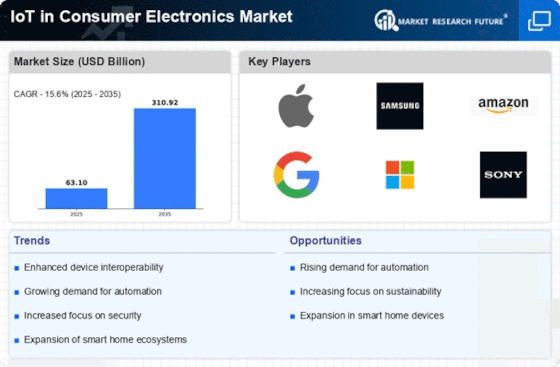
As per Market Research Future analysis, the IoT in Consumer Electronics Market was estimated at 63.1 USD Billion in 2024. The IoT in Consumer Electronics industry is projected to grow from 72.94 USD Billion in 2025 to 310.92 USD Billion by 2035, exhibiting a compound annual growth rate (CAGR) of 15.6% during the forecast period 2025 - 2035

Key Market Trends & Highlights

The IoT in Consumer Electronics Market is experiencing robust growth driven by technological advancements and evolving consumer preferences.

  • North America remains the largest market for IoT in consumer electronics, driven by high consumer spending on smart devices. The Asia-Pacific region is the fastest-growing market, reflecting a surge in demand for innovative consumer electronics solutions. Smartphones continue to dominate the market, while wearable devices are emerging as the fastest-growing segment due to increasing health awareness. Rising consumer demand for smart devices and the integration of artificial intelligence are key drivers propelling market expansion.

Market Size & Forecast

2024 Market Size 63.1 (USD Billion)
2035 Market Size 310.92 (USD Billion)
CAGR (2025 - 2035) 15.6%
Largest Regional Market Share in 2024 North America

Major Players

Apple (US), Samsung (KR), Amazon (US), Google (US), Microsoft (US), Sony (JP), LG Electronics (KR), Xiaomi (CN), Philips (NL)

Market Trends

The IoT in Consumer Electronics Market is currently experiencing a transformative phase, characterized by the integration of smart technologies into everyday devices. This evolution appears to be driven by consumer demand for enhanced connectivity and convenience. As households increasingly adopt smart appliances, wearables, and home automation systems, the market is likely to witness a surge in innovative product offerings. Companies are focusing on developing user-friendly interfaces and seamless interoperability among devices, which may enhance user experience and satisfaction. Furthermore, the growing emphasis on energy efficiency and sustainability is influencing product design and functionality, suggesting a shift towards eco-friendly solutions in consumer electronics. In addition, the competitive landscape of the IoT in Consumer Electronics Market is evolving, with both established players and new entrants vying for market share. Collaboration among technology firms, manufacturers, and service providers is becoming more prevalent, indicating a trend towards ecosystem development. This collaborative approach may facilitate the creation of comprehensive solutions that cater to diverse consumer needs. As the market continues to mature, it is anticipated that advancements in artificial intelligence and machine learning will further enhance the capabilities of IoT devices, potentially leading to more personalized and intuitive user experiences.

Increased Focus on Interoperability

The demand for seamless integration among various smart devices is rising. Consumers expect their devices to communicate effortlessly, leading manufacturers to prioritize interoperability in their product designs. This trend may foster a more cohesive smart home environment, enhancing user satisfaction.

Sustainability and Energy Efficiency

There is a growing awareness regarding environmental impact, prompting consumers to seek energy-efficient devices. Manufacturers are responding by developing products that not only reduce energy consumption but also utilize sustainable materials, aligning with consumer values and preferences.

Advancements in AI and Machine Learning

The incorporation of artificial intelligence and machine learning into consumer electronics is becoming more prevalent. These technologies may enable devices to learn user preferences and behaviors, resulting in more personalized experiences and improved functionality.

IoT Consumer Electronics Market Market Drivers

Focus on Enhanced User Experience

The emphasis on enhanced user experience is a critical driver in the IoT in Consumer Electronics Market. Consumers are increasingly seeking products that not only meet their functional needs but also provide intuitive and engaging interactions. This focus on user experience is prompting manufacturers to invest in design and usability, leading to the development of more sophisticated and user-friendly devices. As a result, the market is witnessing a shift towards products that integrate advanced features such as voice control, touch interfaces, and personalized settings. This trend is likely to continue shaping the landscape of the IoT in Consumer Electronics Market, as companies strive to differentiate themselves through superior user experiences.

Increased Connectivity and 5G Adoption

The advent of 5G technology is poised to revolutionize the IoT in Consumer Electronics Market by providing faster and more reliable connectivity. This enhanced connectivity facilitates seamless communication between devices, enabling real-time data exchange and improved user experiences. As 5G networks expand, the potential for IoT applications in consumer electronics becomes more pronounced, with projections indicating that the number of connected devices could exceed 30 billion by 2030. This proliferation of connected devices is likely to drive demand for innovative consumer electronics that leverage 5G capabilities, thereby propelling growth within the IoT in Consumer Electronics Market.

Integration of Artificial Intelligence

The integration of artificial intelligence (AI) within the IoT in Consumer Electronics Market is transforming the landscape of consumer electronics. AI enhances the functionality of smart devices, enabling them to learn user preferences and adapt accordingly. This capability not only improves user experience but also drives sales, as consumers are increasingly drawn to products that offer personalized features. The market for AI-enabled consumer electronics is expected to grow significantly, with estimates suggesting a compound annual growth rate of over 20% in the coming years. As AI continues to evolve, its synergy with IoT technology is likely to create new opportunities for innovation and differentiation in the market.

Rising Consumer Demand for Smart Devices

The IoT in Consumer Electronics Market is experiencing a notable surge in consumer demand for smart devices. As individuals increasingly seek convenience and enhanced functionality, the adoption of smart home appliances, wearables, and connected gadgets is on the rise. According to recent data, the market for smart home devices is projected to reach approximately 135 billion dollars by 2025. This growing interest in interconnected devices is driving manufacturers to innovate and expand their product offerings, thereby fueling the IoT in Consumer Electronics Market. Furthermore, the integration of IoT technology into everyday products is reshaping consumer expectations, leading to a more connected lifestyle that emphasizes efficiency and ease of use.

Growing Awareness of Smart Home Solutions

There is a growing awareness among consumers regarding the benefits of smart home solutions, which is significantly impacting the IoT in Consumer Electronics Market. As more individuals recognize the advantages of automation, security, and energy efficiency, the demand for smart home devices is escalating. Market Research Future indicates that the smart home market could reach 174 billion dollars by 2025, driven by consumer interest in enhancing home security and energy management. This trend is encouraging manufacturers to develop a wider range of smart home products, thereby contributing to the overall growth of the IoT in Consumer Electronics Market.

Market Segment Insights

By Type: Smartphones (Largest) vs. Wearable Devices (Fastest-Growing)

In the IoT in Consumer Electronics Market, the 'Type' segment is characterized by varying shares among its components. Smartphones dominate the segment, accounting for the largest proportion of market share due to their ubiquitous presence and functionality. Following smartphones, Smart TVs and Kitchen Appliances hold significant shares, although not as commanding. Wearable devices are carving out a notable presence, signifying a shift in consumer preferences towards more personal tech.

Smartphones (Dominant) vs. Wearable Devices (Emerging)

Smartphones remain the dominant force in the IoT in Consumer Electronics Market, driven by their multifunctionality and integration of IoT capabilities. These devices not only manage communication but also connect seamlessly with a wide array of smart home devices. Conversely, wearable devices are emerging rapidly, stimulated by increasing consumer interest in health and fitness tracking features. The ability of wearables to provide real-time data and enhance personal health insights positions them as a key growth area, appealing especially to tech-savvy consumers looking for convenience and connectivity.

By Connectivity: Wi-Fi (Largest) vs. Bluetooth (Fastest-Growing)

In the IoT in Consumer Electronics Market, the connectivity segment is primarily dominated by Wi-Fi, which offers robust internet connectivity and is widely adopted across devices. On the other hand, Bluetooth has carved out a significant niche, being the go-to choice for devices requiring short-range communication, thus representing a notable portion of the market share. Other connectivity options, including NFC and various custom protocols, contribute relatively smaller shares, but their importance in specific application scenarios cannot be overlooked. Looking at growth trends, Bluetooth is emerging as the fastest-growing segment, with rising demand for wireless devices and advancements in Bluetooth technology enhancing its capabilities. Wi-Fi continues to thrive as a reliable backbone for smart homes and connected consumer electronics, driven by increasing internet penetration and the proliferation of smart devices. Both segments are positively influenced by the ongoing trend of digital transformation and the growing emphasis on connectivity in consumer electronics.

Wi-Fi (Dominant) vs. Bluetooth (Emerging)

Wi-Fi is the dominant connectivity option in the IoT in Consumer Electronics Market, offering high bandwidth and the ability to connect multiple devices seamlessly. Its presence is critical in applications such as smart home systems, where reliable internet access is essential for device communication and cloud services. Bluetooth, while considered emerging, is experiencing rapid growth due to the rising usage of wearables and portable devices. This technology excels in power efficiency and ease of use, making it ideal for short-range applications like audio devices, health trackers, and smart home gadgets. Together, these connectivity solutions are shaping the interconnected landscape of consumer electronics.

Get more detailed insights about IoT in Consumer Electronics Market Research Report- Global Forecast to 2035

Regional Insights

North America : Innovation and Market Leadership

North America is the largest market for IoT in consumer electronics, holding approximately 40% of the global market share. The region benefits from strong technological infrastructure, high consumer demand for smart devices, and supportive government regulations promoting innovation. The increasing adoption of smart home devices and wearables is driving growth, with significant investments in IoT technologies from both private and public sectors. The United States is the dominant player in this market, with major companies like Apple, Amazon, and Google leading the charge. Canada also plays a significant role, contributing to the region's overall growth. The competitive landscape is characterized by rapid technological advancements and a focus on enhancing user experience, making North America a hub for IoT innovation.

Europe : Regulatory Framework and Growth

Europe is the second-largest market for IoT in consumer electronics, accounting for around 30% of the global market share. The region's growth is driven by stringent regulations aimed at data protection and privacy, which encourage the development of secure IoT solutions. The European Union's Digital Single Market strategy is a key regulatory catalyst, fostering innovation and collaboration among member states to enhance IoT adoption. Leading countries in this region include Germany, the UK, and France, with a strong presence of key players like Philips and Samsung. The competitive landscape is marked by a focus on sustainability and energy efficiency, aligning with the EU's green initiatives. European companies are increasingly investing in R&D to create innovative IoT solutions that meet regulatory standards while addressing consumer needs.

Asia-Pacific : Emerging Market Dynamics

Asia-Pacific is witnessing rapid growth in the IoT consumer electronics market, holding approximately 25% of the global market share. The region's growth is fueled by increasing smartphone penetration, urbanization, and a growing middle class with disposable income. Countries like China and India are at the forefront, with government initiatives promoting smart city projects and digital transformation, which are significant drivers for IoT adoption. China is the largest market in the region, with major players like Xiaomi and LG Electronics leading the charge. India is also emerging as a key player, with a focus on affordable IoT solutions. The competitive landscape is characterized by a mix of established companies and startups, all vying to capture the growing demand for smart devices and connected solutions in the consumer electronics sector.

Middle East and Africa : Untapped Potential and Growth

The Middle East and Africa (MEA) region is an emerging market for IoT in consumer electronics, currently holding about 5% of the global market share. The growth in this region is driven by increasing internet penetration, mobile connectivity, and government initiatives aimed at digital transformation. Countries like the UAE and South Africa are leading the way, with investments in smart city projects and IoT infrastructure, creating a conducive environment for market expansion. The competitive landscape is still developing, with a mix of local and international players entering the market. Key players are focusing on tailored solutions that meet the unique needs of consumers in this region. As awareness of IoT benefits grows, the MEA region is poised for significant growth, with opportunities for innovation and investment in consumer electronics.

Key Players and Competitive Insights

The IoT in Consumer Electronics Market is characterized by a rapidly evolving competitive landscape, driven by technological advancements and increasing consumer demand for smart devices. Major players such as Apple (US), Samsung (KR), and Amazon (US) are at the forefront, each adopting distinct strategies to enhance their market positioning. Apple (US) continues to focus on innovation, particularly in integrating IoT capabilities into its ecosystem of devices, thereby fostering customer loyalty and enhancing user experience. Samsung (KR), on the other hand, emphasizes regional expansion and partnerships, particularly in Asia, to leverage its manufacturing capabilities and broaden its product offerings. Amazon (US) is heavily investing in digital transformation, utilizing its vast data resources to enhance its smart home devices, which positions it as a leader in the IoT space. Collectively, these strategies contribute to a competitive environment that is increasingly defined by technological sophistication and consumer-centric innovations.Key business tactics within this market include localizing manufacturing and optimizing supply chains to enhance efficiency and reduce costs. The competitive structure appears moderately fragmented, with several key players exerting influence over various segments. This fragmentation allows for niche players to emerge, yet the dominance of major corporations like Apple (US) and Samsung (KR) ensures that the market remains competitive and dynamic. The collective influence of these key players shapes market trends, driving innovation and setting benchmarks for quality and performance.

In August Apple (US) announced the launch of its latest smart home device, which integrates advanced AI capabilities to enhance user interaction and automation. This strategic move not only reinforces Apple's commitment to innovation but also positions it to capture a larger share of the growing smart home market. The integration of AI is particularly significant, as it aligns with consumer expectations for more intuitive and responsive devices, thereby enhancing user satisfaction and loyalty.

In September Samsung (KR) unveiled a new partnership with a leading AI firm to develop next-generation IoT solutions for smart appliances. This collaboration is indicative of Samsung's strategy to leverage external expertise to accelerate innovation and expand its product portfolio. By integrating cutting-edge AI technologies into its appliances, Samsung aims to differentiate itself in a crowded market, appealing to tech-savvy consumers who prioritize smart functionalities in their home devices.

In October Amazon (US) launched a new initiative aimed at enhancing the interoperability of its smart home devices with third-party products. This strategic action reflects Amazon's recognition of the importance of ecosystem compatibility in driving consumer adoption. By fostering an open environment for device integration, Amazon not only enhances the user experience but also positions itself as a central player in the IoT ecosystem, potentially increasing its market share in the smart home segment.

As of October current competitive trends in the IoT in Consumer Electronics Market are heavily influenced by digitalization, sustainability, and AI integration. Strategic alliances are increasingly shaping the landscape, as companies recognize the value of collaboration in driving innovation and expanding market reach. Looking ahead, competitive differentiation is likely to evolve from traditional price-based competition to a focus on innovation, technology integration, and supply chain reliability. This shift underscores the necessity for companies to not only innovate but also ensure that their supply chains are robust and responsive to market demands.

Key Companies in the IoT Consumer Electronics Market include

Industry Developments

April 2024: Infineon has launched their new PSOC Edge, aimed at enhancing Al capabilities in lot, consumer, and industrial technologies. This development is expected to significantly accelerate the company’s growth by positioning infineon on the forefront of Al-driven innovation.

March 2024: at a Connectivity Standards Alliance (CSA) Member event in Singapore SEALSQ Corp announced the latest advancements in loT certification. These developments have an all-in-one solution for consumer loT device makers aiming to achieve the new Product Security Verified Mark.

February 2024: in order to help accelerate its growth Ceva introduced its next-generation low-power ultra-wideband IP for FiRa 2.0 that offers highly accurate and reliable wireless ranging capabilities. This innovative solution addresses the increasing demand for precise and dependable connectivity in both consumer and industrial lot applications. By improving wireless communication performance and efficiency, Ceva positions itself as a key player in the loT market with a view of attracting a broader customer base through such new customers. It will drive revenue growth by implementing advanced IoT technologies.

By 2024 Ericsson says that there will be 5G incorporated into 40% of total population with 1.5 bn subscription services hence making it the largest generation globally. This is driven by novel, inventive solutions reprocessing present infrastructure and a spectrum. Meanwhile in parallel with the deployment of 5G, Cellular IoT reaches major milestones towards becoming a definitive way of enabling broad IoT applications.

March 2023: The Non-Terrestrial Network (NTN) service operator Skylo Technologies, and Monogoto, the Cloud-based cellular network provider signed an agreement to provide an affordable and accessible solution for NB-IoT Satellite connectivity for asset tracking products. Employing the same hardware for both terrestrial and satellite communication will help expand connectivity in areas that were previously inaccessible.

February 2023: a team of Singapore entrepreneurs visited India’s Smart City Command Control Center as they plan to invest in Smart City projects, particularly in UP state, including an Integrated Traffic Management System, Solid Waste Management System, Health ATMs, etc.

February 2023: Canadian-based IoT company Eleven-x will enable North America municipal parking with smart parking system that monitors parking spots and provides real-time data on availability thereby reducing congestion within this area optimize parking enforcement system thus improving urban mobility.

February 2023: Westbase.io. And Taoglas, the IoT distributor, partnered in order to offer innovative 4G/5G and IoT solutions to its customers in the European region. This will provide customers with reliable and high-performance solutions throughout construction, emergency services, logistics, connected health, smart cities, and other demanding applications.

December 2022: Alliot Technologies partnered with Vodafone UK to offer NB-IoT connectivity across the entire country; Vodafone’s Network will transform Alliot’s offering from scale, innovation, efficiency. Through this partnership, alliot will invest in cutting-edge technology so as to ensure great experience for its clients.

December 2022: Vodafone UK and Alliot Technologies partnered to offer NB-IoT connectivity throughout the UK. The network of Vodafone will boost offerings of Alliot with scale, efficiency, and innovation. With this partnership, the investment will be made by Alliot in the latest technology to ensure an excellent experience for its clients, establishing them as the only NB-IoT connectivity provider in the UK.

October 2022: ABB, the technology company released SmartTouch 10 for smart home automation, which can help indoor communication, replacing additional indoor video stations The device manages entire building installation from IP cameras up to lighting, shading scene & temperature control.

August 2022: GrubMarket acquired IOT Pay which is North America's largest IOT Pay platform The acquisition helps GrubMarket to use IOT Pay's technology and payments infrastructure to streamline the food supply chain industry. Furthermore, IOT Pay aims to unveil a digital banking solution for SMBs.

March 2022: KaraMD announced Pure Health Apple Cider Vinegar Gummies, a vegan gummy aimed to aid ketosis, digestion regulation, weight management, and encourage greater levels of energy.


Future Outlook

IoT Consumer Electronics Market Future Outlook

The IoT in Consumer Electronics Market is projected to grow at a 15.6% CAGR from 2025 to 2035, driven by advancements in connectivity, consumer demand for smart devices, and enhanced data analytics capabilities.

New opportunities lie in:

  • Development of AI-integrated smart home ecosystems</p><p>Expansion of subscription-based IoT services for consumer electronics</p><p>Creation of personalized user experience platforms leveraging IoT data

By 2035, the market is expected to be robust, driven by innovation and consumer adoption.

Market Segmentation

IoT Consumer Electronics Market Type Outlook

  • Smart TVs
  • Smartphones
  • Wearable Devices
  • Kitchen Appliances
  • Others

IoT Consumer Electronics Market Connectivity Outlook

  • Bluetooth
  • NFC
  • Wi-Fi
  • Others

Report Scope

MARKET SIZE 2024 63.1(USD Billion)
MARKET SIZE 2025 72.94(USD Billion)
MARKET SIZE 2035 310.92(USD Billion)
COMPOUND ANNUAL GROWTH RATE (CAGR) 15.6% (2025 - 2035)
REPORT COVERAGE Revenue Forecast, Competitive Landscape, Growth Factors, and Trends
BASE YEAR 2024
Market Forecast Period 2025 - 2035
Historical Data 2019 - 2024
Market Forecast Units USD Billion
Key Companies Profiled Apple (US), Samsung (KR), Amazon (US), Google (US), Microsoft (US), Sony (JP), LG Electronics (KR), Xiaomi (CN), Philips (NL)
Segments Covered Product, Connectivity, Region
Key Market Opportunities Integration of artificial intelligence enhances user experience in the IoT in Consumer Electronics Market.
Key Market Dynamics Rising consumer demand for smart devices drives innovation and competition in the Internet of Things in consumer electronics.
Countries Covered North America, Europe, APAC, South America, MEA

FAQs

What is the current valuation of the IoT in Consumer Electronics Market as of 2024?

<p>The market valuation was 63.1 USD Billion in 2024.</p>

What is the projected market size for the IoT in Consumer Electronics Market by 2035?

<p>The market is projected to reach 310.92 USD Billion by 2035.</p>

What is the expected CAGR for the IoT in Consumer Electronics Market during the forecast period 2025 - 2035?

<p>The expected CAGR is 15.6% during the forecast period 2025 - 2035.</p>

Which companies are considered key players in the IoT in Consumer Electronics Market?

<p>Key players include Apple, Samsung, Amazon, Google, Microsoft, Sony, LG Electronics, Xiaomi, and Philips.</p>

How do Smart TVs perform in the IoT in Consumer Electronics Market?

<p>Smart TVs had a valuation of 15.0 USD Billion in 2024 and are projected to reach 70.0 USD Billion by 2035.</p>

What is the market performance of smartphones in the IoT sector?

<p>Smartphones were valued at 20.0 USD Billion in 2024 and are expected to grow to 100.0 USD Billion by 2035.</p>

What is the valuation trend for wearable devices in the IoT market?

Wearable devices had a valuation of 10.0 USD Billion in 2024, with projections reaching 50.0 USD Billion by 2035.

What is the expected growth for kitchen appliances in the IoT market?

Kitchen appliances were valued at 8.0 USD Billion in 2024 and are anticipated to grow to 40.0 USD Billion by 2035.

How does the connectivity segment perform in the IoT in Consumer Electronics Market?

The connectivity segment, particularly Wi-Fi, was valued at 25.23 USD Billion in 2024 and is projected to reach 123.12 USD Billion by 2035.

What are the projected valuations for Bluetooth and NFC in the IoT market?

Bluetooth was valued at 9.43 USD Billion in 2024, expected to grow to 45.96 USD Billion by 2035, while NFC is projected to rise from 3.15 USD Billion to 15.75 USD Billion.

  1. SECTION I: EXECUTIVE SUMMARY AND KEY HIGHLIGHTS
    1. | 1.1 EXECUTIVE SUMMARY
    2. | | 1.1.1 Market Overview
    3. | | 1.1.2 Key Findings
    4. | | 1.1.3 Market Segmentation
    5. | | 1.1.4 Competitive Landscape
    6. | | 1.1.5 Challenges and Opportunities
    7. | | 1.1.6 Future Outlook
  2. SECTION II: SCOPING, METHODOLOGY AND MARKET STRUCTURE
    1. | 2.1 MARKET INTRODUCTION
    2. | | 2.1.1 Definition
    3. | | 2.1.2 Scope of the study
    4. | | | 2.1.2.1 Research Objective
    5. | | | 2.1.2.2 Assumption
    6. | | | 2.1.2.3 Limitations
    7. | 2.2 RESEARCH METHODOLOGY
    8. | | 2.2.1 Overview
    9. | | 2.2.2 Data Mining
    10. | | 2.2.3 Secondary Research
    11. | | 2.2.4 Primary Research
    12. | | | 2.2.4.1 Primary Interviews and Information Gathering Process
    13. | | | 2.2.4.2 Breakdown of Primary Respondents
    14. | | 2.2.5 Forecasting Model
    15. | | 2.2.6 Market Size Estimation
    16. | | | 2.2.6.1 Bottom-Up Approach
    17. | | | 2.2.6.2 Top-Down Approach
    18. | | 2.2.7 Data Triangulation
    19. | | 2.2.8 Validation
  3. SECTION III: QUALITATIVE ANALYSIS
    1. | 3.1 MARKET DYNAMICS
    2. | | 3.1.1 Overview
    3. | | 3.1.2 Drivers
    4. | | 3.1.3 Restraints
    5. | | 3.1.4 Opportunities
    6. | 3.2 MARKET FACTOR ANALYSIS
    7. | | 3.2.1 Value chain Analysis
    8. | | 3.2.2 Porter's Five Forces Analysis
    9. | | | 3.2.2.1 Bargaining Power of Suppliers
    10. | | | 3.2.2.2 Bargaining Power of Buyers
    11. | | | 3.2.2.3 Threat of New Entrants
    12. | | | 3.2.2.4 Threat of Substitutes
    13. | | | 3.2.2.5 Intensity of Rivalry
    14. | | 3.2.3 COVID-19 Impact Analysis
    15. | | | 3.2.3.1 Market Impact Analysis
    16. | | | 3.2.3.2 Regional Impact
    17. | | | 3.2.3.3 Opportunity and Threat Analysis
  4. SECTION IV: QUANTITATIVE ANALYSIS
    1. | 4.1 Semiconductor & Electronics, BY Type (USD Billion)
    2. | | 4.1.1 Smart TVs
    3. | | 4.1.2 Smartphones
    4. | | 4.1.3 Wearable Devices
    5. | | 4.1.4 Kitchen Appliances
    6. | | 4.1.5 Others
    7. | 4.2 Semiconductor & Electronics, BY Connectivity (USD Billion)
    8. | | 4.2.1 Bluetooth
    9. | | 4.2.2 NFC
    10. | | 4.2.3 Wi-Fi
    11. | | 4.2.4 Others
    12. | 4.3 Semiconductor & Electronics, BY Region (USD Billion)
    13. | | 4.3.1 North America
    14. | | | 4.3.1.1 US
    15. | | | 4.3.1.2 Canada
    16. | | 4.3.2 Europe
    17. | | | 4.3.2.1 Germany
    18. | | | 4.3.2.2 UK
    19. | | | 4.3.2.3 France
    20. | | | 4.3.2.4 Russia
    21. | | | 4.3.2.5 Italy
    22. | | | 4.3.2.6 Spain
    23. | | | 4.3.2.7 Rest of Europe
    24. | | 4.3.3 APAC
    25. | | | 4.3.3.1 China
    26. | | | 4.3.3.2 India
    27. | | | 4.3.3.3 Japan
    28. | | | 4.3.3.4 South Korea
    29. | | | 4.3.3.5 Malaysia
    30. | | | 4.3.3.6 Thailand
    31. | | | 4.3.3.7 Indonesia
    32. | | | 4.3.3.8 Rest of APAC
    33. | | 4.3.4 South America
    34. | | | 4.3.4.1 Brazil
    35. | | | 4.3.4.2 Mexico
    36. | | | 4.3.4.3 Argentina
    37. | | | 4.3.4.4 Rest of South America
    38. | | 4.3.5 MEA
    39. | | | 4.3.5.1 GCC Countries
    40. | | | 4.3.5.2 South Africa
    41. | | | 4.3.5.3 Rest of MEA
  5. SECTION V: COMPETITIVE ANALYSIS
    1. | 5.1 Competitive Landscape
    2. | | 5.1.1 Overview
    3. | | 5.1.2 Competitive Analysis
    4. | | 5.1.3 Market share Analysis
    5. | | 5.1.4 Major Growth Strategy in the Semiconductor & Electronics
    6. | | 5.1.5 Competitive Benchmarking
    7. | | 5.1.6 Leading Players in Terms of Number of Developments in the Semiconductor & Electronics
    8. | | 5.1.7 Key developments and growth strategies
    9. | | | 5.1.7.1 New Product Launch/Service Deployment
    10. | | | 5.1.7.2 Merger & Acquisitions
    11. | | | 5.1.7.3 Joint Ventures
    12. | | 5.1.8 Major Players Financial Matrix
    13. | | | 5.1.8.1 Sales and Operating Income
    14. | | | 5.1.8.2 Major Players R&D Expenditure. 2023
    15. | 5.2 Company Profiles
    16. | | 5.2.1 Apple (US)
    17. | | | 5.2.1.1 Financial Overview
    18. | | | 5.2.1.2 Products Offered
    19. | | | 5.2.1.3 Key Developments
    20. | | | 5.2.1.4 SWOT Analysis
    21. | | | 5.2.1.5 Key Strategies
    22. | | 5.2.2 Samsung (KR)
    23. | | | 5.2.2.1 Financial Overview
    24. | | | 5.2.2.2 Products Offered
    25. | | | 5.2.2.3 Key Developments
    26. | | | 5.2.2.4 SWOT Analysis
    27. | | | 5.2.2.5 Key Strategies
    28. | | 5.2.3 Amazon (US)
    29. | | | 5.2.3.1 Financial Overview
    30. | | | 5.2.3.2 Products Offered
    31. | | | 5.2.3.3 Key Developments
    32. | | | 5.2.3.4 SWOT Analysis
    33. | | | 5.2.3.5 Key Strategies
    34. | | 5.2.4 Google (US)
    35. | | | 5.2.4.1 Financial Overview
    36. | | | 5.2.4.2 Products Offered
    37. | | | 5.2.4.3 Key Developments
    38. | | | 5.2.4.4 SWOT Analysis
    39. | | | 5.2.4.5 Key Strategies
    40. | | 5.2.5 Microsoft (US)
    41. | | | 5.2.5.1 Financial Overview
    42. | | | 5.2.5.2 Products Offered
    43. | | | 5.2.5.3 Key Developments
    44. | | | 5.2.5.4 SWOT Analysis
    45. | | | 5.2.5.5 Key Strategies
    46. | | 5.2.6 Sony (JP)
    47. | | | 5.2.6.1 Financial Overview
    48. | | | 5.2.6.2 Products Offered
    49. | | | 5.2.6.3 Key Developments
    50. | | | 5.2.6.4 SWOT Analysis
    51. | | | 5.2.6.5 Key Strategies
    52. | | 5.2.7 LG Electronics (KR)
    53. | | | 5.2.7.1 Financial Overview
    54. | | | 5.2.7.2 Products Offered
    55. | | | 5.2.7.3 Key Developments
    56. | | | 5.2.7.4 SWOT Analysis
    57. | | | 5.2.7.5 Key Strategies
    58. | | 5.2.8 Xiaomi (CN)
    59. | | | 5.2.8.1 Financial Overview
    60. | | | 5.2.8.2 Products Offered
    61. | | | 5.2.8.3 Key Developments
    62. | | | 5.2.8.4 SWOT Analysis
    63. | | | 5.2.8.5 Key Strategies
    64. | | 5.2.9 Philips (NL)
    65. | | | 5.2.9.1 Financial Overview
    66. | | | 5.2.9.2 Products Offered
    67. | | | 5.2.9.3 Key Developments
    68. | | | 5.2.9.4 SWOT Analysis
    69. | | | 5.2.9.5 Key Strategies
    70. | 5.3 Appendix
    71. | | 5.3.1 References
    72. | | 5.3.2 Related Reports
  6. LIST OF FIGURES
    1. | 6.1 MARKET SYNOPSIS
    2. | 6.2 NORTH AMERICA MARKET ANALYSIS
    3. | 6.3 US MARKET ANALYSIS BY TYPE
    4. | 6.4 US MARKET ANALYSIS BY CONNECTIVITY
    5. | 6.5 CANADA MARKET ANALYSIS BY TYPE
    6. | 6.6 CANADA MARKET ANALYSIS BY CONNECTIVITY
    7. | 6.7 EUROPE MARKET ANALYSIS
    8. | 6.8 GERMANY MARKET ANALYSIS BY TYPE
    9. | 6.9 GERMANY MARKET ANALYSIS BY CONNECTIVITY
    10. | 6.10 UK MARKET ANALYSIS BY TYPE
    11. | 6.11 UK MARKET ANALYSIS BY CONNECTIVITY
    12. | 6.12 FRANCE MARKET ANALYSIS BY TYPE
    13. | 6.13 FRANCE MARKET ANALYSIS BY CONNECTIVITY
    14. | 6.14 RUSSIA MARKET ANALYSIS BY TYPE
    15. | 6.15 RUSSIA MARKET ANALYSIS BY CONNECTIVITY
    16. | 6.16 ITALY MARKET ANALYSIS BY TYPE
    17. | 6.17 ITALY MARKET ANALYSIS BY CONNECTIVITY
    18. | 6.18 SPAIN MARKET ANALYSIS BY TYPE
    19. | 6.19 SPAIN MARKET ANALYSIS BY CONNECTIVITY
    20. | 6.20 REST OF EUROPE MARKET ANALYSIS BY TYPE
    21. | 6.21 REST OF EUROPE MARKET ANALYSIS BY CONNECTIVITY
    22. | 6.22 APAC MARKET ANALYSIS
    23. | 6.23 CHINA MARKET ANALYSIS BY TYPE
    24. | 6.24 CHINA MARKET ANALYSIS BY CONNECTIVITY
    25. | 6.25 INDIA MARKET ANALYSIS BY TYPE
    26. | 6.26 INDIA MARKET ANALYSIS BY CONNECTIVITY
    27. | 6.27 JAPAN MARKET ANALYSIS BY TYPE
    28. | 6.28 JAPAN MARKET ANALYSIS BY CONNECTIVITY
    29. | 6.29 SOUTH KOREA MARKET ANALYSIS BY TYPE
    30. | 6.30 SOUTH KOREA MARKET ANALYSIS BY CONNECTIVITY
    31. | 6.31 MALAYSIA MARKET ANALYSIS BY TYPE
    32. | 6.32 MALAYSIA MARKET ANALYSIS BY CONNECTIVITY
    33. | 6.33 THAILAND MARKET ANALYSIS BY TYPE
    34. | 6.34 THAILAND MARKET ANALYSIS BY CONNECTIVITY
    35. | 6.35 INDONESIA MARKET ANALYSIS BY TYPE
    36. | 6.36 INDONESIA MARKET ANALYSIS BY CONNECTIVITY
    37. | 6.37 REST OF APAC MARKET ANALYSIS BY TYPE
    38. | 6.38 REST OF APAC MARKET ANALYSIS BY CONNECTIVITY
    39. | 6.39 SOUTH AMERICA MARKET ANALYSIS
    40. | 6.40 BRAZIL MARKET ANALYSIS BY TYPE
    41. | 6.41 BRAZIL MARKET ANALYSIS BY CONNECTIVITY
    42. | 6.42 MEXICO MARKET ANALYSIS BY TYPE
    43. | 6.43 MEXICO MARKET ANALYSIS BY CONNECTIVITY
    44. | 6.44 ARGENTINA MARKET ANALYSIS BY TYPE
    45. | 6.45 ARGENTINA MARKET ANALYSIS BY CONNECTIVITY
    46. | 6.46 REST OF SOUTH AMERICA MARKET ANALYSIS BY TYPE
    47. | 6.47 REST OF SOUTH AMERICA MARKET ANALYSIS BY CONNECTIVITY
    48. | 6.48 MEA MARKET ANALYSIS
    49. | 6.49 GCC COUNTRIES MARKET ANALYSIS BY TYPE
    50. | 6.50 GCC COUNTRIES MARKET ANALYSIS BY CONNECTIVITY
    51. | 6.51 SOUTH AFRICA MARKET ANALYSIS BY TYPE
    52. | 6.52 SOUTH AFRICA MARKET ANALYSIS BY CONNECTIVITY
    53. | 6.53 REST OF MEA MARKET ANALYSIS BY TYPE
    54. | 6.54 REST OF MEA MARKET ANALYSIS BY CONNECTIVITY
    55. | 6.55 KEY BUYING CRITERIA OF SEMICONDUCTOR & ELECTRONICS
    56. | 6.56 RESEARCH PROCESS OF MRFR
    57. | 6.57 DRO ANALYSIS OF SEMICONDUCTOR & ELECTRONICS
    58. | 6.58 DRIVERS IMPACT ANALYSIS: SEMICONDUCTOR & ELECTRONICS
    59. | 6.59 RESTRAINTS IMPACT ANALYSIS: SEMICONDUCTOR & ELECTRONICS
    60. | 6.60 SUPPLY / VALUE CHAIN: SEMICONDUCTOR & ELECTRONICS
    61. | 6.61 SEMICONDUCTOR & ELECTRONICS, BY TYPE, 2024 (% SHARE)
    62. | 6.62 SEMICONDUCTOR & ELECTRONICS, BY TYPE, 2024 TO 2035 (USD Billion)
    63. | 6.63 SEMICONDUCTOR & ELECTRONICS, BY CONNECTIVITY, 2024 (% SHARE)
    64. | 6.64 SEMICONDUCTOR & ELECTRONICS, BY CONNECTIVITY, 2024 TO 2035 (USD Billion)
    65. | 6.65 BENCHMARKING OF MAJOR COMPETITORS
  7. LIST OF TABLES
    1. | 7.1 LIST OF ASSUMPTIONS
    2. | | 7.1.1
    3. | 7.2 North America MARKET SIZE ESTIMATES; FORECAST
    4. | | 7.2.1 BY TYPE, 2025-2035 (USD Billion)
    5. | | 7.2.2 BY CONNECTIVITY, 2025-2035 (USD Billion)
    6. | 7.3 US MARKET SIZE ESTIMATES; FORECAST
    7. | | 7.3.1 BY TYPE, 2025-2035 (USD Billion)
    8. | | 7.3.2 BY CONNECTIVITY, 2025-2035 (USD Billion)
    9. | 7.4 Canada MARKET SIZE ESTIMATES; FORECAST
    10. | | 7.4.1 BY TYPE, 2025-2035 (USD Billion)
    11. | | 7.4.2 BY CONNECTIVITY, 2025-2035 (USD Billion)
    12. | 7.5 Europe MARKET SIZE ESTIMATES; FORECAST
    13. | | 7.5.1 BY TYPE, 2025-2035 (USD Billion)
    14. | | 7.5.2 BY CONNECTIVITY, 2025-2035 (USD Billion)
    15. | 7.6 Germany MARKET SIZE ESTIMATES; FORECAST
    16. | | 7.6.1 BY TYPE, 2025-2035 (USD Billion)
    17. | | 7.6.2 BY CONNECTIVITY, 2025-2035 (USD Billion)
    18. | 7.7 UK MARKET SIZE ESTIMATES; FORECAST
    19. | | 7.7.1 BY TYPE, 2025-2035 (USD Billion)
    20. | | 7.7.2 BY CONNECTIVITY, 2025-2035 (USD Billion)
    21. | 7.8 France MARKET SIZE ESTIMATES; FORECAST
    22. | | 7.8.1 BY TYPE, 2025-2035 (USD Billion)
    23. | | 7.8.2 BY CONNECTIVITY, 2025-2035 (USD Billion)
    24. | 7.9 Russia MARKET SIZE ESTIMATES; FORECAST
    25. | | 7.9.1 BY TYPE, 2025-2035 (USD Billion)
    26. | | 7.9.2 BY CONNECTIVITY, 2025-2035 (USD Billion)
    27. | 7.10 Italy MARKET SIZE ESTIMATES; FORECAST
    28. | | 7.10.1 BY TYPE, 2025-2035 (USD Billion)
    29. | | 7.10.2 BY CONNECTIVITY, 2025-2035 (USD Billion)
    30. | 7.11 Spain MARKET SIZE ESTIMATES; FORECAST
    31. | | 7.11.1 BY TYPE, 2025-2035 (USD Billion)
    32. | | 7.11.2 BY CONNECTIVITY, 2025-2035 (USD Billion)
    33. | 7.12 Rest of Europe MARKET SIZE ESTIMATES; FORECAST
    34. | | 7.12.1 BY TYPE, 2025-2035 (USD Billion)
    35. | | 7.12.2 BY CONNECTIVITY, 2025-2035 (USD Billion)
    36. | 7.13 APAC MARKET SIZE ESTIMATES; FORECAST
    37. | | 7.13.1 BY TYPE, 2025-2035 (USD Billion)
    38. | | 7.13.2 BY CONNECTIVITY, 2025-2035 (USD Billion)
    39. | 7.14 China MARKET SIZE ESTIMATES; FORECAST
    40. | | 7.14.1 BY TYPE, 2025-2035 (USD Billion)
    41. | | 7.14.2 BY CONNECTIVITY, 2025-2035 (USD Billion)
    42. | 7.15 India MARKET SIZE ESTIMATES; FORECAST
    43. | | 7.15.1 BY TYPE, 2025-2035 (USD Billion)
    44. | | 7.15.2 BY CONNECTIVITY, 2025-2035 (USD Billion)
    45. | 7.16 Japan MARKET SIZE ESTIMATES; FORECAST
    46. | | 7.16.1 BY TYPE, 2025-2035 (USD Billion)
    47. | | 7.16.2 BY CONNECTIVITY, 2025-2035 (USD Billion)
    48. | 7.17 South Korea MARKET SIZE ESTIMATES; FORECAST
    49. | | 7.17.1 BY TYPE, 2025-2035 (USD Billion)
    50. | | 7.17.2 BY CONNECTIVITY, 2025-2035 (USD Billion)
    51. | 7.18 Malaysia MARKET SIZE ESTIMATES; FORECAST
    52. | | 7.18.1 BY TYPE, 2025-2035 (USD Billion)
    53. | | 7.18.2 BY CONNECTIVITY, 2025-2035 (USD Billion)
    54. | 7.19 Thailand MARKET SIZE ESTIMATES; FORECAST
    55. | | 7.19.1 BY TYPE, 2025-2035 (USD Billion)
    56. | | 7.19.2 BY CONNECTIVITY, 2025-2035 (USD Billion)
    57. | 7.20 Indonesia MARKET SIZE ESTIMATES; FORECAST
    58. | | 7.20.1 BY TYPE, 2025-2035 (USD Billion)
    59. | | 7.20.2 BY CONNECTIVITY, 2025-2035 (USD Billion)
    60. | 7.21 Rest of APAC MARKET SIZE ESTIMATES; FORECAST
    61. | | 7.21.1 BY TYPE, 2025-2035 (USD Billion)
    62. | | 7.21.2 BY CONNECTIVITY, 2025-2035 (USD Billion)
    63. | 7.22 South America MARKET SIZE ESTIMATES; FORECAST
    64. | | 7.22.1 BY TYPE, 2025-2035 (USD Billion)
    65. | | 7.22.2 BY CONNECTIVITY, 2025-2035 (USD Billion)
    66. | 7.23 Brazil MARKET SIZE ESTIMATES; FORECAST
    67. | | 7.23.1 BY TYPE, 2025-2035 (USD Billion)
    68. | | 7.23.2 BY CONNECTIVITY, 2025-2035 (USD Billion)
    69. | 7.24 Mexico MARKET SIZE ESTIMATES; FORECAST
    70. | | 7.24.1 BY TYPE, 2025-2035 (USD Billion)
    71. | | 7.24.2 BY CONNECTIVITY, 2025-2035 (USD Billion)
    72. | 7.25 Argentina MARKET SIZE ESTIMATES; FORECAST
    73. | | 7.25.1 BY TYPE, 2025-2035 (USD Billion)
    74. | | 7.25.2 BY CONNECTIVITY, 2025-2035 (USD Billion)
    75. | 7.26 Rest of South America MARKET SIZE ESTIMATES; FORECAST
    76. | | 7.26.1 BY TYPE, 2025-2035 (USD Billion)
    77. | | 7.26.2 BY CONNECTIVITY, 2025-2035 (USD Billion)
    78. | 7.27 MEA MARKET SIZE ESTIMATES; FORECAST
    79. | | 7.27.1 BY TYPE, 2025-2035 (USD Billion)
    80. | | 7.27.2 BY CONNECTIVITY, 2025-2035 (USD Billion)
    81. | 7.28 GCC Countries MARKET SIZE ESTIMATES; FORECAST
    82. | | 7.28.1 BY TYPE, 2025-2035 (USD Billion)
    83. | | 7.28.2 BY CONNECTIVITY, 2025-2035 (USD Billion)
    84. | 7.29 South Africa MARKET SIZE ESTIMATES; FORECAST
    85. | | 7.29.1 BY TYPE, 2025-2035 (USD Billion)
    86. | | 7.29.2 BY CONNECTIVITY, 2025-2035 (USD Billion)
    87. | 7.30 Rest of MEA MARKET SIZE ESTIMATES; FORECAST
    88. | | 7.30.1 BY TYPE, 2025-2035 (USD Billion)
    89. | | 7.30.2 BY CONNECTIVITY, 2025-2035 (USD Billion)
    90. | 7.31 PRODUCT LAUNCH/PRODUCT DEVELOPMENT/APPROVAL
    91. | | 7.31.1
    92. | 7.32 ACQUISITION/PARTNERSHIP
    93. | | 7.32.1

Semiconductor & Electronics Market Segmentation

Semiconductor & Electronics By Type (USD Billion, 2025-2035)

  • Smart TVs
  • Smartphones
  • Wearable Devices
  • Kitchen Appliances
  • Others

Semiconductor & Electronics By Connectivity (USD Billion, 2025-2035)

  • Bluetooth
  • NFC
  • Wi-Fi
  • Others
Infographic

Free Sample Request

Kindly complete the form below to receive a free sample of this Report

Get Free Sample

Customer Strories

Compare Licence

×
Features License Type
Single User Multiuser License Enterprise User
Price $4,950 $5,950 $7,250
Maximum User Access Limit 1 User Upto 10 Users Unrestricted Access Throughout the Organization
Free Customization
Direct Access to Analyst
Deliverable Format
Platform Access
Discount on Next Purchase 10% 15% 15%
Printable Versions