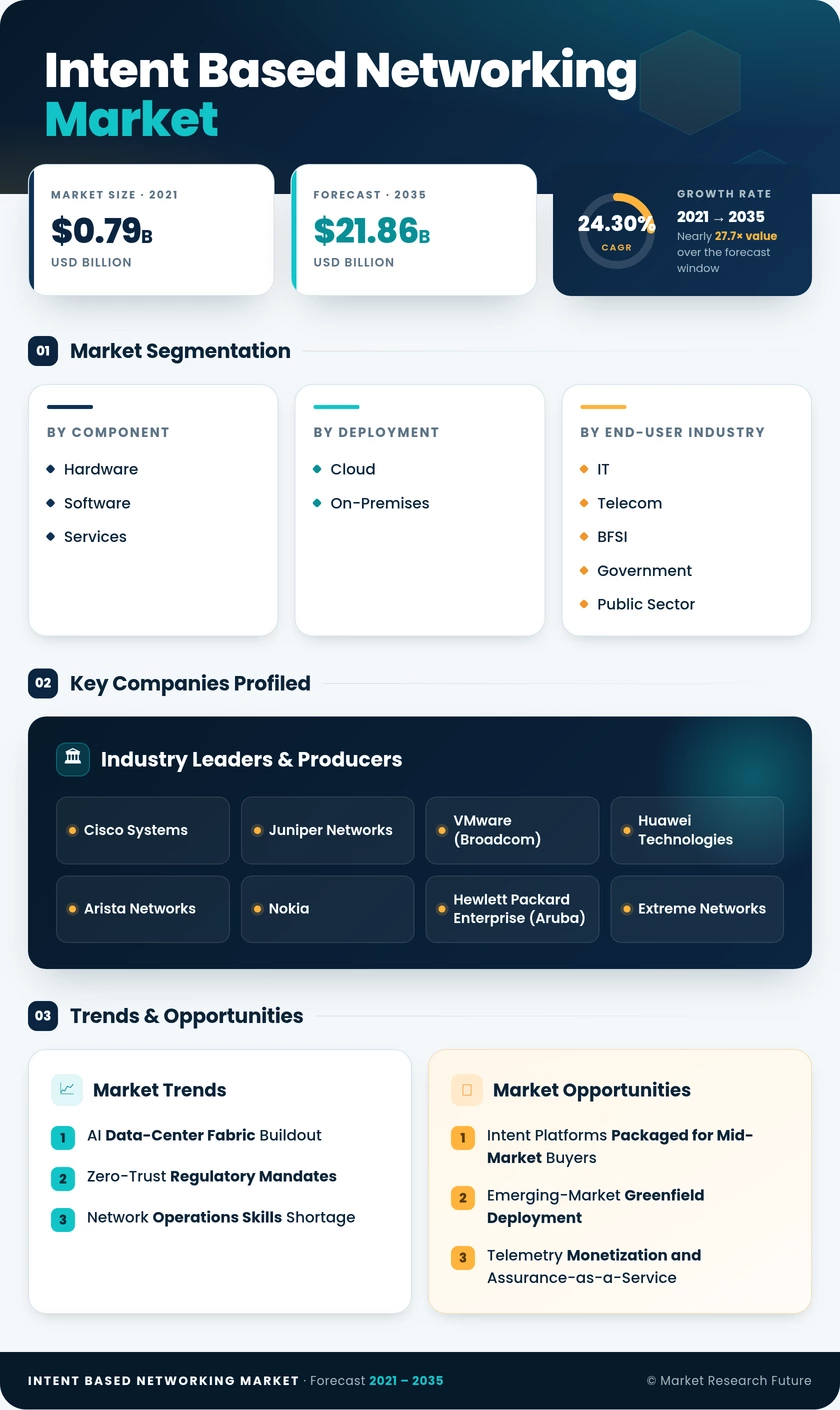
Segmentation Quick Reference
| Dimension | Sub-Segments | Dominant Segment | Fastest Growing Segment |
| By Component | Hardware, Software, Services | Software (48.5% share, 2025) | Services (23.90% CAGR) |
| By Deployment | Cloud, On-Premises | Cloud (53.5% share, 2025) | On-Premises (26.80% CAGR) |
| By End-user Industry | IT and Telecom, BFSI, Government and Public Sector, Manufacturing, Healthcare, Other Industries | IT and Telecom (33.5% share, 2025) | Healthcare (24.90% CAGR) |
| By End-user Enterprise Size | Large Enterprises, Small and Medium Enterprises (SMEs) | Large Enterprises (69.0% share, 2025) | Small and Medium Enterprises (SMEs) (27.90% CAGR) |
| By Network Domain | Campus / Enterprise LAN, Data Center, WAN / SD-WAN | Data Center (44.5% share, 2025) | WAN / SD-WAN (28.20% CAGR) |
Market Segmentation Overview
By Component
| Sub-Segment | Key Trend |
| Hardware | Migration to 400/800 GbE platforms with embedded inference silicon |
| Software | Policy translation and closed-loop assurance as the platform core |
| Services | Outcome-based lifecycle contracts and brownfield migration support |
Software leads this dimension at 48.5% of 2025 revenue because buyers pay for intent translation and continuous verification rather than forwarding capacity, and Hardware increasingly ships as a substrate whose value depends on the policy engine above it. Services grow fastest at a 23.90% CAGR, reflecting the shortage of internal architects capable of executing legacy migrations. Enterprises purchasing all three together typically bundle them into a single subscription, which blurs revenue attribution but strengthens supplier retention.
By Deployment
| Sub-Segment | Key Trend |
| Cloud | Subscription control planes with rapid model update cadence |
| On-Premises | Sovereign and latency-bound deployments in regulated estates |
Cloud holds 53.5% of 2025 revenue because CIOs prefer operating-expense predictability and immediate access to new assurance models without upgrade projects. On-Premises nevertheless posts the faster 26.80% CAGR, driven by European and Asia-Pacific regulated buyers whose residency rules prohibit telemetry export to shared infrastructure. The practical outcome is hybrid: local enforcement with centrally maintained policy logic, which lets both sub-segments expand simultaneously rather than one displacing the other.
By End-user Industry
| Sub-Segment | Key Trend |
| IT and Telecom | Slicing automation and network-as-code monetization |
| BFSI | Payment-system resilience and segmentation auditability |
| Government and Public Sector | Zero-trust maturity reporting obligations |
| Manufacturing | OT/IT convergence with deterministic latency guarantees |
| Healthcare | Clinical device connectivity and telemetry-rich diagnostics |
| Other Industries | Retail, education, and logistics multi-site estates |
IT and Telecom dominate at 33.5% share because carriers need fine-grained policy control to sell differentiated connectivity products, a commercial requirement absent in most other verticals. Healthcare grows fastest at a 24.90% CAGR, since hospitals now equate continuous connectivity with patient safety and cannot schedule maintenance windows around clinical operations. Government and Public Sector adoption tracks compliance deadlines rather than technology preference, giving it a steadier but less elastic demand profile.
By End-user Enterprise Size
| Sub-Segment | Key Trend |
| Large Enterprises | Multi-domain policy federation across campus, data center, and multicloud |
| Small and Medium Enterprises (SMEs) | Partner-delivered managed subscriptions with templated policy libraries |
Large Enterprises account for 69.0% of 2025 revenue because only they operate estates complex enough to justify federation across three or more domains, and only they staff the architecture teams required for initial deployment. Small and Medium Enterprises (SMEs) advance fastest at a 27.90% CAGR as integrators package templated policies and remote operations into monthly fees, removing the skills prerequisite entirely. That channel dependency makes SME growth contingent on partner enablement rather than direct vendor sales capacity.
By Network Domain
| Sub-Segment | Key Trend |
| Campus / Enterprise LAN | Identity-based onboarding for hybrid-work device volumes |
| Data Center | AI cluster fabrics requiring congestion-aware policy |
| WAN / SD-WAN | Uniform policy enforcement across unstaffed distributed sites |
Data Center leads at 44.5% of 2025 revenue because GPU cluster topologies produce configuration permutations that exceed manual capacity, making automation a deployment prerequisite rather than an optimization. WAN / SD-WAN grows fastest at a 28.20% CAGR as retail, logistics, and branch estates expand faster than the engineering teams supporting them. Campus / Enterprise LAN retains a large installed base, but its growth is refresh-driven and therefore paced by hardware replacement cycles rather than new-site creation.


 Noah Malgeri
Co-Founder

 Peter Groot koerkamp
Account and Business Manager

 Younghwan Choi
Senior Retail Manager

 Mark Irwin
Management Consultant

 Akif Moroglu
Strategy & Business Development Director

 Guilherme Gomes Martins
Product Management Director

 Joseph Aguayo
Sales Operations & Pricing Manager

 La Terria Dodd
Program Support Specialist

 Rob Kooiker
Group Product Manager HVAC & Fire Protection GMA