Request Free Sample ×

Kindly complete the form below to receive a free sample of this Report

* Please use a valid business email

Leading companies partner with us for data-driven Insights

clients tt-cursor
Hero Background
English
Chinese
French
Japanese
Korean
German
Spanish

Integrated Circuit Chip Market Analysis

ID: MRFR/SEM/12386-HCR
200 Pages
Ankit Gupta
April 2026

Integrated Circuit Chip Market Size, Share and Research Report By Type (Digital IC, Analog IC, Mixed-Signal IC), By Product Type (General-Purpose IC, Application-Specific IC), By Industry Vertical (Consumer Electronics, Automotive, IT & Telecommunications, Manufacturing and Automation, Healthcare, Aerospace & Defense, Others) And By Region (North America, Europe, Asia-Pacific, And Rest of The World) –Industry Forecast Till 2035

Share:
Download PDF ×

We do not share your information with anyone. However, we may send you emails based on your report interest from time to time. You may contact us at any time to opt-out.

Integrated Circuit Chip Market Infographic
Purchase Options

Market Analysis

Integrated Circuit Chip Market (Global, 2023)

Introduction

The IC market is the spearhead of innovation, a key component of the vast array of electric devices that have come to define modern life. The IC market is undergoing a sea change driven by the IoT, AI, and 5G. The ICs that form the brains of devices from mobile phones and PCs to cars and industry are becoming more sophisticated, enabling higher performance and better energy efficiency. The industry is populated with a diverse array of players, from the established giants to the newcomers. All of them are striving to carve out a share of the market through innovation and strategic alliances. And, as the market develops, the ongoing challenges of supply chain disruptions and geopolitical tensions are changing the game, influencing the way companies are rethinking their sourcing and manufacturing strategies. As the industry navigates these complexities, it is essential for all market participants to understand the trends, opportunities, and challenges in the IC market.

PESTLE Analysis

Political
In 2023, the IC market was heavily influenced by the policy of the government to promote the development of the domestic semiconductor industry. The U.S. CHIPS Act, which allocated fifty-two billion dollars to promote the development of the U.S. semiconductor industry, was the main political factor driving the IC market. In addition, the conflict between China and the United States also led to the export of high-tech chips and the collapse of the supply chain. , the market was more complex. For example, the U.S. Department of Commerce reported that in 2023, the export of 30% of the IC chip to China would be subject to a new certification, which would lead to market fluctuations.
Economic
In 2023, the economic situation in the IC market will be characterized by rising production costs and inflationary pressures. The average cost of semiconductor manufacturing equipment will increase by approximately 15% compared to 2022, driven by the impact of supply chain disruptions and the growing demand for advanced equipment. In addition, in the United States, the number of employees in the semiconductor industry will reach 1.2 million in early 2023, indicating a strong labor market, but also indicating the challenge of labor shortages in skilled positions that can hinder production.
Social
The IC market is influenced by the growing demand for electrical appliances, and the increasing awareness of the role played by technology in daily life. It was estimated that by 2023, over 80 per cent of households in developed countries would own at least three smart devices, which would have a positive impact on the demand for ICs. The rising trend towards environmentalism also encouraged consumers to favour products that used energy-efficient ICs, and this in turn encouraged manufacturers to innovate in this area. According to one survey, more than 65 per cent of consumers were willing to pay a higher price for products that used less energy. This had a significant impact on product development strategies.
Technological
Advances in technology are rapidly transforming the integrated circuit market, with a notable trend towards smaller, more efficient chips. In 2023, the industry will have adopted the 5nm and 3nm process technology. Leading the way are TSMC and Samsung. Their combined production of 5nm chips is around a billion units, a 20 per cent increase over the previous year. In addition, as the demand for artificial intelligence and machine learning rises, the market for specialised chips is expected to grow rapidly. By 2023, the market for AI chips will have grown to 25 per cent of the total.
Legal
Legal factors affecting the IC chip market are the laws and regulations regarding intellectual property and fair competition. In 2023, the United States Trademark and Patent Office reported that the percentage of patents related to the IC chip industry accounted for 35% of all patents for technology filed in that year. This clearly indicated the fierce competition in the industry. In addition, the rules of international trade are also important. There are tariffs and export restrictions. Also, the European Union has recently passed the Digital Market Act, which regulates large Internet companies, and will have an impact on the IC chip industry in the European Union.
Environmental
The integrated circuits market is increasingly influenced by the environment, especially in terms of waste disposal and the disposal of waste. In 2023, it is expected that e-waste will reach about 1,500,000 tons worldwide from the manufacture of integrated circuits. This has led to the need for a more sustainable development. And that is where green technology is important, because today about 40 percent of semiconductor companies have committed themselves to reducing their carbon footprint by 25 percent by 2025. And since the average fab uses 500,000 liters of water per day, water conservation is also an important issue.

Porter's Five Forces

Threat of New Entrants
The market for integrated circuits is characterized by high barriers to entry, such as high capital requirements, advanced technology, and consumers’ brand loyalty. However, with the development of technology and the emergence of niche markets, new entrants may find opportunities, especially in the field of special applications.
Bargaining Power of Suppliers
The supply of materials and components for ICs is wide-ranging, with many suppliers. The suppliers' bargaining power is limited by the abundance of the supply, because manufacturers can easily change suppliers without much trouble or cost.
Bargaining Power of Buyers
The buyers of integrated circuits, the large high-tech companies and manufacturers, have considerable negotiating power because of their size and the volume of their purchases. They can bargain for lower prices and they can also demand higher quality or additional features, which puts pressure on the producers.
Threat of Substitutes
The fact is that there are several alternative technological processes which can perform the same functions as the integrated circuits. These are field-programmable gate arrays (FPGAs) and application-specific integrated circuits (ASICs). But the unique characteristics and the high performance of the conventional chip make these alternative processes less dangerous. However, the technological progress that is constantly being made may in the long run increase this danger.
Competitive Rivalry
Competition in the market for integrated circuits is intense among the established companies, among which the major players with large market shares. The rivalry is based on rapid technological development, price competition and the constant need for innovation, and this creates a highly dynamic market environment.

SWOT Analysis

Strengths

  • High demand for integrated circuits in consumer electronics and automotive sectors.
  • Advancements in technology leading to smaller, more efficient chips.
  • Strong investment in research and development by leading manufacturers.

Weaknesses

  • High production costs and capital-intensive manufacturing processes.
  • Supply chain vulnerabilities, particularly in semiconductor materials.
  • Limited availability of skilled labor in advanced chip design and manufacturing.

Opportunities

  • Growing demand for IoT devices and smart technologies.
  • Expansion into emerging markets with increasing electronics consumption.
  • Potential for innovation in AI and machine learning applications.

Threats

  • Intense competition leading to price wars among manufacturers.
  • Geopolitical tensions affecting global supply chains.
  • Rapid technological changes requiring constant adaptation and investment.

Summary

The IC market will be characterized by strong demand in 2023, driven by technological development and significant investment in R & D. The high cost of production and the weakening of the supply chain are the main challenges. Opportunities exist in the IoT and in emerging markets. Competition and geopolitical risks may limit growth. Strategically, innovation and supply chain resilience will be the main drivers of success.


Author
Author Profile
Ankit Gupta
Team Lead - Research

Ankit Gupta is a seasoned market intelligence and strategic research professional with over six plus years of experience in the ICT and Semiconductor industries. With academic roots in Telecom, Marketing, and Electronics, he blends technical insight with business strategy. Ankit has led 200+ projects, including work for Fortune 500 clients like Microsoft and Rio Tinto, covering market sizing, tech forecasting, and go-to-market strategies. Known for bridging engineering and enterprise decision-making, his insights support growth, innovation, and investment planning across diverse technology markets.

Leave a Comment

FAQs

What is the projected market valuation of the Integrated Circuit Chip Market by 2035?

<p>The Integrated Circuit Chip Market is projected to reach a valuation of 2305.25 USD Billion by 2035.</p>

What was the market valuation of the Integrated Circuit Chip Market in 2024?

<p>In 2024, the market valuation of the Integrated Circuit Chip Market was 618.81 USD Billion.</p>

What is the expected CAGR for the Integrated Circuit Chip Market during the forecast period 2025 - 2035?

<p>The expected CAGR for the Integrated Circuit Chip Market during the forecast period 2025 - 2035 is 12.7%.</p>

Which companies are considered key players in the Integrated Circuit Chip Market?

<p>Key players in the Integrated Circuit Chip Market include Intel Corporation, Samsung Electronics, and Taiwan Semiconductor Manufacturing Company.</p>

What are the main segments of the Integrated Circuit Chip Market?

<p>The main segments of the Integrated Circuit Chip Market include Digital IC, Analog IC, and Mixed-Signal IC.</p>

How much is the Digital IC segment valued at in 2025?

<p>The Digital IC segment is valued at 900.0 USD Billion in 2025.</p>

What is the projected valuation for the Application-Specific IC segment by 2035?

<p>The Application-Specific IC segment is projected to reach a valuation of 1385.0 USD Billion by 2035.</p>

Which industry vertical is expected to have the highest valuation in 2025?

<p>The IT & Telecommunications industry vertical is expected to have the highest valuation at 700.0 USD Billion in 2025.</p>

What was the valuation of the Automotive segment in 2024?

<p>In 2024, the Automotive segment was valued at 400.0 USD Billion.</p>

How does the Mixed-Signal IC segment compare to the Analog IC segment in 2025?

<p>In 2025, the Mixed-Signal IC segment is projected to be valued at 705.25 USD Billion, slightly higher than the Analog IC segment at 700.0 USD Billion.</p>

Market Summary

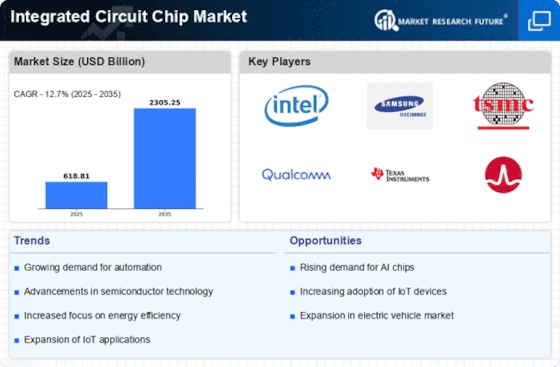
As per Market Research Future analysis, the Integrated Circuit Chip Market Size was estimated at 618.81 USD Billion in 2024. The Integrated Circuit Chip industry is projected to grow from 697.4 USD Billion in 2025 to 2305.25 USD Billion by 2035, exhibiting a compound annual growth rate (CAGR) of 12.7% during the forecast period 2025 - 2035

Key Market Trends & Highlights

The Integrated Circuit Chip Market is poised for substantial growth driven by technological advancements and increasing demand across various sectors.

  • The rise of Artificial Intelligence is significantly influencing the demand for Digital ICs, which remain the largest segment in the market. Asia-Pacific is emerging as the fastest-growing region, propelled by rapid advancements in Mixed-Signal IC technology. The expansion of 5G technology is fostering growth in Application-Specific ICs, which are currently the fastest-growing segment. Surge in consumer electronics demand and advancements in automotive technology are key drivers propelling the Integrated Circuit Chip Market forward.

Market Size & Forecast

2024 Market Size 618.81 (USD Billion)
2035 Market Size 2305.25 (USD Billion)
CAGR (2025 - 2035) 12.7%
Largest Regional Market Share in 2024 Asia Pacific

Major Players

Intel Corporation (US), Samsung Electronics (KR), Taiwan Semiconductor Manufacturing Company (TW), Qualcomm Incorporated (US), Texas Instruments Incorporated (US), Broadcom Inc. (US), NVIDIA Corporation (US), Micron Technology, Inc. (US), STMicroelectronics N.V. (FR)

Market Trends

The Integrated Circuit Chip Market is currently experiencing a dynamic evolution, driven by advancements in technology and increasing demand across various sectors. The proliferation of smart devices, coupled with the rise of the Internet of Things (IoT), has led to a surge in the need for efficient and powerful integrated circuits. As industries such as automotive, healthcare, and consumer electronics continue to integrate sophisticated electronic systems, the market is poised for substantial growth. Furthermore, the ongoing push for miniaturization and enhanced performance in electronic components is reshaping the landscape, prompting manufacturers to innovate and adapt to changing consumer preferences. In addition to technological advancements, sustainability has emerged as a pivotal factor influencing the IC Chip Market. Companies are increasingly focusing on environmentally friendly practices, including the development of energy-efficient chips and sustainable manufacturing processes. This shift not only addresses regulatory pressures but also aligns with consumer expectations for greener products. As the market evolves, collaboration among stakeholders, including manufacturers, suppliers, and regulatory bodies, appears essential to navigate challenges and seize opportunities in this rapidly changing environment.

Rise of Artificial Intelligence

The integration of artificial intelligence into various applications is driving demand for advanced integrated circuits. These chips are essential for processing large volumes of data and executing complex algorithms, making them crucial for AI-driven technologies.

Growth of Electric Vehicles

The increasing adoption of electric vehicles is significantly impacting the Integrated Circuit Chip Industry. These vehicles require specialized chips for battery management, power distribution, and advanced driver-assistance systems, leading to a surge in demand.

Expansion of 5G Technology

The rollout of 5G networks is creating new opportunities for integrated circuits. Enhanced connectivity and higher data speeds necessitate the development of advanced chips that can support the infrastructure and devices associated with this technology.

Integrated Circuit Chip Market Market Drivers

Growing Demand for Data Centers

The Integrated Circuit Chip Market is experiencing growth due to the increasing demand for data centers, driven by the proliferation of cloud computing and big data analytics. In 2025, the data center sector is expected to account for a substantial share of the integrated circuit market, as organizations seek to enhance their data processing capabilities. The need for high-performance chips is critical for managing vast amounts of data efficiently and securely. As businesses continue to migrate to cloud-based solutions, the reliance on advanced integrated circuits becomes more pronounced. This trend not only supports the operational needs of data centers but also drives innovation in chip design and manufacturing. Thus, the growing demand for data centers is a key factor propelling the IC Chip Market.

Surge in Consumer Electronics Demand

The Integrated Circuit Chip Market experiences a notable surge in demand driven by the increasing consumption of consumer electronics. As households adopt smart devices, the need for advanced integrated circuits becomes paramount. In 2025, the consumer electronics sector is projected to account for approximately 30% of the total integrated circuit market. This trend is fueled by innovations in smartphones, tablets, and smart home devices, which require sophisticated chips for enhanced functionality. The proliferation of Internet of Things (IoT) devices further amplifies this demand, as these devices rely heavily on integrated circuits for connectivity and processing capabilities. Consequently, manufacturers are compelled to innovate and produce high-performance chips to meet the evolving needs of consumers, thereby propelling growth within the Integrated Circuit Chip Industry.

Advancements in Automotive Technology

The Integrated Circuit Chip Market is significantly influenced by advancements in automotive technology, particularly with the rise of electric and autonomous vehicles. In 2025, it is estimated that the automotive sector will represent around 25% of the integrated circuit market. The integration of sophisticated chips is essential for various automotive applications, including advanced driver-assistance systems (ADAS), infotainment systems, and electric powertrains. As automakers increasingly adopt smart technologies, the demand for high-performance integrated circuits is expected to escalate. This shift not only enhances vehicle safety and efficiency but also aligns with the broader trend of digital transformation in the automotive industry. Thus, the evolution of automotive technology serves as a critical driver for growth in the Integrated Circuit Chip Industry.

Expansion of Telecommunications Infrastructure

The Integrated Circuit Chip Market is poised for growth due to the expansion of telecommunications infrastructure, particularly with the rollout of 5G technology. As telecommunications companies invest heavily in upgrading their networks, the demand for integrated circuits that support high-speed data transmission is expected to rise. In 2025, the telecommunications sector is projected to account for approximately 20% of the integrated circuit market. The implementation of 5G networks necessitates advanced chips capable of handling increased data loads and providing low-latency communication. This technological evolution not only enhances connectivity but also drives innovation in various sectors, including healthcare, entertainment, and smart cities. Therefore, the expansion of telecommunications infrastructure is a pivotal factor influencing the growth trajectory of the IC Chip Industry.

Increased Investment in Research and Development

The Integrated Circuit Chip Market benefits from increased investment in research and development (R&D) across various sectors. Companies are allocating substantial resources to innovate and develop next-generation integrated circuits that meet the demands of emerging technologies. In 2025, R&D spending in the semiconductor industry is projected to reach unprecedented levels, reflecting a commitment to enhancing chip performance and efficiency. This investment is crucial for addressing challenges such as miniaturization, power consumption, and heat dissipation. As industries strive for technological advancement, the emphasis on R&D fosters a competitive landscape, driving the evolution of integrated circuits. Consequently, the focus on innovation and development serves as a significant driver for the growth of the Integrated Circuit Chip Industry.

Market Segment Insights

By Type: Digital IC (Largest) vs. Mixed-Signal IC (Fastest-Growing)

The Integrated Circuit Chip Market showcases a diverse distribution of market share across three main types: Digital IC, Analog IC, and Mixed-Signal IC. Digital IC has established itself as the largest segment, owing to its pivotal role in powering a variety of consumer electronics, computing devices, and telecommunications. Meanwhile, Analog IC and Mixed-Signal IC also cater to essential applications but occupy relatively smaller shares in comparison. The dynamics of this segment are continually influenced by the rapid advancements in technology and increasing consumer demand. In terms of growth trends, Mixed-Signal IC is emerging as the fastest-growing segment, driven by its versatility and crucial applications in integrated systems, such as automotive, IoT devices, and telecommunications. <a href="https://www.marketresearchfuture.com/reports/digital-ic-market-4344">Digital IC</a> continues to dominate, yet the increasing complexities of electronic devices and the demand for efficient power management are propelling the growth of Mixed-Signal solutions. Furthermore, advancements in manufacturing and design processes contribute significantly to the evolving landscape of this market segment.

Digital IC (Dominant) vs. Analog IC (Emerging)

Digital ICs are the backbone of modern electronics, characterized by their ability to process binary data and perform complex computations, enabling the functionality of devices like smartphones, laptops, and servers. They hold a dominant position in the market due to their widespread application and ongoing innovations, such as improved integration and lower power consumption. Conversely, Analog ICs, while considered emerging in comparison, are gaining traction as they play a critical role in processing real-world signals. Their applications extend to audio, video, and sensor interfaces, making them indispensable in a variety of industries. The growing need for efficient signal processing in diverse applications, including automotive systems and home automation, is driving the increasing relevance of Analog ICs in the integrated circuit landscape.

By Product Type: General-Purpose IC (Largest) vs. Application-Specific IC (Fastest-Growing)

In the Integrated Circuit Chip Market, General-Purpose ICs dominate the share due to their versatility and wide-ranging applications across various sectors including consumer electronics, automotive, and industrial systems. These ICs are designed to perform multiple tasks, making them essential for numerous electronic devices. In contrast, Application-Specific ICs are rapidly gaining traction as industries increasingly require tailored solutions to meet specific needs, thus carving out a growing niche in markets such as telecommunications, computing, and healthcare.

Product Type: General-Purpose IC (Dominant) vs. Application-Specific IC (Emerging)

General-Purpose ICs are characterized by their adaptability, allowing them to be integrated into a multitude of devices ranging from simple household electronics to complex systems in industries like automotive and telecommunications. This versatility positions them as the dominant segment within the Integrated Circuit Chip Industry. On the other hand, Application-Specific ICs are designed for specific applications, making them increasingly favored for specialized tasks in sectors such as industrial automation, medical devices, and consumer electronics. Their rapid development reflects the need for efficiency and performance in targeted applications, thus marking them as an emerging segment with significant growth potential.

By Industry Vertical: Consumer Electronics (Largest) vs. Automotive (Fastest-Growing)

In the Integrated Circuit Chip Market, Consumer Electronics holds the largest market share, driven by the constant demand for innovative electronic devices such as smartphones, laptops, and smart home appliances. This segment is characterized by rapid advancements in technology, resulting in an ever-growing need for efficient and high-performance chips. Conversely, the Automotive industry, while currently smaller in market share, is experiencing the fastest growth, largely due to the increasing integration of advanced technologies like AI, IoT, and electric vehicle developments.

Consumer Electronics: Dominant vs. Automotive: Emerging

Consumer Electronics remains the dominant segment within the Integrated Circuit Chip Market, fueled by continuous innovation and consumer demand for the latest gadgets. This segment encompasses a wide range of devices that require sophisticated chips for functionality, logic processing, and connectivity. In contrast, the Automotive segment is emerging rapidly as a result of the electrification of vehicles and the push towards autonomous driving technology. Automotive ICs are becoming increasingly complex, integrating multiple functionalities to enhance vehicle performance, safety, and connectivity, highlighting a significant shift in technology requirements.

Get more detailed insights about Integrated Circuit Chip Market Research Report—Global Forecast till 2035

Regional Insights

North America : Innovation and Leadership Hub

North America remains the largest market for integrated circuit chips, holding approximately 40% of the global market share. The region's growth is driven by advancements in technology, increasing demand for consumer electronics, and significant investments in research and development. Regulatory support for semiconductor manufacturing and innovation further catalyzes market expansion, making it a key player in the global landscape. The United States is the leading country in this region, home to major players like Intel, Qualcomm, and NVIDIA. The competitive landscape is characterized by continuous innovation and strategic partnerships among companies. The presence of advanced manufacturing facilities and a skilled workforce enhances the region's capability to meet the growing demand for integrated circuits across various sectors, including automotive and telecommunications.

Europe : Emerging Technology Powerhouse

Europe is witnessing a significant transformation in the integrated circuit chip market, with a market share of around 25%. The region's growth is fueled by increasing investments in semiconductor manufacturing and a strong focus on sustainability and energy efficiency. Regulatory initiatives aimed at boosting local production and reducing dependency on imports are also key drivers of market expansion, positioning Europe as a vital player in the global supply chain. Leading countries in Europe include Germany, France, and the Netherlands, which are home to major semiconductor manufacturers like STMicroelectronics and Infineon Technologies. The competitive landscape is evolving, with a mix of established players and emerging startups focusing on innovative solutions. Collaborative efforts between governments and industry stakeholders are enhancing the region's capabilities in integrated circuit design and production, ensuring a robust market presence.

Asia-Pacific : Manufacturing and Innovation Hub

Asia-Pacific is the second-largest market for integrated circuit chips, accounting for approximately 30% of the global market share. The region's growth is driven by the increasing demand for consumer electronics, automotive applications, and the rise of smart technologies. Countries like China and South Korea are investing heavily in semiconductor manufacturing, supported by favorable government policies and initiatives aimed at enhancing local production capabilities. China is the leading country in this region, with significant contributions from South Korea and Taiwan. The competitive landscape is dominated by major players such as Samsung and Taiwan Semiconductor Manufacturing Company. The presence of advanced manufacturing facilities and a robust supply chain network positions Asia-Pacific as a critical hub for integrated circuit production, catering to both domestic and international markets.

Middle East and Africa : Emerging Market Potential

The Middle East and Africa region is gradually emerging in the integrated circuit chip Industry, holding a market share of about 5%. The growth is primarily driven by increasing investments in technology infrastructure and a rising demand for electronic devices. Governments in the region are implementing policies to promote local manufacturing and attract foreign investments, which are essential for developing a sustainable semiconductor industry. Countries like South Africa and the United Arab Emirates are leading the way in fostering a conducive environment for semiconductor growth. The competitive landscape is still developing, with a mix of local and international players entering the market. Collaborative initiatives between governments and private sectors are crucial for enhancing the region's capabilities in integrated circuit design and production, paving the way for future growth.

Key Players and Competitive Insights

The Integrated Circuit Chip Market is characterized by a dynamic competitive landscape, driven by rapid technological advancements and increasing demand across various sectors, including consumer electronics, automotive, and telecommunications. Major players such as Intel Corporation (US), Samsung Electronics (KR), and Taiwan Semiconductor Manufacturing Company (TW) are at the forefront, each adopting distinct strategies to enhance their market positioning. Intel Corporation (US) focuses on innovation and product diversification, particularly in the realm of AI and high-performance computing, while Samsung Electronics (KR) emphasizes vertical integration and advanced manufacturing processes to maintain its leadership in memory chips. Taiwan Semiconductor Manufacturing Company (TW) continues to solidify its role as a leading foundry service provider, catering to a diverse clientele with cutting-edge fabrication technologies.
The business tactics employed by these companies reflect a concerted effort to optimize supply chains and localize manufacturing. The market structure appears moderately fragmented, with a few dominant players exerting considerable influence. This fragmentation allows for niche players to thrive, yet the collective strategies of the key players shape a competitive environment that is increasingly focused on technological superiority and operational efficiency.
In August 2025, Intel Corporation (US) announced a strategic partnership with a leading AI startup to enhance its chip capabilities for machine learning applications. This collaboration is poised to bolster Intel's position in the AI sector, aligning with its broader strategy to integrate advanced technologies into its product offerings. The partnership signifies a shift towards more specialized applications, potentially reshaping the competitive dynamics within the market.
In September 2025, Samsung Electronics (KR) unveiled its latest semiconductor fabrication facility in the United States, aimed at increasing production capacity for advanced chips. This investment not only underscores Samsung's commitment to localizing its supply chain but also positions the company to better serve its North American clients. The facility is expected to enhance Samsung's competitive edge by reducing lead times and improving responsiveness to market demands.
In July 2025, Taiwan Semiconductor Manufacturing Company (TW) expanded its collaboration with major automotive manufacturers to develop specialized chips for electric vehicles. This strategic move highlights TSMC's adaptability to emerging market trends and its focus on the growing demand for automotive semiconductors. By aligning its production capabilities with the needs of the automotive sector, TSMC is likely to strengthen its market position and drive future growth.
As of October 2025, the Integrated Circuit Chip Industry is witnessing trends that emphasize digitalization, sustainability, and AI integration. Strategic alliances among key players are increasingly shaping the competitive landscape, fostering innovation and collaboration. The shift from price-based competition to a focus on technological advancement and supply chain reliability is evident, suggesting that future differentiation will hinge on the ability to innovate and respond to evolving market needs.

Key Companies in the Integrated Circuit Chip Market include

Industry Developments

  • Q2 2025: TSMC and U.S. Finalize $6.6 Billion CHIPS Act Award The U.S. Department of Commerce finalized a $6.6 billion government subsidy for TSMC’s Arizona semiconductor facilities, marking the first major binding contract under the CHIPS Act since the preliminary agreement in April 2024.

Future Outlook

Integrated Circuit Chip Market Future Outlook

The Integrated Circuit Chip Market is projected to grow at a 12.7% CAGR from 2025 to 2035, driven by advancements in AI, IoT, and automotive technologies.

New opportunities lie in:

  • Development of specialized chips for AI applications
  • Expansion into emerging markets with tailored solutions
  • Investment in sustainable manufacturing processes for eco-friendly chips

By 2035, the market is expected to be robust, driven by innovation and strategic investments.

Market Segmentation

Integrated Circuit Chip Market Type Outlook

  • Digital IC
  • Analog IC
  • Mixed-Signal IC

Integrated Circuit Chip Market Product Type Outlook

  • General-Purpose IC
  • Application-Specific IC

Integrated Circuit Chip Market Industry Vertical Outlook

  • Consumer Electronics
  • Automotive
  • IT & Telecommunications
  • Manufacturing and Automation
  • Healthcare
  • Aerospace & Defense
  • Others

Report Scope

MARKET SIZE 2024 618.81(USD Billion)
MARKET SIZE 2025 697.4(USD Billion)
MARKET SIZE 2035 2305.25(USD Billion)
COMPOUND ANNUAL GROWTH RATE (CAGR) 12.7% (2025 - 2035)
REPORT COVERAGE Revenue Forecast, Competitive Landscape, Growth Factors, and Trends
BASE YEAR 2024
Market Forecast Period 2025 - 2035
Historical Data 2019 - 2024
Market Forecast Units USD Billion
Key Companies Profiled Intel Corporation (US), Samsung Electronics (KR), Taiwan Semiconductor Manufacturing Company (TW), Qualcomm Incorporated (US), Texas Instruments Incorporated (US), Broadcom Inc. (US), NVIDIA Corporation (US), Micron Technology, Inc. (US), STMicroelectronics N.V. (FR)
Segments Covered Type, Product Type, Industry Vertical, Region
Key Market Opportunities Advancements in artificial intelligence drive demand for innovative solutions in the Integrated Circuit Chip Market.
Key Market Dynamics Technological advancements drive competition, while supply chain disruptions challenge production in the Integrated Circuit Chip Market.
Countries Covered North America, Europe, APAC, South America, MEA

FAQs

What is the projected market valuation of the Integrated Circuit Chip Market by 2035?

<p>The Integrated Circuit Chip Market is projected to reach a valuation of 2305.25 USD Billion by 2035.</p>

What was the market valuation of the Integrated Circuit Chip Market in 2024?

<p>In 2024, the market valuation of the Integrated Circuit Chip Market was 618.81 USD Billion.</p>

What is the expected CAGR for the Integrated Circuit Chip Market during the forecast period 2025 - 2035?

<p>The expected CAGR for the Integrated Circuit Chip Market during the forecast period 2025 - 2035 is 12.7%.</p>

Which companies are considered key players in the Integrated Circuit Chip Market?

<p>Key players in the Integrated Circuit Chip Market include Intel Corporation, Samsung Electronics, and Taiwan Semiconductor Manufacturing Company.</p>

What are the main segments of the Integrated Circuit Chip Market?

<p>The main segments of the Integrated Circuit Chip Market include Digital IC, Analog IC, and Mixed-Signal IC.</p>

How much is the Digital IC segment valued at in 2025?

<p>The Digital IC segment is valued at 900.0 USD Billion in 2025.</p>

What is the projected valuation for the Application-Specific IC segment by 2035?

<p>The Application-Specific IC segment is projected to reach a valuation of 1385.0 USD Billion by 2035.</p>

Which industry vertical is expected to have the highest valuation in 2025?

<p>The IT & Telecommunications industry vertical is expected to have the highest valuation at 700.0 USD Billion in 2025.</p>

What was the valuation of the Automotive segment in 2024?

<p>In 2024, the Automotive segment was valued at 400.0 USD Billion.</p>

How does the Mixed-Signal IC segment compare to the Analog IC segment in 2025?

<p>In 2025, the Mixed-Signal IC segment is projected to be valued at 705.25 USD Billion, slightly higher than the Analog IC segment at 700.0 USD Billion.</p>

  1. SECTION I: EXECUTIVE SUMMARY AND KEY HIGHLIGHTS
    1. | 1.1 EXECUTIVE SUMMARY
    2. | | 1.1.1 Market Overview
    3. | | 1.1.2 Key Findings
    4. | | 1.1.3 Market Segmentation
    5. | | 1.1.4 Competitive Landscape
    6. | | 1.1.5 Challenges and Opportunities
    7. | | 1.1.6 Future Outlook
  2. SECTION II: SCOPING, METHODOLOGY AND MARKET STRUCTURE
    1. | 2.1 MARKET INTRODUCTION
    2. | | 2.1.1 Definition
    3. | | 2.1.2 Scope of the study
    4. | | | 2.1.2.1 Research Objective
    5. | | | 2.1.2.2 Assumption
    6. | | | 2.1.2.3 Limitations
    7. | 2.2 RESEARCH METHODOLOGY
    8. | | 2.2.1 Overview
    9. | | 2.2.2 Data Mining
    10. | | 2.2.3 Secondary Research
    11. | | 2.2.4 Primary Research
    12. | | | 2.2.4.1 Primary Interviews and Information Gathering Process
    13. | | | 2.2.4.2 Breakdown of Primary Respondents
    14. | | 2.2.5 Forecasting Model
    15. | | 2.2.6 Market Size Estimation
    16. | | | 2.2.6.1 Bottom-Up Approach
    17. | | | 2.2.6.2 Top-Down Approach
    18. | | 2.2.7 Data Triangulation
    19. | | 2.2.8 Validation
  3. SECTION III: QUALITATIVE ANALYSIS
    1. | 3.1 MARKET DYNAMICS
    2. | | 3.1.1 Overview
    3. | | 3.1.2 Drivers
    4. | | 3.1.3 Restraints
    5. | | 3.1.4 Opportunities
    6. | 3.2 MARKET FACTOR ANALYSIS
    7. | | 3.2.1 Value chain Analysis
    8. | | 3.2.2 Porter's Five Forces Analysis
    9. | | | 3.2.2.1 Bargaining Power of Suppliers
    10. | | | 3.2.2.2 Bargaining Power of Buyers
    11. | | | 3.2.2.3 Threat of New Entrants
    12. | | | 3.2.2.4 Threat of Substitutes
    13. | | | 3.2.2.5 Intensity of Rivalry
    14. | | 3.2.3 COVID-19 Impact Analysis
    15. | | | 3.2.3.1 Market Impact Analysis
    16. | | | 3.2.3.2 Regional Impact
    17. | | | 3.2.3.3 Opportunity and Threat Analysis
  4. SECTION IV: QUANTITATIVE ANALYSIS
    1. | 4.1 Semiconductor & Electronics, BY Type (USD Billion)
    2. | | 4.1.1 Digital IC
    3. | | 4.1.2 Analog IC
    4. | | 4.1.3 Mixed-Signal IC
    5. | 4.2 Semiconductor & Electronics, BY Product Type (USD Billion)
    6. | | 4.2.1 General-Purpose IC
    7. | | 4.2.2 Application-Specific IC
    8. | 4.3 Semiconductor & Electronics, BY Industry Vertical (USD Billion)
    9. | | 4.3.1 Consumer Electronics
    10. | | 4.3.2 Automotive
    11. | | 4.3.3 IT & Telecommunications
    12. | | 4.3.4 Manufacturing and Automation
    13. | | 4.3.5 Healthcare
    14. | | 4.3.6 Aerospace & Defense
    15. | | 4.3.7 Others
    16. | 4.4 Semiconductor & Electronics, BY Region (USD Billion)
    17. | | 4.4.1 North America
    18. | | | 4.4.1.1 US
    19. | | | 4.4.1.2 Canada
    20. | | 4.4.2 Europe
    21. | | | 4.4.2.1 Germany
    22. | | | 4.4.2.2 UK
    23. | | | 4.4.2.3 France
    24. | | | 4.4.2.4 Russia
    25. | | | 4.4.2.5 Italy
    26. | | | 4.4.2.6 Spain
    27. | | | 4.4.2.7 Rest of Europe
    28. | | 4.4.3 APAC
    29. | | | 4.4.3.1 China
    30. | | | 4.4.3.2 India
    31. | | | 4.4.3.3 Japan
    32. | | | 4.4.3.4 South Korea
    33. | | | 4.4.3.5 Malaysia
    34. | | | 4.4.3.6 Thailand
    35. | | | 4.4.3.7 Indonesia
    36. | | | 4.4.3.8 Rest of APAC
    37. | | 4.4.4 South America
    38. | | | 4.4.4.1 Brazil
    39. | | | 4.4.4.2 Mexico
    40. | | | 4.4.4.3 Argentina
    41. | | | 4.4.4.4 Rest of South America
    42. | | 4.4.5 MEA
    43. | | | 4.4.5.1 GCC Countries
    44. | | | 4.4.5.2 South Africa
    45. | | | 4.4.5.3 Rest of MEA
  5. SECTION V: COMPETITIVE ANALYSIS
    1. | 5.1 Competitive Landscape
    2. | | 5.1.1 Overview
    3. | | 5.1.2 Competitive Analysis
    4. | | 5.1.3 Market share Analysis
    5. | | 5.1.4 Major Growth Strategy in the Semiconductor & Electronics
    6. | | 5.1.5 Competitive Benchmarking
    7. | | 5.1.6 Leading Players in Terms of Number of Developments in the Semiconductor & Electronics
    8. | | 5.1.7 Key developments and growth strategies
    9. | | | 5.1.7.1 New Product Launch/Service Deployment
    10. | | | 5.1.7.2 Merger & Acquisitions
    11. | | | 5.1.7.3 Joint Ventures
    12. | | 5.1.8 Major Players Financial Matrix
    13. | | | 5.1.8.1 Sales and Operating Income
    14. | | | 5.1.8.2 Major Players R&D Expenditure. 2023
    15. | 5.2 Company Profiles
    16. | | 5.2.1 Intel Corporation (US)
    17. | | | 5.2.1.1 Financial Overview
    18. | | | 5.2.1.2 Products Offered
    19. | | | 5.2.1.3 Key Developments
    20. | | | 5.2.1.4 SWOT Analysis
    21. | | | 5.2.1.5 Key Strategies
    22. | | 5.2.2 Samsung Electronics (KR)
    23. | | | 5.2.2.1 Financial Overview
    24. | | | 5.2.2.2 Products Offered
    25. | | | 5.2.2.3 Key Developments
    26. | | | 5.2.2.4 SWOT Analysis
    27. | | | 5.2.2.5 Key Strategies
    28. | | 5.2.3 Taiwan Semiconductor Manufacturing Company (TW)
    29. | | | 5.2.3.1 Financial Overview
    30. | | | 5.2.3.2 Products Offered
    31. | | | 5.2.3.3 Key Developments
    32. | | | 5.2.3.4 SWOT Analysis
    33. | | | 5.2.3.5 Key Strategies
    34. | | 5.2.4 Qualcomm Incorporated (US)
    35. | | | 5.2.4.1 Financial Overview
    36. | | | 5.2.4.2 Products Offered
    37. | | | 5.2.4.3 Key Developments
    38. | | | 5.2.4.4 SWOT Analysis
    39. | | | 5.2.4.5 Key Strategies
    40. | | 5.2.5 Texas Instruments Incorporated (US)
    41. | | | 5.2.5.1 Financial Overview
    42. | | | 5.2.5.2 Products Offered
    43. | | | 5.2.5.3 Key Developments
    44. | | | 5.2.5.4 SWOT Analysis
    45. | | | 5.2.5.5 Key Strategies
    46. | | 5.2.6 Broadcom Inc. (US)
    47. | | | 5.2.6.1 Financial Overview
    48. | | | 5.2.6.2 Products Offered
    49. | | | 5.2.6.3 Key Developments
    50. | | | 5.2.6.4 SWOT Analysis
    51. | | | 5.2.6.5 Key Strategies
    52. | | 5.2.7 NVIDIA Corporation (US)
    53. | | | 5.2.7.1 Financial Overview
    54. | | | 5.2.7.2 Products Offered
    55. | | | 5.2.7.3 Key Developments
    56. | | | 5.2.7.4 SWOT Analysis
    57. | | | 5.2.7.5 Key Strategies
    58. | | 5.2.8 Micron Technology, Inc. (US)
    59. | | | 5.2.8.1 Financial Overview
    60. | | | 5.2.8.2 Products Offered
    61. | | | 5.2.8.3 Key Developments
    62. | | | 5.2.8.4 SWOT Analysis
    63. | | | 5.2.8.5 Key Strategies
    64. | | 5.2.9 STMicroelectronics N.V. (FR)
    65. | | | 5.2.9.1 Financial Overview
    66. | | | 5.2.9.2 Products Offered
    67. | | | 5.2.9.3 Key Developments
    68. | | | 5.2.9.4 SWOT Analysis
    69. | | | 5.2.9.5 Key Strategies
    70. | 5.3 Appendix
    71. | | 5.3.1 References
    72. | | 5.3.2 Related Reports
  6. LIST OF FIGURES
    1. | 6.1 MARKET SYNOPSIS
    2. | 6.2 NORTH AMERICA MARKET ANALYSIS
    3. | 6.3 US MARKET ANALYSIS BY TYPE
    4. | 6.4 US MARKET ANALYSIS BY PRODUCT TYPE
    5. | 6.5 US MARKET ANALYSIS BY INDUSTRY VERTICAL
    6. | 6.6 CANADA MARKET ANALYSIS BY TYPE
    7. | 6.7 CANADA MARKET ANALYSIS BY PRODUCT TYPE
    8. | 6.8 CANADA MARKET ANALYSIS BY INDUSTRY VERTICAL
    9. | 6.9 EUROPE MARKET ANALYSIS
    10. | 6.10 GERMANY MARKET ANALYSIS BY TYPE
    11. | 6.11 GERMANY MARKET ANALYSIS BY PRODUCT TYPE
    12. | 6.12 GERMANY MARKET ANALYSIS BY INDUSTRY VERTICAL
    13. | 6.13 UK MARKET ANALYSIS BY TYPE
    14. | 6.14 UK MARKET ANALYSIS BY PRODUCT TYPE
    15. | 6.15 UK MARKET ANALYSIS BY INDUSTRY VERTICAL
    16. | 6.16 FRANCE MARKET ANALYSIS BY TYPE
    17. | 6.17 FRANCE MARKET ANALYSIS BY PRODUCT TYPE
    18. | 6.18 FRANCE MARKET ANALYSIS BY INDUSTRY VERTICAL
    19. | 6.19 RUSSIA MARKET ANALYSIS BY TYPE
    20. | 6.20 RUSSIA MARKET ANALYSIS BY PRODUCT TYPE
    21. | 6.21 RUSSIA MARKET ANALYSIS BY INDUSTRY VERTICAL
    22. | 6.22 ITALY MARKET ANALYSIS BY TYPE
    23. | 6.23 ITALY MARKET ANALYSIS BY PRODUCT TYPE
    24. | 6.24 ITALY MARKET ANALYSIS BY INDUSTRY VERTICAL
    25. | 6.25 SPAIN MARKET ANALYSIS BY TYPE
    26. | 6.26 SPAIN MARKET ANALYSIS BY PRODUCT TYPE
    27. | 6.27 SPAIN MARKET ANALYSIS BY INDUSTRY VERTICAL
    28. | 6.28 REST OF EUROPE MARKET ANALYSIS BY TYPE
    29. | 6.29 REST OF EUROPE MARKET ANALYSIS BY PRODUCT TYPE
    30. | 6.30 REST OF EUROPE MARKET ANALYSIS BY INDUSTRY VERTICAL
    31. | 6.31 APAC MARKET ANALYSIS
    32. | 6.32 CHINA MARKET ANALYSIS BY TYPE
    33. | 6.33 CHINA MARKET ANALYSIS BY PRODUCT TYPE
    34. | 6.34 CHINA MARKET ANALYSIS BY INDUSTRY VERTICAL
    35. | 6.35 INDIA MARKET ANALYSIS BY TYPE
    36. | 6.36 INDIA MARKET ANALYSIS BY PRODUCT TYPE
    37. | 6.37 INDIA MARKET ANALYSIS BY INDUSTRY VERTICAL
    38. | 6.38 JAPAN MARKET ANALYSIS BY TYPE
    39. | 6.39 JAPAN MARKET ANALYSIS BY PRODUCT TYPE
    40. | 6.40 JAPAN MARKET ANALYSIS BY INDUSTRY VERTICAL
    41. | 6.41 SOUTH KOREA MARKET ANALYSIS BY TYPE
    42. | 6.42 SOUTH KOREA MARKET ANALYSIS BY PRODUCT TYPE
    43. | 6.43 SOUTH KOREA MARKET ANALYSIS BY INDUSTRY VERTICAL
    44. | 6.44 MALAYSIA MARKET ANALYSIS BY TYPE
    45. | 6.45 MALAYSIA MARKET ANALYSIS BY PRODUCT TYPE
    46. | 6.46 MALAYSIA MARKET ANALYSIS BY INDUSTRY VERTICAL
    47. | 6.47 THAILAND MARKET ANALYSIS BY TYPE
    48. | 6.48 THAILAND MARKET ANALYSIS BY PRODUCT TYPE
    49. | 6.49 THAILAND MARKET ANALYSIS BY INDUSTRY VERTICAL
    50. | 6.50 INDONESIA MARKET ANALYSIS BY TYPE
    51. | 6.51 INDONESIA MARKET ANALYSIS BY PRODUCT TYPE
    52. | 6.52 INDONESIA MARKET ANALYSIS BY INDUSTRY VERTICAL
    53. | 6.53 REST OF APAC MARKET ANALYSIS BY TYPE
    54. | 6.54 REST OF APAC MARKET ANALYSIS BY PRODUCT TYPE
    55. | 6.55 REST OF APAC MARKET ANALYSIS BY INDUSTRY VERTICAL
    56. | 6.56 SOUTH AMERICA MARKET ANALYSIS
    57. | 6.57 BRAZIL MARKET ANALYSIS BY TYPE
    58. | 6.58 BRAZIL MARKET ANALYSIS BY PRODUCT TYPE
    59. | 6.59 BRAZIL MARKET ANALYSIS BY INDUSTRY VERTICAL
    60. | 6.60 MEXICO MARKET ANALYSIS BY TYPE
    61. | 6.61 MEXICO MARKET ANALYSIS BY PRODUCT TYPE
    62. | 6.62 MEXICO MARKET ANALYSIS BY INDUSTRY VERTICAL
    63. | 6.63 ARGENTINA MARKET ANALYSIS BY TYPE
    64. | 6.64 ARGENTINA MARKET ANALYSIS BY PRODUCT TYPE
    65. | 6.65 ARGENTINA MARKET ANALYSIS BY INDUSTRY VERTICAL
    66. | 6.66 REST OF SOUTH AMERICA MARKET ANALYSIS BY TYPE
    67. | 6.67 REST OF SOUTH AMERICA MARKET ANALYSIS BY PRODUCT TYPE
    68. | 6.68 REST OF SOUTH AMERICA MARKET ANALYSIS BY INDUSTRY VERTICAL
    69. | 6.69 MEA MARKET ANALYSIS
    70. | 6.70 GCC COUNTRIES MARKET ANALYSIS BY TYPE
    71. | 6.71 GCC COUNTRIES MARKET ANALYSIS BY PRODUCT TYPE
    72. | 6.72 GCC COUNTRIES MARKET ANALYSIS BY INDUSTRY VERTICAL
    73. | 6.73 SOUTH AFRICA MARKET ANALYSIS BY TYPE
    74. | 6.74 SOUTH AFRICA MARKET ANALYSIS BY PRODUCT TYPE
    75. | 6.75 SOUTH AFRICA MARKET ANALYSIS BY INDUSTRY VERTICAL
    76. | 6.76 REST OF MEA MARKET ANALYSIS BY TYPE
    77. | 6.77 REST OF MEA MARKET ANALYSIS BY PRODUCT TYPE
    78. | 6.78 REST OF MEA MARKET ANALYSIS BY INDUSTRY VERTICAL
    79. | 6.79 KEY BUYING CRITERIA OF SEMICONDUCTOR & ELECTRONICS
    80. | 6.80 RESEARCH PROCESS OF MRFR
    81. | 6.81 DRO ANALYSIS OF SEMICONDUCTOR & ELECTRONICS
    82. | 6.82 DRIVERS IMPACT ANALYSIS: SEMICONDUCTOR & ELECTRONICS
    83. | 6.83 RESTRAINTS IMPACT ANALYSIS: SEMICONDUCTOR & ELECTRONICS
    84. | 6.84 SUPPLY / VALUE CHAIN: SEMICONDUCTOR & ELECTRONICS
    85. | 6.85 SEMICONDUCTOR & ELECTRONICS, BY TYPE, 2024 (% SHARE)
    86. | 6.86 SEMICONDUCTOR & ELECTRONICS, BY TYPE, 2024 TO 2035 (USD Billion)
    87. | 6.87 SEMICONDUCTOR & ELECTRONICS, BY PRODUCT TYPE, 2024 (% SHARE)
    88. | 6.88 SEMICONDUCTOR & ELECTRONICS, BY PRODUCT TYPE, 2024 TO 2035 (USD Billion)
    89. | 6.89 SEMICONDUCTOR & ELECTRONICS, BY INDUSTRY VERTICAL, 2024 (% SHARE)
    90. | 6.90 SEMICONDUCTOR & ELECTRONICS, BY INDUSTRY VERTICAL, 2024 TO 2035 (USD Billion)
    91. | 6.91 BENCHMARKING OF MAJOR COMPETITORS
  7. LIST OF TABLES
    1. | 7.1 LIST OF ASSUMPTIONS
    2. | | 7.1.1
    3. | 7.2 North America MARKET SIZE ESTIMATES; FORECAST
    4. | | 7.2.1 BY TYPE, 2025-2035 (USD Billion)
    5. | | 7.2.2 BY PRODUCT TYPE, 2025-2035 (USD Billion)
    6. | | 7.2.3 BY INDUSTRY VERTICAL, 2025-2035 (USD Billion)
    7. | 7.3 US MARKET SIZE ESTIMATES; FORECAST
    8. | | 7.3.1 BY TYPE, 2025-2035 (USD Billion)
    9. | | 7.3.2 BY PRODUCT TYPE, 2025-2035 (USD Billion)
    10. | | 7.3.3 BY INDUSTRY VERTICAL, 2025-2035 (USD Billion)
    11. | 7.4 Canada MARKET SIZE ESTIMATES; FORECAST
    12. | | 7.4.1 BY TYPE, 2025-2035 (USD Billion)
    13. | | 7.4.2 BY PRODUCT TYPE, 2025-2035 (USD Billion)
    14. | | 7.4.3 BY INDUSTRY VERTICAL, 2025-2035 (USD Billion)
    15. | 7.5 Europe MARKET SIZE ESTIMATES; FORECAST
    16. | | 7.5.1 BY TYPE, 2025-2035 (USD Billion)
    17. | | 7.5.2 BY PRODUCT TYPE, 2025-2035 (USD Billion)
    18. | | 7.5.3 BY INDUSTRY VERTICAL, 2025-2035 (USD Billion)
    19. | 7.6 Germany MARKET SIZE ESTIMATES; FORECAST
    20. | | 7.6.1 BY TYPE, 2025-2035 (USD Billion)
    21. | | 7.6.2 BY PRODUCT TYPE, 2025-2035 (USD Billion)
    22. | | 7.6.3 BY INDUSTRY VERTICAL, 2025-2035 (USD Billion)
    23. | 7.7 UK MARKET SIZE ESTIMATES; FORECAST
    24. | | 7.7.1 BY TYPE, 2025-2035 (USD Billion)
    25. | | 7.7.2 BY PRODUCT TYPE, 2025-2035 (USD Billion)
    26. | | 7.7.3 BY INDUSTRY VERTICAL, 2025-2035 (USD Billion)
    27. | 7.8 France MARKET SIZE ESTIMATES; FORECAST
    28. | | 7.8.1 BY TYPE, 2025-2035 (USD Billion)
    29. | | 7.8.2 BY PRODUCT TYPE, 2025-2035 (USD Billion)
    30. | | 7.8.3 BY INDUSTRY VERTICAL, 2025-2035 (USD Billion)
    31. | 7.9 Russia MARKET SIZE ESTIMATES; FORECAST
    32. | | 7.9.1 BY TYPE, 2025-2035 (USD Billion)
    33. | | 7.9.2 BY PRODUCT TYPE, 2025-2035 (USD Billion)
    34. | | 7.9.3 BY INDUSTRY VERTICAL, 2025-2035 (USD Billion)
    35. | 7.10 Italy MARKET SIZE ESTIMATES; FORECAST
    36. | | 7.10.1 BY TYPE, 2025-2035 (USD Billion)
    37. | | 7.10.2 BY PRODUCT TYPE, 2025-2035 (USD Billion)
    38. | | 7.10.3 BY INDUSTRY VERTICAL, 2025-2035 (USD Billion)
    39. | 7.11 Spain MARKET SIZE ESTIMATES; FORECAST
    40. | | 7.11.1 BY TYPE, 2025-2035 (USD Billion)
    41. | | 7.11.2 BY PRODUCT TYPE, 2025-2035 (USD Billion)
    42. | | 7.11.3 BY INDUSTRY VERTICAL, 2025-2035 (USD Billion)
    43. | 7.12 Rest of Europe MARKET SIZE ESTIMATES; FORECAST
    44. | | 7.12.1 BY TYPE, 2025-2035 (USD Billion)
    45. | | 7.12.2 BY PRODUCT TYPE, 2025-2035 (USD Billion)
    46. | | 7.12.3 BY INDUSTRY VERTICAL, 2025-2035 (USD Billion)
    47. | 7.13 APAC MARKET SIZE ESTIMATES; FORECAST
    48. | | 7.13.1 BY TYPE, 2025-2035 (USD Billion)
    49. | | 7.13.2 BY PRODUCT TYPE, 2025-2035 (USD Billion)
    50. | | 7.13.3 BY INDUSTRY VERTICAL, 2025-2035 (USD Billion)
    51. | 7.14 China MARKET SIZE ESTIMATES; FORECAST
    52. | | 7.14.1 BY TYPE, 2025-2035 (USD Billion)
    53. | | 7.14.2 BY PRODUCT TYPE, 2025-2035 (USD Billion)
    54. | | 7.14.3 BY INDUSTRY VERTICAL, 2025-2035 (USD Billion)
    55. | 7.15 India MARKET SIZE ESTIMATES; FORECAST
    56. | | 7.15.1 BY TYPE, 2025-2035 (USD Billion)
    57. | | 7.15.2 BY PRODUCT TYPE, 2025-2035 (USD Billion)
    58. | | 7.15.3 BY INDUSTRY VERTICAL, 2025-2035 (USD Billion)
    59. | 7.16 Japan MARKET SIZE ESTIMATES; FORECAST
    60. | | 7.16.1 BY TYPE, 2025-2035 (USD Billion)
    61. | | 7.16.2 BY PRODUCT TYPE, 2025-2035 (USD Billion)
    62. | | 7.16.3 BY INDUSTRY VERTICAL, 2025-2035 (USD Billion)
    63. | 7.17 South Korea MARKET SIZE ESTIMATES; FORECAST
    64. | | 7.17.1 BY TYPE, 2025-2035 (USD Billion)
    65. | | 7.17.2 BY PRODUCT TYPE, 2025-2035 (USD Billion)
    66. | | 7.17.3 BY INDUSTRY VERTICAL, 2025-2035 (USD Billion)
    67. | 7.18 Malaysia MARKET SIZE ESTIMATES; FORECAST
    68. | | 7.18.1 BY TYPE, 2025-2035 (USD Billion)
    69. | | 7.18.2 BY PRODUCT TYPE, 2025-2035 (USD Billion)
    70. | | 7.18.3 BY INDUSTRY VERTICAL, 2025-2035 (USD Billion)
    71. | 7.19 Thailand MARKET SIZE ESTIMATES; FORECAST
    72. | | 7.19.1 BY TYPE, 2025-2035 (USD Billion)
    73. | | 7.19.2 BY PRODUCT TYPE, 2025-2035 (USD Billion)
    74. | | 7.19.3 BY INDUSTRY VERTICAL, 2025-2035 (USD Billion)
    75. | 7.20 Indonesia MARKET SIZE ESTIMATES; FORECAST
    76. | | 7.20.1 BY TYPE, 2025-2035 (USD Billion)
    77. | | 7.20.2 BY PRODUCT TYPE, 2025-2035 (USD Billion)
    78. | | 7.20.3 BY INDUSTRY VERTICAL, 2025-2035 (USD Billion)
    79. | 7.21 Rest of APAC MARKET SIZE ESTIMATES; FORECAST
    80. | | 7.21.1 BY TYPE, 2025-2035 (USD Billion)
    81. | | 7.21.2 BY PRODUCT TYPE, 2025-2035 (USD Billion)
    82. | | 7.21.3 BY INDUSTRY VERTICAL, 2025-2035 (USD Billion)
    83. | 7.22 South America MARKET SIZE ESTIMATES; FORECAST
    84. | | 7.22.1 BY TYPE, 2025-2035 (USD Billion)
    85. | | 7.22.2 BY PRODUCT TYPE, 2025-2035 (USD Billion)
    86. | | 7.22.3 BY INDUSTRY VERTICAL, 2025-2035 (USD Billion)
    87. | 7.23 Brazil MARKET SIZE ESTIMATES; FORECAST
    88. | | 7.23.1 BY TYPE, 2025-2035 (USD Billion)
    89. | | 7.23.2 BY PRODUCT TYPE, 2025-2035 (USD Billion)
    90. | | 7.23.3 BY INDUSTRY VERTICAL, 2025-2035 (USD Billion)
    91. | 7.24 Mexico MARKET SIZE ESTIMATES; FORECAST
    92. | | 7.24.1 BY TYPE, 2025-2035 (USD Billion)
    93. | | 7.24.2 BY PRODUCT TYPE, 2025-2035 (USD Billion)
    94. | | 7.24.3 BY INDUSTRY VERTICAL, 2025-2035 (USD Billion)
    95. | 7.25 Argentina MARKET SIZE ESTIMATES; FORECAST
    96. | | 7.25.1 BY TYPE, 2025-2035 (USD Billion)
    97. | | 7.25.2 BY PRODUCT TYPE, 2025-2035 (USD Billion)
    98. | | 7.25.3 BY INDUSTRY VERTICAL, 2025-2035 (USD Billion)
    99. | 7.26 Rest of South America MARKET SIZE ESTIMATES; FORECAST
    100. | | 7.26.1 BY TYPE, 2025-2035 (USD Billion)
    101. | | 7.26.2 BY PRODUCT TYPE, 2025-2035 (USD Billion)
    102. | | 7.26.3 BY INDUSTRY VERTICAL, 2025-2035 (USD Billion)
    103. | 7.27 MEA MARKET SIZE ESTIMATES; FORECAST
    104. | | 7.27.1 BY TYPE, 2025-2035 (USD Billion)
    105. | | 7.27.2 BY PRODUCT TYPE, 2025-2035 (USD Billion)
    106. | | 7.27.3 BY INDUSTRY VERTICAL, 2025-2035 (USD Billion)
    107. | 7.28 GCC Countries MARKET SIZE ESTIMATES; FORECAST
    108. | | 7.28.1 BY TYPE, 2025-2035 (USD Billion)
    109. | | 7.28.2 BY PRODUCT TYPE, 2025-2035 (USD Billion)
    110. | | 7.28.3 BY INDUSTRY VERTICAL, 2025-2035 (USD Billion)
    111. | 7.29 South Africa MARKET SIZE ESTIMATES; FORECAST
    112. | | 7.29.1 BY TYPE, 2025-2035 (USD Billion)
    113. | | 7.29.2 BY PRODUCT TYPE, 2025-2035 (USD Billion)
    114. | | 7.29.3 BY INDUSTRY VERTICAL, 2025-2035 (USD Billion)
    115. | 7.30 Rest of MEA MARKET SIZE ESTIMATES; FORECAST
    116. | | 7.30.1 BY TYPE, 2025-2035 (USD Billion)
    117. | | 7.30.2 BY PRODUCT TYPE, 2025-2035 (USD Billion)
    118. | | 7.30.3 BY INDUSTRY VERTICAL, 2025-2035 (USD Billion)
    119. | 7.31 PRODUCT LAUNCH/PRODUCT DEVELOPMENT/APPROVAL
    120. | | 7.31.1
    121. | 7.32 ACQUISITION/PARTNERSHIP
    122. | | 7.32.1

Semiconductor & Electronics Market Segmentation

Semiconductor & Electronics By Type (USD Billion, 2025-2035)

  • Digital IC
  • Analog IC
  • Mixed-Signal IC

Semiconductor & Electronics By Product Type (USD Billion, 2025-2035)

  • General-Purpose IC
  • Application-Specific IC

Semiconductor & Electronics By Industry Vertical (USD Billion, 2025-2035)

  • Consumer Electronics
  • Automotive
  • IT & Telecommunications
  • Manufacturing and Automation
  • Healthcare
  • Aerospace & Defense
  • Others
Infographic

Free Sample Request

Kindly complete the form below to receive a free sample of this Report

Get Free Sample

Customer Strories

Compare Licence

×
Features License Type
Single User Multiuser License Enterprise User
Price $4,950 $5,950 $7,250
Maximum User Access Limit 1 User Upto 10 Users Unrestricted Access Throughout the Organization
Free Customization
Direct Access to Analyst
Deliverable Format
Platform Access
Discount on Next Purchase 10% 15% 15%
Printable Versions
%>