×
Request Free Sample ×

Kindly complete the form below to receive a free sample of this Report

* Please use a valid business email

Leading companies partner with us for data-driven Insights

clients tt-cursor
Hero Background
English
Chinese
French
Japanese
Korean
German
Spanish

Insurance Protection Product Market Size

ID: MRFR/BS/8506-HCR
200 Pages
Aarti Dhapte
February 2026

Insurance Protection Products Market Size, Share and Research Report By Type (Life Insurance, Critical Issues Insurance, Income Protection Insurance, Term Insurance, Long Term Care Insurance and Others), By Distribution Channel (Direct and Indirect) and By Region (Americas, Europe, Asia-Pacific and Middle East & Africa)- Industry Forecast Till 2035

Share:
Download PDF ×

We do not share your information with anyone. However, we may send you emails based on your report interest from time to time. You may contact us at any time to opt-out.

Insurance Protection Product Market Infographic
Purchase Options

Insurance Protection Product Size

Insurance Protection Product Market Growth Projections and Opportunities

The Insurance Protection Product Market is strongly influenced by the evolving regulatory environment. Changes in insurance regulations, compliance requirements, and consumer protection policies impact the design and distribution of insurance protection products, shaping market dynamics. Due to the increasing realization of individuals and businesses that they require financial stability, this creates demand for insurance products. The market for different insurance products is driven by the fact that consumer wish to be protected financially if unfortunate circumstances happen. Continuous technological development, especially in the field of insurtech greatly influences the market. Digitalization, data analytics and artificial intelligence integration simplify insurance operations; improve customer satisfaction levels as well as open new opportunities for innovative protection products. Insurance protection products market is also under the influence of demographic changes and shifting perceptions on risk. With demographic shifts, people and organizations reconsider their risk exposure as well as need customized coverage opportunities. This in turn paves way for innovations towards product specializations to fulfill various needs. The global economic situation majorly determines the structure of an insurance protection product market. Economic ups and downs, market uncertainties as well as geopolitical events affect the demand for specific coverage types showing the close link between economic stability and insurance requirements. The market features the emergence of specialised insurance products which focus on specific risks or industries. Customized production of protection products for specific demands, like cyber insurance or cancelation event coverage leads to the industry’s responsiveness towards newly arising risks and market needs. Among the greatest areas affected by health and wellness trends are life insurance protection products especially in the field of both, Health Insurance & Life insurance. The market reflects the preferences of consumers who prefer policies that match with healthy lifestyles by providing incentives and coverage alternatives aimed to promote well-being. Growth in consciousness regarding environmental and climate risks propels the market for insurance protection products. They provide insurance cover on natural disasters and climate-related events as well, environmental liabilities. This helps people to be sure that even when their properties are destroyed they will still get some of the money lost because natural disaster does not spare anything including humans Contemporary global pandemics, including COVID-19 increased the sensitivity of the business world towards insurance protection to ensure proper continuity. The insurers respond by coming up with the products to address pandemic risks as well as help businesses manage financial losses. Partnerships and collaborations in insurance are critical driving force to market growth. Insurers, reinsurers brokers and insurtech companies work together to generate synergies; sources of expertise as well as develop integrated protection products that provide solutions for complicated risks.

Regulatory support for innovation and insurtech initiatives impacts the market's ability to introduce new and innovative protection products. Regulatory bodies that foster a conducive environment for experimentation and digital transformation contribute to market vibrancy and innovation.
Insurance Protection Product Market Size Graph
Author
Aarti Dhapte
AVP - Research

A consulting professional focused on helping businesses navigate complex markets through structured research and strategic insights. I partner with clients to solve high-impact business problems across market entry strategy, competitive intelligence, and opportunity assessment. Over the course of my experience, I have led and contributed to 100+ market research and consulting engagements, delivering insights across multiple industries and geographies, and supporting strategic decisions linked to $500M+ market opportunities. My core expertise lies in building robust market sizing, forecasting, and commercial models (top-down and bottom-up), alongside deep-dive competitive and industry analysis. I have played a key role in shaping go-to-market strategies, investment cases, and growth roadmaps, enabling clients to make confident, data-backed decisions in dynamic markets.

Leave a Comment

FAQs

What is the current valuation of The Global Insurance Protection Products?

<p>As of 2024, the market valuation was 61.88 USD Billion.</p>

What is the projected market size for The Global Insurance Protection Products by 2035?

<p>The market is projected to reach 144.0 USD Billion by 2035.</p>

What is the expected CAGR for The Global Insurance Protection Products during the forecast period?

<p>The expected CAGR for the market from 2025 to 2035 is 7.98%.</p>

Which companies are considered key players in The Global Insurance Protection Products?

<p>Key players include Allianz, AXA, Prudential, MetLife, AIG, Zurich, Chubb, Munich Re, and Generali.</p>

What are the main segments of The Global Insurance Protection Products?

<p>The main segments include Life Insurance, Critical Issues Insurance, Income Protection Insurance, Term Insurance, Long Term Care Insurance, and Others.</p>

How much was the Life Insurance segment valued at in 2024?

The Life Insurance segment was valued at 60.0 USD Billion in 2024.

What is the valuation range for the Critical Issues Insurance segment?

The Critical Issues Insurance segment had a valuation range of 10.0 to 25.0 USD Billion.

What distribution channels are utilized in The Global Insurance Protection Products?

The market utilizes Direct and Indirect Channels for distribution.

What was the valuation for the Direct Channel in 2024?

The Direct Channel was valued at 70.0 USD Billion in 2024.

What is the projected growth for the Income Protection Insurance segment by 2035?

The Income Protection Insurance segment is expected to grow from 8.0 to 18.0 USD Billion by 2035.

Market Summary

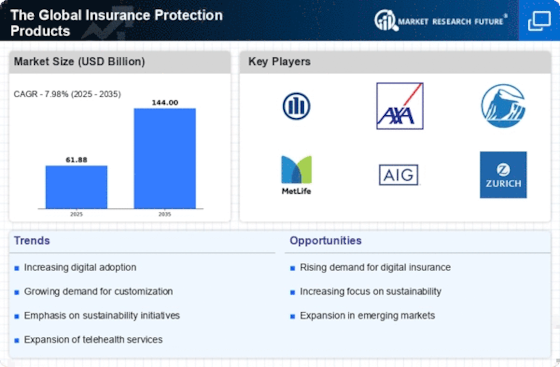
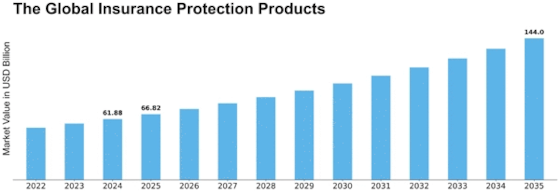
As per Market Research Future analysis, The Global Insurance Protection Products was estimated at 61.88 USD Billion in 2024. The insurance protection products industry is projected to grow from 66.82 USD Billion in 2025 to 144.0 USD Billion by 2035, exhibiting a compound annual growth rate (CAGR) of 7.98% during the forecast period 2025 - 2035

Key Market Trends & Highlights

The Global Insurance Protection Products is experiencing a transformative shift driven by technological advancements and evolving consumer preferences.

  • Technological integration is reshaping the insurance landscape, enhancing efficiency and customer engagement. Personalization of products is becoming increasingly prevalent, catering to diverse consumer needs and preferences. Regulatory adaptations are facilitating market growth, particularly in response to emerging risks and consumer demands. Rising awareness of risk management and technological advancements in insurance are key drivers propelling the market, especially in North America and the Asia-Pacific region, with life insurance leading and critical illness insurance rapidly expanding.

Market Size & Forecast

2024 Market Size 61.88 (USD Billion)
2035 Market Size 144.0 (USD Billion)
CAGR (2025 - 2035) 7.98%
Largest Regional Market Share in 2024 Americas

Major Players

Allianz (DE), AXA (FR), Prudential (GB), MetLife (US), AIG (US), Zurich (CH), Chubb (US), Munich Re (DE), Generali (IT)

Market Trends

The Global Insurance Protection Products is currently experiencing a dynamic evolution, driven by various factors that influence consumer behavior and industry practices. As individuals increasingly recognize the importance of safeguarding their assets and well-being, the demand for diverse insurance products appears to be on the rise. This market encompasses a wide array of offerings, including life, health, property, and liability insurance, each tailored to meet specific needs. The integration of technology into insurance services is also reshaping the landscape, as digital platforms facilitate easier access and enhance customer engagement. Furthermore, regulatory changes and economic fluctuations may impact market growth, prompting companies to adapt their strategies accordingly. In addition to technological advancements, consumer preferences are shifting towards more personalized and flexible insurance solutions. Insurers are likely to respond by developing innovative products that cater to the unique requirements of different demographics. This trend suggests a move towards greater customization, where clients can select coverage options that align with their individual circumstances. As The Global Insurance Protection Products continues to evolve, stakeholders must remain vigilant in monitoring these trends to effectively navigate the complexities of this sector.

Technological Integration

The incorporation of technology into The Global Insurance Protection Products is transforming traditional practices. Digital platforms are enhancing customer interactions, streamlining claims processes, and providing real-time data analysis. This shift not only improves efficiency but also fosters a more customer-centric approach, allowing insurers to tailor products to individual needs.

Personalization of Products

There is a noticeable trend towards the personalization of insurance offerings within The Global Insurance Protection Products. Consumers increasingly seek coverage that reflects their unique situations and preferences. Insurers are responding by developing customizable policies, enabling clients to select specific features and benefits that align with their lifestyles.

Regulatory Adaptations

The Global Insurance Protection Products is subject to evolving regulatory frameworks that influence operational practices. Insurers must navigate these changes to ensure compliance while also adapting their product offerings. This trend indicates a need for agility within the industry, as companies strive to align with new regulations while maintaining competitive advantages.

Insurance Protection Product Market Market Drivers

Growing Economic Stability

Economic stability in various regions is contributing to the growth of the Insurance Protection Products Market. As economies recover and grow, individuals and businesses are more willing to invest in insurance products that offer protection against unforeseen events. Increased disposable income allows consumers to prioritize insurance as a means of financial security. Furthermore, businesses are recognizing the importance of insurance in mitigating risks associated with operations and investments. Recent data indicates that global economic growth is projected to remain steady, which could further enhance the demand for insurance protection products. This economic backdrop is likely to bolster the Insurance Protection Products Market, as more stakeholders seek to safeguard their financial interests.

Increasing Regulatory Support

The evolving regulatory landscape is playing a crucial role in shaping the Insurance Protection Products Market. Governments worldwide are implementing policies that promote transparency and consumer protection, which in turn fosters trust in insurance products. Regulatory bodies are also encouraging the development of new insurance solutions to meet the changing needs of consumers. For example, the introduction of regulations that support digital insurance platforms has made it easier for consumers to access a variety of protection products. This supportive regulatory environment is expected to stimulate growth in the Insurance Protection Products Market, as it encourages both innovation and consumer engagement.

Demographic Shifts and Urbanization

Demographic shifts, particularly urbanization and an aging population, are influencing the Insurance Protection Products Market. As more individuals migrate to urban areas, there is a growing need for insurance products that cater to the unique risks associated with urban living, such as property and health insurance. Additionally, the aging population is driving demand for life and health insurance products that provide long-term care and financial security. According to recent statistics, urban populations are projected to increase significantly, which may lead to a corresponding rise in the demand for insurance protection products. This demographic trend is likely to create new opportunities within the Insurance Protection Products Market.

Rising Awareness of Risk Management

The increasing awareness of risk management among individuals and businesses appears to be a pivotal driver for the Insurance Protection Products Market. As consumers become more cognizant of potential financial risks, they are more inclined to seek insurance solutions that provide comprehensive coverage. This trend is reflected in the growing demand for various protection products, including life, health, and property insurance. In recent years, the market has seen a notable uptick, with The Global Insurance Protection Products projected to reach approximately 7 trillion USD by 2025. This heightened awareness is likely to propel the growth of the Insurance Protection Products Market, as consumers prioritize safeguarding their assets and well-being.

Technological Advancements in Insurance

Technological advancements are reshaping the Insurance Protection Products Market, facilitating enhanced customer experiences and operational efficiencies. Innovations such as artificial intelligence, big data analytics, and blockchain technology are being integrated into insurance processes, allowing for more accurate risk assessments and personalized product offerings. For instance, the use of AI in underwriting processes has streamlined operations, reducing costs and improving service delivery. The Global Insurance Protection Products is expected to grow significantly, indicating a strong correlation with the expansion of the Insurance Protection Products Market. As technology continues to evolve, it is likely to drive further innovation and competition within the sector.

Market Segment Insights

By Type: Life Insurance (Largest) vs. Critical Illness Insurance (Fastest-Growing)

In The Global Insurance Protection Products, Life Insurance leads in market share, owing to its fundamental role in safeguarding financial futures. Following closely are Critical Illness Insurance and Income Protection Insurance, which cater to specific health-related needs and provide critical financial support during medical emergencies. On the other side, Long Term Care Insurance and Term Insurance also play vital roles, albeit with comparatively smaller share sizes, showcasing the diversity of consumer preferences in the market. The growth trends in this segment reveal a notable shift towards Critical Illness Insurance, driven by an increasing awareness of health risks and the importance of financial planning for unforeseen medical challenges. Additionally, demographic changes, such as an aging population and rising disposable income levels, are fueling the demand for Long Term Care Insurance. The adoption of innovative insurance products that cater to specific needs is also contributing to the overall growth of this segment.

Life Insurance (Dominant) vs. Critical Illness Insurance (Emerging)

Life Insurance remains the dominant player in The Global Insurance Protection Products, valued for its ability to provide financial stability for beneficiaries in the event of unforeseen circumstances. Its comprehensive coverage and various policy options cater to a wide range of consumer needs, enhancing its appeal across diverse demographics. In contrast, Critical Illness Insurance is emerging as a noteworthy option for consumers increasingly focusing on health-related financial planning. This product provides lump-sum payments on the diagnosis of severe illnesses, allowing individuals to manage treatment costs and lifestyle changes effectively. As healthcare costs rise, both companies and consumers recognize the value of these tailored protection policies, leading to greater adoption and a stronger market presence for Critical Illness Insurance.

By Distribution Channel: Direct Channel (Largest) vs. Indirect Channel (Fastest-Growing)

The distribution channels for insurance protection products are primarily categorized into direct and indirect channels. The direct channel holds the largest market share, appealing to clients seeking personalized engagement and streamlined access to insurance products. Meanwhile, the indirect channel, though smaller in share, is experiencing significant momentum due to its lower barriers to entry for new providers and enhanced customer reach facilitated by partnerships with financial institutions and agents.

Distribution Channel: Direct (Dominant) vs. Indirect (Emerging)

The direct channel is characterized by direct interactions between insurance providers and consumers, allowing for better customer service and tailored products. This channel is favored by consumers who appreciate transparency and quick access to information. In contrast, the indirect channel is on the rise as it incorporates various intermediaries such as brokers and agents, making it more accessible to a diverse audience. This emerging channel is increasingly important for customer acquisition in underserved markets, driven by innovative digital platforms that simplify the insurance buying process.

Get more detailed insights about Insurance Protection Product Market Research Report - Global Forecast to 2035

Regional Insights

North America : Insurance Innovation and Growth

North America is the largest market for insurance protection products, holding approximately 40% of the global market share. Key growth drivers include increasing consumer awareness, regulatory support, and technological advancements in insurance services. The demand for personalized insurance solutions is rising, driven by changing demographics and economic conditions. The U.S. and Canada are the primary contributors to this growth, with a strong focus on digital transformation and customer-centric services. The competitive landscape in North America is characterized by the presence of major players such as MetLife, AIG, and Prudential. These companies are leveraging technology to enhance customer experience and streamline operations. The market is also witnessing a surge in insurtech startups, which are challenging traditional models and driving innovation. Regulatory frameworks in the region support the growth of insurance products, ensuring consumer protection and market stability.

Europe : Regulatory Framework and Growth

Europe is witnessing significant growth in the insurance protection products market, accounting for approximately 30% of the global share. Key drivers include stringent regulatory frameworks, increasing consumer demand for comprehensive coverage, and a growing emphasis on sustainability. The European Union's regulations are fostering innovation and competition, encouraging insurers to develop new products that meet evolving consumer needs. Countries like Germany and France are leading this growth, supported by robust economic conditions and a strong insurance culture. The competitive landscape in Europe features major players such as Allianz, AXA, and Zurich, which are focusing on digital transformation and customer engagement strategies. The market is also seeing increased collaboration between traditional insurers and fintech companies, enhancing product offerings and distribution channels. The presence of a diverse range of insurance products caters to various consumer segments, driving overall market expansion.

Asia-Pacific : Rapid Growth and Innovation

Asia-Pacific is emerging as a powerhouse in the insurance protection products market, holding approximately 25% of the global market share. The region's growth is fueled by rising disposable incomes, urbanization, and increasing awareness of insurance benefits. Countries like China and India are at the forefront, with expanding middle-class populations driving demand for various insurance products. Regulatory support and government initiatives are also enhancing market accessibility and consumer trust. The competitive landscape in Asia-Pacific is marked by both established players and new entrants. Companies like AIG and Prudential are expanding their footprints, while local insurers are innovating to meet specific regional needs. The rise of digital platforms is transforming distribution channels, making insurance products more accessible to consumers. Additionally, partnerships between insurers and technology firms are fostering innovation, leading to the development of tailored insurance solutions that cater to diverse customer segments.

Middle East and Africa : Emerging Market Potential

The Middle East and Africa region is gradually emerging in the insurance protection products market, accounting for about 5% of the global share. Key growth drivers include increasing economic stability, a growing middle class, and heightened awareness of the importance of insurance. Countries like South Africa and the UAE are leading the charge, supported by government initiatives aimed at enhancing financial literacy and insurance penetration. Regulatory frameworks are evolving to support market growth and consumer protection. The competitive landscape in this region is characterized by a mix of local and international players. Companies such as Chubb and Munich Re are expanding their operations, while local insurers are focusing on niche markets. The market is witnessing a shift towards digital solutions, with an increasing number of consumers seeking online insurance products. This trend is expected to drive further growth and innovation in the insurance sector across the region.

Key Players and Competitive Insights

The Global Insurance Protection Products is characterized by a dynamic competitive landscape, driven by factors such as technological advancements, evolving consumer preferences, and regulatory changes. Major players like Allianz (DE), AXA (FR), and MetLife (US) are strategically positioned to leverage these growth drivers. Allianz (DE) focuses on digital transformation and customer-centric solutions, enhancing its service delivery through innovative platforms. AXA (FR) emphasizes sustainability and environmental responsibility, aligning its product offerings with the growing demand for eco-friendly insurance solutions. Meanwhile, MetLife (US) is investing in partnerships and collaborations to expand its reach and enhance its product portfolio, particularly in emerging markets. Collectively, these strategies contribute to a competitive environment that is increasingly shaped by innovation and responsiveness to market demands.

In terms of business tactics, companies are localizing their operations and optimizing supply chains to enhance efficiency and responsiveness. The market appears moderately fragmented, with a mix of established players and emerging entrants. This structure allows for a diverse range of offerings, although the influence of key players remains significant in shaping market trends and consumer expectations.

In August 2025, Allianz (DE) announced a strategic partnership with a leading fintech company to enhance its digital insurance offerings. This collaboration aims to integrate advanced analytics and AI-driven solutions into Allianz's product suite, potentially revolutionizing customer engagement and risk assessment processes. The strategic importance of this move lies in Allianz's commitment to staying ahead in a rapidly evolving digital landscape, thereby enhancing its competitive edge.

In September 2025, AXA (FR) launched a new line of sustainable insurance products designed to support green initiatives and environmentally friendly practices. This initiative not only aligns with global sustainability trends but also positions AXA as a leader in responsible insurance solutions. The strategic significance of this launch is underscored by the increasing consumer demand for products that reflect their values, suggesting a potential shift in market dynamics towards sustainability.

In October 2025, MetLife (US) expanded its operations in Asia by acquiring a local insurance provider, thereby enhancing its market presence in the region. This acquisition is strategically important as it allows MetLife to tap into the growing demand for insurance products in emerging markets, particularly in Asia, where the middle class is expanding rapidly. Such moves indicate a broader trend of consolidation in the market, as companies seek to strengthen their foothold in lucrative regions.

As of October 2025, current competitive trends in The Global Insurance Protection Products are heavily influenced by digitalization, sustainability, and the integration of AI technologies. Strategic alliances are increasingly shaping the landscape, enabling companies to pool resources and expertise to innovate more effectively. Looking ahead, competitive differentiation is likely to evolve from traditional price-based competition to a focus on innovation, technological advancements, and supply chain reliability, reflecting the changing priorities of consumers and the market at large.

Key Companies in the Insurance Protection Product Market include

Industry Developments

Future Outlook

Insurance Protection Product Market Future Outlook

The Global Insurance Protection Products is projected to grow at a 7.98% CAGR from 2025 to 2035, driven by technological advancements, increasing consumer awareness, and regulatory changes.

New opportunities lie in:

  • Integration of AI-driven risk assessment tools</p><p>Development of customizable insurance packages for millennials</p><p>Expansion into emerging markets with tailored products

By 2035, the market is expected to achieve robust growth, reflecting evolving consumer needs and innovative solutions.

Market Segmentation

Insurance Protection Product Market Type Outlook

  • Life Insurance
  • Critical Issues Insurance
  • Income Protection Insurance
  • Term Insurance
  • Long Term Care Insurance
  • Others

Insurance Protection Product Market Distribution Channel Outlook

  • Direct Channel
  • Indirect Channel

Report Scope

MARKET SIZE 2024 61.88(USD Billion)
MARKET SIZE 2025 66.82(USD Billion)
MARKET SIZE 2035 144.0(USD Billion)
COMPOUND ANNUAL GROWTH RATE (CAGR) 7.98% (2025 - 2035)
REPORT COVERAGE Revenue Forecast, Competitive Landscape, Growth Factors, and Trends
BASE YEAR 2024
Market Forecast Period 2025 - 2035
Historical Data 2019 - 2024
Market Forecast Units USD Billion
Key Companies Profiled Allianz (DE), AXA (FR), Prudential (GB), MetLife (US), AIG (US), Zurich (CH), Chubb (US), Munich Re (DE), Generali (IT)
Segments Covered Type, Distribution Channel, Region
Key Market Opportunities Integration of digital platforms enhances accessibility and personalization in The Global Insurance Protection Products.
Key Market Dynamics Rising consumer demand for personalized insurance solutions drives innovation and competition in protection products.
Countries Covered North America, Europe, APAC, South America, MEA

FAQs

What is the current valuation of The Global Insurance Protection Products?

<p>As of 2024, the market valuation was 61.88 USD Billion.</p>

What is the projected market size for The Global Insurance Protection Products by 2035?

<p>The market is projected to reach 144.0 USD Billion by 2035.</p>

What is the expected CAGR for The Global Insurance Protection Products during the forecast period?

<p>The expected CAGR for the market from 2025 to 2035 is 7.98%.</p>

Which companies are considered key players in The Global Insurance Protection Products?

<p>Key players include Allianz, AXA, Prudential, MetLife, AIG, Zurich, Chubb, Munich Re, and Generali.</p>

What are the main segments of The Global Insurance Protection Products?

<p>The main segments include Life Insurance, Critical Issues Insurance, Income Protection Insurance, Term Insurance, Long Term Care Insurance, and Others.</p>

How much was the Life Insurance segment valued at in 2024?

The Life Insurance segment was valued at 60.0 USD Billion in 2024.

What is the valuation range for the Critical Issues Insurance segment?

The Critical Issues Insurance segment had a valuation range of 10.0 to 25.0 USD Billion.

What distribution channels are utilized in The Global Insurance Protection Products?

The market utilizes Direct and Indirect Channels for distribution.

What was the valuation for the Direct Channel in 2024?

The Direct Channel was valued at 70.0 USD Billion in 2024.

What is the projected growth for the Income Protection Insurance segment by 2035?

The Income Protection Insurance segment is expected to grow from 8.0 to 18.0 USD Billion by 2035.

  1. SECTION I: EXECUTIVE SUMMARY AND KEY HIGHLIGHTS
    1. | 1.1 EXECUTIVE SUMMARY
    2. | | 1.1.1 Market Overview
    3. | | 1.1.2 Key Findings
    4. | | 1.1.3 Market Segmentation
    5. | | 1.1.4 Competitive Landscape
    6. | | 1.1.5 Challenges and Opportunities
    7. | | 1.1.6 Future Outlook
  2. SECTION II: SCOPING, METHODOLOGY AND MARKET STRUCTURE
    1. | 2.1 MARKET INTRODUCTION
    2. | | 2.1.1 Definition
    3. | | 2.1.2 Scope of the study
    4. | | | 2.1.2.1 Research Objective
    5. | | | 2.1.2.2 Assumption
    6. | | | 2.1.2.3 Limitations
    7. | 2.2 RESEARCH METHODOLOGY
    8. | | 2.2.1 Overview
    9. | | 2.2.2 Data Mining
    10. | | 2.2.3 Secondary Research
    11. | | 2.2.4 Primary Research
    12. | | | 2.2.4.1 Primary Interviews and Information Gathering Process
    13. | | | 2.2.4.2 Breakdown of Primary Respondents
    14. | | 2.2.5 Forecasting Model
    15. | | 2.2.6 Market Size Estimation
    16. | | | 2.2.6.1 Bottom-Up Approach
    17. | | | 2.2.6.2 Top-Down Approach
    18. | | 2.2.7 Data Triangulation
    19. | | 2.2.8 Validation
  3. SECTION III: QUALITATIVE ANALYSIS
    1. | 3.1 MARKET DYNAMICS
    2. | | 3.1.1 Overview
    3. | | 3.1.2 Drivers
    4. | | 3.1.3 Restraints
    5. | | 3.1.4 Opportunities
    6. | 3.2 MARKET FACTOR ANALYSIS
    7. | | 3.2.1 Value chain Analysis
    8. | | 3.2.2 Porter's Five Forces Analysis
    9. | | | 3.2.2.1 Bargaining Power of Suppliers
    10. | | | 3.2.2.2 Bargaining Power of Buyers
    11. | | | 3.2.2.3 Threat of New Entrants
    12. | | | 3.2.2.4 Threat of Substitutes
    13. | | | 3.2.2.5 Intensity of Rivalry
    14. | | 3.2.3 COVID-19 Impact Analysis
    15. | | | 3.2.3.1 Market Impact Analysis
    16. | | | 3.2.3.2 Regional Impact
    17. | | | 3.2.3.3 Opportunity and Threat Analysis
  4. SECTION IV: QUANTITATIVE ANALYSIS
    1. | 4.1 BFSI, BY Type (USD Billion)
    2. | | 4.1.1 Life Insurance
    3. | | 4.1.2 Critical Issues Insurance
    4. | | 4.1.3 Income Protection Insurance
    5. | | 4.1.4 Term Insurance
    6. | | 4.1.5 Long Term Care Insurance
    7. | | 4.1.6 Others
    8. | 4.2 BFSI, BY Distribution Channel (USD Billion)
    9. | | 4.2.1 Direct Channel
    10. | | 4.2.2 Indirect Channel
    11. | 4.3 BFSI, BY Region (USD Billion)
    12. | | 4.3.1 North America
    13. | | | 4.3.1.1 US
    14. | | | 4.3.1.2 Canada
    15. | | 4.3.2 Europe
    16. | | | 4.3.2.1 Germany
    17. | | | 4.3.2.2 UK
    18. | | | 4.3.2.3 France
    19. | | | 4.3.2.4 Russia
    20. | | | 4.3.2.5 Italy
    21. | | | 4.3.2.6 Spain
    22. | | | 4.3.2.7 Rest of Europe
    23. | | 4.3.3 APAC
    24. | | | 4.3.3.1 China
    25. | | | 4.3.3.2 India
    26. | | | 4.3.3.3 Japan
    27. | | | 4.3.3.4 South Korea
    28. | | | 4.3.3.5 Malaysia
    29. | | | 4.3.3.6 Thailand
    30. | | | 4.3.3.7 Indonesia
    31. | | | 4.3.3.8 Rest of APAC
    32. | | 4.3.4 South America
    33. | | | 4.3.4.1 Brazil
    34. | | | 4.3.4.2 Mexico
    35. | | | 4.3.4.3 Argentina
    36. | | | 4.3.4.4 Rest of South America
    37. | | 4.3.5 MEA
    38. | | | 4.3.5.1 GCC Countries
    39. | | | 4.3.5.2 South Africa
    40. | | | 4.3.5.3 Rest of MEA
  5. SECTION V: COMPETITIVE ANALYSIS
    1. | 5.1 Competitive Landscape
    2. | | 5.1.1 Overview
    3. | | 5.1.2 Competitive Analysis
    4. | | 5.1.3 Market share Analysis
    5. | | 5.1.4 Major Growth Strategy in the BFSI
    6. | | 5.1.5 Competitive Benchmarking
    7. | | 5.1.6 Leading Players in Terms of Number of Developments in the BFSI
    8. | | 5.1.7 Key developments and growth strategies
    9. | | | 5.1.7.1 New Product Launch/Service Deployment
    10. | | | 5.1.7.2 Merger & Acquisitions
    11. | | | 5.1.7.3 Joint Ventures
    12. | | 5.1.8 Major Players Financial Matrix
    13. | | | 5.1.8.1 Sales and Operating Income
    14. | | | 5.1.8.2 Major Players R&D Expenditure. 2023
    15. | 5.2 Company Profiles
    16. | | 5.2.1 Allianz (DE)
    17. | | | 5.2.1.1 Financial Overview
    18. | | | 5.2.1.2 Products Offered
    19. | | | 5.2.1.3 Key Developments
    20. | | | 5.2.1.4 SWOT Analysis
    21. | | | 5.2.1.5 Key Strategies
    22. | | 5.2.2 AXA (FR)
    23. | | | 5.2.2.1 Financial Overview
    24. | | | 5.2.2.2 Products Offered
    25. | | | 5.2.2.3 Key Developments
    26. | | | 5.2.2.4 SWOT Analysis
    27. | | | 5.2.2.5 Key Strategies
    28. | | 5.2.3 Prudential (GB)
    29. | | | 5.2.3.1 Financial Overview
    30. | | | 5.2.3.2 Products Offered
    31. | | | 5.2.3.3 Key Developments
    32. | | | 5.2.3.4 SWOT Analysis
    33. | | | 5.2.3.5 Key Strategies
    34. | | 5.2.4 MetLife (US)
    35. | | | 5.2.4.1 Financial Overview
    36. | | | 5.2.4.2 Products Offered
    37. | | | 5.2.4.3 Key Developments
    38. | | | 5.2.4.4 SWOT Analysis
    39. | | | 5.2.4.5 Key Strategies
    40. | | 5.2.5 AIG (US)
    41. | | | 5.2.5.1 Financial Overview
    42. | | | 5.2.5.2 Products Offered
    43. | | | 5.2.5.3 Key Developments
    44. | | | 5.2.5.4 SWOT Analysis
    45. | | | 5.2.5.5 Key Strategies
    46. | | 5.2.6 Zurich (CH)
    47. | | | 5.2.6.1 Financial Overview
    48. | | | 5.2.6.2 Products Offered
    49. | | | 5.2.6.3 Key Developments
    50. | | | 5.2.6.4 SWOT Analysis
    51. | | | 5.2.6.5 Key Strategies
    52. | | 5.2.7 Chubb (US)
    53. | | | 5.2.7.1 Financial Overview
    54. | | | 5.2.7.2 Products Offered
    55. | | | 5.2.7.3 Key Developments
    56. | | | 5.2.7.4 SWOT Analysis
    57. | | | 5.2.7.5 Key Strategies
    58. | | 5.2.8 Munich Re (DE)
    59. | | | 5.2.8.1 Financial Overview
    60. | | | 5.2.8.2 Products Offered
    61. | | | 5.2.8.3 Key Developments
    62. | | | 5.2.8.4 SWOT Analysis
    63. | | | 5.2.8.5 Key Strategies
    64. | | 5.2.9 Generali (IT)
    65. | | | 5.2.9.1 Financial Overview
    66. | | | 5.2.9.2 Products Offered
    67. | | | 5.2.9.3 Key Developments
    68. | | | 5.2.9.4 SWOT Analysis
    69. | | | 5.2.9.5 Key Strategies
    70. | 5.3 Appendix
    71. | | 5.3.1 References
    72. | | 5.3.2 Related Reports
  6. LIST OF FIGURES
    1. | 6.1 MARKET SYNOPSIS
    2. | 6.2 NORTH AMERICA MARKET ANALYSIS
    3. | 6.3 US MARKET ANALYSIS BY TYPE
    4. | 6.4 US MARKET ANALYSIS BY DISTRIBUTION CHANNEL
    5. | 6.5 CANADA MARKET ANALYSIS BY TYPE
    6. | 6.6 CANADA MARKET ANALYSIS BY DISTRIBUTION CHANNEL
    7. | 6.7 EUROPE MARKET ANALYSIS
    8. | 6.8 GERMANY MARKET ANALYSIS BY TYPE
    9. | 6.9 GERMANY MARKET ANALYSIS BY DISTRIBUTION CHANNEL
    10. | 6.10 UK MARKET ANALYSIS BY TYPE
    11. | 6.11 UK MARKET ANALYSIS BY DISTRIBUTION CHANNEL
    12. | 6.12 FRANCE MARKET ANALYSIS BY TYPE
    13. | 6.13 FRANCE MARKET ANALYSIS BY DISTRIBUTION CHANNEL
    14. | 6.14 RUSSIA MARKET ANALYSIS BY TYPE
    15. | 6.15 RUSSIA MARKET ANALYSIS BY DISTRIBUTION CHANNEL
    16. | 6.16 ITALY MARKET ANALYSIS BY TYPE
    17. | 6.17 ITALY MARKET ANALYSIS BY DISTRIBUTION CHANNEL
    18. | 6.18 SPAIN MARKET ANALYSIS BY TYPE
    19. | 6.19 SPAIN MARKET ANALYSIS BY DISTRIBUTION CHANNEL
    20. | 6.20 REST OF EUROPE MARKET ANALYSIS BY TYPE
    21. | 6.21 REST OF EUROPE MARKET ANALYSIS BY DISTRIBUTION CHANNEL
    22. | 6.22 APAC MARKET ANALYSIS
    23. | 6.23 CHINA MARKET ANALYSIS BY TYPE
    24. | 6.24 CHINA MARKET ANALYSIS BY DISTRIBUTION CHANNEL
    25. | 6.25 INDIA MARKET ANALYSIS BY TYPE
    26. | 6.26 INDIA MARKET ANALYSIS BY DISTRIBUTION CHANNEL
    27. | 6.27 JAPAN MARKET ANALYSIS BY TYPE
    28. | 6.28 JAPAN MARKET ANALYSIS BY DISTRIBUTION CHANNEL
    29. | 6.29 SOUTH KOREA MARKET ANALYSIS BY TYPE
    30. | 6.30 SOUTH KOREA MARKET ANALYSIS BY DISTRIBUTION CHANNEL
    31. | 6.31 MALAYSIA MARKET ANALYSIS BY TYPE
    32. | 6.32 MALAYSIA MARKET ANALYSIS BY DISTRIBUTION CHANNEL
    33. | 6.33 THAILAND MARKET ANALYSIS BY TYPE
    34. | 6.34 THAILAND MARKET ANALYSIS BY DISTRIBUTION CHANNEL
    35. | 6.35 INDONESIA MARKET ANALYSIS BY TYPE
    36. | 6.36 INDONESIA MARKET ANALYSIS BY DISTRIBUTION CHANNEL
    37. | 6.37 REST OF APAC MARKET ANALYSIS BY TYPE
    38. | 6.38 REST OF APAC MARKET ANALYSIS BY DISTRIBUTION CHANNEL
    39. | 6.39 SOUTH AMERICA MARKET ANALYSIS
    40. | 6.40 BRAZIL MARKET ANALYSIS BY TYPE
    41. | 6.41 BRAZIL MARKET ANALYSIS BY DISTRIBUTION CHANNEL
    42. | 6.42 MEXICO MARKET ANALYSIS BY TYPE
    43. | 6.43 MEXICO MARKET ANALYSIS BY DISTRIBUTION CHANNEL
    44. | 6.44 ARGENTINA MARKET ANALYSIS BY TYPE
    45. | 6.45 ARGENTINA MARKET ANALYSIS BY DISTRIBUTION CHANNEL
    46. | 6.46 REST OF SOUTH AMERICA MARKET ANALYSIS BY TYPE
    47. | 6.47 REST OF SOUTH AMERICA MARKET ANALYSIS BY DISTRIBUTION CHANNEL
    48. | 6.48 MEA MARKET ANALYSIS
    49. | 6.49 GCC COUNTRIES MARKET ANALYSIS BY TYPE
    50. | 6.50 GCC COUNTRIES MARKET ANALYSIS BY DISTRIBUTION CHANNEL
    51. | 6.51 SOUTH AFRICA MARKET ANALYSIS BY TYPE
    52. | 6.52 SOUTH AFRICA MARKET ANALYSIS BY DISTRIBUTION CHANNEL
    53. | 6.53 REST OF MEA MARKET ANALYSIS BY TYPE
    54. | 6.54 REST OF MEA MARKET ANALYSIS BY DISTRIBUTION CHANNEL
    55. | 6.55 KEY BUYING CRITERIA OF BFSI
    56. | 6.56 RESEARCH PROCESS OF MRFR
    57. | 6.57 DRO ANALYSIS OF BFSI
    58. | 6.58 DRIVERS IMPACT ANALYSIS: BFSI
    59. | 6.59 RESTRAINTS IMPACT ANALYSIS: BFSI
    60. | 6.60 SUPPLY / VALUE CHAIN: BFSI
    61. | 6.61 BFSI, BY TYPE, 2024 (% SHARE)
    62. | 6.62 BFSI, BY TYPE, 2024 TO 2035 (USD Billion)
    63. | 6.63 BFSI, BY DISTRIBUTION CHANNEL, 2024 (% SHARE)
    64. | 6.64 BFSI, BY DISTRIBUTION CHANNEL, 2024 TO 2035 (USD Billion)
    65. | 6.65 BENCHMARKING OF MAJOR COMPETITORS
  7. LIST OF TABLES
    1. | 7.1 LIST OF ASSUMPTIONS
    2. | | 7.1.1
    3. | 7.2 North America MARKET SIZE ESTIMATES; FORECAST
    4. | | 7.2.1 BY TYPE, 2025-2035 (USD Billion)
    5. | | 7.2.2 BY DISTRIBUTION CHANNEL, 2025-2035 (USD Billion)
    6. | 7.3 US MARKET SIZE ESTIMATES; FORECAST
    7. | | 7.3.1 BY TYPE, 2025-2035 (USD Billion)
    8. | | 7.3.2 BY DISTRIBUTION CHANNEL, 2025-2035 (USD Billion)
    9. | 7.4 Canada MARKET SIZE ESTIMATES; FORECAST
    10. | | 7.4.1 BY TYPE, 2025-2035 (USD Billion)
    11. | | 7.4.2 BY DISTRIBUTION CHANNEL, 2025-2035 (USD Billion)
    12. | 7.5 Europe MARKET SIZE ESTIMATES; FORECAST
    13. | | 7.5.1 BY TYPE, 2025-2035 (USD Billion)
    14. | | 7.5.2 BY DISTRIBUTION CHANNEL, 2025-2035 (USD Billion)
    15. | 7.6 Germany MARKET SIZE ESTIMATES; FORECAST
    16. | | 7.6.1 BY TYPE, 2025-2035 (USD Billion)
    17. | | 7.6.2 BY DISTRIBUTION CHANNEL, 2025-2035 (USD Billion)
    18. | 7.7 UK MARKET SIZE ESTIMATES; FORECAST
    19. | | 7.7.1 BY TYPE, 2025-2035 (USD Billion)
    20. | | 7.7.2 BY DISTRIBUTION CHANNEL, 2025-2035 (USD Billion)
    21. | 7.8 France MARKET SIZE ESTIMATES; FORECAST
    22. | | 7.8.1 BY TYPE, 2025-2035 (USD Billion)
    23. | | 7.8.2 BY DISTRIBUTION CHANNEL, 2025-2035 (USD Billion)
    24. | 7.9 Russia MARKET SIZE ESTIMATES; FORECAST
    25. | | 7.9.1 BY TYPE, 2025-2035 (USD Billion)
    26. | | 7.9.2 BY DISTRIBUTION CHANNEL, 2025-2035 (USD Billion)
    27. | 7.10 Italy MARKET SIZE ESTIMATES; FORECAST
    28. | | 7.10.1 BY TYPE, 2025-2035 (USD Billion)
    29. | | 7.10.2 BY DISTRIBUTION CHANNEL, 2025-2035 (USD Billion)
    30. | 7.11 Spain MARKET SIZE ESTIMATES; FORECAST
    31. | | 7.11.1 BY TYPE, 2025-2035 (USD Billion)
    32. | | 7.11.2 BY DISTRIBUTION CHANNEL, 2025-2035 (USD Billion)
    33. | 7.12 Rest of Europe MARKET SIZE ESTIMATES; FORECAST
    34. | | 7.12.1 BY TYPE, 2025-2035 (USD Billion)
    35. | | 7.12.2 BY DISTRIBUTION CHANNEL, 2025-2035 (USD Billion)
    36. | 7.13 APAC MARKET SIZE ESTIMATES; FORECAST
    37. | | 7.13.1 BY TYPE, 2025-2035 (USD Billion)
    38. | | 7.13.2 BY DISTRIBUTION CHANNEL, 2025-2035 (USD Billion)
    39. | 7.14 China MARKET SIZE ESTIMATES; FORECAST
    40. | | 7.14.1 BY TYPE, 2025-2035 (USD Billion)
    41. | | 7.14.2 BY DISTRIBUTION CHANNEL, 2025-2035 (USD Billion)
    42. | 7.15 India MARKET SIZE ESTIMATES; FORECAST
    43. | | 7.15.1 BY TYPE, 2025-2035 (USD Billion)
    44. | | 7.15.2 BY DISTRIBUTION CHANNEL, 2025-2035 (USD Billion)
    45. | 7.16 Japan MARKET SIZE ESTIMATES; FORECAST
    46. | | 7.16.1 BY TYPE, 2025-2035 (USD Billion)
    47. | | 7.16.2 BY DISTRIBUTION CHANNEL, 2025-2035 (USD Billion)
    48. | 7.17 South Korea MARKET SIZE ESTIMATES; FORECAST
    49. | | 7.17.1 BY TYPE, 2025-2035 (USD Billion)
    50. | | 7.17.2 BY DISTRIBUTION CHANNEL, 2025-2035 (USD Billion)
    51. | 7.18 Malaysia MARKET SIZE ESTIMATES; FORECAST
    52. | | 7.18.1 BY TYPE, 2025-2035 (USD Billion)
    53. | | 7.18.2 BY DISTRIBUTION CHANNEL, 2025-2035 (USD Billion)
    54. | 7.19 Thailand MARKET SIZE ESTIMATES; FORECAST
    55. | | 7.19.1 BY TYPE, 2025-2035 (USD Billion)
    56. | | 7.19.2 BY DISTRIBUTION CHANNEL, 2025-2035 (USD Billion)
    57. | 7.20 Indonesia MARKET SIZE ESTIMATES; FORECAST
    58. | | 7.20.1 BY TYPE, 2025-2035 (USD Billion)
    59. | | 7.20.2 BY DISTRIBUTION CHANNEL, 2025-2035 (USD Billion)
    60. | 7.21 Rest of APAC MARKET SIZE ESTIMATES; FORECAST
    61. | | 7.21.1 BY TYPE, 2025-2035 (USD Billion)
    62. | | 7.21.2 BY DISTRIBUTION CHANNEL, 2025-2035 (USD Billion)
    63. | 7.22 South America MARKET SIZE ESTIMATES; FORECAST
    64. | | 7.22.1 BY TYPE, 2025-2035 (USD Billion)
    65. | | 7.22.2 BY DISTRIBUTION CHANNEL, 2025-2035 (USD Billion)
    66. | 7.23 Brazil MARKET SIZE ESTIMATES; FORECAST
    67. | | 7.23.1 BY TYPE, 2025-2035 (USD Billion)
    68. | | 7.23.2 BY DISTRIBUTION CHANNEL, 2025-2035 (USD Billion)
    69. | 7.24 Mexico MARKET SIZE ESTIMATES; FORECAST
    70. | | 7.24.1 BY TYPE, 2025-2035 (USD Billion)
    71. | | 7.24.2 BY DISTRIBUTION CHANNEL, 2025-2035 (USD Billion)
    72. | 7.25 Argentina MARKET SIZE ESTIMATES; FORECAST
    73. | | 7.25.1 BY TYPE, 2025-2035 (USD Billion)
    74. | | 7.25.2 BY DISTRIBUTION CHANNEL, 2025-2035 (USD Billion)
    75. | 7.26 Rest of South America MARKET SIZE ESTIMATES; FORECAST
    76. | | 7.26.1 BY TYPE, 2025-2035 (USD Billion)
    77. | | 7.26.2 BY DISTRIBUTION CHANNEL, 2025-2035 (USD Billion)
    78. | 7.27 MEA MARKET SIZE ESTIMATES; FORECAST
    79. | | 7.27.1 BY TYPE, 2025-2035 (USD Billion)
    80. | | 7.27.2 BY DISTRIBUTION CHANNEL, 2025-2035 (USD Billion)
    81. | 7.28 GCC Countries MARKET SIZE ESTIMATES; FORECAST
    82. | | 7.28.1 BY TYPE, 2025-2035 (USD Billion)
    83. | | 7.28.2 BY DISTRIBUTION CHANNEL, 2025-2035 (USD Billion)
    84. | 7.29 South Africa MARKET SIZE ESTIMATES; FORECAST
    85. | | 7.29.1 BY TYPE, 2025-2035 (USD Billion)
    86. | | 7.29.2 BY DISTRIBUTION CHANNEL, 2025-2035 (USD Billion)
    87. | 7.30 Rest of MEA MARKET SIZE ESTIMATES; FORECAST
    88. | | 7.30.1 BY TYPE, 2025-2035 (USD Billion)
    89. | | 7.30.2 BY DISTRIBUTION CHANNEL, 2025-2035 (USD Billion)
    90. | 7.31 PRODUCT LAUNCH/PRODUCT DEVELOPMENT/APPROVAL
    91. | | 7.31.1
    92. | 7.32 ACQUISITION/PARTNERSHIP
    93. | | 7.32.1

BFSI Market Segmentation

BFSI By Type (USD Billion, 2025-2035)

  • Life Insurance
  • Critical Issues Insurance
  • Income Protection Insurance
  • Term Insurance
  • Long Term Care Insurance
  • Others

BFSI By Distribution Channel (USD Billion, 2025-2035)

  • Direct Channel
  • Indirect Channel
Infographic

Free Sample Request

Kindly complete the form below to receive a free sample of this Report

Get Free Sample

Customer Strories

Compare Licence

×
Features License Type
Single User Multiuser License Enterprise User
Price $4,950 $5,950 $7,250
Maximum User Access Limit 1 User Upto 10 Users Unrestricted Access Throughout the Organization
Free Customization
Direct Access to Analyst
Deliverable Format
Platform Access
Discount on Next Purchase 10% 15% 15%
Printable Versions