Request Free Sample ×

Kindly complete the form below to receive a free sample of this Report

* Please use a valid business email

Leading companies partner with us for data-driven Insights

clients tt-cursor
Hero Background
English
Chinese
French
Japanese
Korean
German
Spanish

Industrial Radiographys Market Share

ID: MRFR/SEM/8544-HCR
100 Pages
Ankit Gupta
March 2026

Industrial Radiography Market Size, Share and Research Report By Component (Hardware And Software), By Imaging Technology (Film-Based Radiography And Digital Radiography), By Radiation Type (X-Rays And Gamma Rays), By End-User (Automotive, Consumer Electronics, Oil & Gas, Aerospace & Defense, Manufacturing, Power Generation And Others) And By Region (North America, Europe, Asia-Pacific, And Rest Of The World) –Industry Forecast Till 2035

Share:
Download PDF ×

We do not share your information with anyone. However, we may send you emails based on your report interest from time to time. You may contact us at any time to opt-out.

Industrial Radiographys Market Infographic
Purchase Options

Market Share

Industrial Radiographys Market Share Analysis

In the aggressive landscape of the Industrial Radiography Market, organizations rent numerous marketplace share positioning techniques to gain a foothold and extend their presence. One customary technique is differentiation, where companies seek to differentiate their products or services from the ones of competitors. This may be carried out through technological advancements, unique features, or superior niches. Companies spend money on research and improvement to stay ahead in innovation, supplying clients with cutting-edge answers that set them apart. Market segmentation is likewise a vital element of marketplace percentage positioning inside the Industrial Radiography Market. Companies pick out wonderful segments inside the marketplace and tailor their services or products to meet the precise needs of each section. By doing so, they are able to successfully target precise client corporations, taking into account more personalized advertising and marketing and a better alignment with consumer possibilities. Strategic partnerships and collaborations play a huge position in market percentage positioning as well. Companies regularly search for alliances with complementary companies to decorate their universal offering or expand their reach. This can involve partnerships with generation companies, distributors, or maybe competitors in certain scenarios. Such collaborations enable organizations to leverage each other's strengths and percentage resources and capture a larger marketplace proportion together. Geographical expansion is every other noteworthy approach hired inside the Industrial Radiography Market. Companies may additionally focus on getting into new markets or strengthening their presence in current ones. This expansion may be done through acquisitions, mergers, or establishing new distribution channels. With expertise in the particular needs and dynamics of different regions, companies can tailor their strategies to shape nearby conditions and take advantage of a competitive area in various markets. Customer-centric strategies also play a critical function in market share positioning. Building sturdy relationships with clients through excellent customer support, customized solutions, and responsiveness to feedback can foster emblem loyalty. Satisfied customers are much more likely to become repeat clients and advocates, contributing to the market proportion boom through advantageous word-of-mouth and referrals. Continuous monitoring of market trends and competitor sports is fundamental to powerful marketplace share positioning. Companies need to live agile and adaptable, adjusting their techniques in reaction to converting marketplace dynamics. This consists of staying abreast of technological advancements, regulatory modifications, and shifts in patron possibilities.

Author
Author Profile
Ankit Gupta
Team Lead - Research

Ankit Gupta is a seasoned market intelligence and strategic research professional with over six plus years of experience in the ICT and Semiconductor industries. With academic roots in Telecom, Marketing, and Electronics, he blends technical insight with business strategy. Ankit has led 200+ projects, including work for Fortune 500 clients like Microsoft and Rio Tinto, covering market sizing, tech forecasting, and go-to-market strategies. Known for bridging engineering and enterprise decision-making, his insights support growth, innovation, and investment planning across diverse technology markets.

Leave a Comment

FAQs

What is the projected market valuation of the Industrial Radiography Market by 2035?

<p>The Industrial Radiography Market is projected to reach a valuation of 1.103 USD Billion by 2035.</p>

What was the market valuation of the Industrial Radiography Market in 2024?

<p>In 2024, the Industrial Radiography Market had a valuation of 0.56 USD Billion.</p>

What is the expected CAGR for the Industrial Radiography Market during the forecast period 2025 - 2035?

<p>The expected CAGR for the Industrial Radiography Market during the forecast period 2025 - 2035 is 6.35%.</p>

Which companies are considered key players in the Industrial Radiography Market?

<p>Key players in the Industrial Radiography Market include General Electric, Siemens, Mistras Group, Nikon Metrology, Olympus Corporation, Zetec, Fujifilm, Ametek, and Intertek Group.</p>

What are the main segments of the Industrial Radiography Market?

<p>The main segments of the Industrial Radiography Market include Component, Imaging Technology, Radiation Type, and End-User.</p>

How did the Hardware segment perform in the Industrial Radiography Market in 2024?

<p>In 2024, the Hardware segment of the Industrial Radiography Market was valued at 0.336 USD Billion.</p>

What is the valuation of the Digital Radiography segment in 2024?

The Digital Radiography segment was valued at 0.31 USD Billion in 2024.

What is the projected growth for the Oil & Gas segment in the Industrial Radiography Market by 2035?

The Oil &amp; Gas segment is projected to grow from 0.14 USD Billion in 2024 to 0.28 USD Billion by 2035.

What was the valuation of the Gamma Rays segment in 2024?

The Gamma Rays segment was valued at 0.22 USD Billion in 2024.

How does the Consumer Electronics segment compare to other end-user segments in 2024?

In 2024, the Consumer Electronics segment was valued at 0.08 USD Billion, which is lower than segments like Oil &amp; Gas and Automotive.

Market Summary

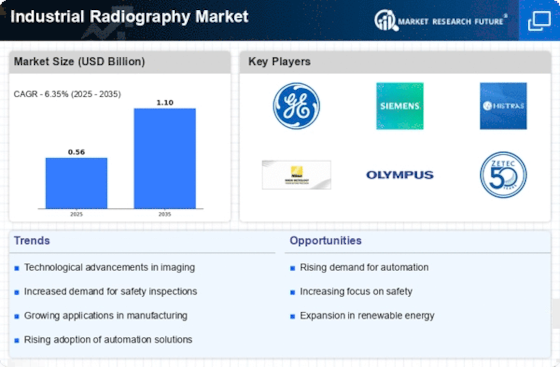
As per Market Research Future analysis, the Industrial Radiography Market Size was estimated at 0.56 USD Billion in 2024. The Industrial Radiography industry is projected to grow from USD 0.5956 Billion in 2025 to USD 1.103 Billion by 2035, exhibiting a compound annual growth rate (CAGR) of 6.35% during the forecast period 2025 - 2035

Key Market Trends & Highlights

The Industrial Radiography Market is poised for substantial growth driven by technological advancements and increasing regulatory compliance.

  • North America remains the largest market for industrial radiography, driven by stringent safety regulations and advanced technology adoption. Asia-Pacific is emerging as the fastest-growing region, fueled by rising infrastructure investments and demand for non-destructive testing. The hardware segment continues to dominate the market, while the software segment is experiencing rapid growth due to advancements in digital solutions. Technological advancements and regulatory compliance are key drivers, as industries increasingly recognize the benefits of non-destructive testing.

Market Size & Forecast

2024 Market Size 0.56 (USD Billion)
2035 Market Size 1.103 (USD Billion)
CAGR (2025 - 2035) 6.35%
Largest Regional Market Share in 2024 Asia Pacific

Major Players

General Electric (US), Siemens (DE), Mistras Group (US), Nikon Metrology (JP), Olympus Corporation (JP), Zetec (US), Fujifilm (JP), Ametek (US), Intertek Group (GB)

Market Trends

The Industrial Radiography Market is currently experiencing a transformative phase, driven by advancements in technology and increasing demand for non-destructive testing methods across various industries. This market encompasses a range of applications, including quality control, safety inspections, and structural integrity assessments. As industries strive for enhanced efficiency and reliability, the adoption of industrial radiography techniques appears to be on the rise. Furthermore, the integration of digital technologies and automation into radiographic processes is likely to streamline operations and improve accuracy, thereby attracting more stakeholders to this field. In addition, regulatory frameworks and safety standards are evolving, which may further propel the growth of the Industrial Radiography Market. Companies are increasingly recognizing the importance of compliance with these regulations, leading to a heightened focus on adopting advanced radiographic solutions. The interplay between technological innovation and regulatory compliance suggests a promising outlook for the market, as organizations seek to leverage these advancements to enhance their operational capabilities and ensure safety in their processes. Overall, the Industrial Radiography Market is poised for continued growth, driven by a combination of technological advancements and increasing awareness of the benefits of non-destructive testing methods.

Technological Advancements

The Industrial Radiography Market is witnessing a surge in technological innovations, particularly in digital radiography and computed tomography. These advancements enhance image quality and reduce exposure times, making inspections more efficient and reliable. As industries adopt these cutting-edge technologies, the market is likely to expand further.

Regulatory Compliance

Increasingly stringent safety regulations and quality standards are influencing the Industrial Radiography Market. Companies are compelled to adopt non-destructive testing methods to comply with these regulations, which may drive demand for advanced radiographic solutions. This trend underscores the importance of maintaining safety and quality in industrial operations.

Growing Demand in Emerging Markets

Emerging economies are experiencing rapid industrialization, leading to a heightened demand for non-destructive testing methods. The Industrial Radiography Market is likely to benefit from this trend, as industries in these regions seek to enhance quality control and ensure safety in their operations. This growth potential presents opportunities for market players.

Industrial Radiographys Market Market Drivers

Growing Demand in Emerging Markets

The Industrial Radiography Market is witnessing a surge in demand from emerging markets, where industrialization is rapidly advancing. Countries in Asia-Pacific and Latin America are increasingly adopting industrial radiography techniques to enhance quality control and ensure the integrity of infrastructure projects. The expansion of manufacturing and construction sectors in these regions is contributing to the growth of the market. For instance, the Asia-Pacific region is projected to account for a significant share of the industrial radiography equipment market, driven by rising investments in infrastructure development. This trend indicates a shift in focus towards modern inspection techniques that can meet the demands of expanding industries. As emerging markets continue to evolve, the Industrial Radiography Market is likely to experience robust growth fueled by this increasing demand.

Regulatory Compliance and Safety Standards

The Industrial Radiography Market is heavily influenced by stringent regulatory compliance and safety standards. Governments and international organizations have established rigorous guidelines to ensure the safety of radiographic testing processes. Compliance with these regulations is not only essential for operational integrity but also for maintaining public safety. The increasing emphasis on safety protocols in industries such as oil and gas, nuclear, and manufacturing is propelling the demand for reliable radiographic solutions. As a result, companies are investing in advanced radiography equipment that meets or exceeds regulatory requirements. This trend is likely to continue, as adherence to safety standards is critical for minimizing risks associated with radiographic inspections. The Industrial Radiography Market, therefore, stands to benefit from the ongoing focus on regulatory compliance, which drives innovation and investment in safer technologies.

Increased Investment in Infrastructure Development

The Industrial Radiography Market is benefiting from increased investment in infrastructure development across various regions. Governments and private entities are allocating substantial resources to enhance transportation, energy, and utility infrastructures. This investment necessitates rigorous quality assurance processes, where industrial radiography plays a crucial role. The need for non-destructive testing methods to ensure the safety and reliability of infrastructure projects is driving the demand for radiographic solutions. As infrastructure projects become more complex, the requirement for advanced inspection techniques is likely to grow. The Industrial Radiography Market is poised to capitalize on this trend, as stakeholders seek to mitigate risks associated with structural failures and ensure compliance with safety standards. The ongoing commitment to infrastructure development is expected to sustain the growth trajectory of the market.

Rising Awareness of Non-Destructive Testing Benefits

The Industrial Radiography Market is experiencing a heightened awareness of the benefits associated with non-destructive testing (NDT) methods. Industries are increasingly recognizing that NDT techniques, including radiography, provide critical insights into material integrity without compromising the structural integrity of components. This awareness is leading to a broader acceptance of industrial radiography as a standard practice in quality assurance processes. The ability to detect internal flaws and defects in materials is becoming essential for industries such as aerospace, automotive, and manufacturing. As companies strive to enhance product quality and safety, the demand for industrial radiography solutions is likely to rise. The Industrial Radiography Market is thus positioned to grow as more organizations adopt NDT practices, driven by the need for reliable and efficient inspection methods.

Technological Advancements in Industrial Radiography

The Industrial Radiography Market is experiencing a notable transformation due to rapid technological advancements. Innovations such as digital radiography and computed radiography are enhancing image quality and reducing exposure times. These technologies not only improve the efficiency of inspections but also ensure higher accuracy in detecting flaws in materials. The market for industrial radiography equipment is projected to grow significantly, with estimates suggesting a compound annual growth rate of around 6% over the next few years. This growth is driven by the increasing adoption of advanced imaging techniques across various sectors, including aerospace, automotive, and construction, where precision is paramount. As industries seek to enhance safety and compliance, the integration of cutting-edge technologies in the Industrial Radiography Market appears to be a key driver of growth.

Market Segment Insights

By Component: Hardware (Largest) vs. Software (Fastest-Growing)

In the Industrial Radiography Market, the component segment showcases a clear differentiation between hardware and software offerings. Hardware holds the largest share, reflecting its essential role in radiographic imaging processes. This dominance is attributed to the widespread use of X-ray equipment and other radiographic devices in various industries such as manufacturing, construction, and oil &amp; gas. In contrast, software is increasingly gaining traction, enabling seamless integration with advanced imaging technologies and enhancing processing capabilities, which makes it a critical player in the evolving landscape of industrial radiography.

Component: Hardware (Dominant) vs. Software (Emerging)

Hardware in the Industrial Radiography Market stands as the dominant player, owing to its foundational role in enabling radiographic inspections. Typical hardware components include X-ray machines, gamma radiography equipment, and digital imaging systems, which are crucial for producing high-quality images necessary for material inspection. Software, while currently an emerging segment, is rapidly becoming vital for optimizing radiographic processes. It encompasses various applications such as image enhancement, analysis tools, and compliance management, which are essential for meeting regulatory standards. As industries increasingly embrace digitization, the software segment is projected to expand swiftly, providing integrated solutions that support advanced radiography techniques.

By Imaging Technology: Digital Radiography (Largest) vs. Film-Based Radiography (Fastest-Growing)

In the Industrial Radiography Market, Digital Radiography currently holds the largest market share due to its advanced capabilities, offering superior image quality and faster processing times compared to traditional methods. Film-Based Radiography, while historically significant, is experiencing a decline in market share as industries transition to more efficient digital solutions. However, Film-Based Radiography still maintains a notable presence, particularly in sectors where legacy systems are deeply entrenched. The growth trends for Digital Radiography are driven by the increasing demand for high-quality imaging and the push for automation in industrial settings. On the other hand, Film-Based Radiography is noted for its emerging applications in specific niches where physical film is still preferred for particular regulatory or procedural reasons. Innovations in film technology are also contributing to its resurgence, making it an area of interest for market participants.

Imaging Technology: Digital Radiography (Dominant) vs. Film-Based Radiography (Emerging)

Digital Radiography stands out as the dominant technology in the Industrial Radiography Market, characterized by its ability to deliver real-time imaging and eliminate many of the drawbacks associated with traditional film methods. It leverages advanced digital sensors and software, enhancing image quality and reducing inspection times. Furthermore, Digital Radiography supports automated processes, making it more adaptable to modern industrial workflows. In contrast, Film-Based Radiography serves as an emerging option, still utilized in certain applications where direct physical copies are required. Its recent technological enhancements, such as improved film sensitivity and processing techniques, are revitalizing its relevance, particularly in industries that prioritize thorough documentation and regulatory compliance.

By Radiation Type: X-Rays (Largest) vs. Gamma Rays (Fastest-Growing)

In the Industrial Radiography Market, the X-Rays segment holds a significant share, favored for its versatility and effectiveness in non-destructive testing applications. This established technology is widely utilized in various industries, contributing to its dominance in market share. Meanwhile, Gamma Rays, while having a smaller current market share, are rapidly gaining traction due to their ability to penetrate dense materials, making them ideal for specific applications where X-Rays may fall short. The growth trends for the radiation types show a shift towards Gamma Rays as the industry increasingly recognizes their potential in advanced and complex imaging applications. Factors such as technological advancements, the need for high precision in inspections, and stringent regulatory standards in safety and quality assurance are driving this expansion. As industries adopt more sophisticated testing methods, Gamma Rays are positioned to become a critical player, showing promise for explosive growth in the coming years.

Radiation Type: X-Rays (Dominant) vs. Gamma Rays (Emerging)

X-Rays are the cornerstone of the Industrial Radiography Market, renowned for their efficiency and reliability in various inspection processes. This technology is established in sectors like aerospace, automotive, and manufacturing, where high-quality standards must be maintained. The ease of use and the ability to produce clear images of internal structures have solidified X-Rays' position as the dominant choice among industry professionals. Conversely, Gamma Rays are emerging as a competitive alternative due to their superior penetrating ability, especially in high-density materials. Their adaptation is accelerated by innovations in detector and imaging technologies. As industries face increasing demands for precise inspections, Gamma Rays are becoming integral, positioned to capture a larger market share with their growing applications in rigorous testing environments.

By End-User: Oil & Gas (Largest) vs. Aerospace & Defense (Fastest-Growing)

In the Industrial Radiography Market, the distribution of market share among end-user segments reveals that the Oil &amp; Gas sector holds the largest share, driven by a high demand for non-destructive testing and inspection services to ensure safety and compliance in operations. Meanwhile, other segments, such as Automotive and Manufacturing, also contribute significantly to the market, although they lag behind in terms of share when compared to Oil &amp; Gas. The Aerospace &amp; Defense sector, while smaller in overall market share, is rapidly gaining traction due to increasing investments in advanced technologies and stringent regulations for quality assurance. Growth trends in this market indicate a shift towards more innovative and efficient technologies, particularly impacting segments like Aerospace &amp; Defense, which is becoming the fastest-growing end-user category. Factors driving growth include the rise in global air traffic, increased safety standards, and the ongoing development of advanced materials requiring rigorous inspection. Similarly, the push for sustainable practices within the Oil &amp; Gas sector fosters the need for reliable radiography solutions, maintaining its leadership position. Overall, the Industrial Radiography Market is witnessing significant changes based on evolving end-user needs and technological advancements.

Oil &amp; Gas (Dominant) vs. Aerospace &amp; Defense (Emerging)

The Oil &amp; Gas sector remains a dominant end-user for the Industrial Radiography Market, due to its extensive requirements for non-destructive testing methodologies to maintain safety and efficiency. The substantial investments in exploration and production lead to an ongoing demand for radiographic testing to inspect pipelines, equipment, and infrastructure. This sector benefits from established protocols and a history of reliance on industrial radiography, driving a consistent market position. On the other hand, the Aerospace &amp; Defense segment is emerging as a significant player, characterized by rapid technological advancements and heightened safety regulations. As air travel increases and new aircraft designs emerge, the need for non-destructive testing becomes critical in ensuring safety and quality. Investments in this segment are also increasing, making it a vital area for future growth and opportunities in industrial radiography.

Get more detailed insights about Industrial Radiography Market Research Report - Forecast till 2035

Regional Insights

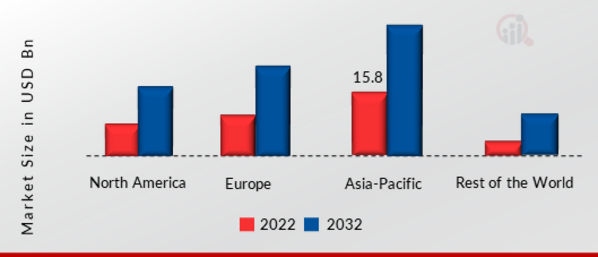
By region, the study provides market insights into North America, Europe, Asia-Pacific and Rest of the World. The Asia-Pacific Industrial Radiography market will dominate this market, owing to rigid government regulations regarding safety, which have created a huge demand for industrial radiography equipment. In addition, the growing technological advancement and rising focus of manufacturers on R&D will boost market growth in this region.

Further, the major countries studied in the market report are The US, Canada, German, France, the UK, Italy, Spain, China, Japan, India, Australia, South Korea, and Brazil.

Figure 2: Industrial Radiography Market SHARE BY REGION 2022 (USD Billion)

Industrial Radiography Market SHARE BY REGION 2022

Europe's Industrial Radiography market accounts for the second-largest market share due to the largest aerospace industry in this area. Further, the German Industrial Radiography market held the largest market share, and the UK Industrial Radiography market was the fastest-growing market in the European region.

The North America Industrial Radiography Market is expected to grow at the fastest CAGR from 2023 to 2032 due to rising development in the automotive, aerospace, manufacturing, and oil sectors. Industrial radiography techniques are greatly used across these sectors for maintenance, inspection, and dimensional measurement. Moreover, China’s Industrial Radiography market held the largest market share, and the Indian Industrial Radiography market was the fastest-growing market in the Asia-Pacific region.

Key Players and Competitive Insights

Leading market players are investing heavily in research and development to expand their product lines, which will help the Industrial Radiography market, grow even more. Market participants are also undertaking various strategic activities to expand their global footprint, with important market developments including new product launches, contractual agreements, mergers and acquisitions, higher investments, and collaboration with other organizations. The Industrial Radiography industry must offer cost-effective items to expand and survive in a more competitive and rising market climate.Manufacturing locally to minimize operational costs is one of the key business tactics manufacturers use in the global Industrial Radiography industry to benefit clients and increase the market sector. In recent years, the Industrial Radiography industry has offered some of the most significant advantages to technology.Major players in the Industrial Radiography market, including General Electric Company (US), Fujifilm Holdings Corporation (Japan), Nikon Corporation (Japan), Shimadzu Corporation (Japan), Nikon Corporation (Japan), Shimadzu Corporation (Japan), Baker Hughes (US), Anritsu Corporation (Japan), Mettler-Toledo (US), PerkinElmer Inc. (US), 3DX-Ray Ltd. (UK), Bosello High Technology Srl (Italy), COMET Holding AG (Switzerland)., and others, are attempting to increase market demand by investing in research and development operations.DÜRR NDT offers comprehensive digitalization solutions for the NDT sector, including networked digital radiography devices and cutting-edge software. Digital radiography devices include flat panel detectors and high-resolution imaging plate scanners, equipment for digital archiving compliant with standards, image acquisition and evaluation software, and the distinctive and all-encompassing workflow management and reporting platform DRIVE NDT. In Baden-Wϋrttemberg, a high-tech German federal state, DÜRR NDT is a component of the DÜRR DENTAL group. Here, all products-including cutting-edge hardware, cutting-edge software and contemporary services- are created, engineered and marketed.DÜRR NDT operates in more than 100 countries thanks to a global sales and service organization and its branch offices in Western Europe, North America, and Asia. For instance: in February 2021, A new D-Tect X NDT program that offers excellent performance, is user-friendly and is incredibly adaptable was launched by DÜRR NDT GmbH & Co. KG.Waygate Technologies provide more high-end non-destructive testing options, including safer X-ray, advanced digital, ultra-precise computed tomography, radiography testing, HD remote visual inspection, and ultrasonic portables. Numerous industrial partners worldwide now rely on our industrial inspection solutions and knowledge to increase productivity and dependability. With cutting-edge data and analytics, Waygate assists companies in accelerating their digital transformation while revealing ground-breaking insights and resolving business problems. Numerous global industrial partners rely on Waygate’s industrial inspection solutions and knowledge to increase productivity and dependability.For Instance: In August 2020, Waygate Technologies, a global leader in industrial inspection solutions, released two new portable X-ray detectors from their digital X-ray family DXR to ensure the quality, safety, and productivity of their customer complex products and processes. The direct radiography detectors DXR140P-HC and DXR75P-HR combine the latest technological advances with extensive customer feedback and guarantee high-quality, efficient imaging and thorough protection for use in harsh environments.

Key Companies in the Industrial Radiographys Market include

Industry Developments

September 2022: DÜRR NDT GmbH & Co. KG join hands with JME Ltd. to develop an innovative X-ray solution. The partnership would help JME Ltd. to use the D-Tect X software with the DXB:1 to inspect circumferential welds in applications such as new pipelines.

July 2022: L3Harris Technologies join hands with DÜRR NDT GmbH & Co. KG to use ScanX Discover HC computed radiography scanner to electronically capture X-ray images and then project them digitally on a monitor for evaluation.

Future Outlook

Industrial Radiographys Market Future Outlook

The Industrial Radiography Market is projected to grow at a 6.35% CAGR from 2025 to 2035, driven by technological advancements, increasing safety regulations, and rising demand for non-destructive testing.

New opportunities lie in:

  • Development of portable radiography equipment for remote inspections.</p><p>Integration of AI-driven analytics for enhanced image interpretation.</p><p>Expansion into emerging markets with tailored training programs.

By 2035, the market is expected to achieve robust growth, driven by innovation and strategic expansion.

Market Segmentation

Industrial Radiographys Market End-User Outlook

  • Automotive
  • Consumer Electronics
  • Oil & Gas
  • Aerospace & Defense
  • Manufacturing
  • Power Generation
  • Others

Industrial Radiographys Market Component Outlook

  • Hardware
  • Software

Industrial Radiographys Market Radiation Type Outlook

  • X-Rays
  • Gamma Rays

Industrial Radiographys Market Imaging Technology Outlook

  • Film-Based Radiography
  • Digital Radiography

Report Scope

MARKET SIZE 2024 0.56(USD Billion)
MARKET SIZE 2025 0.5956(USD Billion)
MARKET SIZE 2035 1.103(USD Billion)
COMPOUND ANNUAL GROWTH RATE (CAGR) 6.35% (2025 - 2035)
REPORT COVERAGE Revenue Forecast, Competitive Landscape, Growth Factors, and Trends
BASE YEAR 2024
Market Forecast Period 2025 - 2035
Historical Data 2019 - 2024
Market Forecast Units USD Billion
Key Companies Profiled General Electric (US), Siemens (DE), Mistras Group (US), Nikon Metrology (JP), Olympus Corporation (JP), Zetec (US), Fujifilm (JP), Ametek (US), Intertek Group (GB)
Segments Covered Component, Imaging Technology, Radiation Type, End-User, Region
Key Market Opportunities Integration of advanced digital imaging technologies enhances efficiency in the Industrial Radiography Market.
Key Market Dynamics Technological advancements and regulatory changes drive innovation and competition in the Industrial Radiography Market.
Countries Covered North America, Europe, APAC, South America, MEA

FAQs

What is the projected market valuation of the Industrial Radiography Market by 2035?

<p>The Industrial Radiography Market is projected to reach a valuation of 1.103 USD Billion by 2035.</p>

What was the market valuation of the Industrial Radiography Market in 2024?

<p>In 2024, the Industrial Radiography Market had a valuation of 0.56 USD Billion.</p>

What is the expected CAGR for the Industrial Radiography Market during the forecast period 2025 - 2035?

<p>The expected CAGR for the Industrial Radiography Market during the forecast period 2025 - 2035 is 6.35%.</p>

Which companies are considered key players in the Industrial Radiography Market?

<p>Key players in the Industrial Radiography Market include General Electric, Siemens, Mistras Group, Nikon Metrology, Olympus Corporation, Zetec, Fujifilm, Ametek, and Intertek Group.</p>

What are the main segments of the Industrial Radiography Market?

<p>The main segments of the Industrial Radiography Market include Component, Imaging Technology, Radiation Type, and End-User.</p>

How did the Hardware segment perform in the Industrial Radiography Market in 2024?

<p>In 2024, the Hardware segment of the Industrial Radiography Market was valued at 0.336 USD Billion.</p>

What is the valuation of the Digital Radiography segment in 2024?

The Digital Radiography segment was valued at 0.31 USD Billion in 2024.

What is the projected growth for the Oil & Gas segment in the Industrial Radiography Market by 2035?

The Oil &amp; Gas segment is projected to grow from 0.14 USD Billion in 2024 to 0.28 USD Billion by 2035.

What was the valuation of the Gamma Rays segment in 2024?

The Gamma Rays segment was valued at 0.22 USD Billion in 2024.

How does the Consumer Electronics segment compare to other end-user segments in 2024?

In 2024, the Consumer Electronics segment was valued at 0.08 USD Billion, which is lower than segments like Oil &amp; Gas and Automotive.

  1. SECTION I: EXECUTIVE SUMMARY AND KEY HIGHLIGHTS
    1. | 1.1 EXECUTIVE SUMMARY
    2. | | 1.1.1 Market Overview
    3. | | 1.1.2 Key Findings
    4. | | 1.1.3 Market Segmentation
    5. | | 1.1.4 Competitive Landscape
    6. | | 1.1.5 Challenges and Opportunities
    7. | | 1.1.6 Future Outlook
  2. SECTION II: SCOPING, METHODOLOGY AND MARKET STRUCTURE
    1. | 2.1 MARKET INTRODUCTION
    2. | | 2.1.1 Definition
    3. | | 2.1.2 Scope of the study
    4. | | | 2.1.2.1 Research Objective
    5. | | | 2.1.2.2 Assumption
    6. | | | 2.1.2.3 Limitations
    7. | 2.2 RESEARCH METHODOLOGY
    8. | | 2.2.1 Overview
    9. | | 2.2.2 Data Mining
    10. | | 2.2.3 Secondary Research
    11. | | 2.2.4 Primary Research
    12. | | | 2.2.4.1 Primary Interviews and Information Gathering Process
    13. | | | 2.2.4.2 Breakdown of Primary Respondents
    14. | | 2.2.5 Forecasting Model
    15. | | 2.2.6 Market Size Estimation
    16. | | | 2.2.6.1 Bottom-Up Approach
    17. | | | 2.2.6.2 Top-Down Approach
    18. | | 2.2.7 Data Triangulation
    19. | | 2.2.8 Validation
  3. SECTION III: QUALITATIVE ANALYSIS
    1. | 3.1 MARKET DYNAMICS
    2. | | 3.1.1 Overview
    3. | | 3.1.2 Drivers
    4. | | 3.1.3 Restraints
    5. | | 3.1.4 Opportunities
    6. | 3.2 MARKET FACTOR ANALYSIS
    7. | | 3.2.1 Value chain Analysis
    8. | | 3.2.2 Porter's Five Forces Analysis
    9. | | | 3.2.2.1 Bargaining Power of Suppliers
    10. | | | 3.2.2.2 Bargaining Power of Buyers
    11. | | | 3.2.2.3 Threat of New Entrants
    12. | | | 3.2.2.4 Threat of Substitutes
    13. | | | 3.2.2.5 Intensity of Rivalry
    14. | | 3.2.3 COVID-19 Impact Analysis
    15. | | | 3.2.3.1 Market Impact Analysis
    16. | | | 3.2.3.2 Regional Impact
    17. | | | 3.2.3.3 Opportunity and Threat Analysis
  4. SECTION IV: QUANTITATIVE ANALYSIS
    1. | 4.1 Semiconductor & Electronics, BY Component (USD Billion)
    2. | | 4.1.1 Hardware
    3. | | 4.1.2 Software
    4. | 4.2 Semiconductor & Electronics, BY Imaging Technology (USD Billion)
    5. | | 4.2.1 Film-Based Radiography
    6. | | 4.2.2 Digital Radiography
    7. | 4.3 Semiconductor & Electronics, BY Radiation Type (USD Billion)
    8. | | 4.3.1 X-Rays
    9. | | 4.3.2 Gamma Rays
    10. | 4.4 Semiconductor & Electronics, BY End-User (USD Billion)
    11. | | 4.4.1 Automotive
    12. | | 4.4.2 Consumer Electronics
    13. | | 4.4.3 Oil & Gas
    14. | | 4.4.4 Aerospace & Defense
    15. | | 4.4.5 Manufacturing
    16. | | 4.4.6 Power Generation
    17. | | 4.4.7 Others
    18. | 4.5 Semiconductor & Electronics, BY Region (USD Billion)
    19. | | 4.5.1 North America
    20. | | | 4.5.1.1 US
    21. | | | 4.5.1.2 Canada
    22. | | 4.5.2 Europe
    23. | | | 4.5.2.1 Germany
    24. | | | 4.5.2.2 UK
    25. | | | 4.5.2.3 France
    26. | | | 4.5.2.4 Russia
    27. | | | 4.5.2.5 Italy
    28. | | | 4.5.2.6 Spain
    29. | | | 4.5.2.7 Rest of Europe
    30. | | 4.5.3 APAC
    31. | | | 4.5.3.1 China
    32. | | | 4.5.3.2 India
    33. | | | 4.5.3.3 Japan
    34. | | | 4.5.3.4 South Korea
    35. | | | 4.5.3.5 Malaysia
    36. | | | 4.5.3.6 Thailand
    37. | | | 4.5.3.7 Indonesia
    38. | | | 4.5.3.8 Rest of APAC
    39. | | 4.5.4 South America
    40. | | | 4.5.4.1 Brazil
    41. | | | 4.5.4.2 Mexico
    42. | | | 4.5.4.3 Argentina
    43. | | | 4.5.4.4 Rest of South America
    44. | | 4.5.5 MEA
    45. | | | 4.5.5.1 GCC Countries
    46. | | | 4.5.5.2 South Africa
    47. | | | 4.5.5.3 Rest of MEA
  5. SECTION V: COMPETITIVE ANALYSIS
    1. | 5.1 Competitive Landscape
    2. | | 5.1.1 Overview
    3. | | 5.1.2 Competitive Analysis
    4. | | 5.1.3 Market share Analysis
    5. | | 5.1.4 Major Growth Strategy in the Semiconductor & Electronics
    6. | | 5.1.5 Competitive Benchmarking
    7. | | 5.1.6 Leading Players in Terms of Number of Developments in the Semiconductor & Electronics
    8. | | 5.1.7 Key developments and growth strategies
    9. | | | 5.1.7.1 New Product Launch/Service Deployment
    10. | | | 5.1.7.2 Merger & Acquisitions
    11. | | | 5.1.7.3 Joint Ventures
    12. | | 5.1.8 Major Players Financial Matrix
    13. | | | 5.1.8.1 Sales and Operating Income
    14. | | | 5.1.8.2 Major Players R&D Expenditure. 2023
    15. | 5.2 Company Profiles
    16. | | 5.2.1 General Electric (US)
    17. | | | 5.2.1.1 Financial Overview
    18. | | | 5.2.1.2 Products Offered
    19. | | | 5.2.1.3 Key Developments
    20. | | | 5.2.1.4 SWOT Analysis
    21. | | | 5.2.1.5 Key Strategies
    22. | | 5.2.2 Siemens (DE)
    23. | | | 5.2.2.1 Financial Overview
    24. | | | 5.2.2.2 Products Offered
    25. | | | 5.2.2.3 Key Developments
    26. | | | 5.2.2.4 SWOT Analysis
    27. | | | 5.2.2.5 Key Strategies
    28. | | 5.2.3 Mistras Group (US)
    29. | | | 5.2.3.1 Financial Overview
    30. | | | 5.2.3.2 Products Offered
    31. | | | 5.2.3.3 Key Developments
    32. | | | 5.2.3.4 SWOT Analysis
    33. | | | 5.2.3.5 Key Strategies
    34. | | 5.2.4 Nikon Metrology (JP)
    35. | | | 5.2.4.1 Financial Overview
    36. | | | 5.2.4.2 Products Offered
    37. | | | 5.2.4.3 Key Developments
    38. | | | 5.2.4.4 SWOT Analysis
    39. | | | 5.2.4.5 Key Strategies
    40. | | 5.2.5 Olympus Corporation (JP)
    41. | | | 5.2.5.1 Financial Overview
    42. | | | 5.2.5.2 Products Offered
    43. | | | 5.2.5.3 Key Developments
    44. | | | 5.2.5.4 SWOT Analysis
    45. | | | 5.2.5.5 Key Strategies
    46. | | 5.2.6 Zetec (US)
    47. | | | 5.2.6.1 Financial Overview
    48. | | | 5.2.6.2 Products Offered
    49. | | | 5.2.6.3 Key Developments
    50. | | | 5.2.6.4 SWOT Analysis
    51. | | | 5.2.6.5 Key Strategies
    52. | | 5.2.7 Fujifilm (JP)
    53. | | | 5.2.7.1 Financial Overview
    54. | | | 5.2.7.2 Products Offered
    55. | | | 5.2.7.3 Key Developments
    56. | | | 5.2.7.4 SWOT Analysis
    57. | | | 5.2.7.5 Key Strategies
    58. | | 5.2.8 Ametek (US)
    59. | | | 5.2.8.1 Financial Overview
    60. | | | 5.2.8.2 Products Offered
    61. | | | 5.2.8.3 Key Developments
    62. | | | 5.2.8.4 SWOT Analysis
    63. | | | 5.2.8.5 Key Strategies
    64. | | 5.2.9 Intertek Group (GB)
    65. | | | 5.2.9.1 Financial Overview
    66. | | | 5.2.9.2 Products Offered
    67. | | | 5.2.9.3 Key Developments
    68. | | | 5.2.9.4 SWOT Analysis
    69. | | | 5.2.9.5 Key Strategies
    70. | 5.3 Appendix
    71. | | 5.3.1 References
    72. | | 5.3.2 Related Reports
  6. LIST OF FIGURES
    1. | 6.1 MARKET SYNOPSIS
    2. | 6.2 NORTH AMERICA MARKET ANALYSIS
    3. | 6.3 US MARKET ANALYSIS BY COMPONENT
    4. | 6.4 US MARKET ANALYSIS BY IMAGING TECHNOLOGY
    5. | 6.5 US MARKET ANALYSIS BY RADIATION TYPE
    6. | 6.6 US MARKET ANALYSIS BY END-USER
    7. | 6.7 CANADA MARKET ANALYSIS BY COMPONENT
    8. | 6.8 CANADA MARKET ANALYSIS BY IMAGING TECHNOLOGY
    9. | 6.9 CANADA MARKET ANALYSIS BY RADIATION TYPE
    10. | 6.10 CANADA MARKET ANALYSIS BY END-USER
    11. | 6.11 EUROPE MARKET ANALYSIS
    12. | 6.12 GERMANY MARKET ANALYSIS BY COMPONENT
    13. | 6.13 GERMANY MARKET ANALYSIS BY IMAGING TECHNOLOGY
    14. | 6.14 GERMANY MARKET ANALYSIS BY RADIATION TYPE
    15. | 6.15 GERMANY MARKET ANALYSIS BY END-USER
    16. | 6.16 UK MARKET ANALYSIS BY COMPONENT
    17. | 6.17 UK MARKET ANALYSIS BY IMAGING TECHNOLOGY
    18. | 6.18 UK MARKET ANALYSIS BY RADIATION TYPE
    19. | 6.19 UK MARKET ANALYSIS BY END-USER
    20. | 6.20 FRANCE MARKET ANALYSIS BY COMPONENT
    21. | 6.21 FRANCE MARKET ANALYSIS BY IMAGING TECHNOLOGY
    22. | 6.22 FRANCE MARKET ANALYSIS BY RADIATION TYPE
    23. | 6.23 FRANCE MARKET ANALYSIS BY END-USER
    24. | 6.24 RUSSIA MARKET ANALYSIS BY COMPONENT
    25. | 6.25 RUSSIA MARKET ANALYSIS BY IMAGING TECHNOLOGY
    26. | 6.26 RUSSIA MARKET ANALYSIS BY RADIATION TYPE
    27. | 6.27 RUSSIA MARKET ANALYSIS BY END-USER
    28. | 6.28 ITALY MARKET ANALYSIS BY COMPONENT
    29. | 6.29 ITALY MARKET ANALYSIS BY IMAGING TECHNOLOGY
    30. | 6.30 ITALY MARKET ANALYSIS BY RADIATION TYPE
    31. | 6.31 ITALY MARKET ANALYSIS BY END-USER
    32. | 6.32 SPAIN MARKET ANALYSIS BY COMPONENT
    33. | 6.33 SPAIN MARKET ANALYSIS BY IMAGING TECHNOLOGY
    34. | 6.34 SPAIN MARKET ANALYSIS BY RADIATION TYPE
    35. | 6.35 SPAIN MARKET ANALYSIS BY END-USER
    36. | 6.36 REST OF EUROPE MARKET ANALYSIS BY COMPONENT
    37. | 6.37 REST OF EUROPE MARKET ANALYSIS BY IMAGING TECHNOLOGY
    38. | 6.38 REST OF EUROPE MARKET ANALYSIS BY RADIATION TYPE
    39. | 6.39 REST OF EUROPE MARKET ANALYSIS BY END-USER
    40. | 6.40 APAC MARKET ANALYSIS
    41. | 6.41 CHINA MARKET ANALYSIS BY COMPONENT
    42. | 6.42 CHINA MARKET ANALYSIS BY IMAGING TECHNOLOGY
    43. | 6.43 CHINA MARKET ANALYSIS BY RADIATION TYPE
    44. | 6.44 CHINA MARKET ANALYSIS BY END-USER
    45. | 6.45 INDIA MARKET ANALYSIS BY COMPONENT
    46. | 6.46 INDIA MARKET ANALYSIS BY IMAGING TECHNOLOGY
    47. | 6.47 INDIA MARKET ANALYSIS BY RADIATION TYPE
    48. | 6.48 INDIA MARKET ANALYSIS BY END-USER
    49. | 6.49 JAPAN MARKET ANALYSIS BY COMPONENT
    50. | 6.50 JAPAN MARKET ANALYSIS BY IMAGING TECHNOLOGY
    51. | 6.51 JAPAN MARKET ANALYSIS BY RADIATION TYPE
    52. | 6.52 JAPAN MARKET ANALYSIS BY END-USER
    53. | 6.53 SOUTH KOREA MARKET ANALYSIS BY COMPONENT
    54. | 6.54 SOUTH KOREA MARKET ANALYSIS BY IMAGING TECHNOLOGY
    55. | 6.55 SOUTH KOREA MARKET ANALYSIS BY RADIATION TYPE
    56. | 6.56 SOUTH KOREA MARKET ANALYSIS BY END-USER
    57. | 6.57 MALAYSIA MARKET ANALYSIS BY COMPONENT
    58. | 6.58 MALAYSIA MARKET ANALYSIS BY IMAGING TECHNOLOGY
    59. | 6.59 MALAYSIA MARKET ANALYSIS BY RADIATION TYPE
    60. | 6.60 MALAYSIA MARKET ANALYSIS BY END-USER
    61. | 6.61 THAILAND MARKET ANALYSIS BY COMPONENT
    62. | 6.62 THAILAND MARKET ANALYSIS BY IMAGING TECHNOLOGY
    63. | 6.63 THAILAND MARKET ANALYSIS BY RADIATION TYPE
    64. | 6.64 THAILAND MARKET ANALYSIS BY END-USER
    65. | 6.65 INDONESIA MARKET ANALYSIS BY COMPONENT
    66. | 6.66 INDONESIA MARKET ANALYSIS BY IMAGING TECHNOLOGY
    67. | 6.67 INDONESIA MARKET ANALYSIS BY RADIATION TYPE
    68. | 6.68 INDONESIA MARKET ANALYSIS BY END-USER
    69. | 6.69 REST OF APAC MARKET ANALYSIS BY COMPONENT
    70. | 6.70 REST OF APAC MARKET ANALYSIS BY IMAGING TECHNOLOGY
    71. | 6.71 REST OF APAC MARKET ANALYSIS BY RADIATION TYPE
    72. | 6.72 REST OF APAC MARKET ANALYSIS BY END-USER
    73. | 6.73 SOUTH AMERICA MARKET ANALYSIS
    74. | 6.74 BRAZIL MARKET ANALYSIS BY COMPONENT
    75. | 6.75 BRAZIL MARKET ANALYSIS BY IMAGING TECHNOLOGY
    76. | 6.76 BRAZIL MARKET ANALYSIS BY RADIATION TYPE
    77. | 6.77 BRAZIL MARKET ANALYSIS BY END-USER
    78. | 6.78 MEXICO MARKET ANALYSIS BY COMPONENT
    79. | 6.79 MEXICO MARKET ANALYSIS BY IMAGING TECHNOLOGY
    80. | 6.80 MEXICO MARKET ANALYSIS BY RADIATION TYPE
    81. | 6.81 MEXICO MARKET ANALYSIS BY END-USER
    82. | 6.82 ARGENTINA MARKET ANALYSIS BY COMPONENT
    83. | 6.83 ARGENTINA MARKET ANALYSIS BY IMAGING TECHNOLOGY
    84. | 6.84 ARGENTINA MARKET ANALYSIS BY RADIATION TYPE
    85. | 6.85 ARGENTINA MARKET ANALYSIS BY END-USER
    86. | 6.86 REST OF SOUTH AMERICA MARKET ANALYSIS BY COMPONENT
    87. | 6.87 REST OF SOUTH AMERICA MARKET ANALYSIS BY IMAGING TECHNOLOGY
    88. | 6.88 REST OF SOUTH AMERICA MARKET ANALYSIS BY RADIATION TYPE
    89. | 6.89 REST OF SOUTH AMERICA MARKET ANALYSIS BY END-USER
    90. | 6.90 MEA MARKET ANALYSIS
    91. | 6.91 GCC COUNTRIES MARKET ANALYSIS BY COMPONENT
    92. | 6.92 GCC COUNTRIES MARKET ANALYSIS BY IMAGING TECHNOLOGY
    93. | 6.93 GCC COUNTRIES MARKET ANALYSIS BY RADIATION TYPE
    94. | 6.94 GCC COUNTRIES MARKET ANALYSIS BY END-USER
    95. | 6.95 SOUTH AFRICA MARKET ANALYSIS BY COMPONENT
    96. | 6.96 SOUTH AFRICA MARKET ANALYSIS BY IMAGING TECHNOLOGY
    97. | 6.97 SOUTH AFRICA MARKET ANALYSIS BY RADIATION TYPE
    98. | 6.98 SOUTH AFRICA MARKET ANALYSIS BY END-USER
    99. | 6.99 REST OF MEA MARKET ANALYSIS BY COMPONENT
    100. | 6.100 REST OF MEA MARKET ANALYSIS BY IMAGING TECHNOLOGY
    101. | 6.101 REST OF MEA MARKET ANALYSIS BY RADIATION TYPE
    102. | 6.102 REST OF MEA MARKET ANALYSIS BY END-USER
    103. | 6.103 KEY BUYING CRITERIA OF SEMICONDUCTOR & ELECTRONICS
    104. | 6.104 RESEARCH PROCESS OF MRFR
    105. | 6.105 DRO ANALYSIS OF SEMICONDUCTOR & ELECTRONICS
    106. | 6.106 DRIVERS IMPACT ANALYSIS: SEMICONDUCTOR & ELECTRONICS
    107. | 6.107 RESTRAINTS IMPACT ANALYSIS: SEMICONDUCTOR & ELECTRONICS
    108. | 6.108 SUPPLY / VALUE CHAIN: SEMICONDUCTOR & ELECTRONICS
    109. | 6.109 SEMICONDUCTOR & ELECTRONICS, BY COMPONENT, 2024 (% SHARE)
    110. | 6.110 SEMICONDUCTOR & ELECTRONICS, BY COMPONENT, 2024 TO 2035 (USD Billion)
    111. | 6.111 SEMICONDUCTOR & ELECTRONICS, BY IMAGING TECHNOLOGY, 2024 (% SHARE)
    112. | 6.112 SEMICONDUCTOR & ELECTRONICS, BY IMAGING TECHNOLOGY, 2024 TO 2035 (USD Billion)
    113. | 6.113 SEMICONDUCTOR & ELECTRONICS, BY RADIATION TYPE, 2024 (% SHARE)
    114. | 6.114 SEMICONDUCTOR & ELECTRONICS, BY RADIATION TYPE, 2024 TO 2035 (USD Billion)
    115. | 6.115 SEMICONDUCTOR & ELECTRONICS, BY END-USER, 2024 (% SHARE)
    116. | 6.116 SEMICONDUCTOR & ELECTRONICS, BY END-USER, 2024 TO 2035 (USD Billion)
    117. | 6.117 BENCHMARKING OF MAJOR COMPETITORS
  7. LIST OF TABLES
    1. | 7.1 LIST OF ASSUMPTIONS
    2. | | 7.1.1
    3. | 7.2 North America MARKET SIZE ESTIMATES; FORECAST
    4. | | 7.2.1 BY COMPONENT, 2025-2035 (USD Billion)
    5. | | 7.2.2 BY IMAGING TECHNOLOGY, 2025-2035 (USD Billion)
    6. | | 7.2.3 BY RADIATION TYPE, 2025-2035 (USD Billion)
    7. | | 7.2.4 BY END-USER, 2025-2035 (USD Billion)
    8. | 7.3 US MARKET SIZE ESTIMATES; FORECAST
    9. | | 7.3.1 BY COMPONENT, 2025-2035 (USD Billion)
    10. | | 7.3.2 BY IMAGING TECHNOLOGY, 2025-2035 (USD Billion)
    11. | | 7.3.3 BY RADIATION TYPE, 2025-2035 (USD Billion)
    12. | | 7.3.4 BY END-USER, 2025-2035 (USD Billion)
    13. | 7.4 Canada MARKET SIZE ESTIMATES; FORECAST
    14. | | 7.4.1 BY COMPONENT, 2025-2035 (USD Billion)
    15. | | 7.4.2 BY IMAGING TECHNOLOGY, 2025-2035 (USD Billion)
    16. | | 7.4.3 BY RADIATION TYPE, 2025-2035 (USD Billion)
    17. | | 7.4.4 BY END-USER, 2025-2035 (USD Billion)
    18. | 7.5 Europe MARKET SIZE ESTIMATES; FORECAST
    19. | | 7.5.1 BY COMPONENT, 2025-2035 (USD Billion)
    20. | | 7.5.2 BY IMAGING TECHNOLOGY, 2025-2035 (USD Billion)
    21. | | 7.5.3 BY RADIATION TYPE, 2025-2035 (USD Billion)
    22. | | 7.5.4 BY END-USER, 2025-2035 (USD Billion)
    23. | 7.6 Germany MARKET SIZE ESTIMATES; FORECAST
    24. | | 7.6.1 BY COMPONENT, 2025-2035 (USD Billion)
    25. | | 7.6.2 BY IMAGING TECHNOLOGY, 2025-2035 (USD Billion)
    26. | | 7.6.3 BY RADIATION TYPE, 2025-2035 (USD Billion)
    27. | | 7.6.4 BY END-USER, 2025-2035 (USD Billion)
    28. | 7.7 UK MARKET SIZE ESTIMATES; FORECAST
    29. | | 7.7.1 BY COMPONENT, 2025-2035 (USD Billion)
    30. | | 7.7.2 BY IMAGING TECHNOLOGY, 2025-2035 (USD Billion)
    31. | | 7.7.3 BY RADIATION TYPE, 2025-2035 (USD Billion)
    32. | | 7.7.4 BY END-USER, 2025-2035 (USD Billion)
    33. | 7.8 France MARKET SIZE ESTIMATES; FORECAST
    34. | | 7.8.1 BY COMPONENT, 2025-2035 (USD Billion)
    35. | | 7.8.2 BY IMAGING TECHNOLOGY, 2025-2035 (USD Billion)
    36. | | 7.8.3 BY RADIATION TYPE, 2025-2035 (USD Billion)
    37. | | 7.8.4 BY END-USER, 2025-2035 (USD Billion)
    38. | 7.9 Russia MARKET SIZE ESTIMATES; FORECAST
    39. | | 7.9.1 BY COMPONENT, 2025-2035 (USD Billion)
    40. | | 7.9.2 BY IMAGING TECHNOLOGY, 2025-2035 (USD Billion)
    41. | | 7.9.3 BY RADIATION TYPE, 2025-2035 (USD Billion)
    42. | | 7.9.4 BY END-USER, 2025-2035 (USD Billion)
    43. | 7.10 Italy MARKET SIZE ESTIMATES; FORECAST
    44. | | 7.10.1 BY COMPONENT, 2025-2035 (USD Billion)
    45. | | 7.10.2 BY IMAGING TECHNOLOGY, 2025-2035 (USD Billion)
    46. | | 7.10.3 BY RADIATION TYPE, 2025-2035 (USD Billion)
    47. | | 7.10.4 BY END-USER, 2025-2035 (USD Billion)
    48. | 7.11 Spain MARKET SIZE ESTIMATES; FORECAST
    49. | | 7.11.1 BY COMPONENT, 2025-2035 (USD Billion)
    50. | | 7.11.2 BY IMAGING TECHNOLOGY, 2025-2035 (USD Billion)
    51. | | 7.11.3 BY RADIATION TYPE, 2025-2035 (USD Billion)
    52. | | 7.11.4 BY END-USER, 2025-2035 (USD Billion)
    53. | 7.12 Rest of Europe MARKET SIZE ESTIMATES; FORECAST
    54. | | 7.12.1 BY COMPONENT, 2025-2035 (USD Billion)
    55. | | 7.12.2 BY IMAGING TECHNOLOGY, 2025-2035 (USD Billion)
    56. | | 7.12.3 BY RADIATION TYPE, 2025-2035 (USD Billion)
    57. | | 7.12.4 BY END-USER, 2025-2035 (USD Billion)
    58. | 7.13 APAC MARKET SIZE ESTIMATES; FORECAST
    59. | | 7.13.1 BY COMPONENT, 2025-2035 (USD Billion)
    60. | | 7.13.2 BY IMAGING TECHNOLOGY, 2025-2035 (USD Billion)
    61. | | 7.13.3 BY RADIATION TYPE, 2025-2035 (USD Billion)
    62. | | 7.13.4 BY END-USER, 2025-2035 (USD Billion)
    63. | 7.14 China MARKET SIZE ESTIMATES; FORECAST
    64. | | 7.14.1 BY COMPONENT, 2025-2035 (USD Billion)
    65. | | 7.14.2 BY IMAGING TECHNOLOGY, 2025-2035 (USD Billion)
    66. | | 7.14.3 BY RADIATION TYPE, 2025-2035 (USD Billion)
    67. | | 7.14.4 BY END-USER, 2025-2035 (USD Billion)
    68. | 7.15 India MARKET SIZE ESTIMATES; FORECAST
    69. | | 7.15.1 BY COMPONENT, 2025-2035 (USD Billion)
    70. | | 7.15.2 BY IMAGING TECHNOLOGY, 2025-2035 (USD Billion)
    71. | | 7.15.3 BY RADIATION TYPE, 2025-2035 (USD Billion)
    72. | | 7.15.4 BY END-USER, 2025-2035 (USD Billion)
    73. | 7.16 Japan MARKET SIZE ESTIMATES; FORECAST
    74. | | 7.16.1 BY COMPONENT, 2025-2035 (USD Billion)
    75. | | 7.16.2 BY IMAGING TECHNOLOGY, 2025-2035 (USD Billion)
    76. | | 7.16.3 BY RADIATION TYPE, 2025-2035 (USD Billion)
    77. | | 7.16.4 BY END-USER, 2025-2035 (USD Billion)
    78. | 7.17 South Korea MARKET SIZE ESTIMATES; FORECAST
    79. | | 7.17.1 BY COMPONENT, 2025-2035 (USD Billion)
    80. | | 7.17.2 BY IMAGING TECHNOLOGY, 2025-2035 (USD Billion)
    81. | | 7.17.3 BY RADIATION TYPE, 2025-2035 (USD Billion)
    82. | | 7.17.4 BY END-USER, 2025-2035 (USD Billion)
    83. | 7.18 Malaysia MARKET SIZE ESTIMATES; FORECAST
    84. | | 7.18.1 BY COMPONENT, 2025-2035 (USD Billion)
    85. | | 7.18.2 BY IMAGING TECHNOLOGY, 2025-2035 (USD Billion)
    86. | | 7.18.3 BY RADIATION TYPE, 2025-2035 (USD Billion)
    87. | | 7.18.4 BY END-USER, 2025-2035 (USD Billion)
    88. | 7.19 Thailand MARKET SIZE ESTIMATES; FORECAST
    89. | | 7.19.1 BY COMPONENT, 2025-2035 (USD Billion)
    90. | | 7.19.2 BY IMAGING TECHNOLOGY, 2025-2035 (USD Billion)
    91. | | 7.19.3 BY RADIATION TYPE, 2025-2035 (USD Billion)
    92. | | 7.19.4 BY END-USER, 2025-2035 (USD Billion)
    93. | 7.20 Indonesia MARKET SIZE ESTIMATES; FORECAST
    94. | | 7.20.1 BY COMPONENT, 2025-2035 (USD Billion)
    95. | | 7.20.2 BY IMAGING TECHNOLOGY, 2025-2035 (USD Billion)
    96. | | 7.20.3 BY RADIATION TYPE, 2025-2035 (USD Billion)
    97. | | 7.20.4 BY END-USER, 2025-2035 (USD Billion)
    98. | 7.21 Rest of APAC MARKET SIZE ESTIMATES; FORECAST
    99. | | 7.21.1 BY COMPONENT, 2025-2035 (USD Billion)
    100. | | 7.21.2 BY IMAGING TECHNOLOGY, 2025-2035 (USD Billion)
    101. | | 7.21.3 BY RADIATION TYPE, 2025-2035 (USD Billion)
    102. | | 7.21.4 BY END-USER, 2025-2035 (USD Billion)
    103. | 7.22 South America MARKET SIZE ESTIMATES; FORECAST
    104. | | 7.22.1 BY COMPONENT, 2025-2035 (USD Billion)
    105. | | 7.22.2 BY IMAGING TECHNOLOGY, 2025-2035 (USD Billion)
    106. | | 7.22.3 BY RADIATION TYPE, 2025-2035 (USD Billion)
    107. | | 7.22.4 BY END-USER, 2025-2035 (USD Billion)
    108. | 7.23 Brazil MARKET SIZE ESTIMATES; FORECAST
    109. | | 7.23.1 BY COMPONENT, 2025-2035 (USD Billion)
    110. | | 7.23.2 BY IMAGING TECHNOLOGY, 2025-2035 (USD Billion)
    111. | | 7.23.3 BY RADIATION TYPE, 2025-2035 (USD Billion)
    112. | | 7.23.4 BY END-USER, 2025-2035 (USD Billion)
    113. | 7.24 Mexico MARKET SIZE ESTIMATES; FORECAST
    114. | | 7.24.1 BY COMPONENT, 2025-2035 (USD Billion)
    115. | | 7.24.2 BY IMAGING TECHNOLOGY, 2025-2035 (USD Billion)
    116. | | 7.24.3 BY RADIATION TYPE, 2025-2035 (USD Billion)
    117. | | 7.24.4 BY END-USER, 2025-2035 (USD Billion)
    118. | 7.25 Argentina MARKET SIZE ESTIMATES; FORECAST
    119. | | 7.25.1 BY COMPONENT, 2025-2035 (USD Billion)
    120. | | 7.25.2 BY IMAGING TECHNOLOGY, 2025-2035 (USD Billion)
    121. | | 7.25.3 BY RADIATION TYPE, 2025-2035 (USD Billion)
    122. | | 7.25.4 BY END-USER, 2025-2035 (USD Billion)
    123. | 7.26 Rest of South America MARKET SIZE ESTIMATES; FORECAST
    124. | | 7.26.1 BY COMPONENT, 2025-2035 (USD Billion)
    125. | | 7.26.2 BY IMAGING TECHNOLOGY, 2025-2035 (USD Billion)
    126. | | 7.26.3 BY RADIATION TYPE, 2025-2035 (USD Billion)
    127. | | 7.26.4 BY END-USER, 2025-2035 (USD Billion)
    128. | 7.27 MEA MARKET SIZE ESTIMATES; FORECAST
    129. | | 7.27.1 BY COMPONENT, 2025-2035 (USD Billion)
    130. | | 7.27.2 BY IMAGING TECHNOLOGY, 2025-2035 (USD Billion)
    131. | | 7.27.3 BY RADIATION TYPE, 2025-2035 (USD Billion)
    132. | | 7.27.4 BY END-USER, 2025-2035 (USD Billion)
    133. | 7.28 GCC Countries MARKET SIZE ESTIMATES; FORECAST
    134. | | 7.28.1 BY COMPONENT, 2025-2035 (USD Billion)
    135. | | 7.28.2 BY IMAGING TECHNOLOGY, 2025-2035 (USD Billion)
    136. | | 7.28.3 BY RADIATION TYPE, 2025-2035 (USD Billion)
    137. | | 7.28.4 BY END-USER, 2025-2035 (USD Billion)
    138. | 7.29 South Africa MARKET SIZE ESTIMATES; FORECAST
    139. | | 7.29.1 BY COMPONENT, 2025-2035 (USD Billion)
    140. | | 7.29.2 BY IMAGING TECHNOLOGY, 2025-2035 (USD Billion)
    141. | | 7.29.3 BY RADIATION TYPE, 2025-2035 (USD Billion)
    142. | | 7.29.4 BY END-USER, 2025-2035 (USD Billion)
    143. | 7.30 Rest of MEA MARKET SIZE ESTIMATES; FORECAST
    144. | | 7.30.1 BY COMPONENT, 2025-2035 (USD Billion)
    145. | | 7.30.2 BY IMAGING TECHNOLOGY, 2025-2035 (USD Billion)
    146. | | 7.30.3 BY RADIATION TYPE, 2025-2035 (USD Billion)
    147. | | 7.30.4 BY END-USER, 2025-2035 (USD Billion)
    148. | 7.31 PRODUCT LAUNCH/PRODUCT DEVELOPMENT/APPROVAL
    149. | | 7.31.1
    150. | 7.32 ACQUISITION/PARTNERSHIP
    151. | | 7.32.1

Semiconductor & Electronics Market Segmentation

Semiconductor & Electronics By Component (USD Billion, 2025-2035)

  • Hardware
  • Software

Semiconductor & Electronics By Imaging Technology (USD Billion, 2025-2035)

  • Film-Based Radiography
  • Digital Radiography

Semiconductor & Electronics By Radiation Type (USD Billion, 2025-2035)

  • X-Rays
  • Gamma Rays

Semiconductor & Electronics By End-User (USD Billion, 2025-2035)

  • Automotive
  • Consumer Electronics
  • Oil & Gas
  • Aerospace & Defense
  • Manufacturing
  • Power Generation
  • Others
Infographic

Free Sample Request

Kindly complete the form below to receive a free sample of this Report

Get Free Sample

Customer Strories

Compare Licence

×
Features License Type
Single User Multiuser License Enterprise User
Price $4,950 $5,950 $7,250
Maximum User Access Limit 1 User Upto 10 Users Unrestricted Access Throughout the Organization
Free Customization
Direct Access to Analyst
Deliverable Format
Platform Access
Discount on Next Purchase 10% 15% 15%
Printable Versions