×
Request Free Sample ×

Kindly complete the form below to receive a free sample of this Report

* Please use a valid business email

Leading companies partner with us for data-driven Insights

clients tt-cursor
Hero Background
English
Chinese
French
Japanese
Korean
German
Spanish

Industrial Fabrics Market Trends

ID: MRFR/CnM/5803-HCR
185 Pages
Anshula Mandaokar
October 2025

Industrial Fabrics Market Research Report Information by Fiber Type (Polyamide, Polyester, Aramid, Composite), Application (Automotive Carpet, Conveyor Belts, Transmission Belts, Protective Apparel, Flame Resistant Apparel, Filter Media) and Region Forecast till 2035

Share:
Download PDF ×

We do not share your information with anyone. However, we may send you emails based on your report interest from time to time. You may contact us at any time to opt-out.

Industrial Fabrics Market Infographic
Purchase Options

Market Trends

Key Emerging Trends in the Industrial Fabrics Market

The market for Industrial Fabrics is changing fast, showing how different businesses need something new. Looking more carefully at market patterns gives important information for people who want to stay ahead in business. This helps them act quickly when new chances come up. The market for Industrial Fabrics is seeing a big growth in using special materials. These fabrics are made with special features like strength, toughness and ability to resist things from the environment. Markets for industrial fabrics are growing because they're used in many areas like cars, buildings and health care. People are liking nonwoven fabrics more and more in the industry because they can do many things and cost less. These materials are used in many different jobs, like filters, earth-textiles and parts for cars. People are expected to want more nonwoven fabrics in the future. This is because they have benefits like being light and absorbent quickly, as well as easy to change according their needs. Sustainability is an important point in the market of industrial fabrics. More attention is now given to materials and making methods that are good for our environment. Businesses are starting to use green methods because more people want items that help the environment. Recycled and breakable materials are getting more popular. People want products that match their caring for the environment, so this makes businesses look tough on sustainability solutions too. Protecting methods are important for improving the function of factory clothes. Recent patterns are focused on making better coverings that have features like stopping water, preventing fire and protecting against germs. The change in how we put things on materials is due to the need for clothes that can handle bad situations. This makes them good for many uses across different types of jobs and businesses. Geotextiles, a type of fabric used in big projects, are being asked for more and more in building and construction work. These materials are used to hold soil together, prevent erosion and strengthen applications. As more big projects to build stuff happen all over the world, people will need geotextiles. This is likely to make the total market for materials used by factories grow too. A big change in the market for industrial fabrics is combining digital tech and smart cloth. Smart clothes have built-in sensors and devices that allow features such as controlling temperature, checking conditions, and talking. Businesses like healthcare, sports and army are looking into the use of smart fabrics for tasks that need instant data or extra abilities. People want special and unique industrial fabrics more often to meet their needs in certain industries.

Author
Anshula Mandaokar
Team Lead - Research

Anshula Mandaokar holds an academic degree in Chemical Engineering and has been contributing to the field for more than 5 years. She has expertise in Market Research and Business Consulting and serves as a Team Lead for a reputed Market Research firm under the Chemicals and Materials domain spectrum. She has worked on multiple projects, generating explicit results in a quick turnaround time. Her understanding of data interpretation justifies her role as a leader.

Leave a Comment

FAQs

What are main fiber types used in the making of industrial fabrics?

Industrial fabrics are designed to use in products, processes, and services of non-textiles industries. Polyamide, aramid, polyester, and composite are the main fiber types used in the making of industrial fabrics.

What are the major applications of industrial fabrics?

Automotive carpet, conveyor & transmission belts, protective & flame resistant apparel, and filter media are some of the major applications of industrial fabrics.

Which are the leading segments in the global industrial fabrics market?

By fiber type, the polyester segment and by application, the automotive carpet segment account for the leading share in the global industrial fabrics market.

Which region holds the largest share in the global industrial fabrics market?

Asia Pacific holds the largest share in the global industrial fabrics market, followed by North America and Europe, respectively.

Who are the top players in the global industrial fabrics market?

Ahlstrom-Munksjö (Finland), Forbo International SA (Switzerland), Habasit (Switzerland), ContiTech AG (Germany), Toray Industries, Inc. (Japan), Cerex Advanced Fabrics, Inc. (US), DowDuPont (US), W. Barnet GmbH & Co. KG (Germany), Fitesa SA (Brazil), and Johns Manville (US), are some of the major players operating in the industrial fabrics market.

Market Summary

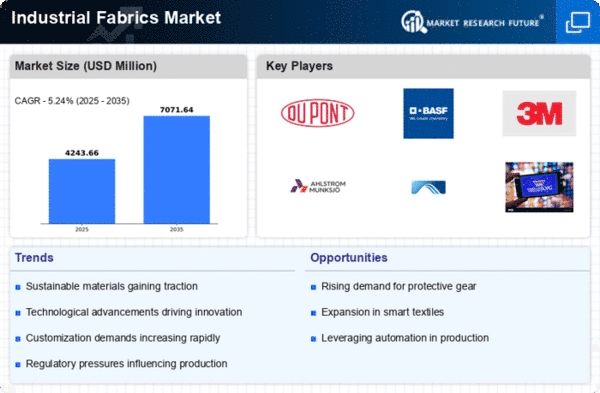
As per MRFR analysis, the Industrial Fabrics Market Size was estimated at 4032.36 USD Million in 2024. The Industrial Fabrics industry is projected to grow from 4243.63 USD Million in 2025 to 7071.64 USD Million by 2035, exhibiting a compound annual growth rate (CAGR) of 5.24 during the forecast period 2025 - 2035.

Key Market Trends & Highlights

The Industrial Fabrics Market is experiencing a dynamic shift towards sustainability and technological innovation.

  • North America remains the largest market for industrial fabrics, driven by robust demand across various sectors.
  • The Asia-Pacific region is emerging as the fastest-growing market, fueled by rapid industrialization and urbanization.
  • The automotive segment continues to dominate, while the medical segment is witnessing the highest growth rates due to increasing healthcare needs.
  • Key market drivers include rising demand in the automotive sector and a heightened focus on sustainability and eco-friendly materials.

Market Size & Forecast

2024 Market Size 4032.36 (USD Million)
2035 Market Size 7071.64 (USD Million)
CAGR (2025 - 2035) 5.24%
Largest Regional Market Share in 2024 North America

Major Players

<p>DuPont (US), BASF (DE), 3M (US), Ahlstrom-Munksjö (FI), Freudenberg Group (DE), Trelleborg AB (SE), Saint-Gobain (FR), Milliken & Company (US), Sioen Industries (BE)</p>

Market Trends

The Industrial Fabrics Market is currently experiencing a dynamic evolution, driven by various factors that influence its growth trajectory. The increasing demand for lightweight and durable materials across multiple industries, including automotive, aerospace, and construction, appears to be a primary catalyst. Furthermore, advancements in technology and manufacturing processes are enabling the development of innovative fabric solutions that cater to specific applications. This trend suggests a shift towards more specialized products, which may enhance performance and sustainability in end-use applications. In addition, the growing emphasis on environmental sustainability is prompting manufacturers to explore eco-friendly materials and production methods. This shift not only aligns with global sustainability goals but also meets the rising consumer preference for environmentally responsible products. As the Industrial Fabrics Market continues to adapt to these changing dynamics, it is likely to witness a diversification of offerings, catering to a broader range of applications and industries. The interplay of these factors indicates a promising outlook for the market, as stakeholders seek to capitalize on emerging opportunities and address evolving consumer needs.

Sustainability Initiatives

The Industrial Fabrics Market is increasingly focusing on sustainability, with manufacturers exploring eco-friendly materials and production techniques. This trend reflects a broader commitment to environmental responsibility, aligning with consumer preferences for sustainable products.

Technological Advancements

Innovations in technology are reshaping the Industrial Fabrics Market, enabling the creation of specialized fabrics that enhance performance and durability. These advancements are likely to drive the development of new applications across various industries.

Customization and Specialization

There is a growing trend towards customization within the Industrial Fabrics Market, as companies seek to provide tailored solutions for specific applications. This shift towards specialization may lead to a more diverse product range, catering to unique industry requirements.

Industrial Fabrics Market Market Drivers

Expansion of the Automotive Sector

The expansion of the automotive sector significantly influences the Global Industrial Fabrics Market Industry. With the rise of electric vehicles and advancements in automotive technology, there is an increasing need for specialized fabrics that enhance vehicle performance and safety. Industrial fabrics are utilized in various applications, including interior upholstery, insulation, and safety features like airbags. This growing demand from the automotive industry is expected to contribute to the overall market growth, with the market projected to reach 96.2 USD Billion in 2024. The automotive sector's evolution suggests a dynamic future for industrial fabrics within the Global Industrial Fabrics Market Industry.

Increasing Environmental Awareness

The Global Industrial Fabrics Market Industry is witnessing a shift towards sustainable practices driven by increasing environmental awareness. Industries are increasingly seeking eco-friendly materials and processes to reduce their carbon footprint. Biodegradable and recyclable industrial fabrics are gaining traction, particularly in sectors such as agriculture and packaging. For instance, the use of biodegradable geotextiles in erosion control reflects this trend. As sustainability becomes a priority for manufacturers and consumers alike, the demand for environmentally friendly industrial fabrics is expected to rise, further shaping the landscape of the Global Industrial Fabrics Market Industry.

Growth in Infrastructure Development

Infrastructure development plays a crucial role in driving the Global Industrial Fabrics Market Industry. Governments worldwide are investing heavily in infrastructure projects, including roads, bridges, and buildings, which require high-performance fabrics for reinforcement and protection. For example, geotextiles are increasingly used in civil engineering applications to enhance soil stability and drainage. This growing focus on infrastructure is likely to propel the market forward, with projections indicating a market size of 292.7 USD Billion by 2035. The ongoing investments in infrastructure suggest a sustained demand for industrial fabrics, thereby reinforcing their importance in the Global Industrial Fabrics Market Industry.

Rising Demand for Technical Textiles

The Global Industrial Fabrics Market Industry experiences a notable surge in demand for technical textiles, which are engineered for specific performance characteristics. Industries such as automotive, aerospace, and construction increasingly utilize these fabrics for their durability and functionality. For instance, the automotive sector employs industrial fabrics for airbags and seat covers, enhancing safety and comfort. This trend is projected to contribute significantly to the market's growth, with the market size expected to reach 96.2 USD Billion in 2024. The emphasis on innovation and performance in textiles suggests a robust future for technical textiles within the Global Industrial Fabrics Market Industry.

Advancements in Manufacturing Technologies

Technological advancements in manufacturing processes are transforming the Global Industrial Fabrics Market Industry. Innovations such as 3D weaving and digital printing enable the production of complex fabric structures with enhanced properties. These technologies facilitate the creation of customized solutions tailored to specific industrial needs, thereby expanding the application range of industrial fabrics. As manufacturers adopt these advanced techniques, the market is poised for growth, with a projected CAGR of 10.64% from 2025 to 2035. The integration of cutting-edge technologies in fabric production indicates a promising trajectory for the Global Industrial Fabrics Market Industry.

Market Segment Insights

By Application: Automotive (Largest) vs. Medical (Fastest-Growing)

<p>The Industrial Fabrics Market is witnessing a diversified application landscape, with the 'Automotive' segment leading in market share. This segment benefits from innovation in manufacturing processes and rising consumer demand for lightweight yet durable materials. Following closely, the 'Aerospace', 'Construction', 'Medical', and 'Agriculture' segments each capture significant portions of the market, catering to specific needs in engineering and infrastructure developments that require specialized fabric solutions. Growth trends indicate that the 'Medical' application is rapidly evolving, driven by technological advancements and increased healthcare expenditure. The growing need for medical textiles like surgical gowns and bed linens underscores the dynamic shift towards health-related applications. Similarly, the 'Agriculture' segment is also gaining traction, propelled by innovations in crop protection and smart farming techniques that demand high-performance fabrics. Overall, the market's adaptability to end-user requirements fuels notable expansion across these applications.</p>

<p>Automotive: Automotive (Dominant) vs. Medical (Emerging)</p>

<p>The 'Automotive' application dominates the Industrial Fabrics Market due to an increasing focus on fuel efficiency and safety measures, which demand light and high-strength materials. This sector integrates advanced textiles for various components, from upholstery to tire manufacturing, highlighting its penetration in the automotive supply chain. On the other hand, the 'Medical' application is emerging as a vital segment, leveraging innovations like antimicrobial fabrics and bio-compatible materials. This growth is driven by the rising demand for quality healthcare products and advancements in medical technology. While automotive textiles often prioritize performance and durability, medical fabrics focus on hygiene, comfort, and functionality, leading to distinct competitive advantages in their respective markets.</p>

By End Use: Protective Clothing (Largest) vs. Geotextiles (Fastest-Growing)

<p>The Industrial Fabrics Market exhibits a diverse range of applications, with Protective Clothing being the most prominent segment, catering to safety requirements across industries such as construction, manufacturing, and healthcare. It reflects the highest market share due to increasing safety regulations and heightened awareness around worker safety, necessitating the use of specialized fabrics designed for protection against hazardous environments. On the other hand, Geotextiles have emerged as the fastest-growing segment due to the rising demand for sustainable and efficient land management solutions in construction and agriculture. Their ability to improve soil stability, prevent erosion, and facilitate drainage has contributed significantly to their growth, indicating a shift toward eco-friendly practices in various sectors.</p>

<p>Protective Clothing (Dominant) vs. Geotextiles (Emerging)</p>

<p>Protective Clothing remains the dominant force in the Industrial Fabrics Market, characterized by a wide assortment of materials engineered for durability and resistance against industrial hazards. This segment emphasizes not only safety but also comfort, with advancements in breathable and lightweight fabrics making them more appealing for prolonged wear. The consistent demand for high-performance protective gear is fueled by stringent safety regulations and a focus on employee safety in hazardous environments. In contrast, Geotextiles represent an emerging category with a promising trajectory as they cater to the increasing need for sustainable construction solutions. Their versatility allows for a range of applications, from road construction to landscape architecture, highlighting their role in enhancing infrastructure while addressing environmental concerns. As the market pivots towards eco-conscious products, the growth of Geotextiles reflects a broader trend toward incorporating sustainability into industrial practices.</p>

By Material Type: Polyester (Largest) vs. Nylon (Fastest-Growing)

<p>The Industrial Fabrics Market showcases a diverse material landscape, where polyester stands as the largest segment, owing to its extensive application across various industries. It dominates in terms of market share due to its favorable properties such as durability, resistance to environmental factors, and cost-effectiveness. Conversely, nylon emerges as the fastest-growing segment, driven by increasing demand in innovative applications such as automotive, aerospace, and protective clothing due to its lightweight and high tensile strength. Nylon's rapid growth is further fuelled by advancements in production technologies, which have significantly enhanced its performance characteristics, making it a preferred choice for high-performance applications. Moreover, the increasing trends towards lightweight and durable materials in industries is propelling the growth of nylon, while polyester continues to show steady growth but is more focused on traditional applications in industrial fabrics.</p>

<p>Polyester (Dominant) vs. Nylon (Emerging)</p>

<p>Polyester is a dominant material in the Industrial Fabrics Market, known for its exceptional durability, moisture-wicking properties, and resistance to UV rays and chemicals. Its versatility makes it suitable for various applications, from automotive interiors to industrial mesh fabrics. On the other hand, nylon has emerged as a strong contender with its lightweight and resilient characteristics. Its remarkable tensile strength and flexibility make it ideal for high-performance applications, especially in sectors like aerospace and personal protective equipment. As industries shift towards innovative and high-performance materials, nylon is poised to capture a significant share of the market, thereby complementing polyester's established presence.</p>

By Weaving Type: Woven (Largest) vs. Non-Woven (Fastest-Growing)

<p>In the Industrial Fabrics Market, the woven segment stands out as the largest contributor to market share, primarily due to its vast applications across various industries including automotive, construction, and filtration. The unique properties of woven fabrics, such as strength and durability, enable them to cater to diverse industrial needs, solidifying their position in the market. Conversely, the non-woven segment is rapidly gaining traction, driven by its versatile applications in hygiene products, medical supplies, and geotextiles. This growth is further supported by technological advancements that enhance manufacturing processes, making non-woven fabrics more accessible and efficient for industrial use.</p>

<p>Woven (Dominant) vs. Non-Woven (Emerging)</p>

<p>Woven fabrics dominate the Industrial Fabrics Market due to their structured weave patterns that provide exceptional strength and stability. These fabrics are extensively used in applications like tarpaulins, industrial bags, and various types of reinforcement, showcasing their versatility and reliability in demanding environments. On the other hand, non-woven fabrics are emerging as a key player, especially in industries like healthcare and personal protective equipment. Their ability to be produced more cost-effectively and with rapid manufacturing processes positions them well for growth. Both segments exhibit unique characteristics that cater to different industrial needs, with woven fabrics maintaining dominance while non-woven fabrics capitalize on emerging trends.</p>

By Functionality: Fire Resistance (Largest) vs. Water Resistance (Fastest-Growing)

<p>In the Industrial Fabrics Market, the functionality segment exhibits diverse characteristics, with Fire Resistance holding the largest market share. This segment is primarily driven by stringent safety regulations across various industries, including construction and manufacturing, ensuring that fire-resistant fabrics are widely adopted. Water Resistance follows closely, emerging as the fastest-growing segment, fueled by increasing demand for protective clothing and outdoor gear that can withstand harsh weather conditions. The growth trends in the functionality segment reflect a broader shift towards enhanced safety and durability in industrial applications. Rising awareness regarding workplace safety and environmental concerns are encouraging innovations in fabric technologies. Moreover, industries such as automotive and aerospace are increasingly incorporating advanced materials that offer superior performances, such as enhanced water and chemical resistance, indicating a robust future for these segments.</p>

<p>Fire Resistance (Dominant) vs. Chemical Resistance (Emerging)</p>

<p>Fire Resistance fabric stands out as the dominant player in the functionality segment of the Industrial Fabrics Market. It is highly sought after for its ability to protect against flames and extreme heat, making it indispensable in industries such as construction, oil and gas, and firefighting. Notably, advancements in technology have made fire-resistant materials not only safer but also lighter and more comfortable to wear. On the other hand, Chemical Resistance fabric is emerging rapidly due to rising concerns over chemical exposure in workplaces, particularly in manufacturing and laboratories. This segment benefits from innovations that enhance durability and provide effective protection against a range of hazardous substances, positioning it well for future growth as regulations concerning worker safety become more stringent.</p>

Get more detailed insights about Industrial Fabrics Market Research Report – Global Forecast till 2035

Regional Insights

North America : Market Leader in Industrial Fabrics

North America is poised to maintain its leadership in the industrial fabrics market, holding a significant share of $2015.0 million. The region's growth is driven by robust demand across various sectors, including automotive, aerospace, and construction. Regulatory support for innovation and sustainability further enhances market dynamics, encouraging investments in advanced materials and technologies. The increasing focus on safety and performance standards is also a key catalyst for growth. The United States stands out as the leading country in this region, hosting major players such as DuPont and 3M. The competitive landscape is characterized by a mix of established companies and emerging innovators, all striving to meet the evolving needs of industries. The presence of key players ensures a steady supply of high-quality industrial fabrics, reinforcing North America's position as a manufacturing hub. The market is expected to continue expanding as new applications and technologies emerge.

Europe : Innovation and Sustainability Focus

Europe's industrial fabrics market is projected to reach 1200.0 million, driven by increasing demand for high-performance materials in sectors like automotive, healthcare, and construction. The region's commitment to sustainability and innovation is a significant growth driver, with regulations promoting eco-friendly practices and materials. The European Union's Green Deal aims to enhance the circular economy, further catalyzing the adoption of sustainable industrial fabrics. Leading countries such as Germany, France, and the UK are at the forefront of this market, with a strong presence of key players like BASF and Freudenberg Group. The competitive landscape is marked by a focus on R&D, with companies investing heavily in innovative solutions to meet stringent regulatory standards. This emphasis on quality and sustainability positions Europe as a vital player in The Industrial Fabrics, fostering collaboration between industry and academia.

Asia-Pacific : Emerging Market with High Potential

The Asia-Pacific region is experiencing rapid growth in the industrial fabrics market, projected to reach 1500.0 million. This growth is fueled by increasing industrialization, urbanization, and rising demand for advanced materials in sectors such as construction, automotive, and textiles. Government initiatives aimed at boosting manufacturing capabilities and infrastructure development are also significant drivers of market expansion in this region. Countries like China, Japan, and India are leading the charge, with a growing number of local and international players entering the market. The competitive landscape is dynamic, with companies like Ahlstrom-Munksjö and Trelleborg AB making significant inroads. The region's diverse market needs and the presence of key players are expected to drive innovation and enhance the quality of industrial fabrics, positioning Asia-Pacific as a critical player in the global market.

Middle East and Africa : Resource-Rich with Growth Opportunities

The Middle East and Africa region is witnessing growth in the industrial fabrics market, projected to reach 317.36 million. This growth is driven by increasing investments in infrastructure and construction, alongside a rising demand for durable and high-performance materials. Regulatory frameworks are gradually evolving to support industrial growth, enhancing the market's attractiveness for both local and international players. Countries like South Africa and the UAE are emerging as key markets, with a focus on diversifying their economies and investing in manufacturing capabilities. The competitive landscape is characterized by a mix of established companies and new entrants, all vying for market share. The presence of key players such as Sioen Industries is expected to drive innovation and quality in industrial fabrics, further enhancing the region's market potential.

Key Players and Competitive Insights

The Industrial Fabrics Market is currently characterized by a dynamic competitive landscape, driven by innovation, sustainability, and technological advancements. Key players such as DuPont (US), BASF (DE), and 3M (US) are strategically positioning themselves to leverage these growth drivers. DuPont (US) focuses on enhancing its product portfolio through advanced materials and sustainable practices, while BASF (DE) emphasizes digital transformation and eco-friendly solutions. 3M (US) is known for its commitment to innovation, particularly in developing high-performance fabrics that cater to diverse industrial applications. Collectively, these strategies not only enhance their market presence but also shape a competitive environment that increasingly prioritizes sustainability and technological integration.

In terms of business tactics, companies are increasingly localizing manufacturing and optimizing supply chains to enhance efficiency and responsiveness to market demands. The competitive structure of the market appears moderately fragmented, with several key players exerting considerable influence. This fragmentation allows for a variety of specialized offerings, yet the collective strength of major companies like Freudenberg Group (DE) and Milliken & Company (US) ensures that competition remains robust and innovation-driven.

In November 2025, Freudenberg Group (DE) announced a strategic partnership with a leading automotive manufacturer to develop advanced textile solutions aimed at enhancing vehicle safety and comfort. This collaboration is significant as it not only expands Freudenberg's footprint in the automotive sector but also aligns with the growing demand for high-performance materials in vehicle manufacturing. Such partnerships are indicative of a broader trend where companies seek to integrate their offerings into emerging industries, thereby diversifying their market reach.

In October 2025, Milliken & Company (US) launched a new line of sustainable industrial fabrics designed to reduce environmental impact while maintaining high performance. This initiative underscores Milliken's commitment to sustainability and innovation, positioning the company favorably in a market increasingly driven by eco-conscious consumers and regulatory pressures. The introduction of these fabrics is likely to enhance Milliken's competitive edge, as it aligns with the industry's shift towards greener solutions.

In September 2025, 3M (US) unveiled a digital platform aimed at streamlining the supply chain for its industrial fabrics division. This platform is designed to enhance transparency and efficiency, allowing customers to track orders and manage inventory in real-time. The strategic importance of this move lies in 3M's recognition of the need for digitalization in maintaining competitive advantage, particularly as industries increasingly rely on data-driven decision-making.

As of December 2025, current competitive trends in the Industrial Fabrics Market are heavily influenced by digitalization, sustainability, and the integration of AI technologies. Strategic alliances are becoming more prevalent, as companies recognize the value of collaboration in driving innovation and expanding market reach. Looking ahead, it is anticipated that competitive differentiation will increasingly pivot from price-based strategies to those centered on innovation, technological advancements, and supply chain reliability. This evolution suggests a market where adaptability and forward-thinking strategies will be paramount for success.

Key Companies in the Industrial Fabrics Market include

Industry Developments

In May 2023,

DuPont announced the launch of its new line of Tyvek® industrial fabrics. These fabrics are designed to provide superior performance in a variety of harsh environments.

In June 2023,

Teijin announced the acquisition of the industrial fabrics business of Toyobo

.

 This acquisition will strengthen Teijin's position in the global industrial fabrics market.

In July 2023,

INVISTA announced the launch of its new line of Cordura® industrial fabrics

.

 These fabrics are designed to provide superior durability and performance.

Intended Audience

  • Industrial fabrics manufacturers
  • Traders and distributors of industrial fabrics
  • Research and development institutes
  • Potential investors
  • Raw material suppliers
  • Nationalized laboratories

Future Outlook

Industrial Fabrics Market Future Outlook

<p>The Industrial Fabrics Market is projected to grow at a 5.24% CAGR from 2024 to 2035. This growth is driven by advancements in technology, increasing demand for lightweight materials, and sustainability initiatives.</p>

New opportunities lie in:

  • <p>Development of smart textiles for industrial applications.</p>
  • <p>Expansion into emerging markets with tailored product offerings.</p>
  • <p>Investment in eco-friendly manufacturing processes to attract sustainability-focused clients.</p>

<p>By 2035, the Industrial Fabrics Market is expected to achieve robust growth, positioning itself as a leader in innovative solutions.</p>

Market Segmentation

Industrial Fabrics Market End Use Outlook

  • Protective Clothing
  • Industrial Equipment
  • Transportation
  • Building Materials
  • Geotextiles

Industrial Fabrics Market Application Outlook

  • Automotive
  • Aerospace
  • Construction
  • Medical
  • Agriculture

Industrial Fabrics Market Weaving Type Outlook

  • Woven
  • Non-Woven
  • Knitted
  • Braided

Industrial Fabrics Market Functionality Outlook

  • Fire Resistance
  • Water Resistance
  • Chemical Resistance
  • UV Resistance

Industrial Fabrics Market Material Type Outlook

  • Polyester
  • Nylon
  • Polypropylene
  • Aramid
  • Glass Fiber

Report Scope

MARKET SIZE 20244032.36(USD Million)
MARKET SIZE 20254243.63(USD Million)
MARKET SIZE 20357071.64(USD Million)
COMPOUND ANNUAL GROWTH RATE (CAGR)5.24% (2024 - 2035)
REPORT COVERAGERevenue Forecast, Competitive Landscape, Growth Factors, and Trends
BASE YEAR2024
Market Forecast Period2025 - 2035
Historical Data2019 - 2024
Market Forecast UnitsUSD Million
Key Companies ProfiledDuPont (US), BASF (DE), 3M (US), Ahlstrom-Munksjö (FI), Freudenberg Group (DE), Trelleborg AB (SE), Saint-Gobain (FR), Milliken & Company (US), Sioen Industries (BE)
Segments CoveredApplication, End Use, Material Type, Weaving Type, Functionality
Key Market OpportunitiesIntegration of smart textiles in the Industrial Fabrics Market enhances functionality and performance across various applications.
Key Market DynamicsRising demand for lightweight, durable materials drives innovation and competition in the Industrial Fabrics Market.
Countries CoveredNorth America, Europe, APAC, South America, MEA

FAQs

What are main fiber types used in the making of industrial fabrics?

Industrial fabrics are designed to use in products, processes, and services of non-textiles industries. Polyamide, aramid, polyester, and composite are the main fiber types used in the making of industrial fabrics.

What are the major applications of industrial fabrics?

Automotive carpet, conveyor &amp; transmission belts, protective &amp; flame resistant apparel, and filter media are some of the major applications of industrial fabrics.

Which are the leading segments in the global industrial fabrics market?

By fiber type, the polyester segment and by application, the automotive carpet segment account for the leading share in the global industrial fabrics market.

Which region holds the largest share in the global industrial fabrics market?

Asia Pacific holds the largest share in the global industrial fabrics market, followed by North America and Europe, respectively.

Who are the top players in the global industrial fabrics market?

Ahlstrom-Munksjö (Finland), Forbo International SA (Switzerland), Habasit (Switzerland), ContiTech AG (Germany), Toray Industries, Inc. (Japan), Cerex Advanced Fabrics, Inc. (US), DowDuPont (US), W. Barnet GmbH &amp; Co. KG (Germany), Fitesa SA (Brazil), and Johns Manville (US), are some of the major players operating in the industrial fabrics market.

  1. Executive Summary
  2. Scope of the Report
    1. Market Definition
    2. Scope of the Study
      1. Research Objectives
      2. Assumptions & Limitations
    3. Markets Structure
  3. Market Research Methodology
    1. Research Process
    2. Secondary Research
    3. Primary Research
    4. Forecast Model
  4. Market Landscape
    1. Supply Chain Analysis
      1. Raw Material Suppliers
      2. Manufacturers/Producers
      3. Distributors/Retailers/Wholesalers/E-Commerce
      4. End User
    2. Porter’s Five Forces Analysis
      1. Threat of New Entrants
      2. Bargaining Power of Buyers
      3. Bargaining Power of Suppliers
      4. Threat of Substitutes
      5. Intensity of Competitive Rivalry
  5. Market Dynamics of Global Industrial Fabrics Market
    1. Introduction
    2. Drivers
    3. Restraints
    4. Opportunities
    5. Challenges
    6. Trends/Technology
  6. Global Industrial Fabrics Market, by Fiber Type
    1. Introduction
    2. Polyamide
      1. Market Estimates & Forecast, 2022–2030
      2. Market Estimates & Forecast, by Region, 2022–2030
    3. Polyester
      1. Market Estimates & Forecast, 2022–2030
      2. Market Estimates & Forecast, by Region, 2022–2030
    4. Aramid
      1. Market Estimates & Forecast, 2022–2030
      2. Market Estimates & Forecast, by Region, 2022–2030
    5. Composite
      1. Market Estimates & Forecast, 2022–2030
      2. Market Estimates & Forecast, by Region, 2022–2030
    6. Others
      1. Market Estimates & Forecast, 2022–2030
      2. Market Estimates & Forecast, by Region, 2022–2030
  7. Global Industrial Fabrics Market, by Application
    1. Introduction
    2. Automotive Carpets
      1. Market Estimates & Forecast, 2022–2030
      2. Market Estimates & Forecast, by Region, 2022–2030
    3. Conveyor Belts
      1. Market Estimates & Forecast, 2022–2030
      2. Market Estimates & Forecast, by Region, 2022–2030
    4. Transmission Belts
      1. Market Estimates & Forecast, 2022–2030
      2. Market Estimates & Forecast, by Region, 2022–2030
    5. Protective Apparel
      1. Market Estimates & Forecast, 2022–2030
      2. Market Estimates & Forecast, by Region, 2022–2030
    6. Flame Resistant Apparel
      1. Market Estimates & Forecast, 2022–2030
      2. Market Estimates & Forecast, by Region, 2022–2030
    7. Filter Media
      1. Market Estimates & Forecast, 2022–2030
      2. Market Estimates & Forecast, by Region, 2022–2030
    8. Others
      1. Market Estimates & Forecast, 2022–2030
      2. Market Estimates & Forecast, by Region, 2022–2030
  8. Global Industrial Fabrics Market, by Region
    1. Introduction
    2. North America
      1. Market Estimates & Forecast, 2022–2030
      2. Market Estimates & Forecast, by Fiber Type, 2022–2030
      3. Market Estimates & Forecast, by Application, 2022–2030
      4. US
      5. Canada
    3. Europe
      1. Market Estimates & Forecast, 2022–2030
      2. Market Estimates & Forecast, by Fiber Type, 2022–2030
      3. Market Estimates & Forecast, by Application, 2022–2030
      4. Germany
      5. France
      6. Italy
      7. Spain
      8. UK
      9. Russia
      10. Poland
      11. Rest of Europe
    4. Asia-Pacific
      1. Market Estimates & Forecast, 2022–2030
      2. Market Estimates & Forecast, by Fiber Type, 2022–2030
      3. Market Estimates & Forecast, by Application, 2022–2030
      4. China
      5. India
      6. Japan
      7. Australia & New Zealand
      8. Rest of Asia-Pacific
    5. Middle East & Africa
      1. Market Estimates & Forecast, 2022–2030
      2. Market Estimates & Forecast, by Fiber Type, 2022–2030
      3. Market Estimates & Forecast, by Application, 2022–2030
      4. GCC
      5. Israel
      6. North Africa
      7. Turkey
      8. Rest of Middle East & Africa
    6. Latin America
      1. Market Estimates & Forecast, 2022–2030
      2. Market Estimates & Forecast, by Fiber Type, 2022–2030
      3. Market Estimates & Forecast, by Application, 2022–2030
      4. Brazil
      5. Argentina
      6. Mexico
      7. Rest of Latin America
  9. Company Landscape
    1. Introduction
    2. Market Strategy
    3. Key Development Analysis (Expansion/Merger & Acquisitions/Joint Venture/New Product Development/Agreement/Investment)
  10. Company Profiles
    1. Forbo International SA
      1. Company Overview
      2. Financial Updates
      3. Product/Business Segment Overview
      4. Strategy
      5. Key Developments
      6. SWOT Analysis
    2. Ahlstrom-Munksjö
      1. Company Overview
      2. Financial Updates
      3. Product/Business Segment Overview
      4. Strategy
      5. Key Developments
      6. SWOT Analysis
    3. Habasit
      1. Company Overview
      2. Financial Updates
      3. Product/Business Segment Overview
      4. Strategy
      5. Key Developments
      6. SWOT Analysis
    4. TORAY INDUSTRIES, INC.
      1. Company Overview
      2. Financial Updates
      3. Product/Business Segment Overview
      4. Strategy
      5. Key Developments
      6. SWOT Analysis
    5. ContiTech AG
      1. Company Overview
      2. Financial Updates
      3. Product/Business Segment Overview
      4. Strategy
      5. Key Developments
      6. SWOT Analysis
    6. Cerex Advanced Fabrics, Inc.
      1. Company Overview
      2. Financial Updates
      3. Product/Business Segment Overview
      4. Strategy
      5. Key Developments
      6. SWOT Analysis
    7. W. Barnet GmbH & Co. KG
      1. Company Overview
      2. Financial Updates
      3. Product/Business Segment Overview
      4. Strategy
      5. Key Developments
      6. SWOT Analysis
    8. DowDuPont
      1. Company Overview
      2. Financial Updates
      3. Product/Business Segment Overview
      4. Strategy
      5. Key Developments
      6. SWOT Analysis
    9. Johns Manville
      1. Company Overview
      2. Financial Updates
      3. Product/Business Segment Overview
      4. Strategy
      5. Key Developments
      6. SWOT Analysis
    10. Fitesa SA
      1. Company Overview
      2. Financial Updates
      3. Product/Business Segment Overview
      4. Strategy
      5. Key Developments
      6. SWOT Analysis
  11. Conclusion
  12. LIST OF TABLES
  13. Global Industrial Fabrics Market: by Region, 2022–2030
  14. North America: Industrial Fabrics Market, by Country, 2022–2030
  15. Europe: Industrial Fabrics Market, by Country, 2022–2030
  16. Asia-Pacific: Industrial Fabrics Market. by Country, 2022–2030
  17. Middle East & Africa: Industrial Fabrics Market, by Country, 2022–2030
  18. Latin America: Industrial Fabrics Market, by Country, 2022–2030
  19. Global Industrial Fabrics Fiber Type Market, by Regions, 2022–2030
  20. North America: Industrial Fabrics Fiber Type Market, by Country, 2022–2030
  21. Europe: Industrial Fabrics Fiber Type Market, by Country, 2022–2030
  22. Table10 Asia-Pacific: Industrial Fabrics Fiber Type Market, by Country, 2022–2030
  23. Table11 Middle East & Africa: Industrial Fabrics Fiber Type Market, by Country, 2022–2030
  24. Table12 Latin America: Industrial Fabrics Fiber Type Market, by Country, 2022–2030
  25. Global Industrial Fabrics Application Market, by Regions, 2022–2030
  26. Table14 North America: Industrial Fabrics Application Market, by Country, 2022–2030
  27. Table15 Europe: Industrial Fabrics Application Market, by Country, 2022–2030
  28. Table16 Asia-Pacific: Industrial Fabrics Application Market, by Country, 2022–2030
  29. Table17 Middle East & Africa: Industrial Fabrics Application Market, by Country, 2022–2030
  30. Table18 Latin America: Industrial Fabrics by Application Market, by Country, 2016-2023
  31. Table19 Global Fiber Type Market, by Region, 2022–2030
  32. Table20 Global Application Market, by Region, 2022–2030
  33. Table21 North America: Industrial Fabrics Market, by Country, 2022–2030
  34. Table22 North America: Industrial Fabrics Market, by Fiber Type, 2022–2030
  35. Table23 North America: Industrial Fabrics Market, by Application, 2022–2030
  36. Table24 Europe: Industrial Fabrics Market, by Country, 2022–2030
  37. Table25 Europe: Industrial Fabrics Market, by Fiber Type, 2022–2030
  38. Table26 Europe: Industrial Fabrics Market, by Application, 2022–2030
  39. Table27 Asia-Pacific: Industrial Fabrics Market, by Country, 2022–2030
  40. Table28 Asia-Pacific: Industrial Fabrics Market, by Fiber Type, 2022–2030
  41. Table29 Asia-Pacific: Industrial Fabrics Market, by Application, 2022–2030
  42. Table30 Middle East & Africa: Industrial Fabrics Market, by Country, 2022–2030
  43. Table31 Middle East & Africa: Industrial Fabrics Market, by Fiber Type, 2022–2030
  44. Table32 Middle East & Africa: Industrial Fabrics Market, by Application, 2022–2030
  45. Table33 Latin America: Industrial Fabrics Market, by Country, 2022–2030
  46. Table34 Latin America: Industrial Fabrics Market, by Fiber Type, 2022–2030
  47. Table35 Latin America: Industrial Fabrics Market, by Application, 2022–2030
  48. LIST OF FIGURES
  49. Global Industrial Fabrics Market Segmentation
  50. Forecast Research Methodology
  51. Porter’s Five Forces Analysis of Global Industrial Fabrics Market
  52. Value Chain of Global Industrial Fabrics Market
  53. Share of Global Industrial Fabrics Market in 2020, by Country
  54. Global Industrial Fabrics Market, 2022–2030,
  55. Global Industrial Fabrics Market Size, by Fiber Type, 2020
  56. Share of Global Industrial Fabrics Market, by Fiber Type, 2022–2030
  57. Global Industrial Fabrics Market Size, by Application, 2020
  58. FIGURE10 Share of Global Industrial Fabrics Market, by Application, 2022–2030

Industrial Fabrics Market Segmentation

Market Segmentation Overview

  • Detailed segmentation data will be available in the full report
  • Comprehensive analysis by multiple parameters
  • Regional and country-level breakdowns
  • Market size forecasts by segment
Infographic

Free Sample Request

Kindly complete the form below to receive a free sample of this Report

Get Free Sample

Customer Strories

Compare Licence

×
Features License Type
Single User Multiuser License Enterprise User
Price $4,950 $5,950 $7,250
Maximum User Access Limit 1 User Upto 10 Users Unrestricted Access Throughout the Organization
Free Customization
Direct Access to Analyst
Deliverable Format
Platform Access
Discount on Next Purchase 10% 15% 15%
Printable Versions