×
Request Free Sample ×

Kindly complete the form below to receive a free sample of this Report

* Please use a valid business email

Leading companies partner with us for data-driven Insights

clients tt-cursor
Hero Background
English
Chinese
French
Japanese
Korean
German
Spanish

Industrial Explosives Market Share

ID: MRFR/CnM/10241-HCR
128 Pages
Priya Nagrale
February 2026

Industrial Explosives Market Research Report Information By Type (High Explosives and Blasting Agents), By End Use (Mining, Construction, and Others), and By Region (North America, Europe, Asia-Pacific, and Rest of The World) – Market Forecast Till 2035

Share:
Download PDF ×

We do not share your information with anyone. However, we may send you emails based on your report interest from time to time. You may contact us at any time to opt-out.

Industrial Explosives Market Infographic
Purchase Options

Market Share

Industrial Explosives Market Share Analysis

Companies that spend money on research and development to come up with new ways to make industrial explosives and improve the way they are made can get ahead in technology. Companies work hard to get this edge. The company's market position and the trust of its customers are backed by new developments in explosives that make the goods safer, more stable, and more accurate. When it comes to making, storing, and moving industrial explosives, it is very important to make sure that the strictest safety rules are followed whenever possible. Businesses can affect the choices their customers make if they build trust in the market by showing a strong dedication to following safety rules. Business can meet the needs of a huge range of customers by providing a wide range of industrial explosives that are specifically designed for different uses. This kind of use can be seen in quarrying, building, and mining. Businesses may be able to stand out in the market as flexible providers if they use customization strategies based on explosive properties and application needs. One way to meet the goal of growing market share is to build a global footprint and use foreign markets to reach more customers. Companies can lower the risks that come with changes in the region's economy and increase their general market exposure when they can sell their goods in more than one place. When used in explosives, cutting-edge technologies like electronic blasting systems and accurate explosion methods make the work safer and more efficient. Companies that offer precise blasting services through technology are ahead of their rivals, especially in fields where controlled blasts are very important. People who handle and use industrial weapons can be made much safer by putting them through intense training programs. Companies that put a high focus on teaching and improving their employees' skills can show that they are committed to following the right standards for handling explosives. Using thorough risk assessment and management methods when dealing explosives is a key part of keeping people safe and following the rules. Companies with good risk management practices make both their customers and the regulatory authorities trust them. This is good for the market positioning of both the customers and the regulatory authorities. It is possible to make sure that dangerous materials are delivered on time and that they are safe at the same time by building storage facilities that are both safe and legal. As long as the transportation system works well, this can be done. Businesses can become more competitive in the market if they can offer supply chain solutions that work all the time and don't cause any problems. This is because these businesses have reliable tools for moving things around and storing things.


Author
Priya Nagrale
Senior Research Analyst

With an experience of over five years in market research industry (Chemicals & Materials domain), I gather and analyze market data from diverse sources to produce results, which are then presented back to a client. Also, provide recommendations based on the findings. As a Senior Research Analyst, I perform quality checks (QC) for market estimations, QC for reports, and handle queries and work extensively on client customizations. Also, handle the responsibilities of client proposals, report planning, report finalization, and execution

Leave a Comment

FAQs

What is the current valuation of the Industrial Explosives Market?

<p>The Industrial Explosives Market was valued at 24.98 USD Billion in 2024.</p>

What is the projected market valuation for the Industrial Explosives Market in 2035?

<p>The market is projected to reach 599.82 USD Billion by 2035.</p>

What is the expected CAGR for the Industrial Explosives Market during the forecast period 2025 - 2035?

<p>The expected CAGR for the Industrial Explosives Market is 33.5% from 2025 to 2035.</p>

Which segments are included in the Industrial Explosives Market?

<p>The market segments include High Explosives, Blasting Agents, Mining, Construction, and Others.</p>

What was the market size for High Explosives in 2024?

<p>The market size for High Explosives was 12.49 USD Billion in 2024.</p>

How much is the Blasting Agents segment projected to grow by 2035?

<p>The Blasting Agents segment is projected to grow to 299.91 USD Billion by 2035.</p>

Which companies are considered key players in the Industrial Explosives Market?

Key players include Orica, Dyno Nobel, BME, Maxam, AEL Mining Services, EPC-UK, Hanwha Corporation, Nobel Explosives, and Explosives Technology.

What was the market size for the Mining segment in 2024?

The Mining segment was valued at 12.49 USD Billion in 2024.

What is the projected market size for the Construction segment by 2035?

The Construction segment is projected to reach 199.96 USD Billion by 2035.

What does the future hold for the Industrial Explosives Market?

The Industrial Explosives Market is expected to experience substantial growth, reaching nearly 600 USD Billion by 2035.

Market Summary

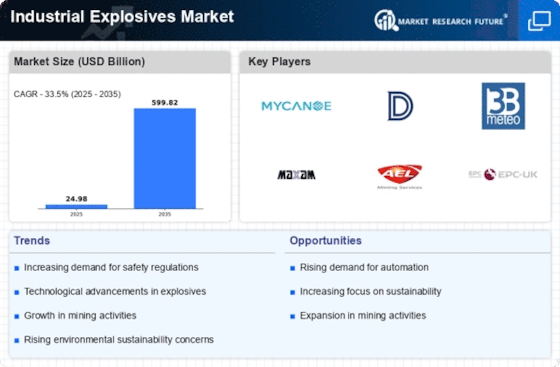
As per Market Research Future analysis, the Industrial Explosives Market Size was estimated at 24.98 USD Billion in 2024. The Industrial Explosives industry is projected to grow from 33.35 USD Billion in 2025 to 599.82 USD Billion by 2035, exhibiting a compound annual growth rate (CAGR) of 33.5% during the forecast period 2025 - 2035

Key Market Trends & Highlights

The Industrial Explosives Market is poised for growth driven by technological advancements and increasing demand across various sectors.

  • North America remains the largest market for industrial explosives, driven by robust mining and construction activities. Asia-Pacific is emerging as the fastest-growing region, fueled by rapid infrastructure development and urbanization. High explosives dominate the market, while blasting agents are witnessing the fastest growth due to their efficiency and cost-effectiveness. Key market drivers include increasing demand in the mining sector and a growing emphasis on sustainability initiatives.

Market Size & Forecast

2024 Market Size 24.98 (USD Billion)
2035 Market Size 599.82 (USD Billion)
CAGR (2025 - 2035) 33.5%
Largest Regional Market Share in 2024 North America

Major Players

Orica (AU), Dyno Nobel (US), BME (ZA), Maxam (ES), AEL Mining Services (ZA), EPC-UK (GB), Hanwha Corporation (KR), Nobel Explosives (ZA), Explosives Technology (US)

Market Trends

The Industrial Explosives Market is currently experiencing a dynamic evolution, driven by various factors that influence demand and supply. The increasing need for efficient and safe blasting solutions in sectors such as mining, construction, and demolition is propelling growth. Additionally, advancements in technology are enhancing the performance and safety of explosive materials, which appears to attract a broader range of applications. Regulatory frameworks are also evolving, emphasizing safety and environmental considerations, which may further shape market dynamics. As industries seek to optimize operations, the integration of innovative solutions is likely to become a focal point in the Industrial Explosives Market. Moreover, the global push towards sustainable practices is prompting manufacturers to explore eco-friendly alternatives to traditional explosives. This shift could lead to the development of new products that meet both performance and environmental standards. The interplay between traditional methods and emerging technologies suggests a complex landscape where companies must navigate challenges while seizing opportunities. Overall, the Industrial Explosives Market is poised for transformation, with trends indicating a blend of innovation, safety, and sustainability as key drivers of future growth.

Technological Advancements

The Industrial Explosives Market is witnessing a surge in technological innovations that enhance the efficiency and safety of explosive materials. New formulations and delivery systems are being developed, which may improve performance in various applications. This trend indicates a shift towards more sophisticated solutions that cater to the evolving needs of industries.

Sustainability Initiatives

There is a growing emphasis on sustainability within the Industrial Explosives Market, as companies seek to reduce their environmental impact. The development of eco-friendly explosives is becoming more prevalent, reflecting a broader commitment to sustainable practices. This trend suggests that manufacturers are increasingly prioritizing environmental considerations in their product offerings.

Regulatory Changes

The regulatory landscape surrounding the global Industrial Explosives Market is evolving, with stricter safety and environmental regulations being implemented. These changes may compel companies to adapt their practices and products to comply with new standards. This trend highlights the importance of regulatory compliance in shaping market strategies and product development.

Industrial Explosives Market Market Drivers

Increasing Demand in Mining Sector

The Industrial Explosives Market is experiencing a notable surge in demand, particularly driven by the mining sector. As mineral extraction activities intensify, the need for efficient blasting solutions becomes paramount. In 2025, the mining industry is projected to account for a substantial share of the explosives market, with estimates suggesting a growth rate of approximately 5.2% annually. This growth is largely attributed to the rising demand for minerals such as gold, copper, and lithium, which are essential for various industries, including electronics and renewable energy. Consequently, manufacturers in the Industrial Explosives Market are focusing on developing advanced explosives that enhance safety and efficiency in mining operations.

Infrastructure Development Projects

Infrastructure development projects are significantly influencing the Industrial Explosives Market. Governments and private entities are increasingly investing in large-scale infrastructure initiatives, including roads, bridges, and tunnels. These projects necessitate the use of explosives for excavation and demolition purposes. In 2025, the construction sector is expected to contribute to a considerable portion of the explosives market, with a projected growth rate of around 4.8%. This trend indicates a robust demand for industrial explosives, as construction companies seek reliable and effective blasting solutions to meet project timelines and safety standards. The Industrial Explosives Market is thus poised to benefit from this ongoing infrastructure boom.

Technological Innovations in Explosives

Technological innovations are reshaping the Industrial Explosives Market, leading to the development of safer and more efficient products. Advancements in explosive formulations and delivery systems are enhancing the performance of industrial explosives. For instance, the introduction of electronic detonators has improved precision in blasting operations, reducing the risk of accidents and increasing productivity. In 2025, it is anticipated that the market for technologically advanced explosives will expand, driven by the need for enhanced safety and efficiency in various applications, including mining and construction. This trend suggests that companies within the Industrial Explosives Market must invest in research and development to remain competitive.

Growing Demand for Sustainable Solutions

The Industrial Explosives Market is witnessing a shift towards sustainable solutions, driven by increasing environmental awareness. Companies are under pressure to adopt practices that minimize environmental impact while maintaining operational efficiency. This has led to the development of eco-friendly explosives that reduce harmful emissions and improve safety. In 2025, the market for sustainable explosives is expected to grow, as industries seek to comply with stringent environmental regulations. This trend indicates a potential for innovation within the Industrial Explosives Market, as manufacturers explore new materials and technologies that align with sustainability goals, thereby attracting environmentally conscious clients.

Regulatory Compliance and Safety Standards

Regulatory compliance and safety standards are critical drivers in the Industrial Explosives Market. As safety regulations become more stringent, companies are compelled to adhere to these guidelines to avoid penalties and ensure safe operations. In 2025, the emphasis on compliance is likely to increase, prompting manufacturers to invest in safer explosive products and practices. This trend not only enhances safety but also fosters trust among clients and stakeholders. The Industrial Explosives Market must navigate these regulatory landscapes effectively, as adherence to safety standards can significantly influence market dynamics and competitive positioning.

Market Segment Insights

By Type: High Explosives (Largest) vs. Blasting Agents (Fastest-Growing)

In the global Industrial Explosives Market, the segment is primarily divided into High Explosives and Blasting Agents. High Explosives hold a significant market share, dominating applications in mining, construction, and military operations due to their effectiveness and reliability. Blasting Agents, while currently reflecting a smaller portion of the overall market, are rapidly gaining traction, especially in commercial blasting operations, where safety and cost-effectiveness are paramount. This trend indicates a diversifying market with distinct preferences among user segments.

High Explosives (Dominant) vs. Blasting Agents (Emerging)

High Explosives are known for their effectiveness and precision in producing powerful blasts, thus being the preferred choice in sectors like mining, demolition, and <a href="https://www.marketresearchfuture.com/reports/defense-market-34071" target="_blank" title="defense">defense</a>. Their ability to deliver consistent results makes them dominant in the industrial explosives market. Conversely, Blasting Agents, which require a booster for detonation, are increasingly recognized for their cost-efficiency and safety features, particularly in large-scale mining and construction projects. This segment is emerging due to the growing demand for environmentally sustainable and safe blasting solutions, making it a focus area for innovation and new developments.

By End Use: Mining (Largest) vs. Construction (Fastest-Growing)

The Industrial Explosives Market is significantly influenced by its end use segments, primarily Mining, <a href="https://www.marketresearchfuture.com/reports/construction-market-16065">Construction</a>, and Others. Mining occupies the largest share due to its critical role in resource extraction, driving demand for various explosives. Construction follows as a substantial segment, particularly in infrastructure development, contributing significantly to overall market dynamics. The 'Others' segment, which includes applications like demolitions and quarrying, also plays a notable role, but it remains comparatively smaller on the market share scale.

Construction: Dominant vs. Mining: Emerging

In the comparison of Construction and Mining within the Industrial Explosives Market, Construction emerges as a dominant player, essential for infrastructure projects that require precision blasting techniques. The segment benefits from increasing investments in urbanization and regeneration projects worldwide. Conversely, while Mining holds the largest market share at this stage, it is facing challenges such as environmental regulations and shifting resource availability that may hinder its growth. Nevertheless, as technology evolves, the Mining segment is adapting to become more efficient and environmentally friendly, allowing it to maintain relevance in an evolving landscape.

Get more detailed insights about Industrial Explosives Market Research Report—Global Forecast till 2035

Regional Insights

North America : Market Leader in Innovation

North America is the largest regional segment in the Industrial Explosives Market, holding approximately 40% of the global share. The region's growth is driven by robust demand from the mining and construction sectors, alongside stringent safety regulations that promote the use of advanced explosives. The U.S. and Canada are the primary contributors, with increasing investments in infrastructure projects further fueling market expansion. The competitive landscape is characterized by key players such as Orica, Dyno Nobel, and Explosives Technology, which dominate the market with innovative products and services. The presence of established companies ensures a steady supply chain and technological advancements. Additionally, regulatory frameworks in the U.S. and Canada support sustainable practices, enhancing the market's growth potential.

Europe : Regulatory Framework Drives Growth

Europe is the second-largest Industrial Explosive Market, accounting for approximately 30% of the global market share. The region's growth is propelled by increasing demand in mining, quarrying, and construction sectors, coupled with stringent regulations aimed at ensuring safety and environmental protection. Countries like Germany and the UK are leading the market, supported by favorable government policies and investments in infrastructure. The competitive landscape features major players such as Maxam and EPC-UK, which are known for their innovative solutions and strong market presence. The European market is also witnessing a trend towards sustainable explosives, driven by regulatory bodies emphasizing eco-friendly practices. This shift is expected to enhance the market's growth trajectory in the coming years.

Asia-Pacific : Emerging Market with High Potential

Asia-Pacific is an emerging powerhouse in the industrial explosives market, holding approximately 25% of the global share. The region's growth is driven by rapid industrialization, urbanization, and increasing investments in mining and construction. Countries like China and India are at the forefront, with significant infrastructure projects boosting demand for explosives and related services. The competitive landscape is evolving, with local players like Hanwha Corporation gaining traction alongside established global firms. The presence of diverse applications in mining, construction, and demolition further enhances market opportunities. As regulations become more stringent, companies are focusing on innovation and sustainability to meet market demands and regulatory requirements, positioning themselves for future growth.

Middle East and Africa : Resource-Rich Region's Growth Potential

The Middle East and Africa region is witnessing a gradual increase in the Industrial Explosive Market , holding about 5% of the global share. The growth is primarily driven by the mining sector, particularly in countries like South Africa and Nigeria, where mineral extraction activities are on the rise. Additionally, infrastructure development projects are creating new opportunities for explosives usage in construction. The competitive landscape is characterized by local players such as BME and AEL Mining Services, which are focusing on expanding their market presence through strategic partnerships and innovations. The region's unique challenges, including regulatory hurdles and safety concerns, are prompting companies to adopt advanced technologies and sustainable practices to enhance operational efficiency and safety standards.

Key Players and Competitive Insights

Leading market players are investing heavily in research and development in order to expand their product lines, which will help the Industrial Explosives Market, grow even more. Market participants are also undertaking a variety of strategic activities to expand their global footprint, with important market developments including new product launches, contractual agreements, mergers and acquisitions, higher investments, and collaboration with other organizations. To expand and survive in a more competitive and rising market climate, Industrial Explosives industry must offer cost-effective items.Manufacturing locally to minimize operational costs is one of the key business tactics used by manufacturers in the global Industrial Explosives industry to benefit clients and increase the market sector. In recent years, the Industrial Explosives industry has offered some of the most significant advantages to medicine. Major players in the Industrial Explosives Market, including AECI Ltd., Austin Powder Company, EPC Groupe, Incitec Pivot limited, Irish Industrial Explosives Market Ltd., Keltech Energies Ltd., MaxamCorp. International SL, NOF Corporation, Orica Ltd., Sigdo Koppers S.A., Solar Industries India Ltd., are attempting to increase market demand by investing in research and development operations.An integrated oil and gas business, Shell plc (often known as Shell), was formerly known as Royal Dutch Shell Plc. The company uses conventional fields and sources, including tight rock, shale, and coal formations, to explore for and produce oil and gas. It runs petrochemical and refining complexes all around the world. Lubricants, bitumen, liquefied petroleum gas, and petrochemical goods such raw materials for plastics, paints, and detergents are among Shell's product offerings. In Brazil, the firm is a significant biofuel producer. It also has stakes in a number of gas to liquids (GTL) and liquefied natural gas (LNG) projects.With the help of distributors across Europe, Asia, Oceania, Africa, North America, and South America, the corporation markets its goods both directly and indirectly. The U.K.'s capital of England, London, is home to Shell. The emulsifiers business unit of ISCA UK was going to be purchased, according to an announcement made in August 2021 by Infineum, the additives joint venture between Shell and ExxonMobil.The company Epiroc Rock Drills Aktiebolag makes construction tools. The company sells exploration equipment as well as drilling rigs, loaders, mobile crushers, compactors, grippers, hydraulic attachments, ventilation systems, and rotating units. The global mining and construction industries are served by Epiroc Rock Drills. On November 14, 2019, Orica and Epiroc Rock Drills AB made an agreement to work together to create a semi-automatic explosives delivery system in order to make underground mine blasting operations safer and more effective. The need for blast automation becomes more apparent as the mine descends deeper and farther from the deposit.In order to address clients' expanding needs in more risky and difficult underground operations, the association will combine the extensive experience and understanding of two worldwide industry leaders.

Key Companies in the Industrial Explosives Market include

Industry Developments

Fluitron LLC, which designs and manufactures industrial-grade gas compression systems, finished making India’s maiden locally produced hydrogen dispenser, including manufacturing it, testing it out, and installing it by PESO (Petroleum & Explosives Safety Organization) approval Jan 2023.

SRG Global received a five-year contract worth $156.5 million from Northern Star Resources gold producer for Western Australia's Bronzewing gold operations (WA), thus awarded on February 2023. Therefore, SRG will provide professional drill and blast services throughout the five-year contract period, as well as explosives management and grade control drilling.

Hexagon AB said in March 2022 that it intends to acquire ETQ software for Environmental Health Safety and Quality Management Systems compliance programs.

LK Metrology- According to LK Metrology, who are involved with Coordinate Measuring Machines (CMMs) manufacture as well as metrology software development plus CMM-related accessory items, there will be numerous new products showcased at Chicago Booth No. 135230 August 2022.

Orica Limited revealed in 2021 that it has acquired 55% of Exsa, an explosives manufacturing company based in Peru. This will move Orica towards becoming the market leader in the area and extend its product portfolio.

Chemring’s ability to provide defense goods and services in Australia was streamlined through this acquisition, where Chemring Group purchased the remaining half of Chemring Australia Pty Ltd from Nioa Nominees Pty Ltd in 2020.

Future Outlook

Industrial Explosives Market Future Outlook

The Industrial Explosives Market size is projected to grow at a 33.5% CAGR from 2024 to 2035, driven by advancements in mining technologies, infrastructure development, and increased demand for safety regulations.

New opportunities lie in:

  • <p>Development of eco-friendly explosives for sustainable mining practices. Integration of IoT technology for real-time monitoring of explosive usage. Expansion into emerging markets with tailored explosive solutions.</p>

By 2035, the global Industrial Explosives Market is expected to achieve substantial growth and innovation.

Market Segmentation

Industrial Explosives Market Type Outlook

  • High Explosives
  • Blasting Agents

Industrial Explosives Market End Use Outlook

  • Mining
  • Construction
  • Others

Report Scope

MARKET SIZE 2024 24.98(USD Billion)
MARKET SIZE 2025 33.35(USD Billion)
MARKET SIZE 2035 599.82(USD Billion)
COMPOUND ANNUAL GROWTH RATE (CAGR) 33.5% (2025 - 2035)
REPORT COVERAGE Revenue Forecast, Competitive Landscape, Growth Factors, and Trends
BASE YEAR 2024
Market Forecast Period 2025 - 2035
Historical Data 2019 - 2024
Market Forecast Units USD Billion
Key Companies Profiled Orica (AU), Dyno Nobel (US), BME (ZA), Maxam (ES), AEL Mining Services (ZA), EPC-UK (GB), Hanwha Corporation (KR), Nobel Explosives (ZA), Explosives Technology (US)
Segments Covered Type, End Use, Region
Key Market Opportunities Adoption of advanced safety protocols and automation technologies in the Industrial Explosives Market.
Key Market Dynamics Technological advancements and regulatory changes are reshaping competitive dynamics in the Industrial Explosives Market.
Countries Covered North America, Europe, APAC, South America, MEA

FAQs

What is the current valuation of the Industrial Explosives Market?

<p>The Industrial Explosives Market was valued at 24.98 USD Billion in 2024.</p>

What is the projected market valuation for the Industrial Explosives Market in 2035?

<p>The market is projected to reach 599.82 USD Billion by 2035.</p>

What is the expected CAGR for the Industrial Explosives Market during the forecast period 2025 - 2035?

<p>The expected CAGR for the Industrial Explosives Market is 33.5% from 2025 to 2035.</p>

Which segments are included in the Industrial Explosives Market?

<p>The market segments include High Explosives, Blasting Agents, Mining, Construction, and Others.</p>

What was the market size for High Explosives in 2024?

<p>The market size for High Explosives was 12.49 USD Billion in 2024.</p>

How much is the Blasting Agents segment projected to grow by 2035?

<p>The Blasting Agents segment is projected to grow to 299.91 USD Billion by 2035.</p>

Which companies are considered key players in the Industrial Explosives Market?

Key players include Orica, Dyno Nobel, BME, Maxam, AEL Mining Services, EPC-UK, Hanwha Corporation, Nobel Explosives, and Explosives Technology.

What was the market size for the Mining segment in 2024?

The Mining segment was valued at 12.49 USD Billion in 2024.

What is the projected market size for the Construction segment by 2035?

The Construction segment is projected to reach 199.96 USD Billion by 2035.

What does the future hold for the Industrial Explosives Market?

The Industrial Explosives Market is expected to experience substantial growth, reaching nearly 600 USD Billion by 2035.

  1. SECTION I: EXECUTIVE SUMMARY AND KEY HIGHLIGHTS
    1. | 1.1 EXECUTIVE SUMMARY
    2. | | 1.1.1 Market Overview
    3. | | 1.1.2 Key Findings
    4. | | 1.1.3 Market Segmentation
    5. | | 1.1.4 Competitive Landscape
    6. | | 1.1.5 Challenges and Opportunities
    7. | | 1.1.6 Future Outlook
  2. SECTION II: SCOPING, METHODOLOGY AND MARKET STRUCTURE
    1. | 2.1 MARKET INTRODUCTION
    2. | | 2.1.1 Definition
    3. | | 2.1.2 Scope of the study
    4. | | | 2.1.2.1 Research Objective
    5. | | | 2.1.2.2 Assumption
    6. | | | 2.1.2.3 Limitations
    7. | 2.2 RESEARCH METHODOLOGY
    8. | | 2.2.1 Overview
    9. | | 2.2.2 Data Mining
    10. | | 2.2.3 Secondary Research
    11. | | 2.2.4 Primary Research
    12. | | | 2.2.4.1 Primary Interviews and Information Gathering Process
    13. | | | 2.2.4.2 Breakdown of Primary Respondents
    14. | | 2.2.5 Forecasting Model
    15. | | 2.2.6 Market Size Estimation
    16. | | | 2.2.6.1 Bottom-Up Approach
    17. | | | 2.2.6.2 Top-Down Approach
    18. | | 2.2.7 Data Triangulation
    19. | | 2.2.8 Validation
  3. SECTION III: QUALITATIVE ANALYSIS
    1. | 3.1 MARKET DYNAMICS
    2. | | 3.1.1 Overview
    3. | | 3.1.2 Drivers
    4. | | 3.1.3 Restraints
    5. | | 3.1.4 Opportunities
    6. | 3.2 MARKET FACTOR ANALYSIS
    7. | | 3.2.1 Value chain Analysis
    8. | | 3.2.2 Porter's Five Forces Analysis
    9. | | | 3.2.2.1 Bargaining Power of Suppliers
    10. | | | 3.2.2.2 Bargaining Power of Buyers
    11. | | | 3.2.2.3 Threat of New Entrants
    12. | | | 3.2.2.4 Threat of Substitutes
    13. | | | 3.2.2.5 Intensity of Rivalry
    14. | | 3.2.3 COVID-19 Impact Analysis
    15. | | | 3.2.3.1 Market Impact Analysis
    16. | | | 3.2.3.2 Regional Impact
    17. | | | 3.2.3.3 Opportunity and Threat Analysis
  4. SECTION IV: QUANTITATIVE ANALYSIS
    1. | 4.1 Chemicals and Materials, BY Type (USD Billion)
    2. | | 4.1.1 High Explosives
    3. | | 4.1.2 Blasting Agents
    4. | 4.2 Chemicals and Materials, BY End Use (USD Billion)
    5. | | 4.2.1 Mining
    6. | | 4.2.2 Construction
    7. | | 4.2.3 Others
    8. | 4.3 Chemicals and Materials, BY Region (USD Billion)
    9. | | 4.3.1 North America
    10. | | | 4.3.1.1 US
    11. | | | 4.3.1.2 Canada
    12. | | 4.3.2 Europe
    13. | | | 4.3.2.1 Germany
    14. | | | 4.3.2.2 UK
    15. | | | 4.3.2.3 France
    16. | | | 4.3.2.4 Russia
    17. | | | 4.3.2.5 Italy
    18. | | | 4.3.2.6 Spain
    19. | | | 4.3.2.7 Rest of Europe
    20. | | 4.3.3 APAC
    21. | | | 4.3.3.1 China
    22. | | | 4.3.3.2 India
    23. | | | 4.3.3.3 Japan
    24. | | | 4.3.3.4 South Korea
    25. | | | 4.3.3.5 Malaysia
    26. | | | 4.3.3.6 Thailand
    27. | | | 4.3.3.7 Indonesia
    28. | | | 4.3.3.8 Rest of APAC
    29. | | 4.3.4 South America
    30. | | | 4.3.4.1 Brazil
    31. | | | 4.3.4.2 Mexico
    32. | | | 4.3.4.3 Argentina
    33. | | | 4.3.4.4 Rest of South America
    34. | | 4.3.5 MEA
    35. | | | 4.3.5.1 GCC Countries
    36. | | | 4.3.5.2 South Africa
    37. | | | 4.3.5.3 Rest of MEA
  5. SECTION V: COMPETITIVE ANALYSIS
    1. | 5.1 Competitive Landscape
    2. | | 5.1.1 Overview
    3. | | 5.1.2 Competitive Analysis
    4. | | 5.1.3 Market share Analysis
    5. | | 5.1.4 Major Growth Strategy in the Chemicals and Materials
    6. | | 5.1.5 Competitive Benchmarking
    7. | | 5.1.6 Leading Players in Terms of Number of Developments in the Chemicals and Materials
    8. | | 5.1.7 Key developments and growth strategies
    9. | | | 5.1.7.1 New Product Launch/Service Deployment
    10. | | | 5.1.7.2 Merger & Acquisitions
    11. | | | 5.1.7.3 Joint Ventures
    12. | | 5.1.8 Major Players Financial Matrix
    13. | | | 5.1.8.1 Sales and Operating Income
    14. | | | 5.1.8.2 Major Players R&D Expenditure. 2023
    15. | 5.2 Company Profiles
    16. | | 5.2.1 Orica (AU)
    17. | | | 5.2.1.1 Financial Overview
    18. | | | 5.2.1.2 Products Offered
    19. | | | 5.2.1.3 Key Developments
    20. | | | 5.2.1.4 SWOT Analysis
    21. | | | 5.2.1.5 Key Strategies
    22. | | 5.2.2 Dyno Nobel (US)
    23. | | | 5.2.2.1 Financial Overview
    24. | | | 5.2.2.2 Products Offered
    25. | | | 5.2.2.3 Key Developments
    26. | | | 5.2.2.4 SWOT Analysis
    27. | | | 5.2.2.5 Key Strategies
    28. | | 5.2.3 BME (ZA)
    29. | | | 5.2.3.1 Financial Overview
    30. | | | 5.2.3.2 Products Offered
    31. | | | 5.2.3.3 Key Developments
    32. | | | 5.2.3.4 SWOT Analysis
    33. | | | 5.2.3.5 Key Strategies
    34. | | 5.2.4 Maxam (ES)
    35. | | | 5.2.4.1 Financial Overview
    36. | | | 5.2.4.2 Products Offered
    37. | | | 5.2.4.3 Key Developments
    38. | | | 5.2.4.4 SWOT Analysis
    39. | | | 5.2.4.5 Key Strategies
    40. | | 5.2.5 AEL Mining Services (ZA)
    41. | | | 5.2.5.1 Financial Overview
    42. | | | 5.2.5.2 Products Offered
    43. | | | 5.2.5.3 Key Developments
    44. | | | 5.2.5.4 SWOT Analysis
    45. | | | 5.2.5.5 Key Strategies
    46. | | 5.2.6 EPC-UK (GB)
    47. | | | 5.2.6.1 Financial Overview
    48. | | | 5.2.6.2 Products Offered
    49. | | | 5.2.6.3 Key Developments
    50. | | | 5.2.6.4 SWOT Analysis
    51. | | | 5.2.6.5 Key Strategies
    52. | | 5.2.7 Hanwha Corporation (KR)
    53. | | | 5.2.7.1 Financial Overview
    54. | | | 5.2.7.2 Products Offered
    55. | | | 5.2.7.3 Key Developments
    56. | | | 5.2.7.4 SWOT Analysis
    57. | | | 5.2.7.5 Key Strategies
    58. | | 5.2.8 Nobel Explosives (ZA)
    59. | | | 5.2.8.1 Financial Overview
    60. | | | 5.2.8.2 Products Offered
    61. | | | 5.2.8.3 Key Developments
    62. | | | 5.2.8.4 SWOT Analysis
    63. | | | 5.2.8.5 Key Strategies
    64. | | 5.2.9 Explosives Technology (US)
    65. | | | 5.2.9.1 Financial Overview
    66. | | | 5.2.9.2 Products Offered
    67. | | | 5.2.9.3 Key Developments
    68. | | | 5.2.9.4 SWOT Analysis
    69. | | | 5.2.9.5 Key Strategies
    70. | 5.3 Appendix
    71. | | 5.3.1 References
    72. | | 5.3.2 Related Reports
  6. LIST OF FIGURES
    1. | 6.1 MARKET SYNOPSIS
    2. | 6.2 NORTH AMERICA MARKET ANALYSIS
    3. | 6.3 US MARKET ANALYSIS BY TYPE
    4. | 6.4 US MARKET ANALYSIS BY END USE
    5. | 6.5 CANADA MARKET ANALYSIS BY TYPE
    6. | 6.6 CANADA MARKET ANALYSIS BY END USE
    7. | 6.7 EUROPE MARKET ANALYSIS
    8. | 6.8 GERMANY MARKET ANALYSIS BY TYPE
    9. | 6.9 GERMANY MARKET ANALYSIS BY END USE
    10. | 6.10 UK MARKET ANALYSIS BY TYPE
    11. | 6.11 UK MARKET ANALYSIS BY END USE
    12. | 6.12 FRANCE MARKET ANALYSIS BY TYPE
    13. | 6.13 FRANCE MARKET ANALYSIS BY END USE
    14. | 6.14 RUSSIA MARKET ANALYSIS BY TYPE
    15. | 6.15 RUSSIA MARKET ANALYSIS BY END USE
    16. | 6.16 ITALY MARKET ANALYSIS BY TYPE
    17. | 6.17 ITALY MARKET ANALYSIS BY END USE
    18. | 6.18 SPAIN MARKET ANALYSIS BY TYPE
    19. | 6.19 SPAIN MARKET ANALYSIS BY END USE
    20. | 6.20 REST OF EUROPE MARKET ANALYSIS BY TYPE
    21. | 6.21 REST OF EUROPE MARKET ANALYSIS BY END USE
    22. | 6.22 APAC MARKET ANALYSIS
    23. | 6.23 CHINA MARKET ANALYSIS BY TYPE
    24. | 6.24 CHINA MARKET ANALYSIS BY END USE
    25. | 6.25 INDIA MARKET ANALYSIS BY TYPE
    26. | 6.26 INDIA MARKET ANALYSIS BY END USE
    27. | 6.27 JAPAN MARKET ANALYSIS BY TYPE
    28. | 6.28 JAPAN MARKET ANALYSIS BY END USE
    29. | 6.29 SOUTH KOREA MARKET ANALYSIS BY TYPE
    30. | 6.30 SOUTH KOREA MARKET ANALYSIS BY END USE
    31. | 6.31 MALAYSIA MARKET ANALYSIS BY TYPE
    32. | 6.32 MALAYSIA MARKET ANALYSIS BY END USE
    33. | 6.33 THAILAND MARKET ANALYSIS BY TYPE
    34. | 6.34 THAILAND MARKET ANALYSIS BY END USE
    35. | 6.35 INDONESIA MARKET ANALYSIS BY TYPE
    36. | 6.36 INDONESIA MARKET ANALYSIS BY END USE
    37. | 6.37 REST OF APAC MARKET ANALYSIS BY TYPE
    38. | 6.38 REST OF APAC MARKET ANALYSIS BY END USE
    39. | 6.39 SOUTH AMERICA MARKET ANALYSIS
    40. | 6.40 BRAZIL MARKET ANALYSIS BY TYPE
    41. | 6.41 BRAZIL MARKET ANALYSIS BY END USE
    42. | 6.42 MEXICO MARKET ANALYSIS BY TYPE
    43. | 6.43 MEXICO MARKET ANALYSIS BY END USE
    44. | 6.44 ARGENTINA MARKET ANALYSIS BY TYPE
    45. | 6.45 ARGENTINA MARKET ANALYSIS BY END USE
    46. | 6.46 REST OF SOUTH AMERICA MARKET ANALYSIS BY TYPE
    47. | 6.47 REST OF SOUTH AMERICA MARKET ANALYSIS BY END USE
    48. | 6.48 MEA MARKET ANALYSIS
    49. | 6.49 GCC COUNTRIES MARKET ANALYSIS BY TYPE
    50. | 6.50 GCC COUNTRIES MARKET ANALYSIS BY END USE
    51. | 6.51 SOUTH AFRICA MARKET ANALYSIS BY TYPE
    52. | 6.52 SOUTH AFRICA MARKET ANALYSIS BY END USE
    53. | 6.53 REST OF MEA MARKET ANALYSIS BY TYPE
    54. | 6.54 REST OF MEA MARKET ANALYSIS BY END USE
    55. | 6.55 KEY BUYING CRITERIA OF CHEMICALS AND MATERIALS
    56. | 6.56 RESEARCH PROCESS OF MRFR
    57. | 6.57 DRO ANALYSIS OF CHEMICALS AND MATERIALS
    58. | 6.58 DRIVERS IMPACT ANALYSIS: CHEMICALS AND MATERIALS
    59. | 6.59 RESTRAINTS IMPACT ANALYSIS: CHEMICALS AND MATERIALS
    60. | 6.60 SUPPLY / VALUE CHAIN: CHEMICALS AND MATERIALS
    61. | 6.61 CHEMICALS AND MATERIALS, BY TYPE, 2024 (% SHARE)
    62. | 6.62 CHEMICALS AND MATERIALS, BY TYPE, 2024 TO 2035 (USD Billion)
    63. | 6.63 CHEMICALS AND MATERIALS, BY END USE, 2024 (% SHARE)
    64. | 6.64 CHEMICALS AND MATERIALS, BY END USE, 2024 TO 2035 (USD Billion)
    65. | 6.65 BENCHMARKING OF MAJOR COMPETITORS
  7. LIST OF TABLES
    1. | 7.1 LIST OF ASSUMPTIONS
    2. | | 7.1.1
    3. | 7.2 North America MARKET SIZE ESTIMATES; FORECAST
    4. | | 7.2.1 BY TYPE, 2025-2035 (USD Billion)
    5. | | 7.2.2 BY END USE, 2025-2035 (USD Billion)
    6. | 7.3 US MARKET SIZE ESTIMATES; FORECAST
    7. | | 7.3.1 BY TYPE, 2025-2035 (USD Billion)
    8. | | 7.3.2 BY END USE, 2025-2035 (USD Billion)
    9. | 7.4 Canada MARKET SIZE ESTIMATES; FORECAST
    10. | | 7.4.1 BY TYPE, 2025-2035 (USD Billion)
    11. | | 7.4.2 BY END USE, 2025-2035 (USD Billion)
    12. | 7.5 Europe MARKET SIZE ESTIMATES; FORECAST
    13. | | 7.5.1 BY TYPE, 2025-2035 (USD Billion)
    14. | | 7.5.2 BY END USE, 2025-2035 (USD Billion)
    15. | 7.6 Germany MARKET SIZE ESTIMATES; FORECAST
    16. | | 7.6.1 BY TYPE, 2025-2035 (USD Billion)
    17. | | 7.6.2 BY END USE, 2025-2035 (USD Billion)
    18. | 7.7 UK MARKET SIZE ESTIMATES; FORECAST
    19. | | 7.7.1 BY TYPE, 2025-2035 (USD Billion)
    20. | | 7.7.2 BY END USE, 2025-2035 (USD Billion)
    21. | 7.8 France MARKET SIZE ESTIMATES; FORECAST
    22. | | 7.8.1 BY TYPE, 2025-2035 (USD Billion)
    23. | | 7.8.2 BY END USE, 2025-2035 (USD Billion)
    24. | 7.9 Russia MARKET SIZE ESTIMATES; FORECAST
    25. | | 7.9.1 BY TYPE, 2025-2035 (USD Billion)
    26. | | 7.9.2 BY END USE, 2025-2035 (USD Billion)
    27. | 7.10 Italy MARKET SIZE ESTIMATES; FORECAST
    28. | | 7.10.1 BY TYPE, 2025-2035 (USD Billion)
    29. | | 7.10.2 BY END USE, 2025-2035 (USD Billion)
    30. | 7.11 Spain MARKET SIZE ESTIMATES; FORECAST
    31. | | 7.11.1 BY TYPE, 2025-2035 (USD Billion)
    32. | | 7.11.2 BY END USE, 2025-2035 (USD Billion)
    33. | 7.12 Rest of Europe MARKET SIZE ESTIMATES; FORECAST
    34. | | 7.12.1 BY TYPE, 2025-2035 (USD Billion)
    35. | | 7.12.2 BY END USE, 2025-2035 (USD Billion)
    36. | 7.13 APAC MARKET SIZE ESTIMATES; FORECAST
    37. | | 7.13.1 BY TYPE, 2025-2035 (USD Billion)
    38. | | 7.13.2 BY END USE, 2025-2035 (USD Billion)
    39. | 7.14 China MARKET SIZE ESTIMATES; FORECAST
    40. | | 7.14.1 BY TYPE, 2025-2035 (USD Billion)
    41. | | 7.14.2 BY END USE, 2025-2035 (USD Billion)
    42. | 7.15 India MARKET SIZE ESTIMATES; FORECAST
    43. | | 7.15.1 BY TYPE, 2025-2035 (USD Billion)
    44. | | 7.15.2 BY END USE, 2025-2035 (USD Billion)
    45. | 7.16 Japan MARKET SIZE ESTIMATES; FORECAST
    46. | | 7.16.1 BY TYPE, 2025-2035 (USD Billion)
    47. | | 7.16.2 BY END USE, 2025-2035 (USD Billion)
    48. | 7.17 South Korea MARKET SIZE ESTIMATES; FORECAST
    49. | | 7.17.1 BY TYPE, 2025-2035 (USD Billion)
    50. | | 7.17.2 BY END USE, 2025-2035 (USD Billion)
    51. | 7.18 Malaysia MARKET SIZE ESTIMATES; FORECAST
    52. | | 7.18.1 BY TYPE, 2025-2035 (USD Billion)
    53. | | 7.18.2 BY END USE, 2025-2035 (USD Billion)
    54. | 7.19 Thailand MARKET SIZE ESTIMATES; FORECAST
    55. | | 7.19.1 BY TYPE, 2025-2035 (USD Billion)
    56. | | 7.19.2 BY END USE, 2025-2035 (USD Billion)
    57. | 7.20 Indonesia MARKET SIZE ESTIMATES; FORECAST
    58. | | 7.20.1 BY TYPE, 2025-2035 (USD Billion)
    59. | | 7.20.2 BY END USE, 2025-2035 (USD Billion)
    60. | 7.21 Rest of APAC MARKET SIZE ESTIMATES; FORECAST
    61. | | 7.21.1 BY TYPE, 2025-2035 (USD Billion)
    62. | | 7.21.2 BY END USE, 2025-2035 (USD Billion)
    63. | 7.22 South America MARKET SIZE ESTIMATES; FORECAST
    64. | | 7.22.1 BY TYPE, 2025-2035 (USD Billion)
    65. | | 7.22.2 BY END USE, 2025-2035 (USD Billion)
    66. | 7.23 Brazil MARKET SIZE ESTIMATES; FORECAST
    67. | | 7.23.1 BY TYPE, 2025-2035 (USD Billion)
    68. | | 7.23.2 BY END USE, 2025-2035 (USD Billion)
    69. | 7.24 Mexico MARKET SIZE ESTIMATES; FORECAST
    70. | | 7.24.1 BY TYPE, 2025-2035 (USD Billion)
    71. | | 7.24.2 BY END USE, 2025-2035 (USD Billion)
    72. | 7.25 Argentina MARKET SIZE ESTIMATES; FORECAST
    73. | | 7.25.1 BY TYPE, 2025-2035 (USD Billion)
    74. | | 7.25.2 BY END USE, 2025-2035 (USD Billion)
    75. | 7.26 Rest of South America MARKET SIZE ESTIMATES; FORECAST
    76. | | 7.26.1 BY TYPE, 2025-2035 (USD Billion)
    77. | | 7.26.2 BY END USE, 2025-2035 (USD Billion)
    78. | 7.27 MEA MARKET SIZE ESTIMATES; FORECAST
    79. | | 7.27.1 BY TYPE, 2025-2035 (USD Billion)
    80. | | 7.27.2 BY END USE, 2025-2035 (USD Billion)
    81. | 7.28 GCC Countries MARKET SIZE ESTIMATES; FORECAST
    82. | | 7.28.1 BY TYPE, 2025-2035 (USD Billion)
    83. | | 7.28.2 BY END USE, 2025-2035 (USD Billion)
    84. | 7.29 South Africa MARKET SIZE ESTIMATES; FORECAST
    85. | | 7.29.1 BY TYPE, 2025-2035 (USD Billion)
    86. | | 7.29.2 BY END USE, 2025-2035 (USD Billion)
    87. | 7.30 Rest of MEA MARKET SIZE ESTIMATES; FORECAST
    88. | | 7.30.1 BY TYPE, 2025-2035 (USD Billion)
    89. | | 7.30.2 BY END USE, 2025-2035 (USD Billion)
    90. | 7.31 PRODUCT LAUNCH/PRODUCT DEVELOPMENT/APPROVAL
    91. | | 7.31.1
    92. | 7.32 ACQUISITION/PARTNERSHIP
    93. | | 7.32.1

Chemicals and Materials Market Segmentation

Chemicals and Materials By Type (USD Billion, 2025-2035)

  • High Explosives
  • Blasting Agents

Chemicals and Materials By End Use (USD Billion, 2025-2035)

  • Mining
  • Construction
  • Others
Infographic

Free Sample Request

Kindly complete the form below to receive a free sample of this Report

Get Free Sample

Customer Strories

Compare Licence

×
Features License Type
Single User Multiuser License Enterprise User
Price $4,950 $5,950 $7,250
Maximum User Access Limit 1 User Upto 10 Users Unrestricted Access Throughout the Organization
Free Customization
Direct Access to Analyst
Deliverable Format
Platform Access
Discount on Next Purchase 10% 15% 15%
Printable Versions