
×
Hero Background
English
Chinese
French
Japanese
Korean
German
Spanish

Industrial Automation Market Size

ID: MRFR/ICT/1643-CR
189 Pages
Aarti Dhapte
June 2025

Industrial Automation Market Research Report Information by Component (Hardware, Software, Services), by Type (Fixed Automation, Programmable Automation, Flexible Automation), by Technology (Industrial Robotics, Machine Vision Systems, Control Systems, Artificial Intelligence and Machine Learning, Industrial Internet of Things (IIoT), Advanced Process Control (APC), Human-Machine Interface (HMI), Others), by End-Use Industry (Automotive, Pharmaceutical, Food & Beverage, Chemicals, Packaging, Energy & Power, Aerospace & Defense, M... read more

Share:
Download PDF ×

We do not share your information with anyone. However, we may send you emails based on your report interest from time to time. You may contact us at any time to opt-out.

Industrial Automation Market Infographic
Purchase Options

Industrial Automation Size

Industrial Automation Market Growth Projections and Opportunities

Adapting to modern technology is crucial for manufacturers to stay competitive in today's business landscape. A large portion of older manufacturing equipment operates manually and lacks connectivity, making it disjointed in the production process. To meet the demands of consumers, industrial manufacturers are increasingly focused on enhancing efficiency by cutting costs and automating tasks. They're turning to industrial automation solutions to modernize their conventional manufacturing processes, using computer-controlled devices to manage industrial operations.

Integrated computer-controlled devices, control systems, sensors, and artificial intelligence play a pivotal role in industrial automation for manufacturers and service lines. This technology ecosystem enables a connection between various products and components within the plant, enabling complete control over these elements and the ability to automate operations according to schedules. Manufacturers can also track, monitor, and collect data about their plant assets through industrial automation. By integrating operational equipment, manufacturers can gain new insights into patterns and efficiencies as more data is collected from sensors. Thanks to advancements in sensor technology and machine learning, computers can analyze a continuous stream of data, detecting potential asset failures and suggesting solutions.

According to MRFR, the global industrial automation market has experienced substantial growth in recent years and is projected to reach USD 414.48 billion by 2030, with a projected Compound Annual Growth Rate (CAGR) of 10.0% during the forecast period from 2022 to 2030.

This market is anticipated to grow at a 10.0% CAGR during the forecast period, 2022-2030. Asia-Pacific led the market in 2021, holding a share of 43.74%, followed by Europe (26.56%) and North America (21.42%). The surge in demand for collaborative robots in manufacturing facilities and the increased need for qualitative and reliable manufacturing processes are driving the growth of the Asia-Pacific region in industrial automation.

The global industrial automation market is categorized based on type, component, solution, industry, and region. Fixed automation held the largest market share in the type segment in 2021, valued at USD 86.22 billion and projected to grow at a CAGR of 9.6% during the forecast period. Regarding components, hardware dominated with a market value of USD 91.36 billion in 2021, expected to grow at a CAGR of 7.8%. In solutions, Human Machine Interface (HMI) held a market value of USD 29.31 billion in 2021, projected to grow at a CAGR of 11.9%. Automotive emerged as the dominant industry with a market value of USD 16.38 billion in 2021 and a projected growth rate of 14.9% during the forecasted period.

Industrial Automation Market Size Graph
Author
Aarti Dhapte
Team Lead - Research

She holds an experience of about 6+ years in Market Research and Business Consulting, working under the spectrum of Information Communication Technology, Telecommunications and Semiconductor domains. Aarti conceptualizes and implements a scalable business strategy and provides strategic leadership to the clients. Her expertise lies in market estimation, competitive intelligence, pipeline analysis, customer assessment, etc.

Leave a Comment

FAQs

What is the current valuation of the Industrial Automation Market in 2025?

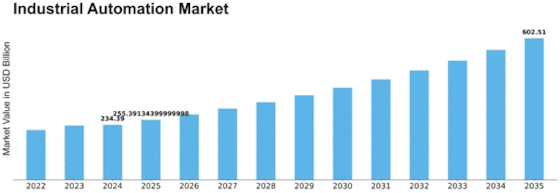
The Industrial Automation Market is valued at approximately 234.39 USD Billion in 2024.

What is the projected market size for the Industrial Automation Market by 2035?

The market is projected to reach around 602.51 USD Billion by 2035.

What is the expected CAGR for the Industrial Automation Market during the forecast period 2025 - 2035?

The expected CAGR for the Industrial Automation Market during the forecast period 2025 - 2035 is 8.96%.

Which companies are considered key players in the Industrial Automation Market?

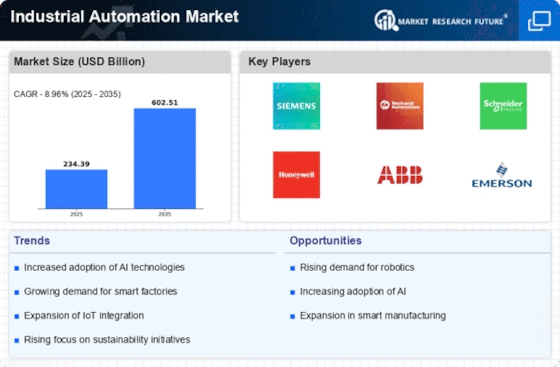
Key players in the market include Siemens, Rockwell Automation, Schneider Electric, Honeywell, ABB, Emerson Electric, Mitsubishi Electric, Yokogawa Electric, and General Electric.

What are the main segments of the Industrial Automation Market?

The main segments include components, types, technologies, and end-use industries.

Market Summary

As per MRFR analysis, the Industrial Automation Market was estimated at 234.39 USD Billion in 2024. The Industrial Automation industry is projected to grow from 255.39 USD Billion in 2025 to 602.51 USD Billion by 2035, exhibiting a compound annual growth rate (CAGR) of 8.96 during the forecast period 2025 - 2035.

Key Market Trends & Highlights

The Industrial Automation Market is experiencing robust growth driven by technological advancements and increasing demand for efficiency.

  • The integration of Artificial Intelligence is transforming operational processes across various industries.
  • Cybersecurity has become a critical focus as companies seek to protect their automated systems from potential threats.
  • Collaborative robots are gaining traction, particularly in North America, where they enhance productivity and safety in manufacturing environments.
  • Rising demand for efficiency and advancements in robotics technology are key drivers propelling the market forward, especially in the hardware and fixed automation segments.

Market Size & Forecast

2024 Market Size 234.39 (USD Billion)
2035 Market Size 602.51 (USD Billion)
CAGR (2025 - 2035) 8.96%
Largest Regional Market Share in 2024 Asia Pacific

Major Players

<p>Siemens (DE), Rockwell Automation (US), Schneider Electric (FR), Honeywell (US), ABB (CH), Emerson Electric (US), Mitsubishi Electric (JP), Yokogawa Electric (JP), General Electric (US)</p>

Market Trends

The Industrial Automation Market is currently experiencing a transformative phase, driven by advancements in technology and the increasing demand for efficiency across various sectors. Automation solutions are being integrated into manufacturing processes, logistics, and supply chain management, enhancing productivity and reducing operational costs. The rise of smart factories, characterized by interconnected devices and real-time data analytics, appears to be reshaping traditional manufacturing paradigms. As industries strive for greater flexibility and responsiveness, the adoption of automation technologies is likely to accelerate, fostering innovation and competitiveness. Moreover, the emphasis on sustainability and energy efficiency is influencing the direction of the Industrial Automation Market. Companies are increasingly seeking solutions that not only optimize performance but also minimize environmental impact. This trend suggests a growing alignment between automation technologies and corporate sustainability goals. As organizations navigate the complexities of modern production environments, the integration of automation is expected to play a pivotal role in achieving operational excellence and meeting evolving consumer expectations. The future landscape of the Industrial Automation Market seems poised for further evolution, with emerging technologies such as artificial intelligence and machine learning set to redefine operational capabilities.

Integration of Artificial Intelligence

The incorporation of artificial intelligence into automation systems is becoming more prevalent. This trend indicates a shift towards smarter, more adaptive manufacturing processes that can learn and optimize operations in real-time. AI-driven solutions may enhance decision-making, predictive maintenance, and overall efficiency.

Focus on Cybersecurity

As industrial systems become increasingly interconnected, the focus on cybersecurity is intensifying. Protecting sensitive data and ensuring the integrity of automated processes is critical. This trend suggests that companies are prioritizing robust security measures to safeguard their operations against potential cyber threats.

Growth of Collaborative Robots

Collaborative robots, or cobots, are gaining traction in various industries. These machines are designed to work alongside human operators, enhancing productivity while ensuring safety. The rise of cobots indicates a shift towards more flexible and efficient work environments, where human and machine collaboration is optimized.

Industrial Automation Market Market Drivers

Rising Demand for Efficiency

The Industrial Automation Market is experiencing a notable surge in demand for enhanced operational efficiency. Companies are increasingly adopting automation technologies to streamline processes, reduce waste, and improve productivity. According to recent data, organizations that implement automation can achieve efficiency gains of up to 30%. This trend is driven by the need to remain competitive in a rapidly evolving market landscape. As industries strive to optimize their operations, the integration of automation solutions becomes paramount. The Industrial Automation Market is thus positioned to benefit from this growing emphasis on efficiency, as businesses seek to leverage technology to achieve their operational goals.

Increased Focus on Sustainability

Sustainability has emerged as a critical driver within the Industrial Automation Market. Companies are increasingly prioritizing eco-friendly practices and energy-efficient technologies to meet regulatory requirements and consumer expectations. The integration of automation solutions can significantly reduce energy consumption and waste generation, aligning with sustainability goals. Recent studies suggest that automation can lead to a 25% reduction in energy usage in manufacturing processes. As organizations strive to enhance their environmental performance, the Industrial Automation Market is likely to see a surge in demand for sustainable automation solutions that contribute to a greener future.

Growing Need for Skilled Workforce

The Industrial Automation Market faces a growing need for a skilled workforce capable of managing advanced automation technologies. As industries adopt more sophisticated automation solutions, the demand for professionals with expertise in robotics, data analytics, and system integration is increasing. Reports indicate that the skills gap in the automation sector could hinder growth, with an estimated 2 million jobs unfilled by 2025. This situation presents both a challenge and an opportunity for the Industrial Automation Market, as companies invest in training and development programs to equip their workforce with the necessary skills to thrive in an automated environment.

Advancements in Robotics Technology

The Industrial Automation Market is witnessing significant advancements in robotics technology, which are reshaping manufacturing processes. Innovations in robotic systems, such as collaborative robots and autonomous mobile robots, are enhancing flexibility and precision in production lines. Data indicates that the adoption of robotics in manufacturing can lead to a 20% increase in production rates. As industries recognize the potential of robotics to improve quality and reduce labor costs, the demand for these technologies is expected to rise. This trend underscores the importance of robotics in the Industrial Automation Market, as companies seek to harness these advancements to drive growth and innovation.

Integration of Internet of Things (IoT)

The Industrial Automation Market is being transformed by the integration of the Internet of Things (IoT). IoT technologies enable real-time data collection and analysis, facilitating smarter decision-making and predictive maintenance. This connectivity allows for enhanced monitoring of equipment and processes, leading to reduced downtime and increased operational efficiency. Data shows that IoT adoption in industrial settings can improve productivity by up to 15%. As industries recognize the value of IoT in optimizing operations, the Industrial Automation Market is poised for growth, driven by the demand for interconnected systems that enhance overall performance.

Market Segment Insights

By Component: Hardware (Largest) vs. Software (Fastest-Growing)

<p>In the Industrial Automation Market, the component segment is primarily dominated by hardware, which holds the largest share of the market. This includes components such as sensors, actuators, and controllers essential for various automation processes. In contrast, software solutions are gaining momentum and are recognized as the fastest-growing segment, driven by increased demand for sophisticated automation technologies and digital transformation initiatives. The growth of software in the Industrial Automation Market is attributed to the increasing integration of IoT and advanced analytics into industrial processes. Manufacturers are investing in software that supports data analytics, real-time monitoring, and predictive maintenance. This trend indicates a shift towards more intelligent, interconnected systems, further enhancing operational efficiency and driving competitive advantage for businesses in the sector.</p>

<p>Hardware: Sensors (Dominant) vs. Software: IoT Solutions (Emerging)</p>

<p>In the context of the Industrial Automation Market, hardware, particularly sensors, remains a dominant force due to their critical role in facilitating automation and data acquisition. Sensors provide invaluable data that enables real-time monitoring and control of industrial processes. They help improve efficiency, reduce downtime, and ensure safety across various applications. Meanwhile, IoT solutions have emerged as a key software offering, harnessing the power of interconnected devices and data analytics to transform traditional automation practices. These solutions facilitate seamless communication between machines, allowing for enhanced decision-making and agile responses to changing production demands. As industries increasingly adopt smart technologies, both segments are essential for optimizing operational performance and achieving long-term sustainability.</p>

By Type: Fixed Automation (Largest) vs. Flexible Automation (Fastest-Growing)

<p>In the Industrial Automation Market, Fixed Automation holds the largest market share, driven by its efficiency and reliability in high-volume production settings. This segment is characterized by its automation of processes that are repetitive and require little to no change in the production line. Conversely, Flexible Automation is emerging rapidly, appealing to businesses that demand adaptability in their manufacturing processes. This segment allows for the quick reconfiguration of production lines, catering to the increasing need for customization and shorter product life cycles. The growth dynamics of these segments are influenced by various factors. Fixed Automation continues to thrive in industries with steady demand and predefined production processes, such as automotive and consumer goods. However, Flexible Automation is gaining traction particularly in sectors such as electronics and pharmaceuticals, where flexibility and rapid response to market changes are crucial. The rise of Industry 4.0 and smart manufacturing initiatives further fuel the adoption of flexible solutions, emphasizing the need for agility in production capabilities.</p>

<p>Automation Type: Fixed (Dominant) vs. Programmable (Emerging)</p>

<p>Fixed Automation is recognized as the dominant player in the Industrial Automation Market, emphasizing high efficiency in mass production environments. Its characteristics include high initial investment and low operational cost per unit, making it ideal for industries that produce large volumes of identical products. On the other hand, Programmable Automation is emerging as a significant alternative, allowing manufacturers to easily adapt their systems for different product types without extensive reconfiguration. This segment is particularly beneficial for companies with lower production volumes and more varied product lines, as it provides a balance between customization and cost-efficiency. Together, these types represent a spectrum of solutions catering to diverse industrial automation needs.</p>

By Technology: Industrial Robotics (Largest) vs. Artificial Intelligence and Machine Learning (Fastest-Growing)

<p>In the Industrial Automation market, Industrial Robotics currently commands the largest market share, driven by its widespread application in manufacturing and logistics. This segment has been seeing increased adoption due to the growing need for automation in repetitive and hazardous tasks, significantly enhancing productivity and operational efficiency. Artificial Intelligence and Machine Learning, while still emerging, is rapidly gaining traction, contributing to advanced automation processes and decision-making capabilities.</p>

<p>Technology: Industrial Robotics (Dominant) vs. AI and ML (Emerging)</p>

<p>Industrial Robotics holds a dominant position in the Industrial Automation market, leveraging its robust capabilities for handling tasks such as assembly, welding, and packaging. The continuous evolution of robotics technology, including collaborative robots (cobots), makes them essential for modern factories focused on flexibility and efficiency. In contrast, Artificial Intelligence and Machine Learning are emerging as transformative forces in the sector, providing advanced analytics and predictive maintenance functionalities. This segment enhances operational decision-making, heralding a shift towards more intelligent manufacturing processes.</p>

By End-Use Industry: Automotive (Largest) vs. Pharmaceuticals (Fastest-Growing)

<p>The Industrial Automation Market reveals a diverse distribution of market share across various end-use industries. The automotive sector holds the largest share, driven by the increasing demand for automation in assembly lines and production processes. Following closely are pharmaceuticals and food & beverage industries, which also utilize automation for efficiency and compliance purposes. Sectors like chemicals, packaging, energy & power, aerospace & defense, mining & metals, and electronics & semiconductor contribute significantly, albeit with varying degrees of automation adoption.</p>

<p>Automotive: Dominant vs. Pharmaceuticals: Emerging</p>

<p>The automotive sector remains the dominant force in the Industrial Automation Market due to its extensive use of robotics and automation technologies to enhance manufacturing productivity and quality. Companies are increasingly automating assembly lines for greater efficiency and reduced operational costs. In contrast, the pharmaceuticals industry is emerging rapidly as a key end-user of industrial automation, driven by stringent regulatory requirements and the need for precision. Automation in pharmaceuticals not only accelerates production but also ensures compliance with safety standards, making this sector the fastest-growing in the market, with innovative technologies continuously shaping its landscape.</p>

Get more detailed insights about Industrial Automation Market Research Report – Forecast Till 2035

Regional Insights

North America : Innovation and Technology Leader

North America is the largest market for industrial automation, holding approximately 40% of the global share. Key growth drivers include advancements in IoT, AI, and robotics, alongside increasing demand for efficiency and productivity in manufacturing. Regulatory support for automation technologies, particularly in the U.S., is fostering innovation and investment in this sector. The U.S. and Canada are the leading countries in this region, with major players like Rockwell Automation, Honeywell, and General Electric dominating the landscape. The competitive environment is characterized by continuous innovation and strategic partnerships among key players, enhancing their market presence and technological capabilities.

Europe : Sustainable Automation Initiatives

Europe is the second-largest market for industrial automation, accounting for around 30% of the global market share. The region is driven by stringent regulations aimed at sustainability and energy efficiency, which are pushing industries to adopt automated solutions. The European Union's Green Deal and Industry 4.0 initiatives are significant catalysts for growth in this sector. Germany and France are the leading countries in Europe, with a strong presence of key players like Siemens and Schneider Electric. The competitive landscape is marked by a focus on innovation and sustainability, with companies investing heavily in R&D to meet regulatory requirements and market demands. The region is also witnessing increased collaboration between industry and academia to foster technological advancements.

Asia-Pacific : Emerging Market Potential

Asia-Pacific is witnessing rapid growth in the industrial automation market, holding approximately 25% of the global share. The region's growth is driven by increasing industrialization, urbanization, and a rising demand for smart manufacturing solutions. Countries like China and India are leading this transformation, supported by government initiatives promoting automation and digitalization. China is the largest market in the region, with significant investments in automation technologies. Key players such as Mitsubishi Electric and Yokogawa Electric are expanding their operations to meet the growing demand. The competitive landscape is evolving, with local companies emerging alongside established global players, creating a dynamic market environment.

Middle East and Africa : Resource-Rich Automation Growth

The Middle East and Africa region is gradually emerging in the industrial automation market, holding about 5% of the global share. Growth is driven by increasing investments in infrastructure and industrial projects, particularly in oil and gas, manufacturing, and utilities. Governments are also promoting automation to enhance operational efficiency and competitiveness in various sectors. Countries like the UAE and South Africa are at the forefront of this growth, with key players like ABB and Emerson Electric establishing a strong presence. The competitive landscape is characterized by a mix of local and international companies, focusing on innovative solutions tailored to the region's unique challenges and opportunities.

Key Players and Competitive Insights

Many global, regional, and local vendors characterize the Industrial Automation Market. The market is highly competitive, with all the players competing to gain market share. Intense competition, rapid advances in technology, frequent changes in government policies, and environmental regulations are key factors that confront market growth. The vendors compete based on cost, product quality, reliability, and government regulations. Vendors must provide cost-efficient, high-quality products to survive and succeed in an intensely competitive market.

The major competitors in the market are Siemens, General Electric, Rockwell Automation Inc., ABB Group, Schneider Electric S.E., Honeywell International Inc., Mitsubishi Electric Corporation, Omron Corporation, Yokogawa Electric Corporation, and Fanuc Corporation are among others. The Industrial Automation Market is a consolidated market due to increasing competition, acquisitions, mergers and other strategic market developments and decisions to improve operational effectiveness.

Key Companies in the Industrial Automation Market market include

Industry Developments

August 2024: The R-50iA, the first robot controller in the world to provide cyber security in addition to other improvements and new intelligent features intended to optimize robot performance, is introduced by FANUC America.

October 2024: To help industrial enterprises transition to autonomous operations in their facilities, Rockwell Automation, Inc. stated that it has entered into an agreement with Taurob (Dietsmann Group) to deliver a comprehensive robotic solution. Taurob creates and produces ground robots for data collecting, maintenance, and inspection to maximize productivity on a range of industrial locations.

May 2023: Mitsubishi Electric Corporation and MOVENSYS Inc. formed a strategic alliance to improve collaboration in their respective AC servo and motion control industries. As part of the transaction, Mitsubishi Electric will acquire a share in Movensys.

September 2022: The OpreX Magnetic Flowmeter CA Series has been released, according to Yokogawa Electric Corporation. The OpreX Field Instruments family has released this new product series as the replacement for the ADMAG CA Series.

Industrial Automation Market Segmentation

Industrial Automation Market by Component Outlook

  • Hardware
  • Software
  • Services

Industrial Automation Market by Type Outlook

  • Fixed Automation
  • Programmable Automation
  • Flexible Automation

Industrial Automation Market by Technology Outlook

  • Industrial Robotics
  • Machine Vision Systems
  • Control Systems
  • Artificial Intelligence and Machine Learning
  • Industrial Internet of Things (IIoT)
  • Advanced Process Control (APC)
  • Human-Machine Interface (HMI)
  • Others

Industrial Automation Market by End-Use Industry Outlook

  • Automotive
  • Pharmaceutical
  • Food & Beverage
  • Chemicals
  • Packaging
  • Energy & Power
  • Aerospace & Defense
  • Mining & Metals
  • Electronics and Semiconductor
  • Others

Industrial Automation Market Regional Outlook

  • North America
    • US
    • Canada
    • Mexico
  • Europe
    • Germany
    • UK
    • France
    • Russia
    • Italy
    • Spain
    • Rest of Europe
  • Asia-Pacific
    • China
    • India
    • Japan
    • South Korea
    • Malaysia
    • Thailand
    • Indonesia
    • Rest of Asia-Pacific
  • South America
    • Brazil
    • Argentina
    • Rest of South America
  • Middle East & Africa
    • GCC Countries
    • South Africa
    • Rest of Middle East & Africa

Future Outlook

Industrial Automation Market Future Outlook

<p>The Industrial Automation Market is projected to grow at an 8.96% CAGR from 2024 to 2035, driven by advancements in AI, IoT, and demand for operational efficiency.</p>

New opportunities lie in:

  • <p>Integration of AI-driven predictive maintenance solutions</p>
  • <p>Development of modular automation systems for SMEs</p>
  • <p>Expansion of remote monitoring and control platforms for industrial processes</p>

<p>By 2035, the market is expected to be robust, characterized by innovation and increased adoption of automation technologies.</p>

Market Segmentation

Industrial Automation Market Type Outlook

  • Fixed Automation
  • Programmable Automation
  • Flexible Automation

Industrial Automation Market Component Outlook

  • Hardware
  • Software
  • Services

Industrial Automation Market Technology Outlook

  • Industrial Robotics
  • Machine Vision Systems
  • Control Systems
  • Artificial Intelligence and Machine Learning
  • Industrial Internet of Things (IIoT)
  • Advanced Process Control (APC)
  • Human-Machine Interface (HMI)
  • Others

Industrial Automation Market End-Use Industry Outlook

  • Automotive
  • Pharmaceutical
  • Food & Beverage
  • Chemicals
  • Packaging
  • Energy & Power
  • Aerospace & Defense
  • Mining & Metals
  • Electronics and Semiconductor
  • Others

Report Scope

MARKET SIZE 2024234.39(USD Billion)
MARKET SIZE 2025255.39(USD Billion)
MARKET SIZE 2035602.51(USD Billion)
COMPOUND ANNUAL GROWTH RATE (CAGR)8.96% (2024 - 2035)
REPORT COVERAGERevenue Forecast, Competitive Landscape, Growth Factors, and Trends
BASE YEAR2024
Market Forecast Period2025 - 2035
Historical Data2019 - 2024
Market Forecast UnitsUSD Billion
Key Companies ProfiledMarket analysis in progress
Segments CoveredMarket segmentation analysis in progress
Key Market OpportunitiesIntegration of artificial intelligence and machine learning in Industrial Automation Market enhances operational efficiency and decision-making.
Key Market DynamicsRising demand for smart manufacturing technologies drives innovation and competition in the Industrial Automation Market.
Countries CoveredNorth America, Europe, APAC, South America, MEA

FAQs

What is the current valuation of the Industrial Automation Market in 2025?

The Industrial Automation Market is valued at approximately 234.39 USD Billion in 2024.

What is the projected market size for the Industrial Automation Market by 2035?

The market is projected to reach around 602.51 USD Billion by 2035.

What is the expected CAGR for the Industrial Automation Market during the forecast period 2025 - 2035?

The expected CAGR for the Industrial Automation Market during the forecast period 2025 - 2035 is 8.96%.

Which companies are considered key players in the Industrial Automation Market?

Key players in the market include Siemens, Rockwell Automation, Schneider Electric, Honeywell, ABB, Emerson Electric, Mitsubishi Electric, Yokogawa Electric, and General Electric.

What are the main segments of the Industrial Automation Market?

The main segments include components, types, technologies, and end-use industries.

  1. SECTION I: EXECUTIVE SUMMARY AND KEY HIGHLIGHTS
    1. EXECUTIVE SUMMARY
      1. Market Overview
      2. Key Findings
      3. Market Segmentation
      4. Competitive Landscape
      5. Challenges and Opportunities
      6. Future Outlook
  2. SECTION II: SCOPING, METHODOLOGY AND MARKET STRUCTURE
    1. MARKET INTRODUCTION
      1. Definition
      2. Scope of the study
    2. RESEARCH METHODOLOGY
      1. Overview
      2. Data Mining
      3. Secondary Research
      4. Primary Research
      5. Forecasting Model
      6. Market Size Estimation
      7. Data Triangulation
      8. Validation
  3. SECTION III: QUALITATIVE ANALYSIS
    1. MARKET DYNAMICS
      1. Overview
      2. Drivers
      3. Restraints
      4. Opportunities
    2. MARKET FACTOR ANALYSIS
      1. Value chain Analysis
      2. Porter's Five Forces Analysis
      3. COVID-19 Impact Analysis
  4. SECTION IV: QUANTITATIVE ANALYSIS
    1. Semiconductor & Electronics, BY Component (USD Billion)
      1. Hardware
      2. Software
      3. Services
    2. Semiconductor & Electronics, BY Type (USD Billion)
      1. Fixed Automation
      2. Programmable Automation
      3. Flexible Automation
    3. Semiconductor & Electronics, BY Technology (USD Billion)
      1. Industrial Robotics
      2. Machine Vision Systems
      3. Control Systems
      4. Artificial Intelligence and Machine Learning
      5. Industrial Internet of Things (IIoT)
      6. Advanced Process Control (APC)
      7. Human-Machine Interface (HMI)
      8. Others
    4. Semiconductor & Electronics, BY End-Use Industry (USD Billion)
      1. Automotive
      2. Pharmaceutical
      3. Food & Beverage
      4. Chemicals
      5. Packaging
      6. Energy & Power
      7. Aerospace & Defense
      8. Mining & Metals
      9. Electronics and Semiconductor
      10. Others
    5. Semiconductor & Electronics, BY Region (USD Billion)
      1. North America
      2. Europe
      3. APAC
      4. South America
      5. MEA
  5. SECTION V: COMPETITIVE ANALYSIS
    1. Competitive Landscape
      1. Overview
      2. Competitive Analysis
      3. Market share Analysis
      4. Major Growth Strategy in the Semiconductor & Electronics
      5. Competitive Benchmarking
      6. Leading Players in Terms of Number of Developments in the Semiconductor & Electronics
      7. Key developments and growth strategies
      8. Major Players Financial Matrix
    2. Company Profiles
      1. Siemens (DE)
      2. Rockwell Automation (US)
      3. Schneider Electric (FR)
      4. Honeywell (US)
      5. ABB (CH)
      6. Emerson Electric (US)
      7. Mitsubishi Electric (JP)
      8. Yokogawa Electric (JP)
      9. General Electric (US)
    3. Appendix
      1. References
      2. Related Reports
  6. LIST OF FIGURES
    1. MARKET SYNOPSIS
    2. NORTH AMERICA MARKET ANALYSIS
    3. US MARKET ANALYSIS BY COMPONENT
    4. US MARKET ANALYSIS BY TYPE
    5. US MARKET ANALYSIS BY TECHNOLOGY
    6. US MARKET ANALYSIS BY END-USE INDUSTRY
    7. CANADA MARKET ANALYSIS BY COMPONENT
    8. CANADA MARKET ANALYSIS BY TYPE
    9. CANADA MARKET ANALYSIS BY TECHNOLOGY
    10. CANADA MARKET ANALYSIS BY END-USE INDUSTRY
    11. EUROPE MARKET ANALYSIS
    12. GERMANY MARKET ANALYSIS BY COMPONENT
    13. GERMANY MARKET ANALYSIS BY TYPE
    14. GERMANY MARKET ANALYSIS BY TECHNOLOGY
    15. GERMANY MARKET ANALYSIS BY END-USE INDUSTRY
    16. UK MARKET ANALYSIS BY COMPONENT
    17. UK MARKET ANALYSIS BY TYPE
    18. UK MARKET ANALYSIS BY TECHNOLOGY
    19. UK MARKET ANALYSIS BY END-USE INDUSTRY
    20. FRANCE MARKET ANALYSIS BY COMPONENT
    21. FRANCE MARKET ANALYSIS BY TYPE
    22. FRANCE MARKET ANALYSIS BY TECHNOLOGY
    23. FRANCE MARKET ANALYSIS BY END-USE INDUSTRY
    24. RUSSIA MARKET ANALYSIS BY COMPONENT
    25. RUSSIA MARKET ANALYSIS BY TYPE
    26. RUSSIA MARKET ANALYSIS BY TECHNOLOGY
    27. RUSSIA MARKET ANALYSIS BY END-USE INDUSTRY
    28. ITALY MARKET ANALYSIS BY COMPONENT
    29. ITALY MARKET ANALYSIS BY TYPE
    30. ITALY MARKET ANALYSIS BY TECHNOLOGY
    31. ITALY MARKET ANALYSIS BY END-USE INDUSTRY
    32. SPAIN MARKET ANALYSIS BY COMPONENT
    33. SPAIN MARKET ANALYSIS BY TYPE
    34. SPAIN MARKET ANALYSIS BY TECHNOLOGY
    35. SPAIN MARKET ANALYSIS BY END-USE INDUSTRY
    36. REST OF EUROPE MARKET ANALYSIS BY COMPONENT
    37. REST OF EUROPE MARKET ANALYSIS BY TYPE
    38. REST OF EUROPE MARKET ANALYSIS BY TECHNOLOGY
    39. REST OF EUROPE MARKET ANALYSIS BY END-USE INDUSTRY
    40. APAC MARKET ANALYSIS
    41. CHINA MARKET ANALYSIS BY COMPONENT
    42. CHINA MARKET ANALYSIS BY TYPE
    43. CHINA MARKET ANALYSIS BY TECHNOLOGY
    44. CHINA MARKET ANALYSIS BY END-USE INDUSTRY
    45. INDIA MARKET ANALYSIS BY COMPONENT
    46. INDIA MARKET ANALYSIS BY TYPE
    47. INDIA MARKET ANALYSIS BY TECHNOLOGY
    48. INDIA MARKET ANALYSIS BY END-USE INDUSTRY
    49. JAPAN MARKET ANALYSIS BY COMPONENT
    50. JAPAN MARKET ANALYSIS BY TYPE
    51. JAPAN MARKET ANALYSIS BY TECHNOLOGY
    52. JAPAN MARKET ANALYSIS BY END-USE INDUSTRY
    53. SOUTH KOREA MARKET ANALYSIS BY COMPONENT
    54. SOUTH KOREA MARKET ANALYSIS BY TYPE
    55. SOUTH KOREA MARKET ANALYSIS BY TECHNOLOGY
    56. SOUTH KOREA MARKET ANALYSIS BY END-USE INDUSTRY
    57. MALAYSIA MARKET ANALYSIS BY COMPONENT
    58. MALAYSIA MARKET ANALYSIS BY TYPE
    59. MALAYSIA MARKET ANALYSIS BY TECHNOLOGY
    60. MALAYSIA MARKET ANALYSIS BY END-USE INDUSTRY
    61. THAILAND MARKET ANALYSIS BY COMPONENT
    62. THAILAND MARKET ANALYSIS BY TYPE
    63. THAILAND MARKET ANALYSIS BY TECHNOLOGY
    64. THAILAND MARKET ANALYSIS BY END-USE INDUSTRY
    65. INDONESIA MARKET ANALYSIS BY COMPONENT
    66. INDONESIA MARKET ANALYSIS BY TYPE
    67. INDONESIA MARKET ANALYSIS BY TECHNOLOGY
    68. INDONESIA MARKET ANALYSIS BY END-USE INDUSTRY
    69. REST OF APAC MARKET ANALYSIS BY COMPONENT
    70. REST OF APAC MARKET ANALYSIS BY TYPE
    71. REST OF APAC MARKET ANALYSIS BY TECHNOLOGY
    72. REST OF APAC MARKET ANALYSIS BY END-USE INDUSTRY
    73. SOUTH AMERICA MARKET ANALYSIS
    74. BRAZIL MARKET ANALYSIS BY COMPONENT
    75. BRAZIL MARKET ANALYSIS BY TYPE
    76. BRAZIL MARKET ANALYSIS BY TECHNOLOGY
    77. BRAZIL MARKET ANALYSIS BY END-USE INDUSTRY
    78. MEXICO MARKET ANALYSIS BY COMPONENT
    79. MEXICO MARKET ANALYSIS BY TYPE
    80. MEXICO MARKET ANALYSIS BY TECHNOLOGY
    81. MEXICO MARKET ANALYSIS BY END-USE INDUSTRY
    82. ARGENTINA MARKET ANALYSIS BY COMPONENT
    83. ARGENTINA MARKET ANALYSIS BY TYPE
    84. ARGENTINA MARKET ANALYSIS BY TECHNOLOGY
    85. ARGENTINA MARKET ANALYSIS BY END-USE INDUSTRY
    86. REST OF SOUTH AMERICA MARKET ANALYSIS BY COMPONENT
    87. REST OF SOUTH AMERICA MARKET ANALYSIS BY TYPE
    88. REST OF SOUTH AMERICA MARKET ANALYSIS BY TECHNOLOGY
    89. REST OF SOUTH AMERICA MARKET ANALYSIS BY END-USE INDUSTRY
    90. MEA MARKET ANALYSIS
    91. GCC COUNTRIES MARKET ANALYSIS BY COMPONENT
    92. GCC COUNTRIES MARKET ANALYSIS BY TYPE
    93. GCC COUNTRIES MARKET ANALYSIS BY TECHNOLOGY
    94. GCC COUNTRIES MARKET ANALYSIS BY END-USE INDUSTRY
    95. SOUTH AFRICA MARKET ANALYSIS BY COMPONENT
    96. SOUTH AFRICA MARKET ANALYSIS BY TYPE
    97. SOUTH AFRICA MARKET ANALYSIS BY TECHNOLOGY
    98. SOUTH AFRICA MARKET ANALYSIS BY END-USE INDUSTRY
    99. REST OF MEA MARKET ANALYSIS BY COMPONENT
    100. REST OF MEA MARKET ANALYSIS BY TYPE
    101. REST OF MEA MARKET ANALYSIS BY TECHNOLOGY
    102. REST OF MEA MARKET ANALYSIS BY END-USE INDUSTRY
    103. KEY BUYING CRITERIA OF SEMICONDUCTOR & ELECTRONICS
    104. RESEARCH PROCESS OF MRFR
    105. DRO ANALYSIS OF SEMICONDUCTOR & ELECTRONICS
    106. DRIVERS IMPACT ANALYSIS: SEMICONDUCTOR & ELECTRONICS
    107. RESTRAINTS IMPACT ANALYSIS: SEMICONDUCTOR & ELECTRONICS
    108. SUPPLY / VALUE CHAIN: SEMICONDUCTOR & ELECTRONICS
    109. SEMICONDUCTOR & ELECTRONICS, BY COMPONENT, 2024 (% SHARE)
    110. SEMICONDUCTOR & ELECTRONICS, BY COMPONENT, 2024 TO 2035 (USD Billion)
    111. SEMICONDUCTOR & ELECTRONICS, BY TYPE, 2024 (% SHARE)
    112. SEMICONDUCTOR & ELECTRONICS, BY TYPE, 2024 TO 2035 (USD Billion)
    113. SEMICONDUCTOR & ELECTRONICS, BY TECHNOLOGY, 2024 (% SHARE)
    114. SEMICONDUCTOR & ELECTRONICS, BY TECHNOLOGY, 2024 TO 2035 (USD Billion)
    115. SEMICONDUCTOR & ELECTRONICS, BY END-USE INDUSTRY, 2024 (% SHARE)
    116. SEMICONDUCTOR & ELECTRONICS, BY END-USE INDUSTRY, 2024 TO 2035 (USD Billion)
    117. BENCHMARKING OF MAJOR COMPETITORS
  7. LIST OF TABLES
    1. LIST OF ASSUMPTIONS
    2. North America MARKET SIZE ESTIMATES; FORECAST
      1. BY COMPONENT, 2025-2035 (USD Billion)
      2. BY TYPE, 2025-2035 (USD Billion)
      3. BY TECHNOLOGY, 2025-2035 (USD Billion)
      4. BY END-USE INDUSTRY, 2025-2035 (USD Billion)
    3. US MARKET SIZE ESTIMATES; FORECAST
      1. BY COMPONENT, 2025-2035 (USD Billion)
      2. BY TYPE, 2025-2035 (USD Billion)
      3. BY TECHNOLOGY, 2025-2035 (USD Billion)
      4. BY END-USE INDUSTRY, 2025-2035 (USD Billion)
    4. Canada MARKET SIZE ESTIMATES; FORECAST
      1. BY COMPONENT, 2025-2035 (USD Billion)
      2. BY TYPE, 2025-2035 (USD Billion)
      3. BY TECHNOLOGY, 2025-2035 (USD Billion)
      4. BY END-USE INDUSTRY, 2025-2035 (USD Billion)
    5. Europe MARKET SIZE ESTIMATES; FORECAST
      1. BY COMPONENT, 2025-2035 (USD Billion)
      2. BY TYPE, 2025-2035 (USD Billion)
      3. BY TECHNOLOGY, 2025-2035 (USD Billion)
      4. BY END-USE INDUSTRY, 2025-2035 (USD Billion)
    6. Germany MARKET SIZE ESTIMATES; FORECAST
      1. BY COMPONENT, 2025-2035 (USD Billion)
      2. BY TYPE, 2025-2035 (USD Billion)
      3. BY TECHNOLOGY, 2025-2035 (USD Billion)
      4. BY END-USE INDUSTRY, 2025-2035 (USD Billion)
    7. UK MARKET SIZE ESTIMATES; FORECAST
      1. BY COMPONENT, 2025-2035 (USD Billion)
      2. BY TYPE, 2025-2035 (USD Billion)
      3. BY TECHNOLOGY, 2025-2035 (USD Billion)
      4. BY END-USE INDUSTRY, 2025-2035 (USD Billion)
    8. France MARKET SIZE ESTIMATES; FORECAST
      1. BY COMPONENT, 2025-2035 (USD Billion)
      2. BY TYPE, 2025-2035 (USD Billion)
      3. BY TECHNOLOGY, 2025-2035 (USD Billion)
      4. BY END-USE INDUSTRY, 2025-2035 (USD Billion)
    9. Russia MARKET SIZE ESTIMATES; FORECAST
      1. BY COMPONENT, 2025-2035 (USD Billion)
      2. BY TYPE, 2025-2035 (USD Billion)
      3. BY TECHNOLOGY, 2025-2035 (USD Billion)
      4. BY END-USE INDUSTRY, 2025-2035 (USD Billion)
    10. Italy MARKET SIZE ESTIMATES; FORECAST
      1. BY COMPONENT, 2025-2035 (USD Billion)
      2. BY TYPE, 2025-2035 (USD Billion)
      3. BY TECHNOLOGY, 2025-2035 (USD Billion)
      4. BY END-USE INDUSTRY, 2025-2035 (USD Billion)
    11. Spain MARKET SIZE ESTIMATES; FORECAST
      1. BY COMPONENT, 2025-2035 (USD Billion)
      2. BY TYPE, 2025-2035 (USD Billion)
      3. BY TECHNOLOGY, 2025-2035 (USD Billion)
      4. BY END-USE INDUSTRY, 2025-2035 (USD Billion)
    12. Rest of Europe MARKET SIZE ESTIMATES; FORECAST
      1. BY COMPONENT, 2025-2035 (USD Billion)
      2. BY TYPE, 2025-2035 (USD Billion)
      3. BY TECHNOLOGY, 2025-2035 (USD Billion)
      4. BY END-USE INDUSTRY, 2025-2035 (USD Billion)
    13. APAC MARKET SIZE ESTIMATES; FORECAST
      1. BY COMPONENT, 2025-2035 (USD Billion)
      2. BY TYPE, 2025-2035 (USD Billion)
      3. BY TECHNOLOGY, 2025-2035 (USD Billion)
      4. BY END-USE INDUSTRY, 2025-2035 (USD Billion)
    14. China MARKET SIZE ESTIMATES; FORECAST
      1. BY COMPONENT, 2025-2035 (USD Billion)
      2. BY TYPE, 2025-2035 (USD Billion)
      3. BY TECHNOLOGY, 2025-2035 (USD Billion)
      4. BY END-USE INDUSTRY, 2025-2035 (USD Billion)
    15. India MARKET SIZE ESTIMATES; FORECAST
      1. BY COMPONENT, 2025-2035 (USD Billion)
      2. BY TYPE, 2025-2035 (USD Billion)
      3. BY TECHNOLOGY, 2025-2035 (USD Billion)
      4. BY END-USE INDUSTRY, 2025-2035 (USD Billion)
    16. Japan MARKET SIZE ESTIMATES; FORECAST
      1. BY COMPONENT, 2025-2035 (USD Billion)
      2. BY TYPE, 2025-2035 (USD Billion)
      3. BY TECHNOLOGY, 2025-2035 (USD Billion)
      4. BY END-USE INDUSTRY, 2025-2035 (USD Billion)
    17. South Korea MARKET SIZE ESTIMATES; FORECAST
      1. BY COMPONENT, 2025-2035 (USD Billion)
      2. BY TYPE, 2025-2035 (USD Billion)
      3. BY TECHNOLOGY, 2025-2035 (USD Billion)
      4. BY END-USE INDUSTRY, 2025-2035 (USD Billion)
    18. Malaysia MARKET SIZE ESTIMATES; FORECAST
      1. BY COMPONENT, 2025-2035 (USD Billion)
      2. BY TYPE, 2025-2035 (USD Billion)
      3. BY TECHNOLOGY, 2025-2035 (USD Billion)
      4. BY END-USE INDUSTRY, 2025-2035 (USD Billion)
    19. Thailand MARKET SIZE ESTIMATES; FORECAST
      1. BY COMPONENT, 2025-2035 (USD Billion)
      2. BY TYPE, 2025-2035 (USD Billion)
      3. BY TECHNOLOGY, 2025-2035 (USD Billion)
      4. BY END-USE INDUSTRY, 2025-2035 (USD Billion)
    20. Indonesia MARKET SIZE ESTIMATES; FORECAST
      1. BY COMPONENT, 2025-2035 (USD Billion)
      2. BY TYPE, 2025-2035 (USD Billion)
      3. BY TECHNOLOGY, 2025-2035 (USD Billion)
      4. BY END-USE INDUSTRY, 2025-2035 (USD Billion)
    21. Rest of APAC MARKET SIZE ESTIMATES; FORECAST
      1. BY COMPONENT, 2025-2035 (USD Billion)
      2. BY TYPE, 2025-2035 (USD Billion)
      3. BY TECHNOLOGY, 2025-2035 (USD Billion)
      4. BY END-USE INDUSTRY, 2025-2035 (USD Billion)
    22. South America MARKET SIZE ESTIMATES; FORECAST
      1. BY COMPONENT, 2025-2035 (USD Billion)
      2. BY TYPE, 2025-2035 (USD Billion)
      3. BY TECHNOLOGY, 2025-2035 (USD Billion)
      4. BY END-USE INDUSTRY, 2025-2035 (USD Billion)
    23. Brazil MARKET SIZE ESTIMATES; FORECAST
      1. BY COMPONENT, 2025-2035 (USD Billion)
      2. BY TYPE, 2025-2035 (USD Billion)
      3. BY TECHNOLOGY, 2025-2035 (USD Billion)
      4. BY END-USE INDUSTRY, 2025-2035 (USD Billion)
    24. Mexico MARKET SIZE ESTIMATES; FORECAST
      1. BY COMPONENT, 2025-2035 (USD Billion)
      2. BY TYPE, 2025-2035 (USD Billion)
      3. BY TECHNOLOGY, 2025-2035 (USD Billion)
      4. BY END-USE INDUSTRY, 2025-2035 (USD Billion)
    25. Argentina MARKET SIZE ESTIMATES; FORECAST
      1. BY COMPONENT, 2025-2035 (USD Billion)
      2. BY TYPE, 2025-2035 (USD Billion)
      3. BY TECHNOLOGY, 2025-2035 (USD Billion)
      4. BY END-USE INDUSTRY, 2025-2035 (USD Billion)
    26. Rest of South America MARKET SIZE ESTIMATES; FORECAST
      1. BY COMPONENT, 2025-2035 (USD Billion)
      2. BY TYPE, 2025-2035 (USD Billion)
      3. BY TECHNOLOGY, 2025-2035 (USD Billion)
      4. BY END-USE INDUSTRY, 2025-2035 (USD Billion)
    27. MEA MARKET SIZE ESTIMATES; FORECAST
      1. BY COMPONENT, 2025-2035 (USD Billion)
      2. BY TYPE, 2025-2035 (USD Billion)
      3. BY TECHNOLOGY, 2025-2035 (USD Billion)
      4. BY END-USE INDUSTRY, 2025-2035 (USD Billion)
    28. GCC Countries MARKET SIZE ESTIMATES; FORECAST
      1. BY COMPONENT, 2025-2035 (USD Billion)
      2. BY TYPE, 2025-2035 (USD Billion)
      3. BY TECHNOLOGY, 2025-2035 (USD Billion)
      4. BY END-USE INDUSTRY, 2025-2035 (USD Billion)
    29. South Africa MARKET SIZE ESTIMATES; FORECAST
      1. BY COMPONENT, 2025-2035 (USD Billion)
      2. BY TYPE, 2025-2035 (USD Billion)
      3. BY TECHNOLOGY, 2025-2035 (USD Billion)
      4. BY END-USE INDUSTRY, 2025-2035 (USD Billion)
    30. Rest of MEA MARKET SIZE ESTIMATES; FORECAST
      1. BY COMPONENT, 2025-2035 (USD Billion)
      2. BY TYPE, 2025-2035 (USD Billion)
      3. BY TECHNOLOGY, 2025-2035 (USD Billion)
      4. BY END-USE INDUSTRY, 2025-2035 (USD Billion)
    31. PRODUCT LAUNCH/PRODUCT DEVELOPMENT/APPROVAL
    32. ACQUISITION/PARTNERSHIP

Global Outlook (USD Billion,2019-2035)

Global Industrial Automation, By Component (USD Billion,2019-2035)

  • Hardware
  • Software
  • Services

Global Industrial Automation, By Type (USD Billion,2019-2035)

  • Fixed Automation
  • Programmable Automation
  • Flexible Automation

Global Industrial Automation, By Technology (USD Billion,2019-2035)

  • Industrial Robotics
  • Machine Vision Systems
  • Control Systems
  • Artificial Intelligence and Machine Learning
  • Industrial Internet of Things (IIoT)
  • Advanced Process Control (APC)
  • Human-Machine Interface (HMI)
  • Others

Global Industrial Automation, By End-Use Industry (USD Billion,2019-2035)

  • Automotive
  • Pharmaceutical
  • Food & Beverage
  • Chemicals
  • Packaging
  • Energy & Power
  • Aerospace & Defense
  • Mining & Metals
  • Electronics and Semiconductor
  • Others

North America Outlook (USD Billion,2019-2035)

North America Industrial Automation, By Component (USD Billion,2019-2035)

  • Hardware
  • Software
  • Services

North America Industrial Automation, By Type (USD Billion,2019-2035)

  • Fixed Automation
  • Programmable Automation
  • Flexible Automation

North America Industrial Automation, By Technology (USD Billion,2019-2035)

  • Industrial Robotics
  • Machine Vision Systems
  • Control Systems
  • Artificial Intelligence and Machine Learning
  • Industrial Internet of Things (IIoT)
  • Advanced Process Control (APC)
  • Human-Machine Interface (HMI)
  • Others

North America Industrial Automation, By End-Use Industry (USD Billion,2019-2035)

  • Automotive
  • Pharmaceutical
  • Food & Beverage
  • Chemicals
  • Packaging
  • Energy & Power
  • Aerospace & Defense
  • Mining & Metals
  • Electronics and Semiconductor
  • Others

US Outlook (USD Billion,2019-2035)

US Industrial Automation, By Component (USD Billion,2019-2035)

  • Hardware
  • Software
  • Services

US Industrial Automation, By Type (USD Billion,2019-2035)

  • Fixed Automation
  • Programmable Automation
  • Flexible Automation

US Industrial Automation, By Technology (USD Billion,2019-2035)

  • Industrial Robotics
  • Machine Vision Systems
  • Control Systems
  • Artificial Intelligence and Machine Learning
  • Industrial Internet of Things (IIoT)
  • Advanced Process Control (APC)
  • Human-Machine Interface (HMI)
  • Others

US Industrial Automation, By End-Use Industry (USD Billion,2019-2035)

  • Automotive
  • Pharmaceutical
  • Food & Beverage
  • Chemicals
  • Packaging
  • Energy & Power
  • Aerospace & Defense
  • Mining & Metals
  • Electronics and Semiconductor
  • Others

Canada Outlook (USD Billion,2019-2035)

Canada Industrial Automation, By Component (USD Billion,2019-2035)

  • Hardware
  • Software
  • Services

Canada Industrial Automation, By Type (USD Billion,2019-2035)

  • Fixed Automation
  • Programmable Automation
  • Flexible Automation

Canada Industrial Automation, By Technology (USD Billion,2019-2035)

  • Industrial Robotics
  • Machine Vision Systems
  • Control Systems
  • Artificial Intelligence and Machine Learning
  • Industrial Internet of Things (IIoT)
  • Advanced Process Control (APC)
  • Human-Machine Interface (HMI)
  • Others

Canada Industrial Automation, By End-Use Industry (USD Billion,2019-2035)

  • Automotive
  • Pharmaceutical
  • Food & Beverage
  • Chemicals
  • Packaging
  • Energy & Power
  • Aerospace & Defense
  • Mining & Metals
  • Electronics and Semiconductor
  • Others

Mexico Outlook (USD Billion,2019-2035)

Mexico Industrial Automation, By Component (USD Billion,2019-2035)

  • Hardware
  • Software
  • Services

Mexico Industrial Automation, By Type (USD Billion,2019-2035)

  • Fixed Automation
  • Programmable Automation
  • Flexible Automation

Mexico Industrial Automation, By Technology (USD Billion,2019-2035)

  • Industrial Robotics
  • Machine Vision Systems
  • Control Systems
  • Artificial Intelligence and Machine Learning
  • Industrial Internet of Things (IIoT)
  • Advanced Process Control (APC)
  • Human-Machine Interface (HMI)
  • Others

Mexico Industrial Automation, By End-Use Industry (USD Billion,2019-2035)

  • Automotive
  • Pharmaceutical
  • Food & Beverage
  • Chemicals
  • Packaging
  • Energy & Power
  • Aerospace & Defense
  • Mining & Metals
  • Electronics and Semiconductor
  • Others

Europe Outlook (USD Billion,2019-2035)

Europe Industrial Automation, By Component (USD Billion,2019-2035)

  • Hardware
  • Software
  • Services

Europe Industrial Automation, By Type (USD Billion,2019-2035)

  • Fixed Automation
  • Programmable Automation
  • Flexible Automation

Europe Industrial Automation, By Technology (USD Billion,2019-2035)

  • Industrial Robotics
  • Machine Vision Systems
  • Control Systems
  • Artificial Intelligence and Machine Learning
  • Industrial Internet of Things (IIoT)
  • Advanced Process Control (APC)
  • Human-Machine Interface (HMI)
  • Others

Europe Industrial Automation, By End-Use Industry (USD Billion,2019-2035)

  • Automotive
  • Pharmaceutical
  • Food & Beverage
  • Chemicals
  • Packaging
  • Energy & Power
  • Aerospace & Defense
  • Mining & Metals
  • Electronics and Semiconductor
  • Others

Germany Outlook (USD Billion,2019-2035)

Germany Industrial Automation, By Component (USD Billion,2019-2035)

  • Hardware
  • Software
  • Services

Germany Industrial Automation, By Type (USD Billion,2019-2035)

  • Fixed Automation
  • Programmable Automation
  • Flexible Automation

Germany Industrial Automation, By Technology (USD Billion,2019-2035)

  • Industrial Robotics
  • Machine Vision Systems
  • Control Systems
  • Artificial Intelligence and Machine Learning
  • Industrial Internet of Things (IIoT)
  • Advanced Process Control (APC)
  • Human-Machine Interface (HMI)
  • Others

Germany Industrial Automation, By End-Use Industry (USD Billion,2019-2035)

  • Automotive
  • Pharmaceutical
  • Food & Beverage
  • Chemicals
  • Packaging
  • Energy & Power
  • Aerospace & Defense
  • Mining & Metals
  • Electronics and Semiconductor
  • Others

UK Outlook (USD Billion,2019-2035)

UK Industrial Automation, By Component (USD Billion,2019-2035)

  • Hardware
  • Software
  • Services

UK Industrial Automation, By Type (USD Billion,2019-2035)

  • Fixed Automation
  • Programmable Automation
  • Flexible Automation

UK Industrial Automation, By Technology (USD Billion,2019-2035)

  • Industrial Robotics
  • Machine Vision Systems
  • Control Systems
  • Artificial Intelligence and Machine Learning
  • Industrial Internet of Things (IIoT)
  • Advanced Process Control (APC)
  • Human-Machine Interface (HMI)
  • Others

UK Industrial Automation, By End-Use Industry (USD Billion,2019-2035)

  • Automotive
  • Pharmaceutical
  • Food & Beverage
  • Chemicals
  • Packaging
  • Energy & Power
  • Aerospace & Defense
  • Mining & Metals
  • Electronics and Semiconductor
  • Others

France Outlook (USD Billion,2019-2035)

France Industrial Automation, By Component (USD Billion,2019-2035)

  • Hardware
  • Software
  • Services

France Industrial Automation, By Type (USD Billion,2019-2035)

  • Fixed Automation
  • Programmable Automation
  • Flexible Automation

France Industrial Automation, By Technology (USD Billion,2019-2035)

  • Industrial Robotics
  • Machine Vision Systems
  • Control Systems
  • Artificial Intelligence and Machine Learning
  • Industrial Internet of Things (IIoT)
  • Advanced Process Control (APC)
  • Human-Machine Interface (HMI)
  • Others

France Industrial Automation, By End-Use Industry (USD Billion,2019-2035)

  • Automotive
  • Pharmaceutical
  • Food & Beverage
  • Chemicals
  • Packaging
  • Energy & Power
  • Aerospace & Defense
  • Mining & Metals
  • Electronics and Semiconductor
  • Others

Russia Outlook (USD Billion,2019-2035)

Russia Industrial Automation, By Component (USD Billion,2019-2035)

  • Hardware
  • Software
  • Services

Russia Industrial Automation, By Type (USD Billion,2019-2035)

  • Fixed Automation
  • Programmable Automation
  • Flexible Automation

Russia Industrial Automation, By Technology (USD Billion,2019-2035)

  • Industrial Robotics
  • Machine Vision Systems
  • Control Systems
  • Artificial Intelligence and Machine Learning
  • Industrial Internet of Things (IIoT)
  • Advanced Process Control (APC)
  • Human-Machine Interface (HMI)
  • Others

Russia Industrial Automation, By End-Use Industry (USD Billion,2019-2035)

  • Automotive
  • Pharmaceutical
  • Food & Beverage
  • Chemicals
  • Packaging
  • Energy & Power
  • Aerospace & Defense
  • Mining & Metals
  • Electronics and Semiconductor
  • Others

Italy Outlook (USD Billion,2019-2035)

Italy Industrial Automation, By Component (USD Billion,2019-2035)

  • Hardware
  • Software
  • Services

Italy Industrial Automation, By Type (USD Billion,2019-2035)

  • Fixed Automation
  • Programmable Automation
  • Flexible Automation

Italy Industrial Automation, By Technology (USD Billion,2019-2035)

  • Industrial Robotics
  • Machine Vision Systems
  • Control Systems
  • Artificial Intelligence and Machine Learning
  • Industrial Internet of Things (IIoT)
  • Advanced Process Control (APC)
  • Human-Machine Interface (HMI)
  • Others

Italy Industrial Automation, By End-Use Industry (USD Billion,2019-2035)

  • Automotive
  • Pharmaceutical
  • Food & Beverage
  • Chemicals
  • Packaging
  • Energy & Power
  • Aerospace & Defense
  • Mining & Metals
  • Electronics and Semiconductor
  • Others

Spain Outlook (USD Billion,2019-2035)

Spain Industrial Automation, By Component (USD Billion,2019-2035)

  • Hardware
  • Software
  • Services

Spain Industrial Automation, By Type (USD Billion,2019-2035)

  • Fixed Automation
  • Programmable Automation
  • Flexible Automation

Spain Industrial Automation, By Technology (USD Billion,2019-2035)

  • Industrial Robotics
  • Machine Vision Systems
  • Control Systems
  • Artificial Intelligence and Machine Learning
  • Industrial Internet of Things (IIoT)
  • Advanced Process Control (APC)
  • Human-Machine Interface (HMI)
  • Others

Spain Industrial Automation, By End-Use Industry (USD Billion,2019-2035)

  • Automotive
  • Pharmaceutical
  • Food & Beverage
  • Chemicals
  • Packaging
  • Energy & Power
  • Aerospace & Defense
  • Mining & Metals
  • Electronics and Semiconductor
  • Others

Rest of Europe Outlook (USD Billion,2019-2035)

Rest of Europe Industrial Automation, By Component (USD Billion,2019-2035)

  • Hardware
  • Software
  • Services

Rest of Europe Industrial Automation, By Type (USD Billion,2019-2035)

  • Fixed Automation
  • Programmable Automation
  • Flexible Automation

Rest of Europe Industrial Automation, By Technology (USD Billion,2019-2035)

  • Industrial Robotics
  • Machine Vision Systems
  • Control Systems
  • Artificial Intelligence and Machine Learning
  • Industrial Internet of Things (IIoT)
  • Advanced Process Control (APC)
  • Human-Machine Interface (HMI)
  • Others

Rest of Europe Industrial Automation, By End-Use Industry (USD Billion,2019-2035)

  • Automotive
  • Pharmaceutical
  • Food & Beverage
  • Chemicals
  • Packaging
  • Energy & Power
  • Aerospace & Defense
  • Mining & Metals
  • Electronics and Semiconductor
  • Others

Asia-Pacific Outlook (USD Billion,2019-2035)

Asia-Pacific Industrial Automation, By Component (USD Billion,2019-2035)

  • Hardware
  • Software
  • Services

Asia-Pacific Industrial Automation, By Type (USD Billion,2019-2035)

  • Fixed Automation
  • Programmable Automation
  • Flexible Automation

Asia-Pacific Industrial Automation, By Technology (USD Billion,2019-2035)

  • Industrial Robotics
  • Machine Vision Systems
  • Control Systems
  • Artificial Intelligence and Machine Learning
  • Industrial Internet of Things (IIoT)
  • Advanced Process Control (APC)
  • Human-Machine Interface (HMI)
  • Others

Asia-Pacific Industrial Automation, By End-Use Industry (USD Billion,2019-2035)

  • Automotive
  • Pharmaceutical
  • Food & Beverage
  • Chemicals
  • Packaging
  • Energy & Power
  • Aerospace & Defense
  • Mining & Metals
  • Electronics and Semiconductor
  • Others

China Outlook (USD Billion,2019-2035)

China Industrial Automation, By Component (USD Billion,2019-2035)

  • Hardware
  • Software
  • Services

China Industrial Automation, By Type (USD Billion,2019-2035)

  • Fixed Automation
  • Programmable Automation
  • Flexible Automation

China Industrial Automation, By Technology (USD Billion,2019-2035)

  • Industrial Robotics
  • Machine Vision Systems
  • Control Systems
  • Artificial Intelligence and Machine Learning
  • Industrial Internet of Things (IIoT)
  • Advanced Process Control (APC)
  • Human-Machine Interface (HMI)
  • Others

China Industrial Automation, By End-Use Industry (USD Billion,2019-2035)

  • Automotive
  • Pharmaceutical
  • Food & Beverage
  • Chemicals
  • Packaging
  • Energy & Power
  • Aerospace & Defense
  • Mining & Metals
  • Electronics and Semiconductor
  • Others

India Outlook (USD Billion,2019-2035)

India Industrial Automation, By Component (USD Billion,2019-2035)

  • Hardware
  • Software
  • Services

India Industrial Automation, By Type (USD Billion,2019-2035)

  • Fixed Automation
  • Programmable Automation
  • Flexible Automation

India Industrial Automation, By Technology (USD Billion,2019-2035)

  • Industrial Robotics
  • Machine Vision Systems
  • Control Systems
  • Artificial Intelligence and Machine Learning
  • Industrial Internet of Things (IIoT)
  • Advanced Process Control (APC)
  • Human-Machine Interface (HMI)
  • Others

India Industrial Automation, By End-Use Industry (USD Billion,2019-2035)

  • Automotive
  • Pharmaceutical
  • Food & Beverage
  • Chemicals
  • Packaging
  • Energy & Power
  • Aerospace & Defense
  • Mining & Metals
  • Electronics and Semiconductor
  • Others

Japan Outlook (USD Billion,2019-2035)

Japan Industrial Automation, By Component (USD Billion,2019-2035)

  • Hardware
  • Software
  • Services

Japan Industrial Automation, By Type (USD Billion,2019-2035)

  • Fixed Automation
  • Programmable Automation
  • Flexible Automation

Japan Industrial Automation, By Technology (USD Billion,2019-2035)

  • Industrial Robotics
  • Machine Vision Systems
  • Control Systems
  • Artificial Intelligence and Machine Learning
  • Industrial Internet of Things (IIoT)
  • Advanced Process Control (APC)
  • Human-Machine Interface (HMI)
  • Others

Japan Industrial Automation, By End-Use Industry (USD Billion,2019-2035)

  • Automotive
  • Pharmaceutical
  • Food & Beverage
  • Chemicals
  • Packaging
  • Energy & Power
  • Aerospace & Defense
  • Mining & Metals
  • Electronics and Semiconductor
  • Others

South Korea Outlook (USD Billion,2019-2035)

South Korea Industrial Automation, By Component (USD Billion,2019-2035)

  • Hardware
  • Software
  • Services

South Korea Industrial Automation, By Type (USD Billion,2019-2035)

  • Fixed Automation
  • Programmable Automation
  • Flexible Automation

South Korea Industrial Automation, By Technology (USD Billion,2019-2035)

  • Industrial Robotics
  • Machine Vision Systems
  • Control Systems
  • Artificial Intelligence and Machine Learning
  • Industrial Internet of Things (IIoT)
  • Advanced Process Control (APC)
  • Human-Machine Interface (HMI)
  • Others

South Korea Industrial Automation, By End-Use Industry (USD Billion,2019-2035)

  • Automotive
  • Pharmaceutical
  • Food & Beverage
  • Chemicals
  • Packaging
  • Energy & Power
  • Aerospace & Defense
  • Mining & Metals
  • Electronics and Semiconductor
  • Others

Malaysia Outlook (USD Billion,2019-2035)

Malaysia Industrial Automation, By Component (USD Billion,2019-2035)

  • Hardware
  • Software
  • Services

Malaysia Industrial Automation, By Type (USD Billion,2019-2035)

  • Fixed Automation
  • Programmable Automation
  • Flexible Automation

Malaysia Industrial Automation, By Technology (USD Billion,2019-2035)

  • Industrial Robotics
  • Machine Vision Systems
  • Control Systems
  • Artificial Intelligence and Machine Learning
  • Industrial Internet of Things (IIoT)
  • Advanced Process Control (APC)
  • Human-Machine Interface (HMI)
  • Others

Malaysia Industrial Automation, By End-Use Industry (USD Billion,2019-2035)

  • Automotive
  • Pharmaceutical
  • Food & Beverage
  • Chemicals
  • Packaging
  • Energy & Power
  • Aerospace & Defense
  • Mining & Metals
  • Electronics and Semiconductor
  • Others

Thailand Outlook (USD Billion,2019-2035)

Thailand Industrial Automation, By Component (USD Billion,2019-2035)

  • Hardware
  • Software
  • Services

Thailand Industrial Automation, By Type (USD Billion,2019-2035)

  • Fixed Automation
  • Programmable Automation
  • Flexible Automation

Thailand Industrial Automation, By Technology (USD Billion,2019-2035)

  • Industrial Robotics
  • Machine Vision Systems
  • Control Systems
  • Artificial Intelligence and Machine Learning
  • Industrial Internet of Things (IIoT)
  • Advanced Process Control (APC)
  • Human-Machine Interface (HMI)
  • Others

Thailand Industrial Automation, By End-Use Industry (USD Billion,2019-2035)

  • Automotive
  • Pharmaceutical
  • Food & Beverage
  • Chemicals
  • Packaging
  • Energy & Power
  • Aerospace & Defense
  • Mining & Metals
  • Electronics and Semiconductor
  • Others

Indonesia Outlook (USD Billion,2019-2035)

Indonesia Industrial Automation, By Component (USD Billion,2019-2035)

  • Hardware
  • Software
  • Services

Indonesia Industrial Automation, By Type (USD Billion,2019-2035)

  • Fixed Automation
  • Programmable Automation
  • Flexible Automation

Indonesia Industrial Automation, By Technology (USD Billion,2019-2035)

  • Industrial Robotics
  • Machine Vision Systems
  • Control Systems
  • Artificial Intelligence and Machine Learning
  • Industrial Internet of Things (IIoT)
  • Advanced Process Control (APC)
  • Human-Machine Interface (HMI)
  • Others

Indonesia Industrial Automation, By End-Use Industry (USD Billion,2019-2035)

  • Automotive
  • Pharmaceutical
  • Food & Beverage
  • Chemicals
  • Packaging
  • Energy & Power
  • Aerospace & Defense
  • Mining & Metals
  • Electronics and Semiconductor
  • Others

Rest of Asia-Pacific Outlook (USD Billion,2019-2035)

Rest of Asia-Pacific Industrial Automation, By Component (USD Billion,2019-2035)

  • Hardware
  • Software
  • Services

Rest of Asia-Pacific Industrial Automation, By Type (USD Billion,2019-2035)

  • Fixed Automation
  • Programmable Automation
  • Flexible Automation

Rest of Asia-Pacific Industrial Automation, By Technology (USD Billion,2019-2035)

  • Industrial Robotics
  • Machine Vision Systems
  • Control Systems
  • Artificial Intelligence and Machine Learning
  • Industrial Internet of Things (IIoT)
  • Advanced Process Control (APC)
  • Human-Machine Interface (HMI)
  • Others

Rest of Asia-Pacific Industrial Automation, By End-Use Industry (USD Billion,2019-2035)

  • Automotive
  • Pharmaceutical
  • Food & Beverage
  • Chemicals
  • Packaging
  • Energy & Power
  • Aerospace & Defense
  • Mining & Metals
  • Electronics and Semiconductor
  • Others

South America Outlook (USD Billion,2019-2035)

South America Industrial Automation, By Component (USD Billion,2019-2035)

  • Hardware
  • Software
  • Services

South America Industrial Automation, By Type (USD Billion,2019-2035)

  • Fixed Automation
  • Programmable Automation
  • Flexible Automation

South America Industrial Automation, By Technology (USD Billion,2019-2035)

  • Industrial Robotics
  • Machine Vision Systems
  • Control Systems
  • Artificial Intelligence and Machine Learning
  • Industrial Internet of Things (IIoT)
  • Advanced Process Control (APC)
  • Human-Machine Interface (HMI)
  • Others

South America Industrial Automation, By End-Use Industry (USD Billion,2019-2035)

  • Automotive
  • Pharmaceutical
  • Food & Beverage
  • Chemicals
  • Packaging
  • Energy & Power
  • Aerospace & Defense
  • Mining & Metals
  • Electronics and Semiconductor
  • Others

Brazil Outlook (USD Billion,2019-2035)

Brazil Industrial Automation, By Component (USD Billion,2019-2035)

  • Hardware
  • Software
  • Services

Brazil Industrial Automation, By Type (USD Billion,2019-2035)

  • Fixed Automation
  • Programmable Automation
  • Flexible Automation

Brazil Industrial Automation, By Technology (USD Billion,2019-2035)

  • Industrial Robotics
  • Machine Vision Systems
  • Control Systems
  • Artificial Intelligence and Machine Learning
  • Industrial Internet of Things (IIoT)
  • Advanced Process Control (APC)
  • Human-Machine Interface (HMI)
  • Others

Brazil Industrial Automation, By End-Use Industry (USD Billion,2019-2035)

  • Automotive
  • Pharmaceutical
  • Food & Beverage
  • Chemicals
  • Packaging
  • Energy & Power
  • Aerospace & Defense
  • Mining & Metals
  • Electronics and Semiconductor
  • Others

Argentina Outlook (USD Billion,2019-2035)

Argentina Industrial Automation, By Component (USD Billion,2019-2035)

  • Hardware
  • Software
  • Services

Argentina Industrial Automation, By Type (USD Billion,2019-2035)

  • Fixed Automation
  • Programmable Automation
  • Flexible Automation

Argentina Industrial Automation, By Technology (USD Billion,2019-2035)

  • Industrial Robotics
  • Machine Vision Systems
  • Control Systems
  • Artificial Intelligence and Machine Learning
  • Industrial Internet of Things (IIoT)
  • Advanced Process Control (APC)
  • Human-Machine Interface (HMI)
  • Others

Argentina Industrial Automation, By End-Use Industry (USD Billion,2019-2035)

  • Automotive
  • Pharmaceutical
  • Food & Beverage
  • Chemicals
  • Packaging
  • Energy & Power
  • Aerospace & Defense
  • Mining & Metals
  • Electronics and Semiconductor
  • Others

Rest of South America Outlook (USD Billion,2019-2035)

Rest of South America Industrial Automation, By Component (USD Billion,2019-2035)

  • Hardware
  • Software
  • Services

Rest of South America Industrial Automation, By Type (USD Billion,2019-2035)

  • Fixed Automation
  • Programmable Automation
  • Flexible Automation

Rest of South America Industrial Automation, By Technology (USD Billion,2019-2035)

  • Industrial Robotics
  • Machine Vision Systems
  • Control Systems
  • Artificial Intelligence and Machine Learning
  • Industrial Internet of Things (IIoT)
  • Advanced Process Control (APC)
  • Human-Machine Interface (HMI)
  • Others

Rest of South America Industrial Automation, By End-Use Industry (USD Billion,2019-2035)

  • Automotive
  • Pharmaceutical
  • Food & Beverage
  • Chemicals
  • Packaging
  • Energy & Power
  • Aerospace & Defense
  • Mining & Metals
  • Electronics and Semiconductor
  • Others

Middle East & Africa Outlook (USD Billion,2019-2035)

Middle East & Africa Industrial Automation, By Component (USD Billion,2019-2035)

  • Hardware
  • Software
  • Services

Middle East & Africa Industrial Automation, By Type (USD Billion,2019-2035)

  • Fixed Automation
  • Programmable Automation
  • Flexible Automation

Middle East & Africa Industrial Automation, By Technology (USD Billion,2019-2035)

  • Industrial Robotics
  • Machine Vision Systems
  • Control Systems
  • Artificial Intelligence and Machine Learning
  • Industrial Internet of Things (IIoT)
  • Advanced Process Control (APC)
  • Human-Machine Interface (HMI)
  • Others

Middle East & Africa Industrial Automation, By End-Use Industry (USD Billion,2019-2035)

  • Automotive
  • Pharmaceutical
  • Food & Beverage
  • Chemicals
  • Packaging
  • Energy & Power
  • Aerospace & Defense
  • Mining & Metals
  • Electronics and Semiconductor
  • Others

GCC Countries Outlook (USD Billion,2019-2035)

GCC Countries Industrial Automation, By Component (USD Billion,2019-2035)

  • Hardware
  • Software
  • Services

GCC Countries Industrial Automation, By Type (USD Billion,2019-2035)

  • Fixed Automation
  • Programmable Automation
  • Flexible Automation

GCC Countries Industrial Automation, By Technology (USD Billion,2019-2035)

  • Industrial Robotics
  • Machine Vision Systems
  • Control Systems
  • Artificial Intelligence and Machine Learning
  • Industrial Internet of Things (IIoT)
  • Advanced Process Control (APC)
  • Human-Machine Interface (HMI)
  • Others

GCC Countries Industrial Automation, By End-Use Industry (USD Billion,2019-2035)

  • Automotive
  • Pharmaceutical
  • Food & Beverage
  • Chemicals
  • Packaging
  • Energy & Power
  • Aerospace & Defense
  • Mining & Metals
  • Electronics and Semiconductor
  • Others

South Africa Outlook (USD Billion,2019-2035)

South Africa Industrial Automation, By Component (USD Billion,2019-2035)

  • Hardware
  • Software
  • Services

South Africa Industrial Automation, By Type (USD Billion,2019-2035)

  • Fixed Automation
  • Programmable Automation
  • Flexible Automation

South Africa Industrial Automation, By Technology (USD Billion,2019-2035)

  • Industrial Robotics
  • Machine Vision Systems
  • Control Systems
  • Artificial Intelligence and Machine Learning
  • Industrial Internet of Things (IIoT)
  • Advanced Process Control (APC)
  • Human-Machine Interface (HMI)
  • Others

South Africa Industrial Automation, By End-Use Industry (USD Billion,2019-2035)

  • Automotive
  • Pharmaceutical
  • Food & Beverage
  • Chemicals
  • Packaging
  • Energy & Power
  • Aerospace & Defense
  • Mining & Metals
  • Electronics and Semiconductor
  • Others

Rest of Middle East & Africa Outlook (USD Billion,2019-2035)

Rest of Middle East & Africa Industrial Automation, By Component (USD Billion,2019-2035)

  • Hardware
  • Software
  • Services

Rest of Middle East & Africa Industrial Automation, By Type (USD Billion,2019-2035)

  • Fixed Automation
  • Programmable Automation
  • Flexible Automation

Rest of Middle East & Africa Industrial Automation, By Technology (USD Billion,2019-2035)

  • Industrial Robotics
  • Machine Vision Systems
  • Control Systems
  • Artificial Intelligence and Machine Learning
  • Industrial Internet of Things (IIoT)
  • Advanced Process Control (APC)
  • Human-Machine Interface (HMI)
  • Others

Rest of Middle East & Africa Industrial Automation, By End-Use Industry (USD Billion,2019-2035)

  • Automotive
  • Pharmaceutical
  • Food & Beverage
  • Chemicals
  • Packaging
  • Energy & Power
  • Aerospace & Defense
  • Mining & Metals
  • Electronics and Semiconductor
  • Others
Infographic

Free Sample Request

Kindly complete the form below to receive a free sample of this Report

Get Free Sample

Customer Strories

Compare Licence

×
Features License Type
Single User Multiuser License Enterprise User
Price $4,950 $5,950 $7,250
Maximum User Access Limit 1 User Upto 10 Users Unrestricted Access Throughout the Organization
Free Customization
Direct Access to Analyst
Deliverable Format
Platform Access
Discount on Next Purchase 10% 15% 15%
Printable Versions