
Request Free Sample ×

Kindly complete the form below to receive a free sample of this Report

* Please use a valid business email

Leading companies partner with us for data-driven Insights

clients tt-cursor
Hero Background
English
Chinese
French
Japanese
Korean
German
Spanish

Industrial AI Market Share

ID: MRFR/ICT/10692-HCR
215 Pages
Nirmit Biswas
April 2026

Industrial AI Market Research Report Information By Offering (Hardware, Software ( AI platform, AI solution)) , By Technology (Computer vision, Deep learning, Natural Language Processing (NLP), and context awareness), By Application (Predictive maintenance and machinery inspection, Material movement, Production planning, Field Services, Quality Control, and Others), By Industry (Automobile, Energy and power, Pharmaceuticals , Heavy metals and machine manufacturing, Semiconductor & Electronics), By Region - Forecast Till 2035

Share:
Download PDF ×

We do not share your information with anyone. However, we may send you emails based on your report interest from time to time. You may contact us at any time to opt-out.

Industrial AI Market Infographic
Purchase Options

Market Share

Industrial AI Market Share Analysis

The Industrial AI Market is witnessing substantial growth as industries increasingly leverage artificial intelligence to enhance operational efficiency, predictive maintenance, and overall productivity. In this dynamic landscape, companies are implementing diverse market share positioning strategies to establish themselves as key players in providing AI solutions for industrial applications.

A prevalent strategy is differentiation, where companies focus on developing unique and advanced AI solutions tailored for industrial use. This involves investing in research and development to create intelligent systems capable of optimizing manufacturing processes, predicting equipment failures, and improving overall supply chain management. By offering features such as predictive analytics, machine learning algorithms, and real-time monitoring, companies aim to attract industrial clients seeking innovative and impactful AI solutions to streamline operations.

Cost leadership is another strategic approach adopted by companies in the Industrial AI Market. Businesses strive to become the most cost-efficient providers of AI solutions for industrial applications by optimizing algorithms, negotiating favorable agreements with manufacturing clients, and reducing implementation costs. By delivering cost-effective solutions without compromising on performance, companies can appeal to a broad range of industries, particularly in a market where cost-effectiveness is crucial for widespread adoption.

Market segmentation is a strategy employed to target specific industrial sectors with tailored AI solutions. Companies analyze the diverse needs of different industries, such as manufacturing, energy, or logistics, and develop specialized AI applications for each sector. This targeted approach allows companies to address the unique challenges faced by industrial clients in specific domains, building stronger relationships and understanding their specific requirements.

Collaboration and partnerships represent another strategic approach in the Industrial AI sector. Recognizing the complexity of industrial operations, companies form strategic alliances with manufacturing enterprises, technology integrators, or research institutions. These collaborations aim to create comprehensive and integrated AI solutions that enhance industrial processes across various domains. By offering collaborative and interoperable solutions, companies can cater to a broader range of industrial applications and increase their market share.

Geographical expansion is a vital strategy for companies aiming to strengthen their position in the global Industrial AI Market. This involves adapting solutions to meet regional industrial standards, addressing cultural nuances, and establishing partnerships with local manufacturing hubs. By extending their footprint, companies can tap into diverse industrial markets and address the growing demand for AI-driven solutions on a global scale.

Continuous innovation is key to maintaining a strong market position in the Industrial AI sector. Proactive strategies involve staying ahead of emerging technologies, addressing concerns related to data security and reliability, and incorporating advancements such as edge computing for real-time decision-making. By demonstrating a commitment to technological excellence and contributing to the modernization of industrial processes, companies can build trust with industrial clients and secure a competitive edge in the rapidly evolving Industrial AI Market.


Author
Author Profile
Nirmit Biswas
Senior Research Analyst

With 5+ years of expertise in Market Intelligence and Strategic Research, Nirmit Biswas specializes in ICT, Semiconductors, and BFSI. Backed by an MBA in Financial Services and a Computer Science foundation, Nirmit blends technical depth with business acumen. He has successfully led 100+ projects for global enterprises and startups, including Amazon, Cisco, L&T and Huawei, delivering market estimations, competitive benchmarking, and GTM strategies. His focus lies in transforming complex data into clear, actionable insights that drive growth, innovation, and investment decisions. Recognized for bridging engineering innovation with executive strategy, Nirmit helps businesses navigate dynamic markets with confidence.

Leave a Comment

FAQs

What is the current valuation of the Industrial AI Market as of 2024?

<p>The Industrial AI Market was valued at 4.351 USD Billion in 2024.</p>

What is the projected market size for the Industrial AI Market by 2035?

<p>The market is projected to reach 280.01 USD Billion by 2035.</p>

What is the expected CAGR for the Industrial AI Market during the forecast period 2025 - 2035?

<p>The expected CAGR for the Industrial AI Market during 2025 - 2035 is 46.02%.</p>

Which companies are considered key players in the Industrial AI Market?

<p>Key players include Siemens, General Electric, Honeywell, IBM, Rockwell Automation, ABB, Schneider Electric, C3.ai, and Microsoft.</p>

What are the main segments of the Industrial AI Market?

The main segments include Offering, Technology, Application, and Industry.

How much is the Hardware segment valued in the Industrial AI Market?

The Hardware segment is valued at 40.0 USD Billion.

What is the valuation of the Software segment in the Industrial AI Market?

The Software segment is valued at 240.01 USD Billion.

Which technology segment has the highest valuation in the Industrial AI Market?

Deep learning has the highest valuation at 90.0 USD Billion.

What application area is projected to have the highest growth in the Industrial AI Market?

Predictive maintenance and machinery inspection is projected to grow to 58.0 USD Billion.

Which industry segment is expected to lead in the Industrial AI Market?

The Manufacturing industry segment is expected to lead with a valuation of 60.0 USD Billion.

Market Summary

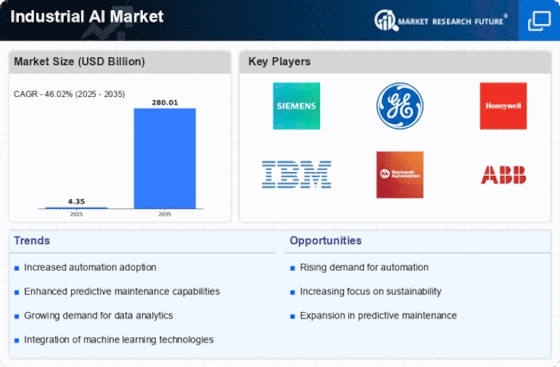
As per Market Research Future analysis, the Industrial AI Market Size was estimated at 4.351 USD Billion in 2024. The Industrial AI industry is projected to grow from 6.354 USD Billion in 2025 to 280.01 USD Billion by 2035, exhibiting a compound annual growth rate (CAGR) of 46.02% during the forecast period 2025 - 2035

Key Market Trends & Highlights

The Industrial AI Market is poised for substantial growth driven by automation and data-centric strategies.

  • North America remains the largest market for Industrial AI Market, reflecting robust investment in automation technologies. Asia-Pacific is emerging as the fastest-growing region, propelled by rapid industrialization and technological adoption. The software segment dominates the market, while the hardware segment is experiencing the fastest growth due to increasing demand for advanced AI solutions. Enhanced operational efficiency and predictive maintenance solutions are key drivers fueling market expansion.

Market Size & Forecast

2024 Market Size 4.351 (USD Billion)
2035 Market Size 280.01 (USD Billion)
CAGR (2025 - 2035) 46.02%
Largest Regional Market Share in 2024 North America

Major Players

<a href="https://blogs.sw.siemens.com/cicv/2025/12/23/how-nxp-achieved-robust-verification-and-portfolio-re-characterization-of-liberty-ip-with-solido-characterization-suite/?ste_sid=41c6b7b7f4e31e0d0476f2739f80e34e">Siemens</a> (DE), General Electric (US), Honeywell (US), IBM (US), Rockwell Automation (US), ABB (CH), Schneider Electric (FR), C3.ai (US), <a href="https://blogs.windows.com/windowsexperience/2025/12/09/windows-pc-gaming-in-2025-handheld-innovation-arm-progress-and-directx-advances/">Microsoft </a>(US)

Market Trends

The Industrial AI Market is currently experiencing a transformative phase, characterized by the integration of advanced technologies into traditional manufacturing processes. This evolution appears to be driven by the increasing demand for automation and efficiency across various sectors. Companies are increasingly adopting AI-driven solutions to enhance productivity, reduce operational costs, and improve decision-making capabilities. As organizations strive to remain competitive, the emphasis on data analytics and machine learning is becoming more pronounced, suggesting a shift towards data-centric operational models. Furthermore, the growing focus on sustainability and environmental responsibility is likely to influence the adoption of AI technologies, as businesses seek to optimize resource usage and minimize waste. In addition, the Industrial AI Market seems to be witnessing a surge in collaborative efforts between technology providers and industrial players. This collaboration may facilitate the development of tailored solutions that address specific industry challenges. Moreover, the rise of edge computing is expected to play a crucial role in the future of this market, enabling real-time data processing and analysis at the source. As the landscape continues to evolve, it is essential for stakeholders to remain agile and responsive to emerging trends, ensuring that they leverage the full potential of AI technologies in their operations.

Increased Automation Adoption

The trend towards automation in industrial settings is gaining momentum, as organizations seek to streamline operations and enhance efficiency. This shift is likely to lead to a greater reliance on AI technologies that facilitate automated processes, thereby reducing human intervention and minimizing errors.

Data-Driven Decision Making

There is a growing emphasis on utilizing data analytics to inform strategic decisions within the Industrial AI Market. Companies are increasingly leveraging AI to analyze vast amounts of data, which may lead to more informed choices and improved operational outcomes.

Sustainability Initiatives

The focus on sustainability is becoming a pivotal aspect of the Industrial AI Market. Organizations are exploring AI solutions that not only enhance productivity but also contribute to environmental goals, indicating a potential alignment between technological advancement and ecological responsibility.

Industrial AI Market Market Drivers

Workforce Augmentation

Workforce augmentation through AI technologies is reshaping the Industrial AI Market. By automating routine tasks and providing advanced analytical tools, AI empowers employees to focus on higher-value activities. This shift not only enhances job satisfaction but also increases overall productivity. Data indicates that organizations that embrace workforce augmentation can experience a 15 to 20% improvement in employee efficiency. As industries recognize the potential of AI to complement human capabilities, the trend towards workforce augmentation is likely to accelerate, further fueling the growth of the Industrial AI Market.


Supply Chain Optimization

Supply chain optimization is a pivotal factor influencing the Industrial AI Market. AI technologies enable companies to analyze complex supply chain data, forecast demand, and optimize inventory levels. This capability is particularly crucial in today's fast-paced market, where agility and responsiveness are essential. Studies suggest that AI-driven supply chain solutions can lead to a 20% reduction in operational costs. As businesses seek to enhance their supply chain efficiency and resilience, the adoption of AI technologies becomes increasingly vital, thereby driving the expansion of the Industrial AI Market.


Enhanced Operational Efficiency

The Industrial AI Market is witnessing a surge in demand for enhanced operational efficiency. Companies are increasingly adopting AI technologies to streamline processes, reduce downtime, and optimize resource allocation. According to recent data, organizations that implement AI-driven solutions can achieve up to a 30% increase in productivity. This trend is particularly evident in manufacturing sectors, where AI algorithms analyze vast amounts of data to identify inefficiencies and suggest improvements. As industries strive for higher efficiency, the integration of AI into operational frameworks becomes paramount, driving growth in the Industrial AI Market.

Predictive Maintenance Solutions

Predictive maintenance is emerging as a critical driver in the Industrial AI Market. By leveraging AI algorithms, companies can predict equipment failures before they occur, thereby minimizing unplanned downtime and maintenance costs. Research indicates that predictive maintenance can reduce maintenance costs by 25 to 30% while increasing equipment lifespan. This proactive approach not only enhances operational efficiency but also contributes to overall productivity. As industries increasingly recognize the value of maintaining equipment through AI-driven insights, the demand for predictive maintenance solutions continues to rise, propelling the growth of the Industrial AI Market.

Regulatory Compliance and Risk Management

Regulatory compliance and risk management are becoming increasingly critical in the Industrial AI Market. As industries face stringent regulations, AI technologies offer solutions to ensure compliance and mitigate risks. AI can analyze vast datasets to identify potential compliance issues and suggest corrective actions. This capability is particularly valuable in sectors such as manufacturing and energy, where non-compliance can result in significant penalties. The integration of AI for compliance purposes is projected to grow, as organizations seek to navigate complex regulatory landscapes while maintaining operational efficiency, thus driving the demand within the Industrial AI Market.

Market Segment Insights

By Offering: Software (Largest) vs. Hardware (Fastest-Growing)

In the Industrial AI Market, the Software segment presently holds the largest market share, establishing itself as the backbone of AI applications in industrial settings. Continually evolving to meet specific industry needs, software solutions encompassing machine learning, analytics, and automation technologies are widely adopted across various sectors. In contrast, the Hardware segment, which includes AI-specific processors and integrated systems, is witnessing remarkable growth driven by the increasing demand for efficient computing powers to support AI algorithms and data processing in real-time.

Software (Dominant) vs. Hardware (Emerging)

The Software segment stands as the dominant force within the Industrial AI Market, characterized by its pivotal role in enabling advanced analytics and automation functionalities. Companies are increasingly turning towards sophisticated algorithms and user-friendly interfaces that enhance operational efficiency. Meanwhile, the Hardware segment is emerging rapidly, featuring innovative technologies such as AI-optimized chips designed to accelerate data processing capabilities. This convergence of software applications with dedicated hardware has fostered a synergistic environment, allowing organizations to harness the full potential of AI-driven insights, thus enhancing productivity and scalability in industrial setups.

By Technology: Natural Language Processing (Largest) vs. Deep Learning (Fastest-Growing)

In the Industrial AI Market, the distribution of market shares among the Technology segment values shows Natural Language Processing (NLP) leading as the largest component. This segment captures significant attention due to its applications in automating communication and enhancing user interfaces within industrial environments. Following closely is Deep Learning, which, while not the largest presently, is recognized for its rapid growth trajectory. This indicates a robust interest in capabilities such as image recognition, anomaly detection, and predictive maintenance, which are becoming cornerstones of AI applications in various industrial sectors. The growth trends in the Technology segment reflect a convergence of evolving technologies and increasing organizational reliance on data-driven decision-making. As industries strive to improve operational efficiency and reduce costs, the importance of <a href="https://www.marketresearchfuture.com/reports/artificial-intelligence-market-1139">AI technologies</a>, particularly NLP and Deep Learning, continues to escalate. Additionally, advancements in computing power, data availability, and algorithmic innovations are driving adoption. The push towards smarter automation solutions positions both NLP and Deep Learning as critical players, with NLP focusing on the interface between humans and machines, while Deep Learning enhances intelligent data analysis.

Technology: Natural Language Processing (Dominant) vs. Deep Learning (Emerging)

Natural Language Processing (NLP) currently stands as the dominant force in the Technology segment of the Industrial AI Market, seamlessly integrating advanced linguistic capabilities into systems for improved human-machine interaction. Its applications range from voice recognition systems to automated help desks, making it a pivotal tool for optimizing communication processes. On the other hand, Deep Learning is emerging as a significant player, driven by its impressive capacity for pattern recognition and predictive capabilities in large datasets. This technology is crucial for advancements in computer vision and automated quality control, enhancing efficiency and accuracy in industrial applications. As both segments evolve, the interplay between NLP's user-centric approach and Deep Learning's analytical prowess will define the future landscape of industrial AI.

By Application: Predictive Maintenance (Largest) vs. Quality Control (Fastest-Growing)

The Industrial AI Market is largely dominated by the predictive maintenance and machinery inspection segment, which accounts for a significant portion of overall market share. This segment benefits from the increasing need for operational efficiency and cost reduction in manufacturing processes. Material movement and field services also contribute to the market, showcasing steady demand as industries increasingly automate their logistics and enhance service delivery through AI technologies. In recent years, quality control has emerged as the fastest-growing segment within the Industrial AI Market. As industries focus on improving product quality and reducing defects, the integration of AI in quality control processes has gained traction. Additionally, production planning and material movement are expected to experience positive growth as organizations seek to optimize their operations and leverage AI to enhance decision-making capabilities.

Predictive Maintenance (Dominant) vs. Quality Control (Emerging)

Predictive maintenance has established itself as the dominant application within the Industrial AI Market due to its ability to preemptively address equipment failures before they occur, thus minimizing downtime and maintenance costs. Organizations increasingly rely on AI algorithms to analyze data from machinery, enabling timely interventions. On the other hand, quality control is recognized as an emerging force within the sector, supported by advancements in AI technologies that facilitate real-time monitoring and defect detection. This segment is characterized by its focus on ensuring product excellence, aligning with market demands for high-quality standards. As industries continue to embrace automation, both predictive maintenance and quality control will play pivotal roles in shaping operational efficiencies and competitive advantage.

By Industry: Automobile (Largest) vs. Energy and Power (Fastest-Growing)

The Industrial AI Market is witnessing substantial contributions from several key segments. The Automobile industry currently holds the largest market share due to the ongoing integration of AI technologies for automated driving, predictive maintenance, and enhanced manufacturing processes. Energy and power is also a significant player, utilizing AI for grid management, optimization of power generation, and predictive maintenance of equipment, enhancing overall efficiency. Growth trends in the Industrial AI Market are being driven by rapid advancements in AI algorithms and the increasing adoption of IoT technology across industries. The automobile sector is expected to continue benefiting from autonomous vehicle innovations and the shift toward electric vehicles, while the energy and power sector is leveraging AI to transition toward renewable energy sources, making it the fastest-growing segment in this market landscape.

Automobile: Traditional Manufacturing (Dominant) vs. Energy and Power: Smart Grids (Emerging)

In the Automobile sector, traditional manufacturing practices are deeply integrated with AI, utilizing data analytics for optimizing production lines and enhancing supply chain management. The focus is on improving efficiency, reducing costs, and ensuring quality control. Conversely, the Energy and Power sector is witnessing an emergence of smart grids, driven by AI's capabilities in real-time data processing and predictive analytics. These smart systems enhance energy distribution reliability and efficiency, indicating a shift towards AI-driven solutions as critical to future developments in the energy landscape.

Get more detailed insights about Industrial AI Market Research Report - Global Forecast till 2035

Regional Insights

North America : Innovation and Leadership Hub

North America is the largest market for Industrial AI Market, holding approximately 45% of the global share. The region's growth is driven by rapid technological advancements, increased automation in manufacturing, and supportive government policies promoting AI integration. The demand for predictive maintenance and operational efficiency is also on the rise, further fueling market expansion. The United States leads the market, with significant contributions from Canada. Key players such as General Electric, IBM, and Honeywell are at the forefront, driving innovation and competition. The presence of advanced infrastructure and a skilled workforce enhances the region's competitive edge, making it a focal point for Industrial AI Market development.

Europe : Regulatory Framework and Growth

Europe is the second-largest market for Industrial AI Market, accounting for around 30% of the global share. The region benefits from stringent regulations that encourage the adoption of AI technologies, particularly in manufacturing and energy sectors. Initiatives like the European AI Strategy aim to foster innovation while ensuring ethical standards, thus driving market growth. Germany and France are the leading countries in this sector, with a strong presence of companies like Siemens and Schneider Electric. The competitive landscape is characterized by collaboration between tech firms and traditional industries, enhancing the development of AI solutions tailored to specific needs. This synergy is crucial for maintaining Europe's position in the global market.

Asia-Pacific : Rapid Growth and Adoption

Asia-Pacific is witnessing rapid growth in the Industrial AI Market, holding approximately 20% of the global share. The region's expansion is driven by increasing investments in smart manufacturing and Industry 4.0 initiatives. Countries like China and Japan are leading the charge, supported by government policies that promote technological innovation and digital transformation. China is the largest market in the region, with significant contributions from Japan and South Korea. The competitive landscape is marked by the presence of both local and international players, including ABB and Rockwell Automation. The focus on enhancing operational efficiency and reducing costs is propelling the adoption of AI technologies across various industries, making Asia-Pacific a key player in the global market.

Middle East and Africa : Emerging Market Potential

The Middle East and Africa region is gradually emerging in the Industrial AI Market, currently holding about 5% of the global share. The growth is primarily driven by increasing investments in infrastructure and a push towards digital transformation across various sectors. Governments are recognizing the potential of AI to enhance productivity and efficiency, leading to supportive policies and initiatives. Countries like South Africa and the UAE are at the forefront of this transformation, with a growing number of startups and tech companies entering the market. The competitive landscape is evolving, with both local and international players seeking to capitalize on the opportunities presented by AI technologies. This region's potential for growth makes it an area of interest for future investments.

Key Players and Competitive Insights

The Industrial AI Market is a highly competitive industry, as numerous companies offer Industrial AI Market solutions such as AI platforms, AI software and solutions across the globe. The market is characterized by the presence of established and large information technological giants like Amazon, Microsoft and other companies applying these AI solutions in its processes. SiemensAI optimises tool placement within machine tools to successfully reduce production times by up to 10% – all without the need for new hardware.
At GE, the development of Artificial Intelligence (AI) is primarily focused on integrating minds and industrial machines to enable intelligent and user-friendly products and services that move, cure, and power the globe.

Key Companies in the Industrial AI Market include

Industry Developments

May 2023: ERP company- SAP inked an agreement with IBM to use its Watson AI technology. Its aim is to help users find apps on its solutions cloud. IBM Watson is expected to power the digital assistant in SAP Start, through which users enter its cloud solutions environment and search for, launch and "interactively engage” with apps. Residing in cloud solutions from SAP and S/4HANA, IBM Watson is intended to help users boost productivity with both natural language capabilities and predictive insights. Watson is a question-answering system developed by IBM in the Noughties.

SAP said the Watson-powered system would help managers and employees find answers across various SAP business applications, having already been deployed in SAP Concur, the expense management application.

April 2023: Siemens and Microsoft are leveraging the collaborative power of generative artificial intelligence (AI) to assist industrial enterprises in driving innovation and efficiency throughout the product design, engineering, manufacturing, and operating lifecycle. The firms are integrating Siemens' Teamcenter software for product lifecycle management (PLM) with Microsoft's collaboration platform Teams and the language models in Azure OpenAI Service, as well as other Azure AI capabilities, to improve cross-functional communication.

December 2020: PepsiCo announced that they have started using Microsoft’s Project Bonsai solution to increase efficiency while maintaining consistency and quality. The solution uses data from a computer vision system to make recommendations or adjustments any time a product falls out of spec, has proven itself at a pilot plant and would be deployed in a production plant. PepsiCo, whose Frito-Lay division makes Cheetos -wanted a more efficient way to consistently manufacture Cheetos with the proper attributes while reducing waste.

To meet this goal, PepsiCo developed an AI solution powered by Microsoft Project Bonsai that monitors and adjusts its extruders, the equipment that produces Cheetos.

Future Outlook

Industrial AI Market Future Outlook

The Industrial AI Market is projected to grow at a 46.02% CAGR from 2025 to 2035, driven by advancements in automation, data analytics, and machine learning technologies.

New opportunities lie in:

  • Development of predictive maintenance solutions for manufacturing equipment.
  • Integration of AI-driven supply chain optimization tools.
  • Implementation of AI-based quality control systems in production lines.

By 2035, the Industrial AI Market is expected to be a cornerstone of operational efficiency and innovation.

Market Segmentation

Industrial AI Market Industry Outlook

  • Automobile
  • Energy and power
  • Pharmaceuticals
  • Heavy metals and machine Manufacturing
  • Semiconductor & Electronics
  • Food & beverages
  • Manufacturing
  • Others

Industrial AI Market Offering Outlook

  • Hardware
  • Software

Industrial AI Market Technology Outlook

  • Computer vision
  • Deep learning
  • Natural Language Processing (NLP)
  • Context Awareness

Industrial AI Market Application Outlook

  • Predictive maintenance and machinery inspection
  • Material movement
  • Production planning
  • Field Services
  • Quality Control
  • Others

Report Scope

MARKET SIZE 2024 4.351(USD Billion)
MARKET SIZE 2025 6.354(USD Billion)
MARKET SIZE 2035 280.01(USD Billion)
COMPOUND ANNUAL GROWTH RATE (CAGR) 46.02% (2025 - 2035)
REPORT COVERAGE Revenue Forecast, Competitive Landscape, Growth Factors, and Trends
BASE YEAR 2024
Market Forecast Period 2025 - 2035
Historical Data 2019 - 2024
Market Forecast Units USD Billion
Key Companies Profiled Siemens (DE), General Electric (US), Honeywell (US), IBM (US), Rockwell Automation (US), ABB (CH), Schneider Electric (FR), C3.ai (US), Microsoft (US)
Segments Covered Offering, Technology, Application, Industry, Region - Forecast Till 2035
Key Market Opportunities Integration of advanced machine learning algorithms for predictive maintenance in the Industrial AI Market.
Key Market Dynamics Rising demand for automation drives competitive innovation in the Industrial Artificial Intelligence sector.
Countries Covered North America, Europe, APAC, South America, MEA

FAQs

What is the current valuation of the Industrial AI Market as of 2024?

<p>The Industrial AI Market was valued at 4.351 USD Billion in 2024.</p>

What is the projected market size for the Industrial AI Market by 2035?

<p>The market is projected to reach 280.01 USD Billion by 2035.</p>

What is the expected CAGR for the Industrial AI Market during the forecast period 2025 - 2035?

<p>The expected CAGR for the Industrial AI Market during 2025 - 2035 is 46.02%.</p>

Which companies are considered key players in the Industrial AI Market?

<p>Key players include Siemens, General Electric, Honeywell, IBM, Rockwell Automation, ABB, Schneider Electric, C3.ai, and Microsoft.</p>

What are the main segments of the Industrial AI Market?

The main segments include Offering, Technology, Application, and Industry.

How much is the Hardware segment valued in the Industrial AI Market?

The Hardware segment is valued at 40.0 USD Billion.

What is the valuation of the Software segment in the Industrial AI Market?

The Software segment is valued at 240.01 USD Billion.

Which technology segment has the highest valuation in the Industrial AI Market?

Deep learning has the highest valuation at 90.0 USD Billion.

What application area is projected to have the highest growth in the Industrial AI Market?

Predictive maintenance and machinery inspection is projected to grow to 58.0 USD Billion.

Which industry segment is expected to lead in the Industrial AI Market?

The Manufacturing industry segment is expected to lead with a valuation of 60.0 USD Billion.

  1. SECTION I: EXECUTIVE SUMMARY AND KEY HIGHLIGHTS
    1. | 1.1 EXECUTIVE SUMMARY
    2. | | 1.1.1 Market Overview
    3. | | 1.1.2 Key Findings
    4. | | 1.1.3 Market Segmentation
    5. | | 1.1.4 Competitive Landscape
    6. | | 1.1.5 Challenges and Opportunities
    7. | | 1.1.6 Future Outlook
  2. SECTION II: SCOPING, METHODOLOGY AND MARKET STRUCTURE
    1. | 2.1 MARKET INTRODUCTION
    2. | | 2.1.1 Definition
    3. | | 2.1.2 Scope of the study
    4. | | | 2.1.2.1 Research Objective
    5. | | | 2.1.2.2 Assumption
    6. | | | 2.1.2.3 Limitations
    7. | 2.2 RESEARCH METHODOLOGY
    8. | | 2.2.1 Overview
    9. | | 2.2.2 Data Mining
    10. | | 2.2.3 Secondary Research
    11. | | 2.2.4 Primary Research
    12. | | | 2.2.4.1 Primary Interviews and Information Gathering Process
    13. | | | 2.2.4.2 Breakdown of Primary Respondents
    14. | | 2.2.5 Forecasting Model
    15. | | 2.2.6 Market Size Estimation
    16. | | | 2.2.6.1 Bottom-Up Approach
    17. | | | 2.2.6.2 Top-Down Approach
    18. | | 2.2.7 Data Triangulation
    19. | | 2.2.8 Validation
  3. SECTION III: QUALITATIVE ANALYSIS
    1. | 3.1 MARKET DYNAMICS
    2. | | 3.1.1 Overview
    3. | | 3.1.2 Drivers
    4. | | 3.1.3 Restraints
    5. | | 3.1.4 Opportunities
    6. | 3.2 MARKET FACTOR ANALYSIS
    7. | | 3.2.1 Value chain Analysis
    8. | | 3.2.2 Porter's Five Forces Analysis
    9. | | | 3.2.2.1 Bargaining Power of Suppliers
    10. | | | 3.2.2.2 Bargaining Power of Buyers
    11. | | | 3.2.2.3 Threat of New Entrants
    12. | | | 3.2.2.4 Threat of Substitutes
    13. | | | 3.2.2.5 Intensity of Rivalry
    14. | | 3.2.3 COVID-19 Impact Analysis
    15. | | | 3.2.3.1 Market Impact Analysis
    16. | | | 3.2.3.2 Regional Impact
    17. | | | 3.2.3.3 Opportunity and Threat Analysis
  4. SECTION IV: QUANTITATIVE ANALYSIS
    1. | 4.1 Information and Communications Technology, BY Offering (USD Billion)
    2. | | 4.1.1 Hardware
    3. | | 4.1.2 Software
    4. | 4.2 Information and Communications Technology, BY Technology (USD Billion)
    5. | | 4.2.1 Computer vision
    6. | | 4.2.2 Deep learning
    7. | | 4.2.3 Natural Language Processing (NLP)
    8. | | 4.2.4 Context Awareness
    9. | 4.3 Information and Communications Technology, BY Application (USD Billion)
    10. | | 4.3.1 Predictive maintenance and machinery inspection
    11. | | 4.3.2 Material movement
    12. | | 4.3.3 Production planning
    13. | | 4.3.4 Field Services
    14. | | 4.3.5 Quality Control
    15. | | 4.3.6 Others
    16. | 4.4 Information and Communications Technology, BY Industry (USD Billion)
    17. | | 4.4.1 Automobile
    18. | | 4.4.2 Energy and power
    19. | | 4.4.3 Pharmaceuticals
    20. | | 4.4.4 Heavy metals and machine Manufacturing
    21. | | 4.4.5 Semiconductor & Electronics
    22. | | 4.4.6 Food & beverages
    23. | | 4.4.7 Manufacturing
    24. | | 4.4.8 Others
    25. | 4.5 Information and Communications Technology, BY Region (USD Billion)
    26. | | 4.5.1 North America
    27. | | | 4.5.1.1 US
    28. | | | 4.5.1.2 Canada
    29. | | 4.5.2 Europe
    30. | | | 4.5.2.1 Germany
    31. | | | 4.5.2.2 UK
    32. | | | 4.5.2.3 France
    33. | | | 4.5.2.4 Russia
    34. | | | 4.5.2.5 Italy
    35. | | | 4.5.2.6 Spain
    36. | | | 4.5.2.7 Rest of Europe
    37. | | 4.5.3 APAC
    38. | | | 4.5.3.1 China
    39. | | | 4.5.3.2 India
    40. | | | 4.5.3.3 Japan
    41. | | | 4.5.3.4 South Korea
    42. | | | 4.5.3.5 Malaysia
    43. | | | 4.5.3.6 Thailand
    44. | | | 4.5.3.7 Indonesia
    45. | | | 4.5.3.8 Rest of APAC
    46. | | 4.5.4 South America
    47. | | | 4.5.4.1 Brazil
    48. | | | 4.5.4.2 Mexico
    49. | | | 4.5.4.3 Argentina
    50. | | | 4.5.4.4 Rest of South America
    51. | | 4.5.5 MEA
    52. | | | 4.5.5.1 GCC Countries
    53. | | | 4.5.5.2 South Africa
    54. | | | 4.5.5.3 Rest of MEA
  5. SECTION V: COMPETITIVE ANALYSIS
    1. | 5.1 Competitive Landscape
    2. | | 5.1.1 Overview
    3. | | 5.1.2 Competitive Analysis
    4. | | 5.1.3 Market share Analysis
    5. | | 5.1.4 Major Growth Strategy in the Information and Communications Technology
    6. | | 5.1.5 Competitive Benchmarking
    7. | | 5.1.6 Leading Players in Terms of Number of Developments in the Information and Communications Technology
    8. | | 5.1.7 Key developments and growth strategies
    9. | | | 5.1.7.1 New Product Launch/Service Deployment
    10. | | | 5.1.7.2 Merger & Acquisitions
    11. | | | 5.1.7.3 Joint Ventures
    12. | | 5.1.8 Major Players Financial Matrix
    13. | | | 5.1.8.1 Sales and Operating Income
    14. | | | 5.1.8.2 Major Players R&D Expenditure. 2023
    15. | 5.2 Company Profiles
    16. | | 5.2.1 Siemens (DE)
    17. | | | 5.2.1.1 Financial Overview
    18. | | | 5.2.1.2 Products Offered
    19. | | | 5.2.1.3 Key Developments
    20. | | | 5.2.1.4 SWOT Analysis
    21. | | | 5.2.1.5 Key Strategies
    22. | | 5.2.2 General Electric (US)
    23. | | | 5.2.2.1 Financial Overview
    24. | | | 5.2.2.2 Products Offered
    25. | | | 5.2.2.3 Key Developments
    26. | | | 5.2.2.4 SWOT Analysis
    27. | | | 5.2.2.5 Key Strategies
    28. | | 5.2.3 Honeywell (US)
    29. | | | 5.2.3.1 Financial Overview
    30. | | | 5.2.3.2 Products Offered
    31. | | | 5.2.3.3 Key Developments
    32. | | | 5.2.3.4 SWOT Analysis
    33. | | | 5.2.3.5 Key Strategies
    34. | | 5.2.4 IBM (US)
    35. | | | 5.2.4.1 Financial Overview
    36. | | | 5.2.4.2 Products Offered
    37. | | | 5.2.4.3 Key Developments
    38. | | | 5.2.4.4 SWOT Analysis
    39. | | | 5.2.4.5 Key Strategies
    40. | | 5.2.5 Rockwell Automation (US)
    41. | | | 5.2.5.1 Financial Overview
    42. | | | 5.2.5.2 Products Offered
    43. | | | 5.2.5.3 Key Developments
    44. | | | 5.2.5.4 SWOT Analysis
    45. | | | 5.2.5.5 Key Strategies
    46. | | 5.2.6 ABB (CH)
    47. | | | 5.2.6.1 Financial Overview
    48. | | | 5.2.6.2 Products Offered
    49. | | | 5.2.6.3 Key Developments
    50. | | | 5.2.6.4 SWOT Analysis
    51. | | | 5.2.6.5 Key Strategies
    52. | | 5.2.7 Schneider Electric (FR)
    53. | | | 5.2.7.1 Financial Overview
    54. | | | 5.2.7.2 Products Offered
    55. | | | 5.2.7.3 Key Developments
    56. | | | 5.2.7.4 SWOT Analysis
    57. | | | 5.2.7.5 Key Strategies
    58. | | 5.2.8 C3.ai (US)
    59. | | | 5.2.8.1 Financial Overview
    60. | | | 5.2.8.2 Products Offered
    61. | | | 5.2.8.3 Key Developments
    62. | | | 5.2.8.4 SWOT Analysis
    63. | | | 5.2.8.5 Key Strategies
    64. | | 5.2.9 Microsoft (US)
    65. | | | 5.2.9.1 Financial Overview
    66. | | | 5.2.9.2 Products Offered
    67. | | | 5.2.9.3 Key Developments
    68. | | | 5.2.9.4 SWOT Analysis
    69. | | | 5.2.9.5 Key Strategies
    70. | 5.3 Appendix
    71. | | 5.3.1 References
    72. | | 5.3.2 Related Reports
  6. LIST OF FIGURES
    1. | 6.1 MARKET SYNOPSIS
    2. | 6.2 NORTH AMERICA MARKET ANALYSIS
    3. | 6.3 US MARKET ANALYSIS BY OFFERING
    4. | 6.4 US MARKET ANALYSIS BY TECHNOLOGY
    5. | 6.5 US MARKET ANALYSIS BY APPLICATION
    6. | 6.6 US MARKET ANALYSIS BY INDUSTRY
    7. | 6.7 CANADA MARKET ANALYSIS BY OFFERING
    8. | 6.8 CANADA MARKET ANALYSIS BY TECHNOLOGY
    9. | 6.9 CANADA MARKET ANALYSIS BY APPLICATION
    10. | 6.10 CANADA MARKET ANALYSIS BY INDUSTRY
    11. | 6.11 EUROPE MARKET ANALYSIS
    12. | 6.12 GERMANY MARKET ANALYSIS BY OFFERING
    13. | 6.13 GERMANY MARKET ANALYSIS BY TECHNOLOGY
    14. | 6.14 GERMANY MARKET ANALYSIS BY APPLICATION
    15. | 6.15 GERMANY MARKET ANALYSIS BY INDUSTRY
    16. | 6.16 UK MARKET ANALYSIS BY OFFERING
    17. | 6.17 UK MARKET ANALYSIS BY TECHNOLOGY
    18. | 6.18 UK MARKET ANALYSIS BY APPLICATION
    19. | 6.19 UK MARKET ANALYSIS BY INDUSTRY
    20. | 6.20 FRANCE MARKET ANALYSIS BY OFFERING
    21. | 6.21 FRANCE MARKET ANALYSIS BY TECHNOLOGY
    22. | 6.22 FRANCE MARKET ANALYSIS BY APPLICATION
    23. | 6.23 FRANCE MARKET ANALYSIS BY INDUSTRY
    24. | 6.24 RUSSIA MARKET ANALYSIS BY OFFERING
    25. | 6.25 RUSSIA MARKET ANALYSIS BY TECHNOLOGY
    26. | 6.26 RUSSIA MARKET ANALYSIS BY APPLICATION
    27. | 6.27 RUSSIA MARKET ANALYSIS BY INDUSTRY
    28. | 6.28 ITALY MARKET ANALYSIS BY OFFERING
    29. | 6.29 ITALY MARKET ANALYSIS BY TECHNOLOGY
    30. | 6.30 ITALY MARKET ANALYSIS BY APPLICATION
    31. | 6.31 ITALY MARKET ANALYSIS BY INDUSTRY
    32. | 6.32 SPAIN MARKET ANALYSIS BY OFFERING
    33. | 6.33 SPAIN MARKET ANALYSIS BY TECHNOLOGY
    34. | 6.34 SPAIN MARKET ANALYSIS BY APPLICATION
    35. | 6.35 SPAIN MARKET ANALYSIS BY INDUSTRY
    36. | 6.36 REST OF EUROPE MARKET ANALYSIS BY OFFERING
    37. | 6.37 REST OF EUROPE MARKET ANALYSIS BY TECHNOLOGY
    38. | 6.38 REST OF EUROPE MARKET ANALYSIS BY APPLICATION
    39. | 6.39 REST OF EUROPE MARKET ANALYSIS BY INDUSTRY
    40. | 6.40 APAC MARKET ANALYSIS
    41. | 6.41 CHINA MARKET ANALYSIS BY OFFERING
    42. | 6.42 CHINA MARKET ANALYSIS BY TECHNOLOGY
    43. | 6.43 CHINA MARKET ANALYSIS BY APPLICATION
    44. | 6.44 CHINA MARKET ANALYSIS BY INDUSTRY
    45. | 6.45 INDIA MARKET ANALYSIS BY OFFERING
    46. | 6.46 INDIA MARKET ANALYSIS BY TECHNOLOGY
    47. | 6.47 INDIA MARKET ANALYSIS BY APPLICATION
    48. | 6.48 INDIA MARKET ANALYSIS BY INDUSTRY
    49. | 6.49 JAPAN MARKET ANALYSIS BY OFFERING
    50. | 6.50 JAPAN MARKET ANALYSIS BY TECHNOLOGY
    51. | 6.51 JAPAN MARKET ANALYSIS BY APPLICATION
    52. | 6.52 JAPAN MARKET ANALYSIS BY INDUSTRY
    53. | 6.53 SOUTH KOREA MARKET ANALYSIS BY OFFERING
    54. | 6.54 SOUTH KOREA MARKET ANALYSIS BY TECHNOLOGY
    55. | 6.55 SOUTH KOREA MARKET ANALYSIS BY APPLICATION
    56. | 6.56 SOUTH KOREA MARKET ANALYSIS BY INDUSTRY
    57. | 6.57 MALAYSIA MARKET ANALYSIS BY OFFERING
    58. | 6.58 MALAYSIA MARKET ANALYSIS BY TECHNOLOGY
    59. | 6.59 MALAYSIA MARKET ANALYSIS BY APPLICATION
    60. | 6.60 MALAYSIA MARKET ANALYSIS BY INDUSTRY
    61. | 6.61 THAILAND MARKET ANALYSIS BY OFFERING
    62. | 6.62 THAILAND MARKET ANALYSIS BY TECHNOLOGY
    63. | 6.63 THAILAND MARKET ANALYSIS BY APPLICATION
    64. | 6.64 THAILAND MARKET ANALYSIS BY INDUSTRY
    65. | 6.65 INDONESIA MARKET ANALYSIS BY OFFERING
    66. | 6.66 INDONESIA MARKET ANALYSIS BY TECHNOLOGY
    67. | 6.67 INDONESIA MARKET ANALYSIS BY APPLICATION
    68. | 6.68 INDONESIA MARKET ANALYSIS BY INDUSTRY
    69. | 6.69 REST OF APAC MARKET ANALYSIS BY OFFERING
    70. | 6.70 REST OF APAC MARKET ANALYSIS BY TECHNOLOGY
    71. | 6.71 REST OF APAC MARKET ANALYSIS BY APPLICATION
    72. | 6.72 REST OF APAC MARKET ANALYSIS BY INDUSTRY
    73. | 6.73 SOUTH AMERICA MARKET ANALYSIS
    74. | 6.74 BRAZIL MARKET ANALYSIS BY OFFERING
    75. | 6.75 BRAZIL MARKET ANALYSIS BY TECHNOLOGY
    76. | 6.76 BRAZIL MARKET ANALYSIS BY APPLICATION
    77. | 6.77 BRAZIL MARKET ANALYSIS BY INDUSTRY
    78. | 6.78 MEXICO MARKET ANALYSIS BY OFFERING
    79. | 6.79 MEXICO MARKET ANALYSIS BY TECHNOLOGY
    80. | 6.80 MEXICO MARKET ANALYSIS BY APPLICATION
    81. | 6.81 MEXICO MARKET ANALYSIS BY INDUSTRY
    82. | 6.82 ARGENTINA MARKET ANALYSIS BY OFFERING
    83. | 6.83 ARGENTINA MARKET ANALYSIS BY TECHNOLOGY
    84. | 6.84 ARGENTINA MARKET ANALYSIS BY APPLICATION
    85. | 6.85 ARGENTINA MARKET ANALYSIS BY INDUSTRY
    86. | 6.86 REST OF SOUTH AMERICA MARKET ANALYSIS BY OFFERING
    87. | 6.87 REST OF SOUTH AMERICA MARKET ANALYSIS BY TECHNOLOGY
    88. | 6.88 REST OF SOUTH AMERICA MARKET ANALYSIS BY APPLICATION
    89. | 6.89 REST OF SOUTH AMERICA MARKET ANALYSIS BY INDUSTRY
    90. | 6.90 MEA MARKET ANALYSIS
    91. | 6.91 GCC COUNTRIES MARKET ANALYSIS BY OFFERING
    92. | 6.92 GCC COUNTRIES MARKET ANALYSIS BY TECHNOLOGY
    93. | 6.93 GCC COUNTRIES MARKET ANALYSIS BY APPLICATION
    94. | 6.94 GCC COUNTRIES MARKET ANALYSIS BY INDUSTRY
    95. | 6.95 SOUTH AFRICA MARKET ANALYSIS BY OFFERING
    96. | 6.96 SOUTH AFRICA MARKET ANALYSIS BY TECHNOLOGY
    97. | 6.97 SOUTH AFRICA MARKET ANALYSIS BY APPLICATION
    98. | 6.98 SOUTH AFRICA MARKET ANALYSIS BY INDUSTRY
    99. | 6.99 REST OF MEA MARKET ANALYSIS BY OFFERING
    100. | 6.100 REST OF MEA MARKET ANALYSIS BY TECHNOLOGY
    101. | 6.101 REST OF MEA MARKET ANALYSIS BY APPLICATION
    102. | 6.102 REST OF MEA MARKET ANALYSIS BY INDUSTRY
    103. | 6.103 KEY BUYING CRITERIA OF INFORMATION AND COMMUNICATIONS TECHNOLOGY
    104. | 6.104 RESEARCH PROCESS OF MRFR
    105. | 6.105 DRO ANALYSIS OF INFORMATION AND COMMUNICATIONS TECHNOLOGY
    106. | 6.106 DRIVERS IMPACT ANALYSIS: INFORMATION AND COMMUNICATIONS TECHNOLOGY
    107. | 6.107 RESTRAINTS IMPACT ANALYSIS: INFORMATION AND COMMUNICATIONS TECHNOLOGY
    108. | 6.108 SUPPLY / VALUE CHAIN: INFORMATION AND COMMUNICATIONS TECHNOLOGY
    109. | 6.109 INFORMATION AND COMMUNICATIONS TECHNOLOGY, BY OFFERING, 2024 (% SHARE)
    110. | 6.110 INFORMATION AND COMMUNICATIONS TECHNOLOGY, BY OFFERING, 2024 TO 2035 (USD Billion)
    111. | 6.111 INFORMATION AND COMMUNICATIONS TECHNOLOGY, BY TECHNOLOGY, 2024 (% SHARE)
    112. | 6.112 INFORMATION AND COMMUNICATIONS TECHNOLOGY, BY TECHNOLOGY, 2024 TO 2035 (USD Billion)
    113. | 6.113 INFORMATION AND COMMUNICATIONS TECHNOLOGY, BY APPLICATION, 2024 (% SHARE)
    114. | 6.114 INFORMATION AND COMMUNICATIONS TECHNOLOGY, BY APPLICATION, 2024 TO 2035 (USD Billion)
    115. | 6.115 INFORMATION AND COMMUNICATIONS TECHNOLOGY, BY INDUSTRY, 2024 (% SHARE)
    116. | 6.116 INFORMATION AND COMMUNICATIONS TECHNOLOGY, BY INDUSTRY, 2024 TO 2035 (USD Billion)
    117. | 6.117 BENCHMARKING OF MAJOR COMPETITORS
  7. LIST OF TABLES
    1. | 7.1 LIST OF ASSUMPTIONS
    2. | | 7.1.1
    3. | 7.2 North America MARKET SIZE ESTIMATES; FORECAST
    4. | | 7.2.1 BY OFFERING, 2025-2035 (USD Billion)
    5. | | 7.2.2 BY TECHNOLOGY, 2025-2035 (USD Billion)
    6. | | 7.2.3 BY APPLICATION, 2025-2035 (USD Billion)
    7. | | 7.2.4 BY INDUSTRY, 2025-2035 (USD Billion)
    8. | 7.3 US MARKET SIZE ESTIMATES; FORECAST
    9. | | 7.3.1 BY OFFERING, 2025-2035 (USD Billion)
    10. | | 7.3.2 BY TECHNOLOGY, 2025-2035 (USD Billion)
    11. | | 7.3.3 BY APPLICATION, 2025-2035 (USD Billion)
    12. | | 7.3.4 BY INDUSTRY, 2025-2035 (USD Billion)
    13. | 7.4 Canada MARKET SIZE ESTIMATES; FORECAST
    14. | | 7.4.1 BY OFFERING, 2025-2035 (USD Billion)
    15. | | 7.4.2 BY TECHNOLOGY, 2025-2035 (USD Billion)
    16. | | 7.4.3 BY APPLICATION, 2025-2035 (USD Billion)
    17. | | 7.4.4 BY INDUSTRY, 2025-2035 (USD Billion)
    18. | 7.5 Europe MARKET SIZE ESTIMATES; FORECAST
    19. | | 7.5.1 BY OFFERING, 2025-2035 (USD Billion)
    20. | | 7.5.2 BY TECHNOLOGY, 2025-2035 (USD Billion)
    21. | | 7.5.3 BY APPLICATION, 2025-2035 (USD Billion)
    22. | | 7.5.4 BY INDUSTRY, 2025-2035 (USD Billion)
    23. | 7.6 Germany MARKET SIZE ESTIMATES; FORECAST
    24. | | 7.6.1 BY OFFERING, 2025-2035 (USD Billion)
    25. | | 7.6.2 BY TECHNOLOGY, 2025-2035 (USD Billion)
    26. | | 7.6.3 BY APPLICATION, 2025-2035 (USD Billion)
    27. | | 7.6.4 BY INDUSTRY, 2025-2035 (USD Billion)
    28. | 7.7 UK MARKET SIZE ESTIMATES; FORECAST
    29. | | 7.7.1 BY OFFERING, 2025-2035 (USD Billion)
    30. | | 7.7.2 BY TECHNOLOGY, 2025-2035 (USD Billion)
    31. | | 7.7.3 BY APPLICATION, 2025-2035 (USD Billion)
    32. | | 7.7.4 BY INDUSTRY, 2025-2035 (USD Billion)
    33. | 7.8 France MARKET SIZE ESTIMATES; FORECAST
    34. | | 7.8.1 BY OFFERING, 2025-2035 (USD Billion)
    35. | | 7.8.2 BY TECHNOLOGY, 2025-2035 (USD Billion)
    36. | | 7.8.3 BY APPLICATION, 2025-2035 (USD Billion)
    37. | | 7.8.4 BY INDUSTRY, 2025-2035 (USD Billion)
    38. | 7.9 Russia MARKET SIZE ESTIMATES; FORECAST
    39. | | 7.9.1 BY OFFERING, 2025-2035 (USD Billion)
    40. | | 7.9.2 BY TECHNOLOGY, 2025-2035 (USD Billion)
    41. | | 7.9.3 BY APPLICATION, 2025-2035 (USD Billion)
    42. | | 7.9.4 BY INDUSTRY, 2025-2035 (USD Billion)
    43. | 7.10 Italy MARKET SIZE ESTIMATES; FORECAST
    44. | | 7.10.1 BY OFFERING, 2025-2035 (USD Billion)
    45. | | 7.10.2 BY TECHNOLOGY, 2025-2035 (USD Billion)
    46. | | 7.10.3 BY APPLICATION, 2025-2035 (USD Billion)
    47. | | 7.10.4 BY INDUSTRY, 2025-2035 (USD Billion)
    48. | 7.11 Spain MARKET SIZE ESTIMATES; FORECAST
    49. | | 7.11.1 BY OFFERING, 2025-2035 (USD Billion)
    50. | | 7.11.2 BY TECHNOLOGY, 2025-2035 (USD Billion)
    51. | | 7.11.3 BY APPLICATION, 2025-2035 (USD Billion)
    52. | | 7.11.4 BY INDUSTRY, 2025-2035 (USD Billion)
    53. | 7.12 Rest of Europe MARKET SIZE ESTIMATES; FORECAST
    54. | | 7.12.1 BY OFFERING, 2025-2035 (USD Billion)
    55. | | 7.12.2 BY TECHNOLOGY, 2025-2035 (USD Billion)
    56. | | 7.12.3 BY APPLICATION, 2025-2035 (USD Billion)
    57. | | 7.12.4 BY INDUSTRY, 2025-2035 (USD Billion)
    58. | 7.13 APAC MARKET SIZE ESTIMATES; FORECAST
    59. | | 7.13.1 BY OFFERING, 2025-2035 (USD Billion)
    60. | | 7.13.2 BY TECHNOLOGY, 2025-2035 (USD Billion)
    61. | | 7.13.3 BY APPLICATION, 2025-2035 (USD Billion)
    62. | | 7.13.4 BY INDUSTRY, 2025-2035 (USD Billion)
    63. | 7.14 China MARKET SIZE ESTIMATES; FORECAST
    64. | | 7.14.1 BY OFFERING, 2025-2035 (USD Billion)
    65. | | 7.14.2 BY TECHNOLOGY, 2025-2035 (USD Billion)
    66. | | 7.14.3 BY APPLICATION, 2025-2035 (USD Billion)
    67. | | 7.14.4 BY INDUSTRY, 2025-2035 (USD Billion)
    68. | 7.15 India MARKET SIZE ESTIMATES; FORECAST
    69. | | 7.15.1 BY OFFERING, 2025-2035 (USD Billion)
    70. | | 7.15.2 BY TECHNOLOGY, 2025-2035 (USD Billion)
    71. | | 7.15.3 BY APPLICATION, 2025-2035 (USD Billion)
    72. | | 7.15.4 BY INDUSTRY, 2025-2035 (USD Billion)
    73. | 7.16 Japan MARKET SIZE ESTIMATES; FORECAST
    74. | | 7.16.1 BY OFFERING, 2025-2035 (USD Billion)
    75. | | 7.16.2 BY TECHNOLOGY, 2025-2035 (USD Billion)
    76. | | 7.16.3 BY APPLICATION, 2025-2035 (USD Billion)
    77. | | 7.16.4 BY INDUSTRY, 2025-2035 (USD Billion)
    78. | 7.17 South Korea MARKET SIZE ESTIMATES; FORECAST
    79. | | 7.17.1 BY OFFERING, 2025-2035 (USD Billion)
    80. | | 7.17.2 BY TECHNOLOGY, 2025-2035 (USD Billion)
    81. | | 7.17.3 BY APPLICATION, 2025-2035 (USD Billion)
    82. | | 7.17.4 BY INDUSTRY, 2025-2035 (USD Billion)
    83. | 7.18 Malaysia MARKET SIZE ESTIMATES; FORECAST
    84. | | 7.18.1 BY OFFERING, 2025-2035 (USD Billion)
    85. | | 7.18.2 BY TECHNOLOGY, 2025-2035 (USD Billion)
    86. | | 7.18.3 BY APPLICATION, 2025-2035 (USD Billion)
    87. | | 7.18.4 BY INDUSTRY, 2025-2035 (USD Billion)
    88. | 7.19 Thailand MARKET SIZE ESTIMATES; FORECAST
    89. | | 7.19.1 BY OFFERING, 2025-2035 (USD Billion)
    90. | | 7.19.2 BY TECHNOLOGY, 2025-2035 (USD Billion)
    91. | | 7.19.3 BY APPLICATION, 2025-2035 (USD Billion)
    92. | | 7.19.4 BY INDUSTRY, 2025-2035 (USD Billion)
    93. | 7.20 Indonesia MARKET SIZE ESTIMATES; FORECAST
    94. | | 7.20.1 BY OFFERING, 2025-2035 (USD Billion)
    95. | | 7.20.2 BY TECHNOLOGY, 2025-2035 (USD Billion)
    96. | | 7.20.3 BY APPLICATION, 2025-2035 (USD Billion)
    97. | | 7.20.4 BY INDUSTRY, 2025-2035 (USD Billion)
    98. | 7.21 Rest of APAC MARKET SIZE ESTIMATES; FORECAST
    99. | | 7.21.1 BY OFFERING, 2025-2035 (USD Billion)
    100. | | 7.21.2 BY TECHNOLOGY, 2025-2035 (USD Billion)
    101. | | 7.21.3 BY APPLICATION, 2025-2035 (USD Billion)
    102. | | 7.21.4 BY INDUSTRY, 2025-2035 (USD Billion)
    103. | 7.22 South America MARKET SIZE ESTIMATES; FORECAST
    104. | | 7.22.1 BY OFFERING, 2025-2035 (USD Billion)
    105. | | 7.22.2 BY TECHNOLOGY, 2025-2035 (USD Billion)
    106. | | 7.22.3 BY APPLICATION, 2025-2035 (USD Billion)
    107. | | 7.22.4 BY INDUSTRY, 2025-2035 (USD Billion)
    108. | 7.23 Brazil MARKET SIZE ESTIMATES; FORECAST
    109. | | 7.23.1 BY OFFERING, 2025-2035 (USD Billion)
    110. | | 7.23.2 BY TECHNOLOGY, 2025-2035 (USD Billion)
    111. | | 7.23.3 BY APPLICATION, 2025-2035 (USD Billion)
    112. | | 7.23.4 BY INDUSTRY, 2025-2035 (USD Billion)
    113. | 7.24 Mexico MARKET SIZE ESTIMATES; FORECAST
    114. | | 7.24.1 BY OFFERING, 2025-2035 (USD Billion)
    115. | | 7.24.2 BY TECHNOLOGY, 2025-2035 (USD Billion)
    116. | | 7.24.3 BY APPLICATION, 2025-2035 (USD Billion)
    117. | | 7.24.4 BY INDUSTRY, 2025-2035 (USD Billion)
    118. | 7.25 Argentina MARKET SIZE ESTIMATES; FORECAST
    119. | | 7.25.1 BY OFFERING, 2025-2035 (USD Billion)
    120. | | 7.25.2 BY TECHNOLOGY, 2025-2035 (USD Billion)
    121. | | 7.25.3 BY APPLICATION, 2025-2035 (USD Billion)
    122. | | 7.25.4 BY INDUSTRY, 2025-2035 (USD Billion)
    123. | 7.26 Rest of South America MARKET SIZE ESTIMATES; FORECAST
    124. | | 7.26.1 BY OFFERING, 2025-2035 (USD Billion)
    125. | | 7.26.2 BY TECHNOLOGY, 2025-2035 (USD Billion)
    126. | | 7.26.3 BY APPLICATION, 2025-2035 (USD Billion)
    127. | | 7.26.4 BY INDUSTRY, 2025-2035 (USD Billion)
    128. | 7.27 MEA MARKET SIZE ESTIMATES; FORECAST
    129. | | 7.27.1 BY OFFERING, 2025-2035 (USD Billion)
    130. | | 7.27.2 BY TECHNOLOGY, 2025-2035 (USD Billion)
    131. | | 7.27.3 BY APPLICATION, 2025-2035 (USD Billion)
    132. | | 7.27.4 BY INDUSTRY, 2025-2035 (USD Billion)
    133. | 7.28 GCC Countries MARKET SIZE ESTIMATES; FORECAST
    134. | | 7.28.1 BY OFFERING, 2025-2035 (USD Billion)
    135. | | 7.28.2 BY TECHNOLOGY, 2025-2035 (USD Billion)
    136. | | 7.28.3 BY APPLICATION, 2025-2035 (USD Billion)
    137. | | 7.28.4 BY INDUSTRY, 2025-2035 (USD Billion)
    138. | 7.29 South Africa MARKET SIZE ESTIMATES; FORECAST
    139. | | 7.29.1 BY OFFERING, 2025-2035 (USD Billion)
    140. | | 7.29.2 BY TECHNOLOGY, 2025-2035 (USD Billion)
    141. | | 7.29.3 BY APPLICATION, 2025-2035 (USD Billion)
    142. | | 7.29.4 BY INDUSTRY, 2025-2035 (USD Billion)
    143. | 7.30 Rest of MEA MARKET SIZE ESTIMATES; FORECAST
    144. | | 7.30.1 BY OFFERING, 2025-2035 (USD Billion)
    145. | | 7.30.2 BY TECHNOLOGY, 2025-2035 (USD Billion)
    146. | | 7.30.3 BY APPLICATION, 2025-2035 (USD Billion)
    147. | | 7.30.4 BY INDUSTRY, 2025-2035 (USD Billion)
    148. | 7.31 PRODUCT LAUNCH/PRODUCT DEVELOPMENT/APPROVAL
    149. | | 7.31.1
    150. | 7.32 ACQUISITION/PARTNERSHIP
    151. | | 7.32.1

Information and Communications Technology Market Segmentation

Information and Communications Technology By Offering (USD Billion, 2025-2035)

  • Hardware
  • Software

Information and Communications Technology By Technology (USD Billion, 2025-2035)

  • Computer vision
  • Deep learning
  • Natural Language Processing (NLP)
  • Context Awareness

Information and Communications Technology By Application (USD Billion, 2025-2035)

  • Predictive maintenance and machinery inspection
  • Material movement
  • Production planning
  • Field Services
  • Quality Control
  • Others

Information and Communications Technology By Industry (USD Billion, 2025-2035)

  • Automobile
  • Energy and power
  • Pharmaceuticals
  • Heavy metals and machine Manufacturing
  • Semiconductor & Electronics
  • Food & beverages
  • Manufacturing
  • Others
Infographic

Free Sample Request

Kindly complete the form below to receive a free sample of this Report

Get Free Sample

Customer Strories

Compare Licence

×
Features License Type
Single User Multiuser License Enterprise User
Price $4,950 $5,950 $7,250
Maximum User Access Limit 1 User Upto 10 Users Unrestricted Access Throughout the Organization
Free Customization
Direct Access to Analyst
Deliverable Format
Platform Access
Discount on Next Purchase 10% 15% 15%
Printable Versions