
Request Free Sample ×

Kindly complete the form below to receive a free sample of this Report

* Please use a valid business email

Leading companies partner with us for data-driven Insights

clients tt-cursor
Hero Background
English
Chinese
French
Japanese
Korean
German
Spanish

Industrial Access Control Market Analysis

ID: MRFR/SEM/2417-HCR
128 Pages
Nirmit Biswas
Last Updated: April 20, 2026

Industrial Access Control Market Size, Share and Research Report By Technology (Biometric Systems, Card-Based Systems, Smart Locks, Keypad Entry Systems), By Deployment Type (On-Premises, Cloud-Based), By End Use (Manufacturing, Healthcare, Government, Retail), By Component (Hardware, Software, Services) and By Regional (North America, Europe, South America, Asia Pacific, Middle East and Africa) - Industry Forecast Till 2035

Share:
Download PDF ×

We do not share your information with anyone. However, we may send you emails based on your report interest from time to time. You may contact us at any time to opt-out.

Industrial Access Control Market Infographic
Purchase Options

Market Analysis

In-depth Analysis of Industrial Access Control Market Industry Landscape

The industrial access control market is seeing notable transformations due to a combination of factors such as increased security concerns, mechanical advancements, and the need for more efficient and straightforward activities in industrial environments. Once a basic safety measure, access control has evolved into a sophisticated system that uses more than just standard key cards and PINs. Modern arrangements are flooding the market, propelled by the combination of smart cards, biometric verification, and portable access capabilities. This move toward more helpful and safe entry methods is a response to the growing need for robust insurance of critical infrastructure and sensitive industrial areas. The utilization of biometrics, for example, unique mark and retina examines, adds an additional layer of safety, guaranteeing that main approved faculty gain passage to limited regions. The market is seeing a shift from conventional access control frameworks to additional savvy and versatile arrangements that can progressively answer developing security dangers. Security uncertainties inside industrial settings have raised, provoking organizations to put resources into exhaustive access control arrangements. Industrial offices, including fabricating plants, treatment facilities, and energy framework, are practical objectives for security breaks because of the basic idea of their activities. Unauthorized access jeopardizes academic security and calls into question the reliability of industrial cycles. Consequently, regions where maintaining a controlled and safe environment is of utmost importance are beginning to accept the industrial access control market more widely. Another important factor influencing market components is functional efficacy. Industrial access control framework are often viewed as tools to increase the effectiveness of work processes rather than only as safety measures. Integrated access control systems may provide businesses with ongoing data on faculty development, enabling them to improve asset allocation and filter functional examples. With the help of this data-driven strategy, businesses may identify bottlenecks, increase employee productivity, and streamline overall processes. In this way, the growing recognition of access control frameworks as integral components of a larger industrial administration system affects the market factors. The market factors are also being impacted by the ongoing trend towards intelligent plants and the use of Industrial Internet of Things (IIoT) developments. Access control becomes an essential component of the larger industrial computerization biological system when businesses adopt computerized change. Access control systems that can interact with other intelligent devices and platforms are advancing, enabling businesses to create safe, networked environments that support the Fourth Industrial Revolution.


Author
Author Profile
Nirmit Biswas
Senior Research Analyst

With 5+ years of expertise in Market Intelligence and Strategic Research, Nirmit Biswas specializes in ICT, Semiconductors, and BFSI. Backed by an MBA in Financial Services and a Computer Science foundation, Nirmit blends technical depth with business acumen. He has successfully led 100+ projects for global enterprises and startups, including Amazon, Cisco, L&T and Huawei, delivering market estimations, competitive benchmarking, and GTM strategies. His focus lies in transforming complex data into clear, actionable insights that drive growth, innovation, and investment decisions. Recognized for bridging engineering innovation with executive strategy, Nirmit helps businesses navigate dynamic markets with confidence.

Leave a Comment

FAQs

What is the projected market valuation of the Industrial Access Control Market by 2035?

<p>The Industrial Access Control Market is projected to reach a valuation of 17.79 USD Billion by 2035.</p>

What was the market valuation of the Industrial Access Control Market in 2024?

<p>In 2024, the market valuation of the Industrial Access Control Market was 8.541 USD Billion.</p>

What is the expected CAGR for the Industrial Access Control Market during the forecast period 2025 - 2035?

<p>The expected CAGR for the Industrial Access Control Market during the forecast period 2025 - 2035 is 6.9%.</p>

Which technology segment is anticipated to grow the most in the Industrial Access Control Market?

<p>The Card-Based Systems segment is expected to grow from 3.0 USD Billion in 2024 to 6.5 USD Billion by 2035.</p>

What are the key components of the Industrial Access Control Market?

<p>The key components include Hardware, Software, and Services, with Hardware projected to grow from 3.5 USD Billion to 7.5 USD Billion by 2035.</p>

Which end-use sector is likely to see significant growth in the Industrial Access Control Market?

<p>The Manufacturing sector is projected to expand from 2.5 USD Billion in 2024 to 5.5 USD Billion by 2035.</p>

Who are the leading players in the Industrial Access Control Market?

<p>Key players in the market include Honeywell, Johnson Controls, ASSA ABLOY, Siemens, and Bosch Security Systems.</p>

What is the anticipated growth of the Cloud-Based deployment type in the Industrial Access Control Market?

<p>The Cloud-Based deployment type is expected to grow from 3.413 USD Billion in 2024 to 7.29 USD Billion by 2035.</p>

How does the growth of Smart Locks compare to other technology segments?

<p>Smart Locks are projected to grow from 2.0 USD Billion in 2024 to 4.0 USD Billion by 2035, indicating a robust growth trajectory.</p>

What is the expected growth trend for the Services component in the Industrial Access Control Market?

<p>The Services component is anticipated to grow from 2.541 USD Billion in 2024 to 4.79 USD Billion by 2035.</p>

Market Summary

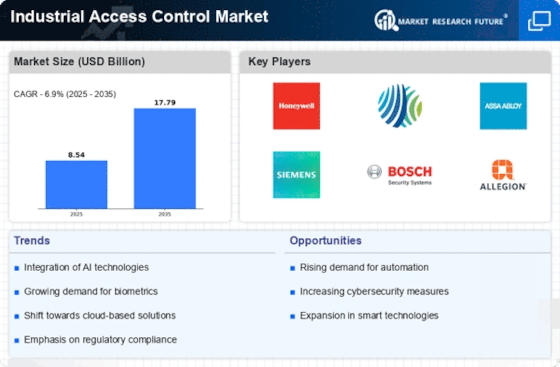
As per Market Research Future analysis, the Industrial Access Control Market Size was estimated at 8.541 USD Billion in 2024. The Industrial Access Control industry is projected to grow from 9.131 USD Billion in 2025 to 17.79 USD Billion by 2035, exhibiting a compound annual growth rate (CAGR) of 6.9% during the forecast period 2025 - 2035

Key Market Trends & Highlights

The Industrial Access Control Market is experiencing robust growth driven by technological advancements and increasing security concerns.

  • The integration of biometric solutions is becoming prevalent, particularly in North America, which remains the largest market. Cloud-based access management is emerging as the fastest-growing segment, especially in the Asia-Pacific region. There is a heightened focus on cybersecurity integration across various industries, reflecting the evolving threat landscape. Rising security concerns and regulatory compliance are major drivers propelling the adoption of biometric systems and cloud solutions.

Market Size & Forecast

2024 Market Size 8.541 (USD Billion)
2035 Market Size 17.79 (USD Billion)
CAGR (2025 - 2035) 6.9%
Largest Regional Market Share in 2024 North America

Major Players

<a href="https://buildings.honeywell.com/us/en/solutions/security/access-controls">Honeywell</a>(US), Johnson Controls (US), ASSA ABLOY (SE), Siemens (DE), Bosch Security Systems (DE), Allegion (IE), Genetec (CA), <a href="https://www.tyco.com/access-control">Tyco International</a> (IE), Axis Communications (SE)

Market Trends

The Industrial Access Control Market is currently experiencing a transformative phase, driven by advancements in technology and an increasing emphasis on security protocols across various sectors. Organizations are increasingly recognizing the necessity of robust access control systems to safeguard sensitive areas and assets. This heightened awareness is prompting investments in innovative solutions that integrate biometric authentication, mobile access, and cloud-based management systems. As a result, the market is evolving to meet the diverse needs of industries ranging from manufacturing to healthcare, where the protection of personnel and information is paramount. Moreover, the growing trend towards automation and smart technologies is reshaping the landscape of access control. Companies are exploring the integration of artificial intelligence and machine learning to enhance security measures and streamline operations. This shift not only improves efficiency but also provides a more comprehensive approach to risk management. The Industrial Access Control Market appears poised for continued growth, as organizations seek to adapt to emerging threats and leverage technology to create safer environments for their employees and assets.

Integration of Biometric Solutions

The adoption of biometric technologies is gaining traction within the Industrial Access Control Market. Organizations are increasingly implementing fingerprint, facial recognition, and iris scanning systems to enhance security measures. These solutions offer a higher level of accuracy and reliability compared to traditional methods, thereby reducing unauthorized access incidents.

Cloud-Based Access Management

There is a noticeable shift towards cloud-based access control systems, which provide flexibility and scalability for organizations. This trend allows for centralized management of access rights and real-time monitoring, enabling companies to respond swiftly to security breaches or changes in personnel. The convenience of remote access management is particularly appealing to businesses with multiple locations.

Focus on Cybersecurity Integration

As the Industrial Access Control Market evolves, there is an increasing emphasis on integrating cybersecurity measures with physical access control systems. This convergence aims to protect against both physical and digital threats, ensuring comprehensive security. Organizations are recognizing the importance of safeguarding their networks alongside their physical assets, leading to a more holistic approach to security.

Industrial Access Control Market Market Drivers

Regulatory Compliance

Regulatory compliance is a critical driver for the Industrial Access Control Market. Organizations are increasingly required to adhere to stringent regulations regarding data protection and security. Compliance with standards such as GDPR and HIPAA necessitates the implementation of robust access control measures. In 2025, the market is anticipated to grow as businesses invest in solutions that ensure compliance and mitigate legal risks. This trend underscores the importance of access control systems in safeguarding sensitive information and maintaining regulatory standards, thereby fueling the growth of the Industrial Access Control Market.

Focus on Employee Safety

The emphasis on employee safety is becoming a prominent driver in the Industrial Access Control Market. As organizations strive to create secure working environments, the demand for access control systems that monitor and manage employee access is increasing. In 2025, the market is expected to reflect this trend, with a growing number of companies investing in solutions that enhance workplace safety. This focus on safety not only protects employees but also safeguards organizational assets, thereby contributing to the overall growth of the Industrial Access Control Market.

Rising Security Concerns

The Industrial Access Control Market is experiencing a surge in demand due to escalating security concerns across various sectors. Organizations are increasingly prioritizing the protection of sensitive information and physical assets. In 2025, the market is projected to reach a valuation of approximately 10 billion USD, reflecting a compound annual growth rate of around 8%. This growth is driven by the need for enhanced security measures to mitigate risks associated with unauthorized access and potential breaches. As industries face evolving threats, the adoption of advanced access control systems becomes imperative, thereby propelling the Industrial Access Control Market forward.

Technological Advancements

Technological advancements play a pivotal role in shaping the Industrial Access Control Market. Innovations such as artificial intelligence, machine learning, and the Internet of Things are revolutionizing access control solutions. These technologies enable real-time monitoring, predictive analytics, and automated responses to security incidents. In 2025, the integration of these technologies is expected to account for a significant portion of the market, enhancing operational efficiency and security. As organizations seek to leverage these advancements, the Industrial Access Control Market is likely to witness a transformation in how access is managed and monitored.

Increased Adoption of Cloud Solutions

The shift towards cloud-based solutions is significantly influencing the Industrial Access Control Market. Organizations are increasingly adopting cloud technologies for their flexibility, scalability, and cost-effectiveness. By 2025, it is estimated that cloud-based access control systems will constitute a substantial share of the market, driven by the need for remote access and centralized management. This trend allows businesses to streamline operations and enhance security protocols, making cloud solutions a preferred choice. Consequently, the Industrial Access Control Market is poised for growth as more organizations transition to cloud-based access management.

Market Segment Insights

By Technology: Biometric Systems (Largest) vs. Card-Based Systems (Fastest-Growing)

The Industrial Access Control Market demonstrates a clear hierarchy among its technology segments. <a href="https://www.marketresearchfuture.com/reports/biometric-system-market-3754">Biometric systems</a> command a significant portion of the market, drawing attention for their security and efficiency. They are widely regarded as the largest segment due to their ability to provide superior authentication methods compared to more traditional alternatives. Meanwhile, card-based systems are experiencing rapid adoption and growth, reflecting the ongoing trend towards convenience and user-friendly solutions in access control.

Biometric Systems (Dominant) vs. Keypad Entry Systems (Emerging)

Biometric systems represent the dominant technology in the Industrial Access Control Market, leveraging unique biological traits to authenticate individuals. This segment is characterized by fingerprint recognition, facial recognition, and iris scanning technologies that ensure high-level security and precision. Consequently, companies are investing heavily in these systems, recognizing their effectiveness in reducing unauthorized access. In contrast, keypad entry systems are emerging as a viable alternative, particularly in environments prioritizing cost-efficiency and simplicity. They are gaining traction due to their straightforward installation and user-friendly interfaces, appealing to smaller businesses and areas where sophisticated technology may not be justified.

By Deployment Type: On-Premises (Largest) vs. Cloud-Based (Fastest-Growing)

The Industrial Access Control Market exhibits a clear dichotomy in deployment type preferences, with On-Premises solutions capturing the largest share. This approach is often favored by organizations seeking to maintain control over their sensitive data and ensure compliance with industry regulations. On-Premises solutions are typically seen as more secure, particularly in industries dealing with critical infrastructure, leading to their sustained popularity among traditional <a href="https://www.marketresearchfuture.com/reports/manufacturing-sector-market-67241">manufacturing sectors</a>. On the other hand, Cloud-Based solutions are rapidly gaining traction, emerging as the fastest-growing segment in the market. This growth is driven by the increasing demand for flexibility, scalability, and reduced operational costs. Organizations are increasingly adopting Cloud-Based systems for their ease of access and integration capabilities, catering to the needs of a modern workforce that values remote access and collaboration.

Deployment Method: On-Premises (Dominant) vs. Cloud-Based (Emerging)

On-Premises deployment is known for its robust security features and comprehensive control, making it the dominant choice in sectors that require meticulous data governance. This method allows companies to install and manage their access control systems internally, aligning them with existing infrastructure and compliance requirements. In contrast, Cloud-Based deployment is seen as an emerging innovation, offering significant advantages in terms of agility and cost-efficiency. As more organizations move towards digital transformation, Cloud-Based solutions are appealing due to features such as remote management, automatic updates, and the ability to scale effortlessly with changing demands. This dynamic is reshaping the landscape of the Industrial Access Control Market, as companies weigh the benefits of each deployment type against their operational needs.

By End Use: Manufacturing (Largest) vs. Healthcare (Fastest-Growing)

The Industrial Access Control Market is significantly influenced by its end-use segments, with Manufacturing leading the share considerably. This segment encompasses industries that prioritize the protection of inventory and workforce safety, which translates to a greater reliance on robust access control solutions. On the other hand, the Healthcare segment, though smaller, is witnessing rapid growth due to rising concerns for patient and data security amidst evolving regulatory requirements, driving investments in advanced access control technologies.

Manufacturing: Dominant vs. Healthcare: Emerging

The Manufacturing sector stands as a dominant force in the Industrial Access Control Market, focusing on comprehensive solutions that prevent unauthorized access to facilities and critical infrastructure. With an increasing emphasis on operational efficiency and employee safety, manufacturers are investing in state-of-the-art access control technologies such as biometrics and mobile credentials. Conversely, the Healthcare segment has emerged as a rapidly growing field, driven by the demand for stringent security measures to protect sensitive patient data and ensure facility safety. Hospitals and healthcare providers are integrating innovative access control systems that not only safeguard physical premises but also align with healthcare compliance regulations, reflecting a shift towards more secure and efficient operational environments.

By Component: Hardware (Largest) vs. Software (Fastest-Growing)

The Industrial Access Control Market is primarily segmented into Hardware, Software, and Services. Among these, Hardware dominates the landscape, accounting for the largest share due to its essential role in physical security infrastructure. This includes various components like access control systems, locks, and biometric devices, all of which are crucial for securing industrial premises. Software, while smaller in share, is rapidly gaining ground, driven by the growing need for advanced management systems and integration capabilities that enhance security operations.

Component: Hardware (Dominant) vs. Software (Emerging)

Hardware remains the dominant component in the Industrial Access Control Market, with its established applications in securing physical access points. This segment includes key technologies such as electronic locks, card readers, and biometric scanners, which are favored for their reliability and effectiveness. Meanwhile, the Software segment is emerging as a critical player, focusing on providing sophisticated solutions like access control management platforms and analytics tools. The convergence of IoT and cloud computing is propelling software growth, allowing for enhanced interoperability and real-time monitoring, making it a vital component for future advancements in industrial security.

Get more detailed insights about Industrial Access Control Market Research Report- Global Forecast 2035

Regional Insights

The Industrial Access Control Market is projected to reach a valuation of 7.99 USD Billion by 2023, with significant growth in various regions. North America leads with a substantial contribution of 3.2 USD Billion in 2023, increasing to 5.8 USD Billion in 2032, highlighting its majority holding and robust adoption of access control technologies across diverse industries. Europe follows with a significant valuation of 2.4 USD Billion in 2023, anticipated to expand to 4.4 USD Billion by 2032, due in part to stringent regulations and a strong emphasis on security.

The Asia-Pacific (APAC) region shows promising growth potential, valued at 1.8 USD Billion in 2023 and expected to reach 3.2 USD Billion by 2032, driven by increasing industrialization and urbanization. South America and MEA represent smaller segments, with valuations of 0.3 USD Billion and 0.29 USD Billion in 2023, respectively; however, both regions are witnessing gradual acceptance of access control solutions in their growing sectors. This diversified regional landscape reflects the Industrial Access Control Market segmentation and ensures a comprehensive outlook on market dynamics and regional growth opportunities.

Key Players and Competitive Insights

The Industrial Access Control Market is characterized by a rapidly evolving competitive landscape, shaped by the ongoing advancements in technology and heightened demand for security solutions across various industries. With increasing concerns over workplace safety, theft, and unauthorized access, companies are investing significantly in robust access control systems that ensure secure environments. This market is fueled by a multitude of players ranging from established industry leaders to emerging startups, each striving to innovate and enhance their product offerings.  As organizations prioritize security infrastructure, the market is poised for substantial growth, with players focusing on advanced technologies such as biometrics, cloud-based solutions, and integrated security systems. Competitive strategies include partnerships, mergers and acquisitions, and the development of customized solutions to meet unique customer requirements.Tyco International stands out in the Industrial Access Control Market, renowned for its diverse portfolio of security products and services. The company's strengths lie in its ability to provide comprehensive access control solutions that integrate seamlessly with existing security systems.  Tyco International's commitment to innovation drives its continuous investment in research and development, enabling the introduction of cutting-edge technologies that enhance user experience and system efficiency. With a strong global presence, the company has established a reputation for reliability and effectiveness, fostering long-term relationships with clients across various sectors. Additionally, Tyco's extensive customer support network and commitment to service excellence further bolster its competitive advantage, ensuring that clients receive the necessary assistance for optimal system performance. Siemens is a formidable contender in the Industrial Access Control Market, distinguished by its technological leadership and extensive experience in automation and security solutions.  The company's capacity to execute large-scale projects positions uniquely in the market, allowing it to cater to diverse industrial needs effectively. Siemens emphasizes sustainability and energy efficiency in its access control systems, aligning with the growing trend towards environmentally conscious solutions. Its strength is further amplified by an integrated approach, where access control systems are designed to work in harmony with other safety and security measures, thus offering comprehensive protection. Siemens’ strategic focus on digitalization and smart building technologies ensures that it remains at the forefront of industry trends, ultimately enhancing its competitive position within the Industrial Access Control Market.

Key Companies in the Industrial Access Control Market include

Industry Developments

Recent developments in the Industrial Access Control Market have shown significant activity, particularly in the context of technological advancements and strategic alignments among key players. Tyco International has been enhancing its product offerings by integrating advanced technologies, while Siemens continues to focus on smart city initiatives that involve sophisticated access control systems. Additionally, Stanley Black & Decker is making strides in expanding its portfolio through innovative digital security solutions. 

In terms of mergers and acquisitions, Honeywell has recently acquired a technology firm specializing in cybersecurity solutions to bolster its access control capabilities, reflecting a growing emphasis on security within this segment. ASSA ABLOY has also pursued expansion by acquiring a smaller competitor, thereby strengthening its market position. 

Furthermore, the valuation of many companies in this sector remains robust, driving the market growth as organizations increasingly adopt advanced access control measures to enhance security and operational efficiency. Companies like Bosch Security Systems and Hikvision are also witnessing growth, underlining the rising demand for integrated security solutions in various industries. Overall, these movements indicate a dynamic environment characterized by innovation, strategic partnerships, and market expansion.

Future Outlook

Industrial Access Control Market Future Outlook

The Industrial Access Control Market is projected to grow at a 6.9% CAGR from 2025 to 2035, driven by technological advancements, increasing security concerns, and regulatory compliance.

New opportunities lie in:

  • <p>Integration of AI-driven biometric systems for enhanced security Development of cloud-based access management solutions Expansion into emerging markets with tailored access control systems</p>

By 2035, the market is expected to be robust, driven by innovation and increased demand for security solutions.

Market Segmentation

Industrial Access Control Market End Use Outlook

  • Manufacturing
  • Healthcare
  • Government
  • Retail

Industrial Access Control Market Component Outlook

  • Hardware
  • Software
  • Services

Industrial Access Control Market Technology Outlook

  • Biometric Systems
  • Card-Based Systems
  • Smart Locks
  • Keypad Entry Systems

Industrial Access Control Market Deployment Type Outlook

  • On-Premises
  • Cloud-Based

Report Scope

MARKET SIZE 2024 8.541(USD Billion)
MARKET SIZE 2025 9.131(USD Billion)
MARKET SIZE 2035 17.79(USD Billion)
COMPOUND ANNUAL GROWTH RATE (CAGR) 6.9% (2025 - 2035)
REPORT COVERAGE Revenue Forecast, Competitive Landscape, Growth Factors, and Trends
BASE YEAR 2024
Market Forecast Period 2025 - 2035
Historical Data 2019 - 2024
Market Forecast Units USD Billion
Key Companies Profiled Honeywell (US), Johnson Controls (US), ASSA ABLOY (SE), Siemens (DE), Bosch Security Systems (DE), Allegion (IE), Genetec (CA), Tyco International (IE), Axis Communications (SE)
Segments Covered Technology, Deployment Type, End Use, Component, Regional
Key Market Opportunities Integration of advanced biometric systems enhances security in the Industrial Access Control Market.
Key Market Dynamics Rising demand for advanced security solutions drives innovation and competition in the Industrial Access Control Market.
Countries Covered North America, Europe, APAC, South America, MEA

FAQs

What is the projected market valuation of the Industrial Access Control Market by 2035?

<p>The Industrial Access Control Market is projected to reach a valuation of 17.79 USD Billion by 2035.</p>

What was the market valuation of the Industrial Access Control Market in 2024?

<p>In 2024, the market valuation of the Industrial Access Control Market was 8.541 USD Billion.</p>

What is the expected CAGR for the Industrial Access Control Market during the forecast period 2025 - 2035?

<p>The expected CAGR for the Industrial Access Control Market during the forecast period 2025 - 2035 is 6.9%.</p>

Which technology segment is anticipated to grow the most in the Industrial Access Control Market?

<p>The Card-Based Systems segment is expected to grow from 3.0 USD Billion in 2024 to 6.5 USD Billion by 2035.</p>

What are the key components of the Industrial Access Control Market?

<p>The key components include Hardware, Software, and Services, with Hardware projected to grow from 3.5 USD Billion to 7.5 USD Billion by 2035.</p>

Which end-use sector is likely to see significant growth in the Industrial Access Control Market?

<p>The Manufacturing sector is projected to expand from 2.5 USD Billion in 2024 to 5.5 USD Billion by 2035.</p>

Who are the leading players in the Industrial Access Control Market?

<p>Key players in the market include Honeywell, Johnson Controls, ASSA ABLOY, Siemens, and Bosch Security Systems.</p>

What is the anticipated growth of the Cloud-Based deployment type in the Industrial Access Control Market?

<p>The Cloud-Based deployment type is expected to grow from 3.413 USD Billion in 2024 to 7.29 USD Billion by 2035.</p>

How does the growth of Smart Locks compare to other technology segments?

<p>Smart Locks are projected to grow from 2.0 USD Billion in 2024 to 4.0 USD Billion by 2035, indicating a robust growth trajectory.</p>

What is the expected growth trend for the Services component in the Industrial Access Control Market?

<p>The Services component is anticipated to grow from 2.541 USD Billion in 2024 to 4.79 USD Billion by 2035.</p>

  1. SECTION I: EXECUTIVE SUMMARY AND KEY HIGHLIGHTS |
    1. EXECUTIVE SUMMARY | |
      1. Market Overview | |
      2. Key Findings | |
      3. Market Segmentation | |
      4. Competitive Landscape | |
      5. Challenges and Opportunities | |
      6. Future Outlook 2
  2. SECTION II: SCOPING, METHODOLOGY AND MARKET STRUCTURE |
    1. MARKET INTRODUCTION | |
      1. Definition | |
      2. Scope of the study | | |
    2. RESEARCH METHODOLOGY | |
      1. Overview | |
      2. Data Mining | |
      3. Secondary Research | |
      4. Primary Research | | |
      5. Forecasting Model | |
      6. Market Size Estimation | | |
      7. Data Triangulation | |
      8. Validation 3
  3. SECTION III: QUALITATIVE ANALYSIS |
    1. MARKET DYNAMICS | |
      1. Overview | |
      2. Drivers | |
      3. Restraints | |
      4. Opportunities |
    2. MARKET FACTOR ANALYSIS | |
      1. Value chain Analysis | |
      2. Porter's Five Forces Analysis | | |
      3. COVID-19 Impact Analysis | | |
  4. SECTION IV: QUANTITATIVE ANALYSIS |
    1. Semiconductor & Electronics, BY Technology (USD Billion) | |
      1. Biometric Systems | |
      2. Card-Based Systems | |
      3. Smart Locks | |
      4. Keypad Entry Systems |
    2. Semiconductor & Electronics, BY Deployment Type (USD Billion) | |
      1. On-Premises | |
      2. Cloud-Based |
    3. Semiconductor & Electronics, BY End Use (USD Billion) | |
      1. Manufacturing | |
      2. Healthcare | |
      3. Government | |
      4. Retail |
    4. Semiconductor & Electronics, BY Component (USD Billion) | |
      1. Hardware | |
      2. Software | |
      3. Services |
    5. Semiconductor & Electronics, BY Region (USD Billion) | |
      1. North America | | |
      2. Europe | | |
      3. APAC | | |
      4. South America | | |
      5. MEA | | |
  5. SECTION V: COMPETITIVE ANALYSIS |
    1. Competitive Landscape | |
      1. Overview | |
      2. Competitive Analysis | |
      3. Market share Analysis | |
      4. Major Growth Strategy in the Semiconductor & Electronics | |
      5. Competitive Benchmarking | |
      6. Leading Players in Terms of Number of Developments in the Semiconductor & Electronics | |
      7. Key developments and growth strategies | | |
      8. Major Players Financial Matrix | | |
    2. Company Profiles | |
      1. Honeywell (US) | | |
      2. Johnson Controls (US) | | |
      3. ASSA ABLOY (SE) | | |
      4. Siemens (DE) | | |
      5. Bosch Security Systems (DE) | | |
      6. Allegion (IE) | | |
      7. Genetec (CA) | | |
      8. Tyco International (IE) | | |
      9. Axis Communications (SE) | | |
    3. Appendix | |
      1. References | |
      2. Related Reports 6 LIST OF FIGURES |
    4. MARKET SYNOPSIS |
    5. NORTH AMERICA MARKET ANALYSIS |
    6. US MARKET ANALYSIS BY TECHNOLOGY |
    7. US MARKET ANALYSIS BY DEPLOYMENT TYPE |
    8. US MARKET ANALYSIS BY END USE |
    9. US MARKET ANALYSIS BY COMPONENT |
    10. CANADA MARKET ANALYSIS BY TECHNOLOGY |
    11. CANADA MARKET ANALYSIS BY DEPLOYMENT TYPE |
    12. CANADA MARKET ANALYSIS BY END USE |
    13. CANADA MARKET ANALYSIS BY COMPONENT |
    14. EUROPE MARKET ANALYSIS |
    15. GERMANY MARKET ANALYSIS BY TECHNOLOGY |
    16. GERMANY MARKET ANALYSIS BY DEPLOYMENT TYPE |
    17. GERMANY MARKET ANALYSIS BY END USE |
    18. GERMANY MARKET ANALYSIS BY COMPONENT |
    19. UK MARKET ANALYSIS BY TECHNOLOGY |
    20. UK MARKET ANALYSIS BY DEPLOYMENT TYPE |
    21. UK MARKET ANALYSIS BY END USE |
    22. UK MARKET ANALYSIS BY COMPONENT |
    23. FRANCE MARKET ANALYSIS BY TECHNOLOGY |
    24. FRANCE MARKET ANALYSIS BY DEPLOYMENT TYPE |
    25. FRANCE MARKET ANALYSIS BY END USE |
    26. FRANCE MARKET ANALYSIS BY COMPONENT |
    27. RUSSIA MARKET ANALYSIS BY TECHNOLOGY |
    28. RUSSIA MARKET ANALYSIS BY DEPLOYMENT TYPE |
    29. RUSSIA MARKET ANALYSIS BY END USE |
    30. RUSSIA MARKET ANALYSIS BY COMPONENT |
    31. ITALY MARKET ANALYSIS BY TECHNOLOGY |
    32. ITALY MARKET ANALYSIS BY DEPLOYMENT TYPE |
    33. ITALY MARKET ANALYSIS BY END USE |
    34. ITALY MARKET ANALYSIS BY COMPONENT |
    35. SPAIN MARKET ANALYSIS BY TECHNOLOGY |
    36. SPAIN MARKET ANALYSIS BY DEPLOYMENT TYPE |
    37. SPAIN MARKET ANALYSIS BY END USE |
    38. SPAIN MARKET ANALYSIS BY COMPONENT |
    39. REST OF EUROPE MARKET ANALYSIS BY TECHNOLOGY |
    40. REST OF EUROPE MARKET ANALYSIS BY DEPLOYMENT TYPE |
    41. REST OF EUROPE MARKET ANALYSIS BY END USE |
    42. REST OF EUROPE MARKET ANALYSIS BY COMPONENT |
    43. APAC MARKET ANALYSIS |
    44. CHINA MARKET ANALYSIS BY TECHNOLOGY |
    45. CHINA MARKET ANALYSIS BY DEPLOYMENT TYPE |
    46. CHINA MARKET ANALYSIS BY END USE |
    47. CHINA MARKET ANALYSIS BY COMPONENT |
    48. INDIA MARKET ANALYSIS BY TECHNOLOGY |
    49. INDIA MARKET ANALYSIS BY DEPLOYMENT TYPE |
    50. INDIA MARKET ANALYSIS BY END USE |
    51. INDIA MARKET ANALYSIS BY COMPONENT |
    52. JAPAN MARKET ANALYSIS BY TECHNOLOGY |
    53. JAPAN MARKET ANALYSIS BY DEPLOYMENT TYPE |
    54. JAPAN MARKET ANALYSIS BY END USE |
    55. JAPAN MARKET ANALYSIS BY COMPONENT |
    56. SOUTH KOREA MARKET ANALYSIS BY TECHNOLOGY |
    57. SOUTH KOREA MARKET ANALYSIS BY DEPLOYMENT TYPE |
    58. SOUTH KOREA MARKET ANALYSIS BY END USE |
    59. SOUTH KOREA MARKET ANALYSIS BY COMPONENT |
    60. MALAYSIA MARKET ANALYSIS BY TECHNOLOGY |
    61. MALAYSIA MARKET ANALYSIS BY DEPLOYMENT TYPE |
    62. MALAYSIA MARKET ANALYSIS BY END USE |
    63. MALAYSIA MARKET ANALYSIS BY COMPONENT |
    64. THAILAND MARKET ANALYSIS BY TECHNOLOGY |
    65. THAILAND MARKET ANALYSIS BY DEPLOYMENT TYPE |
    66. THAILAND MARKET ANALYSIS BY END USE |
    67. THAILAND MARKET ANALYSIS BY COMPONENT |
    68. INDONESIA MARKET ANALYSIS BY TECHNOLOGY |
    69. INDONESIA MARKET ANALYSIS BY DEPLOYMENT TYPE |
    70. INDONESIA MARKET ANALYSIS BY END USE |
    71. INDONESIA MARKET ANALYSIS BY COMPONENT |
    72. REST OF APAC MARKET ANALYSIS BY TECHNOLOGY |
    73. REST OF APAC MARKET ANALYSIS BY DEPLOYMENT TYPE |
    74. REST OF APAC MARKET ANALYSIS BY END USE |
    75. REST OF APAC MARKET ANALYSIS BY COMPONENT |
    76. SOUTH AMERICA MARKET ANALYSIS |
    77. BRAZIL MARKET ANALYSIS BY TECHNOLOGY |
    78. BRAZIL MARKET ANALYSIS BY DEPLOYMENT TYPE |
    79. BRAZIL MARKET ANALYSIS BY END USE |
    80. BRAZIL MARKET ANALYSIS BY COMPONENT |
    81. MEXICO MARKET ANALYSIS BY TECHNOLOGY |
    82. MEXICO MARKET ANALYSIS BY DEPLOYMENT TYPE |
    83. MEXICO MARKET ANALYSIS BY END USE |
    84. MEXICO MARKET ANALYSIS BY COMPONENT |
    85. ARGENTINA MARKET ANALYSIS BY TECHNOLOGY |
    86. ARGENTINA MARKET ANALYSIS BY DEPLOYMENT TYPE |
    87. ARGENTINA MARKET ANALYSIS BY END USE |
    88. ARGENTINA MARKET ANALYSIS BY COMPONENT |
    89. REST OF SOUTH AMERICA MARKET ANALYSIS BY TECHNOLOGY |
    90. REST OF SOUTH AMERICA MARKET ANALYSIS BY DEPLOYMENT TYPE |
    91. REST OF SOUTH AMERICA MARKET ANALYSIS BY END USE |
    92. REST OF SOUTH AMERICA MARKET ANALYSIS BY COMPONENT |
    93. MEA MARKET ANALYSIS |
    94. GCC COUNTRIES MARKET ANALYSIS BY TECHNOLOGY |
    95. GCC COUNTRIES MARKET ANALYSIS BY DEPLOYMENT TYPE |
    96. GCC COUNTRIES MARKET ANALYSIS BY END USE |
    97. GCC COUNTRIES MARKET ANALYSIS BY COMPONENT |
    98. SOUTH AFRICA MARKET ANALYSIS BY TECHNOLOGY |
    99. SOUTH AFRICA MARKET ANALYSIS BY DEPLOYMENT TYPE |
    100. SOUTH AFRICA MARKET ANALYSIS BY END USE |
    101. SOUTH AFRICA MARKET ANALYSIS BY COMPONENT |
    102. REST OF MEA MARKET ANALYSIS BY TECHNOLOGY |
    103. REST OF MEA MARKET ANALYSIS BY DEPLOYMENT TYPE |
    104. REST OF MEA MARKET ANALYSIS BY END USE |
    105. REST OF MEA MARKET ANALYSIS BY COMPONENT |
    106. KEY BUYING CRITERIA OF SEMICONDUCTOR & ELECTRONICS |
    107. RESEARCH PROCESS OF MRFR |
    108. DRO ANALYSIS OF SEMICONDUCTOR & ELECTRONICS |
    109. DRIVERS IMPACT ANALYSIS: SEMICONDUCTOR & ELECTRONICS |
    110. RESTRAINTS IMPACT ANALYSIS: SEMICONDUCTOR & ELECTRONICS |
    111. SUPPLY / VALUE CHAIN: SEMICONDUCTOR & ELECTRONICS |
    112. SEMICONDUCTOR & ELECTRONICS, BY TECHNOLOGY, 2024 (% SHARE) |
    113. SEMICONDUCTOR & ELECTRONICS, BY TECHNOLOGY, 2024 TO 2035 (USD Billion) |
    114. SEMICONDUCTOR & ELECTRONICS, BY DEPLOYMENT TYPE, 2024 (% SHARE) |
    115. SEMICONDUCTOR & ELECTRONICS, BY DEPLOYMENT TYPE, 2024 TO 2035 (USD Billion) |
    116. SEMICONDUCTOR & ELECTRONICS, BY END USE, 2024 (% SHARE) |
    117. SEMICONDUCTOR & ELECTRONICS, BY END USE, 2024 TO 2035 (USD Billion) |
    118. SEMICONDUCTOR & ELECTRONICS, BY COMPONENT, 2024 (% SHARE) |
    119. SEMICONDUCTOR & ELECTRONICS, BY COMPONENT, 2024 TO 2035 (USD Billion) |
    120. BENCHMARKING OF MAJOR COMPETITORS 7 LIST OF TABLES |
    121. LIST OF ASSUMPTIONS | |
      1. |
    122. North America MARKET SIZE ESTIMATES; FORECAST | |
      1. BY TECHNOLOGY, 2025-2035 (USD Billion) | |
      2. BY DEPLOYMENT TYPE, 2025-2035 (USD Billion) | |
      3. BY END USE, 2025-2035 (USD Billion) | |
      4. BY COMPONENT, 2025-2035 (USD Billion) |
    123. US MARKET SIZE ESTIMATES; FORECAST | |
      1. BY TECHNOLOGY, 2025-2035 (USD Billion) | |
      2. BY DEPLOYMENT TYPE, 2025-2035 (USD Billion) | |
      3. BY END USE, 2025-2035 (USD Billion) | |
      4. BY COMPONENT, 2025-2035 (USD Billion) |
    124. Canada MARKET SIZE ESTIMATES; FORECAST | |
      1. BY TECHNOLOGY, 2025-2035 (USD Billion) | |
      2. BY DEPLOYMENT TYPE, 2025-2035 (USD Billion) | |
      3. BY END USE, 2025-2035 (USD Billion) | |
      4. BY COMPONENT, 2025-2035 (USD Billion) |
    125. Europe MARKET SIZE ESTIMATES; FORECAST | |
      1. BY TECHNOLOGY, 2025-2035 (USD Billion) | |
      2. BY DEPLOYMENT TYPE, 2025-2035 (USD Billion) | |
      3. BY END USE, 2025-2035 (USD Billion) | |
      4. BY COMPONENT, 2025-2035 (USD Billion) |
    126. Germany MARKET SIZE ESTIMATES; FORECAST | |
      1. BY TECHNOLOGY, 2025-2035 (USD Billion) | |
      2. BY DEPLOYMENT TYPE, 2025-2035 (USD Billion) | |
      3. BY END USE, 2025-2035 (USD Billion) | |
      4. BY COMPONENT, 2025-2035 (USD Billion) |
    127. UK MARKET SIZE ESTIMATES; FORECAST | |
      1. BY TECHNOLOGY, 2025-2035 (USD Billion) | |
      2. BY DEPLOYMENT TYPE, 2025-2035 (USD Billion) | |
      3. BY END USE, 2025-2035 (USD Billion) | |
      4. BY COMPONENT, 2025-2035 (USD Billion) |
    128. France MARKET SIZE ESTIMATES; FORECAST | |
      1. BY TECHNOLOGY, 2025-2035 (USD Billion) | |
      2. BY DEPLOYMENT TYPE, 2025-2035 (USD Billion) | |
      3. BY END USE, 2025-2035 (USD Billion) | |
      4. BY COMPONENT, 2025-2035 (USD Billion) |
    129. Russia MARKET SIZE ESTIMATES; FORECAST | |
      1. BY TECHNOLOGY, 2025-2035 (USD Billion) | |
      2. BY DEPLOYMENT TYPE, 2025-2035 (USD Billion) | |
      3. BY END USE, 2025-2035 (USD Billion) | |
      4. BY COMPONENT, 2025-2035 (USD Billion) |
    130. Italy MARKET SIZE ESTIMATES; FORECAST | |
      1. BY TECHNOLOGY, 2025-2035 (USD Billion) | |
      2. BY DEPLOYMENT TYPE, 2025-2035 (USD Billion) | |
      3. BY END USE, 2025-2035 (USD Billion) | |
      4. BY COMPONENT, 2025-2035 (USD Billion) |
    131. Spain MARKET SIZE ESTIMATES; FORECAST | |
      1. BY TECHNOLOGY, 2025-2035 (USD Billion) | |
      2. BY DEPLOYMENT TYPE, 2025-2035 (USD Billion) | |
      3. BY END USE, 2025-2035 (USD Billion) | |
      4. BY COMPONENT, 2025-2035 (USD Billion) |
    132. Rest of Europe MARKET SIZE ESTIMATES; FORECAST | |
      1. BY TECHNOLOGY, 2025-2035 (USD Billion) | |
      2. BY DEPLOYMENT TYPE, 2025-2035 (USD Billion) | |
      3. BY END USE, 2025-2035 (USD Billion) | |
      4. BY COMPONENT, 2025-2035 (USD Billion) |
    133. APAC MARKET SIZE ESTIMATES; FORECAST | |
      1. BY TECHNOLOGY, 2025-2035 (USD Billion) | |
      2. BY DEPLOYMENT TYPE, 2025-2035 (USD Billion) | |
      3. BY END USE, 2025-2035 (USD Billion) | |
      4. BY COMPONENT, 2025-2035 (USD Billion) |
    134. China MARKET SIZE ESTIMATES; FORECAST | |
      1. BY TECHNOLOGY, 2025-2035 (USD Billion) | |
      2. BY DEPLOYMENT TYPE, 2025-2035 (USD Billion) | |
      3. BY END USE, 2025-2035 (USD Billion) | |
      4. BY COMPONENT, 2025-2035 (USD Billion) |
    135. India MARKET SIZE ESTIMATES; FORECAST | |
      1. BY TECHNOLOGY, 2025-2035 (USD Billion) | |
      2. BY DEPLOYMENT TYPE, 2025-2035 (USD Billion) | |
      3. BY END USE, 2025-2035 (USD Billion) | |
      4. BY COMPONENT, 2025-2035 (USD Billion) |
    136. Japan MARKET SIZE ESTIMATES; FORECAST | |
      1. BY TECHNOLOGY, 2025-2035 (USD Billion) | |
      2. BY DEPLOYMENT TYPE, 2025-2035 (USD Billion) | |
      3. BY END USE, 2025-2035 (USD Billion) | |
      4. BY COMPONENT, 2025-2035 (USD Billion) |
    137. South Korea MARKET SIZE ESTIMATES; FORECAST | |
      1. BY TECHNOLOGY, 2025-2035 (USD Billion) | |
      2. BY DEPLOYMENT TYPE, 2025-2035 (USD Billion) | |
      3. BY END USE, 2025-2035 (USD Billion) | |
      4. BY COMPONENT, 2025-2035 (USD Billion) |
    138. Malaysia MARKET SIZE ESTIMATES; FORECAST | |
      1. BY TECHNOLOGY, 2025-2035 (USD Billion) | |
      2. BY DEPLOYMENT TYPE, 2025-2035 (USD Billion) | |
      3. BY END USE, 2025-2035 (USD Billion) | |
      4. BY COMPONENT, 2025-2035 (USD Billion) |
    139. Thailand MARKET SIZE ESTIMATES; FORECAST | |
      1. BY TECHNOLOGY, 2025-2035 (USD Billion) | |
      2. BY DEPLOYMENT TYPE, 2025-2035 (USD Billion) | |
      3. BY END USE, 2025-2035 (USD Billion) | |
      4. BY COMPONENT, 2025-2035 (USD Billion) |
    140. Indonesia MARKET SIZE ESTIMATES; FORECAST | |
      1. BY TECHNOLOGY, 2025-2035 (USD Billion) | |
      2. BY DEPLOYMENT TYPE, 2025-2035 (USD Billion) | |
      3. BY END USE, 2025-2035 (USD Billion) | |
      4. BY COMPONENT, 2025-2035 (USD Billion) |
    141. Rest of APAC MARKET SIZE ESTIMATES; FORECAST | |
      1. BY TECHNOLOGY, 2025-2035 (USD Billion) | |
      2. BY DEPLOYMENT TYPE, 2025-2035 (USD Billion) | |
      3. BY END USE, 2025-2035 (USD Billion) | |
      4. BY COMPONENT, 2025-2035 (USD Billion) |
    142. South America MARKET SIZE ESTIMATES; FORECAST | |
      1. BY TECHNOLOGY, 2025-2035 (USD Billion) | |
      2. BY DEPLOYMENT TYPE, 2025-2035 (USD Billion) | |
      3. BY END USE, 2025-2035 (USD Billion) | |
      4. BY COMPONENT, 2025-2035 (USD Billion) |
    143. Brazil MARKET SIZE ESTIMATES; FORECAST | |
      1. BY TECHNOLOGY, 2025-2035 (USD Billion) | |
      2. BY DEPLOYMENT TYPE, 2025-2035 (USD Billion) | |
      3. BY END USE, 2025-2035 (USD Billion) | |
      4. BY COMPONENT, 2025-2035 (USD Billion) |
    144. Mexico MARKET SIZE ESTIMATES; FORECAST | |
      1. BY TECHNOLOGY, 2025-2035 (USD Billion) | |
      2. BY DEPLOYMENT TYPE, 2025-2035 (USD Billion) | |
      3. BY END USE, 2025-2035 (USD Billion) | |
      4. BY COMPONENT, 2025-2035 (USD Billion) |
    145. Argentina MARKET SIZE ESTIMATES; FORECAST | |
      1. BY TECHNOLOGY, 2025-2035 (USD Billion) | |
      2. BY DEPLOYMENT TYPE, 2025-2035 (USD Billion) | |
      3. BY END USE, 2025-2035 (USD Billion) | |
      4. BY COMPONENT, 2025-2035 (USD Billion) |
    146. Rest of South America MARKET SIZE ESTIMATES; FORECAST | |
      1. BY TECHNOLOGY, 2025-2035 (USD Billion) | |
      2. BY DEPLOYMENT TYPE, 2025-2035 (USD Billion) | |
      3. BY END USE, 2025-2035 (USD Billion) | |
      4. BY COMPONENT, 2025-2035 (USD Billion) |
    147. MEA MARKET SIZE ESTIMATES; FORECAST | |
      1. BY TECHNOLOGY, 2025-2035 (USD Billion) | |
      2. BY DEPLOYMENT TYPE, 2025-2035 (USD Billion) | |
      3. BY END USE, 2025-2035 (USD Billion) | |
      4. BY COMPONENT, 2025-2035 (USD Billion) |
    148. GCC Countries MARKET SIZE ESTIMATES; FORECAST | |
      1. BY TECHNOLOGY, 2025-2035 (USD Billion) | |
      2. BY DEPLOYMENT TYPE, 2025-2035 (USD Billion) | |
      3. BY END USE, 2025-2035 (USD Billion) | |
      4. BY COMPONENT, 2025-2035 (USD Billion) |
    149. South Africa MARKET SIZE ESTIMATES; FORECAST | |
      1. BY TECHNOLOGY, 2025-2035 (USD Billion) | |
      2. BY DEPLOYMENT TYPE, 2025-2035 (USD Billion) | |
      3. BY END USE, 2025-2035 (USD Billion) | |
      4. BY COMPONENT, 2025-2035 (USD Billion) |
    150. Rest of MEA MARKET SIZE ESTIMATES; FORECAST | |
      1. BY TECHNOLOGY, 2025-2035 (USD Billion) | |
      2. BY DEPLOYMENT TYPE, 2025-2035 (USD Billion) | |
      3. BY END USE, 2025-2035 (USD Billion) | |
      4. BY COMPONENT, 2025-2035 (USD Billion) |
    151. PRODUCT LAUNCH/PRODUCT DEVELOPMENT/APPROVAL | |
      1. |
    152. ACQUISITION/PARTNERSHIP | |

Semiconductor & Electronics Market Segmentation

Semiconductor & Electronics By Technology (USD Billion, 2025-2035)

  • Biometric Systems
  • Card-Based Systems
  • Smart Locks
  • Keypad Entry Systems

Semiconductor & Electronics By Deployment Type (USD Billion, 2025-2035)

  • On-Premises
  • Cloud-Based

Semiconductor & Electronics By End Use (USD Billion, 2025-2035)

  • Manufacturing
  • Healthcare
  • Government
  • Retail

Semiconductor & Electronics By Component (USD Billion, 2025-2035)

  • Hardware
  • Software
  • Services
Infographic

Free Sample Request

Kindly complete the form below to receive a free sample of this Report

Get Free Sample

Customer Strories

Compare Licence

×
Features License Type
Single User Multiuser License Enterprise User
Price $4,950 $5,950 $7,250
Maximum User Access Limit 1 User Upto 10 Users Unrestricted Access Throughout the Organization
Free Customization
Direct Access to Analyst
Deliverable Format
Platform Access
Discount on Next Purchase 10% 15% 15%
Printable Versions