×
Request Free Sample ×

Kindly complete the form below to receive a free sample of this Report

* Please use a valid business email

Leading companies partner with us for data-driven Insights

clients tt-cursor
Hero Background
English
Chinese
French
Japanese
Korean
German
Spanish

India Electric Bike Market Analysis

ID: MRFR/AT/11160-HCR
128 Pages
Swapnil Palwe
February 2026

India Electric Bike Market Research Report Information By Propulsion Type (Pedal Assisted, Speed Pedelec and Throttle Assisted), By Application Type (Cargo/Utility, City/Urban and Trekking), By Battery Type (Lead Acid Battery, Lithium-ion Battery and Others) - Growth & Industry Forecast to 2035

Share:
Download PDF ×

We do not share your information with anyone. However, we may send you emails based on your report interest from time to time. You may contact us at any time to opt-out.

India Electric Bike Market Infographic
Purchase Options

Market Analysis

In-depth Analysis of India Electric Bike Market Industry Landscape

The market dynamics of electric bikes in India have undergone a significant transformation, propelled by a combination of environmental consciousness, urban mobility challenges, and advancements in technology. As India grapples with issues like air pollution and traffic congestion, electric bikes have emerged as a compelling solution to address these concerns. The demand for electric bikes has seen a notable upswing, driven by the need for sustainable and efficient modes of transportation in the country.

The Indian electric bike market is characterized by a diverse array of players, ranging from traditional two-wheeler manufacturers to innovative startups. Established companies have adapted to the changing landscape by introducing electric bike models, leveraging their expertise in the automotive industry. Simultaneously, startups are entering the market with agile and technology-driven solutions, contributing to the dynamic and competitive nature of the electric bike segment. This diversity in players fosters innovation and drives the development of a wide range of electric bikes to cater to different consumer preferences and needs.

Infrastructure development plays a crucial role in shaping the market dynamics of electric bikes in India. The availability of charging infrastructure is a key determinant of the widespread adoption of electric bikes. To address this, the government and private entities are investing in the establishment of charging stations across urban centers. This infrastructure development not only enhances the convenience of owning an electric bike but also addresses concerns about range anxiety, making electric bikes a practical and viable option for daily commuting.

Consumer awareness and acceptance are instrumental in shaping the market dynamics of electric bikes in India. As more consumers become environmentally conscious and seek sustainable alternatives, electric bikes have gained popularity. The lower operating costs, reduced environmental impact, and government incentives make electric bikes an attractive option for urban commuters. The ease of use and maneuverability of electric bikes make them well-suited for the congested and traffic-laden streets of Indian cities, further driving their adoption.

Government policies and incentives are pivotal in influencing the market dynamics of electric bikes in India. Initiatives like the Faster Adoption and Manufacturing of Hybrid and Electric Vehicles (FAME) scheme provide financial incentives to buyers of electric bikes, making them more affordable and accessible. State-level policies, such as subsidies and tax breaks, further stimulate the adoption of electric bikes. These policy measures not only support the growth of the electric bike market but also align with the government's broader vision of promoting sustainable and clean mobility solutions.

Despite the positive momentum, challenges exist in the Indian electric bike market. Limited awareness among consumers, concerns about charging infrastructure in certain regions, and the need for more affordable models are obstacles that need to be addressed. However, ongoing technological advancements, collaborations between stakeholders, and continued government support are expected to overcome these challenges gradually.

The market dynamics of electric bikes in India are experiencing a transformative shift, driven by a convergence of consumer awareness, technological innovation, infrastructure development, and government support. Electric bikes are emerging as a practical and sustainable solution to address the challenges of urban mobility in the country. As the market continues to evolve, collaboration between the government, industry players, and consumers will be crucial in shaping a vibrant and sustainable electric bike ecosystem in India.

Author
Swapnil Palwe
Team Lead - Research

With a technical background as Bachelor's in Mechanical Engineering, with MBA in Operations Management , Swapnil has 6+ years of experience in market research, consulting and analytics with the tasks of data mining, analysis, and project execution. He is the POC for our clients, for their consulting projects running under the Automotive/A&D domain. Swapnil has worked on major projects in verticals such as Aerospace & Defense, Automotive and many other domain projects. He has worked on projects for fortune 500 companies' syndicate and consulting projects along with several government projects.

Leave a Comment

FAQs

What is the current valuation of the India Electric Bike Market?

<p>The market valuation was 2.119 USD Billion in 2024.</p>

What is the projected market size for the India Electric Bike Market by 2035?

<p>The market is projected to reach 7.017 USD Billion by 2035.</p>

What is the expected CAGR for the India Electric Bike Market during the forecast period?

<p>The expected CAGR for the market from 2025 to 2035 is 11.5%.</p>

Which companies are the key players in the India Electric Bike Market?

<p>Key players include Hero Electric, Bajaj Auto, Ather Energy, and others.</p>

What are the main propulsion types in the India Electric Bike Market?

<p>The main propulsion types include pedal assisted, speed pedelec, and throttle assisted.</p>

How much revenue is generated from pedal assisted electric bikes?

<p>Pedal assisted electric bikes generated approximately 0.847 USD Billion in 2024.</p>

What is the revenue generated from lithium-ion batteries in the market?

<p>Lithium-ion batteries accounted for about 1.184 USD Billion in 2024.</p>

What application types are prevalent in the India Electric Bike Market?

<p>Prevalent application types include cargo/utility, city/urban, and trekking.</p>

What was the revenue from city/urban electric bikes in 2024?

<p>City/urban electric bikes generated around 1.059 USD Billion in 2024.</p>

What is the future outlook for the India Electric Bike Market?

<p>The market is expected to grow significantly, reaching 7.017 USD Billion by 2035.</p>

Market Summary

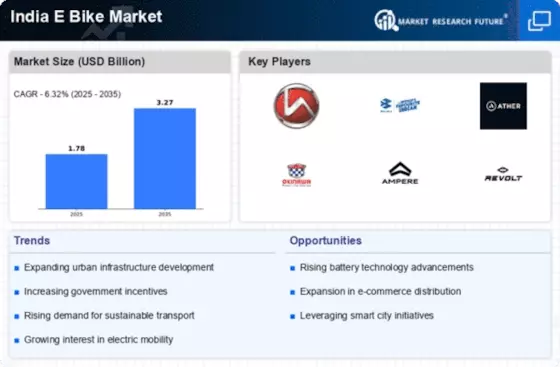
As per MRFR analysis, the India E Bike Market is projected to grow from USD 1.78 Billion in 2025 to USD 3.27 Billion by 2035, exhibiting a compound annual growth rate (CAGR) of 6.32% during the forecast period (2025 - 2035).

Key Market Trends & Highlights

The India E Bike Market is poised for substantial growth driven by technological advancements and supportive government policies.

  • The commuting segment remains the largest in the India E Bike Market, reflecting a shift towards sustainable urban mobility. Delivery services are the fastest-growing segment, indicating a rising demand for efficient logistics solutions. Lithium-ion batteries dominate the market, while lead-acid batteries are experiencing rapid growth due to cost-effectiveness. Government policies and rising fuel prices are key drivers propelling the adoption of e-bikes in India.

Market Size & Forecast

2024 Market Size 1.67 (USD Billion)
2035 Market Size 3.27 (USD Billion)
CAGR (2025 - 2035) 6.32%

Major Players

Hero Electric (IN), <a href="https://www.bajajauto.com/three-wheelers">Bajaj Auto</a> (IN), Ather Energy (IN), Okinawa Autotech (IN), <a href="https://ampere.greaveselectricmobility.com/">Ampere Vehicles</a> (IN), Revolt Motors (IN), Tork Motors (IN), TVS Motor Company (IN), Yulu (IN)

Market Trends

The India E Bike Market is currently experiencing a notable transformation, driven by a confluence of factors including urbanization, environmental awareness, and advancements in technology. As cities expand and traffic congestion becomes increasingly problematic, electric bicycles are emerging as a viable alternative for urban commuting. The government has also been proactive in promoting electric mobility, implementing policies that encourage the adoption of electric vehicles, including e-bikes. This supportive regulatory environment, coupled with rising fuel prices, appears to be fostering a shift in consumer preferences towards more sustainable transportation options. Moreover, the growing emphasis on reducing carbon footprints is likely to propel the demand for e-bikes in India. Manufacturers are responding to this trend by innovating and introducing a diverse range of models that cater to various consumer needs, from daily commuting to recreational use. The integration of smart technologies, such as app connectivity and enhanced battery management systems, may further enhance user experience and convenience. As the market evolves, it seems poised for substantial growth, reflecting a broader shift towards sustainable mobility solutions in the country.

Government Initiatives and Incentives

The Indian government is actively promoting electric mobility through various initiatives and incentives aimed at boosting the adoption of e-bikes. These measures include subsidies for manufacturers and consumers, as well as the establishment of charging infrastructure. Such support is likely to enhance the attractiveness of e-bikes, making them a more feasible option for a larger segment of the population.

Technological Advancements

The India E Bike Market is witnessing rapid technological advancements that are reshaping consumer expectations. Innovations in battery technology, such as improved energy density and faster charging capabilities, are enhancing the performance and convenience of e-bikes. Additionally, the integration of smart features, such as GPS tracking and mobile app connectivity, is likely to appeal to tech-savvy consumers.

Urbanization and Changing Mobility Patterns

As urban areas in India continue to expand, the demand for efficient and sustainable transportation solutions is increasing. E-bikes are becoming an attractive option for urban commuters seeking to navigate congested streets. This shift in mobility patterns, driven by the need for convenience and eco-friendliness, is expected to significantly influence the growth trajectory of the India E Bike Market.

India Electric Bike Market Market Drivers

Rising Fuel Prices

The escalating fuel prices in India have emerged as a pivotal driver for the India E Bike Market. With petrol and diesel prices reaching record highs, consumers are increasingly seeking cost-effective alternatives for daily commuting. E-bikes, which offer lower operational costs compared to traditional vehicles, are becoming an appealing option for urban commuters. Reports indicate that the average cost of running an e-bike is significantly lower than that of a petrol bike, potentially saving users thousands of rupees annually. This economic advantage is likely to propel the demand for e-bikes, as more individuals recognize the long-term financial benefits. Consequently, the India E Bike Market is expected to experience robust growth as consumers shift towards more economical and sustainable transportation solutions.

Technological Innovations

Technological advancements play a vital role in shaping the India E Bike Market. Innovations in battery technology, such as the development of lithium-ion batteries, have enhanced the performance and range of e-bikes, making them more appealing to consumers. Additionally, features like regenerative braking and smart connectivity are becoming increasingly common, providing users with a more efficient and enjoyable riding experience. The integration of advanced technologies not only improves the functionality of e-bikes but also addresses concerns related to battery life and charging infrastructure. As manufacturers continue to invest in research and development, the India E Bike Market is likely to benefit from a steady influx of innovative products, attracting a broader customer base and fostering market growth.

Government Policies and Subsidies

The India E Bike Market is significantly influenced by government policies and subsidies aimed at promoting electric mobility. The Faster Adoption and Manufacturing of Electric Vehicles (FAME) scheme, for instance, provides financial incentives for electric vehicle purchases, including e-bikes. This initiative has led to a surge in e-bike sales, with the market witnessing a growth rate of approximately 20% annually. Additionally, various state governments are implementing their own subsidy programs, further enhancing the attractiveness of e-bikes. These policies not only reduce the upfront cost for consumers but also contribute to the overall reduction of carbon emissions, aligning with India's commitment to sustainable development. As a result, the India E Bike Market is poised for continued expansion, driven by favorable regulatory frameworks.

Urbanization and Traffic Congestion

Rapid urbanization in India is a significant driver for the India E Bike Market. As cities expand and populations grow, traffic congestion has become a pressing issue, leading to longer commute times and increased frustration among commuters. E-bikes offer a practical solution to this problem, allowing users to navigate through congested urban areas with ease. The compact size and maneuverability of e-bikes make them ideal for city commuting, appealing to a demographic that values convenience and efficiency. Furthermore, urban planning initiatives are increasingly incorporating cycling infrastructure, such as dedicated bike lanes, which further supports the growth of the e-bike market. As urbanization continues to rise, the India E Bike Market is expected to thrive, driven by the need for efficient and sustainable transportation options.

Environmental Awareness and Sustainability

Growing environmental awareness among Indian consumers is a crucial driver for the India E Bike Market. As concerns about air pollution and climate change intensify, more individuals are opting for eco-friendly transportation options. E-bikes, which produce zero tailpipe emissions, align with the increasing demand for sustainable mobility solutions. The Indian government has also set ambitious targets for reducing carbon emissions, further encouraging the adoption of electric vehicles, including e-bikes. Market Research Future indicates that a significant portion of the population is willing to invest in e-bikes as a means to contribute to environmental sustainability. This shift in consumer mindset is likely to bolster the India E Bike Market, as more people prioritize eco-conscious choices in their daily lives.

Market Segment Insights

By Propulsion Type: Pedal Assisted (Largest) vs. Throttle Assisted (Fastest-Growing)

<p>In the India Electric Bike Market, pedal assisted bikes hold the largest share among the propulsion types, as they appeal to a wide range of consumers looking for both fitness and eco-friendly transportation. This segment is particularly popular in urban areas where commuting is common, as it allows users to pedal while also receiving assistance, creating a balance between exercise and convenience. Conversely, throttle assisted bikes, which provide power without requiring pedaling, are emerging rapidly in popularity, especially among new riders seeking ease of use and instant power.</p>

<p>Pedal Assisted (Dominant) vs. Throttle Assisted (Emerging)</p>

<p>Pedal assisted bikes are characterized by their integration of human pedaling with electrical assistance, making them a preferred choice among health-conscious consumers and daily commuters. They offer a unique blend of exercise and convenience, helping riders to navigate urban environments efficiently while maintaining fitness levels. On the other hand, throttle assisted bikes cater to a different audience; they provide immediate power and don’t require pedaling, making them particularly appealing to those who may be less physically active or seeking a straightforward riding experience. This segment is undergoing rapid growth due to increasing demand for user-friendly transportation options, especially among younger populations.</p>

By Application Type: City/Urban (Largest) vs. Cargo/Utility (Fastest-Growing)

<p>In the India Electric Bike Market, the application type segment is primarily dominated by city/urban electric bikes, which cater to the increasing demand for eco-friendly commuting solutions in metropolitan areas. These bikes are favored for their efficiency, convenience, and ease of use in congested urban environments, capturing a significant share of the market. Conversely, cargo/utility electric bikes are emerging rapidly, designed for transporting goods and services, reflecting the evolving needs of businesses and individual consumers alike. Growth trends within this segment are being driven by urbanization, changing consumer lifestyles, and government incentives promoting electric mobility. As cities continue to expand, the demand for city/urban electric bikes remains robust, while cargo/utility bikes are gaining traction as businesses seek to leverage electric solutions for delivery and logistics. Furthermore, environmental concerns are pushing both segments towards sustainable alternatives in transportation.</p>

<p>City/Urban (Dominant) vs. Cargo/Utility (Emerging)</p>

<p>City/Urban electric bikes have established themselves as the dominant force in the Indian market, appealing especially to young professionals and city dwellers who prioritize sustainability and convenience in their daily commutes. These bikes are characterized by their lightweight design, agile maneuverability, and range designed for typical urban distances. On the other hand, cargo/utility electric bikes are emerging as a vital solution for logistics and delivery services, featuring robust designs suited for carrying heavy loads. This segment is being adopted by small businesses and delivery services looking to reduce operational costs while enhancing efficiency. As both segments evolve, we expect them to influence each other, with urban riders increasingly seeking utility features and businesses prioritizing eco-friendly transport solutions.</p>

By Battery Type: Lithium-Ion Battery (Largest) vs. Lead Acid Battery (Fastest-Growing)

<p>In the India Electric Bike Market, the battery type segment is primarily dominated by lithium-ion batteries, which have gained significant market share due to their efficiency and lower weight compared to traditional options. Lead acid batteries, while historically popular, are experiencing a decline in share as consumers and manufacturers shift towards more advanced technologies. Other battery types, though less significant, also contribute to this market with niche applications.</p>

<p>Battery Type: Lithium-Ion (Dominant) vs. Lead Acid (Emerging)</p>

<p>Lithium-ion batteries stand out in the India Electric Bike Market as the dominant force, favored for their high energy density, longer lifespan, and decreasing costs due to technological advancements. Their lightweight nature enhances the performance of electric bikes, making them the preferred choice for manufacturers and consumers alike. Conversely, lead acid batteries, recognized for their low initial costs and established infrastructure, are seen as an emerging option, particularly among budget-conscious consumers. However, as electric mobility gains traction and the industry evolves, lead acid battery usage is expected to decline, making way for more efficient technologies. Other battery types, such as nickel-metal hydride, hold potential but are currently overshadowed by lithium-ion advancements.</p>

By Price Range: Budget (Largest) vs. Luxury (Fastest-Growing)

In the India E Bike Market, the price range segmentation presents a diverse landscape. The 'Budget' segment dominates the market, appealing to cost-conscious consumers looking for affordable electric mobility solutions. This segment is characterized by its accessibility and the availability of various affordable models, making it attractive for first-time buyers and those in urban areas seeking an economical transportation option. On the other hand, the 'Luxury' segment is the fastest-growing, driven by the increasing demand for high-performance e-bikes with advanced features and superior designs. As disposable incomes rise and consumer preferences shift towards premium products, luxury e-bikes are gaining traction among affluent customers who prioritize quality, technology, and sustainability in their buying decisions.

Budget: Lowest Price Point (Dominant) vs. Luxury: High-End Features (Emerging)

The 'Budget' segment in the India E Bike Market is defined by its focus on affordability and practicality, catering primarily to the mass market. Models in this range often feature basic functionalities without compromising on essential performance, making them attractive to a wide demographic. Customers in this segment prioritize cost-effective commuting solutions, particularly in urban environments where traffic congestion is a major concern. Conversely, the 'Luxury' segment stands out with its emphasis on cutting-edge technology, superior design, and enhanced performance capabilities. These e-bikes often come equipped with the latest advancements such as smart connectivity, high-capacity batteries, and personalized features, appealing to tech-savvy consumers willing to invest in premium products. The growth of this segment reflects changing consumer preferences towards high-end electric mobility solutions.

By User Demographics: Young Adults (Largest) vs. Families (Fastest-Growing)

In the India E Bike Market, the market share distribution among user demographics shows that Young Adults constitute the largest segment. This demographic is increasingly attracted to e-bikes due to their cost-effectiveness and environmental sustainability. Families, on the other hand, are emerging as a significant segment, capitalizing on the convenience e-bikes offer for family outings and errands. As fuel prices rise, families are turning to e-bikes as a practical solution for their transportation needs. Growth trends within these demographics indicate that Young Adults are initially driving the market, embracing e-bikes for their everyday commute and leisure activities. Meanwhile, Families are becoming the fastest-growing segment as they recognize e-bikes as a viable alternative to traditional vehicles, largely fueled by eco-consciousness and financial practicality. The focus on sustainable urban mobility solutions is further igniting interest in e-bikes among these user demographics.

Young Adults: (Dominant) vs. Families (Emerging)

The Young Adults segment in the India E Bike Market is characterized by a strong preference for tech-savvy and sustainable transportation options. They are typically in the age group of 18-35, valuing cost efficiency and eco-friendliness, making e-bikes an attractive choice for daily commuting and recreational use. This demographic is increasingly engaged with digital platforms for shopping, which influences their purchasing behavior towards e-bikes. In contrast, Families represent an emerging segment, motivated by the need for family-oriented transportation solutions. They favor e-bikes for their ability to accommodate multiple passengers and cargo without the hassle of fuel and parking costs. As urban infrastructure evolves to support cycling, Families are likely to become a more prominent segment, capturing both convenience and sustainable transportation trends.

Get more detailed insights about India Electric Bike Market Research Report—Forecast till 2035

Regional Insights

North America : Innovation and Sustainability Focus

The North American electric bike market is witnessing significant growth, driven by increasing environmental awareness and government incentives. The U.S. holds the largest market share at approximately 60%, followed by Canada at 25%. Regulatory support, such as tax credits and grants for electric vehicle purchases, is propelling demand. The shift towards sustainable transportation is further fueled by urbanization and the need for efficient commuting solutions. Leading the charge in this market are companies like Rad Power Bikes and Trek, which are innovating with advanced technologies and designs. The competitive landscape is characterized by a mix of established brands and emerging startups, all vying for market share. The presence of key players like Specialized and Cannondale enhances the competitive dynamics, ensuring a diverse range of options for consumers. The market is expected to continue expanding as more consumers opt for eco-friendly transportation alternatives.

Europe : Regulatory Support and Growth

Europe is experiencing a robust growth trajectory in the electric bike market, driven by stringent emissions regulations and a strong push for sustainable transport solutions. Germany leads the market with a share of around 35%, followed closely by France at 25%. The European Union's Green Deal aims to promote electric mobility, providing a favorable regulatory environment that encourages adoption and innovation in the sector. Countries like the Netherlands and Sweden are also significant players, showcasing high adoption rates and a well-developed infrastructure for electric bikes. The competitive landscape features established brands like Bosch and Gazelle, alongside innovative startups. The presence of key players such as Riese & Müller and Cube further enriches the market, ensuring a variety of choices for consumers. The combination of regulatory support and consumer demand is set to propel the market forward.

Asia-Pacific : Rapid Adoption and Innovation

The Asia-Pacific region is witnessing explosive growth in the electric bike market, primarily driven by urbanization, rising disposable incomes, and government initiatives promoting electric mobility. India is the largest market, holding approximately 40% of the regional share, followed by China at 30%. The Indian government has introduced subsidies and incentives to boost electric vehicle adoption, significantly impacting market dynamics and consumer behavior. Key players in this region include Hero Electric, Bajaj Auto, and Ather Energy, which are leading the charge with innovative products tailored to local needs. The competitive landscape is vibrant, with numerous startups emerging alongside established manufacturers. The presence of companies like Okinawa Autotech and TVS Motor Company further enhances competition, ensuring a diverse range of offerings for consumers. The market is poised for continued growth as infrastructure improves and consumer awareness increases.

Middle East and Africa : Emerging Market Potential

The Middle East and Africa region is gradually recognizing the potential of electric bikes, driven by increasing urbanization and a growing focus on sustainable transportation. South Africa is the largest market, accounting for approximately 30% of the regional share, followed by the UAE at 20%. Government initiatives aimed at reducing carbon emissions are beginning to catalyze interest in electric mobility, although the market is still in its nascent stages compared to other regions. Countries like Kenya and Nigeria are also exploring electric bike solutions, with local startups emerging to meet the demand. The competitive landscape is characterized by a mix of international brands and local players, with companies like Yulu and Ampere Vehicles making strides in the market. As infrastructure develops and awareness grows, the electric bike market in this region is expected to expand significantly in the coming years.

Key Players and Competitive Insights

The E Bike Market in India is currently characterized by a dynamic competitive landscape, driven by increasing consumer demand for sustainable transportation solutions and government initiatives promoting electric mobility. Key players such as Hero Electric (IN), Ather Energy (IN), and Bajaj Auto (IN) are strategically positioning themselves through innovation and regional expansion. Hero Electric (IN) has focused on enhancing its product portfolio with advanced battery technologies, while Ather Energy (IN) emphasizes smart connectivity features in its offerings. Bajaj Auto (IN), on the other hand, is leveraging its extensive distribution network to penetrate deeper into tier-2 and tier-3 cities, thereby shaping a competitive environment that is increasingly focused on technological advancement and customer-centric solutions.
In terms of business tactics, companies are localizing manufacturing to reduce costs and optimize supply chains, which is particularly crucial in a market that remains moderately fragmented. The collective influence of these key players is significant, as they not only compete on product features but also on service and support, which are becoming essential in retaining customer loyalty in this evolving market.
In December 2025, Ather Energy (IN) announced the launch of its new manufacturing facility in Tamil Nadu, aimed at increasing production capacity by 50%. This strategic move is likely to enhance Ather's ability to meet the growing demand for its electric scooters, while also reducing lead times and costs associated with logistics. The establishment of this facility underscores Ather's commitment to scaling operations and solidifying its market presence.
In November 2025, Bajaj Auto (IN) unveiled a partnership with a leading battery technology firm to develop next-generation battery systems for its electric two-wheelers. This collaboration is expected to significantly improve the performance and range of Bajaj's E Bikes, positioning the company favorably against competitors. The strategic importance of this partnership lies in its potential to enhance product differentiation through superior technology, which is increasingly becoming a key factor in consumer purchasing decisions.
In January 2026, Hero Electric (IN) launched a new line of E Bikes equipped with AI-driven features aimed at enhancing user experience and safety. This initiative reflects a broader trend towards digitalization within the industry, as companies seek to integrate advanced technologies into their products. The introduction of AI capabilities not only differentiates Hero's offerings but also aligns with consumer expectations for smarter, more connected vehicles.
As of January 2026, the competitive trends in the E Bike Market are increasingly defined by digitalization, sustainability, and the integration of AI technologies. Strategic alliances are playing a pivotal role in shaping the landscape, as companies collaborate to enhance their technological capabilities and market reach. Looking ahead, competitive differentiation is likely to evolve from traditional price-based competition to a focus on innovation, technology, and supply chain reliability, as players strive to meet the demands of a more discerning consumer base.

Key Companies in the India Electric Bike Market include

Industry Developments

The latest citations by Ultraviolette suggests that E-bikes will grab 50% of electric 2-wheeler market by March '28. Among the other manufacturers, BMW currently has two e-vehicles in India while Royal Enfield has said it too will introduce its e-bike soon.

Future Outlook

India Electric Bike Market Future Outlook

The India E Bike Market is projected to grow at a 6.32% CAGR from 2025 to 2035, driven by urbanization, environmental concerns, and technological advancements.

New opportunities lie in:

  • <p>Expansion of battery swapping stations in urban areas. Development of smart E-bike rental platforms for tourists. Partnerships with local governments for sustainable transport initiatives.</p>

By 2035, the India E Bike Market is expected to be robust, reflecting substantial growth and innovation.

Market Segmentation

India Electric Bike Market Motor Type Outlook

  • Hub Motor
  • Mid-drive Motor
  • Geared Motor
  • Direct Drive Motor
  • Brushless Motor

India Electric Bike Market Application Outlook

  • Commuting
  • Recreational
  • Delivery Services
  • Tourism
  • Fitness

India Electric Bike Market Price Range Outlook

  • Budget
  • Mid-range
  • Premium
  • Luxury
  • Economy

India Electric Bike Market Battery Type Outlook

  • Lithium-ion
  • Lead-acid
  • Nickel-metal Hydride
  • Solid State
  • Flow Battery

India Electric Bike Market User Demographics Outlook

  • Young Adults
  • Working Professionals
  • Senior Citizens
  • Students
  • Families

Report Scope

MARKET SIZE 2024 1.67(USD Billion)
MARKET SIZE 2025 1.78(USD Billion)
MARKET SIZE 2035 3.27(USD Billion)
COMPOUND ANNUAL GROWTH RATE (CAGR) 6.32% (2024 - 2035)
REPORT COVERAGE Revenue Forecast, Competitive Landscape, Growth Factors, and Trends
BASE YEAR 2024
Market Forecast Period 2025 - 2035
Historical Data 2019 - 2024
Market Forecast Units USD Billion
Key Companies Profiled Hero Electric (IN), Bajaj Auto (IN), Ather Energy (IN), Okinawa Autotech (IN), Ampere Vehicles (IN), Revolt Motors (IN), Tork Motors (IN), TVS Motor Company (IN), Yulu (IN)
Segments Covered Application, Battery Type, Motor Type, Price Range, User Demographics
Key Market Opportunities Growing demand for eco-friendly transportation solutions drives innovation in the India E Bike Market.
Key Market Dynamics Rising consumer preference for sustainable transportation drives growth in India's electric bike market amid regulatory support.
Countries Covered India

FAQs

What is the current valuation of the India Electric Bike Market?

<p>The market valuation was 2.119 USD Billion in 2024.</p>

What is the projected market size for the India Electric Bike Market by 2035?

<p>The market is projected to reach 7.017 USD Billion by 2035.</p>

What is the expected CAGR for the India Electric Bike Market during the forecast period?

<p>The expected CAGR for the market from 2025 to 2035 is 11.5%.</p>

Which companies are the key players in the India Electric Bike Market?

<p>Key players include Hero Electric, Bajaj Auto, Ather Energy, and others.</p>

What are the main propulsion types in the India Electric Bike Market?

<p>The main propulsion types include pedal assisted, speed pedelec, and throttle assisted.</p>

How much revenue is generated from pedal assisted electric bikes?

<p>Pedal assisted electric bikes generated approximately 0.847 USD Billion in 2024.</p>

What is the revenue generated from lithium-ion batteries in the market?

<p>Lithium-ion batteries accounted for about 1.184 USD Billion in 2024.</p>

What application types are prevalent in the India Electric Bike Market?

<p>Prevalent application types include cargo/utility, city/urban, and trekking.</p>

What was the revenue from city/urban electric bikes in 2024?

<p>City/urban electric bikes generated around 1.059 USD Billion in 2024.</p>

What is the future outlook for the India Electric Bike Market?

<p>The market is expected to grow significantly, reaching 7.017 USD Billion by 2035.</p>

  1. SECTION I: EXECUTIVE SUMMARY AND KEY HIGHLIGHTS
    1. EXECUTIVE SUMMARY 2
  2. SECTION II: SCOPING, METHODOLOGY AND MARKET STRUCTURE
    1. MARKET INTRODUCTION
    2. RESEARCH METHODOLOGY 3
  3. SECTION III: QUALITATIVE ANALYSIS
    1. MARKET DYNAMICS
    2. MARKET FACTOR ANALYSIS 4
  4. SECTION IV: QUANTITATIVE ANALYSIS
    1. India Electric Bike Market, BY Application (USD Billion)
    2. India Electric Bike Market, BY Battery Type (USD Billion)
    3. India Electric Bike Market, BY Motor Type (USD Billion)
    4. India Electric Bike Market, BY Price Range (USD Billion)
    5. India Electric Bike Market, BY User Demographics (USD Billion) 5
  5. SECTION V: COMPETITIVE ANALYSIS
    1. Competitive Landscape
    2. Company Profiles
    3. Appendix

India Electric Bike Market Segmentation

Market Segmentation Overview

  • Detailed segmentation data will be available in the full report
  • Comprehensive analysis by multiple parameters
  • Regional and country-level breakdowns
  • Market size forecasts by segment
Infographic

Free Sample Request

Kindly complete the form below to receive a free sample of this Report

Get Free Sample

Customer Strories

Compare Licence

×
Features License Type
Single User Multiuser License Enterprise User
Price $4,950 $5,950 $7,250
Maximum User Access Limit 1 User Upto 10 Users Unrestricted Access Throughout the Organization
Free Customization
Direct Access to Analyst
Deliverable Format
Platform Access
Discount on Next Purchase 10% 15% 15%
Printable Versions