Request Free Sample ×

Kindly complete the form below to receive a free sample of this Report

* Please use a valid business email

Leading companies partner with us for data-driven Insights

clients tt-cursor
Hero Background
English
Chinese
French
Japanese
Korean
German
Spanish

In-Vitro Fertilization (IVF) Market Analysis

ID: MRFR/HC/1682-CR
200 Pages
Satyendra Maurya
April 2025

In Vitro Fertilization Market Research Report: Size, Share, Trend Analysis By Technique (Intra-Cytoplasmic Sperm Injection, Traditional IVF, Preimplantation Genetic Testing, Cryopreservation, Embryo Culture), By Product Type (Instruments, Media, Consumables), By End Users (Fertility Clinics, Hospitals, Research Laboratories), By Patient Type (Male Infertility, Female Infertility, Unexplained Infertility) and By Regional (North America, Europe, South America, Asia Pacific, Middle East and Africa) - Growth Outlook & Industry Forecast 2026 To 2035

Share:
Download PDF ×

We do not share your information with anyone. However, we may send you emails based on your report interest from time to time. You may contact us at any time to opt-out.

In Vitro Fertilization Market Infographic
Purchase Options

Market Analysis

In-depth Analysis of In Vitro Fertilization Market Industry Landscape

The radiopharmaceutical market is a dynamic sector driven by advancements in medical imaging and the increasing prevalence of various diseases. It is important for various stakeholders, such as pharmaceutical companies, healthcare providers and investors to understand the market dynamics. Technological innovations make a critical contribution to the radiopharmaceutical market. Developments of PET and SPECT diagnostic imaging methods have stimulated the need for radiopharmaceuticals. The increase in the incidence of cancer across the globe is a major driving factor for this radiopharmaceutical market. Radiopharmaceuticals are widely used in cancer diagnosis and treatment since they provide the most effective imaging for disease management. Today, however, the applications of radiopharmaceuticals go beyond oncology. The horizon of the market is growing as radiopharmaceuticals are used increasingly in diagnosing and monitoring cardiovascular, neurological, and musculoskeletal disorders. We can observe a significant impact of the demographic shift towards an aging population on the market dynamics. The increasing aging population not only increases the demand for diagnostics and related treatments in connection with age-related diseases – such as neurodegenerative disorders that can benefit from radiopharmaceuticals. The regulatory landscape impacts the radiopharmaceutical market significantly. Legal requirements for the approval and sale of radiopharmaceuticals affect market entry obstacles in terms of competitors. It is not uncommon to see collaborations and partnerships between pharmaceutical companies, research institutions as well as healthcare providers in the radiopharmaceutical market. Such partnerships promote research and development activities; they also facilitate commercialization of products as well as strengthen market presence. Radiopharmaceutical market is international, where companies extend worldwide. It’s this need to address patients around the globe and harness emerging economies with unmet medical needs that drive such a trend. Economic considerations such as healthcare spending and reimbursement formulations affect the availability and cost of radiopharmaceuticals. Economic considerations have effects both on the supply and demand sides of the market. Market dynamics can also be influenced by patients and their awareness of the benefits associated with radiopharmaceuticals. The rising patient consciousness as well as a liking for non-invasive diagnostic methods, lead to the market’s development. The radiopharmaceutical market is highly competitive among the leading players. Products innovation, pricing strategies and market share serve as sources of influence for the dynamics in the market since firms need to create competitive advantage. Tests in the radiopharmaceutical market include problems with production, distribution channels and compliance requirements. Radiopharmaceuticals’ complex nature represents some extraordinary challenges that need constant interaction and improvement from the industry.


Author
Author Profile
Satyendra Maurya
Research Analyst

An accomplished research analyst with high proficiency in market forecasting, data visualization, competitive benchmarking, and others. He holds a pronounced track record in research and consulting projects for sectors such as life sciences, medical devices, and healthcare IT. His capabilities in qualitative and quantitative analysis have resulted in positive client outcomes. Working on niche market trends, opportunities, sales, and forecasted value is part of his skill set.

Leave a Comment

FAQs

What is the current valuation of the In Vitro Fertilization Market?

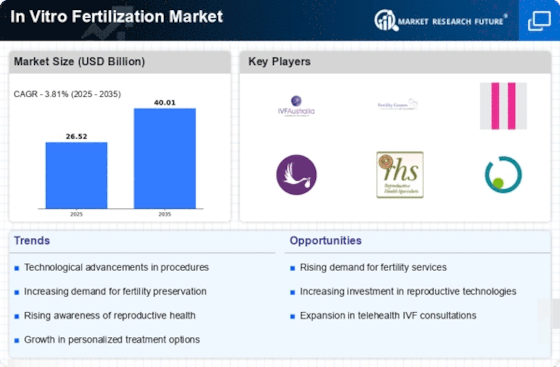
As of 2024, the market was valued at 26.52 USD Billion.

What is the projected market size for the In Vitro Fertilization Market in 2035?

<p>The market is projected to reach 40.01 USD Billion by 2035.</p>

What is the expected CAGR for the market from 2025 to 2035?

The expected CAGR for the market during the forecast period 2025 - 2035 is 3.81%.

Which segment of the In Vitro Fertilization Market had the highest valuation in 2024?

<p>In 2024, the Traditional IVF segment had the highest valuation at 10.0 to 15.0 USD Billion.</p>

What are the projected values for the Cryopreservation segment by 2035?

<p>The Cryopreservation segment is projected to reach between 4.5 to 6.0 USD Billion by 2035.</p>

Which key players are leading the In Vitro Fertilization Market?

<p>Key players in the market include IVF Australia, Fertility Centers of Illinois, and CCRM Fertility, among others.</p>

What is the market valuation for the Female Infertility patient type in 2024?

<p>The market valuation for the Female Infertility patient type was between 15.0 to 23.0 USD Billion in 2024.</p>

How does the market for Fertility Clinics compare to Hospitals in 2024?

<p>In 2024, the market for Fertility Clinics was valued at 10.0 to 15.0 USD Billion, whereas Hospitals were valued at 8.0 to 12.0 USD Billion.</p>

What is the projected growth for the Instruments product type by 2035?

<p>The Instruments product type is projected to grow to between 9.5 to 12.0 USD Billion by 2035.</p>

What is the expected market size for Unexplained Infertility by 2035?

<p>The market size for Unexplained Infertility is expected to reach between 9.51 to 12.0 USD Billion by 2035.</p>

Market Summary

As per Market Research Future analysis, the In-Vitro Fertilization (IVF) Market size was valued at USD 29.0 Billion in 2025. The market is projected to grow from USD 31.7 Billion in 2026 to USD 71.3 Billion by 2035, exhibiting a CAGR of 9.4% during the forecast period 2026-2035. North America led the market with over 45% share, generating around USD 11.9 billion in revenue.
 
Rising infertility prevalence, delayed pregnancies, and expanding access to assisted reproductive technologies are driving IVF market growth globally. Continuous improvements in embryo screening, genetic testing, and clinical success rates further enhance adoption across fertility clinics and specialized healthcare centers.
 
According to WHO, infertility affects an estimated 1 in 6 people globally (17.5% of adult population), highlighting strong unmet reproductive healthcare demand. CDC reports increasing ART utilization in the U.S., with 238,000 ART cycles performed annually, reflecting growing IVF adoption worldwide.

Key Market Trends & Highlights

The In-Vitro Fertilization (IVF) Market is experiencing robust growth driven by technological advancements and increasing acceptance.

  • North America holds over 45% IVF market share in 2024 due to strong ART infrastructure and high adoption rates. Europe IVF market valued at USD 8.70 billion in 2024, accounting for nearly 30% global market share. ICSI dominates IVF techniques with 65% share, supported by higher success rates in male infertility treatments. Female infertility leads IVF demand with 68% share, while male infertility grows rapidly due to rising awareness.

Market Size & Forecast

2025 Market Size 29.0 (USD Billion)
2035 Market Size 71.3 (USD Billion)
CAGR (2025 - 2035) 9.4%
Largest Regional Market Share in 2024 North America

Major Players

Companies such as IVF Australia (AU), <a href="https://www.fcionline.com/article/understanding-ivf-success-rates/">Fertility Centers of Illinois</a> (US), <a href="https://www.ccrmivf.com/fertility/ivf-fertilization/">CCRM Fertility</a> (US), New Hope Fertility Center (US), Reproductive Health Specialists (US), IVF Spain (ES), Clinica Tambre (ES), Bourn Hall Clinic (GB), IVF Clinic (RU) are some of the major participants in the global market.

Market Trends

The In Vitro Fertilization Market is currently experiencing notable growth, driven by advancements in reproductive technologies and increasing awareness of fertility issues. As more individuals and couples seek assistance in conceiving, the demand for IVF services continues to rise. This trend is further supported by the growing acceptance of assisted reproductive technologies across various cultures and demographics.

Additionally, the expansion of fertility clinics and the introduction of innovative IVF treatment options are likely to enhance accessibility and affordability for patients. Moreover, the market is witnessing a shift towards personalized medicine, where treatments are tailored to individual patient needs. This approach not only improves success rates but also enhances patient satisfaction.

The integration of artificial intelligence and data analytics into IVF procedures appears to be revolutionizing the field, offering new insights into embryo selection and treatment protocols. As the market evolves, it seems poised to address the diverse needs of patients, potentially leading to improved outcomes and experiences in reproductive health.

Technological Advancements

The market is significantly influenced by ongoing technological innovations. Developments in embryo culture techniques, genetic screening, and cryopreservation methods are enhancing the efficiency and success rates of IVF procedures. These advancements not only improve the chances of conception but also reduce the risks associated with multiple pregnancies.

WHO reports that modern ART techniques can improve pregnancy success rates significantly, with embryo vitrification achieving survival rates above 90% in optimized clinical settings, enhancing overall IVF efficiency and reducing multiple pregnancy risks.

Increased Awareness and Acceptance

There is a growing awareness regarding fertility challenges and the available solutions, which is contributing to the expansion of the market. As societal norms evolve, more individuals and couples are openly discussing their reproductive health, leading to increased acceptance of IVF as a viable option for family planning.

UNFPA estimates that millions of individuals globally face unmet reproductive health needs, with infertility increasingly recognized as a public health issue across both developed and developing regions, driving higher demand for assisted reproduction services including IVF.

Personalized Treatment Approaches

The trend towards personalized medicine is becoming increasingly prominent within the market. Tailoring In vivo fertilization treatments to the specific needs of patients, based on genetic and health profiles, is likely to enhance the effectiveness of IVF procedures. This individualized approach may lead to better outcomes and higher patient satisfaction.

CDC ART data shows that individualized embryo transfer strategies contribute to improved live birth outcomes, with success rates varying significantly by age group, reaching ~45–55% per cycle in women under 35, demonstrating strong impact of personalized IVF protocols.

In Vitro Fertilization Market Market Drivers

Changing Societal Norms

Shifting societal attitudes towards family planning and reproductive health are significantly impacting the In Vitro Fertilization Market. As societal norms evolve, there is a growing acceptance of assisted reproductive technologies, including IVF. This change is particularly evident among younger generations who prioritize career and personal development before starting families. Consequently, more individuals are opting for IVF as a means to achieve their reproductive goals.
 
Additionally, the increasing visibility of diverse family structures, including single parents and same-sex couples, is further driving demand for IVF services. This cultural shift suggests that the market will continue to expand as it becomes more inclusive and accessible to a wider range of individuals seeking fertility solutions.
 
IVF treatments involve multiple stages, including ovarian stimulation, egg retrieval, fertilization, embryo culture, and embryo transfer. These treatments are used to address conditions such as blocked fallopian tubes, low sperm count, unexplained infertility, and age-related fertility decline. With advancements in medical science, IVF success rates have steadily improved.

Rising Infertility Rates

The increasing prevalence of infertility is a primary driver for the In Vitro Fertilization Market. Factors such as delayed childbearing, lifestyle changes, and environmental influences contribute to this trend. According to recent statistics, infertility affects approximately 10-15% of couples worldwide, leading to a heightened demand for assisted reproductive technologies.
 
As more individuals seek solutions to their fertility challenges, the market is poised for growth. This rising demand is further supported by the increasing number of fertility clinics and advancements in reproductive technologies, which enhance the success rates of IVF procedures. Consequently, the market is likely to expand as more couples turn to IVF as a viable option for achieving parenthood.
 
New technologies are transforming IVF outcomes and patient experiences. Innovations such as preimplantation genetic testing (PGT), time-lapse embryo imaging, artificial intelligence–based embryo selection, cryopreservation, and improved culture media have enhanced embryo quality and implantation rates. Additionally, minimally invasive procedures and personalized treatment protocols are making IVF safer, more efficient, and emotionally supportive for aspiring parents.

Technological Innovations

Technological advancements play a crucial role in shaping the In Vitro Fertilization Market. Innovations such as preimplantation genetic testing, cryopreservation techniques, and improved embryo culture systems have significantly enhanced the success rates of IVF procedures. For instance, the introduction of time-lapse imaging technology allows for better monitoring of embryo development, leading to more informed decisions regarding embryo selection.
 
As these technologies continue to evolve, they not only improve outcomes but also attract more patients to fertility clinics. The market is expected to benefit from ongoing research and development efforts aimed at refining IVF techniques, thereby increasing accessibility and affordability for a broader demographic. This trend suggests a promising future for the market as it adapts to the needs of modern patients.
 
In vitro fertilization (IVF) has revolutionized reproductive medicine, offering hope to millions of couples facing infertility. IVF babies are born through a process where an egg is fertilized with sperm in a laboratory setting and then transferred into the uterus. Since the birth of the first IVF baby, this treatment has become a widely accepted and successful solution for various fertility challenges.

Government Support and Funding

Government initiatives and funding programs are increasingly influencing the In Vitro Fertilization Market. Many countries are recognizing the importance of addressing infertility as a public health issue and are implementing policies to support assisted reproductive technologies. This includes financial assistance for IVF treatments, which can alleviate the financial burden on couples seeking fertility solutions. In some regions, government-funded programs have led to a notable increase in IVF procedures, thereby driving market growth.
 
Furthermore, public awareness campaigns aimed at educating individuals about fertility options are likely to enhance the acceptance of IVF. As governments continue to invest in reproductive health, the market is expected to experience sustained growth, reflecting a commitment to improving family planning and reproductive health outcomes.

Increased Investment in Fertility Clinics

The proliferation of fertility clinics and increased investment in reproductive health services are pivotal drivers of the In Vitro Fertilization Market. As demand for IVF services rises, entrepreneurs and healthcare providers are establishing new clinics to cater to this growing need. This trend is supported by the increasing availability of specialized training for fertility specialists and advancements in clinic management technologies.
 
Moreover, the competitive landscape among fertility clinics is likely to lead to improved service offerings and patient experiences. As more clinics emerge, the accessibility of IVF treatments is expected to improve, potentially lowering costs and enhancing success rates. This influx of investment and innovation within the sector indicates a robust future for the market, as it adapts to meet the evolving needs of patients.

Market Segment Insights

By Technique: Intra-Cytoplasmic Sperm Injection (Largest) vs. Traditional IVF (Fastest-Growing)

The market is dominated by Intra-Cytoplasmic Sperm Injection (ICSI), which holds the largest In Vitro Fertilization Market share at 65% due to its higher success rates in treating infertility. Traditional IVF, while still significant, has seen a substantial share in recent years as it remains a foundational approach within assisted reproductive technologies. The IVF market is experiencing fluctuating shares, with ICSI leading as a preferred method, especially among patients with male infertility issues, while traditional IVF continues to be widely adopted by numerous clinics worldwide.

Intra-Cytoplasmic Sperm Injection (Dominant) vs. Traditional IVF (Emerging)

Intra-Cytoplasmic Sperm Injection (ICSI) is recognized as the dominant technique in the market share, primarily due to its effectiveness in cases of severe male infertility where sperm quality is compromised. This method entails the direct injection of a single sperm into an oocyte, leading to higher fertilization rates and successful embryo development. In contrast, Traditional IVF has been a longstanding technique that is now emerging with renewed interest as advancements in technology enhance its efficacy and patient outcomes. Clinics are increasingly combining methods to tailor treatments to individual needs, positioning Traditional IVF as a reliable option alongside ICSI for successful pregnancies.

By Product Type: Instruments (Largest) vs. Consumables (Fastest-Growing)

The distribution of market share among product types shows a clear dominance of instruments, which continue to hold the largest In Vitro Fertilization Market share at 58%. Instruments encompass a variety of essential tools and equipment that are critical in facilitating IVF procedures, affirming their pivotal role in the IVF market. Meanwhile, consumables have emerged as the fastest-growing segment, driven by the increasing demand for efficient and effective IVF solutions. This growth is further augmented by advancements in reproductive technologies that necessitate the use of high-quality consumables.

Instruments (Dominant) vs. Consumables (Emerging)

Instruments have established themselves as the dominant product type in the market share, providing essential tools such as microscopes, incubators, and aspiration devices that are integral to the IVF process. Their reliability and effectiveness in maintaining optimal conditions for embryo development contribute significantly to their prominent IVF market position. On the other hand, consumables, which include media and other single-use items, are increasingly recognized as an emerging segment. Their rapid growth is fueled by an ongoing trend towards disposable products which enhance sterility and reduce contamination risks. As the In Vitro Fertilization Market expands, both segments are poised for significant development, yet instruments will likely continue to lead due to their fundamental role.

By End User: Fertility Clinics (Largest) vs. Research Laboratories (Fastest-Growing)

The end-user segment shows a significant distribution, prominently including Fertility Clinics, Hospitals, and Research Laboratories. Fertility Clinics hold the largest In Vitro Fertilization (IVF) Market share at 72%, driven by their specialized services and the growing demand for assisted reproductive technologies. Hospitals also play a crucial role but exhibit a stable share, focusing on providing associated medical care alongside IVF procedures. Research Laboratories, though currently smaller in share, are rapidly gaining traction as innovation and research in reproductive health gain importance.

Fertility Clinics (Dominant) vs. Research Laboratories (Emerging)

Fertility Clinics are the dominant players in the market share, known for their tailored services and success-oriented models that attract a high number of patients seeking fertility treatments. These clinics are equipped with advanced technologies and skilled specialists, making them the first choice for individuals and couples. On the other hand, Research Laboratories represent an emerging segment, positioned to enhance the IVF landscape through innovative research and clinical trials aimed at improving IVF techniques. Their growth is spurred by increasing investment in research initiatives and the need for customized fertility solutions, paving the way for future advancements in the <a title="fertility services" href="https://www.marketresearchfuture.com/reports/fertility-services-market-6281" target="_blank" rel="noopener">fertility services</a> market.

By Patient Type: Female Infertility (Largest) vs. Male Infertility (Fastest-Growing)

The patient type segment shows significant variation, with Female Infertility accounting for the largest In Vitro Fertilization Market share at 68%. This predominance can be attributed to increasing awareness and acceptance of IVF treatments among women facing infertility issues. Conversely, Male Infertility is emerging as a fast-growing area in the fertility services market as more men become aware of fertility challenges and seek solutions. This shift is notably influenced by lifestyle changes and advancing medical technologies that facilitate male fertility treatments. Growth trends within this segment are driven by various factors, including societal shifts towards delayed childbearing and the increasing incidence of fertility issues in both genders. The focus on comprehensive fertility health and the advent of advanced reproductive technologies contribute to the expanding fertility services market. Furthermore, rising investments in healthcare research aimed at improving understanding and treatment options for unexplained infertility also enhance growth prospects.

Female Infertility (Dominant) vs. Male Infertility (Emerging)

The Female Infertility segment is characterized by its established dominance in the market share, largely due to the prevalence of conditions such as polycystic ovarian syndrome (PCOS) and endometriosis, which complicate conception. Women facing these challenges often turn to IVF as a viable solution, propelling this segment's prominence. In contrast, the Male Infertility segment is rapidly emerging, with a notable rise in men seeking help for issues like low sperm count and motility. As awareness increases and reproductive technologies advance, Male Infertility is expected to gain traction in the IVF landscape, thereby diversifying treatment options and catering to the growing need for male-specific fertility solutions.

Get more detailed insights about In Vitro Fertilization Market Research Report-Forecast to 2035

Regional Insights

North America : Leading Innovation and Access

North America dominated the global In Vitro Fertilization Market in 2024, reaching a market size of USD 11.9 billion. The region benefits from advanced healthcare infrastructure, high disposable incomes, and increasing awareness of fertility treatments. Regulatory support, including favorable reimbursement policies, further drives demand. The U.S. is the largest market, followed by Canada, which holds around 15% of the market share.

The competitive landscape in North America is robust, featuring key players such as Fertility Centers of Illinois, CCRM Fertility, and New Hope Fertility Center. These organizations are at the forefront of technological advancements and patient care. The presence of numerous fertility clinics and a growing trend towards personalized treatment options are enhancing the market dynamics, making it a hub for IVF services.

CDC reports approximately 238,000 ART cycles annually in the U.S., with more than 85,000 resulting live births, reflecting strong IVF penetration and clinical success. Infertility affects about 1 in 5 women in the U.S., reinforcing demand for assisted reproduction services.

Europe : Diverse Market with Regulations

Europe is a significant player in the market, holding approximately 30% of the global artificial insemination market share. The region's growth is driven by increasing infertility rates, advancements in reproductive technologies, and supportive regulations. Countries like Spain and the UK are leading the market, with Spain accounting for about 10% of the global share due to its favorable laws regarding IVF treatments. The competitive landscape in Europe is characterized by a mix of established clinics and emerging players.

ECDC and European reproductive health datasets indicate rising infertility trends across Europe, while countries like Spain perform over 140,000 IVF cycles annually, making it one of the highest IVF utilization regions globally, supporting strong market expansion.

Key organizations such as IVF Spain and Bourn Hall Clinic are prominent in the market. The region's diverse regulatory environment allows for innovative practices, enhancing patient access to IVF services. As a result, Europe continues to attract international patients seeking high-quality fertility treatments, driving the artificial insemination market share.

Asia-Pacific : Emerging Market with Potential

Asia-Pacific is an emerging powerhouse in the market, currently holding about 20% of the global share. The region's growth is fueled by rising infertility rates, increasing disposable incomes, and a growing acceptance of assisted reproductive technologies. Countries like Australia and India are leading the market, with Australia accounting for approximately 8% of the global share.

Regulatory frameworks are evolving to support the growing demand for IVF services. The competitive landscape in Asia-Pacific is becoming increasingly dynamic, with key players such as IVF Australia and various local clinics expanding their services. The region is witnessing a surge in medical tourism, as patients from neighboring countries seek advanced fertility treatments. This trend is expected to further boost the artificial insemination market share, making Asia-Pacific a focal point for IVF advancements.

Middle East and Africa : Growing Awareness and Access

The Middle East and Africa region is witnessing a gradual increase in the market, currently holding about 5% of the global share. The growth is driven by rising awareness of fertility issues, increasing healthcare investments, and a shift towards modern reproductive technologies. Countries like South Africa and the UAE are leading the artificial insemination market share, with the UAE showing significant growth potential due to its advanced healthcare infrastructure.

The competitive landscape in this region is evolving, with key players establishing clinics and services to cater to the growing demand. The presence of international fertility centers is enhancing the quality of care available. As awareness continues to grow, the market in the Middle East and Africa is expected to expand, attracting both local and international patients seeking fertility solutions.

Key Players and Competitive Insights

The In Vitro Fertilization Market is characterized by a dynamic competitive landscape, driven by increasing infertility rates, advancements in reproductive technologies, and a growing acceptance of assisted reproductive techniques. Key players such as IVF Australia (AU), CCRM Fertility (US), and Bourn Hall Clinic (GB) are strategically positioned to leverage these growth drivers. IVF Australia (AU) focuses on expanding its service offerings and enhancing patient experience through innovative technologies, while CCRM Fertility (US) emphasizes a patient-centric approach, integrating advanced genetic testing and personalized treatment plans. Bourn Hall Clinic (GB) is known for its pioneering role in IVF and continues to invest in research and development, thereby shaping the competitive environment through innovation and quality care.
 
The business tactics employed by these in vitro fertilization companies include localizing services to cater to regional needs and optimizing supply chains to enhance operational efficiency. The market structure appears moderately fragmented, with a mix of established players and emerging clinics. This fragmentation allows for diverse service offerings, yet the collective influence of key fertility tech companies like IVF Australia (AU) and CCRM Fertility (US) is significant, as they set benchmarks for quality and innovation in the industry.
 
In August 2025, IVF Australia (AU) announced the launch of a new telehealth platform aimed at improving access to fertility consultations. This strategic move is likely to enhance patient engagement and streamline the consultation process, reflecting a broader trend towards digital transformation in healthcare. By integrating telehealth, IVF Australia (AU) positions itself as a leader in accessibility, potentially attracting a wider patient base.
 
In September 2025, CCRM Fertility (US), a key IVF company, expanded its partnership with a leading genetic testing company to offer comprehensive pre-implantation genetic testing services. This collaboration is strategically important as it enhances CCRM's service portfolio, allowing for more personalized treatment options. The integration of advanced genetic testing aligns with the growing demand for precision medicine in reproductive health, thereby strengthening CCRM's competitive edge.
 
In July 2025, Bourn Hall Clinic (GB) launched a sustainability initiative aimed at reducing its carbon footprint through eco-friendly practices in its laboratories. This initiative not only reflects a commitment to environmental responsibility but also resonates with the increasing consumer preference for sustainable healthcare practices. By prioritizing sustainability, Bourn Hall Clinic (GB) differentiates itself in a crowded market as a leading IVF company, appealing to environmentally conscious patients.
 
As of October 2025, the market is witnessing trends such as digitalization, sustainability, and the integration of artificial intelligence in treatment protocols. Strategic alliances among key fertility tech companies are shaping the competitive landscape, fostering innovation and enhancing service delivery. Moving forward, competitive differentiation is likely to evolve from traditional price-based competition to a focus on technological advancements, innovative treatment options, and reliable supply chains, thereby redefining the parameters of success in the market.

Key Companies in the In Vitro Fertilization Market include

Industry Developments

The In Vitro Fertilization Market has recently witnessed significant developments, with in vitro fertilization companies like Merck KGaA and Thermo Fisher Scientific focusing on advancing their product offerings. In October 2023, Ferring Pharmaceuticals announced a new partnership with Bourn Hall to enhance access to fertility treatments in key regions. Meanwhile, Repromed has been expanding its facilities to incorporate cutting-edge technologies that improve IVF outcomes. Notably, IVF Technologies has seen a surge in market valuation due to increasing demand for Fertility Therapy, impacting the overall market positively.

In terms of mergers and acquisitions, Merck KGaA completed the acquisition of a smaller fertility-related firm in July 2023, strengthening its position in the IVF sector.

Furthermore, LabCorp has been actively integrating more genetic testing services, enabling more personalized treatment solutions. In the past few years, regulatory bodies have also made strides in simplifying approval processes for new IVF-related technologies, contributing to accelerated innovation in the market. This dynamically evolving IVF market size reflects a growing awareness and acceptance of assisted reproductive technologies globally.

Future Outlook

In Vitro Fertilization Market Future Outlook

The In Vitro Fertilization Market size is projected to reach USD 71.3 Billion by 2035, growing at a CAGR of 9.4%, driven by technological advancements, increasing infertility rates, and rising awareness.

New opportunities lie in:

  • <p>Expansion of telehealth services for remote consultations Development of personalized IVF treatment plans using AI Investment in cryopreservation technologies for egg and embryo storage</p>

By 2035, the market is expected to achieve substantial growth, driven by innovation and increased accessibility.

Market Segmentation

In Vitro Fertilization Market Technique Outlook

  • Intra-Cytoplasmic Sperm Injection
  • Traditional IVF
  • Preimplantation Genetic Testing
  • Cryopreservation
  • Embryo Culture

In Vitro Fertilization Market Patient Type Outlook

  • Male Infertility
  • Female Infertility
  • Unexplained Infertility

In Vitro Fertilization Market Product Type Outlook

  • Instruments
  • Media
  • Consumables

In-Vitro Fertilization (IVF) Market End User Outlook

  • Fertility Clinics
  • Hospitals
  • Research Laboratories

Report Scope

MARKET SIZE 2025 29.0(USD Billion)
MARKET SIZE 2026 31.7(USD Billion)
MARKET SIZE 2035 71.3(USD Billion)
COMPOUND ANNUAL GROWTH RATE (CAGR) 9.4% (2026 - 2035)
REPORT COVERAGE Revenue Forecast, Competitive Landscape, Growth Factors, and Trends
BASE YEAR 2025
Market Forecast Period 2026 - 2035
Historical Data 2019 - 2024
Market Forecast Units USD Billion
Key Companies Profiled IVF Australia (AU), Fertility Centers of Illinois (US), CCRM Fertility (US), New Hope Fertility Center (US), Reproductive Health Specialists (US), IVF Spain (ES), Clinica Tambre (ES), Bourn Hall Clinic (GB), IVF Clinic (RU)
Segments Covered Technique, Product Type, End Users, Patient Type, Regional
Key Market Opportunities Integration of artificial intelligence in embryo selection enhances success rates in the In Vitro Fertilization Market.
Key Market Dynamics Rising demand for advanced reproductive technologies drives innovation and competition in the In Vitro Fertilization Market.
Countries Covered North America, Europe, APAC, South America, MEA

FAQs

What is the current valuation of the In Vitro Fertilization Market?

As of 2024, the market was valued at 26.52 USD Billion.

What is the projected market size for the In Vitro Fertilization Market in 2035?

<p>The market is projected to reach 40.01 USD Billion by 2035.</p>

What is the expected CAGR for the market from 2025 to 2035?

The expected CAGR for the market during the forecast period 2025 - 2035 is 3.81%.

Which segment of the In Vitro Fertilization Market had the highest valuation in 2024?

<p>In 2024, the Traditional IVF segment had the highest valuation at 10.0 to 15.0 USD Billion.</p>

What are the projected values for the Cryopreservation segment by 2035?

<p>The Cryopreservation segment is projected to reach between 4.5 to 6.0 USD Billion by 2035.</p>

Which key players are leading the In Vitro Fertilization Market?

<p>Key players in the market include IVF Australia, Fertility Centers of Illinois, and CCRM Fertility, among others.</p>

What is the market valuation for the Female Infertility patient type in 2024?

<p>The market valuation for the Female Infertility patient type was between 15.0 to 23.0 USD Billion in 2024.</p>

How does the market for Fertility Clinics compare to Hospitals in 2024?

<p>In 2024, the market for Fertility Clinics was valued at 10.0 to 15.0 USD Billion, whereas Hospitals were valued at 8.0 to 12.0 USD Billion.</p>

What is the projected growth for the Instruments product type by 2035?

<p>The Instruments product type is projected to grow to between 9.5 to 12.0 USD Billion by 2035.</p>

What is the expected market size for Unexplained Infertility by 2035?

<p>The market size for Unexplained Infertility is expected to reach between 9.51 to 12.0 USD Billion by 2035.</p>

  1. SECTION I: EXECUTIVE SUMMARY AND KEY HIGHLIGHTS |
    1. EXECUTIVE SUMMARY | |
      1. Market Overview | |
      2. Key Findings | |
      3. Market Segmentation | |
      4. Competitive Landscape | |
      5. Challenges and Opportunities | |
      6. Future Outlook 2
  2. SECTION II: SCOPING, METHODOLOGY AND MARKET STRUCTURE |
    1. MARKET INTRODUCTION | |
      1. Definition | |
      2. Scope of the study | | |
    2. RESEARCH METHODOLOGY | |
      1. Overview | |
      2. Data Mining | |
      3. Secondary Research | |
      4. Primary Research | | |
      5. Forecasting Model | |
      6. Market Size Estimation | | |
      7. Data Triangulation | |
      8. Validation 3
  3. SECTION III: QUALITATIVE ANALYSIS |
    1. MARKET DYNAMICS | |
      1. Overview | |
      2. Drivers | |
      3. Restraints | |
      4. Opportunities |
    2. MARKET FACTOR ANALYSIS | |
      1. Value chain Analysis | |
      2. Porter's Five Forces Analysis | | |
      3. COVID-19 Impact Analysis | | |
  4. SECTION IV: QUANTITATIVE ANALYSIS |
    1. Healthcare, BY Technique (USD Billion) | |
      1. Intra-Cytoplasmic Sperm Injection | |
      2. Traditional IVF | |
      3. Preimplantation Genetic Testing | |
      4. Cryopreservation | |
      5. Embryo Culture |
    2. Healthcare, BY Product Type (USD Billion) | |
      1. Instruments | |
      2. Media | |
      3. Consumables |
    3. Healthcare, BY End User (USD Billion) | |
      1. Fertility Clinics | |
      2. Hospitals | |
      3. Research Laboratories |
    4. Healthcare, BY Patient Type (USD Billion) | |
      1. Male Infertility | |
      2. Female Infertility | |
      3. Unexplained Infertility |
    5. Healthcare, BY Region (USD Billion) | |
      1. North America | | |
      2. Europe | | |
      3. APAC | | |
      4. South America | | |
      5. MEA | | |
  5. SECTION V: COMPETITIVE ANALYSIS |
    1. Competitive Landscape | |
      1. Overview | |
      2. Competitive Analysis | |
      3. Market share Analysis | |
      4. Major Growth Strategy in the Healthcare | |
      5. Competitive Benchmarking | |
      6. Leading Players in Terms of Number of Developments in the Healthcare | |
      7. Key developments and growth strategies | | |
      8. Major Players Financial Matrix | | |
    2. Company Profiles | |
      1. IVF Australia (AU) | | |
      2. Fertility Centers of Illinois (US) | | |
      3. CCRM Fertility (US) | | |
      4. New Hope Fertility Center (US) | | |
      5. Reproductive Health Specialists (US) | | |
      6. IVF Spain (ES) | | |
      7. Clinica Tambre (ES) | | |
      8. Bourn Hall Clinic (GB) | | |
      9. IVF Clinic (RU) | | |
    3. Appendix | |
      1. References | |
      2. Related Reports 6 LIST OF FIGURES |
    4. MARKET SYNOPSIS |
    5. NORTH AMERICA MARKET ANALYSIS |
    6. US MARKET ANALYSIS BY TECHNIQUE |
    7. US MARKET ANALYSIS BY PRODUCT TYPE |
    8. US MARKET ANALYSIS BY END USER |
    9. US MARKET ANALYSIS BY PATIENT TYPE |
    10. CANADA MARKET ANALYSIS BY TECHNIQUE |
    11. CANADA MARKET ANALYSIS BY PRODUCT TYPE |
    12. CANADA MARKET ANALYSIS BY END USER |
    13. CANADA MARKET ANALYSIS BY PATIENT TYPE |
    14. EUROPE MARKET ANALYSIS |
    15. GERMANY MARKET ANALYSIS BY TECHNIQUE |
    16. GERMANY MARKET ANALYSIS BY PRODUCT TYPE |
    17. GERMANY MARKET ANALYSIS BY END USER |
    18. GERMANY MARKET ANALYSIS BY PATIENT TYPE |
    19. UK MARKET ANALYSIS BY TECHNIQUE |
    20. UK MARKET ANALYSIS BY PRODUCT TYPE |
    21. UK MARKET ANALYSIS BY END USER |
    22. UK MARKET ANALYSIS BY PATIENT TYPE |
    23. FRANCE MARKET ANALYSIS BY TECHNIQUE |
    24. FRANCE MARKET ANALYSIS BY PRODUCT TYPE |
    25. FRANCE MARKET ANALYSIS BY END USER |
    26. FRANCE MARKET ANALYSIS BY PATIENT TYPE |
    27. RUSSIA MARKET ANALYSIS BY TECHNIQUE |
    28. RUSSIA MARKET ANALYSIS BY PRODUCT TYPE |
    29. RUSSIA MARKET ANALYSIS BY END USER |
    30. RUSSIA MARKET ANALYSIS BY PATIENT TYPE |
    31. ITALY MARKET ANALYSIS BY TECHNIQUE |
    32. ITALY MARKET ANALYSIS BY PRODUCT TYPE |
    33. ITALY MARKET ANALYSIS BY END USER |
    34. ITALY MARKET ANALYSIS BY PATIENT TYPE |
    35. SPAIN MARKET ANALYSIS BY TECHNIQUE |
    36. SPAIN MARKET ANALYSIS BY PRODUCT TYPE |
    37. SPAIN MARKET ANALYSIS BY END USER |
    38. SPAIN MARKET ANALYSIS BY PATIENT TYPE |
    39. REST OF EUROPE MARKET ANALYSIS BY TECHNIQUE |
    40. REST OF EUROPE MARKET ANALYSIS BY PRODUCT TYPE |
    41. REST OF EUROPE MARKET ANALYSIS BY END USER |
    42. REST OF EUROPE MARKET ANALYSIS BY PATIENT TYPE |
    43. APAC MARKET ANALYSIS |
    44. CHINA MARKET ANALYSIS BY TECHNIQUE |
    45. CHINA MARKET ANALYSIS BY PRODUCT TYPE |
    46. CHINA MARKET ANALYSIS BY END USER |
    47. CHINA MARKET ANALYSIS BY PATIENT TYPE |
    48. INDIA MARKET ANALYSIS BY TECHNIQUE |
    49. INDIA MARKET ANALYSIS BY PRODUCT TYPE |
    50. INDIA MARKET ANALYSIS BY END USER |
    51. INDIA MARKET ANALYSIS BY PATIENT TYPE |
    52. JAPAN MARKET ANALYSIS BY TECHNIQUE |
    53. JAPAN MARKET ANALYSIS BY PRODUCT TYPE |
    54. JAPAN MARKET ANALYSIS BY END USER |
    55. JAPAN MARKET ANALYSIS BY PATIENT TYPE |
    56. SOUTH KOREA MARKET ANALYSIS BY TECHNIQUE |
    57. SOUTH KOREA MARKET ANALYSIS BY PRODUCT TYPE |
    58. SOUTH KOREA MARKET ANALYSIS BY END USER |
    59. SOUTH KOREA MARKET ANALYSIS BY PATIENT TYPE |
    60. MALAYSIA MARKET ANALYSIS BY TECHNIQUE |
    61. MALAYSIA MARKET ANALYSIS BY PRODUCT TYPE |
    62. MALAYSIA MARKET ANALYSIS BY END USER |
    63. MALAYSIA MARKET ANALYSIS BY PATIENT TYPE |
    64. THAILAND MARKET ANALYSIS BY TECHNIQUE |
    65. THAILAND MARKET ANALYSIS BY PRODUCT TYPE |
    66. THAILAND MARKET ANALYSIS BY END USER |
    67. THAILAND MARKET ANALYSIS BY PATIENT TYPE |
    68. INDONESIA MARKET ANALYSIS BY TECHNIQUE |
    69. INDONESIA MARKET ANALYSIS BY PRODUCT TYPE |
    70. INDONESIA MARKET ANALYSIS BY END USER |
    71. INDONESIA MARKET ANALYSIS BY PATIENT TYPE |
    72. REST OF APAC MARKET ANALYSIS BY TECHNIQUE |
    73. REST OF APAC MARKET ANALYSIS BY PRODUCT TYPE |
    74. REST OF APAC MARKET ANALYSIS BY END USER |
    75. REST OF APAC MARKET ANALYSIS BY PATIENT TYPE |
    76. SOUTH AMERICA MARKET ANALYSIS |
    77. BRAZIL MARKET ANALYSIS BY TECHNIQUE |
    78. BRAZIL MARKET ANALYSIS BY PRODUCT TYPE |
    79. BRAZIL MARKET ANALYSIS BY END USER |
    80. BRAZIL MARKET ANALYSIS BY PATIENT TYPE |
    81. MEXICO MARKET ANALYSIS BY TECHNIQUE |
    82. MEXICO MARKET ANALYSIS BY PRODUCT TYPE |
    83. MEXICO MARKET ANALYSIS BY END USER |
    84. MEXICO MARKET ANALYSIS BY PATIENT TYPE |
    85. ARGENTINA MARKET ANALYSIS BY TECHNIQUE |
    86. ARGENTINA MARKET ANALYSIS BY PRODUCT TYPE |
    87. ARGENTINA MARKET ANALYSIS BY END USER |
    88. ARGENTINA MARKET ANALYSIS BY PATIENT TYPE |
    89. REST OF SOUTH AMERICA MARKET ANALYSIS BY TECHNIQUE |
    90. REST OF SOUTH AMERICA MARKET ANALYSIS BY PRODUCT TYPE |
    91. REST OF SOUTH AMERICA MARKET ANALYSIS BY END USER |
    92. REST OF SOUTH AMERICA MARKET ANALYSIS BY PATIENT TYPE |
    93. MEA MARKET ANALYSIS |
    94. GCC COUNTRIES MARKET ANALYSIS BY TECHNIQUE |
    95. GCC COUNTRIES MARKET ANALYSIS BY PRODUCT TYPE |
    96. GCC COUNTRIES MARKET ANALYSIS BY END USER |
    97. GCC COUNTRIES MARKET ANALYSIS BY PATIENT TYPE |
    98. SOUTH AFRICA MARKET ANALYSIS BY TECHNIQUE |
    99. SOUTH AFRICA MARKET ANALYSIS BY PRODUCT TYPE |
    100. SOUTH AFRICA MARKET ANALYSIS BY END USER |
    101. SOUTH AFRICA MARKET ANALYSIS BY PATIENT TYPE |
    102. REST OF MEA MARKET ANALYSIS BY TECHNIQUE |
    103. REST OF MEA MARKET ANALYSIS BY PRODUCT TYPE |
    104. REST OF MEA MARKET ANALYSIS BY END USER |
    105. REST OF MEA MARKET ANALYSIS BY PATIENT TYPE |
    106. KEY BUYING CRITERIA OF HEALTHCARE |
    107. RESEARCH PROCESS OF MRFR |
    108. DRO ANALYSIS OF HEALTHCARE |
    109. DRIVERS IMPACT ANALYSIS: HEALTHCARE |
    110. RESTRAINTS IMPACT ANALYSIS: HEALTHCARE |
    111. SUPPLY / VALUE CHAIN: HEALTHCARE |
    112. HEALTHCARE, BY TECHNIQUE, 2024 (% SHARE) |
    113. HEALTHCARE, BY TECHNIQUE, 2024 TO 2035 (USD Billion) |
    114. HEALTHCARE, BY PRODUCT TYPE, 2024 (% SHARE) |
    115. HEALTHCARE, BY PRODUCT TYPE, 2024 TO 2035 (USD Billion) |
    116. HEALTHCARE, BY END USER, 2024 (% SHARE) |
    117. HEALTHCARE, BY END USER, 2024 TO 2035 (USD Billion) |
    118. HEALTHCARE, BY PATIENT TYPE, 2024 (% SHARE) |
    119. HEALTHCARE, BY PATIENT TYPE, 2024 TO 2035 (USD Billion) |
    120. BENCHMARKING OF MAJOR COMPETITORS 7 LIST OF TABLES |
    121. LIST OF ASSUMPTIONS | |
      1. |
    122. North America MARKET SIZE ESTIMATES; FORECAST | |
      1. BY TECHNIQUE, 2025-2035 (USD Billion) | |
      2. BY PRODUCT TYPE, 2025-2035 (USD Billion) | |
      3. BY END USER, 2025-2035 (USD Billion) | |
      4. BY PATIENT TYPE, 2025-2035 (USD Billion) |
    123. US MARKET SIZE ESTIMATES; FORECAST | |
      1. BY TECHNIQUE, 2025-2035 (USD Billion) | |
      2. BY PRODUCT TYPE, 2025-2035 (USD Billion) | |
      3. BY END USER, 2025-2035 (USD Billion) | |
      4. BY PATIENT TYPE, 2025-2035 (USD Billion) |
    124. Canada MARKET SIZE ESTIMATES; FORECAST | |
      1. BY TECHNIQUE, 2025-2035 (USD Billion) | |
      2. BY PRODUCT TYPE, 2025-2035 (USD Billion) | |
      3. BY END USER, 2025-2035 (USD Billion) | |
      4. BY PATIENT TYPE, 2025-2035 (USD Billion) |
    125. Europe MARKET SIZE ESTIMATES; FORECAST | |
      1. BY TECHNIQUE, 2025-2035 (USD Billion) | |
      2. BY PRODUCT TYPE, 2025-2035 (USD Billion) | |
      3. BY END USER, 2025-2035 (USD Billion) | |
      4. BY PATIENT TYPE, 2025-2035 (USD Billion) |
    126. Germany MARKET SIZE ESTIMATES; FORECAST | |
      1. BY TECHNIQUE, 2025-2035 (USD Billion) | |
      2. BY PRODUCT TYPE, 2025-2035 (USD Billion) | |
      3. BY END USER, 2025-2035 (USD Billion) | |
      4. BY PATIENT TYPE, 2025-2035 (USD Billion) |
    127. UK MARKET SIZE ESTIMATES; FORECAST | |
      1. BY TECHNIQUE, 2025-2035 (USD Billion) | |
      2. BY PRODUCT TYPE, 2025-2035 (USD Billion) | |
      3. BY END USER, 2025-2035 (USD Billion) | |
      4. BY PATIENT TYPE, 2025-2035 (USD Billion) |
    128. France MARKET SIZE ESTIMATES; FORECAST | |
      1. BY TECHNIQUE, 2025-2035 (USD Billion) | |
      2. BY PRODUCT TYPE, 2025-2035 (USD Billion) | |
      3. BY END USER, 2025-2035 (USD Billion) | |
      4. BY PATIENT TYPE, 2025-2035 (USD Billion) |
    129. Russia MARKET SIZE ESTIMATES; FORECAST | |
      1. BY TECHNIQUE, 2025-2035 (USD Billion) | |
      2. BY PRODUCT TYPE, 2025-2035 (USD Billion) | |
      3. BY END USER, 2025-2035 (USD Billion) | |
      4. BY PATIENT TYPE, 2025-2035 (USD Billion) |
    130. Italy MARKET SIZE ESTIMATES; FORECAST | |
      1. BY TECHNIQUE, 2025-2035 (USD Billion) | |
      2. BY PRODUCT TYPE, 2025-2035 (USD Billion) | |
      3. BY END USER, 2025-2035 (USD Billion) | |
      4. BY PATIENT TYPE, 2025-2035 (USD Billion) |
    131. Spain MARKET SIZE ESTIMATES; FORECAST | |
      1. BY TECHNIQUE, 2025-2035 (USD Billion) | |
      2. BY PRODUCT TYPE, 2025-2035 (USD Billion) | |
      3. BY END USER, 2025-2035 (USD Billion) | |
      4. BY PATIENT TYPE, 2025-2035 (USD Billion) |
    132. Rest of Europe MARKET SIZE ESTIMATES; FORECAST | |
      1. BY TECHNIQUE, 2025-2035 (USD Billion) | |
      2. BY PRODUCT TYPE, 2025-2035 (USD Billion) | |
      3. BY END USER, 2025-2035 (USD Billion) | |
      4. BY PATIENT TYPE, 2025-2035 (USD Billion) |
    133. APAC MARKET SIZE ESTIMATES; FORECAST | |
      1. BY TECHNIQUE, 2025-2035 (USD Billion) | |
      2. BY PRODUCT TYPE, 2025-2035 (USD Billion) | |
      3. BY END USER, 2025-2035 (USD Billion) | |
      4. BY PATIENT TYPE, 2025-2035 (USD Billion) |
    134. China MARKET SIZE ESTIMATES; FORECAST | |
      1. BY TECHNIQUE, 2025-2035 (USD Billion) | |
      2. BY PRODUCT TYPE, 2025-2035 (USD Billion) | |
      3. BY END USER, 2025-2035 (USD Billion) | |
      4. BY PATIENT TYPE, 2025-2035 (USD Billion) |
    135. India MARKET SIZE ESTIMATES; FORECAST | |
      1. BY TECHNIQUE, 2025-2035 (USD Billion) | |
      2. BY PRODUCT TYPE, 2025-2035 (USD Billion) | |
      3. BY END USER, 2025-2035 (USD Billion) | |
      4. BY PATIENT TYPE, 2025-2035 (USD Billion) |
    136. Japan MARKET SIZE ESTIMATES; FORECAST | |
      1. BY TECHNIQUE, 2025-2035 (USD Billion) | |
      2. BY PRODUCT TYPE, 2025-2035 (USD Billion) | |
      3. BY END USER, 2025-2035 (USD Billion) | |
      4. BY PATIENT TYPE, 2025-2035 (USD Billion) |
    137. South Korea MARKET SIZE ESTIMATES; FORECAST | |
      1. BY TECHNIQUE, 2025-2035 (USD Billion) | |
      2. BY PRODUCT TYPE, 2025-2035 (USD Billion) | |
      3. BY END USER, 2025-2035 (USD Billion) | |
      4. BY PATIENT TYPE, 2025-2035 (USD Billion) |
    138. Malaysia MARKET SIZE ESTIMATES; FORECAST | |
      1. BY TECHNIQUE, 2025-2035 (USD Billion) | |
      2. BY PRODUCT TYPE, 2025-2035 (USD Billion) | |
      3. BY END USER, 2025-2035 (USD Billion) | |
      4. BY PATIENT TYPE, 2025-2035 (USD Billion) |
    139. Thailand MARKET SIZE ESTIMATES; FORECAST | |
      1. BY TECHNIQUE, 2025-2035 (USD Billion) | |
      2. BY PRODUCT TYPE, 2025-2035 (USD Billion) | |
      3. BY END USER, 2025-2035 (USD Billion) | |
      4. BY PATIENT TYPE, 2025-2035 (USD Billion) |
    140. Indonesia MARKET SIZE ESTIMATES; FORECAST | |
      1. BY TECHNIQUE, 2025-2035 (USD Billion) | |
      2. BY PRODUCT TYPE, 2025-2035 (USD Billion) | |
      3. BY END USER, 2025-2035 (USD Billion) | |
      4. BY PATIENT TYPE, 2025-2035 (USD Billion) |
    141. Rest of APAC MARKET SIZE ESTIMATES; FORECAST | |
      1. BY TECHNIQUE, 2025-2035 (USD Billion) | |
      2. BY PRODUCT TYPE, 2025-2035 (USD Billion) | |
      3. BY END USER, 2025-2035 (USD Billion) | |
      4. BY PATIENT TYPE, 2025-2035 (USD Billion) |
    142. South America MARKET SIZE ESTIMATES; FORECAST | |
      1. BY TECHNIQUE, 2025-2035 (USD Billion) | |
      2. BY PRODUCT TYPE, 2025-2035 (USD Billion) | |
      3. BY END USER, 2025-2035 (USD Billion) | |
      4. BY PATIENT TYPE, 2025-2035 (USD Billion) |
    143. Brazil MARKET SIZE ESTIMATES; FORECAST | |
      1. BY TECHNIQUE, 2025-2035 (USD Billion) | |
      2. BY PRODUCT TYPE, 2025-2035 (USD Billion) | |
      3. BY END USER, 2025-2035 (USD Billion) | |
      4. BY PATIENT TYPE, 2025-2035 (USD Billion) |
    144. Mexico MARKET SIZE ESTIMATES; FORECAST | |
      1. BY TECHNIQUE, 2025-2035 (USD Billion) | |
      2. BY PRODUCT TYPE, 2025-2035 (USD Billion) | |
      3. BY END USER, 2025-2035 (USD Billion) | |
      4. BY PATIENT TYPE, 2025-2035 (USD Billion) |
    145. Argentina MARKET SIZE ESTIMATES; FORECAST | |
      1. BY TECHNIQUE, 2025-2035 (USD Billion) | |
      2. BY PRODUCT TYPE, 2025-2035 (USD Billion) | |
      3. BY END USER, 2025-2035 (USD Billion) | |
      4. BY PATIENT TYPE, 2025-2035 (USD Billion) |
    146. Rest of South America MARKET SIZE ESTIMATES; FORECAST | |
      1. BY TECHNIQUE, 2025-2035 (USD Billion) | |
      2. BY PRODUCT TYPE, 2025-2035 (USD Billion) | |
      3. BY END USER, 2025-2035 (USD Billion) | |
      4. BY PATIENT TYPE, 2025-2035 (USD Billion) |
    147. MEA MARKET SIZE ESTIMATES; FORECAST | |
      1. BY TECHNIQUE, 2025-2035 (USD Billion) | |
      2. BY PRODUCT TYPE, 2025-2035 (USD Billion) | |
      3. BY END USER, 2025-2035 (USD Billion) | |
      4. BY PATIENT TYPE, 2025-2035 (USD Billion) |
    148. GCC Countries MARKET SIZE ESTIMATES; FORECAST | |
      1. BY TECHNIQUE, 2025-2035 (USD Billion) | |
      2. BY PRODUCT TYPE, 2025-2035 (USD Billion) | |
      3. BY END USER, 2025-2035 (USD Billion) | |
      4. BY PATIENT TYPE, 2025-2035 (USD Billion) |
    149. South Africa MARKET SIZE ESTIMATES; FORECAST | |
      1. BY TECHNIQUE, 2025-2035 (USD Billion) | |
      2. BY PRODUCT TYPE, 2025-2035 (USD Billion) | |
      3. BY END USER, 2025-2035 (USD Billion) | |
      4. BY PATIENT TYPE, 2025-2035 (USD Billion) |
    150. Rest of MEA MARKET SIZE ESTIMATES; FORECAST | |
      1. BY TECHNIQUE, 2025-2035 (USD Billion) | |
      2. BY PRODUCT TYPE, 2025-2035 (USD Billion) | |
      3. BY END USER, 2025-2035 (USD Billion) | |
      4. BY PATIENT TYPE, 2025-2035 (USD Billion) |
    151. PRODUCT LAUNCH/PRODUCT DEVELOPMENT/APPROVAL | |
      1. |
    152. ACQUISITION/PARTNERSHIP | |

Healthcare Market Segmentation

Healthcare By Technique (USD Billion, 2025-2035)

  • Intra-Cytoplasmic Sperm Injection
  • Traditional IVF
  • Preimplantation Genetic Testing
  • Cryopreservation
  • Embryo Culture

Healthcare By Product Type (USD Billion, 2025-2035)

  • Instruments
  • Media
  • Consumables

Healthcare By End User (USD Billion, 2025-2035)

  • Fertility Clinics
  • Hospitals
  • Research Laboratories

Healthcare By Patient Type (USD Billion, 2025-2035)

  • Male Infertility
  • Female Infertility
  • Unexplained Infertility
Infographic

Free Sample Request

Kindly complete the form below to receive a free sample of this Report

Get Free Sample

Customer Strories

Compare Licence

×
Features License Type
Single User Multiuser License Enterprise User
Price $4,950 $5,950 $7,250
Maximum User Access Limit 1 User Upto 10 Users Unrestricted Access Throughout the Organization
Free Customization
Direct Access to Analyst
Deliverable Format
Platform Access
Discount on Next Purchase 10% 15% 15%
Printable Versions