
×
  • Cat-intel
  • MedIntelliX
  • Resources
  • About Us
  • Hero Background
    English
    Chinese
    French
    Japanese
    Korean
    German
    Spanish

    Hypersonic Weapons Market Share

    ID: MRFR/A&D/10739-HCR
    128 Pages
    Sejal Akre
    October 2025

    Hypersonic Weapons Market Research Report Information By Type (Hypersonic Missiles, Hypersonic Glide Vehicles), By Domain (Land, Naval, Airborne), By Range (Short-range, Medium-range, Long-range), By Subsystem (Guidance System, Propulsion Systems, Boost-Glide, Warheads) And By Region (North America, Europe, Asia-Pacific, And Rest Of The World) –Market Forecast Till 2035.

    Share:
    Download PDF ×

    We do not share your information with anyone. However, we may send you emails based on your report interest from time to time. You may contact us at any time to opt-out.

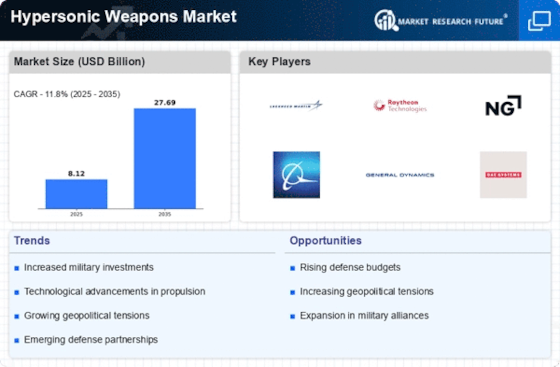
    Hypersonic Weapons Market Infographic
    Purchase Options

    Market Share

    Hypersonic Weapons Market Share Analysis

    Within the defense business, the hypersonic weapons industry is a vibrant and quickly changing sector that is defined by fierce competition and a never-ending quest for technological dominance. Businesses in this industry use a variety of market share positioning techniques to gain control and a sizable portion of this vital space. A key tactic in the market for hypersonic weapons is differentiation. Businesses work hard to create hypersonic weapons that are different from the competition with special characteristics and capabilities. This could entail improvements in range, speed, agility, or accuracy of aim. Companies hope to acquire a competitive edge and increase their share of the market by luring governments and defense organizations looking for cutting-edge hypersonic capabilities with unmatched advantages. One of the most important components of market share placement within the hypersonic weapons business is pricing strategy. To appeal to a range of defense budgets, companies must strike a balance between the cost-effectiveness and the intricacy of their products. A more cost-sensitive strategy may be used by some to appeal to a wider spectrum of customers, while others may choose to emphasize the better performance and advanced features of their hypersonic weaponry through a premium price model. In this highly competitive industry, a business's share of the market and contract-securing capacity are significantly impacted by the pricing strategy it chooses. Collaborations and strategic alliances are essential within the hypersonic weapons industry. To pool resources and expertise, companies frequently form alliances that include defense contractors, research institutes, or governmental organizations. Joint endeavors, improved testing capabilities, and faster research and development are all made possible through collaboration. Companies can fortify their standing in the marketplace and raise their chances of winning contracts for the development and use of hypersonic weapons by carefully connecting with important industry participants. Comprehending the distinct requirements and tactical goals of military agencies is vital for effectively securing a larger market share position within the hypersonic weapons industry. Companies can customize the hypersonic weapons to meet the changing needs of military forces around the world by doing in-depth market research. A customer-centric strategy makes sure that products meet the operational situations and mission criteria that military firms have in mind. This gives businesses a competitive edge and helps them keep ahead of technology advancements. Regarding the hypersonic weapons business, innovation is a key factor. Businesses make large investments in development and research to include cutting-edge features and technologies in their hypersonic weaponry. Propulsion system, navigation technology, and material advancements all help to create hypersonic weapons that are more effective and powerful. Constant innovation positions businesses as leaders in the quickly developing field of hypersonic weapons and draws in defense customers looking for cutting-edge solutions. One noteworthy tactic in the market for hypersonic weapons is geographic growth. To take advantage of more chances, businesses could expand into new markets or bolster their position in already-existing ones. Geographic expansion decisions are influenced by defense alliances, geopolitical concerns, and regional security dynamics. Businesses can increase their market share and take advantage of opportunities provided by various defense modernization efforts by strategically placing themselves in critical regions. To sum up, the marketplace for hypersonic weapons remains critical, and companies who want to prosper in the competitive world of advanced military technology need to position themselves proactively. Businesses can capture a significant share of the market by setting themselves apart from rivals, enacting price plans, establishing partnerships, concentrating on client demands, innovating, and growing internationally. The significance of these market placement techniques in the volatile and highly competitive Hypersonic Weapons industry keeps growing as defense agencies around the world strive to improve their capabilities and remain ahead of possible rivals.


    Author
    Sejal Akre
    Senior Research Analyst

    She has over 5 years of rich experience, in market research and consulting providing valuable market insights to client. Hands on expertise in management consulting, and extensive knowledge in domain including ICT, Automotive & Transportation and Aerospace & Defense. She is skilled in Go-to market strategy, industry analysis, market sizing, in depth company profiling, competitive intelligence & benchmarking and value chain amongst others.

    Leave a Comment

    FAQs

    What is the projected market valuation of the Hypersonic Weapons Market by 2035?

    The Hypersonic Weapons Market is projected to reach a valuation of 27.69 USD Billion by 2035.

    What was the market valuation of the Hypersonic Weapons Market in 2024?

    In 2024, the Hypersonic Weapons Market had a valuation of 8.117 USD Billion.

    What is the expected CAGR for the Hypersonic Weapons Market during the forecast period 2025 - 2035?

    The expected CAGR for the Hypersonic Weapons Market during the forecast period 2025 - 2035 is 11.8%.

    Which companies are considered key players in the Hypersonic Weapons Market?

    Key players in the Hypersonic Weapons Market include Lockheed Martin, Raytheon Technologies, Northrop Grumman, Boeing, General Dynamics, BAE Systems, Thales Group, Kongsberg Gruppen, and Mitsubishi Heavy Industries.

    What are the projected valuations for hypersonic missiles and hypersonic glide vehicles by 2035?

    By 2035, hypersonic missiles are projected to reach 15.0 USD Billion, while hypersonic glide vehicles may reach 12.69 USD Billion.

    How does the market for hypersonic weapons segment by domain?

    The market segments by domain are projected to be 8.5 USD Billion for land, 9.5 USD Billion for naval, and 9.7 USD Billion for airborne by 2035.

    Market Summary

    As per MRFR analysis, the Hypersonic Weapons Market Size was estimated at 8.117 USD Billion in 2024. The Hypersonic Weapons industry is projected to grow from 9.075 USD Billion in 2025 to 27.69 USD Billion by 2035, exhibiting a compound annual growth rate (CAGR) of 11.8 during the forecast period 2025 - 2035.

    Key Market Trends & Highlights

    The Hypersonic Weapons Market is poised for substantial growth driven by geopolitical tensions and technological advancements.

    • North America remains the largest market for hypersonic weapons, reflecting its robust defense budget and technological capabilities. The Asia-Pacific region is emerging as the fastest-growing market, fueled by increasing military investments and regional security concerns. Hypersonic missiles dominate the market, while hypersonic glide vehicles are experiencing the fastest growth due to their advanced capabilities. Escalating geopolitical tensions and increased military budgets are key drivers propelling the demand for hypersonic weapons across both land and naval segments.

    Market Size & Forecast

    2024 Market Size 8.117 (USD Billion)
    2035 Market Size 27.69 (USD Billion)
    CAGR (2025 - 2035) 11.8%
    Largest Regional Market Share in 2024 North America

    Major Players

    <p>Lockheed Martin (US), Raytheon Technologies (US), <a href="https://en.wikipedia.org/wiki/Hypersonic_weapon">Northrop Grumman </a>(US), Boeing (US), General Dynamics (US), BAE Systems (GB), Thales Group (FR), Kongsberg Gruppen (NO), Mitsubishi Heavy Industries (JP)</p>

    Market Trends

    The Hypersonic Weapons Market is currently experiencing a transformative phase, characterized by rapid advancements in technology and increasing geopolitical tensions. Nations are investing heavily in the development of hypersonic capabilities, which are perceived as a means to enhance national security and maintain strategic superiority. The unique attributes of hypersonic weapons, such as their ability to travel at speeds exceeding five times the speed of sound and their maneuverability, present both opportunities and challenges for defense systems worldwide. As countries strive to modernize their military arsenals, the demand for these advanced systems is likely to escalate, prompting further research and development initiatives. Moreover, the competitive landscape of the Hypersonic Weapons Market is evolving, with various nations collaborating with private sector entities to accelerate innovation. This collaboration may lead to the emergence of new technologies and applications, potentially reshaping the defense industry. Additionally, the regulatory environment surrounding hypersonic weapons is becoming increasingly complex, as governments seek to establish frameworks that address the implications of these advanced systems. As the market continues to mature, stakeholders must navigate these challenges while capitalizing on the opportunities presented by hypersonic technologies.

    Increased Investment in Research and Development

    Countries are significantly boosting their funding for hypersonic technologies, aiming to enhance their military capabilities. This trend reflects a broader recognition of the strategic advantages offered by hypersonic systems, which could alter the balance of power in global defense.

    Geopolitical Tensions Driving Demand

    Rising geopolitical conflicts are prompting nations to prioritize the development of hypersonic weapons. The perceived need for advanced deterrence mechanisms is likely to fuel further investments and accelerate the pace of innovation in this sector.

    Emergence of Collaborative Partnerships

    The Hypersonic Weapons Market is witnessing an increase in partnerships between government entities and private companies. Such collaborations are expected to foster innovation and expedite the development of cutting-edge hypersonic technologies.

    Hypersonic Weapons Market Market Drivers

    Escalating Geopolitical Tensions

    The Hypersonic Weapons Market is increasingly influenced by escalating geopolitical tensions among major powers. Nations are prioritizing the development of hypersonic capabilities as a deterrent against perceived threats, leading to a competitive arms race. Countries such as the United States, Russia, and China are investing substantial resources into hypersonic research and development, with military budgets reflecting this shift. For instance, recent defense budgets indicate that hypersonic weaponry is becoming a central component of national defense strategies. This environment of uncertainty and competition is likely to drive demand for hypersonic weapons, as nations seek to maintain strategic advantages over their adversaries.

    Growing Focus on National Security

    The Hypersonic Weapons Market is increasingly shaped by a growing focus on national security among nations. As global threats evolve, governments are compelled to enhance their military capabilities, particularly in the realm of advanced weaponry. Hypersonic weapons, with their ability to evade traditional missile defense systems, are viewed as critical assets in ensuring national security. This heightened emphasis on defense readiness is prompting nations to accelerate their hypersonic programs, with many establishing dedicated research initiatives. The potential for hypersonic weapons to alter the strategic landscape is driving investments and collaborations within the defense sector, further solidifying their role in future military operations.

    Technological Advancements in Defense Systems

    The Hypersonic Weapons Market is experiencing a surge in technological advancements that enhance the capabilities of defense systems. Innovations in materials science, propulsion technologies, and guidance systems are enabling the development of hypersonic weapons that can travel at speeds exceeding Mach 5. This rapid evolution is not only improving the performance of existing systems but also paving the way for new applications in military strategy. As nations invest heavily in these technologies, the market is projected to grow significantly, with estimates suggesting a compound annual growth rate of over 15% in the coming years. The integration of artificial intelligence and machine learning into hypersonic systems further amplifies their effectiveness, making them a focal point in modern warfare strategies.

    Increased Military Budgets and Defense Spending

    The Hypersonic Weapons Market is benefiting from increased military budgets and defense spending across various nations. Governments are recognizing the strategic importance of hypersonic technologies in modern warfare, leading to substantial investments in research, development, and procurement. Recent reports indicate that defense spending is projected to rise by approximately 3% annually, with a significant portion allocated to advanced weapon systems, including hypersonic missiles. This trend is particularly evident in countries that perceive a need to enhance their military capabilities in response to evolving threats. As defense budgets continue to expand, the hypersonic weapons sector is poised for robust growth, attracting both established defense contractors and new entrants.

    Emergence of Strategic Alliances and Partnerships

    The Hypersonic Weapons Market is witnessing the emergence of strategic alliances and partnerships among nations and defense contractors. Collaborative efforts are being formed to share knowledge, resources, and technology in the development of hypersonic capabilities. These partnerships are essential for pooling expertise and accelerating the pace of innovation in hypersonic weaponry. Recent agreements between countries have highlighted the importance of joint research initiatives and co-development projects, which are expected to enhance the effectiveness and reliability of hypersonic systems. As nations recognize the benefits of collaboration, the market is likely to see an increase in joint ventures and cooperative programs, further driving advancements in hypersonic technologies.

    Market Segment Insights

    By Type: Hypersonic Missiles (Largest) vs. Hypersonic Glide Vehicles (Fastest-Growing)

    <p>In the current landscape of the Hypersonic Weapons Market, hypersonic missiles dominate the segment, capturing the largest market share due to their offensive capabilities and integration into military strategies across multiple nations. These advanced weapon systems are characterized by their ability to travel at speeds exceeding Mach 5, allowing for quick strikes that complicate enemy defense systems. Conversely, hypersonic glide vehicles, while presently a smaller segment, exhibit rapid growth and innovation, driven by increased research and development initiatives focused on enhancing their speed, maneuverability, and strategic applications in warfare.</p>

    <p>Hypersonic Missiles: Dominant vs. Hypersonic Glide Vehicles: Emerging</p>

    <p>Hypersonic missiles have established themselves as the dominant force within the Hypersonic Weapons Market, offering precision and speed that exceeds traditional missile capabilities. These systems provide military forces with advanced strike options, making them a critical component of modern defense strategies. In contrast, hypersonic glide vehicles are deemed the emerging segment, drawing significant attention for their unique capabilities to maneuver at high speeds through the atmosphere, making them harder to detect and intercept. Their development is being fueled by technological advancements and the need for nations to stay ahead in strategic weapons capabilities, creating a dynamic environment where both segments continuously challenge and complement each other in terms of innovation and application.</p>

    By Domain: Land (Largest) vs. Naval (Fastest-Growing)

    <p>In the Hypersonic Weapons Market, the distribution of market share among the domain segment values reveals a clear dominance of the land-based applications. This sector is recognized for its substantial investments and advancements in hypersonic technologies, which have attracted governmental and military attention due to its strategic military advantages. Meanwhile, the naval domain has emerged as the fastest-growing segment, fueled by increasing defense budgets and the necessity for advanced maritime capabilities in response to global threats and geopolitical tensions.</p>

    <p>Land (Dominant) vs. Naval (Emerging)</p>

    <p>The land domain in hypersonic weaponry is characterized by high versatility and the ability to integrate with existing military infrastructures. This segment is widely viewed as dominant, owing to its extensive applications in <a href="https://www.marketresearchfuture.com/reports/missiles-missile-defense-systems-market-16124">missile defense</a> and offensive systems which can swiftly adapt to various operational environments. Conversely, the naval segment is classified as emerging, propelled by the rising need for advanced naval defenses and the strategic importance of maritime power in modern warfare. Hypersonic naval systems offer unique advantages, such as rapid strike capabilities and improved deterrence, which are essential in today's fast-evolving maritime security landscape.</p>

    By Range: Long-range (Largest) vs. Medium-range (Fastest-Growing)

    <p>In the Hypersonic Weapons Market, the range segment is characterized by three primary categories: short-range, medium-range, and long-range hypersonic weapons. Among these, long-range hypersonic weapons hold the largest market share, as they are positioned to provide strategic advantages over vast distances. Medium-range hypersonic weapons, on the other hand, are gaining traction rapidly and are projected to become the fastest-growing segment due to evolving military needs and advancements in technology.</p>

    <p>Performance: Long-range (Dominant) vs. Medium-range (Emerging)</p>

    <p>Long-range hypersonic weapons are paramount in modern military strategies, enabling states to strike targets from significant distances with high precision and speed. Their established market position stems from their use in deterrence strategies and their ability to penetrate advanced defense systems. Conversely, medium-range hypersonic weapons are emerging as vital assets to nations looking to enhance their tactical response capabilities. Their growing popularity is attributed to the need for quick deployment, lower costs compared to long-range systems, and increased emphasis on regional conflicts, making them a strong competitor in the hypersonic landscape.</p>

    By Subsystem: Guidance System (Largest) vs. Propulsion Systems (Fastest-Growing)

    <p>In the Hypersonic Weapons Market, the subsystem segment showcases a diverse range of technologies, with the Guidance System taking the largest share. This segment includes various navigation and control systems critical to hypersonic flight, allowing for precision targeting and maneuverability. Propulsion Systems follows closely, emerging as the fastest-growing segment, showcasing innovations that enable sustained hypersonic speeds. As nations invest heavily in advanced hypersonic capabilities, both of these subsystems are integral to the overall strategy and effectiveness of hypersonic weaponry. The growth trends within this segment are driven by the increasing geopolitical tensions and the need for rapid response capabilities. Propulsion Systems, which represent a key technological frontier for hypersonic weapons, are witnessing accelerated development and investment, particularly in scramjet technologies. Meanwhile, Guidance Systems are evolving continuously, adapting to new threat environments, which enables them to maintain their dominance. As a result, the push for both precision and speed in military applications shapes the competitive landscape of the Hypersonic Weapons Market.</p>

    <p>Guidance System (Dominant) vs. Propulsion Systems (Emerging)</p>

    <p>The Guidance System segment stands out as the dominant force in the Hypersonic Weapons Market, encapsulating advanced technologies such as GPS, inertial navigation, and other cutting-edge systems that ensure accurate targeting and flight paths. With military demands for precision engagements, these systems play a pivotal role in operational success. Conversely, Propulsion Systems, labeled as emerging, are gaining traction with innovations in engine technology, including scramjets and rocket-based options that provide the necessary thrust for hypersonic speeds. The rapid evolution and investment in these propulsion methods reflect the urgency in developing efficient hypersonic capabilities, thus positioning them favorably for future growth.</p>

    Get more detailed insights about Hypersonic Weapons Market Research Report – Forecast till 2035

    Regional Insights

    North America : Defense Innovation Leader

    North America is the largest market for hypersonic weapons, holding approximately 60% of the global share. The region's growth is driven by significant defense budgets, technological advancements, and a focus on countering emerging threats. Regulatory support from the U.S. Department of Defense and ongoing investments in R&D further catalyze market expansion. The demand for advanced military capabilities is pushing the development of hypersonic systems, making it a priority for national security strategies. The United States leads the hypersonic weapons market, with key players like Lockheed Martin, Raytheon Technologies, and Northrop Grumman at the forefront. These companies are heavily involved in developing cutting-edge technologies and systems. The competitive landscape is characterized by collaborations between government and private sectors, ensuring rapid advancements in hypersonic capabilities. The focus on deterrence and defense against adversaries solidifies North America's position as a leader in this domain.

    Europe : Emerging Defense Market

    Europe is witnessing a growing interest in hypersonic weapons, accounting for approximately 20% of the global market share. The region's growth is fueled by increasing defense budgets, geopolitical tensions, and a push for advanced military capabilities. Countries are investing in research and development to enhance their defense systems, with regulatory frameworks evolving to support these initiatives. The European Union's focus on strategic autonomy further drives demand for indigenous hypersonic technologies. Leading countries in Europe include the United Kingdom, France, and Germany, where companies like BAE Systems and Thales Group are key players. The competitive landscape is marked by collaborations among European nations to develop hypersonic technologies. The presence of established defense contractors and a growing number of startups in the sector indicates a robust ecosystem for innovation. As Europe seeks to bolster its defense capabilities, hypersonic weapons are becoming a critical area of focus.

    Asia-Pacific : Rapidly Advancing Military Capabilities

    Asia-Pacific is emerging as a significant player in the hypersonic weapons market, holding around 15% of the global share. The region's growth is driven by rising military expenditures, regional security concerns, and technological advancements. Countries like China and India are investing heavily in hypersonic research and development, with regulatory frameworks adapting to support these initiatives. The strategic focus on enhancing military capabilities is a key driver for the market's expansion in this region. China is at the forefront of hypersonic weapons development, with significant investments from state-owned enterprises. India is also making strides in this area, with collaborations between government and private sectors. The competitive landscape is characterized by rapid advancements and a race to achieve technological superiority. As regional tensions escalate, the demand for hypersonic capabilities is expected to grow, positioning Asia-Pacific as a critical player in the global market.

    Middle East and Africa : Emerging Defense Landscape

    The Middle East and Africa region is in the nascent stages of developing hypersonic weapons, currently holding about 5% of the global market share. The growth potential is driven by increasing defense budgets, regional conflicts, and a desire for advanced military technologies. Countries are beginning to recognize the strategic importance of hypersonic capabilities, with regulatory frameworks slowly evolving to accommodate these advancements. The focus on modernization of armed forces is a key factor in market development. Leading countries in this region include Israel and the United Arab Emirates, where there is a growing interest in advanced defense technologies. The competitive landscape is still developing, with a few key players beginning to emerge. As nations seek to enhance their military capabilities, the hypersonic weapons market is expected to gain traction, driven by regional security concerns and the need for deterrence against potential threats.

    Key Players and Competitive Insights

    The Hypersonic Weapons Market is currently characterized by intense competition and rapid technological advancements, driven by the increasing demand for advanced military capabilities. Key players such as Lockheed Martin (US), Raytheon Technologies (US), and Northrop Grumman (US) are at the forefront, focusing on innovation and strategic partnerships to enhance their market positions. Lockheed Martin (US) emphasizes its commitment to developing next-generation hypersonic systems, while Raytheon Technologies (US) is leveraging its extensive experience in missile systems to integrate hypersonic technologies into existing platforms. Northrop Grumman (US) appears to be concentrating on expanding its research and development efforts, particularly in collaboration with government agencies, to ensure its competitive edge in this evolving landscape.

    The competitive structure of the hypersonic weapons market is moderately fragmented, with several players vying for dominance. Companies are increasingly localizing manufacturing and optimizing supply chains to enhance operational efficiency and reduce costs. This trend is indicative of a broader strategy among key players to establish a more resilient and responsive market presence, which is essential given the geopolitical tensions that drive demand for hypersonic capabilities.

    In August 2025, Lockheed Martin (US) announced a significant partnership with the U.S. Department of Defense to accelerate the development of hypersonic glide vehicles. This collaboration is poised to enhance the speed and effectiveness of U.S. military operations, reflecting Lockheed Martin's strategic focus on innovation and government partnerships. The implications of this partnership are profound, as it not only solidifies Lockheed's position in the market but also aligns with national defense priorities.

    In September 2025, Raytheon Technologies (US) unveiled a new hypersonic missile system designed for rapid deployment and enhanced accuracy. This development underscores Raytheon's commitment to integrating cutting-edge technology into its offerings, potentially reshaping the competitive dynamics within the market. The introduction of this system may provide Raytheon with a distinct advantage, particularly in scenarios requiring swift and precise military responses.

    In July 2025, Northrop Grumman (US) secured a contract with the U.S. Air Force to develop advanced hypersonic technologies aimed at improving strike capabilities. This contract not only reinforces Northrop's strategic focus on R&D but also highlights the increasing reliance on advanced technologies in modern warfare. The successful execution of this contract could position Northrop Grumman as a leader in the hypersonic domain, further intensifying competition among key players.

    As of October 2025, the competitive landscape is increasingly shaped by trends such as digitalization, AI integration, and sustainability. Strategic alliances are becoming more prevalent, as companies recognize the need to pool resources and expertise to navigate the complexities of hypersonic technology development. Looking ahead, competitive differentiation is likely to evolve from traditional price-based competition to a focus on innovation, technological advancement, and supply chain reliability, as companies strive to meet the demands of modern military operations.

    Key Companies in the Hypersonic Weapons Market market include

    Industry Developments

    • Q2 2024: Lockheed Martin wins $756 million contract for hypersonic missile systems Lockheed Martin was awarded a $756 million contract by the U.S. Army to produce additional Long Range Hypersonic Weapon (LRHW) systems, expanding the Army’s hypersonic strike capabilities.
    • Q2 2024: Raytheon and Northrop Grumman partner to develop next-generation hypersonic propulsion Raytheon and Northrop Grumman announced a strategic partnership to co-develop advanced air-breathing hypersonic propulsion systems for future U.S. Department of Defense programs.
    • Q2 2024: U.S. Army activates first hypersonic missile battery The U.S. Army officially activated its first operational hypersonic missile battery, marking a significant milestone in the deployment of the Long Range Hypersonic Weapon (LRHW) system.
    • Q3 2024: BAE Systems opens new hypersonic weapons research facility in the UK BAE Systems inaugurated a dedicated research and development facility focused on hypersonic weapons technology, aiming to accelerate innovation and support UK defense initiatives.
    • Q3 2024: Aerojet Rocketdyne secures $215 million contract for hypersonic missile engines Aerojet Rocketdyne was awarded a $215 million contract to supply advanced propulsion systems for a new generation of U.S. hypersonic missiles.
    • Q3 2024: Leidos acquires small hypersonics startup for undisclosed sum Leidos announced the acquisition of a U.S.-based hypersonics technology startup, aiming to bolster its capabilities in high-speed weapons development.
    • Q4 2024: Lockheed Martin successfully tests next-generation hypersonic glide vehicle Lockheed Martin reported a successful flight test of its new hypersonic glide vehicle, demonstrating improved maneuverability and range for future U.S. military applications.
    • Q4 2024: India’s DRDO and BrahMos Aerospace announce successful test of hypersonic cruise missile India’s Defence Research and Development Organisation (DRDO) and BrahMos Aerospace jointly announced the successful test of a new hypersonic cruise missile, advancing India’s indigenous weapons capabilities.
    • Q1 2025: MBDA and Leonardo sign partnership to develop European hypersonic interceptor European defense firms MBDA and Leonardo signed a partnership agreement to jointly develop a hypersonic interceptor missile for European defense applications.
    • Q1 2025: Northrop Grumman opens new hypersonic propulsion manufacturing facility Northrop Grumman opened a state-of-the-art manufacturing facility dedicated to producing advanced propulsion systems for hypersonic weapons.
    • Q2 2025: U.S. Air Force awards $500 million contract to Boeing for hypersonic weapons development Boeing received a $500 million contract from the U.S. Air Force to accelerate the development of next-generation hypersonic weapons.
    • Q2 2025: Anduril appoints new head of hypersonics division Anduril announced the appointment of a new executive to lead its hypersonics division, signaling the company’s increased focus on high-speed weapons technology.

    Future Outlook

    Hypersonic Weapons Market Future Outlook

    <p>The Hypersonic Weapons Market is projected to grow at 11.8% CAGR from 2024 to 2035, driven by advancements in military technology and increasing defense budgets.</p>

    New opportunities lie in:

    • <p>Development of dual-use hypersonic technologies for commercial applications.</p><p>Partnerships with defense contractors for integrated hypersonic systems.</p><p>Investment in R&amp;D for next-generation propulsion systems.</p>

    <p>By 2035, the Hypersonic Weapons Market is expected to be a pivotal segment in global defense strategies.</p>

    Market Segmentation

    Hypersonic Weapons Market Type Outlook

    • Hypersonic missiles
    • Hypersonic glide vehicles

    Hypersonic Weapons Market Range Outlook

    • Short-range
    • Medium-range
    • Long-range

    Hypersonic Weapons Market Domain Outlook

    • Land
    • Naval
    • Airborne

    Hypersonic Weapons Market Subsystem Outlook

    • Guidance System
    • Propulsion Systems
    • Boost-Glide
    • Warheads

    Report Scope

    MARKET SIZE 20248.117(USD Billion)
    MARKET SIZE 20259.075(USD Billion)
    MARKET SIZE 203527.69(USD Billion)
    COMPOUND ANNUAL GROWTH RATE (CAGR)11.8% (2024 - 2035)
    REPORT COVERAGERevenue Forecast, Competitive Landscape, Growth Factors, and Trends
    BASE YEAR2024
    Market Forecast Period2025 - 2035
    Historical Data2019 - 2024
    Market Forecast UnitsUSD Billion
    Key Companies ProfiledMarket analysis in progress
    Segments CoveredMarket segmentation analysis in progress
    Key Market OpportunitiesAdvancements in propulsion technologies enhance capabilities within the Hypersonic Weapons Market.
    Key Market DynamicsIntensifying competition among nations drives rapid advancements in hypersonic weapon technologies and strategic military capabilities.
    Countries CoveredNorth America, Europe, APAC, South America, MEA

    FAQs

    What is the projected market valuation of the Hypersonic Weapons Market by 2035?

    The Hypersonic Weapons Market is projected to reach a valuation of 27.69 USD Billion by 2035.

    What was the market valuation of the Hypersonic Weapons Market in 2024?

    In 2024, the Hypersonic Weapons Market had a valuation of 8.117 USD Billion.

    What is the expected CAGR for the Hypersonic Weapons Market during the forecast period 2025 - 2035?

    The expected CAGR for the Hypersonic Weapons Market during the forecast period 2025 - 2035 is 11.8%.

    Which companies are considered key players in the Hypersonic Weapons Market?

    Key players in the Hypersonic Weapons Market include Lockheed Martin, Raytheon Technologies, Northrop Grumman, Boeing, General Dynamics, BAE Systems, Thales Group, Kongsberg Gruppen, and Mitsubishi Heavy Industries.

    What are the projected valuations for hypersonic missiles and hypersonic glide vehicles by 2035?

    By 2035, hypersonic missiles are projected to reach 15.0 USD Billion, while hypersonic glide vehicles may reach 12.69 USD Billion.

    How does the market for hypersonic weapons segment by domain?

    The market segments by domain are projected to be 8.5 USD Billion for land, 9.5 USD Billion for naval, and 9.7 USD Billion for airborne by 2035.

    1. SECTION I: EXECUTIVE SUMMARY AND KEY HIGHLIGHTS
      1. | 1.1 EXECUTIVE SUMMARY
      2. | | 1.1.1 Market Overview
      3. | | 1.1.2 Key Findings
      4. | | 1.1.3 Market Segmentation
      5. | | 1.1.4 Competitive Landscape
      6. | | 1.1.5 Challenges and Opportunities
      7. | | 1.1.6 Future Outlook
    2. SECTION II: SCOPING, METHODOLOGY AND MARKET STRUCTURE
      1. | 2.1 MARKET INTRODUCTION
      2. | | 2.1.1 Definition
      3. | | 2.1.2 Scope of the study
      4. | | | 2.1.2.1 Research Objective
      5. | | | 2.1.2.2 Assumption
      6. | | | 2.1.2.3 Limitations
      7. | 2.2 RESEARCH METHODOLOGY
      8. | | 2.2.1 Overview
      9. | | 2.2.2 Data Mining
      10. | | 2.2.3 Secondary Research
      11. | | 2.2.4 Primary Research
      12. | | | 2.2.4.1 Primary Interviews and Information Gathering Process
      13. | | | 2.2.4.2 Breakdown of Primary Respondents
      14. | | 2.2.5 Forecasting Model
      15. | | 2.2.6 Market Size Estimation
      16. | | | 2.2.6.1 Bottom-Up Approach
      17. | | | 2.2.6.2 Top-Down Approach
      18. | | 2.2.7 Data Triangulation
      19. | | 2.2.8 Validation
    3. SECTION III: QUALITATIVE ANALYSIS
      1. | 3.1 MARKET DYNAMICS
      2. | | 3.1.1 Overview
      3. | | 3.1.2 Drivers
      4. | | 3.1.3 Restraints
      5. | | 3.1.4 Opportunities
      6. | 3.2 MARKET FACTOR ANALYSIS
      7. | | 3.2.1 Value chain Analysis
      8. | | 3.2.2 Porter's Five Forces Analysis
      9. | | | 3.2.2.1 Bargaining Power of Suppliers
      10. | | | 3.2.2.2 Bargaining Power of Buyers
      11. | | | 3.2.2.3 Threat of New Entrants
      12. | | | 3.2.2.4 Threat of Substitutes
      13. | | | 3.2.2.5 Intensity of Rivalry
      14. | | 3.2.3 COVID-19 Impact Analysis
      15. | | | 3.2.3.1 Market Impact Analysis
      16. | | | 3.2.3.2 Regional Impact
      17. | | | 3.2.3.3 Opportunity and Threat Analysis
    4. SECTION IV: QUANTITATIVE ANALYSIS
      1. | 4.1 Aerospace & Defense, BY Type (USD Billion)
      2. | | 4.1.1 Hypersonic missiles
      3. | | 4.1.2 Hypersonic glide vehicles
      4. | 4.2 Aerospace & Defense, BY Domain (USD Billion)
      5. | | 4.2.1 Land
      6. | | 4.2.2 Naval
      7. | | 4.2.3 Airborne
      8. | 4.3 Aerospace & Defense, BY Range (USD Billion)
      9. | | 4.3.1 Short-range
      10. | | 4.3.2 Medium-range
      11. | | 4.3.3 Long-range
      12. | 4.4 Aerospace & Defense, BY Subsystem (USD Billion)
      13. | | 4.4.1 Guidance System
      14. | | 4.4.2 Propulsion Systems
      15. | | 4.4.3 Boost-Glide
      16. | | 4.4.4 Warheads
      17. | 4.5 Aerospace & Defense, BY Region (USD Billion)
      18. | | 4.5.1 North America
      19. | | | 4.5.1.1 US
      20. | | | 4.5.1.2 Canada
      21. | | 4.5.2 Europe
      22. | | | 4.5.2.1 Germany
      23. | | | 4.5.2.2 UK
      24. | | | 4.5.2.3 France
      25. | | | 4.5.2.4 Russia
      26. | | | 4.5.2.5 Italy
      27. | | | 4.5.2.6 Spain
      28. | | | 4.5.2.7 Rest of Europe
      29. | | 4.5.3 APAC
      30. | | | 4.5.3.1 China
      31. | | | 4.5.3.2 India
      32. | | | 4.5.3.3 Japan
      33. | | | 4.5.3.4 South Korea
      34. | | | 4.5.3.5 Malaysia
      35. | | | 4.5.3.6 Thailand
      36. | | | 4.5.3.7 Indonesia
      37. | | | 4.5.3.8 Rest of APAC
      38. | | 4.5.4 South America
      39. | | | 4.5.4.1 Brazil
      40. | | | 4.5.4.2 Mexico
      41. | | | 4.5.4.3 Argentina
      42. | | | 4.5.4.4 Rest of South America
      43. | | 4.5.5 MEA
      44. | | | 4.5.5.1 GCC Countries
      45. | | | 4.5.5.2 South Africa
      46. | | | 4.5.5.3 Rest of MEA
    5. SECTION V: COMPETITIVE ANALYSIS
      1. | 5.1 Competitive Landscape
      2. | | 5.1.1 Overview
      3. | | 5.1.2 Competitive Analysis
      4. | | 5.1.3 Market share Analysis
      5. | | 5.1.4 Major Growth Strategy in the Aerospace & Defense
      6. | | 5.1.5 Competitive Benchmarking
      7. | | 5.1.6 Leading Players in Terms of Number of Developments in the Aerospace & Defense
      8. | | 5.1.7 Key developments and growth strategies
      9. | | | 5.1.7.1 New Product Launch/Service Deployment
      10. | | | 5.1.7.2 Merger & Acquisitions
      11. | | | 5.1.7.3 Joint Ventures
      12. | | 5.1.8 Major Players Financial Matrix
      13. | | | 5.1.8.1 Sales and Operating Income
      14. | | | 5.1.8.2 Major Players R&D Expenditure. 2023
      15. | 5.2 Company Profiles
      16. | | 5.2.1 Lockheed Martin (US)
      17. | | | 5.2.1.1 Financial Overview
      18. | | | 5.2.1.2 Products Offered
      19. | | | 5.2.1.3 Key Developments
      20. | | | 5.2.1.4 SWOT Analysis
      21. | | | 5.2.1.5 Key Strategies
      22. | | 5.2.2 Raytheon Technologies (US)
      23. | | | 5.2.2.1 Financial Overview
      24. | | | 5.2.2.2 Products Offered
      25. | | | 5.2.2.3 Key Developments
      26. | | | 5.2.2.4 SWOT Analysis
      27. | | | 5.2.2.5 Key Strategies
      28. | | 5.2.3 Northrop Grumman (US)
      29. | | | 5.2.3.1 Financial Overview
      30. | | | 5.2.3.2 Products Offered
      31. | | | 5.2.3.3 Key Developments
      32. | | | 5.2.3.4 SWOT Analysis
      33. | | | 5.2.3.5 Key Strategies
      34. | | 5.2.4 Boeing (US)
      35. | | | 5.2.4.1 Financial Overview
      36. | | | 5.2.4.2 Products Offered
      37. | | | 5.2.4.3 Key Developments
      38. | | | 5.2.4.4 SWOT Analysis
      39. | | | 5.2.4.5 Key Strategies
      40. | | 5.2.5 General Dynamics (US)
      41. | | | 5.2.5.1 Financial Overview
      42. | | | 5.2.5.2 Products Offered
      43. | | | 5.2.5.3 Key Developments
      44. | | | 5.2.5.4 SWOT Analysis
      45. | | | 5.2.5.5 Key Strategies
      46. | | 5.2.6 BAE Systems (GB)
      47. | | | 5.2.6.1 Financial Overview
      48. | | | 5.2.6.2 Products Offered
      49. | | | 5.2.6.3 Key Developments
      50. | | | 5.2.6.4 SWOT Analysis
      51. | | | 5.2.6.5 Key Strategies
      52. | | 5.2.7 Thales Group (FR)
      53. | | | 5.2.7.1 Financial Overview
      54. | | | 5.2.7.2 Products Offered
      55. | | | 5.2.7.3 Key Developments
      56. | | | 5.2.7.4 SWOT Analysis
      57. | | | 5.2.7.5 Key Strategies
      58. | | 5.2.8 Kongsberg Gruppen (NO)
      59. | | | 5.2.8.1 Financial Overview
      60. | | | 5.2.8.2 Products Offered
      61. | | | 5.2.8.3 Key Developments
      62. | | | 5.2.8.4 SWOT Analysis
      63. | | | 5.2.8.5 Key Strategies
      64. | | 5.2.9 Mitsubishi Heavy Industries (JP)
      65. | | | 5.2.9.1 Financial Overview
      66. | | | 5.2.9.2 Products Offered
      67. | | | 5.2.9.3 Key Developments
      68. | | | 5.2.9.4 SWOT Analysis
      69. | | | 5.2.9.5 Key Strategies
      70. | 5.3 Appendix
      71. | | 5.3.1 References
      72. | | 5.3.2 Related Reports
    6. LIST OF FIGURES
      1. | 6.1 MARKET SYNOPSIS
      2. | 6.2 NORTH AMERICA MARKET ANALYSIS
      3. | 6.3 US MARKET ANALYSIS BY TYPE
      4. | 6.4 US MARKET ANALYSIS BY DOMAIN
      5. | 6.5 US MARKET ANALYSIS BY RANGE
      6. | 6.6 US MARKET ANALYSIS BY SUBSYSTEM
      7. | 6.7 CANADA MARKET ANALYSIS BY TYPE
      8. | 6.8 CANADA MARKET ANALYSIS BY DOMAIN
      9. | 6.9 CANADA MARKET ANALYSIS BY RANGE
      10. | 6.10 CANADA MARKET ANALYSIS BY SUBSYSTEM
      11. | 6.11 EUROPE MARKET ANALYSIS
      12. | 6.12 GERMANY MARKET ANALYSIS BY TYPE
      13. | 6.13 GERMANY MARKET ANALYSIS BY DOMAIN
      14. | 6.14 GERMANY MARKET ANALYSIS BY RANGE
      15. | 6.15 GERMANY MARKET ANALYSIS BY SUBSYSTEM
      16. | 6.16 UK MARKET ANALYSIS BY TYPE
      17. | 6.17 UK MARKET ANALYSIS BY DOMAIN
      18. | 6.18 UK MARKET ANALYSIS BY RANGE
      19. | 6.19 UK MARKET ANALYSIS BY SUBSYSTEM
      20. | 6.20 FRANCE MARKET ANALYSIS BY TYPE
      21. | 6.21 FRANCE MARKET ANALYSIS BY DOMAIN
      22. | 6.22 FRANCE MARKET ANALYSIS BY RANGE
      23. | 6.23 FRANCE MARKET ANALYSIS BY SUBSYSTEM
      24. | 6.24 RUSSIA MARKET ANALYSIS BY TYPE
      25. | 6.25 RUSSIA MARKET ANALYSIS BY DOMAIN
      26. | 6.26 RUSSIA MARKET ANALYSIS BY RANGE
      27. | 6.27 RUSSIA MARKET ANALYSIS BY SUBSYSTEM
      28. | 6.28 ITALY MARKET ANALYSIS BY TYPE
      29. | 6.29 ITALY MARKET ANALYSIS BY DOMAIN
      30. | 6.30 ITALY MARKET ANALYSIS BY RANGE
      31. | 6.31 ITALY MARKET ANALYSIS BY SUBSYSTEM
      32. | 6.32 SPAIN MARKET ANALYSIS BY TYPE
      33. | 6.33 SPAIN MARKET ANALYSIS BY DOMAIN
      34. | 6.34 SPAIN MARKET ANALYSIS BY RANGE
      35. | 6.35 SPAIN MARKET ANALYSIS BY SUBSYSTEM
      36. | 6.36 REST OF EUROPE MARKET ANALYSIS BY TYPE
      37. | 6.37 REST OF EUROPE MARKET ANALYSIS BY DOMAIN
      38. | 6.38 REST OF EUROPE MARKET ANALYSIS BY RANGE
      39. | 6.39 REST OF EUROPE MARKET ANALYSIS BY SUBSYSTEM
      40. | 6.40 APAC MARKET ANALYSIS
      41. | 6.41 CHINA MARKET ANALYSIS BY TYPE
      42. | 6.42 CHINA MARKET ANALYSIS BY DOMAIN
      43. | 6.43 CHINA MARKET ANALYSIS BY RANGE
      44. | 6.44 CHINA MARKET ANALYSIS BY SUBSYSTEM
      45. | 6.45 INDIA MARKET ANALYSIS BY TYPE
      46. | 6.46 INDIA MARKET ANALYSIS BY DOMAIN
      47. | 6.47 INDIA MARKET ANALYSIS BY RANGE
      48. | 6.48 INDIA MARKET ANALYSIS BY SUBSYSTEM
      49. | 6.49 JAPAN MARKET ANALYSIS BY TYPE
      50. | 6.50 JAPAN MARKET ANALYSIS BY DOMAIN
      51. | 6.51 JAPAN MARKET ANALYSIS BY RANGE
      52. | 6.52 JAPAN MARKET ANALYSIS BY SUBSYSTEM
      53. | 6.53 SOUTH KOREA MARKET ANALYSIS BY TYPE
      54. | 6.54 SOUTH KOREA MARKET ANALYSIS BY DOMAIN
      55. | 6.55 SOUTH KOREA MARKET ANALYSIS BY RANGE
      56. | 6.56 SOUTH KOREA MARKET ANALYSIS BY SUBSYSTEM
      57. | 6.57 MALAYSIA MARKET ANALYSIS BY TYPE
      58. | 6.58 MALAYSIA MARKET ANALYSIS BY DOMAIN
      59. | 6.59 MALAYSIA MARKET ANALYSIS BY RANGE
      60. | 6.60 MALAYSIA MARKET ANALYSIS BY SUBSYSTEM
      61. | 6.61 THAILAND MARKET ANALYSIS BY TYPE
      62. | 6.62 THAILAND MARKET ANALYSIS BY DOMAIN
      63. | 6.63 THAILAND MARKET ANALYSIS BY RANGE
      64. | 6.64 THAILAND MARKET ANALYSIS BY SUBSYSTEM
      65. | 6.65 INDONESIA MARKET ANALYSIS BY TYPE
      66. | 6.66 INDONESIA MARKET ANALYSIS BY DOMAIN
      67. | 6.67 INDONESIA MARKET ANALYSIS BY RANGE
      68. | 6.68 INDONESIA MARKET ANALYSIS BY SUBSYSTEM
      69. | 6.69 REST OF APAC MARKET ANALYSIS BY TYPE
      70. | 6.70 REST OF APAC MARKET ANALYSIS BY DOMAIN
      71. | 6.71 REST OF APAC MARKET ANALYSIS BY RANGE
      72. | 6.72 REST OF APAC MARKET ANALYSIS BY SUBSYSTEM
      73. | 6.73 SOUTH AMERICA MARKET ANALYSIS
      74. | 6.74 BRAZIL MARKET ANALYSIS BY TYPE
      75. | 6.75 BRAZIL MARKET ANALYSIS BY DOMAIN
      76. | 6.76 BRAZIL MARKET ANALYSIS BY RANGE
      77. | 6.77 BRAZIL MARKET ANALYSIS BY SUBSYSTEM
      78. | 6.78 MEXICO MARKET ANALYSIS BY TYPE
      79. | 6.79 MEXICO MARKET ANALYSIS BY DOMAIN
      80. | 6.80 MEXICO MARKET ANALYSIS BY RANGE
      81. | 6.81 MEXICO MARKET ANALYSIS BY SUBSYSTEM
      82. | 6.82 ARGENTINA MARKET ANALYSIS BY TYPE
      83. | 6.83 ARGENTINA MARKET ANALYSIS BY DOMAIN
      84. | 6.84 ARGENTINA MARKET ANALYSIS BY RANGE
      85. | 6.85 ARGENTINA MARKET ANALYSIS BY SUBSYSTEM
      86. | 6.86 REST OF SOUTH AMERICA MARKET ANALYSIS BY TYPE
      87. | 6.87 REST OF SOUTH AMERICA MARKET ANALYSIS BY DOMAIN
      88. | 6.88 REST OF SOUTH AMERICA MARKET ANALYSIS BY RANGE
      89. | 6.89 REST OF SOUTH AMERICA MARKET ANALYSIS BY SUBSYSTEM
      90. | 6.90 MEA MARKET ANALYSIS
      91. | 6.91 GCC COUNTRIES MARKET ANALYSIS BY TYPE
      92. | 6.92 GCC COUNTRIES MARKET ANALYSIS BY DOMAIN
      93. | 6.93 GCC COUNTRIES MARKET ANALYSIS BY RANGE
      94. | 6.94 GCC COUNTRIES MARKET ANALYSIS BY SUBSYSTEM
      95. | 6.95 SOUTH AFRICA MARKET ANALYSIS BY TYPE
      96. | 6.96 SOUTH AFRICA MARKET ANALYSIS BY DOMAIN
      97. | 6.97 SOUTH AFRICA MARKET ANALYSIS BY RANGE
      98. | 6.98 SOUTH AFRICA MARKET ANALYSIS BY SUBSYSTEM
      99. | 6.99 REST OF MEA MARKET ANALYSIS BY TYPE
      100. | 6.100 REST OF MEA MARKET ANALYSIS BY DOMAIN
      101. | 6.101 REST OF MEA MARKET ANALYSIS BY RANGE
      102. | 6.102 REST OF MEA MARKET ANALYSIS BY SUBSYSTEM
      103. | 6.103 KEY BUYING CRITERIA OF AEROSPACE & DEFENSE
      104. | 6.104 RESEARCH PROCESS OF MRFR
      105. | 6.105 DRO ANALYSIS OF AEROSPACE & DEFENSE
      106. | 6.106 DRIVERS IMPACT ANALYSIS: AEROSPACE & DEFENSE
      107. | 6.107 RESTRAINTS IMPACT ANALYSIS: AEROSPACE & DEFENSE
      108. | 6.108 SUPPLY / VALUE CHAIN: AEROSPACE & DEFENSE
      109. | 6.109 AEROSPACE & DEFENSE, BY TYPE, 2024 (% SHARE)
      110. | 6.110 AEROSPACE & DEFENSE, BY TYPE, 2024 TO 2035 (USD Billion)
      111. | 6.111 AEROSPACE & DEFENSE, BY DOMAIN, 2024 (% SHARE)
      112. | 6.112 AEROSPACE & DEFENSE, BY DOMAIN, 2024 TO 2035 (USD Billion)
      113. | 6.113 AEROSPACE & DEFENSE, BY RANGE, 2024 (% SHARE)
      114. | 6.114 AEROSPACE & DEFENSE, BY RANGE, 2024 TO 2035 (USD Billion)
      115. | 6.115 AEROSPACE & DEFENSE, BY SUBSYSTEM, 2024 (% SHARE)
      116. | 6.116 AEROSPACE & DEFENSE, BY SUBSYSTEM, 2024 TO 2035 (USD Billion)
      117. | 6.117 BENCHMARKING OF MAJOR COMPETITORS
    7. LIST OF TABLES
      1. | 7.1 LIST OF ASSUMPTIONS
      2. | | 7.1.1
      3. | 7.2 North America MARKET SIZE ESTIMATES; FORECAST
      4. | | 7.2.1 BY TYPE, 2025-2035 (USD Billion)
      5. | | 7.2.2 BY DOMAIN, 2025-2035 (USD Billion)
      6. | | 7.2.3 BY RANGE, 2025-2035 (USD Billion)
      7. | | 7.2.4 BY SUBSYSTEM, 2025-2035 (USD Billion)
      8. | 7.3 US MARKET SIZE ESTIMATES; FORECAST
      9. | | 7.3.1 BY TYPE, 2025-2035 (USD Billion)
      10. | | 7.3.2 BY DOMAIN, 2025-2035 (USD Billion)
      11. | | 7.3.3 BY RANGE, 2025-2035 (USD Billion)
      12. | | 7.3.4 BY SUBSYSTEM, 2025-2035 (USD Billion)
      13. | 7.4 Canada MARKET SIZE ESTIMATES; FORECAST
      14. | | 7.4.1 BY TYPE, 2025-2035 (USD Billion)
      15. | | 7.4.2 BY DOMAIN, 2025-2035 (USD Billion)
      16. | | 7.4.3 BY RANGE, 2025-2035 (USD Billion)
      17. | | 7.4.4 BY SUBSYSTEM, 2025-2035 (USD Billion)
      18. | 7.5 Europe MARKET SIZE ESTIMATES; FORECAST
      19. | | 7.5.1 BY TYPE, 2025-2035 (USD Billion)
      20. | | 7.5.2 BY DOMAIN, 2025-2035 (USD Billion)
      21. | | 7.5.3 BY RANGE, 2025-2035 (USD Billion)
      22. | | 7.5.4 BY SUBSYSTEM, 2025-2035 (USD Billion)
      23. | 7.6 Germany MARKET SIZE ESTIMATES; FORECAST
      24. | | 7.6.1 BY TYPE, 2025-2035 (USD Billion)
      25. | | 7.6.2 BY DOMAIN, 2025-2035 (USD Billion)
      26. | | 7.6.3 BY RANGE, 2025-2035 (USD Billion)
      27. | | 7.6.4 BY SUBSYSTEM, 2025-2035 (USD Billion)
      28. | 7.7 UK MARKET SIZE ESTIMATES; FORECAST
      29. | | 7.7.1 BY TYPE, 2025-2035 (USD Billion)
      30. | | 7.7.2 BY DOMAIN, 2025-2035 (USD Billion)
      31. | | 7.7.3 BY RANGE, 2025-2035 (USD Billion)
      32. | | 7.7.4 BY SUBSYSTEM, 2025-2035 (USD Billion)
      33. | 7.8 France MARKET SIZE ESTIMATES; FORECAST
      34. | | 7.8.1 BY TYPE, 2025-2035 (USD Billion)
      35. | | 7.8.2 BY DOMAIN, 2025-2035 (USD Billion)
      36. | | 7.8.3 BY RANGE, 2025-2035 (USD Billion)
      37. | | 7.8.4 BY SUBSYSTEM, 2025-2035 (USD Billion)
      38. | 7.9 Russia MARKET SIZE ESTIMATES; FORECAST
      39. | | 7.9.1 BY TYPE, 2025-2035 (USD Billion)
      40. | | 7.9.2 BY DOMAIN, 2025-2035 (USD Billion)
      41. | | 7.9.3 BY RANGE, 2025-2035 (USD Billion)
      42. | | 7.9.4 BY SUBSYSTEM, 2025-2035 (USD Billion)
      43. | 7.10 Italy MARKET SIZE ESTIMATES; FORECAST
      44. | | 7.10.1 BY TYPE, 2025-2035 (USD Billion)
      45. | | 7.10.2 BY DOMAIN, 2025-2035 (USD Billion)
      46. | | 7.10.3 BY RANGE, 2025-2035 (USD Billion)
      47. | | 7.10.4 BY SUBSYSTEM, 2025-2035 (USD Billion)
      48. | 7.11 Spain MARKET SIZE ESTIMATES; FORECAST
      49. | | 7.11.1 BY TYPE, 2025-2035 (USD Billion)
      50. | | 7.11.2 BY DOMAIN, 2025-2035 (USD Billion)
      51. | | 7.11.3 BY RANGE, 2025-2035 (USD Billion)
      52. | | 7.11.4 BY SUBSYSTEM, 2025-2035 (USD Billion)
      53. | 7.12 Rest of Europe MARKET SIZE ESTIMATES; FORECAST
      54. | | 7.12.1 BY TYPE, 2025-2035 (USD Billion)
      55. | | 7.12.2 BY DOMAIN, 2025-2035 (USD Billion)
      56. | | 7.12.3 BY RANGE, 2025-2035 (USD Billion)
      57. | | 7.12.4 BY SUBSYSTEM, 2025-2035 (USD Billion)
      58. | 7.13 APAC MARKET SIZE ESTIMATES; FORECAST
      59. | | 7.13.1 BY TYPE, 2025-2035 (USD Billion)
      60. | | 7.13.2 BY DOMAIN, 2025-2035 (USD Billion)
      61. | | 7.13.3 BY RANGE, 2025-2035 (USD Billion)
      62. | | 7.13.4 BY SUBSYSTEM, 2025-2035 (USD Billion)
      63. | 7.14 China MARKET SIZE ESTIMATES; FORECAST
      64. | | 7.14.1 BY TYPE, 2025-2035 (USD Billion)
      65. | | 7.14.2 BY DOMAIN, 2025-2035 (USD Billion)
      66. | | 7.14.3 BY RANGE, 2025-2035 (USD Billion)
      67. | | 7.14.4 BY SUBSYSTEM, 2025-2035 (USD Billion)
      68. | 7.15 India MARKET SIZE ESTIMATES; FORECAST
      69. | | 7.15.1 BY TYPE, 2025-2035 (USD Billion)
      70. | | 7.15.2 BY DOMAIN, 2025-2035 (USD Billion)
      71. | | 7.15.3 BY RANGE, 2025-2035 (USD Billion)
      72. | | 7.15.4 BY SUBSYSTEM, 2025-2035 (USD Billion)
      73. | 7.16 Japan MARKET SIZE ESTIMATES; FORECAST
      74. | | 7.16.1 BY TYPE, 2025-2035 (USD Billion)
      75. | | 7.16.2 BY DOMAIN, 2025-2035 (USD Billion)
      76. | | 7.16.3 BY RANGE, 2025-2035 (USD Billion)
      77. | | 7.16.4 BY SUBSYSTEM, 2025-2035 (USD Billion)
      78. | 7.17 South Korea MARKET SIZE ESTIMATES; FORECAST
      79. | | 7.17.1 BY TYPE, 2025-2035 (USD Billion)
      80. | | 7.17.2 BY DOMAIN, 2025-2035 (USD Billion)
      81. | | 7.17.3 BY RANGE, 2025-2035 (USD Billion)
      82. | | 7.17.4 BY SUBSYSTEM, 2025-2035 (USD Billion)
      83. | 7.18 Malaysia MARKET SIZE ESTIMATES; FORECAST
      84. | | 7.18.1 BY TYPE, 2025-2035 (USD Billion)
      85. | | 7.18.2 BY DOMAIN, 2025-2035 (USD Billion)
      86. | | 7.18.3 BY RANGE, 2025-2035 (USD Billion)
      87. | | 7.18.4 BY SUBSYSTEM, 2025-2035 (USD Billion)
      88. | 7.19 Thailand MARKET SIZE ESTIMATES; FORECAST
      89. | | 7.19.1 BY TYPE, 2025-2035 (USD Billion)
      90. | | 7.19.2 BY DOMAIN, 2025-2035 (USD Billion)
      91. | | 7.19.3 BY RANGE, 2025-2035 (USD Billion)
      92. | | 7.19.4 BY SUBSYSTEM, 2025-2035 (USD Billion)
      93. | 7.20 Indonesia MARKET SIZE ESTIMATES; FORECAST
      94. | | 7.20.1 BY TYPE, 2025-2035 (USD Billion)
      95. | | 7.20.2 BY DOMAIN, 2025-2035 (USD Billion)
      96. | | 7.20.3 BY RANGE, 2025-2035 (USD Billion)
      97. | | 7.20.4 BY SUBSYSTEM, 2025-2035 (USD Billion)
      98. | 7.21 Rest of APAC MARKET SIZE ESTIMATES; FORECAST
      99. | | 7.21.1 BY TYPE, 2025-2035 (USD Billion)
      100. | | 7.21.2 BY DOMAIN, 2025-2035 (USD Billion)
      101. | | 7.21.3 BY RANGE, 2025-2035 (USD Billion)
      102. | | 7.21.4 BY SUBSYSTEM, 2025-2035 (USD Billion)
      103. | 7.22 South America MARKET SIZE ESTIMATES; FORECAST
      104. | | 7.22.1 BY TYPE, 2025-2035 (USD Billion)
      105. | | 7.22.2 BY DOMAIN, 2025-2035 (USD Billion)
      106. | | 7.22.3 BY RANGE, 2025-2035 (USD Billion)
      107. | | 7.22.4 BY SUBSYSTEM, 2025-2035 (USD Billion)
      108. | 7.23 Brazil MARKET SIZE ESTIMATES; FORECAST
      109. | | 7.23.1 BY TYPE, 2025-2035 (USD Billion)
      110. | | 7.23.2 BY DOMAIN, 2025-2035 (USD Billion)
      111. | | 7.23.3 BY RANGE, 2025-2035 (USD Billion)
      112. | | 7.23.4 BY SUBSYSTEM, 2025-2035 (USD Billion)
      113. | 7.24 Mexico MARKET SIZE ESTIMATES; FORECAST
      114. | | 7.24.1 BY TYPE, 2025-2035 (USD Billion)
      115. | | 7.24.2 BY DOMAIN, 2025-2035 (USD Billion)
      116. | | 7.24.3 BY RANGE, 2025-2035 (USD Billion)
      117. | | 7.24.4 BY SUBSYSTEM, 2025-2035 (USD Billion)
      118. | 7.25 Argentina MARKET SIZE ESTIMATES; FORECAST
      119. | | 7.25.1 BY TYPE, 2025-2035 (USD Billion)
      120. | | 7.25.2 BY DOMAIN, 2025-2035 (USD Billion)
      121. | | 7.25.3 BY RANGE, 2025-2035 (USD Billion)
      122. | | 7.25.4 BY SUBSYSTEM, 2025-2035 (USD Billion)
      123. | 7.26 Rest of South America MARKET SIZE ESTIMATES; FORECAST
      124. | | 7.26.1 BY TYPE, 2025-2035 (USD Billion)
      125. | | 7.26.2 BY DOMAIN, 2025-2035 (USD Billion)
      126. | | 7.26.3 BY RANGE, 2025-2035 (USD Billion)
      127. | | 7.26.4 BY SUBSYSTEM, 2025-2035 (USD Billion)
      128. | 7.27 MEA MARKET SIZE ESTIMATES; FORECAST
      129. | | 7.27.1 BY TYPE, 2025-2035 (USD Billion)
      130. | | 7.27.2 BY DOMAIN, 2025-2035 (USD Billion)
      131. | | 7.27.3 BY RANGE, 2025-2035 (USD Billion)
      132. | | 7.27.4 BY SUBSYSTEM, 2025-2035 (USD Billion)
      133. | 7.28 GCC Countries MARKET SIZE ESTIMATES; FORECAST
      134. | | 7.28.1 BY TYPE, 2025-2035 (USD Billion)
      135. | | 7.28.2 BY DOMAIN, 2025-2035 (USD Billion)
      136. | | 7.28.3 BY RANGE, 2025-2035 (USD Billion)
      137. | | 7.28.4 BY SUBSYSTEM, 2025-2035 (USD Billion)
      138. | 7.29 South Africa MARKET SIZE ESTIMATES; FORECAST
      139. | | 7.29.1 BY TYPE, 2025-2035 (USD Billion)
      140. | | 7.29.2 BY DOMAIN, 2025-2035 (USD Billion)
      141. | | 7.29.3 BY RANGE, 2025-2035 (USD Billion)
      142. | | 7.29.4 BY SUBSYSTEM, 2025-2035 (USD Billion)
      143. | 7.30 Rest of MEA MARKET SIZE ESTIMATES; FORECAST
      144. | | 7.30.1 BY TYPE, 2025-2035 (USD Billion)
      145. | | 7.30.2 BY DOMAIN, 2025-2035 (USD Billion)
      146. | | 7.30.3 BY RANGE, 2025-2035 (USD Billion)
      147. | | 7.30.4 BY SUBSYSTEM, 2025-2035 (USD Billion)
      148. | 7.31 PRODUCT LAUNCH/PRODUCT DEVELOPMENT/APPROVAL
      149. | | 7.31.1
      150. | 7.32 ACQUISITION/PARTNERSHIP
      151. | | 7.32.1

    Hypersonic Weapons Market Segmentation

    Hypersonic Weapons Type Outlook (USD Billion, 2018-2032)

    Hypersonic missiles

    Hypersonic glide vehicles

    Hypersonic Weapons Range Outlook (USD Billion, 2018-2032)

    Short-range

    Medium-range

    Long-range

    Hypersonic Weapons Domain Outlook (USD Billion, 2018-2032)

    Land

    Naval

    Airborne

    Hypersonic Weapons Subsystem Outlook (USD Billion, 2018-2032)

    Guidance System

    Propulsion Systems

    Boost-Glide

    Warheads

    Hypersonic Weapons Regional Outlook (USD Billion, 2018-2032)

    North America Outlook (USD Billion, 2018-2032)

    Hypersonic Weapons by Type

    Hypersonic missiles

    Hypersonic glide vehicles

    Hypersonic Weapons by Range

    Short-range

    Medium-range

    Long-range

    Hypersonic Weapons by Domain

    Land

    Naval

    Airborne

    Hypersonic Weapons by Subsystem

    Guidance System

    Propulsion Systems

    Boost-Glide

    Warheads

    US Outlook (USD Billion, 2018-2032)

    Hypersonic Weapons by Type

    Hypersonic missiles

    Hypersonic glide vehicles

    Hypersonic Weapons by Range

    Short-range

    Medium-range

    Long-range

    Hypersonic Weapons by Domain

    Land

    Naval

    Airborne

    Hypersonic Weapons by Subsystem

    Guidance System

    Propulsion Systems

    Boost-Glide

    Warheads

    Canada Outlook (USD Billion, 2018-2032)

    Hypersonic Weapons by Type

    Hypersonic missiles

    Hypersonic glide vehicles

    Hypersonic Weapons by Range

    Short-range

    Medium-range

    Long-range

    Hypersonic Weapons by Domain

    Land

    Naval

    Airborne

    Hypersonic Weapons by Subsystem

    Guidance System

    Propulsion Systems

    Boost-Glide

    Warheads

    Europe Outlook (USD Billion, 2018-2032)

    Hypersonic Weapons by Type

    Hypersonic missiles

    Hypersonic glide vehicles

    Hypersonic Weapons by Range

    Short-range

    Medium-range

    Long-range

    Hypersonic Weapons by Domain

    Land

    Naval

    Airborne

    Hypersonic Weapons by Subsystem

    Guidance System

    Propulsion Systems

    Boost-Glide

    Warheads

    Germany Outlook (USD Billion, 2018-2032)

    Hypersonic Weapons by Type

    Hypersonic missiles

    Hypersonic glide vehicles

    Hypersonic Weapons by Range

    Short-range

    Medium-range

    Long-range

    Hypersonic Weapons by Domain

    Land

    Naval

    Airborne

    Hypersonic Weapons by Subsystem

    Guidance System

    Propulsion Systems

    Boost-Glide

    Warheads

    France Outlook (USD Billion, 2018-2032)

    Hypersonic Weapons by Type

    Hypersonic missiles

    Hypersonic glide vehicles

    Hypersonic Weapons by Range

    Short-range

    Medium-range

    Long-range

    Hypersonic Weapons by Domain

    Land

    Naval

    Airborne

    Hypersonic Weapons by Subsystem

    Guidance System

    Propulsion Systems

    Boost-Glide

    Warheads

    UK Outlook (USD Billion, 2018-2032)

    Hypersonic Weapons by Type

    Hypersonic missiles

    Hypersonic glide vehicles

    Hypersonic Weapons by Range

    Short-range

    Medium-range

    Long-range

    Hypersonic Weapons by Domain

    Land

    Naval

    Airborne

    Hypersonic Weapons by Subsystem

    Guidance System

    Propulsion Systems

    Boost-Glide

    Warheads

    Italy Outlook (USD Billion, 2018-2032)

    Hypersonic Weapons by Type

    Hypersonic missiles

    Hypersonic glide vehicles

    Hypersonic Weapons by Range

    Short-range

    Medium-range

    Long-range

    Hypersonic Weapons by Domain

    Land

    Naval

    Airborne

    Hypersonic Weapons by Subsystem

    Guidance System

    Propulsion Systems

    Boost-Glide

    Warheads

    Spain Outlook (USD Billion, 2018-2032)

    Hypersonic Weapons by Type

    Hypersonic missiles

    Hypersonic glide vehicles

    Hypersonic Weapons by Range

    Short-range

    Medium-range

    Long-range

    Hypersonic Weapons by Domain

    Land

    Naval

    Airborne

    Hypersonic Weapons by Subsystem

    Guidance System

    Propulsion Systems

    Boost-Glide

    Warheads

    Rest Of Europe Outlook (USD Billion, 2018-2032)

    Hypersonic Weapons by Type

    Hypersonic missiles

    Hypersonic glide vehicles

    Hypersonic Weapons by Range

    Short-range

    Medium-range

    Long-range

    Hypersonic Weapons by Domain

    Land

    Naval

    Airborne

    Hypersonic Weapons by Subsystem

    Guidance System

    Propulsion Systems

    Boost-Glide

    Warheads

    Asia-Pacific Outlook (USD Billion, 2018-2032)

    Hypersonic Weapons by Type

    Hypersonic missiles

    Hypersonic glide vehicles

    Hypersonic Weapons by Range

    Short-range

    Medium-range

    Long-range

    Hypersonic Weapons by Domain

    Land

    Naval

    Airborne

    Hypersonic Weapons by Subsystem

    Guidance System

    Propulsion Systems

    Boost-Glide

    Warheads

    China Outlook (USD Billion, 2018-2032)

    Hypersonic Weapons by Type

    Hypersonic missiles

    Hypersonic glide vehicles

    Hypersonic Weapons by Range

    Short-range

    Medium-range

    Long-range

    Hypersonic Weapons by Domain

    Land

    Naval

    Airborne

    Hypersonic Weapons by Subsystem

    Guidance System

    Propulsion Systems

    Boost-Glide

    Warheads

    Japan Outlook (USD Billion, 2018-2032)

    Hypersonic Weapons by Type

    Hypersonic missiles

    Hypersonic glide vehicles

    Hypersonic Weapons by Range

    Short-range

    Medium-range

    Long-range

    Hypersonic Weapons by Domain

    Land

    Naval

    Airborne

    Hypersonic Weapons by Subsystem

    Guidance System

    Propulsion Systems

    Boost-Glide

    Warheads

    India Outlook (USD Billion, 2018-2032)

    Hypersonic Weapons by Type

    Hypersonic missiles

    Hypersonic glide vehicles

    Hypersonic Weapons by Range

    Short-range

    Medium-range

    Long-range

    Hypersonic Weapons by Domain

    Land

    Naval

    Airborne

    Hypersonic Weapons by Subsystem

    Guidance System

    Propulsion Systems

    Boost-Glide

    Warheads

    Australia Outlook (USD Billion, 2018-2032)

    Hypersonic Weapons by Type

    Hypersonic missiles

    Hypersonic glide vehicles

    Hypersonic Weapons by Range

    Short-range

    Medium-range

    Long-range

    Hypersonic Weapons by Domain

    Land

    Naval

    Airborne

    Hypersonic Weapons by Subsystem

    Guidance System

    Propulsion Systems

    Boost-Glide

    Warheads

    Rest of Asia-Pacific Outlook (USD Billion, 2018-2032)

    Hypersonic Weapons by Type

    Hypersonic missiles

    Hypersonic glide vehicles

    Hypersonic Weapons by Range

    Short-range

    Medium-range

    Long-range

    Hypersonic Weapons by Domain

    Land

    Naval

    Airborne

    Hypersonic Weapons by Subsystem

    Guidance System

    Propulsion Systems

    Boost-Glide

    Warheads

    Rest of the World Outlook (USD Billion, 2018-2032)

    Hypersonic Weapons by Type

    Hypersonic missiles

    Hypersonic glide vehicles

    Hypersonic Weapons by Range

    Short-range

    Medium-range

    Long-range

    Hypersonic Weapons by Domain

    Land

    Naval

    Airborne

    Hypersonic Weapons by Subsystem

    Guidance System

    Propulsion Systems

    Boost-Glide

    Warheads

    Middle East Outlook (USD Billion, 2018-2032)

    Hypersonic Weapons by Type

    Hypersonic missiles

    Hypersonic glide vehicles

    Hypersonic Weapons by Range

    Short-range

    Medium-range

    Long-range

    Hypersonic Weapons by Domain

    Land

    Naval

    Airborne

    Hypersonic Weapons by Subsystem

    Guidance System

    Propulsion Systems

    Boost-Glide

    Warheads

    Africa Outlook (USD Billion, 2018-2032)

    Hypersonic Weapons by Type

    Hypersonic missiles

    Hypersonic glide vehicles

    Hypersonic Weapons by Range

    Short-range

    Medium-range

    Long-range

    Hypersonic Weapons by Domain

    Land

    Naval

    Airborne

    Hypersonic Weapons by Subsystem

    Guidance System

    Propulsion Systems

    Boost-Glide

    Warheads

    Latin America Outlook (USD Billion, 2018-2032)

    Hypersonic Weapons by Type

    Hypersonic missiles

    Hypersonic glide vehicles

    Hypersonic Weapons by Range

    Short-range

    Medium-range

    Long-range

    Hypersonic Weapons by Domain

    Land

    Naval

    Airborne

    Hypersonic Weapons by Subsystem

    Guidance System

    Propulsion Systems

    Boost-Glide

    Warheads

    Infographic

    Free Sample Request

    Kindly complete the form below to receive a free sample of this Report

    Get Free Sample

    Customer Strories

    “I am very pleased with how market segments have been defined in a relevant way for my purposes (such as "Portable Freezers & refrigerators" and "last-mile"). In general the report is well structured. Thanks very much for your efforts.”

    Victoria Milne

    Founder
    Case Study
    Chemicals and Materials

    Compare Licence

    ×
    Features License Type
    Single User Multiuser License Enterprise User
    Price $4,950 $5,950 $7,250
    Maximum User Access Limit 1 User Upto 10 Users Unrestricted Access Throughout the Organization
    Free Customization
    Direct Access to Analyst
    Deliverable Format
    Platform Access
    Discount on Next Purchase 10% 15% 15%
    Printable Versions