×
Hero Background
English
Chinese
French
Japanese
Korean
German
Spanish

Hyperhidrosis Treatment Market Trends

ID: MRFR/Pharma/7003-HCR
140 Pages
Rahul Gotadki
October 2025

Hyperhidrosis Treatment Market Research Report Information By Treatment (Botulinum Toxin Injections, Topical Treatment, Surgical Treatment, Oral Medication and Microwave Therapy), By Type (Primary Hyperhidrosis and Secondary Generalized Hyperhidrosis), By End-User (Dermatology Clinics, Ambulatory Surgery Centers and Payers/Patients), And By Region (North America, Europe, Asia-Pacific, And Rest Of The World) –Market Forecast Till 2035

Share:
Download PDF ×

We do not share your information with anyone. However, we may send you emails based on your report interest from time to time. You may contact us at any time to opt-out.

Hyperhidrosis Treatment Market Infographic
Purchase Options

Market Trends

Introduction

By 2025, the hyperhidrosis treatment market is experiencing a major transformation, influenced by a number of macroeconomic factors. The technological development of treatments, such as the development of minimally invasive procedures and the development of new formulations of drugs, will reshape the patient experience and outcomes. Meanwhile, the pressure of regulation is increasing, putting pressure on manufacturers to improve product safety and efficacy, and thereby increasing competition. In addition, changes in consumer behavior, characterized by increased awareness and demand for effective hyperhidrosis solutions, are forcing the market to adapt. These trends are strategically important because they influence not only the market dynamics, but also the research and development direction, and ultimately affect the patient experience and satisfaction.

Top Trends

  1. Increased Awareness and Diagnosis
    The rise in awareness of hyperhidrosis has increased the number of cases, with studies showing that nearly 3% of the world population suffers from it. Governments and health authorities are launching campaigns to raise awareness, which is pushing up demand for treatments. This trend is encouraging companies to invest in marketing and education. Awareness is likely to increase, and new patients will come to the market looking for effective treatments.
  2. Advancements in Treatment Technologies
    The new technical innovations, such as microwave therapy and iontophoresis, are gaining ground. Companies like Dermira and Miramar Laboratories are developing less traumatic treatments with faster recovery times. These methods have been tested in clinical trials, and their effectiveness has been demonstrated, which has increased their use. Outpatient treatment is on the rise, which can improve throughput and reduce costs.
  3. Personalized Treatment Approaches
    PERSONALISATION – The new trend towards individualized medicine is also influencing the treatment of hyperhidrosis. Companies are able to offer a wide range of individualized treatment plans based on genetic and biomarker data. This approach has been shown to improve patient satisfaction and clinical outcomes. As this trend develops, companies may need to invest in new diagnostic tools and in training for physicians.
  4. Regulatory Support for New Treatments
    Regulatory authorities are becoming more and more supportive of the development of new hyperhidrosis therapies and are accelerating the approval of new products. For example, the FDA has created a specialized pathway for the approval of drugs and medical devices. This regulatory environment encourages the investment in R&D. As a result, companies can bring new products to the market more quickly, thereby increasing the competition and the number of available treatment options.
  5. Integration of Telemedicine
    The telemedical revolution is transforming the way patients with hyperhidrosis are treated, allowing for remote consultations and follow-ups. A pandemic such as CovId-19 has increased the trend towards remote consultation, and many patients are now choosing this mode of treatment. And companies are responding to this new demand by offering an on-line platform for consultation and prescription. Reduced operating costs and increased access to care, especially in underserved areas, are the advantages.
  6. Focus on Combination Therapies
    The combined treatment of hyperhidrosis is becoming the mainstay of treatment, as it can increase the effectiveness and reduce the side effects of the treatment. The combination of botulinum toxin and topical agents has been shown to be the most effective. These combinations are being tested in clinical trials and may lead to new products. This trend may change the market dynamics as physicians will have to change their treatment protocol.
  7. Emergence of Home Treatment Devices
    It is with increasing speed that the development of devices for the treatment of hyperhidrosis is proceeding, which will permit patients to take charge of their condition at their own homes. Such is the trend, and companies such as Dermadry are at the forefront, with their FDA-approved devices for home use. Research shows that patients prefer the convenience of home treatment. This trend could cause a radical change in the traditional treatment model. It will be necessary for the clinics to adapt in order to remain competitive.
  8. Increased Investment in Clinical Research
    A marked increase in the clinical research on hyperhidrosis is taking place, and companies are investing more and more in the study of the disease. This trend is also favoured by the development of co-operation between pharmaceutical companies and scientific institutions. Consequently, it is likely that new therapeutic options will be discovered. In the next few years, the market may see a greater choice of effective treatments.
  9. Growing Demand for Non-Invasive Procedures
    The demand for non-surgical treatments is on the rise, and the demand for effective treatments with a short recovery time is growing. There are now alternatives to traditional treatments, such as the use of ultrasound and laser therapy. The companies are responding by extending their product range to include these new methods. This development will have an impact on the competitive situation, as companies that offer non-surgical solutions will be able to draw on a larger patient base.
  10. Sustainability in Product Development
    The development of hyperhidrosis remedies is now based on sustainable development and eco-friendly practices. This means, for example, that the packaging materials used are made of sustainable materials, and that the manufacturing process does not produce any waste. As consumers become more aware of the environment, companies that focus on sustainable development may gain a competitive advantage. This could lead to a change in the industry's supply chain practices.

Conclusion: Navigating Hyperhidrosis Market Dynamics

The hyperhidrosis treatment market is characterized by intense competition and a high degree of fragmentation, with a number of companies both established and emerging. In addition, the growing awareness of hyperhidrosis and the increasing number of treatment options have led to an increased demand for new products, especially in North America and Europe. Companies are strategically repositioning themselves, using advanced technology such as artificial intelligence for individualized treatment plans, automation for more efficient service provision, and a sustainable approach to appeal to consumers. In this changing market, a flexible product portfolio and the ability to adapt to the needs of consumers are important to establishing a position as a leader. Strategic considerations for decision-makers wishing to successfully navigate the hyperhidrosis treatment market and seize emerging opportunities are therefore essential.


Author
Rahul Gotadki
Assistant Manager

He holds an experience of about 7+ years in Market Research and Business Consulting, working under the spectrum of Life Sciences and Healthcare domains. Rahul conceptualizes and implements a scalable business strategy and provides strategic leadership to the clients. His expertise lies in market estimation, competitive intelligence, pipeline analysis, customer assessment, etc. In addition to the above, his other responsibility includes strategic tracking of high growth markets & advising clients on the potential areas of focus they could direct their business initiatives

Leave a Comment

FAQs

What is the projected growth of the Hyperhidrosis Treatment market?

The Hyperhidrosis Treatment market is the expected increase in total market value of 1.89 USD billion over a defined forecast period 2025–2035. It is driven by factors such as demand trends, technological advances, regulatory changes, and geographic expansion.

What is the size of the Hyperhidrosis Treatment market?

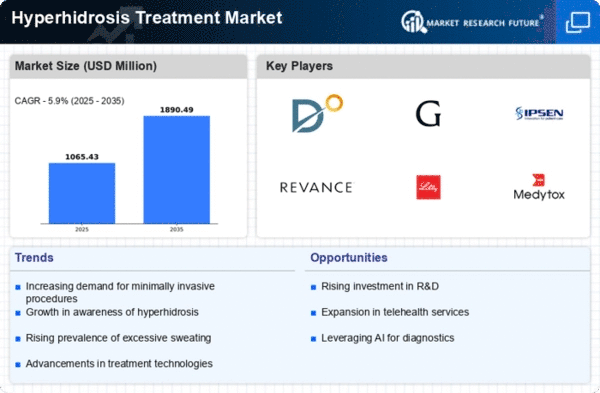
Hyperhidrosis Treatment market size was valued at approximately 1.01 billion USD in 2024. This figure will reach 1.89 billion USD covering all regions (America, Europe, Asia, MEA and ROW), focusing its segments / services / distribution channels till 2035.

What is the CAGR of the Hyperhidrosis Treatment market?

Hyperhidrosis Treatment market is expected to grow at a CAGR of 5.9% between 2025 and 2035.

How much will the Hyperhidrosis Treatment market be worth by 2035?

Hyperhidrosis Treatment market is expected to be worth of 1.89 billion USD, reflecting growth driven by usage, technology and global demands by the end of 2035.

How will the Hyperhidrosis Treatment market perform over the next 10 years?

Over the next 10 years the Hyperhidrosis Treatment market is expected to shift from usd billion 1.01 to 1.89 billion USD, led by adoption of advanced tech, demographic trends, regulatory approvals, with potential headwinds from 2025 to 2035.

Which region held the largest market share in the hyperhidrosis treatment market?

North America had the largest share in the market

Market Summary

As per Market Research Future Analysis, the Hyperhidrosis Treatment Market was valued at 1.01 USD Billion in 2024 and is projected to grow to 1.89 USD Billion by 2035, with a CAGR of 5.90% from 2025 to 2035. The market is driven by the increasing prevalence of axillary hyperhidrosis, particularly in industrialized nations, and the rising demand for innovative treatment options. Recent FDA approvals, such as Brella, and the anticipated launch of Sofdra™ are expected to further stimulate market growth. The market is characterized by a significant focus on product development and strategic acquisitions, enhancing the competitive landscape.

Key Market Trends & Highlights

Key trends driving the hyperhidrosis treatment market include increasing prevalence and innovative treatment options.

  • 365 million people globally experience secondary hyperhidrosis, driving demand for therapies. Botulinum toxin injections are a leading treatment, with effects lasting 4-6 months. Topical treatments dominate the market, with FDA-approved anticholinergic wipes gaining popularity. North America holds the largest market share, driven by technological advancements and high prevalence rates.

Market Size & Forecast

2024 Market Size USD 1.01 Billion
2035 Market Size USD 1.89 Billion
CAGR (2025-2035) 5.90%
Largest Regional Market Share in 2024 North America

Major Players

<p>Key players include Brickell Biotech Inc., Allergan PLC, Cynosure, Dermira Inc., Dermadry Laboratories Inc., GlaxoSmithKline PLC, Sesderma, Miramar Labs Inc., and Ulthera Inc.</p>

Market Trends

An increase in the prevalence of secondary hyperhidrosis is driving the market growth

When an underlying medical condition causes excessive sweating, the disorder is referred to as secondary hyperhidrosis. The less common condition is more likely to cause excessive body sweat. The market for secondary hyperhidrosis therapy is growing as secondary hyperhidrosis prevalence rises. The 2020 International Hyperhidrosis Society estimates that 365 million people, or around 5% of the world's population, experience secondary hyperhidrosis and excessive sweating. In contrast to primary hyperhidrosis, which commonly starts in childhood or adolescence, excessive sweating typically starts in adulthood.

Therefore, chronic illnesses are more prevalent among adults. Due to the rapid rise of the adult population, secondary hyperhidrosis is becoming more common. Additionally, the journal predicts that by 2030, there will be 643 million people living with diabetes worldwide, and by 2045, there will be 783 million. These numbers suggest that as the prevalence of diabetes mellitus increases, so will the incidence of secondary hyperhidrosis. As a result, it is projected that the factors above would enhance demand for hyperhidrosis therapies, aiding the market's overall growth.

Botulinum toxin is a medication used to control medical and cosmetic issues. The therapeutic applications include cervical dystonia, detrusor hyperactivity, chronic migraine, and spastic disorders. It is a member of the class of medications known as neurotoxins. The nerves that regulate the sweat glands in the underarm, foot, and palm regions are momentarily blocked by injections of Botox, a protein produced by the Clostridium botulinum bacteria.

Results are noticeable after five days, but more therapy is needed after four to six months. This time frame is sufficient for curing hyperhidrosis and is therefore anticipated to propel market revenue growth. The market for hyperhidrosis treatment is growing in revenue due to an increase in public awareness of the importance of recognizing and treating disorders like hyperhidrosis.

Using a direct electric current to transmit an ionized material through the skin, tap water iontophoresis is another hyperhidrosis treatment that is becoming increasingly well-liked by patients. Several clinical studies showed considerable improvements in patients with plantar and palmar hyperhidrosis. These beneficial outcomes helped patients live better lives and significantly reduced the sweat they produced. Thus, driving the hyperhidrosis treatment market revenue.

Hyperhidrosis Treatment Market Market Drivers

Market Growth Projections

The Global Hyperhidrosis Treatment Market Industry is poised for substantial growth, with projections indicating an increase from 1.01 USD Billion in 2024 to 1.9 USD Billion by 2035. This growth trajectory reflects a compound annual growth rate (CAGR) of 5.89% from 2025 to 2035. Factors contributing to this expansion include rising awareness of hyperhidrosis, advancements in treatment options, and increased demand for non-invasive therapies. The market's potential is further bolstered by regulatory support for new treatments and a growing emphasis on patient education. These dynamics collectively suggest a robust future for the hyperhidrosis treatment sector.

Regulatory Support and Approval

Regulatory support and approval for new hyperhidrosis treatments are pivotal in driving the Global Hyperhidrosis Treatment Market Industry. Government agencies are increasingly recognizing the need for effective therapies, leading to expedited approval processes for innovative treatments. This regulatory environment fosters research and development, encouraging pharmaceutical companies to invest in new solutions. As a result, the market is likely to benefit from a steady influx of approved products, enhancing treatment options for patients. The projected growth trajectory, with the market expected to reach 1.9 USD Billion by 2035, underscores the significance of regulatory support in facilitating advancements in hyperhidrosis treatment.

Advancements in Treatment Options

Technological advancements in treatment modalities are significantly influencing the Global Hyperhidrosis Treatment Market Industry. New therapies, including botulinum toxin injections, iontophoresis, and microwave therapy, offer patients effective alternatives to traditional methods. These innovations not only enhance treatment efficacy but also improve patient satisfaction. As the market evolves, the introduction of minimally invasive procedures is likely to attract a broader patient base. The anticipated growth from 1.01 USD Billion in 2024 to 1.9 USD Billion by 2035, with a CAGR of 5.89% from 2025 to 2035, underscores the importance of these advancements in meeting diverse patient needs.

Increased Awareness and Education

There is a notable increase in awareness and education regarding hyperhidrosis, which serves as a crucial driver for the Global Hyperhidrosis Treatment Market Industry. Campaigns aimed at educating both healthcare professionals and the public about the condition are gaining traction. This heightened awareness encourages individuals to seek treatment, thereby expanding the patient population. Furthermore, educational initiatives help to destigmatize hyperhidrosis, promoting open discussions about the condition. As more people recognize the availability of effective treatments, the market is likely to see a surge in demand, contributing to its projected growth in the coming years.

Rising Prevalence of Hyperhidrosis

The increasing prevalence of hyperhidrosis globally is a primary driver for the Global Hyperhidrosis Treatment Market Industry. It is estimated that approximately 3% of the population suffers from this condition, leading to a growing demand for effective treatments. As awareness of hyperhidrosis rises, more individuals seek medical intervention, contributing to market growth. The industry is projected to reach 1.01 USD Billion in 2024, reflecting the urgent need for innovative solutions. This trend is likely to continue, as more healthcare providers recognize the impact of hyperhidrosis on quality of life, thus expanding treatment options and accessibility.

Growing Demand for Non-Invasive Treatments

The growing preference for non-invasive treatment options is shaping the Global Hyperhidrosis Treatment Market Industry. Patients increasingly favor procedures that minimize recovery time and reduce the risk of complications. Non-invasive therapies, such as topical treatments and oral medications, are becoming more popular, as they align with patient desires for convenience and safety. This shift in patient preferences is likely to drive market growth, as healthcare providers adapt to meet these demands. The anticipated market expansion from 1.01 USD Billion in 2024 to 1.9 USD Billion by 2035 highlights the potential for non-invasive treatments to capture a significant share of the market.

Market Segment Insights

Hyperhidrosis Treatment Market Treatment Insights

<p>The hyperhidrosis treatment market segmentation, based on treatment includes Botulinum Toxin Injections, Topical Treatment, Surgical Treatment, Oral Medication and Microwave Therapy. The topical treatment segment dominated the market. Topical treatments for hyperhidrosis include aluminum chloride, astringent chemicals, and local anesthetics.</p>

<p>The topical anticholinergic wipes have FDA approval. For cosmetic purposes, the general populous of industrialized countries use over-the-counter antiperspirants to control underarm sweating and odor. But more active treatment is required for those with moderate to severe hyperhidrosis. Compared to people with psoriasis or atopic dermatitis, people with hyperhidrosis have a substantially lower quality of life.</p>

Hyperhidrosis Treatment Market Type Insights

<p>The hyperhidrosis treatment market segmentation, based on type, includes Primary Hyperhidrosis and Secondary Generalized Hyperhidrosis. The primary hyperhidrosis category generated the most income. Primary hyperhidrosis, a condition that produces excessive sweating in those areas, affects several body parts, including the underarms, feet, and palms.</p>

<p>Primary hyperhidrosis is excessive sweating in the axillae, palms, soles, or craniofacial region that is bilaterally symmetric and unrelated to other underlying illnesses. Primarily inherited, primary hyperhidrosis normally first appears in childhood and worsens with puberty, especially in women. People affected could react more strongly to stimuli that can make them sweat, such as stress, anxiety, exercise, pain, coffee, and nicotine.</p>

<p>Figure 1: Hyperhidrosis Treatment Market, by Type, 2022 &amp; 2034 (USD Billion)&nbsp;</p>

Hyperhidrosis Treatment Market End-User Insights

<p>The hyperhidrosis treatment market segmentation, based on end-user, includes Dermatology Clinics, Ambulatory Surgery Centers and Payers/Patients. The dermatology clinics category generated the most income. This market will be driven by the rising demand for minimally invasive procedures, non-invasive surgery, and medication therapies in the upcoming years. Additionally, due to their high price range and quality service provided at the end, many patients choose to visit a clinic rather than have surgery. This helps produce money in return.</p>

Get more detailed insights about Hyperhidrosis Treatment Market Research Report - Forecast till 2035

Regional Insights

By region, the study provides the market insights into North America, Europe, Asia-Pacific and Rest of the World. The North American hyperhidrosis treatment market area will dominate this market. The market is driven by the nation's large market players, technological advancements, the rising incidence of primary hyperhidrosis, cancer, cardiovascular disorders that exacerbate secondary hyperhidrosis, and the rising prevalence of primary hyperhidrosis. Due to the high frequency of primary and secondary hyperhidrosis, treatment adoption will increase nationally.

Further, the major countries studied in the market report are The US, Canada, German, France, the UK, Italy, Spain, China, Japan, India, Australia, South Korea, and Brazil.

Figure 2: HYPERHIDROSIS TREATMENT MARKET SHARE BY REGION 2022 (USD Billion) 

HYPERHIDROSIS TREATMENT MARKET SHARE BY REGION 2022

Source: Secondary Research, Primary Research, Market Research Future Database and Analyst Review

Europe hyperhidrosis treatment market accounts for the second-largest market share. Several international pharmaceutical and medical device companies with a sizable presence in Germany are working on hyperhidrosis remedies. Additionally, it is anticipated that the expansion of hyperhidrosis-related research and development and the rise in primary and secondary hyperhidrosis prevalence will fuel market growth throughout the projected decade. Further, the German hyperhidrosis treatment market held the largest market share, and the UK hyperhidrosis treatment market was the fastest growing market in the European region.

The Asia-Pacific Hyperhidrosis treatment Market is expected to grow at the fastest CAGR from 2023 to 2034 because of enhanced technology developments that produce safe and side-effect-free treatment alternatives and support from public and commercial entities. Similarly to this, it is anticipated that greater investment by biotechnology and pharmaceutical businesses will raise industry demand. Moreover, China’s hyperhidrosis treatment market held the largest market share, and the Indian hyperhidrosis treatment market was the fastest growing market in the Asia-Pacific region.

Key Players and Competitive Insights

Leading market players are investing heavily in research and development in order to expand their product lines, which will help the hyperhidrosis treatment market, grow even more. Market participants are also undertaking a variety of strategic activities to expand their footprint, with important market developments including new product launches, contractual agreements, mergers and acquisitions, higher investments, and collaboration with other organizations. To expand and survive in a more competitive and rising market climate, hyperhidrosis treatment industry must offer cost-effective items.

Manufacturing locally to minimize operational costs is one of the key business tactics used by manufacturers in the hyperhidrosis treatment industry to benefit clients and increase the market sector. In recent years, the hyperhidrosis treatment industry has offered some of the most significant advantages to market. Major players in the hyperhidrosis treatment market attempting to increase market demand by investing in research and development operations include Brickell Biotech Inc. (US), Allergan PLC (Ireland), Cynosure (US), Dermira Inc. (US), Dermadry Laboratories inc. (Canada), GlaxoSmithKline PLC (UK), Sesderma (Spain), Miramar Labs Inc. (US) and Ulthera Inc. (US).

A division of AbbVie Inc., Allergan Ltd. (Allergan) is a specialty pharmaceutical company that creates and markets biosimilar and over-the-counter (OTC) medications and branded prescription drugs. It provides products for the central nervous system, dermatology, eye care, women's health, urology, medical aesthetics, and anti-infective therapeutic categories. The business sells its goods to retailers, distributors, national chains of grocery and drug stores, drug wholesalers, mail-order businesses, healthcare facilities including hospitals and clinics, government organizations, and managed healthcare providers like HMOs and other organizations.

The major producer of iontophoresis devices for treating hyperhidrosis, a disease that causes excessive sweating and affects one in twenty persons globally, is Dermadry. It offers three specialized treatments for the hands, feet, and underarms—the three areas most frequently impacted by hyperhidrosis. The Dermadry Hands & Feet, Dermadry Underarms, and the all-in-one Dermadry Total are among the Canadian-made iontophoresis devices offered by this company.

Key Companies in the Hyperhidrosis Treatment Market market include

Industry Developments

  • Q2 2024: Journey Medical Receives FDA Approval for QBREXZA® (glycopyrronium) Cloth for the Treatment of Primary Axillary Hyperhidrosis in Pediatric Patients Aged 9 Years and Older Journey Medical announced that the U.S. FDA approved an expanded indication for QBREXZA® (glycopyrronium) cloth, now including pediatric patients aged 9 years and older for the treatment of primary axillary hyperhidrosis.
  • Q2 2024: Brickell Biotech Announces FDA Acceptance of New Drug Application for Sofpironium Bromide Gel, 15%, for the Treatment of Primary Axillary Hyperhidrosis Brickell Biotech reported that the FDA accepted its New Drug Application for sofpironium bromide gel, 15%, for the treatment of primary axillary hyperhidrosis in adults and children aged 9 years and older.
  • Q1 2024: Candesant Biomedical Announces FDA Clearance of Brella™ SweatControl Patch for the Treatment of Primary Axillary Hyperhidrosis Candesant Biomedical received FDA clearance for its Brella™ SweatControl Patch, a novel, non-invasive treatment for primary axillary hyperhidrosis.
  • Q2 2024: Dermira Announces European Commission Approval of QBREXZA® (glycopyrronium) for the Treatment of Primary Axillary Hyperhidrosis Dermira received approval from the European Commission for QBREXZA® (glycopyrronium) for the treatment of primary axillary hyperhidrosis in adults and children aged 9 years and older.
  • Q1 2024: Candesant Biomedical Raises $35 Million in Series B Financing to Support Commercial Launch of Brella™ SweatControl Patch Candesant Biomedical closed a $35 million Series B funding round to support the commercial launch and scale-up of its FDA-cleared Brella™ SweatControl Patch for hyperhidrosis.
  • Q2 2024: Journey Medical Announces Commercial Launch of QBREXZA® (glycopyrronium) Cloth for Pediatric Hyperhidrosis Patients Journey Medical launched QBREXZA® (glycopyrronium) cloth for pediatric patients with primary axillary hyperhidrosis following FDA approval of the expanded indication.
  • Q1 2024: Brickell Biotech Enters Strategic Partnership with Kaken Pharmaceutical for Commercialization of Sofpironium Bromide Gel in Japan Brickell Biotech entered a strategic partnership with Kaken Pharmaceutical to commercialize sofpironium bromide gel for hyperhidrosis in Japan.
  • Q2 2024: Candesant Biomedical Announces U.S. Commercial Launch of Brella™ SweatControl Patch Candesant Biomedical announced the U.S. commercial launch of its FDA-cleared Brella™ SweatControl Patch for the treatment of primary axillary hyperhidrosis.
  • Q1 2024: Dermira Appoints New Chief Commercial Officer to Lead Hyperhidrosis Franchise Dermira appointed a new Chief Commercial Officer to oversee the commercial strategy and expansion of its hyperhidrosis treatment portfolio.
  • Q2 2024: Journey Medical Expands Manufacturing Facility to Increase QBREXZA® Production Capacity Journey Medical expanded its manufacturing facility to increase production capacity for QBREXZA® (glycopyrronium) cloth, supporting growing demand in the hyperhidrosis market.

Future Outlook

Hyperhidrosis Treatment Market Future Outlook

<p>The Hyperhidrosis Treatment Market is projected to grow at a 5.90% CAGR from 2024 to 2034, driven by increasing awareness, technological advancements, and rising demand for effective treatments.</p>

New opportunities lie in:

  • <p>Develop innovative, non-invasive treatment options to cater to a broader patient demographic. Leverage telemedicine platforms for remote consultations and follow-ups to enhance patient access. Invest in targeted marketing strategies to raise awareness in underserved regions.</p>

<p>By 2035, the Hyperhidrosis Treatment Market is expected to achieve substantial growth, reflecting evolving patient needs and treatment innovations.</p>

Market Segmentation

Hyperhidrosis Treatment Type Outlook (USD Billion, 2018-2034)

  • Primary Hyperhidrosis
  • Secondary Generalized Hyperhidrosis

Hyperhidrosis Treatment End-User Outlook (USD Billion, 2018-2034)

  • Dermatology Clinics
  • Ambulatory Surgery Centers
  • Payers/Patients.webp

Hyperhidrosis Treatment Treatment Outlook (USD Billion, 2018-2034)

  • Botulinum Toxin Injections
  • Topical Treatment
  • Surgical Treatment
  • Oral Medication
  • Microwave Therapy

Report Scope

Report Attribute/MetricDetails
Market Size 2024   1.01 (USD Billion)
Market Size 2025   1.07 (USD Billion)
Market Size 20351.89 (USD Billion)
Compound Annual Growth Rate (CAGR)5.90% (2025 - 2035)
Report CoverageRevenue Forecast, Competitive Landscape, Growth Factors, and Trends
Base Year2024
Market Forecast Period2025 - 2035
Historical Data2020 - 2024
Report CoverageRevenue Forecast, Market Competitive Landscape, Growth Factors, and Trends
Segments CoveredTreatment, Type, End-User, and Region
Geographies CoveredNorth America, Europe, Asia Pacific, and the Rest of the World
Countries CoveredThe US, Canada, German, France, UK, Italy, Spain, China, Japan, India, Australia, South Korea, and Brazil
Key Companies ProfiledBrickell Biotech Inc. (US), Allergan PLC (Ireland), Cynosure (US), Dermira Inc. (US), Dermadry Laboratories inc. (Canada), GlaxoSmithKline PLC (UK), Sesderma (Spain), Miramar Labs Inc. (US) and Ulthera Inc. (US)
Key Market OpportunitiesIncreasing research studies being conducted for the treatment of hyperhidrosisExtensive use of botulinum toxin injections
Key Market DynamicsDevelopment in laser and electronic therapy for hyperhidrosis treatmentRising support by the public and private companies

FAQs

What is the projected growth of the Hyperhidrosis Treatment market?

The Hyperhidrosis Treatment market is the expected increase in total market value of 1.89 USD billion over a defined forecast period 2025–2035. It is driven by factors such as demand trends, technological advances, regulatory changes, and geographic expansion.

What is the size of the Hyperhidrosis Treatment market?

Hyperhidrosis Treatment market size was valued at approximately 1.01 billion USD in 2024. This figure will reach 1.89 billion USD covering all regions (America, Europe, Asia, MEA and ROW), focusing its segments / services / distribution channels till 2035.

What is the CAGR of the Hyperhidrosis Treatment market?

Hyperhidrosis Treatment market is expected to grow at a CAGR of 5.9% between 2025 and 2035.

How much will the Hyperhidrosis Treatment market be worth by 2035?

Hyperhidrosis Treatment market is expected to be worth of 1.89 billion USD, reflecting growth driven by usage, technology and global demands by the end of 2035.

How will the Hyperhidrosis Treatment market perform over the next 10 years?

Over the next 10 years the Hyperhidrosis Treatment market is expected to shift from usd billion 1.01 to 1.89 billion USD, led by adoption of advanced tech, demographic trends, regulatory approvals, with potential headwinds from 2025 to 2035.

Which region held the largest market share in the hyperhidrosis treatment market?

North America had the largest share in the market

  1. EXECUTIVE SUMMARY
    1. Market Attractiveness Analysis
      1. Global Hyperhidrosis Treatment Market, by Type
      2. Global Hyperhidrosis Treatment Market, by Treatment
      3. Global Hyperhidrosis Treatment Market, by End User
  2. MARKET INTRODUCTION
    1. Definition
    2. Scope of the Study
      1. Research Objective
      2. Assumptions
      3. Limitations
  3. RESEARCH METHODOLOGY
    1. Overview
    2. Data Mining
    3. Secondary Research
    4. Primary Research
    5. Breakdown of Primary Respondents
    6. Forecasting Techniques
    7. Research Methodology for Market Size Estimation
    8. Bottom-Up Approach
    9. Top-Down Approach
    10. Data Triangulation
    11. Validation
  4. MARKET DYNAMICS
    1. Overview
    2. Drivers
    3. Restraints
    4. Opportunities
  5. MARKET FACTOR ANALYSIS
    1. Porter’s Five Forces Analysis
      1. Bargaining Power of Suppliers
      2. Bargaining Power of Buyers
      3. Threat of New Entrants
      4. Threat of Substitutes
      5. Intensity of Rivalry
    2. Value Chain Analysis
      1. R&D and Designing
      2. Manufacturing
      3. Distribution & Sales
      4. Post Sales Services
    3. Pipeline Product Analysis
  6. GLOBAL HYPERHIDROSIS TREATMENT MARKET, BY TYPE
    1. Overview
    2. Primary Hyperhidrosis
  7. Market Estimates & Forecast, by Region, 2020–2027
  8. Market Estimates & Forecast, by Country, 2020–2027
    1. Secondary Generalized Hyperhidrosis
  9. Market Estimates & Forecast, by Region, 2020–2027
  10. Market Estimates & Forecast, by Country, 2020–2027
  11. GLOBAL HYPERHIDROSIS TREATMENT MARKET, BY TREATMENT
    1. Overview
    2. Botulinum Toxin Injections
  12. Market Estimates & Forecast, by Region, 2020–2027
  13. Market Estimates & Forecast, by Country, 2020–2027
    1. Topical Treatment
  14. Market Estimates & Forecast, by Region, 2020–2027
  15. Market Estimates & Forecast, by Country, 2020–2027
    1. Surgical Treatment
  16. Market Estimates & Forecast, by Region, 2020–2027
  17. Market Estimates & Forecast, by Country, 2020–2027
    1. Oral Medication
  18. Market Estimates & Forecast, by Region, 2020–2027
  19. Market Estimates & Forecast, by Country, 2020–2027
    1. Microwave Therapy
  20. Market Estimates & Forecast, by Region, 2020–2027
  21. Market Estimates & Forecast, by Country, 2020–2027
    1. Others
  22. Market Estimates & Forecast, by Region, 2020–2027
  23. Market Estimates & Forecast, by Country, 2020–2027
  24. GLOBAL HYPERHIDROSIS TREATMENT MARKET, BY END USER
    1. Overview
    2. Dermatology Clinics
  25. Market Estimates & Forecast, by Region, 2020–2027
  26. Market Estimates & Forecast, by Country, 2020–2027
    1. Ambulatory Surgery Centers
  27. Market Estimates & Forecast, by Region, 2020–2027
  28. Market Estimates & Forecast, by Country, 2020–2027
    1. Payers/Patients
  29. Market Estimates & Forecast, by Region, 2020–2027
  30. Market Estimates & Forecast, by Country, 2020–2027
    1. Others
  31. Market Estimates & Forecast, by Region, 2020–2027
  32. Market Estimates & Forecast, by Country, 2020–2027
  33. GLOBAL HYPERHIDROSIS TREATMENT MARKET, BY REGION
    1. Overview
    2. Americas
      1. North America
      2. Latin America
    3. Europe
      1. Western Europe
      2. Eastern Europe
    4. Asia-Pacific
      1. Japan
      2. China
      3. India
      4. Australia
      5. South Korea
      6. Rest of Asia-Pacific
    5. Middle East & Africa
      1. Middle East
      2. Africa
  34. COMPANY LANDSCAPE
    1. Overview
    2. Competitor Dashboard
    3. Major Growth Strategy in the Global Hyperhidrosis Treatment Market
    4. Competitive Benchmarking
    5. The Leading Player in terms of Number of Developments in the Global Hyperhidrosis Treatment Market
    6. Key Developments & Growth Strategies
    7. Major Players Financial Matrix & Market Ratio
  35. COMPANY PROFILE
    1. Allergan PLC
      1. Company Overview
      2. Products/Services Offered
      3. Financial Overview
      4. Key Developments
      5. SWOT Analysis
      6. Key Strategies
    2. Brickell Biotech Inc.
    3. Cynosure
    4. Dermadry Laboratories lnc.
    5. Dermira Inc.
    6. GlaxoSmithKline PLC
    7. Miramar Labs, Inc.
    8. Sesderma
    9. Ulthera Inc.
    10. Others
  36. APPENDIX
    1. References
    2. Related Reports
  37. LIST OF TABLES
  38. GLOBAL HYPERHIDROSIS TREATMENT MARKET SYNOPSIS, 2020–2027
  39. GLOBAL HYPERHIDROSIS TREATMENT MARKET ESTIMATES & FORECAST, 2020–2027 (USD MILLION)
  40. GLOBAL HYPERHIDROSIS TREATMENT MARKET, BY TYPE, 2020–2027 (USD MILLION)
  41. GLOBAL HYPERHIDROSIS TREATMENT MARKET, BY TREATMENT, 2020–2027 (USD MILLION)
  42. GLOBAL HYPERHIDROSIS TREATMENT MARKET, BY END USER, 2020–2027 (USD MILLION)
  43. GLOBAL HYPERHIDROSIS TREATMENT MARKET, BY REGION, 2020–2027 (USD MILLION)
  44. NORTH AMERICA: HYPERHIDROSIS TREATMENT MARKET, BY TYPE, 2020–2027 (USD MILLION)
  45. NORTH AMERICA: HYPERHIDROSIS TREATMENT MARKET, BY TREATMENT, 2020–2027 (USD MILLION)
  46. NORTH AMERICA: HYPERHIDROSIS TREATMENT MARKET, BY END USER, 2020–2027 (USD MILLION)
  47. US: HYPERHIDROSIS TREATMENT MARKET, BY TYPE, 2020–2027 (USD MILLION)
  48. US: HYPERHIDROSIS TREATMENT MARKET, BY TREATMENT, 2020–2027 (USD MILLION)
  49. US: HYPERHIDROSIS TREATMENT MARKET, BY END USER, 2020–2027 (USD MILLION)
  50. CANADA: HYPERHIDROSIS TREATMENT MARKET, BY TYPE, 2020–2027 (USD MILLION)
  51. CANADA: HYPERHIDROSIS TREATMENT MARKET, BY TREATMENT, 2020–2027 (USD MILLION)
  52. CANADA: HYPERHIDROSIS TREATMENT MARKET, BY END USER, 2020–2027 (USD MILLION)
  53. LATIN AMERICA: HYPERHIDROSIS TREATMENT MARKET, BY TYPE, 2020–2027 (USD MILLION)
  54. LATIN AMERICA: HYPERHIDROSIS TREATMENT MARKET, BY TREATMENT, 2020–2027 (USD MILLION)
  55. LATIN AMERICA: HYPERHIDROSIS TREATMENT MARKET, BY END USER, 2020–2027 (USD MILLION)
  56. EUROPE: HYPERHIDROSIS TREATMENT MARKET, BY TYPE, 2020–2027 (USD MILLION)
  57. EUROPE: HYPERHIDROSIS TREATMENT MARKET, BY TREATMENT, 2020–2027 (USD MILLION)
  58. EUROPE: HYPERHIDROSIS TREATMENT MARKET, BY END USER, 2020–2027 (USD MILLION)
  59. WESTERN EUROPE: HYPERHIDROSIS TREATMENT MARKET, BY TYPE, 2020–2027 (USD MILLION)
  60. WESTERN EUROPE: HYPERHIDROSIS TREATMENT MARKET, BY TREATMENT, 2020–2027 (USD MILLION)
  61. WESTERN EUROPE: HYPERHIDROSIS TREATMENT MARKET, BY END USER, 2020–2027 (USD MILLION)
  62. EASTERN EUROPE: HYPERHIDROSIS TREATMENT MARKET, BY TYPE, 2020–2027 (USD MILLION)
  63. EASTERN EUROPE: HYPERHIDROSIS TREATMENT MARKET, BY TREATMENT, 2020–2027 (USD MILLION)
  64. EASTERN EUROPE: HYPERHIDROSIS TREATMENT MARKET, BY END USER, 2020–2027 (USD MILLION)
  65. ASIA-PACIFIC: HYPERHIDROSIS TREATMENT MARKET, BY TYPE, 2020–2027 (USD MILLION)
  66. ASIA-PACIFIC: HYPERHIDROSIS TREATMENT MARKET, BY TREATMENT, 2020–2027 (USD MILLION)
  67. ASIA-PACIFIC: HYPERHIDROSIS TREATMENT MARKET, BY END USER, 2020–2027 (USD MILLION)
  68. MIDDLE EAST & AFRICA: HYPERHIDROSIS TREATMENT MARKET, BY TYPE, 2020–2027 (USD MILLION)
  69. MIDDLE EAST & AFRICA: HYPERHIDROSIS TREATMENT MARKET, BY TREATMENT, 2020–2027 (USD MILLION)
  70. MIDDLE EAST & AFRICA: HYPERHIDROSIS TREATMENT MARKET, BY END USER, 2020–2027 (USD MILLION)
  71. LIST OF FIGURES
  72. RESEARCH PROCESS
  73. MARKET STRUCTURE FOR THE GLOBAL HYPERHIDROSIS TREATMENT MARKET
  74. MARKET DYNAMICS FOR THE GLOBAL HYPERHIDROSIS TREATMENT MARKET
  75. GLOBAL HYPERHIDROSIS TREATMENT MARKET SHARE, BY TYPE, 2020 (%)
  76. GLOBAL HYPERHIDROSIS TREATMENT MARKET SHARE, BY TREATMENT, 2020 (%)
  77. GLOBAL HYPERHIDROSIS TREATMENT MARKET SHARE, BY END USER, 2020 (%)
  78. GLOBAL HYPERHIDROSIS TREATMENT MARKET SHARE, BY REGION, 2020 (%)
  79. AMERICAS: HYPERHIDROSIS TREATMENT MARKET SHARE BY REGION, 2020 (%)
  80. NORTH AMERICA: HYPERHIDROSIS TREATMENT MARKET SHARE, BY COUNTRY, 2020 (%)
  81. EUROPE: HYPERHIDROSIS TREATMENT MARKET SHARE, BY REGION, 2020 (%)
  82. WESTERN EUROPE: HYPERHIDROSIS TREATMENT MARKET SHARE, BY COUNTRY, 2020 (%)
  83. ASIA-PACIFIC: HYPERHIDROSIS TREATMENT MARKET SHARE, BY COUNTRY, 2020 (%)
  84. MIDDLE EAST & AFRICA: HYPERHIDROSIS TREATMENT MARKET SHARE, BY COUNTRY, 2020 (%)
  85. GLOBAL HYPERHIDROSIS TREATMENT MARKET: COMPANY SHARE ANALYSIS, 2020 (%)
  86. ALLERGAN PLC: KEY FINANCIALS
  87. ALLERGAN PLC: SEGMENTAL REVENUE
  88. ALLERGAN PLC: REGIONAL REVENUE
  89. BRICKELL BIOTECH INC.: KEY FINANCIALS
  90. BRICKELL BIOTECH INC.: SEGMENTAL REVENUE
  91. BRICKELL BIOTECH INC.: REGIONAL REVENUE
  92. CYNOSURE: KEY FINANCIALS
  93. CYNOSURE: SEGMENTAL REVENUE
  94. CYNOSURE: REGIONAL REVENUE
  95. DERMIRA INC.: KEY FINANCIALS
  96. DERMIRA INC.: SEGMENTAL REVENUE
  97. DERMIRA INC.: REGIONAL REVENUE
  98. GLAXOSMITHKLINE PLC: KEY FINANCIALS
  99. GLAXOSMITHKLINE PLC: SEGMENTAL REVENUE
  100. GLAXOSMITHKLINE PLC: REGIONAL REVENUE
  101. MIRAMAR LABS, INC.: KEY FINANCIALS
  102. MIRAMAR LABS, INC.: SEGMENTAL REVENUE
  103. MIRAMAR LABS, INC.: REGIONAL REVENUE
    1. "

Market Segmentation

Hyperhidrosis Treatment Treatment Outlook (USD Billion, 2018-2034)

Botulinum Toxin Injections

Topical Treatment

Surgical Treatment

Oral Medication

Microwave Therapy

Hyperhidrosis Treatment Type Outlook (USD Billion, 2018-2034)

Primary Hyperhidrosis

Secondary Generalized Hyperhidrosis

Hyperhidrosis Treatment End-User Outlook (USD Billion, 2018-2034)

Dermatology Clinics

Ambulatory Surgery Centers

Payers/Patients

Hyperhidrosis Treatment Regional Outlook (USD Billion, 2018-2034)

North America Outlook (USD Billion, 2018-2034)

North America Hyperhidrosis Treatment by Treatment

Botulinum Toxin Injections

Topical Treatment

Surgical Treatment

Oral Medication

Microwave Therapy

North America Hyperhidrosis Treatment by Type

Primary Hyperhidrosis

Secondary Generalized Hyperhidrosis

North America Hyperhidrosis Treatment by End-User

Dermatology Clinics

Ambulatory Surgery Centers

Payers/Patients

US Outlook (USD Billion, 2018-2034)

US Hyperhidrosis Treatment by Treatment

Botulinum Toxin Injections

Topical Treatment

Surgical Treatment

Oral Medication

Microwave Therapy

US Hyperhidrosis Treatment by Type

Primary Hyperhidrosis

Secondary Generalized Hyperhidrosis

US Hyperhidrosis Treatment by End-User

Dermatology Clinics

Ambulatory Surgery Centers

Payers/Patients

Canada Outlook (USD Billion, 2018-2034)

Canada Hyperhidrosis Treatment by Treatment

Botulinum Toxin Injections

Topical Treatment

Surgical Treatment

Oral Medication

Microwave Therapy

Canada Hyperhidrosis Treatment by Type

Primary Hyperhidrosis

Secondary Generalized Hyperhidrosis

Canada Hyperhidrosis Treatment by End-User

Dermatology Clinics

Ambulatory Surgery Centers

Payers/Patients

Europe Outlook (USD Billion, 2018-2034)

Europe Hyperhidrosis Treatment by Treatment

Botulinum Toxin Injections

Topical Treatment

Surgical Treatment

Oral Medication

Microwave Therapy

Europe Hyperhidrosis Treatment by Type

Primary Hyperhidrosis

Secondary Generalized Hyperhidrosis

Europe Hyperhidrosis Treatment by End-User

Dermatology Clinics

Ambulatory Surgery Centers

Payers/Patients

Germany Outlook (USD Billion, 2018-2034)

Germany Hyperhidrosis Treatment by Treatment

Botulinum Toxin Injections

Topical Treatment

Surgical Treatment

Oral Medication

Microwave Therapy

Germany Hyperhidrosis Treatment by Type

Primary Hyperhidrosis

Secondary Generalized Hyperhidrosis

Germany Hyperhidrosis Treatment by End-User

Dermatology Clinics

Ambulatory Surgery Centers

Payers/Patients

France Outlook (USD Billion, 2018-2034)

France Hyperhidrosis Treatment by Treatment

Botulinum Toxin Injections

Topical Treatment

Surgical Treatment

Oral Medication

Microwave Therapy

France Hyperhidrosis Treatment by Type

Primary Hyperhidrosis

Secondary Generalized Hyperhidrosis

France Hyperhidrosis Treatment by End-User

Dermatology Clinics

Ambulatory Surgery Centers

Payers/Patients

UK Outlook (USD Billion, 2018-2034)

UK Hyperhidrosis Treatment by Treatment

Botulinum Toxin Injections

Topical Treatment

Surgical Treatment

Oral Medication

Microwave Therapy

UK Hyperhidrosis Treatment by Type

Primary Hyperhidrosis

Secondary Generalized Hyperhidrosis

UK Hyperhidrosis Treatment by End-User

Dermatology Clinics

Ambulatory Surgery Centers

Payers/Patients

Italy Outlook (USD Billion, 2018-2034)

Italy Hyperhidrosis Treatment by Treatment

Botulinum Toxin Injections

Topical Treatment

Surgical Treatment

Oral Medication

Microwave Therapy

Italy Hyperhidrosis Treatment by Type

Primary Hyperhidrosis

Secondary Generalized Hyperhidrosis

Italy Hyperhidrosis Treatment by End-User

Dermatology Clinics

Ambulatory Surgery Centers

Payers/Patients

Spain Outlook (USD Billion, 2018-2034)

Spain Hyperhidrosis Treatment by Treatment

Botulinum Toxin Injections

Topical Treatment

Surgical Treatment

Oral Medication

Microwave Therapy

Spain Hyperhidrosis Treatment by Type

Primary Hyperhidrosis

Secondary Generalized Hyperhidrosis

Spain Hyperhidrosis Treatment by End-User

Dermatology Clinics

Ambulatory Surgery Centers

Payers/Patients

Rest Of Europe Outlook (USD Billion, 2018-2034)

Rest Of Europe Hyperhidrosis Treatment by Treatment

Botulinum Toxin Injections

Topical Treatment

Surgical Treatment

Oral Medication

Microwave Therapy

Rest Of Europe Hyperhidrosis Treatment by Type

Primary Hyperhidrosis

Secondary Generalized Hyperhidrosis

Rest Of Europe Hyperhidrosis Treatment by End-User

Dermatology Clinics

Ambulatory Surgery Centers

Payers/Patients

Asia-Pacific Outlook (USD Billion, 2018-2034)

Asia-Pacific Hyperhidrosis Treatment by Treatment

Botulinum Toxin Injections

Topical Treatment

Surgical Treatment

Oral Medication

Microwave Therapy

Asia-Pacific Hyperhidrosis Treatment by Type

Primary Hyperhidrosis

Secondary Generalized Hyperhidrosis

Asia-Pacific Hyperhidrosis Treatment by End-User

Dermatology Clinics

Ambulatory Surgery Centers

Payers/Patients

China Outlook (USD Billion, 2018-2034)

China Hyperhidrosis Treatment by Treatment

Botulinum Toxin Injections

Topical Treatment

Surgical Treatment

Oral Medication

Microwave Therapy

China Hyperhidrosis Treatment by Type

Primary Hyperhidrosis

Secondary Generalized Hyperhidrosis

China Hyperhidrosis Treatment by End-User

Dermatology Clinics

Ambulatory Surgery Centers

Payers/Patients

Japan Outlook (USD Billion, 2018-2034)

Japan Hyperhidrosis Treatment by Treatment

Botulinum Toxin Injections

Topical Treatment

Surgical Treatment

Oral Medication

Microwave Therapy

Japan Hyperhidrosis Treatment by Type

Primary Hyperhidrosis

Secondary Generalized Hyperhidrosis

Japan Hyperhidrosis Treatment by End-User

Dermatology Clinics

Ambulatory Surgery Centers

Payers/Patients

India Outlook (USD Billion, 2018-2034)

India Hyperhidrosis Treatment by Treatment

Botulinum Toxin Injections

Topical Treatment

Surgical Treatment

Oral Medication

Microwave Therapy

India Hyperhidrosis Treatment by Type

Primary Hyperhidrosis

Secondary Generalized Hyperhidrosis

India Hyperhidrosis Treatment by End-User

Dermatology Clinics

Ambulatory Surgery Centers

Payers/Patients

Australia Outlook (USD Billion, 2018-2034)

Australia Hyperhidrosis Treatment by Treatment

Botulinum Toxin Injections

Topical Treatment

Surgical Treatment

Oral Medication

Microwave Therapy

Australia Hyperhidrosis Treatment by Type

Primary Hyperhidrosis

Secondary Generalized Hyperhidrosis

Australia Hyperhidrosis Treatment by End-User

Dermatology Clinics

Ambulatory Surgery Centers

Payers/Patients

Rest of Asia-Pacific Outlook (USD Billion, 2018-2034)

Rest of Asia-Pacific Hyperhidrosis Treatment by Treatment

Botulinum Toxin Injections

Topical Treatment

Surgical Treatment

Oral Medication

Microwave Therapy

Rest of Asia-Pacific Hyperhidrosis Treatment by Type

Primary Hyperhidrosis

Secondary Generalized Hyperhidrosis

Rest of Asia-Pacific Hyperhidrosis Treatment by End-User

Dermatology Clinics

Ambulatory Surgery Centers

Payers/Patients

Rest of the World Outlook (USD Billion, 2018-2034)

Rest of the World Hyperhidrosis Treatment by Treatment

Botulinum Toxin Injections

Topical Treatment

Surgical Treatment

Oral Medication

Microwave Therapy

Rest of the World Hyperhidrosis Treatment by Type

Primary Hyperhidrosis

Secondary Generalized Hyperhidrosis

Rest of the World Hyperhidrosis Treatment by End-User

Dermatology Clinics

Ambulatory Surgery Centers

Payers/Patients

Middle East Outlook (USD Billion, 2018-2034)

Middle East Hyperhidrosis Treatment by Treatment

Botulinum Toxin Injections

Topical Treatment

Surgical Treatment

Oral Medication

Microwave Therapy

Middle East Hyperhidrosis Treatment by Type

Primary Hyperhidrosis

Secondary Generalized Hyperhidrosis

Middle East Hyperhidrosis Treatment by End-User

Dermatology Clinics

Ambulatory Surgery Centers

Payers/Patients

Africa Outlook (USD Billion, 2018-2034)

Africa Hyperhidrosis Treatment by Treatment

Botulinum Toxin Injections

Topical Treatment

Surgical Treatment

Oral Medication

Microwave Therapy

Africa Hyperhidrosis Treatment by Type

Primary Hyperhidrosis

Secondary Generalized Hyperhidrosis

Africa Hyperhidrosis Treatment by End-User

Dermatology Clinics

Ambulatory Surgery Centers

Payers/Patients

Latin America Outlook (USD Billion, 2018-2034)

Latin America Hyperhidrosis Treatment by Treatment

Botulinum Toxin Injections

Topical Treatment

Surgical Treatment

Oral Medication

Microwave Therapy

Latin America Hyperhidrosis Treatment by Type

Primary Hyperhidrosis

Secondary Generalized Hyperhidrosis

Latin America Hyperhidrosis Treatment by End-User

Dermatology Clinics

Ambulatory Surgery Centers

Payers/Patients

Infographic

Free Sample Request

Kindly complete the form below to receive a free sample of this Report

Get Free Sample

Customer Strories

Compare Licence

×
Features License Type
Single User Multiuser License Enterprise User
Price $4,950 $5,950 $7,250
Maximum User Access Limit 1 User Upto 10 Users Unrestricted Access Throughout the Organization
Free Customization
Direct Access to Analyst
Deliverable Format
Platform Access
Discount on Next Purchase 10% 15% 15%
Printable Versions