×
Request Free Sample ×

Kindly complete the form below to receive a free sample of this Report

* Please use a valid business email

Leading companies partner with us for data-driven Insights

clients tt-cursor
Hero Background
English
Chinese
French
Japanese
Korean
German
Spanish

Hydrographic Survey Equipment Market Size

ID: MRFR/AD/8146-HCR
168 Pages
Sejal Akre
October 2025

Hydrographic Survey Equipment Market Size, Share, Industry Trend & Analysis Research Report Information by Type (Sensing Systems, Positioning Systems, Subsea Sensors, Software and Unmanned Vehicles), Depth (Shallow Water and Deep Water), Application (Hydrographic Charting, Offshore Oil Gas Survey, Port Harbor Management and Coastal Engineering), End User (Commercial, Research and Defense) and Region (North America, Europe, Asia-Pacific, Middle East Africa and Latin America) - Forecast till 2035

Share:
Download PDF ×

We do not share your information with anyone. However, we may send you emails based on your report interest from time to time. You may contact us at any time to opt-out.

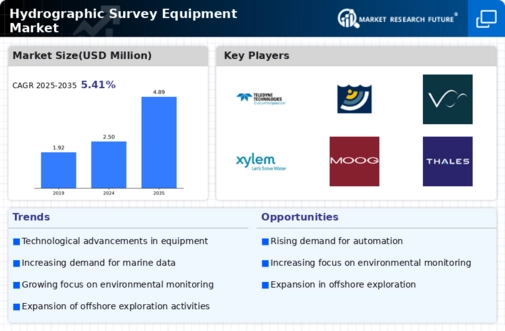
Hydrographic Survey Equipment Market Infographic
Purchase Options

Hydrographic Survey Equipment Size

Hydrographic Survey Equipment Market Growth Projections and Opportunities

Various factors influence the Hydrographic Survey Equipment Market, which functions in a dynamic framework that shapes marine surveying technologies as a whole. The primary market driver is the need for detailed and accurate hydrographic data to support maritime activities, coastal zone management and infrastructure development. As the maritime industry expands, there is growing demand for sophisticated survey equipment that can accurately map and monitor seafloors and underwater environments.

In shaping dynamics of the Hydrographic Survey Equipment Market, technological advancement is central. Various technologies including advanced sonar systems, multibeam echosounders, and LiDAR are continually evolving in the industry thereby enhancing capabilities of hydrographic survey equipment. The market dynamics are characterized by a constant pursuit of innovation towards better accuracy of surveys, efficiency and quality of data. This leads to introduction of state-of-the-art instruments supported by ongoing research and development efforts to satisfy changing needs from hydrography users.

Interoperability within the Hydrographic Survey Equipment Market is important because it has a global nature with respect to hydrographic surveying activities. In many instances surveyors cover diverse geographic regions working together on international projects. Thus, market dynamics are determined by need for such equipment that could seamlessly integrate with various platforms/vessels/data processing systems standardizing an interoperable approach to data acquisition hydrographically.

Market dynamics in Hydrographic Survey Equipment also involve environmental concerns. There is increasing demand for equipments that do not affect marine ecosystems as sustainable maritime practices gain more recognition globally (Clayton et al., 2020). As such measures have been put up in place such as use eco-friendly sensors – less power consumption than before or even emission reduction during production so as not to compromise collection processes with sustainability attempts around earth’s natural resources [9].

Geopolitical factors also determine trends in Hyrographic Survey Equipment Market. Changing maritime boundaries, territorial disputes and international regulations impact on demand for technology used in hydrographic surveying. Market dynamics are influenced by geopolitical factors such as accurate and up-to-date hydrographic data for navigation, security and compliance with international maritime laws.

The market’s resilience and adaptability is evident in its response to global challenges like natural disasters and climate change. One of the essential uses of hydrographic survey equipment is for assessing changes in underwater topography, coastal erosion, seabed conditions etc (Nwana et al., 2019). The market dynamics reveal an increased focus on surveying technologies that can support disaster preparedness, environmental monitoring and adaptation strategies addressing changing oceanic circumstances.

The hydrographic surveying industry greatly depends on collaboration and partnerships hence contribute significantly to market dynamics. Manufactures of integrated solutions that enhance efficiency and capabilities of hydrographic survey equipment collaborate with survey companies as well as technology developers. Hence the relationship between industry partnerships that foster innovation, knowledge sharing, comprehensive marine surveys among others all shape the market dynamics.

Regulatory frameworks and industry standards influence the market dynamics of Hydrographic Survey Equipment. Manufacturers should ensure their equipment comply with international hydrographic standards or safety regulations for operation by any company. This follows by developing features which meet regulatory requirements so as to improve reliability/precision of collected information using survey equipments [20].
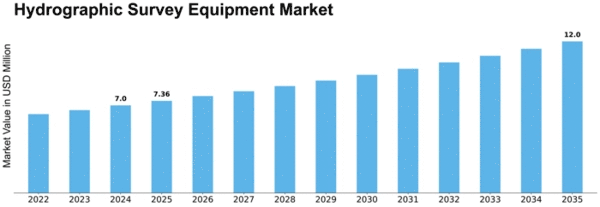

Hydrographic Survey Equipment Market Size Graph
Author
Sejal Akre
Senior Research Analyst

She has over 5 years of rich experience, in market research and consulting providing valuable market insights to client. Hands on expertise in management consulting, and extensive knowledge in domain including ICT, Automotive & Transportation and Aerospace & Defense. She is skilled in Go-to market strategy, industry analysis, market sizing, in depth company profiling, competitive intelligence & benchmarking and value chain amongst others.

Leave a Comment

FAQs

What is the CAGR for Hydrographic survey equipment industry?

Hydrographic survey equipment market can expand at 5.41% CAGR by 2030.

What is the valuation of the Hydrographic survey equipment market?

By 2030, the Hydrographic survey equipment market value can touch to USD 3,760 Mn.

Who are key players of the Hydrographic survey equipment industry?

Kongsberg Gruppen ASA (Norway), Chesapeake Technology (US), and EdgeTech (US) are some reputed names in the Hydrographic survey equipment market.

What is the Hydrographic survey equipment market driver?

The rise in maritime trade can promote the Hydrographic survey equipment market.

What is the Hydrographic survey equipment market restrain?

Time inefficiency is one of the restrains on the Hydrographic survey equipment market expansion.

Market Summary

As per MRFR analysis, the Hydrographic Survey Equipment Market Size was estimated at 7.0 USD Million in 2024. The Hydrographic Survey Equipment industry is projected to grow from 7.3 in 2025 to 12.0 by 2035, exhibiting a compound annual growth rate (CAGR) of 5.1 during the forecast period 2025 - 2035.

Key Market Trends & Highlights

The Hydrographic Survey Equipment Market is experiencing robust growth driven by technological advancements and increasing demand for data-driven solutions.

  • Technological advancements are enhancing the capabilities of hydrographic survey equipment, leading to more accurate data collection.
  • North America remains the largest market for hydrographic survey equipment, while Asia-Pacific is recognized as the fastest-growing region.
  • The hydrographic survey segment dominates the market, whereas the marine research segment is witnessing rapid growth.
  • Key market drivers include rising demand for environmental monitoring and increased investment in infrastructure development.

Market Size & Forecast

2024 Market Size 7.0 (USD Million)
2035 Market Size 12.0 (USD Million)
CAGR (2025 - 2035) 5.1%
Largest Regional Market Share in 2024 North America

Major Players

Teledyne Marine (US), Kongsberg Gruppen (NO), Fugro (NL), Hexagon AB (SE), Sonardyne International (GB), iXblue (FR), Oceaneering International (US), RBR Ltd (CA), Echologger (GB)

Market Trends

Hydrographic Survey Equipment

Hydrographic Survey Equipment Market Market Drivers

Market Growth Projections

The Global hydrographic survey equipment Market Industry is projected to experience a compound annual growth rate (CAGR) of 6.31% from 2025 to 2035. This growth is indicative of the increasing reliance on hydrographic surveys across various sectors, including marine construction, environmental monitoring, and resource exploration. The market's expansion reflects the ongoing technological advancements and the rising demand for accurate data in marine applications. As stakeholders recognize the value of hydrographic survey equipment in enhancing operational efficiency and safety, the industry is likely to witness sustained growth in the coming years.

Expansion of Maritime Trade

The Global Hydrographic Survey Equipment Market Industry is closely linked to the expansion of maritime trade, which necessitates accurate navigation and safety measures. As global trade volumes increase, the demand for reliable hydrographic surveys to ensure safe shipping routes is becoming more pronounced. The growth of container shipping and the development of new trade routes, particularly in emerging markets, are driving investments in hydrographic survey equipment. This trend suggests that the industry will continue to thrive as stakeholders prioritize safety and efficiency in maritime operations, further propelling market growth.

Rising Environmental Regulations

The Global Hydrographic Survey Equipment Market Industry is influenced by stringent environmental regulations aimed at protecting marine ecosystems. Governments worldwide are implementing policies that require comprehensive hydrographic surveys before any marine development projects. This regulatory landscape compels developers to invest in high-quality survey equipment to ensure compliance with environmental standards. For example, the need for accurate data to assess the impact of construction on marine habitats is driving the demand for hydrographic survey equipment. Consequently, this trend is expected to bolster market growth as stakeholders prioritize environmental sustainability in their projects.

Growth in Renewable Energy Projects

The Global Hydrographic Survey Equipment Market Industry is benefiting from the increasing investment in renewable energy projects, particularly offshore wind and tidal energy. As countries strive to meet their energy needs sustainably, the demand for hydrographic surveys to assess suitable sites for these projects is surging. By 2035, the market is projected to reach 4.89 USD Billion, driven by the need for accurate seabed mapping and environmental assessments. The integration of hydrographic survey equipment in renewable energy initiatives not only supports energy transition efforts but also highlights the industry's pivotal role in facilitating sustainable development.

Increasing Demand for Marine Infrastructure

The Global Hydrographic Survey Equipment Market Industry is experiencing heightened demand due to the expansion of marine infrastructure projects. Governments and private entities are investing in ports, harbors, and offshore wind farms, necessitating accurate hydrographic surveys for planning and construction. For instance, the global investment in marine infrastructure is projected to reach 2.5 USD Billion in 2024, reflecting a robust growth trajectory. This surge in infrastructure development underscores the critical role of hydrographic survey equipment in ensuring safety and efficiency in marine operations. As a result, the industry is poised for significant growth, driven by these infrastructural advancements.

Technological Advancements in Survey Equipment

Technological innovations are transforming the Global Hydrographic Survey Equipment Market Industry, enhancing the precision and efficiency of data collection. The introduction of advanced sonar systems, autonomous underwater vehicles, and integrated software solutions has revolutionized hydrographic surveying. These technologies allow for real-time data acquisition and processing, which is increasingly essential for modern marine applications. As organizations seek to improve operational efficiency, the demand for state-of-the-art hydrographic survey equipment is likely to rise. This trend indicates a shift towards more sophisticated tools that can meet the evolving needs of the industry, potentially driving market growth significantly.

Market Segment Insights

By Application: Hydrographic Survey (Largest) vs. Marine Research (Fastest-Growing)

In the Hydrographic Survey Equipment Market, the application segment showcases a diverse range of uses, with Hydrographic Survey being the largest contributor. This segment is fundamental for various applications such as mapping underwater features and ensuring navigational safety. Following closely, Marine Research is emerging as the fastest-growing segment due to its rising importance in studying aquatic ecosystems and understanding climate change impacts. Other applications like Coastal Engineering, Dredging Operations, and Environmental Monitoring also constitute significant portions of the market, reflecting the wide-reaching impact of hydrographic technologies. The growth trends in this market segment are largely driven by advancements in technology and an increased focus on sustainable practices. The demand for high-precision equipment for Marine Research is being fueled by research initiatives that address environmental concerns. Additionally, the rising importance of coastal development and management in addressing erosion and habitat loss is propelling growth in Coastal Engineering and Dredging Operations. Furthermore, Environmental Monitoring continues to gain traction as governments and organizations prioritize data collection about water quality and ecosystem health, further broadening the application scope of hydrographic survey equipment.

Hydrographic Survey (Dominant) vs. Dredging Operations (Emerging)

Hydrographic Survey remains the dominant application in the Hydrographic Survey Equipment Market, primarily due to its crucial role in maritime operations and infrastructure development. It is essential for accurate mapping and navigation, supporting industries ranging from shipping to tourism. In contrast, Dredging Operations are an emerging segment that focuses on the removal of sediment and debris from water bodies to maintain navigable waterways and support construction projects. This segment is gaining prominence as governments and private entities invest in infrastructure to improve flood mitigation and environmental restoration efforts. While Hydrographic Survey emphasizes precision and accuracy for safe navigation, Dredging Operations highlight efficiency and effectiveness in maintaining waterways, showcasing a complementary dynamic within the Hydrographic Survey Equipment Market.

By Equipment Type: Multibeam Echo Sounders (Largest) vs. Singlebeam Echo Sounders (Fastest-Growing)

In the Hydrographic Survey Equipment Market, Multibeam Echo Sounders currently hold the largest share, significantly outperforming other equipment types. These advanced devices are integral for high-resolution underwater mapping, which increases their demand in both commercial and governmental applications. On the other hand, Singlebeam Echo Sounders have a smaller market share but are rapidly gaining traction due to their cost-effectiveness and user-friendly features, appealing particularly to smaller enterprises and research organizations.

Survey Equipment: Multibeam Echo Sounders (Dominant) vs. Singlebeam Echo Sounders (Emerging)

Multibeam Echo Sounders are pivotal in the hydrographic survey market, known for their ability to capture detailed and accurate seabed data over wide areas. These devices use multiple beams to create a comprehensive image of underwater features, making them essential in various applications, including navigation and resource exploration. Conversely, Singlebeam Echo Sounders, as an emerging technology, offer simplicity and lower costs, appealing to niche markets and small-scale projects. They are ideal for shallow waters and allow users to perform surveys quickly, fostering their adoption among budget-conscious operators.

By End Use: Government Agencies (Largest) vs. Private Sector (Fastest-Growing)

The Hydrographic Survey Equipment Market is predominantly influenced by government agencies, which hold a significant share due to their extensive use in national infrastructure projects and environmental monitoring. These agencies leverage hydrographic equipment for naval navigation, flood prevention, and habitat preservation. Meanwhile, the private sector is witnessing rapid growth, fueled by increasing investments in offshore exploration and development, particularly in oil and gas and marine construction, leading to a dynamic shift in market demands.

Government Agencies: Dominant vs. Private Sector: Emerging

Government agencies have established a stronghold in the Hydrographic Survey Equipment Market, primarily due to their funding capabilities and regulatory frameworks that encourage comprehensive waterway studies and environmental preservation. This segment is characterized by steady demand for advanced hydrographic tools like multibeam echosounders and survey boats. In contrast, the private sector, focusing on sectors such as marine construction and oil and gas exploration, is becoming increasingly influential. This segment is characterized by innovation and adaptability, with companies integrating modern technology and services to meet the evolving demands of clients seeking efficient and precise survey solutions.

Get more detailed insights about Hydrographic Survey Equipment Market Research Report - Forecast till 2035

Regional Insights

North America : Market Leader in Hydrographic Equipment

North America is poised to maintain its leadership in the hydrographic survey equipment market, holding a significant share of 3.5 billion. The region's growth is driven by increasing investments in marine infrastructure, environmental monitoring, and advancements in technology. Regulatory support for sustainable practices and enhanced maritime safety further catalyzes demand for hydrographic equipment, ensuring robust market expansion. The United States and Canada are the primary contributors to this market, with key players like Teledyne Marine and Oceaneering International leading the charge. The competitive landscape is characterized by innovation and strategic partnerships, as companies strive to enhance their product offerings. The presence of established firms and a strong focus on R&D positions North America as a hub for hydrographic survey technology.

Europe : Emerging Hub for Innovation

Europe is witnessing a burgeoning hydrographic survey equipment market, valued at 2.0 billion. The region's growth is fueled by increasing maritime activities, environmental regulations, and a focus on sustainable development. Countries are investing in advanced technologies to enhance marine resource management and ensure compliance with stringent regulations, driving demand for hydrographic equipment. Leading countries such as the Netherlands and Norway are at the forefront, supported by key players like Kongsberg Gruppen and Fugro. The competitive landscape is marked by innovation and collaboration among firms, enhancing the region's capabilities in hydrographic surveying. The European market is characterized by a strong emphasis on research and development, ensuring continuous advancements in technology and applications.

Asia-Pacific : Rapidly Growing Market Potential

The Asia-Pacific region is emerging as a significant player in the hydrographic survey equipment market, currently valued at 1.2 billion. The growth is driven by increasing investments in coastal development, shipping, and environmental monitoring. Governments are prioritizing maritime safety and resource management, leading to a surge in demand for advanced hydrographic technologies and equipment. Countries like Australia and Japan are leading the charge, with a growing presence of key players such as iXblue and Hexagon AB. The competitive landscape is evolving, with local firms increasingly entering the market, fostering innovation and competition. The region's focus on sustainable practices and technological advancements positions it for substantial growth in the hydrographic survey sector.

Middle East and Africa : Emerging Market with Challenges

The Middle East and Africa region is gradually developing its hydrographic survey equipment market, currently valued at 0.3 billion. The growth is primarily driven by increasing maritime activities, oil and gas exploration, and a focus on environmental sustainability. However, challenges such as regulatory hurdles and limited infrastructure can impede rapid growth. Governments are beginning to recognize the importance of hydrographic surveying for resource management and safety, which may catalyze future demand. Countries like South Africa and the UAE are leading the market, with a growing interest from international players. The competitive landscape is still in its nascent stages, but the presence of firms like Sonardyne International indicates a potential for growth. As investments in maritime infrastructure increase, the region is expected to see a gradual rise in hydrographic survey equipment adoption.

Key Players and Competitive Insights

The Hydrographic Survey Equipment Market is currently characterized by a dynamic competitive landscape, driven by technological advancements and increasing demand for precise underwater mapping. Key players such as Teledyne Marine (US), Kongsberg Gruppen (NO), and Fugro (NL) are at the forefront, each adopting distinct strategies to enhance their market positioning. Teledyne Marine (US) focuses on innovation through the development of advanced sonar systems, while Kongsberg Gruppen (NO) emphasizes partnerships with governmental agencies to expand its operational reach. Fugro (NL) is leveraging digital transformation initiatives to optimize its service offerings, thereby shaping a competitive environment that prioritizes technological prowess and strategic collaborations.In terms of business tactics, companies are increasingly localizing manufacturing to reduce costs and enhance supply chain efficiency. The Hydrographic Survey Equipment Market appears moderately fragmented, with a mix of established players and emerging firms. The collective influence of these key players fosters a competitive structure that encourages innovation and responsiveness to market demands.

In November Teledyne Marine (US) announced the launch of its latest underwater autonomous vehicle, designed to enhance data collection capabilities in challenging environments. This strategic move is likely to solidify its position as a leader in the market, as it addresses the growing need for efficient and accurate survey solutions. Similarly, in October 2025, Kongsberg Gruppen (NO) secured a significant contract with a national maritime authority to provide advanced hydrographic survey equipment, indicating its strong foothold in governmental projects and reinforcing its reputation for reliability and quality.Fugro (NL) made headlines in September 2025 by unveiling a new digital platform that integrates AI-driven analytics for hydrographic data interpretation. This innovation not only enhances operational efficiency but also positions Fugro as a forward-thinking player in the market, capable of delivering actionable insights to clients. Such advancements reflect a broader trend towards the integration of technology in hydrographic surveying, which is becoming increasingly critical in meeting client expectations.

As of December the Hydrographic Survey Equipment Market is witnessing trends that emphasize digitalization, sustainability, and AI integration. Strategic alliances among key players are shaping the competitive landscape, fostering collaboration that enhances technological capabilities. The shift from price-based competition to a focus on innovation and supply chain reliability is evident, suggesting that future differentiation will hinge on the ability to deliver cutting-edge solutions that meet evolving market needs. Companies that prioritize these aspects are likely to thrive in an increasingly competitive environment.

Key Companies in the Hydrographic Survey Equipment Market include

Industry Developments

    • Focus on Unmanned Vehicles (AUVs & USVs): There's a strong push towards autonomous solutions. Companies like Kongsberg Maritime, Teledyne Marine, and IXblue are investing heavily in developing advanced AUVs and USVs for efficient and cost-effective data collection.

    • Integration and Software Advancements: Several players like Teledyne Technologies, Kongsberg Maritime, and Thales are focusing on integrated solutions that combine hardware, software, and data analytics for improved data processing, visualization, and decision-making.

    • Strategic Partnerships: Key players are collaborating for wider market reach and expertise. For instance, partnerships between sensor manufacturers and software developers are creating more comprehensive solutions.

    • Sustainability Initiatives: Companies are incorporating eco-friendly designs and energy-efficient technologies in their equipment. This aligns with growing environmental regulations and customer preferences.

Future Outlook

Hydrographic Survey Equipment Market Future Outlook

The Hydrographic Survey Equipment Market is projected to grow at a 5.1% CAGR from 2025 to 2035, driven by technological advancements, increasing maritime activities, and environmental monitoring needs.

New opportunities lie in:

  • Development of autonomous underwater vehicles for enhanced data collection.
  • Integration of AI-driven analytics for real-time survey data interpretation.
  • Expansion into emerging markets with tailored hydrographic solutions.

By 2035, the Hydrographic Survey Equipment Market is expected to be robust, driven by innovation and strategic expansion.

Market Segmentation

Hydrographic Survey Equipment Market End Use Outlook

  • Government Agencies
  • Research Institutions
  • Private Sector
  • Environmental Organizations
  • Construction Companies

Hydrographic Survey Equipment Market Application Outlook

  • Hydrographic Survey
  • Marine Research
  • Coastal Engineering
  • Dredging Operations
  • Environmental Monitoring

Hydrographic Survey Equipment Market Equipment Type Outlook

  • Multibeam Echo Sounders
  • Singlebeam Echo Sounders
  • Side-scan Sonars
  • Sub-bottom Profilers
  • GNSS Receivers

Report Scope

MARKET SIZE 20247.0(USD Million)
MARKET SIZE 20257.3(USD Million)
MARKET SIZE 203512.0(USD Million)
COMPOUND ANNUAL GROWTH RATE (CAGR)5.1% (2025 - 2035)
REPORT COVERAGERevenue Forecast, Competitive Landscape, Growth Factors, and Trends
BASE YEAR2024
Market Forecast Period2025 - 2035
Historical Data2019 - 2024
Market Forecast UnitsUSD Million
Key Companies ProfiledTeledyne Marine (US), Kongsberg Gruppen (NO), Fugro (NL), Hexagon AB (SE), Sonardyne International (GB), iXblue (FR), Oceaneering International (US), RBR Ltd (CA), Echologger (GB)
Segments CoveredApplication, Equipment Type, End Use
Key Market OpportunitiesIntegration of advanced autonomous systems enhances efficiency in the Hydrographic Survey Equipment Market.
Key Market DynamicsTechnological advancements and regulatory changes drive innovation and competition in the Hydrographic Survey Equipment market.
Countries CoveredNorth America, Europe, APAC, South America, MEA

FAQs

What is the CAGR for Hydrographic survey equipment industry?

Hydrographic survey equipment market can expand at 5.41% CAGR by 2030.

What is the valuation of the Hydrographic survey equipment market?

By 2030, the Hydrographic survey equipment market value can touch to USD 3,760 Mn.

Who are key players of the Hydrographic survey equipment industry?

Kongsberg Gruppen ASA (Norway), Chesapeake Technology (US), and EdgeTech (US) are some reputed names in the Hydrographic survey equipment market.

What is the Hydrographic survey equipment market driver?

The rise in maritime trade can promote the Hydrographic survey equipment market.

What is the Hydrographic survey equipment market restrain?

Time inefficiency is one of the restrains on the Hydrographic survey equipment market expansion.

  1. SECTION I: EXECUTIVE SUMMARY AND KEY HIGHLIGHTS
    1. | 1.1 EXECUTIVE SUMMARY
    2. | 1.1.1 Market Overview
    3. | 1.1.2 Key Findings
    4. | 1.1.3 Market Segmentation
    5. | 1.1.4 Competitive Landscape
    6. | 1.1.5 Challenges and Opportunities
    7. | 1.1.6 Future Outlook
  2. SECTION II: SCOPING, METHODOLOGY AND MARKET STRUCTURE
    1. | 2.1 MARKET INTRODUCTION
    2. | 2.1.1 Definition
    3. | 2.1.2 Scope of the study
    4. |-- 2.1.2.1 Research Objective
    5. |-- 2.1.2.2 Assumption
    6. |-- 2.1.2.3 Limitations
    7. | 2.2 RESEARCH METHODOLOGY
    8. | 2.2.1 Overview
    9. | 2.2.2 Data Mining
    10. | 2.2.3 Secondary Research
    11. | 2.2.4 Primary Research
    12. |-- 2.2.4.1 Primary Interviews and Information Gathering Process
    13. |-- 2.2.4.2 Breakdown of Primary Respondents
    14. | 2.2.5 Forecasting Model
    15. | 2.2.6 Market Size Estimation
    16. |-- 2.2.6.1 Bottom-Up Approach
    17. |-- 2.2.6.2 Top-Down Approach
    18. | 2.2.7 Data Triangulation
    19. | 2.2.8 Validation
  3. SECTION III: QUALITATIVE ANALYSIS
    1. | 3.1 MARKET DYNAMICS
    2. | 3.1.1 Overview
    3. | 3.1.2 Drivers
    4. | 3.1.3 Restraints
    5. | 3.1.4 Opportunities
    6. | 3.2 MARKET FACTOR ANALYSIS
    7. | 3.2.1 Value chain Analysis
    8. | 3.2.2 Porter's Five Forces Analysis
    9. |-- 3.2.2.1 Bargaining Power of Suppliers
    10. |-- 3.2.2.2 Bargaining Power of Buyers
    11. |-- 3.2.2.3 Threat of New Entrants
    12. |-- 3.2.2.4 Threat of Substitutes
    13. |-- 3.2.2.5 Intensity of Rivalry
    14. | 3.2.3 COVID-19 Impact Analysis
    15. |-- 3.2.3.1 Market Impact Analysis
    16. |-- 3.2.3.2 Regional Impact
    17. |-- 3.2.3.3 Opportunity and Threat Analysis
  4. SECTION IV: QUANTITATIVE ANALYSIS
    1. | 4.1 Aerospace & Defense, BY Application (USD Million)
    2. | 4.1.1 Hydrographic Survey
    3. | 4.1.2 Marine Research
    4. | 4.1.3 Coastal Engineering
    5. | 4.1.4 Dredging Operations
    6. | 4.1.5 Environmental Monitoring
    7. | 4.2 Aerospace & Defense, BY Equipment Type (USD Million)
    8. | 4.2.1 Multibeam Echo Sounders
    9. | 4.2.2 Singlebeam Echo Sounders
    10. | 4.2.3 Side-scan Sonars
    11. | 4.2.4 Sub-bottom Profilers
    12. | 4.2.5 GNSS Receivers
    13. | 4.3 Aerospace & Defense, BY End Use (USD Million)
    14. | 4.3.1 Government Agencies
    15. | 4.3.2 Research Institutions
    16. | 4.3.3 Private Sector
    17. | 4.3.4 Environmental Organizations
    18. | 4.3.5 Construction Companies
    19. | 4.4 Aerospace & Defense, BY Region (USD Million)
    20. | 4.4.1 North America
    21. |-- 4.4.1.1 US
    22. |-- 4.4.1.2 Canada
    23. | 4.4.2 Europe
    24. |-- 4.4.2.1 Germany
    25. |-- 4.4.2.2 UK
    26. |-- 4.4.2.3 France
    27. |-- 4.4.2.4 Russia
    28. |-- 4.4.2.5 Italy
    29. |-- 4.4.2.6 Spain
    30. |-- 4.4.2.7 Rest of Europe
    31. | 4.4.3 APAC
    32. |-- 4.4.3.1 China
    33. |-- 4.4.3.2 India
    34. |-- 4.4.3.3 Japan
    35. |-- 4.4.3.4 South Korea
    36. |-- 4.4.3.5 Malaysia
    37. |-- 4.4.3.6 Thailand
    38. |-- 4.4.3.7 Indonesia
    39. |-- 4.4.3.8 Rest of APAC
    40. | 4.4.4 South America
    41. |-- 4.4.4.1 Brazil
    42. |-- 4.4.4.2 Mexico
    43. |-- 4.4.4.3 Argentina
    44. |-- 4.4.4.4 Rest of South America
    45. | 4.4.5 MEA
    46. |-- 4.4.5.1 GCC Countries
    47. |-- 4.4.5.2 South Africa
    48. |-- 4.4.5.3 Rest of MEA
  5. SECTION V: COMPETITIVE ANALYSIS
    1. | 5.1 Competitive Landscape
    2. | 5.1.1 Overview
    3. | 5.1.2 Competitive Analysis
    4. | 5.1.3 Market share Analysis
    5. | 5.1.4 Major Growth Strategy in the Aerospace & Defense
    6. | 5.1.5 Competitive Benchmarking
    7. | 5.1.6 Leading Players in Terms of Number of Developments in the Aerospace & Defense
    8. | 5.1.7 Key developments and growth strategies
    9. |-- 5.1.7.1 New Product Launch/Service Deployment
    10. |-- 5.1.7.2 Merger & Acquisitions
    11. |-- 5.1.7.3 Joint Ventures
    12. | 5.1.8 Major Players Financial Matrix
    13. |-- 5.1.8.1 Sales and Operating Income
    14. |-- 5.1.8.2 Major Players R&D Expenditure. 2023
    15. | 5.2 Company Profiles
    16. | 5.2.1 Teledyne Marine (US)
    17. |-- 5.2.1.1 Financial Overview
    18. |-- 5.2.1.2 Products Offered
    19. |-- 5.2.1.3 Key Developments
    20. |-- 5.2.1.4 SWOT Analysis
    21. |-- 5.2.1.5 Key Strategies
    22. | 5.2.2 Kongsberg Gruppen (NO)
    23. |-- 5.2.2.1 Financial Overview
    24. |-- 5.2.2.2 Products Offered
    25. |-- 5.2.2.3 Key Developments
    26. |-- 5.2.2.4 SWOT Analysis
    27. |-- 5.2.2.5 Key Strategies
    28. | 5.2.3 Fugro (NL)
    29. |-- 5.2.3.1 Financial Overview
    30. |-- 5.2.3.2 Products Offered
    31. |-- 5.2.3.3 Key Developments
    32. |-- 5.2.3.4 SWOT Analysis
    33. |-- 5.2.3.5 Key Strategies
    34. | 5.2.4 Hexagon AB (SE)
    35. |-- 5.2.4.1 Financial Overview
    36. |-- 5.2.4.2 Products Offered
    37. |-- 5.2.4.3 Key Developments
    38. |-- 5.2.4.4 SWOT Analysis
    39. |-- 5.2.4.5 Key Strategies
    40. | 5.2.5 Sonardyne International (GB)
    41. |-- 5.2.5.1 Financial Overview
    42. |-- 5.2.5.2 Products Offered
    43. |-- 5.2.5.3 Key Developments
    44. |-- 5.2.5.4 SWOT Analysis
    45. |-- 5.2.5.5 Key Strategies
    46. | 5.2.6 iXblue (FR)
    47. |-- 5.2.6.1 Financial Overview
    48. |-- 5.2.6.2 Products Offered
    49. |-- 5.2.6.3 Key Developments
    50. |-- 5.2.6.4 SWOT Analysis
    51. |-- 5.2.6.5 Key Strategies
    52. | 5.2.7 Oceaneering International (US)
    53. |-- 5.2.7.1 Financial Overview
    54. |-- 5.2.7.2 Products Offered
    55. |-- 5.2.7.3 Key Developments
    56. |-- 5.2.7.4 SWOT Analysis
    57. |-- 5.2.7.5 Key Strategies
    58. | 5.2.8 RBR Ltd (CA)
    59. |-- 5.2.8.1 Financial Overview
    60. |-- 5.2.8.2 Products Offered
    61. |-- 5.2.8.3 Key Developments
    62. |-- 5.2.8.4 SWOT Analysis
    63. |-- 5.2.8.5 Key Strategies
    64. | 5.2.9 Echologger (GB)
    65. |-- 5.2.9.1 Financial Overview
    66. |-- 5.2.9.2 Products Offered
    67. |-- 5.2.9.3 Key Developments
    68. |-- 5.2.9.4 SWOT Analysis
    69. |-- 5.2.9.5 Key Strategies
    70. | 5.3 Appendix
    71. | 5.3.1 References
    72. | 5.3.2 Related Reports

Aerospace & Defense Market Segmentation

Aerospace & Defense By Application (USD Million, 2025-2035)

  • Hydrographic Survey
  • Marine Research
  • Coastal Engineering
  • Dredging Operations
  • Environmental Monitoring

Aerospace & Defense By Equipment Type (USD Million, 2025-2035)

  • Multibeam Echo Sounders
  • Singlebeam Echo Sounders
  • Side-scan Sonars
  • Sub-bottom Profilers
  • GNSS Receivers

Aerospace & Defense By End Use (USD Million, 2025-2035)

  • Government Agencies
  • Research Institutions
  • Private Sector
  • Environmental Organizations
  • Construction Companies
Infographic

Free Sample Request

Kindly complete the form below to receive a free sample of this Report

Get Free Sample

Customer Strories

Compare Licence

×
Features License Type
Single User Multiuser License Enterprise User
Price $4,950 $5,950 $7,250
Maximum User Access Limit 1 User Upto 10 Users Unrestricted Access Throughout the Organization
Free Customization
Direct Access to Analyst
Deliverable Format
Platform Access
Discount on Next Purchase 10% 15% 15%
Printable Versions