
Request Free Sample ×

Kindly complete the form below to receive a free sample of this Report

* Please use a valid business email

Leading companies partner with us for data-driven Insights

clients tt-cursor
Hero Background
English
Chinese
French
Japanese
Korean
German
Spanish

Hydrographic Survey Equipment Market Analysis

ID: MRFR/AD/8146-HCR
168 Pages
Abbas Raut
Last Updated: April 06, 2026

Hydrographic Survey Equipment Market Size, Share, Industry Trend & Analysis Research Report Information by Type (Sensing Systems, Positioning Systems, Subsea Sensors, Software and Unmanned Vehicles), Depth (Shallow Water and Deep Water), Application (Hydrographic Charting, Offshore Oil Gas Survey, Port Harbor Management and Coastal Engineering), End User (Commercial, Research and Defense) and Region (North America, Europe, Asia-Pacific, Middle East Africa and Latin America) - Forecast till 2035

Share:
Download PDF ×

We do not share your information with anyone. However, we may send you emails based on your report interest from time to time. You may contact us at any time to opt-out.

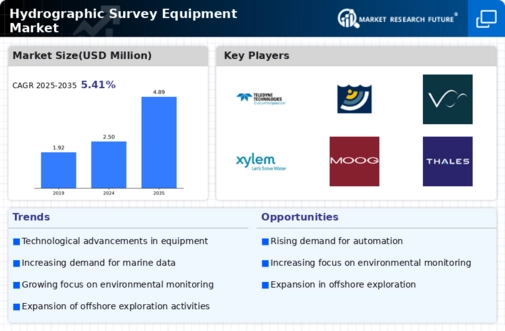
Hydrographic Survey Equipment Market Infographic
Purchase Options

Market Analysis

In-depth Analysis of Hydrographic Survey Equipment Market Industry Landscape

The Hydrographic Survey Equipment Market is influenced by a host of market factors that collectively shape the development, adoption, and evolution of marine survey technology. One major factor in this case is the increasing need for precise hydrographic data that is detailed across various industries. In making informed decisions, there is a need for maritime industry, environmental agencies and infrastructure developers to have accurate seabed mapping and underwater terrain information. This demand drives the market for hydrographic survey equipment while emphasizing the need for advanced technologies capable of delivering high-quality data fast.

Hydrographic Survey Equipment Market is influenced by Technological advancements. The industry undergoes continuous innovation as witnessed through introduction of new sonar systems’ models or multibeam echosounders and LiDAR technologies. These innovations enhance survey equipment capabilities thereby facilitating more efficient and accurate collection of data from different undersea conditions. The market dynamics are characterized by a race to integrate cutting-edge technologies, ensuring that hydrographic survey equipment remains at the forefront in terms of precision and reliability.

Interoperability is an important consideration within Hydrographic Survey Equipment Market. With hydrographic surveyors working across various geographical regions on international projects there has been increased focus on interoperable survey equipment’s. To bridge this gap incompatibility between vessels, platforms or data processing system can be overcome through developing products that seamlessly fit into these situations. Interoperability improves efficiency in conducting hydrographic surveys hence supporting standardized approaches to data acquisition and processing.

Environmental concerns significantly influence Hydrographic Survey Equipment market dynamics. As people increasingly embrace sustainable practices within maritime activities, low-impact survey equipment becomes more popular. Eco-friendly aspects such as energy saving sensors with reduced emissions are considered when assessing market viability against global efforts aimed at striking a balance between essential hydrographic data gathering activities and environmental preservation.

Hydrographic Survey Equipment Market dynamics are also driven by Geo-political considerations. Changes in maritime borders geopolitical tensions and international regulations affect the demand for surveying technologies. The market responds to geo-political forces by providing devices that are suitable for navigation, security and compliance with international maritime laws in different parts of the world.

Market resilience is evidenced through global issues like natural disasters and climate change. Hydrographic survey equipment is vital in assessing undersea conditions and thus assists in disaster preparedness, as well as environmental monitoring. Market dynamics show an increased interest in surveying technologies that foster resilience thereby enabling stakeholders to adjust to changing oceanic conditions while minimizing impacts from environmental challenges.

Collaboration and partnerships within hydrographic survey industry are critical market factors. To increase efficiency and capabilities of hydrographic survey equipment manufacturers, survey companies, and technology developers collaborate on integrated solutions. Thus, collaboration efforts that breed innovation, knowledge sharing, as well as holistic surveying solutions for various marine applications shape the market dynamics.

Hydrographic Survey Equipment Market has a number of Regulatory frameworks and industry standards which are intrinsic to the market. Manufacturers of equipment and operators involved in surveys need to comply with international standards on hydrography surveys and safety regulations. Consequently, features aligned with regulatory requirements have been developed or integrated into such systems making it possible to collect hydrographic data using Best Available Technology which conforms to established standards for reliability accuracy.”

Author
Author Profile
Abbas Raut
Research Analyst

Abbas Raut is a Senior Research Analyst with 5+ years of experience delivering data-driven insights and strategic recommendations across the Automotive and Aerospace & Defense sectors. He specializes in emerging technologies, industry value chains, and global market dynamics shaping the future of mobility and defense. In automotive, Abbas has led studies on EVs, charging stations, BMS, superchargers, and more, guiding stakeholders through electrification and regulatory shifts. In Aerospace & Defense, he has analyzed markets for military electronics, drones, radars, and electronic warfare solutions, supporting procurement and investment strategies. With expertise in market sizing, forecasting, benchmarking, and technology adoption, Abbas is known for transforming complex datasets into actionable insights that drive strategy, innovation, and growth.

Leave a Comment

FAQs

What is the projected market valuation for the Hydrographic Survey Equipment Market in 2035?

<p>The projected market valuation for the Hydrographic Survey Equipment Market in 2035 is expected to reach 12.0 USD Million.</p>

What was the market valuation for Hydrographic Survey Equipment in 2024?

<p>The market valuation for Hydrographic Survey Equipment in 2024 was 7.0 USD Million.</p>

What is the expected CAGR for the Hydrographic Survey Equipment Market from 2025 to 2035?

<p>The expected CAGR for the Hydrographic Survey Equipment Market during the forecast period 2025 - 2035 is 5.1%.</p>

Which application segment is projected to have the highest growth in the Hydrographic Survey Equipment Market?

<p>The Hydrographic Survey application segment is projected to grow from 2.1 USD Million to 3.5 USD Million by 2035.</p>

What are the key players in the Hydrographic Survey Equipment Market?

<p>Key players in the Hydrographic Survey Equipment Market include Teledyne Marine, Kongsberg Gruppen, and Fugro, among others.</p>

How does the Marine Research segment perform in terms of market valuation?

The Marine Research segment is expected to grow from 1.5 USD Million in 2024 to 2.5 USD Million by 2035.

What is the projected valuation for the Oil and Gas Industry segment by 2035?

The Oil and Gas Industry segment is projected to increase from 2.0 USD Million to 3.5 USD Million by 2035.

Which equipment type is anticipated to see the most growth in the Hydrographic Survey Equipment Market?

The Multibeam Echo Sounder equipment type is expected to grow from 2.1 USD Million to 3.5 USD Million by 2035.

What is the expected market performance for Environmental Monitoring by 2035?

The Environmental Monitoring segment is projected to grow from 1.2 USD Million to 2.3 USD Million by 2035.

Which end-use segment is likely to show significant growth in the Hydrographic Survey Equipment Market?

The Marine Contractors end-use segment is expected to grow from 1.5 USD Million to 2.5 USD Million by 2035.

Market Summary

As per MRFR analysis, the Hydrographic Survey Equipment Market Size was estimated at 7.0 USD Million in 2024. The Hydrographic Survey Equipment industry is projected to grow from 7.3 in 2025 to 12.0 by 2035, exhibiting a compound annual growth rate (CAGR) of 5.1% during the forecast period 2025 - 2035.

Key Market Trends & Highlights

The Hydrographic Survey Equipment Market is experiencing robust growth driven by technological advancements and increasing demand for data-driven solutions.

  • Technological advancements are enhancing the capabilities of hydrographic survey equipment, leading to more accurate data collection.
  • North America remains the largest market for hydrographic survey equipment, while Asia-Pacific is recognized as the fastest-growing region.
  • The hydrographic survey segment dominates the market, whereas the marine research segment is witnessing rapid growth.
  • Key market drivers include rising demand for environmental monitoring and increased investment in infrastructure development.

Market Size & Forecast

2024 Market Size 7.0 (USD Million)
2035 Market Size 12.0 (USD Million)
CAGR (2025 - 2035) 5.1%
Largest Regional Market Share in 2024 North America

Major Players

Teledyne Marine (US), Kongsberg Gruppen (NO), Fugro (NL), Hexagon AB (SE), Sonardyne International (GB), iXblue (FR), Oceaneering International (US), RBR Ltd (CA), Echologger (GB)

Market Trends

Hydrographic Survey Equipment

Hydrographic Survey Equipment Market Market Drivers

Market Growth Projections

The Global hydrographic survey equipment Market Industry is projected to experience a compound annual growth rate (CAGR) of 6.31% from 2025 to 2035. This growth is indicative of the increasing reliance on hydrographic surveys across various sectors, including marine construction, environmental monitoring, and resource exploration. The market's expansion reflects the ongoing technological advancements and the rising demand for accurate data in marine applications. As stakeholders recognize the value of hydrographic survey equipment in enhancing operational efficiency and safety, the industry is likely to witness sustained growth in the coming years.

Expansion of Maritime Trade

The Global Hydrographic Survey Equipment Market Industry is closely linked to the expansion of maritime trade, which necessitates accurate navigation and safety measures. As global trade volumes increase, the demand for reliable hydrographic surveys to ensure safe shipping routes is becoming more pronounced. The growth of container shipping and the development of new trade routes, particularly in emerging markets, are driving investments in hydrographic survey equipment. This trend suggests that the industry will continue to thrive as stakeholders prioritize safety and efficiency in maritime operations, further propelling market growth.

Rising Environmental Regulations

The Global Hydrographic Survey Equipment Market Industry is influenced by stringent environmental regulations aimed at protecting marine ecosystems. Governments worldwide are implementing policies that require comprehensive hydrographic surveys before any marine development projects. This regulatory landscape compels developers to invest in high-quality survey equipment to ensure compliance with environmental standards. For example, the need for accurate data to assess the impact of construction on marine habitats is driving the demand for hydrographic survey equipment. Consequently, this trend is expected to bolster market growth as stakeholders prioritize environmental sustainability in their projects.

Growth in Renewable Energy Projects

The Global Hydrographic Survey Equipment Market Industry is benefiting from the increasing investment in renewable energy projects, particularly offshore wind and tidal energy. As countries strive to meet their energy needs sustainably, the demand for hydrographic surveys to assess suitable sites for these projects is surging. By 2035, the market is projected to reach 4.89 USD Billion, driven by the need for accurate seabed mapping and environmental assessments. The integration of hydrographic survey equipment in renewable energy initiatives not only supports energy transition efforts but also highlights the industry's pivotal role in facilitating sustainable development.

Increasing Demand for Marine Infrastructure

The Global Hydrographic Survey Equipment Market Industry is experiencing heightened demand due to the expansion of marine infrastructure projects. Governments and private entities are investing in ports, harbors, and offshore wind farms, necessitating accurate hydrographic surveys for planning and construction. For instance, the global investment in marine infrastructure is projected to reach 2.5 USD Billion in 2024, reflecting a robust growth trajectory. This surge in infrastructure development underscores the critical role of hydrographic survey equipment in ensuring safety and efficiency in marine operations. As a result, the industry is poised for significant growth, driven by these infrastructural advancements.

Technological Advancements in Survey Equipment

Technological innovations are transforming the Global Hydrographic Survey Equipment Market Industry, enhancing the precision and efficiency of data collection. The introduction of advanced sonar systems, autonomous underwater vehicles, and integrated software solutions has revolutionized hydrographic surveying. These technologies allow for real-time data acquisition and processing, which is increasingly essential for modern marine applications. As organizations seek to improve operational efficiency, the demand for state-of-the-art hydrographic survey equipment is likely to rise. This trend indicates a shift towards more sophisticated tools that can meet the evolving needs of the industry, potentially driving market growth significantly.

Market Segment Insights

By Application: Hydrographic Survey (Largest) vs. Environmental Monitoring (Fastest-Growing)

<p>The Hydrographic Survey Equipment Market showcases a diverse range of applications, with Hydrographic Surveying holding the largest share due to its fundamental importance in mapping underwater terrains. Marine Research follows closely, buoyed by increasing investments in ocean studies and climate change observations. In contrast, Environmental Monitoring is emerging as a rapidly growing segment, driven by heightened awareness of ecological preservation and regulatory requirements for monitoring water bodies. Dredging Operations and Coastal Management are also significant but maintain smaller shares within the overall segment distribution.</p>

<p>Hydrographic Survey (Dominant) vs. Environmental Monitoring (Emerging)</p>

<p>Hydrographic Surveying is recognized as the dominant application within the Hydrographic Survey Equipment Market, serving critical roles in navigation, maritime safety, and construction planning. It leverages advanced sonar technologies for accurate seabed mapping, catering to industries such as oil and gas, shipping, and renewable energy. On the other hand, Environmental Monitoring is an emerging application, gaining traction due to the increasing demand for assessing water quality and ecosystem health. It integrates sophisticated sensor technologies and data analytics, empowering stakeholders to undertake effective environmental management and compliance with regulations. The convergence of these segments reflects a broadened scope of hydrographic survey technologies, emphasizing both foundational and innovative applications in marine environments.</p>

By Equipment Type: Multibeam Echo Sounder (Largest) vs. Singlebeam Echo Sounder (Fastest-Growing)

<p>In the Hydrographic Survey Equipment Market, the Multibeam Echo Sounder holds the largest market share due to its advanced capabilities in mapping large areas with high-resolution data accuracy. Following closely, the Singlebeam Echo Sounder is notable for its cost-effectiveness and widespread adoption, serving as a reliable tool for specific depth measurements. The Side-scan Sonar and Sub-bottom Profiler equip hydrographic surveys with complementary data about the seafloor and sub-seafloor structures, while GNSS Equipment ensures precise positioning critical for all surveying tasks. Together, these equipment types contribute to a robust and competitive market landscape.</p>

<p>Multibeam Echo Sounder (Dominant) vs. Singlebeam Echo Sounder (Emerging)</p>

<p>The Multibeam Echo Sounder is the dominant player in the Hydrographic Survey Equipment Market, known for its capability to simultaneously capture multiple depth measurements across a wide swath of the seafloor. This technology delivers detailed bathymetric data, making it invaluable for large-scale oceanographic studies and underwater construction projects. In contrast, the Singlebeam Echo Sounder is emerging rapidly, driven by its affordability and simplicity, catering to niche applications like shallow water surveys. While it may not match the Multibeam system in data richness, its growing popularity highlights a strong demand for simpler, cost-effective surveying solutions, appealing to smaller enterprises and governmental agencies.</p>

By End Use: Government Agencies (Largest) vs. Marine Contractors (Fastest-Growing)

<p>In the Hydrographic Survey Equipment Market, government agencies hold the largest share due to their ongoing investments in oceanographic and environmental studies. These agencies require reliable data for coastal management, navigation, and national defense purposes. On the other hand, marine contractors are rapidly gaining traction as the fastest-growing segment. Their demand for advanced surveying tools is driven by increased offshore projects and an expanding marine construction sector, leading to a rising reliance on precise hydrographic data.</p>

<p>Marine Contractors (Dominant) vs. Environmental Consultants (Emerging)</p>

<p>Marine contractors play a dominant role in the Hydrographic Survey Equipment Market, leveraging advanced technologies to enhance their surveying capabilities for underwater construction projects. Their operations often encompass a wide array of activities, including dredging, underwater installations, and the laying of pipelines. Conversely, environmental consultants, while emerging, focus on assessments and monitoring necessary for regulatory compliance and protection of marine ecosystems. The growing emphasis on sustainable practices and environmental monitoring drives the demand for hydrographic equipment in this sector, positioning them as a notable contender in the market.</p>

Get more detailed insights about Hydrographic Survey Equipment Market Research Report - Forecast till 2035

Regional Insights

North America : Market Leader in Hydrographic Equipment

North America is poised to maintain its leadership in the hydrographic survey equipment market, holding a significant share of 3.5 billion. The region's growth is driven by increasing investments in marine infrastructure, environmental monitoring, and advancements in technology. Regulatory support for sustainable practices and enhanced maritime safety further catalyzes demand for hydrographic equipment, ensuring robust market expansion. The United States and Canada are the primary contributors to this market, with key players like Teledyne Marine and Oceaneering International leading the charge. The competitive landscape is characterized by innovation and strategic partnerships, as companies strive to enhance their product offerings. The presence of established firms and a strong focus on R&D positions North America as a hub for hydrographic survey technology.

Europe : Emerging Hub for Innovation

Europe is witnessing a burgeoning hydrographic survey equipment market, valued at 2.0 billion. The region's growth is fueled by increasing maritime activities, environmental regulations, and a focus on sustainable development. Countries are investing in advanced technologies to enhance marine resource management and ensure compliance with stringent regulations, driving demand for hydrographic equipment. Leading countries such as the Netherlands and Norway are at the forefront, supported by key players like Kongsberg Gruppen and Fugro. The competitive landscape is marked by innovation and collaboration among firms, enhancing the region's capabilities in hydrographic surveying. The European market is characterized by a strong emphasis on research and development, ensuring continuous advancements in technology and applications.

Asia-Pacific : Rapidly Growing Market Potential

The Asia-Pacific region is emerging as a significant player in the hydrographic survey equipment market, currently valued at 1.2 billion. The growth is driven by increasing investments in coastal development, shipping, and environmental monitoring. Governments are prioritizing maritime safety and resource management, leading to a surge in demand for advanced hydrographic technologies and equipment. Countries like Australia and Japan are leading the charge, with a growing presence of key players such as iXblue and Hexagon AB. The competitive landscape is evolving, with local firms increasingly entering the market, fostering innovation and competition. The region's focus on sustainable practices and technological advancements positions it for substantial growth in the hydrographic survey sector.

Middle East and Africa : Emerging Market with Challenges

The Middle East and Africa region is gradually developing its hydrographic survey equipment market, currently valued at 0.3 billion. The growth is primarily driven by increasing maritime activities, oil and gas exploration, and a focus on environmental sustainability. However, challenges such as regulatory hurdles and limited infrastructure can impede rapid growth. Governments are beginning to recognize the importance of hydrographic surveying for resource management and safety, which may catalyze future demand. Countries like South Africa and the UAE are leading the market, with a growing interest from international players. The competitive landscape is still in its nascent stages, but the presence of firms like Sonardyne International indicates a potential for growth. As investments in maritime infrastructure increase, the region is expected to see a gradual rise in hydrographic survey equipment adoption.

Key Players and Competitive Insights

The Hydrographic Survey Equipment Market is currently characterized by a dynamic competitive landscape, driven by technological advancements and increasing demand for precise underwater mapping. Key players such as Teledyne Marine (US), Kongsberg Gruppen (NO), and Fugro (NL) are at the forefront, each adopting distinct strategies to enhance their market positioning. Teledyne Marine (US) focuses on innovation through the development of advanced sonar systems, while Kongsberg Gruppen (NO) emphasizes partnerships with governmental agencies to expand its operational reach. Fugro (NL) is leveraging digital transformation initiatives to optimize its service offerings, thereby shaping a competitive environment that prioritizes technological prowess and strategic collaborations.In terms of business tactics, companies are increasingly localizing manufacturing to reduce costs and enhance supply chain efficiency. The Hydrographic Survey Equipment Market appears moderately fragmented, with a mix of established players and emerging firms. The collective influence of these key players fosters a competitive structure that encourages innovation and responsiveness to market demands.

In November Teledyne Marine (US) announced the launch of its latest underwater autonomous vehicle, designed to enhance data collection capabilities in challenging environments. This strategic move is likely to solidify its position as a leader in the market, as it addresses the growing need for efficient and accurate survey solutions. Similarly, in October 2025, Kongsberg Gruppen (NO) secured a significant contract with a national maritime authority to provide advanced hydrographic survey equipment, indicating its strong foothold in governmental projects and reinforcing its reputation for reliability and quality.Fugro (NL) made headlines in September 2025 by unveiling a new digital platform that integrates AI-driven analytics for hydrographic data interpretation. This innovation not only enhances operational efficiency but also positions Fugro as a forward-thinking player in the market, capable of delivering actionable insights to clients. Such advancements reflect a broader trend towards the integration of technology in hydrographic surveying, which is becoming increasingly critical in meeting client expectations.

As of December the Hydrographic Survey Equipment Market is witnessing trends that emphasize digitalization, sustainability, and AI integration. Strategic alliances among key players are shaping the competitive landscape, fostering collaboration that enhances technological capabilities. The shift from price-based competition to a focus on innovation and supply chain reliability is evident, suggesting that future differentiation will hinge on the ability to deliver cutting-edge solutions that meet evolving market needs. Companies that prioritize these aspects are likely to thrive in an increasingly competitive environment.

Key Companies in the Hydrographic Survey Equipment Market include

Industry Developments

    • Focus on Unmanned Vehicles (AUVs & USVs): There's a strong push towards autonomous solutions. Companies like Kongsberg Maritime, Teledyne Marine, and IXblue are investing heavily in developing advanced AUVs and USVs for efficient and cost-effective data collection.

    • Integration and Software Advancements: Several players like Teledyne Technologies, Kongsberg Maritime, and Thales are focusing on integrated solutions that combine hardware, software, and data analytics for improved data processing, visualization, and decision-making.

    • Strategic Partnerships: Key players are collaborating for wider market reach and expertise. For instance, partnerships between sensor manufacturers and software developers are creating more comprehensive solutions.

    • Sustainability Initiatives: Companies are incorporating eco-friendly designs and energy-efficient technologies in their equipment. This aligns with growing environmental regulations and customer preferences.

Future Outlook

Hydrographic Survey Equipment Market Future Outlook

The Hydrographic Survey Equipment Market is projected to grow at a 5.1% CAGR from 2025 to 2035, driven by technological advancements, increasing maritime activities, and environmental monitoring needs.

New opportunities lie in:

  • Development of autonomous underwater vehicles for enhanced data collection.
  • Integration of AI-driven analytics for real-time survey data interpretation.
  • Expansion into emerging markets with tailored hydrographic solutions.

By 2035, the Hydrographic Survey Equipment Market is expected to be robust, driven by innovation and strategic expansion.

Market Segmentation

Hydrographic Survey Equipment Market End Use Outlook

  • Government Agencies
  • Research Institutions
  • Private Sector
  • Environmental Organizations
  • Construction Companies

Hydrographic Survey Equipment Market Application Outlook

  • Hydrographic Survey
  • Marine Research
  • Coastal Engineering
  • Dredging Operations
  • Environmental Monitoring

Hydrographic Survey Equipment Market Equipment Type Outlook

  • Multibeam Echo Sounders
  • Singlebeam Echo Sounders
  • Side-scan Sonars
  • Sub-bottom Profilers
  • GNSS Receivers

Report Scope

MARKET SIZE 2024 7.0(USD Million)
MARKET SIZE 2025 7.3(USD Million)
MARKET SIZE 2035 12.0(USD Million)
COMPOUND ANNUAL GROWTH RATE (CAGR) 5.1% (2025 - 2035)
REPORT COVERAGE Revenue Forecast, Competitive Landscape, Growth Factors, and Trends
BASE YEAR 2024
Market Forecast Period 2025 - 2035
Historical Data 2019 - 2024
Market Forecast Units USD Million
Key Companies Profiled Teledyne Marine (US), Kongsberg Gruppen (NO), Fugro (NL), Hexagon AB (SE), Sonardyne International (GB), iXblue (FR), Oceaneering International (US), RBR Ltd (CA), Echologger (GB)
Segments Covered Application, Equipment Type, End Use
Key Market Opportunities Integration of advanced autonomous systems enhances efficiency in the Hydrographic Survey Equipment Market.
Key Market Dynamics Technological advancements and regulatory changes drive innovation and competition in the Hydrographic Survey Equipment market.
Countries Covered North America, Europe, APAC, South America, MEA

FAQs

What is the projected market valuation for the Hydrographic Survey Equipment Market in 2035?

<p>The projected market valuation for the Hydrographic Survey Equipment Market in 2035 is expected to reach 12.0 USD Million.</p>

What was the market valuation for Hydrographic Survey Equipment in 2024?

<p>The market valuation for Hydrographic Survey Equipment in 2024 was 7.0 USD Million.</p>

What is the expected CAGR for the Hydrographic Survey Equipment Market from 2025 to 2035?

<p>The expected CAGR for the Hydrographic Survey Equipment Market during the forecast period 2025 - 2035 is 5.1%.</p>

Which application segment is projected to have the highest growth in the Hydrographic Survey Equipment Market?

<p>The Hydrographic Survey application segment is projected to grow from 2.1 USD Million to 3.5 USD Million by 2035.</p>

What are the key players in the Hydrographic Survey Equipment Market?

<p>Key players in the Hydrographic Survey Equipment Market include Teledyne Marine, Kongsberg Gruppen, and Fugro, among others.</p>

How does the Marine Research segment perform in terms of market valuation?

The Marine Research segment is expected to grow from 1.5 USD Million in 2024 to 2.5 USD Million by 2035.

What is the projected valuation for the Oil and Gas Industry segment by 2035?

The Oil and Gas Industry segment is projected to increase from 2.0 USD Million to 3.5 USD Million by 2035.

Which equipment type is anticipated to see the most growth in the Hydrographic Survey Equipment Market?

The Multibeam Echo Sounder equipment type is expected to grow from 2.1 USD Million to 3.5 USD Million by 2035.

What is the expected market performance for Environmental Monitoring by 2035?

The Environmental Monitoring segment is projected to grow from 1.2 USD Million to 2.3 USD Million by 2035.

Which end-use segment is likely to show significant growth in the Hydrographic Survey Equipment Market?

The Marine Contractors end-use segment is expected to grow from 1.5 USD Million to 2.5 USD Million by 2035.

  1. SECTION I: EXECUTIVE SUMMARY AND KEY HIGHLIGHTS
    1. | 1.1 EXECUTIVE SUMMARY
    2. | | 1.1.1 Market Overview
    3. | | 1.1.2 Key Findings
    4. | | 1.1.3 Market Segmentation
    5. | | 1.1.4 Competitive Landscape
    6. | | 1.1.5 Challenges and Opportunities
    7. | | 1.1.6 Future Outlook
  2. SECTION II: SCOPING, METHODOLOGY AND MARKET STRUCTURE
    1. | 2.1 MARKET INTRODUCTION
    2. | | 2.1.1 Definition
    3. | | 2.1.2 Scope of the study
    4. | | | 2.1.2.1 Research Objective
    5. | | | 2.1.2.2 Assumption
    6. | | | 2.1.2.3 Limitations
    7. | 2.2 RESEARCH METHODOLOGY
    8. | | 2.2.1 Overview
    9. | | 2.2.2 Data Mining
    10. | | 2.2.3 Secondary Research
    11. | | 2.2.4 Primary Research
    12. | | | 2.2.4.1 Primary Interviews and Information Gathering Process
    13. | | | 2.2.4.2 Breakdown of Primary Respondents
    14. | | 2.2.5 Forecasting Model
    15. | | 2.2.6 Market Size Estimation
    16. | | | 2.2.6.1 Bottom-Up Approach
    17. | | | 2.2.6.2 Top-Down Approach
    18. | | 2.2.7 Data Triangulation
    19. | | 2.2.8 Validation
  3. SECTION III: QUALITATIVE ANALYSIS
    1. | 3.1 MARKET DYNAMICS
    2. | | 3.1.1 Overview
    3. | | 3.1.2 Drivers
    4. | | 3.1.3 Restraints
    5. | | 3.1.4 Opportunities
    6. | 3.2 MARKET FACTOR ANALYSIS
    7. | | 3.2.1 Value chain Analysis
    8. | | 3.2.2 Porter's Five Forces Analysis
    9. | | | 3.2.2.1 Bargaining Power of Suppliers
    10. | | | 3.2.2.2 Bargaining Power of Buyers
    11. | | | 3.2.2.3 Threat of New Entrants
    12. | | | 3.2.2.4 Threat of Substitutes
    13. | | | 3.2.2.5 Intensity of Rivalry
    14. | | 3.2.3 COVID-19 Impact Analysis
    15. | | | 3.2.3.1 Market Impact Analysis
    16. | | | 3.2.3.2 Regional Impact
    17. | | | 3.2.3.3 Opportunity and Threat Analysis
  4. SECTION IV: QUANTITATIVE ANALYSIS
    1. | 4.1 Aerospace & Defense, BY Application (USD Million)
    2. | | 4.1.1 Hydrographic Survey
    3. | | 4.1.2 Marine Research
    4. | | 4.1.3 Coastal Management
    5. | | 4.1.4 Dredging Operations
    6. | | 4.1.5 Environmental Monitoring
    7. | 4.2 Aerospace & Defense, BY Equipment Type (USD Million)
    8. | | 4.2.1 Multibeam Echo Sounder
    9. | | 4.2.2 Singlebeam Echo Sounder
    10. | | 4.2.3 Side-scan Sonar
    11. | | 4.2.4 Sub-bottom Profiler
    12. | | 4.2.5 GNSS Equipment
    13. | 4.3 Aerospace & Defense, BY End Use (USD Million)
    14. | | 4.3.1 Government Agencies
    15. | | 4.3.2 Research Institutions
    16. | | 4.3.3 Marine Contractors
    17. | | 4.3.4 Environmental Consultants
    18. | | 4.3.5 Oil and Gas Industry
    19. | 4.4 Aerospace & Defense, BY Region (USD Million)
    20. | | 4.4.1 North America
    21. | | | 4.4.1.1 US
    22. | | | 4.4.1.2 Canada
    23. | | 4.4.2 Europe
    24. | | | 4.4.2.1 Germany
    25. | | | 4.4.2.2 UK
    26. | | | 4.4.2.3 France
    27. | | | 4.4.2.4 Russia
    28. | | | 4.4.2.5 Italy
    29. | | | 4.4.2.6 Spain
    30. | | | 4.4.2.7 Rest of Europe
    31. | | 4.4.3 APAC
    32. | | | 4.4.3.1 China
    33. | | | 4.4.3.2 India
    34. | | | 4.4.3.3 Japan
    35. | | | 4.4.3.4 South Korea
    36. | | | 4.4.3.5 Malaysia
    37. | | | 4.4.3.6 Thailand
    38. | | | 4.4.3.7 Indonesia
    39. | | | 4.4.3.8 Rest of APAC
    40. | | 4.4.4 South America
    41. | | | 4.4.4.1 Brazil
    42. | | | 4.4.4.2 Mexico
    43. | | | 4.4.4.3 Argentina
    44. | | | 4.4.4.4 Rest of South America
    45. | | 4.4.5 MEA
    46. | | | 4.4.5.1 GCC Countries
    47. | | | 4.4.5.2 South Africa
    48. | | | 4.4.5.3 Rest of MEA
  5. SECTION V: COMPETITIVE ANALYSIS
    1. | 5.1 Competitive Landscape
    2. | | 5.1.1 Overview
    3. | | 5.1.2 Competitive Analysis
    4. | | 5.1.3 Market share Analysis
    5. | | 5.1.4 Major Growth Strategy in the Aerospace & Defense
    6. | | 5.1.5 Competitive Benchmarking
    7. | | 5.1.6 Leading Players in Terms of Number of Developments in the Aerospace & Defense
    8. | | 5.1.7 Key developments and growth strategies
    9. | | | 5.1.7.1 New Product Launch/Service Deployment
    10. | | | 5.1.7.2 Merger & Acquisitions
    11. | | | 5.1.7.3 Joint Ventures
    12. | | 5.1.8 Major Players Financial Matrix
    13. | | | 5.1.8.1 Sales and Operating Income
    14. | | | 5.1.8.2 Major Players R&D Expenditure. 2023
    15. | 5.2 Company Profiles
    16. | | 5.2.1 Teledyne Marine (US)
    17. | | | 5.2.1.1 Financial Overview
    18. | | | 5.2.1.2 Products Offered
    19. | | | 5.2.1.3 Key Developments
    20. | | | 5.2.1.4 SWOT Analysis
    21. | | | 5.2.1.5 Key Strategies
    22. | | 5.2.2 Kongsberg Gruppen (NO)
    23. | | | 5.2.2.1 Financial Overview
    24. | | | 5.2.2.2 Products Offered
    25. | | | 5.2.2.3 Key Developments
    26. | | | 5.2.2.4 SWOT Analysis
    27. | | | 5.2.2.5 Key Strategies
    28. | | 5.2.3 Fugro (NL)
    29. | | | 5.2.3.1 Financial Overview
    30. | | | 5.2.3.2 Products Offered
    31. | | | 5.2.3.3 Key Developments
    32. | | | 5.2.3.4 SWOT Analysis
    33. | | | 5.2.3.5 Key Strategies
    34. | | 5.2.4 Hexagon AB (SE)
    35. | | | 5.2.4.1 Financial Overview
    36. | | | 5.2.4.2 Products Offered
    37. | | | 5.2.4.3 Key Developments
    38. | | | 5.2.4.4 SWOT Analysis
    39. | | | 5.2.4.5 Key Strategies
    40. | | 5.2.5 Sonardyne International (GB)
    41. | | | 5.2.5.1 Financial Overview
    42. | | | 5.2.5.2 Products Offered
    43. | | | 5.2.5.3 Key Developments
    44. | | | 5.2.5.4 SWOT Analysis
    45. | | | 5.2.5.5 Key Strategies
    46. | | 5.2.6 iXblue (FR)
    47. | | | 5.2.6.1 Financial Overview
    48. | | | 5.2.6.2 Products Offered
    49. | | | 5.2.6.3 Key Developments
    50. | | | 5.2.6.4 SWOT Analysis
    51. | | | 5.2.6.5 Key Strategies
    52. | | 5.2.7 R2Sonic (US)
    53. | | | 5.2.7.1 Financial Overview
    54. | | | 5.2.7.2 Products Offered
    55. | | | 5.2.7.3 Key Developments
    56. | | | 5.2.7.4 SWOT Analysis
    57. | | | 5.2.7.5 Key Strategies
    58. | | 5.2.8 Oceaneering International (US)
    59. | | | 5.2.8.1 Financial Overview
    60. | | | 5.2.8.2 Products Offered
    61. | | | 5.2.8.3 Key Developments
    62. | | | 5.2.8.4 SWOT Analysis
    63. | | | 5.2.8.5 Key Strategies
    64. | | 5.2.9 Echologger (GB)
    65. | | | 5.2.9.1 Financial Overview
    66. | | | 5.2.9.2 Products Offered
    67. | | | 5.2.9.3 Key Developments
    68. | | | 5.2.9.4 SWOT Analysis
    69. | | | 5.2.9.5 Key Strategies
    70. | 5.3 Appendix
    71. | | 5.3.1 References
    72. | | 5.3.2 Related Reports
  6. LIST OF FIGURES
    1. | 6.1 MARKET SYNOPSIS
    2. | 6.2 NORTH AMERICA MARKET ANALYSIS
    3. | 6.3 US MARKET ANALYSIS BY APPLICATION
    4. | 6.4 US MARKET ANALYSIS BY EQUIPMENT TYPE
    5. | 6.5 US MARKET ANALYSIS BY END USE
    6. | 6.6 CANADA MARKET ANALYSIS BY APPLICATION
    7. | 6.7 CANADA MARKET ANALYSIS BY EQUIPMENT TYPE
    8. | 6.8 CANADA MARKET ANALYSIS BY END USE
    9. | 6.9 EUROPE MARKET ANALYSIS
    10. | 6.10 GERMANY MARKET ANALYSIS BY APPLICATION
    11. | 6.11 GERMANY MARKET ANALYSIS BY EQUIPMENT TYPE
    12. | 6.12 GERMANY MARKET ANALYSIS BY END USE
    13. | 6.13 UK MARKET ANALYSIS BY APPLICATION
    14. | 6.14 UK MARKET ANALYSIS BY EQUIPMENT TYPE
    15. | 6.15 UK MARKET ANALYSIS BY END USE
    16. | 6.16 FRANCE MARKET ANALYSIS BY APPLICATION
    17. | 6.17 FRANCE MARKET ANALYSIS BY EQUIPMENT TYPE
    18. | 6.18 FRANCE MARKET ANALYSIS BY END USE
    19. | 6.19 RUSSIA MARKET ANALYSIS BY APPLICATION
    20. | 6.20 RUSSIA MARKET ANALYSIS BY EQUIPMENT TYPE
    21. | 6.21 RUSSIA MARKET ANALYSIS BY END USE
    22. | 6.22 ITALY MARKET ANALYSIS BY APPLICATION
    23. | 6.23 ITALY MARKET ANALYSIS BY EQUIPMENT TYPE
    24. | 6.24 ITALY MARKET ANALYSIS BY END USE
    25. | 6.25 SPAIN MARKET ANALYSIS BY APPLICATION
    26. | 6.26 SPAIN MARKET ANALYSIS BY EQUIPMENT TYPE
    27. | 6.27 SPAIN MARKET ANALYSIS BY END USE
    28. | 6.28 REST OF EUROPE MARKET ANALYSIS BY APPLICATION
    29. | 6.29 REST OF EUROPE MARKET ANALYSIS BY EQUIPMENT TYPE
    30. | 6.30 REST OF EUROPE MARKET ANALYSIS BY END USE
    31. | 6.31 APAC MARKET ANALYSIS
    32. | 6.32 CHINA MARKET ANALYSIS BY APPLICATION
    33. | 6.33 CHINA MARKET ANALYSIS BY EQUIPMENT TYPE
    34. | 6.34 CHINA MARKET ANALYSIS BY END USE
    35. | 6.35 INDIA MARKET ANALYSIS BY APPLICATION
    36. | 6.36 INDIA MARKET ANALYSIS BY EQUIPMENT TYPE
    37. | 6.37 INDIA MARKET ANALYSIS BY END USE
    38. | 6.38 JAPAN MARKET ANALYSIS BY APPLICATION
    39. | 6.39 JAPAN MARKET ANALYSIS BY EQUIPMENT TYPE
    40. | 6.40 JAPAN MARKET ANALYSIS BY END USE
    41. | 6.41 SOUTH KOREA MARKET ANALYSIS BY APPLICATION
    42. | 6.42 SOUTH KOREA MARKET ANALYSIS BY EQUIPMENT TYPE
    43. | 6.43 SOUTH KOREA MARKET ANALYSIS BY END USE
    44. | 6.44 MALAYSIA MARKET ANALYSIS BY APPLICATION
    45. | 6.45 MALAYSIA MARKET ANALYSIS BY EQUIPMENT TYPE
    46. | 6.46 MALAYSIA MARKET ANALYSIS BY END USE
    47. | 6.47 THAILAND MARKET ANALYSIS BY APPLICATION
    48. | 6.48 THAILAND MARKET ANALYSIS BY EQUIPMENT TYPE
    49. | 6.49 THAILAND MARKET ANALYSIS BY END USE
    50. | 6.50 INDONESIA MARKET ANALYSIS BY APPLICATION
    51. | 6.51 INDONESIA MARKET ANALYSIS BY EQUIPMENT TYPE
    52. | 6.52 INDONESIA MARKET ANALYSIS BY END USE
    53. | 6.53 REST OF APAC MARKET ANALYSIS BY APPLICATION
    54. | 6.54 REST OF APAC MARKET ANALYSIS BY EQUIPMENT TYPE
    55. | 6.55 REST OF APAC MARKET ANALYSIS BY END USE
    56. | 6.56 SOUTH AMERICA MARKET ANALYSIS
    57. | 6.57 BRAZIL MARKET ANALYSIS BY APPLICATION
    58. | 6.58 BRAZIL MARKET ANALYSIS BY EQUIPMENT TYPE
    59. | 6.59 BRAZIL MARKET ANALYSIS BY END USE
    60. | 6.60 MEXICO MARKET ANALYSIS BY APPLICATION
    61. | 6.61 MEXICO MARKET ANALYSIS BY EQUIPMENT TYPE
    62. | 6.62 MEXICO MARKET ANALYSIS BY END USE
    63. | 6.63 ARGENTINA MARKET ANALYSIS BY APPLICATION
    64. | 6.64 ARGENTINA MARKET ANALYSIS BY EQUIPMENT TYPE
    65. | 6.65 ARGENTINA MARKET ANALYSIS BY END USE
    66. | 6.66 REST OF SOUTH AMERICA MARKET ANALYSIS BY APPLICATION
    67. | 6.67 REST OF SOUTH AMERICA MARKET ANALYSIS BY EQUIPMENT TYPE
    68. | 6.68 REST OF SOUTH AMERICA MARKET ANALYSIS BY END USE
    69. | 6.69 MEA MARKET ANALYSIS
    70. | 6.70 GCC COUNTRIES MARKET ANALYSIS BY APPLICATION
    71. | 6.71 GCC COUNTRIES MARKET ANALYSIS BY EQUIPMENT TYPE
    72. | 6.72 GCC COUNTRIES MARKET ANALYSIS BY END USE
    73. | 6.73 SOUTH AFRICA MARKET ANALYSIS BY APPLICATION
    74. | 6.74 SOUTH AFRICA MARKET ANALYSIS BY EQUIPMENT TYPE
    75. | 6.75 SOUTH AFRICA MARKET ANALYSIS BY END USE
    76. | 6.76 REST OF MEA MARKET ANALYSIS BY APPLICATION
    77. | 6.77 REST OF MEA MARKET ANALYSIS BY EQUIPMENT TYPE
    78. | 6.78 REST OF MEA MARKET ANALYSIS BY END USE
    79. | 6.79 KEY BUYING CRITERIA OF AEROSPACE & DEFENSE
    80. | 6.80 RESEARCH PROCESS OF MRFR
    81. | 6.81 DRO ANALYSIS OF AEROSPACE & DEFENSE
    82. | 6.82 DRIVERS IMPACT ANALYSIS: AEROSPACE & DEFENSE
    83. | 6.83 RESTRAINTS IMPACT ANALYSIS: AEROSPACE & DEFENSE
    84. | 6.84 SUPPLY / VALUE CHAIN: AEROSPACE & DEFENSE
    85. | 6.85 AEROSPACE & DEFENSE, BY APPLICATION, 2024 (% SHARE)
    86. | 6.86 AEROSPACE & DEFENSE, BY APPLICATION, 2024 TO 2035 (USD Million)
    87. | 6.87 AEROSPACE & DEFENSE, BY EQUIPMENT TYPE, 2024 (% SHARE)
    88. | 6.88 AEROSPACE & DEFENSE, BY EQUIPMENT TYPE, 2024 TO 2035 (USD Million)
    89. | 6.89 AEROSPACE & DEFENSE, BY END USE, 2024 (% SHARE)
    90. | 6.90 AEROSPACE & DEFENSE, BY END USE, 2024 TO 2035 (USD Million)
    91. | 6.91 BENCHMARKING OF MAJOR COMPETITORS
  7. LIST OF TABLES
    1. | 7.1 LIST OF ASSUMPTIONS
    2. | | 7.1.1
    3. | 7.2 North America MARKET SIZE ESTIMATES; FORECAST
    4. | | 7.2.1 BY APPLICATION, 2025-2035 (USD Million)
    5. | | 7.2.2 BY EQUIPMENT TYPE, 2025-2035 (USD Million)
    6. | | 7.2.3 BY END USE, 2025-2035 (USD Million)
    7. | 7.3 US MARKET SIZE ESTIMATES; FORECAST
    8. | | 7.3.1 BY APPLICATION, 2025-2035 (USD Million)
    9. | | 7.3.2 BY EQUIPMENT TYPE, 2025-2035 (USD Million)
    10. | | 7.3.3 BY END USE, 2025-2035 (USD Million)
    11. | 7.4 Canada MARKET SIZE ESTIMATES; FORECAST
    12. | | 7.4.1 BY APPLICATION, 2025-2035 (USD Million)
    13. | | 7.4.2 BY EQUIPMENT TYPE, 2025-2035 (USD Million)
    14. | | 7.4.3 BY END USE, 2025-2035 (USD Million)
    15. | 7.5 Europe MARKET SIZE ESTIMATES; FORECAST
    16. | | 7.5.1 BY APPLICATION, 2025-2035 (USD Million)
    17. | | 7.5.2 BY EQUIPMENT TYPE, 2025-2035 (USD Million)
    18. | | 7.5.3 BY END USE, 2025-2035 (USD Million)
    19. | 7.6 Germany MARKET SIZE ESTIMATES; FORECAST
    20. | | 7.6.1 BY APPLICATION, 2025-2035 (USD Million)
    21. | | 7.6.2 BY EQUIPMENT TYPE, 2025-2035 (USD Million)
    22. | | 7.6.3 BY END USE, 2025-2035 (USD Million)
    23. | 7.7 UK MARKET SIZE ESTIMATES; FORECAST
    24. | | 7.7.1 BY APPLICATION, 2025-2035 (USD Million)
    25. | | 7.7.2 BY EQUIPMENT TYPE, 2025-2035 (USD Million)
    26. | | 7.7.3 BY END USE, 2025-2035 (USD Million)
    27. | 7.8 France MARKET SIZE ESTIMATES; FORECAST
    28. | | 7.8.1 BY APPLICATION, 2025-2035 (USD Million)
    29. | | 7.8.2 BY EQUIPMENT TYPE, 2025-2035 (USD Million)
    30. | | 7.8.3 BY END USE, 2025-2035 (USD Million)
    31. | 7.9 Russia MARKET SIZE ESTIMATES; FORECAST
    32. | | 7.9.1 BY APPLICATION, 2025-2035 (USD Million)
    33. | | 7.9.2 BY EQUIPMENT TYPE, 2025-2035 (USD Million)
    34. | | 7.9.3 BY END USE, 2025-2035 (USD Million)
    35. | 7.10 Italy MARKET SIZE ESTIMATES; FORECAST
    36. | | 7.10.1 BY APPLICATION, 2025-2035 (USD Million)
    37. | | 7.10.2 BY EQUIPMENT TYPE, 2025-2035 (USD Million)
    38. | | 7.10.3 BY END USE, 2025-2035 (USD Million)
    39. | 7.11 Spain MARKET SIZE ESTIMATES; FORECAST
    40. | | 7.11.1 BY APPLICATION, 2025-2035 (USD Million)
    41. | | 7.11.2 BY EQUIPMENT TYPE, 2025-2035 (USD Million)
    42. | | 7.11.3 BY END USE, 2025-2035 (USD Million)
    43. | 7.12 Rest of Europe MARKET SIZE ESTIMATES; FORECAST
    44. | | 7.12.1 BY APPLICATION, 2025-2035 (USD Million)
    45. | | 7.12.2 BY EQUIPMENT TYPE, 2025-2035 (USD Million)
    46. | | 7.12.3 BY END USE, 2025-2035 (USD Million)
    47. | 7.13 APAC MARKET SIZE ESTIMATES; FORECAST
    48. | | 7.13.1 BY APPLICATION, 2025-2035 (USD Million)
    49. | | 7.13.2 BY EQUIPMENT TYPE, 2025-2035 (USD Million)
    50. | | 7.13.3 BY END USE, 2025-2035 (USD Million)
    51. | 7.14 China MARKET SIZE ESTIMATES; FORECAST
    52. | | 7.14.1 BY APPLICATION, 2025-2035 (USD Million)
    53. | | 7.14.2 BY EQUIPMENT TYPE, 2025-2035 (USD Million)
    54. | | 7.14.3 BY END USE, 2025-2035 (USD Million)
    55. | 7.15 India MARKET SIZE ESTIMATES; FORECAST
    56. | | 7.15.1 BY APPLICATION, 2025-2035 (USD Million)
    57. | | 7.15.2 BY EQUIPMENT TYPE, 2025-2035 (USD Million)
    58. | | 7.15.3 BY END USE, 2025-2035 (USD Million)
    59. | 7.16 Japan MARKET SIZE ESTIMATES; FORECAST
    60. | | 7.16.1 BY APPLICATION, 2025-2035 (USD Million)
    61. | | 7.16.2 BY EQUIPMENT TYPE, 2025-2035 (USD Million)
    62. | | 7.16.3 BY END USE, 2025-2035 (USD Million)
    63. | 7.17 South Korea MARKET SIZE ESTIMATES; FORECAST
    64. | | 7.17.1 BY APPLICATION, 2025-2035 (USD Million)
    65. | | 7.17.2 BY EQUIPMENT TYPE, 2025-2035 (USD Million)
    66. | | 7.17.3 BY END USE, 2025-2035 (USD Million)
    67. | 7.18 Malaysia MARKET SIZE ESTIMATES; FORECAST
    68. | | 7.18.1 BY APPLICATION, 2025-2035 (USD Million)
    69. | | 7.18.2 BY EQUIPMENT TYPE, 2025-2035 (USD Million)
    70. | | 7.18.3 BY END USE, 2025-2035 (USD Million)
    71. | 7.19 Thailand MARKET SIZE ESTIMATES; FORECAST
    72. | | 7.19.1 BY APPLICATION, 2025-2035 (USD Million)
    73. | | 7.19.2 BY EQUIPMENT TYPE, 2025-2035 (USD Million)
    74. | | 7.19.3 BY END USE, 2025-2035 (USD Million)
    75. | 7.20 Indonesia MARKET SIZE ESTIMATES; FORECAST
    76. | | 7.20.1 BY APPLICATION, 2025-2035 (USD Million)
    77. | | 7.20.2 BY EQUIPMENT TYPE, 2025-2035 (USD Million)
    78. | | 7.20.3 BY END USE, 2025-2035 (USD Million)
    79. | 7.21 Rest of APAC MARKET SIZE ESTIMATES; FORECAST
    80. | | 7.21.1 BY APPLICATION, 2025-2035 (USD Million)
    81. | | 7.21.2 BY EQUIPMENT TYPE, 2025-2035 (USD Million)
    82. | | 7.21.3 BY END USE, 2025-2035 (USD Million)
    83. | 7.22 South America MARKET SIZE ESTIMATES; FORECAST
    84. | | 7.22.1 BY APPLICATION, 2025-2035 (USD Million)
    85. | | 7.22.2 BY EQUIPMENT TYPE, 2025-2035 (USD Million)
    86. | | 7.22.3 BY END USE, 2025-2035 (USD Million)
    87. | 7.23 Brazil MARKET SIZE ESTIMATES; FORECAST
    88. | | 7.23.1 BY APPLICATION, 2025-2035 (USD Million)
    89. | | 7.23.2 BY EQUIPMENT TYPE, 2025-2035 (USD Million)
    90. | | 7.23.3 BY END USE, 2025-2035 (USD Million)
    91. | 7.24 Mexico MARKET SIZE ESTIMATES; FORECAST
    92. | | 7.24.1 BY APPLICATION, 2025-2035 (USD Million)
    93. | | 7.24.2 BY EQUIPMENT TYPE, 2025-2035 (USD Million)
    94. | | 7.24.3 BY END USE, 2025-2035 (USD Million)
    95. | 7.25 Argentina MARKET SIZE ESTIMATES; FORECAST
    96. | | 7.25.1 BY APPLICATION, 2025-2035 (USD Million)
    97. | | 7.25.2 BY EQUIPMENT TYPE, 2025-2035 (USD Million)
    98. | | 7.25.3 BY END USE, 2025-2035 (USD Million)
    99. | 7.26 Rest of South America MARKET SIZE ESTIMATES; FORECAST
    100. | | 7.26.1 BY APPLICATION, 2025-2035 (USD Million)
    101. | | 7.26.2 BY EQUIPMENT TYPE, 2025-2035 (USD Million)
    102. | | 7.26.3 BY END USE, 2025-2035 (USD Million)
    103. | 7.27 MEA MARKET SIZE ESTIMATES; FORECAST
    104. | | 7.27.1 BY APPLICATION, 2025-2035 (USD Million)
    105. | | 7.27.2 BY EQUIPMENT TYPE, 2025-2035 (USD Million)
    106. | | 7.27.3 BY END USE, 2025-2035 (USD Million)
    107. | 7.28 GCC Countries MARKET SIZE ESTIMATES; FORECAST
    108. | | 7.28.1 BY APPLICATION, 2025-2035 (USD Million)
    109. | | 7.28.2 BY EQUIPMENT TYPE, 2025-2035 (USD Million)
    110. | | 7.28.3 BY END USE, 2025-2035 (USD Million)
    111. | 7.29 South Africa MARKET SIZE ESTIMATES; FORECAST
    112. | | 7.29.1 BY APPLICATION, 2025-2035 (USD Million)
    113. | | 7.29.2 BY EQUIPMENT TYPE, 2025-2035 (USD Million)
    114. | | 7.29.3 BY END USE, 2025-2035 (USD Million)
    115. | 7.30 Rest of MEA MARKET SIZE ESTIMATES; FORECAST
    116. | | 7.30.1 BY APPLICATION, 2025-2035 (USD Million)
    117. | | 7.30.2 BY EQUIPMENT TYPE, 2025-2035 (USD Million)
    118. | | 7.30.3 BY END USE, 2025-2035 (USD Million)
    119. | 7.31 PRODUCT LAUNCH/PRODUCT DEVELOPMENT/APPROVAL
    120. | | 7.31.1
    121. | 7.32 ACQUISITION/PARTNERSHIP
    122. | | 7.32.1

Aerospace & Defense Market Segmentation

Aerospace & Defense By Application (USD Million, 2025-2035)

  • Hydrographic Survey
  • Marine Research
  • Coastal Management
  • Dredging Operations
  • Environmental Monitoring

Aerospace & Defense By Equipment Type (USD Million, 2025-2035)

  • Multibeam Echo Sounder
  • Singlebeam Echo Sounder
  • Side-scan Sonar
  • Sub-bottom Profiler
  • GNSS Equipment

Aerospace & Defense By End Use (USD Million, 2025-2035)

  • Government Agencies
  • Research Institutions
  • Marine Contractors
  • Environmental Consultants
  • Oil and Gas Industry
Infographic

Free Sample Request

Kindly complete the form below to receive a free sample of this Report

Get Free Sample

Customer Strories

Compare Licence

×
Features License Type
Single User Multiuser License Enterprise User
Price $4,950 $5,950 $7,250
Maximum User Access Limit 1 User Upto 10 Users Unrestricted Access Throughout the Organization
Free Customization
Direct Access to Analyst
Deliverable Format
Platform Access
Discount on Next Purchase 10% 15% 15%
Printable Versions