×
Request Free Sample ×

Kindly complete the form below to receive a free sample of this Report

* Please use a valid business email

Leading companies partner with us for data-driven Insights

clients tt-cursor
Hero Background
English
Chinese
French
Japanese
Korean
German
Spanish

Hydraulic Equipment Market Trends

ID: MRFR/EnP/6594-HCR
188 Pages
Priya Nagrale
October 2025

Hydraulic Equipment Market Research Report Information By Component (Pumps, Motors, Valves, Cylinder and Accessories), By Application (Industrial and Mobile), By End User (Mining & Construction, Agriculture & Forestry, Packaging, Material Handling, Aerospace & defense, Machine Tool, Oil & Gas, Automotive, Others) And By Region (North America, Europe, Asia-Pacific, And Rest Of The World) –Market Forecast Till 2035

Share:
Download PDF ×

We do not share your information with anyone. However, we may send you emails based on your report interest from time to time. You may contact us at any time to opt-out.

Hydraulic Equipment Market Infographic
×
Hydraulic Equipment Market Infographic Full View
Purchase Options

Market Trends

Key Emerging Trends in the Hydraulic Equipment Market

The Hydraulic Equipment Market is undergoing significant transformations, marked by notable trends that are reshaping the landscape of industries relying on hydraulic systems. One key trend is the growing adoption of Advanced Hydraulic Systems in various applications. Industries such as construction, agriculture, and manufacturing are increasingly embracing hydraulic systems with advanced features, including electronic control, sensor technologies, and predictive maintenance capabilities. This trend aims to enhance the overall efficiency, precision, and reliability of hydraulic equipment, meeting the evolving demands of modern industrial processes.

A noteworthy aspect in the Hydraulics Equipment market is focusing on making more energy-efficient hydraulic systems. With more attention being paid to saving the environment and stopping waste of energy, companies are looking for ways they can save power using hydraulics. These solutions help lower harm on nature too. Makers are making hydraulic tools with better use of energy. They're using technologies like speed changing drives, systems that return energy and improved ways to control fluid. This pattern matches worldwide efforts to encourage green habits in business practices.

The market is also seeing the use of IoT (Internet of Things) and Industry 4.0 technologies in Hydraulic Systems, too. Using smart sensors and connections allows us to watch, use data analysis, or control hydraulic equipment from far away in real-time. This connection lets us do things before they break, keep an eye on the state and make better diagnoses. This helps lower time lost to problems and boost production overall. The use of IoT in water systems shows how the industry is moving more towards digital and smart production.

Moreover, there is an increasing movement towards making hydraulic parts smaller and more compact. More and more industries want hydraulic gear that takes up little space, is not too heavy but still works well. Small hydraulic parts are used in portable things, robots and places with no space. They offer freedom to be used many ways in different job situations. This way of doing things answers the need for small and good working systems using liquid power in today's production processes. This is because space can be a big issue there.

People want green solutions so the market for machinery parts is changing to use Breakable Hydraulic Fluids. Old-fashioned hydraulic liquids may harm the environment. More and more people want eco-friendly fluids that can break down in nature instead of hurting our planet. Makers are making machines that work well with these liquids. This meets the earth-friendly needs of businesses while also guaranteeing good and quick hydraulic performance. This habit goes along with the worldwide effort to use eco-friendly ways in factories around the world.

Also, the Hydraulic Equipment market is getting more requests for special and purpose-built solutions. Businesses want hydraulic machines that can be changed to match what they need and the problems they face. Makers are answering by giving special hydraulic choices. These answers help the different needs of many things like building machines, farming tools and factory automation parts. This habit highlights how important it is for water systems to be able to change and adjust in different areas. Additionally, the market is witnessing geographic expansion, with emerging economies playing a significant role in driving market growth. Rapid industrialization, infrastructure development, and increased investment in construction and manufacturing activities in regions such as Asia-Pacific contribute to the rising demand for hydraulic equipment. The geographic expansion underscores the global nature of the hydraulic equipment market and the need for diverse solutions to address the varied requirements of different industries.

Author
Priya Nagrale
Senior Research Analyst

With an experience of over five years in market research industry (Chemicals & Materials domain), I gather and analyze market data from diverse sources to produce results, which are then presented back to a client. Also, provide recommendations based on the findings. As a Senior Research Analyst, I perform quality checks (QC) for market estimations, QC for reports, and handle queries and work extensively on client customizations. Also, handle the responsibilities of client proposals, report planning, report finalization, and execution

Leave a Comment

FAQs

How much is the hydraulic equipment market?

The global hydraulic equipment market size was valued at USD 57.55 Billion in 2024.

What is the growth rate of the hydraulic equipment market?

The global market is projected to grow at a CAGR of 9.11% during the forecast period, 2025-2034.

Which region held the largest market share in the hydraulic equipment market?

North America had the largest share in the global market.

Who are the key players in the hydraulic equipment market?

The key players in the market are Bosch Rexroth (Germany), Eaton Corporation Plc (Ireland), Parker Hannifin (US), Kawasaki (Japan), HAWE (Germany), Hydac (Germany), Moog, Inc. (US), Bucker Hydraulics (Germany), Daikin (Japan), Concentric (Sweden), Casappa (Italy), Nachi-Fujikoshi (Japan), Dantal Hydraulics (India), Fluitronics GmbH (Germany), and Linde Hydraulics (Germany).

Which component led the hydraulic equipment market?

The cylinder category dominated the market in 2022.

Which application had the largest market share in the hydraulic equipment market?

The industrial category had the largest share in the global market.

Market Summary

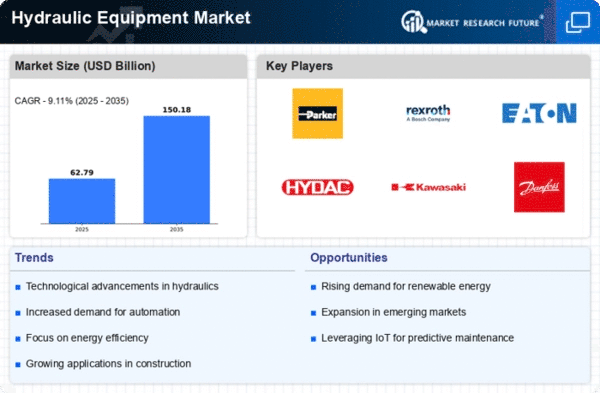
As per MRFR analysis, the Hydraulic Equipment Market Size was estimated at 57.55 USD Billion in 2024. The Hydraulic Equipment industry is projected to grow from 62.79 USD Billion in 2025 to 150.18 USD Billion by 2035, exhibiting a compound annual growth rate (CAGR) of 9.11 during the forecast period 2025 - 2035.

Key Market Trends & Highlights

The Hydraulic Equipment Market is poised for robust growth driven by technological advancements and sustainability initiatives.

  • Technological advancements are reshaping hydraulic systems, enhancing efficiency and performance across various applications.
  • North America remains the largest market for hydraulic equipment, while Asia-Pacific is recognized as the fastest-growing region.
  • The construction segment leads in market share, whereas the agriculture segment is experiencing rapid growth due to increased mechanization.
  • Rising demand in the construction sector and a growing focus on energy efficiency are key drivers propelling market expansion.

Market Size & Forecast

2024 Market Size 57.55 (USD Billion)
2035 Market Size 150.18 (USD Billion)
CAGR (2025 - 2035) 9.11%
Largest Regional Market Share in 2024 North America

Major Players

<p>Parker Hannifin (US), Bosch Rexroth (DE), Eaton Corporation (US), Hydac International (DE), Kawasaki Heavy Industries (JP), Danfoss (DK), Moog Inc. (US), Sauer-Danfoss (DK), Bucher Hydraulics (DE)</p>

Market Trends

The Hydraulic Equipment Market is currently experiencing a dynamic evolution, driven by advancements in technology and increasing demand across various sectors. The integration of automation and smart technologies into hydraulic systems appears to enhance efficiency and performance, thereby attracting a diverse range of industries. Furthermore, the growing emphasis on sustainability and energy efficiency is prompting manufacturers to innovate and develop eco-friendly hydraulic solutions. This shift not only aligns with global environmental goals but also caters to the rising consumer preference for sustainable products. In addition, the expansion of infrastructure projects worldwide seems to bolster the Hydraulic Equipment Market, as these initiatives require robust hydraulic systems for construction and maintenance. The ongoing urbanization trends and the need for modernized transportation networks further contribute to the market's growth. As industries continue to evolve, the Hydraulic Equipment Market is likely to witness a surge in demand for advanced hydraulic solutions that meet the challenges of modern applications, ensuring a promising outlook for the future.

Technological Advancements

The Hydraulic Equipment Market is witnessing a notable shift towards the incorporation of advanced technologies. Innovations such as IoT integration and smart sensors are enhancing the operational capabilities of hydraulic systems, leading to improved efficiency and reduced downtime. This trend indicates a growing preference for systems that offer real-time monitoring and predictive maintenance.

Sustainability Initiatives

There is a marked increase in the focus on sustainability within the Hydraulic Equipment Market. Manufacturers are actively developing eco-friendly hydraulic solutions that minimize environmental impact. This trend reflects a broader commitment to reducing carbon footprints and aligns with global efforts to promote sustainable industrial practices.

Infrastructure Development

The ongoing expansion of infrastructure projects globally is significantly influencing the Hydraulic Equipment Market. As nations invest in modernizing their infrastructure, the demand for reliable and efficient hydraulic systems is expected to rise. This trend underscores the critical role of hydraulic equipment in supporting construction and maintenance activities.

Hydraulic Equipment Market Market Drivers

Increased Focus on Energy Efficiency

The Global Hydraulic Equipment Market Industry is witnessing a heightened emphasis on energy efficiency, driven by regulatory frameworks and sustainability initiatives. Industries are increasingly adopting hydraulic systems that minimize energy consumption while maximizing output. This shift not only aligns with global environmental goals but also offers cost savings for businesses. Hydraulic equipment manufacturers are responding by developing energy-efficient solutions that comply with stringent regulations. As a result, the market is likely to see a significant uptick in demand for such products, contributing to the overall growth of the industry. This trend reflects a broader commitment to sustainable practices across various sectors.

Expansion of Agricultural Mechanization

The Global Hydraulic Equipment Market Industry is significantly influenced by the expansion of agricultural mechanization. As farmers seek to enhance productivity and efficiency, the adoption of hydraulic systems in agricultural machinery is on the rise. Equipment such as tractors and harvesters increasingly rely on hydraulic technology to perform complex tasks with precision. This trend is particularly evident in regions where agriculture is a primary economic driver. The integration of hydraulic systems not only improves operational efficiency but also supports sustainable farming practices. As the agricultural sector continues to evolve, the demand for hydraulic equipment is expected to grow, further bolstering the industry.

Rising Demand for Construction Equipment

The Global Hydraulic Equipment Market Industry is experiencing a surge in demand driven by the booming construction sector. As urbanization accelerates, infrastructure projects are proliferating, necessitating advanced hydraulic systems for machinery such as excavators and cranes. In 2024, the market is projected to reach 57.5 USD Billion, reflecting the industry's response to the increasing need for efficient construction solutions. This growth trajectory is expected to continue, with the market potentially expanding to 150.2 USD Billion by 2035, indicating a robust compound annual growth rate of 9.11% from 2025 to 2035. Such dynamics underscore the critical role of hydraulic equipment in modern construction practices.

Growing Demand from the Manufacturing Sector

The Global Hydraulic Equipment Market Industry is benefiting from the escalating demand from the manufacturing sector. As industries strive for automation and increased production capabilities, hydraulic systems are becoming integral to manufacturing processes. These systems facilitate the operation of machinery, enhancing productivity and precision. The ongoing trend towards automation is likely to drive further investments in hydraulic technology, as manufacturers seek to optimize their operations. This demand is expected to contribute significantly to the market's growth, with projections indicating a robust expansion trajectory. The manufacturing sector's reliance on hydraulic equipment underscores its importance in driving industrial advancements.

Technological Advancements in Hydraulic Systems

Technological innovation plays a pivotal role in shaping the Global Hydraulic Equipment Market Industry. The introduction of smart hydraulic systems, which integrate IoT and automation, enhances operational efficiency and reduces downtime. These advancements allow for real-time monitoring and predictive maintenance, thereby optimizing performance. As industries increasingly adopt these technologies, the demand for sophisticated hydraulic solutions is likely to rise. The ongoing evolution of hydraulic components, such as pumps and valves, further supports this trend, enabling manufacturers to offer more reliable and efficient products. Consequently, the market is poised for substantial growth as businesses seek to leverage these innovations.

Market Segment Insights

By Application: Construction (Largest) vs. Agriculture (Fastest-Growing)

<p>The hydraulic equipment market's application segment is predominantly driven by the construction sector, which commands a significant share due to its reliance on hydraulic systems for various tasks such as lifting, excavating, and material handling. The agriculture sector also plays a vital role, harnessing hydraulic equipment for efficiency in farming activities like tilling and harvesting. Among these, construction remains the dominant force, utilizing advanced hydraulic technologies to enhance productivity and reduce labor costs.</p>

<p>Construction: Excavators (Dominant) vs. Agriculture: Tractors (Emerging)</p>

<p>Excavators have established themselves as the dominant force within the construction application of hydraulic equipment. These versatile machines are essential for a wide range of tasks, from digging foundations to demolishing structures, showcasing robust performance and adaptability. On the other hand, tractors represent the emerging segment in agriculture, leveraging hydraulic systems for various functions, including planting and harvesting. While excavators play a critical role in large-scale construction projects, tractors are gaining traction as modern farming practices evolve, emphasizing automation and precision.</p>

By End Use: Industrial (Largest) vs. Marine (Fastest-Growing)

<p>The Hydraulic Equipment Market is significantly influenced by its end use segments, with the industrial segment commanding the largest share due to extensive applications in manufacturing, construction, and material handling. This segment's reliance on hydraulic systems for efficient power transmission highlights its dominance, while commercial, residential, and aerospace applications play crucial roles in supporting diverse hydraulic needs across various industries. On the growth front, the marine segment is emerging as the fastest-growing area within the hydraulic equipment market. With increasing investments in marine infrastructure and a growing emphasis on sustainable maritime operations, hydraulic technologies are becoming vital for enhancing productivity and efficiency in marine applications. This growth is further supported by advancements in equipment reliability and performance, driving significant interest and adoption in the marine sector.</p>

<p>Industrial: Largest vs. Marine: Fastest-Growing</p>

<p>The industrial segment of the Hydraulic Equipment Market represents the cornerstone of hydraulic system applications, leveraging advanced technologies for optimized operations across various sectors such as construction, manufacturing, and mining. This segment is characterized by its robust demand for high-performance hydraulic pumps, valves, and cylinders, essential for machinery and equipment that handle heavy loads and exert significant force. In contrast, the marine segment is rapidly gaining traction, primarily due to the rising demand for efficient underwater operations and enhanced vessel performance. As maritime activities expand, innovations in hydraulic technologies aimed at reliability and energy efficiency are steering this segment's growth, making it a key focus for manufacturers and stakeholders in the industry.</p>

By Type: Hydraulic Pumps (Largest) vs. Hydraulic Motors (Fastest-Growing)

<p>In the Hydraulic Equipment Market, the segment distribution reveals that Hydraulic Pumps hold the largest market share, showcasing their critical role in various industrial applications. They are preferred for their efficiency and reliability, being extensively utilized in construction, manufacturing, and automotive sectors. Following closely, Hydraulic Cylinders and Hydraulic Valves also contribute significantly to the market, showcasing varied applications in both mobile and stationary equipment. Conversely, Hydraulic Accumulators, while holding a smaller share, are gaining traction due to their role in energy efficiency and system stability. As emphasized by recent trends, Hydraulic Motors are emerging as the fastest-growing segment, driven by the increasing demand for automation in industrial operations. This growth is fueled by advancements in technology and the shift towards efficient energy solutions. Additionally, the rising focus on sustainability and minimizing operational costs further supports this growth, making Hydraulic Motors a focal point for manufacturers seeking to innovate and meet evolving market needs.</p>

<p>Hydraulic Pumps (Dominant) vs. Hydraulic Accumulators (Emerging)</p>

<p>Hydraulic Pumps are the dominant component in the Hydraulic Equipment Market, known for their robustness and versatility across multiple sectors. They are integral in driving hydraulic systems, offering a variety of designs such as gear, vane, and piston types to meet different operational requirements. Their widespread usage in construction and machinery sectors underscores their reliability and efficiency. In contrast, Hydraulic Accumulators represent an emerging segment, gaining popularity for their ability to store energy and maintain system pressure. Their increasing adoption aligns with modern energy-saving initiatives, promoting system efficiency and reducing the overall carbon footprint. As industries strive for innovation and sustainability, Hydraulic Accumulators are expected to play a more prominent role in the market.</p>

By Distribution Channel: Distributors (Largest) vs. Online Sales (Fastest-Growing)

<p>In the Hydraulic Equipment Market, the distribution of sales among various channels reveals that distributors hold the largest market share due to their established networks and relationships within the industry. Direct sales also play a significant role, particularly for manufacturers focusing on specific clients or niche applications, while retail and wholesale channels contribute to a strong customer base. Online sales, although a smaller portion of the overall distribution, are gaining traction as more customers turn to digital platforms for convenience and competitive pricing.</p>

<p>Distributors (Dominant) vs. Online Sales (Emerging)</p>

<p>Distributors are a dominant force in the Hydraulic Equipment Market, leveraging their extensive networks to provide timely and effective access to hydraulic solutions for various industries. They offer a broad range of products, comprehensive service support, and industry expertise that cater to diverse end-user needs. On the other hand, online sales represent an emerging channel, capitalizing on the growing digitalization trend. This shift is driven by customer demand for ease of access, the ability to compare products quickly, and seamless purchasing experiences. As manufacturers and distributors enhance their online capabilities, the online sales channel is expected to witness rapid growth, appealing to tech-savvy and cost-conscious customers.</p>

By Pressure Range: High Pressure (Largest) vs. Ultra High Pressure (Fastest-Growing)

<p>The Hydraulic Equipment Market is characterized by a diverse pressure range segment distribution, primarily categorized into Low Pressure, Medium Pressure, High Pressure, and Ultra High Pressure. Among these, High Pressure holds the largest market share due to its widespread application in various industrial sectors, including construction, manufacturing, and automotive industries. Low and Medium Pressure segments follow, reflecting stable demand for lighter applications, while Ultra High Pressure, though smaller in share, illustrates a growing preference in niche and specialized applications.</p>

<p>High Pressure (Dominant) vs. Ultra High Pressure (Emerging)</p>

<p>High Pressure hydraulic equipment is well-established, catering to heavy machinery and demanding applications, making it a dominant force in the market. This segment benefits from robust usage in sectors like construction and manufacturing. Conversely, Ultra High Pressure equipment is emerging as a segment with rapid growth potential, driven by innovations in hydraulic technology and increasing needs for precision in industries such as aerospace and pharmaceuticals. Ultra High Pressure systems are characterized by their ability to handle extreme conditions, offering significant efficiency advantages in specialized applications, thus attracting more attention and investment.</p>

Get more detailed insights about Hydraulic Equipment Market Research Report - Global Forecast till 2035

Regional Insights

North America : Market Leader in Hydraulic Equipment

North America is poised to maintain its leadership in the hydraulic equipment market, holding a significant market share of 28.0 in 2024. The region's growth is driven by robust demand from sectors such as construction, agriculture, and manufacturing, alongside increasing investments in infrastructure. Regulatory support for advanced hydraulic technologies further fuels this growth, ensuring compliance with safety and environmental standards. The competitive landscape in North America is characterized by the presence of key players like Parker Hannifin and Eaton Corporation, which are at the forefront of innovation. The U.S. leads the market, supported by a strong manufacturing base and technological advancements. Companies are focusing on R&D to enhance efficiency and sustainability, positioning themselves strategically to capture emerging opportunities in the hydraulic sector.

Europe : Innovation and Sustainability Focus

Europe's hydraulic equipment market is projected to reach a size of 15.0 by 2025, driven by increasing demand for sustainable and efficient hydraulic solutions. The region is witnessing a shift towards eco-friendly technologies, supported by stringent regulations aimed at reducing carbon emissions. This regulatory environment encourages innovation, pushing manufacturers to develop advanced hydraulic systems that meet both performance and environmental standards. Germany and France are leading the charge in Europe, with companies like Bosch Rexroth and Hydac International playing pivotal roles. The competitive landscape is marked by a strong emphasis on R&D, with firms investing heavily in new technologies. The European market is also characterized by collaborations between manufacturers and research institutions, fostering innovation and enhancing product offerings.

Asia-Pacific : Emerging Market with High Potential

The Asia-Pacific region is emerging as a significant player in the hydraulic equipment market, with a projected size of 12.0 by 2025. The growth is primarily driven by rapid industrialization, urbanization, and increasing investments in infrastructure projects across countries like China and India. Additionally, government initiatives aimed at boosting manufacturing capabilities are further propelling demand for hydraulic solutions in various sectors, including construction and agriculture. China stands out as the leading country in this region, with major players like Kawasaki Heavy Industries and Moog Inc. establishing a strong presence. The competitive landscape is evolving, with local manufacturers increasingly innovating to meet the growing demand. As the market matures, there is a notable shift towards automation and smart hydraulic systems, enhancing operational efficiency and productivity.

Middle East and Africa : Developing Market with Opportunities

The Middle East and Africa region, with a market size of 2.55, presents significant growth potential in the hydraulic equipment sector. The demand is driven by ongoing infrastructure projects and a growing focus on industrialization. Countries like the UAE and South Africa are investing heavily in construction and mining, which are key sectors for hydraulic equipment. Regulatory frameworks are gradually evolving to support industry growth, enhancing safety and operational standards. In this region, the competitive landscape is still developing, with both local and international players vying for market share. Companies are increasingly focusing on partnerships and collaborations to enhance their offerings. The presence of key players is growing, and as the market matures, there is a shift towards adopting advanced hydraulic technologies to meet the demands of various industries.

Key Players and Competitive Insights

The Hydraulic Equipment Market is currently characterized by a dynamic competitive landscape, driven by technological advancements and increasing demand across various sectors, including construction, agriculture, and manufacturing. Major players such as Parker Hannifin (US), Bosch Rexroth (DE), and Eaton Corporation (US) are strategically positioned to leverage innovation and regional expansion to enhance their market presence. These companies are focusing on digital transformation and sustainability initiatives, which collectively shape a competitive environment that emphasizes efficiency and environmental responsibility.

Key business tactics within the Hydraulic Equipment Market include localizing manufacturing and optimizing supply chains to meet regional demands effectively. The market structure appears moderately fragmented, with several key players exerting considerable influence. This fragmentation allows for niche players to thrive while larger companies consolidate their positions through strategic partnerships and acquisitions, thereby enhancing their operational capabilities and market reach.

In November 2025, Parker Hannifin (US) announced the launch of a new line of energy-efficient hydraulic pumps designed to reduce energy consumption by up to 30%. This strategic move not only aligns with global sustainability goals but also positions Parker as a leader in innovation within the hydraulic sector. The introduction of these pumps is expected to attract environmentally conscious customers and enhance Parker's competitive edge in a market increasingly focused on energy efficiency.

In October 2025, Bosch Rexroth (DE) expanded its manufacturing capabilities in Asia by opening a new facility in Vietnam. This expansion is significant as it allows Bosch to cater to the growing demand in the Asia-Pacific region, which is witnessing rapid industrialization. By localizing production, Bosch Rexroth aims to reduce lead times and improve supply chain efficiency, thereby strengthening its market position in a highly competitive landscape.

In September 2025, Eaton Corporation (US) entered into a strategic partnership with a leading technology firm to integrate AI-driven analytics into its hydraulic systems. This collaboration is poised to enhance predictive maintenance capabilities, thereby reducing downtime for customers. The integration of AI not only signifies a shift towards smarter hydraulic solutions but also reflects Eaton's commitment to innovation and customer-centricity in a rapidly evolving market.

As of December 2025, current competitive trends in the Hydraulic Equipment Market are increasingly defined by digitalization, sustainability, and the integration of advanced technologies such as AI. Strategic alliances are playing a crucial role in shaping the landscape, enabling companies to pool resources and expertise to drive innovation. Looking ahead, competitive differentiation is likely to evolve from traditional price-based competition to a focus on technological advancements, supply chain reliability, and sustainable practices, indicating a transformative shift in how companies compete in this sector.

Key Companies in the Hydraulic Equipment Market include

Industry Developments

August 2022: The mini hydraulic power pack type HICON, developed by HAWE for use in recreational boats but with a distinct advantage in many other applications, was released. Because it is waterproof, it can operate when being splashed with water or briefly submerged in water.

July 2022: Bosch made an investment in BRUSA HyPower to round out its line of eLION products for off-road vehicle electrification. In the upcoming years, prominent corporations are likely to prioritize strategic acquisition and investments in up-and-coming businesses.

April 2022: Energy conservation and reducing carbon emissions are more important than ever, but oftentimes, outcomes come at the sacrifice of usability or efficiency. A speedy return on investment is provided by the Danfoss Heat Recovery Unit, which also offers significant environmental benefits and savings on heating bills.

January 2022: Future mobile hydraulics OEMs must create smarter, safer, and higher-performing machines than ever before if they are to meet the digitally driven expectations of the market. Since our factory in Minden, Germany now has additional manufacturing capacity, Danfoss Sensing Solutions will more than treble its thin-film pressure sensor production there in 2022.

Future Outlook

Hydraulic Equipment Market Future Outlook

<p>The Hydraulic Equipment Market is projected to grow at a 9.11% CAGR from 2024 to 2035, driven by technological advancements, increased automation, and rising demand in construction and agriculture.</p>

New opportunities lie in:

  • <p>Development of smart hydraulic systems with IoT integration</p>
  • <p>Expansion into renewable energy sector applications</p>
  • <p>Customized hydraulic solutions for niche industries</p>

<p>By 2035, the market is expected to achieve robust growth, reflecting evolving industry demands.</p>

Market Segmentation

Hydraulic Equipment Market Type Outlook

  • Hydraulic Pumps
  • Hydraulic Cylinders
  • Hydraulic Motors
  • Hydraulic Valves
  • Hydraulic Accumulators

Hydraulic Equipment Market End Use Outlook

  • Industrial
  • Commercial
  • Residential
  • Marine
  • Aerospace

Hydraulic Equipment Market Application Outlook

  • Construction
  • Agriculture
  • Mining
  • Manufacturing
  • Transportation

Hydraulic Equipment Market Pressure Range Outlook

  • Low Pressure
  • Medium Pressure
  • High Pressure
  • Ultra High Pressure

Hydraulic Equipment Market Distribution Channel Outlook

  • Direct Sales
  • Distributors
  • Online Sales
  • Retail
  • Wholesale

Report Scope

MARKET SIZE 202457.55(USD Billion)
MARKET SIZE 202562.79(USD Billion)
MARKET SIZE 2035150.18(USD Billion)
COMPOUND ANNUAL GROWTH RATE (CAGR)9.11% (2024 - 2035)
REPORT COVERAGERevenue Forecast, Competitive Landscape, Growth Factors, and Trends
BASE YEAR2024
Market Forecast Period2025 - 2035
Historical Data2019 - 2024
Market Forecast UnitsUSD Billion
Key Companies ProfiledParker Hannifin (US), Bosch Rexroth (DE), Eaton Corporation (US), Hydac International (DE), Kawasaki Heavy Industries (JP), Danfoss (DK), Moog Inc. (US), Sauer-Danfoss (DK), Bucher Hydraulics (DE)
Segments CoveredApplication, End Use, Type, Distribution Channel, Pressure Range
Key Market OpportunitiesIntegration of smart technologies enhances efficiency and safety in the Hydraulic Equipment Market.
Key Market DynamicsTechnological advancements and regulatory changes drive innovation and competition in the hydraulic equipment market.
Countries CoveredNorth America, Europe, APAC, South America, MEA

FAQs

How much is the hydraulic equipment market?

The global hydraulic equipment market size was valued at USD 57.55 Billion in 2024.

What is the growth rate of the hydraulic equipment market?

The global market is projected to grow at a CAGR of 9.11% during the forecast period, 2025-2034.

Which region held the largest market share in the hydraulic equipment market?

North America had the largest share in the global market.

Who are the key players in the hydraulic equipment market?

The key players in the market are Bosch Rexroth (Germany), Eaton Corporation Plc (Ireland), Parker Hannifin (US), Kawasaki (Japan), HAWE (Germany), Hydac (Germany), Moog, Inc. (US), Bucker Hydraulics (Germany), Daikin (Japan), Concentric (Sweden), Casappa (Italy), Nachi-Fujikoshi (Japan), Dantal Hydraulics (India), Fluitronics GmbH (Germany), and Linde Hydraulics (Germany).

Which component led the hydraulic equipment market?

The cylinder category dominated the market in 2022.

Which application had the largest market share in the hydraulic equipment market?

The industrial category had the largest share in the global market.

  1. SECTION I: EXECUTIVE SUMMARY AND KEY HIGHLIGHTS
    1. | 1.1 EXECUTIVE SUMMARY
  2. SECTION II: SCOPING, METHODOLOGY AND MARKET STRUCTURE
    1. | 2.1 MARKET INTRODUCTION
    2. | 2.2 RESEARCH METHODOLOGY
  3. SECTION III: QUALITATIVE ANALYSIS
    1. | 3.1 MARKET DYNAMICS
    2. | 3.2 MARKET FACTOR ANALYSIS
  4. SECTION IV: QUANTITATIVE ANALYSIS
    1. | 4.1 Energy & Power, BY Application (USD Billion)
    2. | 4.2 Energy & Power, BY End Use (USD Billion)
    3. | 4.3 Energy & Power, BY Type (USD Billion)
    4. | 4.4 Energy & Power, BY Distribution Channel (USD Billion)
    5. | 4.5 Energy & Power, BY Pressure Range (USD Billion)
    6. | 4.6 Energy & Power, BY Region (USD Billion)
  5. SECTION V: COMPETITIVE ANALYSIS
    1. | 5.1 Competitive Landscape
    2. | 5.2 Company Profiles
    3. | 5.3 Appendix

Hydraulic Equipment Market Segmentation

Market Segmentation Overview

  • Detailed segmentation data will be available in the full report
  • Comprehensive analysis by multiple parameters
  • Regional and country-level breakdowns
  • Market size forecasts by segment
Infographic

Free Sample Request

Kindly complete the form below to receive a free sample of this Report

Get Free Sample

Customer Strories

Compare Licence

×
Features License Type
Single User Multiuser License Enterprise User
Price $4,950 $5,950 $7,250
Maximum User Access Limit 1 User Upto 10 Users Unrestricted Access Throughout the Organization
Free Customization
Direct Access to Analyst
Deliverable Format
Platform Access
Discount on Next Purchase 10% 15% 15%
Printable Versions