Request Free Sample ×

Kindly complete the form below to receive a free sample of this Report

* Please use a valid business email

Leading companies partner with us for data-driven Insights

clients tt-cursor
Hero Background
English
Chinese
French
Japanese
Korean
German
Spanish

Hydrate Inhibitors Market Share

ID: MRFR/CnM/7322-CR
111 Pages
Anshula Mandaokar
October 2022

Hydrate Inhibitors Market Research Research Report Information By Type (Thermodynamic Inhibitors (THIs), Low-Dosage Hydrate Inhibitors (LDHIs)) Application (Onshore Operations, Offshore Operations) Forecast 2030

Share:
Download PDF ×

We do not share your information with anyone. However, we may send you emails based on your report interest from time to time. You may contact us at any time to opt-out.

Hydrate Inhibitors Market Infographic
Purchase Options

Market Share

Hydrate Inhibitors Market Share Analysis

The Hydrate Inhibitors Market is an integral part of the oil and gas industry, and it employs different market share positioning strategies in order to cope with competition within its environment. Fundamentally, this involves differentiation through product innovation. Some firms within the hydrate inhibitors industry invest heavily in research and development so that new sophisticated products can be introduced to markets that have improved efficiency in preventing hydrate formation, adaptability to varying operating conditions, and reduced environmental impacts, among other unique properties. Again, there is a cost leadership strategy which is significant in the case of hydrate inhibitors. All said and done, some companies gear towards optimization production processes while simultaneously looking at cheap raw materials sourcing to allow them to compete favorably on price-based grounds. Strategic partnerships and collaboration have an influential role in defining the market share of the hydrate inhibitors market. Oil and gas operators, engineering companies, and research institutions are some of the key stakeholders where companies often form alliances. Collaborative efforts make sure that the supply chain is smooth, thereby ensuring consistent and reliable channels of distribution. As a result, a customer-centric approach has become crucial in the hydrate inhibitors market. Understanding and addressing customer needs, including ease of application compatibility with other oil and gas compositions and technical support, among others, are important to ensure steady growth in terms of the firm's shares. Environmental sustainability is increasingly becoming a priority for firms involved in the hydrate inhibitors market; hence, they are embarking on eco-friendly positioning strategies. Hydrate inhibitors that fit into environmentally friendly practices are sought after by customers who are now more aware of environmental consequences. Some businesses in this industry sell biodegradable products that use environmentally safe components or even possess low levels of toxicity. By doing so, these companies target a segment that prefers sustainable choices, hence developing both their market share and good reputation.

Author
Author Profile
Anshula Mandaokar
Team Lead - Research

Anshula Mandaokar holds an academic degree in Chemical Engineering and has been contributing to the field for more than 5 years. She has expertise in Market Research and Business Consulting and serves as a Team Lead for a reputed Market Research firm under the Chemicals and Materials domain spectrum. She has worked on multiple projects, generating explicit results in a quick turnaround time. Her understanding of data interpretation justifies her role as a leader.

Leave a Comment

FAQs

What is the projected market valuation for the Hydrate Inhibitors Market by 2035?

<p>The Hydrate Inhibitors Market is projected to reach a valuation of 66.26 USD Million by 2035.</p>

What was the market valuation of the Hydrate Inhibitors Market in 2024?

<p>In 2024, the Hydrate Inhibitors Market was valued at 15.71 USD Million.</p>

What is the expected CAGR for the Hydrate Inhibitors Market during the forecast period 2025 - 2035?

<p>The expected CAGR for the Hydrate Inhibitors Market during the forecast period 2025 - 2035 is 13.98%.</p>

Which companies are considered key players in the Hydrate Inhibitors Market?

Key players in the Hydrate Inhibitors Market include BASF SE, Clariant AG, Halliburton Company, Schlumberger Limited, Baker Hughes Company, BASF Corporation, Ecolab Inc., and Nalco Champion.

What are the primary applications of hydrate inhibitors in the market?

The primary applications of hydrate inhibitors include Oil and Gas Production, Natural Gas Processing, Chemical Processing, and Water Treatment.

How do thermodynamic hydrate inhibitors compare to kinetic hydrate inhibitors in market valuation?

Thermodynamic hydrate inhibitors are valued between 5.0 and 21.0 USD Million, while kinetic hydrate inhibitors range from 6.0 to 25.0 USD Million.

What is the market segmentation by end use for hydrate inhibitors?

The market segmentation by end use includes Offshore, Onshore, and Subsea applications.

What forms do hydrate inhibitors take in the market?

Hydrate inhibitors are available in various forms, including Liquid, Solid, and Powder.

How are hydrate inhibitors distributed in the market?

Hydrate inhibitors are distributed through Direct Sales, Distributors, and Online Sales channels.

What is the valuation range for hydrate inhibitors used in offshore applications?

The valuation range for hydrate inhibitors used in offshore applications is between 5.0 and 20.0 USD Million.

Market Summary

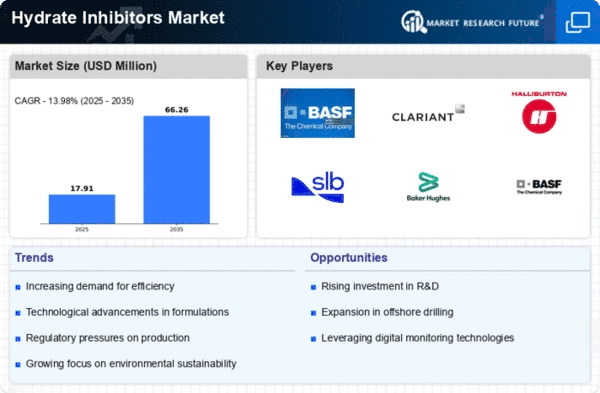
As per MRFR analysis, the Hydrate Inhibitors Market Size was estimated at 15.71 USD Million in 2024. The Hydrate Inhibitors industry is projected to grow from 17.91 in 2025 to 66.26 by 2035, exhibiting a compound annual growth rate (CAGR) of 13.98% during the forecast period 2025 - 2035.

Key Market Trends & Highlights

The Hydrate Inhibitors Market is poised for growth driven by technological advancements and sustainability efforts.

  • North America remains the largest market for hydrate inhibitors, primarily due to its extensive oil and gas production activities. Asia-Pacific is emerging as the fastest-growing region, fueled by increasing energy demands and infrastructure development. The oil and gas production segment dominates the market, while the water treatment segment is witnessing rapid growth. Key market drivers include the increasing demand for energy resources and the growing focus on environmental sustainability.

Market Size & Forecast

2024 Market Size 15.71 (USD Million)
2035 Market Size 66.26 (USD Million)
CAGR (2025 - 2035) 13.98%
Largest Regional Market Share in 2024 North America

Major Players

BASF SE (DE), Clariant AG (CH), Halliburton Company (US), Schlumberger Limited (US), Baker Hughes Company (US), BASF Corporation (US), Ecolab Inc. (US), Nalco Champion (US)

Market Trends

The hydrate inhibitors market is currently experiencing a notable evolution, driven by the increasing demand for energy resources and the need for efficient extraction methods. As industries seek to optimize production processes, the role of hydrate inhibitors becomes increasingly critical. These substances are essential in preventing the formation of gas hydrates, which can obstruct pipelines and disrupt operations. The market appears to be influenced by advancements in chemical formulations and the growing emphasis on sustainable practices. Companies are likely focusing on developing innovative solutions that not only enhance performance but also minimize environmental impact, which is expected to positively influence overall hydrate inhibitors market growth and expand hydrate inhibitors market revenue in the coming years.

In addition, the hydrate inhibitors market seems to be shaped by the rising exploration activities in deepwater and ultra-deepwater regions. As energy companies venture into more challenging environments, the necessity for effective hydrate management solutions becomes paramount. This trend indicates a shift towards specialized products tailored for specific operational conditions. Furthermore, collaboration between manufacturers and end-users is likely to foster the development of customized inhibitors, enhancing overall efficiency and safety in hydrocarbon production. Overall, the market is poised for growth, with a clear trajectory towards innovation and sustainability, which will likely contribute to an increase in hydrate inhibitors market share among leading players.

Sustainable Solutions

The Hydrate Inhibitors Market is witnessing a shift towards environmentally friendly products. Companies are increasingly prioritizing sustainable practices, leading to the development of biodegradable and less toxic inhibitors. This trend reflects a broader commitment to reducing the ecological footprint of energy production.

Technological Advancements

Innovations in chemical formulations and application techniques are transforming the Hydrate Inhibitors Market. Enhanced understanding of hydrate dynamics is driving the creation of more effective inhibitors, which can operate efficiently under diverse conditions, thereby improving overall operational efficiency.

Regulatory Influences

The Hydrate Inhibitors Market is also shaped by evolving regulations aimed at ensuring safety and environmental protection. Stricter guidelines compel companies to adopt advanced hydrate management solutions, thereby fostering a market environment that encourages compliance and innovation.

Hydrate Inhibitors Market Market Drivers

Rising Demand for Energy

The Global Hydrate Inhibitors Market Industry is experiencing a surge in demand driven by the increasing need for energy resources. As global energy consumption rises, particularly in developing nations, the oil and gas sector is under pressure to enhance production efficiency. Hydrate inhibitors play a crucial role in preventing the formation of gas hydrates in pipelines, thereby ensuring uninterrupted flow. This demand is reflected in the market's projected growth, with an estimated value of 14.3 USD Billion in 2024 and a forecasted increase to 29.2 USD Billion by 2035. Such growth suggests a compound annual growth rate of 6.68% from 2025 to 2035.

Market Segment Insights

By Application: Oil and Gas Production (Largest) vs. Water Treatment (Fastest-Growing)

The hydrate inhibitors market is characterized by diverse applications, with Oil and Gas Production holding the largest share. This segment prominently leads due to its essential role in combating hydrate formation in offshore and onshore operations. In contrast, Water Treatment, while currently smaller in share, is rapidly gaining traction as the fastest-growing application, driven by increasing regulations concerning water quality and safety across industries. Furthermore, the adoption of innovative solutions in various sectors also fuels the demand for hydrate inhibitors in water treatment processes.

Oil and Gas Production (Dominant) vs. Chemical Processing (Emerging)

Oil and Gas Production continues to be the dominant application in the hydrate inhibitors market due to its critical need for maintaining flow assurance and preventing blockage in pipelines. This segment benefits from the advancement of technologies tailored for complex offshore fields and deep-water extraction. Conversely, Chemical Processing is emerging as a vital segment that increasingly utilizes hydrate inhibitors to enhance production efficiency and safety in chemical reactions. The rise of unconventional resources and enhanced recovery techniques is expected to elevate the Chemical Processing segment, as companies seek effective ways to manage hydrates during production.

By Type: Thermodynamic Hydrate Inhibitors (Largest) vs. Kinetic Hydrate Inhibitors (Fastest-Growing)

The hydrate inhibitors market is primarily dominated by thermodynamic hydrate inhibitors, which play a crucial role in prevention strategies for hydrate formation. They hold the largest market share due to their effective performance and widespread application in various oil and gas operations. Kinetic hydrate inhibitors are gaining traction, albeit with a smaller slice of the market pie, as industries seek innovative solutions to enhance operational efficiency. Other categories such as anti-agglomerants contribute but are overshadowed by the performance capabilities of thermodynamic and kinetic inhibitors.

Thermodynamic Hydrate Inhibitors (Dominant) vs. Kinetic Hydrate Inhibitors (Emerging)

Thermodynamic hydrate inhibitors are established as the dominant players in the hydrate inhibitors market, recognized for their effectiveness in increasing the stability of hydrate formation under varying pressure and temperature conditions. Their resilience and reliability make them the preferred choice for operators dealing with high-risk environments. Kinetic hydrate inhibitors, while emerging, are known for their ability to delay hydrate formation and are witnessing significant investments in R&amp;D. This category is primarily gaining momentum due to advancements that enable better performance under fluctuating operational conditions, which, coupled with the growing focus on safe and cost-effective solutions, is driving their adoption.

By End Use: Offshore (Largest) vs. Subsea (Fastest-Growing)

In the Hydrate Inhibitors Market, the market share distribution is significantly influenced by the end use of the products. Offshore applications hold the largest share, characterized by their extensive usage in deep-water oil and gas exploration, where hydrate formation risks are prevalent. Onshore operations also contribute to the market but are less impactful than offshore due to the relatively stable environmental conditions. Subsea applications are emerging rapidly, driven by technological advancements and the increasing need for effective hydrate management solutions.

Offshore (Dominant) vs. Subsea (Emerging)

Offshore hydrate inhibitors are crucial in ensuring safe and efficient operations in deep-sea environments. Their dominant role arises from the complexities involved in high-pressure and low-temperature conditions that favor hydrate formation. The effectiveness of these inhibitors is paramount, as they help maintain flow assurance in pipelines, preventing blockages that could result in costly downtimes. On the other hand, subsea hydrate inhibitors are gaining traction as emerging options due to the rising investments in subsea engineering and the exploration of untapped reserves. The growing focus on environmentally friendly inhibitors and advancements in subsea technology position subsea products as viable alternatives, appealing to operators seeking innovative solutions for hydrate management.

By Formulation: Liquid (Largest) vs. Solid (Fastest-Growing)

In the Hydrate Inhibitors Market, the formulation segment is divided into three primary types: liquid, solid, and powder. Among these, liquid formulations hold the largest market share, favored for their ease of application and effectiveness in various conditions. Solid formulations, while currently smaller in market share, are rapidly gaining traction due to advancements in manufacturing processes and an increasing preference for options that offer higher stability and lower transportation costs. Powder formulations lag behind in terms of market presence but are critical for specific applications.

Solid (Dominant) vs. Powder (Emerging)

Liquid formulations are recognized as the dominant force in the Hydrate Inhibitors Market, often preferred for their versatility and rapid disbursement in various environments. Solid formulations are emerging as a compelling choice, attracting interest due to their enhanced shelf-life and cost-effectiveness in transportation and handling. The powder segment remains essential for specialized applications, aiming at niche markets that require specific performance characteristics. Overall, the solid formulations are likely to see increased R&amp;D investment as the market recognizes their potential, positioning them as key players in the future of hydrate inhibition solutions.

By Distribution Channel: Direct Sales (Largest) vs. Online Sales (Fastest-Growing)

In the Hydrate Inhibitors Market, Direct Sales currently holds the largest share, leveraging strong relationships with key industrial players and offering tailored solutions. Meanwhile, distributors play a significant role, providing accessibility and regional coverage, ensuring that products reach various sectors in need of these inhibitors. Online Sales, although a smaller segment, is rapidly gaining traction as industrial clients seek convenience and efficiency in sourcing hydrate inhibitors through digital platforms.

Direct Sales (Dominant) vs. Online Sales (Emerging)

Direct Sales in the hydrate inhibitors market stands out as the dominant distribution channel, providing personalized engagement and fostering long-term partnerships with customers. This segment often caters to large corporations that require customized solutions and real-time support. Conversely, Online Sales is emerging as a significant player, driven by a growing preference for e-commerce among industrial buyers. Clients are increasingly attracted to the convenience of online platforms that offer quick comparisons and easier procurement processes. Both segments are vital, but Online Sales represents the future direction of distribution in this market.

Get more detailed insights about Hydrate inhibitors Market Research Report—Global Forecast till 2035

Regional Insights

North America : Market Leader in Hydrate Inhibitors

North America is poised to maintain its leadership in the hydrate inhibitors market, holding a significant share of 7.86 in 2024. The region's growth is driven by increasing offshore oil and gas exploration activities, stringent regulations promoting safety, and technological advancements in hydrate management. The demand for effective hydrate inhibitors is further fueled by the need for enhanced production efficiency and reduced operational costs. The United States stands out as the leading country in this sector, with major players like Halliburton Company, Schlumberger Limited, and Baker Hughes Company driving innovation and competition. The presence of key companies such as BASF SE and Ecolab Inc. enhances the competitive landscape, ensuring a robust supply chain and advanced product offerings. This dynamic environment positions North America as a critical hub for hydrate inhibitor solutions.

Europe : Emerging Market with Growth Potential

Europe's hydrate inhibitors market is on a growth trajectory, with a market size of 4.71. The region benefits from increasing investments in renewable energy and stringent environmental regulations that necessitate the use of effective hydrate management solutions. The demand for hydrate inhibitors is also driven by the need to optimize production in aging oil fields and enhance safety measures in offshore operations. Leading countries such as the UK, Germany, and Norway are at the forefront of this market, supported by key players like Clariant AG and BASF SE. The competitive landscape is characterized by a mix of established companies and innovative startups, fostering a dynamic environment for product development. The European market is expected to see continued growth as companies adapt to regulatory changes and technological advancements.

Asia-Pacific : Emerging Powerhouse in Hydrate Solutions

The Asia-Pacific region is emerging as a significant player in the hydrate inhibitors market, with a market size of 2.14. The growth is primarily driven by increasing offshore exploration activities and the rising demand for energy in countries like China and India. Regulatory frameworks promoting safety and environmental sustainability are also contributing to the demand for effective hydrate management solutions in the region. Countries such as China, Australia, and India are leading the charge, with a growing presence of key players like Halliburton Company and Schlumberger Limited. The competitive landscape is evolving, with both local and international companies vying for market share. As the region continues to invest in energy infrastructure, the demand for hydrate inhibitors is expected to rise significantly, positioning Asia-Pacific as a vital market for future growth.

Middle East and Africa : Resource-Rich Frontier for Hydrate Inhibitors

The Middle East and Africa region, with a market size of 1.0, is recognized as a resource-rich frontier for hydrate inhibitors. The growth in this region is driven by the increasing exploration and production activities in oil-rich countries, alongside the need for effective hydrate management solutions to ensure operational efficiency. Regulatory initiatives aimed at enhancing safety and environmental standards are also catalyzing market growth. Countries like Saudi Arabia, UAE, and Nigeria are leading the market, supported by key players such as Baker Hughes Company and Ecolab Inc. The competitive landscape is characterized by a mix of established firms and emerging players, fostering innovation and collaboration. As the region continues to develop its energy sector, the demand for hydrate inhibitors is expected to grow, making it a key area for investment and development.

Key Players and Competitive Insights

The Hydrate Inhibitors Market is currently characterized by a dynamic competitive landscape, driven by the increasing demand for efficient solutions in oil and gas extraction processes. Key players are actively engaging in strategic initiatives to enhance their market positioning. For instance, BASF SE (DE) has been focusing on innovation and sustainability, developing advanced hydrate inhibitors that align with environmental regulations. Similarly, Halliburton Company (US) is emphasizing digital transformation, integrating AI technologies into their operations to optimize hydrate management solutions. These strategies collectively contribute to a competitive environment that prioritizes technological advancement and sustainability.In terms of business tactics, companies are increasingly localizing manufacturing and optimizing supply chains to enhance operational efficiency. The market structure appears moderately fragmented, with several key players exerting influence over their respective segments. This fragmentation allows for a diverse range of products and services, fostering competition that drives innovation and customer-centric solutions.
In November Clariant AG (CH) announced a strategic partnership with a leading oil and gas company to co-develop next-generation hydrate inhibitors. This collaboration is expected to leverage Clariant's expertise in specialty chemicals, enhancing the performance of hydrate management solutions. The strategic importance of this partnership lies in its potential to accelerate product development and expand market reach, positioning Clariant as a frontrunner in innovative solutions.
In October Baker Hughes Company (US) launched a new line of hydrate inhibitors designed specifically for deepwater applications. This product introduction is significant as it addresses the unique challenges faced in deepwater drilling, showcasing Baker Hughes' commitment to meeting evolving industry needs. The launch not only strengthens their product portfolio but also reinforces their competitive edge in a niche market segment.
In September Ecolab Inc. (US) expanded its hydrate management services through the acquisition of a regional player specializing in chemical solutions for offshore operations. This acquisition is indicative of Ecolab's strategy to enhance its service offerings and geographic footprint, allowing for a more comprehensive approach to hydrate management. The move is likely to bolster Ecolab's market presence and provide customers with integrated solutions.
As of December current competitive trends indicate a strong emphasis on digitalization, sustainability, and AI integration within the Hydrate Inhibitors Market. Strategic alliances are increasingly shaping the landscape, enabling companies to pool resources and expertise for enhanced innovation. Looking ahead, competitive differentiation is expected to evolve, shifting from price-based competition to a focus on technological advancements, supply chain reliability, and sustainable practices. This transition underscores the importance of innovation as a key driver of market success.

Key Companies in the Hydrate Inhibitors Market include

Industry Developments

Future Outlook

Hydrate Inhibitors Market Future Outlook

The Hydrate Inhibitors Market is projected to grow at a 13.98% CAGR from 2025 to 2035, driven by increasing offshore oil and gas exploration and technological advancements in inhibitor formulations.

New opportunities lie in:

  • <p>Development of biodegradable hydrate inhibitors for eco-friendly applications. Integration of AI-driven predictive maintenance systems for hydrate management. Expansion into emerging markets with tailored hydrate inhibition solutions.</p>

By 2035, the Hydrate Inhibitors Market is expected to achieve substantial growth and innovation.

Market Segmentation

Hydrate Inhibitors Market Type Outlook

  • Thermodynamic Hydrate Inhibitors
  • Kinetic Hydrate Inhibitors
  • Anti-Agglomerants

Hydrate Inhibitors Market End Use Outlook

  • Offshore
  • Onshore
  • Subsea

Hydrate Inhibitors Market Application Outlook

  • Oil and Gas Production
  • Natural Gas Processing
  • Chemical Processing
  • Water Treatment

Hydrate Inhibitors Market Formulation Outlook

  • Liquid
  • Solid
  • Powder

Hydrate Inhibitors Market Distribution Channel Outlook

  • Direct Sales
  • Distributors
  • Online Sales

Report Scope

MARKET SIZE 2024 15.71(USD Million)
MARKET SIZE 2025 17.91(USD Million)
MARKET SIZE 2035 66.26(USD Million)
COMPOUND ANNUAL GROWTH RATE (CAGR) 13.98% (2025 - 2035)
REPORT COVERAGE Revenue Forecast, Competitive Landscape, Growth Factors, and Trends
BASE YEAR 2024
Market Forecast Period 2025 - 2035
Historical Data 2019 - 2024
Market Forecast Units USD Million
Key Companies Profiled BASF SE (DE), Clariant AG (CH), Halliburton Company (US), Schlumberger Limited (US), Baker Hughes Company (US), BASF Corporation (US), Ecolab Inc. (US), Nalco Champion (US)
Segments Covered Application, Type, End Use, Formulation, Distribution Channel
Key Market Opportunities Advancements in biodegradable hydrate inhibitors present new opportunities in the Hydrate Inhibitors Market.
Key Market Dynamics Rising demand for hydrate inhibitors driven by stringent regulations and technological advancements in oil and gas extraction.
Countries Covered North America, Europe, APAC, South America, MEA

FAQs

What is the projected market valuation for the Hydrate Inhibitors Market by 2035?

<p>The Hydrate Inhibitors Market is projected to reach a valuation of 66.26 USD Million by 2035.</p>

What was the market valuation of the Hydrate Inhibitors Market in 2024?

<p>In 2024, the Hydrate Inhibitors Market was valued at 15.71 USD Million.</p>

What is the expected CAGR for the Hydrate Inhibitors Market during the forecast period 2025 - 2035?

<p>The expected CAGR for the Hydrate Inhibitors Market during the forecast period 2025 - 2035 is 13.98%.</p>

Which companies are considered key players in the Hydrate Inhibitors Market?

Key players in the Hydrate Inhibitors Market include BASF SE, Clariant AG, Halliburton Company, Schlumberger Limited, Baker Hughes Company, BASF Corporation, Ecolab Inc., and Nalco Champion.

What are the primary applications of hydrate inhibitors in the market?

The primary applications of hydrate inhibitors include Oil and Gas Production, Natural Gas Processing, Chemical Processing, and Water Treatment.

How do thermodynamic hydrate inhibitors compare to kinetic hydrate inhibitors in market valuation?

Thermodynamic hydrate inhibitors are valued between 5.0 and 21.0 USD Million, while kinetic hydrate inhibitors range from 6.0 to 25.0 USD Million.

What is the market segmentation by end use for hydrate inhibitors?

The market segmentation by end use includes Offshore, Onshore, and Subsea applications.

What forms do hydrate inhibitors take in the market?

Hydrate inhibitors are available in various forms, including Liquid, Solid, and Powder.

How are hydrate inhibitors distributed in the market?

Hydrate inhibitors are distributed through Direct Sales, Distributors, and Online Sales channels.

What is the valuation range for hydrate inhibitors used in offshore applications?

The valuation range for hydrate inhibitors used in offshore applications is between 5.0 and 20.0 USD Million.

  1. SECTION I: EXECUTIVE SUMMARY AND KEY HIGHLIGHTS |
    1. EXECUTIVE SUMMARY | |
      1. Market Overview | |
      2. Key Findings | |
      3. Market Segmentation | |
      4. Competitive Landscape | |
      5. Challenges and Opportunities | |
      6. Future Outlook 2
  2. SECTION II: SCOPING, METHODOLOGY AND MARKET STRUCTURE |
    1. MARKET INTRODUCTION | |
      1. Definition | |
      2. Scope of the study | | |
    2. RESEARCH METHODOLOGY | |
      1. Overview | |
      2. Data Mining | |
      3. Secondary Research | |
      4. Primary Research | | |
      5. Forecasting Model | |
      6. Market Size Estimation | | |
      7. Data Triangulation | |
      8. Validation 3
  3. SECTION III: QUALITATIVE ANALYSIS |
    1. MARKET DYNAMICS | |
      1. Overview | |
      2. Drivers | |
      3. Restraints | |
      4. Opportunities |
    2. MARKET FACTOR ANALYSIS | |
      1. Value chain Analysis | |
      2. Porter's Five Forces Analysis | | |
      3. COVID-19 Impact Analysis | | |
  4. SECTION IV: QUANTITATIVE ANALYSIS |
    1. Chemicals and Materials, BY Application (USD Million) | |
      1. Oil and Gas Production | |
      2. Natural Gas Processing | |
      3. Chemical Processing | |
      4. Water Treatment |
    2. Chemicals and Materials, BY Type (USD Million) | |
      1. Thermodynamic Hydrate Inhibitors | |
      2. Kinetic Hydrate Inhibitors | |
      3. Anti-Agglomerants |
    3. Chemicals and Materials, BY End Use (USD Million) | |
      1. Offshore | |
      2. Onshore | |
      3. Subsea |
    4. Chemicals and Materials, BY Formulation (USD Million) | |
      1. Liquid | |
      2. Solid | |
      3. Powder |
    5. Chemicals and Materials, BY Distribution Channel (USD Million) | |
      1. Direct Sales | |
      2. Distributors | |
      3. Online Sales |
    6. Chemicals and Materials, BY Region (USD Million) | |
      1. North America | | |
      2. Europe | | |
      3. APAC | | |
      4. South America | | |
      5. MEA | | |
  5. SECTION V: COMPETITIVE ANALYSIS |
    1. Competitive Landscape | |
      1. Overview | |
      2. Competitive Analysis | |
      3. Market share Analysis | |
      4. Major Growth Strategy in the Chemicals and Materials | |
      5. Competitive Benchmarking | |
      6. Leading Players in Terms of Number of Developments in the Chemicals and Materials | |
      7. Key developments and growth strategies | | |
      8. Major Players Financial Matrix | | |
    2. Company Profiles | |
      1. BASF SE (DE) | | |
      2. Clariant AG (CH) | | |
      3. Halliburton Company (US) | | |
      4. Schlumberger Limited (US) | | |
      5. Baker Hughes Company (US) | | |
      6. BASF Corporation (US) | | |
      7. Ecolab Inc. (US) | | |
      8. Nalco Champion (US) | | |
    3. Appendix | |
      1. References | |
      2. Related Reports 6 LIST OF FIGURES |
    4. MARKET SYNOPSIS |
    5. NORTH AMERICA MARKET ANALYSIS |
    6. US MARKET ANALYSIS BY APPLICATION |
    7. US MARKET ANALYSIS BY TYPE |
    8. US MARKET ANALYSIS BY END USE |
    9. US MARKET ANALYSIS BY FORMULATION |
    10. US MARKET ANALYSIS BY DISTRIBUTION CHANNEL |
    11. CANADA MARKET ANALYSIS BY APPLICATION |
    12. CANADA MARKET ANALYSIS BY TYPE |
    13. CANADA MARKET ANALYSIS BY END USE |
    14. CANADA MARKET ANALYSIS BY FORMULATION |
    15. CANADA MARKET ANALYSIS BY DISTRIBUTION CHANNEL |
    16. EUROPE MARKET ANALYSIS |
    17. GERMANY MARKET ANALYSIS BY APPLICATION |
    18. GERMANY MARKET ANALYSIS BY TYPE |
    19. GERMANY MARKET ANALYSIS BY END USE |
    20. GERMANY MARKET ANALYSIS BY FORMULATION |
    21. GERMANY MARKET ANALYSIS BY DISTRIBUTION CHANNEL |
    22. UK MARKET ANALYSIS BY APPLICATION |
    23. UK MARKET ANALYSIS BY TYPE |
    24. UK MARKET ANALYSIS BY END USE |
    25. UK MARKET ANALYSIS BY FORMULATION |
    26. UK MARKET ANALYSIS BY DISTRIBUTION CHANNEL |
    27. FRANCE MARKET ANALYSIS BY APPLICATION |
    28. FRANCE MARKET ANALYSIS BY TYPE |
    29. FRANCE MARKET ANALYSIS BY END USE |
    30. FRANCE MARKET ANALYSIS BY FORMULATION |
    31. FRANCE MARKET ANALYSIS BY DISTRIBUTION CHANNEL |
    32. RUSSIA MARKET ANALYSIS BY APPLICATION |
    33. RUSSIA MARKET ANALYSIS BY TYPE |
    34. RUSSIA MARKET ANALYSIS BY END USE |
    35. RUSSIA MARKET ANALYSIS BY FORMULATION |
    36. RUSSIA MARKET ANALYSIS BY DISTRIBUTION CHANNEL |
    37. ITALY MARKET ANALYSIS BY APPLICATION |
    38. ITALY MARKET ANALYSIS BY TYPE |
    39. ITALY MARKET ANALYSIS BY END USE |
    40. ITALY MARKET ANALYSIS BY FORMULATION |
    41. ITALY MARKET ANALYSIS BY DISTRIBUTION CHANNEL |
    42. SPAIN MARKET ANALYSIS BY APPLICATION |
    43. SPAIN MARKET ANALYSIS BY TYPE |
    44. SPAIN MARKET ANALYSIS BY END USE |
    45. SPAIN MARKET ANALYSIS BY FORMULATION |
    46. SPAIN MARKET ANALYSIS BY DISTRIBUTION CHANNEL |
    47. REST OF EUROPE MARKET ANALYSIS BY APPLICATION |
    48. REST OF EUROPE MARKET ANALYSIS BY TYPE |
    49. REST OF EUROPE MARKET ANALYSIS BY END USE |
    50. REST OF EUROPE MARKET ANALYSIS BY FORMULATION |
    51. REST OF EUROPE MARKET ANALYSIS BY DISTRIBUTION CHANNEL |
    52. APAC MARKET ANALYSIS |
    53. CHINA MARKET ANALYSIS BY APPLICATION |
    54. CHINA MARKET ANALYSIS BY TYPE |
    55. CHINA MARKET ANALYSIS BY END USE |
    56. CHINA MARKET ANALYSIS BY FORMULATION |
    57. CHINA MARKET ANALYSIS BY DISTRIBUTION CHANNEL |
    58. INDIA MARKET ANALYSIS BY APPLICATION |
    59. INDIA MARKET ANALYSIS BY TYPE |
    60. INDIA MARKET ANALYSIS BY END USE |
    61. INDIA MARKET ANALYSIS BY FORMULATION |
    62. INDIA MARKET ANALYSIS BY DISTRIBUTION CHANNEL |
    63. JAPAN MARKET ANALYSIS BY APPLICATION |
    64. JAPAN MARKET ANALYSIS BY TYPE |
    65. JAPAN MARKET ANALYSIS BY END USE |
    66. JAPAN MARKET ANALYSIS BY FORMULATION |
    67. JAPAN MARKET ANALYSIS BY DISTRIBUTION CHANNEL |
    68. SOUTH KOREA MARKET ANALYSIS BY APPLICATION |
    69. SOUTH KOREA MARKET ANALYSIS BY TYPE |
    70. SOUTH KOREA MARKET ANALYSIS BY END USE |
    71. SOUTH KOREA MARKET ANALYSIS BY FORMULATION |
    72. SOUTH KOREA MARKET ANALYSIS BY DISTRIBUTION CHANNEL |
    73. MALAYSIA MARKET ANALYSIS BY APPLICATION |
    74. MALAYSIA MARKET ANALYSIS BY TYPE |
    75. MALAYSIA MARKET ANALYSIS BY END USE |
    76. MALAYSIA MARKET ANALYSIS BY FORMULATION |
    77. MALAYSIA MARKET ANALYSIS BY DISTRIBUTION CHANNEL |
    78. THAILAND MARKET ANALYSIS BY APPLICATION |
    79. THAILAND MARKET ANALYSIS BY TYPE |
    80. THAILAND MARKET ANALYSIS BY END USE |
    81. THAILAND MARKET ANALYSIS BY FORMULATION |
    82. THAILAND MARKET ANALYSIS BY DISTRIBUTION CHANNEL |
    83. INDONESIA MARKET ANALYSIS BY APPLICATION |
    84. INDONESIA MARKET ANALYSIS BY TYPE |
    85. INDONESIA MARKET ANALYSIS BY END USE |
    86. INDONESIA MARKET ANALYSIS BY FORMULATION |
    87. INDONESIA MARKET ANALYSIS BY DISTRIBUTION CHANNEL |
    88. REST OF APAC MARKET ANALYSIS BY APPLICATION |
    89. REST OF APAC MARKET ANALYSIS BY TYPE |
    90. REST OF APAC MARKET ANALYSIS BY END USE |
    91. REST OF APAC MARKET ANALYSIS BY FORMULATION |
    92. REST OF APAC MARKET ANALYSIS BY DISTRIBUTION CHANNEL |
    93. SOUTH AMERICA MARKET ANALYSIS |
    94. BRAZIL MARKET ANALYSIS BY APPLICATION |
    95. BRAZIL MARKET ANALYSIS BY TYPE |
    96. BRAZIL MARKET ANALYSIS BY END USE |
    97. BRAZIL MARKET ANALYSIS BY FORMULATION |
    98. BRAZIL MARKET ANALYSIS BY DISTRIBUTION CHANNEL |
    99. MEXICO MARKET ANALYSIS BY APPLICATION |
    100. MEXICO MARKET ANALYSIS BY TYPE |
    101. MEXICO MARKET ANALYSIS BY END USE |
    102. MEXICO MARKET ANALYSIS BY FORMULATION |
    103. MEXICO MARKET ANALYSIS BY DISTRIBUTION CHANNEL |
    104. ARGENTINA MARKET ANALYSIS BY APPLICATION |
    105. ARGENTINA MARKET ANALYSIS BY TYPE |
    106. ARGENTINA MARKET ANALYSIS BY END USE |
    107. ARGENTINA MARKET ANALYSIS BY FORMULATION |
    108. ARGENTINA MARKET ANALYSIS BY DISTRIBUTION CHANNEL |
    109. REST OF SOUTH AMERICA MARKET ANALYSIS BY APPLICATION |
    110. REST OF SOUTH AMERICA MARKET ANALYSIS BY TYPE |
    111. REST OF SOUTH AMERICA MARKET ANALYSIS BY END USE |
    112. REST OF SOUTH AMERICA MARKET ANALYSIS BY FORMULATION |
    113. REST OF SOUTH AMERICA MARKET ANALYSIS BY DISTRIBUTION CHANNEL |
    114. MEA MARKET ANALYSIS |
    115. GCC COUNTRIES MARKET ANALYSIS BY APPLICATION |
    116. GCC COUNTRIES MARKET ANALYSIS BY TYPE |
    117. GCC COUNTRIES MARKET ANALYSIS BY END USE |
    118. GCC COUNTRIES MARKET ANALYSIS BY FORMULATION |
    119. GCC COUNTRIES MARKET ANALYSIS BY DISTRIBUTION CHANNEL |
    120. SOUTH AFRICA MARKET ANALYSIS BY APPLICATION |
    121. SOUTH AFRICA MARKET ANALYSIS BY TYPE |
    122. SOUTH AFRICA MARKET ANALYSIS BY END USE |
    123. SOUTH AFRICA MARKET ANALYSIS BY FORMULATION |
    124. SOUTH AFRICA MARKET ANALYSIS BY DISTRIBUTION CHANNEL |
    125. REST OF MEA MARKET ANALYSIS BY APPLICATION |
    126. REST OF MEA MARKET ANALYSIS BY TYPE |
    127. REST OF MEA MARKET ANALYSIS BY END USE |
    128. REST OF MEA MARKET ANALYSIS BY FORMULATION |
    129. REST OF MEA MARKET ANALYSIS BY DISTRIBUTION CHANNEL |
    130. KEY BUYING CRITERIA OF CHEMICALS AND MATERIALS |
    131. RESEARCH PROCESS OF MRFR |
    132. DRO ANALYSIS OF CHEMICALS AND MATERIALS |
    133. DRIVERS IMPACT ANALYSIS: CHEMICALS AND MATERIALS |
    134. RESTRAINTS IMPACT ANALYSIS: CHEMICALS AND MATERIALS |
    135. SUPPLY / VALUE CHAIN: CHEMICALS AND MATERIALS |
    136. CHEMICALS AND MATERIALS, BY APPLICATION, 2024 (% SHARE) |
    137. CHEMICALS AND MATERIALS, BY APPLICATION, 2024 TO 2035 (USD Million) |
    138. CHEMICALS AND MATERIALS, BY TYPE, 2024 (% SHARE) |
    139. CHEMICALS AND MATERIALS, BY TYPE, 2024 TO 2035 (USD Million) |
    140. CHEMICALS AND MATERIALS, BY END USE, 2024 (% SHARE) |
    141. CHEMICALS AND MATERIALS, BY END USE, 2024 TO 2035 (USD Million) |
    142. CHEMICALS AND MATERIALS, BY FORMULATION, 2024 (% SHARE) |
    143. CHEMICALS AND MATERIALS, BY FORMULATION, 2024 TO 2035 (USD Million) |
    144. CHEMICALS AND MATERIALS, BY DISTRIBUTION CHANNEL, 2024 (% SHARE) |
    145. CHEMICALS AND MATERIALS, BY DISTRIBUTION CHANNEL, 2024 TO 2035 (USD Million) |
    146. BENCHMARKING OF MAJOR COMPETITORS 7 LIST OF TABLES |
    147. LIST OF ASSUMPTIONS | |
      1. |
    148. North America MARKET SIZE ESTIMATES; FORECAST | |
      1. BY APPLICATION, 2025-2035 (USD Million) | |
      2. BY TYPE, 2025-2035 (USD Million) | |
      3. BY END USE, 2025-2035 (USD Million) | |
      4. BY FORMULATION, 2025-2035 (USD Million) | |
      5. BY DISTRIBUTION CHANNEL, 2025-2035 (USD Million) |
    149. US MARKET SIZE ESTIMATES; FORECAST | |
      1. BY APPLICATION, 2025-2035 (USD Million) | |
      2. BY TYPE, 2025-2035 (USD Million) | |
      3. BY END USE, 2025-2035 (USD Million) | |
      4. BY FORMULATION, 2025-2035 (USD Million) | |
      5. BY DISTRIBUTION CHANNEL, 2025-2035 (USD Million) |
    150. Canada MARKET SIZE ESTIMATES; FORECAST | |
      1. BY APPLICATION, 2025-2035 (USD Million) | |
      2. BY TYPE, 2025-2035 (USD Million) | |
      3. BY END USE, 2025-2035 (USD Million) | |
      4. BY FORMULATION, 2025-2035 (USD Million) | |
      5. BY DISTRIBUTION CHANNEL, 2025-2035 (USD Million) |
    151. Europe MARKET SIZE ESTIMATES; FORECAST | |
      1. BY APPLICATION, 2025-2035 (USD Million) | |
      2. BY TYPE, 2025-2035 (USD Million) | |
      3. BY END USE, 2025-2035 (USD Million) | |
      4. BY FORMULATION, 2025-2035 (USD Million) | |
      5. BY DISTRIBUTION CHANNEL, 2025-2035 (USD Million) |
    152. Germany MARKET SIZE ESTIMATES; FORECAST | |
      1. BY APPLICATION, 2025-2035 (USD Million) | |
      2. BY TYPE, 2025-2035 (USD Million) | |
      3. BY END USE, 2025-2035 (USD Million) | |
      4. BY FORMULATION, 2025-2035 (USD Million) | |
      5. BY DISTRIBUTION CHANNEL, 2025-2035 (USD Million) |
    153. UK MARKET SIZE ESTIMATES; FORECAST | |
      1. BY APPLICATION, 2025-2035 (USD Million) | |
      2. BY TYPE, 2025-2035 (USD Million) | |
      3. BY END USE, 2025-2035 (USD Million) | |
      4. BY FORMULATION, 2025-2035 (USD Million) | |
      5. BY DISTRIBUTION CHANNEL, 2025-2035 (USD Million) |
    154. France MARKET SIZE ESTIMATES; FORECAST | |
      1. BY APPLICATION, 2025-2035 (USD Million) | |
      2. BY TYPE, 2025-2035 (USD Million) | |
      3. BY END USE, 2025-2035 (USD Million) | |
      4. BY FORMULATION, 2025-2035 (USD Million) | |
      5. BY DISTRIBUTION CHANNEL, 2025-2035 (USD Million) |
    155. Russia MARKET SIZE ESTIMATES; FORECAST | |
      1. BY APPLICATION, 2025-2035 (USD Million) | |
      2. BY TYPE, 2025-2035 (USD Million) | |
      3. BY END USE, 2025-2035 (USD Million) | |
      4. BY FORMULATION, 2025-2035 (USD Million) | |
      5. BY DISTRIBUTION CHANNEL, 2025-2035 (USD Million) |
    156. Italy MARKET SIZE ESTIMATES; FORECAST | |
      1. BY APPLICATION, 2025-2035 (USD Million) | |
      2. BY TYPE, 2025-2035 (USD Million) | |
      3. BY END USE, 2025-2035 (USD Million) | |
      4. BY FORMULATION, 2025-2035 (USD Million) | |
      5. BY DISTRIBUTION CHANNEL, 2025-2035 (USD Million) |
    157. Spain MARKET SIZE ESTIMATES; FORECAST | |
      1. BY APPLICATION, 2025-2035 (USD Million) | |
      2. BY TYPE, 2025-2035 (USD Million) | |
      3. BY END USE, 2025-2035 (USD Million) | |
      4. BY FORMULATION, 2025-2035 (USD Million) | |
      5. BY DISTRIBUTION CHANNEL, 2025-2035 (USD Million) |
    158. Rest of Europe MARKET SIZE ESTIMATES; FORECAST | |
      1. BY APPLICATION, 2025-2035 (USD Million) | |
      2. BY TYPE, 2025-2035 (USD Million) | |
      3. BY END USE, 2025-2035 (USD Million) | |
      4. BY FORMULATION, 2025-2035 (USD Million) | |
      5. BY DISTRIBUTION CHANNEL, 2025-2035 (USD Million) |
    159. APAC MARKET SIZE ESTIMATES; FORECAST | |
      1. BY APPLICATION, 2025-2035 (USD Million) | |
      2. BY TYPE, 2025-2035 (USD Million) | |
      3. BY END USE, 2025-2035 (USD Million) | |
      4. BY FORMULATION, 2025-2035 (USD Million) | |
      5. BY DISTRIBUTION CHANNEL, 2025-2035 (USD Million) |
    160. China MARKET SIZE ESTIMATES; FORECAST | |
      1. BY APPLICATION, 2025-2035 (USD Million) | |
      2. BY TYPE, 2025-2035 (USD Million) | |
      3. BY END USE, 2025-2035 (USD Million) | |
      4. BY FORMULATION, 2025-2035 (USD Million) | |
      5. BY DISTRIBUTION CHANNEL, 2025-2035 (USD Million) |
    161. India MARKET SIZE ESTIMATES; FORECAST | |
      1. BY APPLICATION, 2025-2035 (USD Million) | |
      2. BY TYPE, 2025-2035 (USD Million) | |
      3. BY END USE, 2025-2035 (USD Million) | |
      4. BY FORMULATION, 2025-2035 (USD Million) | |
      5. BY DISTRIBUTION CHANNEL, 2025-2035 (USD Million) |
    162. Japan MARKET SIZE ESTIMATES; FORECAST | |
      1. BY APPLICATION, 2025-2035 (USD Million) | |
      2. BY TYPE, 2025-2035 (USD Million) | |
      3. BY END USE, 2025-2035 (USD Million) | |
      4. BY FORMULATION, 2025-2035 (USD Million) | |
      5. BY DISTRIBUTION CHANNEL, 2025-2035 (USD Million) |
    163. South Korea MARKET SIZE ESTIMATES; FORECAST | |
      1. BY APPLICATION, 2025-2035 (USD Million) | |
      2. BY TYPE, 2025-2035 (USD Million) | |
      3. BY END USE, 2025-2035 (USD Million) | |
      4. BY FORMULATION, 2025-2035 (USD Million) | |
      5. BY DISTRIBUTION CHANNEL, 2025-2035 (USD Million) |
    164. Malaysia MARKET SIZE ESTIMATES; FORECAST | |
      1. BY APPLICATION, 2025-2035 (USD Million) | |
      2. BY TYPE, 2025-2035 (USD Million) | |
      3. BY END USE, 2025-2035 (USD Million) | |
      4. BY FORMULATION, 2025-2035 (USD Million) | |
      5. BY DISTRIBUTION CHANNEL, 2025-2035 (USD Million) |
    165. Thailand MARKET SIZE ESTIMATES; FORECAST | |
      1. BY APPLICATION, 2025-2035 (USD Million) | |
      2. BY TYPE, 2025-2035 (USD Million) | |
      3. BY END USE, 2025-2035 (USD Million) | |
      4. BY FORMULATION, 2025-2035 (USD Million) | |
      5. BY DISTRIBUTION CHANNEL, 2025-2035 (USD Million) |
    166. Indonesia MARKET SIZE ESTIMATES; FORECAST | |
      1. BY APPLICATION, 2025-2035 (USD Million) | |
      2. BY TYPE, 2025-2035 (USD Million) | |
      3. BY END USE, 2025-2035 (USD Million) | |
      4. BY FORMULATION, 2025-2035 (USD Million) | |
      5. BY DISTRIBUTION CHANNEL, 2025-2035 (USD Million) |
    167. Rest of APAC MARKET SIZE ESTIMATES; FORECAST | |
      1. BY APPLICATION, 2025-2035 (USD Million) | |
      2. BY TYPE, 2025-2035 (USD Million) | |
      3. BY END USE, 2025-2035 (USD Million) | |
      4. BY FORMULATION, 2025-2035 (USD Million) | |
      5. BY DISTRIBUTION CHANNEL, 2025-2035 (USD Million) |
    168. South America MARKET SIZE ESTIMATES; FORECAST | |
      1. BY APPLICATION, 2025-2035 (USD Million) | |
      2. BY TYPE, 2025-2035 (USD Million) | |
      3. BY END USE, 2025-2035 (USD Million) | |
      4. BY FORMULATION, 2025-2035 (USD Million) | |
      5. BY DISTRIBUTION CHANNEL, 2025-2035 (USD Million) |
    169. Brazil MARKET SIZE ESTIMATES; FORECAST | |
      1. BY APPLICATION, 2025-2035 (USD Million) | |
      2. BY TYPE, 2025-2035 (USD Million) | |
      3. BY END USE, 2025-2035 (USD Million) | |
      4. BY FORMULATION, 2025-2035 (USD Million) | |
      5. BY DISTRIBUTION CHANNEL, 2025-2035 (USD Million) |
    170. Mexico MARKET SIZE ESTIMATES; FORECAST | |
      1. BY APPLICATION, 2025-2035 (USD Million) | |
      2. BY TYPE, 2025-2035 (USD Million) | |
      3. BY END USE, 2025-2035 (USD Million) | |
      4. BY FORMULATION, 2025-2035 (USD Million) | |
      5. BY DISTRIBUTION CHANNEL, 2025-2035 (USD Million) |
    171. Argentina MARKET SIZE ESTIMATES; FORECAST | |
      1. BY APPLICATION, 2025-2035 (USD Million) | |
      2. BY TYPE, 2025-2035 (USD Million) | |
      3. BY END USE, 2025-2035 (USD Million) | |
      4. BY FORMULATION, 2025-2035 (USD Million) | |
      5. BY DISTRIBUTION CHANNEL, 2025-2035 (USD Million) |
    172. Rest of South America MARKET SIZE ESTIMATES; FORECAST | |
      1. BY APPLICATION, 2025-2035 (USD Million) | |
      2. BY TYPE, 2025-2035 (USD Million) | |
      3. BY END USE, 2025-2035 (USD Million) | |
      4. BY FORMULATION, 2025-2035 (USD Million) | |
      5. BY DISTRIBUTION CHANNEL, 2025-2035 (USD Million) |
    173. MEA MARKET SIZE ESTIMATES; FORECAST | |
      1. BY APPLICATION, 2025-2035 (USD Million) | |
      2. BY TYPE, 2025-2035 (USD Million) | |
      3. BY END USE, 2025-2035 (USD Million) | |
      4. BY FORMULATION, 2025-2035 (USD Million) | |
      5. BY DISTRIBUTION CHANNEL, 2025-2035 (USD Million) |
    174. GCC Countries MARKET SIZE ESTIMATES; FORECAST | |
      1. BY APPLICATION, 2025-2035 (USD Million) | |
      2. BY TYPE, 2025-2035 (USD Million) | |
      3. BY END USE, 2025-2035 (USD Million) | |
      4. BY FORMULATION, 2025-2035 (USD Million) | |
      5. BY DISTRIBUTION CHANNEL, 2025-2035 (USD Million) |
    175. South Africa MARKET SIZE ESTIMATES; FORECAST | |
      1. BY APPLICATION, 2025-2035 (USD Million) | |
      2. BY TYPE, 2025-2035 (USD Million) | |
      3. BY END USE, 2025-2035 (USD Million) | |
      4. BY FORMULATION, 2025-2035 (USD Million) | |
      5. BY DISTRIBUTION CHANNEL, 2025-2035 (USD Million) |
    176. Rest of MEA MARKET SIZE ESTIMATES; FORECAST | |
      1. BY APPLICATION, 2025-2035 (USD Million) | |
      2. BY TYPE, 2025-2035 (USD Million) | |
      3. BY END USE, 2025-2035 (USD Million) | |
      4. BY FORMULATION, 2025-2035 (USD Million) | |
      5. BY DISTRIBUTION CHANNEL, 2025-2035 (USD Million) |
    177. PRODUCT LAUNCH/PRODUCT DEVELOPMENT/APPROVAL | |
      1. |
    178. ACQUISITION/PARTNERSHIP | |

Chemicals and Materials Market Segmentation

Chemicals and Materials By Application (USD Million, 2025-2035)

  • Oil and Gas Production
  • Natural Gas Processing
  • Chemical Processing
  • Water Treatment

Chemicals and Materials By Type (USD Million, 2025-2035)

  • Thermodynamic Hydrate Inhibitors
  • Kinetic Hydrate Inhibitors
  • Anti-Agglomerants

Chemicals and Materials By End Use (USD Million, 2025-2035)

  • Offshore
  • Onshore
  • Subsea

Chemicals and Materials By Formulation (USD Million, 2025-2035)

  • Liquid
  • Solid
  • Powder

Chemicals and Materials By Distribution Channel (USD Million, 2025-2035)

  • Direct Sales
  • Distributors
  • Online Sales
Infographic

Free Sample Request

Kindly complete the form below to receive a free sample of this Report

Get Free Sample

Customer Strories

Compare Licence

×
Features License Type
Single User Multiuser License Enterprise User
Price $4,950 $5,950 $7,250
Maximum User Access Limit 1 User Upto 10 Users Unrestricted Access Throughout the Organization
Free Customization
Direct Access to Analyst
Deliverable Format
Platform Access
Discount on Next Purchase 10% 15% 15%
Printable Versions
%>