
Request Free Sample ×

Kindly complete the form below to receive a free sample of this Report

* Please use a valid business email

Leading companies partner with us for data-driven Insights

clients tt-cursor
Hero Background
English
Chinese
French
Japanese
Korean
German
Spanish

Human Augmentation Market Share

ID: MRFR/ICT/3608-CR
200 Pages
Aarti Dhapte
July 2025

Human Augmentation Market Size, Share and Research Report: By Technology (Wearables, Exoskeletons, Neural Implants, Smart Prosthetics), By Application (Healthcare, Military, Industrial, Sports), By End Use (Individual Users, Healthcare Providers, Industrial Operators), By Type (Physical Augmentation, Cognitive Augmentation, Sensory Augmentation) and By Regional (North America, Europe, South America, Asia Pacific, Middle East and Africa) - Industry Forecast to 2035

Share:
Download PDF ×

We do not share your information with anyone. However, we may send you emails based on your report interest from time to time. You may contact us at any time to opt-out.

Human Augmentation Market Infographic
Purchase Options

Market Share

Human Augmentation Market Share Analysis

The human augmentation market is categorized into two main types of products: wearable augmentation and in-built augmentation. Wearable augmentation, which includes devices you can wear, was the top earner in 2017, making a whopping USD 576.46 Million, and it's expected to keep growing at a rate of 30.10% each year. On the other hand, in-built augmentation, involving technologies integrated into the human body, is predicted to become a growing market, with a 28.78% yearly growth rate. Let's delve into this a bit more. Wearable augmentation refers to devices you can easily put on or carry, like exoskeletons or smart glasses.

These items dominated the market in 2017, bringing in the most money compared to other types of human augmentation products. Now, they're on track to keep growing, with an expected increase of 30.10% each year. This means more and more people are likely to use and benefit from wearable augmentation in the future. On the flip side, we have in-built augmentation, which involves incorporating technology directly into the human body. While it didn't make as much money as wearables in 2017, it's predicted to be a growing market in the future, with a 28.78% yearly growth rate. This type of augmentation includes advanced technologies like brain-computer interfaces, neurotechnology, and gene editing.

These are currently in the testing phase, as they require a connection to the brain, which is still under research. But once these technologies are perfected, they could open up huge opportunities, especially in the healthcare and defense sectors. Now, let's talk about who's using these technologies. One major user is the healthcare industry, which is expected to see substantial growth in the coming years. This means that more hospitals, doctors, and medical professionals are likely to adopt and use human augmentation technologies. These technologies can be incredibly helpful in healthcare settings, assisting with various medical procedures and improving patient care. Another significant user is the defense industry. This sector is experiencing high growth due to investments made by government authorities in developing advanced technologies like exoskeletons and prosthetic arms. Imagine soldiers equipped with powerful exoskeletons that enhance their strength and endurance, making them more effective in challenging situations. This is the kind of innovation that government investments are fueling in the defense industry.

Additionally, there's a strong focus on developing artificial intelligence (AI) technology, and governments are investing heavily in this area. This not only contributes to advancements in AI but also fuels overall technological development. In conclusion, the human augmentation market is evolving with two main types of products: wearables and in-built technologies. Wearables, like exoskeletons and smart glasses, were the big earners in 2017 and are expected to continue growing at a fast pace. On the other hand, in-built technologies, such as brain-computer interfaces and gene editing, are predicted to become a growing market in the future. These advancements are not just for show; they have practical applications, especially in the healthcare and defense sectors. Healthcare is expected to experience significant growth, indicating a positive impact on medical practices, while the defense industry is gearing up for a technological revolution with advanced exoskeletons and AI development. The future holds exciting possibilities as technology continues to advance and find new ways to enhance the human experience.


Author
Author Profile
Aarti Dhapte
AVP - Research

A consulting professional focused on helping businesses navigate complex markets through structured research and strategic insights. I partner with clients to solve high-impact business problems across market entry strategy, competitive intelligence, and opportunity assessment. Over the course of my experience, I have led and contributed to 100+ market research and consulting engagements, delivering insights across multiple industries and geographies, and supporting strategic decisions linked to $500M+ market opportunities. My core expertise lies in building robust market sizing, forecasting, and commercial models (top-down and bottom-up), alongside deep-dive competitive and industry analysis. I have played a key role in shaping go-to-market strategies, investment cases, and growth roadmaps, enabling clients to make confident, data-backed decisions in dynamic markets.

Leave a Comment

FAQs

What is the current valuation of the Human Augmentation Market as of 2024?

<p>The Human Augmentation Market was valued at 26.19 USD Billion in 2024.</p>

What is the projected market size for the Human Augmentation Market in 2035?

<p>The market is projected to reach 227.61 USD Billion by 2035.</p>

What is the expected CAGR for the Human Augmentation Market during the forecast period 2025 - 2035?

<p>The expected CAGR for the Human Augmentation Market during 2025 - 2035 is 21.72%.</p>

Which application segment is expected to dominate the Human Augmentation Market?

<p>The Industrial application segment is projected to grow from 7.0 USD Billion in 2024 to 60.0 USD Billion by 2035.</p>

How does the Healthcare segment perform in the Human Augmentation Market?

<p>The Healthcare segment is anticipated to expand from 5.0 USD Billion in 2024 to 45.0 USD Billion by 2035.</p>

What are the key technologies driving the Human Augmentation Market?

<p>Key technologies include Robotics, which is expected to grow from 7.0 USD Billion in 2024 to 60.0 USD Billion by 2035.</p>

Which companies are leading the Human Augmentation Market?

<p>Key players include Google, Microsoft, IBM, and Intel, among others.</p>

What is the growth outlook for the Sports segment in the Human Augmentation Market?

<p>The Sports segment is projected to increase from 4.0 USD Billion in 2024 to 30.0 USD Billion by 2035.</p>

How does the Wearable Technology segment contribute to the market?

<p>The Wearable Technology segment is expected to grow from 8.19 USD Billion in 2024 to 72.61 USD Billion by 2035.</p>

What is the expected performance of the Cognitive Enhancement segment?

<p>The Cognitive Enhancement segment is likely to grow from 6.0 USD Billion in 2024 to 50.0 USD Billion by 2035.</p>

Market Summary

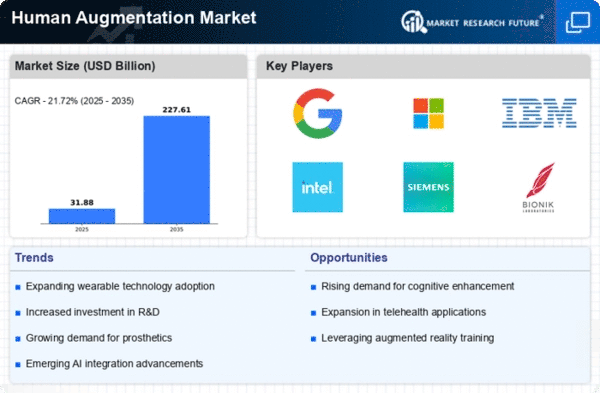
As per MRFR analysis, the Human Augmentation Market Size was estimated at 26.19 USD Billion in 2024. The Human Augmentation industry is projected to grow from 31.88 USD Billion in 2025 to 227.61 USD Billion by 2035, exhibiting a compound annual growth rate (CAGR) of 21.72% during the forecast period 2025 - 2035.

Key Market Trends & Highlights

The Human Augmentation Market is poised for substantial growth driven by technological advancements and increasing demand for enhanced capabilities.

  • The integration of Artificial Intelligence is transforming the Human Augmentation Market, enhancing user experience and functionality. North America remains the largest market, while the Asia-Pacific region is emerging as the fastest-growing area for human augmentation technologies. In the healthcare segment, the focus on rehabilitation and assistive technologies is driving significant advancements, whereas the military segment is rapidly evolving with innovative solutions. Key market drivers include advancements in wearable technology and a rising demand for enhanced productivity, which are shaping the future of human augmentation.

Market Size & Forecast

2024 Market Size 26.19 (USD Billion)
2035 Market Size 227.61 (USD Billion)
CAGR (2025 - 2035) 21.72%
Largest Regional Market Share in 2024 North America

Major Players

Google (US), Microsoft (US), IBM (US), Intel (US), Siemens (DE), Bionik Laboratories (CA), Cyberdyne (JP), Ekso Bionics (US), Open Bionics (GB)

Market Trends

The Human Augmentation Market is currently experiencing a transformative phase, characterized by rapid advancements in technology and increasing consumer interest. This sector encompasses a wide array of applications, including wearable devices, exoskeletons, and neuro-enhancement tools, all aimed at enhancing human capabilities. As organizations and individuals seek to improve productivity, health, and overall quality of life, the demand for innovative solutions continues to rise. Furthermore, the integration of artificial intelligence and machine learning into augmentation technologies appears to be reshaping the landscape, offering personalized experiences and improved functionality. In addition to technological advancements, societal acceptance plays a crucial role in the evolution of the Human Augmentation Market. As ethical considerations and regulatory frameworks develop, stakeholders are likely to navigate complex challenges surrounding privacy, security, and accessibility. The interplay between innovation and regulation may influence market dynamics, potentially leading to new opportunities and challenges. Overall, the Human Augmentation Market seems poised for substantial growth, driven by a confluence of technological progress and changing consumer expectations.

Integration of Artificial Intelligence

The incorporation of artificial intelligence into human augmentation technologies is becoming increasingly prevalent. This trend suggests that AI can enhance the functionality of devices, enabling them to adapt to individual user needs and preferences. As a result, users may experience improved performance and efficiency in their augmented capabilities.

Focus on Health and Wellness

There is a growing emphasis on health and wellness within the Human Augmentation Market. Consumers appear to be more inclined towards solutions that promote physical and mental well-being. This trend indicates a shift towards products that not only enhance capabilities but also contribute to overall health, reflecting a holistic approach to augmentation.

Ethical and Regulatory Considerations

As the Human Augmentation Market evolves, ethical and regulatory issues are gaining prominence. Stakeholders are increasingly aware of the implications of augmentation technologies on privacy and security. This trend suggests that future developments may be shaped by the need for clear guidelines and ethical standards, ensuring responsible innovation.

Human Augmentation Market Market Drivers

Aging Population

The Global Human Augmentation Market Industry is significantly influenced by the increasing aging population worldwide. As individuals age, they often experience a decline in physical and cognitive abilities, leading to a growing demand for solutions that enhance their quality of life. Technologies such as assistive devices and cognitive enhancers are being developed to address these challenges. For example, smart home technologies can assist elderly individuals in maintaining independence. The market is projected to reach 150 USD Billion by 2035, driven by the need for innovative solutions that cater to the aging demographic, thereby highlighting the importance of human augmentation in enhancing life quality.

Workforce Enhancement

The Global Human Augmentation Market Industry is driven by the need for workforce enhancement in an increasingly competitive global economy. Organizations are seeking ways to improve employee productivity and efficiency through human augmentation technologies. For instance, companies are implementing augmented reality training programs to enhance skill acquisition and retention among workers. This trend is indicative of a broader shift towards integrating technology into the workplace, which is expected to contribute to the market's growth. As businesses recognize the value of augmenting human capabilities, the Global Human Augmentation Market is poised for expansion, aligning with the evolving demands of the labor market.

Healthcare Sector Growth

The Global Human Augmentation Market Industry is experiencing substantial growth within the healthcare sector, where human augmentation technologies are being increasingly integrated into medical practices. Innovations such as telemedicine, robotic surgery, and augmented reality are transforming patient care and surgical procedures. For instance, augmented reality is being utilized in surgical training, allowing for enhanced visualization and precision. This integration is expected to drive market growth, with a compound annual growth rate of 9.99% projected from 2025 to 2035. As healthcare systems continue to adopt these technologies, the Global Human Augmentation Market will likely expand, improving patient outcomes and operational efficiency.

Technological Advancements

The Global Human Augmentation Market Industry is propelled by rapid technological advancements in fields such as robotics, artificial intelligence, and biotechnology. Innovations in wearable devices and exoskeletons enhance physical capabilities, enabling individuals to perform tasks beyond their natural limitations. For instance, companies are developing smart prosthetics that integrate with neural signals, allowing for more intuitive control. This technological evolution is expected to contribute to the market's growth, with projections indicating a market value of 52.6 USD Billion in 2024. As these technologies become more accessible, they are likely to reshape industries, including healthcare and manufacturing, thereby expanding the Global Human Augmentation Market.

Increased Investment in R&D

The Global Human Augmentation Market Industry is benefiting from increased investment in research and development across various sectors. Governments and private entities are allocating substantial resources to explore innovative human augmentation solutions, recognizing their potential to enhance productivity and quality of life. For example, funding initiatives aimed at developing advanced prosthetics and cognitive enhancement technologies are on the rise. This influx of investment is likely to accelerate the pace of innovation, leading to the introduction of new products and services. As a result, the market is expected to grow significantly, reflecting the commitment to advancing human capabilities through technology.

Market Segment Insights

By Application: Healthcare (Largest) vs. Military (Fastest-Growing)

In the Human Augmentation Market, the application segment is led by Healthcare, which holds a significant share due to increasing demand for advanced medical technologies and solutions. This segment encompasses various innovations such as prosthetics, exoskeletons, and telemedicine tools that enhance patient care and recovery outcomes. Following closely is the Military application, which is rapidly gaining traction, driven by the need for enhanced soldier safety, performance, and operational effectiveness through advanced augmentation technologies.

Healthcare: Prosthetics (Dominant) vs. Military: Exoskeletons (Emerging)

The Healthcare sector, particularly through the adoption of prosthetics, is recognized as a dominant force within the Human Augmentation Market. Innovations in prosthetic technologies not only enhance mobility for individuals with disabilities but also focus on integrating smart features for a personalized experience. On the other hand, the military segment sees emerging interest in exoskeletons designed to increase carrying capacity and reduce physical strain on soldiers. This application is fueled by advancements in materials and robotics, providing military personnel with enhanced capability on the battlefield.

By End Use: Prosthetics (Largest) vs. Exoskeletons (Fastest-Growing)

The Human Augmentation Market displays a diverse distribution among its key segments, with Prosthetics holding the largest market share. This segment is well-established, attributed to the significant advancements in biocompatible materials and smart technology integration. Following closely behind, Exoskeletons represent the fastest-growing segment, reflecting an increasing demand for assistive devices in rehabilitation and industrial applications. This shifting landscape indicates a strong interest in solutions that enhance mobility and functional capabilities. In terms of growth trends, the market is driven by technological innovations and an aging population, which boosts the demand for both Prosthetics and Exoskeletons. Furthermore, rising healthcare spending and increased awareness regarding disability management contribute to the expansion of these segments. Wearable Technology and Cognitive Enhancement also show promising growth, propelled by advancements in IoT and AI technologies, but they currently trail behind in market share compared to Prosthetics and Exoskeletons.

Prosthetics (Dominant) vs. Wearable Technology (Emerging)

Prosthetics have established themselves as the dominant segment in the Human Augmentation Market, characterized by innovations that significantly enhance mobility and quality of life for amputees. These devices are increasingly integrating smart technology, providing users with better functionality, adaptability, and comfort. Leading manufacturers focus on the development of advanced prosthetic limbs that utilize sensors and AI, thereby improving their responsiveness to user needs. In contrast, Wearable Technology is positioned as an emerging segment, gaining traction due to its application in health monitoring and fitness enhancement. These devices, including fitness trackers and smart glasses, are developing rapidly with the advent of new technologies, but they are still comparatively nascent and focus more on supplementary applications rather than core mobility enhancements.

By Technology: Biometrics (Largest) vs. Augmented Reality (Fastest-Growing)

In the Human Augmentation Market, Biometrics holds the largest market share due to its widespread adoption across various sectors, including security, healthcare, and finance. This segment’s ability to provide improved user identification and authentication methods has driven its dominance. On the other hand, Augmented Reality is rapidly gaining traction, with increasing applications in training, education, and entertainment, which contributes to its significant growth rate.

Technology: Biometrics (Dominant) vs. Augmented Reality (Emerging)

Biometrics is currently the dominant segment in the Human Augmentation Market, characterized by the deployment of fingerprint scanners,<a title=" facial recognition systems" href="https://www.marketresearchfuture.com/reports/facial-recognition-market-1250" target="_blank" rel="noopener"> facial recognition systems</a>, and retina identification technologies. It significantly enhances security protocols and offers seamless user experiences across various platforms. In contrast, Augmented Reality, while emerging, is quickly disrupting traditional training and entertainment methods. It allows immersive user experiences and has broad applicability in sectors like gaming, education, and retail, positioning it as a key player for future innovations in human augmentation.

Get more detailed insights about Human Augmentation Market Research Report - Global Forecast To 2035

Regional Insights

North America : Innovation and Leadership Hub

North America leads the Human Augmentation market with a share of 12.0 in 2024, driven by rapid technological advancements and a strong focus on R&D. The region benefits from a robust healthcare infrastructure and increasing demand for assistive technologies. Regulatory support and funding initiatives from government bodies further catalyze growth, making it a prime location for innovation in this sector. The competitive landscape is characterized by major players like Google, Microsoft, and IBM, who are investing heavily in AI and robotics. The U.S. stands out as a leader, with significant contributions from Canadian firms like Bionik Laboratories. This dynamic environment fosters collaboration between tech companies and healthcare providers, enhancing the development of cutting-edge solutions.

Europe : Emerging Market with Potential

Europe's Human Augmentation market is projected at 8.0, reflecting a growing interest in enhancing human capabilities through technology. Key drivers include an aging population and increasing healthcare costs, prompting governments to invest in innovative solutions. Regulatory frameworks are evolving to support the integration of advanced technologies in healthcare, which is crucial for market expansion. Leading countries like Germany and the UK are at the forefront, with companies such as Siemens and Open Bionics making significant strides. The competitive landscape is diverse, with numerous startups emerging alongside established firms. This blend of innovation and regulatory support positions Europe as a promising market for human augmentation technologies.

Asia-Pacific : Rapid Growth and Adoption

The Asia-Pacific region, with a market size of 4.5, is witnessing rapid growth in Human Augmentation, driven by increasing urbanization and technological adoption. Countries like Japan and China are investing heavily in robotics and AI, which are essential for enhancing human capabilities. Government initiatives aimed at improving healthcare access and quality are also significant growth catalysts in this region. Japan leads the way with companies like Cyberdyne, focusing on exoskeleton technologies. The competitive landscape is evolving, with both established firms and startups vying for market share. As the region continues to embrace technological advancements, the demand for human augmentation solutions is expected to rise significantly, making it a key player in the global market.

Middle East and Africa : Untapped Market Opportunities

The Middle East and Africa region, with a market size of 1.69, presents untapped opportunities in the Human Augmentation sector. The growth is driven by increasing healthcare investments and a rising demand for advanced medical technologies. Governments are recognizing the importance of innovation in healthcare, leading to supportive policies and funding initiatives that encourage the adoption of human augmentation solutions. Countries like South Africa and the UAE are emerging as key players, with a focus on enhancing healthcare delivery through technology. The competitive landscape is still developing, with local startups and international firms exploring partnerships to penetrate the market. As awareness and demand grow, this region is poised for significant advancements in human augmentation technologies.

Key Players and Competitive Insights

The Human Augmentation Market is currently characterized by a dynamic competitive landscape, driven by rapid technological advancements and increasing demand for enhanced human capabilities. Major players such as Google (US), Microsoft (US), and IBM (US) are at the forefront, focusing on innovation and strategic partnerships to solidify their market positions. Google (US) has been particularly active in integrating AI technologies into its augmentation solutions, while Microsoft (US) emphasizes cloud-based platforms that facilitate seamless human-machine interaction. IBM (US) continues to leverage its expertise in data analytics to enhance the functionality of its augmentation products, thereby shaping a competitive environment that prioritizes technological integration and user experience. The market structure appears moderately fragmented, with a mix of established corporations and emerging startups. Key players are adopting various business tactics, such as localizing manufacturing and optimizing supply chains, to enhance operational efficiency and reduce costs. This collective influence of major companies fosters a competitive atmosphere where innovation and strategic positioning are paramount, allowing them to respond effectively to evolving consumer needs and market demands. In November 2025, Google (US) announced a partnership with a leading robotics firm to develop advanced exoskeletons aimed at improving mobility for individuals with disabilities. This strategic move underscores Google's commitment to leveraging its technological prowess to create impactful solutions in the human augmentation space. The collaboration is expected to enhance product offerings and expand market reach, aligning with the growing trend of inclusivity in technology. In October 2025, Microsoft (US) launched a new suite of augmented reality tools designed for healthcare professionals, enhancing surgical precision and patient outcomes. This initiative reflects Microsoft's focus on integrating digital transformation within critical sectors, thereby positioning itself as a leader in the application of human augmentation technologies in healthcare. The implications of this launch are profound, as it not only addresses immediate market needs but also sets a precedent for future innovations in medical technology. In September 2025, IBM (US) unveiled a new AI-driven platform that personalizes human augmentation experiences based on user data and preferences. This development highlights IBM's strategic emphasis on data analytics and user-centric design, which are crucial for maintaining competitive differentiation in a rapidly evolving market. By prioritizing personalization, IBM is likely to enhance user engagement and satisfaction, further solidifying its market presence. As of December 2025, current trends in the Human Augmentation Market are increasingly defined by digitalization, sustainability, and the integration of AI technologies. Strategic alliances among key players are shaping the competitive landscape, fostering innovation and collaboration. The shift from price-based competition to a focus on technological advancement and supply chain reliability is evident, suggesting that future competitive differentiation will hinge on the ability to innovate and adapt to changing consumer expectations.

Key Companies in the Human Augmentation Market include

Industry Developments

The Human Augmentation Market has witnessed significant developments in recent months, with companies like Microsoft and NVIDIA making strides in artificial intelligence and augmented reality technologies. Microsoft revealed substantial improvements to its Dynamics 365 Field Service platform at Ignite 2023 in November 2023.

These upgrades included the integration of spatial computing, Teams, Copilot, and improved guidance annotations, as well as the enhancement of mixed-reality tools for frontline workers through HoloLens 2.

After exiting preview, Microsoft Mesh, the immersive collaboration platform, was introduced within Teams in January 2024, thereby enhancing the use of MR in the enterprise.

Future Outlook

Human Augmentation Market Future Outlook

The Human Augmentation Market is projected to grow at a 21.72% CAGR from 2025 to 2035, driven by technological advancements, increasing healthcare demands, and enhanced productivity needs.

New opportunities lie in:

  • <p>Development of AI-driven exoskeletons for industrial applications. Integration of augmented reality in training programs for skilled labor. Launch of personalized health monitoring wearables for chronic disease management.</p>

By 2035, the Human Augmentation Market is expected to be a pivotal sector, reflecting substantial growth and innovation.

Market Segmentation

Human Augmentation Market End Use Outlook

  • Prosthetics
  • Exoskeletons
  • Wearable Technology
  • Cognitive Enhancement
  • Sensory Augmentation

Human Augmentation Market Technology Outlook

  • Biometrics
  • Neurotechnology
  • Robotics
  • Genetic Engineering
  • Augmented Reality

Human Augmentation Market Application Outlook

  • Healthcare
  • Military
  • Sports
  • Industrial
  • Entertainment

Report Scope

MARKET SIZE 2024 26.19(USD Billion)
MARKET SIZE 2025 31.88(USD Billion)
MARKET SIZE 2035 227.61(USD Billion)
COMPOUND ANNUAL GROWTH RATE (CAGR) 21.72% (2025 - 2035)
REPORT COVERAGE Revenue Forecast, Competitive Landscape, Growth Factors, and Trends
BASE YEAR 2024
Market Forecast Period 2025 - 2035
Historical Data 2019 - 2024
Market Forecast Units USD Billion
Key Companies Profiled Google (US), Microsoft (US), IBM (US), Intel (US), Siemens (DE), Bionik Laboratories (CA), Cyberdyne (JP), Ekso Bionics (US), Open Bionics (GB)
Segments Covered Application, End Use, Technology
Key Market Opportunities Integration of artificial intelligence in wearable devices enhances user experience in the Human Augmentation Market.
Key Market Dynamics Technological advancements drive competitive forces, reshaping consumer behavior and regulatory frameworks in the Human Augmentation Market.
Countries Covered North America, Europe, APAC, South America, MEA

FAQs

What is the current valuation of the Human Augmentation Market as of 2024?

<p>The Human Augmentation Market was valued at 26.19 USD Billion in 2024.</p>

What is the projected market size for the Human Augmentation Market in 2035?

<p>The market is projected to reach 227.61 USD Billion by 2035.</p>

What is the expected CAGR for the Human Augmentation Market during the forecast period 2025 - 2035?

<p>The expected CAGR for the Human Augmentation Market during 2025 - 2035 is 21.72%.</p>

Which application segment is expected to dominate the Human Augmentation Market?

<p>The Industrial application segment is projected to grow from 7.0 USD Billion in 2024 to 60.0 USD Billion by 2035.</p>

How does the Healthcare segment perform in the Human Augmentation Market?

<p>The Healthcare segment is anticipated to expand from 5.0 USD Billion in 2024 to 45.0 USD Billion by 2035.</p>

What are the key technologies driving the Human Augmentation Market?

<p>Key technologies include Robotics, which is expected to grow from 7.0 USD Billion in 2024 to 60.0 USD Billion by 2035.</p>

Which companies are leading the Human Augmentation Market?

<p>Key players include Google, Microsoft, IBM, and Intel, among others.</p>

What is the growth outlook for the Sports segment in the Human Augmentation Market?

<p>The Sports segment is projected to increase from 4.0 USD Billion in 2024 to 30.0 USD Billion by 2035.</p>

How does the Wearable Technology segment contribute to the market?

<p>The Wearable Technology segment is expected to grow from 8.19 USD Billion in 2024 to 72.61 USD Billion by 2035.</p>

What is the expected performance of the Cognitive Enhancement segment?

<p>The Cognitive Enhancement segment is likely to grow from 6.0 USD Billion in 2024 to 50.0 USD Billion by 2035.</p>

  1. SECTION I: EXECUTIVE SUMMARY AND KEY HIGHLIGHTS
    1. | 1.1 EXECUTIVE SUMMARY
    2. | | 1.1.1 Market Overview
    3. | | 1.1.2 Key Findings
    4. | | 1.1.3 Market Segmentation
    5. | | 1.1.4 Competitive Landscape
    6. | | 1.1.5 Challenges and Opportunities
    7. | | 1.1.6 Future Outlook
  2. SECTION II: SCOPING, METHODOLOGY AND MARKET STRUCTURE
    1. | 2.1 MARKET INTRODUCTION
    2. | | 2.1.1 Definition
    3. | | 2.1.2 Scope of the study
    4. | | | 2.1.2.1 Research Objective
    5. | | | 2.1.2.2 Assumption
    6. | | | 2.1.2.3 Limitations
    7. | 2.2 RESEARCH METHODOLOGY
    8. | | 2.2.1 Overview
    9. | | 2.2.2 Data Mining
    10. | | 2.2.3 Secondary Research
    11. | | 2.2.4 Primary Research
    12. | | | 2.2.4.1 Primary Interviews and Information Gathering Process
    13. | | | 2.2.4.2 Breakdown of Primary Respondents
    14. | | 2.2.5 Forecasting Model
    15. | | 2.2.6 Market Size Estimation
    16. | | | 2.2.6.1 Bottom-Up Approach
    17. | | | 2.2.6.2 Top-Down Approach
    18. | | 2.2.7 Data Triangulation
    19. | | 2.2.8 Validation
  3. SECTION III: QUALITATIVE ANALYSIS
    1. | 3.1 MARKET DYNAMICS
    2. | | 3.1.1 Overview
    3. | | 3.1.2 Drivers
    4. | | 3.1.3 Restraints
    5. | | 3.1.4 Opportunities
    6. | 3.2 MARKET FACTOR ANALYSIS
    7. | | 3.2.1 Value chain Analysis
    8. | | 3.2.2 Porter's Five Forces Analysis
    9. | | | 3.2.2.1 Bargaining Power of Suppliers
    10. | | | 3.2.2.2 Bargaining Power of Buyers
    11. | | | 3.2.2.3 Threat of New Entrants
    12. | | | 3.2.2.4 Threat of Substitutes
    13. | | | 3.2.2.5 Intensity of Rivalry
    14. | | 3.2.3 COVID-19 Impact Analysis
    15. | | | 3.2.3.1 Market Impact Analysis
    16. | | | 3.2.3.2 Regional Impact
    17. | | | 3.2.3.3 Opportunity and Threat Analysis
  4. SECTION IV: QUANTITATIVE ANALYSIS
    1. | 4.1 Information and Communications Technology, BY Application (USD Billion)
    2. | | 4.1.1 Healthcare
    3. | | 4.1.2 Military
    4. | | 4.1.3 Sports
    5. | | 4.1.4 Industrial
    6. | | 4.1.5 Entertainment
    7. | 4.2 Information and Communications Technology, BY End Use (USD Billion)
    8. | | 4.2.1 Prosthetics
    9. | | 4.2.2 Exoskeletons
    10. | | 4.2.3 Cognitive Enhancement
    11. | | 4.2.4 Sensory Augmentation
    12. | | 4.2.5 Wearable Technology
    13. | 4.3 Information and Communications Technology, BY Technology (USD Billion)
    14. | | 4.3.1 Biometrics
    15. | | 4.3.2 Neurotechnology
    16. | | 4.3.3 Robotics
    17. | | 4.3.4 Genetic Engineering
    18. | | 4.3.5 Augmented Reality
    19. | 4.4 Information and Communications Technology, BY Region (USD Billion)
    20. | | 4.4.1 North America
    21. | | | 4.4.1.1 US
    22. | | | 4.4.1.2 Canada
    23. | | 4.4.2 Europe
    24. | | | 4.4.2.1 Germany
    25. | | | 4.4.2.2 UK
    26. | | | 4.4.2.3 France
    27. | | | 4.4.2.4 Russia
    28. | | | 4.4.2.5 Italy
    29. | | | 4.4.2.6 Spain
    30. | | | 4.4.2.7 Rest of Europe
    31. | | 4.4.3 APAC
    32. | | | 4.4.3.1 China
    33. | | | 4.4.3.2 India
    34. | | | 4.4.3.3 Japan
    35. | | | 4.4.3.4 South Korea
    36. | | | 4.4.3.5 Malaysia
    37. | | | 4.4.3.6 Thailand
    38. | | | 4.4.3.7 Indonesia
    39. | | | 4.4.3.8 Rest of APAC
    40. | | 4.4.4 South America
    41. | | | 4.4.4.1 Brazil
    42. | | | 4.4.4.2 Mexico
    43. | | | 4.4.4.3 Argentina
    44. | | | 4.4.4.4 Rest of South America
    45. | | 4.4.5 MEA
    46. | | | 4.4.5.1 GCC Countries
    47. | | | 4.4.5.2 South Africa
    48. | | | 4.4.5.3 Rest of MEA
  5. SECTION V: COMPETITIVE ANALYSIS
    1. | 5.1 Competitive Landscape
    2. | | 5.1.1 Overview
    3. | | 5.1.2 Competitive Analysis
    4. | | 5.1.3 Market share Analysis
    5. | | 5.1.4 Major Growth Strategy in the Information and Communications Technology
    6. | | 5.1.5 Competitive Benchmarking
    7. | | 5.1.6 Leading Players in Terms of Number of Developments in the Information and Communications Technology
    8. | | 5.1.7 Key developments and growth strategies
    9. | | | 5.1.7.1 New Product Launch/Service Deployment
    10. | | | 5.1.7.2 Merger & Acquisitions
    11. | | | 5.1.7.3 Joint Ventures
    12. | | 5.1.8 Major Players Financial Matrix
    13. | | | 5.1.8.1 Sales and Operating Income
    14. | | | 5.1.8.2 Major Players R&D Expenditure. 2023
    15. | 5.2 Company Profiles
    16. | | 5.2.1 Google (US)
    17. | | | 5.2.1.1 Financial Overview
    18. | | | 5.2.1.2 Products Offered
    19. | | | 5.2.1.3 Key Developments
    20. | | | 5.2.1.4 SWOT Analysis
    21. | | | 5.2.1.5 Key Strategies
    22. | | 5.2.2 Microsoft (US)
    23. | | | 5.2.2.1 Financial Overview
    24. | | | 5.2.2.2 Products Offered
    25. | | | 5.2.2.3 Key Developments
    26. | | | 5.2.2.4 SWOT Analysis
    27. | | | 5.2.2.5 Key Strategies
    28. | | 5.2.3 IBM (US)
    29. | | | 5.2.3.1 Financial Overview
    30. | | | 5.2.3.2 Products Offered
    31. | | | 5.2.3.3 Key Developments
    32. | | | 5.2.3.4 SWOT Analysis
    33. | | | 5.2.3.5 Key Strategies
    34. | | 5.2.4 Intel (US)
    35. | | | 5.2.4.1 Financial Overview
    36. | | | 5.2.4.2 Products Offered
    37. | | | 5.2.4.3 Key Developments
    38. | | | 5.2.4.4 SWOT Analysis
    39. | | | 5.2.4.5 Key Strategies
    40. | | 5.2.5 Siemens (DE)
    41. | | | 5.2.5.1 Financial Overview
    42. | | | 5.2.5.2 Products Offered
    43. | | | 5.2.5.3 Key Developments
    44. | | | 5.2.5.4 SWOT Analysis
    45. | | | 5.2.5.5 Key Strategies
    46. | | 5.2.6 Bionik Laboratories (CA)
    47. | | | 5.2.6.1 Financial Overview
    48. | | | 5.2.6.2 Products Offered
    49. | | | 5.2.6.3 Key Developments
    50. | | | 5.2.6.4 SWOT Analysis
    51. | | | 5.2.6.5 Key Strategies
    52. | | 5.2.7 Cyberdyne (JP)
    53. | | | 5.2.7.1 Financial Overview
    54. | | | 5.2.7.2 Products Offered
    55. | | | 5.2.7.3 Key Developments
    56. | | | 5.2.7.4 SWOT Analysis
    57. | | | 5.2.7.5 Key Strategies
    58. | | 5.2.8 Ekso Bionics (US)
    59. | | | 5.2.8.1 Financial Overview
    60. | | | 5.2.8.2 Products Offered
    61. | | | 5.2.8.3 Key Developments
    62. | | | 5.2.8.4 SWOT Analysis
    63. | | | 5.2.8.5 Key Strategies
    64. | | 5.2.9 Raytheon Technologies (US)
    65. | | | 5.2.9.1 Financial Overview
    66. | | | 5.2.9.2 Products Offered
    67. | | | 5.2.9.3 Key Developments
    68. | | | 5.2.9.4 SWOT Analysis
    69. | | | 5.2.9.5 Key Strategies
    70. | 5.3 Appendix
    71. | | 5.3.1 References
    72. | | 5.3.2 Related Reports
  6. LIST OF FIGURES
    1. | 6.1 MARKET SYNOPSIS
    2. | 6.2 NORTH AMERICA MARKET ANALYSIS
    3. | 6.3 US MARKET ANALYSIS BY APPLICATION
    4. | 6.4 US MARKET ANALYSIS BY END USE
    5. | 6.5 US MARKET ANALYSIS BY TECHNOLOGY
    6. | 6.6 CANADA MARKET ANALYSIS BY APPLICATION
    7. | 6.7 CANADA MARKET ANALYSIS BY END USE
    8. | 6.8 CANADA MARKET ANALYSIS BY TECHNOLOGY
    9. | 6.9 EUROPE MARKET ANALYSIS
    10. | 6.10 GERMANY MARKET ANALYSIS BY APPLICATION
    11. | 6.11 GERMANY MARKET ANALYSIS BY END USE
    12. | 6.12 GERMANY MARKET ANALYSIS BY TECHNOLOGY
    13. | 6.13 UK MARKET ANALYSIS BY APPLICATION
    14. | 6.14 UK MARKET ANALYSIS BY END USE
    15. | 6.15 UK MARKET ANALYSIS BY TECHNOLOGY
    16. | 6.16 FRANCE MARKET ANALYSIS BY APPLICATION
    17. | 6.17 FRANCE MARKET ANALYSIS BY END USE
    18. | 6.18 FRANCE MARKET ANALYSIS BY TECHNOLOGY
    19. | 6.19 RUSSIA MARKET ANALYSIS BY APPLICATION
    20. | 6.20 RUSSIA MARKET ANALYSIS BY END USE
    21. | 6.21 RUSSIA MARKET ANALYSIS BY TECHNOLOGY
    22. | 6.22 ITALY MARKET ANALYSIS BY APPLICATION
    23. | 6.23 ITALY MARKET ANALYSIS BY END USE
    24. | 6.24 ITALY MARKET ANALYSIS BY TECHNOLOGY
    25. | 6.25 SPAIN MARKET ANALYSIS BY APPLICATION
    26. | 6.26 SPAIN MARKET ANALYSIS BY END USE
    27. | 6.27 SPAIN MARKET ANALYSIS BY TECHNOLOGY
    28. | 6.28 REST OF EUROPE MARKET ANALYSIS BY APPLICATION
    29. | 6.29 REST OF EUROPE MARKET ANALYSIS BY END USE
    30. | 6.30 REST OF EUROPE MARKET ANALYSIS BY TECHNOLOGY
    31. | 6.31 APAC MARKET ANALYSIS
    32. | 6.32 CHINA MARKET ANALYSIS BY APPLICATION
    33. | 6.33 CHINA MARKET ANALYSIS BY END USE
    34. | 6.34 CHINA MARKET ANALYSIS BY TECHNOLOGY
    35. | 6.35 INDIA MARKET ANALYSIS BY APPLICATION
    36. | 6.36 INDIA MARKET ANALYSIS BY END USE
    37. | 6.37 INDIA MARKET ANALYSIS BY TECHNOLOGY
    38. | 6.38 JAPAN MARKET ANALYSIS BY APPLICATION
    39. | 6.39 JAPAN MARKET ANALYSIS BY END USE
    40. | 6.40 JAPAN MARKET ANALYSIS BY TECHNOLOGY
    41. | 6.41 SOUTH KOREA MARKET ANALYSIS BY APPLICATION
    42. | 6.42 SOUTH KOREA MARKET ANALYSIS BY END USE
    43. | 6.43 SOUTH KOREA MARKET ANALYSIS BY TECHNOLOGY
    44. | 6.44 MALAYSIA MARKET ANALYSIS BY APPLICATION
    45. | 6.45 MALAYSIA MARKET ANALYSIS BY END USE
    46. | 6.46 MALAYSIA MARKET ANALYSIS BY TECHNOLOGY
    47. | 6.47 THAILAND MARKET ANALYSIS BY APPLICATION
    48. | 6.48 THAILAND MARKET ANALYSIS BY END USE
    49. | 6.49 THAILAND MARKET ANALYSIS BY TECHNOLOGY
    50. | 6.50 INDONESIA MARKET ANALYSIS BY APPLICATION
    51. | 6.51 INDONESIA MARKET ANALYSIS BY END USE
    52. | 6.52 INDONESIA MARKET ANALYSIS BY TECHNOLOGY
    53. | 6.53 REST OF APAC MARKET ANALYSIS BY APPLICATION
    54. | 6.54 REST OF APAC MARKET ANALYSIS BY END USE
    55. | 6.55 REST OF APAC MARKET ANALYSIS BY TECHNOLOGY
    56. | 6.56 SOUTH AMERICA MARKET ANALYSIS
    57. | 6.57 BRAZIL MARKET ANALYSIS BY APPLICATION
    58. | 6.58 BRAZIL MARKET ANALYSIS BY END USE
    59. | 6.59 BRAZIL MARKET ANALYSIS BY TECHNOLOGY
    60. | 6.60 MEXICO MARKET ANALYSIS BY APPLICATION
    61. | 6.61 MEXICO MARKET ANALYSIS BY END USE
    62. | 6.62 MEXICO MARKET ANALYSIS BY TECHNOLOGY
    63. | 6.63 ARGENTINA MARKET ANALYSIS BY APPLICATION
    64. | 6.64 ARGENTINA MARKET ANALYSIS BY END USE
    65. | 6.65 ARGENTINA MARKET ANALYSIS BY TECHNOLOGY
    66. | 6.66 REST OF SOUTH AMERICA MARKET ANALYSIS BY APPLICATION
    67. | 6.67 REST OF SOUTH AMERICA MARKET ANALYSIS BY END USE
    68. | 6.68 REST OF SOUTH AMERICA MARKET ANALYSIS BY TECHNOLOGY
    69. | 6.69 MEA MARKET ANALYSIS
    70. | 6.70 GCC COUNTRIES MARKET ANALYSIS BY APPLICATION
    71. | 6.71 GCC COUNTRIES MARKET ANALYSIS BY END USE
    72. | 6.72 GCC COUNTRIES MARKET ANALYSIS BY TECHNOLOGY
    73. | 6.73 SOUTH AFRICA MARKET ANALYSIS BY APPLICATION
    74. | 6.74 SOUTH AFRICA MARKET ANALYSIS BY END USE
    75. | 6.75 SOUTH AFRICA MARKET ANALYSIS BY TECHNOLOGY
    76. | 6.76 REST OF MEA MARKET ANALYSIS BY APPLICATION
    77. | 6.77 REST OF MEA MARKET ANALYSIS BY END USE
    78. | 6.78 REST OF MEA MARKET ANALYSIS BY TECHNOLOGY
    79. | 6.79 KEY BUYING CRITERIA OF INFORMATION AND COMMUNICATIONS TECHNOLOGY
    80. | 6.80 RESEARCH PROCESS OF MRFR
    81. | 6.81 DRO ANALYSIS OF INFORMATION AND COMMUNICATIONS TECHNOLOGY
    82. | 6.82 DRIVERS IMPACT ANALYSIS: INFORMATION AND COMMUNICATIONS TECHNOLOGY
    83. | 6.83 RESTRAINTS IMPACT ANALYSIS: INFORMATION AND COMMUNICATIONS TECHNOLOGY
    84. | 6.84 SUPPLY / VALUE CHAIN: INFORMATION AND COMMUNICATIONS TECHNOLOGY
    85. | 6.85 INFORMATION AND COMMUNICATIONS TECHNOLOGY, BY APPLICATION, 2024 (% SHARE)
    86. | 6.86 INFORMATION AND COMMUNICATIONS TECHNOLOGY, BY APPLICATION, 2024 TO 2035 (USD Billion)
    87. | 6.87 INFORMATION AND COMMUNICATIONS TECHNOLOGY, BY END USE, 2024 (% SHARE)
    88. | 6.88 INFORMATION AND COMMUNICATIONS TECHNOLOGY, BY END USE, 2024 TO 2035 (USD Billion)
    89. | 6.89 INFORMATION AND COMMUNICATIONS TECHNOLOGY, BY TECHNOLOGY, 2024 (% SHARE)
    90. | 6.90 INFORMATION AND COMMUNICATIONS TECHNOLOGY, BY TECHNOLOGY, 2024 TO 2035 (USD Billion)
    91. | 6.91 BENCHMARKING OF MAJOR COMPETITORS
  7. LIST OF TABLES
    1. | 7.1 LIST OF ASSUMPTIONS
    2. | | 7.1.1
    3. | 7.2 North America MARKET SIZE ESTIMATES; FORECAST
    4. | | 7.2.1 BY APPLICATION, 2025-2035 (USD Billion)
    5. | | 7.2.2 BY END USE, 2025-2035 (USD Billion)
    6. | | 7.2.3 BY TECHNOLOGY, 2025-2035 (USD Billion)
    7. | 7.3 US MARKET SIZE ESTIMATES; FORECAST
    8. | | 7.3.1 BY APPLICATION, 2025-2035 (USD Billion)
    9. | | 7.3.2 BY END USE, 2025-2035 (USD Billion)
    10. | | 7.3.3 BY TECHNOLOGY, 2025-2035 (USD Billion)
    11. | 7.4 Canada MARKET SIZE ESTIMATES; FORECAST
    12. | | 7.4.1 BY APPLICATION, 2025-2035 (USD Billion)
    13. | | 7.4.2 BY END USE, 2025-2035 (USD Billion)
    14. | | 7.4.3 BY TECHNOLOGY, 2025-2035 (USD Billion)
    15. | 7.5 Europe MARKET SIZE ESTIMATES; FORECAST
    16. | | 7.5.1 BY APPLICATION, 2025-2035 (USD Billion)
    17. | | 7.5.2 BY END USE, 2025-2035 (USD Billion)
    18. | | 7.5.3 BY TECHNOLOGY, 2025-2035 (USD Billion)
    19. | 7.6 Germany MARKET SIZE ESTIMATES; FORECAST
    20. | | 7.6.1 BY APPLICATION, 2025-2035 (USD Billion)
    21. | | 7.6.2 BY END USE, 2025-2035 (USD Billion)
    22. | | 7.6.3 BY TECHNOLOGY, 2025-2035 (USD Billion)
    23. | 7.7 UK MARKET SIZE ESTIMATES; FORECAST
    24. | | 7.7.1 BY APPLICATION, 2025-2035 (USD Billion)
    25. | | 7.7.2 BY END USE, 2025-2035 (USD Billion)
    26. | | 7.7.3 BY TECHNOLOGY, 2025-2035 (USD Billion)
    27. | 7.8 France MARKET SIZE ESTIMATES; FORECAST
    28. | | 7.8.1 BY APPLICATION, 2025-2035 (USD Billion)
    29. | | 7.8.2 BY END USE, 2025-2035 (USD Billion)
    30. | | 7.8.3 BY TECHNOLOGY, 2025-2035 (USD Billion)
    31. | 7.9 Russia MARKET SIZE ESTIMATES; FORECAST
    32. | | 7.9.1 BY APPLICATION, 2025-2035 (USD Billion)
    33. | | 7.9.2 BY END USE, 2025-2035 (USD Billion)
    34. | | 7.9.3 BY TECHNOLOGY, 2025-2035 (USD Billion)
    35. | 7.10 Italy MARKET SIZE ESTIMATES; FORECAST
    36. | | 7.10.1 BY APPLICATION, 2025-2035 (USD Billion)
    37. | | 7.10.2 BY END USE, 2025-2035 (USD Billion)
    38. | | 7.10.3 BY TECHNOLOGY, 2025-2035 (USD Billion)
    39. | 7.11 Spain MARKET SIZE ESTIMATES; FORECAST
    40. | | 7.11.1 BY APPLICATION, 2025-2035 (USD Billion)
    41. | | 7.11.2 BY END USE, 2025-2035 (USD Billion)
    42. | | 7.11.3 BY TECHNOLOGY, 2025-2035 (USD Billion)
    43. | 7.12 Rest of Europe MARKET SIZE ESTIMATES; FORECAST
    44. | | 7.12.1 BY APPLICATION, 2025-2035 (USD Billion)
    45. | | 7.12.2 BY END USE, 2025-2035 (USD Billion)
    46. | | 7.12.3 BY TECHNOLOGY, 2025-2035 (USD Billion)
    47. | 7.13 APAC MARKET SIZE ESTIMATES; FORECAST
    48. | | 7.13.1 BY APPLICATION, 2025-2035 (USD Billion)
    49. | | 7.13.2 BY END USE, 2025-2035 (USD Billion)
    50. | | 7.13.3 BY TECHNOLOGY, 2025-2035 (USD Billion)
    51. | 7.14 China MARKET SIZE ESTIMATES; FORECAST
    52. | | 7.14.1 BY APPLICATION, 2025-2035 (USD Billion)
    53. | | 7.14.2 BY END USE, 2025-2035 (USD Billion)
    54. | | 7.14.3 BY TECHNOLOGY, 2025-2035 (USD Billion)
    55. | 7.15 India MARKET SIZE ESTIMATES; FORECAST
    56. | | 7.15.1 BY APPLICATION, 2025-2035 (USD Billion)
    57. | | 7.15.2 BY END USE, 2025-2035 (USD Billion)
    58. | | 7.15.3 BY TECHNOLOGY, 2025-2035 (USD Billion)
    59. | 7.16 Japan MARKET SIZE ESTIMATES; FORECAST
    60. | | 7.16.1 BY APPLICATION, 2025-2035 (USD Billion)
    61. | | 7.16.2 BY END USE, 2025-2035 (USD Billion)
    62. | | 7.16.3 BY TECHNOLOGY, 2025-2035 (USD Billion)
    63. | 7.17 South Korea MARKET SIZE ESTIMATES; FORECAST
    64. | | 7.17.1 BY APPLICATION, 2025-2035 (USD Billion)
    65. | | 7.17.2 BY END USE, 2025-2035 (USD Billion)
    66. | | 7.17.3 BY TECHNOLOGY, 2025-2035 (USD Billion)
    67. | 7.18 Malaysia MARKET SIZE ESTIMATES; FORECAST
    68. | | 7.18.1 BY APPLICATION, 2025-2035 (USD Billion)
    69. | | 7.18.2 BY END USE, 2025-2035 (USD Billion)
    70. | | 7.18.3 BY TECHNOLOGY, 2025-2035 (USD Billion)
    71. | 7.19 Thailand MARKET SIZE ESTIMATES; FORECAST
    72. | | 7.19.1 BY APPLICATION, 2025-2035 (USD Billion)
    73. | | 7.19.2 BY END USE, 2025-2035 (USD Billion)
    74. | | 7.19.3 BY TECHNOLOGY, 2025-2035 (USD Billion)
    75. | 7.20 Indonesia MARKET SIZE ESTIMATES; FORECAST
    76. | | 7.20.1 BY APPLICATION, 2025-2035 (USD Billion)
    77. | | 7.20.2 BY END USE, 2025-2035 (USD Billion)
    78. | | 7.20.3 BY TECHNOLOGY, 2025-2035 (USD Billion)
    79. | 7.21 Rest of APAC MARKET SIZE ESTIMATES; FORECAST
    80. | | 7.21.1 BY APPLICATION, 2025-2035 (USD Billion)
    81. | | 7.21.2 BY END USE, 2025-2035 (USD Billion)
    82. | | 7.21.3 BY TECHNOLOGY, 2025-2035 (USD Billion)
    83. | 7.22 South America MARKET SIZE ESTIMATES; FORECAST
    84. | | 7.22.1 BY APPLICATION, 2025-2035 (USD Billion)
    85. | | 7.22.2 BY END USE, 2025-2035 (USD Billion)
    86. | | 7.22.3 BY TECHNOLOGY, 2025-2035 (USD Billion)
    87. | 7.23 Brazil MARKET SIZE ESTIMATES; FORECAST
    88. | | 7.23.1 BY APPLICATION, 2025-2035 (USD Billion)
    89. | | 7.23.2 BY END USE, 2025-2035 (USD Billion)
    90. | | 7.23.3 BY TECHNOLOGY, 2025-2035 (USD Billion)
    91. | 7.24 Mexico MARKET SIZE ESTIMATES; FORECAST
    92. | | 7.24.1 BY APPLICATION, 2025-2035 (USD Billion)
    93. | | 7.24.2 BY END USE, 2025-2035 (USD Billion)
    94. | | 7.24.3 BY TECHNOLOGY, 2025-2035 (USD Billion)
    95. | 7.25 Argentina MARKET SIZE ESTIMATES; FORECAST
    96. | | 7.25.1 BY APPLICATION, 2025-2035 (USD Billion)
    97. | | 7.25.2 BY END USE, 2025-2035 (USD Billion)
    98. | | 7.25.3 BY TECHNOLOGY, 2025-2035 (USD Billion)
    99. | 7.26 Rest of South America MARKET SIZE ESTIMATES; FORECAST
    100. | | 7.26.1 BY APPLICATION, 2025-2035 (USD Billion)
    101. | | 7.26.2 BY END USE, 2025-2035 (USD Billion)
    102. | | 7.26.3 BY TECHNOLOGY, 2025-2035 (USD Billion)
    103. | 7.27 MEA MARKET SIZE ESTIMATES; FORECAST
    104. | | 7.27.1 BY APPLICATION, 2025-2035 (USD Billion)
    105. | | 7.27.2 BY END USE, 2025-2035 (USD Billion)
    106. | | 7.27.3 BY TECHNOLOGY, 2025-2035 (USD Billion)
    107. | 7.28 GCC Countries MARKET SIZE ESTIMATES; FORECAST
    108. | | 7.28.1 BY APPLICATION, 2025-2035 (USD Billion)
    109. | | 7.28.2 BY END USE, 2025-2035 (USD Billion)
    110. | | 7.28.3 BY TECHNOLOGY, 2025-2035 (USD Billion)
    111. | 7.29 South Africa MARKET SIZE ESTIMATES; FORECAST
    112. | | 7.29.1 BY APPLICATION, 2025-2035 (USD Billion)
    113. | | 7.29.2 BY END USE, 2025-2035 (USD Billion)
    114. | | 7.29.3 BY TECHNOLOGY, 2025-2035 (USD Billion)
    115. | 7.30 Rest of MEA MARKET SIZE ESTIMATES; FORECAST
    116. | | 7.30.1 BY APPLICATION, 2025-2035 (USD Billion)
    117. | | 7.30.2 BY END USE, 2025-2035 (USD Billion)
    118. | | 7.30.3 BY TECHNOLOGY, 2025-2035 (USD Billion)
    119. | 7.31 PRODUCT LAUNCH/PRODUCT DEVELOPMENT/APPROVAL
    120. | | 7.31.1
    121. | 7.32 ACQUISITION/PARTNERSHIP
    122. | | 7.32.1

Information and Communications Technology Market Segmentation

Information and Communications Technology By Application (USD Billion, 2025-2035)

  • Healthcare
  • Military
  • Sports
  • Industrial
  • Entertainment

Information and Communications Technology By End Use (USD Billion, 2025-2035)

  • Prosthetics
  • Exoskeletons
  • Cognitive Enhancement
  • Sensory Augmentation
  • Wearable Technology

Information and Communications Technology By Technology (USD Billion, 2025-2035)

  • Biometrics
  • Neurotechnology
  • Robotics
  • Genetic Engineering
  • Augmented Reality
Infographic

Free Sample Request

Kindly complete the form below to receive a free sample of this Report

Get Free Sample

Customer Strories

Compare Licence

×
Features License Type
Single User Multiuser License Enterprise User
Price $4,950 $5,950 $7,250
Maximum User Access Limit 1 User Upto 10 Users Unrestricted Access Throughout the Organization
Free Customization
Direct Access to Analyst
Deliverable Format
Platform Access
Discount on Next Purchase 10% 15% 15%
Printable Versions