
Request Free Sample ×

Kindly complete the form below to receive a free sample of this Report

* Please use a valid business email

Leading companies partner with us for data-driven Insights

clients tt-cursor
Hero Background
English
Chinese
French
Japanese
Korean
German
Spanish

High Speed Camera Market Size

ID: MRFR/SEM/1308-HCR
200 Pages
Ankit Gupta
March 2026

High-Speed Camera Market Size, Share and Research Report By Frame rate (1000-5000 fps, 5001-10000fps, 10001-20000fps,20001-100,000fps, above 100,000fps), Resolution (0-2MP, 2-5MP, greater than 5MP), Application (Industrial Manufacturing, Sports, Consumer Electronics, media and entertainment, others ), And By Region (North America, Europe, Asia-Pacific, And Rest Of The World) – Industry Forecast Till 2035

Share:
Download PDF ×

We do not share your information with anyone. However, we may send you emails based on your report interest from time to time. You may contact us at any time to opt-out.

High Speed Camera Market Infographic
Purchase Options

High Speed Camera Size

High Speed Camera Market Growth Projections and Opportunities

The global market for high-speed cameras is inclined by a wealth of aspects that cooperatively model its circumstances and expansion patterns. Technological developments stand out as an elementary driving force, with endless innovation fueling the expansion of high-speed cameras with expanded capabilities. As sensor technologies advance, high-speed cameras are becoming more expanded, proposing faster frame rates, developed resolutions, and developed image quality.

Another extensive market feature is the expanding demand across varied industries for high-speed cameras capable of capturing fast-moving happenings with accuracy. The escalating requirement for accurate and detailed visual data in applications like healthcare imaging, sports analysis, and entertainment creation further pushes the demand.

Moreover, the globalization of businesses plays an important part in modeling the global market for high-speed cameras. High-speed cameras find uses in countless regions and industries, aiding their widespread acceptance. Additionally, the advent of emerging economies as considerable participants in industrial expansion further speeds up the demand for high-speed cameras, establishing new opportunities for market expansion.

The regulatory landscape also applies authority on the global market for high-speed cameras. Accordance with industry standards and guidelines is necessary, particularly in segments like automotive and healthcare, where severe guidelines oversee the utilization of imaging technologies. Companies must traverse these regulatory outlines, guaranteeing that their high-speed cameras fulfill the necessitated safety and quality guidelines.

Market competition is an essential reason that models the tactics of high-speed camera companies. The existence of prime players, paired with the entry of newfound opponents, forwards an environment of constant advance and product variation. Corporations endeavor to outdo their rivals by establishing advanced attributes, improving overall performance, and investigating niche applications.

Financial aspects, both global and regional, play a sizable part in the global market for high-speed cameras. Economic development, research and development investments, and industrialization influence the market's enlargement. Industries in cautiously vivid regions supervise to invest more in expanded technologies, including high-speed cameras, to continue competitive and fulfill evolving demands.

The speed of research and development activities is also a considerable market factor. Continuous investment in R&D enables manufacturers to stay ahead of technological trends, address emerging challenges, and explore new applications for high-speed cameras. Collaborations between manufacturers and research institutions further drive innovation, pushing the boundaries of what high-speed cameras can achieve. This factor is essential for sustaining the market's development momentum and ensuring its relevance in swiftly moving technological circumstances.

In the end, the global market for high-speed cameras is modeled by a complex interplay of aspects, including technological developments, globalization, industry demand, regulatory considerations, competition, economic conditions, and research and development activities. As industries across sectors continue to involve high-speed cameras for various applications, the market is expected to remain dynamic and responsive to evolving requirements.
High Speed Camera Market Size Graph
Author
Author Profile
Ankit Gupta
Team Lead - Research

Ankit Gupta is a seasoned market intelligence and strategic research professional with over six plus years of experience in the ICT and Semiconductor industries. With academic roots in Telecom, Marketing, and Electronics, he blends technical insight with business strategy. Ankit has led 200+ projects, including work for Fortune 500 clients like Microsoft and Rio Tinto, covering market sizing, tech forecasting, and go-to-market strategies. Known for bridging engineering and enterprise decision-making, his insights support growth, innovation, and investment planning across diverse technology markets.

Leave a Comment

FAQs

What is the current valuation of the High Speed Camera Market?

<p>As of 2024, the High Speed Camera Market was valued at approximately 619.36 USD Million.</p>

What is the projected market valuation for the High Speed Camera Market in 2035?

<p>The market is projected to reach a valuation of about 1175.98 USD Million by 2035.</p>

What is the expected CAGR for the High Speed Camera Market during the forecast period 2025 - 2035?

<p>The expected CAGR for the High Speed Camera Market during the forecast period 2025 - 2035 is 6.0%.</p>

Which application segments are driving growth in the High Speed Camera Market?

<p>The application segments driving growth include Media and Entertainment, which was valued at 200.0 to 350.0 USD Million, and Industrial Manufacturing, valued at 150.0 to 300.0 USD Million.</p>

What are the key technologies utilized in the High Speed Camera Market?

<p>Key technologies include CMOS, which had a valuation range of 200.0 to 400.0 USD Million, and CCD, valued at 150.0 to 300.0 USD Million.</p>

Who are the leading players in the High Speed Camera Market?

<p>Leading players in the market include Vision Research, Photron, Olympus Corporation, and Sony Corporation, among others.</p>

What end-use sectors are contributing to the High Speed Camera Market?

End-use sectors contributing to the market include Consumer Electronics, valued at 200.0 to 400.0 USD Million, and Automotive, valued at 150.0 to 300.0 USD Million.

How does the High Speed Camera Market perform in terms of frame rate segments?

The High Speed Camera Market shows strong performance in the High Frame Rate segment, which was valued at 185.0 to 350.0 USD Million.

What resolution segments are present in the High Speed Camera Market?

Resolution segments include High Definition, valued at 200.0 to 400.0 USD Million, and Ultra High Definition, valued at 150.0 to 300.0 USD Million.

What is the significance of the Automotive Testing application in the High Speed Camera Market?

The Automotive Testing application segment was valued at 89.36 to 175.98 USD Million, indicating its relevance in the market.

Market Summary

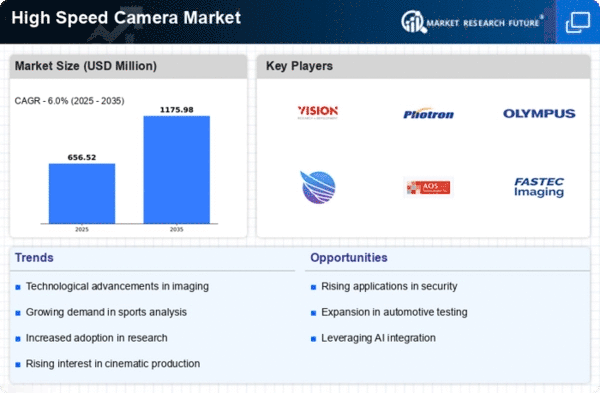
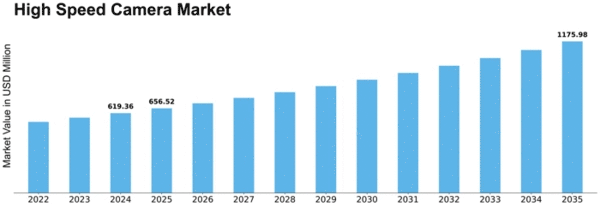
As per MRFR analysis, the High Speed Camera Market Size was estimated at 619.36 USD Million in 2024. The High Speed Camera industry is projected to grow from 656.54 in 2025 to 1175.98 by 2035, exhibiting a compound annual growth rate (CAGR) of 6.0% during the forecast period 2025 - 2035.

Key Market Trends & Highlights

The High Speed Camera Market is experiencing robust growth driven by technological advancements and increasing applications across various sectors.

  • Technological advancements are propelling the development of high-speed cameras, enhancing their capabilities and performance. North America remains the largest market, while Asia-Pacific is emerging as the fastest-growing region for high-speed camera adoption. The scientific research segment dominates the market, whereas the sports analysis segment is witnessing rapid growth due to increased investment in analytics. Rising demand in research and development, along with expansion in entertainment and media, are key drivers fueling market growth.

Market Size & Forecast

2024 Market Size 619.36 (USD Million)
2035 Market Size 1175.98 (USD Million)
CAGR (2025 - 2035) 6.0%
Largest Regional Market Share in 2024 North America

Major Players

Vision Research (US), Photron (JP), Olympus Corporation (JP), IDT (US), AOS Technologies AG (CH), Fastec Imaging Corporation (US), Nikon Corporation (JP), Sony Corporation (JP), Basler AG (DE) — all notable contributors in the cameras industry.

Market Trends

The High Speed Camera Market is currently experiencing a notable evolution, driven by advancements in technology and increasing demand across various sectors. Industries such as entertainment, sports, and scientific research are increasingly adopting high-speed imaging solutions to capture fast-moving events with precision. This trend appears to be fueled by the need for detailed analysis and enhanced visual storytelling, which high-speed cameras facilitate effectively. Furthermore, the integration of artificial intelligence and machine learning into imaging systems is likely to enhance functionality, enabling users to extract valuable insights from captured footage. In addition, the High Speed Camera Market is witnessing a shift towards compact and portable designs, catering to the needs of professionals who require mobility without compromising on performance. This trend suggests a growing preference for versatile equipment that can be utilized in diverse environments, from film sets to field research. As the market continues to evolve, it seems poised for further growth, driven by innovation and the expanding applications of high-speed imaging technology across multiple industries.

Technological Advancements

The high-speed camera market is marked by rapid innovation in high speed high resolution cameras and high speed video recording cameras, with advancements in sensor technology and processing enabling ultra-high-definition footage capture.The High Speed Camera Market is characterized by rapid technological progress, with manufacturers continually enhancing image quality and frame rates. Innovations in sensor technology and processing capabilities are enabling the capture of ultra-high-definition footage, which is increasingly sought after in various applications.

Increased Adoption in Sports

There is a growing trend of high-speed cameras being adopted in the sports industry. These devices are utilized for performance analysis, coaching, and broadcasting, providing detailed insights into athletes' movements. This trend indicates a shift towards data-driven decision-making in sports, where visual analysis plays a crucial role in enhancing performance.

Focus on Portability

Rising interest in camera high speed systems spans automotive, healthcare, sports, and research, indicating that cameras high speed are increasingly valued for precision analysis, quality assurance, and training applications. There is a rising interest in high-speed cameras across multiple sectors, including automotive, healthcare, and sports. This trend suggests that industries are recognizing the value of high-speed imaging for analysis, training, and quality assurance, thereby expanding the market's reach.

Shift Towards Compact Designs

The market is shifting towards portable high speed cameras fps solutions, making high speed camera consumer products more accessible to creators and professionals. This shift indicates a potential increase in usage among amateur filmmakers and content creators, who are looking for accessible solutions that do not compromise on performance.

High Speed Camera Market Market Drivers

Market Growth Projections

The Global High-Speed Camera Market Industry is projected to experience substantial growth, with expectations of reaching 1.18 USD Billion by 2035. This growth trajectory indicates a compound annual growth rate of 6.0% from 2025 to 2035. The increasing applications across various sectors, including automotive, entertainment, and research, are likely to drive this expansion. The market's growth is supported by advancements in technology and rising demand for high-performance imaging solutions. As industries continue to recognize the value of high-speed cameras in enhancing productivity and quality, the market is poised for a promising future.

Technological Advancements

The Global High-Speed Camera Market Industry is experiencing rapid technological advancements, particularly in sensor technology and image processing capabilities. Innovations such as enhanced CMOS sensors and advanced algorithms allow for higher frame rates and better image quality. This evolution is crucial for industries like automotive and sports, where capturing high-speed events with precision is essential. For instance, the integration of these technologies has enabled cameras to achieve frame rates exceeding 1 million frames per second. As a result, the market is projected to grow from 0.62 USD Billion in 2024 to 1.18 USD Billion by 2035, reflecting a robust demand for high-performance imaging solutions.

Growth in Media and Entertainment

The Global High-Speed Camera Market Industry is experiencing notable growth in the media and entertainment sector. High-speed cameras are essential for capturing slow-motion footage, which has become a popular technique in filmmaking and sports broadcasting. The ability to record high-quality images at high frame rates allows filmmakers to create visually stunning scenes that engage audiences. For example, major film productions and sports events increasingly rely on high-speed cameras to enhance storytelling and viewer experience. This trend is expected to contribute to the overall market growth, aligning with the projected increase from 0.62 USD Billion in 2024 to 1.18 USD Billion by 2035.

Expansion in Industrial Applications

The Global High-Speed Camera Market Industry is witnessing expansion in industrial applications, particularly in quality control and manufacturing processes. Industries such as automotive and electronics utilize high-speed cameras to monitor production lines and detect defects in real-time. For instance, in automotive manufacturing, these cameras are employed to analyze the behavior of components during high-speed operations, ensuring safety and reliability. This trend is likely to drive market growth as companies increasingly adopt high-speed imaging technologies to enhance operational efficiency. The anticipated growth from 0.62 USD Billion in 2024 to 1.18 USD Billion by 2035 reflects the rising importance of high-speed cameras in industrial settings.

Rising Adoption in Security and Surveillance

The Global High-Speed Camera Market Industry is witnessing a rising adoption of high-speed cameras in security and surveillance applications. These cameras are instrumental in capturing fast-moving events, such as theft or vandalism, providing law enforcement with critical evidence. The ability to record high-resolution images at high frame rates enhances the effectiveness of surveillance systems. As security concerns continue to grow globally, the demand for advanced surveillance technologies, including high-speed cameras, is likely to increase. This trend may further propel the market, contributing to the anticipated growth trajectory from 0.62 USD Billion in 2024 to 1.18 USD Billion by 2035.

Increasing Demand in Research and Development

The Global High-Speed Camera Market Industry is significantly driven by the increasing demand for high-speed imaging in research and development sectors. Various scientific fields, including physics and biology, require precise motion analysis for experiments. High-speed cameras facilitate this by capturing rapid phenomena that are otherwise invisible to the naked eye. For example, in biomechanics, researchers utilize these cameras to study the motion of athletes, leading to improved performance and injury prevention. This growing reliance on high-speed imaging in R&D is expected to contribute to a compound annual growth rate of 6.0% from 2025 to 2035, underscoring the market's potential.

Market Segment Insights

By Application: Media and Entertainment (Largest) vs. Sports Analysis (Fastest-Growing)

<p>The application segment of the High Speed Camera Market demonstrates varied distribution, with 'Media and Entertainment' holding the largest share. This segment benefits from the increasing demand for high-quality video production and cinematic experiences. Following closely, segments like 'Sports Analysis' are rapidly emerging due to the growing focus on performance analysis and broadcasting efficiency in professional sports. 'Scientific Research', 'Industrial Manufacturing', and 'Automotive Testing' also contribute to the market but represent smaller portions of the overall application landscape. As technology advances, the growth drivers for the High Speed Camera Market are evolving. The surge in content creation for digital platforms fuels the 'Media and Entertainment' segment, while 'Sports Analysis' sees exponential growth from advancements in analytical technologies and the rising emphasis on data-driven performance metrics in sports. Other sectors, like 'Automotive Testing' and 'Industrial Manufacturing', benefit from enhanced precision and product development demands, ensuring steady growth within their niches.</p>

<p>Media and Entertainment (Dominant) vs. Sports Analysis (Emerging)</p>

<p>The 'Media and Entertainment' segment of the High Speed Camera Market stands out as the dominant force, leveraging advancements in filming techniques and a growing market for streaming high-definition video content. This segment thrives on innovations that allow for intricate scene capture and slow-motion effects, which are crucial for filmmakers and content creators. In contrast, 'Sports Analysis' is classified as an emerging segment driven by the increasing need for high-speed capture in sports. Coaches and analysts leverage high-speed cameras to gain insights into athlete performance, improving strategies and training techniques. With technological advancements and the push for competitive advantage, 'Sports Analysis' is poised to witness rapid growth, integrating high-speed imaging solutions into standard practices.</p>

By End Use: Aerospace (Largest) vs. Automotive (Fastest-Growing)

<p>The High Speed Camera Market is characterized by diverse end uses, with aerospace taking a significant lead in market share. This sector greatly benefits from high-speed imaging for testing and evaluating various components under extreme conditions, resulting in a substantial demand for high-performance cameras. Automotive applications follow closely, utilizing these cameras for advanced driver-assistance systems (ADAS), crash testing, and quality control processes, reflecting a growing need for precision monitoring in vehicle safety and efficiency.</p>

<p>Aerospace: Dominant vs. Automotive: Emerging</p>

<p>Aerospace represents a dominant segment in the High Speed Camera Market due to the stringent quality assurance required in aerospace engineering and design. High-speed cameras are pivotal for analyzing aerodynamic features, material durability, and safety testing. Conversely, the automotive sector is an emerging segment driven by the rapid advancements in technology and increasing regulatory pressures for vehicle safety. The demand for real-time visualization in crash tests and the integration of safety systems has accelerated the adoption of high-speed cameras in this industry, making it a significant growth area.</p>

By Technology: CMOS (Largest) vs. Global Shutter (Fastest-Growing)

<p>In the High Speed Camera Market, the technology segment is primarily dominated by CMOS sensors, which have established the largest market share due to their cost efficiency and performance advantages. CCD sensors have traditionally played a vital role but have seen a decline as CMOS technology continues to advance and innovate, capturing a larger market segment. Hybrid and Rolling Shutter technologies contribute to the diversity, catering to specific high-speed imaging needs, making the market competitive and dynamic. Growth trends in the technology segment are significantly influenced by advancements in imaging capabilities, where consumers expect higher resolution and faster frame rates. CMOS technology, being at the forefront, benefits from continuous research and development, enhancing application scope across industries, from sports broadcasting to scientific research. As demand for high-speed imaging rises for various applications, Global Shutter technology emerges as the quickest-Increasing segment, appealing to users seeking methods to eliminate motion distortion in fast-moving objects.</p>

<p>Technology: CMOS (Dominant) vs. Global Shutter (Emerging)</p>

<p>In the High Speed Camera Market, CMOS technology stands out as the dominant segment owing to its superior efficiency and affordability. CMOS sensors allow for faster readouts and lower power consumption, making them suitable for a variety of applications from entertainment to industrial purposes. On the other hand, Global Shutter technology is recognized as an emerging force, particularly invaluable in high-speed photography where capturing motion without distortion is essential. This technology excels in maintaining image integrity during rapid motion and is gaining traction in industries like automotive and sports analytics. The unique capabilities of Global Shutter are driving its rapid adoption, presenting an exciting contrast to the established CMOS segment.</p>

By Frame Rate: High Frame Rate (Largest) vs. Ultra High Frame Rate (Fastest-Growing)

In the High Speed Camera Market, segment values such as High Frame Rate, Ultra High Frame Rate, Standard Frame Rate, Variable Frame Rate, and Fixed Frame Rate play differing roles. High Frame Rate cameras command the largest market share, driven by extensive applications in industries such as sports, scientific research, and film production. Conversely, Ultra High Frame Rate cameras, while currently smaller in market share, are witnessing rapid growth due to advancements in technology and increasing demands for high-resolution slow-motion capabilities in various sectors.

High Frame Rate (Dominant) vs. Ultra High Frame Rate (Emerging)

High Frame Rate cameras are characterized by their ability to capture fast-moving objects with clarity, making them essential in fields like sports analytics, cinematography, and scientific research. Their dominance stems from established demand and proven reliability in performance. On the other hand, Ultra High Frame Rate cameras are emerging rapidly, driven by innovations that allow for higher resolutions and frame rates. These cameras cater to niche markets looking for extreme slow-motion capabilities, appealing to advanced research and high-end filmmaking. Their growth can be attributed to continued technological enhancements, which provide users with unprecedented detail and precision in motion capture.

By Resolution: Ultra High Definition (Largest) vs. 4K Resolution (Fastest-Growing)

<p>In the High-Speed Camera Market, the resolution segment has seen varied market share distribution among the categories of Standard Definition, High Definition, Ultra High Definition, and 4K Resolution. Ultra High Definition is currently the largest segment, capturing significant attention due to its superior image quality and enhanced viewing experience. Conversely, 4K Resolution is rapidly gaining traction, attracting a growing consumer base seeking advanced imaging solutions, which contributes to its substantial growth in market share over recent years.</p>

<p>Ultra High Definition (Dominant) vs. 4K Resolution (Emerging)</p>

<p>Ultra High Definition (UHD) cameras possess remarkable capability to capture high-resolution content, making them preferred for professional applications in film, sports, and broadcast media. Their dominance stems from their ability to render sharp images with great detail, increasing demand across various sectors. In contrast, 4K Resolution cameras, while emerging, are swiftly becoming popular in both consumer and professional arenas. The affordability and accessibility of 4K technology have empowered users to create high-quality content. Both segments reflect the industry's direction towards higher resolution standards, yet UHD continues to stand out for its established reputation, while 4K is remarkable for its potential growth.</p>

Get more detailed insights about High-Speed Camera Market Research Report - Forecast 2035

Regional Insights

North America : Market Leader in Innovation

North America continues to lead the high speed camera market, holding a significant share of 310.0 million in 2025. North America leads the high-speed camera market, with strong adoption of high speed cameras fps in research and entertainment. The region's growth is driven by advancements in technology, increasing demand from industries such as automotive and entertainment, and supportive regulatory frameworks. The presence of major players like Vision Research and IDT further fuels market expansion, as they innovate to meet diverse consumer needs.

The competitive landscape in North America is robust, with the U.S. being the primary market contributor. Companies like Nikon and Sony are investing heavily in R&D to enhance product offerings. The region's focus on high-quality imaging solutions and the integration of AI in camera technology are key trends. As industries seek faster and more efficient imaging solutions, North America is poised for sustained growth in this sector.

Europe : Emerging Market with Growth Potential

Europe's market is growing with demand for high speed video recording cameras in automotive and research applications. Europe's high speed camera market is valued at 150.0 million in 2025, reflecting a growing interest in high-speed imaging technologies across various sectors. The region benefits from stringent quality regulations and a strong emphasis on research and development, which drive innovation. Countries like Germany and the UK are at the forefront, with increasing investments in automotive testing and scientific research fueling demand for high speed cameras.

The competitive landscape in Europe features key players such as Basler AG and Olympus Corporation, who are leveraging advanced technologies to enhance their product lines. The market is characterized by collaborations between manufacturers and research institutions, fostering innovation. As European industries continue to adopt high-speed imaging for quality assurance and analysis, the market is expected to expand significantly.

Asia-Pacific : Rapid Growth in Emerging Markets

Asia-Pacific shows rapid expansion, driven by ultra high speed camera deployment in industrial and entertainment sectors. The Asia-Pacific region, with a market size of 130.0 million in 2025, is experiencing rapid growth in the high speed camera sector. This growth is attributed to increasing industrial automation, rising demand from the entertainment industry, and advancements in technology. Countries like Japan and China are leading the charge, with significant investments in high-speed imaging technologies to enhance production processes and quality control.

The competitive landscape is vibrant, featuring major players such as Photron and Nikon, who are expanding their market presence through innovative product offerings. The region's focus on technological advancements and the growing adoption of high-speed cameras in various applications, including sports and scientific research, are key drivers of market growth. As the demand for high-quality imaging solutions rises, Asia-Pacific is set to become a significant player in the global market.

Middle East and Africa : Emerging Market with Unique Challenges

The Middle East and Africa region, with a market size of 29.36 million in 2025, presents emerging opportunities in the high speed camera market. MEA presents emerging opportunities for camera high speed solutions in infrastructure monitoring and oil & gas industries. The growth is driven by increasing investments in infrastructure and technology, particularly in sectors like oil and gas, where high-speed imaging is essential for monitoring and analysis. Regulatory support for technological advancements is also a catalyst for market growth in this region.

Countries such as South Africa and the UAE are leading the way in adopting high-speed imaging technologies. The competitive landscape is evolving, with local and international players vying for market share. As industries in the region recognize the value of high-speed cameras for enhancing operational efficiency, the market is expected to grow steadily, driven by both demand and innovation.

Key Players and Competitive Insights

The High Speed Camera Market is currently characterized by a dynamic competitive landscape, driven by technological advancements and increasing demand across various sectors such as automotive, aerospace, and entertainment. Vision Research, Photron, Olympus, IDT, AOS Technologies, Fastec, Nikon, Sony, and Basler remain central to high-speed camera market innovations, with increasing emphasis on high speed camera consumer products and AI integration. Key players are strategically positioning themselves through innovation and partnerships, which collectively shape the market's competitive environment. For instance, Vision Research (US) has focused on enhancing its product offerings with cutting-edge imaging technology, while Photron (JP) emphasizes its commitment to high-performance cameras tailored for scientific research and industrial applications. Meanwhile, Olympus Corporation (JP) is leveraging its expertise in optics to expand its high-speed imaging solutions, indicating a trend towards specialization in niche markets.
In terms of business tactics, companies are increasingly localizing manufacturing to reduce costs and optimize supply chains. The market appears moderately fragmented, with several players vying for market share. This fragmentation allows for diverse offerings, yet the collective influence of key players like Nikon Corporation (JP) and Sony Corporation (JP) remains significant, as they continue to dominate through brand recognition and extensive distribution networks.
In November 2025, Nikon Corporation (JP) announced the launch of its latest high-speed camera model, which features advanced AI capabilities for real-time image processing. This strategic move not only enhances Nikon's product portfolio but also positions the company as a leader in integrating AI technology into imaging solutions, potentially attracting a broader customer base seeking innovative features. The emphasis on AI reflects a growing trend in the market towards smart imaging solutions that can adapt to various applications.
In October 2025, Sony Corporation (JP) unveiled a partnership with a leading automotive manufacturer to develop high-speed imaging systems for autonomous vehicles. This collaboration underscores the increasing importance of high-speed cameras in the automotive sector, particularly for safety and performance testing. By aligning with a major player in the automotive industry, Sony is likely to enhance its market presence and capitalize on the burgeoning demand for advanced imaging technologies in vehicle development.
In December 2025, AOS Technologies AG (CH) revealed its plans to expand its operations into the Asian market, focusing on high-speed cameras for industrial applications. This strategic expansion indicates a proactive approach to tapping into emerging markets, where demand for high-speed imaging is on the rise. By establishing a foothold in Asia, AOS Technologies may enhance its competitive edge and diversify its revenue streams, reflecting a broader trend of globalization in the industry.
As of December 2025, current competitive trends in the High Speed Camera Market include a strong emphasis on digitalization, sustainability, and AI integration. Strategic alliances are increasingly shaping the landscape, as companies recognize the value of collaboration in driving innovation. The shift from price-based competition to a focus on technological advancement and supply chain reliability is evident, suggesting that future differentiation will hinge on the ability to innovate and adapt to changing market demands.

Key Companies in the High Speed Camera Market include

Industry Developments

Key launches include ultra high speed video cameras, high speed high resolution cameras, and partnerships to integrate AI and advanced CMOS sensors. Adoption of cheap high speed cameras is noted in educational and research institutions.

  • Q2 2024: Vision Research Launches Phantom T4040 High-Speed Camera for Scientific and Industrial Applications Vision Research announced the release of its new Phantom T4040 high-speed camera, designed for demanding scientific and industrial imaging applications, featuring a 4-megapixel sensor and frame rates up to 4,000 fps at full resolution.
  • Q1 2024: Photron Introduces FASTCAM Nova R5-4K High-Speed Camera Photron launched the FASTCAM Nova R5-4K, a high-speed camera capable of capturing 4K resolution video at up to 1,250 frames per second, targeting automotive crash testing and advanced research markets.
  • Q2 2024: IDT Announces Partnership with NVIDIA to Integrate AI into High-Speed Camera Systems Integrated Design Tools (IDT) revealed a strategic partnership with NVIDIA to embed AI-powered analytics directly into its high-speed camera platforms, aiming to accelerate adoption in industrial automation and quality control.
  • Q1 2024: Optronis Opens New Manufacturing Facility in Germany to Expand High-Speed Camera Production Optronis inaugurated a new manufacturing facility in Kehl, Germany, to increase production capacity for its high-speed cameras, supporting growing demand from automotive and scientific research sectors.
  • Q3 2024: AOS Technologies Wins Major Contract to Supply High-Speed Cameras for Aerospace Testing AOS Technologies secured a multi-million dollar contract to provide high-speed imaging systems for a leading European aerospace manufacturer’s structural testing programs.
  • Q2 2024: Teledyne FLIR Launches X-Series High-Speed Cameras for Defense and Research Markets Teledyne FLIR introduced the X-Series, a new line of high-speed cameras designed for defense, aerospace, and scientific research, offering advanced thermal and visible imaging capabilities.
  • Q1 2025: DEL Imaging Systems Appoints New CEO to Drive Global Expansion DEL Imaging Systems announced the appointment of Dr. Lisa Chen as Chief Executive Officer, with a mandate to accelerate international growth and product innovation in the high-speed camera sector.
  • Q2 2025: NAC Image Technology Partners with Sony for Next-Generation High-Speed Sensor Development NAC Image Technology entered a partnership with Sony to co-develop advanced CMOS sensors for ultra-high-speed cameras, targeting applications in automotive safety and industrial inspection.
  • Q3 2024: Photron Secures $20 Million Contract for High-Speed Cameras in Sports Analytics Photron was awarded a $20 million contract to supply high-speed camera systems for a global sports analytics company, supporting enhanced motion analysis in professional sports leagues.
  • Q2 2024: Fastec Imaging Launches TS7-S High-Speed Camera for Biomechanics Research Fastec Imaging released the TS7-S, a portable high-speed camera optimized for biomechanics and motion analysis, featuring high frame rates and on-board data processing.
  • Q1 2025: Teledyne Technologies Acquires High-Speed Camera Specialist Mikrotron Teledyne Technologies completed the acquisition of Mikrotron, a German manufacturer of high-speed cameras, to strengthen its imaging solutions portfolio for industrial and scientific markets.
  • Q2 2025: IDT Raises $30 Million in Series C Funding to Expand High-Speed Camera R&D Integrated Design Tools (IDT) closed a $30 million Series C funding round led by a consortium of technology investors, aimed at accelerating research and development of next-generation high-speed imaging systems.

Future Outlook

High Speed Camera Market Future Outlook

The High Speed Camera Market is projected to grow at a 6.0% CAGR from 2025 to 2035, driven by advancements in technology, increasing demand in research, and expanding applications in various industries.

New opportunities lie in:

  • <p>Development of specialized high-speed cameras for automotive crash testing. Integration of AI for real-time data analysis in high-speed imaging. Expansion into emerging markets with tailored product offerings.</p>

By 2035, the High Speed Camera Market is expected to achieve robust growth and diversification.

Market Segmentation

High Speed Camera Market End Use Outlook

  • Aerospace
  • Automotive
  • Healthcare
  • Media and Entertainment
  • Research and Development

High Speed Camera Market Frame Rate Outlook

  • High Frame Rate
  • Ultra High Frame Rate
  • Standard Frame Rate
  • Variable Frame Rate
  • Fixed Frame Rate

High Speed Camera Market Resolution Outlook

  • Standard Resolution
  • High Resolution
  • Ultra High Resolution
  • 4K Resolution
  • 8K Resolution

High Speed Camera Market Technology Outlook

  • CMOS Technology
  • CCD Technology
  • Hybrid Technology
  • Digital Technology
  • Analog Technology

High Speed Camera Market Application Outlook

  • Scientific Research
  • Industrial Manufacturing
  • Sports Analysis
  • Entertainment
  • Automotive Testing

Report Scope

MARKET SIZE 2024 619.36(USD Million)
MARKET SIZE 2025 656.54(USD Million)
MARKET SIZE 2035 1175.98(USD Million)
COMPOUND ANNUAL GROWTH RATE (CAGR) 6.0% (2025 - 2035)
REPORT COVERAGE Revenue Forecast, Competitive Landscape, Growth Factors, and Trends
BASE YEAR 2024
Market Forecast Period 2025 - 2035
Historical Data 2019 - 2024
Market Forecast Units USD Million
Key Companies Profiled Vision Research (US), Photron (JP), Olympus Corporation (JP), IDT (US), AOS Technologies AG (CH), Fastec Imaging (US), Nikon Corporation (JP), Sony Corporation (JP), Red.com (US)
Segments Covered Application, End Use, Technology, Frame Rate, Resolution
Key Market Opportunities Advancements in imaging technology drive demand for High Speed Cameras in various industrial applications.
Key Market Dynamics Technological advancements drive demand for high-speed cameras across various industries, enhancing image capture capabilities and applications.
Countries Covered North America, Europe, APAC, South America, MEA

FAQs

What is the current valuation of the High Speed Camera Market?

<p>As of 2024, the High Speed Camera Market was valued at approximately 619.36 USD Million.</p>

What is the projected market valuation for the High Speed Camera Market in 2035?

<p>The market is projected to reach a valuation of about 1175.98 USD Million by 2035.</p>

What is the expected CAGR for the High Speed Camera Market during the forecast period 2025 - 2035?

<p>The expected CAGR for the High Speed Camera Market during the forecast period 2025 - 2035 is 6.0%.</p>

Which application segments are driving growth in the High Speed Camera Market?

<p>The application segments driving growth include Media and Entertainment, which was valued at 200.0 to 350.0 USD Million, and Industrial Manufacturing, valued at 150.0 to 300.0 USD Million.</p>

What are the key technologies utilized in the High Speed Camera Market?

<p>Key technologies include CMOS, which had a valuation range of 200.0 to 400.0 USD Million, and CCD, valued at 150.0 to 300.0 USD Million.</p>

Who are the leading players in the High Speed Camera Market?

<p>Leading players in the market include Vision Research, Photron, Olympus Corporation, and Sony Corporation, among others.</p>

What end-use sectors are contributing to the High Speed Camera Market?

End-use sectors contributing to the market include Consumer Electronics, valued at 200.0 to 400.0 USD Million, and Automotive, valued at 150.0 to 300.0 USD Million.

How does the High Speed Camera Market perform in terms of frame rate segments?

The High Speed Camera Market shows strong performance in the High Frame Rate segment, which was valued at 185.0 to 350.0 USD Million.

What resolution segments are present in the High Speed Camera Market?

Resolution segments include High Definition, valued at 200.0 to 400.0 USD Million, and Ultra High Definition, valued at 150.0 to 300.0 USD Million.

What is the significance of the Automotive Testing application in the High Speed Camera Market?

The Automotive Testing application segment was valued at 89.36 to 175.98 USD Million, indicating its relevance in the market.

  1. SECTION I: EXECUTIVE SUMMARY AND KEY HIGHLIGHTS
    1. | 1.1 EXECUTIVE SUMMARY
    2. | | 1.1.1 Market Overview
    3. | | 1.1.2 Key Findings
    4. | | 1.1.3 Market Segmentation
    5. | | 1.1.4 Competitive Landscape
    6. | | 1.1.5 Challenges and Opportunities
    7. | | 1.1.6 Future Outlook
  2. SECTION II: SCOPING, METHODOLOGY AND MARKET STRUCTURE
    1. | 2.1 MARKET INTRODUCTION
    2. | | 2.1.1 Definition
    3. | | 2.1.2 Scope of the study
    4. | | | 2.1.2.1 Research Objective
    5. | | | 2.1.2.2 Assumption
    6. | | | 2.1.2.3 Limitations
    7. | 2.2 RESEARCH METHODOLOGY
    8. | | 2.2.1 Overview
    9. | | 2.2.2 Data Mining
    10. | | 2.2.3 Secondary Research
    11. | | 2.2.4 Primary Research
    12. | | | 2.2.4.1 Primary Interviews and Information Gathering Process
    13. | | | 2.2.4.2 Breakdown of Primary Respondents
    14. | | 2.2.5 Forecasting Model
    15. | | 2.2.6 Market Size Estimation
    16. | | | 2.2.6.1 Bottom-Up Approach
    17. | | | 2.2.6.2 Top-Down Approach
    18. | | 2.2.7 Data Triangulation
    19. | | 2.2.8 Validation
  3. SECTION III: QUALITATIVE ANALYSIS
    1. | 3.1 MARKET DYNAMICS
    2. | | 3.1.1 Overview
    3. | | 3.1.2 Drivers
    4. | | 3.1.3 Restraints
    5. | | 3.1.4 Opportunities
    6. | 3.2 MARKET FACTOR ANALYSIS
    7. | | 3.2.1 Value chain Analysis
    8. | | 3.2.2 Porter's Five Forces Analysis
    9. | | | 3.2.2.1 Bargaining Power of Suppliers
    10. | | | 3.2.2.2 Bargaining Power of Buyers
    11. | | | 3.2.2.3 Threat of New Entrants
    12. | | | 3.2.2.4 Threat of Substitutes
    13. | | | 3.2.2.5 Intensity of Rivalry
    14. | | 3.2.3 COVID-19 Impact Analysis
    15. | | | 3.2.3.1 Market Impact Analysis
    16. | | | 3.2.3.2 Regional Impact
    17. | | | 3.2.3.3 Opportunity and Threat Analysis
  4. SECTION IV: QUANTITATIVE ANALYSIS
    1. | 4.1 Semiconductor & Electronics, BY Application (USD Million)
    2. | | 4.1.1 Scientific Research
    3. | | 4.1.2 Industrial Manufacturing
    4. | | 4.1.3 Media and Entertainment
    5. | | 4.1.4 Sports Analysis
    6. | | 4.1.5 Automotive Testing
    7. | 4.2 Semiconductor & Electronics, BY End Use (USD Million)
    8. | | 4.2.1 Aerospace
    9. | | 4.2.2 Automotive
    10. | | 4.2.3 Healthcare
    11. | | 4.2.4 Consumer Electronics
    12. | | 4.2.5 Military and Defense
    13. | 4.3 Semiconductor & Electronics, BY Technology (USD Million)
    14. | | 4.3.1 CMOS
    15. | | 4.3.2 CCD
    16. | | 4.3.3 Hybrid
    17. | | 4.3.4 Global Shutter
    18. | | 4.3.5 Rolling Shutter
    19. | 4.4 Semiconductor & Electronics, BY Frame Rate (USD Million)
    20. | | 4.4.1 High Frame Rate
    21. | | 4.4.2 Ultra High Frame Rate
    22. | | 4.4.3 Super Slow Motion
    23. | | 4.4.4 Standard Frame Rate
    24. | 4.5 Semiconductor & Electronics, BY Resolution (USD Million)
    25. | | 4.5.1 Standard Definition
    26. | | 4.5.2 High Definition
    27. | | 4.5.3 Ultra High Definition
    28. | | 4.5.4 4K Resolution
    29. | 4.6 Semiconductor & Electronics, BY Region (USD Million)
    30. | | 4.6.1 North America
    31. | | | 4.6.1.1 US
    32. | | | 4.6.1.2 Canada
    33. | | 4.6.2 Europe
    34. | | | 4.6.2.1 Germany
    35. | | | 4.6.2.2 UK
    36. | | | 4.6.2.3 France
    37. | | | 4.6.2.4 Russia
    38. | | | 4.6.2.5 Italy
    39. | | | 4.6.2.6 Spain
    40. | | | 4.6.2.7 Rest of Europe
    41. | | 4.6.3 APAC
    42. | | | 4.6.3.1 China
    43. | | | 4.6.3.2 India
    44. | | | 4.6.3.3 Japan
    45. | | | 4.6.3.4 South Korea
    46. | | | 4.6.3.5 Malaysia
    47. | | | 4.6.3.6 Thailand
    48. | | | 4.6.3.7 Indonesia
    49. | | | 4.6.3.8 Rest of APAC
    50. | | 4.6.4 South America
    51. | | | 4.6.4.1 Brazil
    52. | | | 4.6.4.2 Mexico
    53. | | | 4.6.4.3 Argentina
    54. | | | 4.6.4.4 Rest of South America
    55. | | 4.6.5 MEA
    56. | | | 4.6.5.1 GCC Countries
    57. | | | 4.6.5.2 South Africa
    58. | | | 4.6.5.3 Rest of MEA
  5. SECTION V: COMPETITIVE ANALYSIS
    1. | 5.1 Competitive Landscape
    2. | | 5.1.1 Overview
    3. | | 5.1.2 Competitive Analysis
    4. | | 5.1.3 Market share Analysis
    5. | | 5.1.4 Major Growth Strategy in the Semiconductor & Electronics
    6. | | 5.1.5 Competitive Benchmarking
    7. | | 5.1.6 Leading Players in Terms of Number of Developments in the Semiconductor & Electronics
    8. | | 5.1.7 Key developments and growth strategies
    9. | | | 5.1.7.1 New Product Launch/Service Deployment
    10. | | | 5.1.7.2 Merger & Acquisitions
    11. | | | 5.1.7.3 Joint Ventures
    12. | | 5.1.8 Major Players Financial Matrix
    13. | | | 5.1.8.1 Sales and Operating Income
    14. | | | 5.1.8.2 Major Players R&D Expenditure. 2023
    15. | 5.2 Company Profiles
    16. | | 5.2.1 Vision Research (US)
    17. | | | 5.2.1.1 Financial Overview
    18. | | | 5.2.1.2 Products Offered
    19. | | | 5.2.1.3 Key Developments
    20. | | | 5.2.1.4 SWOT Analysis
    21. | | | 5.2.1.5 Key Strategies
    22. | | 5.2.2 Photron (JP)
    23. | | | 5.2.2.1 Financial Overview
    24. | | | 5.2.2.2 Products Offered
    25. | | | 5.2.2.3 Key Developments
    26. | | | 5.2.2.4 SWOT Analysis
    27. | | | 5.2.2.5 Key Strategies
    28. | | 5.2.3 Olympus Corporation (JP)
    29. | | | 5.2.3.1 Financial Overview
    30. | | | 5.2.3.2 Products Offered
    31. | | | 5.2.3.3 Key Developments
    32. | | | 5.2.3.4 SWOT Analysis
    33. | | | 5.2.3.5 Key Strategies
    34. | | 5.2.4 IDT (US)
    35. | | | 5.2.4.1 Financial Overview
    36. | | | 5.2.4.2 Products Offered
    37. | | | 5.2.4.3 Key Developments
    38. | | | 5.2.4.4 SWOT Analysis
    39. | | | 5.2.4.5 Key Strategies
    40. | | 5.2.5 AOS Technologies AG (CH)
    41. | | | 5.2.5.1 Financial Overview
    42. | | | 5.2.5.2 Products Offered
    43. | | | 5.2.5.3 Key Developments
    44. | | | 5.2.5.4 SWOT Analysis
    45. | | | 5.2.5.5 Key Strategies
    46. | | 5.2.6 Fastec Imaging Corporation (US)
    47. | | | 5.2.6.1 Financial Overview
    48. | | | 5.2.6.2 Products Offered
    49. | | | 5.2.6.3 Key Developments
    50. | | | 5.2.6.4 SWOT Analysis
    51. | | | 5.2.6.5 Key Strategies
    52. | | 5.2.7 Nikon Corporation (JP)
    53. | | | 5.2.7.1 Financial Overview
    54. | | | 5.2.7.2 Products Offered
    55. | | | 5.2.7.3 Key Developments
    56. | | | 5.2.7.4 SWOT Analysis
    57. | | | 5.2.7.5 Key Strategies
    58. | | 5.2.8 Sony Corporation (JP)
    59. | | | 5.2.8.1 Financial Overview
    60. | | | 5.2.8.2 Products Offered
    61. | | | 5.2.8.3 Key Developments
    62. | | | 5.2.8.4 SWOT Analysis
    63. | | | 5.2.8.5 Key Strategies
    64. | | 5.2.9 Basler AG (DE)
    65. | | | 5.2.9.1 Financial Overview
    66. | | | 5.2.9.2 Products Offered
    67. | | | 5.2.9.3 Key Developments
    68. | | | 5.2.9.4 SWOT Analysis
    69. | | | 5.2.9.5 Key Strategies
    70. | 5.3 Appendix
    71. | | 5.3.1 References
    72. | | 5.3.2 Related Reports
  6. LIST OF FIGURES
    1. | 6.1 MARKET SYNOPSIS
    2. | 6.2 NORTH AMERICA MARKET ANALYSIS
    3. | 6.3 US MARKET ANALYSIS BY APPLICATION
    4. | 6.4 US MARKET ANALYSIS BY END USE
    5. | 6.5 US MARKET ANALYSIS BY TECHNOLOGY
    6. | 6.6 US MARKET ANALYSIS BY FRAME RATE
    7. | 6.7 US MARKET ANALYSIS BY RESOLUTION
    8. | 6.8 CANADA MARKET ANALYSIS BY APPLICATION
    9. | 6.9 CANADA MARKET ANALYSIS BY END USE
    10. | 6.10 CANADA MARKET ANALYSIS BY TECHNOLOGY
    11. | 6.11 CANADA MARKET ANALYSIS BY FRAME RATE
    12. | 6.12 CANADA MARKET ANALYSIS BY RESOLUTION
    13. | 6.13 EUROPE MARKET ANALYSIS
    14. | 6.14 GERMANY MARKET ANALYSIS BY APPLICATION
    15. | 6.15 GERMANY MARKET ANALYSIS BY END USE
    16. | 6.16 GERMANY MARKET ANALYSIS BY TECHNOLOGY
    17. | 6.17 GERMANY MARKET ANALYSIS BY FRAME RATE
    18. | 6.18 GERMANY MARKET ANALYSIS BY RESOLUTION
    19. | 6.19 UK MARKET ANALYSIS BY APPLICATION
    20. | 6.20 UK MARKET ANALYSIS BY END USE
    21. | 6.21 UK MARKET ANALYSIS BY TECHNOLOGY
    22. | 6.22 UK MARKET ANALYSIS BY FRAME RATE
    23. | 6.23 UK MARKET ANALYSIS BY RESOLUTION
    24. | 6.24 FRANCE MARKET ANALYSIS BY APPLICATION
    25. | 6.25 FRANCE MARKET ANALYSIS BY END USE
    26. | 6.26 FRANCE MARKET ANALYSIS BY TECHNOLOGY
    27. | 6.27 FRANCE MARKET ANALYSIS BY FRAME RATE
    28. | 6.28 FRANCE MARKET ANALYSIS BY RESOLUTION
    29. | 6.29 RUSSIA MARKET ANALYSIS BY APPLICATION
    30. | 6.30 RUSSIA MARKET ANALYSIS BY END USE
    31. | 6.31 RUSSIA MARKET ANALYSIS BY TECHNOLOGY
    32. | 6.32 RUSSIA MARKET ANALYSIS BY FRAME RATE
    33. | 6.33 RUSSIA MARKET ANALYSIS BY RESOLUTION
    34. | 6.34 ITALY MARKET ANALYSIS BY APPLICATION
    35. | 6.35 ITALY MARKET ANALYSIS BY END USE
    36. | 6.36 ITALY MARKET ANALYSIS BY TECHNOLOGY
    37. | 6.37 ITALY MARKET ANALYSIS BY FRAME RATE
    38. | 6.38 ITALY MARKET ANALYSIS BY RESOLUTION
    39. | 6.39 SPAIN MARKET ANALYSIS BY APPLICATION
    40. | 6.40 SPAIN MARKET ANALYSIS BY END USE
    41. | 6.41 SPAIN MARKET ANALYSIS BY TECHNOLOGY
    42. | 6.42 SPAIN MARKET ANALYSIS BY FRAME RATE
    43. | 6.43 SPAIN MARKET ANALYSIS BY RESOLUTION
    44. | 6.44 REST OF EUROPE MARKET ANALYSIS BY APPLICATION
    45. | 6.45 REST OF EUROPE MARKET ANALYSIS BY END USE
    46. | 6.46 REST OF EUROPE MARKET ANALYSIS BY TECHNOLOGY
    47. | 6.47 REST OF EUROPE MARKET ANALYSIS BY FRAME RATE
    48. | 6.48 REST OF EUROPE MARKET ANALYSIS BY RESOLUTION
    49. | 6.49 APAC MARKET ANALYSIS
    50. | 6.50 CHINA MARKET ANALYSIS BY APPLICATION
    51. | 6.51 CHINA MARKET ANALYSIS BY END USE
    52. | 6.52 CHINA MARKET ANALYSIS BY TECHNOLOGY
    53. | 6.53 CHINA MARKET ANALYSIS BY FRAME RATE
    54. | 6.54 CHINA MARKET ANALYSIS BY RESOLUTION
    55. | 6.55 INDIA MARKET ANALYSIS BY APPLICATION
    56. | 6.56 INDIA MARKET ANALYSIS BY END USE
    57. | 6.57 INDIA MARKET ANALYSIS BY TECHNOLOGY
    58. | 6.58 INDIA MARKET ANALYSIS BY FRAME RATE
    59. | 6.59 INDIA MARKET ANALYSIS BY RESOLUTION
    60. | 6.60 JAPAN MARKET ANALYSIS BY APPLICATION
    61. | 6.61 JAPAN MARKET ANALYSIS BY END USE
    62. | 6.62 JAPAN MARKET ANALYSIS BY TECHNOLOGY
    63. | 6.63 JAPAN MARKET ANALYSIS BY FRAME RATE
    64. | 6.64 JAPAN MARKET ANALYSIS BY RESOLUTION
    65. | 6.65 SOUTH KOREA MARKET ANALYSIS BY APPLICATION
    66. | 6.66 SOUTH KOREA MARKET ANALYSIS BY END USE
    67. | 6.67 SOUTH KOREA MARKET ANALYSIS BY TECHNOLOGY
    68. | 6.68 SOUTH KOREA MARKET ANALYSIS BY FRAME RATE
    69. | 6.69 SOUTH KOREA MARKET ANALYSIS BY RESOLUTION
    70. | 6.70 MALAYSIA MARKET ANALYSIS BY APPLICATION
    71. | 6.71 MALAYSIA MARKET ANALYSIS BY END USE
    72. | 6.72 MALAYSIA MARKET ANALYSIS BY TECHNOLOGY
    73. | 6.73 MALAYSIA MARKET ANALYSIS BY FRAME RATE
    74. | 6.74 MALAYSIA MARKET ANALYSIS BY RESOLUTION
    75. | 6.75 THAILAND MARKET ANALYSIS BY APPLICATION
    76. | 6.76 THAILAND MARKET ANALYSIS BY END USE
    77. | 6.77 THAILAND MARKET ANALYSIS BY TECHNOLOGY
    78. | 6.78 THAILAND MARKET ANALYSIS BY FRAME RATE
    79. | 6.79 THAILAND MARKET ANALYSIS BY RESOLUTION
    80. | 6.80 INDONESIA MARKET ANALYSIS BY APPLICATION
    81. | 6.81 INDONESIA MARKET ANALYSIS BY END USE
    82. | 6.82 INDONESIA MARKET ANALYSIS BY TECHNOLOGY
    83. | 6.83 INDONESIA MARKET ANALYSIS BY FRAME RATE
    84. | 6.84 INDONESIA MARKET ANALYSIS BY RESOLUTION
    85. | 6.85 REST OF APAC MARKET ANALYSIS BY APPLICATION
    86. | 6.86 REST OF APAC MARKET ANALYSIS BY END USE
    87. | 6.87 REST OF APAC MARKET ANALYSIS BY TECHNOLOGY
    88. | 6.88 REST OF APAC MARKET ANALYSIS BY FRAME RATE
    89. | 6.89 REST OF APAC MARKET ANALYSIS BY RESOLUTION
    90. | 6.90 SOUTH AMERICA MARKET ANALYSIS
    91. | 6.91 BRAZIL MARKET ANALYSIS BY APPLICATION
    92. | 6.92 BRAZIL MARKET ANALYSIS BY END USE
    93. | 6.93 BRAZIL MARKET ANALYSIS BY TECHNOLOGY
    94. | 6.94 BRAZIL MARKET ANALYSIS BY FRAME RATE
    95. | 6.95 BRAZIL MARKET ANALYSIS BY RESOLUTION
    96. | 6.96 MEXICO MARKET ANALYSIS BY APPLICATION
    97. | 6.97 MEXICO MARKET ANALYSIS BY END USE
    98. | 6.98 MEXICO MARKET ANALYSIS BY TECHNOLOGY
    99. | 6.99 MEXICO MARKET ANALYSIS BY FRAME RATE
    100. | 6.100 MEXICO MARKET ANALYSIS BY RESOLUTION
    101. | 6.101 ARGENTINA MARKET ANALYSIS BY APPLICATION
    102. | 6.102 ARGENTINA MARKET ANALYSIS BY END USE
    103. | 6.103 ARGENTINA MARKET ANALYSIS BY TECHNOLOGY
    104. | 6.104 ARGENTINA MARKET ANALYSIS BY FRAME RATE
    105. | 6.105 ARGENTINA MARKET ANALYSIS BY RESOLUTION
    106. | 6.106 REST OF SOUTH AMERICA MARKET ANALYSIS BY APPLICATION
    107. | 6.107 REST OF SOUTH AMERICA MARKET ANALYSIS BY END USE
    108. | 6.108 REST OF SOUTH AMERICA MARKET ANALYSIS BY TECHNOLOGY
    109. | 6.109 REST OF SOUTH AMERICA MARKET ANALYSIS BY FRAME RATE
    110. | 6.110 REST OF SOUTH AMERICA MARKET ANALYSIS BY RESOLUTION
    111. | 6.111 MEA MARKET ANALYSIS
    112. | 6.112 GCC COUNTRIES MARKET ANALYSIS BY APPLICATION
    113. | 6.113 GCC COUNTRIES MARKET ANALYSIS BY END USE
    114. | 6.114 GCC COUNTRIES MARKET ANALYSIS BY TECHNOLOGY
    115. | 6.115 GCC COUNTRIES MARKET ANALYSIS BY FRAME RATE
    116. | 6.116 GCC COUNTRIES MARKET ANALYSIS BY RESOLUTION
    117. | 6.117 SOUTH AFRICA MARKET ANALYSIS BY APPLICATION
    118. | 6.118 SOUTH AFRICA MARKET ANALYSIS BY END USE
    119. | 6.119 SOUTH AFRICA MARKET ANALYSIS BY TECHNOLOGY
    120. | 6.120 SOUTH AFRICA MARKET ANALYSIS BY FRAME RATE
    121. | 6.121 SOUTH AFRICA MARKET ANALYSIS BY RESOLUTION
    122. | 6.122 REST OF MEA MARKET ANALYSIS BY APPLICATION
    123. | 6.123 REST OF MEA MARKET ANALYSIS BY END USE
    124. | 6.124 REST OF MEA MARKET ANALYSIS BY TECHNOLOGY
    125. | 6.125 REST OF MEA MARKET ANALYSIS BY FRAME RATE
    126. | 6.126 REST OF MEA MARKET ANALYSIS BY RESOLUTION
    127. | 6.127 KEY BUYING CRITERIA OF SEMICONDUCTOR & ELECTRONICS
    128. | 6.128 RESEARCH PROCESS OF MRFR
    129. | 6.129 DRO ANALYSIS OF SEMICONDUCTOR & ELECTRONICS
    130. | 6.130 DRIVERS IMPACT ANALYSIS: SEMICONDUCTOR & ELECTRONICS
    131. | 6.131 RESTRAINTS IMPACT ANALYSIS: SEMICONDUCTOR & ELECTRONICS
    132. | 6.132 SUPPLY / VALUE CHAIN: SEMICONDUCTOR & ELECTRONICS
    133. | 6.133 SEMICONDUCTOR & ELECTRONICS, BY APPLICATION, 2024 (% SHARE)
    134. | 6.134 SEMICONDUCTOR & ELECTRONICS, BY APPLICATION, 2024 TO 2035 (USD Million)
    135. | 6.135 SEMICONDUCTOR & ELECTRONICS, BY END USE, 2024 (% SHARE)
    136. | 6.136 SEMICONDUCTOR & ELECTRONICS, BY END USE, 2024 TO 2035 (USD Million)
    137. | 6.137 SEMICONDUCTOR & ELECTRONICS, BY TECHNOLOGY, 2024 (% SHARE)
    138. | 6.138 SEMICONDUCTOR & ELECTRONICS, BY TECHNOLOGY, 2024 TO 2035 (USD Million)
    139. | 6.139 SEMICONDUCTOR & ELECTRONICS, BY FRAME RATE, 2024 (% SHARE)
    140. | 6.140 SEMICONDUCTOR & ELECTRONICS, BY FRAME RATE, 2024 TO 2035 (USD Million)
    141. | 6.141 SEMICONDUCTOR & ELECTRONICS, BY RESOLUTION, 2024 (% SHARE)
    142. | 6.142 SEMICONDUCTOR & ELECTRONICS, BY RESOLUTION, 2024 TO 2035 (USD Million)
    143. | 6.143 BENCHMARKING OF MAJOR COMPETITORS
  7. LIST OF TABLES
    1. | 7.1 LIST OF ASSUMPTIONS
    2. | | 7.1.1
    3. | 7.2 North America MARKET SIZE ESTIMATES; FORECAST
    4. | | 7.2.1 BY APPLICATION, 2025-2035 (USD Million)
    5. | | 7.2.2 BY END USE, 2025-2035 (USD Million)
    6. | | 7.2.3 BY TECHNOLOGY, 2025-2035 (USD Million)
    7. | | 7.2.4 BY FRAME RATE, 2025-2035 (USD Million)
    8. | | 7.2.5 BY RESOLUTION, 2025-2035 (USD Million)
    9. | 7.3 US MARKET SIZE ESTIMATES; FORECAST
    10. | | 7.3.1 BY APPLICATION, 2025-2035 (USD Million)
    11. | | 7.3.2 BY END USE, 2025-2035 (USD Million)
    12. | | 7.3.3 BY TECHNOLOGY, 2025-2035 (USD Million)
    13. | | 7.3.4 BY FRAME RATE, 2025-2035 (USD Million)
    14. | | 7.3.5 BY RESOLUTION, 2025-2035 (USD Million)
    15. | 7.4 Canada MARKET SIZE ESTIMATES; FORECAST
    16. | | 7.4.1 BY APPLICATION, 2025-2035 (USD Million)
    17. | | 7.4.2 BY END USE, 2025-2035 (USD Million)
    18. | | 7.4.3 BY TECHNOLOGY, 2025-2035 (USD Million)
    19. | | 7.4.4 BY FRAME RATE, 2025-2035 (USD Million)
    20. | | 7.4.5 BY RESOLUTION, 2025-2035 (USD Million)
    21. | 7.5 Europe MARKET SIZE ESTIMATES; FORECAST
    22. | | 7.5.1 BY APPLICATION, 2025-2035 (USD Million)
    23. | | 7.5.2 BY END USE, 2025-2035 (USD Million)
    24. | | 7.5.3 BY TECHNOLOGY, 2025-2035 (USD Million)
    25. | | 7.5.4 BY FRAME RATE, 2025-2035 (USD Million)
    26. | | 7.5.5 BY RESOLUTION, 2025-2035 (USD Million)
    27. | 7.6 Germany MARKET SIZE ESTIMATES; FORECAST
    28. | | 7.6.1 BY APPLICATION, 2025-2035 (USD Million)
    29. | | 7.6.2 BY END USE, 2025-2035 (USD Million)
    30. | | 7.6.3 BY TECHNOLOGY, 2025-2035 (USD Million)
    31. | | 7.6.4 BY FRAME RATE, 2025-2035 (USD Million)
    32. | | 7.6.5 BY RESOLUTION, 2025-2035 (USD Million)
    33. | 7.7 UK MARKET SIZE ESTIMATES; FORECAST
    34. | | 7.7.1 BY APPLICATION, 2025-2035 (USD Million)
    35. | | 7.7.2 BY END USE, 2025-2035 (USD Million)
    36. | | 7.7.3 BY TECHNOLOGY, 2025-2035 (USD Million)
    37. | | 7.7.4 BY FRAME RATE, 2025-2035 (USD Million)
    38. | | 7.7.5 BY RESOLUTION, 2025-2035 (USD Million)
    39. | 7.8 France MARKET SIZE ESTIMATES; FORECAST
    40. | | 7.8.1 BY APPLICATION, 2025-2035 (USD Million)
    41. | | 7.8.2 BY END USE, 2025-2035 (USD Million)
    42. | | 7.8.3 BY TECHNOLOGY, 2025-2035 (USD Million)
    43. | | 7.8.4 BY FRAME RATE, 2025-2035 (USD Million)
    44. | | 7.8.5 BY RESOLUTION, 2025-2035 (USD Million)
    45. | 7.9 Russia MARKET SIZE ESTIMATES; FORECAST
    46. | | 7.9.1 BY APPLICATION, 2025-2035 (USD Million)
    47. | | 7.9.2 BY END USE, 2025-2035 (USD Million)
    48. | | 7.9.3 BY TECHNOLOGY, 2025-2035 (USD Million)
    49. | | 7.9.4 BY FRAME RATE, 2025-2035 (USD Million)
    50. | | 7.9.5 BY RESOLUTION, 2025-2035 (USD Million)
    51. | 7.10 Italy MARKET SIZE ESTIMATES; FORECAST
    52. | | 7.10.1 BY APPLICATION, 2025-2035 (USD Million)
    53. | | 7.10.2 BY END USE, 2025-2035 (USD Million)
    54. | | 7.10.3 BY TECHNOLOGY, 2025-2035 (USD Million)
    55. | | 7.10.4 BY FRAME RATE, 2025-2035 (USD Million)
    56. | | 7.10.5 BY RESOLUTION, 2025-2035 (USD Million)
    57. | 7.11 Spain MARKET SIZE ESTIMATES; FORECAST
    58. | | 7.11.1 BY APPLICATION, 2025-2035 (USD Million)
    59. | | 7.11.2 BY END USE, 2025-2035 (USD Million)
    60. | | 7.11.3 BY TECHNOLOGY, 2025-2035 (USD Million)
    61. | | 7.11.4 BY FRAME RATE, 2025-2035 (USD Million)
    62. | | 7.11.5 BY RESOLUTION, 2025-2035 (USD Million)
    63. | 7.12 Rest of Europe MARKET SIZE ESTIMATES; FORECAST
    64. | | 7.12.1 BY APPLICATION, 2025-2035 (USD Million)
    65. | | 7.12.2 BY END USE, 2025-2035 (USD Million)
    66. | | 7.12.3 BY TECHNOLOGY, 2025-2035 (USD Million)
    67. | | 7.12.4 BY FRAME RATE, 2025-2035 (USD Million)
    68. | | 7.12.5 BY RESOLUTION, 2025-2035 (USD Million)
    69. | 7.13 APAC MARKET SIZE ESTIMATES; FORECAST
    70. | | 7.13.1 BY APPLICATION, 2025-2035 (USD Million)
    71. | | 7.13.2 BY END USE, 2025-2035 (USD Million)
    72. | | 7.13.3 BY TECHNOLOGY, 2025-2035 (USD Million)
    73. | | 7.13.4 BY FRAME RATE, 2025-2035 (USD Million)
    74. | | 7.13.5 BY RESOLUTION, 2025-2035 (USD Million)
    75. | 7.14 China MARKET SIZE ESTIMATES; FORECAST
    76. | | 7.14.1 BY APPLICATION, 2025-2035 (USD Million)
    77. | | 7.14.2 BY END USE, 2025-2035 (USD Million)
    78. | | 7.14.3 BY TECHNOLOGY, 2025-2035 (USD Million)
    79. | | 7.14.4 BY FRAME RATE, 2025-2035 (USD Million)
    80. | | 7.14.5 BY RESOLUTION, 2025-2035 (USD Million)
    81. | 7.15 India MARKET SIZE ESTIMATES; FORECAST
    82. | | 7.15.1 BY APPLICATION, 2025-2035 (USD Million)
    83. | | 7.15.2 BY END USE, 2025-2035 (USD Million)
    84. | | 7.15.3 BY TECHNOLOGY, 2025-2035 (USD Million)
    85. | | 7.15.4 BY FRAME RATE, 2025-2035 (USD Million)
    86. | | 7.15.5 BY RESOLUTION, 2025-2035 (USD Million)
    87. | 7.16 Japan MARKET SIZE ESTIMATES; FORECAST
    88. | | 7.16.1 BY APPLICATION, 2025-2035 (USD Million)
    89. | | 7.16.2 BY END USE, 2025-2035 (USD Million)
    90. | | 7.16.3 BY TECHNOLOGY, 2025-2035 (USD Million)
    91. | | 7.16.4 BY FRAME RATE, 2025-2035 (USD Million)
    92. | | 7.16.5 BY RESOLUTION, 2025-2035 (USD Million)
    93. | 7.17 South Korea MARKET SIZE ESTIMATES; FORECAST
    94. | | 7.17.1 BY APPLICATION, 2025-2035 (USD Million)
    95. | | 7.17.2 BY END USE, 2025-2035 (USD Million)
    96. | | 7.17.3 BY TECHNOLOGY, 2025-2035 (USD Million)
    97. | | 7.17.4 BY FRAME RATE, 2025-2035 (USD Million)
    98. | | 7.17.5 BY RESOLUTION, 2025-2035 (USD Million)
    99. | 7.18 Malaysia MARKET SIZE ESTIMATES; FORECAST
    100. | | 7.18.1 BY APPLICATION, 2025-2035 (USD Million)
    101. | | 7.18.2 BY END USE, 2025-2035 (USD Million)
    102. | | 7.18.3 BY TECHNOLOGY, 2025-2035 (USD Million)
    103. | | 7.18.4 BY FRAME RATE, 2025-2035 (USD Million)
    104. | | 7.18.5 BY RESOLUTION, 2025-2035 (USD Million)
    105. | 7.19 Thailand MARKET SIZE ESTIMATES; FORECAST
    106. | | 7.19.1 BY APPLICATION, 2025-2035 (USD Million)
    107. | | 7.19.2 BY END USE, 2025-2035 (USD Million)
    108. | | 7.19.3 BY TECHNOLOGY, 2025-2035 (USD Million)
    109. | | 7.19.4 BY FRAME RATE, 2025-2035 (USD Million)
    110. | | 7.19.5 BY RESOLUTION, 2025-2035 (USD Million)
    111. | 7.20 Indonesia MARKET SIZE ESTIMATES; FORECAST
    112. | | 7.20.1 BY APPLICATION, 2025-2035 (USD Million)
    113. | | 7.20.2 BY END USE, 2025-2035 (USD Million)
    114. | | 7.20.3 BY TECHNOLOGY, 2025-2035 (USD Million)
    115. | | 7.20.4 BY FRAME RATE, 2025-2035 (USD Million)
    116. | | 7.20.5 BY RESOLUTION, 2025-2035 (USD Million)
    117. | 7.21 Rest of APAC MARKET SIZE ESTIMATES; FORECAST
    118. | | 7.21.1 BY APPLICATION, 2025-2035 (USD Million)
    119. | | 7.21.2 BY END USE, 2025-2035 (USD Million)
    120. | | 7.21.3 BY TECHNOLOGY, 2025-2035 (USD Million)
    121. | | 7.21.4 BY FRAME RATE, 2025-2035 (USD Million)
    122. | | 7.21.5 BY RESOLUTION, 2025-2035 (USD Million)
    123. | 7.22 South America MARKET SIZE ESTIMATES; FORECAST
    124. | | 7.22.1 BY APPLICATION, 2025-2035 (USD Million)
    125. | | 7.22.2 BY END USE, 2025-2035 (USD Million)
    126. | | 7.22.3 BY TECHNOLOGY, 2025-2035 (USD Million)
    127. | | 7.22.4 BY FRAME RATE, 2025-2035 (USD Million)
    128. | | 7.22.5 BY RESOLUTION, 2025-2035 (USD Million)
    129. | 7.23 Brazil MARKET SIZE ESTIMATES; FORECAST
    130. | | 7.23.1 BY APPLICATION, 2025-2035 (USD Million)
    131. | | 7.23.2 BY END USE, 2025-2035 (USD Million)
    132. | | 7.23.3 BY TECHNOLOGY, 2025-2035 (USD Million)
    133. | | 7.23.4 BY FRAME RATE, 2025-2035 (USD Million)
    134. | | 7.23.5 BY RESOLUTION, 2025-2035 (USD Million)
    135. | 7.24 Mexico MARKET SIZE ESTIMATES; FORECAST
    136. | | 7.24.1 BY APPLICATION, 2025-2035 (USD Million)
    137. | | 7.24.2 BY END USE, 2025-2035 (USD Million)
    138. | | 7.24.3 BY TECHNOLOGY, 2025-2035 (USD Million)
    139. | | 7.24.4 BY FRAME RATE, 2025-2035 (USD Million)
    140. | | 7.24.5 BY RESOLUTION, 2025-2035 (USD Million)
    141. | 7.25 Argentina MARKET SIZE ESTIMATES; FORECAST
    142. | | 7.25.1 BY APPLICATION, 2025-2035 (USD Million)
    143. | | 7.25.2 BY END USE, 2025-2035 (USD Million)
    144. | | 7.25.3 BY TECHNOLOGY, 2025-2035 (USD Million)
    145. | | 7.25.4 BY FRAME RATE, 2025-2035 (USD Million)
    146. | | 7.25.5 BY RESOLUTION, 2025-2035 (USD Million)
    147. | 7.26 Rest of South America MARKET SIZE ESTIMATES; FORECAST
    148. | | 7.26.1 BY APPLICATION, 2025-2035 (USD Million)
    149. | | 7.26.2 BY END USE, 2025-2035 (USD Million)
    150. | | 7.26.3 BY TECHNOLOGY, 2025-2035 (USD Million)
    151. | | 7.26.4 BY FRAME RATE, 2025-2035 (USD Million)
    152. | | 7.26.5 BY RESOLUTION, 2025-2035 (USD Million)
    153. | 7.27 MEA MARKET SIZE ESTIMATES; FORECAST
    154. | | 7.27.1 BY APPLICATION, 2025-2035 (USD Million)
    155. | | 7.27.2 BY END USE, 2025-2035 (USD Million)
    156. | | 7.27.3 BY TECHNOLOGY, 2025-2035 (USD Million)
    157. | | 7.27.4 BY FRAME RATE, 2025-2035 (USD Million)
    158. | | 7.27.5 BY RESOLUTION, 2025-2035 (USD Million)
    159. | 7.28 GCC Countries MARKET SIZE ESTIMATES; FORECAST
    160. | | 7.28.1 BY APPLICATION, 2025-2035 (USD Million)
    161. | | 7.28.2 BY END USE, 2025-2035 (USD Million)
    162. | | 7.28.3 BY TECHNOLOGY, 2025-2035 (USD Million)
    163. | | 7.28.4 BY FRAME RATE, 2025-2035 (USD Million)
    164. | | 7.28.5 BY RESOLUTION, 2025-2035 (USD Million)
    165. | 7.29 South Africa MARKET SIZE ESTIMATES; FORECAST
    166. | | 7.29.1 BY APPLICATION, 2025-2035 (USD Million)
    167. | | 7.29.2 BY END USE, 2025-2035 (USD Million)
    168. | | 7.29.3 BY TECHNOLOGY, 2025-2035 (USD Million)
    169. | | 7.29.4 BY FRAME RATE, 2025-2035 (USD Million)
    170. | | 7.29.5 BY RESOLUTION, 2025-2035 (USD Million)
    171. | 7.30 Rest of MEA MARKET SIZE ESTIMATES; FORECAST
    172. | | 7.30.1 BY APPLICATION, 2025-2035 (USD Million)
    173. | | 7.30.2 BY END USE, 2025-2035 (USD Million)
    174. | | 7.30.3 BY TECHNOLOGY, 2025-2035 (USD Million)
    175. | | 7.30.4 BY FRAME RATE, 2025-2035 (USD Million)
    176. | | 7.30.5 BY RESOLUTION, 2025-2035 (USD Million)
    177. | 7.31 PRODUCT LAUNCH/PRODUCT DEVELOPMENT/APPROVAL
    178. | | 7.31.1
    179. | 7.32 ACQUISITION/PARTNERSHIP
    180. | | 7.32.1

Semiconductor & Electronics Market Segmentation

Semiconductor & Electronics By Application (USD Million, 2025-2035)

  • Scientific Research
  • Industrial Manufacturing
  • Media and Entertainment
  • Sports Analysis
  • Automotive Testing

Semiconductor & Electronics By End Use (USD Million, 2025-2035)

  • Aerospace
  • Automotive
  • Healthcare
  • Consumer Electronics
  • Military and Defense

Semiconductor & Electronics By Technology (USD Million, 2025-2035)

  • CMOS
  • CCD
  • Hybrid
  • Global Shutter
  • Rolling Shutter

Semiconductor & Electronics By Frame Rate (USD Million, 2025-2035)

  • High Frame Rate
  • Ultra High Frame Rate
  • Super Slow Motion
  • Standard Frame Rate

Semiconductor & Electronics By Resolution (USD Million, 2025-2035)

  • Standard Definition
  • High Definition
  • Ultra High Definition
  • 4K Resolution
Infographic

Free Sample Request

Kindly complete the form below to receive a free sample of this Report

Get Free Sample

Customer Strories

Compare Licence

×
Features License Type
Single User Multiuser License Enterprise User
Price $4,950 $5,950 $7,250
Maximum User Access Limit 1 User Upto 10 Users Unrestricted Access Throughout the Organization
Free Customization
Direct Access to Analyst
Deliverable Format
Platform Access
Discount on Next Purchase 10% 15% 15%
Printable Versions