×
Request Free Sample ×

Kindly complete the form below to receive a free sample of this Report

* Please use a valid business email

Leading companies partner with us for data-driven Insights

clients tt-cursor
Hero Background
English
Chinese
French
Japanese
Korean
German
Spanish

High Speed Camera Market Analysis

ID: MRFR/SEM/1308-HCR
200 Pages
Ankit Gupta
October 2025

High-Speed Camera Market Size, Share and Research Report By Frame rate (1000-5000 fps, 5001-10000fps, 10001-20000fps,20001-100,000fps, above 100,000fps), Resolution (0-2MP, 2-5MP, greater than 5MP), Application (Industrial Manufacturing, Sports, Consumer Electronics, media and entertainment, others ), And By Region (North America, Europe, Asia-Pacific, And Rest Of The World) – Industry Forecast Till 2035

Share:
Download PDF ×

We do not share your information with anyone. However, we may send you emails based on your report interest from time to time. You may contact us at any time to opt-out.

High Speed Camera Market Infographic
×
High Speed Camera Market Infographic Full View
Purchase Options

Market Analysis

In-depth Analysis of High Speed Camera Market Industry Landscape

The global market for high-speed cameras is described by active impacts that model its expansion and evolution. This niche zone, piloted by innovations in technology and an escalating demand for high-performance imaging solutions, is experiencing haste in market conditions that guide its course. One of the prime aspects forcing the global market for high-speed cameras is the quick rate of technological invention. As manufacturing across the board asks to improve its procedures and obtain a competitive superiority, there is an intensified requirement for imaging solutions that can capture and examine fast-moving events with accuracy.

Moreover, the ascending implementation of high-speed cameras in the aerospace and automotive sectors is adding substantially to the market situation. These cameras play an indispensable part in aerodynamics research, crash testing, and other functions where depicting fast-paced incidents is needed for evaluation and development. In addition to technological progress and industry-precise requests, the market circumstances are also prompted by the escalating understanding of the benefits offered by high-speed cameras. As end-users become more informed about the capabilities of these cameras, there is a mounting demand across varied sectors, including healthcare, sports, and entertainment.

Furthermore, the market conditions of the global market for high-speed cameras are modeled by the competitive circumstances. The presence of prime enterprises and the appearance of newfound entrants promote a viable environment where invention and product variation are dominant. Corporations are financing heavily in research and development to improve image quality, commence cutting-edge features, and increase the selection of applications.

The global environment of the global market for high-speed cameras also increases additional layers to its conditions. As expanding economies continue to fund infrastructure development and technological upgrades, the demand for high-speed cameras is predicted to increase substantially in these regions.

In the end, the market circumstances of the global market for high-speed cameras are multilayered and pushed by a grouping of technological innovations, industry-specific applications, rivalry among market companies, rising awareness, and global economic aspects. Keeping constrained with these market conditions and limiting proceeding movements will be essential for establishments to find a strong position in this dynamic and increasing market.


Author
Ankit Gupta
Senior Research Analyst

Ankit Gupta is an analyst in market research industry in ICT and SEMI industry. With post-graduation in "Telecom and Marketing Management" and graduation in "Electronics and Telecommunication" vertical he is well versed with recent development in ICT industry as a whole. Having worked on more than 150+ reports including consultation for fortune 500 companies such as Microsoft and Rio Tinto in identifying solutions with respect to business problems his opinions are inclined towards mixture of technical and managerial aspects.

Leave a Comment

FAQs

How much is the High-Speed Camera market?

The High-Speed Camera market size was valued at USD 0.62 billion in 2024.

What is the growth rate of the High-Speed Camera market?

The market is projected to grow at a CAGR of 6.00% during the forecast period, 2025 to 2035.

Which region held the largest market share in the High-Speed Camera market?

North america had the largest share in the High-Speed Camera market.

Who are the key players in the High-Speed Camera market?

The key players in the market are Del Imaging Systems, Mikrotron GMBH, NAC Image Technology, Photron Limited, Vision Research, Inc, Mikrotron GmbH, Olympus Corporation, Del Imaging Systems LLC, NAC Imaging Technology, Inc, AOS Technologies AG.

Which resolution led the High-Speed Camera market?

The 0-2MP category dominated the market in 2021.

Which application had the largest market share in the market?

The media & entertainment had the largest share in the market for High-Speed Camera.

Market Summary

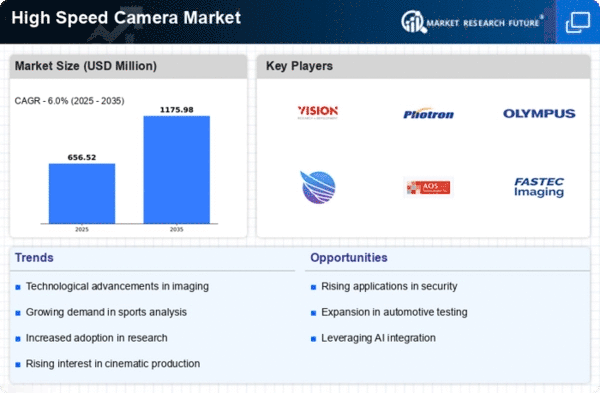
As per MRFR analysis, the High Speed Camera Market Size was estimated at 619.36 USD Million in 2024. The High Speed Camera industry is projected to grow from 656.54 in 2025 to 1175.98 by 2035, exhibiting a compound annual growth rate (CAGR) of 6.0 during the forecast period 2025 - 2035.

Key Market Trends & Highlights

The High Speed Camera Market is experiencing robust growth driven by technological advancements and increasing applications across various sectors.

  • Technological advancements are propelling the development of high-speed cameras, enhancing their capabilities and performance. North America remains the largest market, while Asia-Pacific is emerging as the fastest-growing region for high-speed camera adoption. The scientific research segment dominates the market, whereas the sports analysis segment is witnessing rapid growth due to increased investment in analytics. Rising demand in research and development, along with expansion in entertainment and media, are key drivers fueling market growth.

Market Size & Forecast

2024 Market Size 619.36 (USD Million)
2035 Market Size 1175.98 (USD Million)
CAGR (2025 - 2035) 6.0%
Largest Regional Market Share in 2024 North America

Major Players

Vision Research (US), Photron (JP), Olympus Corporation (JP), IDT (US), AOS Technologies AG (CH), Fastec Imaging (US), Nikon Corporation (JP), Sony Corporation (JP), Red.com (US)

Market Trends

The High Speed Camera Market is currently experiencing a notable evolution, driven by advancements in technology and increasing demand across various sectors. Industries such as entertainment, sports, and scientific research are increasingly adopting high-speed imaging solutions to capture fast-moving events with precision. This trend appears to be fueled by the need for detailed analysis and enhanced visual storytelling, which high-speed cameras facilitate effectively. Furthermore, the integration of artificial intelligence and machine learning into imaging systems is likely to enhance functionality, enabling users to extract valuable insights from captured footage. In addition, the High Speed Camera Market is witnessing a shift towards compact and portable designs, catering to the needs of professionals who require mobility without compromising on performance. This trend suggests a growing preference for versatile equipment that can be utilized in diverse environments, from film sets to field research. As the market continues to evolve, it seems poised for further growth, driven by innovation and the expanding applications of high-speed imaging technology across multiple industries.

Technological Advancements

The High Speed Camera Market is significantly influenced by rapid technological advancements. Innovations in sensor technology and image processing capabilities are enhancing the performance of high-speed cameras, allowing for improved resolution and frame rates. This evolution is likely to attract a broader range of users, from filmmakers to researchers, who seek high-quality imaging solutions.

Increased Adoption in Sports

There is a growing trend of high-speed cameras being adopted in the sports industry. These devices are utilized for performance analysis, coaching, and broadcasting, providing detailed insights into athletes' movements. This trend indicates a shift towards data-driven decision-making in sports, where visual analysis plays a crucial role in enhancing performance.

Focus on Portability

The demand for portable high-speed cameras is on the rise, as professionals seek equipment that is easy to transport and set up. This trend suggests a shift towards more compact designs without sacrificing functionality, enabling users to capture high-quality footage in various settings, from outdoor events to studio environments.

High Speed Camera Market Market Drivers

Market Growth Projections

The Global High-Speed Camera Market Industry is projected to experience substantial growth, with expectations of reaching 1.18 USD Billion by 2035. This growth trajectory indicates a compound annual growth rate of 6.0% from 2025 to 2035. The increasing applications across various sectors, including automotive, entertainment, and research, are likely to drive this expansion. The market's growth is supported by advancements in technology and rising demand for high-performance imaging solutions. As industries continue to recognize the value of high-speed cameras in enhancing productivity and quality, the market is poised for a promising future.

Technological Advancements

The Global High-Speed Camera Market Industry is experiencing rapid technological advancements, particularly in sensor technology and image processing capabilities. Innovations such as enhanced CMOS sensors and advanced algorithms allow for higher frame rates and better image quality. This evolution is crucial for industries like automotive and sports, where capturing high-speed events with precision is essential. For instance, the integration of these technologies has enabled cameras to achieve frame rates exceeding 1 million frames per second. As a result, the market is projected to grow from 0.62 USD Billion in 2024 to 1.18 USD Billion by 2035, reflecting a robust demand for high-performance imaging solutions.

Growth in Media and Entertainment

The Global High-Speed Camera Market Industry is experiencing notable growth in the media and entertainment sector. High-speed cameras are essential for capturing slow-motion footage, which has become a popular technique in filmmaking and sports broadcasting. The ability to record high-quality images at high frame rates allows filmmakers to create visually stunning scenes that engage audiences. For example, major film productions and sports events increasingly rely on high-speed cameras to enhance storytelling and viewer experience. This trend is expected to contribute to the overall market growth, aligning with the projected increase from 0.62 USD Billion in 2024 to 1.18 USD Billion by 2035.

Expansion in Industrial Applications

The Global High-Speed Camera Market Industry is witnessing expansion in industrial applications, particularly in quality control and manufacturing processes. Industries such as automotive and electronics utilize high-speed cameras to monitor production lines and detect defects in real-time. For instance, in automotive manufacturing, these cameras are employed to analyze the behavior of components during high-speed operations, ensuring safety and reliability. This trend is likely to drive market growth as companies increasingly adopt high-speed imaging technologies to enhance operational efficiency. The anticipated growth from 0.62 USD Billion in 2024 to 1.18 USD Billion by 2035 reflects the rising importance of high-speed cameras in industrial settings.

Rising Adoption in Security and Surveillance

The Global High-Speed Camera Market Industry is witnessing a rising adoption of high-speed cameras in security and surveillance applications. These cameras are instrumental in capturing fast-moving events, such as theft or vandalism, providing law enforcement with critical evidence. The ability to record high-resolution images at high frame rates enhances the effectiveness of surveillance systems. As security concerns continue to grow globally, the demand for advanced surveillance technologies, including high-speed cameras, is likely to increase. This trend may further propel the market, contributing to the anticipated growth trajectory from 0.62 USD Billion in 2024 to 1.18 USD Billion by 2035.

Increasing Demand in Research and Development

The Global High-Speed Camera Market Industry is significantly driven by the increasing demand for high-speed imaging in research and development sectors. Various scientific fields, including physics and biology, require precise motion analysis for experiments. High-speed cameras facilitate this by capturing rapid phenomena that are otherwise invisible to the naked eye. For example, in biomechanics, researchers utilize these cameras to study the motion of athletes, leading to improved performance and injury prevention. This growing reliance on high-speed imaging in R&D is expected to contribute to a compound annual growth rate of 6.0% from 2025 to 2035, underscoring the market's potential.

Market Segment Insights

By Application: Scientific Research (Largest) vs. Sports Analysis (Fastest-Growing)

The application segment of the High Speed Camera Market showcases a diverse landscape, where Scientific Research holds a significant market share, underscoring its essential role in advancing experimental methodologies across various scientific fields. Meanwhile, Sports Analysis is rapidly gaining traction, as teams and analysts leverage high-speed footage for performance evaluation, leading to a notable competitive edge. Other segments, such as Industrial Manufacturing, Entertainment, and Automotive Testing, also contribute substantially, yet Scientific Research and Sports Analysis are poised to dominate the narrative of this market. The growth trends within the High Speed Camera Market are driven primarily by innovation and technological advancements. Scientific Research benefits from continuous improvements in <a href="https://www.marketresearchfuture.com/reports/next-imaging-technology-market-1154">imaging technology</a>, enabling clearer and faster data capture, which is imperative for experiments. Conversely, the surge in popularity of sports analytics has made Sports Analysis one of the fastest-growing applications. Sports organizations are increasingly utilizing high-speed cameras to enhance training methodologies and improve player performance, indicating a promising future for this segment.

Scientific Research (Dominant) vs. Sports Analysis (Emerging)

Scientific Research stands out as the dominant application in the High Speed Camera Market, characterized by its extensive reliance on advanced imaging techniques for detailed analysis and experimentation. This segment includes various disciplines such as physics, biology, and engineering, where precision and clarity are paramount. The adoption of high-speed cameras facilitates groundbreaking studies and enhances data accuracy. On the other hand, Sports Analysis emerges as a quickly developing area, reflecting a shift in how sports are coached and analyzed. This segment focuses on performance enhancement through video analysis, offering insights that drive training regimens and gameplay strategies. As sporting organizations invest in technology to capture and analyze fast-moving actions, Sports Analysis is projected to see significant growth.

By End Use: Aerospace (Largest) vs. Media and Entertainment (Fastest-Growing)

The High Speed Camera Market is distinguished by diverse end-use applications, with aerospace taking the lead as the largest segment. This dominance is attributed to the aerospace industry's increasing adoption of high-speed cameras for testing, safety assessments, and enhanced imaging capabilities. Meanwhile, the media and entertainment sector is rapidly gaining traction, driven by technological advancements in filmmaking and broadcasting, requiring high-quality imaging solutions for slow-motion and high-resolution effects.

Aerospace (Dominant) vs. Media and Entertainment (Emerging)

Aerospace stands out as a dominant player within the High Speed Camera Market, leveraging high-speed imaging for critical applications in testing and inspections that improve safety and efficiency. Its rigorous standards and reliance on precision imaging make high speed cameras an essential tool. In contrast, the media and entertainment sector emerges as a vibrant segment, propelled by the demand for cinematic experiences offering sharp and slow-motion captures. The rapid growth in streaming services and content creation is driving innovation in high-speed imaging technologies, establishing media and entertainment as a dynamic and competitive area of growth within the market.

By Technology: CMOS Technology (Largest) vs. CCD Technology (Fastest-Growing)

In the High Speed Camera Market, the distribution of technology segments reveals that CMOS technology dominates with a significant share, driven by its cost-effectiveness and superior performance in low-light conditions. CCD technology, while historically strong, is now growing rapidly as it offers enhanced image quality, attracting professionals in film and scientific applications. Emerging technologies are also starting to carve out space, reflecting a shift in consumer preferences towards more advanced functionalities. The growth trends within this segment are primarily propelled by innovations in image sensor technology. CMOS technology continues to see improvements in frame rates and resolution, making it more appealing for a range of users from amateur filmmakers to industrial applications. CCD technology, on the other hand, is experiencing a resurgence due to advancements that enhance its capabilities, appealing to niche markets where high quality is paramount. This dynamic creates a competitive landscape that invites further technological advancements and collaborations.

Technology: CMOS (Dominant) vs. Hybrid (Emerging)

CMOS technology has established itself as the dominant force in the high-speed camera market, owing to its cost-effectiveness and efficiency in processing high-resolution images at fast frame rates. Its operational strengths make it a preferred choice for various applications, including sports, surveillance, and scientific research. In contrast, hybrid technology stands as an emerging trend that combines the advantages of both CMOS and CCD sensors, providing enhanced image quality and superior low-light performance. This positions hybrid technology as a promising alternative for specific market segments demanding high fidelity and dynamic range. As both technologies continue to evolve, the competition between them is likely to drive further innovation and development within the high speed camera market.

By Frame Rate: High Frame Rate (Largest) vs. Ultra High Frame Rate (Fastest-Growing)

In the High Speed Camera Market, segment values such as High Frame Rate, Ultra High Frame Rate, Standard Frame Rate, Variable Frame Rate, and Fixed Frame Rate play differing roles. High Frame Rate cameras command the largest market share, driven by extensive applications in industries such as sports, scientific research, and film production. Conversely, Ultra High Frame Rate cameras, while currently smaller in market share, are witnessing rapid growth due to advancements in technology and increasing demands for high-resolution slow-motion capabilities in various sectors.

High Frame Rate (Dominant) vs. Ultra High Frame Rate (Emerging)

High Frame Rate cameras are characterized by their ability to capture fast-moving objects with clarity, making them essential in fields like sports analytics, cinematography, and scientific research. Their dominance stems from established demand and proven reliability in performance. On the other hand, Ultra High Frame Rate cameras are emerging rapidly, driven by innovations that allow for higher resolutions and frame rates. These cameras cater to niche markets looking for extreme slow-motion capabilities, appealing to advanced research and high-end filmmaking. Their growth can be attributed to continued technological enhancements, which provide users with unprecedented detail and precision in motion capture.

By Resolution: Ultra High Resolution (Largest) vs. 8K Resolution (Fastest-Growing)

In the High Speed Camera Market, the resolution segment showcases a significant distribution of market share across various types. Ultra High Resolution cameras have emerged as the largest segment, catering to a wide range of applications including sports and entertainment, where clarity and detail are paramount. Standard and High Resolution cameras, while still relevant, have experienced slower growth rates, primarily serving niche markets for archival and educational uses. Conversely, 8K Resolution is witnessing rapid adoption, attracting attention for its ability to capture details with unparalleled sharpness, which positions it well for future growth opportunities. The growth trends within the Resolution segment are largely driven by technological advancements and increasing demand for high-definition content creation. As industries such as filmmaking, broadcasting, and live event production continue to evolve, the need for high-speed cameras with advanced resolution capabilities is becoming more pronounced. Furthermore, the proliferation of digital platforms and the rise of streaming services are propelling the need for content that meets the expectations of today's consumers, further bolstering the need for innovations within ultra-high resolutions and beyond.

Ultra High Resolution (Dominant) vs. 8K Resolution (Emerging)

Ultra High Resolution cameras represent the dominant force within the High Speed Camera Market. These cameras are primarily recognized for their capability to deliver superior image quality, essential for professional applications in filmmaking, sports, and scientific research. Their ability to capture intricate details in high-speed scenarios has made them indispensable for various industries. In contrast, 8K Resolution cameras are considered emerging players in this market segment. While they are on the rise, targeting high-end consumers and professional video productions, their adoption is fueled by the growing demand for even sharper and more detailed visuals. This emerging segment is gaining traction due to the increasing capability of display technology and a demand for ultra-realistic content, positioning 8K cameras as an exciting frontier in high-speed imaging.

Get more detailed insights about High-Speed Camera Market Research Report - Forecast 2035

Regional Insights

North America : Market Leader in Innovation

North America continues to lead the high speed camera market, holding a significant share of 310.0 million in 2025. The region's growth is driven by advancements in technology, increasing demand from sectors like sports, entertainment, and scientific research. Regulatory support for innovation and research funding further catalyzes market expansion. The presence of major players and a robust infrastructure also contribute to the region's dominance. The competitive landscape in North America is characterized by key players such as Vision Research, IDT, and Fastec Imaging, which are at the forefront of technological advancements. The U.S. remains the largest market, driven by high investments in R&D and a strong consumer base. The region's focus on quality and performance ensures that it remains a hub for high speed camera innovation, catering to diverse applications across various industries.

Europe : Emerging Market with Growth Potential

Europe's high speed camera market is poised for growth, with a market size of 150.0 million in 2025. The region benefits from a strong emphasis on research and development, particularly in automotive and industrial applications. Regulatory frameworks promoting technological advancements and sustainability are key drivers of market growth. The increasing adoption of high speed cameras in various sectors is expected to further boost demand in the coming years. Leading countries in Europe include Germany, the UK, and France, where significant investments in technology and innovation are evident. The competitive landscape features companies like Olympus and Photron, which are known for their cutting-edge products. The presence of these key players, along with a growing focus on high-quality imaging solutions, positions Europe as a significant player in The High Speed Camera.

Asia-Pacific : Rapid Growth in Emerging Markets

The Asia-Pacific region is experiencing rapid growth in the high speed camera market, with a projected size of 130.0 million in 2025. Factors such as increasing industrial automation, advancements in technology, and rising demand from the entertainment sector are driving this growth. Government initiatives aimed at enhancing technological capabilities and infrastructure are also contributing to the market's expansion. The region's diverse applications across various industries further fuel demand for high speed cameras. Key players in the Asia-Pacific market include Nikon and Sony, which are leveraging their technological expertise to capture market share. Countries like Japan and China are leading the charge, with significant investments in R&D and manufacturing capabilities. The competitive landscape is becoming increasingly dynamic, with new entrants emerging to challenge established players, thereby enhancing innovation and product offerings.

Middle East and Africa : Emerging Market with Unique Challenges

The Middle East and Africa region is gradually developing its high speed camera market, currently valued at 29.36 million in 2025. The growth is primarily driven by increasing investments in media and entertainment, as well as advancements in industrial applications. However, challenges such as limited infrastructure and varying regulatory environments can hinder market expansion. Despite these challenges, the region shows potential for growth as demand for high quality imaging solutions rises. Countries like South Africa and the UAE are leading the market, with a growing focus on technological advancements and innovation. The competitive landscape is characterized by a mix of local and international players, striving to meet the unique demands of the region. As the market matures, the presence of key players and increased investment in technology will likely enhance the region's position in The High Speed Camera.

Key Players and Competitive Insights

The High Speed Camera Market is currently characterized by a dynamic competitive landscape, driven by technological advancements and increasing demand across various sectors such as automotive, sports, and scientific research. Key players are actively pursuing strategies that emphasize innovation, regional expansion, and strategic partnerships to enhance their market positioning. For instance, Vision Research (US) has focused on developing cutting-edge imaging technologies, while Photron (JP) has been enhancing its product offerings through strategic collaborations with research institutions, thereby fostering a culture of innovation that shapes the competitive environment.
In terms of business tactics, companies are increasingly localizing manufacturing to reduce costs and optimize supply chains. The market appears moderately fragmented, with several key players exerting significant influence. This structure allows for a diverse range of products and services, catering to various customer needs while fostering healthy competition among established and emerging players.
In November 2025, Nikon Corporation (JP) announced the launch of its latest high-speed camera model, which features enhanced frame rates and improved image quality. This strategic move is likely to bolster Nikon's competitive edge, as it addresses the growing demand for high-resolution imaging in fast-paced environments, particularly in the sports and entertainment sectors. The introduction of this model may also signify Nikon's commitment to innovation and its intent to capture a larger market share.
In October 2025, Sony Corporation (JP) unveiled a new line of high-speed cameras designed specifically for industrial applications. This initiative reflects Sony's strategic focus on diversifying its product portfolio and tapping into the industrial sector, which has shown a rising demand for high-speed imaging solutions. By aligning its offerings with industry needs, Sony is positioning itself as a key player in the industrial high-speed camera segment, potentially enhancing its market presence.
In September 2025, AOS Technologies AG (CH) entered into a partnership with a leading automotive manufacturer to develop specialized high-speed imaging solutions for vehicle testing. This collaboration underscores AOS Technologies' strategy of leveraging partnerships to drive innovation and expand its reach within the automotive sector. Such alliances are indicative of a broader trend where companies are seeking synergies to enhance their technological capabilities and market offerings.
As of December 2025, the competitive trends in the High Speed Camera Market are increasingly defined by digitalization, sustainability, and the integration of artificial intelligence (AI). Strategic alliances are playing a crucial role in shaping the current landscape, enabling companies to pool resources and expertise. Looking ahead, it appears that competitive differentiation will evolve from traditional price-based competition to a focus on innovation, advanced technology, and supply chain reliability. This shift may ultimately redefine how companies position themselves in the market, emphasizing the importance of adaptability and forward-thinking strategies.

Key Companies in the High Speed Camera Market include

Industry Developments

  • Q2 2024: Vision Research Launches Phantom T4040 High-Speed Camera for Scientific and Industrial Applications Vision Research announced the release of its new Phantom T4040 high-speed camera, designed for demanding scientific and industrial imaging applications, featuring a 4-megapixel sensor and frame rates up to 4,000 fps at full resolution.
  • Q1 2024: Photron Introduces FASTCAM Nova R5-4K High-Speed Camera Photron launched the FASTCAM Nova R5-4K, a high-speed camera capable of capturing 4K resolution video at up to 1,250 frames per second, targeting automotive crash testing and advanced research markets.
  • Q2 2024: IDT Announces Partnership with NVIDIA to Integrate AI into High-Speed Camera Systems Integrated Design Tools (IDT) revealed a strategic partnership with NVIDIA to embed AI-powered analytics directly into its high-speed camera platforms, aiming to accelerate adoption in industrial automation and quality control.
  • Q1 2024: Optronis Opens New Manufacturing Facility in Germany to Expand High-Speed Camera Production Optronis inaugurated a new manufacturing facility in Kehl, Germany, to increase production capacity for its high-speed cameras, supporting growing demand from automotive and scientific research sectors.
  • Q3 2024: AOS Technologies Wins Major Contract to Supply High-Speed Cameras for Aerospace Testing AOS Technologies secured a multi-million dollar contract to provide high-speed imaging systems for a leading European aerospace manufacturer’s structural testing programs.
  • Q2 2024: Teledyne FLIR Launches X-Series High-Speed Cameras for Defense and Research Markets Teledyne FLIR introduced the X-Series, a new line of high-speed cameras designed for defense, aerospace, and scientific research, offering advanced thermal and visible imaging capabilities.
  • Q1 2025: DEL Imaging Systems Appoints New CEO to Drive Global Expansion DEL Imaging Systems announced the appointment of Dr. Lisa Chen as Chief Executive Officer, with a mandate to accelerate international growth and product innovation in the high-speed camera sector.
  • Q2 2025: NAC Image Technology Partners with Sony for Next-Generation High-Speed Sensor Development NAC Image Technology entered a partnership with Sony to co-develop advanced CMOS sensors for ultra-high-speed cameras, targeting applications in automotive safety and industrial inspection.
  • Q3 2024: Photron Secures $20 Million Contract for High-Speed Cameras in Sports Analytics Photron was awarded a $20 million contract to supply high-speed camera systems for a global sports analytics company, supporting enhanced motion analysis in professional sports leagues.
  • Q2 2024: Fastec Imaging Launches TS7-S High-Speed Camera for Biomechanics Research Fastec Imaging released the TS7-S, a portable high-speed camera optimized for biomechanics and motion analysis, featuring high frame rates and on-board data processing.
  • Q1 2025: Teledyne Technologies Acquires High-Speed Camera Specialist Mikrotron Teledyne Technologies completed the acquisition of Mikrotron, a German manufacturer of high-speed cameras, to strengthen its imaging solutions portfolio for industrial and scientific markets.
  • Q2 2025: IDT Raises $30 Million in Series C Funding to Expand High-Speed Camera R&D Integrated Design Tools (IDT) closed a $30 million Series C funding round led by a consortium of technology investors, aimed at accelerating research and development of next-generation high-speed imaging systems.

Future Outlook

High Speed Camera Market Future Outlook

The High Speed Camera Market is projected to grow at a 6.0% CAGR from 2024 to 2035, driven by advancements in technology, increasing demand in research, and expanding applications in various industries.

New opportunities lie in:

  • Development of specialized high-speed cameras for automotive crash testing.
  • Integration of AI for real-time data analysis in high-speed imaging.
  • Expansion into emerging markets with tailored product offerings.

By 2035, the High Speed Camera Market is expected to achieve robust growth and diversification.

Market Segmentation

High Speed Camera Market End Use Outlook

  • Aerospace
  • Automotive
  • Healthcare
  • Media and Entertainment
  • Research and Development

High Speed Camera Market Frame Rate Outlook

  • High Frame Rate
  • Ultra High Frame Rate
  • Standard Frame Rate
  • Variable Frame Rate
  • Fixed Frame Rate

High Speed Camera Market Resolution Outlook

  • Standard Resolution
  • High Resolution
  • Ultra High Resolution
  • 4K Resolution
  • 8K Resolution

High Speed Camera Market Technology Outlook

  • CMOS Technology
  • CCD Technology
  • Hybrid Technology
  • Digital Technology
  • Analog Technology

High Speed Camera Market Application Outlook

  • Scientific Research
  • Industrial Manufacturing
  • Sports Analysis
  • Entertainment
  • Automotive Testing

Report Scope

MARKET SIZE 2024 619.36(USD Million)
MARKET SIZE 2025 656.54(USD Million)
MARKET SIZE 2035 1175.98(USD Million)
COMPOUND ANNUAL GROWTH RATE (CAGR) 6.0% (2025 - 2035)
REPORT COVERAGE Revenue Forecast, Competitive Landscape, Growth Factors, and Trends
BASE YEAR 2024
Market Forecast Period 2025 - 2035
Historical Data 2019 - 2024
Market Forecast Units USD Million
Key Companies Profiled Vision Research (US), Photron (JP), Olympus Corporation (JP), IDT (US), AOS Technologies AG (CH), Fastec Imaging (US), Nikon Corporation (JP), Sony Corporation (JP), Red.com (US)
Segments Covered Application, End Use, Technology, Frame Rate, Resolution
Key Market Opportunities Advancements in imaging technology drive demand for High Speed Cameras in various industrial applications.
Key Market Dynamics Technological advancements drive demand for high-speed cameras across various industries, enhancing image capture capabilities and applications.
Countries Covered North America, Europe, APAC, South America, MEA

FAQs

How much is the High-Speed Camera market?

The High-Speed Camera market size was valued at USD 0.62 billion in 2024.

What is the growth rate of the High-Speed Camera market?

The market is projected to grow at a CAGR of 6.00% during the forecast period, 2025 to 2035.

Which region held the largest market share in the High-Speed Camera market?

North america had the largest share in the High-Speed Camera market.

Who are the key players in the High-Speed Camera market?

The key players in the market are Del Imaging Systems, Mikrotron GMBH, NAC Image Technology, Photron Limited, Vision Research, Inc, Mikrotron GmbH, Olympus Corporation, Del Imaging Systems LLC, NAC Imaging Technology, Inc, AOS Technologies AG.

Which resolution led the High-Speed Camera market?

The 0-2MP category dominated the market in 2021.

Which application had the largest market share in the market?

The media &amp; entertainment had the largest share in the market for High-Speed Camera.

  1. SECTION I: EXECUTIVE SUMMARY AND KEY HIGHLIGHTS
    1. | 1.1 EXECUTIVE SUMMARY
  2. SECTION II: SCOPING, METHODOLOGY AND MARKET STRUCTURE
    1. | 2.1 MARKET INTRODUCTION
    2. | 2.2 RESEARCH METHODOLOGY
  3. SECTION III: QUALITATIVE ANALYSIS
    1. | 3.1 MARKET DYNAMICS
    2. | 3.2 MARKET FACTOR ANALYSIS
  4. SECTION IV: QUANTITATIVE ANALYSIS
    1. | 4.1 Semiconductor & Electronics, BY Application (USD Million)
    2. | 4.2 Semiconductor & Electronics, BY End Use (USD Million)
    3. | 4.3 Semiconductor & Electronics, BY Technology (USD Million)
    4. | 4.4 Semiconductor & Electronics, BY Frame Rate (USD Million)
    5. | 4.5 Semiconductor & Electronics, BY Resolution (USD Million)
    6. | 4.6 Semiconductor & Electronics, BY Region (USD Million)
  5. SECTION V: COMPETITIVE ANALYSIS
    1. | 5.1 Competitive Landscape
    2. | 5.2 Company Profiles
    3. | 5.3 Appendix

High-Speed Camera Market Segmentation

Market Segmentation Overview

  • Detailed segmentation data will be available in the full report
  • Comprehensive analysis by multiple parameters
  • Regional and country-level breakdowns
  • Market size forecasts by segment
Infographic

Free Sample Request

Kindly complete the form below to receive a free sample of this Report

Get Free Sample

Customer Strories

Compare Licence

×
Features License Type
Single User Multiuser License Enterprise User
Price $4,950 $5,950 $7,250
Maximum User Access Limit 1 User Upto 10 Users Unrestricted Access Throughout the Organization
Free Customization
Direct Access to Analyst
Deliverable Format
Platform Access
Discount on Next Purchase 10% 15% 15%
Printable Versions