Herbal Supplements Market (2026 - 2035)

ID: MRFR/CG/2340-HCR
110 Pages
Pradeep Nandi
Last Updated: July 15, 2026
Herbal Supplements Market Size, Share, Industry Trend & Analysis Research Report Information By Type (Active, Passive, Special Purpose), By Size Class (Size A, Size B), By Deployment Method (Free-Fall, Cartridge/Pneumatic Launch, Spring Launch Systems), By Application (Commercial, Defense), By Geography (North America, Europe, Asia-Pacific, South America, Middle East & Africa) – Forecast Till 2035
Herbal Supplements Market
Market Size
Forecast Period2026-2035
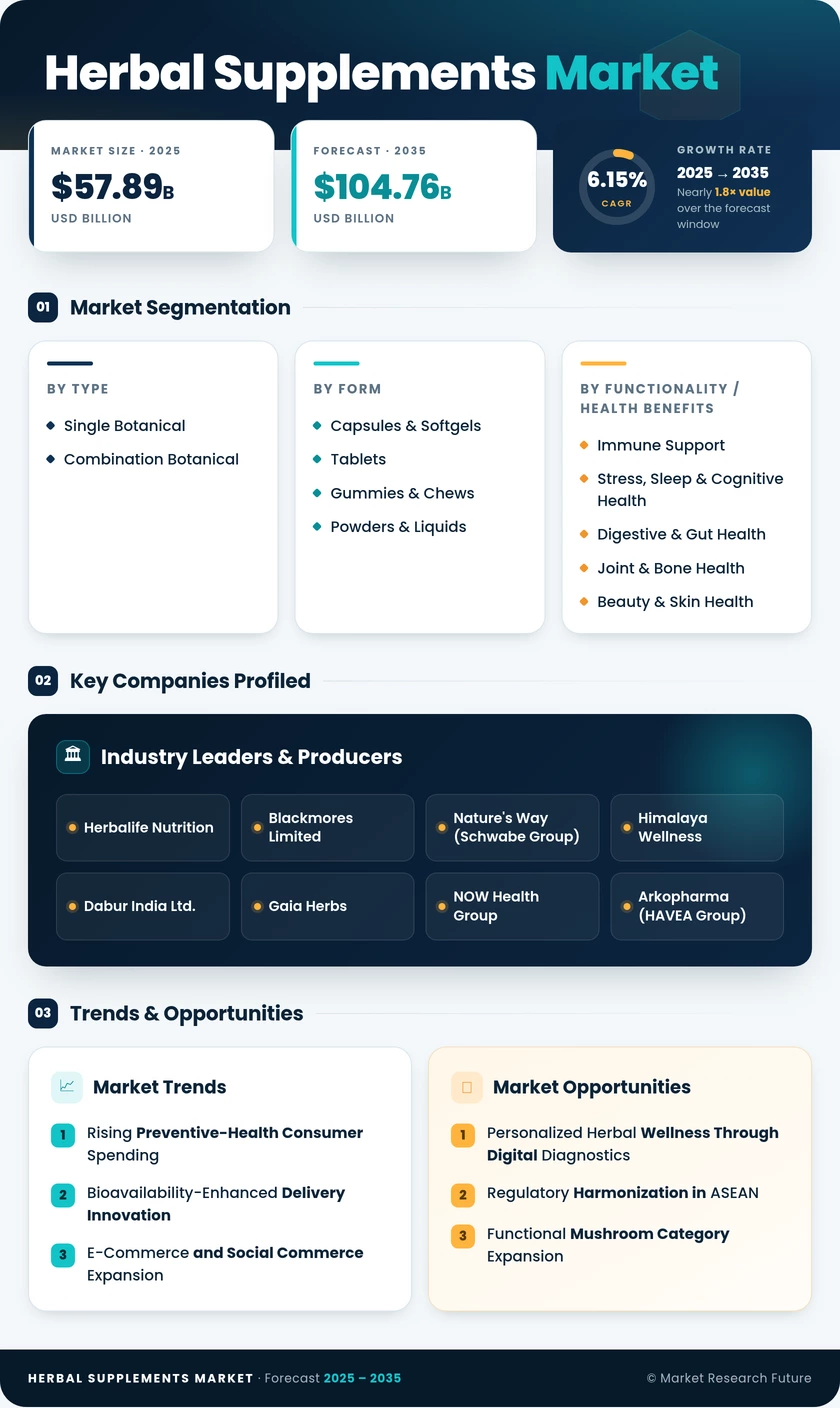
CAGR (2026-2035)6.15%
2025 Market SizeUSD 57.89 Billion
2035 Market SizeUSD 104.76 Billion
Key Players
Herbalife Nutrition
Blackmores Limited
Nature's Way
Himalaya Wellness
Dabur India Ltd.
Gaia Herbs
Opportunities
  • Personalized Herbal Wellness Through Digital Diagnostics
  • Regulatory Harmonization in ASEAN
  • Functional Mushroom Category Expansion
  1. 1 Market Overview |
    1. 1.1 Study Assumptions & Market Definition |
    2. 1.2 Scope of the Study |
    3. 1.3 Research Methodology
  2. 2 Market Summary & Key Takeaways
  3. 3 Market Dynamics |
    1. 3.1 Market Drivers Analysis | |
      1. 3.1.1 Rising Preventive-Health Consumer Spending | |
      2. 3.1.2 Bioavailability-Enhanced Delivery Innovation | |
      3. 3.1.3 E-Commerce and Social Commerce Expansion | |
      4. 3.1.4 Government Herbal Integration Programs | |
      5. 3.1.5 Gummy and Chew Format Adoption | |
      6. 3.1.6 Clinical Validation and Monograph Expansion | |
      7. 3.1.7 Subscription and DTC Model Scaling |
    2. 3.2 Market Restraints Analysis | |
      1. 3.2.1 Regulatory Fragmentation Across Jurisdictions | |
      2. 3.2.2 Raw-Material Price Volatility | |
      3. 3.2.3 Adulteration and Quality-Control Concerns | |
      4. 3.2.4 Limited Clinical Evidence for Many Botanicals | |
      5. 3.2.5 High Compliance Costs for Small Manufacturers |
    3. 3.3 Market Opportunity Analysis | |
      1. 3.3.1 Personalized Herbal Wellness Through Digital Diagnostics | |
      2. 3.3.2 Regulatory Harmonization in ASEAN | |
      3. 3.3.3 Functional Mushroom Category Expansion | |
      4. 3.3.4 Emerging-Market Contract Manufacturing | |
      5. 3.3.5 Subscription and Data-Monetization Models |
    4. 3.4 Industry Value Chain Analysis |
    5. 3.5 Porter's Five Forces Analysis
  4. 4 Global Herbal Supplements Market Size & Forecast (2021–2035) |
    1. 4.1 Historical Market Size (2021–2025) |
    2. 4.2 Current & Forecast Market Size (2026–2035) |
    3. 4.3 Market Size by Revenue (USD Billion) |
    4. 4.4 Year-over-Year Growth Analysis
  5. 5 Segmentation Analysis |
    1. 5.1 By Product Type | |
      1. 5.1.1 Single Botanical | |
      2. 5.1.2 Combination Botanical |
    2. 5.2 By Form | |
      1. 5.2.1 Capsules & Softgels | |
      2. 5.2.2 Tablets | |
      3. 5.2.3 Gummies & Chews | |
      4. 5.2.4 Powders & Liquids |
    3. 5.3 By Functionality / Health Benefits | |
      1. 5.3.1 Immune Support | |
      2. 5.3.2 Stress, Sleep & Cognitive Health | |
      3. 5.3.3 Digestive & Gut Health | |
      4. 5.3.4 Joint & Bone Health | |
      5. 5.3.5 Beauty & Skin Health |
    4. 5.4 By Distribution Channel | |
      1. 5.4.1 Pharmacies & Drug Stores | |
      2. 5.4.2 Supermarkets / Hypermarkets | |
      3. 5.4.3 Online Retail | |
      4. 5.4.4 Specialty & Health Stores
  6. 6 Regional Analysis |
    1. 6.1 North America | |
      1. 6.1.1 United States | |
      2. 6.1.2 Canada | |
      3. 6.1.3 Mexico |
    2. 6.2 Europe | |
      1. 6.2.1 Germany | |
      2. 6.2.2 United Kingdom | |
      3. 6.2.3 France | |
      4. 6.2.4 Italy | |
      5. 6.2.5 Spain | |
      6. 6.2.6 Nordic Countries | |
      7. 6.2.7 Russia | |
      8. 6.2.8 Rest of Europe |
    3. 6.3 Asia-Pacific | |
      1. 6.3.1 China | |
      2. 6.3.2 India | |
      3. 6.3.3 Japan | |
      4. 6.3.4 South Korea | |
      5. 6.3.5 ASEAN | |
      6. 6.3.6 Rest of Asia-Pacific |
    4. 6.4 South America | |
      1. 6.4.1 Brazil | |
      2. 6.4.2 Argentina | |
      3. 6.4.3 Rest of South America |
    5. 6.5 Middle East & Africa | |
      1. 6.5.1 Saudi Arabia | |
      2. 6.5.2 UAE | |
      3. 6.5.3 South Africa | |
      4. 6.5.4 Egypt | |
      5. 6.5.5 Rest of MEA
  7. 7 Competitive Landscape |
    1. 7.1 Market Share Analysis (2025) |
    2. 7.2 Competitive Benchmarking Matrix |
    3. 7.3 Company Profiles | |
      1. 7.3.1 Herbalife Nutrition | |
      2. 7.3.2 Blackmores Limited | |
      3. 7.3.3 Nature's Way (Schwabe Group) | |
      4. 7.3.4 Himalaya Wellness | |
      5. 7.3.5 Dabur India Ltd. | |
      6. 7.3.6 Gaia Herbs | |
      7. 7.3.7 NOW Health Group | |
      8. 7.3.8 Arkopharma (HAVEA Group) | |
      9. 7.3.9 Bionorica SE | |
      10. 7.3.10 GNC Holdings
  8. 8 Future Outlook & Strategic Recommendations (2026–2035) |
    1. 8.1 AI-Driven Formulation and Personalization |
    2. 8.2 Sustainability and Regenerative Sourcing |
    3. 8.3 Platform Economics and Marketplace Consolidation |
    4. 8.4 Precision Fermentation and Biotechnology Integration
  9. 9 Recent Developments & News
  10. 10 Frequently Asked Questions (FAQs)
  11. 11 Report Scope & Methodology |
    1. 11.1 Study Period & Base Year |
    2. 11.2 Data Sources & Citations |
    3. 11.3 Abbreviations
  12. 12 LIST OF TABLES |
  13. TABLE 1 Global Herbal Supplements Market Size & Forecast, by Revenue (USD Billion), 2021–2035 |
  14. TABLE 2 Global Herbal Supplements Market — Year-over-Year Growth Analysis, 2021–2035 |
  15. TABLE 3 Driver Impact Analysis — Herbal Supplements Market, 2026–2035 |
  16. TABLE 4 Restraint Impact Analysis — Herbal Supplements Market, 2026–2035 |
  17. TABLE 5 Global Herbal Supplements Market Size, by Product Type, 2021–2035 (USD Billion) |
  18. TABLE 6 Global Herbal Supplements Market Size, by Form, 2021–2035 (USD Billion) |
  19. TABLE 7 Global Herbal Supplements Market Size, by Functionality / Health Benefits, 2021–2035 (USD Billion) |
  20. TABLE 8 Global Herbal Supplements Market Size, by Distribution Channel, 2021–2035 (USD Billion) |
  21. TABLE 9 Global Herbal Supplements Market Size, by Region, 2021–2035 (USD Billion) |
  22. TABLE 10 North America Herbal Supplements Market Size, by Country, 2021–2035 (USD Billion) |
  23. TABLE 11 Europe Herbal Supplements Market Size, by Country, 2021–2035 (USD Billion) |
  24. TABLE 12 Asia-Pacific Herbal Supplements Market Size, by Country, 2021–2035 (USD Billion) |
  25. TABLE 13 South America Herbal Supplements Market Size, by Country, 2021–2035 (USD Billion) |
  26. TABLE 14 Middle East & Africa Herbal Supplements Market Size, by Country, 2021–2035 (USD Billion) |
  27. TABLE 15 Competitive Benchmarking Matrix — Global Herbal Supplements Market, 2025 |
  28. TABLE 16 Company Profiles — Key Players, Global Herbal Supplements Market |
  29. TABLE 17 Recent Developments & Strategic Announcements, 2023–2025 |
  30. TABLE 18 North America Herbal Supplements Market Size, by Product Type, 2021–2035 (USD Billion) |
  31. TABLE 19 North America Herbal Supplements Market Size, by Form, 2021–2035 (USD Billion) |
  32. TABLE 20 North America Herbal Supplements Market Size, by Functionality, 2021–2035 (USD Billion) |
  33. TABLE 21 North America Herbal Supplements Market Size, by Distribution Channel, 2021–2035 (USD Billion) |
  34. TABLE 22 Europe Herbal Supplements Market Size, by Product Type, 2021–2035 (USD Billion) |
  35. TABLE 23 Europe Herbal Supplements Market Size, by Form, 2021–2035 (USD Billion) |
  36. TABLE 24 Europe Herbal Supplements Market Size, by Functionality, 2021–2035 (USD Billion) |
  37. TABLE 25 Europe Herbal Supplements Market Size, by Distribution Channel, 2021–2035 (USD Billion) |
  38. TABLE 26 Asia-Pacific Herbal Supplements Market Size, by Product Type, 2021–2035 (USD Billion) |
  39. TABLE 27 Asia-Pacific Herbal Supplements Market Size, by Form, 2021–2035 (USD Billion) |
  40. TABLE 28 Asia-Pacific Herbal Supplements Market Size, by Functionality, 2021–2035 (USD Billion) |
  41. TABLE 29 Asia-Pacific Herbal Supplements Market Size, by Distribution Channel, 2021–2035 (USD Billion) |
  42. TABLE 30 South America Herbal Supplements Market Size, by Product Type, 2021–2035 (USD Billion) |
  43. TABLE 31 South America Herbal Supplements Market Size, by Form, 2021–2035 (USD Billion) |
  44. TABLE 32 South America Herbal Supplements Market Size, by Functionality, 2021–2035 (USD Billion) |
  45. TABLE 33 South America Herbal Supplements Market Size, by Distribution Channel, 2021–2035 (USD Billion) |
  46. TABLE 34 Middle East & Africa Herbal Supplements Market Size, by Product Type, 2021–2035 (USD Billion) |
  47. TABLE 35 Middle East & Africa Herbal Supplements Market Size, by Form, 2021–2035 (USD Billion) |
  48. TABLE 36 Middle East & Africa Herbal Supplements Market Size, by Functionality, 2021–2035 (USD Billion) |
  49. TABLE 37 Middle East & Africa Herbal Supplements Market Size, by Distribution Channel, 2021–2035 (USD Billion) |
  50. TABLE 38 Report Scope & Methodology Summary |
  51. TABLE 39 Detailed Sources and Citations
  52. 13 LIST OF FIGURES |
  53. FIGURE 1 Herbal Supplements Market Dynamics — Drivers, Restraints, and Opportunities |
  54. FIGURE 2 Industry Value Chain Analysis — Herbal Supplements Market |
  55. FIGURE 3 Porter's Five Forces Analysis — Herbal Supplements Market |
  56. FIGURE 4 Global Herbal Supplements Market Size Trend (USD Billion), 2021–2035 |
  57. FIGURE 5 Herbal Supplements Market Share, by Product Type (%), 2025 |
  58. FIGURE 6 Herbal Supplements Market Share, by Form (%), 2025 |
  59. FIGURE 7 Herbal Supplements Market Share, by Functionality / Health Benefits (%), 2025 |
  60. FIGURE 8 Herbal Supplements Market Share, by Distribution Channel (%), 2025 |
  61. FIGURE 9 Herbal Supplements Market Share, by Region (%), 2025 |
  62. FIGURE 10 North America Herbal Supplements Market — Country Revenue Share (%), 2025 |
  63. FIGURE 11 Europe Herbal Supplements Market — Country Revenue Share (%), 2025 |
  64. FIGURE 12 Asia-Pacific Herbal Supplements Market — Country Revenue Share (%), 2025 |
  65. FIGURE 13 South America Herbal Supplements Market — Country Revenue Share (%), 2025 |
  66. FIGURE 14 Middle East & Africa Herbal Supplements Market — Country Revenue Share (%), 2025 |
  67. FIGURE 15 Competitive Landscape — Market Share Analysis, 2025 |
  68. FIGURE 16 Competitive Benchmarking Radar Chart — Top 10 Players

Segmentation Quick Reference

DimensionSub-SegmentsDominant SegmentFastest Growing Segment
Product TypeSingle Botanical, Combination BotanicalSingle BotanicalCombination Botanical
FormCapsules & Softgels, Tablets, Gummies & Chews, Powders & LiquidsCapsules & SoftgelsGummies & Chews
Functionality / Health BenefitsImmune Support, Stress / Sleep / Cognitive Health, Digestive & Gut Health, Joint & Bone Health, Beauty & Skin HealthImmune SupportStress, Sleep & Cognitive Health
Distribution ChannelPharmacies & Drug Stores, Supermarkets / Hypermarkets, Online Retail, Specialty & Health StoresPharmacies & Drug StoresOnline Retail
GeographyNorth America, Europe, Asia-Pacific, South America, Middle East & AfricaNorth AmericaAsia-Pacific


Market Segmentation Overview

By Product Type

Sub-SegmentKey Trend
Single BotanicalContinued consumer demand for transparency and single-ingredient clinical validation
Combination BotanicalRising interest in multi-target wellness formulas combining adaptogens with nootropics


Single botanical products remain the foundation of the global herbal supplements category, benefiting from straightforward labelling and regulatory simplicity. Combination formulas are gaining traction as brands develop proprietary stacks targeting stress-plus-immunity and cognitive-plus-energy consumer segments.

By Form

Sub-SegmentKey Trend
Capsules & SoftgelsDominant format driven by pharmacy distribution and dosage precision
TabletsCost-effective option for mass-market and price-sensitive consumers
Gummies & ChewsFastest-growing format, led by taste-driven millennial and Gen-Z adoption
Powders & LiquidsExpanding through smoothie culture and functional-beverage integration


Format innovation is one of the most consequential trends shaping category growth. Gummies and chews are transforming consumer expectations around supplement consumption, while powders are benefiting from the at-home blending trend and ready-to-drink herbal shot launches.

By Functionality / Health Benefits

Sub-SegmentKey Trend
Immune SupportLargest segment, sustained by post-pandemic purchasing habits
Stress, Sleep & Cognitive HealthFastest-growing, driven by workplace wellness and clinical evidence for adaptogens
Digestive & Gut HealthExpanding alongside microbiome science awareness and probiotic-herbal combinations
Joint & Bone HealthSteady demand from aging populations in developed markets
Beauty & Skin HealthNutricosmetics positioning pulls herbal supplements into beauty aisles


Immune support continues to command the largest share of consumer spending, but stress and cognitive health formulas are capturing an increasing portion of new product development budgets. The beauty-from-within trend is also creating cross-category shelf presence for herbal ingredients.

By Distribution Channel

Sub-SegmentKey Trend
Pharmacies & Drug StoresTrust-driven channel with pharmacist recommendation advantage
Supermarkets / HypermarketsMass accessibility and impulse-purchase positioning
Online RetailFastest-growing channel, fuelled by subscriptions and social commerce
Specialty & Health StoresCurated assortment and premium positioning for informed consumers


Channel dynamics are shifting as digital-native brands capture an increasing share of first-time herbal buyers. Traditional pharmacy distribution retains its trust advantage, but omnichannel strategies that integrate online discovery with in-store fulfillment are becoming the competitive norm.


 

Download PDF ×

We do not share your information with anyone. However, we may send you emails based on your report interest from time to time. You may contact us at any time to opt-out.