Request Free Sample ×

Kindly complete the form below to receive a free sample of this Report

* Please use a valid business email

Leading companies partner with us for data-driven Insights

clients tt-cursor
Hero Background
English
Chinese
French
Japanese
Korean
German
Spanish

Hemorrhoids Treatment Market Share

ID: MRFR/Pharma/5534-HCR
90 Pages
Rahul Gotadki
April 2026

Hemorrhoids Treatment Market research report, by Treatment type (drugs, non-surgical procedures, surgical procedures), Route of administration (oral, topical agents) Distribution channel (retail pharmacies) &Forecast till 2035

Share:
Download PDF ×

We do not share your information with anyone. However, we may send you emails based on your report interest from time to time. You may contact us at any time to opt-out.

Hemorrhoids Treatment Market Infographic
Purchase Options

Market Share

Hemorrhoids Treatment Market Share Analysis

Product distinction via development is an essential process in the market for hemorrhoids treatment. Companies are investing in the development of novel treatment modalities, such as less intrusive techniques, innovative medication formulations, and OTC remedies. By providing creative solutions, businesses want to stand out in a crowded market and attract customers seeking cutting-edge and effective treatment options. Companies in the hemorrhoids treatment industry are focusing on non-invasive and minimally intrusive approaches in response to consumer demand for less intrusive treatments. This includes advancements in infrared coagulation, elastic band ligation, and office-based therapies. Presenting these technologies as beneficial and patient-friendly increases market share by providing alternatives to those who would otherwise require cautious mediations. Since hemorrhoids are a widespread medical condition around the world, companies are expanding their market penetration by concentrating on various topographical areas. One important advancement is modifying things to accommodate administrative requirements and local preferences. Through leveraging emerging markets and establishing a global footprint, companies may broaden their product offering and cater to a larger patient population. As the field of medicine becomes more digitally advanced, companies are modernizing their online presence and providing telehealth services for remote meetings. This approach creates a uniform experience for those seeking advice and treatment for hemorrhoids by fostering more openness to medical professionals and utilizing item recommendations. Generic products play a significant role in the hemorrhoids treatment industry by providing accessible solutions with little side effects. Companies are diversifying their over-the-counter product offerings by introducing salves, lotions, and suppositories that provide relief from common hemorrhoid side effects. This method caters to a wider range of customers who are searching for self-care options. In the field of hemorrhoids treatment, comprehensive clinical approval and forward-thinking logical analysis are essential components of market positioning strategies. Businesses who invest in evidence-based research and demonstrate the practicality and safety of their products have an advantage. Logic of approval increases consumer and medical professional trust and influences purchasing decisions. Considering the importance of cost-adequacy in healthcare, businesses are using estimation approaches that reduce the cost of hemorrhoid treatments. This includes looking at different payment options and providing a range of products at different pricing points. Reasonable agreements increase market share development and appeal to a wider spectrum of consumers.


Author
Author Profile
Rahul Gotadki
Research Manager

He holds an experience of about 9+ years in Market Research and Business Consulting, working under the spectrum of Life Sciences and Healthcare domains. Rahul conceptualizes and implements a scalable business strategy and provides strategic leadership to the clients. His expertise lies in market estimation, competitive intelligence, pipeline analysis, customer assessment, etc.

Leave a Comment

FAQs

What is the projected market valuation of the Hemorrhoids Treatment Market by 2035?

<p>The projected market valuation for the Hemorrhoids Treatment Market is 2994.6 USD Million by 2035.</p>

What was the market valuation of the market in 2024?

The overall market valuation of the market was 1441.59 USD Million in 2024.

What is the expected CAGR for the Hemorrhoids Treatment Market during the forecast period 2025 - 2035?

<p>The expected CAGR for the Hemorrhoids Treatment Market during the forecast period 2025 - 2035 is 6.83%.</p>

Which treatment type segment had the highest valuation in 2024?

<p>The Minimally Invasive Procedures segment had the highest valuation at 450.0 USD Million in 2024.</p>

How do the valuations of oral medications compare to topical treatments in 2024?

In 2024, oral medications were valued at 250.0 USD Million, whereas topical treatments were valued at 300.0 USD Million.

What demographic segment is expected to have the highest market valuation by 2035?

The Adults demographic segment is expected to have the highest market valuation, projected at 1200.0 USD Million by 2035.

Which distribution channel is anticipated to dominate the Hemorrhoids Treatment Market by 2035?

Pharmacies are anticipated to dominate the Hemorrhoids Treatment Market, with a projected valuation of 1200.0 USD Million by 2035.

What was the valuation of surgical procedures in 2024?

The valuation of surgical procedures in 2024 was 441.59 USD Million.

Which key players are leading the Hemorrhoids Treatment Market?

Key players in the Hemorrhoids Treatment Market include Johnson &amp; Johnson, Bayer AG, and Medtronic.

What is the projected valuation for the severe severity level segment by 2035?

The projected valuation for the severe severity level segment is 594.6 USD Million by 2035.

Market Summary

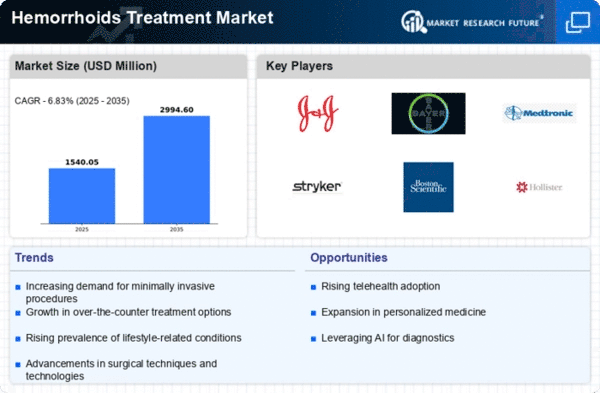
April 01, 2026- According to Market Research Future analysis, the Hemorrhoids Treatment Market Size was valued at USD 1441.59 Million in 2024 & the market is projected to grow from USD 1556.57 Million in 2025 to USD 2994.6 Million by 2035, registering a CAGR of 6.83% during the forecast period 2025–2035. North America led the market with over 50% share, generating around USD 720.8 million in revenue.
 
Hemorrhoids treatment market growth is driven by rising prevalence of gastrointestinal disorders, sedentary lifestyles, and increasing awareness of early diagnosis. Expanding access to over-the-counter medications and minimally invasive procedures is improving patient outcomes and boosting global demand for effective treatments. WHO highlights digestive diseases are a significant global health burden, while IHME estimates gastrointestinal conditions contribute notably to global morbidity, with lifestyle-related factors increasing incidence rates, thereby driving consistent demand for hemorrhoids treatments and preventive healthcare solutions worldwide.

Key Market Trends & Highlights

The Hemorrhoids Treatment Market is experiencing notable growth driven by increasing awareness and technological advancements.

  • North America dominates with over 50% share driven by advanced healthcare systems and strong adoption of innovative treatments. Europe holds 33.30% share with USD 480 million market size supported by healthcare investment and patient-centered treatment approaches. Aging population expected to exceed 1.6 billion by 2050 (UNFPA), significantly increasing demand for gastrointestinal and hemorrhoid treatments. Technological advancements in minimally invasive procedures are improving patient outcomes and accelerating adoption of advanced hemorrhoids treatment solutions globally.

Market Size & Forecast

2024 Market Size 1441.59 (USD Million)
2035 Market Size 2994.6 (USD Million)
CAGR (2025 - 2035) 6.83%
Largest Regional Market Share in 2024 North America

Major Players

Companies such as Johnson &amp; Johnson (US), Bayer AG (DE), <a title="Medtronic" href="https://www.medtronic.com/content/dam/medtronic-wide/public/united-states/products/surgical-energy/het-bipolar-system-kothari-white-paper.pdf" target="_blank" rel="noopener">Medtronic</a> (US), Stryker Corporation (US), <a title="Boston Scientific" href="https://www.bostonscientific.com/content/dam/bostonscientific/pi/portfolio-group/pelvic/patient_leaflet/FV_BVS172018_Patient_Leaflet_EMB_Hemorrhoid_DINONC3579EA_72dpi.pdf.coredownload.pdf" target="_blank" rel="noopener">Boston Scientific</a> (US), Hollister Incorporated (US), Coloplast A/S (DK), Smith &amp; Nephew (GB), 3M Company (US) are some of the major participants in the global market.

Market Trends

The Hemorrhoids Treatment Market is currently experiencing a notable evolution, driven by a combination of factors including increasing awareness of gastrointestinal health and the rising prevalence of conditions associated with hemorrhoids. This market encompasses a variety of treatment options, ranging from over-the-counter medications to surgical interventions. As individuals become more informed about their health, there is a growing demand for effective and accessible treatment solutions.

Furthermore, advancements in medical technology are likely to enhance the efficacy of treatments, potentially leading to improved patient outcomes. In addition to technological advancements, the market is influenced by demographic shifts, particularly the aging population, which tends to experience higher incidences of hemorrhoidal conditions. This demographic trend suggests a sustained demand for treatment options tailored to older adults.

Moreover, the increasing focus on preventive healthcare may lead to a rise in the adoption of lifestyle modifications and non-invasive treatments. Overall, the Hemorrhoids Treatment Market appears poised for growth, with a diverse array of treatment modalities catering to the evolving needs of patients.

Rising Awareness of Gastrointestinal Health

There is a growing recognition among the public regarding the importance of gastrointestinal health, which is likely to drive demand for hemorrhoids treatments. Educational campaigns and health initiatives are contributing to this awareness, encouraging individuals to seek timely interventions.

WHO emphasizes that digestive health awareness initiatives are improving early diagnosis rates, while PAHO reports increasing public health campaigns across regions are encouraging timely medical consultations, leading to better disease management and growing demand for gastrointestinal and hemorrhoids-related treatments globally.

Technological Advancements in Treatment Options

Innovations in medical technology are enhancing the effectiveness of hemorrhoids treatments. New minimally invasive procedures and improved drug formulations are emerging, potentially leading to better patient experiences and outcomes.

ECDC highlights that minimally invasive medical technologies significantly reduce recovery time and complications, while WHO notes advanced treatment methods improve patient outcomes, supporting increased adoption of innovative hemorrhoid treatment procedures including laser therapy and non-surgical interventions worldwide.

Demographic Shifts and Aging Population

The aging population is expected to significantly impact the Hemorrhoids Treatment Market. As older adults are more prone to developing hemorrhoidal conditions, there is likely to be an increased demand for tailored treatment solutions that address their specific needs.

UNFPA projects that the global population aged 65+ will reach over 1.6 billion by 2050, while WHO indicates aging populations are more prone to chronic gastrointestinal conditions, significantly increasing demand for specialized hemorrhoids treatments and long-term care solutions globally.

Hemorrhoids Treatment Market Market Drivers

Market Growth Projections

The Global Hemorrhoids Treatment Market is poised for substantial growth, with projections indicating a market value of 8.9 USD Billion in 2024 and an anticipated increase to 11.6 USD Billion by 2035. 
 
This growth trajectory reflects a compound annual growth rate of 2.41% from 2025 to 2035, driven by various factors including rising prevalence, advancements in treatment options, and increased awareness. The market's expansion is indicative of a broader recognition of the importance of effective hemorrhoid management, which is likely to lead to further innovations and improvements in patient care.

Growing Geriatric Population

The aging population worldwide is a critical factor influencing the Global Hemorrhoids Treatment Market. Older adults are more susceptible to developing hemorrhoids due to factors such as decreased mobility and changes in dietary habits. 
 
As the global demographic shifts towards an older population, the demand for effective treatment options is expected to rise. This demographic trend is particularly pronounced in developed countries, where healthcare systems are adapting to meet the needs of older patients. Consequently, the market is projected to grow significantly, with a valuation of 11.6 USD Billion anticipated by 2035.

Rising Prevalence of Hemorrhoids

The Global Hemorrhoids Treatment Market experiences growth driven by the increasing prevalence of hemorrhoids among the population. Factors such as sedentary lifestyles, poor dietary habits, and an aging population contribute to this rise. It is estimated that approximately 50% of adults will experience hemorrhoids by the age of 50. 
 
This growing incidence necessitates effective treatment options, thereby expanding the market. In 2024, the market is valued at 8.9 USD Billion, indicating a robust demand for various treatment modalities, including over-the-counter medications, surgical interventions, and lifestyle modifications.

Advancements in Treatment Options

Innovations in medical technology and treatment methodologies are propelling the Global Hemorrhoids Treatment Market forward. New minimally invasive procedures, such as rubber band ligation and infrared coagulation, offer patients effective alternatives to traditional surgical methods. 
 
These advancements not only improve patient outcomes but also enhance recovery times, making treatments more appealing. As the market evolves, the introduction of novel pharmacological agents and combination therapies is likely to further enhance treatment efficacy. This trend is expected to sustain the market's growth trajectory, with projections indicating a rise to 11.6 USD Billion by 2035.

Increased Awareness and Education

Heightened awareness regarding hemorrhoids and their treatment options is a significant driver for the Global Hemorrhoids Treatment Market. Public health campaigns and educational initiatives aim to destigmatize the condition, encouraging individuals to seek medical advice. This shift in perception is crucial, as many patients delay treatment due to embarrassment. 
 
As awareness grows, more individuals are likely to pursue effective treatment, thereby expanding the market. The increasing availability of information through digital platforms further supports this trend, potentially leading to a compound annual growth rate of 2.41% from 2025 to 2035.

Regulatory Support and Reimbursement Policies

Supportive regulatory frameworks and favorable reimbursement policies are essential drivers for the Global Hemorrhoids Treatment Market. Governments and health organizations are increasingly recognizing the importance of treating hemorrhoids, leading to improved access to care. 
 
Reimbursement for various treatment modalities encourages healthcare providers to offer a wider range of options to patients. This support not only enhances patient access to necessary treatments but also fosters innovation within the industry. As a result, the market is likely to witness sustained growth, with a projected compound annual growth rate of 2.41% from 2025 to 2035.

Market Segment Insights

By Treatment Type: Topical Treatments (Largest) vs. Minimally Invasive Procedures (Fastest-Growing)

The market exhibits a diverse distribution of treatment types, with topical treatments holding the largest share in the Hemorrhoids Treatment Market at 44%. This segment remains a preferred choice among patients due to its ease of use and immediate effects. Conversely, minimally invasive procedures are capturing attention as the fastest-growing segment, driven by advancements in technology and patient preferences for less invasive options. Oral medications and surgical procedures also contribute to the market, yet their share is overshadowed by the prominence of topical solutions and the emerging trend of minimally invasive techniques.

Topical Treatments (Dominant) vs. Minimally Invasive Procedures (Emerging)

Topical treatments dominate the market, characterized by a variety of creams, ointments, and suppositories designed to relieve symptoms effectively. Their accessibility and non-invasive nature appeal to a broad patient demographic, making them the first choice for many. Conversely, minimally invasive procedures are emerging as a favored option due to their quicker recovery times and reduced discomfort. These include rubber band ligation and laser treatments, which have gained traction among patients seeking effective solutions without the rigors of surgery. As both segments evolve, they cater to varying patient needs, reinforcing their respective positions in the market.

By Severity Level: Moderate (Largest) vs. Severe (Fastest-Growing)

The distribution of market share among severity levels reveals that moderate hemorrhoids treatment is the largest segment in the Hemorrhoids Treatment Market, with a 48% share. This is primarily due to the high prevalence of mild to moderate cases among the population, prompting a steady demand for effective treatment options. Conversely, the severe segment, although currently smaller, is gaining traction as awareness about effective treatments increases, particularly through minimally invasive procedures and advanced pharmacological solutions. Growth trends indicate that the mild and moderate segments are driven by a general rise in awareness and proactive health measures among patients, as well as the growing availability of over-the-counter remedies. The severe segment, recognized as the fastest-growing, is seeing an uptick due to a combination of factors including an aging population, the prevalent shift towards surgical interventions, and improvements in treatment options that make managing severe cases more feasible.

Moderate (Dominant) vs. Severe (Emerging)

The moderate severity segment in the market is characterized by a significant number of patients opting for lifestyle modifications and non-invasive treatment options, leading to a dominant market presence. Patients with moderate conditions typically experience symptoms that necessitate medical intervention but do not require immediate surgical remedies. In contrast, the severe segment, classified as emerging, encompasses patients who often require surgical intervention due to the complexity and severity of their symptoms. This segment is expanding rapidly, driven by advancements in surgical techniques and a growing preference for efficacious treatment options, as patients become increasingly informed of available therapies. The emergence of targeted therapies specifically designed for severe cases further galvanizes growth, setting the stage for a dynamic future in hemorrhoid treatment.

By Patient Demographics: Adults (Largest) vs. Elderly (Fastest-Growing)

In the Hemorrhoids Treatment Market, adults represent the largest demographic segment, with a 58% share, accounting for the majority of diagnoses and treatment requirements.This population faces various lifestyle-induced conditions leading to hemorrhoids, with many seeking effective relief methods. On the other hand, the elderly demographic is emerging rapidly due to age-related health issues that increase susceptibility to hemorrhoids, thus driving their market share up significantly. The growth trends within these demographics show a robust increase in product innovations targeted at the elderly, as healthcare providers emphasize tailored treatment options. Additionally, rising awareness about gastrointestinal health and preventive care among older adults is contributing to this segment's burgeoning prominence. Meanwhile, the adult segment continues to be influenced by lifestyle changes, ensuring consistent demand for hemorrhoid treatments throughout this segment.

Adults (Dominant) vs. Elderly (Emerging)

The adult segment is positioned as the dominant force within the market, primarily due to lifestyle factors such as diet, sedentary behavior, and stress that contribute to the prevalence of hemorrhoidal issues in this demographic. Adults often seek medical advice for treatment, creating a steady demand for solutions ranging from over-the-counter products to surgical interventions. Conversely, the elderly segment is emerging as a significant player, influenced by the aging population's increasing health challenges. The susceptibility of older individuals to hemorrhoids, coupled with their growing reliance on healthcare services, enhances their importance in the market. Both segments necessitate differentiated marketing strategies that cater to their unique needs, propelling innovation across treatment options.

By Distribution Channel: Pharmacies (Largest) vs. Online Retail (Fastest-Growing)

In the Hemorrhoids Treatment Market, the distribution of treatment options across various channels shows that pharmacies dominate the landscape, accounting for a significant share of consumer purchases. Pharmacies are preferred by many due to their accessibility and the assurance of pharmaceutical guidance from qualified staff, which fosters consumer trust compared to other channels. Online retail, while initially slower to gain traction, has rapidly become a competitive alternative, particularly appealing to younger demographic segments who favor the convenience and discretion of online purchasing. The growth trends observed in this segment are driven by increasing digital penetration, with more consumers turning to online platforms for their health and wellness needs. Furthermore, the evolving landscape of e-commerce and changes in consumer behavior have made online retail a key player in the market, expected to outpace traditional methods. Hospitals and clinics also contribute to the distribution, but their roles are more focused on extensive care rather than continuous treatment, making them less prominent in this segment overall.

Pharmacies (Dominant) vs. Online Retail (Emerging)

Pharmacies are the dominant distribution channel in the market, largely because they offer a reliable and familiar purchasing experience for consumers. Many patients prefer visiting a pharmacy for advice on treatments, as pharmacists can provide tailored recommendations based on individual needs. In contrast, online retail has emerged as a significant challenger, gaining traction among tech-savvy consumers looking for privacy and convenience. Online platforms often offer wider selections and competitive pricing, appealing to those who may feel uncomfortable discussing their condition in person. As both channels evolve, pharmacies may maintain their stronghold through personalized service, while online retail continues to innovate with user-friendly experiences that cater to the growing demand for accessible health solutions.

Get more detailed insights about Hemorrhoids Treatment Market Research Report-Forecast till 2035

Regional Insights

North America : Market Leader in Treatment

North America leads in the Hemorrhoids Treatment Market size, accounting for over 50% of the global revenue in 2024. The region's growth is driven by increasing awareness of treatment options, a rise in the aging population, and advancements in minimally invasive procedures. Regulatory support for innovative therapies further fuels market expansion, making it a hub for medical technology and healthcare innovation.

CDC reports that digestive diseases lead to millions of outpatient visits annually in the U.S., while high healthcare spending exceeding USD 4.5 trillion supports adoption of advanced treatment options, significantly boosting demand for hemorrhoids therapies across North America.

The competitive landscape in North America is robust, featuring key players such as Johnson & Johnson, Medtronic, and Boston Scientific. These companies are at the forefront of developing advanced treatment solutions, including surgical and non-surgical options. The U.S. remains the largest market, supported by a well-established healthcare infrastructure and a high prevalence of hemorrhoid cases, ensuring sustained demand for effective treatments.

Europe : Emerging Market Dynamics

Europe Hemorrhoids Treatment Market size was valued at USD 480 million in 2024, making it the second-largest regional market with a 33.30% share, driven by increasing healthcare expenditure and a growing focus on patient-centered care. The region benefits from stringent regulatory frameworks that promote the adoption of innovative treatment options. Additionally, rising awareness about hemorrhoid conditions and available treatments is expected to boost demand across various European countries. 

WHO Europe highlights rising burden of gastrointestinal disorders, while ECDC indicates increasing healthcare investments across EU nations, supporting adoption of advanced and minimally invasive treatments, thereby driving growth in hemorrhoids treatment demand across the region.

Leading countries in this market include Germany, France, and the UK, where healthcare systems are increasingly integrating advanced treatment modalities. Key players like Bayer AG and Coloplast A/S are actively involved in expanding their product portfolios to cater to the growing demand. The competitive landscape is characterized by collaborations and partnerships aimed at enhancing treatment efficacy and patient outcomes.

Asia-Pacific : Rapid Growth Potential

The Asia-Pacific region is experiencing significant growth in the hemorrhoids treatment market, projected to reach $200.0 million by 2025. Factors contributing to this growth include increasing urbanization, changing lifestyles, and a rising prevalence of hemorrhoid conditions. Additionally, government initiatives aimed at improving healthcare access and affordability are expected to drive demand for effective treatment options across the region.

Countries like China and India are leading the market, supported by a large population base and increasing healthcare investments. The competitive landscape features both local and international players, including Medtronic and Stryker Corporation, who are focusing on expanding their presence through innovative product offerings and strategic partnerships. This dynamic environment presents ample opportunities for growth and development in the region.

Middle East and Africa : Untapped Market Opportunities

The Middle East and Africa (MEA) region, with a market size of $40.79 million, is gradually emerging in the hemorrhoids treatment landscape. The growth is driven by increasing healthcare investments and a rising awareness of treatment options among the population. Additionally, government initiatives aimed at improving healthcare infrastructure are expected to enhance access to effective treatments, thereby boosting market growth.

Countries such as South Africa and the UAE are at the forefront of this emerging market, with a growing number of healthcare facilities offering specialized treatments. The competitive landscape is characterized by the presence of both local and international players, including Hollister Incorporated and Smith & Nephew, who are working to expand their market share through innovative solutions and strategic collaborations.

Key Players and Competitive Insights

The Hemorrhoids Treatment Market is characterized by a competitive landscape that is increasingly shaped by innovation, strategic partnerships, and a focus on patient-centric solutions. Key players such as Johnson & Johnson (US), Bayer AG (DE), and Medtronic (US) are actively pursuing strategies that enhance their market positioning. Johnson & Johnson (US) emphasizes innovation in minimally invasive surgical techniques, while Bayer AG (DE) focuses on expanding its product portfolio through strategic acquisitions. Medtronic (US) is leveraging its expertise in medical devices to develop advanced treatment options, thereby contributing to a dynamic competitive environment that prioritizes technological advancement and patient outcomes.
 
In terms of business tactics, companies are increasingly localizing manufacturing to reduce costs and enhance supply chain efficiency. The market structure appears moderately fragmented, with several players vying for market share. This fragmentation is influenced by the diverse range of treatment options available, from over-the-counter medications to surgical interventions. The collective influence of these key players fosters a competitive atmosphere where innovation and operational efficiency are paramount. 
 
In November 2025, Johnson & Johnson (US) announced the launch of a new line of minimally invasive hemorrhoid treatment devices, which is expected to significantly enhance patient recovery times and reduce hospital stays. This strategic move not only reinforces the company's commitment to innovation but also positions it favorably against competitors by addressing the growing demand for less invasive treatment options. The introduction of these devices could potentially reshape patient preferences and treatment protocols in the market. 
 
In October 2025, Bayer AG (DE) completed the acquisition of a leading digital health platform focused on gastrointestinal disorders, which includes hemorrhoid treatments. This acquisition is strategically important as it allows Bayer to integrate digital health solutions into its product offerings, thereby enhancing patient engagement and adherence to treatment regimens. The move signifies a broader trend towards digitalization in healthcare, which is likely to influence treatment outcomes and patient satisfaction. 
 
In September 2025, Medtronic (US) launched a new AI-driven analytics tool designed to optimize treatment plans for patients suffering from hemorrhoids. This tool utilizes machine learning algorithms to analyze patient data and recommend personalized treatment options. The introduction of AI in treatment planning reflects a significant shift towards data-driven healthcare solutions, which may improve clinical outcomes and operational efficiencies in the long run. 
 
As of December 2025, the competitive trends in the Hemorrhoids Treatment Market are increasingly defined by digitalization, sustainability, and the integration of advanced technologies such as AI. Strategic alliances among key players are shaping the landscape, fostering innovation and enhancing product offerings. The market appears to be transitioning from a focus on price-based competition to one that emphasizes technological advancement, supply chain reliability, and patient-centric solutions. This evolution suggests that companies that prioritize innovation and operational excellence are likely to gain a competitive edge in the future.

Key Companies in the Hemorrhoids Treatment Market include

Industry Developments

  • New OTC/Self-Care Products: The stigma-busting start-up Norms Hemorrhoid Relief debuted in September 2025 with a line of maximum-strength, FDA-compliant OTC products (creams, sprays, wipes) aimed at normalizing the conversation around hemorrhoids and encouraging early treatment
  • Haleon plc (June 2025) completed the acquisition of the remaining equity in its China-based OTC joint venture, Tianjin TSKF Pharmaceutical Co. Ltd (TSKF).
  • Karo Healthcare (March 2024) acquired the global rights to the OTC hemorrhoid brand Proctosedyl from Bayer in Italy, strengthening its digestive health portfolio
  • In June 2020, developeration AB, the Swedish medical company, developed an innovative solution to tackle hemorrhoids less painfully. PexyEazy enables surgical treatment without the need for anaesthesia and within 40 % less time.
  • In February 2022, the State Scientific Centre of Coloproctology, Russian Federation did a clinical experiment on the use of a 1940 nm laser method to treat hemorrhoids, which will lead the future product pipeline expansion.
  • In January 2022, Cook Medical launched a medical device manufacturing facility in Indianapolis, which will cater to the need for external hemorrhoids treatment and hemorrhoids self-care initiatives.


Future Outlook

Hemorrhoids Treatment Market Future Outlook

The Hemorrhoids Treatment Market size is projected to reach USD 2994.6 Million by 2035, growing at a CAGR of 6.83%, driven by increasing awareness, innovative treatments, and rising healthcare expenditures.

New opportunities lie in:

  • <p>Development of telehealth platforms for remote consultations and follow-ups. Investment in biodegradable hemorrhoid treatment products to meet eco-friendly demands. Expansion of over-the-counter product lines targeting specific demographics.</p>

By 2035, the Hemorrhoids Treatment Market is expected to achieve substantial growth and innovation.

Market Segmentation

Hemorrhoids Treatment Market Severity Level Outlook

  • Mild
  • Moderate
  • Severe

Hemorrhoids Treatment Market Treatment Type Outlook

  • Topical Treatments
  • Oral Medications
  • Minimally Invasive Procedures
  • Surgical Procedures

Hemorrhoids Treatment Market Distribution Channel Outlook

  • Pharmacies
  • Online Retail
  • Hospitals
  • Clinics

Hemorrhoids Treatment Market Patient Demographics Outlook

  • Adults
  • Elderly
  • Pregnant Women
  • Children

Report Scope

MARKET SIZE 2024 1441.59(USD Million)
MARKET SIZE 2025 1556.57(USD Million)
MARKET SIZE 2035 2994.6(USD Million)
COMPOUND ANNUAL GROWTH RATE (CAGR) 6.83% (2025 - 2035)
REPORT COVERAGE Revenue Forecast, Competitive Landscape, Growth Factors, and Trends
BASE YEAR 2024
Market Forecast Period 2025 - 2035
Historical Data 2019 - 2024
Market Forecast Units USD Million
Key Companies Profiled Johnson & Johnson (US), Bayer AG (DE), Medtronic (US), Stryker Corporation (US), Boston Scientific (US), Hollister Incorporated (US), Coloplast A/S (DK), Smith & Nephew (GB), 3M Company (US)
Segments Covered Treatment Type, Severity Level, Patient Demographics, Distribution Channel
Key Market Opportunities Integration of telehealth services enhances access to the market solutions.
Key Market Dynamics Rising demand for minimally invasive procedures drives innovation and competition in the market.
Countries Covered North America, Europe, APAC, South America, MEA

FAQs

What is the projected market valuation of the Hemorrhoids Treatment Market by 2035?

<p>The projected market valuation for the Hemorrhoids Treatment Market is 2994.6 USD Million by 2035.</p>

What was the market valuation of the market in 2024?

The overall market valuation of the market was 1441.59 USD Million in 2024.

What is the expected CAGR for the Hemorrhoids Treatment Market during the forecast period 2025 - 2035?

<p>The expected CAGR for the Hemorrhoids Treatment Market during the forecast period 2025 - 2035 is 6.83%.</p>

Which treatment type segment had the highest valuation in 2024?

<p>The Minimally Invasive Procedures segment had the highest valuation at 450.0 USD Million in 2024.</p>

How do the valuations of oral medications compare to topical treatments in 2024?

In 2024, oral medications were valued at 250.0 USD Million, whereas topical treatments were valued at 300.0 USD Million.

What demographic segment is expected to have the highest market valuation by 2035?

The Adults demographic segment is expected to have the highest market valuation, projected at 1200.0 USD Million by 2035.

Which distribution channel is anticipated to dominate the Hemorrhoids Treatment Market by 2035?

Pharmacies are anticipated to dominate the Hemorrhoids Treatment Market, with a projected valuation of 1200.0 USD Million by 2035.

What was the valuation of surgical procedures in 2024?

The valuation of surgical procedures in 2024 was 441.59 USD Million.

Which key players are leading the Hemorrhoids Treatment Market?

Key players in the Hemorrhoids Treatment Market include Johnson &amp; Johnson, Bayer AG, and Medtronic.

What is the projected valuation for the severe severity level segment by 2035?

The projected valuation for the severe severity level segment is 594.6 USD Million by 2035.

  1. SECTION I: EXECUTIVE SUMMARY AND KEY HIGHLIGHTS |
    1. EXECUTIVE SUMMARY | |
      1. Market Overview | |
      2. Key Findings | |
      3. Market Segmentation | |
      4. Competitive Landscape | |
      5. Challenges and Opportunities | |
      6. Future Outlook 2
  2. SECTION II: SCOPING, METHODOLOGY AND MARKET STRUCTURE |
    1. MARKET INTRODUCTION | |
      1. Definition | |
      2. Scope of the study | | |
    2. RESEARCH METHODOLOGY | |
      1. Overview | |
      2. Data Mining | |
      3. Secondary Research | |
      4. Primary Research | | |
      5. Forecasting Model | |
      6. Market Size Estimation | | |
      7. Data Triangulation | |
      8. Validation 3
  3. SECTION III: QUALITATIVE ANALYSIS |
    1. MARKET DYNAMICS | |
      1. Overview | |
      2. Drivers | |
      3. Restraints | |
      4. Opportunities |
    2. MARKET FACTOR ANALYSIS | |
      1. Value chain Analysis | |
      2. Porter's Five Forces Analysis | | |
      3. COVID-19 Impact Analysis | | |
  4. SECTION IV: QUANTITATIVE ANALYSIS |
    1. Healthcare, BY Treatment Type (USD Million) | |
      1. Topical Treatments | |
      2. Oral Medications | |
      3. Minimally Invasive Procedures | |
      4. Surgical Procedures |
    2. Healthcare, BY Severity Level (USD Million) | |
      1. Mild | |
      2. Moderate | |
      3. Severe |
    3. Healthcare, BY Patient Demographics (USD Million) | |
      1. Adults | |
      2. Elderly | |
      3. Pregnant Women | |
      4. Children |
    4. Healthcare, BY Distribution Channel (USD Million) | |
      1. Pharmacies | |
      2. Online Retail | |
      3. Hospitals | |
      4. Clinics |
    5. Healthcare, BY Region (USD Million) | |
      1. North America | | |
      2. Europe | | |
      3. APAC | | |
      4. South America | | |
      5. MEA | | |
  5. SECTION V: COMPETITIVE ANALYSIS |
    1. Competitive Landscape | |
      1. Overview | |
      2. Competitive Analysis | |
      3. Market share Analysis | |
      4. Major Growth Strategy in the Healthcare | |
      5. Competitive Benchmarking | |
      6. Leading Players in Terms of Number of Developments in the Healthcare | |
      7. Key developments and growth strategies | | |
      8. Major Players Financial Matrix | | |
    2. Company Profiles | |
      1. Johnson & Johnson (US) | | |
      2. Bayer AG (DE) | | |
      3. Medtronic (US) | | |
      4. Stryker Corporation (US) | | |
      5. Boston Scientific (US) | | |
      6. Smith & Nephew (GB) | | |
      7. Hollister Incorporated (US) | | |
      8. Coloplast A/S (DK) | | |
      9. 3M Company (US) | | |
    3. Appendix | |
      1. References | |
      2. Related Reports 6 LIST OF FIGURES |
    4. MARKET SYNOPSIS |
    5. NORTH AMERICA MARKET ANALYSIS |
    6. US MARKET ANALYSIS BY TREATMENT TYPE |
    7. US MARKET ANALYSIS BY SEVERITY LEVEL |
    8. US MARKET ANALYSIS BY PATIENT DEMOGRAPHICS |
    9. US MARKET ANALYSIS BY DISTRIBUTION CHANNEL |
    10. CANADA MARKET ANALYSIS BY TREATMENT TYPE |
    11. CANADA MARKET ANALYSIS BY SEVERITY LEVEL |
    12. CANADA MARKET ANALYSIS BY PATIENT DEMOGRAPHICS |
    13. CANADA MARKET ANALYSIS BY DISTRIBUTION CHANNEL |
    14. EUROPE MARKET ANALYSIS |
    15. GERMANY MARKET ANALYSIS BY TREATMENT TYPE |
    16. GERMANY MARKET ANALYSIS BY SEVERITY LEVEL |
    17. GERMANY MARKET ANALYSIS BY PATIENT DEMOGRAPHICS |
    18. GERMANY MARKET ANALYSIS BY DISTRIBUTION CHANNEL |
    19. UK MARKET ANALYSIS BY TREATMENT TYPE |
    20. UK MARKET ANALYSIS BY SEVERITY LEVEL |
    21. UK MARKET ANALYSIS BY PATIENT DEMOGRAPHICS |
    22. UK MARKET ANALYSIS BY DISTRIBUTION CHANNEL |
    23. FRANCE MARKET ANALYSIS BY TREATMENT TYPE |
    24. FRANCE MARKET ANALYSIS BY SEVERITY LEVEL |
    25. FRANCE MARKET ANALYSIS BY PATIENT DEMOGRAPHICS |
    26. FRANCE MARKET ANALYSIS BY DISTRIBUTION CHANNEL |
    27. RUSSIA MARKET ANALYSIS BY TREATMENT TYPE |
    28. RUSSIA MARKET ANALYSIS BY SEVERITY LEVEL |
    29. RUSSIA MARKET ANALYSIS BY PATIENT DEMOGRAPHICS |
    30. RUSSIA MARKET ANALYSIS BY DISTRIBUTION CHANNEL |
    31. ITALY MARKET ANALYSIS BY TREATMENT TYPE |
    32. ITALY MARKET ANALYSIS BY SEVERITY LEVEL |
    33. ITALY MARKET ANALYSIS BY PATIENT DEMOGRAPHICS |
    34. ITALY MARKET ANALYSIS BY DISTRIBUTION CHANNEL |
    35. SPAIN MARKET ANALYSIS BY TREATMENT TYPE |
    36. SPAIN MARKET ANALYSIS BY SEVERITY LEVEL |
    37. SPAIN MARKET ANALYSIS BY PATIENT DEMOGRAPHICS |
    38. SPAIN MARKET ANALYSIS BY DISTRIBUTION CHANNEL |
    39. REST OF EUROPE MARKET ANALYSIS BY TREATMENT TYPE |
    40. REST OF EUROPE MARKET ANALYSIS BY SEVERITY LEVEL |
    41. REST OF EUROPE MARKET ANALYSIS BY PATIENT DEMOGRAPHICS |
    42. REST OF EUROPE MARKET ANALYSIS BY DISTRIBUTION CHANNEL |
    43. APAC MARKET ANALYSIS |
    44. CHINA MARKET ANALYSIS BY TREATMENT TYPE |
    45. CHINA MARKET ANALYSIS BY SEVERITY LEVEL |
    46. CHINA MARKET ANALYSIS BY PATIENT DEMOGRAPHICS |
    47. CHINA MARKET ANALYSIS BY DISTRIBUTION CHANNEL |
    48. INDIA MARKET ANALYSIS BY TREATMENT TYPE |
    49. INDIA MARKET ANALYSIS BY SEVERITY LEVEL |
    50. INDIA MARKET ANALYSIS BY PATIENT DEMOGRAPHICS |
    51. INDIA MARKET ANALYSIS BY DISTRIBUTION CHANNEL |
    52. JAPAN MARKET ANALYSIS BY TREATMENT TYPE |
    53. JAPAN MARKET ANALYSIS BY SEVERITY LEVEL |
    54. JAPAN MARKET ANALYSIS BY PATIENT DEMOGRAPHICS |
    55. JAPAN MARKET ANALYSIS BY DISTRIBUTION CHANNEL |
    56. SOUTH KOREA MARKET ANALYSIS BY TREATMENT TYPE |
    57. SOUTH KOREA MARKET ANALYSIS BY SEVERITY LEVEL |
    58. SOUTH KOREA MARKET ANALYSIS BY PATIENT DEMOGRAPHICS |
    59. SOUTH KOREA MARKET ANALYSIS BY DISTRIBUTION CHANNEL |
    60. MALAYSIA MARKET ANALYSIS BY TREATMENT TYPE |
    61. MALAYSIA MARKET ANALYSIS BY SEVERITY LEVEL |
    62. MALAYSIA MARKET ANALYSIS BY PATIENT DEMOGRAPHICS |
    63. MALAYSIA MARKET ANALYSIS BY DISTRIBUTION CHANNEL |
    64. THAILAND MARKET ANALYSIS BY TREATMENT TYPE |
    65. THAILAND MARKET ANALYSIS BY SEVERITY LEVEL |
    66. THAILAND MARKET ANALYSIS BY PATIENT DEMOGRAPHICS |
    67. THAILAND MARKET ANALYSIS BY DISTRIBUTION CHANNEL |
    68. INDONESIA MARKET ANALYSIS BY TREATMENT TYPE |
    69. INDONESIA MARKET ANALYSIS BY SEVERITY LEVEL |
    70. INDONESIA MARKET ANALYSIS BY PATIENT DEMOGRAPHICS |
    71. INDONESIA MARKET ANALYSIS BY DISTRIBUTION CHANNEL |
    72. REST OF APAC MARKET ANALYSIS BY TREATMENT TYPE |
    73. REST OF APAC MARKET ANALYSIS BY SEVERITY LEVEL |
    74. REST OF APAC MARKET ANALYSIS BY PATIENT DEMOGRAPHICS |
    75. REST OF APAC MARKET ANALYSIS BY DISTRIBUTION CHANNEL |
    76. SOUTH AMERICA MARKET ANALYSIS |
    77. BRAZIL MARKET ANALYSIS BY TREATMENT TYPE |
    78. BRAZIL MARKET ANALYSIS BY SEVERITY LEVEL |
    79. BRAZIL MARKET ANALYSIS BY PATIENT DEMOGRAPHICS |
    80. BRAZIL MARKET ANALYSIS BY DISTRIBUTION CHANNEL |
    81. MEXICO MARKET ANALYSIS BY TREATMENT TYPE |
    82. MEXICO MARKET ANALYSIS BY SEVERITY LEVEL |
    83. MEXICO MARKET ANALYSIS BY PATIENT DEMOGRAPHICS |
    84. MEXICO MARKET ANALYSIS BY DISTRIBUTION CHANNEL |
    85. ARGENTINA MARKET ANALYSIS BY TREATMENT TYPE |
    86. ARGENTINA MARKET ANALYSIS BY SEVERITY LEVEL |
    87. ARGENTINA MARKET ANALYSIS BY PATIENT DEMOGRAPHICS |
    88. ARGENTINA MARKET ANALYSIS BY DISTRIBUTION CHANNEL |
    89. REST OF SOUTH AMERICA MARKET ANALYSIS BY TREATMENT TYPE |
    90. REST OF SOUTH AMERICA MARKET ANALYSIS BY SEVERITY LEVEL |
    91. REST OF SOUTH AMERICA MARKET ANALYSIS BY PATIENT DEMOGRAPHICS |
    92. REST OF SOUTH AMERICA MARKET ANALYSIS BY DISTRIBUTION CHANNEL |
    93. MEA MARKET ANALYSIS |
    94. GCC COUNTRIES MARKET ANALYSIS BY TREATMENT TYPE |
    95. GCC COUNTRIES MARKET ANALYSIS BY SEVERITY LEVEL |
    96. GCC COUNTRIES MARKET ANALYSIS BY PATIENT DEMOGRAPHICS |
    97. GCC COUNTRIES MARKET ANALYSIS BY DISTRIBUTION CHANNEL |
    98. SOUTH AFRICA MARKET ANALYSIS BY TREATMENT TYPE |
    99. SOUTH AFRICA MARKET ANALYSIS BY SEVERITY LEVEL |
    100. SOUTH AFRICA MARKET ANALYSIS BY PATIENT DEMOGRAPHICS |
    101. SOUTH AFRICA MARKET ANALYSIS BY DISTRIBUTION CHANNEL |
    102. REST OF MEA MARKET ANALYSIS BY TREATMENT TYPE |
    103. REST OF MEA MARKET ANALYSIS BY SEVERITY LEVEL |
    104. REST OF MEA MARKET ANALYSIS BY PATIENT DEMOGRAPHICS |
    105. REST OF MEA MARKET ANALYSIS BY DISTRIBUTION CHANNEL |
    106. KEY BUYING CRITERIA OF HEALTHCARE |
    107. RESEARCH PROCESS OF MRFR |
    108. DRO ANALYSIS OF HEALTHCARE |
    109. DRIVERS IMPACT ANALYSIS: HEALTHCARE |
    110. RESTRAINTS IMPACT ANALYSIS: HEALTHCARE |
    111. SUPPLY / VALUE CHAIN: HEALTHCARE |
    112. HEALTHCARE, BY TREATMENT TYPE, 2024 (% SHARE) |
    113. HEALTHCARE, BY TREATMENT TYPE, 2024 TO 2035 (USD Million) |
    114. HEALTHCARE, BY SEVERITY LEVEL, 2024 (% SHARE) |
    115. HEALTHCARE, BY SEVERITY LEVEL, 2024 TO 2035 (USD Million) |
    116. HEALTHCARE, BY PATIENT DEMOGRAPHICS, 2024 (% SHARE) |
    117. HEALTHCARE, BY PATIENT DEMOGRAPHICS, 2024 TO 2035 (USD Million) |
    118. HEALTHCARE, BY DISTRIBUTION CHANNEL, 2024 (% SHARE) |
    119. HEALTHCARE, BY DISTRIBUTION CHANNEL, 2024 TO 2035 (USD Million) |
    120. BENCHMARKING OF MAJOR COMPETITORS 7 LIST OF TABLES |
    121. LIST OF ASSUMPTIONS | |
      1. |
    122. North America MARKET SIZE ESTIMATES; FORECAST | |
      1. BY TREATMENT TYPE, 2025-2035 (USD Million) | |
      2. BY SEVERITY LEVEL, 2025-2035 (USD Million) | |
      3. BY PATIENT DEMOGRAPHICS, 2025-2035 (USD Million) | |
      4. BY DISTRIBUTION CHANNEL, 2025-2035 (USD Million) |
    123. US MARKET SIZE ESTIMATES; FORECAST | |
      1. BY TREATMENT TYPE, 2025-2035 (USD Million) | |
      2. BY SEVERITY LEVEL, 2025-2035 (USD Million) | |
      3. BY PATIENT DEMOGRAPHICS, 2025-2035 (USD Million) | |
      4. BY DISTRIBUTION CHANNEL, 2025-2035 (USD Million) |
    124. Canada MARKET SIZE ESTIMATES; FORECAST | |
      1. BY TREATMENT TYPE, 2025-2035 (USD Million) | |
      2. BY SEVERITY LEVEL, 2025-2035 (USD Million) | |
      3. BY PATIENT DEMOGRAPHICS, 2025-2035 (USD Million) | |
      4. BY DISTRIBUTION CHANNEL, 2025-2035 (USD Million) |
    125. Europe MARKET SIZE ESTIMATES; FORECAST | |
      1. BY TREATMENT TYPE, 2025-2035 (USD Million) | |
      2. BY SEVERITY LEVEL, 2025-2035 (USD Million) | |
      3. BY PATIENT DEMOGRAPHICS, 2025-2035 (USD Million) | |
      4. BY DISTRIBUTION CHANNEL, 2025-2035 (USD Million) |
    126. Germany MARKET SIZE ESTIMATES; FORECAST | |
      1. BY TREATMENT TYPE, 2025-2035 (USD Million) | |
      2. BY SEVERITY LEVEL, 2025-2035 (USD Million) | |
      3. BY PATIENT DEMOGRAPHICS, 2025-2035 (USD Million) | |
      4. BY DISTRIBUTION CHANNEL, 2025-2035 (USD Million) |
    127. UK MARKET SIZE ESTIMATES; FORECAST | |
      1. BY TREATMENT TYPE, 2025-2035 (USD Million) | |
      2. BY SEVERITY LEVEL, 2025-2035 (USD Million) | |
      3. BY PATIENT DEMOGRAPHICS, 2025-2035 (USD Million) | |
      4. BY DISTRIBUTION CHANNEL, 2025-2035 (USD Million) |
    128. France MARKET SIZE ESTIMATES; FORECAST | |
      1. BY TREATMENT TYPE, 2025-2035 (USD Million) | |
      2. BY SEVERITY LEVEL, 2025-2035 (USD Million) | |
      3. BY PATIENT DEMOGRAPHICS, 2025-2035 (USD Million) | |
      4. BY DISTRIBUTION CHANNEL, 2025-2035 (USD Million) |
    129. Russia MARKET SIZE ESTIMATES; FORECAST | |
      1. BY TREATMENT TYPE, 2025-2035 (USD Million) | |
      2. BY SEVERITY LEVEL, 2025-2035 (USD Million) | |
      3. BY PATIENT DEMOGRAPHICS, 2025-2035 (USD Million) | |
      4. BY DISTRIBUTION CHANNEL, 2025-2035 (USD Million) |
    130. Italy MARKET SIZE ESTIMATES; FORECAST | |
      1. BY TREATMENT TYPE, 2025-2035 (USD Million) | |
      2. BY SEVERITY LEVEL, 2025-2035 (USD Million) | |
      3. BY PATIENT DEMOGRAPHICS, 2025-2035 (USD Million) | |
      4. BY DISTRIBUTION CHANNEL, 2025-2035 (USD Million) |
    131. Spain MARKET SIZE ESTIMATES; FORECAST | |
      1. BY TREATMENT TYPE, 2025-2035 (USD Million) | |
      2. BY SEVERITY LEVEL, 2025-2035 (USD Million) | |
      3. BY PATIENT DEMOGRAPHICS, 2025-2035 (USD Million) | |
      4. BY DISTRIBUTION CHANNEL, 2025-2035 (USD Million) |
    132. Rest of Europe MARKET SIZE ESTIMATES; FORECAST | |
      1. BY TREATMENT TYPE, 2025-2035 (USD Million) | |
      2. BY SEVERITY LEVEL, 2025-2035 (USD Million) | |
      3. BY PATIENT DEMOGRAPHICS, 2025-2035 (USD Million) | |
      4. BY DISTRIBUTION CHANNEL, 2025-2035 (USD Million) |
    133. APAC MARKET SIZE ESTIMATES; FORECAST | |
      1. BY TREATMENT TYPE, 2025-2035 (USD Million) | |
      2. BY SEVERITY LEVEL, 2025-2035 (USD Million) | |
      3. BY PATIENT DEMOGRAPHICS, 2025-2035 (USD Million) | |
      4. BY DISTRIBUTION CHANNEL, 2025-2035 (USD Million) |
    134. China MARKET SIZE ESTIMATES; FORECAST | |
      1. BY TREATMENT TYPE, 2025-2035 (USD Million) | |
      2. BY SEVERITY LEVEL, 2025-2035 (USD Million) | |
      3. BY PATIENT DEMOGRAPHICS, 2025-2035 (USD Million) | |
      4. BY DISTRIBUTION CHANNEL, 2025-2035 (USD Million) |
    135. India MARKET SIZE ESTIMATES; FORECAST | |
      1. BY TREATMENT TYPE, 2025-2035 (USD Million) | |
      2. BY SEVERITY LEVEL, 2025-2035 (USD Million) | |
      3. BY PATIENT DEMOGRAPHICS, 2025-2035 (USD Million) | |
      4. BY DISTRIBUTION CHANNEL, 2025-2035 (USD Million) |
    136. Japan MARKET SIZE ESTIMATES; FORECAST | |
      1. BY TREATMENT TYPE, 2025-2035 (USD Million) | |
      2. BY SEVERITY LEVEL, 2025-2035 (USD Million) | |
      3. BY PATIENT DEMOGRAPHICS, 2025-2035 (USD Million) | |
      4. BY DISTRIBUTION CHANNEL, 2025-2035 (USD Million) |
    137. South Korea MARKET SIZE ESTIMATES; FORECAST | |
      1. BY TREATMENT TYPE, 2025-2035 (USD Million) | |
      2. BY SEVERITY LEVEL, 2025-2035 (USD Million) | |
      3. BY PATIENT DEMOGRAPHICS, 2025-2035 (USD Million) | |
      4. BY DISTRIBUTION CHANNEL, 2025-2035 (USD Million) |
    138. Malaysia MARKET SIZE ESTIMATES; FORECAST | |
      1. BY TREATMENT TYPE, 2025-2035 (USD Million) | |
      2. BY SEVERITY LEVEL, 2025-2035 (USD Million) | |
      3. BY PATIENT DEMOGRAPHICS, 2025-2035 (USD Million) | |
      4. BY DISTRIBUTION CHANNEL, 2025-2035 (USD Million) |
    139. Thailand MARKET SIZE ESTIMATES; FORECAST | |
      1. BY TREATMENT TYPE, 2025-2035 (USD Million) | |
      2. BY SEVERITY LEVEL, 2025-2035 (USD Million) | |
      3. BY PATIENT DEMOGRAPHICS, 2025-2035 (USD Million) | |
      4. BY DISTRIBUTION CHANNEL, 2025-2035 (USD Million) |
    140. Indonesia MARKET SIZE ESTIMATES; FORECAST | |
      1. BY TREATMENT TYPE, 2025-2035 (USD Million) | |
      2. BY SEVERITY LEVEL, 2025-2035 (USD Million) | |
      3. BY PATIENT DEMOGRAPHICS, 2025-2035 (USD Million) | |
      4. BY DISTRIBUTION CHANNEL, 2025-2035 (USD Million) |
    141. Rest of APAC MARKET SIZE ESTIMATES; FORECAST | |
      1. BY TREATMENT TYPE, 2025-2035 (USD Million) | |
      2. BY SEVERITY LEVEL, 2025-2035 (USD Million) | |
      3. BY PATIENT DEMOGRAPHICS, 2025-2035 (USD Million) | |
      4. BY DISTRIBUTION CHANNEL, 2025-2035 (USD Million) |
    142. South America MARKET SIZE ESTIMATES; FORECAST | |
      1. BY TREATMENT TYPE, 2025-2035 (USD Million) | |
      2. BY SEVERITY LEVEL, 2025-2035 (USD Million) | |
      3. BY PATIENT DEMOGRAPHICS, 2025-2035 (USD Million) | |
      4. BY DISTRIBUTION CHANNEL, 2025-2035 (USD Million) |
    143. Brazil MARKET SIZE ESTIMATES; FORECAST | |
      1. BY TREATMENT TYPE, 2025-2035 (USD Million) | |
      2. BY SEVERITY LEVEL, 2025-2035 (USD Million) | |
      3. BY PATIENT DEMOGRAPHICS, 2025-2035 (USD Million) | |
      4. BY DISTRIBUTION CHANNEL, 2025-2035 (USD Million) |
    144. Mexico MARKET SIZE ESTIMATES; FORECAST | |
      1. BY TREATMENT TYPE, 2025-2035 (USD Million) | |
      2. BY SEVERITY LEVEL, 2025-2035 (USD Million) | |
      3. BY PATIENT DEMOGRAPHICS, 2025-2035 (USD Million) | |
      4. BY DISTRIBUTION CHANNEL, 2025-2035 (USD Million) |
    145. Argentina MARKET SIZE ESTIMATES; FORECAST | |
      1. BY TREATMENT TYPE, 2025-2035 (USD Million) | |
      2. BY SEVERITY LEVEL, 2025-2035 (USD Million) | |
      3. BY PATIENT DEMOGRAPHICS, 2025-2035 (USD Million) | |
      4. BY DISTRIBUTION CHANNEL, 2025-2035 (USD Million) |
    146. Rest of South America MARKET SIZE ESTIMATES; FORECAST | |
      1. BY TREATMENT TYPE, 2025-2035 (USD Million) | |
      2. BY SEVERITY LEVEL, 2025-2035 (USD Million) | |
      3. BY PATIENT DEMOGRAPHICS, 2025-2035 (USD Million) | |
      4. BY DISTRIBUTION CHANNEL, 2025-2035 (USD Million) |
    147. MEA MARKET SIZE ESTIMATES; FORECAST | |
      1. BY TREATMENT TYPE, 2025-2035 (USD Million) | |
      2. BY SEVERITY LEVEL, 2025-2035 (USD Million) | |
      3. BY PATIENT DEMOGRAPHICS, 2025-2035 (USD Million) | |
      4. BY DISTRIBUTION CHANNEL, 2025-2035 (USD Million) |
    148. GCC Countries MARKET SIZE ESTIMATES; FORECAST | |
      1. BY TREATMENT TYPE, 2025-2035 (USD Million) | |
      2. BY SEVERITY LEVEL, 2025-2035 (USD Million) | |
      3. BY PATIENT DEMOGRAPHICS, 2025-2035 (USD Million) | |
      4. BY DISTRIBUTION CHANNEL, 2025-2035 (USD Million) |
    149. South Africa MARKET SIZE ESTIMATES; FORECAST | |
      1. BY TREATMENT TYPE, 2025-2035 (USD Million) | |
      2. BY SEVERITY LEVEL, 2025-2035 (USD Million) | |
      3. BY PATIENT DEMOGRAPHICS, 2025-2035 (USD Million) | |
      4. BY DISTRIBUTION CHANNEL, 2025-2035 (USD Million) |
    150. Rest of MEA MARKET SIZE ESTIMATES; FORECAST | |
      1. BY TREATMENT TYPE, 2025-2035 (USD Million) | |
      2. BY SEVERITY LEVEL, 2025-2035 (USD Million) | |
      3. BY PATIENT DEMOGRAPHICS, 2025-2035 (USD Million) | |
      4. BY DISTRIBUTION CHANNEL, 2025-2035 (USD Million) |
    151. PRODUCT LAUNCH/PRODUCT DEVELOPMENT/APPROVAL | |
      1. |
    152. ACQUISITION/PARTNERSHIP | |

Healthcare Market Segmentation

Healthcare By Treatment Type (USD Million, 2025-2035)

  • Topical Treatments
  • Oral Medications
  • Minimally Invasive Procedures
  • Surgical Procedures

Healthcare By Severity Level (USD Million, 2025-2035)

  • Mild
  • Moderate
  • Severe

Healthcare By Patient Demographics (USD Million, 2025-2035)

  • Adults
  • Elderly
  • Pregnant Women
  • Children

Healthcare By Distribution Channel (USD Million, 2025-2035)

  • Pharmacies
  • Online Retail
  • Hospitals
  • Clinics
Infographic

Free Sample Request

Kindly complete the form below to receive a free sample of this Report

Get Free Sample

Customer Strories

Compare Licence

×
Features License Type
Single User Multiuser License Enterprise User
Price $4,950 $5,950 $7,250
Maximum User Access Limit 1 User Upto 10 Users Unrestricted Access Throughout the Organization
Free Customization
Direct Access to Analyst
Deliverable Format
Platform Access
Discount on Next Purchase 10% 15% 15%
Printable Versions
%>