
Request Free Sample ×

Kindly complete the form below to receive a free sample of this Report

* Please use a valid business email

Leading companies partner with us for data-driven Insights

clients tt-cursor
Hero Background
English
Chinese
French
Japanese
Korean
German
Spanish

Helicopter MRO Market Analysis

ID: MRFR/AD/7051-CR
136 Pages
Abbas Raut
October 2019

Helicopter MRO Market Size, Share, Industry Trend & Analysis Research Report Information By Type (Airframe Heavy Maintenance, Engine Maintenance, Component Maintenance and Line Maintenance), Helicopter Type (Light Helicopter (3.1 Tons), Medium Helicopter (3.19.0 Tons) and Heavy Helicopter (9.0 Tons)), By Application (Civil and Military) - Forecast till 2035

Share:
Download PDF ×

We do not share your information with anyone. However, we may send you emails based on your report interest from time to time. You may contact us at any time to opt-out.

Helicopter MRO Market Infographic
Purchase Options

Market Analysis

In-depth Analysis of Helicopter MRO Market Industry Landscape

Technology is always getting better, and it helps make services smoother and more efficient, especially when it comes to helicopters. Now, there's a discussion about bringing in the Internet of Things (IoT) into helicopter services. Think of it like making helicopter services smarter and more effective by connecting them with advanced technology, similar to how your phone connects to the internet to provide you with smart and useful information.

Introducing IoT into helicopter Maintenance, Repair, and Overhaul (MRO) services can be a game-changer. It has the potential to improve the connection between the companies taking care of helicopters and their customers. Imagine using smart tools like business intelligence and data analytics to provide top-notch services. Big companies, such as Honeywell International Inc., are already exploring the idea of incorporating IoT into their helicopter services to enhance efficiency, convenience, and overall smartness.

The use of smart technologies in MRO services goes beyond just making the companies smarter; it also benefits the people who fix and maintain helicopters, such as technicians and engineers. It's like giving them smart tools that make their jobs easier and more effective. IoT can be applied in various aspects of helicopter care. For instance, in managing spare parts – those extra pieces that might be needed – IoT can ensure that there's always enough of what's required and prompt orders when supplies run low. In the warehouse, where all these spare parts are stored, IoT can assist in locating items and keeping a record of what has been dispatched. It's like introducing a smart approach to managing resources.

By incorporating IoT into helicopter MRO services, it's not just about making things smart; it's about opening up new opportunities for these services to grow and improve. It adds a touch of smartness to how helicopters are taken care of, making the entire process more effective and providing avenues for continual enhancement. It's like ushering in a new era of innovation in helicopter services that not only benefits the industry but also offers exciting possibilities for further advancements.


Author
Author Profile
Abbas Raut
Research Analyst

Abbas Raut is a Senior Research Analyst with 5+ years of experience delivering data-driven insights and strategic recommendations across the Automotive and Aerospace & Defense sectors. He specializes in emerging technologies, industry value chains, and global market dynamics shaping the future of mobility and defense. In automotive, Abbas has led studies on EVs, charging stations, BMS, superchargers, and more, guiding stakeholders through electrification and regulatory shifts. In Aerospace & Defense, he has analyzed markets for military electronics, drones, radars, and electronic warfare solutions, supporting procurement and investment strategies. With expertise in market sizing, forecasting, benchmarking, and technology adoption, Abbas is known for transforming complex datasets into actionable insights that drive strategy, innovation, and growth.

Leave a Comment

FAQs

What is the current valuation of the helicopter MRO market as of 2024?

<p>The helicopter MRO market was valued at 9.5 USD Billion in 2024.</p>

What is the projected market size for the helicopter MRO market by 2035?

<p>The market is projected to reach 15.2 USD Billion by 2035.</p>

What is the expected CAGR for the helicopter MRO market during the forecast period 2025 - 2035?

<p>The expected CAGR for the helicopter MRO market during 2025 - 2035 is 4.37%.</p>

Which companies are considered key players in the helicopter MRO market?

<p>Key players in the helicopter MRO market include Lockheed Martin, Northrop Grumman, Airbus, Boeing, Leonardo, Bell Helicopter, Sikorsky, Hélicoptères Guimbal, and MD Helicopters.</p>

How does the helicopter MRO market segment by application?

<p>The market segments by application include Commercial Aviation, Military Aviation, Emergency Medical Services, Law Enforcement, and Search and Rescue.</p>

What are the projected valuations for the helicopter MRO market by application in 2035?

<p>By 2035, the projected valuations for applications are 5.5 USD Billion for Commercial Aviation, 3.0 USD Billion for Military Aviation, 1.5 USD Billion for Emergency Medical Services, 2.0 USD Billion for Law Enforcement, and 3.2 USD Billion for Search and Rescue.</p>

What are the main service types in the helicopter MRO market?

<p>The main service types in the helicopter MRO market include Maintenance, Repair, Overhaul, Modification, and Inspection.</p>

What are the projected valuations for the helicopter MRO market by service type in 2035?

<p>In 2035, the projected valuations by service type are 4.55 USD Billion for Maintenance, 3.3 USD Billion for Repair, 2.9 USD Billion for Overhaul, 1.5 USD Billion for Modification, and 2.35 USD Billion for Inspection.</p>

How is the helicopter MRO market segmented by customer type?

<p>The market segments by customer type into Private Operators, Government Agencies, Commercial Operators, and Charter Services.</p>

What are the projected valuations for the helicopter MRO market by customer type in 2035?

<p>By 2035, the projected valuations by customer type are 4.5 USD Billion for Private Operators, 3.2 USD Billion for Government Agencies, 4.8 USD Billion for Commercial Operators, and 2.7 USD Billion for Charter Services.</p>

Market Summary

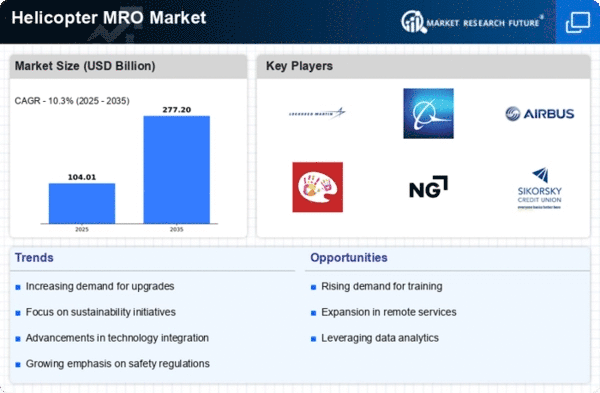
As per Market Research Future analysis, the Helicopter MRO Market Size was estimated at 94.3 USD Billion in 2024. The Helicopter MRO industry is projected to grow from 104.0 USD Billion in 2025 to 277.2 USD Billion by 2035, exhibiting a compound annual growth rate (CAGR) of 10% during the forecast period 2025 - 2035

Key Market Trends & Highlights

The Helicopter MRO Market is poised for growth driven by technological advancements and increasing demand for services.

  • Technological advancements in maintenance are reshaping operational efficiencies in the Helicopter MRO Market. Sustainability initiatives are becoming increasingly critical as the industry seeks to reduce its environmental footprint. The emergence of new aircraft types is driving innovation and competition within the market. The rising demand for helicopter services and regulatory compliance are key drivers propelling market expansion.

Market Size & Forecast

2024 Market Size 94.3 (USD Billion)
2035 Market Size 277.2 (USD Billion)
CAGR (2025 - 2035) 10.3%
Largest Regional Market Share in 2024 North America

Major Players

Lockheed Martin (US), Boeing (US), Airbus (FR), Leonardo (IT), <a href="https://www.northropgrumman.com/">Northrop Grumman</a> (US), Sikorsky (US), Bell Helicopter (US), Hélicoptères Guimbal (FR), MD Helicopters (US)

Market Trends

The Helicopter MRO Market is currently experiencing a dynamic evolution, driven by advancements in technology and increasing demand for efficient maintenance solutions. As operators seek to enhance operational readiness and reduce downtime, the focus on predictive maintenance and data analytics has intensified. This trend suggests that biggest helicopter companies are investing in sophisticated software and tools that facilitate real-time monitoring of helicopter performance, thereby enabling timely interventions and minimizing unexpected failures. Furthermore, the growing emphasis on safety regulations and compliance is prompting operators to prioritize regular maintenance checks, which could lead to a more structured approach to MRO activities. In addition, the Helicopter MRO Market is witnessing a shift towards sustainable practices, as environmental concerns gain prominence. Operators are increasingly exploring eco-friendly materials and processes in maintenance operations. This inclination towards sustainability may not only enhance the market's reputation but also align with global efforts to reduce carbon footprints. Moreover, the rise of unmanned aerial vehicles and electric helicopters could potentially reshape the landscape of helicopter maintenance, necessitating new skill sets and expertise within the MRO sector. Overall, the Helicopter MRO Market appears poised for growth, driven by technological innovations and a commitment to sustainability.

Technological Advancements in Maintenance

The Helicopter MRO Market is seeing a notable shift towards the integration of advanced technologies. Innovations such as predictive maintenance tools and data analytics are becoming increasingly prevalent. These technologies enable operators to monitor helicopter performance in real-time, allowing for proactive maintenance strategies that can significantly reduce downtime and enhance operational efficiency.

Sustainability Initiatives

There is a growing trend within the Helicopter MRO Market towards adopting sustainable practices. Operators are exploring eco-friendly materials and processes to minimize environmental impact. This shift not only addresses regulatory pressures but also aligns with broader global sustainability goals, potentially enhancing the market's appeal to environmentally conscious stakeholders.

Emergence of New Aircraft Types

The introduction of new aircraft types, including electric and unmanned aerial vehicles, is likely to influence the Helicopter MRO Market. These innovations may require specialized maintenance approaches and skill sets, prompting MRO providers to adapt their services. This evolution could lead to new opportunities and challenges within the sector, as traditional maintenance practices are reassessed.

Helicopter MRO Market Market Drivers

Market Growth Projections

The Global Helicopter MRO Industry is poised for substantial growth, with projections indicating a compound annual growth rate (CAGR) of 7.0% from 2025 to 2035. This growth trajectory is fueled by various factors, including increasing helicopter utilization across sectors, advancements in technology, and the need for compliance with safety regulations. As the market evolves, stakeholders can anticipate a market value of 3.09 USD Billion by 2035. This upward trend suggests a robust demand for MRO services, emphasizing the importance of strategic investments and innovations within the biggest helicopter companies.

Growing Military Helicopter Fleet

The military sector is a crucial driver of the Global Helicopter MRO Industry, as nations invest in expanding and modernizing their helicopter fleets. This growth is largely attributed to the increasing need for advanced aerial capabilities in defense operations. Military helicopters require specialized maintenance and support services to ensure operational readiness and effectiveness. As governments allocate budgets for biggest helicopter companies, the demand for MRO services is expected to rise correspondingly. This trend underscores the importance of maintaining a robust military helicopter fleet, which is projected to contribute significantly to the overall market growth in the coming years.

Emergence of Urban Air Mobility Solutions

The emergence of urban air mobility solutions is reshaping the landscape of the Global Helicopter MRO Industry. As cities explore innovative transportation alternatives, helicopters are increasingly viewed as viable options for urban commuting. This shift is driven by the need to alleviate traffic congestion and enhance connectivity. The development of electric vertical takeoff and landing eVTOL aircraft further exemplifies this trend, as these vehicles require specialized MRO services to ensure safety and efficiency. The potential for urban air mobility to revolutionize transportation is likely to stimulate demand for MRO services, creating new opportunities for industry players.

Increasing Demand for Helicopter Services

The Global Helicopter MRO Industry is witnessing a surge in demand for helicopter services across various sectors, including emergency medical services, law enforcement, and tourism. This heightened demand is driven by the need for rapid response capabilities and versatile transportation solutions. As of 2024, the market is valued at approximately 1.47 USD Billion, reflecting the growing reliance on helicopters for critical operations. The expansion of urban air mobility initiatives further contributes to this trend, as cities explore innovative transportation solutions. Consequently, the increasing demand for helicopter services is expected to propel the MRO sector, necessitating enhanced maintenance and support services.

Regulatory Compliance and Safety Standards

The Global Helicopter MRO Industry is significantly influenced by stringent regulatory compliance and safety standards imposed by aviation authorities worldwide. These regulations necessitate regular inspections, maintenance, and upgrades to ensure the airworthiness of helicopters. As safety remains a paramount concern, operators are compelled to invest in MRO services that meet or exceed regulatory requirements. This trend is expected to sustain the market's growth trajectory, as the industry anticipates a market value of 3.09 USD Billion by 2035. The emphasis on safety and compliance not only drives demand for MRO services but also fosters a culture of continuous improvement within the sector.

Technological Advancements in Helicopter Systems

Technological innovations in biggest helicopter companies play a pivotal role in shaping the Global Helicopter MRO Industry. The integration of advanced avionics, materials, and maintenance technologies enhances helicopter performance and safety. For instance, the adoption of predictive maintenance systems allows operators to identify potential issues before they escalate, thereby reducing downtime and maintenance costs. As helicopters become more sophisticated, the need for specialized MRO services increases. This trend is likely to drive market growth, as operators seek to maintain compliance with evolving safety regulations and operational standards. The continuous evolution of helicopter technology is expected to create opportunities for MRO providers to offer cutting-edge solutions.

Market Segment Insights

By Application: Commercial Aviation (Largest) vs. Emergency Medical Services (Fastest-Growing)

<p>In the helicopter MRO market, the application segment is primarily dominated by Commercial Aviation, which holds the largest share. This sector is characterized by a variety of operational helicopters used in passenger transport, tourism, and cargo activities. Following, Emergency Medical Services (EMS) represents a rapidly growing segment, attributed to increasing demand for rapid medical response and transport in urban settings. This trend highlights the importance of helicopters in critical life-saving scenarios and is further supported by advancements in helicopter technology enhancing operational efficiency. The growth trends in the helicopter MRO market show a significant uptick in both Commercial Aviation and EMS applications. Factors such as the increasing air traffic and the rising number of emergency medical flights contribute to this trajectory. Moreover, technological innovations in helicopters are driving operational excellence, with new maintenance protocols enhancing safety and reliability. Furthermore, regulatory factors and investments in fleet modernization are also pivotal in shaping the trajectory of these segments, underscoring their importance in the overall MRO landscape.</p>

<p>Commercial Aviation (Dominant) vs. Law Enforcement (Emerging)</p>

<p>Commercial Aviation significantly dominates the helicopter MRO market, owing to its extensive applications ranging from passenger transport to freight services. The vast utilization of helicopters in commercial operations ensures a steady demand for maintenance, repair, and overhaul services. In contrast, the Law Enforcement segment signifies an emerging opportunity within the market, driven by increasing investments in public safety and enhanced capabilities of helicopters for police and security operations. The evolving nature of law enforcement operations necessitates specialized helicopters equipped with advanced surveillance and tactical tools, thus propelling MRO requirements in this sector. The dynamic nature of both segments presents unique challenges and opportunities, shaping investment and operational strategies focused on quality maintenance practices.</p>

By Service Type: Maintenance (Largest) vs. Repair (Fastest-Growing)

<p>In the helicopter MRO market, the service type segment consists of various values, including Maintenance, Repair, Overhaul, Modification, and Inspection. Maintenance holds the largest share among these services, driven by the increasing demand for regular upkeep to ensure operational efficiency and safety. Following closely, Repair services are rapidly gaining traction, as helicopter operators seek timely solutions to minimize downtime and operational disruptions.</p>

<p>Maintenance: Helicopter MRO (Dominant) vs. Repair (Emerging)</p>

<p>Maintenance services in the helicopter MRO market are characterized by their crucial role in ensuring the longevity and reliability of rotary-wing aircraft. This segment is well-established, with a significant focus on routine checks, preventive measures and compliance with safety regulations. On the other hand, Repair is emerging as a vital segment, thanks to advancements in technology and repair techniques which enable faster turnaround times and improved cost efficiency. Repair services are increasingly tailored to meet specific operator needs, reflecting a shift towards more customizable and responsive service offerings.</p>

By Component Type: Engine (Largest) vs. Avionics (Fastest-Growing)

<p>In the helicopter MRO market, the component type segment shows a diverse distribution of market share. The engine segment holds the largest share, attributed to the essential maintenance requirements and longer lifecycle of engine components. Following closely is the avionics segment, which, while smaller in share, demonstrates significant growth driven by advancements in technology and increased demand for upgraded electronic systems in helicopters.</p>

<p>Engine (Dominant) vs. Avionics (Emerging)</p>

<p>The engine segment plays a dominant role in the helicopter MRO market, mainly due to the complexity and critical nature of engine maintenance. Engine components require rigorous maintenance schedules and expertise, establishing them as a staple in the MRO process. Conversely, the avionics segment is emerging rapidly, attributed to the integration of new technologies that enhance performance, safety, and connectivity. Increasing regulatory requirements around avionics systems further amplify this segment's growth, making it a crucial area for innovation and investment as helicopters evolve.</p>

By Customer Type: Private Operators (Largest) vs. Charter Services (Fastest-Growing)

<p>In the helicopter MRO market, the customer type segment is primarily dominated by private operators, who account for a significant portion of the market share. These operators benefit from the flexibility and efficiency that helicopters provide, particularly in terms of accessing remote locations. Following private operators, commercial operators hold another substantial share, with government agencies contributing significantly, particularly for law enforcement and emergency services. Charter services, while smaller currently, are gaining traction due to increasing demand for on-demand travel solutions.</p>

<p>Private Operators (Dominant) vs. Charter Services (Emerging)</p>

<p>Private operators play a crucial role in the helicopter MRO market, as they frequently utilize helicopters for personal and business travel, thereby necessitating regular maintenance, repair, and overhaul services. Their dominance is attributed to a growing trend of high-net-worth individuals investing in private aviation for convenience and exclusivity. In contrast, charter services are emerging rapidly, driven by a shift in consumer preferences towards accessing helicopters without ownership burdens. The growth of charter services is propelled by increased urbanization, the expansion of tourism, and the demand for time-efficient travel solutions. Both segments reflect the diverse needs of helicopter users, highlighting the respondent nature of the market.</p>

By Maintenance Strategy: Predictive Maintenance (Largest) vs. Preventive Maintenance (Fastest-Growing)

<p>In the helicopter MRO market, Predictive Maintenance currently holds the largest share, reflecting its effectiveness in forecasting issues before they escalate into major failures. This method relies heavily on data analytics and real-time monitoring, allowing operators to anticipate maintenance needs based on actual aircraft conditions rather than relying solely on scheduled checks. Preventive Maintenance, while traditionally significant, is witnessing a shift as operators increasingly recognize the value of a more analytical, data-driven approach to maintenance management.</p>

<p>Predictive Maintenance (Dominant) vs. Condition-Based Maintenance (Emerging)</p>

<p>Predictive Maintenance has established itself as the dominant force in the helicopter MRO sector due to its ability to minimize downtime and maintenance costs through proactive interventions. By leveraging advanced analytics and sensor technology, operators can monitor aircraft conditions continuously, allowing for timely maintenance actions. In contrast, Condition-Based Maintenance is emerging as a relevant strategy, focusing on real-time data to dictate maintenance needs. While still developing, it follows a philosophy similar to Predictive Maintenance but may not yet boast the same level of sophistication and market penetration. Both strategies represent a shift toward more intelligent maintenance practices in the industry.</p>

Get more detailed insights about Helicopter MRO Market Research Report - Global Forecast till 2035

Regional Insights

North America : Market Leader in MRO Services

North America continues to lead the Helicopter MRO market, holding a significant share of 50.0% in 2024. The region's growth is driven by increasing defense budgets, technological advancements, and a robust demand for helicopter services across various sectors, including military, commercial, and emergency services. Regulatory support and investment in infrastructure further catalyze this growth, ensuring a competitive edge in the global market. The competitive landscape in North America is characterized by the presence of major players such as Lockheed Martin, Boeing, and Sikorsky. These companies are at the forefront of innovation, providing advanced MRO solutions that enhance operational efficiency and safety. The U.S. remains the leading country, with a strong focus on modernization and maintenance of existing fleets, ensuring sustained demand for MRO services.

Europe : Emerging Market with Growth Potential

Europe's Helicopter MRO market is poised for growth, accounting for 25.0% of the global share in 2024. The region benefits from increasing investments in defense and security, alongside a rising demand for commercial helicopter services. Regulatory frameworks are evolving to support modernization and safety standards, which are crucial for market expansion. The focus on sustainability and eco-friendly technologies is also shaping the future of MRO services in Europe. Leading countries in this region include France, Germany, and the UK, where key players like Airbus and Leonardo are actively enhancing their service offerings. The competitive landscape is marked by collaborations and partnerships aimed at improving service efficiency and customer satisfaction. The presence of established manufacturers and a growing number of service providers contribute to a dynamic market environment.

Asia-Pacific : Rapidly Growing MRO Sector

The Asia-Pacific region is witnessing rapid growth in the Helicopter MRO market, holding a share of 15.0% in 2024. This growth is fueled by increasing air traffic, rising investments in defense, and a growing demand for emergency medical services. Countries are enhancing their regulatory frameworks to support the aviation sector, which is vital for the expansion of MRO services. The focus on modernization and technological advancements is also driving demand in this region. Key players in the Asia-Pacific market include major companies like Boeing and Sikorsky, which are expanding their operations to cater to the growing demand. Countries such as China, India, and Australia are leading the charge, with significant investments in helicopter fleets and MRO capabilities. The competitive landscape is evolving, with new entrants and partnerships emerging to meet the increasing service demands.

Middle East and Africa : Emerging Market with Unique Challenges

The Middle East and Africa region represents a nascent but growing Helicopter MRO market, accounting for 4.3% of the global share in 2024. The growth is driven by increasing investments in defense and security, alongside a rising demand for commercial helicopter services. Regulatory frameworks are evolving to support modernization and safety standards, which are crucial for market expansion. The focus on sustainability and eco-friendly technologies is also shaping the future of MRO services in this region. Leading countries in this region include the UAE and South Africa, where key players are actively enhancing their service offerings. The competitive landscape is marked by collaborations and partnerships aimed at improving service efficiency and customer satisfaction. The presence of established manufacturers and a growing number of service providers contribute to a dynamic market environment.

Key Players and Competitive Insights

The Helicopter MRO Market is characterized by a competitive landscape that is increasingly shaped by technological advancements and strategic partnerships. Key players such as Lockheed Martin (US), Boeing (US), and Airbus (FR) are actively pursuing innovation and digital transformation to enhance their service offerings. Lockheed Martin (US) has focused on integrating advanced analytics into its maintenance processes, which appears to streamline operations and improve efficiency. Meanwhile, Boeing (US) has been investing in sustainable aviation technologies, indicating a shift towards environmentally friendly practices that resonate with current market demands. Airbus (FR) is also enhancing its digital capabilities, suggesting a collective industry trend towards leveraging technology to optimize maintenance, repair, and overhaul services. The business tactics employed by these companies reflect a concerted effort to localize manufacturing and optimize supply chains. The Helicopter MRO Market is moderately fragmented, with a mix of established players and emerging firms vying for market share. This competitive structure allows for a diverse range of services and innovations, as biggest helicopter companies seek to differentiate themselves through specialized offerings and enhanced customer service. In November 2025, Lockheed Martin (US) announced a partnership with a leading AI firm to develop predictive maintenance solutions for its helicopter fleet. This strategic move is likely to enhance operational readiness and reduce downtime, thereby providing a competitive edge in the MRO sector. The integration of AI into maintenance practices could potentially revolutionize how operators manage their fleets, aligning with broader industry trends towards automation and data-driven decision-making. In October 2025, Boeing (US) unveiled a new service center in Europe aimed at expanding its MRO capabilities. This facility is expected to cater to the growing demand for helicopter maintenance in the region, reflecting Boeing's commitment to regional expansion. The establishment of this center may not only bolster Boeing's market presence but also enhance its ability to respond swiftly to customer needs, thereby strengthening its competitive position. In September 2025, Airbus (FR) launched a new digital platform designed to streamline the MRO process for its helicopters. This platform is anticipated to facilitate real-time data sharing between operators and maintenance teams, which could significantly improve turnaround times and operational efficiency. By prioritizing digital solutions, Airbus is positioning itself as a leader in the integration of technology within the MRO landscape. As of December 2025, the Helicopter MRO Market is witnessing trends that emphasize digitalization, sustainability, and AI integration. Strategic alliances among key players are shaping the competitive environment, fostering innovation and collaboration. The shift from price-based competition to a focus on technological advancement and supply chain reliability is becoming increasingly evident. Companies that can effectively leverage these trends are likely to emerge as leaders in the evolving market landscape.

Key Companies in the Helicopter MRO Market include

Industry Developments

December 2020: Erickson Integrated, the world's leading utility aircraft operator, maintainer, and manufacturer, declared final FAA approval for the S-64F and CH-54B composite main rotor blades. The advanced design of the blades, especially in hot and high temperatures, provides a significant performance advantage.

December 2020: South Korea's lone aircraft maker, Korea Aerospace Industries Co. (KAI), received a USD 958 million helicopter contract from the state military procurement department. Under the agreement with the Administration of the Defense Acquisition Program (DAPA), KAI will provide the Army with the Surion (KUH-1) transport utility helicopter by 2024.

Future Outlook

Helicopter MRO Market Future Outlook

The Helicopter MRO Market is projected to grow at a 10.3% CAGR from 2025 to 2035, driven by technological advancements, increasing fleet sizes, and rising demand for maintenance services.

New opportunities lie in:

  • <p>Development of predictive maintenance software solutions Expansion of mobile MRO service units Partnerships with OEMs for exclusive service contracts</p>

By 2035, the Helicopter MRO Market is expected to be robust, reflecting substantial growth and innovation.

Market Segmentation

Helicopter MRO Market End Use Outlook

  • Private Operators
  • Government Agencies
  • Commercial Operators
  • Helicopter Manufacturers

Helicopter MRO Market Technology Outlook

  • Conventional Technology
  • Advanced Technology
  • Digital Technology
  • Hybrid Technology

Helicopter MRO Market Application Outlook

  • Commercial Aviation
  • Military Aviation
  • Emergency Medical Services
  • Law Enforcement
  • Search and Rescue

Helicopter MRO Market Service Type Outlook

  • Airframe Maintenance
  • Engine Maintenance
  • Component Maintenance
  • Modification Services
  • Overhaul Services

Helicopter MRO Market Maintenance Type Outlook

  • Scheduled Maintenance
  • Unscheduled Maintenance
  • Preventive Maintenance
  • Corrective Maintenance

Report Scope

MARKET SIZE 2024 94.3(USD Billion)
MARKET SIZE 2025 104.0(USD Billion)
MARKET SIZE 2035 277.2(USD Billion)
COMPOUND ANNUAL GROWTH RATE (CAGR) 10.3% (2025 - 2035)
REPORT COVERAGE Revenue Forecast, Competitive Landscape, Growth Factors, and Trends
BASE YEAR 2024
Market Forecast Period 2025 - 2035
Historical Data 2019 - 2024
Market Forecast Units USD Billion
Key Companies Profiled Lockheed Martin (US), Boeing (US), Airbus (FR), Leonardo (IT), Northrop Grumman (US), Sikorsky (US), Bell Helicopter (US), Hélicoptères Guimbal (FR), MD Helicopters (US)
Segments Covered Application, Service Type, End Use, Maintenance Type, Technology
Key Market Opportunities Integration of advanced predictive maintenance technologies enhances efficiency in the Helicopter MRO Market.
Key Market Dynamics Technological advancements and regulatory changes drive competitive dynamics in the Helicopter Maintenance, Repair, and Overhaul market.
Countries Covered North America, Europe, APAC, South America, MEA

FAQs

What is the current valuation of the helicopter MRO market as of 2024?

<p>The helicopter MRO market was valued at 9.5 USD Billion in 2024.</p>

What is the projected market size for the helicopter MRO market by 2035?

<p>The market is projected to reach 15.2 USD Billion by 2035.</p>

What is the expected CAGR for the helicopter MRO market during the forecast period 2025 - 2035?

<p>The expected CAGR for the helicopter MRO market during 2025 - 2035 is 4.37%.</p>

Which companies are considered key players in the helicopter MRO market?

<p>Key players in the helicopter MRO market include Lockheed Martin, Northrop Grumman, Airbus, Boeing, Leonardo, Bell Helicopter, Sikorsky, Hélicoptères Guimbal, and MD Helicopters.</p>

How does the helicopter MRO market segment by application?

<p>The market segments by application include Commercial Aviation, Military Aviation, Emergency Medical Services, Law Enforcement, and Search and Rescue.</p>

What are the projected valuations for the helicopter MRO market by application in 2035?

<p>By 2035, the projected valuations for applications are 5.5 USD Billion for Commercial Aviation, 3.0 USD Billion for Military Aviation, 1.5 USD Billion for Emergency Medical Services, 2.0 USD Billion for Law Enforcement, and 3.2 USD Billion for Search and Rescue.</p>

What are the main service types in the helicopter MRO market?

<p>The main service types in the helicopter MRO market include Maintenance, Repair, Overhaul, Modification, and Inspection.</p>

What are the projected valuations for the helicopter MRO market by service type in 2035?

<p>In 2035, the projected valuations by service type are 4.55 USD Billion for Maintenance, 3.3 USD Billion for Repair, 2.9 USD Billion for Overhaul, 1.5 USD Billion for Modification, and 2.35 USD Billion for Inspection.</p>

How is the helicopter MRO market segmented by customer type?

<p>The market segments by customer type into Private Operators, Government Agencies, Commercial Operators, and Charter Services.</p>

What are the projected valuations for the helicopter MRO market by customer type in 2035?

<p>By 2035, the projected valuations by customer type are 4.5 USD Billion for Private Operators, 3.2 USD Billion for Government Agencies, 4.8 USD Billion for Commercial Operators, and 2.7 USD Billion for Charter Services.</p>

  1. SECTION I: EXECUTIVE SUMMARY AND KEY HIGHLIGHTS
    1. | 1.1 EXECUTIVE SUMMARY
    2. | | 1.1.1 Market Overview
    3. | | 1.1.2 Key Findings
    4. | | 1.1.3 Market Segmentation
    5. | | 1.1.4 Competitive Landscape
    6. | | 1.1.5 Challenges and Opportunities
    7. | | 1.1.6 Future Outlook
  2. SECTION II: SCOPING, METHODOLOGY AND MARKET STRUCTURE
    1. | 2.1 MARKET INTRODUCTION
    2. | | 2.1.1 Definition
    3. | | 2.1.2 Scope of the study
    4. | | | 2.1.2.1 Research Objective
    5. | | | 2.1.2.2 Assumption
    6. | | | 2.1.2.3 Limitations
    7. | 2.2 RESEARCH METHODOLOGY
    8. | | 2.2.1 Overview
    9. | | 2.2.2 Data Mining
    10. | | 2.2.3 Secondary Research
    11. | | 2.2.4 Primary Research
    12. | | | 2.2.4.1 Primary Interviews and Information Gathering Process
    13. | | | 2.2.4.2 Breakdown of Primary Respondents
    14. | | 2.2.5 Forecasting Model
    15. | | 2.2.6 Market Size Estimation
    16. | | | 2.2.6.1 Bottom-Up Approach
    17. | | | 2.2.6.2 Top-Down Approach
    18. | | 2.2.7 Data Triangulation
    19. | | 2.2.8 Validation
  3. SECTION III: QUALITATIVE ANALYSIS
    1. | 3.1 MARKET DYNAMICS
    2. | | 3.1.1 Overview
    3. | | 3.1.2 Drivers
    4. | | 3.1.3 Restraints
    5. | | 3.1.4 Opportunities
    6. | 3.2 MARKET FACTOR ANALYSIS
    7. | | 3.2.1 Value chain Analysis
    8. | | 3.2.2 Porter's Five Forces Analysis
    9. | | | 3.2.2.1 Bargaining Power of Suppliers
    10. | | | 3.2.2.2 Bargaining Power of Buyers
    11. | | | 3.2.2.3 Threat of New Entrants
    12. | | | 3.2.2.4 Threat of Substitutes
    13. | | | 3.2.2.5 Intensity of Rivalry
    14. | | 3.2.3 COVID-19 Impact Analysis
    15. | | | 3.2.3.1 Market Impact Analysis
    16. | | | 3.2.3.2 Regional Impact
    17. | | | 3.2.3.3 Opportunity and Threat Analysis
  4. SECTION IV: QUANTITATIVE ANALYSIS
    1. | 4.1 Aerospace & Defense, BY Application (USD Billion)
    2. | | 4.1.1 Commercial Aviation
    3. | | 4.1.2 Military Aviation
    4. | | 4.1.3 Emergency Medical Services
    5. | | 4.1.4 Law Enforcement
    6. | | 4.1.5 Search and Rescue
    7. | 4.2 Aerospace & Defense, BY Service Type (USD Billion)
    8. | | 4.2.1 Maintenance
    9. | | 4.2.2 Repair
    10. | | 4.2.3 Overhaul
    11. | | 4.2.4 Modification
    12. | | 4.2.5 Inspection
    13. | 4.3 Aerospace & Defense, BY Component Type (USD Billion)
    14. | | 4.3.1 Airframe
    15. | | 4.3.2 Avionics
    16. | | 4.3.3 Engine
    17. | | 4.3.4 Landing Gear
    18. | | 4.3.5 Electrical Systems
    19. | 4.4 Aerospace & Defense, BY Customer Type (USD Billion)
    20. | | 4.4.1 Private Operators
    21. | | 4.4.2 Government Agencies
    22. | | 4.4.3 Commercial Operators
    23. | | 4.4.4 Charter Services
    24. | 4.5 Aerospace & Defense, BY Maintenance Strategy (USD Billion)
    25. | | 4.5.1 Predictive Maintenance
    26. | | 4.5.2 Preventive Maintenance
    27. | | 4.5.3 Corrective Maintenance
    28. | | 4.5.4 Condition-Based Maintenance
    29. | 4.6 Aerospace & Defense, BY Region (USD Billion)
    30. | | 4.6.1 North America
    31. | | | 4.6.1.1 US
    32. | | | 4.6.1.2 Canada
    33. | | 4.6.2 Europe
    34. | | | 4.6.2.1 Germany
    35. | | | 4.6.2.2 UK
    36. | | | 4.6.2.3 France
    37. | | | 4.6.2.4 Russia
    38. | | | 4.6.2.5 Italy
    39. | | | 4.6.2.6 Spain
    40. | | | 4.6.2.7 Rest of Europe
    41. | | 4.6.3 APAC
    42. | | | 4.6.3.1 China
    43. | | | 4.6.3.2 India
    44. | | | 4.6.3.3 Japan
    45. | | | 4.6.3.4 South Korea
    46. | | | 4.6.3.5 Malaysia
    47. | | | 4.6.3.6 Thailand
    48. | | | 4.6.3.7 Indonesia
    49. | | | 4.6.3.8 Rest of APAC
    50. | | 4.6.4 South America
    51. | | | 4.6.4.1 Brazil
    52. | | | 4.6.4.2 Mexico
    53. | | | 4.6.4.3 Argentina
    54. | | | 4.6.4.4 Rest of South America
    55. | | 4.6.5 MEA
    56. | | | 4.6.5.1 GCC Countries
    57. | | | 4.6.5.2 South Africa
    58. | | | 4.6.5.3 Rest of MEA
  5. SECTION V: COMPETITIVE ANALYSIS
    1. | 5.1 Competitive Landscape
    2. | | 5.1.1 Overview
    3. | | 5.1.2 Competitive Analysis
    4. | | 5.1.3 Market share Analysis
    5. | | 5.1.4 Major Growth Strategy in the Aerospace & Defense
    6. | | 5.1.5 Competitive Benchmarking
    7. | | 5.1.6 Leading Players in Terms of Number of Developments in the Aerospace & Defense
    8. | | 5.1.7 Key developments and growth strategies
    9. | | | 5.1.7.1 New Product Launch/Service Deployment
    10. | | | 5.1.7.2 Merger & Acquisitions
    11. | | | 5.1.7.3 Joint Ventures
    12. | | 5.1.8 Major Players Financial Matrix
    13. | | | 5.1.8.1 Sales and Operating Income
    14. | | | 5.1.8.2 Major Players R&D Expenditure. 2023
    15. | 5.2 Company Profiles
    16. | | 5.2.1 Lockheed Martin (US)
    17. | | | 5.2.1.1 Financial Overview
    18. | | | 5.2.1.2 Products Offered
    19. | | | 5.2.1.3 Key Developments
    20. | | | 5.2.1.4 SWOT Analysis
    21. | | | 5.2.1.5 Key Strategies
    22. | | 5.2.2 Northrop Grumman (US)
    23. | | | 5.2.2.1 Financial Overview
    24. | | | 5.2.2.2 Products Offered
    25. | | | 5.2.2.3 Key Developments
    26. | | | 5.2.2.4 SWOT Analysis
    27. | | | 5.2.2.5 Key Strategies
    28. | | 5.2.3 Airbus (FR)
    29. | | | 5.2.3.1 Financial Overview
    30. | | | 5.2.3.2 Products Offered
    31. | | | 5.2.3.3 Key Developments
    32. | | | 5.2.3.4 SWOT Analysis
    33. | | | 5.2.3.5 Key Strategies
    34. | | 5.2.4 Boeing (US)
    35. | | | 5.2.4.1 Financial Overview
    36. | | | 5.2.4.2 Products Offered
    37. | | | 5.2.4.3 Key Developments
    38. | | | 5.2.4.4 SWOT Analysis
    39. | | | 5.2.4.5 Key Strategies
    40. | | 5.2.5 Leonardo (IT)
    41. | | | 5.2.5.1 Financial Overview
    42. | | | 5.2.5.2 Products Offered
    43. | | | 5.2.5.3 Key Developments
    44. | | | 5.2.5.4 SWOT Analysis
    45. | | | 5.2.5.5 Key Strategies
    46. | | 5.2.6 Bell Helicopter (US)
    47. | | | 5.2.6.1 Financial Overview
    48. | | | 5.2.6.2 Products Offered
    49. | | | 5.2.6.3 Key Developments
    50. | | | 5.2.6.4 SWOT Analysis
    51. | | | 5.2.6.5 Key Strategies
    52. | | 5.2.7 Sikorsky (US)
    53. | | | 5.2.7.1 Financial Overview
    54. | | | 5.2.7.2 Products Offered
    55. | | | 5.2.7.3 Key Developments
    56. | | | 5.2.7.4 SWOT Analysis
    57. | | | 5.2.7.5 Key Strategies
    58. | | 5.2.8 Hélicoptères Guimbal (FR)
    59. | | | 5.2.8.1 Financial Overview
    60. | | | 5.2.8.2 Products Offered
    61. | | | 5.2.8.3 Key Developments
    62. | | | 5.2.8.4 SWOT Analysis
    63. | | | 5.2.8.5 Key Strategies
    64. | | 5.2.9 MD Helicopters (US)
    65. | | | 5.2.9.1 Financial Overview
    66. | | | 5.2.9.2 Products Offered
    67. | | | 5.2.9.3 Key Developments
    68. | | | 5.2.9.4 SWOT Analysis
    69. | | | 5.2.9.5 Key Strategies
    70. | 5.3 Appendix
    71. | | 5.3.1 References
    72. | | 5.3.2 Related Reports
  6. LIST OF FIGURES
    1. | 6.1 MARKET SYNOPSIS
    2. | 6.2 NORTH AMERICA MARKET ANALYSIS
    3. | 6.3 US MARKET ANALYSIS BY APPLICATION
    4. | 6.4 US MARKET ANALYSIS BY SERVICE TYPE
    5. | 6.5 US MARKET ANALYSIS BY COMPONENT TYPE
    6. | 6.6 US MARKET ANALYSIS BY CUSTOMER TYPE
    7. | 6.7 US MARKET ANALYSIS BY MAINTENANCE STRATEGY
    8. | 6.8 CANADA MARKET ANALYSIS BY APPLICATION
    9. | 6.9 CANADA MARKET ANALYSIS BY SERVICE TYPE
    10. | 6.10 CANADA MARKET ANALYSIS BY COMPONENT TYPE
    11. | 6.11 CANADA MARKET ANALYSIS BY CUSTOMER TYPE
    12. | 6.12 CANADA MARKET ANALYSIS BY MAINTENANCE STRATEGY
    13. | 6.13 EUROPE MARKET ANALYSIS
    14. | 6.14 GERMANY MARKET ANALYSIS BY APPLICATION
    15. | 6.15 GERMANY MARKET ANALYSIS BY SERVICE TYPE
    16. | 6.16 GERMANY MARKET ANALYSIS BY COMPONENT TYPE
    17. | 6.17 GERMANY MARKET ANALYSIS BY CUSTOMER TYPE
    18. | 6.18 GERMANY MARKET ANALYSIS BY MAINTENANCE STRATEGY
    19. | 6.19 UK MARKET ANALYSIS BY APPLICATION
    20. | 6.20 UK MARKET ANALYSIS BY SERVICE TYPE
    21. | 6.21 UK MARKET ANALYSIS BY COMPONENT TYPE
    22. | 6.22 UK MARKET ANALYSIS BY CUSTOMER TYPE
    23. | 6.23 UK MARKET ANALYSIS BY MAINTENANCE STRATEGY
    24. | 6.24 FRANCE MARKET ANALYSIS BY APPLICATION
    25. | 6.25 FRANCE MARKET ANALYSIS BY SERVICE TYPE
    26. | 6.26 FRANCE MARKET ANALYSIS BY COMPONENT TYPE
    27. | 6.27 FRANCE MARKET ANALYSIS BY CUSTOMER TYPE
    28. | 6.28 FRANCE MARKET ANALYSIS BY MAINTENANCE STRATEGY
    29. | 6.29 RUSSIA MARKET ANALYSIS BY APPLICATION
    30. | 6.30 RUSSIA MARKET ANALYSIS BY SERVICE TYPE
    31. | 6.31 RUSSIA MARKET ANALYSIS BY COMPONENT TYPE
    32. | 6.32 RUSSIA MARKET ANALYSIS BY CUSTOMER TYPE
    33. | 6.33 RUSSIA MARKET ANALYSIS BY MAINTENANCE STRATEGY
    34. | 6.34 ITALY MARKET ANALYSIS BY APPLICATION
    35. | 6.35 ITALY MARKET ANALYSIS BY SERVICE TYPE
    36. | 6.36 ITALY MARKET ANALYSIS BY COMPONENT TYPE
    37. | 6.37 ITALY MARKET ANALYSIS BY CUSTOMER TYPE
    38. | 6.38 ITALY MARKET ANALYSIS BY MAINTENANCE STRATEGY
    39. | 6.39 SPAIN MARKET ANALYSIS BY APPLICATION
    40. | 6.40 SPAIN MARKET ANALYSIS BY SERVICE TYPE
    41. | 6.41 SPAIN MARKET ANALYSIS BY COMPONENT TYPE
    42. | 6.42 SPAIN MARKET ANALYSIS BY CUSTOMER TYPE
    43. | 6.43 SPAIN MARKET ANALYSIS BY MAINTENANCE STRATEGY
    44. | 6.44 REST OF EUROPE MARKET ANALYSIS BY APPLICATION
    45. | 6.45 REST OF EUROPE MARKET ANALYSIS BY SERVICE TYPE
    46. | 6.46 REST OF EUROPE MARKET ANALYSIS BY COMPONENT TYPE
    47. | 6.47 REST OF EUROPE MARKET ANALYSIS BY CUSTOMER TYPE
    48. | 6.48 REST OF EUROPE MARKET ANALYSIS BY MAINTENANCE STRATEGY
    49. | 6.49 APAC MARKET ANALYSIS
    50. | 6.50 CHINA MARKET ANALYSIS BY APPLICATION
    51. | 6.51 CHINA MARKET ANALYSIS BY SERVICE TYPE
    52. | 6.52 CHINA MARKET ANALYSIS BY COMPONENT TYPE
    53. | 6.53 CHINA MARKET ANALYSIS BY CUSTOMER TYPE
    54. | 6.54 CHINA MARKET ANALYSIS BY MAINTENANCE STRATEGY
    55. | 6.55 INDIA MARKET ANALYSIS BY APPLICATION
    56. | 6.56 INDIA MARKET ANALYSIS BY SERVICE TYPE
    57. | 6.57 INDIA MARKET ANALYSIS BY COMPONENT TYPE
    58. | 6.58 INDIA MARKET ANALYSIS BY CUSTOMER TYPE
    59. | 6.59 INDIA MARKET ANALYSIS BY MAINTENANCE STRATEGY
    60. | 6.60 JAPAN MARKET ANALYSIS BY APPLICATION
    61. | 6.61 JAPAN MARKET ANALYSIS BY SERVICE TYPE
    62. | 6.62 JAPAN MARKET ANALYSIS BY COMPONENT TYPE
    63. | 6.63 JAPAN MARKET ANALYSIS BY CUSTOMER TYPE
    64. | 6.64 JAPAN MARKET ANALYSIS BY MAINTENANCE STRATEGY
    65. | 6.65 SOUTH KOREA MARKET ANALYSIS BY APPLICATION
    66. | 6.66 SOUTH KOREA MARKET ANALYSIS BY SERVICE TYPE
    67. | 6.67 SOUTH KOREA MARKET ANALYSIS BY COMPONENT TYPE
    68. | 6.68 SOUTH KOREA MARKET ANALYSIS BY CUSTOMER TYPE
    69. | 6.69 SOUTH KOREA MARKET ANALYSIS BY MAINTENANCE STRATEGY
    70. | 6.70 MALAYSIA MARKET ANALYSIS BY APPLICATION
    71. | 6.71 MALAYSIA MARKET ANALYSIS BY SERVICE TYPE
    72. | 6.72 MALAYSIA MARKET ANALYSIS BY COMPONENT TYPE
    73. | 6.73 MALAYSIA MARKET ANALYSIS BY CUSTOMER TYPE
    74. | 6.74 MALAYSIA MARKET ANALYSIS BY MAINTENANCE STRATEGY
    75. | 6.75 THAILAND MARKET ANALYSIS BY APPLICATION
    76. | 6.76 THAILAND MARKET ANALYSIS BY SERVICE TYPE
    77. | 6.77 THAILAND MARKET ANALYSIS BY COMPONENT TYPE
    78. | 6.78 THAILAND MARKET ANALYSIS BY CUSTOMER TYPE
    79. | 6.79 THAILAND MARKET ANALYSIS BY MAINTENANCE STRATEGY
    80. | 6.80 INDONESIA MARKET ANALYSIS BY APPLICATION
    81. | 6.81 INDONESIA MARKET ANALYSIS BY SERVICE TYPE
    82. | 6.82 INDONESIA MARKET ANALYSIS BY COMPONENT TYPE
    83. | 6.83 INDONESIA MARKET ANALYSIS BY CUSTOMER TYPE
    84. | 6.84 INDONESIA MARKET ANALYSIS BY MAINTENANCE STRATEGY
    85. | 6.85 REST OF APAC MARKET ANALYSIS BY APPLICATION
    86. | 6.86 REST OF APAC MARKET ANALYSIS BY SERVICE TYPE
    87. | 6.87 REST OF APAC MARKET ANALYSIS BY COMPONENT TYPE
    88. | 6.88 REST OF APAC MARKET ANALYSIS BY CUSTOMER TYPE
    89. | 6.89 REST OF APAC MARKET ANALYSIS BY MAINTENANCE STRATEGY
    90. | 6.90 SOUTH AMERICA MARKET ANALYSIS
    91. | 6.91 BRAZIL MARKET ANALYSIS BY APPLICATION
    92. | 6.92 BRAZIL MARKET ANALYSIS BY SERVICE TYPE
    93. | 6.93 BRAZIL MARKET ANALYSIS BY COMPONENT TYPE
    94. | 6.94 BRAZIL MARKET ANALYSIS BY CUSTOMER TYPE
    95. | 6.95 BRAZIL MARKET ANALYSIS BY MAINTENANCE STRATEGY
    96. | 6.96 MEXICO MARKET ANALYSIS BY APPLICATION
    97. | 6.97 MEXICO MARKET ANALYSIS BY SERVICE TYPE
    98. | 6.98 MEXICO MARKET ANALYSIS BY COMPONENT TYPE
    99. | 6.99 MEXICO MARKET ANALYSIS BY CUSTOMER TYPE
    100. | 6.100 MEXICO MARKET ANALYSIS BY MAINTENANCE STRATEGY
    101. | 6.101 ARGENTINA MARKET ANALYSIS BY APPLICATION
    102. | 6.102 ARGENTINA MARKET ANALYSIS BY SERVICE TYPE
    103. | 6.103 ARGENTINA MARKET ANALYSIS BY COMPONENT TYPE
    104. | 6.104 ARGENTINA MARKET ANALYSIS BY CUSTOMER TYPE
    105. | 6.105 ARGENTINA MARKET ANALYSIS BY MAINTENANCE STRATEGY
    106. | 6.106 REST OF SOUTH AMERICA MARKET ANALYSIS BY APPLICATION
    107. | 6.107 REST OF SOUTH AMERICA MARKET ANALYSIS BY SERVICE TYPE
    108. | 6.108 REST OF SOUTH AMERICA MARKET ANALYSIS BY COMPONENT TYPE
    109. | 6.109 REST OF SOUTH AMERICA MARKET ANALYSIS BY CUSTOMER TYPE
    110. | 6.110 REST OF SOUTH AMERICA MARKET ANALYSIS BY MAINTENANCE STRATEGY
    111. | 6.111 MEA MARKET ANALYSIS
    112. | 6.112 GCC COUNTRIES MARKET ANALYSIS BY APPLICATION
    113. | 6.113 GCC COUNTRIES MARKET ANALYSIS BY SERVICE TYPE
    114. | 6.114 GCC COUNTRIES MARKET ANALYSIS BY COMPONENT TYPE
    115. | 6.115 GCC COUNTRIES MARKET ANALYSIS BY CUSTOMER TYPE
    116. | 6.116 GCC COUNTRIES MARKET ANALYSIS BY MAINTENANCE STRATEGY
    117. | 6.117 SOUTH AFRICA MARKET ANALYSIS BY APPLICATION
    118. | 6.118 SOUTH AFRICA MARKET ANALYSIS BY SERVICE TYPE
    119. | 6.119 SOUTH AFRICA MARKET ANALYSIS BY COMPONENT TYPE
    120. | 6.120 SOUTH AFRICA MARKET ANALYSIS BY CUSTOMER TYPE
    121. | 6.121 SOUTH AFRICA MARKET ANALYSIS BY MAINTENANCE STRATEGY
    122. | 6.122 REST OF MEA MARKET ANALYSIS BY APPLICATION
    123. | 6.123 REST OF MEA MARKET ANALYSIS BY SERVICE TYPE
    124. | 6.124 REST OF MEA MARKET ANALYSIS BY COMPONENT TYPE
    125. | 6.125 REST OF MEA MARKET ANALYSIS BY CUSTOMER TYPE
    126. | 6.126 REST OF MEA MARKET ANALYSIS BY MAINTENANCE STRATEGY
    127. | 6.127 KEY BUYING CRITERIA OF AEROSPACE & DEFENSE
    128. | 6.128 RESEARCH PROCESS OF MRFR
    129. | 6.129 DRO ANALYSIS OF AEROSPACE & DEFENSE
    130. | 6.130 DRIVERS IMPACT ANALYSIS: AEROSPACE & DEFENSE
    131. | 6.131 RESTRAINTS IMPACT ANALYSIS: AEROSPACE & DEFENSE
    132. | 6.132 SUPPLY / VALUE CHAIN: AEROSPACE & DEFENSE
    133. | 6.133 AEROSPACE & DEFENSE, BY APPLICATION, 2024 (% SHARE)
    134. | 6.134 AEROSPACE & DEFENSE, BY APPLICATION, 2024 TO 2035 (USD Billion)
    135. | 6.135 AEROSPACE & DEFENSE, BY SERVICE TYPE, 2024 (% SHARE)
    136. | 6.136 AEROSPACE & DEFENSE, BY SERVICE TYPE, 2024 TO 2035 (USD Billion)
    137. | 6.137 AEROSPACE & DEFENSE, BY COMPONENT TYPE, 2024 (% SHARE)
    138. | 6.138 AEROSPACE & DEFENSE, BY COMPONENT TYPE, 2024 TO 2035 (USD Billion)
    139. | 6.139 AEROSPACE & DEFENSE, BY CUSTOMER TYPE, 2024 (% SHARE)
    140. | 6.140 AEROSPACE & DEFENSE, BY CUSTOMER TYPE, 2024 TO 2035 (USD Billion)
    141. | 6.141 AEROSPACE & DEFENSE, BY MAINTENANCE STRATEGY, 2024 (% SHARE)
    142. | 6.142 AEROSPACE & DEFENSE, BY MAINTENANCE STRATEGY, 2024 TO 2035 (USD Billion)
    143. | 6.143 BENCHMARKING OF MAJOR COMPETITORS
  7. LIST OF TABLES
    1. | 7.1 LIST OF ASSUMPTIONS
    2. | | 7.1.1
    3. | 7.2 North America MARKET SIZE ESTIMATES; FORECAST
    4. | | 7.2.1 BY APPLICATION, 2025-2035 (USD Billion)
    5. | | 7.2.2 BY SERVICE TYPE, 2025-2035 (USD Billion)
    6. | | 7.2.3 BY COMPONENT TYPE, 2025-2035 (USD Billion)
    7. | | 7.2.4 BY CUSTOMER TYPE, 2025-2035 (USD Billion)
    8. | | 7.2.5 BY MAINTENANCE STRATEGY, 2025-2035 (USD Billion)
    9. | 7.3 US MARKET SIZE ESTIMATES; FORECAST
    10. | | 7.3.1 BY APPLICATION, 2025-2035 (USD Billion)
    11. | | 7.3.2 BY SERVICE TYPE, 2025-2035 (USD Billion)
    12. | | 7.3.3 BY COMPONENT TYPE, 2025-2035 (USD Billion)
    13. | | 7.3.4 BY CUSTOMER TYPE, 2025-2035 (USD Billion)
    14. | | 7.3.5 BY MAINTENANCE STRATEGY, 2025-2035 (USD Billion)
    15. | 7.4 Canada MARKET SIZE ESTIMATES; FORECAST
    16. | | 7.4.1 BY APPLICATION, 2025-2035 (USD Billion)
    17. | | 7.4.2 BY SERVICE TYPE, 2025-2035 (USD Billion)
    18. | | 7.4.3 BY COMPONENT TYPE, 2025-2035 (USD Billion)
    19. | | 7.4.4 BY CUSTOMER TYPE, 2025-2035 (USD Billion)
    20. | | 7.4.5 BY MAINTENANCE STRATEGY, 2025-2035 (USD Billion)
    21. | 7.5 Europe MARKET SIZE ESTIMATES; FORECAST
    22. | | 7.5.1 BY APPLICATION, 2025-2035 (USD Billion)
    23. | | 7.5.2 BY SERVICE TYPE, 2025-2035 (USD Billion)
    24. | | 7.5.3 BY COMPONENT TYPE, 2025-2035 (USD Billion)
    25. | | 7.5.4 BY CUSTOMER TYPE, 2025-2035 (USD Billion)
    26. | | 7.5.5 BY MAINTENANCE STRATEGY, 2025-2035 (USD Billion)
    27. | 7.6 Germany MARKET SIZE ESTIMATES; FORECAST
    28. | | 7.6.1 BY APPLICATION, 2025-2035 (USD Billion)
    29. | | 7.6.2 BY SERVICE TYPE, 2025-2035 (USD Billion)
    30. | | 7.6.3 BY COMPONENT TYPE, 2025-2035 (USD Billion)
    31. | | 7.6.4 BY CUSTOMER TYPE, 2025-2035 (USD Billion)
    32. | | 7.6.5 BY MAINTENANCE STRATEGY, 2025-2035 (USD Billion)
    33. | 7.7 UK MARKET SIZE ESTIMATES; FORECAST
    34. | | 7.7.1 BY APPLICATION, 2025-2035 (USD Billion)
    35. | | 7.7.2 BY SERVICE TYPE, 2025-2035 (USD Billion)
    36. | | 7.7.3 BY COMPONENT TYPE, 2025-2035 (USD Billion)
    37. | | 7.7.4 BY CUSTOMER TYPE, 2025-2035 (USD Billion)
    38. | | 7.7.5 BY MAINTENANCE STRATEGY, 2025-2035 (USD Billion)
    39. | 7.8 France MARKET SIZE ESTIMATES; FORECAST
    40. | | 7.8.1 BY APPLICATION, 2025-2035 (USD Billion)
    41. | | 7.8.2 BY SERVICE TYPE, 2025-2035 (USD Billion)
    42. | | 7.8.3 BY COMPONENT TYPE, 2025-2035 (USD Billion)
    43. | | 7.8.4 BY CUSTOMER TYPE, 2025-2035 (USD Billion)
    44. | | 7.8.5 BY MAINTENANCE STRATEGY, 2025-2035 (USD Billion)
    45. | 7.9 Russia MARKET SIZE ESTIMATES; FORECAST
    46. | | 7.9.1 BY APPLICATION, 2025-2035 (USD Billion)
    47. | | 7.9.2 BY SERVICE TYPE, 2025-2035 (USD Billion)
    48. | | 7.9.3 BY COMPONENT TYPE, 2025-2035 (USD Billion)
    49. | | 7.9.4 BY CUSTOMER TYPE, 2025-2035 (USD Billion)
    50. | | 7.9.5 BY MAINTENANCE STRATEGY, 2025-2035 (USD Billion)
    51. | 7.10 Italy MARKET SIZE ESTIMATES; FORECAST
    52. | | 7.10.1 BY APPLICATION, 2025-2035 (USD Billion)
    53. | | 7.10.2 BY SERVICE TYPE, 2025-2035 (USD Billion)
    54. | | 7.10.3 BY COMPONENT TYPE, 2025-2035 (USD Billion)
    55. | | 7.10.4 BY CUSTOMER TYPE, 2025-2035 (USD Billion)
    56. | | 7.10.5 BY MAINTENANCE STRATEGY, 2025-2035 (USD Billion)
    57. | 7.11 Spain MARKET SIZE ESTIMATES; FORECAST
    58. | | 7.11.1 BY APPLICATION, 2025-2035 (USD Billion)
    59. | | 7.11.2 BY SERVICE TYPE, 2025-2035 (USD Billion)
    60. | | 7.11.3 BY COMPONENT TYPE, 2025-2035 (USD Billion)
    61. | | 7.11.4 BY CUSTOMER TYPE, 2025-2035 (USD Billion)
    62. | | 7.11.5 BY MAINTENANCE STRATEGY, 2025-2035 (USD Billion)
    63. | 7.12 Rest of Europe MARKET SIZE ESTIMATES; FORECAST
    64. | | 7.12.1 BY APPLICATION, 2025-2035 (USD Billion)
    65. | | 7.12.2 BY SERVICE TYPE, 2025-2035 (USD Billion)
    66. | | 7.12.3 BY COMPONENT TYPE, 2025-2035 (USD Billion)
    67. | | 7.12.4 BY CUSTOMER TYPE, 2025-2035 (USD Billion)
    68. | | 7.12.5 BY MAINTENANCE STRATEGY, 2025-2035 (USD Billion)
    69. | 7.13 APAC MARKET SIZE ESTIMATES; FORECAST
    70. | | 7.13.1 BY APPLICATION, 2025-2035 (USD Billion)
    71. | | 7.13.2 BY SERVICE TYPE, 2025-2035 (USD Billion)
    72. | | 7.13.3 BY COMPONENT TYPE, 2025-2035 (USD Billion)
    73. | | 7.13.4 BY CUSTOMER TYPE, 2025-2035 (USD Billion)
    74. | | 7.13.5 BY MAINTENANCE STRATEGY, 2025-2035 (USD Billion)
    75. | 7.14 China MARKET SIZE ESTIMATES; FORECAST
    76. | | 7.14.1 BY APPLICATION, 2025-2035 (USD Billion)
    77. | | 7.14.2 BY SERVICE TYPE, 2025-2035 (USD Billion)
    78. | | 7.14.3 BY COMPONENT TYPE, 2025-2035 (USD Billion)
    79. | | 7.14.4 BY CUSTOMER TYPE, 2025-2035 (USD Billion)
    80. | | 7.14.5 BY MAINTENANCE STRATEGY, 2025-2035 (USD Billion)
    81. | 7.15 India MARKET SIZE ESTIMATES; FORECAST
    82. | | 7.15.1 BY APPLICATION, 2025-2035 (USD Billion)
    83. | | 7.15.2 BY SERVICE TYPE, 2025-2035 (USD Billion)
    84. | | 7.15.3 BY COMPONENT TYPE, 2025-2035 (USD Billion)
    85. | | 7.15.4 BY CUSTOMER TYPE, 2025-2035 (USD Billion)
    86. | | 7.15.5 BY MAINTENANCE STRATEGY, 2025-2035 (USD Billion)
    87. | 7.16 Japan MARKET SIZE ESTIMATES; FORECAST
    88. | | 7.16.1 BY APPLICATION, 2025-2035 (USD Billion)
    89. | | 7.16.2 BY SERVICE TYPE, 2025-2035 (USD Billion)
    90. | | 7.16.3 BY COMPONENT TYPE, 2025-2035 (USD Billion)
    91. | | 7.16.4 BY CUSTOMER TYPE, 2025-2035 (USD Billion)
    92. | | 7.16.5 BY MAINTENANCE STRATEGY, 2025-2035 (USD Billion)
    93. | 7.17 South Korea MARKET SIZE ESTIMATES; FORECAST
    94. | | 7.17.1 BY APPLICATION, 2025-2035 (USD Billion)
    95. | | 7.17.2 BY SERVICE TYPE, 2025-2035 (USD Billion)
    96. | | 7.17.3 BY COMPONENT TYPE, 2025-2035 (USD Billion)
    97. | | 7.17.4 BY CUSTOMER TYPE, 2025-2035 (USD Billion)
    98. | | 7.17.5 BY MAINTENANCE STRATEGY, 2025-2035 (USD Billion)
    99. | 7.18 Malaysia MARKET SIZE ESTIMATES; FORECAST
    100. | | 7.18.1 BY APPLICATION, 2025-2035 (USD Billion)
    101. | | 7.18.2 BY SERVICE TYPE, 2025-2035 (USD Billion)
    102. | | 7.18.3 BY COMPONENT TYPE, 2025-2035 (USD Billion)
    103. | | 7.18.4 BY CUSTOMER TYPE, 2025-2035 (USD Billion)
    104. | | 7.18.5 BY MAINTENANCE STRATEGY, 2025-2035 (USD Billion)
    105. | 7.19 Thailand MARKET SIZE ESTIMATES; FORECAST
    106. | | 7.19.1 BY APPLICATION, 2025-2035 (USD Billion)
    107. | | 7.19.2 BY SERVICE TYPE, 2025-2035 (USD Billion)
    108. | | 7.19.3 BY COMPONENT TYPE, 2025-2035 (USD Billion)
    109. | | 7.19.4 BY CUSTOMER TYPE, 2025-2035 (USD Billion)
    110. | | 7.19.5 BY MAINTENANCE STRATEGY, 2025-2035 (USD Billion)
    111. | 7.20 Indonesia MARKET SIZE ESTIMATES; FORECAST
    112. | | 7.20.1 BY APPLICATION, 2025-2035 (USD Billion)
    113. | | 7.20.2 BY SERVICE TYPE, 2025-2035 (USD Billion)
    114. | | 7.20.3 BY COMPONENT TYPE, 2025-2035 (USD Billion)
    115. | | 7.20.4 BY CUSTOMER TYPE, 2025-2035 (USD Billion)
    116. | | 7.20.5 BY MAINTENANCE STRATEGY, 2025-2035 (USD Billion)
    117. | 7.21 Rest of APAC MARKET SIZE ESTIMATES; FORECAST
    118. | | 7.21.1 BY APPLICATION, 2025-2035 (USD Billion)
    119. | | 7.21.2 BY SERVICE TYPE, 2025-2035 (USD Billion)
    120. | | 7.21.3 BY COMPONENT TYPE, 2025-2035 (USD Billion)
    121. | | 7.21.4 BY CUSTOMER TYPE, 2025-2035 (USD Billion)
    122. | | 7.21.5 BY MAINTENANCE STRATEGY, 2025-2035 (USD Billion)
    123. | 7.22 South America MARKET SIZE ESTIMATES; FORECAST
    124. | | 7.22.1 BY APPLICATION, 2025-2035 (USD Billion)
    125. | | 7.22.2 BY SERVICE TYPE, 2025-2035 (USD Billion)
    126. | | 7.22.3 BY COMPONENT TYPE, 2025-2035 (USD Billion)
    127. | | 7.22.4 BY CUSTOMER TYPE, 2025-2035 (USD Billion)
    128. | | 7.22.5 BY MAINTENANCE STRATEGY, 2025-2035 (USD Billion)
    129. | 7.23 Brazil MARKET SIZE ESTIMATES; FORECAST
    130. | | 7.23.1 BY APPLICATION, 2025-2035 (USD Billion)
    131. | | 7.23.2 BY SERVICE TYPE, 2025-2035 (USD Billion)
    132. | | 7.23.3 BY COMPONENT TYPE, 2025-2035 (USD Billion)
    133. | | 7.23.4 BY CUSTOMER TYPE, 2025-2035 (USD Billion)
    134. | | 7.23.5 BY MAINTENANCE STRATEGY, 2025-2035 (USD Billion)
    135. | 7.24 Mexico MARKET SIZE ESTIMATES; FORECAST
    136. | | 7.24.1 BY APPLICATION, 2025-2035 (USD Billion)
    137. | | 7.24.2 BY SERVICE TYPE, 2025-2035 (USD Billion)
    138. | | 7.24.3 BY COMPONENT TYPE, 2025-2035 (USD Billion)
    139. | | 7.24.4 BY CUSTOMER TYPE, 2025-2035 (USD Billion)
    140. | | 7.24.5 BY MAINTENANCE STRATEGY, 2025-2035 (USD Billion)
    141. | 7.25 Argentina MARKET SIZE ESTIMATES; FORECAST
    142. | | 7.25.1 BY APPLICATION, 2025-2035 (USD Billion)
    143. | | 7.25.2 BY SERVICE TYPE, 2025-2035 (USD Billion)
    144. | | 7.25.3 BY COMPONENT TYPE, 2025-2035 (USD Billion)
    145. | | 7.25.4 BY CUSTOMER TYPE, 2025-2035 (USD Billion)
    146. | | 7.25.5 BY MAINTENANCE STRATEGY, 2025-2035 (USD Billion)
    147. | 7.26 Rest of South America MARKET SIZE ESTIMATES; FORECAST
    148. | | 7.26.1 BY APPLICATION, 2025-2035 (USD Billion)
    149. | | 7.26.2 BY SERVICE TYPE, 2025-2035 (USD Billion)
    150. | | 7.26.3 BY COMPONENT TYPE, 2025-2035 (USD Billion)
    151. | | 7.26.4 BY CUSTOMER TYPE, 2025-2035 (USD Billion)
    152. | | 7.26.5 BY MAINTENANCE STRATEGY, 2025-2035 (USD Billion)
    153. | 7.27 MEA MARKET SIZE ESTIMATES; FORECAST
    154. | | 7.27.1 BY APPLICATION, 2025-2035 (USD Billion)
    155. | | 7.27.2 BY SERVICE TYPE, 2025-2035 (USD Billion)
    156. | | 7.27.3 BY COMPONENT TYPE, 2025-2035 (USD Billion)
    157. | | 7.27.4 BY CUSTOMER TYPE, 2025-2035 (USD Billion)
    158. | | 7.27.5 BY MAINTENANCE STRATEGY, 2025-2035 (USD Billion)
    159. | 7.28 GCC Countries MARKET SIZE ESTIMATES; FORECAST
    160. | | 7.28.1 BY APPLICATION, 2025-2035 (USD Billion)
    161. | | 7.28.2 BY SERVICE TYPE, 2025-2035 (USD Billion)
    162. | | 7.28.3 BY COMPONENT TYPE, 2025-2035 (USD Billion)
    163. | | 7.28.4 BY CUSTOMER TYPE, 2025-2035 (USD Billion)
    164. | | 7.28.5 BY MAINTENANCE STRATEGY, 2025-2035 (USD Billion)
    165. | 7.29 South Africa MARKET SIZE ESTIMATES; FORECAST
    166. | | 7.29.1 BY APPLICATION, 2025-2035 (USD Billion)
    167. | | 7.29.2 BY SERVICE TYPE, 2025-2035 (USD Billion)
    168. | | 7.29.3 BY COMPONENT TYPE, 2025-2035 (USD Billion)
    169. | | 7.29.4 BY CUSTOMER TYPE, 2025-2035 (USD Billion)
    170. | | 7.29.5 BY MAINTENANCE STRATEGY, 2025-2035 (USD Billion)
    171. | 7.30 Rest of MEA MARKET SIZE ESTIMATES; FORECAST
    172. | | 7.30.1 BY APPLICATION, 2025-2035 (USD Billion)
    173. | | 7.30.2 BY SERVICE TYPE, 2025-2035 (USD Billion)
    174. | | 7.30.3 BY COMPONENT TYPE, 2025-2035 (USD Billion)
    175. | | 7.30.4 BY CUSTOMER TYPE, 2025-2035 (USD Billion)
    176. | | 7.30.5 BY MAINTENANCE STRATEGY, 2025-2035 (USD Billion)
    177. | 7.31 PRODUCT LAUNCH/PRODUCT DEVELOPMENT/APPROVAL
    178. | | 7.31.1
    179. | 7.32 ACQUISITION/PARTNERSHIP
    180. | | 7.32.1

Aerospace & Defense Market Segmentation

Aerospace & Defense By Application (USD Billion, 2025-2035)

  • Commercial Aviation
  • Military Aviation
  • Emergency Medical Services
  • Law Enforcement
  • Search and Rescue

Aerospace & Defense By Service Type (USD Billion, 2025-2035)

  • Maintenance
  • Repair
  • Overhaul
  • Modification
  • Inspection

Aerospace & Defense By Component Type (USD Billion, 2025-2035)

  • Airframe
  • Avionics
  • Engine
  • Landing Gear
  • Electrical Systems

Aerospace & Defense By Customer Type (USD Billion, 2025-2035)

  • Private Operators
  • Government Agencies
  • Commercial Operators
  • Charter Services

Aerospace & Defense By Maintenance Strategy (USD Billion, 2025-2035)

  • Predictive Maintenance
  • Preventive Maintenance
  • Corrective Maintenance
  • Condition-Based Maintenance
Infographic

Free Sample Request

Kindly complete the form below to receive a free sample of this Report

Get Free Sample

Customer Strories

Compare Licence

×
Features License Type
Single User Multiuser License Enterprise User
Price $4,950 $5,950 $7,250
Maximum User Access Limit 1 User Upto 10 Users Unrestricted Access Throughout the Organization
Free Customization
Direct Access to Analyst
Deliverable Format
Platform Access
Discount on Next Purchase 10% 15% 15%
Printable Versions
%>