Request Free Sample ×

Kindly complete the form below to receive a free sample of this Report

* Please use a valid business email

Leading companies partner with us for data-driven Insights

clients tt-cursor
Hero Background
English
Chinese
French
Japanese
Korean
German
Spanish

Healthcare RFID Market Size

ID: MRFR/HC/6111-HCR
85 Pages
Vikita Thakur
April 2026

Healthcare RFID Market Size, Growth Research Report By Application (Inventory Management, Patient Tracking, Medication Management, Asset Management), By End Use (Hospitals, Clinics, Pharmaceutical Companies, Laboratories), By Product Type (Tags, Readers, Software, Services), By Technology (Active RFID, Passive RFID, Semi-Passive RFID) and By Regional (North America, Europe, South America, Asia Pacific, Middle East and Africa) - Competitor Industry Analysis and Trends Forecast Till 2035

Share:
Download PDF ×

We do not share your information with anyone. However, we may send you emails based on your report interest from time to time. You may contact us at any time to opt-out.

Healthcare RFID Market Infographic
Purchase Options

Healthcare Rfid Size

Healthcare RFID Market Growth Projections and Opportunities

The Healthcare RFID Market is pushed with the aid of the growing demand for green asset management in healthcare facilities. RFID (Radio Frequency Identification) era allows for real-time monitoring of scientific gadgets, supplies, and property, lowering the probability of loss or misplacement and improving ordinary operational performance. Stringent regulatory requirements within the healthcare sector pressure the adoption of RFID generation. Compliance with policies, including serialization for prescription drugs and traceability requirements, is facilitated via RFID structures. Healthcare vendors and manufacturers are searching for RFID solutions to meet regulatory mandates and ensure patient protection. The universal growth in healthcare spending globally contributes to the growth of the RFID marketplace. As healthcare companies allocate budgets to enhance operational efficiency and patient protection, RFID generation will become a strategic investment to streamline methods, reduce expenses, and enhance the overall value of healthcare offerings. The integration of RFID with IoT technology is a key market influencer. RFID systems, while combined with IoT devices, allow a more comprehensive healthcare environment. This integration facilitates seamless record trade between devices, mainly for progress monitoring, diagnostics, and personalized affected person care. The expansion of healthcare IT infrastructure is a sizable factor driving the adoption of the RFID era. As healthcare organizations digitize their operations, RFID structures seamlessly integrate with present IT structures, together with Electronic Health Records (EHR) and Hospital Information Systems (HIS), imparting a unified technique to healthcare control. RFID performs a crucial position in optimizing patient float within healthcare facilities. From appointment scheduling to tracking the movement of sufferers within hospitals, RFID technology enhances performance, reduces wait times, and ensures a smoother healthcare shipping system. In the pharmaceutical region, combating counterfeiting is a developing concern. RFID generation enables anti-counterfeiting efforts with the aid of supplying a dependable and traceable manner of figuring out and authenticating pharmaceutical merchandise throughout the supply chain, making sure of affected persons' safety and regulatory compliance. Ongoing technological improvements in RFID generation contribute to market growth. Innovations consisting of smaller, more price-effective RFID tags and progressed records analytics abilities make RFID answers extra handy to a wider variety of healthcare carriers, mainly to expanded adoption.
Healthcare RFID Market Size Graph
Author
Author Profile
Vikita Thakur
Senior Research Analyst

She holds an experience of about 5+ years in market research and business consulting projects for sectors such as life sciences, medical devices, and healthcare IT. She possesses a robust background in data analysis, market estimation, competitive intelligence, pipeline analysis market trend identification, and consumer behavior insights. Her expertise lies in technical Sales support, client interaction and project management, designing and implementing market research studies, conducting competitive analysis, and synthesizing complex data into actionable recommendations that drive business growth.

Leave a Comment

FAQs

What is the projected market valuation of the Healthcare RFID Market by 2035?

<p>The projected market valuation of the Healthcare RFID Market is 2.557 USD Billion by 2035.</p>

What was the overall market valuation of the Healthcare RFID Market in 2024?

<p>The overall market valuation of the Healthcare RFID Market was 1.02 USD Billion in 2024.</p>

What is the expected CAGR for the Healthcare RFID Market during the forecast period 2025 - 2035?

<p>The expected CAGR for the Healthcare RFID Market during the forecast period 2025 - 2035 is 8.71%.</p>

Which application segments are included in the Healthcare RFID Market?

<p>The application segments in the Healthcare RFID Market include Inventory Management, Patient Tracking, Medication Management, and Asset Management.</p>

What are the projected valuations for the Patient Tracking segment by 2035?

<p>The projected valuation for the Patient Tracking segment is expected to reach 0.75 USD Billion by 2035.</p>

Who are the key players in the Healthcare RFID Market?

<p>Key players in the Healthcare RFID Market include Zebra Technologies, Impinj, Avery Dennison, and CenTrak.</p>

What is the projected valuation for the Services product type in the Healthcare RFID Market by 2035?

<p>The projected valuation for the Services product type is anticipated to be 0.95 USD Billion by 2035.</p>

What end-use segments are represented in the Healthcare RFID Market?

<p>The end-use segments in the Healthcare RFID Market include Hospitals, Clinics, Pharmaceutical Companies, and Laboratories.</p>

What is the expected growth for the Passive RFID technology segment by 2035?

<p>The expected growth for the Passive RFID technology segment is projected to reach 1.271 USD Billion by 2035.</p>

How does the market valuation for Clinics compare to that of Hospitals in 2035?

<p>By 2035, the market valuation for Clinics is expected to be 0.55 USD Billion, whereas Hospitals are projected to reach 0.95 USD Billion.</p>

Market Summary

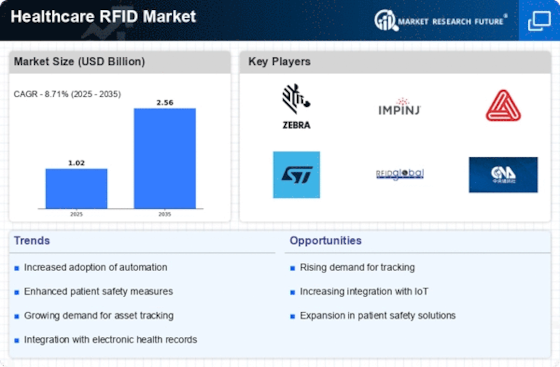
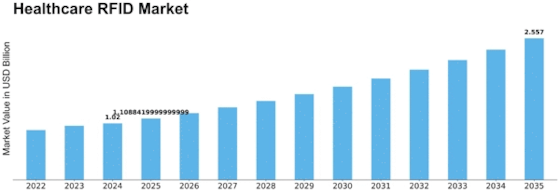
As per Market Research Future analysis, the Healthcare RFID Market Size was estimated at 1.02 USD Billion in 2024. The Healthcare RFID industry is projected to grow from 1.109 USD Billion in 2025 to 2.557 USD Billion by 2035, exhibiting a compound annual growth rate (CAGR) of 8.7% during the forecast period 2025 - 2035

Key Market Trends & Highlights

The Healthcare RFID Market is experiencing robust growth driven by technological advancements and increasing demand for efficiency.

  • North America remains the largest market for Healthcare RFID Market, driven by advanced healthcare infrastructure and technology adoption. The Asia-Pacific region is emerging as the fastest-growing market, fueled by rising healthcare expenditures and increasing awareness of RFID benefits. Inventory Management continues to dominate the market, while Patient Tracking is rapidly gaining traction as healthcare providers seek enhanced patient safety. Key market drivers include improved patient care and safety, alongside enhanced inventory management, which are pivotal in shaping market dynamics.

Market Size & Forecast

2024 Market Size 1.02 (USD Billion)
2035 Market Size 2.557 (USD Billion)
CAGR (2025 - 2035) 8.71%
Largest Regional Market Share in 2024 North America

Major Players

<a href="https://www.zebra.com/ap/en/products/rfid.html">Zebra Technologies (US)</a>, Impinj (US), Avery Dennison (US), STMicroelectronics (FR), <a href="https://rfidgs.com/">RFID Global Solution</a> (US), CenTrak (US), MediTags (US), TagMaster (SE), Sato Holdings (JP)

Market Trends

The Healthcare RFID Market is currently experiencing a transformative phase, driven by advancements in technology and an increasing emphasis on operational efficiency within healthcare settings. The integration of Radio Frequency Identification (RFID) systems is becoming more prevalent, as these solutions offer enhanced tracking capabilities for medical equipment, pharmaceuticals, and patient management. This trend appears to be fueled by the need for improved inventory control, reduced errors in medication administration, and heightened patient safety. As healthcare providers seek to optimize their operations, the adoption of RFID technology is likely to expand, leading to more streamlined processes and better resource allocation. Moreover, the Healthcare RFID Market seems to be influenced by the growing demand for real-time data access and analytics. Healthcare organizations are increasingly recognizing the value of data-driven decision-making, which RFID systems can facilitate. By providing accurate and timely information, these technologies may enhance patient care and operational workflows. Additionally, the ongoing development of RFID solutions tailored to specific healthcare applications suggests a future where customization and adaptability are paramount. As the market evolves, stakeholders must remain vigilant to emerging trends and innovations that could shape the landscape of healthcare delivery.

Increased Adoption of RFID in Asset Management

Healthcare facilities are increasingly utilizing RFID technology for effective asset management. This trend indicates a shift towards real-time tracking of medical equipment, which enhances operational efficiency and reduces the risk of loss or misplacement.

Integration with IoT and Data Analytics

The convergence of RFID technology with Internet of Things (IoT) devices and data analytics is becoming more pronounced. This integration suggests a future where healthcare providers can leverage comprehensive data insights to improve patient outcomes and streamline operations.

Focus on Patient Safety and Compliance

There is a growing emphasis on utilizing RFID systems to enhance patient safety and ensure regulatory compliance. This trend highlights the potential for RFID technology to minimize medication errors and improve overall healthcare quality.

Healthcare RFID Market Market Drivers

Enhanced Inventory Management

The Healthcare RFID Market is experiencing a notable shift towards enhanced inventory management solutions. RFID technology facilitates real-time tracking of medical supplies and equipment, thereby reducing instances of stockouts and overstock situations. This capability is particularly crucial in hospitals where the availability of essential items can directly impact patient care. According to recent data, hospitals utilizing RFID systems have reported a reduction in inventory costs by up to 30%. This efficiency not only streamlines operations but also contributes to better financial management within healthcare facilities. As the demand for efficient inventory management continues to rise, the Healthcare RFID Market is likely to see increased investments in RFID solutions that promise to optimize supply chain processes.

Improved Patient Care and Safety

The Healthcare RFID Market is increasingly focused on improving patient care and safety through the implementation of RFID technology. By enabling precise tracking of patients, medications, and medical devices, RFID systems help to minimize errors associated with patient identification and medication administration. Studies indicate that hospitals employing RFID solutions have experienced a significant decrease in medication errors, enhancing overall patient safety. Furthermore, the ability to monitor the location and status of critical medical equipment ensures that healthcare providers can deliver timely and effective care. As patient safety remains a top priority for healthcare organizations, the Healthcare RFID Market is poised for growth as more facilities adopt these technologies to safeguard patient welfare.

Regulatory Compliance and Standards

The Healthcare RFID Market is influenced by the increasing emphasis on regulatory compliance and adherence to industry standards. Healthcare organizations are mandated to maintain accurate records of medical devices and pharmaceuticals, which can be efficiently managed through RFID technology. Compliance with regulations such as the FDA's Unique Device Identification (UDI) system necessitates robust tracking mechanisms that RFID provides. This technology not only aids in meeting regulatory requirements but also enhances traceability and accountability within healthcare systems. As regulatory pressures mount, the Healthcare RFID Market is likely to expand as organizations seek to implement RFID solutions that facilitate compliance and improve operational transparency.

Integration with Advanced Technologies

The Healthcare RFID Market is increasingly integrating with advanced technologies such as the Internet of Things (IoT) and artificial intelligence (AI). This convergence allows for more sophisticated data analytics and real-time monitoring capabilities, enhancing the overall effectiveness of RFID systems. For instance, IoT-enabled RFID solutions can provide insights into equipment usage patterns, enabling healthcare facilities to optimize asset utilization. Additionally, AI algorithms can analyze data collected from RFID systems to predict trends and improve decision-making processes. As healthcare organizations strive for innovation and efficiency, the integration of RFID with these advanced technologies is likely to propel the Healthcare RFID Market forward, fostering a more connected and intelligent healthcare ecosystem.

Cost Reduction and Operational Efficiency

The Healthcare RFID Market is driven by the need for cost reduction and operational efficiency within healthcare facilities. RFID technology enables organizations to automate various processes, thereby reducing labor costs associated with manual tracking and inventory management. By streamlining operations, healthcare providers can allocate resources more effectively, leading to improved service delivery. Reports suggest that hospitals implementing RFID systems have achieved operational cost savings of approximately 20%. This financial incentive, coupled with the potential for enhanced patient outcomes, positions RFID as a compelling solution for healthcare organizations. As the pressure to reduce costs intensifies, the Healthcare RFID Market is expected to witness a surge in adoption rates.

Market Segment Insights

By Application: Inventory Management (Largest) vs. Patient Tracking (Fastest-Growing)

The Healthcare RFID Market is segmented into various applications with distinct characteristics. Inventory Management holds the largest share within this segment, serving as a cornerstone for optimizing inventory levels and minimizing waste across healthcare facilities. In contrast, Patient Tracking is swiftly gaining traction, driven by the increasing demand for efficient patient flow management and enhanced care delivery. This segment reflects a shift towards more patient-centric solutions in healthcare.

Inventory Management (Dominant) vs. Patient Tracking (Emerging)

Inventory Management in the Healthcare RFID Market is a dominant application known for its ability to streamline stock control and reduce operational costs. This segment leverages RFID technology to ensure that <a href="https://www.marketresearchfuture.com/reports/medical-supplies-market-2433">medical supplies</a> and equipment are available when needed, thus preventing stockouts and minimizing excess inventory. Meanwhile, Patient Tracking is emerging as a vital application that enhances patient safety and operational efficiency. It utilizes real-time location data to monitor patients' movements within healthcare facilities, addressing critical issues such as reducing wait times and improving overall patient experience. As hospitals and clinics recognize the importance of these applications, investments in both areas are expected to rise, supporting broader healthcare goals.

By End-Use: Hospitals (Largest) vs. Clinics (Fastest-Growing)

In the Healthcare RFID Market, hospitals constitute the largest segment due to their extensive need for asset tracking, patient management, and inventory control. This segment's dominance can be attributed to the growing adoption of RFID technology for improving operational efficiency and patient care. Following hospitals, clinics represent a rapidly growing segment as they increasingly adopt RFID solutions to streamline their operations and enhance patient safety, thus indicating a shift towards advanced healthcare solutions even at smaller facilities.

Hospitals (Dominant) vs. Clinics (Emerging)

Hospitals are at the forefront of the Healthcare RFID Market, leveraging advanced RFID solutions to optimize asset management, reduce errors, and ensure patient safety with real-time tracking of medical equipment and supplies. This segment benefits from significant investments in healthcare technology, where RFID plays a critical role in enhancing patient flow and operational efficiency. On the other hand, clinics are emerging as a notable segment, harnessing RFID technology to improve patient identification, medication administration, and workflow processes. This trend is driven by the need for small to mid-sized healthcare providers to enhance service delivery, manage resources effectively, and ensure patient safety, making clinics a ripe area for future RFID growth.

By Product Type: Tags (Largest) vs. Software (Fastest-Growing)

The Healthcare RFID Market shows a significant distribution of market share among its product types. Tags represent the largest segment, widely employed for patient tracking, inventory management, and asset tracking in hospitals. Readers come next in importance, acting as the pivotal interface that facilitates interaction with these tags. Software and services follow but are rapidly gaining ground due to the increasing demand for integrated solutions that enable optimal management of RFID data in healthcare settings.

RFID Tools: Readers (Dominant) vs. Services (Emerging)

Readers play a dominant role in the Healthcare RFID Market, acting as the essential hardware that captures data from RFID tags to streamline processes. The versatility of readers contributes to their widespread adoption across various healthcare applications, from inpatient tracking to medicine dispensing. On the other hand, services related to RFID implementation and maintenance are emerging as crucial drives for market growth. As healthcare providers increasingly seek complete solutions that include training, system integration, and ongoing support, service providers are poised for rapid expansion, reflecting a shift towards comprehensive RFID ecosystems.

By Technology: Active RFID (Largest) vs. Passive RFID (Fastest-Growing)

The Healthcare RFID Market exhibits a varied distribution among the three technology segments: Active RFID, Passive RFID, and Semi-Passive RFID. Active RFID currently holds the largest market share, driven by its comprehensive capabilities in tracking high-value assets and patients efficiently. In contrast, Passive RFID, while smaller in scale, is emerging rapidly due to its lower cost and ease of integration into existing systems. This dynamic illustrates the competitive nature of the healthcare sector where different technologies cater to distinct needs.

Technology: Active RFID (Dominant) vs. Passive RFID (Emerging)

Active RFID systems are characterized by their battery-powered tags, providing continuous signal transmission and thereby excellent tracking capabilities for critical assets, patients, and equipment in hospitals. Their dominance is attributed to features such as extended read range and real-time data collection. On the other hand, Passive RFID represents an emerging trend, offering a cost-effective solution for tagging and monitoring supplies and medications. These tags, powered by the reader's signal, are lighter and less expensive, making them increasingly popular in hospitals for inventory management and workflow enhancement, highlighting a shift towards more economical tracking solutions.

Get more detailed insights about Healthcare RFID Market Research Report – Global Forecast till 2035

Regional Insights

North America : Leading Innovation and Adoption

North America is the largest market for Healthcare RFID Market, holding approximately 45% of the global share. The region's growth is driven by increasing demand for efficient inventory management, patient tracking, and regulatory compliance. The adoption of advanced technologies and government initiatives supporting healthcare digitization further catalyze market expansion. The U.S. is the primary contributor, followed by Canada, which is rapidly increasing its market presence.

Europe : Regulatory Support and Growth

Europe is the second-largest market for Healthcare RFID Market, accounting for around 30% of the global share. The region benefits from stringent regulations aimed at improving patient safety and operational efficiency. Countries like Germany and the UK lead in adoption, driven by healthcare reforms and technological advancements. The competitive landscape features key players such as STMicroelectronics and Avery Dennison, enhancing innovation and market penetration.

Asia-Pacific : Emerging Market Potential

Asia-Pacific is witnessing significant growth in the Healthcare RFID Market, holding about 20% of the global share. The region's expansion is fueled by increasing healthcare expenditures, rising patient populations, and a growing emphasis on healthcare automation. Countries like China and India are at the forefront, with investments in healthcare infrastructure and technology adoption. The competitive landscape is evolving, with both local and international players vying for market share.

Middle East and Africa : Untapped Opportunities Ahead

The Middle East and Africa represent a nascent but promising market for Healthcare RFID Market, capturing around 5% of the global share. The region's growth is driven by increasing healthcare investments and a focus on improving patient care. Countries like the UAE and South Africa are leading the charge, with government initiatives aimed at modernizing healthcare systems. The competitive landscape is still developing, with opportunities for both established and emerging players.

Key Players and Competitive Insights

The Healthcare RFID Market is currently characterized by a dynamic competitive landscape, driven by the increasing demand for efficient asset management, patient tracking, and inventory control within healthcare facilities. Key players such as Zebra Technologies (US), Impinj (US), and Avery Dennison (US) are strategically positioned to leverage technological advancements and enhance operational efficiencies. Zebra Technologies (US) focuses on innovation through the development of advanced RFID solutions that integrate seamlessly with existing healthcare systems, while Impinj (US) emphasizes partnerships with healthcare providers to expand its market reach. Avery Dennison (US) is actively pursuing regional expansion, particularly in emerging markets, to capitalize on the growing adoption of RFID technology in healthcare settings. Collectively, these strategies contribute to a competitive environment that is increasingly centered around technological innovation and strategic partnerships.
In terms of business tactics, companies are increasingly localizing manufacturing and optimizing supply chains to enhance responsiveness to market demands. The Healthcare RFID Market appears moderately fragmented, with several key players exerting influence over various segments. This fragmentation allows for a diverse range of solutions, catering to the specific needs of healthcare providers, while also fostering competition that drives innovation and efficiency.
In August 2025, Zebra Technologies (US) announced a partnership with a leading hospital network to implement a comprehensive RFID tracking system aimed at improving patient safety and operational efficiency. This strategic move underscores Zebra's commitment to enhancing healthcare delivery through technology, positioning the company as a leader in the integration of RFID solutions within clinical environments. The partnership is expected to yield significant improvements in asset utilization and patient flow, thereby reinforcing Zebra's competitive edge.
In September 2025, Impinj (US) launched a new line of RFID tags specifically designed for the healthcare sector, which are capable of withstanding sterilization processes. This innovation is particularly relevant as it addresses a critical need for reliable tracking of medical instruments and supplies. By introducing these specialized tags, Impinj not only enhances its product portfolio but also strengthens its position in the market by meeting the stringent requirements of healthcare providers.
In July 2025, Avery Dennison (US) expanded its RFID solutions to include a new software platform that integrates with existing hospital management systems. This development is significant as it facilitates seamless data exchange and enhances the overall efficiency of healthcare operations. By focusing on software integration, Avery Dennison is likely to differentiate itself in a crowded market, appealing to healthcare organizations seeking comprehensive solutions that streamline operations.
As of October 2025, the competitive trends within the Healthcare RFID Market are increasingly defined by digitalization, sustainability, and the integration of artificial intelligence. Strategic alliances among key players are shaping the landscape, fostering innovation and enhancing service delivery. Looking ahead, it is anticipated that competitive differentiation will evolve from traditional price-based strategies to a focus on technological innovation, supply chain reliability, and the ability to provide tailored solutions that meet the unique needs of healthcare providers.

Key Companies in the Healthcare RFID Market include

Industry Developments

Recent developments in the Global Healthcare RFID Market have shown significant growth and technological advancements. Companies such as Zebra Technologies and Honeywell continue to enhance their RFID solutions, aiming to improve asset management and patient care within healthcare facilities globally. Medsense and CenTrak have introduced robust RFID systems for tracking medical equipment and monitoring patients, thereby streamlining operations and reducing costs. In a notable merger in September 2023, Impinj acquired Terso Solutions, enhancing its asset-tracking capabilities.

This acquisition is expected to improve inventory management solutions in the healthcare sector. Additionally, the increasing adoption of interoperable RFID technologies across hospitals is facilitating real-time data access and improving operational efficiency. According to recent market analyses, the healthcare RFID market is anticipated to grow significantly, with estimates reaching a valuation exceeding USD 5 billion by 2025 due to rising demand for automation and inventory control solutions, especially in the context of improving healthcare outcomes and operational efficiencies.

Future Outlook

Healthcare RFID Market Future Outlook

The Healthcare RFID Market is projected to grow at an 8.71% CAGR from 2025 to 2035, driven by advancements in patient tracking, inventory management, and regulatory compliance.

New opportunities lie in:

  • Integration of RFID with IoT for real-time <a href="https://www.marketresearchfuture.com/reports/patient-monitoring-devices-market-2484">patient monitoring</a> solutions.
  • Development of RFID-enabled surgical instruments for enhanced operational efficiency.
  • Expansion of RFID applications in pharmaceutical <a href="https://www.marketresearchfuture.com/reports/supply-chain-management-market-21742">supply chain management</a>.

By 2035, the Healthcare RFID Market is expected to achieve substantial growth, driven by innovative applications and technological advancements.

Market Segmentation

Healthcare RFID Market End-Use Outlook

  • Hospitals
  • Clinics
  • Pharmaceutical Companies
  • Laboratories

Healthcare RFID Market Technology Outlook

  • Active RFID
  • Passive RFID
  • Semi-Passive RFID

Healthcare RFID Market Application Outlook

  • Inventory Management
  • Patient Tracking
  • Medication Management
  • Asset Management

Healthcare RFID Market Product Type Outlook

  • Tags
  • Readers
  • Software
  • Services

Report Scope

MARKET SIZE 2024 1.02(USD Billion)
MARKET SIZE 2025 1.109(USD Billion)
MARKET SIZE 2035 2.557(USD Billion)
COMPOUND ANNUAL GROWTH RATE (CAGR) 8.71% (2025 - 2035)
REPORT COVERAGE Revenue Forecast, Competitive Landscape, Growth Factors, and Trends
BASE YEAR 2024
Market Forecast Period 2025 - 2035
Historical Data 2019 - 2024
Market Forecast Units USD Billion
Key Companies Profiled Zebra Technologies (US), Impinj (US), Avery Dennison (US), STMicroelectronics (FR), RFID Global Solution (US), CenTrak (US), MediTags (US), TagMaster (SE), Sato Holdings (JP)
Segments Covered Application, End Use, Product Type, Technology, Regional
Key Market Opportunities Integration of advanced tracking solutions enhances patient safety and operational efficiency in the Healthcare RFID Market.
Key Market Dynamics Rising demand for efficient asset tracking drives innovation and competition in the Healthcare RFID Market.
Countries Covered North America, Europe, APAC, South America, MEA

FAQs

What is the projected market valuation of the Healthcare RFID Market by 2035?

<p>The projected market valuation of the Healthcare RFID Market is 2.557 USD Billion by 2035.</p>

What was the overall market valuation of the Healthcare RFID Market in 2024?

<p>The overall market valuation of the Healthcare RFID Market was 1.02 USD Billion in 2024.</p>

What is the expected CAGR for the Healthcare RFID Market during the forecast period 2025 - 2035?

<p>The expected CAGR for the Healthcare RFID Market during the forecast period 2025 - 2035 is 8.71%.</p>

Which application segments are included in the Healthcare RFID Market?

<p>The application segments in the Healthcare RFID Market include Inventory Management, Patient Tracking, Medication Management, and Asset Management.</p>

What are the projected valuations for the Patient Tracking segment by 2035?

<p>The projected valuation for the Patient Tracking segment is expected to reach 0.75 USD Billion by 2035.</p>

Who are the key players in the Healthcare RFID Market?

<p>Key players in the Healthcare RFID Market include Zebra Technologies, Impinj, Avery Dennison, and CenTrak.</p>

What is the projected valuation for the Services product type in the Healthcare RFID Market by 2035?

<p>The projected valuation for the Services product type is anticipated to be 0.95 USD Billion by 2035.</p>

What end-use segments are represented in the Healthcare RFID Market?

<p>The end-use segments in the Healthcare RFID Market include Hospitals, Clinics, Pharmaceutical Companies, and Laboratories.</p>

What is the expected growth for the Passive RFID technology segment by 2035?

<p>The expected growth for the Passive RFID technology segment is projected to reach 1.271 USD Billion by 2035.</p>

How does the market valuation for Clinics compare to that of Hospitals in 2035?

<p>By 2035, the market valuation for Clinics is expected to be 0.55 USD Billion, whereas Hospitals are projected to reach 0.95 USD Billion.</p>

  1. SECTION I: EXECUTIVE SUMMARY AND KEY HIGHLIGHTS
    1. | 1.1 EXECUTIVE SUMMARY
    2. | | 1.1.1 Market Overview
    3. | | 1.1.2 Key Findings
    4. | | 1.1.3 Market Segmentation
    5. | | 1.1.4 Competitive Landscape
    6. | | 1.1.5 Challenges and Opportunities
    7. | | 1.1.6 Future Outlook
  2. SECTION II: SCOPING, METHODOLOGY AND MARKET STRUCTURE
    1. | 2.1 MARKET INTRODUCTION
    2. | | 2.1.1 Definition
    3. | | 2.1.2 Scope of the study
    4. | | | 2.1.2.1 Research Objective
    5. | | | 2.1.2.2 Assumption
    6. | | | 2.1.2.3 Limitations
    7. | 2.2 RESEARCH METHODOLOGY
    8. | | 2.2.1 Overview
    9. | | 2.2.2 Data Mining
    10. | | 2.2.3 Secondary Research
    11. | | 2.2.4 Primary Research
    12. | | | 2.2.4.1 Primary Interviews and Information Gathering Process
    13. | | | 2.2.4.2 Breakdown of Primary Respondents
    14. | | 2.2.5 Forecasting Model
    15. | | 2.2.6 Market Size Estimation
    16. | | | 2.2.6.1 Bottom-Up Approach
    17. | | | 2.2.6.2 Top-Down Approach
    18. | | 2.2.7 Data Triangulation
    19. | | 2.2.8 Validation
  3. SECTION III: QUALITATIVE ANALYSIS
    1. | 3.1 MARKET DYNAMICS
    2. | | 3.1.1 Overview
    3. | | 3.1.2 Drivers
    4. | | 3.1.3 Restraints
    5. | | 3.1.4 Opportunities
    6. | 3.2 MARKET FACTOR ANALYSIS
    7. | | 3.2.1 Value chain Analysis
    8. | | 3.2.2 Porter's Five Forces Analysis
    9. | | | 3.2.2.1 Bargaining Power of Suppliers
    10. | | | 3.2.2.2 Bargaining Power of Buyers
    11. | | | 3.2.2.3 Threat of New Entrants
    12. | | | 3.2.2.4 Threat of Substitutes
    13. | | | 3.2.2.5 Intensity of Rivalry
    14. | | 3.2.3 COVID-19 Impact Analysis
    15. | | | 3.2.3.1 Market Impact Analysis
    16. | | | 3.2.3.2 Regional Impact
    17. | | | 3.2.3.3 Opportunity and Threat Analysis
  4. SECTION IV: QUANTITATIVE ANALYSIS
    1. | 4.1 Healthcare, BY Application (USD Billion)
    2. | | 4.1.1 Inventory Management
    3. | | 4.1.2 Patient Tracking
    4. | | 4.1.3 Medication Management
    5. | | 4.1.4 Asset Management
    6. | 4.2 Healthcare, BY End-Use (USD Billion)
    7. | | 4.2.1 Hospitals
    8. | | 4.2.2 Clinics
    9. | | 4.2.3 Pharmaceutical Companies
    10. | | 4.2.4 Laboratories
    11. | 4.3 Healthcare, BY Product Type (USD Billion)
    12. | | 4.3.1 Tags
    13. | | 4.3.2 Readers
    14. | | 4.3.3 Software
    15. | | 4.3.4 Services
    16. | 4.4 Healthcare, BY Technology (USD Billion)
    17. | | 4.4.1 Active RFID
    18. | | 4.4.2 Passive RFID
    19. | | 4.4.3 Semi-Passive RFID
    20. | 4.5 Healthcare, BY Region (USD Billion)
    21. | | 4.5.1 North America
    22. | | | 4.5.1.1 US
    23. | | | 4.5.1.2 Canada
    24. | | 4.5.2 Europe
    25. | | | 4.5.2.1 Germany
    26. | | | 4.5.2.2 UK
    27. | | | 4.5.2.3 France
    28. | | | 4.5.2.4 Russia
    29. | | | 4.5.2.5 Italy
    30. | | | 4.5.2.6 Spain
    31. | | | 4.5.2.7 Rest of Europe
    32. | | 4.5.3 APAC
    33. | | | 4.5.3.1 China
    34. | | | 4.5.3.2 India
    35. | | | 4.5.3.3 Japan
    36. | | | 4.5.3.4 South Korea
    37. | | | 4.5.3.5 Malaysia
    38. | | | 4.5.3.6 Thailand
    39. | | | 4.5.3.7 Indonesia
    40. | | | 4.5.3.8 Rest of APAC
    41. | | 4.5.4 South America
    42. | | | 4.5.4.1 Brazil
    43. | | | 4.5.4.2 Mexico
    44. | | | 4.5.4.3 Argentina
    45. | | | 4.5.4.4 Rest of South America
    46. | | 4.5.5 MEA
    47. | | | 4.5.5.1 GCC Countries
    48. | | | 4.5.5.2 South Africa
    49. | | | 4.5.5.3 Rest of MEA
  5. SECTION V: COMPETITIVE ANALYSIS
    1. | 5.1 Competitive Landscape
    2. | | 5.1.1 Overview
    3. | | 5.1.2 Competitive Analysis
    4. | | 5.1.3 Market share Analysis
    5. | | 5.1.4 Major Growth Strategy in the Healthcare
    6. | | 5.1.5 Competitive Benchmarking
    7. | | 5.1.6 Leading Players in Terms of Number of Developments in the Healthcare
    8. | | 5.1.7 Key developments and growth strategies
    9. | | | 5.1.7.1 New Product Launch/Service Deployment
    10. | | | 5.1.7.2 Merger & Acquisitions
    11. | | | 5.1.7.3 Joint Ventures
    12. | | 5.1.8 Major Players Financial Matrix
    13. | | | 5.1.8.1 Sales and Operating Income
    14. | | | 5.1.8.2 Major Players R&D Expenditure. 2023
    15. | 5.2 Company Profiles
    16. | | 5.2.1 Zebra Technologies (US)
    17. | | | 5.2.1.1 Financial Overview
    18. | | | 5.2.1.2 Products Offered
    19. | | | 5.2.1.3 Key Developments
    20. | | | 5.2.1.4 SWOT Analysis
    21. | | | 5.2.1.5 Key Strategies
    22. | | 5.2.2 Impinj (US)
    23. | | | 5.2.2.1 Financial Overview
    24. | | | 5.2.2.2 Products Offered
    25. | | | 5.2.2.3 Key Developments
    26. | | | 5.2.2.4 SWOT Analysis
    27. | | | 5.2.2.5 Key Strategies
    28. | | 5.2.3 Avery Dennison (US)
    29. | | | 5.2.3.1 Financial Overview
    30. | | | 5.2.3.2 Products Offered
    31. | | | 5.2.3.3 Key Developments
    32. | | | 5.2.3.4 SWOT Analysis
    33. | | | 5.2.3.5 Key Strategies
    34. | | 5.2.4 STMicroelectronics (FR)
    35. | | | 5.2.4.1 Financial Overview
    36. | | | 5.2.4.2 Products Offered
    37. | | | 5.2.4.3 Key Developments
    38. | | | 5.2.4.4 SWOT Analysis
    39. | | | 5.2.4.5 Key Strategies
    40. | | 5.2.5 RFID Global Solution (US)
    41. | | | 5.2.5.1 Financial Overview
    42. | | | 5.2.5.2 Products Offered
    43. | | | 5.2.5.3 Key Developments
    44. | | | 5.2.5.4 SWOT Analysis
    45. | | | 5.2.5.5 Key Strategies
    46. | | 5.2.6 CenTrak (US)
    47. | | | 5.2.6.1 Financial Overview
    48. | | | 5.2.6.2 Products Offered
    49. | | | 5.2.6.3 Key Developments
    50. | | | 5.2.6.4 SWOT Analysis
    51. | | | 5.2.6.5 Key Strategies
    52. | | 5.2.7 MediTags (US)
    53. | | | 5.2.7.1 Financial Overview
    54. | | | 5.2.7.2 Products Offered
    55. | | | 5.2.7.3 Key Developments
    56. | | | 5.2.7.4 SWOT Analysis
    57. | | | 5.2.7.5 Key Strategies
    58. | | 5.2.8 TagMaster (SE)
    59. | | | 5.2.8.1 Financial Overview
    60. | | | 5.2.8.2 Products Offered
    61. | | | 5.2.8.3 Key Developments
    62. | | | 5.2.8.4 SWOT Analysis
    63. | | | 5.2.8.5 Key Strategies
    64. | | 5.2.9 Sato Holdings (JP)
    65. | | | 5.2.9.1 Financial Overview
    66. | | | 5.2.9.2 Products Offered
    67. | | | 5.2.9.3 Key Developments
    68. | | | 5.2.9.4 SWOT Analysis
    69. | | | 5.2.9.5 Key Strategies
    70. | 5.3 Appendix
    71. | | 5.3.1 References
    72. | | 5.3.2 Related Reports
  6. LIST OF FIGURES
    1. | 6.1 MARKET SYNOPSIS
    2. | 6.2 NORTH AMERICA MARKET ANALYSIS
    3. | 6.3 US MARKET ANALYSIS BY APPLICATION
    4. | 6.4 US MARKET ANALYSIS BY END-USE
    5. | 6.5 US MARKET ANALYSIS BY PRODUCT TYPE
    6. | 6.6 US MARKET ANALYSIS BY TECHNOLOGY
    7. | 6.7 CANADA MARKET ANALYSIS BY APPLICATION
    8. | 6.8 CANADA MARKET ANALYSIS BY END-USE
    9. | 6.9 CANADA MARKET ANALYSIS BY PRODUCT TYPE
    10. | 6.10 CANADA MARKET ANALYSIS BY TECHNOLOGY
    11. | 6.11 EUROPE MARKET ANALYSIS
    12. | 6.12 GERMANY MARKET ANALYSIS BY APPLICATION
    13. | 6.13 GERMANY MARKET ANALYSIS BY END-USE
    14. | 6.14 GERMANY MARKET ANALYSIS BY PRODUCT TYPE
    15. | 6.15 GERMANY MARKET ANALYSIS BY TECHNOLOGY
    16. | 6.16 UK MARKET ANALYSIS BY APPLICATION
    17. | 6.17 UK MARKET ANALYSIS BY END-USE
    18. | 6.18 UK MARKET ANALYSIS BY PRODUCT TYPE
    19. | 6.19 UK MARKET ANALYSIS BY TECHNOLOGY
    20. | 6.20 FRANCE MARKET ANALYSIS BY APPLICATION
    21. | 6.21 FRANCE MARKET ANALYSIS BY END-USE
    22. | 6.22 FRANCE MARKET ANALYSIS BY PRODUCT TYPE
    23. | 6.23 FRANCE MARKET ANALYSIS BY TECHNOLOGY
    24. | 6.24 RUSSIA MARKET ANALYSIS BY APPLICATION
    25. | 6.25 RUSSIA MARKET ANALYSIS BY END-USE
    26. | 6.26 RUSSIA MARKET ANALYSIS BY PRODUCT TYPE
    27. | 6.27 RUSSIA MARKET ANALYSIS BY TECHNOLOGY
    28. | 6.28 ITALY MARKET ANALYSIS BY APPLICATION
    29. | 6.29 ITALY MARKET ANALYSIS BY END-USE
    30. | 6.30 ITALY MARKET ANALYSIS BY PRODUCT TYPE
    31. | 6.31 ITALY MARKET ANALYSIS BY TECHNOLOGY
    32. | 6.32 SPAIN MARKET ANALYSIS BY APPLICATION
    33. | 6.33 SPAIN MARKET ANALYSIS BY END-USE
    34. | 6.34 SPAIN MARKET ANALYSIS BY PRODUCT TYPE
    35. | 6.35 SPAIN MARKET ANALYSIS BY TECHNOLOGY
    36. | 6.36 REST OF EUROPE MARKET ANALYSIS BY APPLICATION
    37. | 6.37 REST OF EUROPE MARKET ANALYSIS BY END-USE
    38. | 6.38 REST OF EUROPE MARKET ANALYSIS BY PRODUCT TYPE
    39. | 6.39 REST OF EUROPE MARKET ANALYSIS BY TECHNOLOGY
    40. | 6.40 APAC MARKET ANALYSIS
    41. | 6.41 CHINA MARKET ANALYSIS BY APPLICATION
    42. | 6.42 CHINA MARKET ANALYSIS BY END-USE
    43. | 6.43 CHINA MARKET ANALYSIS BY PRODUCT TYPE
    44. | 6.44 CHINA MARKET ANALYSIS BY TECHNOLOGY
    45. | 6.45 INDIA MARKET ANALYSIS BY APPLICATION
    46. | 6.46 INDIA MARKET ANALYSIS BY END-USE
    47. | 6.47 INDIA MARKET ANALYSIS BY PRODUCT TYPE
    48. | 6.48 INDIA MARKET ANALYSIS BY TECHNOLOGY
    49. | 6.49 JAPAN MARKET ANALYSIS BY APPLICATION
    50. | 6.50 JAPAN MARKET ANALYSIS BY END-USE
    51. | 6.51 JAPAN MARKET ANALYSIS BY PRODUCT TYPE
    52. | 6.52 JAPAN MARKET ANALYSIS BY TECHNOLOGY
    53. | 6.53 SOUTH KOREA MARKET ANALYSIS BY APPLICATION
    54. | 6.54 SOUTH KOREA MARKET ANALYSIS BY END-USE
    55. | 6.55 SOUTH KOREA MARKET ANALYSIS BY PRODUCT TYPE
    56. | 6.56 SOUTH KOREA MARKET ANALYSIS BY TECHNOLOGY
    57. | 6.57 MALAYSIA MARKET ANALYSIS BY APPLICATION
    58. | 6.58 MALAYSIA MARKET ANALYSIS BY END-USE
    59. | 6.59 MALAYSIA MARKET ANALYSIS BY PRODUCT TYPE
    60. | 6.60 MALAYSIA MARKET ANALYSIS BY TECHNOLOGY
    61. | 6.61 THAILAND MARKET ANALYSIS BY APPLICATION
    62. | 6.62 THAILAND MARKET ANALYSIS BY END-USE
    63. | 6.63 THAILAND MARKET ANALYSIS BY PRODUCT TYPE
    64. | 6.64 THAILAND MARKET ANALYSIS BY TECHNOLOGY
    65. | 6.65 INDONESIA MARKET ANALYSIS BY APPLICATION
    66. | 6.66 INDONESIA MARKET ANALYSIS BY END-USE
    67. | 6.67 INDONESIA MARKET ANALYSIS BY PRODUCT TYPE
    68. | 6.68 INDONESIA MARKET ANALYSIS BY TECHNOLOGY
    69. | 6.69 REST OF APAC MARKET ANALYSIS BY APPLICATION
    70. | 6.70 REST OF APAC MARKET ANALYSIS BY END-USE
    71. | 6.71 REST OF APAC MARKET ANALYSIS BY PRODUCT TYPE
    72. | 6.72 REST OF APAC MARKET ANALYSIS BY TECHNOLOGY
    73. | 6.73 SOUTH AMERICA MARKET ANALYSIS
    74. | 6.74 BRAZIL MARKET ANALYSIS BY APPLICATION
    75. | 6.75 BRAZIL MARKET ANALYSIS BY END-USE
    76. | 6.76 BRAZIL MARKET ANALYSIS BY PRODUCT TYPE
    77. | 6.77 BRAZIL MARKET ANALYSIS BY TECHNOLOGY
    78. | 6.78 MEXICO MARKET ANALYSIS BY APPLICATION
    79. | 6.79 MEXICO MARKET ANALYSIS BY END-USE
    80. | 6.80 MEXICO MARKET ANALYSIS BY PRODUCT TYPE
    81. | 6.81 MEXICO MARKET ANALYSIS BY TECHNOLOGY
    82. | 6.82 ARGENTINA MARKET ANALYSIS BY APPLICATION
    83. | 6.83 ARGENTINA MARKET ANALYSIS BY END-USE
    84. | 6.84 ARGENTINA MARKET ANALYSIS BY PRODUCT TYPE
    85. | 6.85 ARGENTINA MARKET ANALYSIS BY TECHNOLOGY
    86. | 6.86 REST OF SOUTH AMERICA MARKET ANALYSIS BY APPLICATION
    87. | 6.87 REST OF SOUTH AMERICA MARKET ANALYSIS BY END-USE
    88. | 6.88 REST OF SOUTH AMERICA MARKET ANALYSIS BY PRODUCT TYPE
    89. | 6.89 REST OF SOUTH AMERICA MARKET ANALYSIS BY TECHNOLOGY
    90. | 6.90 MEA MARKET ANALYSIS
    91. | 6.91 GCC COUNTRIES MARKET ANALYSIS BY APPLICATION
    92. | 6.92 GCC COUNTRIES MARKET ANALYSIS BY END-USE
    93. | 6.93 GCC COUNTRIES MARKET ANALYSIS BY PRODUCT TYPE
    94. | 6.94 GCC COUNTRIES MARKET ANALYSIS BY TECHNOLOGY
    95. | 6.95 SOUTH AFRICA MARKET ANALYSIS BY APPLICATION
    96. | 6.96 SOUTH AFRICA MARKET ANALYSIS BY END-USE
    97. | 6.97 SOUTH AFRICA MARKET ANALYSIS BY PRODUCT TYPE
    98. | 6.98 SOUTH AFRICA MARKET ANALYSIS BY TECHNOLOGY
    99. | 6.99 REST OF MEA MARKET ANALYSIS BY APPLICATION
    100. | 6.100 REST OF MEA MARKET ANALYSIS BY END-USE
    101. | 6.101 REST OF MEA MARKET ANALYSIS BY PRODUCT TYPE
    102. | 6.102 REST OF MEA MARKET ANALYSIS BY TECHNOLOGY
    103. | 6.103 KEY BUYING CRITERIA OF HEALTHCARE
    104. | 6.104 RESEARCH PROCESS OF MRFR
    105. | 6.105 DRO ANALYSIS OF HEALTHCARE
    106. | 6.106 DRIVERS IMPACT ANALYSIS: HEALTHCARE
    107. | 6.107 RESTRAINTS IMPACT ANALYSIS: HEALTHCARE
    108. | 6.108 SUPPLY / VALUE CHAIN: HEALTHCARE
    109. | 6.109 HEALTHCARE, BY APPLICATION, 2024 (% SHARE)
    110. | 6.110 HEALTHCARE, BY APPLICATION, 2024 TO 2035 (USD Billion)
    111. | 6.111 HEALTHCARE, BY END-USE, 2024 (% SHARE)
    112. | 6.112 HEALTHCARE, BY END-USE, 2024 TO 2035 (USD Billion)
    113. | 6.113 HEALTHCARE, BY PRODUCT TYPE, 2024 (% SHARE)
    114. | 6.114 HEALTHCARE, BY PRODUCT TYPE, 2024 TO 2035 (USD Billion)
    115. | 6.115 HEALTHCARE, BY TECHNOLOGY, 2024 (% SHARE)
    116. | 6.116 HEALTHCARE, BY TECHNOLOGY, 2024 TO 2035 (USD Billion)
    117. | 6.117 BENCHMARKING OF MAJOR COMPETITORS
  7. LIST OF TABLES
    1. | 7.1 LIST OF ASSUMPTIONS
    2. | | 7.1.1
    3. | 7.2 North America MARKET SIZE ESTIMATES; FORECAST
    4. | | 7.2.1 BY APPLICATION, 2025-2035 (USD Billion)
    5. | | 7.2.2 BY END-USE, 2025-2035 (USD Billion)
    6. | | 7.2.3 BY PRODUCT TYPE, 2025-2035 (USD Billion)
    7. | | 7.2.4 BY TECHNOLOGY, 2025-2035 (USD Billion)
    8. | 7.3 US MARKET SIZE ESTIMATES; FORECAST
    9. | | 7.3.1 BY APPLICATION, 2025-2035 (USD Billion)
    10. | | 7.3.2 BY END-USE, 2025-2035 (USD Billion)
    11. | | 7.3.3 BY PRODUCT TYPE, 2025-2035 (USD Billion)
    12. | | 7.3.4 BY TECHNOLOGY, 2025-2035 (USD Billion)
    13. | 7.4 Canada MARKET SIZE ESTIMATES; FORECAST
    14. | | 7.4.1 BY APPLICATION, 2025-2035 (USD Billion)
    15. | | 7.4.2 BY END-USE, 2025-2035 (USD Billion)
    16. | | 7.4.3 BY PRODUCT TYPE, 2025-2035 (USD Billion)
    17. | | 7.4.4 BY TECHNOLOGY, 2025-2035 (USD Billion)
    18. | 7.5 Europe MARKET SIZE ESTIMATES; FORECAST
    19. | | 7.5.1 BY APPLICATION, 2025-2035 (USD Billion)
    20. | | 7.5.2 BY END-USE, 2025-2035 (USD Billion)
    21. | | 7.5.3 BY PRODUCT TYPE, 2025-2035 (USD Billion)
    22. | | 7.5.4 BY TECHNOLOGY, 2025-2035 (USD Billion)
    23. | 7.6 Germany MARKET SIZE ESTIMATES; FORECAST
    24. | | 7.6.1 BY APPLICATION, 2025-2035 (USD Billion)
    25. | | 7.6.2 BY END-USE, 2025-2035 (USD Billion)
    26. | | 7.6.3 BY PRODUCT TYPE, 2025-2035 (USD Billion)
    27. | | 7.6.4 BY TECHNOLOGY, 2025-2035 (USD Billion)
    28. | 7.7 UK MARKET SIZE ESTIMATES; FORECAST
    29. | | 7.7.1 BY APPLICATION, 2025-2035 (USD Billion)
    30. | | 7.7.2 BY END-USE, 2025-2035 (USD Billion)
    31. | | 7.7.3 BY PRODUCT TYPE, 2025-2035 (USD Billion)
    32. | | 7.7.4 BY TECHNOLOGY, 2025-2035 (USD Billion)
    33. | 7.8 France MARKET SIZE ESTIMATES; FORECAST
    34. | | 7.8.1 BY APPLICATION, 2025-2035 (USD Billion)
    35. | | 7.8.2 BY END-USE, 2025-2035 (USD Billion)
    36. | | 7.8.3 BY PRODUCT TYPE, 2025-2035 (USD Billion)
    37. | | 7.8.4 BY TECHNOLOGY, 2025-2035 (USD Billion)
    38. | 7.9 Russia MARKET SIZE ESTIMATES; FORECAST
    39. | | 7.9.1 BY APPLICATION, 2025-2035 (USD Billion)
    40. | | 7.9.2 BY END-USE, 2025-2035 (USD Billion)
    41. | | 7.9.3 BY PRODUCT TYPE, 2025-2035 (USD Billion)
    42. | | 7.9.4 BY TECHNOLOGY, 2025-2035 (USD Billion)
    43. | 7.10 Italy MARKET SIZE ESTIMATES; FORECAST
    44. | | 7.10.1 BY APPLICATION, 2025-2035 (USD Billion)
    45. | | 7.10.2 BY END-USE, 2025-2035 (USD Billion)
    46. | | 7.10.3 BY PRODUCT TYPE, 2025-2035 (USD Billion)
    47. | | 7.10.4 BY TECHNOLOGY, 2025-2035 (USD Billion)
    48. | 7.11 Spain MARKET SIZE ESTIMATES; FORECAST
    49. | | 7.11.1 BY APPLICATION, 2025-2035 (USD Billion)
    50. | | 7.11.2 BY END-USE, 2025-2035 (USD Billion)
    51. | | 7.11.3 BY PRODUCT TYPE, 2025-2035 (USD Billion)
    52. | | 7.11.4 BY TECHNOLOGY, 2025-2035 (USD Billion)
    53. | 7.12 Rest of Europe MARKET SIZE ESTIMATES; FORECAST
    54. | | 7.12.1 BY APPLICATION, 2025-2035 (USD Billion)
    55. | | 7.12.2 BY END-USE, 2025-2035 (USD Billion)
    56. | | 7.12.3 BY PRODUCT TYPE, 2025-2035 (USD Billion)
    57. | | 7.12.4 BY TECHNOLOGY, 2025-2035 (USD Billion)
    58. | 7.13 APAC MARKET SIZE ESTIMATES; FORECAST
    59. | | 7.13.1 BY APPLICATION, 2025-2035 (USD Billion)
    60. | | 7.13.2 BY END-USE, 2025-2035 (USD Billion)
    61. | | 7.13.3 BY PRODUCT TYPE, 2025-2035 (USD Billion)
    62. | | 7.13.4 BY TECHNOLOGY, 2025-2035 (USD Billion)
    63. | 7.14 China MARKET SIZE ESTIMATES; FORECAST
    64. | | 7.14.1 BY APPLICATION, 2025-2035 (USD Billion)
    65. | | 7.14.2 BY END-USE, 2025-2035 (USD Billion)
    66. | | 7.14.3 BY PRODUCT TYPE, 2025-2035 (USD Billion)
    67. | | 7.14.4 BY TECHNOLOGY, 2025-2035 (USD Billion)
    68. | 7.15 India MARKET SIZE ESTIMATES; FORECAST
    69. | | 7.15.1 BY APPLICATION, 2025-2035 (USD Billion)
    70. | | 7.15.2 BY END-USE, 2025-2035 (USD Billion)
    71. | | 7.15.3 BY PRODUCT TYPE, 2025-2035 (USD Billion)
    72. | | 7.15.4 BY TECHNOLOGY, 2025-2035 (USD Billion)
    73. | 7.16 Japan MARKET SIZE ESTIMATES; FORECAST
    74. | | 7.16.1 BY APPLICATION, 2025-2035 (USD Billion)
    75. | | 7.16.2 BY END-USE, 2025-2035 (USD Billion)
    76. | | 7.16.3 BY PRODUCT TYPE, 2025-2035 (USD Billion)
    77. | | 7.16.4 BY TECHNOLOGY, 2025-2035 (USD Billion)
    78. | 7.17 South Korea MARKET SIZE ESTIMATES; FORECAST
    79. | | 7.17.1 BY APPLICATION, 2025-2035 (USD Billion)
    80. | | 7.17.2 BY END-USE, 2025-2035 (USD Billion)
    81. | | 7.17.3 BY PRODUCT TYPE, 2025-2035 (USD Billion)
    82. | | 7.17.4 BY TECHNOLOGY, 2025-2035 (USD Billion)
    83. | 7.18 Malaysia MARKET SIZE ESTIMATES; FORECAST
    84. | | 7.18.1 BY APPLICATION, 2025-2035 (USD Billion)
    85. | | 7.18.2 BY END-USE, 2025-2035 (USD Billion)
    86. | | 7.18.3 BY PRODUCT TYPE, 2025-2035 (USD Billion)
    87. | | 7.18.4 BY TECHNOLOGY, 2025-2035 (USD Billion)
    88. | 7.19 Thailand MARKET SIZE ESTIMATES; FORECAST
    89. | | 7.19.1 BY APPLICATION, 2025-2035 (USD Billion)
    90. | | 7.19.2 BY END-USE, 2025-2035 (USD Billion)
    91. | | 7.19.3 BY PRODUCT TYPE, 2025-2035 (USD Billion)
    92. | | 7.19.4 BY TECHNOLOGY, 2025-2035 (USD Billion)
    93. | 7.20 Indonesia MARKET SIZE ESTIMATES; FORECAST
    94. | | 7.20.1 BY APPLICATION, 2025-2035 (USD Billion)
    95. | | 7.20.2 BY END-USE, 2025-2035 (USD Billion)
    96. | | 7.20.3 BY PRODUCT TYPE, 2025-2035 (USD Billion)
    97. | | 7.20.4 BY TECHNOLOGY, 2025-2035 (USD Billion)
    98. | 7.21 Rest of APAC MARKET SIZE ESTIMATES; FORECAST
    99. | | 7.21.1 BY APPLICATION, 2025-2035 (USD Billion)
    100. | | 7.21.2 BY END-USE, 2025-2035 (USD Billion)
    101. | | 7.21.3 BY PRODUCT TYPE, 2025-2035 (USD Billion)
    102. | | 7.21.4 BY TECHNOLOGY, 2025-2035 (USD Billion)
    103. | 7.22 South America MARKET SIZE ESTIMATES; FORECAST
    104. | | 7.22.1 BY APPLICATION, 2025-2035 (USD Billion)
    105. | | 7.22.2 BY END-USE, 2025-2035 (USD Billion)
    106. | | 7.22.3 BY PRODUCT TYPE, 2025-2035 (USD Billion)
    107. | | 7.22.4 BY TECHNOLOGY, 2025-2035 (USD Billion)
    108. | 7.23 Brazil MARKET SIZE ESTIMATES; FORECAST
    109. | | 7.23.1 BY APPLICATION, 2025-2035 (USD Billion)
    110. | | 7.23.2 BY END-USE, 2025-2035 (USD Billion)
    111. | | 7.23.3 BY PRODUCT TYPE, 2025-2035 (USD Billion)
    112. | | 7.23.4 BY TECHNOLOGY, 2025-2035 (USD Billion)
    113. | 7.24 Mexico MARKET SIZE ESTIMATES; FORECAST
    114. | | 7.24.1 BY APPLICATION, 2025-2035 (USD Billion)
    115. | | 7.24.2 BY END-USE, 2025-2035 (USD Billion)
    116. | | 7.24.3 BY PRODUCT TYPE, 2025-2035 (USD Billion)
    117. | | 7.24.4 BY TECHNOLOGY, 2025-2035 (USD Billion)
    118. | 7.25 Argentina MARKET SIZE ESTIMATES; FORECAST
    119. | | 7.25.1 BY APPLICATION, 2025-2035 (USD Billion)
    120. | | 7.25.2 BY END-USE, 2025-2035 (USD Billion)
    121. | | 7.25.3 BY PRODUCT TYPE, 2025-2035 (USD Billion)
    122. | | 7.25.4 BY TECHNOLOGY, 2025-2035 (USD Billion)
    123. | 7.26 Rest of South America MARKET SIZE ESTIMATES; FORECAST
    124. | | 7.26.1 BY APPLICATION, 2025-2035 (USD Billion)
    125. | | 7.26.2 BY END-USE, 2025-2035 (USD Billion)
    126. | | 7.26.3 BY PRODUCT TYPE, 2025-2035 (USD Billion)
    127. | | 7.26.4 BY TECHNOLOGY, 2025-2035 (USD Billion)
    128. | 7.27 MEA MARKET SIZE ESTIMATES; FORECAST
    129. | | 7.27.1 BY APPLICATION, 2025-2035 (USD Billion)
    130. | | 7.27.2 BY END-USE, 2025-2035 (USD Billion)
    131. | | 7.27.3 BY PRODUCT TYPE, 2025-2035 (USD Billion)
    132. | | 7.27.4 BY TECHNOLOGY, 2025-2035 (USD Billion)
    133. | 7.28 GCC Countries MARKET SIZE ESTIMATES; FORECAST
    134. | | 7.28.1 BY APPLICATION, 2025-2035 (USD Billion)
    135. | | 7.28.2 BY END-USE, 2025-2035 (USD Billion)
    136. | | 7.28.3 BY PRODUCT TYPE, 2025-2035 (USD Billion)
    137. | | 7.28.4 BY TECHNOLOGY, 2025-2035 (USD Billion)
    138. | 7.29 South Africa MARKET SIZE ESTIMATES; FORECAST
    139. | | 7.29.1 BY APPLICATION, 2025-2035 (USD Billion)
    140. | | 7.29.2 BY END-USE, 2025-2035 (USD Billion)
    141. | | 7.29.3 BY PRODUCT TYPE, 2025-2035 (USD Billion)
    142. | | 7.29.4 BY TECHNOLOGY, 2025-2035 (USD Billion)
    143. | 7.30 Rest of MEA MARKET SIZE ESTIMATES; FORECAST
    144. | | 7.30.1 BY APPLICATION, 2025-2035 (USD Billion)
    145. | | 7.30.2 BY END-USE, 2025-2035 (USD Billion)
    146. | | 7.30.3 BY PRODUCT TYPE, 2025-2035 (USD Billion)
    147. | | 7.30.4 BY TECHNOLOGY, 2025-2035 (USD Billion)
    148. | 7.31 PRODUCT LAUNCH/PRODUCT DEVELOPMENT/APPROVAL
    149. | | 7.31.1
    150. | 7.32 ACQUISITION/PARTNERSHIP
    151. | | 7.32.1

Healthcare Market Segmentation

Healthcare By Application (USD Billion, 2025-2035)

  • Inventory Management
  • Patient Tracking
  • Medication Management
  • Asset Management

Healthcare By End-Use (USD Billion, 2025-2035)

  • Hospitals
  • Clinics
  • Pharmaceutical Companies
  • Laboratories

Healthcare By Product Type (USD Billion, 2025-2035)

  • Tags
  • Readers
  • Software
  • Services

Healthcare By Technology (USD Billion, 2025-2035)

  • Active RFID
  • Passive RFID
  • Semi-Passive RFID
Infographic

Free Sample Request

Kindly complete the form below to receive a free sample of this Report

Get Free Sample

Customer Strories

Compare Licence

×
Features License Type
Single User Multiuser License Enterprise User
Price $4,950 $5,950 $7,250
Maximum User Access Limit 1 User Upto 10 Users Unrestricted Access Throughout the Organization
Free Customization
Direct Access to Analyst
Deliverable Format
Platform Access
Discount on Next Purchase 10% 15% 15%
Printable Versions
%>