Request Free Sample ×

Kindly complete the form below to receive a free sample of this Report

* Please use a valid business email

Leading companies partner with us for data-driven Insights

clients tt-cursor
Hero Background
English
Chinese
French
Japanese
Korean
German
Spanish

Healthcare Information Governance Solution (IGS) Market Size

ID: MRFR/HCIT/0273-HCR
110 Pages
Nidhi Mandole
March 2026

Healthcare Information Governance Solution Market Research Report, by Type (eDiscovery,), Deployment (Web and Cloud, In-Premise), by Applications (Financials, Records), by End-User (Hospitals and Clinics, Research and Academics) - Forecast Till 2035

Share:
Download PDF ×

We do not share your information with anyone. However, we may send you emails based on your report interest from time to time. You may contact us at any time to opt-out.

Healthcare Information Governance Solution (IGS) Market Infographic
Purchase Options

Healthcare Information Governance Solution Igs Size

Healthcare Information Governance Solution (IGS) Market Growth Projections and Opportunities

Regulatory compliance and data security drive the Healthcare Information Governance Solution Market. To comply with HIPAA and other data protection laws, healthcare organizations seek information governance solutions to protect patient data and prevent data breaches. Increasing healthcare data volume and complexity affect market dynamics. Information governance solutions help healthcare businesses manage, organize, and secure massive volumes of data from EHRs, medical imaging, and other digital sources. Multifaceted healthcare IT interoperability issues affect the industry. Information governance solutions must manage interoperability issues to ensure data integrity and compliance with healthcare data standards across systems and platforms. The development of EHRs impacts market patterns. Healthcare providers need information governance solutions to optimize EHR systems, standardize data management, and make patient data more accessible and usable. Growing patient privacy and consent management is a market factor. Healthcare businesses may comply with privacy laws and enable patients to manage their health information with information governance systems that manage patient consent choices. Effective data lifecycle management is important in the market. Information governance solutions help healthcare businesses keep, archive, and destroy data in accordance with regulatory regulations, decreasing data breaches and legal issues. Healthcare Information Exchange (HIE) network integration is a market trend. Information governance solutions provide safe data interchange and cooperation between healthcare institutions, facilitating HIE network interoperability and patient care continuity. Advances in analytics and business intelligence affect market dynamics. Information governance solutions use analytics to help healthcare businesses make better decisions, spot patterns, and boost efficiency. Cybersecurity readiness is a market driver. For healthcare data to be protected, secure, and available throughout its lifespan, information governance systems must have strong cybersecurity capabilities. Patients' data portability efforts affect the market. Information governance solutions let patients access and transmit their health data smoothly across healthcare providers, giving them more control over their health data. A major market development is the merging of AI and ML. Information governance solutions use AI and ML for data categorization, anomaly detection, and predictive analytics to automate data governance operations and improve healthcare data management. The competition among information governance solution suppliers affects market developments. Intense competition creates customizable possibilities, enhanced user experiences, and creative features, enabling healthcare companies to pick solutions that meet their information governance and organizational demands. Training and education programs affect the market. Healthcare businesses teach workers on information governance best practices to ensure they handle data ethically and follow governance standards. The market demands strong audit and compliance reporting. Information governance platforms should provide audit trails and compliance reports, facilitate internal and external audits, and demonstrate regulatory compliance.

Healthcare Information Governance Solution (IGS) Market Size Graph
Author
Author Profile
Nidhi Mandole
Senior Research Analyst

She is an extremely curious individual currently working in Healthcare and Medical Devices Domain. Nidhi is comfortably versed in data centric research backed by healthcare educational background. She leverages extensive data mining and analytics tools such as Primary and Secondary Research, Statistical Analysis, Machine Learning, Data Modelling. Her key role also involves Technical Sales Support, Client Interaction and Project management within the Healthcare team. Lastly, she showcases extensive affinity towards learning new skills and remain fascinated in implementing them.

Leave a Comment

FAQs

What is the projected market valuation of the Healthcare Information Governance Solution Market by 2035?

<p>The projected market valuation is expected to reach 62.66 USD Billion by 2035.</p>

What was the overall market valuation of the Healthcare Information Governance Solution Market in 2024?

<p>The overall market valuation was 17.27 USD Billion in 2024.</p>

What is the expected CAGR for the Healthcare Information Governance Solution Market during the forecast period 2025 - 2035?

<p>The expected CAGR for the market during this period is 12.43%.</p>

Which companies are considered key players in the Healthcare Information Governance Solution Market?

<p>Key players include IBM, Oracle, Microsoft, SAP, Cerner Corporation, Epic Systems Corporation, Allscripts Healthcare Solutions, and Meditech.</p>

What segment had the highest valuation in the Healthcare Information Governance Solution Market in 2024?

<p>The Records segment had the highest valuation at 7.27 USD Billion in 2024.</p>

How much is the Analytics segment projected to be valued at by 2035?

The Analytics segment is projected to reach a valuation of 12.56 USD Billion by 2035.

What is the projected valuation for the Cloud deployment segment by 2035?

The Cloud deployment segment is expected to be valued at 37.66 USD Billion by 2035.

What was the valuation of the Information Archiving segment in 2024?

The Information Archiving segment was valued at 4.12 USD Billion in 2024.

Which application segment is projected to have the highest growth by 2035?

The Records application segment is projected to grow to 25.45 USD Billion by 2035.

What is the expected valuation for the Ediscovery segment by 2035?

The Ediscovery segment is expected to reach a valuation of 16.45 USD Billion by 2035.

Market Summary

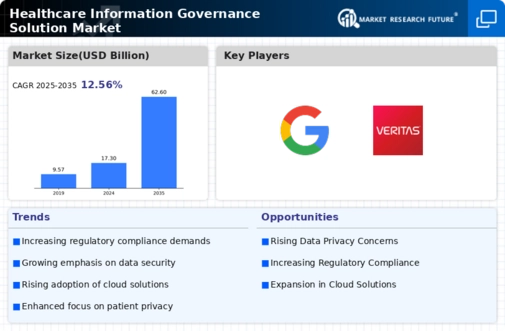
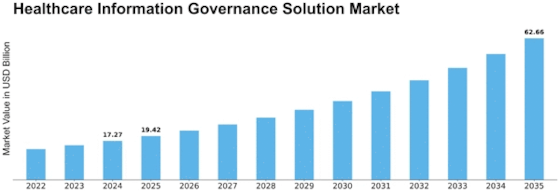
As per Market Research Future analysis, the Healthcare Information Governance Solution Market was estimated at 17.27 USD Billion in 2024. The Healthcare Information Governance Solution industry is projected to grow from 19.42 USD Billion in 2025 to 62.66 USD Billion by 2035, exhibiting a compound annual growth rate (CAGR) of 12.43% during the forecast period 2025 - 2035

Key Market Trends & Highlights

The Healthcare Information Governance Solution Market is experiencing robust growth driven by regulatory compliance and technological advancements.

  • North America remains the largest market for healthcare information governance solutions, reflecting a strong demand for regulatory compliance.

  • The Asia-Pacific region is emerging as the fastest-growing market, fueled by increasing healthcare investments and digital transformation initiatives.
  • Content management solutions dominate the market, while eDiscovery solutions are witnessing the fastest growth due to rising legal and compliance needs.
  • Rising data breaches and a growing emphasis on patient privacy are key drivers propelling the demand for healthcare information governance solutions.

Market Size & Forecast

2024 Market Size 17.27 (USD Billion)
2035 Market Size 62.66 (USD Billion)
CAGR (2025 - 2035) 12.43%
Largest Regional Market Share in 2024 Asia Pacific

Major Players

IBM (US), Oracle (US), Microsoft (US), SAP (DE), Cerner Corporation (US), Epic Systems Corporation (US), Allscripts Healthcare Solutions (US), Meditech (US)

Market Trends

The Healthcare Information Governance Solution Market is currently experiencing a transformative phase, driven by the increasing need for effective data management and compliance within healthcare organizations. As the volume of health data continues to expand, stakeholders are recognizing the necessity of robust governance frameworks to ensure data integrity, security, and accessibility. This market appears to be influenced by various factors, including regulatory requirements, technological advancements, and the growing emphasis on patient-centric care. Organizations are likely to invest in solutions that not only streamline data processes but also enhance decision-making capabilities and operational efficiency. Moreover, the integration of artificial intelligence and machine learning technologies into governance solutions is becoming more prevalent. These innovations seem to offer enhanced analytics and predictive capabilities, which could significantly improve the management of healthcare information. As healthcare providers strive to meet evolving standards and patient expectations, the demand for comprehensive governance solutions is expected to rise. This trend indicates a shift towards more sophisticated, automated systems that facilitate compliance and optimize data utilization across the healthcare landscape.

Increased Regulatory Compliance

Healthcare organizations are facing heightened scrutiny regarding data management practices. This trend suggests that there is a growing emphasis on adhering to regulations, which drives the demand for governance solutions that ensure compliance with legal and ethical standards.

Adoption of Advanced Technologies

The integration of advanced technologies, such as artificial intelligence and machine learning, is becoming more common in the Healthcare Information Governance Solution Market. These technologies appear to enhance data analytics capabilities, enabling organizations to derive insights and improve decision-making.

Focus on Patient-Centric Solutions

There is a noticeable shift towards solutions that prioritize patient engagement and data accessibility. This trend indicates that healthcare providers are increasingly recognizing the importance of empowering patients through better information governance, which may lead to improved health outcomes.

Healthcare Information Governance Solution (IGS) Market Market Drivers

Shift Towards Value-Based Care Models

The shift towards value-based care models is reshaping the Healthcare Information Governance Solution Market. As healthcare providers transition from volume-based to value-based care, there is an increasing need for effective data management and governance solutions. In 2025, it is estimated that value-based care will account for over 50% of healthcare spending, highlighting the importance of accurate data for measuring outcomes and improving patient care. This paradigm shift necessitates the implementation of robust information governance frameworks that ensure data integrity and facilitate performance measurement. Consequently, organizations that embrace value-based care are likely to drive demand for innovative governance solutions that align with their strategic objectives.

Regulatory Changes and Compliance Requirements

Regulatory changes and evolving compliance requirements are significant drivers of the Healthcare Information Governance Solution Market. As governments and regulatory bodies introduce new standards for data management and protection, healthcare organizations must adapt their governance strategies accordingly. In 2025, it is projected that compliance-related costs for healthcare organizations could exceed 30 billion dollars, underscoring the necessity for effective governance solutions. Organizations that proactively address these regulatory challenges are better positioned to avoid penalties and enhance their operational efficiency. Thus, the demand for comprehensive information governance solutions that facilitate compliance with evolving regulations is likely to surge in the coming years.

Rising Data Breaches and Cybersecurity Threats

The increasing frequency of data breaches and cybersecurity threats is a critical driver for the Healthcare Information Governance Solution Market. As healthcare organizations face heightened scrutiny regarding data protection, the demand for robust governance solutions intensifies. In 2025, it is estimated that healthcare data breaches could cost the industry over 4 billion dollars, prompting organizations to invest in comprehensive information governance frameworks. These frameworks not only safeguard sensitive patient information but also ensure compliance with stringent regulations. Consequently, the need for effective governance solutions becomes paramount, as organizations strive to mitigate risks associated with data vulnerabilities and enhance their overall security posture.

Growing Emphasis on Patient Privacy and Data Protection

The growing emphasis on patient privacy and data protection is a pivotal driver for the Healthcare Information Governance Solution Market. As patients become increasingly aware of their rights regarding personal health information, healthcare organizations are compelled to adopt stringent governance measures. In 2025, it is anticipated that over 70% of patients will prioritize data privacy when choosing healthcare providers. This shift in consumer behavior necessitates the implementation of comprehensive information governance solutions that not only protect patient data but also build trust between patients and providers. Consequently, organizations that prioritize patient privacy are likely to gain a competitive advantage in the evolving healthcare landscape.

Integration of Artificial Intelligence and Machine Learning

The integration of artificial intelligence (AI) and machine learning (ML) technologies is transforming the Healthcare Information Governance Solution Market. These advanced technologies enable healthcare organizations to analyze vast amounts of data efficiently, thereby improving decision-making processes. In 2025, the market for AI in healthcare is projected to reach approximately 36 billion dollars, indicating a significant shift towards data-driven governance solutions. By leveraging AI and ML, organizations can enhance data accuracy, streamline workflows, and ensure compliance with regulatory standards. This technological evolution not only optimizes operational efficiency but also fosters a culture of proactive information governance, ultimately benefiting patient care and organizational performance.

Market Segment Insights

By Type: Content Management (Largest) vs. Ediscovery (Fastest-Growing)

The Healthcare Information Governance Solution Market is notably divided among four key segments: Content Management, Information Archiving, Analytics, and Ediscovery. Of these, Content Management holds the largest share, proving to be the backbone of most healthcare organizations' data handling abilities. Information Archiving closely follows, ensuring critical patient data remains accessible while optimizing storage capacity. Analytics and Ediscovery play significant roles but account for a smaller portion of overall market share, often complementing the primary functions of management and archiving.

Content Management (Dominant) vs. Ediscovery (Emerging)

Content Management remains the dominant force in the Healthcare Information Governance Solution Market due to its essential role in organizing and controlling healthcare data effectively. This segment focuses on improving efficiency in documentation processes and regulatory compliance, which are crucial in healthcare settings. Meanwhile, Ediscovery is rapidly emerging, driven by increasing legal requirements and the need for healthcare entities to manage legal inquiries more efficiently. This growth is propelled by advancements in technology, allowing healthcare organizations to streamline folder structures and data retrieval processes during litigation and compliance audits, highlighting a shift towards more proactive governance solutions.

By Application: Records (Largest) vs. Financials (Fastest-Growing)

In the Healthcare Information Governance Solution Market, the application segment is led by Records management, which holds the largest share among various functionalities. This category is crucial for maintaining patient data integrity and compliance with regulatory standards, making it indispensable for healthcare organizations. Financials follow closely, and while it does not surpass Records in market share, its rising importance in optimizing budgeting and resource allocation positions it as a growing priority for organizations in this segment.

Records (Dominant) vs. Financials (Emerging)

Records management is the dominant application in Healthcare Information Governance Solutions, focused on ensuring the accurate storage, retrieval, and secure handling of patient information and healthcare documents. This segment emphasizes compliance and risk management, directly impacting patient care quality. In contrast, Financials is an emerging application increasingly recognized for its role in enhancing operational efficiency and financial transparency in healthcare institutions. This application focuses on integrating data analytics to support strategic decision-making regarding staff allocation and funding, appealing to organizations seeking to improve their financial health and operational agility.

By Deployment: Cloud (Largest) vs. Web (Fastest-Growing)

In the Healthcare Information Governance Solution Market, the deployment segment shows a clear distinction in market share between Cloud and Web solutions. The Cloud deployment model is the largest segment, favored by large healthcare organizations for its scalability, security, and ability to easily integrate with existing systems. Meanwhile, the Web deployment model, while smaller in share, is quickly gaining traction due to its accessibility and cost-effectiveness.

Deployment: Cloud (Dominant) vs. Web (Emerging)

Cloud solutions in the Healthcare Information Governance sector dominate the market, offering robust infrastructure and enhanced data security, making them the preferred choice for large healthcare systems. These solutions enable organizations to securely store, manage, and access vast amounts of patient data efficiently. On the other hand, Web deployment is emerging rapidly, catering to smaller healthcare providers seeking simpler and more affordable options. This model offers faster implementation and user-friendly interfaces, appealing to organizations looking for quick solutions without the complexities of traditional IT infrastructure.

Get more detailed insights about Healthcare Information Governance Solution (IGS) Market Research Report - Forecast to 2035

Regional Insights

North America : Leading Innovation and Adoption

North America is the largest market for Healthcare Information Governance Solutions, holding approximately 45% of the global market share. The region's growth is driven by increasing regulatory requirements, technological advancements, and a rising focus on data security and patient privacy. The demand for integrated healthcare solutions is further fueled by the ongoing digital transformation in healthcare systems, enhancing operational efficiency and patient care. The United States is the primary contributor to this market, with significant investments from key players like IBM, Oracle, and Microsoft. The competitive landscape is characterized by a mix of established firms and innovative startups, all striving to meet the evolving needs of healthcare providers. The presence of advanced healthcare infrastructure and a strong emphasis on research and development further solidify North America's position as a leader in this sector.

Europe : Regulatory Framework and Growth

Europe is witnessing significant growth in the Healthcare Information Governance Solutions market, accounting for approximately 30% of the global share. The region's expansion is largely driven by stringent data protection regulations such as the GDPR, which mandates robust data governance practices. Additionally, the increasing adoption of electronic health records (EHRs) and telemedicine solutions is propelling demand for effective information governance frameworks across healthcare organizations. Leading countries in this region include Germany, the UK, and France, where healthcare systems are increasingly prioritizing data management and compliance. The competitive landscape features major players like SAP and Cerner Corporation, alongside numerous local firms. The emphasis on interoperability and patient-centric care is shaping the market, encouraging innovation and collaboration among stakeholders.

Asia-Pacific : Rapid Growth and Adoption

Asia-Pacific is rapidly emerging as a significant player in the Healthcare Information Governance Solutions market, holding around 20% of the global market share. The region's growth is driven by increasing healthcare expenditures, a rising population, and the adoption of digital health technologies. Governments are also implementing policies to enhance healthcare infrastructure, which is further stimulating demand for effective information governance solutions to manage vast amounts of health data securely. Countries like China, India, and Japan are at the forefront of this growth, with substantial investments in healthcare IT. The competitive landscape is diverse, featuring both global giants and local startups. Key players are focusing on tailored solutions to meet regional needs, emphasizing data security and compliance with local regulations, which is crucial for gaining market traction in this dynamic environment.

Middle East and Africa : Emerging Market with Challenges

The Middle East and Africa region is gradually developing its Healthcare Information Governance Solutions market, accounting for approximately 5% of the global share. The growth is primarily driven by increasing healthcare investments and a growing awareness of the importance of data governance. However, challenges such as regulatory inconsistencies and varying levels of technological adoption across countries hinder faster progress. Governments are beginning to recognize the need for robust information governance frameworks to enhance healthcare delivery. Leading countries in this region include South Africa, the UAE, and Saudi Arabia, where healthcare systems are increasingly focusing on digital transformation. The competitive landscape is characterized by a mix of international and local players, with a growing emphasis on partnerships to address regional challenges. As the market matures, there is a significant opportunity for innovative solutions tailored to local needs, particularly in data management and compliance.

Key Players and Competitive Insights

The Healthcare Information Governance Solution Market is currently characterized by a dynamic competitive landscape, driven by the increasing need for data security, regulatory compliance, and efficient data management. Major players such as IBM (US), Oracle (US), and Microsoft (US) are strategically positioned to leverage their technological prowess and extensive resources. IBM (US) focuses on innovation through its Watson Health platform, which integrates AI to enhance data governance capabilities. Oracle (US) emphasizes cloud-based solutions, aiming to streamline healthcare data management while ensuring compliance with evolving regulations. Microsoft (US) is investing heavily in partnerships and digital transformation initiatives, particularly through its Azure cloud services, which are tailored for healthcare applications. Collectively, these strategies foster a competitive environment that prioritizes technological advancement and regulatory adherence.

In terms of business tactics, companies are increasingly localizing their operations to better serve regional markets, optimizing supply chains to enhance efficiency. The market appears moderately fragmented, with a mix of established players and emerging startups. This structure allows for diverse offerings, yet the influence of key players remains substantial, as they set benchmarks for innovation and service delivery.

In August 2025, IBM (US) announced a strategic partnership with a leading telehealth provider to enhance data governance in remote patient monitoring. This collaboration is significant as it not only expands IBM's footprint in the telehealth sector but also underscores the importance of secure data management in virtual care settings. Such partnerships are likely to enhance patient outcomes while ensuring compliance with healthcare regulations.

In September 2025, Oracle (US) launched a new suite of AI-driven analytics tools designed specifically for healthcare organizations. This initiative is pivotal as it positions Oracle at the forefront of data analytics in healthcare, enabling providers to derive actionable insights from vast datasets. The integration of AI into their offerings suggests a commitment to innovation that could redefine data governance practices across the industry.

In October 2025, Microsoft (US) unveiled a new initiative aimed at integrating its Azure cloud services with electronic health record (EHR) systems. This move is crucial as it enhances interoperability among healthcare systems, facilitating better data sharing and governance. By focusing on seamless integration, Microsoft is likely to strengthen its competitive edge in the healthcare information governance space.

As of October 2025, the competitive trends in the Healthcare Information Governance Solution Market are increasingly defined by digitalization, sustainability, and the integration of artificial intelligence. Strategic alliances are becoming more prevalent, as companies recognize the value of collaboration in addressing complex healthcare challenges. Looking ahead, competitive differentiation is expected to evolve, shifting from traditional price-based competition to a focus on innovation, technological advancement, and supply chain reliability. This transition may redefine how companies position themselves in the market, emphasizing the need for robust, forward-thinking strategies.

Key Companies in the Healthcare Information Governance Solution (IGS) Market include

Industry Developments

Future Outlook

Healthcare Information Governance Solution (IGS) Market Future Outlook

The Healthcare Information Governance Solution Market is projected to grow at a 12.43% CAGR from 2025 to 2035, driven by regulatory compliance, data security needs, and technological advancements.

New opportunities lie in:

  • Integration of AI-driven analytics for predictive governance
  • Development of blockchain-based data integrity solutions
  • Expansion of mobile governance applications for remote healthcare access

By 2035, the market is expected to be robust, driven by innovation and increasing demand for data governance.

Market Segmentation

Healthcare Information Governance Solution (IGS) Market Type Outlook

  • Content Management
  • Information Archiving
  • Analytics
  • Ediscovery

Healthcare Information Governance Solution (IGS) Market Deployment Outlook

  • Web
  • Cloud

Healthcare Information Governance Solution (IGS) Market Application Outlook

  • Financials
  • Records
  • Customer Support

Report Scope

MARKET SIZE 2024 17.27(USD Billion)
MARKET SIZE 2025 19.42(USD Billion)
MARKET SIZE 2035 62.66(USD Billion)
COMPOUND ANNUAL GROWTH RATE (CAGR) 12.43% (2025 - 2035)
REPORT COVERAGE Revenue Forecast, Competitive Landscape, Growth Factors, and Trends
BASE YEAR 2024
Market Forecast Period 2025 - 2035
Historical Data 2019 - 2024
Market Forecast Units USD Billion
Key Companies Profiled IBM (US), Oracle (US), Microsoft (US), SAP (DE), Cerner Corporation (US), Epic Systems Corporation (US), Allscripts Healthcare Solutions (US), Meditech (US)
Segments Covered Type, Applications, End-User
Key Market Opportunities Integration of artificial intelligence enhances data management in the Healthcare Information Governance Solution Market.
Key Market Dynamics Rising regulatory compliance demands drive innovation and competition in the Healthcare Information Governance Solution Market.
Countries Covered North America, Europe, APAC, South America, MEA

FAQs

What is the projected market valuation of the Healthcare Information Governance Solution Market by 2035?

<p>The projected market valuation is expected to reach 62.66 USD Billion by 2035.</p>

What was the overall market valuation of the Healthcare Information Governance Solution Market in 2024?

<p>The overall market valuation was 17.27 USD Billion in 2024.</p>

What is the expected CAGR for the Healthcare Information Governance Solution Market during the forecast period 2025 - 2035?

<p>The expected CAGR for the market during this period is 12.43%.</p>

Which companies are considered key players in the Healthcare Information Governance Solution Market?

<p>Key players include IBM, Oracle, Microsoft, SAP, Cerner Corporation, Epic Systems Corporation, Allscripts Healthcare Solutions, and Meditech.</p>

What segment had the highest valuation in the Healthcare Information Governance Solution Market in 2024?

<p>The Records segment had the highest valuation at 7.27 USD Billion in 2024.</p>

How much is the Analytics segment projected to be valued at by 2035?

The Analytics segment is projected to reach a valuation of 12.56 USD Billion by 2035.

What is the projected valuation for the Cloud deployment segment by 2035?

The Cloud deployment segment is expected to be valued at 37.66 USD Billion by 2035.

What was the valuation of the Information Archiving segment in 2024?

The Information Archiving segment was valued at 4.12 USD Billion in 2024.

Which application segment is projected to have the highest growth by 2035?

The Records application segment is projected to grow to 25.45 USD Billion by 2035.

What is the expected valuation for the Ediscovery segment by 2035?

The Ediscovery segment is expected to reach a valuation of 16.45 USD Billion by 2035.

  1. SECTION I: EXECUTIVE SUMMARY AND KEY HIGHLIGHTS
    1. | 1.1 EXECUTIVE SUMMARY
    2. | | 1.1.1 Market Overview
    3. | | 1.1.2 Key Findings
    4. | | 1.1.3 Market Segmentation
    5. | | 1.1.4 Competitive Landscape
    6. | | 1.1.5 Challenges and Opportunities
    7. | | 1.1.6 Future Outlook
  2. SECTION II: SCOPING, METHODOLOGY AND MARKET STRUCTURE
    1. | 2.1 MARKET INTRODUCTION
    2. | | 2.1.1 Definition
    3. | | 2.1.2 Scope of the study
    4. | | | 2.1.2.1 Research Objective
    5. | | | 2.1.2.2 Assumption
    6. | | | 2.1.2.3 Limitations
    7. | 2.2 RESEARCH METHODOLOGY
    8. | | 2.2.1 Overview
    9. | | 2.2.2 Data Mining
    10. | | 2.2.3 Secondary Research
    11. | | 2.2.4 Primary Research
    12. | | | 2.2.4.1 Primary Interviews and Information Gathering Process
    13. | | | 2.2.4.2 Breakdown of Primary Respondents
    14. | | 2.2.5 Forecasting Model
    15. | | 2.2.6 Market Size Estimation
    16. | | | 2.2.6.1 Bottom-Up Approach
    17. | | | 2.2.6.2 Top-Down Approach
    18. | | 2.2.7 Data Triangulation
    19. | | 2.2.8 Validation
  3. SECTION III: QUALITATIVE ANALYSIS
    1. | 3.1 MARKET DYNAMICS
    2. | | 3.1.1 Overview
    3. | | 3.1.2 Drivers
    4. | | 3.1.3 Restraints
    5. | | 3.1.4 Opportunities
    6. | 3.2 MARKET FACTOR ANALYSIS
    7. | | 3.2.1 Value chain Analysis
    8. | | 3.2.2 Porter's Five Forces Analysis
    9. | | | 3.2.2.1 Bargaining Power of Suppliers
    10. | | | 3.2.2.2 Bargaining Power of Buyers
    11. | | | 3.2.2.3 Threat of New Entrants
    12. | | | 3.2.2.4 Threat of Substitutes
    13. | | | 3.2.2.5 Intensity of Rivalry
    14. | | 3.2.3 COVID-19 Impact Analysis
    15. | | | 3.2.3.1 Market Impact Analysis
    16. | | | 3.2.3.2 Regional Impact
    17. | | | 3.2.3.3 Opportunity and Threat Analysis
  4. SECTION IV: QUANTITATIVE ANALYSIS
    1. | 4.1 Healthcare, BY Type (USD Billion)
    2. | | 4.1.1 Content Management
    3. | | 4.1.2 Information Archiving
    4. | | 4.1.3 Analytics
    5. | | 4.1.4 Ediscovery
    6. | 4.2 Healthcare, BY Application (USD Billion)
    7. | | 4.2.1 Financials
    8. | | 4.2.2 Records
    9. | | 4.2.3 Customer Support
    10. | 4.3 Healthcare, BY Deployment (USD Billion)
    11. | | 4.3.1 Web
    12. | | 4.3.2 Cloud
    13. | 4.4 Healthcare, BY Region (USD Billion)
    14. | | 4.4.1 North America
    15. | | | 4.4.1.1 US
    16. | | | 4.4.1.2 Canada
    17. | | 4.4.2 Europe
    18. | | | 4.4.2.1 Germany
    19. | | | 4.4.2.2 UK
    20. | | | 4.4.2.3 France
    21. | | | 4.4.2.4 Russia
    22. | | | 4.4.2.5 Italy
    23. | | | 4.4.2.6 Spain
    24. | | | 4.4.2.7 Rest of Europe
    25. | | 4.4.3 APAC
    26. | | | 4.4.3.1 China
    27. | | | 4.4.3.2 India
    28. | | | 4.4.3.3 Japan
    29. | | | 4.4.3.4 South Korea
    30. | | | 4.4.3.5 Malaysia
    31. | | | 4.4.3.6 Thailand
    32. | | | 4.4.3.7 Indonesia
    33. | | | 4.4.3.8 Rest of APAC
    34. | | 4.4.4 South America
    35. | | | 4.4.4.1 Brazil
    36. | | | 4.4.4.2 Mexico
    37. | | | 4.4.4.3 Argentina
    38. | | | 4.4.4.4 Rest of South America
    39. | | 4.4.5 MEA
    40. | | | 4.4.5.1 GCC Countries
    41. | | | 4.4.5.2 South Africa
    42. | | | 4.4.5.3 Rest of MEA
  5. SECTION V: COMPETITIVE ANALYSIS
    1. | 5.1 Competitive Landscape
    2. | | 5.1.1 Overview
    3. | | 5.1.2 Competitive Analysis
    4. | | 5.1.3 Market share Analysis
    5. | | 5.1.4 Major Growth Strategy in the Healthcare
    6. | | 5.1.5 Competitive Benchmarking
    7. | | 5.1.6 Leading Players in Terms of Number of Developments in the Healthcare
    8. | | 5.1.7 Key developments and growth strategies
    9. | | | 5.1.7.1 New Product Launch/Service Deployment
    10. | | | 5.1.7.2 Merger & Acquisitions
    11. | | | 5.1.7.3 Joint Ventures
    12. | | 5.1.8 Major Players Financial Matrix
    13. | | | 5.1.8.1 Sales and Operating Income
    14. | | | 5.1.8.2 Major Players R&D Expenditure. 2023
    15. | 5.2 Company Profiles
    16. | | 5.2.1 IBM (US)
    17. | | | 5.2.1.1 Financial Overview
    18. | | | 5.2.1.2 Products Offered
    19. | | | 5.2.1.3 Key Developments
    20. | | | 5.2.1.4 SWOT Analysis
    21. | | | 5.2.1.5 Key Strategies
    22. | | 5.2.2 Oracle (US)
    23. | | | 5.2.2.1 Financial Overview
    24. | | | 5.2.2.2 Products Offered
    25. | | | 5.2.2.3 Key Developments
    26. | | | 5.2.2.4 SWOT Analysis
    27. | | | 5.2.2.5 Key Strategies
    28. | | 5.2.3 Microsoft (US)
    29. | | | 5.2.3.1 Financial Overview
    30. | | | 5.2.3.2 Products Offered
    31. | | | 5.2.3.3 Key Developments
    32. | | | 5.2.3.4 SWOT Analysis
    33. | | | 5.2.3.5 Key Strategies
    34. | | 5.2.4 SAP (DE)
    35. | | | 5.2.4.1 Financial Overview
    36. | | | 5.2.4.2 Products Offered
    37. | | | 5.2.4.3 Key Developments
    38. | | | 5.2.4.4 SWOT Analysis
    39. | | | 5.2.4.5 Key Strategies
    40. | | 5.2.5 Cerner Corporation (US)
    41. | | | 5.2.5.1 Financial Overview
    42. | | | 5.2.5.2 Products Offered
    43. | | | 5.2.5.3 Key Developments
    44. | | | 5.2.5.4 SWOT Analysis
    45. | | | 5.2.5.5 Key Strategies
    46. | | 5.2.6 Epic Systems Corporation (US)
    47. | | | 5.2.6.1 Financial Overview
    48. | | | 5.2.6.2 Products Offered
    49. | | | 5.2.6.3 Key Developments
    50. | | | 5.2.6.4 SWOT Analysis
    51. | | | 5.2.6.5 Key Strategies
    52. | | 5.2.7 Allscripts Healthcare Solutions (US)
    53. | | | 5.2.7.1 Financial Overview
    54. | | | 5.2.7.2 Products Offered
    55. | | | 5.2.7.3 Key Developments
    56. | | | 5.2.7.4 SWOT Analysis
    57. | | | 5.2.7.5 Key Strategies
    58. | | 5.2.8 Meditech (US)
    59. | | | 5.2.8.1 Financial Overview
    60. | | | 5.2.8.2 Products Offered
    61. | | | 5.2.8.3 Key Developments
    62. | | | 5.2.8.4 SWOT Analysis
    63. | | | 5.2.8.5 Key Strategies
    64. | 5.3 Appendix
    65. | | 5.3.1 References
    66. | | 5.3.2 Related Reports
  6. LIST OF FIGURES
    1. | 6.1 MARKET SYNOPSIS
    2. | 6.2 NORTH AMERICA MARKET ANALYSIS
    3. | 6.3 US MARKET ANALYSIS BY TYPE
    4. | 6.4 US MARKET ANALYSIS BY APPLICATION
    5. | 6.5 US MARKET ANALYSIS BY DEPLOYMENT
    6. | 6.6 CANADA MARKET ANALYSIS BY TYPE
    7. | 6.7 CANADA MARKET ANALYSIS BY APPLICATION
    8. | 6.8 CANADA MARKET ANALYSIS BY DEPLOYMENT
    9. | 6.9 EUROPE MARKET ANALYSIS
    10. | 6.10 GERMANY MARKET ANALYSIS BY TYPE
    11. | 6.11 GERMANY MARKET ANALYSIS BY APPLICATION
    12. | 6.12 GERMANY MARKET ANALYSIS BY DEPLOYMENT
    13. | 6.13 UK MARKET ANALYSIS BY TYPE
    14. | 6.14 UK MARKET ANALYSIS BY APPLICATION
    15. | 6.15 UK MARKET ANALYSIS BY DEPLOYMENT
    16. | 6.16 FRANCE MARKET ANALYSIS BY TYPE
    17. | 6.17 FRANCE MARKET ANALYSIS BY APPLICATION
    18. | 6.18 FRANCE MARKET ANALYSIS BY DEPLOYMENT
    19. | 6.19 RUSSIA MARKET ANALYSIS BY TYPE
    20. | 6.20 RUSSIA MARKET ANALYSIS BY APPLICATION
    21. | 6.21 RUSSIA MARKET ANALYSIS BY DEPLOYMENT
    22. | 6.22 ITALY MARKET ANALYSIS BY TYPE
    23. | 6.23 ITALY MARKET ANALYSIS BY APPLICATION
    24. | 6.24 ITALY MARKET ANALYSIS BY DEPLOYMENT
    25. | 6.25 SPAIN MARKET ANALYSIS BY TYPE
    26. | 6.26 SPAIN MARKET ANALYSIS BY APPLICATION
    27. | 6.27 SPAIN MARKET ANALYSIS BY DEPLOYMENT
    28. | 6.28 REST OF EUROPE MARKET ANALYSIS BY TYPE
    29. | 6.29 REST OF EUROPE MARKET ANALYSIS BY APPLICATION
    30. | 6.30 REST OF EUROPE MARKET ANALYSIS BY DEPLOYMENT
    31. | 6.31 APAC MARKET ANALYSIS
    32. | 6.32 CHINA MARKET ANALYSIS BY TYPE
    33. | 6.33 CHINA MARKET ANALYSIS BY APPLICATION
    34. | 6.34 CHINA MARKET ANALYSIS BY DEPLOYMENT
    35. | 6.35 INDIA MARKET ANALYSIS BY TYPE
    36. | 6.36 INDIA MARKET ANALYSIS BY APPLICATION
    37. | 6.37 INDIA MARKET ANALYSIS BY DEPLOYMENT
    38. | 6.38 JAPAN MARKET ANALYSIS BY TYPE
    39. | 6.39 JAPAN MARKET ANALYSIS BY APPLICATION
    40. | 6.40 JAPAN MARKET ANALYSIS BY DEPLOYMENT
    41. | 6.41 SOUTH KOREA MARKET ANALYSIS BY TYPE
    42. | 6.42 SOUTH KOREA MARKET ANALYSIS BY APPLICATION
    43. | 6.43 SOUTH KOREA MARKET ANALYSIS BY DEPLOYMENT
    44. | 6.44 MALAYSIA MARKET ANALYSIS BY TYPE
    45. | 6.45 MALAYSIA MARKET ANALYSIS BY APPLICATION
    46. | 6.46 MALAYSIA MARKET ANALYSIS BY DEPLOYMENT
    47. | 6.47 THAILAND MARKET ANALYSIS BY TYPE
    48. | 6.48 THAILAND MARKET ANALYSIS BY APPLICATION
    49. | 6.49 THAILAND MARKET ANALYSIS BY DEPLOYMENT
    50. | 6.50 INDONESIA MARKET ANALYSIS BY TYPE
    51. | 6.51 INDONESIA MARKET ANALYSIS BY APPLICATION
    52. | 6.52 INDONESIA MARKET ANALYSIS BY DEPLOYMENT
    53. | 6.53 REST OF APAC MARKET ANALYSIS BY TYPE
    54. | 6.54 REST OF APAC MARKET ANALYSIS BY APPLICATION
    55. | 6.55 REST OF APAC MARKET ANALYSIS BY DEPLOYMENT
    56. | 6.56 SOUTH AMERICA MARKET ANALYSIS
    57. | 6.57 BRAZIL MARKET ANALYSIS BY TYPE
    58. | 6.58 BRAZIL MARKET ANALYSIS BY APPLICATION
    59. | 6.59 BRAZIL MARKET ANALYSIS BY DEPLOYMENT
    60. | 6.60 MEXICO MARKET ANALYSIS BY TYPE
    61. | 6.61 MEXICO MARKET ANALYSIS BY APPLICATION
    62. | 6.62 MEXICO MARKET ANALYSIS BY DEPLOYMENT
    63. | 6.63 ARGENTINA MARKET ANALYSIS BY TYPE
    64. | 6.64 ARGENTINA MARKET ANALYSIS BY APPLICATION
    65. | 6.65 ARGENTINA MARKET ANALYSIS BY DEPLOYMENT
    66. | 6.66 REST OF SOUTH AMERICA MARKET ANALYSIS BY TYPE
    67. | 6.67 REST OF SOUTH AMERICA MARKET ANALYSIS BY APPLICATION
    68. | 6.68 REST OF SOUTH AMERICA MARKET ANALYSIS BY DEPLOYMENT
    69. | 6.69 MEA MARKET ANALYSIS
    70. | 6.70 GCC COUNTRIES MARKET ANALYSIS BY TYPE
    71. | 6.71 GCC COUNTRIES MARKET ANALYSIS BY APPLICATION
    72. | 6.72 GCC COUNTRIES MARKET ANALYSIS BY DEPLOYMENT
    73. | 6.73 SOUTH AFRICA MARKET ANALYSIS BY TYPE
    74. | 6.74 SOUTH AFRICA MARKET ANALYSIS BY APPLICATION
    75. | 6.75 SOUTH AFRICA MARKET ANALYSIS BY DEPLOYMENT
    76. | 6.76 REST OF MEA MARKET ANALYSIS BY TYPE
    77. | 6.77 REST OF MEA MARKET ANALYSIS BY APPLICATION
    78. | 6.78 REST OF MEA MARKET ANALYSIS BY DEPLOYMENT
    79. | 6.79 KEY BUYING CRITERIA OF HEALTHCARE
    80. | 6.80 RESEARCH PROCESS OF MRFR
    81. | 6.81 DRO ANALYSIS OF HEALTHCARE
    82. | 6.82 DRIVERS IMPACT ANALYSIS: HEALTHCARE
    83. | 6.83 RESTRAINTS IMPACT ANALYSIS: HEALTHCARE
    84. | 6.84 SUPPLY / VALUE CHAIN: HEALTHCARE
    85. | 6.85 HEALTHCARE, BY TYPE, 2024 (% SHARE)
    86. | 6.86 HEALTHCARE, BY TYPE, 2024 TO 2035 (USD Billion)
    87. | 6.87 HEALTHCARE, BY APPLICATION, 2024 (% SHARE)
    88. | 6.88 HEALTHCARE, BY APPLICATION, 2024 TO 2035 (USD Billion)
    89. | 6.89 HEALTHCARE, BY DEPLOYMENT, 2024 (% SHARE)
    90. | 6.90 HEALTHCARE, BY DEPLOYMENT, 2024 TO 2035 (USD Billion)
    91. | 6.91 BENCHMARKING OF MAJOR COMPETITORS
  7. LIST OF TABLES
    1. | 7.1 LIST OF ASSUMPTIONS
    2. | | 7.1.1
    3. | 7.2 North America MARKET SIZE ESTIMATES; FORECAST
    4. | | 7.2.1 BY TYPE, 2025-2035 (USD Billion)
    5. | | 7.2.2 BY APPLICATION, 2025-2035 (USD Billion)
    6. | | 7.2.3 BY DEPLOYMENT, 2025-2035 (USD Billion)
    7. | 7.3 US MARKET SIZE ESTIMATES; FORECAST
    8. | | 7.3.1 BY TYPE, 2025-2035 (USD Billion)
    9. | | 7.3.2 BY APPLICATION, 2025-2035 (USD Billion)
    10. | | 7.3.3 BY DEPLOYMENT, 2025-2035 (USD Billion)
    11. | 7.4 Canada MARKET SIZE ESTIMATES; FORECAST
    12. | | 7.4.1 BY TYPE, 2025-2035 (USD Billion)
    13. | | 7.4.2 BY APPLICATION, 2025-2035 (USD Billion)
    14. | | 7.4.3 BY DEPLOYMENT, 2025-2035 (USD Billion)
    15. | 7.5 Europe MARKET SIZE ESTIMATES; FORECAST
    16. | | 7.5.1 BY TYPE, 2025-2035 (USD Billion)
    17. | | 7.5.2 BY APPLICATION, 2025-2035 (USD Billion)
    18. | | 7.5.3 BY DEPLOYMENT, 2025-2035 (USD Billion)
    19. | 7.6 Germany MARKET SIZE ESTIMATES; FORECAST
    20. | | 7.6.1 BY TYPE, 2025-2035 (USD Billion)
    21. | | 7.6.2 BY APPLICATION, 2025-2035 (USD Billion)
    22. | | 7.6.3 BY DEPLOYMENT, 2025-2035 (USD Billion)
    23. | 7.7 UK MARKET SIZE ESTIMATES; FORECAST
    24. | | 7.7.1 BY TYPE, 2025-2035 (USD Billion)
    25. | | 7.7.2 BY APPLICATION, 2025-2035 (USD Billion)
    26. | | 7.7.3 BY DEPLOYMENT, 2025-2035 (USD Billion)
    27. | 7.8 France MARKET SIZE ESTIMATES; FORECAST
    28. | | 7.8.1 BY TYPE, 2025-2035 (USD Billion)
    29. | | 7.8.2 BY APPLICATION, 2025-2035 (USD Billion)
    30. | | 7.8.3 BY DEPLOYMENT, 2025-2035 (USD Billion)
    31. | 7.9 Russia MARKET SIZE ESTIMATES; FORECAST
    32. | | 7.9.1 BY TYPE, 2025-2035 (USD Billion)
    33. | | 7.9.2 BY APPLICATION, 2025-2035 (USD Billion)
    34. | | 7.9.3 BY DEPLOYMENT, 2025-2035 (USD Billion)
    35. | 7.10 Italy MARKET SIZE ESTIMATES; FORECAST
    36. | | 7.10.1 BY TYPE, 2025-2035 (USD Billion)
    37. | | 7.10.2 BY APPLICATION, 2025-2035 (USD Billion)
    38. | | 7.10.3 BY DEPLOYMENT, 2025-2035 (USD Billion)
    39. | 7.11 Spain MARKET SIZE ESTIMATES; FORECAST
    40. | | 7.11.1 BY TYPE, 2025-2035 (USD Billion)
    41. | | 7.11.2 BY APPLICATION, 2025-2035 (USD Billion)
    42. | | 7.11.3 BY DEPLOYMENT, 2025-2035 (USD Billion)
    43. | 7.12 Rest of Europe MARKET SIZE ESTIMATES; FORECAST
    44. | | 7.12.1 BY TYPE, 2025-2035 (USD Billion)
    45. | | 7.12.2 BY APPLICATION, 2025-2035 (USD Billion)
    46. | | 7.12.3 BY DEPLOYMENT, 2025-2035 (USD Billion)
    47. | 7.13 APAC MARKET SIZE ESTIMATES; FORECAST
    48. | | 7.13.1 BY TYPE, 2025-2035 (USD Billion)
    49. | | 7.13.2 BY APPLICATION, 2025-2035 (USD Billion)
    50. | | 7.13.3 BY DEPLOYMENT, 2025-2035 (USD Billion)
    51. | 7.14 China MARKET SIZE ESTIMATES; FORECAST
    52. | | 7.14.1 BY TYPE, 2025-2035 (USD Billion)
    53. | | 7.14.2 BY APPLICATION, 2025-2035 (USD Billion)
    54. | | 7.14.3 BY DEPLOYMENT, 2025-2035 (USD Billion)
    55. | 7.15 India MARKET SIZE ESTIMATES; FORECAST
    56. | | 7.15.1 BY TYPE, 2025-2035 (USD Billion)
    57. | | 7.15.2 BY APPLICATION, 2025-2035 (USD Billion)
    58. | | 7.15.3 BY DEPLOYMENT, 2025-2035 (USD Billion)
    59. | 7.16 Japan MARKET SIZE ESTIMATES; FORECAST
    60. | | 7.16.1 BY TYPE, 2025-2035 (USD Billion)
    61. | | 7.16.2 BY APPLICATION, 2025-2035 (USD Billion)
    62. | | 7.16.3 BY DEPLOYMENT, 2025-2035 (USD Billion)
    63. | 7.17 South Korea MARKET SIZE ESTIMATES; FORECAST
    64. | | 7.17.1 BY TYPE, 2025-2035 (USD Billion)
    65. | | 7.17.2 BY APPLICATION, 2025-2035 (USD Billion)
    66. | | 7.17.3 BY DEPLOYMENT, 2025-2035 (USD Billion)
    67. | 7.18 Malaysia MARKET SIZE ESTIMATES; FORECAST
    68. | | 7.18.1 BY TYPE, 2025-2035 (USD Billion)
    69. | | 7.18.2 BY APPLICATION, 2025-2035 (USD Billion)
    70. | | 7.18.3 BY DEPLOYMENT, 2025-2035 (USD Billion)
    71. | 7.19 Thailand MARKET SIZE ESTIMATES; FORECAST
    72. | | 7.19.1 BY TYPE, 2025-2035 (USD Billion)
    73. | | 7.19.2 BY APPLICATION, 2025-2035 (USD Billion)
    74. | | 7.19.3 BY DEPLOYMENT, 2025-2035 (USD Billion)
    75. | 7.20 Indonesia MARKET SIZE ESTIMATES; FORECAST
    76. | | 7.20.1 BY TYPE, 2025-2035 (USD Billion)
    77. | | 7.20.2 BY APPLICATION, 2025-2035 (USD Billion)
    78. | | 7.20.3 BY DEPLOYMENT, 2025-2035 (USD Billion)
    79. | 7.21 Rest of APAC MARKET SIZE ESTIMATES; FORECAST
    80. | | 7.21.1 BY TYPE, 2025-2035 (USD Billion)
    81. | | 7.21.2 BY APPLICATION, 2025-2035 (USD Billion)
    82. | | 7.21.3 BY DEPLOYMENT, 2025-2035 (USD Billion)
    83. | 7.22 South America MARKET SIZE ESTIMATES; FORECAST
    84. | | 7.22.1 BY TYPE, 2025-2035 (USD Billion)
    85. | | 7.22.2 BY APPLICATION, 2025-2035 (USD Billion)
    86. | | 7.22.3 BY DEPLOYMENT, 2025-2035 (USD Billion)
    87. | 7.23 Brazil MARKET SIZE ESTIMATES; FORECAST
    88. | | 7.23.1 BY TYPE, 2025-2035 (USD Billion)
    89. | | 7.23.2 BY APPLICATION, 2025-2035 (USD Billion)
    90. | | 7.23.3 BY DEPLOYMENT, 2025-2035 (USD Billion)
    91. | 7.24 Mexico MARKET SIZE ESTIMATES; FORECAST
    92. | | 7.24.1 BY TYPE, 2025-2035 (USD Billion)
    93. | | 7.24.2 BY APPLICATION, 2025-2035 (USD Billion)
    94. | | 7.24.3 BY DEPLOYMENT, 2025-2035 (USD Billion)
    95. | 7.25 Argentina MARKET SIZE ESTIMATES; FORECAST
    96. | | 7.25.1 BY TYPE, 2025-2035 (USD Billion)
    97. | | 7.25.2 BY APPLICATION, 2025-2035 (USD Billion)
    98. | | 7.25.3 BY DEPLOYMENT, 2025-2035 (USD Billion)
    99. | 7.26 Rest of South America MARKET SIZE ESTIMATES; FORECAST
    100. | | 7.26.1 BY TYPE, 2025-2035 (USD Billion)
    101. | | 7.26.2 BY APPLICATION, 2025-2035 (USD Billion)
    102. | | 7.26.3 BY DEPLOYMENT, 2025-2035 (USD Billion)
    103. | 7.27 MEA MARKET SIZE ESTIMATES; FORECAST
    104. | | 7.27.1 BY TYPE, 2025-2035 (USD Billion)
    105. | | 7.27.2 BY APPLICATION, 2025-2035 (USD Billion)
    106. | | 7.27.3 BY DEPLOYMENT, 2025-2035 (USD Billion)
    107. | 7.28 GCC Countries MARKET SIZE ESTIMATES; FORECAST
    108. | | 7.28.1 BY TYPE, 2025-2035 (USD Billion)
    109. | | 7.28.2 BY APPLICATION, 2025-2035 (USD Billion)
    110. | | 7.28.3 BY DEPLOYMENT, 2025-2035 (USD Billion)
    111. | 7.29 South Africa MARKET SIZE ESTIMATES; FORECAST
    112. | | 7.29.1 BY TYPE, 2025-2035 (USD Billion)
    113. | | 7.29.2 BY APPLICATION, 2025-2035 (USD Billion)
    114. | | 7.29.3 BY DEPLOYMENT, 2025-2035 (USD Billion)
    115. | 7.30 Rest of MEA MARKET SIZE ESTIMATES; FORECAST
    116. | | 7.30.1 BY TYPE, 2025-2035 (USD Billion)
    117. | | 7.30.2 BY APPLICATION, 2025-2035 (USD Billion)
    118. | | 7.30.3 BY DEPLOYMENT, 2025-2035 (USD Billion)
    119. | 7.31 PRODUCT LAUNCH/PRODUCT DEVELOPMENT/APPROVAL
    120. | | 7.31.1
    121. | 7.32 ACQUISITION/PARTNERSHIP
    122. | | 7.32.1

Healthcare Market Segmentation

Healthcare By Type (USD Billion, 2025-2035)

  • Content Management
  • Information Archiving
  • Analytics
  • Ediscovery

Healthcare By Application (USD Billion, 2025-2035)

  • Financials
  • Records
  • Customer Support

Healthcare By Deployment (USD Billion, 2025-2035)

  • Web
  • Cloud
Infographic

Free Sample Request

Kindly complete the form below to receive a free sample of this Report

Get Free Sample

Customer Strories

Compare Licence

×
Features License Type
Single User Multiuser License Enterprise User
Price $4,950 $5,950 $7,250
Maximum User Access Limit 1 User Upto 10 Users Unrestricted Access Throughout the Organization
Free Customization
Direct Access to Analyst
Deliverable Format
Platform Access
Discount on Next Purchase 10% 15% 15%
Printable Versions