Request Free Sample ×

Kindly complete the form below to receive a free sample of this Report

* Please use a valid business email

Leading companies partner with us for data-driven Insights

clients tt-cursor
Hero Background
English
Chinese
French
Japanese
Korean
German
Spanish

Healthcare Fraud Detection Market Trends

ID: MRFR/HCIT/4215-CR
160 Pages
Rahul Gotadki
September 2019

Healthcare Fraud Detection Market Research Report By Technology (Artificial Intelligence, Machine Learning, Data Analytics, Predictive Modeling), By Component (Software, Hardware, Services), By Application (Claim Verification, Provider Enrollment Screening, Fraud Analytics), By Deployment Mode (On-Premise, Cloud-Based) and By Regional (North America, Europe, South America, Asia Pacific, Middle East and Africa) - Growth & Industry Forecast 2025 To 2035

Share:
Download PDF ×

We do not share your information with anyone. However, we may send you emails based on your report interest from time to time. You may contact us at any time to opt-out.

Healthcare Fraud Detection Market Infographic
Purchase Options

Market Trends

Key Emerging Trends in the Healthcare Fraud Detection Market

The Healthcare Fraud Detection marketplace is experiencing dynamic growth as healthcare organizations install advanced technologies to combat fraudulent sports. With the increasing digitization of healthcare data, the marketplace is witnessing a surge in demand for robust fraud detection answers to shield monetary integrity, protect affected person statistics, and keep the overall trust in healthcare systems. A prominent trend in the healthcare fraud detection market is the good-sized adoption of synthetic intelligence (AI) and machine learning (ML) algorithms. This technology examines large datasets, discovers patterns, and locates anomalies indicative of fraudulent sports. The use of AI and ML enhances the accuracy and performance of fraud detection, bearing in mind the real-time evaluation of various information resources. Predictive analytics is gambling a critical position in Healthcare Fraud Detection. By leveraging historical information and patterns, predictive analytics algorithms can forecast ability fraud dangers, permitting healthcare corporations to take proactive measures to prevent fraudulent activities before they occur. This fashion contributes to a more preemptive and effective approach to fraud prevention. The integration of big records analytics is an extremely good trend inside the Healthcare Fraud Detection market. Big data structures methods and analyzes good-sized quantities of established and unstructured facts, facilitating complete fraud detection abilities. The utilization of large information analytics complements the scalability and adaptability of fraud detection systems to evolving styles of fraudulent conduct. Healthcare agencies are more and more imposing actual-time tracking and alert systems for fraud detection. These systems offer instant notifications while suspicious activities are recognized, permitting quick responses to mitigate potential financial losses and protect the integrity of healthcare operations. Evolving regulatory frameworks influence the Healthcare Fraud Detection market. Healthcare companies are investing in solutions that ensure compliance with regulatory necessities and requirements for fraud detection and prevention. This trend displays the dedication to maintaining the highest moral and felony requirements in healthcare operations. The upward thrust of telehealth has prompted a particular focus on fraud detection within digital healthcare settings. Fraud detection systems are adapting to the unique challenges of telehealth transactions, together with identity verification for faraway consultations and monitoring for doubtlessly fraudulent billing practices in virtual healthcare interactions. Healthcare companies are investing in educational tasks and schooling applications to enhance awareness and abilities related to fraud detection among healthcare experts. This fashion recognizes the importance of a properly knowledgeable and vigilant team of workers in figuring out and reporting capacity fraudulent activities. The Healthcare Fraud Detection marketplace emphasizes the significance of non-stop gadget updates and adaptability. Fraud detection solutions want to stay ahead of evolving fraud techniques, requiring regular updates and upgrades to algorithms and detection mechanisms. This trend ensures that healthcare businesses remain resilient in opposition to emerging threats.

Author
Author Profile
Rahul Gotadki
Research Manager

He holds an experience of about 9+ years in Market Research and Business Consulting, working under the spectrum of Life Sciences and Healthcare domains. Rahul conceptualizes and implements a scalable business strategy and provides strategic leadership to the clients. His expertise lies in market estimation, competitive intelligence, pipeline analysis, customer assessment, etc.

Leave a Comment

FAQs

What is the projected market valuation of the Healthcare Fraud Detection Market by 2035?

The projected market valuation for the market is expected to reach 60.72 USD Billion by 2035.

What was the market valuation of the market in 2024?

The overall market valuation of the market was 4.9 USD Billion in 2024.

What is the expected CAGR for the Healthcare Fraud Detection Market during the forecast period 2025 - 2035?

The expected CAGR for the market during the forecast period 2025 - 2035 is 25.71%.

Which technology segments are leading in the market?

The leading technology segments include Artificial Intelligence, Machine Learning, Data Analytics, and Predictive Modeling, with valuations reaching up to 18.5 USD Billion.

What are the key components driving the Healthcare Fraud Detection Market?

<p>Key components driving the market include Software, Hardware, and Services, with Software alone projected to reach 24.18 USD Billion.</p>

How does the deployment mode affect the market?

The deployment mode significantly impacts the market, with Cloud-Based solutions projected to reach 36.43 USD Billion by 2035.

What applications are most prevalent in the Healthcare Fraud Detection Market?

<p>Prevalent applications include Claim Verification, Provider Enrollment Screening, and Fraud Analytics, with Claim Verification expected to reach 24.0 USD Billion.</p>

Who are the key players in the market?

Key players in the market include Optum, Cognizant, IBM, Change Healthcare, and Verisk Analytics, among others.

What is the significance of predictive modeling in the Healthcare Fraud Detection Market?

<p>Predictive Modeling is significant, with a projected valuation of 15.2 USD Billion, indicating its crucial role in fraud detection.</p>

How does the market performance of Healthcare Fraud Detection compare across different segments?

<p>Market performance varies across segments, with Technology, Component, Application, and Deployment Mode all showing substantial growth potential.</p>

Market Summary

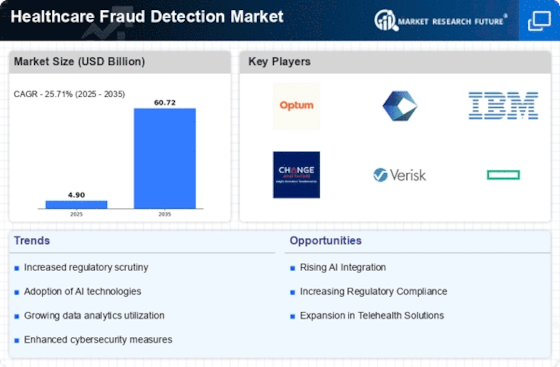
According to Market Research Future Reports analysis, the Healthcare Fraud Detection Market size was valued at USD 4.9 Billion in 2024. The market is projected to grow from USD 6.16 Billion in 2025 to USD 60.72 Billion by 2035, registering a CAGR of 25.7% during the forecast 2025–2035. North America led the market with over 45% share, generating around USD 2.2 billion in revenue.
 
The major growth driver of the market is the rising incidence of healthcare fraud and billing irregularities, prompting adoption of advanced analytics and AI-driven solutions to enhance detection accuracy, reduce financial losses, and ensure compliance across increasingly complex healthcare systems globally.
 
According to the World Health Organization (WHO), up to 6% of global healthcare expenditure is lost annually to fraud and errors, representing billions in losses. Additionally, the CDC emphasizes increasing healthcare transaction volumes, strengthening demand for advanced fraud detection systems and analytics tools globally.

Key Market Trends & Highlights

The Healthcare Fraud Detection Market is experiencing robust growth driven by technological advancements and increasing regulatory demands.

  • North America leads the market with over 45% share, supported by strong regulatory frameworks and advanced healthcare infrastructure. Europe accounted for USD 1.47 billion in 2024, holding around 30% share as the second-largest regional market. Rising healthcare fraud causes nearly 6% financial losses globally, significantly accelerating adoption of advanced fraud detection technologies. Artificial Intelligence dominates with around 42% share, driven by superior capability to detect complex fraudulent healthcare patterns efficiently. Software segment leads with approximately 48% share, supported by increasing demand for advanced analytics and fraud detection platforms. On-premise deployment holds about 55% share due to strict data security requirements and regulatory compliance in healthcare systems.

Market Size & Forecast

2024 Market Size 4.9 (USD Billion)
2035 Market Size 60.72 (USD Billion)
CAGR (2025 - 2035) 25.71%
Largest Regional Market Share in 2024 North America

Major Players

Companies such as Optum (US), <a href="https://www.cognizant.com/us/en/glossary/fraud-detection">Cognizant</a> (US), IBM (US), Change Healthcare (US), Verisk Analytics (US), Hewlett Packard Enterprise (US), <a href="https://www.mckesson.com/">McKesson Corporation </a>(US), Quest Diagnostics (US), FraudScope (US) are some of the major participants in the global market.

Market Trends

The Healthcare Fraud Detection Market is currently experiencing a notable evolution, driven by the increasing complexity of healthcare systems and the rising costs associated with fraudulent activities. Stakeholders are becoming increasingly aware of the need for robust detection mechanisms to safeguard financial resources and maintain the integrity of healthcare services.

As technology advances, the integration of artificial intelligence and machine learning into fraud detection systems appears to enhance the ability to identify suspicious patterns and anomalies. This technological shift not only streamlines the detection process but also allows for more proactive measures to be implemented, potentially reducing the incidence of fraud. Moreover, regulatory bodies are intensifying their focus on compliance and accountability within the healthcare sector.

This heightened scrutiny is likely to propel investments in advanced fraud detection solutions, as organizations strive to adhere to evolving regulations and standards. The collaboration between public and private sectors may also foster innovative approaches to combat fraud, suggesting a trend towards more comprehensive and collaborative strategies. As the Healthcare Fraud Detection Market continues to mature, it seems poised for further growth, driven by the dual forces of technological advancement and regulatory pressure.

Integration of Advanced Technologies

The incorporation of artificial intelligence and machine learning into fraud detection systems is becoming increasingly prevalent. These technologies enhance the ability to analyze vast amounts of data, identifying patterns that may indicate fraudulent behavior. This trend suggests a shift towards more automated and efficient detection processes.

The integration of artificial intelligence and machine learning is accelerating fraud detection efficiency. According to the Centers for Disease Control and Prevention (CDC), healthcare data generation has grown exponentially with millions of patient records processed annually, reinforcing the need for AI-driven analytics to identify anomalies and improve detection accuracy.

Regulatory Compliance and Accountability

With regulatory bodies placing greater emphasis on compliance, organizations are compelled to invest in sophisticated fraud detection solutions. This trend indicates a growing recognition of the importance of adhering to regulations, which may lead to increased collaboration between public and private sectors.

Growing regulatory oversight is pushing healthcare organizations toward advanced fraud detection solutions. The European Centre for Disease Prevention and Control (ECDC) highlights increasing regulatory frameworks across EU healthcare systems, with standardized compliance measures improving transparency and accountability, encouraging adoption of sophisticated fraud prevention technologies across healthcare institutions.

Proactive Fraud Prevention Strategies

There is a noticeable shift towards implementing proactive measures in fraud detection. Organizations are not only focusing on identifying fraud after it occurs but are also developing strategies to prevent it from happening in the first place. This trend highlights a more holistic approach to managing fraud risks.

Healthcare systems are shifting toward proactive fraud prevention strategies. According to the Pan American Health Organization (PAHO), strengthening health system governance across the Americas has improved monitoring of financial flows, reducing inefficiencies and enhancing fraud prevention through early detection systems and predictive analytics integration.

Healthcare Fraud Detection Market Market Drivers

Rising Healthcare Costs

The escalating costs associated with healthcare services are a significant driver for the Healthcare Fraud Detection Market. As expenditures continue to rise, healthcare organizations are under increasing pressure to minimize losses due to fraudulent claims. Reports indicate that healthcare fraud costs the industry billions annually, prompting stakeholders to invest in robust fraud detection systems.
 
The financial implications of unchecked fraud can lead to higher premiums for patients and reduced resources for legitimate care. Consequently, the urgency to implement effective fraud detection measures is likely to stimulate market growth, as organizations seek to protect their financial interests and ensure the sustainability of healthcare services.

Adoption of Data Analytics Solutions

The adoption of data analytics solutions is emerging as a key driver in the Healthcare Fraud Detection Market. With the proliferation of electronic health records and claims data, healthcare organizations are leveraging analytics to uncover insights that can detect fraudulent activities. Advanced analytics tools enable organizations to sift through large datasets, identifying irregularities that may indicate fraud.
 
The market for data analytics in healthcare is projected to grow significantly, with estimates suggesting a compound annual growth rate of over 20% in the coming years. This trend underscores the importance of data-driven decision-making in combating fraud, thereby propelling the demand for innovative fraud detection solutions within the market.

Integration of Artificial Intelligence

The integration of artificial intelligence (AI) technologies into the Healthcare Fraud Detection Market appears to be a pivotal driver. AI algorithms can analyze vast amounts of data, identifying patterns and anomalies that may indicate fraudulent activities. This capability enhances the efficiency of fraud detection systems, allowing for real-time monitoring and response.
 
According to recent estimates, AI-driven solutions could reduce fraud detection costs by up to 30%, thereby improving the overall financial health of healthcare organizations. As healthcare providers increasingly adopt AI technologies, the demand for sophisticated fraud detection solutions is likely to rise, further propelling the growth of the market.

Regulatory Compliance and Accountability

Regulatory compliance remains a crucial driver within the Healthcare Fraud Detection Market. Governments and regulatory bodies are increasingly mandating stringent compliance measures to combat healthcare fraud. Organizations that fail to adhere to these regulations face severe penalties, including hefty fines and reputational damage.
 
The implementation of compliance-driven fraud detection systems is essential for healthcare providers to navigate this complex landscape. As regulations evolve, the demand for advanced fraud detection solutions that ensure compliance is expected to grow. This trend not only safeguards organizations against legal repercussions but also enhances their credibility in the eyes of patients and stakeholders.

Increased Awareness of Fraudulent Activities

The heightened awareness of fraudulent activities in the healthcare sector serves as a significant driver for the Healthcare Fraud Detection Market. Stakeholders, including patients, providers, and insurers, are becoming more vigilant regarding potential fraud schemes. This increased awareness is fostering a culture of accountability and transparency within healthcare organizations.
 
As a result, there is a growing demand for effective fraud detection tools that can identify and mitigate fraudulent claims. Educational initiatives and training programs aimed at recognizing fraud are also contributing to this trend. Consequently, the market is likely to experience growth as organizations invest in solutions that align with this heightened awareness.

Market Segment Insights

By Technology: Artificial Intelligence (Largest) vs. Machine Learning (Fastest-Growing)

In the Healthcare Fraud Detection Market, artificial intelligence (AI) leads the technology segment, accounting for approximately 42% of the market share due to its advanced capabilities in identifying complex fraud patterns. AI's ability to analyze vast datasets and detect patterns of fraudulent behavior positioning it as the frontrunner in this market. Meanwhile, Machine Learning (ML) has emerged as a critical tool for enhancing detection capabilities, enabling healthcare providers to refine their fraud detection strategies more effectively than ever before. The other segments, Data Analytics and Predictive Modeling, play pivotal roles but have yet to unseat AI and ML from their prominent positions. The growth trends indicate an increasing reliance on advanced technological solutions in healthcare fraud detection. With rising fraudulent activities and regulatory requirements, the adoption of AI and ML is accelerating. These technologies are driven by a need for more efficient systems that can adapt to new fraudulent techniques that evolve rapidly. As healthcare organizations become more data-driven, the demand for predictive capabilities through Data Analytics and Predictive Modeling is also increasing, albeit at a slower pace than AI and ML.

Technology: Artificial Intelligence (Dominant) vs. Machine Learning (Emerging)

Artificial Intelligence is the dominant force in the market share, leveraging complex algorithms to analyze extensive datasets and prioritize fraudulent activities. Its efficiency in recognizing suspicious patterns and anomalies has made it a cornerstone technology for many healthcare organizations. In contrast, Machine Learning represents an emerging force, continuously evolving and adapting to new fraud methods. It enables real-time analysis and predictive insights, enhancing overall fraud detection capabilities. While AI sets the standard for market leaders, Machine Learning is rapidly catching up, supported by evolving algorithms and increasing integration into existing systems. The collaboration of both technologies demonstrates a trend towards advanced, combined approaches for tackling healthcare fraud.

By Component: Software (Largest) vs. Services (Fastest-Growing)

In the Healthcare Fraud Detection Market, software solutions dominate the component segment, accounting for approximately 48% of the market share due to their capability to analyze large datasets and deliver advanced fraud analytics. Services, on the other hand, are the fastest-growing sector, driven by increased demand for specialized consultancy and fraud management services in the ever-evolving healthcare landscape. The hardware component, while essential, retains a smaller market share compared to its counterparts, being primarily utilized for data storage and computational support. Growth trends in the healthcare fraud detection segment indicate a robust shift towards integrated solutions that combine software, services, and hardware capabilities. The growing sophistication of fraudulent practices augments the need for advanced <a title="software analytics" href="https://www.marketresearchfuture.com/reports/software-analytics-market-4270" target="_blank" rel="noopener">software analytics</a>, while the expansion of service providers reflects an industry adapting to heightened regulatory scrutiny. Technological advancements and an increasing focus on preventing healthcare fraud drive investments in this sector, amplifying the demand for comprehensive solutions.

Software (Dominant) vs. Services (Emerging)

Software solutions stand out as the dominant force in the market share, primarily due to their capabilities in leveraging artificial intelligence and machine learning for real-time analysis of health records and claims. Vendors in this segment focus on developing sophisticated algorithms that can detect anomalies and flag suspicious activity efficiently. Conversely, services are emerging as a key growth area, as organizations increasingly seek out expertise to navigate the complex landscape of healthcare fraud detection. These services include consulting, implementation, and ongoing support, reflecting a holistic approach to fraud management. As regulations tighten and stakeholders demand transparency, the role of these services in providing customized solutions continues to gain importance, establishing a competitive balance between software and service provisions.

By Application: Claim Verification (Largest) vs. Fraud Analytics (Fastest-Growing)

In the Healthcare Fraud Detection Market, claim verification leads the application segment, accounting for approximately 46% of the market share due to its critical role in detecting and preventing fraudulent claims. This method is widely adopted by healthcare organizations to ensure that the claims submitted are valid and compliant, thereby reducing the risk of false claims. Provider Enrollment Screening also holds a notable share, acting as a crucial step in verifying the credentials and legitimacy of healthcare providers. Fraud Analytics is witnessing an impressive rise in its share, driven by advancements in technology and the increasing need for sophisticated data analysis tools to detect fraudulent activities effectively.

Claim Verification (Dominant) vs. Fraud Analytics (Emerging)

Claim Verification is the dominant application in the market share, characterized by its emphasis on validating claims to combat fraud. It incorporates various auditing techniques and analysis protocols to ensure accuracy and compliance in the claims process. On the other hand, Fraud Analytics, as an emerging application, leverages advanced technologies such as artificial intelligence and machine learning to identify patterns and trends that indicate potential fraud. This emerging segment is gaining traction as organizations recognize the importance of proactive fraud detection strategies, enhancing their operational efficiency and safeguarding their financial assets.

By Deployment Mode: On-Premise (Largest) vs. Cloud-Based (Fastest-Growing)

The Healthcare Fraud Detection Market exhibits a balanced distribution between On-Premise and Cloud-Based deployment modes. On-premise solutions lead the segment, accounting for approximately 55% of the market share, driven by organizations prioritizing data security and strict regulatory compliance. These systems, while requiring significant initial investments and ongoing maintenance, provide comprehensive control to healthcare institutions over their fraud detection processes, making them a go-to option for many healthcare providers. In contrast, Cloud-Based solutions are rapidly gaining traction due to their scalability, cost-effectiveness, and lower operational overhead. As healthcare organizations increasingly adopt advanced analytics and AI-driven technologies, the flexibility and accessibility offered by Cloud-Based deployment are becoming essential. This trend indicates a shift towards more agile, responsive fraud detection systems that can be updated and managed with ease, attracting both small and large healthcare entities alike.

On-Premise (Dominant) vs. Cloud-Based (Emerging)

On-Premise deployment in the Healthcare Fraud Detection Market is characterized by robust security and compliance capabilities, catering to healthcare providers that handle sensitive patient data. Institutions often prefer these solutions for their perceived control and customization options, allowing them to tailor systems to align with specific requirements and regulations. However, the rising popularity of Cloud-Based solutions, recognized as emerging contenders, is notable. These platforms provide significant advantages in terms of flexibility, enabling healthcare organizations to leverage advanced data analytics without the upfront capital expenditure associated with On-Premise setups. As the Healthcare Fraud Detection Market evolves, the demand for more agile and scalable solutions is expected to increase, prompting On-Premise providers to innovate, while Cloud-Based offerings will gain further penetration by addressing integration and management concerns.

Get more detailed insights about Healthcare Fraud Detection Market Research Report - Forecast till 2035

Regional Insights

North America : Leading Market Innovators

North America is the largest market for healthcare fraud detection, holding approximately 45% of the global share. The region's growth is driven by stringent regulations, increasing healthcare costs, and the rising incidence of fraud. The U.S. government has implemented various initiatives to combat healthcare fraud, enhancing demand for advanced detection solutions. The second largest market is Europe, accounting for around 30% of the market share, driven by similar regulatory frameworks and increasing awareness of fraud prevention. The competitive landscape in North America is robust, featuring key players such as Optum, Cognizant, and IBM. These companies leverage advanced technologies like AI and machine learning to enhance fraud detection capabilities. The presence of established healthcare systems and a focus on compliance further bolster the Healthcare Fraud Detection Market. As healthcare providers increasingly adopt these solutions, the Healthcare Fraud Detection Market is expected to witness significant growth in the coming years.

Europe : Regulatory Frameworks Driving Growth

Europe Healthcare Fraud Detection Market was valued at USD 1.47 billion in 2024, making it the second-largest regional market with a 30% share. The growth is fueled by stringent regulations and initiatives from the European Union aimed at combating healthcare fraud. Countries like Germany and the UK are leading the charge, implementing advanced technologies to enhance fraud detection. The increasing complexity of healthcare systems and rising fraud cases are further driving demand for effective solutions in this region. Leading countries in Europe include Germany, the UK, and France, where key players like IBM and Change Healthcare are actively involved. The competitive landscape is characterized by collaborations between technology providers and healthcare organizations to develop innovative solutions. The focus on compliance and regulatory adherence is shaping the Healthcare Fraud Detection Market, ensuring that healthcare providers are equipped with the necessary tools to combat fraud effectively.

Asia-Pacific : Rapid Growth and Adoption

Asia-Pacific is emerging as a significant player in the healthcare fraud detection market, holding approximately 20% of the global share. The region's growth is driven by increasing healthcare expenditures, rising awareness of fraud, and the adoption of advanced technologies. Countries like China and India are witnessing rapid growth in healthcare services, leading to a higher incidence of fraud.

 Regulatory bodies are beginning to implement measures to address these challenges, further propelling market demand. The competitive landscape in Asia-Pacific is evolving, with key players such as Cognizant and Hewlett Packard Enterprise expanding their presence. The region is characterized by a mix of established companies and startups focusing on innovative solutions. As healthcare systems modernize and digital transformation accelerates, the demand for effective fraud detection solutions is expected to rise significantly in the coming years.

Middle East and Africa : Emerging Market Potential

The Middle East and Africa region is gradually developing its healthcare fraud detection market, currently holding about 5% of the global share. The growth is driven by increasing healthcare investments and a rising awareness of fraud-related issues. Governments in countries like South Africa and the UAE are beginning to implement regulations aimed at combating healthcare fraud, which is expected to enhance market demand.

The region's unique challenges, including varying healthcare infrastructure, also play a role in shaping the market landscape. Leading countries in this region include South Africa and the UAE, where there is a growing presence of technology providers. The competitive landscape is characterized by partnerships between local firms and international players to develop tailored solutions. As the healthcare sector continues to evolve, the demand for effective fraud detection mechanisms is anticipated to grow, supported by government initiatives and investments in healthcare technology.

Key Players and Competitive Insights

The Healthcare Fraud Detection Market is currently characterized by a dynamic competitive landscape, driven by the increasing prevalence of fraudulent activities and the growing need for advanced detection solutions. Key players such as Optum (US), Cognizant (US), and IBM (US) are strategically positioned to leverage their technological capabilities and extensive data analytics expertise. These companies are focusing on innovation and digital transformation, which are essential for enhancing their service offerings and maintaining a competitive edge.
 
The collective strategies of these firms contribute to a moderately fragmented market structure, where competition is intensifying as companies seek to differentiate themselves through advanced technologies and strategic partnerships. In terms of business tactics, companies are increasingly localizing their operations and optimizing supply chains to enhance efficiency and responsiveness to market demands.
 
 The competitive structure of the market appears to be moderately fragmented, with several key players exerting influence over various segments. This fragmentation allows for a diverse range of solutions, catering to different customer needs while fostering innovation and collaboration among industry participants. In September 2025, Optum (US) announced a partnership with a leading AI firm to enhance its fraud detection algorithms, aiming to improve accuracy and reduce false positives.
 
This strategic move underscores Optum's commitment to leveraging cutting-edge technology to refine its service offerings, thereby positioning itself as a leader in the Healthcare Fraud Detection Market. The integration of AI into their fraud detection processes is likely to enhance operational efficiency and customer satisfaction, which are critical in a competitive landscape. In August 2025, Cognizant (US) launched a new suite of fraud detection tools that utilize machine learning to analyze claims data in real-time. This initiative reflects Cognizant's focus on innovation and its intent to provide clients with more effective solutions to combat fraud.
 
By harnessing machine learning, Cognizant aims to stay ahead of the curve, offering clients a proactive approach to fraud detection that could significantly reduce financial losses. In July 2025, IBM (US) expanded its blockchain-based fraud detection platform, collaborating with several healthcare providers to enhance data security and transparency.
 
This expansion indicates IBM's strategic focus on integrating blockchain technology into its fraud detection solutions, which may provide a more secure and reliable framework for managing sensitive healthcare data. The emphasis on blockchain could potentially set IBM apart from competitors, as it addresses growing concerns regarding data integrity and security in the healthcare sector. As of October 2025, the competitive trends in the Healthcare Fraud Detection Market are increasingly defined by digitalization, AI integration, and a focus on sustainability.
 
Strategic alliances among key players are shaping the landscape, fostering innovation and enhancing service delivery. Looking ahead, it appears that competitive differentiation will evolve from traditional price-based competition to a focus on technological innovation, reliability in supply chains, and the ability to provide comprehensive, data-driven solutions that address the complexities of healthcare fraud.

Key Companies in the Healthcare Fraud Detection Market include

Industry Developments

The Global Healthcare Fraud Detection Market has experienced significant developments recently, with growing attention on technological solutions to combat fraud in healthcare systems worldwide. Companies such as IBM, NICE Actimize, and Change Healthcare are at the forefront, employing advanced analytics and artificial intelligence to enhance fraud detection capabilities. In a notable move, Anthem announced the acquisition of a Healthcare analytics firm in January 2023 to bolster its fraud detection and prevention efforts.

In the previous years, Quest Diagnostics and Cerner launched collaborative strategies aimed at enhancing efficiency in fraud detection mechanisms, significantly impacting their market positions in mid-2022. Market valuations have been on an upward trajectory, driven by increasing awareness of healthcare fraud, leading to an estimated growth rate of over 15% annually as healthcare providers seek to safeguard their revenue cycles. The rising costs associated with healthcare fraud, projected to reach billions annually, are compelling organizations like Cardinal Health and McKesson to innovate their fraud detection processes.

With a growing focus on regulations and compliance, the Global Healthcare Fraud Detection Market remains dynamic, indicating robust ongoing investment and development within this critical sector.

Future Outlook

Healthcare Fraud Detection Market Future Outlook

The Healthcare Fraud Detection Market size is projected to reach USD 60.72 Billion by 2035, growing at a CAGR of 25.7%, driven by technological advancements, regulatory changes, and increasing fraud incidents.

New opportunities lie in:

  • <p>Integration of AI-driven analytics for real-time fraud detection Development of blockchain solutions for secure patient data management Expansion of telehealth fraud prevention tools and services</p>

By 2035, the Healthcare Fraud Detection Market is expected to be robust, driven by innovative solutions and heightened regulatory scrutiny.

Market Segmentation

Healthcare Fraud Detection Market Component Outlook

  • Software
  • Hardware
  • Services

Healthcare Fraud Detection Market Technology Outlook

  • Artificial Intelligence
  • Machine Learning
  • Data Analytics
  • Predictive Modeling

Healthcare Fraud Detection Market Application Outlook

  • Claim Verification
  • Provider Enrollment Screening
  • Fraud Analytics

Healthcare Fraud Detection Market Deployment Mode Outlook

  • On-Premise
  • Cloud-Based

Report Scope

MARKET SIZE 2024 4.9(USD Billion)
MARKET SIZE 2025 6.16(USD Billion)
MARKET SIZE 2035 60.72(USD Billion)
COMPOUND ANNUAL GROWTH RATE (CAGR) 25.71% (2025 - 2035)
REPORT COVERAGE Revenue Forecast, Competitive Landscape, Growth Factors, and Trends
BASE YEAR 2024
Market Forecast Period 2025 - 2035
Historical Data 2019 - 2024
Market Forecast Units USD Billion
Key Companies Profiled Optum (US), Cognizant (US), IBM (US), Change Healthcare (US), Verisk Analytics (US), Hewlett Packard Enterprise (US), McKesson Corporation (US), Quest Diagnostics (US), FraudScope (US)
Segments Covered Technology, Component, Application, Deployment Mode, Regional
Key Market Opportunities Integration of artificial intelligence and machine learning enhances fraud detection capabilities in the market.
Key Market Dynamics Rising regulatory scrutiny and technological advancements drive innovation in healthcare fraud detection solutions.
Countries Covered North America, Europe, APAC, South America, MEA

FAQs

What is the projected market valuation of the Healthcare Fraud Detection Market by 2035?

The projected market valuation for the market is expected to reach 60.72 USD Billion by 2035.

What was the market valuation of the market in 2024?

The overall market valuation of the market was 4.9 USD Billion in 2024.

What is the expected CAGR for the Healthcare Fraud Detection Market during the forecast period 2025 - 2035?

The expected CAGR for the market during the forecast period 2025 - 2035 is 25.71%.

Which technology segments are leading in the market?

The leading technology segments include Artificial Intelligence, Machine Learning, Data Analytics, and Predictive Modeling, with valuations reaching up to 18.5 USD Billion.

What are the key components driving the Healthcare Fraud Detection Market?

<p>Key components driving the market include Software, Hardware, and Services, with Software alone projected to reach 24.18 USD Billion.</p>

How does the deployment mode affect the market?

The deployment mode significantly impacts the market, with Cloud-Based solutions projected to reach 36.43 USD Billion by 2035.

What applications are most prevalent in the Healthcare Fraud Detection Market?

<p>Prevalent applications include Claim Verification, Provider Enrollment Screening, and Fraud Analytics, with Claim Verification expected to reach 24.0 USD Billion.</p>

Who are the key players in the market?

Key players in the market include Optum, Cognizant, IBM, Change Healthcare, and Verisk Analytics, among others.

What is the significance of predictive modeling in the Healthcare Fraud Detection Market?

<p>Predictive Modeling is significant, with a projected valuation of 15.2 USD Billion, indicating its crucial role in fraud detection.</p>

How does the market performance of Healthcare Fraud Detection compare across different segments?

<p>Market performance varies across segments, with Technology, Component, Application, and Deployment Mode all showing substantial growth potential.</p>

  1. SECTION I: EXECUTIVE SUMMARY AND KEY HIGHLIGHTS |
    1. EXECUTIVE SUMMARY | |
      1. Market Overview | |
      2. Key Findings | |
      3. Market Segmentation | |
      4. Competitive Landscape | |
      5. Challenges and Opportunities | |
      6. Future Outlook 2
  2. SECTION II: SCOPING, METHODOLOGY AND MARKET STRUCTURE |
    1. MARKET INTRODUCTION | |
      1. Definition | |
      2. Scope of the study | | |
    2. RESEARCH METHODOLOGY | |
      1. Overview | |
      2. Data Mining | |
      3. Secondary Research | |
      4. Primary Research | | |
      5. Forecasting Model | |
      6. Market Size Estimation | | |
      7. Data Triangulation | |
      8. Validation 3
  3. SECTION III: QUALITATIVE ANALYSIS |
    1. MARKET DYNAMICS | |
      1. Overview | |
      2. Drivers | |
      3. Restraints | |
      4. Opportunities |
    2. MARKET FACTOR ANALYSIS | |
      1. Value chain Analysis | |
      2. Porter's Five Forces Analysis | | |
      3. COVID-19 Impact Analysis | | |
  4. SECTION IV: QUANTITATIVE ANALYSIS |
    1. Healthcare, BY Technology (USD Billion) | |
      1. Artificial Intelligence | |
      2. Machine Learning | |
      3. Data Analytics | |
      4. Predictive Modeling |
    2. Healthcare, BY Component (USD Billion) | |
      1. Software | |
      2. Hardware | |
      3. Services |
    3. Healthcare, BY Application (USD Billion) | |
      1. Claim Verification | |
      2. Provider Enrollment Screening | |
      3. Fraud Analytics |
    4. Healthcare, BY Deployment Mode (USD Billion) | |
      1. On-Premise | |
      2. Cloud-Based |
    5. Healthcare, BY Region (USD Billion) | |
      1. North America | | |
      2. Europe | | |
      3. APAC | | |
      4. South America | | |
      5. MEA | | |
  5. SECTION V: COMPETITIVE ANALYSIS |
    1. Competitive Landscape | |
      1. Overview | |
      2. Competitive Analysis | |
      3. Market share Analysis | |
      4. Major Growth Strategy in the Healthcare | |
      5. Competitive Benchmarking | |
      6. Leading Players in Terms of Number of Developments in the Healthcare | |
      7. Key developments and growth strategies | | |
      8. Major Players Financial Matrix | | |
    2. Company Profiles | |
      1. Optum (US) | | |
      2. Cognizant (US) | | |
      3. IBM (US) | | |
      4. Change Healthcare (US) | | |
      5. Verisk Analytics (US) | | |
      6. Hewlett Packard Enterprise (US) | | |
      7. McKesson Corporation (US) | | |
      8. Quest Diagnostics (US) | | |
      9. FraudScope (US) | | |
    3. Appendix | |
      1. References | |
      2. Related Reports 6 LIST OF FIGURES |
    4. MARKET SYNOPSIS |
    5. NORTH AMERICA MARKET ANALYSIS |
    6. US MARKET ANALYSIS BY TECHNOLOGY |
    7. US MARKET ANALYSIS BY COMPONENT |
    8. US MARKET ANALYSIS BY APPLICATION |
    9. US MARKET ANALYSIS BY DEPLOYMENT MODE |
    10. CANADA MARKET ANALYSIS BY TECHNOLOGY |
    11. CANADA MARKET ANALYSIS BY COMPONENT |
    12. CANADA MARKET ANALYSIS BY APPLICATION |
    13. CANADA MARKET ANALYSIS BY DEPLOYMENT MODE |
    14. EUROPE MARKET ANALYSIS |
    15. GERMANY MARKET ANALYSIS BY TECHNOLOGY |
    16. GERMANY MARKET ANALYSIS BY COMPONENT |
    17. GERMANY MARKET ANALYSIS BY APPLICATION |
    18. GERMANY MARKET ANALYSIS BY DEPLOYMENT MODE |
    19. UK MARKET ANALYSIS BY TECHNOLOGY |
    20. UK MARKET ANALYSIS BY COMPONENT |
    21. UK MARKET ANALYSIS BY APPLICATION |
    22. UK MARKET ANALYSIS BY DEPLOYMENT MODE |
    23. FRANCE MARKET ANALYSIS BY TECHNOLOGY |
    24. FRANCE MARKET ANALYSIS BY COMPONENT |
    25. FRANCE MARKET ANALYSIS BY APPLICATION |
    26. FRANCE MARKET ANALYSIS BY DEPLOYMENT MODE |
    27. RUSSIA MARKET ANALYSIS BY TECHNOLOGY |
    28. RUSSIA MARKET ANALYSIS BY COMPONENT |
    29. RUSSIA MARKET ANALYSIS BY APPLICATION |
    30. RUSSIA MARKET ANALYSIS BY DEPLOYMENT MODE |
    31. ITALY MARKET ANALYSIS BY TECHNOLOGY |
    32. ITALY MARKET ANALYSIS BY COMPONENT |
    33. ITALY MARKET ANALYSIS BY APPLICATION |
    34. ITALY MARKET ANALYSIS BY DEPLOYMENT MODE |
    35. SPAIN MARKET ANALYSIS BY TECHNOLOGY |
    36. SPAIN MARKET ANALYSIS BY COMPONENT |
    37. SPAIN MARKET ANALYSIS BY APPLICATION |
    38. SPAIN MARKET ANALYSIS BY DEPLOYMENT MODE |
    39. REST OF EUROPE MARKET ANALYSIS BY TECHNOLOGY |
    40. REST OF EUROPE MARKET ANALYSIS BY COMPONENT |
    41. REST OF EUROPE MARKET ANALYSIS BY APPLICATION |
    42. REST OF EUROPE MARKET ANALYSIS BY DEPLOYMENT MODE |
    43. APAC MARKET ANALYSIS |
    44. CHINA MARKET ANALYSIS BY TECHNOLOGY |
    45. CHINA MARKET ANALYSIS BY COMPONENT |
    46. CHINA MARKET ANALYSIS BY APPLICATION |
    47. CHINA MARKET ANALYSIS BY DEPLOYMENT MODE |
    48. INDIA MARKET ANALYSIS BY TECHNOLOGY |
    49. INDIA MARKET ANALYSIS BY COMPONENT |
    50. INDIA MARKET ANALYSIS BY APPLICATION |
    51. INDIA MARKET ANALYSIS BY DEPLOYMENT MODE |
    52. JAPAN MARKET ANALYSIS BY TECHNOLOGY |
    53. JAPAN MARKET ANALYSIS BY COMPONENT |
    54. JAPAN MARKET ANALYSIS BY APPLICATION |
    55. JAPAN MARKET ANALYSIS BY DEPLOYMENT MODE |
    56. SOUTH KOREA MARKET ANALYSIS BY TECHNOLOGY |
    57. SOUTH KOREA MARKET ANALYSIS BY COMPONENT |
    58. SOUTH KOREA MARKET ANALYSIS BY APPLICATION |
    59. SOUTH KOREA MARKET ANALYSIS BY DEPLOYMENT MODE |
    60. MALAYSIA MARKET ANALYSIS BY TECHNOLOGY |
    61. MALAYSIA MARKET ANALYSIS BY COMPONENT |
    62. MALAYSIA MARKET ANALYSIS BY APPLICATION |
    63. MALAYSIA MARKET ANALYSIS BY DEPLOYMENT MODE |
    64. THAILAND MARKET ANALYSIS BY TECHNOLOGY |
    65. THAILAND MARKET ANALYSIS BY COMPONENT |
    66. THAILAND MARKET ANALYSIS BY APPLICATION |
    67. THAILAND MARKET ANALYSIS BY DEPLOYMENT MODE |
    68. INDONESIA MARKET ANALYSIS BY TECHNOLOGY |
    69. INDONESIA MARKET ANALYSIS BY COMPONENT |
    70. INDONESIA MARKET ANALYSIS BY APPLICATION |
    71. INDONESIA MARKET ANALYSIS BY DEPLOYMENT MODE |
    72. REST OF APAC MARKET ANALYSIS BY TECHNOLOGY |
    73. REST OF APAC MARKET ANALYSIS BY COMPONENT |
    74. REST OF APAC MARKET ANALYSIS BY APPLICATION |
    75. REST OF APAC MARKET ANALYSIS BY DEPLOYMENT MODE |
    76. SOUTH AMERICA MARKET ANALYSIS |
    77. BRAZIL MARKET ANALYSIS BY TECHNOLOGY |
    78. BRAZIL MARKET ANALYSIS BY COMPONENT |
    79. BRAZIL MARKET ANALYSIS BY APPLICATION |
    80. BRAZIL MARKET ANALYSIS BY DEPLOYMENT MODE |
    81. MEXICO MARKET ANALYSIS BY TECHNOLOGY |
    82. MEXICO MARKET ANALYSIS BY COMPONENT |
    83. MEXICO MARKET ANALYSIS BY APPLICATION |
    84. MEXICO MARKET ANALYSIS BY DEPLOYMENT MODE |
    85. ARGENTINA MARKET ANALYSIS BY TECHNOLOGY |
    86. ARGENTINA MARKET ANALYSIS BY COMPONENT |
    87. ARGENTINA MARKET ANALYSIS BY APPLICATION |
    88. ARGENTINA MARKET ANALYSIS BY DEPLOYMENT MODE |
    89. REST OF SOUTH AMERICA MARKET ANALYSIS BY TECHNOLOGY |
    90. REST OF SOUTH AMERICA MARKET ANALYSIS BY COMPONENT |
    91. REST OF SOUTH AMERICA MARKET ANALYSIS BY APPLICATION |
    92. REST OF SOUTH AMERICA MARKET ANALYSIS BY DEPLOYMENT MODE |
    93. MEA MARKET ANALYSIS |
    94. GCC COUNTRIES MARKET ANALYSIS BY TECHNOLOGY |
    95. GCC COUNTRIES MARKET ANALYSIS BY COMPONENT |
    96. GCC COUNTRIES MARKET ANALYSIS BY APPLICATION |
    97. GCC COUNTRIES MARKET ANALYSIS BY DEPLOYMENT MODE |
    98. SOUTH AFRICA MARKET ANALYSIS BY TECHNOLOGY |
    99. SOUTH AFRICA MARKET ANALYSIS BY COMPONENT |
    100. SOUTH AFRICA MARKET ANALYSIS BY APPLICATION |
    101. SOUTH AFRICA MARKET ANALYSIS BY DEPLOYMENT MODE |
    102. REST OF MEA MARKET ANALYSIS BY TECHNOLOGY |
    103. REST OF MEA MARKET ANALYSIS BY COMPONENT |
    104. REST OF MEA MARKET ANALYSIS BY APPLICATION |
    105. REST OF MEA MARKET ANALYSIS BY DEPLOYMENT MODE |
    106. KEY BUYING CRITERIA OF HEALTHCARE |
    107. RESEARCH PROCESS OF MRFR |
    108. DRO ANALYSIS OF HEALTHCARE |
    109. DRIVERS IMPACT ANALYSIS: HEALTHCARE |
    110. RESTRAINTS IMPACT ANALYSIS: HEALTHCARE |
    111. SUPPLY / VALUE CHAIN: HEALTHCARE |
    112. HEALTHCARE, BY TECHNOLOGY, 2024 (% SHARE) |
    113. HEALTHCARE, BY TECHNOLOGY, 2024 TO 2035 (USD Billion) |
    114. HEALTHCARE, BY COMPONENT, 2024 (% SHARE) |
    115. HEALTHCARE, BY COMPONENT, 2024 TO 2035 (USD Billion) |
    116. HEALTHCARE, BY APPLICATION, 2024 (% SHARE) |
    117. HEALTHCARE, BY APPLICATION, 2024 TO 2035 (USD Billion) |
    118. HEALTHCARE, BY DEPLOYMENT MODE, 2024 (% SHARE) |
    119. HEALTHCARE, BY DEPLOYMENT MODE, 2024 TO 2035 (USD Billion) |
    120. BENCHMARKING OF MAJOR COMPETITORS 7 LIST OF TABLES |
    121. LIST OF ASSUMPTIONS | |
      1. |
    122. North America MARKET SIZE ESTIMATES; FORECAST | |
      1. BY TECHNOLOGY, 2025-2035 (USD Billion) | |
      2. BY COMPONENT, 2025-2035 (USD Billion) | |
      3. BY APPLICATION, 2025-2035 (USD Billion) | |
      4. BY DEPLOYMENT MODE, 2025-2035 (USD Billion) |
    123. US MARKET SIZE ESTIMATES; FORECAST | |
      1. BY TECHNOLOGY, 2025-2035 (USD Billion) | |
      2. BY COMPONENT, 2025-2035 (USD Billion) | |
      3. BY APPLICATION, 2025-2035 (USD Billion) | |
      4. BY DEPLOYMENT MODE, 2025-2035 (USD Billion) |
    124. Canada MARKET SIZE ESTIMATES; FORECAST | |
      1. BY TECHNOLOGY, 2025-2035 (USD Billion) | |
      2. BY COMPONENT, 2025-2035 (USD Billion) | |
      3. BY APPLICATION, 2025-2035 (USD Billion) | |
      4. BY DEPLOYMENT MODE, 2025-2035 (USD Billion) |
    125. Europe MARKET SIZE ESTIMATES; FORECAST | |
      1. BY TECHNOLOGY, 2025-2035 (USD Billion) | |
      2. BY COMPONENT, 2025-2035 (USD Billion) | |
      3. BY APPLICATION, 2025-2035 (USD Billion) | |
      4. BY DEPLOYMENT MODE, 2025-2035 (USD Billion) |
    126. Germany MARKET SIZE ESTIMATES; FORECAST | |
      1. BY TECHNOLOGY, 2025-2035 (USD Billion) | |
      2. BY COMPONENT, 2025-2035 (USD Billion) | |
      3. BY APPLICATION, 2025-2035 (USD Billion) | |
      4. BY DEPLOYMENT MODE, 2025-2035 (USD Billion) |
    127. UK MARKET SIZE ESTIMATES; FORECAST | |
      1. BY TECHNOLOGY, 2025-2035 (USD Billion) | |
      2. BY COMPONENT, 2025-2035 (USD Billion) | |
      3. BY APPLICATION, 2025-2035 (USD Billion) | |
      4. BY DEPLOYMENT MODE, 2025-2035 (USD Billion) |
    128. France MARKET SIZE ESTIMATES; FORECAST | |
      1. BY TECHNOLOGY, 2025-2035 (USD Billion) | |
      2. BY COMPONENT, 2025-2035 (USD Billion) | |
      3. BY APPLICATION, 2025-2035 (USD Billion) | |
      4. BY DEPLOYMENT MODE, 2025-2035 (USD Billion) |
    129. Russia MARKET SIZE ESTIMATES; FORECAST | |
      1. BY TECHNOLOGY, 2025-2035 (USD Billion) | |
      2. BY COMPONENT, 2025-2035 (USD Billion) | |
      3. BY APPLICATION, 2025-2035 (USD Billion) | |
      4. BY DEPLOYMENT MODE, 2025-2035 (USD Billion) |
    130. Italy MARKET SIZE ESTIMATES; FORECAST | |
      1. BY TECHNOLOGY, 2025-2035 (USD Billion) | |
      2. BY COMPONENT, 2025-2035 (USD Billion) | |
      3. BY APPLICATION, 2025-2035 (USD Billion) | |
      4. BY DEPLOYMENT MODE, 2025-2035 (USD Billion) |
    131. Spain MARKET SIZE ESTIMATES; FORECAST | |
      1. BY TECHNOLOGY, 2025-2035 (USD Billion) | |
      2. BY COMPONENT, 2025-2035 (USD Billion) | |
      3. BY APPLICATION, 2025-2035 (USD Billion) | |
      4. BY DEPLOYMENT MODE, 2025-2035 (USD Billion) |
    132. Rest of Europe MARKET SIZE ESTIMATES; FORECAST | |
      1. BY TECHNOLOGY, 2025-2035 (USD Billion) | |
      2. BY COMPONENT, 2025-2035 (USD Billion) | |
      3. BY APPLICATION, 2025-2035 (USD Billion) | |
      4. BY DEPLOYMENT MODE, 2025-2035 (USD Billion) |
    133. APAC MARKET SIZE ESTIMATES; FORECAST | |
      1. BY TECHNOLOGY, 2025-2035 (USD Billion) | |
      2. BY COMPONENT, 2025-2035 (USD Billion) | |
      3. BY APPLICATION, 2025-2035 (USD Billion) | |
      4. BY DEPLOYMENT MODE, 2025-2035 (USD Billion) |
    134. China MARKET SIZE ESTIMATES; FORECAST | |
      1. BY TECHNOLOGY, 2025-2035 (USD Billion) | |
      2. BY COMPONENT, 2025-2035 (USD Billion) | |
      3. BY APPLICATION, 2025-2035 (USD Billion) | |
      4. BY DEPLOYMENT MODE, 2025-2035 (USD Billion) |
    135. India MARKET SIZE ESTIMATES; FORECAST | |
      1. BY TECHNOLOGY, 2025-2035 (USD Billion) | |
      2. BY COMPONENT, 2025-2035 (USD Billion) | |
      3. BY APPLICATION, 2025-2035 (USD Billion) | |
      4. BY DEPLOYMENT MODE, 2025-2035 (USD Billion) |
    136. Japan MARKET SIZE ESTIMATES; FORECAST | |
      1. BY TECHNOLOGY, 2025-2035 (USD Billion) | |
      2. BY COMPONENT, 2025-2035 (USD Billion) | |
      3. BY APPLICATION, 2025-2035 (USD Billion) | |
      4. BY DEPLOYMENT MODE, 2025-2035 (USD Billion) |
    137. South Korea MARKET SIZE ESTIMATES; FORECAST | |
      1. BY TECHNOLOGY, 2025-2035 (USD Billion) | |
      2. BY COMPONENT, 2025-2035 (USD Billion) | |
      3. BY APPLICATION, 2025-2035 (USD Billion) | |
      4. BY DEPLOYMENT MODE, 2025-2035 (USD Billion) |
    138. Malaysia MARKET SIZE ESTIMATES; FORECAST | |
      1. BY TECHNOLOGY, 2025-2035 (USD Billion) | |
      2. BY COMPONENT, 2025-2035 (USD Billion) | |
      3. BY APPLICATION, 2025-2035 (USD Billion) | |
      4. BY DEPLOYMENT MODE, 2025-2035 (USD Billion) |
    139. Thailand MARKET SIZE ESTIMATES; FORECAST | |
      1. BY TECHNOLOGY, 2025-2035 (USD Billion) | |
      2. BY COMPONENT, 2025-2035 (USD Billion) | |
      3. BY APPLICATION, 2025-2035 (USD Billion) | |
      4. BY DEPLOYMENT MODE, 2025-2035 (USD Billion) |
    140. Indonesia MARKET SIZE ESTIMATES; FORECAST | |
      1. BY TECHNOLOGY, 2025-2035 (USD Billion) | |
      2. BY COMPONENT, 2025-2035 (USD Billion) | |
      3. BY APPLICATION, 2025-2035 (USD Billion) | |
      4. BY DEPLOYMENT MODE, 2025-2035 (USD Billion) |
    141. Rest of APAC MARKET SIZE ESTIMATES; FORECAST | |
      1. BY TECHNOLOGY, 2025-2035 (USD Billion) | |
      2. BY COMPONENT, 2025-2035 (USD Billion) | |
      3. BY APPLICATION, 2025-2035 (USD Billion) | |
      4. BY DEPLOYMENT MODE, 2025-2035 (USD Billion) |
    142. South America MARKET SIZE ESTIMATES; FORECAST | |
      1. BY TECHNOLOGY, 2025-2035 (USD Billion) | |
      2. BY COMPONENT, 2025-2035 (USD Billion) | |
      3. BY APPLICATION, 2025-2035 (USD Billion) | |
      4. BY DEPLOYMENT MODE, 2025-2035 (USD Billion) |
    143. Brazil MARKET SIZE ESTIMATES; FORECAST | |
      1. BY TECHNOLOGY, 2025-2035 (USD Billion) | |
      2. BY COMPONENT, 2025-2035 (USD Billion) | |
      3. BY APPLICATION, 2025-2035 (USD Billion) | |
      4. BY DEPLOYMENT MODE, 2025-2035 (USD Billion) |
    144. Mexico MARKET SIZE ESTIMATES; FORECAST | |
      1. BY TECHNOLOGY, 2025-2035 (USD Billion) | |
      2. BY COMPONENT, 2025-2035 (USD Billion) | |
      3. BY APPLICATION, 2025-2035 (USD Billion) | |
      4. BY DEPLOYMENT MODE, 2025-2035 (USD Billion) |
    145. Argentina MARKET SIZE ESTIMATES; FORECAST | |
      1. BY TECHNOLOGY, 2025-2035 (USD Billion) | |
      2. BY COMPONENT, 2025-2035 (USD Billion) | |
      3. BY APPLICATION, 2025-2035 (USD Billion) | |
      4. BY DEPLOYMENT MODE, 2025-2035 (USD Billion) |
    146. Rest of South America MARKET SIZE ESTIMATES; FORECAST | |
      1. BY TECHNOLOGY, 2025-2035 (USD Billion) | |
      2. BY COMPONENT, 2025-2035 (USD Billion) | |
      3. BY APPLICATION, 2025-2035 (USD Billion) | |
      4. BY DEPLOYMENT MODE, 2025-2035 (USD Billion) |
    147. MEA MARKET SIZE ESTIMATES; FORECAST | |
      1. BY TECHNOLOGY, 2025-2035 (USD Billion) | |
      2. BY COMPONENT, 2025-2035 (USD Billion) | |
      3. BY APPLICATION, 2025-2035 (USD Billion) | |
      4. BY DEPLOYMENT MODE, 2025-2035 (USD Billion) |
    148. GCC Countries MARKET SIZE ESTIMATES; FORECAST | |
      1. BY TECHNOLOGY, 2025-2035 (USD Billion) | |
      2. BY COMPONENT, 2025-2035 (USD Billion) | |
      3. BY APPLICATION, 2025-2035 (USD Billion) | |
      4. BY DEPLOYMENT MODE, 2025-2035 (USD Billion) |
    149. South Africa MARKET SIZE ESTIMATES; FORECAST | |
      1. BY TECHNOLOGY, 2025-2035 (USD Billion) | |
      2. BY COMPONENT, 2025-2035 (USD Billion) | |
      3. BY APPLICATION, 2025-2035 (USD Billion) | |
      4. BY DEPLOYMENT MODE, 2025-2035 (USD Billion) |
    150. Rest of MEA MARKET SIZE ESTIMATES; FORECAST | |
      1. BY TECHNOLOGY, 2025-2035 (USD Billion) | |
      2. BY COMPONENT, 2025-2035 (USD Billion) | |
      3. BY APPLICATION, 2025-2035 (USD Billion) | |
      4. BY DEPLOYMENT MODE, 2025-2035 (USD Billion) |
    151. PRODUCT LAUNCH/PRODUCT DEVELOPMENT/APPROVAL | |
      1. |
    152. ACQUISITION/PARTNERSHIP | |

Healthcare Market Segmentation

Healthcare By Technology (USD Billion, 2025-2035)

  • Artificial Intelligence
  • Machine Learning
  • Data Analytics
  • Predictive Modeling

Healthcare By Component (USD Billion, 2025-2035)

  • Software
  • Hardware
  • Services

Healthcare By Application (USD Billion, 2025-2035)

  • Claim Verification
  • Provider Enrollment Screening
  • Fraud Analytics

Healthcare By Deployment Mode (USD Billion, 2025-2035)

  • On-Premise
  • Cloud-Based
Infographic

Free Sample Request

Kindly complete the form below to receive a free sample of this Report

Get Free Sample

Customer Strories

Compare Licence

×
Features License Type
Single User Multiuser License Enterprise User
Price $4,950 $5,950 $7,250
Maximum User Access Limit 1 User Upto 10 Users Unrestricted Access Throughout the Organization
Free Customization
Direct Access to Analyst
Deliverable Format
Platform Access
Discount on Next Purchase 10% 15% 15%
Printable Versions