Request Free Sample ×

Kindly complete the form below to receive a free sample of this Report

* Please use a valid business email

Leading companies partner with us for data-driven Insights

clients tt-cursor
Hero Background
English
Chinese
French
Japanese
Korean
German
Spanish

Health Supplements Market Size

ID: MRFR/Pharma/1115-HCR
85 Pages
Satyendra Maurya
March 2026

Health Supplements Market Research Report Information By Type (Dietary Supplements, Bodybuilding Supplements, Eye Health Supplements, Specialty Supplements, Others), By Application (Cardiology, Rheumatic Disorders, Allergy, Others), By Ingredients (Vitamins & Minerals, Amino Acids, Botanicals, Enzymes, Others), By End-Users (Hospitals, Clinics, Research Centers, Other) And By Region (North America, Europe, Asia-Pacific, And Rest Of The World) –Market Forecast Till 2035

Share:
Download PDF ×

We do not share your information with anyone. However, we may send you emails based on your report interest from time to time. You may contact us at any time to opt-out.

Health Supplements Market Infographic
Purchase Options

Health Supplements Size

Health Supplements Market Growth Projections and Opportunities

The Ayurveda market is fundamentally influenced by a surge in consumer interest in all-encompassing and regular healthcare arrangements. As people seek alternatives to conventional medicine, the demand for Ayurvedic items and treatments has witnessed a significant increase. This trend drives market development, inciting companies to expand their item portfolios to meet diverse consumer needs. The rich heritage and conventional knowledge associated with Ayurveda contribute to its market elements. Consumers often value items and therapies rooted in ancient customs for their perceived authenticity and regular beginnings. Market players leverage this social significance to fabricate brand trust and differentiate their offerings in a competitive landscape. Ayurveda's globalization has brought about significant export prospects for enterprises in this area. As Ayurvedic concepts become more widely known, there is a growing demand for real Ayurvedic products. Companies who can achieve worldwide standards of excellence and regulatory criteria can enter new markets, contributing to the growth of the Ayurveda industry. The rise of computerized platforms and e-commerce has transformed the dissemination channels for Ayurvedic items. Online platforms provide a convenient way for consumers to access a wide range of Ayurvedic offerings. Companies embracing computerized strategies and establishing a powerful online presence can reach a broader consumer base, driving market accessibility and development. Increasing awareness of wellness and preventive healthcare has propelled the Ayurveda market forward. Consumers are proactively seeking Ayurvedic answers for maintaining overall well-being and preventing health issues. Market players adjusting their items to these wellness trends are well-positioned to cater to a health-cognizant consumer demographic. The Ayurveda market experiences diversification through the presentation of a wide exhibit of items beyond customary medicines. Companies expand their product offerings to include skincare, haircare, dietary supplements, and more. This diversification caters to the evolving preferences of consumers, driving market development and offering a comprehensive range of Ayurvedic arrangements.

Health Supplements Market Size Graph
Author
Author Profile
Satyendra Maurya
Research Analyst

An accomplished research analyst with high proficiency in market forecasting, data visualization, competitive benchmarking, and others. He holds a pronounced track record in research and consulting projects for sectors such as life sciences, medical devices, and healthcare IT. His capabilities in qualitative and quantitative analysis have resulted in positive client outcomes. Working on niche market trends, opportunities, sales, and forecasted value is part of his skill set.

Leave a Comment

FAQs

What is the projected market valuation of The Global Health Supplements by 2035?

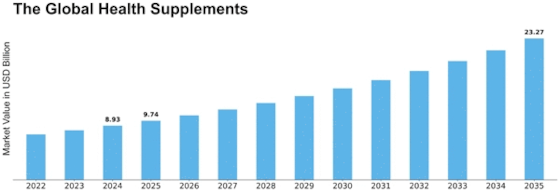
<p>The projected market valuation for The Global Health Supplements by 2035 is 23.27 USD Billion.</p>

What was the market valuation of The Global Health Supplements in 2024?

<p>The overall market valuation of The Global Health Supplements was 8.927 USD Billion in 2024.</p>

What is the expected CAGR for The Global Health Supplements during the forecast period 2025 - 2035?

<p>The expected CAGR for The Global Health Supplements during the forecast period 2025 - 2035 is 9.1%.</p>

Which segment is projected to have the highest growth in The Global Health Supplements?

<p>The Dietary Supplements segment is projected to grow from 3.5 USD Billion in 2024 to 9.5 USD Billion by 2035.</p>

What are the key applications driving The Global Health Supplements?

<p>Key applications include Cardiology, projected to grow from 2.5 USD Billion in 2024 to 6.5 USD Billion by 2035.</p>

Which ingredient segment is expected to see significant growth in The Global Health Supplements?

<p>The Vitamins & Minerals segment is expected to grow from 2.5 USD Billion in 2024 to 6.5 USD Billion by 2035.</p>

Who are the leading players in The Global Health Supplements?

<p>Leading players in the market include Herbalife, Amway, and GNC Holdings, among others.</p>

What is the projected growth for Bodybuilding Supplements in The Global Health Supplements?

<p>Bodybuilding Supplements are projected to grow from 1.5 USD Billion in 2024 to 4.0 USD Billion by 2035.</p>

How are hospitals contributing to The Global Health Supplements?

<p>Hospitals are projected to increase their contribution from 2.5 USD Billion in 2024 to 6.5 USD Billion by 2035.</p>

What is the growth outlook for Specialty Supplements in The Global Health Supplements?

<p>Specialty Supplements are expected to grow from 1.2 USD Billion in 2024 to 3.0 USD Billion by 2035.</p>

Market Summary

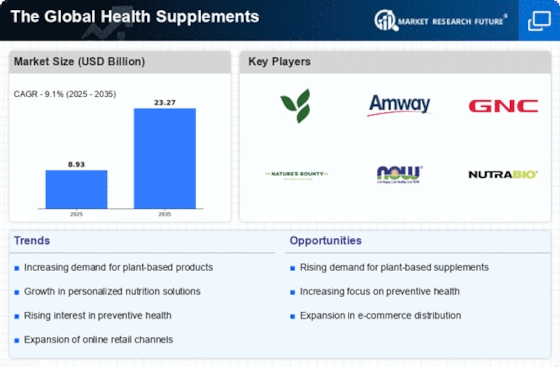
As per Market Research Future analysis, The Global Health Supplements Market was estimated at 8.927 USD Billion in 2024. The health supplements industry is projected to grow from 9.739 USD Billion in 2025 to 23.27 USD Billion by 2035, exhibiting a compound annual growth rate (CAGR) of 9.1% during the forecast period 2025 - 2035

Key Market Trends & Highlights

The Global Health Supplements Market is experiencing a dynamic shift towards natural and preventive health solutions.

  • The rise of plant-based supplements is reshaping consumer preferences, particularly in North America. Preventive health measures are gaining traction, driving demand for dietary supplements as a proactive approach to wellness. Asia-Pacific is emerging as the fastest-growing region, fueled by increasing health awareness and a younger demographic. Key market drivers include rising health consciousness and the aging population, which are propelling growth in both dietary and specialty supplements.

Market Size & Forecast

2024 Market Size 8.927 (USD Billion)
2035 Market Size 23.27 (USD Billion)
CAGR (2025 - 2035) 9.1%
Largest Regional Market Share in 2024 North America

Major Players

Herbalife (US), <a href="https://www.amway.in/nutrition-supplement/c/health-supplements">Amway </a>(US), GNC Holdings (US), <a href="https://naturesbounty.com/">Nature's Bounty</a> (US), NOW Foods (US), <a href="https://nutrabio.com/?srsltid=AfmBOoqja1eVxZiNCNbj2Ls9n4kFkSYsNjdqTmNJZ0rV-UtCQLP2YikN">NutraBio Labs</a> (US), Garden of Life (US), Swanson Health Products (US), Blackmores (AU), Usana Health Sciences (US)

Market Trends

The Global Health Supplements Market is currently experiencing a dynamic evolution, driven by a growing awareness of health and wellness product among consumers. This market encompasses a wide array of products, including vitamins, minerals, herbal supplements, and functional foods, which are increasingly integrated into daily routines. As individuals become more health-conscious, the demand for natural and organic ingredients appears to be on the rise. This shift suggests a potential transformation in consumer preferences, with a focus on products that promote overall well-being and preventive health measures. Furthermore, the influence of digital platforms and e-commerce is reshaping how consumers access and purchase health supplements, indicating a significant shift in distribution channels. In addition, The Global Health Supplements Market seems to be witnessing an increase in personalized nutrition, where products are tailored to meet individual health needs and preferences. This trend may reflect a broader societal movement towards customization in various sectors, including food and wellness. As consumers seek solutions that align with their unique lifestyles, companies are likely to innovate and diversify their offerings. Overall, the market appears poised for continued growth, driven by evolving consumer behaviors and advancements in product development.

Rise of Plant-Based Supplements

There is a noticeable trend towards plant-based health supplements, as consumers increasingly seek natural alternatives to synthetic products. This shift reflects a broader preference for sustainability and environmental consciousness, with many individuals opting for supplements derived from botanical sources.

Focus on Preventive Health

The emphasis on preventive health measures is becoming more pronounced, as consumers recognize the importance of maintaining wellness rather than merely treating ailments. This trend is likely to drive demand for supplements that support immune function, digestive health, and overall vitality.

Integration of Technology in Health Solutions

The integration of technology into health solutions is gaining traction, with innovations such as mobile applications and wearable medical devices enhancing consumer engagement. This trend suggests that technology may play a crucial role in personalizing health supplement recommendations and tracking individual health goals.

Health Supplements Market Market Drivers

Aging Population

The demographic shift towards an aging population is another significant driver impacting the health supplements market. As individuals age, they often experience a decline in health and vitality, prompting a greater reliance on dietary supplements to maintain their quality of life. Market data suggests that the segment of consumers aged 50 and above is increasingly investing in health supplements, with a notable focus on products that support joint health, cognitive function, and cardiovascular wellness. This demographic trend is expected to contribute substantially to the growth of the health supplements market, as older adults seek to mitigate age-related health issues through preventive measures.

E-commerce Expansion

The rapid expansion of e-commerce platforms is transforming the way consumers access health supplements, thereby driving growth in the health supplements market. Online shopping offers convenience and a wider selection of products, allowing consumers to explore various brands and formulations from the comfort of their homes. Recent market data indicates that online sales of health supplements have surged, accounting for a significant portion of total sales. This trend is likely to continue, as more consumers embrace digital shopping experiences. The health supplements market is thus benefiting from this shift, as e-commerce provides an effective channel for reaching a broader audience and catering to diverse consumer preferences.

Focus on Mental Health

The increasing focus on mental health and well-being is emerging as a crucial driver for the health supplements market. As awareness of mental health issues grows, consumers are seeking supplements that support cognitive function, reduce stress, and enhance mood. Market data suggests that products targeting mental health are experiencing significant growth, with consumers increasingly turning to supplements such as omega-3 fatty acids, adaptogens, and herbal extracts. This trend reflects a broader societal shift towards holistic health approaches, where mental and physical well-being are viewed as interconnected. Consequently, the health supplements market is likely to see continued innovation and expansion in this area.

Increasing Health Consciousness

The rising awareness regarding health and wellness among consumers appears to be a primary driver for the health supplements market. Individuals are increasingly prioritizing their health, leading to a surge in demand for products that support overall well-being. This trend is reflected in the market data, which indicates that the health supplements market is projected to grow at a compound annual growth rate of approximately 8.5% over the next few years. Consumers are actively seeking supplements that enhance their immune systems, improve energy levels, and promote longevity. This shift towards a more health-conscious lifestyle is likely to continue influencing purchasing decisions, thereby propelling the growth of the health supplements market.

Rising Interest in Natural Ingredients

There is a growing trend towards natural and organic ingredients in health supplements, which is significantly influencing the health supplements market. Consumers are increasingly wary of synthetic additives and are opting for products that contain natural, plant-based components. This shift is supported by market data indicating that the demand for organic health supplements has risen sharply, with many consumers willing to pay a premium for products that align with their values. As a result, manufacturers are reformulating their products to include more natural ingredients, which is likely to enhance their appeal and drive sales within the health supplements market.

Market Segment Insights

By Type: Dietary Supplements (Largest) vs. Specialty Supplements (Fastest-Growing)

<p>In The Global Health Supplements, Dietary Supplements hold the largest market share, reflecting their widespread adoption among consumers seeking improved health and wellness. Following closely are Bodybuilding Supplements and Eye Health Supplements, which cater to specific consumer needs. Specialty Supplements are gaining traction as personalized health solutions evolve, targeting specific deficiencies and health enhancements, contributing to a dynamic market landscape.</p>

<p>Dietary Supplements (Dominant) vs. Specialty Supplements (Emerging)</p>

<p>Dietary Supplements have become a dominant force in The Global Health Supplements, characterized by a wide range of products designed to fill nutritional gaps. Their comprehensive nature caters to various demographics, including those focused on general wellness and preventative health. In contrast, Specialty Supplements are emerging with a focused approach, concentrating on specific health needs such as immune support, cognitive function, and digestive health. This segment benefits from increasing consumer awareness about personalized nutrition and health optimization, making them a significant driver of market growth. The adaptability of these products to address targeted health concerns positions them uniquely in the market, appealing to health-conscious individuals.</p>

By Application: Cardiology (Largest) vs. Allergy (Fastest-Growing)

<p>In The Global Health Supplements, the application segment shows varied distribution, with cardiology emerging as the largest segment due to the increasing prevalence of cardiovascular diseases and the growing awareness of heart health. Additionally, rheumatic disorders and allergy segments hold significant shares, focusing on the growing populations seeking preventive measures and treatments through health supplements. The 'others' category, while smaller, captures niche applications that collectively contribute to the market's diversity.</p>

<p>Cardiology (Dominant) vs. Allergy (Emerging)</p>

<p>The cardiology segment stands out as a dominant force, driven by rising health consciousness among consumers and a proactive approach towards heart health. This segment emphasizes the incorporation of dietary supplements that support cardiovascular functions, claiming a considerable market share. In contrast, the allergy segment is the fastest-growing, catering to an increasing number of individuals suffering from allergies, particularly due to environmental changes and lifestyle factors. With a surge in demand for natural and holistic approaches to allergy relief, this segment is capitalizing on the growing trend towards preventive health measures, positioning itself as an emerging leader in the health supplements arena.</p>

By Ingredients: Vitamins & Minerals (Largest) vs. Botanicals (Fastest-Growing)

<p>In The Global Health Supplements, the ingredients segment is primarily dominated by Vitamins & Minerals, which hold the largest market share. This significant share reflects consumer reliance on these essential nutrients for overall health and wellness. Elements such as Vitamin D, C, and various minerals have become staples in health supplement formulations, appealing to a broad demographic seeking preventive health measures. Conversely, the Botanicals segment is witnessing rapid growth and is identified as the fastest-growing category within the ingredients scope. This surge is propelled by a surge in consumer interest in natural health products. As more individuals seek alternatives to synthetic ingredients, the appeal of herbal remedies and plant-derived supplements continues to rise, especially among health-conscious consumers seeking holistic wellness solutions.</p>

<p>Vitamins & Minerals (Dominant) vs. Botanicals (Emerging)</p>

<p>Vitamins & Minerals remain the dominant force in The Global Health Supplements, representing a well-established segment favored for their proven effectiveness in supporting health. Products like multivitamins and mineral supplements cater to diverse health needs, from immune support to bone health, which resonate with consumers' preventive health strategies. On the other hand, Botanicals are emerging as a key player, driven by increased consumer awareness about natural ingredients. Trends in holistic health promote the use of standardized herbal extracts and traditional remedies, boosting their presence in the supplement design. As consumers prioritize clean-label products, botanicals are positioned to capture market interest, reflecting a shift towards more natural, plant-based options in health supplementation.</p>

By End-Users: Hospitals (Largest) vs. Clinics (Fastest-Growing)

<p>In The Global Health Supplements, hospitals represent the largest segment by end-users, driven by their comprehensive healthcare services and integrated wellness programs. Clinics, however, are emerging as a significant player, with a growing share as they increasingly prioritize preventive healthcare and complementary therapies. Research centers and other entities also contribute to the landscape, but they hold a smaller market share compared to the leading segments.</p>

<p>Hospitals (Dominant) vs. Clinics (Emerging)</p>

<p>The hospitals segment is characterized by extensive resources and a wide range of health supplement offerings, including vitamins, minerals, and herbal products aimed at supporting patient health. Their established credibility allows hospitals to serve as trusted sources for health supplements, making them a dominant player in the market. Conversely, clinics are experiencing rapid growth as they attract a diverse patient population seeking accessible and individualized care, often leveraging health supplements to enhance treatment outcomes. This emerging segment focuses on patient engagement and education, positioning itself as a crucial avenue for the distribution of health supplements.</p>

Get more detailed insights about Health Supplements Market Research Report- Forecast till 2035

Regional Insights

North America : Health Innovation Leader

North America is the largest market for health supplements, accounting for approximately 40% of the global share. The region's growth is driven by increasing health awareness, a rise in preventive healthcare, and a growing aging population. Regulatory support from agencies like the FDA ensures product safety and efficacy, further boosting consumer confidence in health supplements. The demand for natural and organic products is also on the rise, contributing to market expansion. The United States leads the North American market, with key players such as Herbalife, Amway, and GNC Holdings dominating the landscape. Canada follows as the second-largest market, driven by a growing interest in wellness and fitness. The competitive landscape is characterized by a mix of established brands and emerging companies, all vying for market share in a rapidly evolving sector. The presence of major players ensures a diverse range of products catering to various consumer needs.

Europe : Regulatory Framework Strength

Europe is the second-largest market for health supplements, holding approximately 30% of the global share. The region's growth is fueled by increasing consumer awareness regarding health and wellness, along with a shift towards preventive healthcare. Stringent regulations from the European Food Safety Authority (EFSA) ensure product quality and safety, which enhances consumer trust and drives market growth. The demand for plant-based and organic supplements is particularly strong in this region. Leading countries in Europe include Germany, the UK, and France, with Germany being the largest market. The competitive landscape features a mix of local and international brands, including Nature's Bounty and Blackmores. The presence of established players, along with a growing number of startups, contributes to a dynamic market environment. Consumers are increasingly seeking innovative products that align with their health goals, further propelling market growth.

Asia-Pacific : Emerging Market Potential

Asia-Pacific is an emerging powerhouse in the health supplements market, accounting for approximately 20% of the global share. The region's growth is driven by rising disposable incomes, increasing health consciousness, and a growing aging population. Regulatory frameworks are evolving, with countries like Australia and Japan implementing stringent guidelines to ensure product safety and efficacy. The demand for herbal and traditional supplements is particularly strong, reflecting cultural preferences in the region. China and India are the leading markets in Asia-Pacific, with significant contributions from local manufacturers and international brands. The competitive landscape is characterized by a mix of established companies and new entrants, all aiming to capture the growing consumer base. Key players like Usana Health Sciences and Swanson Health Products are expanding their presence, catering to the diverse needs of health-conscious consumers in the region.

Middle East and Africa : Untapped Market Opportunities

The Middle East and Africa represent a resource-rich frontier for the health supplements market, holding approximately 10% of the global share. The region's growth is driven by increasing urbanization, rising disposable incomes, and a growing awareness of health and wellness. Regulatory bodies are beginning to establish frameworks to ensure product safety, which is crucial for market expansion. The demand for dietary supplements is on the rise, particularly among the younger population seeking healthier lifestyles. Leading countries in this region include South Africa, the UAE, and Nigeria, with South Africa being the largest market. The competitive landscape is still developing, with a mix of local and international brands entering the market. Key players are focusing on innovative products that cater to the unique health needs of consumers in the region, creating a dynamic and competitive environment.

Key Players and Competitive Insights

The Global Health Supplements is currently characterized by a dynamic competitive landscape, driven by increasing consumer awareness regarding health and wellness. Key players are actively engaging in strategies that emphasize innovation, regional expansion, and digital transformation. Companies such as Herbalife (US), Amway (US), and GNC Holdings (US) are at the forefront, leveraging their established brand equity to capture market share. Herbalife (US) focuses on product diversification and community engagement, while Amway (US) emphasizes its direct selling model to enhance customer relationships. GNC Holdings (US) is investing in e-commerce capabilities to adapt to changing consumer purchasing behaviors, collectively shaping a competitive environment that is increasingly reliant on technological advancements and consumer-centric approaches.
In terms of business tactics, companies are localizing manufacturing and optimizing supply chains to enhance operational efficiency. The market appears moderately fragmented, with a mix of established players and emerging brands vying for consumer attention. This competitive structure allows for a variety of product offerings, catering to diverse consumer preferences. The collective influence of these key players is significant, as they set trends that smaller companies often follow, thereby shaping the overall market dynamics.
In August 2025, GNC Holdings (US) announced a strategic partnership with a leading e-commerce platform to enhance its online presence and streamline distribution channels. This move is likely to bolster GNC's market position by improving accessibility to its products, particularly among younger consumers who prefer online shopping. The partnership underscores the importance of digital transformation in the current market landscape, as companies seek to meet evolving consumer demands.
In September 2025, Herbalife (US) launched a new line of plant-based protein supplements aimed at health-conscious consumers. This product introduction not only reflects the growing trend towards plant-based nutrition but also positions Herbalife to capture a segment of the market that is increasingly prioritizing sustainability and health. The launch is indicative of the company's commitment to innovation and responsiveness to consumer trends, which may enhance its competitive edge.
In October 2025, Amway (US) expanded its product range to include personalized nutrition solutions, utilizing advanced AI technology to tailor supplements to individual health needs. This strategic initiative is significant as it aligns with the rising consumer demand for personalized health solutions, potentially setting a new standard in the industry. By integrating technology into its product offerings, Amway is likely to differentiate itself in a crowded marketplace.
As of October 2025, current competitive trends in The Global Health Supplements include a pronounced shift towards digitalization, sustainability, and the integration of artificial intelligence in product development. Strategic alliances are increasingly shaping the landscape, enabling companies to leverage shared resources and expertise. Looking ahead, competitive differentiation is expected to evolve, with a greater emphasis on innovation and technology rather than solely on price. Companies that can reliably optimize their supply chains while delivering unique, high-quality products are likely to thrive in this rapidly changing environment.

Key Companies in the Health Supplements Market include

Industry Developments

  • Q4 2024: Keurig Dr Pepper acquires GHOST energy drink and supplement brand Keurig Dr Pepper announced the acquisition of GHOST, a leading energy drink and supplement brand, expanding its portfolio in the health supplements sector and marking a significant move into the ready-to-drink and nutritional supplement market.
  • Q2 2024: Nestlé Health Science launches new personalized vitamin subscription service Nestlé Health Science introduced a personalized vitamin subscription platform, leveraging AI-driven assessments to tailor supplement regimens for individual consumers, aiming to capture the growing demand for customized health solutions.
  • Q1 2025: Herbalife launches new plant-based protein supplement line Herbalife announced the launch of a new line of plant-based protein supplements, targeting consumers seeking vegan and sustainable nutrition options in the health supplements market.
  • Q2 2025: GNC partners with Fitbit to integrate supplement recommendations into wearable platform GNC entered a partnership with Fitbit to provide personalized supplement recommendations through Fitbit’s wearable devices, combining health tracking data with nutritional advice for users.
  • Q3 2024: Nature’s Bounty opens new manufacturing facility in Texas Nature’s Bounty inaugurated a new manufacturing facility in Texas to increase production capacity for its vitamins and dietary supplements, supporting growing demand in the U.S. market.
  • Q1 2024: Hims & Hers Health raises $100 million in Series C funding to expand supplement offerings Hims & Hers Health secured $100 million in Series C funding, with plans to expand its health supplement product lines and invest in direct-to-consumer distribution channels.
  • Q2 2025: Garden of Life receives USDA Organic certification for new probiotic supplement Garden of Life announced that its latest probiotic supplement has received USDA Organic certification, enhancing its portfolio of certified organic health products.
  • Q1 2025: The Vitamin Shoppe appoints new CEO to drive digital transformation The Vitamin Shoppe named a new Chief Executive Officer, with a mandate to accelerate the company’s digital transformation and expand its online supplement sales.
  • Q2 2024: SmartyPants Vitamins launches children’s immune support gummies SmartyPants Vitamins released a new line of children’s immune support gummies, formulated with vitamins and minerals to support pediatric health.
  • Q3 2025: NOW Foods partners with Amazon for exclusive online supplement distribution NOW Foods announced an exclusive partnership with Amazon to distribute select supplement products through the e-commerce giant’s platform, aiming to reach a broader online customer base.
  • Q4 2024: Olly Nutrition launches sleep support supplement in UK market Olly Nutrition expanded its international presence by launching a new sleep support supplement in the UK, targeting consumers seeking natural solutions for sleep health.
  • Q1 2025: Thorne HealthTech receives FDA clearance for new at-home vitamin deficiency test Thorne HealthTech received FDA clearance for its new at-home vitamin deficiency test, enabling consumers to assess their nutritional needs and personalize supplement intake.

Future Outlook

Health Supplements Market Future Outlook

The Global Health Supplements Market is projected to grow at a 9.1% CAGR from 2025 to 2035, driven by increasing health awareness, aging populations, and rising disposable incomes.

New opportunities lie in:

  • Expansion into personalized nutrition solutions
  • Development of plant-based supplement lines
  • Integration of <a href="https://www.marketresearchfuture.com/reports/digital-healthcare-market-7636">digital healthcare</a> platforms for consumer engagement

By 2035, the market is expected to be robust, reflecting substantial growth and innovation.

Market Segmentation

Health Supplements Market Type Outlook

  • Dietary Supplements
  • Bodybuilding Supplements
  • Eye Health Supplements
  • Specialty Supplements
  • Others

Health Supplements Market End-Users Outlook

  • Hospitals
  • Clinics
  • Research Centers
  • Others

Health Supplements Market Application Outlook

  • Cardiology
  • Rheumatic Disorders
  • Allergy
  • Others

Health Supplements Market Ingredients Outlook

  • Vitamins & Minerals
  • Amino Acids
  • Botanicals
  • Enzymes
  • Others

Report Scope

MARKET SIZE 2024 8.927(USD Billion)
MARKET SIZE 2025 9.739(USD Billion)
MARKET SIZE 2035 23.27(USD Billion)
COMPOUND ANNUAL GROWTH RATE (CAGR) 9.1% (2025 - 2035)
REPORT COVERAGE Revenue Forecast, Competitive Landscape, Growth Factors, and Trends
BASE YEAR 2024
Market Forecast Period 2025 - 2035
Historical Data 2019 - 2024
Market Forecast Units USD Billion
Key Companies Profiled Herbalife (US), Amway (US), GNC Holdings (US), Nature's Bounty (US), NOW Foods (US), NutraBio Labs (US), Garden of Life (US), Swanson Health Products (US), Blackmores (AU), Usana Health Sciences (US)
Segments Covered Type, Application, Ingredients, End-Users, Region
Key Market Opportunities Rising consumer demand for plant-based supplements drives innovation in The Global Health Supplements.
Key Market Dynamics Rising consumer demand for natural ingredients drives innovation and competition in the health supplements sector.
Countries Covered North America, Europe, APAC, South America, MEA

FAQs

What is the projected market valuation of The Global Health Supplements by 2035?

<p>The projected market valuation for The Global Health Supplements by 2035 is 23.27 USD Billion.</p>

What was the market valuation of The Global Health Supplements in 2024?

<p>The overall market valuation of The Global Health Supplements was 8.927 USD Billion in 2024.</p>

What is the expected CAGR for The Global Health Supplements during the forecast period 2025 - 2035?

<p>The expected CAGR for The Global Health Supplements during the forecast period 2025 - 2035 is 9.1%.</p>

Which segment is projected to have the highest growth in The Global Health Supplements?

<p>The Dietary Supplements segment is projected to grow from 3.5 USD Billion in 2024 to 9.5 USD Billion by 2035.</p>

What are the key applications driving The Global Health Supplements?

<p>Key applications include Cardiology, projected to grow from 2.5 USD Billion in 2024 to 6.5 USD Billion by 2035.</p>

Which ingredient segment is expected to see significant growth in The Global Health Supplements?

<p>The Vitamins & Minerals segment is expected to grow from 2.5 USD Billion in 2024 to 6.5 USD Billion by 2035.</p>

Who are the leading players in The Global Health Supplements?

<p>Leading players in the market include Herbalife, Amway, and GNC Holdings, among others.</p>

What is the projected growth for Bodybuilding Supplements in The Global Health Supplements?

<p>Bodybuilding Supplements are projected to grow from 1.5 USD Billion in 2024 to 4.0 USD Billion by 2035.</p>

How are hospitals contributing to The Global Health Supplements?

<p>Hospitals are projected to increase their contribution from 2.5 USD Billion in 2024 to 6.5 USD Billion by 2035.</p>

What is the growth outlook for Specialty Supplements in The Global Health Supplements?

<p>Specialty Supplements are expected to grow from 1.2 USD Billion in 2024 to 3.0 USD Billion by 2035.</p>

  1. SECTION I: EXECUTIVE SUMMARY AND KEY HIGHLIGHTS
    1. | 1.1 EXECUTIVE SUMMARY
    2. | | 1.1.1 Market Overview
    3. | | 1.1.2 Key Findings
    4. | | 1.1.3 Market Segmentation
    5. | | 1.1.4 Competitive Landscape
    6. | | 1.1.5 Challenges and Opportunities
    7. | | 1.1.6 Future Outlook
  2. SECTION II: SCOPING, METHODOLOGY AND MARKET STRUCTURE
    1. | 2.1 MARKET INTRODUCTION
    2. | | 2.1.1 Definition
    3. | | 2.1.2 Scope of the study
    4. | | | 2.1.2.1 Research Objective
    5. | | | 2.1.2.2 Assumption
    6. | | | 2.1.2.3 Limitations
    7. | 2.2 RESEARCH METHODOLOGY
    8. | | 2.2.1 Overview
    9. | | 2.2.2 Data Mining
    10. | | 2.2.3 Secondary Research
    11. | | 2.2.4 Primary Research
    12. | | | 2.2.4.1 Primary Interviews and Information Gathering Process
    13. | | | 2.2.4.2 Breakdown of Primary Respondents
    14. | | 2.2.5 Forecasting Model
    15. | | 2.2.6 Market Size Estimation
    16. | | | 2.2.6.1 Bottom-Up Approach
    17. | | | 2.2.6.2 Top-Down Approach
    18. | | 2.2.7 Data Triangulation
    19. | | 2.2.8 Validation
  3. SECTION III: QUALITATIVE ANALYSIS
    1. | 3.1 MARKET DYNAMICS
    2. | | 3.1.1 Overview
    3. | | 3.1.2 Drivers
    4. | | 3.1.3 Restraints
    5. | | 3.1.4 Opportunities
    6. | 3.2 MARKET FACTOR ANALYSIS
    7. | | 3.2.1 Value chain Analysis
    8. | | 3.2.2 Porter's Five Forces Analysis
    9. | | | 3.2.2.1 Bargaining Power of Suppliers
    10. | | | 3.2.2.2 Bargaining Power of Buyers
    11. | | | 3.2.2.3 Threat of New Entrants
    12. | | | 3.2.2.4 Threat of Substitutes
    13. | | | 3.2.2.5 Intensity of Rivalry
    14. | | 3.2.3 COVID-19 Impact Analysis
    15. | | | 3.2.3.1 Market Impact Analysis
    16. | | | 3.2.3.2 Regional Impact
    17. | | | 3.2.3.3 Opportunity and Threat Analysis
  4. SECTION IV: QUANTITATIVE ANALYSIS
    1. | 4.1 Healthcare, BY Type (USD Billion)
    2. | | 4.1.1 Dietary Supplements
    3. | | 4.1.2 Bodybuilding Supplements
    4. | | 4.1.3 Eye Health Supplements
    5. | | 4.1.4 Specialty Supplements
    6. | | 4.1.5 Others
    7. | 4.2 Healthcare, BY Application (USD Billion)
    8. | | 4.2.1 Cardiology
    9. | | 4.2.2 Rheumatic Disorders
    10. | | 4.2.3 Allergy
    11. | | 4.2.4 Others
    12. | 4.3 Healthcare, BY Ingredients (USD Billion)
    13. | | 4.3.1 Vitamins & Minerals
    14. | | 4.3.2 Amino Acids
    15. | | 4.3.3 Botanicals
    16. | | 4.3.4 Enzymes
    17. | | 4.3.5 Others
    18. | 4.4 Healthcare, BY End-Users (USD Billion)
    19. | | 4.4.1 Hospitals
    20. | | 4.4.2 Clinics
    21. | | 4.4.3 Research Centers
    22. | | 4.4.4 Others
    23. | 4.5 Healthcare, BY Region (USD Billion)
    24. | | 4.5.1 North America
    25. | | | 4.5.1.1 US
    26. | | | 4.5.1.2 Canada
    27. | | 4.5.2 Europe
    28. | | | 4.5.2.1 Germany
    29. | | | 4.5.2.2 UK
    30. | | | 4.5.2.3 France
    31. | | | 4.5.2.4 Russia
    32. | | | 4.5.2.5 Italy
    33. | | | 4.5.2.6 Spain
    34. | | | 4.5.2.7 Rest of Europe
    35. | | 4.5.3 APAC
    36. | | | 4.5.3.1 China
    37. | | | 4.5.3.2 India
    38. | | | 4.5.3.3 Japan
    39. | | | 4.5.3.4 South Korea
    40. | | | 4.5.3.5 Malaysia
    41. | | | 4.5.3.6 Thailand
    42. | | | 4.5.3.7 Indonesia
    43. | | | 4.5.3.8 Rest of APAC
    44. | | 4.5.4 South America
    45. | | | 4.5.4.1 Brazil
    46. | | | 4.5.4.2 Mexico
    47. | | | 4.5.4.3 Argentina
    48. | | | 4.5.4.4 Rest of South America
    49. | | 4.5.5 MEA
    50. | | | 4.5.5.1 GCC Countries
    51. | | | 4.5.5.2 South Africa
    52. | | | 4.5.5.3 Rest of MEA
  5. SECTION V: COMPETITIVE ANALYSIS
    1. | 5.1 Competitive Landscape
    2. | | 5.1.1 Overview
    3. | | 5.1.2 Competitive Analysis
    4. | | 5.1.3 Market share Analysis
    5. | | 5.1.4 Major Growth Strategy in the Healthcare
    6. | | 5.1.5 Competitive Benchmarking
    7. | | 5.1.6 Leading Players in Terms of Number of Developments in the Healthcare
    8. | | 5.1.7 Key developments and growth strategies
    9. | | | 5.1.7.1 New Product Launch/Service Deployment
    10. | | | 5.1.7.2 Merger & Acquisitions
    11. | | | 5.1.7.3 Joint Ventures
    12. | | 5.1.8 Major Players Financial Matrix
    13. | | | 5.1.8.1 Sales and Operating Income
    14. | | | 5.1.8.2 Major Players R&D Expenditure. 2023
    15. | 5.2 Company Profiles
    16. | | 5.2.1 Herbalife (US)
    17. | | | 5.2.1.1 Financial Overview
    18. | | | 5.2.1.2 Products Offered
    19. | | | 5.2.1.3 Key Developments
    20. | | | 5.2.1.4 SWOT Analysis
    21. | | | 5.2.1.5 Key Strategies
    22. | | 5.2.2 Amway (US)
    23. | | | 5.2.2.1 Financial Overview
    24. | | | 5.2.2.2 Products Offered
    25. | | | 5.2.2.3 Key Developments
    26. | | | 5.2.2.4 SWOT Analysis
    27. | | | 5.2.2.5 Key Strategies
    28. | | 5.2.3 GNC Holdings (US)
    29. | | | 5.2.3.1 Financial Overview
    30. | | | 5.2.3.2 Products Offered
    31. | | | 5.2.3.3 Key Developments
    32. | | | 5.2.3.4 SWOT Analysis
    33. | | | 5.2.3.5 Key Strategies
    34. | | 5.2.4 Nature's Bounty (US)
    35. | | | 5.2.4.1 Financial Overview
    36. | | | 5.2.4.2 Products Offered
    37. | | | 5.2.4.3 Key Developments
    38. | | | 5.2.4.4 SWOT Analysis
    39. | | | 5.2.4.5 Key Strategies
    40. | | 5.2.5 NOW Foods (US)
    41. | | | 5.2.5.1 Financial Overview
    42. | | | 5.2.5.2 Products Offered
    43. | | | 5.2.5.3 Key Developments
    44. | | | 5.2.5.4 SWOT Analysis
    45. | | | 5.2.5.5 Key Strategies
    46. | | 5.2.6 NutraBio Labs (US)
    47. | | | 5.2.6.1 Financial Overview
    48. | | | 5.2.6.2 Products Offered
    49. | | | 5.2.6.3 Key Developments
    50. | | | 5.2.6.4 SWOT Analysis
    51. | | | 5.2.6.5 Key Strategies
    52. | | 5.2.7 Garden of Life (US)
    53. | | | 5.2.7.1 Financial Overview
    54. | | | 5.2.7.2 Products Offered
    55. | | | 5.2.7.3 Key Developments
    56. | | | 5.2.7.4 SWOT Analysis
    57. | | | 5.2.7.5 Key Strategies
    58. | | 5.2.8 Swanson Health Products (US)
    59. | | | 5.2.8.1 Financial Overview
    60. | | | 5.2.8.2 Products Offered
    61. | | | 5.2.8.3 Key Developments
    62. | | | 5.2.8.4 SWOT Analysis
    63. | | | 5.2.8.5 Key Strategies
    64. | | 5.2.9 Blackmores (AU)
    65. | | | 5.2.9.1 Financial Overview
    66. | | | 5.2.9.2 Products Offered
    67. | | | 5.2.9.3 Key Developments
    68. | | | 5.2.9.4 SWOT Analysis
    69. | | | 5.2.9.5 Key Strategies
    70. | | 5.2.10 Usana Health Sciences (US)
    71. | | | 5.2.10.1 Financial Overview
    72. | | | 5.2.10.2 Products Offered
    73. | | | 5.2.10.3 Key Developments
    74. | | | 5.2.10.4 SWOT Analysis
    75. | | | 5.2.10.5 Key Strategies
    76. | 5.3 Appendix
    77. | | 5.3.1 References
    78. | | 5.3.2 Related Reports
  6. LIST OF FIGURES
    1. | 6.1 MARKET SYNOPSIS
    2. | 6.2 NORTH AMERICA MARKET ANALYSIS
    3. | 6.3 US MARKET ANALYSIS BY TYPE
    4. | 6.4 US MARKET ANALYSIS BY APPLICATION
    5. | 6.5 US MARKET ANALYSIS BY INGREDIENTS
    6. | 6.6 US MARKET ANALYSIS BY END-USERS
    7. | 6.7 CANADA MARKET ANALYSIS BY TYPE
    8. | 6.8 CANADA MARKET ANALYSIS BY APPLICATION
    9. | 6.9 CANADA MARKET ANALYSIS BY INGREDIENTS
    10. | 6.10 CANADA MARKET ANALYSIS BY END-USERS
    11. | 6.11 EUROPE MARKET ANALYSIS
    12. | 6.12 GERMANY MARKET ANALYSIS BY TYPE
    13. | 6.13 GERMANY MARKET ANALYSIS BY APPLICATION
    14. | 6.14 GERMANY MARKET ANALYSIS BY INGREDIENTS
    15. | 6.15 GERMANY MARKET ANALYSIS BY END-USERS
    16. | 6.16 UK MARKET ANALYSIS BY TYPE
    17. | 6.17 UK MARKET ANALYSIS BY APPLICATION
    18. | 6.18 UK MARKET ANALYSIS BY INGREDIENTS
    19. | 6.19 UK MARKET ANALYSIS BY END-USERS
    20. | 6.20 FRANCE MARKET ANALYSIS BY TYPE
    21. | 6.21 FRANCE MARKET ANALYSIS BY APPLICATION
    22. | 6.22 FRANCE MARKET ANALYSIS BY INGREDIENTS
    23. | 6.23 FRANCE MARKET ANALYSIS BY END-USERS
    24. | 6.24 RUSSIA MARKET ANALYSIS BY TYPE
    25. | 6.25 RUSSIA MARKET ANALYSIS BY APPLICATION
    26. | 6.26 RUSSIA MARKET ANALYSIS BY INGREDIENTS
    27. | 6.27 RUSSIA MARKET ANALYSIS BY END-USERS
    28. | 6.28 ITALY MARKET ANALYSIS BY TYPE
    29. | 6.29 ITALY MARKET ANALYSIS BY APPLICATION
    30. | 6.30 ITALY MARKET ANALYSIS BY INGREDIENTS
    31. | 6.31 ITALY MARKET ANALYSIS BY END-USERS
    32. | 6.32 SPAIN MARKET ANALYSIS BY TYPE
    33. | 6.33 SPAIN MARKET ANALYSIS BY APPLICATION
    34. | 6.34 SPAIN MARKET ANALYSIS BY INGREDIENTS
    35. | 6.35 SPAIN MARKET ANALYSIS BY END-USERS
    36. | 6.36 REST OF EUROPE MARKET ANALYSIS BY TYPE
    37. | 6.37 REST OF EUROPE MARKET ANALYSIS BY APPLICATION
    38. | 6.38 REST OF EUROPE MARKET ANALYSIS BY INGREDIENTS
    39. | 6.39 REST OF EUROPE MARKET ANALYSIS BY END-USERS
    40. | 6.40 APAC MARKET ANALYSIS
    41. | 6.41 CHINA MARKET ANALYSIS BY TYPE
    42. | 6.42 CHINA MARKET ANALYSIS BY APPLICATION
    43. | 6.43 CHINA MARKET ANALYSIS BY INGREDIENTS
    44. | 6.44 CHINA MARKET ANALYSIS BY END-USERS
    45. | 6.45 INDIA MARKET ANALYSIS BY TYPE
    46. | 6.46 INDIA MARKET ANALYSIS BY APPLICATION
    47. | 6.47 INDIA MARKET ANALYSIS BY INGREDIENTS
    48. | 6.48 INDIA MARKET ANALYSIS BY END-USERS
    49. | 6.49 JAPAN MARKET ANALYSIS BY TYPE
    50. | 6.50 JAPAN MARKET ANALYSIS BY APPLICATION
    51. | 6.51 JAPAN MARKET ANALYSIS BY INGREDIENTS
    52. | 6.52 JAPAN MARKET ANALYSIS BY END-USERS
    53. | 6.53 SOUTH KOREA MARKET ANALYSIS BY TYPE
    54. | 6.54 SOUTH KOREA MARKET ANALYSIS BY APPLICATION
    55. | 6.55 SOUTH KOREA MARKET ANALYSIS BY INGREDIENTS
    56. | 6.56 SOUTH KOREA MARKET ANALYSIS BY END-USERS
    57. | 6.57 MALAYSIA MARKET ANALYSIS BY TYPE
    58. | 6.58 MALAYSIA MARKET ANALYSIS BY APPLICATION
    59. | 6.59 MALAYSIA MARKET ANALYSIS BY INGREDIENTS
    60. | 6.60 MALAYSIA MARKET ANALYSIS BY END-USERS
    61. | 6.61 THAILAND MARKET ANALYSIS BY TYPE
    62. | 6.62 THAILAND MARKET ANALYSIS BY APPLICATION
    63. | 6.63 THAILAND MARKET ANALYSIS BY INGREDIENTS
    64. | 6.64 THAILAND MARKET ANALYSIS BY END-USERS
    65. | 6.65 INDONESIA MARKET ANALYSIS BY TYPE
    66. | 6.66 INDONESIA MARKET ANALYSIS BY APPLICATION
    67. | 6.67 INDONESIA MARKET ANALYSIS BY INGREDIENTS
    68. | 6.68 INDONESIA MARKET ANALYSIS BY END-USERS
    69. | 6.69 REST OF APAC MARKET ANALYSIS BY TYPE
    70. | 6.70 REST OF APAC MARKET ANALYSIS BY APPLICATION
    71. | 6.71 REST OF APAC MARKET ANALYSIS BY INGREDIENTS
    72. | 6.72 REST OF APAC MARKET ANALYSIS BY END-USERS
    73. | 6.73 SOUTH AMERICA MARKET ANALYSIS
    74. | 6.74 BRAZIL MARKET ANALYSIS BY TYPE
    75. | 6.75 BRAZIL MARKET ANALYSIS BY APPLICATION
    76. | 6.76 BRAZIL MARKET ANALYSIS BY INGREDIENTS
    77. | 6.77 BRAZIL MARKET ANALYSIS BY END-USERS
    78. | 6.78 MEXICO MARKET ANALYSIS BY TYPE
    79. | 6.79 MEXICO MARKET ANALYSIS BY APPLICATION
    80. | 6.80 MEXICO MARKET ANALYSIS BY INGREDIENTS
    81. | 6.81 MEXICO MARKET ANALYSIS BY END-USERS
    82. | 6.82 ARGENTINA MARKET ANALYSIS BY TYPE
    83. | 6.83 ARGENTINA MARKET ANALYSIS BY APPLICATION
    84. | 6.84 ARGENTINA MARKET ANALYSIS BY INGREDIENTS
    85. | 6.85 ARGENTINA MARKET ANALYSIS BY END-USERS
    86. | 6.86 REST OF SOUTH AMERICA MARKET ANALYSIS BY TYPE
    87. | 6.87 REST OF SOUTH AMERICA MARKET ANALYSIS BY APPLICATION
    88. | 6.88 REST OF SOUTH AMERICA MARKET ANALYSIS BY INGREDIENTS
    89. | 6.89 REST OF SOUTH AMERICA MARKET ANALYSIS BY END-USERS
    90. | 6.90 MEA MARKET ANALYSIS
    91. | 6.91 GCC COUNTRIES MARKET ANALYSIS BY TYPE
    92. | 6.92 GCC COUNTRIES MARKET ANALYSIS BY APPLICATION
    93. | 6.93 GCC COUNTRIES MARKET ANALYSIS BY INGREDIENTS
    94. | 6.94 GCC COUNTRIES MARKET ANALYSIS BY END-USERS
    95. | 6.95 SOUTH AFRICA MARKET ANALYSIS BY TYPE
    96. | 6.96 SOUTH AFRICA MARKET ANALYSIS BY APPLICATION
    97. | 6.97 SOUTH AFRICA MARKET ANALYSIS BY INGREDIENTS
    98. | 6.98 SOUTH AFRICA MARKET ANALYSIS BY END-USERS
    99. | 6.99 REST OF MEA MARKET ANALYSIS BY TYPE
    100. | 6.100 REST OF MEA MARKET ANALYSIS BY APPLICATION
    101. | 6.101 REST OF MEA MARKET ANALYSIS BY INGREDIENTS
    102. | 6.102 REST OF MEA MARKET ANALYSIS BY END-USERS
    103. | 6.103 KEY BUYING CRITERIA OF HEALTHCARE
    104. | 6.104 RESEARCH PROCESS OF MRFR
    105. | 6.105 DRO ANALYSIS OF HEALTHCARE
    106. | 6.106 DRIVERS IMPACT ANALYSIS: HEALTHCARE
    107. | 6.107 RESTRAINTS IMPACT ANALYSIS: HEALTHCARE
    108. | 6.108 SUPPLY / VALUE CHAIN: HEALTHCARE
    109. | 6.109 HEALTHCARE, BY TYPE, 2024 (% SHARE)
    110. | 6.110 HEALTHCARE, BY TYPE, 2024 TO 2035 (USD Billion)
    111. | 6.111 HEALTHCARE, BY APPLICATION, 2024 (% SHARE)
    112. | 6.112 HEALTHCARE, BY APPLICATION, 2024 TO 2035 (USD Billion)
    113. | 6.113 HEALTHCARE, BY INGREDIENTS, 2024 (% SHARE)
    114. | 6.114 HEALTHCARE, BY INGREDIENTS, 2024 TO 2035 (USD Billion)
    115. | 6.115 HEALTHCARE, BY END-USERS, 2024 (% SHARE)
    116. | 6.116 HEALTHCARE, BY END-USERS, 2024 TO 2035 (USD Billion)
    117. | 6.117 BENCHMARKING OF MAJOR COMPETITORS
  7. LIST OF TABLES
    1. | 7.1 LIST OF ASSUMPTIONS
    2. | | 7.1.1
    3. | 7.2 North America MARKET SIZE ESTIMATES; FORECAST
    4. | | 7.2.1 BY TYPE, 2025-2035 (USD Billion)
    5. | | 7.2.2 BY APPLICATION, 2025-2035 (USD Billion)
    6. | | 7.2.3 BY INGREDIENTS, 2025-2035 (USD Billion)
    7. | | 7.2.4 BY END-USERS, 2025-2035 (USD Billion)
    8. | 7.3 US MARKET SIZE ESTIMATES; FORECAST
    9. | | 7.3.1 BY TYPE, 2025-2035 (USD Billion)
    10. | | 7.3.2 BY APPLICATION, 2025-2035 (USD Billion)
    11. | | 7.3.3 BY INGREDIENTS, 2025-2035 (USD Billion)
    12. | | 7.3.4 BY END-USERS, 2025-2035 (USD Billion)
    13. | 7.4 Canada MARKET SIZE ESTIMATES; FORECAST
    14. | | 7.4.1 BY TYPE, 2025-2035 (USD Billion)
    15. | | 7.4.2 BY APPLICATION, 2025-2035 (USD Billion)
    16. | | 7.4.3 BY INGREDIENTS, 2025-2035 (USD Billion)
    17. | | 7.4.4 BY END-USERS, 2025-2035 (USD Billion)
    18. | 7.5 Europe MARKET SIZE ESTIMATES; FORECAST
    19. | | 7.5.1 BY TYPE, 2025-2035 (USD Billion)
    20. | | 7.5.2 BY APPLICATION, 2025-2035 (USD Billion)
    21. | | 7.5.3 BY INGREDIENTS, 2025-2035 (USD Billion)
    22. | | 7.5.4 BY END-USERS, 2025-2035 (USD Billion)
    23. | 7.6 Germany MARKET SIZE ESTIMATES; FORECAST
    24. | | 7.6.1 BY TYPE, 2025-2035 (USD Billion)
    25. | | 7.6.2 BY APPLICATION, 2025-2035 (USD Billion)
    26. | | 7.6.3 BY INGREDIENTS, 2025-2035 (USD Billion)
    27. | | 7.6.4 BY END-USERS, 2025-2035 (USD Billion)
    28. | 7.7 UK MARKET SIZE ESTIMATES; FORECAST
    29. | | 7.7.1 BY TYPE, 2025-2035 (USD Billion)
    30. | | 7.7.2 BY APPLICATION, 2025-2035 (USD Billion)
    31. | | 7.7.3 BY INGREDIENTS, 2025-2035 (USD Billion)
    32. | | 7.7.4 BY END-USERS, 2025-2035 (USD Billion)
    33. | 7.8 France MARKET SIZE ESTIMATES; FORECAST
    34. | | 7.8.1 BY TYPE, 2025-2035 (USD Billion)
    35. | | 7.8.2 BY APPLICATION, 2025-2035 (USD Billion)
    36. | | 7.8.3 BY INGREDIENTS, 2025-2035 (USD Billion)
    37. | | 7.8.4 BY END-USERS, 2025-2035 (USD Billion)
    38. | 7.9 Russia MARKET SIZE ESTIMATES; FORECAST
    39. | | 7.9.1 BY TYPE, 2025-2035 (USD Billion)
    40. | | 7.9.2 BY APPLICATION, 2025-2035 (USD Billion)
    41. | | 7.9.3 BY INGREDIENTS, 2025-2035 (USD Billion)
    42. | | 7.9.4 BY END-USERS, 2025-2035 (USD Billion)
    43. | 7.10 Italy MARKET SIZE ESTIMATES; FORECAST
    44. | | 7.10.1 BY TYPE, 2025-2035 (USD Billion)
    45. | | 7.10.2 BY APPLICATION, 2025-2035 (USD Billion)
    46. | | 7.10.3 BY INGREDIENTS, 2025-2035 (USD Billion)
    47. | | 7.10.4 BY END-USERS, 2025-2035 (USD Billion)
    48. | 7.11 Spain MARKET SIZE ESTIMATES; FORECAST
    49. | | 7.11.1 BY TYPE, 2025-2035 (USD Billion)
    50. | | 7.11.2 BY APPLICATION, 2025-2035 (USD Billion)
    51. | | 7.11.3 BY INGREDIENTS, 2025-2035 (USD Billion)
    52. | | 7.11.4 BY END-USERS, 2025-2035 (USD Billion)
    53. | 7.12 Rest of Europe MARKET SIZE ESTIMATES; FORECAST
    54. | | 7.12.1 BY TYPE, 2025-2035 (USD Billion)
    55. | | 7.12.2 BY APPLICATION, 2025-2035 (USD Billion)
    56. | | 7.12.3 BY INGREDIENTS, 2025-2035 (USD Billion)
    57. | | 7.12.4 BY END-USERS, 2025-2035 (USD Billion)
    58. | 7.13 APAC MARKET SIZE ESTIMATES; FORECAST
    59. | | 7.13.1 BY TYPE, 2025-2035 (USD Billion)
    60. | | 7.13.2 BY APPLICATION, 2025-2035 (USD Billion)
    61. | | 7.13.3 BY INGREDIENTS, 2025-2035 (USD Billion)
    62. | | 7.13.4 BY END-USERS, 2025-2035 (USD Billion)
    63. | 7.14 China MARKET SIZE ESTIMATES; FORECAST
    64. | | 7.14.1 BY TYPE, 2025-2035 (USD Billion)
    65. | | 7.14.2 BY APPLICATION, 2025-2035 (USD Billion)
    66. | | 7.14.3 BY INGREDIENTS, 2025-2035 (USD Billion)
    67. | | 7.14.4 BY END-USERS, 2025-2035 (USD Billion)
    68. | 7.15 India MARKET SIZE ESTIMATES; FORECAST
    69. | | 7.15.1 BY TYPE, 2025-2035 (USD Billion)
    70. | | 7.15.2 BY APPLICATION, 2025-2035 (USD Billion)
    71. | | 7.15.3 BY INGREDIENTS, 2025-2035 (USD Billion)
    72. | | 7.15.4 BY END-USERS, 2025-2035 (USD Billion)
    73. | 7.16 Japan MARKET SIZE ESTIMATES; FORECAST
    74. | | 7.16.1 BY TYPE, 2025-2035 (USD Billion)
    75. | | 7.16.2 BY APPLICATION, 2025-2035 (USD Billion)
    76. | | 7.16.3 BY INGREDIENTS, 2025-2035 (USD Billion)
    77. | | 7.16.4 BY END-USERS, 2025-2035 (USD Billion)
    78. | 7.17 South Korea MARKET SIZE ESTIMATES; FORECAST
    79. | | 7.17.1 BY TYPE, 2025-2035 (USD Billion)
    80. | | 7.17.2 BY APPLICATION, 2025-2035 (USD Billion)
    81. | | 7.17.3 BY INGREDIENTS, 2025-2035 (USD Billion)
    82. | | 7.17.4 BY END-USERS, 2025-2035 (USD Billion)
    83. | 7.18 Malaysia MARKET SIZE ESTIMATES; FORECAST
    84. | | 7.18.1 BY TYPE, 2025-2035 (USD Billion)
    85. | | 7.18.2 BY APPLICATION, 2025-2035 (USD Billion)
    86. | | 7.18.3 BY INGREDIENTS, 2025-2035 (USD Billion)
    87. | | 7.18.4 BY END-USERS, 2025-2035 (USD Billion)
    88. | 7.19 Thailand MARKET SIZE ESTIMATES; FORECAST
    89. | | 7.19.1 BY TYPE, 2025-2035 (USD Billion)
    90. | | 7.19.2 BY APPLICATION, 2025-2035 (USD Billion)
    91. | | 7.19.3 BY INGREDIENTS, 2025-2035 (USD Billion)
    92. | | 7.19.4 BY END-USERS, 2025-2035 (USD Billion)
    93. | 7.20 Indonesia MARKET SIZE ESTIMATES; FORECAST
    94. | | 7.20.1 BY TYPE, 2025-2035 (USD Billion)
    95. | | 7.20.2 BY APPLICATION, 2025-2035 (USD Billion)
    96. | | 7.20.3 BY INGREDIENTS, 2025-2035 (USD Billion)
    97. | | 7.20.4 BY END-USERS, 2025-2035 (USD Billion)
    98. | 7.21 Rest of APAC MARKET SIZE ESTIMATES; FORECAST
    99. | | 7.21.1 BY TYPE, 2025-2035 (USD Billion)
    100. | | 7.21.2 BY APPLICATION, 2025-2035 (USD Billion)
    101. | | 7.21.3 BY INGREDIENTS, 2025-2035 (USD Billion)
    102. | | 7.21.4 BY END-USERS, 2025-2035 (USD Billion)
    103. | 7.22 South America MARKET SIZE ESTIMATES; FORECAST
    104. | | 7.22.1 BY TYPE, 2025-2035 (USD Billion)
    105. | | 7.22.2 BY APPLICATION, 2025-2035 (USD Billion)
    106. | | 7.22.3 BY INGREDIENTS, 2025-2035 (USD Billion)
    107. | | 7.22.4 BY END-USERS, 2025-2035 (USD Billion)
    108. | 7.23 Brazil MARKET SIZE ESTIMATES; FORECAST
    109. | | 7.23.1 BY TYPE, 2025-2035 (USD Billion)
    110. | | 7.23.2 BY APPLICATION, 2025-2035 (USD Billion)
    111. | | 7.23.3 BY INGREDIENTS, 2025-2035 (USD Billion)
    112. | | 7.23.4 BY END-USERS, 2025-2035 (USD Billion)
    113. | 7.24 Mexico MARKET SIZE ESTIMATES; FORECAST
    114. | | 7.24.1 BY TYPE, 2025-2035 (USD Billion)
    115. | | 7.24.2 BY APPLICATION, 2025-2035 (USD Billion)
    116. | | 7.24.3 BY INGREDIENTS, 2025-2035 (USD Billion)
    117. | | 7.24.4 BY END-USERS, 2025-2035 (USD Billion)
    118. | 7.25 Argentina MARKET SIZE ESTIMATES; FORECAST
    119. | | 7.25.1 BY TYPE, 2025-2035 (USD Billion)
    120. | | 7.25.2 BY APPLICATION, 2025-2035 (USD Billion)
    121. | | 7.25.3 BY INGREDIENTS, 2025-2035 (USD Billion)
    122. | | 7.25.4 BY END-USERS, 2025-2035 (USD Billion)
    123. | 7.26 Rest of South America MARKET SIZE ESTIMATES; FORECAST
    124. | | 7.26.1 BY TYPE, 2025-2035 (USD Billion)
    125. | | 7.26.2 BY APPLICATION, 2025-2035 (USD Billion)
    126. | | 7.26.3 BY INGREDIENTS, 2025-2035 (USD Billion)
    127. | | 7.26.4 BY END-USERS, 2025-2035 (USD Billion)
    128. | 7.27 MEA MARKET SIZE ESTIMATES; FORECAST
    129. | | 7.27.1 BY TYPE, 2025-2035 (USD Billion)
    130. | | 7.27.2 BY APPLICATION, 2025-2035 (USD Billion)
    131. | | 7.27.3 BY INGREDIENTS, 2025-2035 (USD Billion)
    132. | | 7.27.4 BY END-USERS, 2025-2035 (USD Billion)
    133. | 7.28 GCC Countries MARKET SIZE ESTIMATES; FORECAST
    134. | | 7.28.1 BY TYPE, 2025-2035 (USD Billion)
    135. | | 7.28.2 BY APPLICATION, 2025-2035 (USD Billion)
    136. | | 7.28.3 BY INGREDIENTS, 2025-2035 (USD Billion)
    137. | | 7.28.4 BY END-USERS, 2025-2035 (USD Billion)
    138. | 7.29 South Africa MARKET SIZE ESTIMATES; FORECAST
    139. | | 7.29.1 BY TYPE, 2025-2035 (USD Billion)
    140. | | 7.29.2 BY APPLICATION, 2025-2035 (USD Billion)
    141. | | 7.29.3 BY INGREDIENTS, 2025-2035 (USD Billion)
    142. | | 7.29.4 BY END-USERS, 2025-2035 (USD Billion)
    143. | 7.30 Rest of MEA MARKET SIZE ESTIMATES; FORECAST
    144. | | 7.30.1 BY TYPE, 2025-2035 (USD Billion)
    145. | | 7.30.2 BY APPLICATION, 2025-2035 (USD Billion)
    146. | | 7.30.3 BY INGREDIENTS, 2025-2035 (USD Billion)
    147. | | 7.30.4 BY END-USERS, 2025-2035 (USD Billion)
    148. | 7.31 PRODUCT LAUNCH/PRODUCT DEVELOPMENT/APPROVAL
    149. | | 7.31.1
    150. | 7.32 ACQUISITION/PARTNERSHIP
    151. | | 7.32.1

Healthcare Market Segmentation

Healthcare By Type (USD Billion, 2025-2035)

  • Dietary Supplements
  • Bodybuilding Supplements
  • Eye Health Supplements
  • Specialty Supplements
  • Others

Healthcare By Application (USD Billion, 2025-2035)

  • Cardiology
  • Rheumatic Disorders
  • Allergy
  • Others

Healthcare By Ingredients (USD Billion, 2025-2035)

  • Vitamins & Minerals
  • Amino Acids
  • Botanicals
  • Enzymes
  • Others

Healthcare By End-Users (USD Billion, 2025-2035)

  • Hospitals
  • Clinics
  • Research Centers
  • Others
Infographic

Free Sample Request

Kindly complete the form below to receive a free sample of this Report

Get Free Sample

Customer Strories

Compare Licence

×
Features License Type
Single User Multiuser License Enterprise User
Price $4,950 $5,950 $7,250
Maximum User Access Limit 1 User Upto 10 Users Unrestricted Access Throughout the Organization
Free Customization
Direct Access to Analyst
Deliverable Format
Platform Access
Discount on Next Purchase 10% 15% 15%
Printable Versions