Request Free Sample ×

Kindly complete the form below to receive a free sample of this Report

* Please use a valid business email

Leading companies partner with us for data-driven Insights

clients tt-cursor
Hero Background
English
Chinese
French
Japanese
Korean
German
Spanish

Head Mounted Display Market Trends

ID: MRFR/SEM/10177-HCR
200 Pages
Aarti Dhapte
April 2026

Head Mounted Display Market Size, Share and Research Report By Technology (Augmented Reality & Virtual Reality), End-use (Consumer, Commercial, Enterprise, Engineering and Design, Defense, Medical, Sports), Product Type (Head Mounted & Eyewear), Component (Processor & Memory, Controller, Sensor, Camera, Computing, Battery, Pico Projectors Technology, Accessories), Connectivity (Wired, Wireless), Application (Security, Training & Simulation, Tracking, Imaging), Type (Discrete, Slide-On, Integrated) And Region- Industry Forecast Till 2035

Share:
Download PDF ×

We do not share your information with anyone. However, we may send you emails based on your report interest from time to time. You may contact us at any time to opt-out.

Head Mounted Display Market Infographic
Purchase Options

Market Trends

Key Emerging Trends in the Head Mounted Display Market

The Head Mounted Display (HMD) market is experiencing several noteworthy trends that are shaping its current landscape and future trajectory. One prominent trend is the increasing integration of augmented reality (AR) and virtual reality (VR) technologies into various industries. As businesses recognize the potential of HMDs for applications such as training, simulation, and remote assistance, there is a growing demand for more sophisticated and versatile devices.

The gaming and entertainment sector continues to be a significant driver of market trends in the HMD industry. As consumers seek more immersive and realistic experiences, HMDs are evolving to deliver higher resolutions, wider fields of view, and improved graphics. The demand for gaming-specific HMDs, offering features like low-latency tracking and high refresh rates, is on the rise, reflecting the evolving preferences of gamers.

Another noteworthy trend is the miniaturization and increased portability of HMDs. Manufacturers are striving to create lightweight, compact, and comfortable devices, enhancing the user experience and making HMDs more practical for everyday use. This trend aligns with the broader consumer preference for devices that are easy to wear and carry, contributing to the broader adoption of HMDs beyond specialized applications.

Advancements in display technology are influencing market trends, with a shift towards higher resolution and more realistic visuals. High-definition and ultra-high-definition displays are becoming standard features in modern HMDs, providing users with sharper and more immersive visual experiences. Additionally, the integration of technologies like eye-tracking and foveated rendering is gaining traction, optimizing graphics rendering based on where the user is looking, thus enhancing overall performance and realism.

The convergence of HMDs with other emerging technologies is a notable trend. Artificial intelligence (AI) and machine learning are being incorporated into HMDs to enhance functionalities such as gesture recognition, voice commands, and adaptive content recommendations. These intelligent features contribute to a more seamless and intuitive user experience, opening up new possibilities for HMD applications.

Market trends in HMDs also reflect a growing focus on enterprise applications. Industries such as healthcare, education, and manufacturing are increasingly adopting HMDs for training, remote collaboration, and visualization purposes. The versatility of HMDs in providing immersive and interactive experiences is driving their integration into various professional settings, expanding their market beyond consumer-centric applications.

The rise of standalone HMDs is reshaping market dynamics. Standalone devices, which do not require external computers or consoles, offer greater mobility and ease of use. This trend aligns with the broader shift towards untethered experiences, providing users with more freedom of movement and flexibility in using HMDs across different environments.

Customization and personalization are becoming key trends in the HMD market. Manufacturers are offering modular HMD designs, allowing users to customize their devices based on specific preferences or application requirements. This trend reflects a recognition of the diverse needs of users across different industries and personal preferences, contributing to a more tailored and user-centric HMD experience.

Sustainability is emerging as a growing concern in the HMD market trends. As consumers become more environmentally conscious, there is an increasing demand for eco-friendly and energy-efficient HMD designs. Manufacturers are exploring materials and manufacturing processes that minimize environmental impact, reflecting a broader industry commitment to sustainability.


Author
Author Profile
Aarti Dhapte
AVP - Research

A consulting professional focused on helping businesses navigate complex markets through structured research and strategic insights. I partner with clients to solve high-impact business problems across market entry strategy, competitive intelligence, and opportunity assessment. Over the course of my experience, I have led and contributed to 100+ market research and consulting engagements, delivering insights across multiple industries and geographies, and supporting strategic decisions linked to $500M+ market opportunities. My core expertise lies in building robust market sizing, forecasting, and commercial models (top-down and bottom-up), alongside deep-dive competitive and industry analysis. I have played a key role in shaping go-to-market strategies, investment cases, and growth roadmaps, enabling clients to make confident, data-backed decisions in dynamic markets.

Leave a Comment

FAQs

What is the current valuation of the Head Mounted Display Market in 2025?

The Head Mounted Display Market is valued at approximately 12.77 USD Billion in 2024.

What is the projected market size for the Head Mounted Display Market by 2035?

The market is projected to reach around 989.04 USD Billion by 2035.

What is the expected CAGR for the Head Mounted Display Market during the forecast period?

The expected CAGR for the market from 2025 to 2035 is 48.5%.

Which companies are considered key players in the Head Mounted Display Market?

Key players include Meta Platforms, Sony, Microsoft, HTC, Samsung, Google, Apple, Valve Corporation, and Oculus.

What are the main technology segments within the Head Mounted Display Market?

The main technology segments are Augmented Reality, valued at 3.83 USD Billion, and Virtual Reality, valued at 8.94 USD Billion.

How is the Head Mounted Display Market segmented by end use?

End use segments include Consumer, Commercial, Enterprise and Industry, Military, Medical, and others, with Consumer valued at 2.5 USD Billion.

What product types are included in the Head Mounted Display Market?

The market includes Head-Mounted displays, valued at 8.0 USD Billion, and Eyewear, valued at 4.77 USD Billion.

What are the key components of Head Mounted Displays?

Key components include Display, valued at 3.83 USD Billion, and Processor and Memory, valued at 1.91 USD Billion.

What connectivity options are available in the Head Mounted Display Market?

Connectivity options include Wired, valued at 5.11 USD Billion, and Wireless, valued at 7.66 USD Billion.

What applications are driving growth in the Head Mounted Display Market?

Applications include Imaging, valued at 6.27 USD Billion, and Training and Simulation, valued at 3.0 USD Billion.

Market Summary

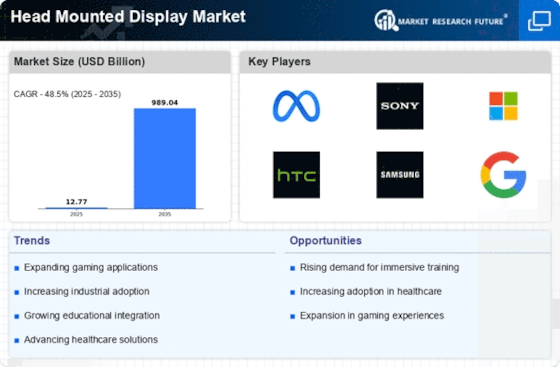
As per Market Research Future analysis, the Head Mounted Display Market Size was estimated at 12.77 USD Billion in 2024. The Head Mounted Display industry is projected to grow from 18.96 USD Billion in 2025 to 989.04 USD Billion by 2035, exhibiting a compound annual growth rate (CAGR) of 48.5% during the forecast period 2025 – 2035, highlighting rapid expansion in the Head Mounted Display market.

Key Market Trends & Highlights

The Head Mounted Display Market is poised for substantial growth driven by technological advancements and diverse applications.

  • North America remains the largest market for head mounted displays, driven by robust consumer demand and technological innovation. The Asia-Pacific region is currently the fastest-growing market, reflecting increasing investments in augmented reality and virtual reality technologies. Augmented reality continues to dominate the market as the largest segment, while virtual reality is emerging as the fastest-growing segment. Key market drivers include technological advancements in display technology and the growing demand in gaming and entertainment sectors.

Market Size & Forecast

2024 Market Size 12.77 (USD Billion)
2035 Market Size 989.04 (USD Billion)
CAGR (2025 - 2035) 48.5%
Largest Regional Market Share in 2024 North America

Major Players

Meta Platforms (US), Sony (JP), Microsoft (US), HTC (TW), Samsung (KR), Google (US), Apple (US), Valve Corporation (US), Oculus (US)

Market Trends

The Head Mounted Display Market is currently experiencing a dynamic evolution, driven by advancements in technology and increasing applications across various sectors. This market encompasses devices that are worn on the head —commonly referred to as head mounted displays— providing immersive visual experiences through augmented reality (AR) and virtual reality (VR). As industries such as gaming, healthcare, and education continue to explore innovative uses for head mounted displays, the demand for high-quality, user-friendly products appears to be on the rise. Furthermore, the integration of artificial intelligence and machine learning into these devices suggests a potential for enhanced interactivity and personalization, which could significantly influence user engagement and satisfaction. In addition to technological advancements, the Head Mounted Display Market is also shaped by changing consumer preferences and the growing popularity of immersive experiences. As more individuals seek out entertainment options that offer deeper engagement, the appeal of head-mounted displays becomes increasingly pronounced. Moreover, the expansion of e-commerce and online content consumption is likely to further propel the market, as consumers look for new ways to experience digital content. Overall, the Head Mounted Display Market seems poised for substantial growth, with various factors converging to create a fertile environment for innovation and expansion.

Technological Advancements

The Head Mounted Display Market is witnessing rapid technological progress, particularly in display resolution and field of view. Innovations in optics and miniaturization are enhancing the user experience, making head-mounted display systems more comfortable and visually appealing. This trend indicates a shift towards more sophisticated products that cater to the demands of both consumers and professionals.

Diverse Applications

The versatility of head mounted displays and head mounted devices is becoming increasingly evident, as they find applications in sectors beyond gaming and entertainment. Industries such as healthcare, military, and education are exploring the potential of these devices for training, simulations, and remote assistance. This diversification suggests a broadening market scope and new opportunities for growth.

Consumer Engagement

As immersive experiences gain traction, the Head Mounted Display Market is likely to see a surge in consumer interest. Users are increasingly drawn to products that offer unique and engaging content. This trend highlights the importance of content creation and curation, as companies strive to provide compelling experiences that resonate with their audiences.

Head Mounted Display Market Market Drivers

Increased Adoption in Healthcare

The Head Mounted Display Market is also benefiting from increased adoption in the healthcare sector. Medical professionals are utilizing head mounted displays for various applications, including surgical simulations, patient education, and remote consultations. The integration of AR and VR technologies in medical training has shown promising results, enhancing the learning experience for healthcare practitioners. Recent studies suggest that the use of head mounted displays in medical training can improve retention rates by up to 30%. As healthcare institutions continue to invest in innovative technologies, the demand for head mounted displays is likely to rise significantly.

Expansion of Industrial Applications

The Head Mounted Display Market is expanding into various industrial applications, including manufacturing, maintenance, and training. Companies are increasingly recognizing the benefits of using head mounted displays for real-time data visualization and remote assistance. For example, technicians can access schematics and instructions directly in their line of sight, improving efficiency and reducing errors. The industrial segment is projected to grow at a robust pace, with estimates suggesting it could represent a substantial portion of the market by 2027. This trend indicates a shift towards more integrated and efficient operational processes across industries.

Rising Interest in Education and Training

The Head Mounted Display Market is gaining traction in the education and training sectors. Educational institutions are exploring the use of head mounted displays to create immersive learning environments that enhance student engagement. Virtual classrooms and interactive simulations are becoming more common, allowing students to experience complex concepts in a more tangible way. Recent surveys indicate that over 60% of educators believe that AR and VR technologies can significantly improve learning outcomes. As educational institutions continue to adopt these technologies, the demand for head mounted displays is expected to grow, further diversifying the market.

Growing Demand in Gaming and Entertainment

The Head Mounted Display Market is witnessing a surge in demand driven by the gaming and entertainment sectors. As virtual reality (VR) and augmented reality (AR) technologies become more mainstream, consumers are increasingly seeking immersive experiences. The gaming industry, in particular, has embraced head mounted displays, with sales of VR headsets reportedly reaching millions annually. This trend is expected to continue, with projections indicating that the gaming segment could account for over 40% of the market share by 2026. The allure of enhanced interactivity and realism in gaming experiences is a key factor propelling this growth.

Technological Advancements in Display Technology

The Head Mounted Display Market is experiencing rapid technological advancements that enhance user experience and functionality. Innovations such as higher resolution displays, improved field of view, and advanced tracking systems are becoming increasingly prevalent. For instance, the introduction of OLED and microLED technologies has significantly improved image quality, leading to more immersive experiences. According to recent data, the market for high-resolution displays is projected to grow at a compound annual growth rate of over 20% in the coming years. These advancements not only attract consumers but also encourage developers to create more sophisticated applications, thereby expanding the market's potential.

Market Segment Insights

By Technology: Augmented Reality (Largest) vs. Virtual Reality (Fastest-Growing)

The Head Mounted Display Market exhibits distinct segments, primarily divided between Augmented Reality (AR) and Virtual Reality (VR). Augmented Reality currently holds the largest market share, appealing to industries such as gaming, healthcare, and education. It enhances real-world experiences by overlaying digital information, thereby gaining traction due to its practical applications. On the other hand, Virtual Reality, though smaller in market share, is recognized as the fastest-growing segment in the Head Mounted Display Market. With advancements in technology and increased consumer interest, VR is being adopted across entertainment and training sectors, driving its rapid growth. Innovations in hardware and content are particularly fueling this upward trend, making VR a focal point for future investments and developments.

Technology: Augmented Reality (Dominant) vs. Virtual Reality (Emerging)

Augmented Reality is dominating the Head Mounted Display Market due to its versatile applications across various sectors. This technology enhances the user's perception by integrating digital elements into the real world, making it invaluable in fields like healthcare for training and diagnostics, in retail for virtual try-ons, and in education for interactive learning. Conversely, Virtual Reality is emerging as a significant player in this market, particularly appealing to gamers and those in training environments. With immersive experiences that transport users to entirely different worlds, VR leverages advancements in hardware, such as improved headsets and improved user interfaces. As the technology matures, its adoption is spreading, supported by the expansion of content libraries and continuous innovation.

By End Use: Consumer (Largest) vs. Commercial (Fastest-Growing)

In the Head Mounted Display Market, the end use segment is primarily driven by consumer applications, which hold the largest market share. This includes personal gaming and entertainment systems that are increasingly being adopted by the average consumer. Commercial applications, although currently smaller in market share, are gaining significant traction due to increasing use cases in marketing, retail, and virtual showrooms.

Consumer (Dominant) vs. Commercial (Emerging)

The consumer segment in the Head Mounted Display Market remains dominant as brands enhance user engagement through VR gaming and immersive entertainment experiences. This segment attracts a family and younger audience looking for innovative and engaging content. On the other hand, the commercial segment represents an emerging market characterized by rapid adoption across various industries. Companies are integrating HMDs for training simulations, collaborative meetings, and interactive customer experiences, making it the fastest-growing sector within the market.

By Product Type: Head-Mounted (Largest) vs. Eyewear (Fastest-Growing)

The Head Mounted Display Market is primarily dominated by head-mounted displays, which capture a significant portion of market share due to their widespread applications in gaming, training, and immersive experiences. These devices provide a robust user experience and are preferred by consumers for their ability to deliver high-quality visuals and interactive content. Conversely, the eyewear segment, while currently smaller, is rapidly gaining traction as developers enhance their functionalities and applications in various settings, including augmented reality and smart applications.

Head-Mounted (Dominant) vs. Eyewear (Emerging)

Head-mounted displays represent the dominant force in the market, appealing to consumers with their ability to provide immersive virtual experiences. They are characterized by advanced technologies that allow for high-resolution displays and a comprehensive field of view, making them a popular choice for gaming and professional training. On the other hand, eyewear, touted as an emerging segment, is gaining popularity due to innovations in augmented reality. This product type is designed to be more lightweight and accessible, appealing to tech-savvy consumers looking for versatile applications like smart glasses that integrate seamlessly into daily life and work.

By Component: Display (Largest) vs. Processor and Memory (Fastest-Growing)

In the Head Mounted Display Market, the display component dominates the market share, reflecting its critical role in delivering immersive visual experiences. Other components like processors and memory, while essential, comprise a smaller portion of the market. However, these segments are gaining traction due to the increasing demand for advanced processing capabilities and memory storage to support high-resolution graphics and enhance user experience. The integration of these components is pivotal in enhancing the overall functionality of head-mounted displays.

Display (Dominant) vs. Processor and Memory (Emerging)

The display segment is a dominant force in the Head Mounted Display Market, characterized by high-resolution screens that provide users with vivid and lifelike visuals. As technology advances, displays are shifting towards OLED and microLED technologies, which offer improved color accuracy and contrast. On the other hand, the processor and memory segment is an emerging player, experiencing rapid growth fueled by the increasing demand for high-performance computing. Processors are evolving to support complex algorithms for augmented and virtual reality, while memory advancements ensure that narratives and interactions are seamless and fluid. This growing reliance on sophisticated processor and memory technologies significantly enhances the user experience.

By Connectivity: Wired (Largest) vs. Wireless (Fastest-Growing)

In the Head Mounted Display Market (HMD) market, HMD displays with wired connectivity segment currently commands the largest share, appealing to users who prioritize stability and minimal latency. Wired solutions provide a direct connection to power sources and video feeds, making them highly reliable for various professional applications, including gaming, simulations, and virtual training. However, as technology advances and end-user preferences evolve, the market is witnessing a steady shift towards wireless options that offer enhanced mobility and convenience. The wireless segment, recognized as the fastest-growing in the HMD market, is rapidly gaining traction. This growth is driven by the increasing consumer demand for mobility and ease of use, especially in areas such as gaming and augmented reality applications. Innovations in wireless technologies, such as improved bandwidth and lower latency, are minimizing the drawbacks traditionally associated with wireless connections, allowing consumers to experience a seamless and immersive environment without restrictions.

Connectivity: Wired (Dominant) vs. Wireless (Emerging)

Wired connectivity in the Head Mounted Display Market is characterized by its robust performance and reliability, making it the dominant choice for professional applications that require precise tracking and reduced input lag. These systems often utilize high-quality cables to ensure high-resolution video and audio transmission, which is critical for immersive experiences. By contrast, the emerging wireless segment is shaped by advancements in wireless technologies, catering to consumer preferences for freedom of movement and easy setup. Wireless HMDs leverage cutting-edge innovations like 5G and Wi-Fi 6, which provide sufficient bandwidth for high-quality streaming while reducing latency, making them attractive for gaming, entertainment, and interactive experiences. As both segments evolve, they cater to distinct needs, indicating a diversified market landscape.

By Application: Training and Simulation (Largest) vs. Security (Fastest-Growing)

The Head Mounted Display Market showcases diverse applications, with Training and Simulation leading the way in market share. This segment encompasses various use cases across industries such as defense, education, and healthcare, where immersive experiences enhance learning and skill acquisition. Conversely, the Security segment is rapidly gaining traction, primarily due to escalating demands for enhanced surveillance and situational awareness in security operations. Growth trends in the Head Mounted Display Market are driven by advancements in technology, coupled with increasing investments in training methods that utilize VR and AR capabilities. As enterprises and defense sectors prioritize efficient training and secure operational environments, the demand for Head Mounted Displays continues to rise. Continuous innovation and integration of <a href="https://www.marketresearchfuture.com/reports/artificial-intelligence-chipset-market-4987">artificial intelligence</a> are also propelling the growth within the application segments, particularly in the security domain.

Training and Simulation (Dominant) vs. Security (Emerging)

In the Head Mounted Display Market, the Training and Simulation segment is considered the dominant force, owing to its extensive application across various industries. Organizations leverage head-mounted display HMD systems to provide immersive training experiences, resulting in improved learning outcomes and operational effectiveness. The technology fosters realistic simulations, allowing users to practice in safe environments before real-world applications. On the other hand, the Security segment is emerging as a critical player in the market, fueled by the increasing adoption of AR and VR technologies in surveillance systems. This segment focuses on enhancing situational awareness through real-time data integration, thus offering security personnel vital information for decision-making. As security threats evolve, the demand for innovative Head Mounted Displays tailored for security applications is set to expand rapidly.

By Type: Discrete (Largest) vs. Integrated (Fastest-Growing)

In the Head Mounted Display Market, the segment values exhibit varying distributions, with Discrete units commanding the largest share. Their standalone functionality creates a considerable demand, appealing particularly to enterprise sectors engaged in training and simulation applications. Conversely, Integrated displays are rapidly gaining traction due to their versatility and ease of use, appealing to both consumers and professionals alike. The innovation within this segment, driven by technological advancements, has resulted in captivating consumer interest and higher adoption rates. The growth trends related to these segment values highlight a significant evolution within the market. Discrete displays continue to thrive as they fulfill specific use cases with excellent performance characteristics, which ensures their dominance. On the other hand, Integrated displays are characterized by their adaptability, with advancements leading to features such as enhanced field-of-view and improved user interfaces. These factors contribute significantly to their status as the fastest-growing segment, driven by increasing consumer and enterprise demand for multifunctional and immersive experiences.

Slide-On (Dominant) vs. Integrated (Emerging)

In the Head Mounted Display Market, Slide-On units have established themselves as a dominant choice for users requiring adaptability and comfort in usage, typically functioning as accessories to existing devices like smartphones. Their design innovation allows for seamless user integration, making them particularly favorable in scenarios requiring on-the-go access to virtual content. Integrated displays, although categorized as emerging, show significant potential with their all-in-one solutions that cater to a broader audience. Their development is marked by trends that focus on enhanced display technologies and sensor integration, aligning with the increasing demand for immersive experiences. Integrated displays are gradually refining their market position through the introduction of cutting-edge features and improved user engagement, establishing a competitive ground against traditional Slide-On units.

Get more detailed insights about Head Mounted Display Market Research Report—Global Forecast till 2035

Regional Insights

By Region, the study provides the market insights into North America, Europe, Asia-Pacific and Rest of the World. North America is the leading region for HMDs. The big US businesses' investments have driven the market expansion in this area. One of the factors influencing the growth of the North American market is the adoption of new technologies and the presence of large corporations. Many businesses across North America are making investments in HMDs. There have been fatalities, losses of life and means of subsistence due to the spread of COVID-19 across the Americas.

Further, the U.S. head mounted displays market held the largest market share, and the Canada head mounted displays market was the fastest growing market in the European region.

Further, the major countries studied in the market report are The U.S., Canada, German, France, the UK, Italy, Spain, China, Japan, India, Australia, South Korea, and Brazil.

Figure 2: HEAD MOUNTED DISPLAY MARKET SHARE BY REGION 2022 (%)

During the projection period, the Asia Pacific head mounted displays market is anticipated to have a sizable market share. This market expansion might be attributed to growing countries like China and India using AR and VR technologies more frequently. The need for head-mounted displays in the medical industry for treatment and surgery is also boosting the market. Moreover, China’s head mounted displays market held the largest market share, and the Indian head mounted displays market was the fastest growing market in the Asia-Pacific region.

The market in Europe head mounted displays market is anticipated to grow as a result of the increasing use of HMD technology in the educational field. Throughout the anticipated period, the HMD market in the Rest of the World experiences tremendous growth. The rising demand for HMD technology in South America, the Middle East, and Africa is said to be the cause of the market expansion. Further, the German head mounted displays market held the largest market share, and the U.K. head mounted displays market was the fastest growing market in the European region.

Key Players and Competitive Insights

Leading market players are investing heavily in research and development of advanced head mounted display systems in order to expand their product lines, which will help the Head Mounted Display Market grow even more. Market participants are also undertaking a variety of strategic activities to expand their global footprint, with important market developments including new product launches, contractual agreements, mergers and acquisitions, higher investments, and collaboration with other organizations. To expand and survive in a more competitive and rising market climate, Head Mounted Display industry must offer cost-effective items.
Manufacturing locally to minimize operational costs is one of the key business tactics used by manufacturers in the global Head Mounted Display industry to benefit clients and increase the market sector. In recent years, the Head Mounted Display industry has offered some of the most significant advantages to medicine. Major players in the Head Mounted Display Market, including Alphabet Inc., Sony Corporation, SAMSUNG, Microsoft Corporation, BAE Systems., Elbit Systems Ltd., FUJITSU, HTC Corporation, Huawei Technologies Co.
Ltd., LG Electronics, Optinvent SA, Collins Aerospace., Seiko Epson Corporation., Thales Group, Avegant Corp., FOVE Inc., Magic Leap Inc., Meta View Inc., CINOPTICS, and Kopin Corporation.
Software development, licensing, and support are all services provided by Microsoft Corp. (Microsoft). The company provides a wide variety of operating systems, server applications, cross-device productivity tools, business solution tools, desktop and server administration tools, video games, and training and certification services. Additionally, it creates, produces, and markets hardware items like PCs, tablets, game consoles, and other sophisticated gadgets. The company offers a wide range of services, such as consultancy, cloud-based solutions, and solution support. Through original equipment manufacturers, distributors, resellers, online marketplaces, Microsoft stores, and other partner channels, Microsoft promotes, distributes, and sells its products.
The company has operations throughout the Middle East, Africa, the Americas, Europe, and Asia-Pacific. The US city of Redmond, Washington, is where Microsoft is based.
Electronics, semiconductors, medical equipment, tools, and devices are all produced by Sony Group Corp. (Sony). Televisions, cell phones, cameras, music systems, game consoles, software, semiconductors, batteries, and other electronic components are among the company's goods. In addition to running television and digital networks, Sony creates, acquires, and distributes movie pictures, television shows, and recorded music. Along with life and non-life insurance, it also offers banking and financial services. The business advertises its goods through distributors, sales divisions, and online direct sales. It sells goods under the brands Airpeak, Sony, PlayStation, Walkman, Blu-ray, Cyber-shot, Bravia, Exmor, and Experia.

Key Companies in the Head Mounted Display Market include

Industry Developments

  • Q2 2024: Apple launches Vision Pro mixed-reality headset in the U.S. Apple officially launched its Vision Pro mixed-reality headset in the United States, marking its entry into the head mounted display market and expanding competition in the AR/VR sector.
  • Q2 2024: Sony Unveils New PlayStation VR2 for PC Compatibility Sony announced the launch of a new PlayStation VR2 headset with expanded compatibility for PC gaming, aiming to broaden its user base beyond PlayStation console owners.
  • Q2 2024: Meta Announces Quest 3S, Expanding Affordable VR Headset Lineup Meta introduced the Quest 3S, a new, more affordable VR headset designed to make virtual reality more accessible to a wider audience.
  • Q2 2024: Magic Leap raises $590M in new funding round led by Saudi Arabia’s PIF Magic Leap secured $590 million in new funding led by Saudi Arabia’s Public Investment Fund to accelerate development of its next-generation AR headsets.
  • Q1 2024: Microsoft and Samsung announce partnership to develop next-gen AR headsets Microsoft and Samsung entered a strategic partnership to co-develop advanced augmented reality headsets targeting enterprise and industrial applications.
  • Q1 2024: Varjo launches XR-4 Series, its most advanced mixed reality headset Varjo announced the launch of its XR-4 Series, a new line of high-fidelity mixed reality headsets aimed at professional and enterprise users.
  • Q2 2024: ByteDance’s Pico launches new VR headset to challenge Meta Pico, the VR subsidiary of ByteDance, launched a new virtual reality headset, intensifying competition with Meta in the global VR market.
  • Q1 2024: HTC launches VIVE Ultimate Tracker for enhanced VR experiences HTC introduced the VIVE Ultimate Tracker, a new accessory designed to improve motion tracking and immersion for its VIVE VR headset ecosystem.
  • Q2 2024: Vuzix Receives $3.2 Million Follow-on Order for Waveguide Displays from Defense Customer Vuzix announced a $3.2 million follow-on order from a defense sector customer for its waveguide-based head mounted displays, supporting military AR applications.
  • Q1 2024: Google acquires Raxium to boost AR hardware development Google completed the acquisition of Raxium, a microLED display startup, to strengthen its capabilities in developing next-generation AR head mounted displays.
  • Q2 2024: RealWear Announces $20 Million Series C Funding to Expand Industrial Wearable Solutions RealWear raised $20 million in Series C funding to accelerate the development and deployment of its head mounted display solutions for industrial and field service applications.
  • Q1 2024: Lenovo launches ThinkReality VRX headset for enterprise customers Lenovo launched the ThinkReality VRX, a new virtual reality headset designed specifically for enterprise and business use cases.

Future Outlook

Head Mounted Display Market Future Outlook

The Head Mounted Display Market is projected to grow at 48.5% CAGR from 2025 to 2035, driven by advancements in technology, increasing demand in gaming, and applications in training and education.

New opportunities lie in:

  • <p>Development of immersive training solutions for corporate sectors.</p>
  • <p> </p>
  • <p>Expansion into telemedicine applications for remote consultations.</p>
  • <p>Integration of augmented reality features for enhanced user experiences.</p>

By 2035, the market is expected to achieve substantial growth, solidifying its position as a leader in immersive technology.

Market Segmentation

Head Mounted Display Market Type Outlook

  • Discrete
  • Slide-On
  • Integrated

Head Mounted Display Market End Use Outlook

  • Consumer
  • Commercial
  • Enterprise and Industry
  • Engineering and Design
  • Military
  • Defense
  • Aerospace
  • Medical
  • Education
  • Sports
  • Fashion
  • Journalism

Head Mounted Display Market Component Outlook

  • Processor and Memory
  • Controller
  • Sensor
  • Camera
  • Display
  • Lens
  • Case and Connector
  • Goggles
  • Head Tracker
  • Computing
  • Battery
  • Pico Projectors Technology
  • Accessories

Head Mounted Display Market Technology Outlook

  • Augmented Reality
  • Virtual Reality

Head Mounted Display Market Application Outlook

  • Security
  • Training and Simulation
  • Tracking
  • Imaging

Head Mounted Display Market Connectivity Outlook

  • Wired
  • Wireless

Head Mounted Display Market Product Type Outlook

  • Head-Mounted
  • Eyewear

Report Scope

MARKET SIZE 2024 12.77(USD Billion)
MARKET SIZE 2025 18.96(USD Billion)
MARKET SIZE 2035 989.04(USD Billion)
COMPOUND ANNUAL GROWTH RATE (CAGR) 48.5% (2025 - 2035)
REPORT COVERAGE Revenue Forecast, Competitive Landscape, Growth Factors, and Trends
BASE YEAR 2024
Market Forecast Period 2025 - 2035
Historical Data 2019 - 2024
Market Forecast Units USD Billion
Key Companies Profiled Meta Platforms (US), Sony (JP), Microsoft (US), HTC (TW), Samsung (KR), Google (US), Apple (US), Valve Corporation (US), Oculus (US)
Segments Covered Technology
Key Market Opportunities Integration of augmented reality in training and education sectors enhances the Head Mounted Display Market.
Key Market Dynamics Technological advancements and consumer demand drive innovation and competition in the Head Mounted Display Market.
Countries Covered North America, Europe, APAC, South America, MEA

FAQs

What is the current valuation of the Head Mounted Display Market in 2025?

The Head Mounted Display Market is valued at approximately 12.77 USD Billion in 2024.

What is the projected market size for the Head Mounted Display Market by 2035?

The market is projected to reach around 989.04 USD Billion by 2035.

What is the expected CAGR for the Head Mounted Display Market during the forecast period?

The expected CAGR for the market from 2025 to 2035 is 48.5%.

Which companies are considered key players in the Head Mounted Display Market?

Key players include Meta Platforms, Sony, Microsoft, HTC, Samsung, Google, Apple, Valve Corporation, and Oculus.

What are the main technology segments within the Head Mounted Display Market?

The main technology segments are Augmented Reality, valued at 3.83 USD Billion, and Virtual Reality, valued at 8.94 USD Billion.

How is the Head Mounted Display Market segmented by end use?

End use segments include Consumer, Commercial, Enterprise and Industry, Military, Medical, and others, with Consumer valued at 2.5 USD Billion.

What product types are included in the Head Mounted Display Market?

The market includes Head-Mounted displays, valued at 8.0 USD Billion, and Eyewear, valued at 4.77 USD Billion.

What are the key components of Head Mounted Displays?

Key components include Display, valued at 3.83 USD Billion, and Processor and Memory, valued at 1.91 USD Billion.

What connectivity options are available in the Head Mounted Display Market?

Connectivity options include Wired, valued at 5.11 USD Billion, and Wireless, valued at 7.66 USD Billion.

What applications are driving growth in the Head Mounted Display Market?

Applications include Imaging, valued at 6.27 USD Billion, and Training and Simulation, valued at 3.0 USD Billion.

  1. SECTION I: EXECUTIVE SUMMARY AND KEY HIGHLIGHTS
    1. | 1.1 EXECUTIVE SUMMARY
    2. | | 1.1.1 Market Overview
    3. | | 1.1.2 Key Findings
    4. | | 1.1.3 Market Segmentation
    5. | | 1.1.4 Competitive Landscape
    6. | | 1.1.5 Challenges and Opportunities
    7. | | 1.1.6 Future Outlook
  2. SECTION II: SCOPING, METHODOLOGY AND MARKET STRUCTURE
    1. | 2.1 MARKET INTRODUCTION
    2. | | 2.1.1 Definition
    3. | | 2.1.2 Scope of the study
    4. | | | 2.1.2.1 Research Objective
    5. | | | 2.1.2.2 Assumption
    6. | | | 2.1.2.3 Limitations
    7. | 2.2 RESEARCH METHODOLOGY
    8. | | 2.2.1 Overview
    9. | | 2.2.2 Data Mining
    10. | | 2.2.3 Secondary Research
    11. | | 2.2.4 Primary Research
    12. | | | 2.2.4.1 Primary Interviews and Information Gathering Process
    13. | | | 2.2.4.2 Breakdown of Primary Respondents
    14. | | 2.2.5 Forecasting Model
    15. | | 2.2.6 Market Size Estimation
    16. | | | 2.2.6.1 Bottom-Up Approach
    17. | | | 2.2.6.2 Top-Down Approach
    18. | | 2.2.7 Data Triangulation
    19. | | 2.2.8 Validation
  3. SECTION III: QUALITATIVE ANALYSIS
    1. | 3.1 MARKET DYNAMICS
    2. | | 3.1.1 Overview
    3. | | 3.1.2 Drivers
    4. | | 3.1.3 Restraints
    5. | | 3.1.4 Opportunities
    6. | 3.2 MARKET FACTOR ANALYSIS
    7. | | 3.2.1 Value chain Analysis
    8. | | 3.2.2 Porter's Five Forces Analysis
    9. | | | 3.2.2.1 Bargaining Power of Suppliers
    10. | | | 3.2.2.2 Bargaining Power of Buyers
    11. | | | 3.2.2.3 Threat of New Entrants
    12. | | | 3.2.2.4 Threat of Substitutes
    13. | | | 3.2.2.5 Intensity of Rivalry
    14. | | 3.2.3 COVID-19 Impact Analysis
    15. | | | 3.2.3.1 Market Impact Analysis
    16. | | | 3.2.3.2 Regional Impact
    17. | | | 3.2.3.3 Opportunity and Threat Analysis
  4. SECTION IV: QUANTITATIVE ANALYSIS
    1. | 4.1 Semiconductor & Electronics, BY Technology (USD Billion)
    2. | | 4.1.1 Augmented Reality
    3. | | 4.1.2 Virtual Reality
    4. | 4.2 Semiconductor & Electronics, BY End Use (USD Billion)
    5. | | 4.2.1 Consumer
    6. | | 4.2.2 Commercial
    7. | | 4.2.3 Enterprise and Industry
    8. | | 4.2.4 Engineering and Design
    9. | | 4.2.5 Military
    10. | | 4.2.6 Defense
    11. | | 4.2.7 Aerospace
    12. | | 4.2.8 Medical
    13. | | 4.2.9 Education
    14. | | 4.2.10 Sports
    15. | | 4.2.11 Fashion
    16. | | 4.2.12 Journalism
    17. | 4.3 Semiconductor & Electronics, BY Product Type (USD Billion)
    18. | | 4.3.1 Head-Mounted
    19. | | 4.3.2 Eyewear
    20. | 4.4 Semiconductor & Electronics, BY Component (USD Billion)
    21. | | 4.4.1 Processor and Memory
    22. | | 4.4.2 Controller
    23. | | 4.4.3 Sensor
    24. | | 4.4.4 Camera
    25. | | 4.4.5 Display
    26. | | 4.4.6 Lens
    27. | | 4.4.7 Case and Connector
    28. | | 4.4.8 Goggles
    29. | | 4.4.9 Head Tracker
    30. | | 4.4.10 Computing
    31. | | 4.4.11 Battery
    32. | | 4.4.12 Pico Projectors Technology
    33. | | 4.4.13 Accessories
    34. | 4.5 Semiconductor & Electronics, BY Connectivity (USD Billion)
    35. | | 4.5.1 Wired
    36. | | 4.5.2 Wireless
    37. | 4.6 Semiconductor & Electronics, BY Application (USD Billion)
    38. | | 4.6.1 Security
    39. | | 4.6.2 Training and Simulation
    40. | | 4.6.3 Tracking
    41. | | 4.6.4 Imaging
    42. | 4.7 Semiconductor & Electronics, BY Type (USD Billion)
    43. | | 4.7.1 Discrete
    44. | | 4.7.2 Slide-On
    45. | | 4.7.3 Integrated
    46. | 4.8 Semiconductor & Electronics, BY Region (USD Billion)
    47. | | 4.8.1 North America
    48. | | | 4.8.1.1 US
    49. | | | 4.8.1.2 Canada
    50. | | 4.8.2 Europe
    51. | | | 4.8.2.1 Germany
    52. | | | 4.8.2.2 UK
    53. | | | 4.8.2.3 France
    54. | | | 4.8.2.4 Russia
    55. | | | 4.8.2.5 Italy
    56. | | | 4.8.2.6 Spain
    57. | | | 4.8.2.7 Rest of Europe
    58. | | 4.8.3 APAC
    59. | | | 4.8.3.1 China
    60. | | | 4.8.3.2 India
    61. | | | 4.8.3.3 Japan
    62. | | | 4.8.3.4 South Korea
    63. | | | 4.8.3.5 Malaysia
    64. | | | 4.8.3.6 Thailand
    65. | | | 4.8.3.7 Indonesia
    66. | | | 4.8.3.8 Rest of APAC
    67. | | 4.8.4 South America
    68. | | | 4.8.4.1 Brazil
    69. | | | 4.8.4.2 Mexico
    70. | | | 4.8.4.3 Argentina
    71. | | | 4.8.4.4 Rest of South America
    72. | | 4.8.5 MEA
    73. | | | 4.8.5.1 GCC Countries
    74. | | | 4.8.5.2 South Africa
    75. | | | 4.8.5.3 Rest of MEA
  5. SECTION V: COMPETITIVE ANALYSIS
    1. | 5.1 Competitive Landscape
    2. | | 5.1.1 Overview
    3. | | 5.1.2 Competitive Analysis
    4. | | 5.1.3 Market share Analysis
    5. | | 5.1.4 Major Growth Strategy in the Semiconductor & Electronics
    6. | | 5.1.5 Competitive Benchmarking
    7. | | 5.1.6 Leading Players in Terms of Number of Developments in the Semiconductor & Electronics
    8. | | 5.1.7 Key developments and growth strategies
    9. | | | 5.1.7.1 New Product Launch/Service Deployment
    10. | | | 5.1.7.2 Merger & Acquisitions
    11. | | | 5.1.7.3 Joint Ventures
    12. | | 5.1.8 Major Players Financial Matrix
    13. | | | 5.1.8.1 Sales and Operating Income
    14. | | | 5.1.8.2 Major Players R&D Expenditure. 2023
    15. | 5.2 Company Profiles
    16. | | 5.2.1 Meta Platforms (US)
    17. | | | 5.2.1.1 Financial Overview
    18. | | | 5.2.1.2 Products Offered
    19. | | | 5.2.1.3 Key Developments
    20. | | | 5.2.1.4 SWOT Analysis
    21. | | | 5.2.1.5 Key Strategies
    22. | | 5.2.2 Sony (JP)
    23. | | | 5.2.2.1 Financial Overview
    24. | | | 5.2.2.2 Products Offered
    25. | | | 5.2.2.3 Key Developments
    26. | | | 5.2.2.4 SWOT Analysis
    27. | | | 5.2.2.5 Key Strategies
    28. | | 5.2.3 Microsoft (US)
    29. | | | 5.2.3.1 Financial Overview
    30. | | | 5.2.3.2 Products Offered
    31. | | | 5.2.3.3 Key Developments
    32. | | | 5.2.3.4 SWOT Analysis
    33. | | | 5.2.3.5 Key Strategies
    34. | | 5.2.4 HTC (TW)
    35. | | | 5.2.4.1 Financial Overview
    36. | | | 5.2.4.2 Products Offered
    37. | | | 5.2.4.3 Key Developments
    38. | | | 5.2.4.4 SWOT Analysis
    39. | | | 5.2.4.5 Key Strategies
    40. | | 5.2.5 Samsung (KR)
    41. | | | 5.2.5.1 Financial Overview
    42. | | | 5.2.5.2 Products Offered
    43. | | | 5.2.5.3 Key Developments
    44. | | | 5.2.5.4 SWOT Analysis
    45. | | | 5.2.5.5 Key Strategies
    46. | | 5.2.6 Google (US)
    47. | | | 5.2.6.1 Financial Overview
    48. | | | 5.2.6.2 Products Offered
    49. | | | 5.2.6.3 Key Developments
    50. | | | 5.2.6.4 SWOT Analysis
    51. | | | 5.2.6.5 Key Strategies
    52. | | 5.2.7 Apple (US)
    53. | | | 5.2.7.1 Financial Overview
    54. | | | 5.2.7.2 Products Offered
    55. | | | 5.2.7.3 Key Developments
    56. | | | 5.2.7.4 SWOT Analysis
    57. | | | 5.2.7.5 Key Strategies
    58. | | 5.2.8 Valve Corporation (US)
    59. | | | 5.2.8.1 Financial Overview
    60. | | | 5.2.8.2 Products Offered
    61. | | | 5.2.8.3 Key Developments
    62. | | | 5.2.8.4 SWOT Analysis
    63. | | | 5.2.8.5 Key Strategies
    64. | | 5.2.9 Oculus (US)
    65. | | | 5.2.9.1 Financial Overview
    66. | | | 5.2.9.2 Products Offered
    67. | | | 5.2.9.3 Key Developments
    68. | | | 5.2.9.4 SWOT Analysis
    69. | | | 5.2.9.5 Key Strategies
    70. | 5.3 Appendix
    71. | | 5.3.1 References
    72. | | 5.3.2 Related Reports
  6. LIST OF FIGURES
    1. | 6.1 MARKET SYNOPSIS
    2. | 6.2 NORTH AMERICA MARKET ANALYSIS
    3. | 6.3 US MARKET ANALYSIS BY TECHNOLOGY
    4. | 6.4 US MARKET ANALYSIS BY END USE
    5. | 6.5 US MARKET ANALYSIS BY PRODUCT TYPE
    6. | 6.6 US MARKET ANALYSIS BY COMPONENT
    7. | 6.7 US MARKET ANALYSIS BY CONNECTIVITY
    8. | 6.8 US MARKET ANALYSIS BY APPLICATION
    9. | 6.9 US MARKET ANALYSIS BY TYPE
    10. | 6.10 CANADA MARKET ANALYSIS BY TECHNOLOGY
    11. | 6.11 CANADA MARKET ANALYSIS BY END USE
    12. | 6.12 CANADA MARKET ANALYSIS BY PRODUCT TYPE
    13. | 6.13 CANADA MARKET ANALYSIS BY COMPONENT
    14. | 6.14 CANADA MARKET ANALYSIS BY CONNECTIVITY
    15. | 6.15 CANADA MARKET ANALYSIS BY APPLICATION
    16. | 6.16 CANADA MARKET ANALYSIS BY TYPE
    17. | 6.17 EUROPE MARKET ANALYSIS
    18. | 6.18 GERMANY MARKET ANALYSIS BY TECHNOLOGY
    19. | 6.19 GERMANY MARKET ANALYSIS BY END USE
    20. | 6.20 GERMANY MARKET ANALYSIS BY PRODUCT TYPE
    21. | 6.21 GERMANY MARKET ANALYSIS BY COMPONENT
    22. | 6.22 GERMANY MARKET ANALYSIS BY CONNECTIVITY
    23. | 6.23 GERMANY MARKET ANALYSIS BY APPLICATION
    24. | 6.24 GERMANY MARKET ANALYSIS BY TYPE
    25. | 6.25 UK MARKET ANALYSIS BY TECHNOLOGY
    26. | 6.26 UK MARKET ANALYSIS BY END USE
    27. | 6.27 UK MARKET ANALYSIS BY PRODUCT TYPE
    28. | 6.28 UK MARKET ANALYSIS BY COMPONENT
    29. | 6.29 UK MARKET ANALYSIS BY CONNECTIVITY
    30. | 6.30 UK MARKET ANALYSIS BY APPLICATION
    31. | 6.31 UK MARKET ANALYSIS BY TYPE
    32. | 6.32 FRANCE MARKET ANALYSIS BY TECHNOLOGY
    33. | 6.33 FRANCE MARKET ANALYSIS BY END USE
    34. | 6.34 FRANCE MARKET ANALYSIS BY PRODUCT TYPE
    35. | 6.35 FRANCE MARKET ANALYSIS BY COMPONENT
    36. | 6.36 FRANCE MARKET ANALYSIS BY CONNECTIVITY
    37. | 6.37 FRANCE MARKET ANALYSIS BY APPLICATION
    38. | 6.38 FRANCE MARKET ANALYSIS BY TYPE
    39. | 6.39 RUSSIA MARKET ANALYSIS BY TECHNOLOGY
    40. | 6.40 RUSSIA MARKET ANALYSIS BY END USE
    41. | 6.41 RUSSIA MARKET ANALYSIS BY PRODUCT TYPE
    42. | 6.42 RUSSIA MARKET ANALYSIS BY COMPONENT
    43. | 6.43 RUSSIA MARKET ANALYSIS BY CONNECTIVITY
    44. | 6.44 RUSSIA MARKET ANALYSIS BY APPLICATION
    45. | 6.45 RUSSIA MARKET ANALYSIS BY TYPE
    46. | 6.46 ITALY MARKET ANALYSIS BY TECHNOLOGY
    47. | 6.47 ITALY MARKET ANALYSIS BY END USE
    48. | 6.48 ITALY MARKET ANALYSIS BY PRODUCT TYPE
    49. | 6.49 ITALY MARKET ANALYSIS BY COMPONENT
    50. | 6.50 ITALY MARKET ANALYSIS BY CONNECTIVITY
    51. | 6.51 ITALY MARKET ANALYSIS BY APPLICATION
    52. | 6.52 ITALY MARKET ANALYSIS BY TYPE
    53. | 6.53 SPAIN MARKET ANALYSIS BY TECHNOLOGY
    54. | 6.54 SPAIN MARKET ANALYSIS BY END USE
    55. | 6.55 SPAIN MARKET ANALYSIS BY PRODUCT TYPE
    56. | 6.56 SPAIN MARKET ANALYSIS BY COMPONENT
    57. | 6.57 SPAIN MARKET ANALYSIS BY CONNECTIVITY
    58. | 6.58 SPAIN MARKET ANALYSIS BY APPLICATION
    59. | 6.59 SPAIN MARKET ANALYSIS BY TYPE
    60. | 6.60 REST OF EUROPE MARKET ANALYSIS BY TECHNOLOGY
    61. | 6.61 REST OF EUROPE MARKET ANALYSIS BY END USE
    62. | 6.62 REST OF EUROPE MARKET ANALYSIS BY PRODUCT TYPE
    63. | 6.63 REST OF EUROPE MARKET ANALYSIS BY COMPONENT
    64. | 6.64 REST OF EUROPE MARKET ANALYSIS BY CONNECTIVITY
    65. | 6.65 REST OF EUROPE MARKET ANALYSIS BY APPLICATION
    66. | 6.66 REST OF EUROPE MARKET ANALYSIS BY TYPE
    67. | 6.67 APAC MARKET ANALYSIS
    68. | 6.68 CHINA MARKET ANALYSIS BY TECHNOLOGY
    69. | 6.69 CHINA MARKET ANALYSIS BY END USE
    70. | 6.70 CHINA MARKET ANALYSIS BY PRODUCT TYPE
    71. | 6.71 CHINA MARKET ANALYSIS BY COMPONENT
    72. | 6.72 CHINA MARKET ANALYSIS BY CONNECTIVITY
    73. | 6.73 CHINA MARKET ANALYSIS BY APPLICATION
    74. | 6.74 CHINA MARKET ANALYSIS BY TYPE
    75. | 6.75 INDIA MARKET ANALYSIS BY TECHNOLOGY
    76. | 6.76 INDIA MARKET ANALYSIS BY END USE
    77. | 6.77 INDIA MARKET ANALYSIS BY PRODUCT TYPE
    78. | 6.78 INDIA MARKET ANALYSIS BY COMPONENT
    79. | 6.79 INDIA MARKET ANALYSIS BY CONNECTIVITY
    80. | 6.80 INDIA MARKET ANALYSIS BY APPLICATION
    81. | 6.81 INDIA MARKET ANALYSIS BY TYPE
    82. | 6.82 JAPAN MARKET ANALYSIS BY TECHNOLOGY
    83. | 6.83 JAPAN MARKET ANALYSIS BY END USE
    84. | 6.84 JAPAN MARKET ANALYSIS BY PRODUCT TYPE
    85. | 6.85 JAPAN MARKET ANALYSIS BY COMPONENT
    86. | 6.86 JAPAN MARKET ANALYSIS BY CONNECTIVITY
    87. | 6.87 JAPAN MARKET ANALYSIS BY APPLICATION
    88. | 6.88 JAPAN MARKET ANALYSIS BY TYPE
    89. | 6.89 SOUTH KOREA MARKET ANALYSIS BY TECHNOLOGY
    90. | 6.90 SOUTH KOREA MARKET ANALYSIS BY END USE
    91. | 6.91 SOUTH KOREA MARKET ANALYSIS BY PRODUCT TYPE
    92. | 6.92 SOUTH KOREA MARKET ANALYSIS BY COMPONENT
    93. | 6.93 SOUTH KOREA MARKET ANALYSIS BY CONNECTIVITY
    94. | 6.94 SOUTH KOREA MARKET ANALYSIS BY APPLICATION
    95. | 6.95 SOUTH KOREA MARKET ANALYSIS BY TYPE
    96. | 6.96 MALAYSIA MARKET ANALYSIS BY TECHNOLOGY
    97. | 6.97 MALAYSIA MARKET ANALYSIS BY END USE
    98. | 6.98 MALAYSIA MARKET ANALYSIS BY PRODUCT TYPE
    99. | 6.99 MALAYSIA MARKET ANALYSIS BY COMPONENT
    100. | 6.100 MALAYSIA MARKET ANALYSIS BY CONNECTIVITY
    101. | 6.101 MALAYSIA MARKET ANALYSIS BY APPLICATION
    102. | 6.102 MALAYSIA MARKET ANALYSIS BY TYPE
    103. | 6.103 THAILAND MARKET ANALYSIS BY TECHNOLOGY
    104. | 6.104 THAILAND MARKET ANALYSIS BY END USE
    105. | 6.105 THAILAND MARKET ANALYSIS BY PRODUCT TYPE
    106. | 6.106 THAILAND MARKET ANALYSIS BY COMPONENT
    107. | 6.107 THAILAND MARKET ANALYSIS BY CONNECTIVITY
    108. | 6.108 THAILAND MARKET ANALYSIS BY APPLICATION
    109. | 6.109 THAILAND MARKET ANALYSIS BY TYPE
    110. | 6.110 INDONESIA MARKET ANALYSIS BY TECHNOLOGY
    111. | 6.111 INDONESIA MARKET ANALYSIS BY END USE
    112. | 6.112 INDONESIA MARKET ANALYSIS BY PRODUCT TYPE
    113. | 6.113 INDONESIA MARKET ANALYSIS BY COMPONENT
    114. | 6.114 INDONESIA MARKET ANALYSIS BY CONNECTIVITY
    115. | 6.115 INDONESIA MARKET ANALYSIS BY APPLICATION
    116. | 6.116 INDONESIA MARKET ANALYSIS BY TYPE
    117. | 6.117 REST OF APAC MARKET ANALYSIS BY TECHNOLOGY
    118. | 6.118 REST OF APAC MARKET ANALYSIS BY END USE
    119. | 6.119 REST OF APAC MARKET ANALYSIS BY PRODUCT TYPE
    120. | 6.120 REST OF APAC MARKET ANALYSIS BY COMPONENT
    121. | 6.121 REST OF APAC MARKET ANALYSIS BY CONNECTIVITY
    122. | 6.122 REST OF APAC MARKET ANALYSIS BY APPLICATION
    123. | 6.123 REST OF APAC MARKET ANALYSIS BY TYPE
    124. | 6.124 SOUTH AMERICA MARKET ANALYSIS
    125. | 6.125 BRAZIL MARKET ANALYSIS BY TECHNOLOGY
    126. | 6.126 BRAZIL MARKET ANALYSIS BY END USE
    127. | 6.127 BRAZIL MARKET ANALYSIS BY PRODUCT TYPE
    128. | 6.128 BRAZIL MARKET ANALYSIS BY COMPONENT
    129. | 6.129 BRAZIL MARKET ANALYSIS BY CONNECTIVITY
    130. | 6.130 BRAZIL MARKET ANALYSIS BY APPLICATION
    131. | 6.131 BRAZIL MARKET ANALYSIS BY TYPE
    132. | 6.132 MEXICO MARKET ANALYSIS BY TECHNOLOGY
    133. | 6.133 MEXICO MARKET ANALYSIS BY END USE
    134. | 6.134 MEXICO MARKET ANALYSIS BY PRODUCT TYPE
    135. | 6.135 MEXICO MARKET ANALYSIS BY COMPONENT
    136. | 6.136 MEXICO MARKET ANALYSIS BY CONNECTIVITY
    137. | 6.137 MEXICO MARKET ANALYSIS BY APPLICATION
    138. | 6.138 MEXICO MARKET ANALYSIS BY TYPE
    139. | 6.139 ARGENTINA MARKET ANALYSIS BY TECHNOLOGY
    140. | 6.140 ARGENTINA MARKET ANALYSIS BY END USE
    141. | 6.141 ARGENTINA MARKET ANALYSIS BY PRODUCT TYPE
    142. | 6.142 ARGENTINA MARKET ANALYSIS BY COMPONENT
    143. | 6.143 ARGENTINA MARKET ANALYSIS BY CONNECTIVITY
    144. | 6.144 ARGENTINA MARKET ANALYSIS BY APPLICATION
    145. | 6.145 ARGENTINA MARKET ANALYSIS BY TYPE
    146. | 6.146 REST OF SOUTH AMERICA MARKET ANALYSIS BY TECHNOLOGY
    147. | 6.147 REST OF SOUTH AMERICA MARKET ANALYSIS BY END USE
    148. | 6.148 REST OF SOUTH AMERICA MARKET ANALYSIS BY PRODUCT TYPE
    149. | 6.149 REST OF SOUTH AMERICA MARKET ANALYSIS BY COMPONENT
    150. | 6.150 REST OF SOUTH AMERICA MARKET ANALYSIS BY CONNECTIVITY
    151. | 6.151 REST OF SOUTH AMERICA MARKET ANALYSIS BY APPLICATION
    152. | 6.152 REST OF SOUTH AMERICA MARKET ANALYSIS BY TYPE
    153. | 6.153 MEA MARKET ANALYSIS
    154. | 6.154 GCC COUNTRIES MARKET ANALYSIS BY TECHNOLOGY
    155. | 6.155 GCC COUNTRIES MARKET ANALYSIS BY END USE
    156. | 6.156 GCC COUNTRIES MARKET ANALYSIS BY PRODUCT TYPE
    157. | 6.157 GCC COUNTRIES MARKET ANALYSIS BY COMPONENT
    158. | 6.158 GCC COUNTRIES MARKET ANALYSIS BY CONNECTIVITY
    159. | 6.159 GCC COUNTRIES MARKET ANALYSIS BY APPLICATION
    160. | 6.160 GCC COUNTRIES MARKET ANALYSIS BY TYPE
    161. | 6.161 SOUTH AFRICA MARKET ANALYSIS BY TECHNOLOGY
    162. | 6.162 SOUTH AFRICA MARKET ANALYSIS BY END USE
    163. | 6.163 SOUTH AFRICA MARKET ANALYSIS BY PRODUCT TYPE
    164. | 6.164 SOUTH AFRICA MARKET ANALYSIS BY COMPONENT
    165. | 6.165 SOUTH AFRICA MARKET ANALYSIS BY CONNECTIVITY
    166. | 6.166 SOUTH AFRICA MARKET ANALYSIS BY APPLICATION
    167. | 6.167 SOUTH AFRICA MARKET ANALYSIS BY TYPE
    168. | 6.168 REST OF MEA MARKET ANALYSIS BY TECHNOLOGY
    169. | 6.169 REST OF MEA MARKET ANALYSIS BY END USE
    170. | 6.170 REST OF MEA MARKET ANALYSIS BY PRODUCT TYPE
    171. | 6.171 REST OF MEA MARKET ANALYSIS BY COMPONENT
    172. | 6.172 REST OF MEA MARKET ANALYSIS BY CONNECTIVITY
    173. | 6.173 REST OF MEA MARKET ANALYSIS BY APPLICATION
    174. | 6.174 REST OF MEA MARKET ANALYSIS BY TYPE
    175. | 6.175 KEY BUYING CRITERIA OF SEMICONDUCTOR & ELECTRONICS
    176. | 6.176 RESEARCH PROCESS OF MRFR
    177. | 6.177 DRO ANALYSIS OF SEMICONDUCTOR & ELECTRONICS
    178. | 6.178 DRIVERS IMPACT ANALYSIS: SEMICONDUCTOR & ELECTRONICS
    179. | 6.179 RESTRAINTS IMPACT ANALYSIS: SEMICONDUCTOR & ELECTRONICS
    180. | 6.180 SUPPLY / VALUE CHAIN: SEMICONDUCTOR & ELECTRONICS
    181. | 6.181 SEMICONDUCTOR & ELECTRONICS, BY TECHNOLOGY, 2024 (% SHARE)
    182. | 6.182 SEMICONDUCTOR & ELECTRONICS, BY TECHNOLOGY, 2024 TO 2035 (USD Billion)
    183. | 6.183 SEMICONDUCTOR & ELECTRONICS, BY END USE, 2024 (% SHARE)
    184. | 6.184 SEMICONDUCTOR & ELECTRONICS, BY END USE, 2024 TO 2035 (USD Billion)
    185. | 6.185 SEMICONDUCTOR & ELECTRONICS, BY PRODUCT TYPE, 2024 (% SHARE)
    186. | 6.186 SEMICONDUCTOR & ELECTRONICS, BY PRODUCT TYPE, 2024 TO 2035 (USD Billion)
    187. | 6.187 SEMICONDUCTOR & ELECTRONICS, BY COMPONENT, 2024 (% SHARE)
    188. | 6.188 SEMICONDUCTOR & ELECTRONICS, BY COMPONENT, 2024 TO 2035 (USD Billion)
    189. | 6.189 SEMICONDUCTOR & ELECTRONICS, BY CONNECTIVITY, 2024 (% SHARE)
    190. | 6.190 SEMICONDUCTOR & ELECTRONICS, BY CONNECTIVITY, 2024 TO 2035 (USD Billion)
    191. | 6.191 SEMICONDUCTOR & ELECTRONICS, BY APPLICATION, 2024 (% SHARE)
    192. | 6.192 SEMICONDUCTOR & ELECTRONICS, BY APPLICATION, 2024 TO 2035 (USD Billion)
    193. | 6.193 SEMICONDUCTOR & ELECTRONICS, BY TYPE, 2024 (% SHARE)
    194. | 6.194 SEMICONDUCTOR & ELECTRONICS, BY TYPE, 2024 TO 2035 (USD Billion)
    195. | 6.195 BENCHMARKING OF MAJOR COMPETITORS
  7. LIST OF TABLES
    1. | 7.1 LIST OF ASSUMPTIONS
    2. | | 7.1.1
    3. | 7.2 North America MARKET SIZE ESTIMATES; FORECAST
    4. | | 7.2.1 BY TECHNOLOGY, 2025-2035 (USD Billion)
    5. | | 7.2.2 BY END USE, 2025-2035 (USD Billion)
    6. | | 7.2.3 BY PRODUCT TYPE, 2025-2035 (USD Billion)
    7. | | 7.2.4 BY COMPONENT, 2025-2035 (USD Billion)
    8. | | 7.2.5 BY CONNECTIVITY, 2025-2035 (USD Billion)
    9. | | 7.2.6 BY APPLICATION, 2025-2035 (USD Billion)
    10. | | 7.2.7 BY TYPE, 2025-2035 (USD Billion)
    11. | 7.3 US MARKET SIZE ESTIMATES; FORECAST
    12. | | 7.3.1 BY TECHNOLOGY, 2025-2035 (USD Billion)
    13. | | 7.3.2 BY END USE, 2025-2035 (USD Billion)
    14. | | 7.3.3 BY PRODUCT TYPE, 2025-2035 (USD Billion)
    15. | | 7.3.4 BY COMPONENT, 2025-2035 (USD Billion)
    16. | | 7.3.5 BY CONNECTIVITY, 2025-2035 (USD Billion)
    17. | | 7.3.6 BY APPLICATION, 2025-2035 (USD Billion)
    18. | | 7.3.7 BY TYPE, 2025-2035 (USD Billion)
    19. | 7.4 Canada MARKET SIZE ESTIMATES; FORECAST
    20. | | 7.4.1 BY TECHNOLOGY, 2025-2035 (USD Billion)
    21. | | 7.4.2 BY END USE, 2025-2035 (USD Billion)
    22. | | 7.4.3 BY PRODUCT TYPE, 2025-2035 (USD Billion)
    23. | | 7.4.4 BY COMPONENT, 2025-2035 (USD Billion)
    24. | | 7.4.5 BY CONNECTIVITY, 2025-2035 (USD Billion)
    25. | | 7.4.6 BY APPLICATION, 2025-2035 (USD Billion)
    26. | | 7.4.7 BY TYPE, 2025-2035 (USD Billion)
    27. | 7.5 Europe MARKET SIZE ESTIMATES; FORECAST
    28. | | 7.5.1 BY TECHNOLOGY, 2025-2035 (USD Billion)
    29. | | 7.5.2 BY END USE, 2025-2035 (USD Billion)
    30. | | 7.5.3 BY PRODUCT TYPE, 2025-2035 (USD Billion)
    31. | | 7.5.4 BY COMPONENT, 2025-2035 (USD Billion)
    32. | | 7.5.5 BY CONNECTIVITY, 2025-2035 (USD Billion)
    33. | | 7.5.6 BY APPLICATION, 2025-2035 (USD Billion)
    34. | | 7.5.7 BY TYPE, 2025-2035 (USD Billion)
    35. | 7.6 Germany MARKET SIZE ESTIMATES; FORECAST
    36. | | 7.6.1 BY TECHNOLOGY, 2025-2035 (USD Billion)
    37. | | 7.6.2 BY END USE, 2025-2035 (USD Billion)
    38. | | 7.6.3 BY PRODUCT TYPE, 2025-2035 (USD Billion)
    39. | | 7.6.4 BY COMPONENT, 2025-2035 (USD Billion)
    40. | | 7.6.5 BY CONNECTIVITY, 2025-2035 (USD Billion)
    41. | | 7.6.6 BY APPLICATION, 2025-2035 (USD Billion)
    42. | | 7.6.7 BY TYPE, 2025-2035 (USD Billion)
    43. | 7.7 UK MARKET SIZE ESTIMATES; FORECAST
    44. | | 7.7.1 BY TECHNOLOGY, 2025-2035 (USD Billion)
    45. | | 7.7.2 BY END USE, 2025-2035 (USD Billion)
    46. | | 7.7.3 BY PRODUCT TYPE, 2025-2035 (USD Billion)
    47. | | 7.7.4 BY COMPONENT, 2025-2035 (USD Billion)
    48. | | 7.7.5 BY CONNECTIVITY, 2025-2035 (USD Billion)
    49. | | 7.7.6 BY APPLICATION, 2025-2035 (USD Billion)
    50. | | 7.7.7 BY TYPE, 2025-2035 (USD Billion)
    51. | 7.8 France MARKET SIZE ESTIMATES; FORECAST
    52. | | 7.8.1 BY TECHNOLOGY, 2025-2035 (USD Billion)
    53. | | 7.8.2 BY END USE, 2025-2035 (USD Billion)
    54. | | 7.8.3 BY PRODUCT TYPE, 2025-2035 (USD Billion)
    55. | | 7.8.4 BY COMPONENT, 2025-2035 (USD Billion)
    56. | | 7.8.5 BY CONNECTIVITY, 2025-2035 (USD Billion)
    57. | | 7.8.6 BY APPLICATION, 2025-2035 (USD Billion)
    58. | | 7.8.7 BY TYPE, 2025-2035 (USD Billion)
    59. | 7.9 Russia MARKET SIZE ESTIMATES; FORECAST
    60. | | 7.9.1 BY TECHNOLOGY, 2025-2035 (USD Billion)
    61. | | 7.9.2 BY END USE, 2025-2035 (USD Billion)
    62. | | 7.9.3 BY PRODUCT TYPE, 2025-2035 (USD Billion)
    63. | | 7.9.4 BY COMPONENT, 2025-2035 (USD Billion)
    64. | | 7.9.5 BY CONNECTIVITY, 2025-2035 (USD Billion)
    65. | | 7.9.6 BY APPLICATION, 2025-2035 (USD Billion)
    66. | | 7.9.7 BY TYPE, 2025-2035 (USD Billion)
    67. | 7.10 Italy MARKET SIZE ESTIMATES; FORECAST
    68. | | 7.10.1 BY TECHNOLOGY, 2025-2035 (USD Billion)
    69. | | 7.10.2 BY END USE, 2025-2035 (USD Billion)
    70. | | 7.10.3 BY PRODUCT TYPE, 2025-2035 (USD Billion)
    71. | | 7.10.4 BY COMPONENT, 2025-2035 (USD Billion)
    72. | | 7.10.5 BY CONNECTIVITY, 2025-2035 (USD Billion)
    73. | | 7.10.6 BY APPLICATION, 2025-2035 (USD Billion)
    74. | | 7.10.7 BY TYPE, 2025-2035 (USD Billion)
    75. | 7.11 Spain MARKET SIZE ESTIMATES; FORECAST
    76. | | 7.11.1 BY TECHNOLOGY, 2025-2035 (USD Billion)
    77. | | 7.11.2 BY END USE, 2025-2035 (USD Billion)
    78. | | 7.11.3 BY PRODUCT TYPE, 2025-2035 (USD Billion)
    79. | | 7.11.4 BY COMPONENT, 2025-2035 (USD Billion)
    80. | | 7.11.5 BY CONNECTIVITY, 2025-2035 (USD Billion)
    81. | | 7.11.6 BY APPLICATION, 2025-2035 (USD Billion)
    82. | | 7.11.7 BY TYPE, 2025-2035 (USD Billion)
    83. | 7.12 Rest of Europe MARKET SIZE ESTIMATES; FORECAST
    84. | | 7.12.1 BY TECHNOLOGY, 2025-2035 (USD Billion)
    85. | | 7.12.2 BY END USE, 2025-2035 (USD Billion)
    86. | | 7.12.3 BY PRODUCT TYPE, 2025-2035 (USD Billion)
    87. | | 7.12.4 BY COMPONENT, 2025-2035 (USD Billion)
    88. | | 7.12.5 BY CONNECTIVITY, 2025-2035 (USD Billion)
    89. | | 7.12.6 BY APPLICATION, 2025-2035 (USD Billion)
    90. | | 7.12.7 BY TYPE, 2025-2035 (USD Billion)
    91. | 7.13 APAC MARKET SIZE ESTIMATES; FORECAST
    92. | | 7.13.1 BY TECHNOLOGY, 2025-2035 (USD Billion)
    93. | | 7.13.2 BY END USE, 2025-2035 (USD Billion)
    94. | | 7.13.3 BY PRODUCT TYPE, 2025-2035 (USD Billion)
    95. | | 7.13.4 BY COMPONENT, 2025-2035 (USD Billion)
    96. | | 7.13.5 BY CONNECTIVITY, 2025-2035 (USD Billion)
    97. | | 7.13.6 BY APPLICATION, 2025-2035 (USD Billion)
    98. | | 7.13.7 BY TYPE, 2025-2035 (USD Billion)
    99. | 7.14 China MARKET SIZE ESTIMATES; FORECAST
    100. | | 7.14.1 BY TECHNOLOGY, 2025-2035 (USD Billion)
    101. | | 7.14.2 BY END USE, 2025-2035 (USD Billion)
    102. | | 7.14.3 BY PRODUCT TYPE, 2025-2035 (USD Billion)
    103. | | 7.14.4 BY COMPONENT, 2025-2035 (USD Billion)
    104. | | 7.14.5 BY CONNECTIVITY, 2025-2035 (USD Billion)
    105. | | 7.14.6 BY APPLICATION, 2025-2035 (USD Billion)
    106. | | 7.14.7 BY TYPE, 2025-2035 (USD Billion)
    107. | 7.15 India MARKET SIZE ESTIMATES; FORECAST
    108. | | 7.15.1 BY TECHNOLOGY, 2025-2035 (USD Billion)
    109. | | 7.15.2 BY END USE, 2025-2035 (USD Billion)
    110. | | 7.15.3 BY PRODUCT TYPE, 2025-2035 (USD Billion)
    111. | | 7.15.4 BY COMPONENT, 2025-2035 (USD Billion)
    112. | | 7.15.5 BY CONNECTIVITY, 2025-2035 (USD Billion)
    113. | | 7.15.6 BY APPLICATION, 2025-2035 (USD Billion)
    114. | | 7.15.7 BY TYPE, 2025-2035 (USD Billion)
    115. | 7.16 Japan MARKET SIZE ESTIMATES; FORECAST
    116. | | 7.16.1 BY TECHNOLOGY, 2025-2035 (USD Billion)
    117. | | 7.16.2 BY END USE, 2025-2035 (USD Billion)
    118. | | 7.16.3 BY PRODUCT TYPE, 2025-2035 (USD Billion)
    119. | | 7.16.4 BY COMPONENT, 2025-2035 (USD Billion)
    120. | | 7.16.5 BY CONNECTIVITY, 2025-2035 (USD Billion)
    121. | | 7.16.6 BY APPLICATION, 2025-2035 (USD Billion)
    122. | | 7.16.7 BY TYPE, 2025-2035 (USD Billion)
    123. | 7.17 South Korea MARKET SIZE ESTIMATES; FORECAST
    124. | | 7.17.1 BY TECHNOLOGY, 2025-2035 (USD Billion)
    125. | | 7.17.2 BY END USE, 2025-2035 (USD Billion)
    126. | | 7.17.3 BY PRODUCT TYPE, 2025-2035 (USD Billion)
    127. | | 7.17.4 BY COMPONENT, 2025-2035 (USD Billion)
    128. | | 7.17.5 BY CONNECTIVITY, 2025-2035 (USD Billion)
    129. | | 7.17.6 BY APPLICATION, 2025-2035 (USD Billion)
    130. | | 7.17.7 BY TYPE, 2025-2035 (USD Billion)
    131. | 7.18 Malaysia MARKET SIZE ESTIMATES; FORECAST
    132. | | 7.18.1 BY TECHNOLOGY, 2025-2035 (USD Billion)
    133. | | 7.18.2 BY END USE, 2025-2035 (USD Billion)
    134. | | 7.18.3 BY PRODUCT TYPE, 2025-2035 (USD Billion)
    135. | | 7.18.4 BY COMPONENT, 2025-2035 (USD Billion)
    136. | | 7.18.5 BY CONNECTIVITY, 2025-2035 (USD Billion)
    137. | | 7.18.6 BY APPLICATION, 2025-2035 (USD Billion)
    138. | | 7.18.7 BY TYPE, 2025-2035 (USD Billion)
    139. | 7.19 Thailand MARKET SIZE ESTIMATES; FORECAST
    140. | | 7.19.1 BY TECHNOLOGY, 2025-2035 (USD Billion)
    141. | | 7.19.2 BY END USE, 2025-2035 (USD Billion)
    142. | | 7.19.3 BY PRODUCT TYPE, 2025-2035 (USD Billion)
    143. | | 7.19.4 BY COMPONENT, 2025-2035 (USD Billion)
    144. | | 7.19.5 BY CONNECTIVITY, 2025-2035 (USD Billion)
    145. | | 7.19.6 BY APPLICATION, 2025-2035 (USD Billion)
    146. | | 7.19.7 BY TYPE, 2025-2035 (USD Billion)
    147. | 7.20 Indonesia MARKET SIZE ESTIMATES; FORECAST
    148. | | 7.20.1 BY TECHNOLOGY, 2025-2035 (USD Billion)
    149. | | 7.20.2 BY END USE, 2025-2035 (USD Billion)
    150. | | 7.20.3 BY PRODUCT TYPE, 2025-2035 (USD Billion)
    151. | | 7.20.4 BY COMPONENT, 2025-2035 (USD Billion)
    152. | | 7.20.5 BY CONNECTIVITY, 2025-2035 (USD Billion)
    153. | | 7.20.6 BY APPLICATION, 2025-2035 (USD Billion)
    154. | | 7.20.7 BY TYPE, 2025-2035 (USD Billion)
    155. | 7.21 Rest of APAC MARKET SIZE ESTIMATES; FORECAST
    156. | | 7.21.1 BY TECHNOLOGY, 2025-2035 (USD Billion)
    157. | | 7.21.2 BY END USE, 2025-2035 (USD Billion)
    158. | | 7.21.3 BY PRODUCT TYPE, 2025-2035 (USD Billion)
    159. | | 7.21.4 BY COMPONENT, 2025-2035 (USD Billion)
    160. | | 7.21.5 BY CONNECTIVITY, 2025-2035 (USD Billion)
    161. | | 7.21.6 BY APPLICATION, 2025-2035 (USD Billion)
    162. | | 7.21.7 BY TYPE, 2025-2035 (USD Billion)
    163. | 7.22 South America MARKET SIZE ESTIMATES; FORECAST
    164. | | 7.22.1 BY TECHNOLOGY, 2025-2035 (USD Billion)
    165. | | 7.22.2 BY END USE, 2025-2035 (USD Billion)
    166. | | 7.22.3 BY PRODUCT TYPE, 2025-2035 (USD Billion)
    167. | | 7.22.4 BY COMPONENT, 2025-2035 (USD Billion)
    168. | | 7.22.5 BY CONNECTIVITY, 2025-2035 (USD Billion)
    169. | | 7.22.6 BY APPLICATION, 2025-2035 (USD Billion)
    170. | | 7.22.7 BY TYPE, 2025-2035 (USD Billion)
    171. | 7.23 Brazil MARKET SIZE ESTIMATES; FORECAST
    172. | | 7.23.1 BY TECHNOLOGY, 2025-2035 (USD Billion)
    173. | | 7.23.2 BY END USE, 2025-2035 (USD Billion)
    174. | | 7.23.3 BY PRODUCT TYPE, 2025-2035 (USD Billion)
    175. | | 7.23.4 BY COMPONENT, 2025-2035 (USD Billion)
    176. | | 7.23.5 BY CONNECTIVITY, 2025-2035 (USD Billion)
    177. | | 7.23.6 BY APPLICATION, 2025-2035 (USD Billion)
    178. | | 7.23.7 BY TYPE, 2025-2035 (USD Billion)
    179. | 7.24 Mexico MARKET SIZE ESTIMATES; FORECAST
    180. | | 7.24.1 BY TECHNOLOGY, 2025-2035 (USD Billion)
    181. | | 7.24.2 BY END USE, 2025-2035 (USD Billion)
    182. | | 7.24.3 BY PRODUCT TYPE, 2025-2035 (USD Billion)
    183. | | 7.24.4 BY COMPONENT, 2025-2035 (USD Billion)
    184. | | 7.24.5 BY CONNECTIVITY, 2025-2035 (USD Billion)
    185. | | 7.24.6 BY APPLICATION, 2025-2035 (USD Billion)
    186. | | 7.24.7 BY TYPE, 2025-2035 (USD Billion)
    187. | 7.25 Argentina MARKET SIZE ESTIMATES; FORECAST
    188. | | 7.25.1 BY TECHNOLOGY, 2025-2035 (USD Billion)
    189. | | 7.25.2 BY END USE, 2025-2035 (USD Billion)
    190. | | 7.25.3 BY PRODUCT TYPE, 2025-2035 (USD Billion)
    191. | | 7.25.4 BY COMPONENT, 2025-2035 (USD Billion)
    192. | | 7.25.5 BY CONNECTIVITY, 2025-2035 (USD Billion)
    193. | | 7.25.6 BY APPLICATION, 2025-2035 (USD Billion)
    194. | | 7.25.7 BY TYPE, 2025-2035 (USD Billion)
    195. | 7.26 Rest of South America MARKET SIZE ESTIMATES; FORECAST
    196. | | 7.26.1 BY TECHNOLOGY, 2025-2035 (USD Billion)
    197. | | 7.26.2 BY END USE, 2025-2035 (USD Billion)
    198. | | 7.26.3 BY PRODUCT TYPE, 2025-2035 (USD Billion)
    199. | | 7.26.4 BY COMPONENT, 2025-2035 (USD Billion)
    200. | | 7.26.5 BY CONNECTIVITY, 2025-2035 (USD Billion)
    201. | | 7.26.6 BY APPLICATION, 2025-2035 (USD Billion)
    202. | | 7.26.7 BY TYPE, 2025-2035 (USD Billion)
    203. | 7.27 MEA MARKET SIZE ESTIMATES; FORECAST
    204. | | 7.27.1 BY TECHNOLOGY, 2025-2035 (USD Billion)
    205. | | 7.27.2 BY END USE, 2025-2035 (USD Billion)
    206. | | 7.27.3 BY PRODUCT TYPE, 2025-2035 (USD Billion)
    207. | | 7.27.4 BY COMPONENT, 2025-2035 (USD Billion)
    208. | | 7.27.5 BY CONNECTIVITY, 2025-2035 (USD Billion)
    209. | | 7.27.6 BY APPLICATION, 2025-2035 (USD Billion)
    210. | | 7.27.7 BY TYPE, 2025-2035 (USD Billion)
    211. | 7.28 GCC Countries MARKET SIZE ESTIMATES; FORECAST
    212. | | 7.28.1 BY TECHNOLOGY, 2025-2035 (USD Billion)
    213. | | 7.28.2 BY END USE, 2025-2035 (USD Billion)
    214. | | 7.28.3 BY PRODUCT TYPE, 2025-2035 (USD Billion)
    215. | | 7.28.4 BY COMPONENT, 2025-2035 (USD Billion)
    216. | | 7.28.5 BY CONNECTIVITY, 2025-2035 (USD Billion)
    217. | | 7.28.6 BY APPLICATION, 2025-2035 (USD Billion)
    218. | | 7.28.7 BY TYPE, 2025-2035 (USD Billion)
    219. | 7.29 South Africa MARKET SIZE ESTIMATES; FORECAST
    220. | | 7.29.1 BY TECHNOLOGY, 2025-2035 (USD Billion)
    221. | | 7.29.2 BY END USE, 2025-2035 (USD Billion)
    222. | | 7.29.3 BY PRODUCT TYPE, 2025-2035 (USD Billion)
    223. | | 7.29.4 BY COMPONENT, 2025-2035 (USD Billion)
    224. | | 7.29.5 BY CONNECTIVITY, 2025-2035 (USD Billion)
    225. | | 7.29.6 BY APPLICATION, 2025-2035 (USD Billion)
    226. | | 7.29.7 BY TYPE, 2025-2035 (USD Billion)
    227. | 7.30 Rest of MEA MARKET SIZE ESTIMATES; FORECAST
    228. | | 7.30.1 BY TECHNOLOGY, 2025-2035 (USD Billion)
    229. | | 7.30.2 BY END USE, 2025-2035 (USD Billion)
    230. | | 7.30.3 BY PRODUCT TYPE, 2025-2035 (USD Billion)
    231. | | 7.30.4 BY COMPONENT, 2025-2035 (USD Billion)
    232. | | 7.30.5 BY CONNECTIVITY, 2025-2035 (USD Billion)
    233. | | 7.30.6 BY APPLICATION, 2025-2035 (USD Billion)
    234. | | 7.30.7 BY TYPE, 2025-2035 (USD Billion)
    235. | 7.31 PRODUCT LAUNCH/PRODUCT DEVELOPMENT/APPROVAL
    236. | | 7.31.1
    237. | 7.32 ACQUISITION/PARTNERSHIP
    238. | | 7.32.1

Semiconductor & Electronics Market Segmentation

Semiconductor & Electronics By Technology (USD Billion, 2025-2035)

  • Augmented Reality
  • Virtual Reality

Semiconductor & Electronics By End Use (USD Billion, 2025-2035)

  • Consumer
  • Commercial
  • Enterprise and Industry
  • Engineering and Design
  • Military
  • Defense
  • Aerospace
  • Medical
  • Education
  • Sports
  • Fashion
  • Journalism

Semiconductor & Electronics By Product Type (USD Billion, 2025-2035)

  • Head-Mounted
  • Eyewear

Semiconductor & Electronics By Component (USD Billion, 2025-2035)

  • Processor and Memory
  • Controller
  • Sensor
  • Camera
  • Display
  • Lens
  • Case and Connector
  • Goggles
  • Head Tracker
  • Computing
  • Battery
  • Pico Projectors Technology
  • Accessories

Semiconductor & Electronics By Connectivity (USD Billion, 2025-2035)

  • Wired
  • Wireless

Semiconductor & Electronics By Application (USD Billion, 2025-2035)

  • Security
  • Training and Simulation
  • Tracking
  • Imaging

Semiconductor & Electronics By Type (USD Billion, 2025-2035)

  • Discrete
  • Slide-On
  • Integrated
Infographic

Free Sample Request

Kindly complete the form below to receive a free sample of this Report

Get Free Sample

Customer Strories

Compare Licence

×
Features License Type
Single User Multiuser License Enterprise User
Price $4,950 $5,950 $7,250
Maximum User Access Limit 1 User Upto 10 Users Unrestricted Access Throughout the Organization
Free Customization
Direct Access to Analyst
Deliverable Format
Platform Access
Discount on Next Purchase 10% 15% 15%
Printable Versions
%>