Request Free Sample ×

Kindly complete the form below to receive a free sample of this Report

* Please use a valid business email

Leading companies partner with us for data-driven Insights

clients tt-cursor
Hero Background
English
Chinese
French
Japanese
Korean
German
Spanish

Hair Care Market Share

ID: MRFR/CG/4562-CR
128 Pages
Pradeep Nandi
April 2025

Hair Care Market Size, Share, Industry Trend & Analysis Research Report By Product Type (Shampoo, Conditioner, Hair Oil, Hair Styling Products, Hair Color), By Hair Type (Straight, Wavy, Curly, Coily), By End User (Men, Women, Children), By Distribution Channel (Supermarkets, Online Stores, Pharmacies, Specialty Stores) andBy Regional (North America, Europe, South America, Asia Pacific, Middle East and Africa)- Forecast to 2035

Share:
Download PDF ×

We do not share your information with anyone. However, we may send you emails based on your report interest from time to time. You may contact us at any time to opt-out.

Hair Care Market Infographic
Purchase Options

Market Share

Hair Care Market Share Analysis

In the Asia Pacific region, there are vast opportunities for the growth of the hair care market. This is because countries like India, Australia, and China, which are part of this region, are developing rapidly. Recently, India's Fast-Moving Consumer Goods (FMCG) sector, which includes products like shampoo, hair oil, and conditioners, has seen significant growth. According to the Indian Brand Equity Foundation, the Indian FMCG sector is expected to grow at a rate of 20.6%, reaching USD 103.7 billion by 2020 from USD 49 billion in 2016.

This growth is not just limited to the FMCG sector; it is also reflected in the increasing disposable income of people in India. With more money to spend, individuals have the freedom to invest more in personal care products. As a result, there is an anticipated rise in the consumption of hair care products in the region. This changing lifestyle presents a valuable opportunity for companies operating in the hair care market to introduce and expand their products in these growing markets of the Asia Pacific.

Moreover, the focus on personal care and grooming is becoming more significant in these developing economies. As people become more aware of various hair care products and their benefits, the demand for these products is likely to increase. Market players can leverage this trend by introducing a variety of hair care items to cater to the diverse needs and preferences of consumers in the Asia Pacific region.

In addition to India, other countries in the Asia Pacific, like Australia and China, are also witnessing economic development and an increase in consumer spending. The market players can tap into these regions by adapting their strategies to the specific demands and trends of each country.

Australia, with its rising disposable income and a population that values personal well-being, is becoming a promising market for hair care products. Similarly, China, being one of the largest economies globally, has a growing middle class with an increasing emphasis on grooming and personal care. This presents a substantial market for various hair care solutions.

As market dynamics shift in these developing economies, companies need to understand the cultural nuances, consumer preferences, and economic factors that influence purchasing decisions. This insight will help them tailor their products and marketing strategies to effectively reach and engage with the diverse consumer base in the Asia Pacific region.

In conclusion, the Asia Pacific region, with its thriving economies like India, Australia, and China, provides immense opportunities for the hair care market. The growth in the FMCG sector, increasing disposable income, and changing lifestyles present a favorable environment for market players to expand their product offerings and capture the attention of a growing consumer base. Adapting to the specific needs and preferences of each country within the region will be key for companies aiming to establish a strong presence and succeed in this evolving market landscape.


Author
Author Profile
Pradeep Nandi
Senior Research Analyst

I have a bachelor's degree in mechanical engineering and an MBA. I have more than two years of expertise in the retail, food, and beverage, chemical, and material industries, and hence have developed a sound cross-domain expertise. A firm believer in lifelong learning and sharing of knowledge. Having a proclivity for hatching ideas and trying to absorb as much information as possible in a short amount of time. Introducing corporates to the data and insight, which enables them to move from probability to possibility, has been my key areas of interest. 

Leave a Comment

FAQs

What is the projected market valuation of The Global Hair Care by 2035?

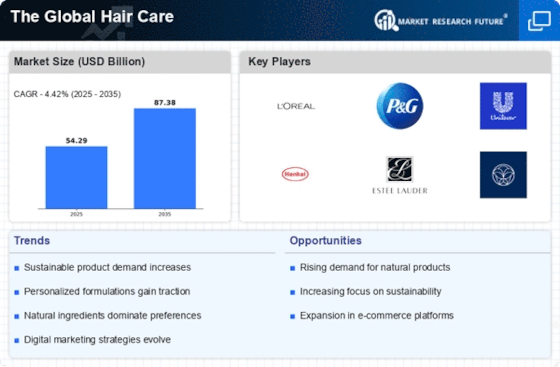
<p>The Global Hair Care is projected to reach a valuation of 87.38 USD Billion by 2035.</p>

What was the market valuation of The Global Hair Care in 2024?

In 2024, The Global Hair Care was valued at 54.29 USD Billion.

What is the expected CAGR for The Global Hair Care during the forecast period 2025 - 2035?

The expected CAGR for The Global Hair Care during the forecast period 2025 - 2035 is 4.42%.

Which segment of hair care products had the highest valuation in 2024?

In 2024, the Hair Color segment had the highest valuation at 15.29 USD Billion.

How do the valuations of hair care products vary by type?

The valuations by type in 2024 were Shampoo at 12.0 USD Billion, Conditioner at 10.0 USD Billion, Hair Oil at 8.0 USD Billion, Hair Styling Products at 9.0 USD Billion, and Hair Color at 15.29 USD Billion.

What are the key distribution channels for hair care products?

Key distribution channels include Supermarkets, Online Stores, Pharmacies, and Specialty Stores, with Supermarkets valued at 20.0 USD Billion in 2024.

Which demographic segment shows the highest market potential in hair care?

The Women demographic segment shows the highest market potential, with a valuation of 30.87 USD Billion in 2024.

What is the projected growth for the Curly hair type segment by 2035?

The Curly hair type segment is projected to grow from 10.0 USD Billion in 2024 to an estimated 16.0 USD Billion by 2035.

Who are the leading companies in The Global Hair Care?

Leading companies in The Global Hair Care include L'Oreal, Procter &amp; Gamble, Unilever, and Estée Lauder.

What was the valuation of the Men's hair care segment in 2024?

In 2024, the Men's hair care segment was valued at 10.86 USD Billion.

Market Summary

As per Market Research Future analysis, The Hair Care Market was estimated at 82.5 USD Billion in 2024. The hair care industry is projected to grow from 86.1 USD Billion in 2025 to 132.8 USD Billion by 2035, exhibiting a compound annual growth rate (CAGR) of 4.4% during the forecast period 2025 - 2035

Key Market Trends & Highlights

The Global Hair Care Market is experiencing a dynamic shift towards natural and personalized products, driven by consumer preferences and technological advancements.

  • The market is witnessing a notable rise in the use of natural ingredients, reflecting a broader consumer trend towards health and wellness. Personalization in hair care products is becoming increasingly prevalent, catering to diverse consumer needs and preferences. North America remains the largest market, while the Asia-Pacific region is emerging as the fastest-growing area for hair care products. The increasing demand for hair care products, coupled with the influence of social media and celebrity endorsements, drives market growth, particularly in the shampoo and curly hair segments.

Market Size & Forecast

2024 Market Size 82.5 (USD Billion)
2035 Market Size 86.1 (USD Billion)
CAGR (2025 - 2035) 4.4%
Largest Regional Market Share in 2024 Asia Pacific

Major Players

L'Oreal (FR), Procter &amp; Gamble (US), Unilever (GB), Henkel (DE), Estée Lauder (US), Coty (US), Shiseido (JP), Revlon (US), Kao Corporation (JP), <a href="https://www.amway.in/personal-care/c/hair-care">Amway</a> (US)

Market Trends

Current hair care market trends indicate a strong shift toward natural ingredients, personalized solutions, and sustainable product formulations driven by evolving consumer preferences. The Global Hair Care Market is currently experiencing a dynamic evolution, driven by shifting consumer preferences and an increasing emphasis on personal grooming. As individuals become more conscious of their appearance, the demand for diverse hair care products continues to rise. This market encompasses a wide array of offerings, including shampoos, conditioners, styling products, and treatments, catering to various hair types and concerns. This hair care market analysis highlights key growth drivers, emerging trends, competitive dynamics, and regional performance influencing the industry outlook through 2035. The clean hair care products market trend in 2025 reflects rising consumer demand for sulfate-free, silicone-free, and naturally derived formulations supported by transparent labeling. Furthermore, the influence of social media and beauty influencers plays a pivotal role in shaping consumer choices, as individuals seek products that align with their personal aesthetics and values. In addition to traditional products, the market is witnessing a surge in the popularity of natural and organic formulations. Consumers are increasingly inclined to select items that boast eco-friendly ingredients and sustainable packaging. This trend reflects a broader societal shift towards health and wellness, where individuals prioritize products that are perceived as safer and more beneficial for both themselves and the environment. As The Global Hair Care Market continues to expand, brands are likely to innovate and adapt to these evolving consumer demands, ensuring a vibrant and competitive landscape.

Rise of Natural Ingredients

There is a growing preference for hair care products that incorporate natural and organic ingredients. Consumers are increasingly aware of the potential harmful effects of synthetic chemicals, leading them to seek out formulations that are perceived as safer and more environmentally friendly.

Personalization in Hair Care Market

The trend towards personalized hair care solutions is gaining momentum. Brands are beginning to offer customized products tailored to individual hair types and concerns, allowing consumers to address their unique needs more effectively.

Sustainability Focus

Sustainability is becoming a central theme in The Global Hair Care Market. Companies are increasingly adopting eco-friendly practices, from sourcing ingredients to packaging, in response to consumer demand for environmentally responsible products.

Hair Care Market Market Drivers

Growth of E-commerce Platforms

The expansion of e-commerce platforms has significantly transformed The Global Hair Care Industry. Online shopping offers consumers unparalleled convenience, allowing them to access a wide range of hair care products from the comfort of their homes. In 2025, it is estimated that online sales will account for over 30% of total hair care product sales, driven by the increasing penetration of smartphones and internet connectivity. This shift towards digital retailing has prompted brands to enhance their online presence and engage with consumers through targeted marketing strategies. Furthermore, the availability of customer reviews and product comparisons online empowers consumers to make informed purchasing decisions, thereby fostering brand loyalty and repeat purchases.

Technological Advancements in Hair Care

Technological innovations are playing a pivotal role in shaping The Global Hair Care Industry. The introduction of advanced formulations and delivery systems has enhanced product efficacy, appealing to a broader consumer base. For instance, the development of hair care products that incorporate nanotechnology allows for deeper penetration of active ingredients, resulting in improved hair health. Additionally, the rise of smart hair care devices, such as hair analyzers and personalized treatment systems, is revolutionizing the way consumers approach hair care. These advancements not only cater to individual needs but also foster a more informed consumer base, as people become increasingly aware of the science behind hair care products.

Increasing Demand for Hair Care Products

The rising awareness regarding personal grooming and aesthetics has led to an increasing demand for hair care products. Consumers are becoming more conscious of their appearance, which drives the growth of The Global Hair Care Industry. In 2025, the market is projected to reach a valuation of approximately 87 billion USD, reflecting a compound annual growth rate of around 4.5% from previous years. This trend is particularly evident among younger demographics, who are more inclined to invest in premium hair care solutions. The proliferation of social media platforms has further amplified this demand, as influencers and beauty enthusiasts showcase various hair care routines and products, thereby encouraging consumers to explore diverse offerings in the market.

Rising Interest in Organic and Natural Products

There is a notable shift towards organic and natural hair care products within The Global Hair Care Industry. Consumers are increasingly seeking products that are free from harmful chemicals and synthetic ingredients, opting instead for formulations that utilize natural extracts and sustainable sourcing. This trend is reflected in the market, where sales of organic hair care products have surged, with a projected growth rate of 8% annually. Brands that emphasize transparency in their ingredient sourcing and production processes are likely to gain a competitive edge. This growing preference for clean beauty aligns with broader consumer trends towards health and wellness, as individuals become more discerning about the products they use on their bodies.

Influence of Social Media and Celebrity Endorsements

The impact of social media and celebrity endorsements on The Global Hair Care Industry cannot be overstated. Platforms such as Instagram and TikTok have become powerful marketing tools, enabling brands to reach vast audiences through influencer partnerships. These endorsements often lead to increased brand visibility and consumer trust, as followers are more likely to purchase products recommended by their favorite personalities. In 2025, it is anticipated that social media-driven sales will constitute a significant portion of the overall market, as consumers increasingly rely on online recommendations. This trend underscores the importance of digital marketing strategies for brands aiming to capture the attention of a tech-savvy consumer base.

Market Segment Insights

By Type: Shampoo (Largest) vs. Hair Color (Fastest-Growing)

In The Global Hair Care Market, the segment distribution shows that shampoo holds the largest market share, driven by consistent consumer demand for cleansing products. Following shampoo, conditioners and hair oils also occupy significant shares, catering to consumers seeking moisturization and nourishment for their hair. Hair styling products and <a href="https://www.marketresearchfuture.com/reports/hair-color-market-7820">hair color</a>, while essential, represent smaller portions of the market but are critical in enhancing overall hair aesthetics. Analyzing growth trends within this segment, hair color emerges as the fastest-growing category, propelled by innovative formulations and increasing interest in personal expression through hair aesthetics. Meanwhile, the shampoo segment continues to thrive due to trends towards natural and organic ingredients, indicating a shift in consumer preferences towards health-conscious hair care choices.

Shampoo: Dominant vs. Hair Color: Emerging

Shampoo remains the dominant player in The Global Hair Care Market, characterized by its essential role in daily hygiene routines. With a diverse array of formulations, including sulfate-free, moisturizing, and clarifying options, <a href="https://www.marketresearchfuture.com/reports/shampoo-market-7824">shampoos</a> cater to various hair types and concerns. The growth of retail, e-commerce, and premium brands further strengthens its market position. In contrast, hair color is an emerging segment, gaining traction as consumers increasingly experiment with vibrant hues and express individuality. The availability of ammonia-free and natural color options has broadened its appeal, making it more accessible and less intimidating for home use. Together, these segments reflect dynamic consumer trends, balancing everyday usability with the desire for creativity in hair care.

By Hair Type: Straight (Largest) vs. Curly (Fastest-Growing)

In The Global Hair Care Market, the distribution of share among different hair types showcases Straight hair as the largest segment, commanding a significant portion of the market. This dominance is attributed to the widespread prevalence of Straight hair across various demographics, leading to tailored product offerings that cater specifically to this consumer base. Contrarily, Curly hair has emerged as the fastest-growing segment, reflecting a growing awareness and appreciation for diverse hair textures. As brands innovate and expand their product ranges, this segment's share is poised to increase steadily, catering to unique needs and preferences of Curly-haired consumers.The professional hair care market continues to expand as consumers increasingly adopt salon-grade shampoos, treatments, and hair color products for at-home use.

Straight (Dominant) vs. Curly (Emerging)

Straight hair products dominate The Global Hair Care Market, capitalizing on a broad customer base that favors ease of styling and maintenance. Brands focusing on this segment invest heavily in smoothing and straightening formulations, appealing to consumers looking for sleek options. In contrast, Curly hair care is identified as an emerging segment, marked by increasing demand for products that enhance and define curls. The surge in the Curly hair segment is driven by changing beauty standards that promote natural textures and the introduction of innovative formulations that protect curl integrity. As more consumers embrace their natural curls, brands are responding with specialized products that cater to this demographic, fostering growth.

By End User: Women (Largest) vs. Men (Fastest-Growing)

In The Global Hair Care Market, the segment capturing the largest share is Women, who represent a significant portion of consumers prioritizing hair care products. Women are increasingly investing in a diverse range of hair care solutions, catering to various hair types and conditions, making this segment a cornerstone of market stability. On the other hand, Men’s grooming is emerging as a rapidly growing segment as changing perceptions around male grooming contribute to a surge in product demand. This evolution is accompanied by an increase in brand offerings specifically targeting male consumers.

Women (Dominant) vs. Men (Emerging)

The Women segment remains dominant in The Global Hair Care Market, characterized by a robust variety of products designed for different hair types, problems, and styling preferences. Brands are continuously innovating to address issues such as hair damage and styling, reflecting a strong consumer preference for quality and specialized products. Meanwhile, the Men's segment is on the rise, driven by shifting attitudes that embrace hair care as an essential part of personal grooming. Companies are responding by developing targeted products such as shampoos, conditioners, and styling gels, making the section appealing to a broader demographic.

By Distribution Channel: Supermarkets (Largest) vs. Online Stores (Fastest-Growing)

The distribution of The Global Hair Care Market reveals Supermarkets as the largest channel, commanding a significant share of consumer purchases. This dominance is attributed to the extensive reach and accessibility of supermarkets, where consumers often purchase hair care products alongside other household essentials. Online Stores, on the other hand, are emerging as a formidable force, rapidly increasing their share of the market as more consumers turn to e-commerce for convenience and variety in hair care options. With the rise of digital shopping habits, this channel is becoming increasingly important in meeting consumer needs and preferences. Growth trends in the distribution channel of The Global Hair Care Market showcase a marked shift toward Online Stores, driven by factors such as the increasing adoption of online shopping platforms and the influence of social media on consumer behavior. Consumers are now more inclined to explore diverse brands and products online, enabling them to make informed choices and take advantage of online promotions. Meanwhile, Supermarkets continue to perform well due to their established presence and comprehensive product offerings; however, to counter the rapid growth of online shopping, they are enhancing their product placements and in-store experiences to retain customer loyalty.

Supermarkets (Dominant) vs. Online Stores (Emerging)

Supermarkets serve as the dominant distribution channel in The Global Hair Care Market, benefiting from their extensive physical presence and the convenience they provide to consumers. The ability to stock a wide array of hair care products—from shampoos to styling products—offers consumers a one-stop shopping experience. In contrast, Online Stores are emerging as a critical channel, appealing to the modern consumer who values convenience and the ability to browse numerous brands easily. The shift towards e-commerce is also fueled by targeted marketing strategies, user-friendly interfaces, and home delivery options that enhance customer experience. Together, these channels reflect a dynamic landscape where traditional routes coexist with modern shopping behaviors, catering to varied consumer preferences.

Get more detailed insights about Hair Care Market Research Report – Forecast to 2035

Regional Insights

The Global Hair Care Market exhibits diverse dynamics across its Regional segmentation, with North America, Europe, APAC, South America, and MEA showcasing varied market valuations. North America, valued at 30.5 USD Billion in 2024, holds a significant position and is projected to reach 40.0 USD Billion by 2035, accounting for a large share of Global Hair Care Market revenue. Europe follows closely with a valuation of 25.0 USD Billion in 2024, increasing to 33.0 USD Billion by 2035, demonstrating its robust consumer base.

The Asia-Pacific (APAC) region leads the market with a valuation of 35.0 USD Billion in 2024, climbing to 48.0 USD Billion by 2035, highlighting its rapidly growing population and increasing disposable income, which play crucial roles in sustaining high demand for hair care products.South America is valued at 8.0 USD Billion in 2024 and is expected to grow to 10.0 USD Billion by 2035, contributing to the overall expanding market.

Meanwhile, the MEA region, with a smaller but significant valuation of 5.1 USD Billion in 2024, is projected to reach 9.5 USD Billion by 2035, aided by the rising adoption of hair care routines among consumers. These regions reflect distinct opportunities and unique growth drivers, influenced by cultural preferences, economic conditions, and varying competitive landscapes, contributing to the extensive Global Hair Care Market statistics.

Key Players and Competitive Insights

The Global Hair Care Market is characterized by a dynamic competitive landscape with numerous players vying for market share. This sector encompasses a wide range of products, including shampoo, conditioners, hair styling products, and treatments, catering to diverse consumer needs. The market has been experiencing notable growth driven by changing consumer preferences, increasing awareness of personal grooming, and the rise of innovative product formulations targeting specific hair types and issues. As industry players strive to differentiate themselves, the emphasis on natural ingredients, sustainability, and personalized hair care solutions has become a focal point in product development and marketing strategies. Competitive insights reveal that brands are leveraging digital platforms for better consumer engagement and to enhance their brand visibility, facilitating the expansion of their reach in the global arena.Avon has established a significant presence in the Global Hair Care Market through its broad product portfolio and direct-selling model. The company's strengths lie in its strong brand recognition and a loyal customer base, stemming from decades of experience in the beauty industry. With a commitment to accessibility and affordability, Avon offers a variety of hair care products that cater to different demographics and hair concerns. The innovative marketing strategies employed by Avon, which include catalog sales and a robust online presence, further enhance its competitive edge, enabling the brand to connect directly with consumers. Additionally, Avon's ability to adapt to market trends and consumer demands allows it to maintain its relevance and appeal in an increasingly competitive landscape. Shiseido is a renowned player in the Global Hair Care Market, recognized for its commitment to quality and innovation. The company offers a diverse range of hair care products, including treatments that merge skincare benefits with hair health. Shiseido is particularly known for its premium formulations that incorporate advanced technology and natural ingredients, appealing to consumers looking for effective and luxurious hair care solutions. The company's strengths include a strong research and development foundation, which allows for constant innovation and product enhancement. Shiseido's strategic mergers and acquisitions have enabled it to expand its market presence and enhance its product offerings, further solidifying its position in the global arena. With a focus on sustainability and ethical practices, Shiseido continues to respond to the evolving preferences of global consumers, positioning itself as a leader in the competitive hair care segment.

Key Companies in the Hair Care Market include

Industry Developments

There have been significant developments in the Global Hair Care Market lately, with notable growth in market valuation for key players like L'Oreal, Unilever, and Procter and Gamble, driven by increased consumer demand for premium and sustainable hair care products. In March 2023, Shiseido announced its acquisition of a leading organic hair care brand, reinforcing its commitment to expanding its natural product portfolio. Similarly, Avon has focused on enhancing its offerings with innovative hair treatments aimed at younger audiences.

Over the past two years, Estee Lauder has experienced considerable growth in its hair care segment, particularly due to its introduction of advanced technologies in hair repair formulations. Other companies, such as Henkel and Coty, have been liberalizing their product lines to cater to diverse consumer preferences, emphasizing cruelty-free and eco-friendly solutions. Additionally, Johnson and Johnson have invested in Research and Development to explore advanced formulations, positioning themselves as leaders in the market. These trends indicate a broader shift towards personalization and sustainability within the Global Hair Care Market, reflecting changing consumer behaviors and preferences.

Future Outlook

Hair Care Market Future Outlook

The Global Hair Care Market is projected to grow at a 4.4% CAGR from 2025 to 2035, driven by increasing consumer demand for natural products and innovative formulations.

New opportunities lie in:

  • <p>Expansion of eco-friendly product lines targeting sustainability-conscious consumers. Development of personalized hair care solutions using AI-driven diagnostics. Investment in e-commerce platforms to enhance direct-to-consumer sales channels.</p>

By 2035, the market is expected to achieve robust growth, reflecting evolving consumer preferences and technological advancements.

Market Segmentation

Hair Care Market Type Outlook

  • Shampoo
  • Conditioner
  • Hair Oil
  • Hair Styling Products
  • Hair Color

Hair Care Market End User Outlook

  • Men
  • Women
  • Children

Hair Care Market Hair Type Outlook

  • Straight
  • Wavy
  • Curly
  • Coily

Hair Care Market Distribution Channel Outlook

  • Supermarkets
  • Online Stores
  • Pharmacies
  • Specialty Stores

Report Scope

MARKET SIZE 2024 82.5 (USD Billion)
MARKET SIZE 2025 86.1 (USD Billion)
MARKET SIZE 2035 132.8 (USD Billion)
COMPOUND ANNUAL GROWTH RATE (CAGR) 4.4% (2025 - 2035)
REPORT COVERAGE Revenue Forecast, Competitive Landscape, Growth Factors, and Trends
BASE YEAR 2024
Market Forecast Period 2025 - 2035
Historical Data 2019 - 2024
Market Forecast Units USD Billion
Key Companies Profiled L'Oreal (FR), Procter & Gamble (US), Unilever (GB), Henkel (DE), Estée Lauder (US), Coty (US), Shiseido (JP), Revlon (US), Kao Corporation (JP), Amway (US)
Segments Covered Product Type, Hair Type, End User, Distribution Channel, Regional
Key Market Opportunities Integration of sustainable ingredients and eco-friendly packaging in The Global Hair Care.
Key Market Dynamics Rising consumer demand for natural ingredients drives innovation and competition in the hair care sector.
Countries Covered North America, Europe, APAC, South America, MEA

FAQs

What is the projected market valuation of The Global Hair Care by 2035?

<p>The Global Hair Care is projected to reach a valuation of 87.38 USD Billion by 2035.</p>

What was the market valuation of The Global Hair Care in 2024?

In 2024, The Global Hair Care was valued at 54.29 USD Billion.

What is the expected CAGR for The Global Hair Care during the forecast period 2025 - 2035?

The expected CAGR for The Global Hair Care during the forecast period 2025 - 2035 is 4.42%.

Which segment of hair care products had the highest valuation in 2024?

In 2024, the Hair Color segment had the highest valuation at 15.29 USD Billion.

How do the valuations of hair care products vary by type?

The valuations by type in 2024 were Shampoo at 12.0 USD Billion, Conditioner at 10.0 USD Billion, Hair Oil at 8.0 USD Billion, Hair Styling Products at 9.0 USD Billion, and Hair Color at 15.29 USD Billion.

What are the key distribution channels for hair care products?

Key distribution channels include Supermarkets, Online Stores, Pharmacies, and Specialty Stores, with Supermarkets valued at 20.0 USD Billion in 2024.

Which demographic segment shows the highest market potential in hair care?

The Women demographic segment shows the highest market potential, with a valuation of 30.87 USD Billion in 2024.

What is the projected growth for the Curly hair type segment by 2035?

The Curly hair type segment is projected to grow from 10.0 USD Billion in 2024 to an estimated 16.0 USD Billion by 2035.

Who are the leading companies in The Global Hair Care?

Leading companies in The Global Hair Care include L'Oreal, Procter &amp; Gamble, Unilever, and Estée Lauder.

What was the valuation of the Men's hair care segment in 2024?

In 2024, the Men's hair care segment was valued at 10.86 USD Billion.

  1. SECTION I: EXECUTIVE SUMMARY AND KEY HIGHLIGHTS
    1. | 1.1 EXECUTIVE SUMMARY
    2. | | 1.1.1 Market Overview
    3. | | 1.1.2 Key Findings
    4. | | 1.1.3 Market Segmentation
    5. | | 1.1.4 Competitive Landscape
    6. | | 1.1.5 Challenges and Opportunities
    7. | | 1.1.6 Future Outlook
  2. SECTION II: SCOPING, METHODOLOGY AND MARKET STRUCTURE
    1. | 2.1 MARKET INTRODUCTION
    2. | | 2.1.1 Definition
    3. | | 2.1.2 Scope of the study
    4. | | | 2.1.2.1 Research Objective
    5. | | | 2.1.2.2 Assumption
    6. | | | 2.1.2.3 Limitations
    7. | 2.2 RESEARCH METHODOLOGY
    8. | | 2.2.1 Overview
    9. | | 2.2.2 Data Mining
    10. | | 2.2.3 Secondary Research
    11. | | 2.2.4 Primary Research
    12. | | | 2.2.4.1 Primary Interviews and Information Gathering Process
    13. | | | 2.2.4.2 Breakdown of Primary Respondents
    14. | | 2.2.5 Forecasting Model
    15. | | 2.2.6 Market Size Estimation
    16. | | | 2.2.6.1 Bottom-Up Approach
    17. | | | 2.2.6.2 Top-Down Approach
    18. | | 2.2.7 Data Triangulation
    19. | | 2.2.8 Validation
  3. SECTION III: QUALITATIVE ANALYSIS
    1. | 3.1 MARKET DYNAMICS
    2. | | 3.1.1 Overview
    3. | | 3.1.2 Drivers
    4. | | 3.1.3 Restraints
    5. | | 3.1.4 Opportunities
    6. | 3.2 MARKET FACTOR ANALYSIS
    7. | | 3.2.1 Value chain Analysis
    8. | | 3.2.2 Porter's Five Forces Analysis
    9. | | | 3.2.2.1 Bargaining Power of Suppliers
    10. | | | 3.2.2.2 Bargaining Power of Buyers
    11. | | | 3.2.2.3 Threat of New Entrants
    12. | | | 3.2.2.4 Threat of Substitutes
    13. | | | 3.2.2.5 Intensity of Rivalry
    14. | | 3.2.3 COVID-19 Impact Analysis
    15. | | | 3.2.3.1 Market Impact Analysis
    16. | | | 3.2.3.2 Regional Impact
    17. | | | 3.2.3.3 Opportunity and Threat Analysis
  4. SECTION IV: QUANTITATIVE ANALYSIS
    1. | 4.1 Consumer and Retail, BY Type (USD Billion)
    2. | | 4.1.1 Shampoo
    3. | | 4.1.2 Conditioner
    4. | | 4.1.3 Hair Oil
    5. | | 4.1.4 Hair Styling Products
    6. | | 4.1.5 Hair Color
    7. | 4.2 Consumer and Retail, BY Hair Type (USD Billion)
    8. | | 4.2.1 Straight
    9. | | 4.2.2 Wavy
    10. | | 4.2.3 Curly
    11. | | 4.2.4 Coily
    12. | 4.3 Consumer and Retail, BY End User (USD Billion)
    13. | | 4.3.1 Men
    14. | | 4.3.2 Women
    15. | | 4.3.3 Children
    16. | 4.4 Consumer and Retail, BY Distribution Channel (USD Billion)
    17. | | 4.4.1 Supermarkets
    18. | | 4.4.2 Online Stores
    19. | | 4.4.3 Pharmacies
    20. | | 4.4.4 Specialty Stores
    21. | 4.5 Consumer and Retail, BY Region (USD Billion)
    22. | | 4.5.1 North America
    23. | | | 4.5.1.1 US
    24. | | | 4.5.1.2 Canada
    25. | | 4.5.2 Europe
    26. | | | 4.5.2.1 Germany
    27. | | | 4.5.2.2 UK
    28. | | | 4.5.2.3 France
    29. | | | 4.5.2.4 Russia
    30. | | | 4.5.2.5 Italy
    31. | | | 4.5.2.6 Spain
    32. | | | 4.5.2.7 Rest of Europe
    33. | | 4.5.3 APAC
    34. | | | 4.5.3.1 China
    35. | | | 4.5.3.2 India
    36. | | | 4.5.3.3 Japan
    37. | | | 4.5.3.4 South Korea
    38. | | | 4.5.3.5 Malaysia
    39. | | | 4.5.3.6 Thailand
    40. | | | 4.5.3.7 Indonesia
    41. | | | 4.5.3.8 Rest of APAC
    42. | | 4.5.4 South America
    43. | | | 4.5.4.1 Brazil
    44. | | | 4.5.4.2 Mexico
    45. | | | 4.5.4.3 Argentina
    46. | | | 4.5.4.4 Rest of South America
    47. | | 4.5.5 MEA
    48. | | | 4.5.5.1 GCC Countries
    49. | | | 4.5.5.2 South Africa
    50. | | | 4.5.5.3 Rest of MEA
  5. SECTION V: COMPETITIVE ANALYSIS
    1. | 5.1 Competitive Landscape
    2. | | 5.1.1 Overview
    3. | | 5.1.2 Competitive Analysis
    4. | | 5.1.3 Market share Analysis
    5. | | 5.1.4 Major Growth Strategy in the Consumer and Retail
    6. | | 5.1.5 Competitive Benchmarking
    7. | | 5.1.6 Leading Players in Terms of Number of Developments in the Consumer and Retail
    8. | | 5.1.7 Key developments and growth strategies
    9. | | | 5.1.7.1 New Product Launch/Service Deployment
    10. | | | 5.1.7.2 Merger & Acquisitions
    11. | | | 5.1.7.3 Joint Ventures
    12. | | 5.1.8 Major Players Financial Matrix
    13. | | | 5.1.8.1 Sales and Operating Income
    14. | | | 5.1.8.2 Major Players R&D Expenditure. 2023
    15. | 5.2 Company Profiles
    16. | | 5.2.1 L'Oreal (FR)
    17. | | | 5.2.1.1 Financial Overview
    18. | | | 5.2.1.2 Products Offered
    19. | | | 5.2.1.3 Key Developments
    20. | | | 5.2.1.4 SWOT Analysis
    21. | | | 5.2.1.5 Key Strategies
    22. | | 5.2.2 Procter & Gamble (US)
    23. | | | 5.2.2.1 Financial Overview
    24. | | | 5.2.2.2 Products Offered
    25. | | | 5.2.2.3 Key Developments
    26. | | | 5.2.2.4 SWOT Analysis
    27. | | | 5.2.2.5 Key Strategies
    28. | | 5.2.3 Unilever (GB)
    29. | | | 5.2.3.1 Financial Overview
    30. | | | 5.2.3.2 Products Offered
    31. | | | 5.2.3.3 Key Developments
    32. | | | 5.2.3.4 SWOT Analysis
    33. | | | 5.2.3.5 Key Strategies
    34. | | 5.2.4 Henkel (DE)
    35. | | | 5.2.4.1 Financial Overview
    36. | | | 5.2.4.2 Products Offered
    37. | | | 5.2.4.3 Key Developments
    38. | | | 5.2.4.4 SWOT Analysis
    39. | | | 5.2.4.5 Key Strategies
    40. | | 5.2.5 Estée Lauder (US)
    41. | | | 5.2.5.1 Financial Overview
    42. | | | 5.2.5.2 Products Offered
    43. | | | 5.2.5.3 Key Developments
    44. | | | 5.2.5.4 SWOT Analysis
    45. | | | 5.2.5.5 Key Strategies
    46. | | 5.2.6 Coty (US)
    47. | | | 5.2.6.1 Financial Overview
    48. | | | 5.2.6.2 Products Offered
    49. | | | 5.2.6.3 Key Developments
    50. | | | 5.2.6.4 SWOT Analysis
    51. | | | 5.2.6.5 Key Strategies
    52. | | 5.2.7 Shiseido (JP)
    53. | | | 5.2.7.1 Financial Overview
    54. | | | 5.2.7.2 Products Offered
    55. | | | 5.2.7.3 Key Developments
    56. | | | 5.2.7.4 SWOT Analysis
    57. | | | 5.2.7.5 Key Strategies
    58. | | 5.2.8 Revlon (US)
    59. | | | 5.2.8.1 Financial Overview
    60. | | | 5.2.8.2 Products Offered
    61. | | | 5.2.8.3 Key Developments
    62. | | | 5.2.8.4 SWOT Analysis
    63. | | | 5.2.8.5 Key Strategies
    64. | | 5.2.9 Kao Corporation (JP)
    65. | | | 5.2.9.1 Financial Overview
    66. | | | 5.2.9.2 Products Offered
    67. | | | 5.2.9.3 Key Developments
    68. | | | 5.2.9.4 SWOT Analysis
    69. | | | 5.2.9.5 Key Strategies
    70. | | 5.2.10 Amway (US)
    71. | | | 5.2.10.1 Financial Overview
    72. | | | 5.2.10.2 Products Offered
    73. | | | 5.2.10.3 Key Developments
    74. | | | 5.2.10.4 SWOT Analysis
    75. | | | 5.2.10.5 Key Strategies
    76. | 5.3 Appendix
    77. | | 5.3.1 References
    78. | | 5.3.2 Related Reports
  6. LIST OF FIGURES
    1. | 6.1 MARKET SYNOPSIS
    2. | 6.2 NORTH AMERICA MARKET ANALYSIS
    3. | 6.3 US MARKET ANALYSIS BY TYPE
    4. | 6.4 US MARKET ANALYSIS BY HAIR TYPE
    5. | 6.5 US MARKET ANALYSIS BY END USER
    6. | 6.6 US MARKET ANALYSIS BY DISTRIBUTION CHANNEL
    7. | 6.7 CANADA MARKET ANALYSIS BY TYPE
    8. | 6.8 CANADA MARKET ANALYSIS BY HAIR TYPE
    9. | 6.9 CANADA MARKET ANALYSIS BY END USER
    10. | 6.10 CANADA MARKET ANALYSIS BY DISTRIBUTION CHANNEL
    11. | 6.11 EUROPE MARKET ANALYSIS
    12. | 6.12 GERMANY MARKET ANALYSIS BY TYPE
    13. | 6.13 GERMANY MARKET ANALYSIS BY HAIR TYPE
    14. | 6.14 GERMANY MARKET ANALYSIS BY END USER
    15. | 6.15 GERMANY MARKET ANALYSIS BY DISTRIBUTION CHANNEL
    16. | 6.16 UK MARKET ANALYSIS BY TYPE
    17. | 6.17 UK MARKET ANALYSIS BY HAIR TYPE
    18. | 6.18 UK MARKET ANALYSIS BY END USER
    19. | 6.19 UK MARKET ANALYSIS BY DISTRIBUTION CHANNEL
    20. | 6.20 FRANCE MARKET ANALYSIS BY TYPE
    21. | 6.21 FRANCE MARKET ANALYSIS BY HAIR TYPE
    22. | 6.22 FRANCE MARKET ANALYSIS BY END USER
    23. | 6.23 FRANCE MARKET ANALYSIS BY DISTRIBUTION CHANNEL
    24. | 6.24 RUSSIA MARKET ANALYSIS BY TYPE
    25. | 6.25 RUSSIA MARKET ANALYSIS BY HAIR TYPE
    26. | 6.26 RUSSIA MARKET ANALYSIS BY END USER
    27. | 6.27 RUSSIA MARKET ANALYSIS BY DISTRIBUTION CHANNEL
    28. | 6.28 ITALY MARKET ANALYSIS BY TYPE
    29. | 6.29 ITALY MARKET ANALYSIS BY HAIR TYPE
    30. | 6.30 ITALY MARKET ANALYSIS BY END USER
    31. | 6.31 ITALY MARKET ANALYSIS BY DISTRIBUTION CHANNEL
    32. | 6.32 SPAIN MARKET ANALYSIS BY TYPE
    33. | 6.33 SPAIN MARKET ANALYSIS BY HAIR TYPE
    34. | 6.34 SPAIN MARKET ANALYSIS BY END USER
    35. | 6.35 SPAIN MARKET ANALYSIS BY DISTRIBUTION CHANNEL
    36. | 6.36 REST OF EUROPE MARKET ANALYSIS BY TYPE
    37. | 6.37 REST OF EUROPE MARKET ANALYSIS BY HAIR TYPE
    38. | 6.38 REST OF EUROPE MARKET ANALYSIS BY END USER
    39. | 6.39 REST OF EUROPE MARKET ANALYSIS BY DISTRIBUTION CHANNEL
    40. | 6.40 APAC MARKET ANALYSIS
    41. | 6.41 CHINA MARKET ANALYSIS BY TYPE
    42. | 6.42 CHINA MARKET ANALYSIS BY HAIR TYPE
    43. | 6.43 CHINA MARKET ANALYSIS BY END USER
    44. | 6.44 CHINA MARKET ANALYSIS BY DISTRIBUTION CHANNEL
    45. | 6.45 INDIA MARKET ANALYSIS BY TYPE
    46. | 6.46 INDIA MARKET ANALYSIS BY HAIR TYPE
    47. | 6.47 INDIA MARKET ANALYSIS BY END USER
    48. | 6.48 INDIA MARKET ANALYSIS BY DISTRIBUTION CHANNEL
    49. | 6.49 JAPAN MARKET ANALYSIS BY TYPE
    50. | 6.50 JAPAN MARKET ANALYSIS BY HAIR TYPE
    51. | 6.51 JAPAN MARKET ANALYSIS BY END USER
    52. | 6.52 JAPAN MARKET ANALYSIS BY DISTRIBUTION CHANNEL
    53. | 6.53 SOUTH KOREA MARKET ANALYSIS BY TYPE
    54. | 6.54 SOUTH KOREA MARKET ANALYSIS BY HAIR TYPE
    55. | 6.55 SOUTH KOREA MARKET ANALYSIS BY END USER
    56. | 6.56 SOUTH KOREA MARKET ANALYSIS BY DISTRIBUTION CHANNEL
    57. | 6.57 MALAYSIA MARKET ANALYSIS BY TYPE
    58. | 6.58 MALAYSIA MARKET ANALYSIS BY HAIR TYPE
    59. | 6.59 MALAYSIA MARKET ANALYSIS BY END USER
    60. | 6.60 MALAYSIA MARKET ANALYSIS BY DISTRIBUTION CHANNEL
    61. | 6.61 THAILAND MARKET ANALYSIS BY TYPE
    62. | 6.62 THAILAND MARKET ANALYSIS BY HAIR TYPE
    63. | 6.63 THAILAND MARKET ANALYSIS BY END USER
    64. | 6.64 THAILAND MARKET ANALYSIS BY DISTRIBUTION CHANNEL
    65. | 6.65 INDONESIA MARKET ANALYSIS BY TYPE
    66. | 6.66 INDONESIA MARKET ANALYSIS BY HAIR TYPE
    67. | 6.67 INDONESIA MARKET ANALYSIS BY END USER
    68. | 6.68 INDONESIA MARKET ANALYSIS BY DISTRIBUTION CHANNEL
    69. | 6.69 REST OF APAC MARKET ANALYSIS BY TYPE
    70. | 6.70 REST OF APAC MARKET ANALYSIS BY HAIR TYPE
    71. | 6.71 REST OF APAC MARKET ANALYSIS BY END USER
    72. | 6.72 REST OF APAC MARKET ANALYSIS BY DISTRIBUTION CHANNEL
    73. | 6.73 SOUTH AMERICA MARKET ANALYSIS
    74. | 6.74 BRAZIL MARKET ANALYSIS BY TYPE
    75. | 6.75 BRAZIL MARKET ANALYSIS BY HAIR TYPE
    76. | 6.76 BRAZIL MARKET ANALYSIS BY END USER
    77. | 6.77 BRAZIL MARKET ANALYSIS BY DISTRIBUTION CHANNEL
    78. | 6.78 MEXICO MARKET ANALYSIS BY TYPE
    79. | 6.79 MEXICO MARKET ANALYSIS BY HAIR TYPE
    80. | 6.80 MEXICO MARKET ANALYSIS BY END USER
    81. | 6.81 MEXICO MARKET ANALYSIS BY DISTRIBUTION CHANNEL
    82. | 6.82 ARGENTINA MARKET ANALYSIS BY TYPE
    83. | 6.83 ARGENTINA MARKET ANALYSIS BY HAIR TYPE
    84. | 6.84 ARGENTINA MARKET ANALYSIS BY END USER
    85. | 6.85 ARGENTINA MARKET ANALYSIS BY DISTRIBUTION CHANNEL
    86. | 6.86 REST OF SOUTH AMERICA MARKET ANALYSIS BY TYPE
    87. | 6.87 REST OF SOUTH AMERICA MARKET ANALYSIS BY HAIR TYPE
    88. | 6.88 REST OF SOUTH AMERICA MARKET ANALYSIS BY END USER
    89. | 6.89 REST OF SOUTH AMERICA MARKET ANALYSIS BY DISTRIBUTION CHANNEL
    90. | 6.90 MEA MARKET ANALYSIS
    91. | 6.91 GCC COUNTRIES MARKET ANALYSIS BY TYPE
    92. | 6.92 GCC COUNTRIES MARKET ANALYSIS BY HAIR TYPE
    93. | 6.93 GCC COUNTRIES MARKET ANALYSIS BY END USER
    94. | 6.94 GCC COUNTRIES MARKET ANALYSIS BY DISTRIBUTION CHANNEL
    95. | 6.95 SOUTH AFRICA MARKET ANALYSIS BY TYPE
    96. | 6.96 SOUTH AFRICA MARKET ANALYSIS BY HAIR TYPE
    97. | 6.97 SOUTH AFRICA MARKET ANALYSIS BY END USER
    98. | 6.98 SOUTH AFRICA MARKET ANALYSIS BY DISTRIBUTION CHANNEL
    99. | 6.99 REST OF MEA MARKET ANALYSIS BY TYPE
    100. | 6.100 REST OF MEA MARKET ANALYSIS BY HAIR TYPE
    101. | 6.101 REST OF MEA MARKET ANALYSIS BY END USER
    102. | 6.102 REST OF MEA MARKET ANALYSIS BY DISTRIBUTION CHANNEL
    103. | 6.103 KEY BUYING CRITERIA OF CONSUMER AND RETAIL
    104. | 6.104 RESEARCH PROCESS OF MRFR
    105. | 6.105 DRO ANALYSIS OF CONSUMER AND RETAIL
    106. | 6.106 DRIVERS IMPACT ANALYSIS: CONSUMER AND RETAIL
    107. | 6.107 RESTRAINTS IMPACT ANALYSIS: CONSUMER AND RETAIL
    108. | 6.108 SUPPLY / VALUE CHAIN: CONSUMER AND RETAIL
    109. | 6.109 CONSUMER AND RETAIL, BY TYPE, 2024 (% SHARE)
    110. | 6.110 CONSUMER AND RETAIL, BY TYPE, 2024 TO 2035 (USD Billion)
    111. | 6.111 CONSUMER AND RETAIL, BY HAIR TYPE, 2024 (% SHARE)
    112. | 6.112 CONSUMER AND RETAIL, BY HAIR TYPE, 2024 TO 2035 (USD Billion)
    113. | 6.113 CONSUMER AND RETAIL, BY END USER, 2024 (% SHARE)
    114. | 6.114 CONSUMER AND RETAIL, BY END USER, 2024 TO 2035 (USD Billion)
    115. | 6.115 CONSUMER AND RETAIL, BY DISTRIBUTION CHANNEL, 2024 (% SHARE)
    116. | 6.116 CONSUMER AND RETAIL, BY DISTRIBUTION CHANNEL, 2024 TO 2035 (USD Billion)
    117. | 6.117 BENCHMARKING OF MAJOR COMPETITORS
  7. LIST OF TABLES
    1. | 7.1 LIST OF ASSUMPTIONS
    2. | | 7.1.1
    3. | 7.2 North America MARKET SIZE ESTIMATES; FORECAST
    4. | | 7.2.1 BY TYPE, 2025-2035 (USD Billion)
    5. | | 7.2.2 BY HAIR TYPE, 2025-2035 (USD Billion)
    6. | | 7.2.3 BY END USER, 2025-2035 (USD Billion)
    7. | | 7.2.4 BY DISTRIBUTION CHANNEL, 2025-2035 (USD Billion)
    8. | 7.3 US MARKET SIZE ESTIMATES; FORECAST
    9. | | 7.3.1 BY TYPE, 2025-2035 (USD Billion)
    10. | | 7.3.2 BY HAIR TYPE, 2025-2035 (USD Billion)
    11. | | 7.3.3 BY END USER, 2025-2035 (USD Billion)
    12. | | 7.3.4 BY DISTRIBUTION CHANNEL, 2025-2035 (USD Billion)
    13. | 7.4 Canada MARKET SIZE ESTIMATES; FORECAST
    14. | | 7.4.1 BY TYPE, 2025-2035 (USD Billion)
    15. | | 7.4.2 BY HAIR TYPE, 2025-2035 (USD Billion)
    16. | | 7.4.3 BY END USER, 2025-2035 (USD Billion)
    17. | | 7.4.4 BY DISTRIBUTION CHANNEL, 2025-2035 (USD Billion)
    18. | 7.5 Europe MARKET SIZE ESTIMATES; FORECAST
    19. | | 7.5.1 BY TYPE, 2025-2035 (USD Billion)
    20. | | 7.5.2 BY HAIR TYPE, 2025-2035 (USD Billion)
    21. | | 7.5.3 BY END USER, 2025-2035 (USD Billion)
    22. | | 7.5.4 BY DISTRIBUTION CHANNEL, 2025-2035 (USD Billion)
    23. | 7.6 Germany MARKET SIZE ESTIMATES; FORECAST
    24. | | 7.6.1 BY TYPE, 2025-2035 (USD Billion)
    25. | | 7.6.2 BY HAIR TYPE, 2025-2035 (USD Billion)
    26. | | 7.6.3 BY END USER, 2025-2035 (USD Billion)
    27. | | 7.6.4 BY DISTRIBUTION CHANNEL, 2025-2035 (USD Billion)
    28. | 7.7 UK MARKET SIZE ESTIMATES; FORECAST
    29. | | 7.7.1 BY TYPE, 2025-2035 (USD Billion)
    30. | | 7.7.2 BY HAIR TYPE, 2025-2035 (USD Billion)
    31. | | 7.7.3 BY END USER, 2025-2035 (USD Billion)
    32. | | 7.7.4 BY DISTRIBUTION CHANNEL, 2025-2035 (USD Billion)
    33. | 7.8 France MARKET SIZE ESTIMATES; FORECAST
    34. | | 7.8.1 BY TYPE, 2025-2035 (USD Billion)
    35. | | 7.8.2 BY HAIR TYPE, 2025-2035 (USD Billion)
    36. | | 7.8.3 BY END USER, 2025-2035 (USD Billion)
    37. | | 7.8.4 BY DISTRIBUTION CHANNEL, 2025-2035 (USD Billion)
    38. | 7.9 Russia MARKET SIZE ESTIMATES; FORECAST
    39. | | 7.9.1 BY TYPE, 2025-2035 (USD Billion)
    40. | | 7.9.2 BY HAIR TYPE, 2025-2035 (USD Billion)
    41. | | 7.9.3 BY END USER, 2025-2035 (USD Billion)
    42. | | 7.9.4 BY DISTRIBUTION CHANNEL, 2025-2035 (USD Billion)
    43. | 7.10 Italy MARKET SIZE ESTIMATES; FORECAST
    44. | | 7.10.1 BY TYPE, 2025-2035 (USD Billion)
    45. | | 7.10.2 BY HAIR TYPE, 2025-2035 (USD Billion)
    46. | | 7.10.3 BY END USER, 2025-2035 (USD Billion)
    47. | | 7.10.4 BY DISTRIBUTION CHANNEL, 2025-2035 (USD Billion)
    48. | 7.11 Spain MARKET SIZE ESTIMATES; FORECAST
    49. | | 7.11.1 BY TYPE, 2025-2035 (USD Billion)
    50. | | 7.11.2 BY HAIR TYPE, 2025-2035 (USD Billion)
    51. | | 7.11.3 BY END USER, 2025-2035 (USD Billion)
    52. | | 7.11.4 BY DISTRIBUTION CHANNEL, 2025-2035 (USD Billion)
    53. | 7.12 Rest of Europe MARKET SIZE ESTIMATES; FORECAST
    54. | | 7.12.1 BY TYPE, 2025-2035 (USD Billion)
    55. | | 7.12.2 BY HAIR TYPE, 2025-2035 (USD Billion)
    56. | | 7.12.3 BY END USER, 2025-2035 (USD Billion)
    57. | | 7.12.4 BY DISTRIBUTION CHANNEL, 2025-2035 (USD Billion)
    58. | 7.13 APAC MARKET SIZE ESTIMATES; FORECAST
    59. | | 7.13.1 BY TYPE, 2025-2035 (USD Billion)
    60. | | 7.13.2 BY HAIR TYPE, 2025-2035 (USD Billion)
    61. | | 7.13.3 BY END USER, 2025-2035 (USD Billion)
    62. | | 7.13.4 BY DISTRIBUTION CHANNEL, 2025-2035 (USD Billion)
    63. | 7.14 China MARKET SIZE ESTIMATES; FORECAST
    64. | | 7.14.1 BY TYPE, 2025-2035 (USD Billion)
    65. | | 7.14.2 BY HAIR TYPE, 2025-2035 (USD Billion)
    66. | | 7.14.3 BY END USER, 2025-2035 (USD Billion)
    67. | | 7.14.4 BY DISTRIBUTION CHANNEL, 2025-2035 (USD Billion)
    68. | 7.15 India MARKET SIZE ESTIMATES; FORECAST
    69. | | 7.15.1 BY TYPE, 2025-2035 (USD Billion)
    70. | | 7.15.2 BY HAIR TYPE, 2025-2035 (USD Billion)
    71. | | 7.15.3 BY END USER, 2025-2035 (USD Billion)
    72. | | 7.15.4 BY DISTRIBUTION CHANNEL, 2025-2035 (USD Billion)
    73. | 7.16 Japan MARKET SIZE ESTIMATES; FORECAST
    74. | | 7.16.1 BY TYPE, 2025-2035 (USD Billion)
    75. | | 7.16.2 BY HAIR TYPE, 2025-2035 (USD Billion)
    76. | | 7.16.3 BY END USER, 2025-2035 (USD Billion)
    77. | | 7.16.4 BY DISTRIBUTION CHANNEL, 2025-2035 (USD Billion)
    78. | 7.17 South Korea MARKET SIZE ESTIMATES; FORECAST
    79. | | 7.17.1 BY TYPE, 2025-2035 (USD Billion)
    80. | | 7.17.2 BY HAIR TYPE, 2025-2035 (USD Billion)
    81. | | 7.17.3 BY END USER, 2025-2035 (USD Billion)
    82. | | 7.17.4 BY DISTRIBUTION CHANNEL, 2025-2035 (USD Billion)
    83. | 7.18 Malaysia MARKET SIZE ESTIMATES; FORECAST
    84. | | 7.18.1 BY TYPE, 2025-2035 (USD Billion)
    85. | | 7.18.2 BY HAIR TYPE, 2025-2035 (USD Billion)
    86. | | 7.18.3 BY END USER, 2025-2035 (USD Billion)
    87. | | 7.18.4 BY DISTRIBUTION CHANNEL, 2025-2035 (USD Billion)
    88. | 7.19 Thailand MARKET SIZE ESTIMATES; FORECAST
    89. | | 7.19.1 BY TYPE, 2025-2035 (USD Billion)
    90. | | 7.19.2 BY HAIR TYPE, 2025-2035 (USD Billion)
    91. | | 7.19.3 BY END USER, 2025-2035 (USD Billion)
    92. | | 7.19.4 BY DISTRIBUTION CHANNEL, 2025-2035 (USD Billion)
    93. | 7.20 Indonesia MARKET SIZE ESTIMATES; FORECAST
    94. | | 7.20.1 BY TYPE, 2025-2035 (USD Billion)
    95. | | 7.20.2 BY HAIR TYPE, 2025-2035 (USD Billion)
    96. | | 7.20.3 BY END USER, 2025-2035 (USD Billion)
    97. | | 7.20.4 BY DISTRIBUTION CHANNEL, 2025-2035 (USD Billion)
    98. | 7.21 Rest of APAC MARKET SIZE ESTIMATES; FORECAST
    99. | | 7.21.1 BY TYPE, 2025-2035 (USD Billion)
    100. | | 7.21.2 BY HAIR TYPE, 2025-2035 (USD Billion)
    101. | | 7.21.3 BY END USER, 2025-2035 (USD Billion)
    102. | | 7.21.4 BY DISTRIBUTION CHANNEL, 2025-2035 (USD Billion)
    103. | 7.22 South America MARKET SIZE ESTIMATES; FORECAST
    104. | | 7.22.1 BY TYPE, 2025-2035 (USD Billion)
    105. | | 7.22.2 BY HAIR TYPE, 2025-2035 (USD Billion)
    106. | | 7.22.3 BY END USER, 2025-2035 (USD Billion)
    107. | | 7.22.4 BY DISTRIBUTION CHANNEL, 2025-2035 (USD Billion)
    108. | 7.23 Brazil MARKET SIZE ESTIMATES; FORECAST
    109. | | 7.23.1 BY TYPE, 2025-2035 (USD Billion)
    110. | | 7.23.2 BY HAIR TYPE, 2025-2035 (USD Billion)
    111. | | 7.23.3 BY END USER, 2025-2035 (USD Billion)
    112. | | 7.23.4 BY DISTRIBUTION CHANNEL, 2025-2035 (USD Billion)
    113. | 7.24 Mexico MARKET SIZE ESTIMATES; FORECAST
    114. | | 7.24.1 BY TYPE, 2025-2035 (USD Billion)
    115. | | 7.24.2 BY HAIR TYPE, 2025-2035 (USD Billion)
    116. | | 7.24.3 BY END USER, 2025-2035 (USD Billion)
    117. | | 7.24.4 BY DISTRIBUTION CHANNEL, 2025-2035 (USD Billion)
    118. | 7.25 Argentina MARKET SIZE ESTIMATES; FORECAST
    119. | | 7.25.1 BY TYPE, 2025-2035 (USD Billion)
    120. | | 7.25.2 BY HAIR TYPE, 2025-2035 (USD Billion)
    121. | | 7.25.3 BY END USER, 2025-2035 (USD Billion)
    122. | | 7.25.4 BY DISTRIBUTION CHANNEL, 2025-2035 (USD Billion)
    123. | 7.26 Rest of South America MARKET SIZE ESTIMATES; FORECAST
    124. | | 7.26.1 BY TYPE, 2025-2035 (USD Billion)
    125. | | 7.26.2 BY HAIR TYPE, 2025-2035 (USD Billion)
    126. | | 7.26.3 BY END USER, 2025-2035 (USD Billion)
    127. | | 7.26.4 BY DISTRIBUTION CHANNEL, 2025-2035 (USD Billion)
    128. | 7.27 MEA MARKET SIZE ESTIMATES; FORECAST
    129. | | 7.27.1 BY TYPE, 2025-2035 (USD Billion)
    130. | | 7.27.2 BY HAIR TYPE, 2025-2035 (USD Billion)
    131. | | 7.27.3 BY END USER, 2025-2035 (USD Billion)
    132. | | 7.27.4 BY DISTRIBUTION CHANNEL, 2025-2035 (USD Billion)
    133. | 7.28 GCC Countries MARKET SIZE ESTIMATES; FORECAST
    134. | | 7.28.1 BY TYPE, 2025-2035 (USD Billion)
    135. | | 7.28.2 BY HAIR TYPE, 2025-2035 (USD Billion)
    136. | | 7.28.3 BY END USER, 2025-2035 (USD Billion)
    137. | | 7.28.4 BY DISTRIBUTION CHANNEL, 2025-2035 (USD Billion)
    138. | 7.29 South Africa MARKET SIZE ESTIMATES; FORECAST
    139. | | 7.29.1 BY TYPE, 2025-2035 (USD Billion)
    140. | | 7.29.2 BY HAIR TYPE, 2025-2035 (USD Billion)
    141. | | 7.29.3 BY END USER, 2025-2035 (USD Billion)
    142. | | 7.29.4 BY DISTRIBUTION CHANNEL, 2025-2035 (USD Billion)
    143. | 7.30 Rest of MEA MARKET SIZE ESTIMATES; FORECAST
    144. | | 7.30.1 BY TYPE, 2025-2035 (USD Billion)
    145. | | 7.30.2 BY HAIR TYPE, 2025-2035 (USD Billion)
    146. | | 7.30.3 BY END USER, 2025-2035 (USD Billion)
    147. | | 7.30.4 BY DISTRIBUTION CHANNEL, 2025-2035 (USD Billion)
    148. | 7.31 PRODUCT LAUNCH/PRODUCT DEVELOPMENT/APPROVAL
    149. | | 7.31.1
    150. | 7.32 ACQUISITION/PARTNERSHIP
    151. | | 7.32.1

Consumer and Retail Market Segmentation

Consumer and Retail By Type (USD Billion, 2025-2035)

  • Shampoo
  • Conditioner
  • Hair Oil
  • Hair Styling Products
  • Hair Color

Consumer and Retail By Hair Type (USD Billion, 2025-2035)

  • Straight
  • Wavy
  • Curly
  • Coily

Consumer and Retail By End User (USD Billion, 2025-2035)

  • Men
  • Women
  • Children

Consumer and Retail By Distribution Channel (USD Billion, 2025-2035)

  • Supermarkets
  • Online Stores
  • Pharmacies
  • Specialty Stores
Infographic

Free Sample Request

Kindly complete the form below to receive a free sample of this Report

Get Free Sample

Customer Strories

Compare Licence

×
Features License Type
Single User Multiuser License Enterprise User
Price $4,950 $5,950 $7,250
Maximum User Access Limit 1 User Upto 10 Users Unrestricted Access Throughout the Organization
Free Customization
Direct Access to Analyst
Deliverable Format
Platform Access
Discount on Next Purchase 10% 15% 15%
Printable Versions