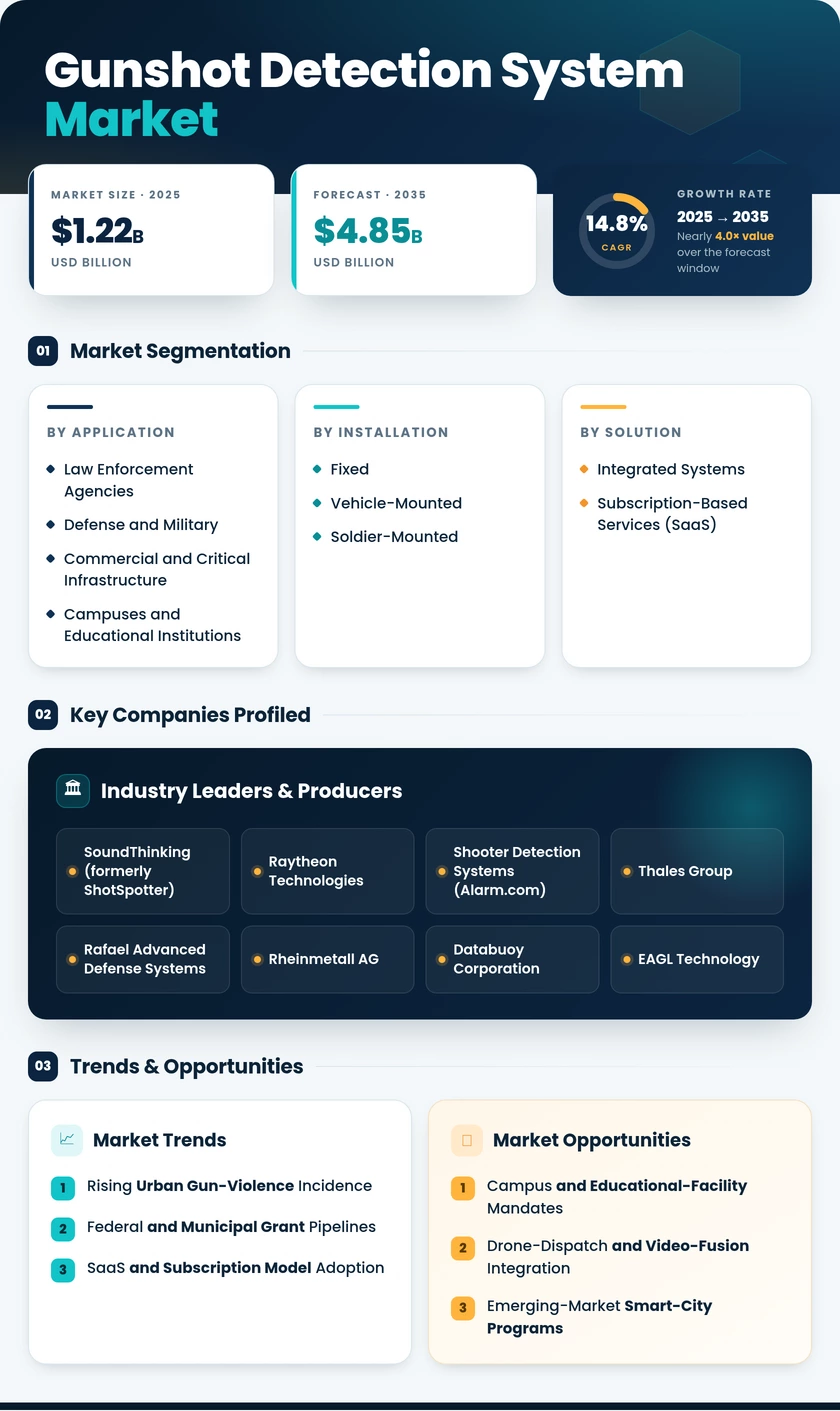
Gunshot Detection System Market (2026 - 2035)

ID: MRFR/AD/5569-CR 100 Pages Shubham Munde Last Updated: October 27, 2026
Gunshot Detection System Market Size, Share, Industry Trend & Analysis Research Report: By Application (Indoor, Outdoor), By Installation (Fixed, Vehicle-Mounted, Soldier-Mounted), By Solution (Integrated Systems, Subscription-Based Services (SaaS)), By End User (Law Enforcement Agencies, Defense and Military, Commercial and Critical Infrastructure, Campuses and Educational Institutions), By Geography (North America, Europe, Asia-Pacific, South America, Middle East & Africa) - Forecast to 2035
Gunshot Detection System Market
Market Size
Forecast Period2026-2035
CAGR (2026-2035)14.80%
2025 Market SizeUSD 1.22 Billion
2035 Market SizeUSD 4.85 Billion
Key Players
SoundThinking
Raytheon Technologies
Shooter Detection Systems
Thales Group
Rafael Advanced Defense Systems
Rheinmetall AG
Opportunities
  • Campus and Educational-Facility Mandates
  • Drone-Dispatch and Video-Fusion Integration
  • Emerging-Market Smart-City Programs
  1. 1 Market Overview |
    1. 1.1 Study Assumptions & Market Definition |
    2. 1.2 Scope of the Study |
    3. 1.3 Research Methodology
  2. 2 Market Summary & Key Takeaways
  3. 3 Market Dynamics |
    1. 3.1 Market Drivers Analysis | |
      1. 3.1.1 Rising Urban Gun-Violence Incidence | |
      2. 3.1.2 Federal and Municipal Grant Pipelines | |
      3. 3.1.3 SaaS and Subscription Model Adoption | |
      4. 3.1.4 AI and Edge-Computing Sensor Fusion | |
      5. 3.1.5 Campus and School-Safety Mandates | |
      6. 3.1.6 Defense Modernization (Soldier-Wearable) | |
      7. 3.1.7 Smart-City Convergence (Video + Drones) |
    2. 3.2 Market Restraints Analysis | |
      1. 3.2.1 Privacy and Civil-Liberties Opposition | |
      2. 3.2.2 High Per-Node and Maintenance Costs | |
      3. 3.2.3 False-Positive Rates in Dense Urban Canyons | |
      4. 3.2.4 Lack of Standardized Performance Benchmarks | |
      5. 3.2.5 Cybersecurity Risk to Networked Sensor Arrays |
    3. 3.3 Market Opportunity Analysis | |
      1. 3.3.1 Campus and Educational-Facility Mandates | |
      2. 3.3.2 Drone-Dispatch and Video-Fusion Integration | |
      3. 3.3.3 Emerging-Market Smart-City Programs | |
      4. 3.3.4 Data Monetization and Predictive-Policing Analytics | |
      5. 3.3.5 Military Wearable and Vehicle-Mounted Systems |
    4. 3.4 Industry Value Chain Analysis |
    5. 3.5 Porter's Five Forces Analysis
  4. 4 Global Gunshot Detection System Market Size & Forecast (2021–2035) |
    1. 4.1 Historical Market Size (2021–2025) |
    2. 4.2 Current & Forecast Market Size (2026–2035) |
    3. 4.3 Market Size by Revenue (USD Billion) |
    4. 4.4 Year-over-Year Growth Analysis
  5. 5 Segmentation Analysis |
    1. 5.1 By Application | |
      1. 5.1.1 Outdoor | |
      2. 5.1.2 Indoor |
    2. 5.2 By Installation | |
      1. 5.2.1 Fixed | |
      2. 5.2.2 Vehicle-Mounted | |
      3. 5.2.3 Soldier-Mounted |
    3. 5.3 By Solution | |
      1. 5.3.1 Integrated Systems | |
      2. 5.3.2 Subscription-Based Gunshot Detection Services (SaaS) |
    4. 5.4 By End User | |
      1. 5.4.1 Law Enforcement Agencies | |
      2. 5.4.2 Defense and Military | |
      3. 5.4.3 Commercial and Critical Infrastructure | |
      4. 5.4.4 Campuses and Educational Institutions
  6. 6 Regional Analysis |
    1. 6.1 North America | |
      1. 6.1.1 United States | |
      2. 6.1.2 Canada | |
      3. 6.1.3 Mexico |
    2. 6.2 Europe | |
      1. 6.2.1 Germany | |
      2. 6.2.2 United Kingdom | |
      3. 6.2.3 France | |
      4. 6.2.4 Italy | |
      5. 6.2.5 Spain | |
      6. 6.2.6 Nordic Countries | |
      7. 6.2.7 Russia | |
      8. 6.2.8 Rest of Europe |
    3. 6.3 Asia-Pacific | |
      1. 6.3.1 China | |
      2. 6.3.2 India | |
      3. 6.3.3 Japan | |
      4. 6.3.4 South Korea | |
      5. 6.3.5 ASEAN | |
      6. 6.3.6 Rest of Asia-Pacific |
    4. 6.4 South America | |
      1. 6.4.1 Brazil | |
      2. 6.4.2 Argentina | |
      3. 6.4.3 Rest of South America |
    5. 6.5 Middle East & Africa | |
      1. 6.5.1 Saudi Arabia | |
      2. 6.5.2 UAE | |
      3. 6.5.3 South Africa | |
      4. 6.5.4 Egypt | |
      5. 6.5.5 Rest of MEA
  7. 7 Competitive Landscape |
    1. 7.1 Market Share Analysis (2025) |
    2. 7.2 Competitive Benchmarking Matrix |
    3. 7.3 Company Profiles | |
      1. 7.3.1 SoundThinking (ShotSpotter) | |
      2. 7.3.2 Raytheon Technologies | |
      3. 7.3.3 Shooter Detection Systems (Alarm.com) | |
      4. 7.3.4 Thales Group | |
      5. 7.3.5 Rafael Advanced Defense Systems | |
      6. 7.3.6 Rheinmetall AG | |
      7. 7.3.7 Databuoy Corporation | |
      8. 7.3.8 EAGL Technology | |
      9. 7.3.9 Qinetiq Group | |
      10. 7.3.10 V5 Systems
  8. 8 Future Outlook & Strategic Recommendations (2026–2035) |
    1. 8.1 AI-Driven Autonomous Detection and Response |
    2. 8.2 Platform Economics and Subscription-First Business Models |
    3. 8.3 Convergence with Broader Public-Safety Ecosystems |
    4. 8.4 ESG Reporting and Community-Accountability Frameworks
  9. 9 Recent Developments & News
  10. 10 Frequently Asked Questions (FAQs)
  11. 11 Report Scope & Methodology |
    1. 11.1 Study Period & Base Year |
    2. 11.2 Data Sources & Citations |
    3. 11.3 Abbreviations
  12. 1 LIST OF TABLES
  13. 2 LIST OF FIGURES

Segmentation Quick Reference

DimensionSub-SegmentsDominant SegmentFastest Growing Segment
By ApplicationIndoor, OutdoorOutdoor (64% share, 2025)Indoor (12.1% CAGR)
By InstallationFixed, Vehicle-Mounted, Soldier-MountedFixed (56% share, 2025)Soldier-Mounted (16.4% CAGR)
By SolutionIntegrated Systems, Subscription-Based Services (SaaS)Integrated Systems (USD 0.83B, 2025)Subscription-Based Services (15.3% CAGR)
By End UserLaw Enforcement Agencies, Defense and Military, Commercial and Critical Infrastructure, Campuses and Educational InstitutionsLaw Enforcement Agencies (52% share, 2025)Campuses and Educational Institutions (15.1% CAGR)
By GeographyNorth America, Europe, Asia-Pacific, South America, Middle East & AfricaNorth America (43% share, 2025)Asia-Pacific (9.9% CAGR)


Market Segmentation Overview

By Application

Sub-SegmentKey Trend
OutdoorExpansion of city-wide pole-mounted sensor networks into Tier-2 and Tier-3 municipalities
IndoorLegislative mandates (Alyssa's Law) driving adoption in K-12 schools, hospitals, and government buildings


Outdoor deployments form the historical backbone of the market, with detection radii of 1,000–1,500 feet per node covering multi-square-mile urban zones. Indoor systems are gaining momentum as school-safety legislation creates a regulatory floor for in-building acoustic monitoring.

By Installation

Sub-SegmentKey Trend
FixedPermanent infrastructure installations with cellular or fiber backhaul dominate municipal and commercial sites
Vehicle-MountedIntegration into police cruisers and military armored vehicles for mobile patrol coverage
Soldier-MountedWearable helmet/vest modules providing real-time bearing and range data to dismounted troops


Fixed systems offer the highest detection consistency over multi-year service periods. Soldier-mounted units are transitioning from prototype to production under NATO and allied-nation modernization programs, representing the fastest-growing installation category.

By Solution

Sub-SegmentKey Trend
Integrated SystemsTurnkey hardware-software bundles for large-city and defense contracts
Subscription-Based Services (SaaS)OpEx-friendly annual pricing enabling adoption by budget-constrained agencies


Integrated systems remain the preferred procurement model for large deployments, while subscription services are reshaping mid-market adoption by eliminating upfront capital barriers and bundling continuous firmware and analytics upgrades.

By End User

Sub-SegmentKey Trend
Law Enforcement AgenciesPrimary adopters; 60–90% faster response times versus 911-only workflows
Defense and MilitarySoldier protection, base-perimeter security, and forward-operating-base awareness
Commercial and Critical InfrastructureData centers, airports, energy facilities seeking perimeter-threat detection
Campuses and Educational InstitutionsFastest-growing end-user driven by parental advocacy and state mandates


Law enforcement agencies remain the largest purchaser category, while campuses and educational institutions are the fastest-growing end-user segment due to a wave of state-level school-safety legislation across the United States.

By Geography

Sub-SegmentKey Trend
North AmericaMature deployments across 150+ U.S. cities; federal grant pipeline sustains growth
EuropeCounter-terrorism sensor programs in France, UK; EU Internal Security Fund co-financing
Asia-PacificSmart-city budgets in India, South Korea, Japan; domestic OEM price competition
South AmericaBrazil-led adoption driven by high urban violence rates
Middle East & AfricaMega-project perimeter security (NEOM, Safe City Abu Dhabi); UN peacekeeping deployments


North America remains the dominant region by revenue share, while Asia-Pacific is closing the gap through large-scale smart-city tenders and growing domestic manufacturing capacity that reduces sensor import dependency.


 

Download PDF ×

We do not share your information with anyone. However, we may send you emails based on your report interest from time to time. You may contact us at any time to opt-out.