Request Free Sample ×

Kindly complete the form below to receive a free sample of this Report

* Please use a valid business email

Leading companies partner with us for data-driven Insights

clients tt-cursor
Hero Background
English
Chinese
French
Japanese
Korean
German
Spanish

Gum Grafting Market Analysis

ID: MRFR/MED/0238-HCR
110 Pages
Rahul Gotadki
March 2026

Gum Grafting Market Research Report by Applications (root coverage, ridge augmentation, augmentation around implants, reduced sensitivity, improved appearance, gum health and others), by Types (connective-tissue, sub-epithelial connective tissue graft, free gingival grafts, pedicle grafts and alloderm) and by End Users (dentists, hospitals and others) - Global Forecast till 2035

Share:
Download PDF ×

We do not share your information with anyone. However, we may send you emails based on your report interest from time to time. You may contact us at any time to opt-out.

Gum Grafting Market Infographic
Purchase Options

Market Analysis

In-depth Analysis of Gum Grafting Market Industry Landscape

More people with gum recession are affecting the gum grafting business. Genetic susceptibility, poor oral care, and aging may cause gum recession. Poor oral hygiene is another danger. The requirement for gum grafting increases due to these factors. Dental technology and grafting procedures are changing market dynamics. All these developments are happening concurrently. The main reason gum grafting procedures are becoming more popular is the adoption of newer technologies and materials. These measures improve patient outcomes and rehabilitation. The growing popularity of cosmetic dental trends drives the industry. Patients are increasingly choosing gum grafting to fix gum recession's esthetic difficulties. This topic includes dental pain and irregular gum lines. The market for cosmetic or therapeutic gum grafting is booming as more people undergo the operation. Several reasons need gum grafting. Common periodontal illnesses include gingivitis and periodontitis. Gum health must be restored to avoid subsequent issues, which will benefit the market. Because gum recession commonly occurs with these circumstances. Consequently, remedies are required. Market dynamics are changing as more individuals realize the significance of oral health and the different treatment options available. Dental professionals and healthcare campaigns are vital in informing people about gum grafting as a gum recession therapy. This increases patients' gum grafting interest and demand. The world's population's rising average age is affecting the industry. Gum recession and accompanying dental disorders are more common in elderly people. The trend in elderly people seeking dental health care is also driving gum grafting. This change increases gum grafting demand. The market benefits from a wide choice of readily available grafting materials. These materials include autografts, allografts, and xenografts. Because of this variability, dental practitioners may pick grafting materials based on patient preferences, health concerns, and procedure needs. The market becomes dynamic and adaptive. Market changes are linked to insurance coverage and reimbursement policies. Patient acceptability and accessibility of gum grafting operations grow due to coverage and appealing compensation. This boosts market growth. The market's dynamics depend on factors including dentistry office competition and dental professionals' gum grafting acceptance. Dental clinics that provide a variety of periodontal treatments, including modern gum grafting, have an advantage in attracting patients seeking complete dental care. Continuous research and development affects market dynamics. Programs focus on periodontics and dental surgery. Continuous efforts are undertaken to improve grafting materials, optimize techniques, and investigate novel modes of operation to boost gum grafting operations and the market.


Author
Author Profile
Rahul Gotadki
Research Manager

He holds an experience of about 9+ years in Market Research and Business Consulting, working under the spectrum of Life Sciences and Healthcare domains. Rahul conceptualizes and implements a scalable business strategy and provides strategic leadership to the clients. His expertise lies in market estimation, competitive intelligence, pipeline analysis, customer assessment, etc.

Leave a Comment

FAQs

What is the projected market valuation of the Gum Grafting Market by 2035?

<p>The projected market valuation of the Gum Grafting Market is expected to reach 1.162 USD Billion by 2035.</p>

What was the market valuation of the Gum Grafting Market in 2024?

<p>The overall market valuation of the Gum Grafting Market was 0.5 USD Billion in 2024.</p>

What is the expected CAGR for the Gum Grafting Market during the forecast period 2025 - 2035?

<p>The expected CAGR for the Gum Grafting Market during the forecast period 2025 - 2035 is 7.97%.</p>

Which companies are considered key players in the Gum Grafting Market?

<p>Key players in the Gum Grafting Market include Dentsply Sirona, Zimmer Biomet, Straumann, and Nobel Biocare.</p>

What are the main types of gum grafting procedures and their market values?

<p>The main types of gum grafting procedures include Subepithelial connective tissue graft valued at 0.35 USD Billion and Pedicle grafts valued at 0.25 USD Billion.</p>

How does the application of gum grafting impact market segments?

Applications such as augmentation around implants are projected to reach 0.3 USD Billion, indicating a strong market segment.

What is the market value for hospitals as end-users in the Gum Grafting Market?

Hospitals are projected to account for a market value of 0.5 USD Billion as end-users in the Gum Grafting Market.

What is the significance of dentists as end-users in the Gum Grafting Market?

Dentists are also projected to represent a market value of 0.5 USD Billion, highlighting their crucial role as end-users.

What are the projected values for free gingival grafts in the Gum Grafting Market?

Free gingival grafts are projected to have a market value of 0.25 USD Billion, reflecting their importance in the market.

How does the Gum Grafting Market's growth potential compare to other dental procedures?

The Gum Grafting Market's growth potential, with a projected CAGR of 7.97%, suggests it may outperform other dental procedures in the coming years.

Market Summary

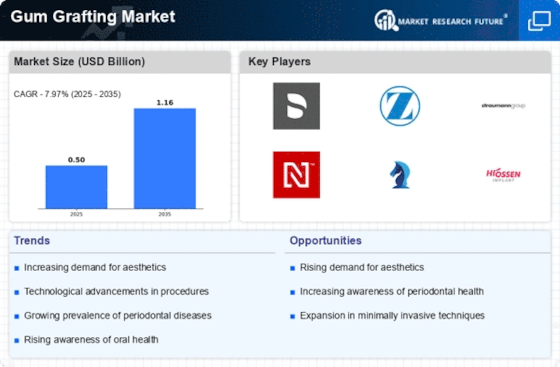
As per Market Research Future analysis, the Gum Grafting Market Size was estimated at 0.5 USD Billion in 2024. The Gum Grafting industry is projected to grow from USD 0.5398 Billion in 2025 to USD 1.162 Billion by 2035, exhibiting a compound annual growth rate (CAGR) of 7.97% during the forecast period 2025 - 2035

Key Market Trends & Highlights

The Gum Grafting Market is poised for growth driven by technological advancements and increasing patient awareness.

  • Technological advancements in dental procedures are enhancing the efficacy of gum grafting techniques. North America remains the largest market, while the Asia-Pacific region is emerging as the fastest-growing market for gum grafting. Subepithelial connective tissue grafts dominate the market, whereas free gingival grafts are witnessing rapid growth. Rising incidence of periodontal diseases and growing aesthetic concerns among patients are key drivers of market expansion.

Market Size & Forecast

2024 Market Size 0.5 (USD Billion)
2035 Market Size 1.162 (USD Billion)
CAGR (2025 - 2035) 7.97%
Largest Regional Market Share in 2024 North America

Major Players

Dentsply Sirona (US), <a title="Zimmer Biomet" href="https://www.zimmerbiomet.com/en/products-and-solutions/specialties/surgical/meshgraft.html" target="_blank" rel="noopener">Zimmer Biomet</a> (US), Straumann (CH), Nobel Biocare (CH), MediCure (US), Hiossen (KR), BioHorizons (US), Osstem Implant (KR), Kerr Corporation (US)

Market Trends

The Gum Grafting Market is currently experiencing a notable evolution, driven by advancements in dental technology and an increasing awareness of oral health. As more individuals seek solutions for gum recession and related dental issues, the demand for gum grafting procedures appears to be on the rise. This trend is further supported by the growing emphasis on aesthetic dentistry, where patients are increasingly concerned about the appearance of their gums and overall smile. Additionally, the integration of minimally invasive techniques is likely to enhance patient comfort and recovery times, making these procedures more appealing to a broader audience. Moreover, the Gum Grafting Market is influenced by the rising prevalence of periodontal diseases, which necessitate effective treatment options. Dental professionals are adopting innovative materials and techniques to improve the success rates of grafting procedures. This shift towards more effective and patient-friendly solutions suggests a promising future for the market. As awareness continues to grow and technology advances, the Gum Grafting Market is poised for further expansion, potentially leading to new opportunities for practitioners and patients alike.

Technological Advancements

The Gum Grafting Market is witnessing a surge in the adoption of advanced technologies, such as laser-assisted procedures and digital imaging. These innovations enhance precision and reduce recovery times, making treatments more efficient and appealing to patients.

Increased Patient Awareness

There is a growing awareness among the general population regarding the importance of gum health. This heightened consciousness is driving more individuals to seek gum grafting procedures as a preventive measure against periodontal diseases.

Shift Towards Aesthetic Dentistry

The trend towards aesthetic dentistry is influencing the Gum Grafting Market significantly. Patients are increasingly prioritizing the appearance of their gums and smiles, leading to a rise in demand for cosmetic gum grafting procedures.

Gum Grafting Market Market Drivers

Rising Awareness of Oral Health

The growing awareness of oral health and its connection to overall well-being is a significant driver for the Gum Grafting Market. Educational campaigns and public health initiatives have highlighted the importance of maintaining healthy gums, leading to increased patient inquiries about gum grafting procedures. Research indicates that individuals who are informed about periodontal health are more likely to seek preventive and corrective treatments. This heightened awareness is reflected in the rising number of dental consultations, with estimates suggesting a 15% increase in patient inquiries regarding gum grafting over the past year. As patients become more proactive about their oral health, the Gum Grafting Market is likely to experience a surge in demand for grafting procedures, as individuals seek to address gum recession and enhance their overall dental aesthetics.

Increased Accessibility to Dental Care

The expansion of dental care accessibility is a crucial factor driving the Gum Grafting Market. With the rise of dental insurance plans and government initiatives aimed at improving oral health, more patients are seeking dental treatments, including gum grafting. Recent statistics indicate that dental visits have increased by approximately 20% over the past five years, reflecting a growing recognition of the importance of oral health. This trend is particularly significant in underserved areas where access to dental care has historically been limited. As more individuals seek treatment for gum-related issues, the demand for gum grafting procedures is expected to rise. The Gum Grafting Market stands to gain from this increased accessibility, as more patients are likely to pursue necessary interventions to maintain their oral health.

Rising Incidence of Periodontal Diseases

The increasing prevalence of periodontal diseases is a primary driver for the Gum Grafting Market. As more individuals experience gum recession and related complications, the demand for gum grafting procedures rises. According to recent data, approximately 47.2% of adults aged 30 years and older exhibit some form of periodontal disease. This statistic underscores the urgent need for effective treatment options, including gum grafting. The Gum Grafting Market is likely to see substantial growth as dental professionals seek to address these conditions through surgical interventions. Furthermore, the aging population, which is more susceptible to periodontal issues, contributes to the expanding patient base requiring gum grafting. This trend suggests a sustained demand for innovative solutions in the Gum Grafting Market.

Growing Aesthetic Concerns Among Patients

The rising emphasis on aesthetic dentistry is a notable driver for the Gum Grafting Market. Patients are increasingly seeking procedures that enhance their smiles and overall appearance, leading to a higher demand for gum grafting. This trend is particularly evident among younger demographics who prioritize cosmetic outcomes. Market Research Future indicates that the aesthetic dentistry segment is expected to witness a growth rate of approximately 7% annually. As individuals become more aware of the impact of gum health on their smile aesthetics, the need for gum grafting procedures to correct gum recession and improve gum contour becomes more pronounced. Consequently, the Gum Grafting Market is likely to benefit from this growing focus on aesthetics, as dental professionals cater to the desires of patients seeking a more attractive smile.

Technological Innovations in Dental Procedures

Technological advancements in dental procedures are significantly influencing the Gum Grafting Market. Innovations such as minimally invasive surgical techniques, improved grafting materials, and enhanced imaging technologies are transforming how gum grafting is performed. For instance, the introduction of platelet-rich plasma (PRP) therapy has shown promising results in enhancing healing and reducing recovery times. The market for dental technologies is projected to grow, with estimates suggesting a compound annual growth rate of around 6.5% over the next few years. These advancements not only improve patient outcomes but also increase the efficiency of dental practices, thereby driving the demand for gum grafting services. As dental professionals adopt these technologies, the Gum Grafting Market is poised for growth, reflecting a shift towards more effective and patient-friendly treatment options.

Market Segment Insights

By Types: Subepithelial Connective Tissue Graft (Largest) vs. Free Gingival Grafts (Fastest-Growing)

The Gum Grafting Market currently showcases a diverse range of types, with Subepithelial Connective Tissue Grafts commanding the largest market share. This type is widely preferred due to its effectiveness in enhancing aesthetic outcomes and improving attachment levels in periodontal treatment. Conversely, Free Gingival Grafts, although smaller in market share, are emerging rapidly, attracting attention for their simplicity and effectiveness in increasing keratinized tissue availability.

Subepithelial Connective Tissue Graft (Dominant) vs. Alloderm (Emerging)

Subepithelial Connective Tissue Grafts dominate the Gum Grafting Market owing to their established success in various dental procedures, particularly in treating gingival recession. Their ability to provide robust support and promote healing makes them a go-to choice among dental professionals. In contrast, Alloderm is an emerging player in this arena, recognized for its acellular dermal matrix that provides an alternative to autogenous grafts. Alloderm's growing acceptance stems from its convenience, reduced donor site morbidity, and effectiveness in complex grafting scenarios, positioning it as a valuable option for future advancements in gum grafting techniques.

By Application: Root Coverage (Largest) vs. Augmentation around Implants (Fastest-Growing)

The Gum Grafting Market's application segment showcases a diverse landscape, with root coverage being the largest contributor to market share. This segment is crucial for restoring dental aesthetics and treating gum recession, attracting substantial demand from both practitioners and patients. Following closely, augmentation around implants is recognized as the fastest-growing application, fueled by an increasing number of dental implant procedures and a growing awareness of aesthetic outcomes among patients seeking dental solutions. The growth trends within the application segment reflect a significant shift towards more specialized and tailored gum grafting procedures. With advancements in dental technology and materials, applications like ridge augmentation and gum health are gaining traction. The evolving perceptions of dental aesthetics alongside rising disposable incomes are driving factors that are expected to enhance the market dynamics of the gum grafting application segment in the coming years, leading to innovations that meet patient demands for enhanced outcomes.

Root Coverage (Dominant) vs. Augmentation around Implants (Emerging)

Root coverage stands out as the dominant application in the Gum Grafting Market, offering a reliable solution for patients experiencing gum recession. It provides not only aesthetic benefits but also functional improvements by protecting tooth roots and enhancing overall gum health. On the other hand, augmentation around implants is emerging rapidly, driven by an influx of dental implant procedures. Patients seek this innovative application for its capability to enhance implant stability and esthetics, which adds to the competitive landscape of gum grafting applications. The growing recognition of oral health’s impact on general well-being further propels these segments, promoting products and services that cater to patient-specific needs and preferences.

By End-user: Hospitals (Largest) vs. Dentists (Fastest-Growing)

In the Gum Grafting Market, hospitals represent the largest end-user segment, benefiting from well-established surgical units equipped with advanced technologies. They tend to perform a significant volume of gum grafting surgeries, making them a key player in the overall market landscape. In contrast, dentists, especially periodontists, have emerged as a rapidly growing segment, providing localized and personalized gum grafting services to patients. The shift toward dental clinics for minor gum surgeries highlights the expanding role of dentists.

Hospitals (Dominant) vs. Dentists (Emerging)

Hospitals dominate the Gum Grafting Market due to their capacity to accommodate complex procedures and offer comprehensive dental care under one roof. They are often equipped with the latest technologies and a larger workforce, allowing them to handle an extensive patient base seeking gum grafting treatments. On the other hand, dentists are becoming an emerging force in this market, primarily because they provide more accessible and patient-friendly services. Many individuals prefer visiting dental clinics for less invasive procedures, allowing dentists to rapidly capture market share, particularly in regions where access to hospitals may be limited. Their personalized care and growing expertise in gum grafting contribute to the overall market expansion.

Get more detailed insights about Gum Grafting Market Research Report - Forecast to 2035

Regional Insights

North America : Leading Market for Innovations

North America is the largest market for gum grafting, accounting for approximately 45% of the global share. The growth is driven by increasing dental health awareness, advancements in dental technologies, and a rise in cosmetic dental procedures. Regulatory support from organizations like the FDA ensures that innovative products meet safety standards, further boosting market confidence. The demand for minimally invasive procedures is also on the rise, contributing to market expansion. The United States is the leading country in this region, with a robust presence of key players such as Dentsply Sirona and Zimmer Biomet. The competitive landscape is characterized by continuous innovation and strategic partnerships among major companies. Canada follows as the second-largest market, benefiting from similar trends in dental health awareness and technological advancements. The presence of established dental clinics and hospitals enhances the market's growth potential.

Europe : Emerging Market with Growth Potential

Europe is witnessing significant growth in the gum grafting market, holding approximately 30% of the global share. The region benefits from a well-established healthcare system and increasing investments in dental research and development. Regulatory frameworks, such as the EU Medical Device Regulation, ensure high standards for dental products, fostering consumer trust and market growth. The rising prevalence of periodontal diseases is also driving demand for gum grafting procedures across the continent. Germany and the United Kingdom are the leading countries in this market, with a strong presence of key players like Straumann and Nobel Biocare. The competitive landscape is marked by innovation and collaboration among companies to enhance product offerings. Additionally, the growing trend of dental tourism in countries like Hungary and Poland is contributing to market expansion, as patients seek affordable and high-quality dental care options.

Asia-Pacific : Rapidly Growing Market Segment

Asia-Pacific is emerging as a significant player in the gum grafting market, accounting for about 20% of the global share. The growth is fueled by increasing disposable incomes, rising awareness of dental aesthetics, and a growing elderly population requiring dental care. Countries like China and India are witnessing a surge in demand for dental procedures, supported by government initiatives to improve healthcare access. The region's regulatory environment is evolving, with efforts to standardize dental practices and products. China is the largest market in this region, driven by a booming dental industry and a growing number of dental clinics. India follows closely, with a rising trend in cosmetic dentistry. The competitive landscape features both local and international players, including Hiossen and Osstem Implant, who are expanding their market presence through strategic partnerships and innovative product offerings. The increasing focus on dental education and training is also enhancing the quality of services in the region.

Middle East and Africa : Untapped Market with Opportunities

The Middle East and Africa region is gradually emerging in the gum grafting market, holding approximately 5% of the global share. The growth is driven by increasing healthcare investments, rising awareness of dental health, and a growing population. Countries like South Africa and the UAE are leading the way, with government initiatives aimed at improving healthcare infrastructure. The regulatory landscape is becoming more structured, which is essential for attracting foreign investments in the dental sector. South Africa is the largest market in this region, supported by a growing number of dental professionals and clinics. The UAE is also witnessing rapid growth, driven by a high demand for cosmetic dental procedures. The competitive landscape is characterized by a mix of local and international players, with companies like MediCure and BioHorizons expanding their footprint. The region presents significant opportunities for growth, particularly in underserved areas where dental care access is limited.

Key Players and Competitive Insights

The Gum Grafting Market is currently characterized by a dynamic competitive landscape, driven by increasing demand for dental restoration procedures and advancements in surgical techniques. Key players such as Dentsply Sirona (US), Zimmer Biomet (US), and Straumann (CH) are strategically positioned to leverage their innovative product offerings and extensive distribution networks. Dentsply Sirona (US) focuses on integrating digital technologies into its product lines, enhancing the precision and efficiency of gum grafting procedures. Meanwhile, Zimmer Biomet (US) emphasizes partnerships with dental professionals to refine its product development, ensuring alignment with market needs. Straumann (CH) is actively pursuing regional expansion, particularly in emerging markets, to capitalize on the growing demand for dental implants and grafting solutions. Collectively, these strategies contribute to a competitive environment that is increasingly centered on innovation and customer-centric solutions.

In terms of business tactics, companies are localizing manufacturing to reduce costs and improve supply chain efficiency. This approach is particularly relevant in the Gum Grafting Market, where timely delivery of materials is crucial for surgical procedures. The market structure appears moderately fragmented, with several players vying for market share, yet the influence of major companies remains significant. Their ability to innovate and adapt to changing consumer preferences shapes the competitive dynamics, fostering an environment where agility and responsiveness are paramount.

In August 2025, Dentsply Sirona (US) announced the launch of a new digital platform designed to streamline the gum grafting process, integrating advanced imaging and planning tools. This strategic move is likely to enhance the precision of procedures, thereby improving patient outcomes and positioning the company as a leader in digital dentistry. The emphasis on technology not only addresses current market demands but also sets a precedent for future innovations in the field.

In September 2025, Zimmer Biomet (US) entered into a strategic partnership with a leading dental education institution to develop training programs focused on advanced gum grafting techniques. This initiative underscores the company's commitment to enhancing practitioner skills and ensuring the effective use of its products. By investing in education, Zimmer Biomet (US) not only strengthens its brand loyalty but also fosters a community of skilled professionals who can effectively utilize its innovative solutions.

In July 2025, Straumann (CH) expanded its product portfolio by acquiring a smaller firm specializing in regenerative dental materials. This acquisition is indicative of Straumann's strategy to enhance its offerings in the gum grafting segment, allowing for a more comprehensive range of solutions for dental professionals. The integration of new technologies and materials is expected to bolster the company's competitive edge in a rapidly evolving market.

As of October 2025, the Gum Grafting Market is witnessing trends such as digitalization, sustainability, and the integration of artificial intelligence in product development. These trends are reshaping the competitive landscape, with companies increasingly forming strategic alliances to enhance their technological capabilities and market reach. The shift from price-based competition to a focus on innovation and supply chain reliability is becoming evident, suggesting that future differentiation will hinge on the ability to deliver cutting-edge solutions that meet the evolving needs of dental professionals and patients alike.

Key Companies in the Gum Grafting Market include

Industry Developments

    • Instead of removing tissue from the palate, pedicle grafts take tissue from the gum surrounding or near the tooth that has to be repaired. The flap, known as a pedicle, is only slightly sliced away, leaving one edge intact. The gum would then be sewed into place after being pushed over or down to conceal the visible root. This surgery can only be performed on persons who have a lot of gum tissue around their teeth.

Future Outlook

Gum Grafting Market Future Outlook

The Gum Grafting Market is projected to grow at a 7.97% CAGR from 2025 to 2035, driven by increasing dental health awareness and technological advancements.

New opportunities lie in:

  • <p>Development of minimally invasive gum grafting techniques Expansion of tele-dentistry services for remote consultations Investment in regenerative medicine for enhanced grafting materials</p>

By 2035, the market is expected to achieve substantial growth, reflecting evolving consumer needs and technological innovations.

Market Segmentation

Gum Grafting Market Types Outlook

  • Subepithelial connective tissue graft
  • Pedicle grafts
  • Connective-tissue
  • Free gingival grafts
  • Alloderm

Gum Grafting Market End-user Outlook

  • Hospitals
  • Dentists
  • Others

Gum Grafting Market Application Outlook

  • Root coverage
  • Augmentation around implants
  • Improved appearance
  • Ridge augmentation
  • Gum health
  • Reduced sensitivity
  • Others

Report Scope

MARKET SIZE 2024 0.5(USD Billion)
MARKET SIZE 2025 0.5398(USD Billion)
MARKET SIZE 2035 1.162(USD Billion)
COMPOUND ANNUAL GROWTH RATE (CAGR) 7.97% (2025 - 2035)
REPORT COVERAGE Revenue Forecast, Competitive Landscape, Growth Factors, and Trends
BASE YEAR 2024
Market Forecast Period 2025 - 2035
Historical Data 2019 - 2024
Market Forecast Units USD Billion
Key Companies Profiled Dentsply Sirona (US), Zimmer Biomet (US), Straumann (CH), Nobel Biocare (CH), MediCure (US), Hiossen (KR), BioHorizons (US), Osstem Implant (KR), Kerr Corporation (US)
Segments Covered Applications, Types, End Users
Key Market Opportunities Advancements in minimally invasive techniques enhance patient acceptance in the Gum Grafting Market.
Key Market Dynamics Rising demand for minimally invasive procedures drives innovation and competition in the gum grafting market.
Countries Covered North America, Europe, APAC, South America, MEA

FAQs

What is the projected market valuation of the Gum Grafting Market by 2035?

<p>The projected market valuation of the Gum Grafting Market is expected to reach 1.162 USD Billion by 2035.</p>

What was the market valuation of the Gum Grafting Market in 2024?

<p>The overall market valuation of the Gum Grafting Market was 0.5 USD Billion in 2024.</p>

What is the expected CAGR for the Gum Grafting Market during the forecast period 2025 - 2035?

<p>The expected CAGR for the Gum Grafting Market during the forecast period 2025 - 2035 is 7.97%.</p>

Which companies are considered key players in the Gum Grafting Market?

<p>Key players in the Gum Grafting Market include Dentsply Sirona, Zimmer Biomet, Straumann, and Nobel Biocare.</p>

What are the main types of gum grafting procedures and their market values?

<p>The main types of gum grafting procedures include Subepithelial connective tissue graft valued at 0.35 USD Billion and Pedicle grafts valued at 0.25 USD Billion.</p>

How does the application of gum grafting impact market segments?

Applications such as augmentation around implants are projected to reach 0.3 USD Billion, indicating a strong market segment.

What is the market value for hospitals as end-users in the Gum Grafting Market?

Hospitals are projected to account for a market value of 0.5 USD Billion as end-users in the Gum Grafting Market.

What is the significance of dentists as end-users in the Gum Grafting Market?

Dentists are also projected to represent a market value of 0.5 USD Billion, highlighting their crucial role as end-users.

What are the projected values for free gingival grafts in the Gum Grafting Market?

Free gingival grafts are projected to have a market value of 0.25 USD Billion, reflecting their importance in the market.

How does the Gum Grafting Market's growth potential compare to other dental procedures?

The Gum Grafting Market's growth potential, with a projected CAGR of 7.97%, suggests it may outperform other dental procedures in the coming years.

  1. SECTION I: EXECUTIVE SUMMARY AND KEY HIGHLIGHTS
    1. | 1.1 EXECUTIVE SUMMARY
    2. | | 1.1.1 Market Overview
    3. | | 1.1.2 Key Findings
    4. | | 1.1.3 Market Segmentation
    5. | | 1.1.4 Competitive Landscape
    6. | | 1.1.5 Challenges and Opportunities
    7. | | 1.1.6 Future Outlook
  2. SECTION II: SCOPING, METHODOLOGY AND MARKET STRUCTURE
    1. | 2.1 MARKET INTRODUCTION
    2. | | 2.1.1 Definition
    3. | | 2.1.2 Scope of the study
    4. | | | 2.1.2.1 Research Objective
    5. | | | 2.1.2.2 Assumption
    6. | | | 2.1.2.3 Limitations
    7. | 2.2 RESEARCH METHODOLOGY
    8. | | 2.2.1 Overview
    9. | | 2.2.2 Data Mining
    10. | | 2.2.3 Secondary Research
    11. | | 2.2.4 Primary Research
    12. | | | 2.2.4.1 Primary Interviews and Information Gathering Process
    13. | | | 2.2.4.2 Breakdown of Primary Respondents
    14. | | 2.2.5 Forecasting Model
    15. | | 2.2.6 Market Size Estimation
    16. | | | 2.2.6.1 Bottom-Up Approach
    17. | | | 2.2.6.2 Top-Down Approach
    18. | | 2.2.7 Data Triangulation
    19. | | 2.2.8 Validation
  3. SECTION III: QUALITATIVE ANALYSIS
    1. | 3.1 MARKET DYNAMICS
    2. | | 3.1.1 Overview
    3. | | 3.1.2 Drivers
    4. | | 3.1.3 Restraints
    5. | | 3.1.4 Opportunities
    6. | 3.2 MARKET FACTOR ANALYSIS
    7. | | 3.2.1 Value chain Analysis
    8. | | 3.2.2 Porter's Five Forces Analysis
    9. | | | 3.2.2.1 Bargaining Power of Suppliers
    10. | | | 3.2.2.2 Bargaining Power of Buyers
    11. | | | 3.2.2.3 Threat of New Entrants
    12. | | | 3.2.2.4 Threat of Substitutes
    13. | | | 3.2.2.5 Intensity of Rivalry
    14. | | 3.2.3 COVID-19 Impact Analysis
    15. | | | 3.2.3.1 Market Impact Analysis
    16. | | | 3.2.3.2 Regional Impact
    17. | | | 3.2.3.3 Opportunity and Threat Analysis
  4. SECTION IV: QUANTITATIVE ANALYSIS
    1. | 4.1 Healthcare, BY Types (USD Billion)
    2. | | 4.1.1 Subepithelial connective tissue graft
    3. | | 4.1.2 Pedicle grafts
    4. | | 4.1.3 Connective-tissue
    5. | | 4.1.4 Free gingival grafts
    6. | | 4.1.5 Alloderm
    7. | 4.2 Healthcare, BY Application (USD Billion)
    8. | | 4.2.1 Root coverage
    9. | | 4.2.2 Augmentation around implants
    10. | | 4.2.3 Improved appearance
    11. | | 4.2.4 Ridge augmentation
    12. | | 4.2.5 Gum health
    13. | | 4.2.6 Reduced sensitivity
    14. | | 4.2.7 Others
    15. | 4.3 Healthcare, BY End-user (USD Billion)
    16. | | 4.3.1 Hospitals
    17. | | 4.3.2 Dentists
    18. | | 4.3.3 Others
    19. | 4.4 Healthcare, BY Region (USD Billion)
    20. | | 4.4.1 North America
    21. | | | 4.4.1.1 US
    22. | | | 4.4.1.2 Canada
    23. | | 4.4.2 Europe
    24. | | | 4.4.2.1 Germany
    25. | | | 4.4.2.2 UK
    26. | | | 4.4.2.3 France
    27. | | | 4.4.2.4 Russia
    28. | | | 4.4.2.5 Italy
    29. | | | 4.4.2.6 Spain
    30. | | | 4.4.2.7 Rest of Europe
    31. | | 4.4.3 APAC
    32. | | | 4.4.3.1 China
    33. | | | 4.4.3.2 India
    34. | | | 4.4.3.3 Japan
    35. | | | 4.4.3.4 South Korea
    36. | | | 4.4.3.5 Malaysia
    37. | | | 4.4.3.6 Thailand
    38. | | | 4.4.3.7 Indonesia
    39. | | | 4.4.3.8 Rest of APAC
    40. | | 4.4.4 South America
    41. | | | 4.4.4.1 Brazil
    42. | | | 4.4.4.2 Mexico
    43. | | | 4.4.4.3 Argentina
    44. | | | 4.4.4.4 Rest of South America
    45. | | 4.4.5 MEA
    46. | | | 4.4.5.1 GCC Countries
    47. | | | 4.4.5.2 South Africa
    48. | | | 4.4.5.3 Rest of MEA
  5. SECTION V: COMPETITIVE ANALYSIS
    1. | 5.1 Competitive Landscape
    2. | | 5.1.1 Overview
    3. | | 5.1.2 Competitive Analysis
    4. | | 5.1.3 Market share Analysis
    5. | | 5.1.4 Major Growth Strategy in the Healthcare
    6. | | 5.1.5 Competitive Benchmarking
    7. | | 5.1.6 Leading Players in Terms of Number of Developments in the Healthcare
    8. | | 5.1.7 Key developments and growth strategies
    9. | | | 5.1.7.1 New Product Launch/Service Deployment
    10. | | | 5.1.7.2 Merger & Acquisitions
    11. | | | 5.1.7.3 Joint Ventures
    12. | | 5.1.8 Major Players Financial Matrix
    13. | | | 5.1.8.1 Sales and Operating Income
    14. | | | 5.1.8.2 Major Players R&D Expenditure. 2023
    15. | 5.2 Company Profiles
    16. | | 5.2.1 Dentsply Sirona (US)
    17. | | | 5.2.1.1 Financial Overview
    18. | | | 5.2.1.2 Products Offered
    19. | | | 5.2.1.3 Key Developments
    20. | | | 5.2.1.4 SWOT Analysis
    21. | | | 5.2.1.5 Key Strategies
    22. | | 5.2.2 Zimmer Biomet (US)
    23. | | | 5.2.2.1 Financial Overview
    24. | | | 5.2.2.2 Products Offered
    25. | | | 5.2.2.3 Key Developments
    26. | | | 5.2.2.4 SWOT Analysis
    27. | | | 5.2.2.5 Key Strategies
    28. | | 5.2.3 Straumann (CH)
    29. | | | 5.2.3.1 Financial Overview
    30. | | | 5.2.3.2 Products Offered
    31. | | | 5.2.3.3 Key Developments
    32. | | | 5.2.3.4 SWOT Analysis
    33. | | | 5.2.3.5 Key Strategies
    34. | | 5.2.4 Nobel Biocare (CH)
    35. | | | 5.2.4.1 Financial Overview
    36. | | | 5.2.4.2 Products Offered
    37. | | | 5.2.4.3 Key Developments
    38. | | | 5.2.4.4 SWOT Analysis
    39. | | | 5.2.4.5 Key Strategies
    40. | | 5.2.5 MediCure (US)
    41. | | | 5.2.5.1 Financial Overview
    42. | | | 5.2.5.2 Products Offered
    43. | | | 5.2.5.3 Key Developments
    44. | | | 5.2.5.4 SWOT Analysis
    45. | | | 5.2.5.5 Key Strategies
    46. | | 5.2.6 Hiossen (KR)
    47. | | | 5.2.6.1 Financial Overview
    48. | | | 5.2.6.2 Products Offered
    49. | | | 5.2.6.3 Key Developments
    50. | | | 5.2.6.4 SWOT Analysis
    51. | | | 5.2.6.5 Key Strategies
    52. | | 5.2.7 BioHorizons (US)
    53. | | | 5.2.7.1 Financial Overview
    54. | | | 5.2.7.2 Products Offered
    55. | | | 5.2.7.3 Key Developments
    56. | | | 5.2.7.4 SWOT Analysis
    57. | | | 5.2.7.5 Key Strategies
    58. | | 5.2.8 Osstem Implant (KR)
    59. | | | 5.2.8.1 Financial Overview
    60. | | | 5.2.8.2 Products Offered
    61. | | | 5.2.8.3 Key Developments
    62. | | | 5.2.8.4 SWOT Analysis
    63. | | | 5.2.8.5 Key Strategies
    64. | | 5.2.9 Kerr Corporation (US)
    65. | | | 5.2.9.1 Financial Overview
    66. | | | 5.2.9.2 Products Offered
    67. | | | 5.2.9.3 Key Developments
    68. | | | 5.2.9.4 SWOT Analysis
    69. | | | 5.2.9.5 Key Strategies
    70. | 5.3 Appendix
    71. | | 5.3.1 References
    72. | | 5.3.2 Related Reports
  6. LIST OF FIGURES
    1. | 6.1 MARKET SYNOPSIS
    2. | 6.2 NORTH AMERICA MARKET ANALYSIS
    3. | 6.3 US MARKET ANALYSIS BY TYPES
    4. | 6.4 US MARKET ANALYSIS BY APPLICATION
    5. | 6.5 US MARKET ANALYSIS BY END-USER
    6. | 6.6 CANADA MARKET ANALYSIS BY TYPES
    7. | 6.7 CANADA MARKET ANALYSIS BY APPLICATION
    8. | 6.8 CANADA MARKET ANALYSIS BY END-USER
    9. | 6.9 EUROPE MARKET ANALYSIS
    10. | 6.10 GERMANY MARKET ANALYSIS BY TYPES
    11. | 6.11 GERMANY MARKET ANALYSIS BY APPLICATION
    12. | 6.12 GERMANY MARKET ANALYSIS BY END-USER
    13. | 6.13 UK MARKET ANALYSIS BY TYPES
    14. | 6.14 UK MARKET ANALYSIS BY APPLICATION
    15. | 6.15 UK MARKET ANALYSIS BY END-USER
    16. | 6.16 FRANCE MARKET ANALYSIS BY TYPES
    17. | 6.17 FRANCE MARKET ANALYSIS BY APPLICATION
    18. | 6.18 FRANCE MARKET ANALYSIS BY END-USER
    19. | 6.19 RUSSIA MARKET ANALYSIS BY TYPES
    20. | 6.20 RUSSIA MARKET ANALYSIS BY APPLICATION
    21. | 6.21 RUSSIA MARKET ANALYSIS BY END-USER
    22. | 6.22 ITALY MARKET ANALYSIS BY TYPES
    23. | 6.23 ITALY MARKET ANALYSIS BY APPLICATION
    24. | 6.24 ITALY MARKET ANALYSIS BY END-USER
    25. | 6.25 SPAIN MARKET ANALYSIS BY TYPES
    26. | 6.26 SPAIN MARKET ANALYSIS BY APPLICATION
    27. | 6.27 SPAIN MARKET ANALYSIS BY END-USER
    28. | 6.28 REST OF EUROPE MARKET ANALYSIS BY TYPES
    29. | 6.29 REST OF EUROPE MARKET ANALYSIS BY APPLICATION
    30. | 6.30 REST OF EUROPE MARKET ANALYSIS BY END-USER
    31. | 6.31 APAC MARKET ANALYSIS
    32. | 6.32 CHINA MARKET ANALYSIS BY TYPES
    33. | 6.33 CHINA MARKET ANALYSIS BY APPLICATION
    34. | 6.34 CHINA MARKET ANALYSIS BY END-USER
    35. | 6.35 INDIA MARKET ANALYSIS BY TYPES
    36. | 6.36 INDIA MARKET ANALYSIS BY APPLICATION
    37. | 6.37 INDIA MARKET ANALYSIS BY END-USER
    38. | 6.38 JAPAN MARKET ANALYSIS BY TYPES
    39. | 6.39 JAPAN MARKET ANALYSIS BY APPLICATION
    40. | 6.40 JAPAN MARKET ANALYSIS BY END-USER
    41. | 6.41 SOUTH KOREA MARKET ANALYSIS BY TYPES
    42. | 6.42 SOUTH KOREA MARKET ANALYSIS BY APPLICATION
    43. | 6.43 SOUTH KOREA MARKET ANALYSIS BY END-USER
    44. | 6.44 MALAYSIA MARKET ANALYSIS BY TYPES
    45. | 6.45 MALAYSIA MARKET ANALYSIS BY APPLICATION
    46. | 6.46 MALAYSIA MARKET ANALYSIS BY END-USER
    47. | 6.47 THAILAND MARKET ANALYSIS BY TYPES
    48. | 6.48 THAILAND MARKET ANALYSIS BY APPLICATION
    49. | 6.49 THAILAND MARKET ANALYSIS BY END-USER
    50. | 6.50 INDONESIA MARKET ANALYSIS BY TYPES
    51. | 6.51 INDONESIA MARKET ANALYSIS BY APPLICATION
    52. | 6.52 INDONESIA MARKET ANALYSIS BY END-USER
    53. | 6.53 REST OF APAC MARKET ANALYSIS BY TYPES
    54. | 6.54 REST OF APAC MARKET ANALYSIS BY APPLICATION
    55. | 6.55 REST OF APAC MARKET ANALYSIS BY END-USER
    56. | 6.56 SOUTH AMERICA MARKET ANALYSIS
    57. | 6.57 BRAZIL MARKET ANALYSIS BY TYPES
    58. | 6.58 BRAZIL MARKET ANALYSIS BY APPLICATION
    59. | 6.59 BRAZIL MARKET ANALYSIS BY END-USER
    60. | 6.60 MEXICO MARKET ANALYSIS BY TYPES
    61. | 6.61 MEXICO MARKET ANALYSIS BY APPLICATION
    62. | 6.62 MEXICO MARKET ANALYSIS BY END-USER
    63. | 6.63 ARGENTINA MARKET ANALYSIS BY TYPES
    64. | 6.64 ARGENTINA MARKET ANALYSIS BY APPLICATION
    65. | 6.65 ARGENTINA MARKET ANALYSIS BY END-USER
    66. | 6.66 REST OF SOUTH AMERICA MARKET ANALYSIS BY TYPES
    67. | 6.67 REST OF SOUTH AMERICA MARKET ANALYSIS BY APPLICATION
    68. | 6.68 REST OF SOUTH AMERICA MARKET ANALYSIS BY END-USER
    69. | 6.69 MEA MARKET ANALYSIS
    70. | 6.70 GCC COUNTRIES MARKET ANALYSIS BY TYPES
    71. | 6.71 GCC COUNTRIES MARKET ANALYSIS BY APPLICATION
    72. | 6.72 GCC COUNTRIES MARKET ANALYSIS BY END-USER
    73. | 6.73 SOUTH AFRICA MARKET ANALYSIS BY TYPES
    74. | 6.74 SOUTH AFRICA MARKET ANALYSIS BY APPLICATION
    75. | 6.75 SOUTH AFRICA MARKET ANALYSIS BY END-USER
    76. | 6.76 REST OF MEA MARKET ANALYSIS BY TYPES
    77. | 6.77 REST OF MEA MARKET ANALYSIS BY APPLICATION
    78. | 6.78 REST OF MEA MARKET ANALYSIS BY END-USER
    79. | 6.79 KEY BUYING CRITERIA OF HEALTHCARE
    80. | 6.80 RESEARCH PROCESS OF MRFR
    81. | 6.81 DRO ANALYSIS OF HEALTHCARE
    82. | 6.82 DRIVERS IMPACT ANALYSIS: HEALTHCARE
    83. | 6.83 RESTRAINTS IMPACT ANALYSIS: HEALTHCARE
    84. | 6.84 SUPPLY / VALUE CHAIN: HEALTHCARE
    85. | 6.85 HEALTHCARE, BY TYPES, 2024 (% SHARE)
    86. | 6.86 HEALTHCARE, BY TYPES, 2024 TO 2035 (USD Billion)
    87. | 6.87 HEALTHCARE, BY APPLICATION, 2024 (% SHARE)
    88. | 6.88 HEALTHCARE, BY APPLICATION, 2024 TO 2035 (USD Billion)
    89. | 6.89 HEALTHCARE, BY END-USER, 2024 (% SHARE)
    90. | 6.90 HEALTHCARE, BY END-USER, 2024 TO 2035 (USD Billion)
    91. | 6.91 BENCHMARKING OF MAJOR COMPETITORS
  7. LIST OF TABLES
    1. | 7.1 LIST OF ASSUMPTIONS
    2. | | 7.1.1
    3. | 7.2 North America MARKET SIZE ESTIMATES; FORECAST
    4. | | 7.2.1 BY TYPES, 2025-2035 (USD Billion)
    5. | | 7.2.2 BY APPLICATION, 2025-2035 (USD Billion)
    6. | | 7.2.3 BY END-USER, 2025-2035 (USD Billion)
    7. | 7.3 US MARKET SIZE ESTIMATES; FORECAST
    8. | | 7.3.1 BY TYPES, 2025-2035 (USD Billion)
    9. | | 7.3.2 BY APPLICATION, 2025-2035 (USD Billion)
    10. | | 7.3.3 BY END-USER, 2025-2035 (USD Billion)
    11. | 7.4 Canada MARKET SIZE ESTIMATES; FORECAST
    12. | | 7.4.1 BY TYPES, 2025-2035 (USD Billion)
    13. | | 7.4.2 BY APPLICATION, 2025-2035 (USD Billion)
    14. | | 7.4.3 BY END-USER, 2025-2035 (USD Billion)
    15. | 7.5 Europe MARKET SIZE ESTIMATES; FORECAST
    16. | | 7.5.1 BY TYPES, 2025-2035 (USD Billion)
    17. | | 7.5.2 BY APPLICATION, 2025-2035 (USD Billion)
    18. | | 7.5.3 BY END-USER, 2025-2035 (USD Billion)
    19. | 7.6 Germany MARKET SIZE ESTIMATES; FORECAST
    20. | | 7.6.1 BY TYPES, 2025-2035 (USD Billion)
    21. | | 7.6.2 BY APPLICATION, 2025-2035 (USD Billion)
    22. | | 7.6.3 BY END-USER, 2025-2035 (USD Billion)
    23. | 7.7 UK MARKET SIZE ESTIMATES; FORECAST
    24. | | 7.7.1 BY TYPES, 2025-2035 (USD Billion)
    25. | | 7.7.2 BY APPLICATION, 2025-2035 (USD Billion)
    26. | | 7.7.3 BY END-USER, 2025-2035 (USD Billion)
    27. | 7.8 France MARKET SIZE ESTIMATES; FORECAST
    28. | | 7.8.1 BY TYPES, 2025-2035 (USD Billion)
    29. | | 7.8.2 BY APPLICATION, 2025-2035 (USD Billion)
    30. | | 7.8.3 BY END-USER, 2025-2035 (USD Billion)
    31. | 7.9 Russia MARKET SIZE ESTIMATES; FORECAST
    32. | | 7.9.1 BY TYPES, 2025-2035 (USD Billion)
    33. | | 7.9.2 BY APPLICATION, 2025-2035 (USD Billion)
    34. | | 7.9.3 BY END-USER, 2025-2035 (USD Billion)
    35. | 7.10 Italy MARKET SIZE ESTIMATES; FORECAST
    36. | | 7.10.1 BY TYPES, 2025-2035 (USD Billion)
    37. | | 7.10.2 BY APPLICATION, 2025-2035 (USD Billion)
    38. | | 7.10.3 BY END-USER, 2025-2035 (USD Billion)
    39. | 7.11 Spain MARKET SIZE ESTIMATES; FORECAST
    40. | | 7.11.1 BY TYPES, 2025-2035 (USD Billion)
    41. | | 7.11.2 BY APPLICATION, 2025-2035 (USD Billion)
    42. | | 7.11.3 BY END-USER, 2025-2035 (USD Billion)
    43. | 7.12 Rest of Europe MARKET SIZE ESTIMATES; FORECAST
    44. | | 7.12.1 BY TYPES, 2025-2035 (USD Billion)
    45. | | 7.12.2 BY APPLICATION, 2025-2035 (USD Billion)
    46. | | 7.12.3 BY END-USER, 2025-2035 (USD Billion)
    47. | 7.13 APAC MARKET SIZE ESTIMATES; FORECAST
    48. | | 7.13.1 BY TYPES, 2025-2035 (USD Billion)
    49. | | 7.13.2 BY APPLICATION, 2025-2035 (USD Billion)
    50. | | 7.13.3 BY END-USER, 2025-2035 (USD Billion)
    51. | 7.14 China MARKET SIZE ESTIMATES; FORECAST
    52. | | 7.14.1 BY TYPES, 2025-2035 (USD Billion)
    53. | | 7.14.2 BY APPLICATION, 2025-2035 (USD Billion)
    54. | | 7.14.3 BY END-USER, 2025-2035 (USD Billion)
    55. | 7.15 India MARKET SIZE ESTIMATES; FORECAST
    56. | | 7.15.1 BY TYPES, 2025-2035 (USD Billion)
    57. | | 7.15.2 BY APPLICATION, 2025-2035 (USD Billion)
    58. | | 7.15.3 BY END-USER, 2025-2035 (USD Billion)
    59. | 7.16 Japan MARKET SIZE ESTIMATES; FORECAST
    60. | | 7.16.1 BY TYPES, 2025-2035 (USD Billion)
    61. | | 7.16.2 BY APPLICATION, 2025-2035 (USD Billion)
    62. | | 7.16.3 BY END-USER, 2025-2035 (USD Billion)
    63. | 7.17 South Korea MARKET SIZE ESTIMATES; FORECAST
    64. | | 7.17.1 BY TYPES, 2025-2035 (USD Billion)
    65. | | 7.17.2 BY APPLICATION, 2025-2035 (USD Billion)
    66. | | 7.17.3 BY END-USER, 2025-2035 (USD Billion)
    67. | 7.18 Malaysia MARKET SIZE ESTIMATES; FORECAST
    68. | | 7.18.1 BY TYPES, 2025-2035 (USD Billion)
    69. | | 7.18.2 BY APPLICATION, 2025-2035 (USD Billion)
    70. | | 7.18.3 BY END-USER, 2025-2035 (USD Billion)
    71. | 7.19 Thailand MARKET SIZE ESTIMATES; FORECAST
    72. | | 7.19.1 BY TYPES, 2025-2035 (USD Billion)
    73. | | 7.19.2 BY APPLICATION, 2025-2035 (USD Billion)
    74. | | 7.19.3 BY END-USER, 2025-2035 (USD Billion)
    75. | 7.20 Indonesia MARKET SIZE ESTIMATES; FORECAST
    76. | | 7.20.1 BY TYPES, 2025-2035 (USD Billion)
    77. | | 7.20.2 BY APPLICATION, 2025-2035 (USD Billion)
    78. | | 7.20.3 BY END-USER, 2025-2035 (USD Billion)
    79. | 7.21 Rest of APAC MARKET SIZE ESTIMATES; FORECAST
    80. | | 7.21.1 BY TYPES, 2025-2035 (USD Billion)
    81. | | 7.21.2 BY APPLICATION, 2025-2035 (USD Billion)
    82. | | 7.21.3 BY END-USER, 2025-2035 (USD Billion)
    83. | 7.22 South America MARKET SIZE ESTIMATES; FORECAST
    84. | | 7.22.1 BY TYPES, 2025-2035 (USD Billion)
    85. | | 7.22.2 BY APPLICATION, 2025-2035 (USD Billion)
    86. | | 7.22.3 BY END-USER, 2025-2035 (USD Billion)
    87. | 7.23 Brazil MARKET SIZE ESTIMATES; FORECAST
    88. | | 7.23.1 BY TYPES, 2025-2035 (USD Billion)
    89. | | 7.23.2 BY APPLICATION, 2025-2035 (USD Billion)
    90. | | 7.23.3 BY END-USER, 2025-2035 (USD Billion)
    91. | 7.24 Mexico MARKET SIZE ESTIMATES; FORECAST
    92. | | 7.24.1 BY TYPES, 2025-2035 (USD Billion)
    93. | | 7.24.2 BY APPLICATION, 2025-2035 (USD Billion)
    94. | | 7.24.3 BY END-USER, 2025-2035 (USD Billion)
    95. | 7.25 Argentina MARKET SIZE ESTIMATES; FORECAST
    96. | | 7.25.1 BY TYPES, 2025-2035 (USD Billion)
    97. | | 7.25.2 BY APPLICATION, 2025-2035 (USD Billion)
    98. | | 7.25.3 BY END-USER, 2025-2035 (USD Billion)
    99. | 7.26 Rest of South America MARKET SIZE ESTIMATES; FORECAST
    100. | | 7.26.1 BY TYPES, 2025-2035 (USD Billion)
    101. | | 7.26.2 BY APPLICATION, 2025-2035 (USD Billion)
    102. | | 7.26.3 BY END-USER, 2025-2035 (USD Billion)
    103. | 7.27 MEA MARKET SIZE ESTIMATES; FORECAST
    104. | | 7.27.1 BY TYPES, 2025-2035 (USD Billion)
    105. | | 7.27.2 BY APPLICATION, 2025-2035 (USD Billion)
    106. | | 7.27.3 BY END-USER, 2025-2035 (USD Billion)
    107. | 7.28 GCC Countries MARKET SIZE ESTIMATES; FORECAST
    108. | | 7.28.1 BY TYPES, 2025-2035 (USD Billion)
    109. | | 7.28.2 BY APPLICATION, 2025-2035 (USD Billion)
    110. | | 7.28.3 BY END-USER, 2025-2035 (USD Billion)
    111. | 7.29 South Africa MARKET SIZE ESTIMATES; FORECAST
    112. | | 7.29.1 BY TYPES, 2025-2035 (USD Billion)
    113. | | 7.29.2 BY APPLICATION, 2025-2035 (USD Billion)
    114. | | 7.29.3 BY END-USER, 2025-2035 (USD Billion)
    115. | 7.30 Rest of MEA MARKET SIZE ESTIMATES; FORECAST
    116. | | 7.30.1 BY TYPES, 2025-2035 (USD Billion)
    117. | | 7.30.2 BY APPLICATION, 2025-2035 (USD Billion)
    118. | | 7.30.3 BY END-USER, 2025-2035 (USD Billion)
    119. | 7.31 PRODUCT LAUNCH/PRODUCT DEVELOPMENT/APPROVAL
    120. | | 7.31.1
    121. | 7.32 ACQUISITION/PARTNERSHIP
    122. | | 7.32.1

Healthcare Market Segmentation

Healthcare By Types (USD Billion, 2025-2035)

  • Subepithelial connective tissue graft
  • Pedicle grafts
  • Connective-tissue
  • Free gingival grafts
  • Alloderm

Healthcare By Application (USD Billion, 2025-2035)

  • Root coverage
  • Augmentation around implants
  • Improved appearance
  • Ridge augmentation
  • Gum health
  • Reduced sensitivity
  • Others

Healthcare By End-user (USD Billion, 2025-2035)

  • Hospitals
  • Dentists
  • Others
Infographic

Free Sample Request

Kindly complete the form below to receive a free sample of this Report

Get Free Sample

Customer Strories

Compare Licence

×
Features License Type
Single User Multiuser License Enterprise User
Price $4,950 $5,950 $7,250
Maximum User Access Limit 1 User Upto 10 Users Unrestricted Access Throughout the Organization
Free Customization
Direct Access to Analyst
Deliverable Format
Platform Access
Discount on Next Purchase 10% 15% 15%
Printable Versions