
×
Request Free Sample ×

Kindly complete the form below to receive a free sample of this Report

* Please use a valid business email

Leading companies partner with us for data-driven Insights

clients tt-cursor
Hero Background
English
Chinese
French
Japanese
Korean
German
Spanish

Graphical User Interface Design Software Market Analysis

ID: MRFR/ICT/9228-CR
100 Pages
Shubham Munde
October 2021

Graphical User Interface Design Software Market Research Report: Information By Deployment (On Cloud and On-premises), By Organization Size (SMEs, and Large Enterprises), By Vertical (Automotive, IT & Telecommunication, Media & Entertainment, Medical & Healthcare, and Manufacturing), And By Region (North America, Europe, Asia-Pacific, And Rest Of The World) –Market Forecast Till 2035.

Share:
Download PDF ×

We do not share your information with anyone. However, we may send you emails based on your report interest from time to time. You may contact us at any time to opt-out.

Graphical User Interface Design Software Market Infographic
Purchase Options

Market Analysis

In-depth Analysis of Graphical User Interface Design Software Market Industry Landscape

As technological advancements continue at a rapid pace, consumer expectations in various industries, including the automotive sector, are on the rise. In particular, consumers in the automotive sector are increasingly looking for innovative digital instrument clusters, driver information displays, and in-vehicle infotainment systems. To meet these evolving demands, Tier 1 companies and Original Equipment Manufacturers (OEMs) acknowledge the importance of providing a sophisticated and engaging experience for consumers.

Graphical User Interface (GUI) design software tools play a crucial role in this context by bringing together designers and developers as equal collaborators. These tools empower them to create rich and intuitive in-vehicle experiences without compromising on resources or performance. By fostering collaboration between designers and developers, GUI design software ensures that the user interface of automotive technologies meets the high standards set by consumers in terms of functionality, aesthetics, and overall user experience.

In summary, GUI design software tools are instrumental in enabling the automotive industry, including Tier 1 companies and OEMs, to keep pace with the dynamic expectations of consumers by delivering cutting-edge and user-friendly in-vehicle interfaces.

In the realm of Information Technology (IT) and telecommunications, creating innovative design interfaces has emerged as a pivotal element in delivering user-friendly convenience to end-users. Telecommunications companies, in particular, have shifted their focus towards elevating the customer experience. This heightened emphasis on customer satisfaction is driving a significant surge in the demand for GUI design software tools.

The IT and telecom industry vertical relies heavily on user interfaces that are not only intuitive but also efficient and engaging. As a result, there's an increased recognition of the importance of employing GUI design software tools to craft interfaces that meet these evolving user expectations. These tools enable the creation of visually appealing and user-centric interfaces, aligning perfectly with the industry's goal of providing enhanced convenience and satisfaction to end-users.

The demand for GUI design software tools within the IT and telecom sector is a direct response to the industry's desire to optimize user experiences. By leveraging these tools, companies aim to enhance their products and services, thereby meeting the growing demands of consumers for intuitive and user-friendly interfaces in the realm of telecommunications.


Author
Shubham Munde
Team Lead - Research

Shubham brings over 7 years of expertise in Market Intelligence and Strategic Consulting, with a strong focus on the Automotive, Aerospace, and Defense sectors. Backed by a solid foundation in semiconductors, electronics, and software, he has successfully delivered high-impact syndicated and custom research on a global scale. His core strengths include market sizing, forecasting, competitive intelligence, consumer insights, and supply chain mapping. Widely recognized for developing scalable growth strategies, Shubham empowers clients to navigate complex markets and achieve a lasting competitive edge. Trusted by start-ups and Fortune 500 companies alike, he consistently converts challenges into strategic opportunities that drive sustainable growth.

Leave a Comment

FAQs

What is the current valuation of the Graphical User Interface Design Software Market?

<p>As of 2024, the market valuation was 25.48 USD Billion.</p>

What is the projected market size for the Graphical User Interface Design Software Market by 2035?

<p>The market is projected to reach 72.71 USD Billion by 2035.</p>

What is the expected CAGR for the Graphical User Interface Design Software Market during the forecast period 2025 - 2035?

<p>The expected CAGR for the market during this period is 10.0%.</p>

Which companies are considered key players in the Graphical User Interface Design Software Market?

<p>Key players include Adobe, Figma, Sketch, InVision, Axure, Balsamiq, Corel, Microsoft, and Canva.</p>

What are the two main deployment segments in the Graphical User Interface Design Software Market?

<p>The two main deployment segments are On-Cloud and On-Premises.</p>

What was the valuation of the On-Premises segment in 2024?

<p>In 2024, the On-Premises segment was valued at 15.48 USD Billion.</p>

How does the market size for SMEs compare to that of large enterprises in 2024?

<p>In 2024, the market size for SMEs was 10.0 USD Billion, while large enterprises had a valuation of 15.48 USD Billion.</p>

Which verticals are driving growth in the Graphical User Interface Design Software Market?

Key verticals include Automotive, IT &amp; Telecommunication, Media &amp; Entertainment, Medical &amp; Healthcare, and Manufacturing.

What was the valuation of the IT & Telecommunication vertical in 2024?

The IT &amp; Telecommunication vertical was valued at 8.0 USD Billion in 2024.

What is the projected growth for the Automotive vertical by 2035?

The Automotive vertical is projected to grow from 3.5 USD Billion in 2024 to 10.0 USD Billion by 2035.

Market Summary

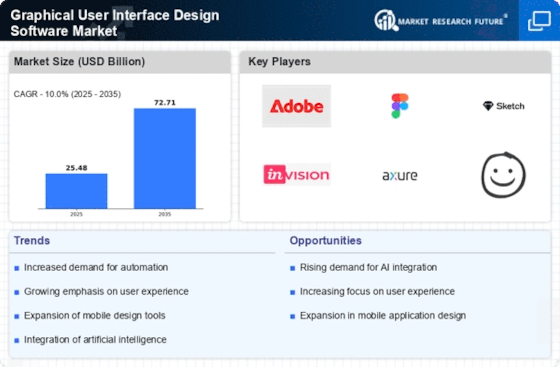
As per Market Research Future analysis, the Graphical User Interface Design Software Market Size was estimated at 25.48 USD Billion in 2024. The Graphical User Interface Design Software industry is projected to grow from 28.03 USD Billion in 2025 to 72.71 USD Billion by 2035, exhibiting a compound annual growth rate (CAGR) of 10.0% during the forecast period 2025 - 2035

Key Market Trends & Highlights

The Graphical User Interface Design Software Market is experiencing dynamic growth driven by technological advancements and evolving user needs.

  • The market exhibits an increased focus on user experience, emphasizing intuitive design and user satisfaction. Integration of AI and automation technologies is reshaping design processes, enhancing efficiency and creativity. Collaborative design platforms are gaining traction, facilitating teamwork and real-time feedback among designers. The growing demand for mobile applications and the emergence of e-commerce platforms are key drivers propelling market expansion, particularly in North America and Asia-Pacific.

Market Size & Forecast

2024 Market Size 25.48 (USD Billion)
2035 Market Size 72.71 (USD Billion)
CAGR (2025 - 2035) 10.0%
Largest Regional Market Share in 2024 North America

Major Players

Adobe (US), Figma (US), Sketch (US), InVision (US), Axure (US), Balsamiq (US), Corel (CA), Microsoft (US), Canva (AU)

Market Trends

The Graphical User Interface Design Software Market is currently experiencing a dynamic evolution, driven by the increasing demand for user-friendly applications across various sectors. As organizations recognize the importance of enhancing user experience, the focus on intuitive design tools has intensified. This market appears to be characterized by a diverse range of software solutions that cater to different user needs, from professional designers to novice developers. The integration of advanced technologies, such as artificial intelligence and machine learning, seems to be reshaping the landscape, enabling more efficient design processes and innovative features. Moreover, the rise of remote work and digital collaboration tools has further propelled the adoption of Graphical User Interface Design Software Market. Companies are increasingly seeking solutions that facilitate teamwork and streamline workflows, which may lead to a surge in cloud-based offerings. As the market continues to expand, it is likely that new entrants will emerge, introducing fresh perspectives and capabilities. This competitive environment could foster innovation, ultimately benefiting end-users with enhanced tools and functionalities.

Increased Focus on User Experience

There is a growing emphasis on creating seamless and engaging user experiences. Companies are prioritizing user-centric design, which is driving the demand for sophisticated Graphical User Interface Design Software Market that allows for extensive customization and personalization.

Integration of AI and Automation

The incorporation of artificial intelligence and automation tools into design software is becoming more prevalent. This trend suggests that designers can leverage intelligent features to streamline workflows, enhance productivity, and generate design suggestions based on user behavior.

Rise of Collaborative Design Platforms

The emergence of collaborative design platforms indicates a shift towards teamwork in the design process. These platforms facilitate real-time collaboration among designers, developers, and stakeholders, thereby improving communication and efficiency in project execution.

Graphical User Interface Design Software Market Market Drivers

Adoption of Cloud-Based Solutions

The shift towards cloud-based solutions is reshaping the landscape of the Graphical User Interface Design Software Market. Organizations are increasingly adopting cloud technologies to enhance collaboration and streamline workflows, which necessitates the use of design software that is compatible with cloud environments. This transition allows for real-time collaboration among design teams, enabling them to work more efficiently and effectively. Market data suggests that the cloud computing market is projected to grow to 832 billion USD by 2025, indicating a robust demand for cloud-integrated design tools. As businesses seek to leverage the benefits of cloud technology, the Graphical User Interface Design Software Market is likely to experience a surge in demand for software that supports cloud functionalities, thereby facilitating seamless design processes and improved project outcomes.

Emergence of E-commerce Platforms

The rapid expansion of e-commerce platforms has significantly influenced the Graphical User Interface Design Software Market. As online shopping becomes a preferred choice for consumers, businesses are compelled to create engaging and user-friendly interfaces to attract and retain customers. Data indicates that e-commerce sales are expected to surpass 6 trillion USD by 2024, highlighting the critical need for effective design solutions. This trend necessitates the use of advanced graphical user interface design software that can enhance the shopping experience through seamless navigation and appealing aesthetics. Furthermore, the integration of features such as personalized recommendations and interactive elements requires sophisticated design tools, thereby driving the demand within the Graphical User Interface Design Software Market. As competition intensifies, companies are likely to prioritize investments in design software to differentiate their offerings.

Integration of Advanced Technologies

The integration of advanced technologies such as artificial intelligence and machine learning is significantly influencing the Graphical User Interface Design Software Market. These technologies enable designers to create more personalized and adaptive user experiences, thereby enhancing overall user satisfaction. As businesses increasingly seek to leverage data-driven insights, the demand for design software that incorporates these advanced technologies is likely to grow. Market analysis suggests that the AI software market is expected to reach 126 billion USD by 2025, indicating a strong potential for integration within design tools. This trend not only enhances the functionality of design software but also allows for the automation of repetitive tasks, thereby streamlining the design process. As a result, the Graphical User Interface Design Software Market is poised for growth as companies adopt these innovative solutions.

Growing Demand for Mobile Applications

The increasing proliferation of mobile devices has led to a burgeoning demand for mobile applications, which in turn drives the Graphical User Interface Design Software Market. As businesses strive to enhance their mobile presence, the need for intuitive and visually appealing interfaces becomes paramount. According to recent data, the mobile application market is projected to reach a valuation of over 407 billion USD by 2026. This surge necessitates advanced design software that can cater to the unique requirements of mobile platforms, thereby propelling the growth of the Graphical User Interface Design Software Market. Companies are increasingly investing in tools that facilitate rapid prototyping and user testing, ensuring that their applications meet user expectations and preferences. Consequently, the demand for sophisticated design software is likely to continue its upward trajectory.

Rising Importance of Accessibility Standards

The increasing emphasis on accessibility standards is becoming a pivotal driver for the Graphical User Interface Design Software Market. As organizations strive to create inclusive digital experiences, the demand for design software that adheres to accessibility guidelines is on the rise. This trend is particularly relevant as legislation and regulations surrounding digital accessibility continue to evolve. Data indicates that approximately 15% of the global population experiences some form of disability, underscoring the necessity for accessible design solutions. Consequently, design software that incorporates features to support accessibility is likely to gain traction within the Graphical User Interface Design Software Market. Companies are recognizing the importance of catering to diverse user needs, which may lead to increased investments in tools that facilitate the creation of accessible interfaces.

Market Segment Insights

By Deployment: On-Cloud (Largest) vs. On-Premises (Fastest-Growing)

<p>In the Graphical User Interface Design Software Market, the deployment segment reveals a clear preference for On-Cloud solutions, distinguishing it as the largest market share holder. This means that users are increasingly favoring the flexibility, accessibility, and collaboration that On-Cloud services provide. In contrast, the On-Premises deployment method is gradually gaining traction, reflecting a growing demand for localized control and security, appealing to industries with stringent compliance requirements.</p>

<p>Deployment: On-Cloud (Dominant) vs. On-Premises (Emerging)</p>

<p>On-Cloud deployment in the Graphical User Interface Design Software Market is characterized by its ability to offer real-time collaboration, scalability, and lower upfront costs, making it the dominant choice for many businesses. Its growth is supported by advancements in cloud technology, ensuring seamless updates and accessibility from various devices. Meanwhile, On-Premises solutions, while historically less favored, are emerging due to the rising need for enhanced data security and control over proprietary designs. Industries such as healthcare and finance, where privacy is paramount, favor this setup, thus driving its rapid growth. As more organizations weigh their options, both deployment types are likely to coexist, catering to different user needs.</p>

By Organization Size: SMEs (Largest) vs. Large Enterprises (Fastest-Growing)

<p>In the Graphical User Interface Design Software Market, small and medium enterprises (SMEs) hold the largest share, benefiting from a growing trend towards affordable and accessible design solutions. These organizations often prioritize cost-effectiveness and ease of use, allowing them to utilize graphical design software to improve user experience without significant financial investment. This share reflects the increasing digitalization among SMEs that are leveraging technology to enhance their product offerings and reach a broader audience. On the other hand, large enterprises are emerging as the fastest-growing segment within this market, driven by the need for advanced design tools and collaboration features that support complex projects. As these organizations continue to expand their digital capabilities, they are increasingly adopting sophisticated GUI design software to ensure their user interfaces are both functional and visually appealing, catering to a diverse range of users.</p>

<p>SMEs: Dominant vs. Large Enterprises: Emerging</p>

<p>The SMEs represent the dominant force in the Graphical User Interface Design Software Market, characterized by their agility and ability to respond rapidly to market changes. They typically favor intuitive, user-friendly tools that allow them to design effective interfaces without extensive training or resources. Conversely, large enterprises are viewed as the emerging segment, prioritizing comprehensive and customizable solutions that support large-scale projects. They often require advanced features like collaborative design environments and integration with other enterprise software, making them key players in driving innovation and efficiency in graphical design.</p>

By Vertical: IT & Telecommunication (Largest) vs. Medical & Healthcare (Fastest-Growing)

<p>In the Graphical User Interface Design Software Market, the distribution among verticals showcases IT & Telecommunication as the largest segment, driven by the increasing demand for user-friendly and efficient software solutions in various applications. This segment benefits from the rapid digital transformation and extensive investments in new technologies, making it pivotal in the overall market dynamics. The Medical & Healthcare sector, on the other hand, is recognized as the fastest-growing segment. The rising focus on patient engagement and health applications, coupled with the need for intuitive user interfaces in medical devices, propels its growth. Innovations such as telemedicine and remote patient monitoring further enhance the demand for tailored GUI solutions, making this segment highly attractive for software developers.</p>

<p>IT & Telecommunication: Dominant vs. Medical & Healthcare: Emerging</p>

<p>The IT & Telecommunication sector stands as a dominant force in the Graphical User Interface Design Software Market, characterized by formal integration of advanced technologies and user-centric design principles. This vertical thrives due to its substantial investment in software development and the constant evolution of telecom applications requiring robust GUI solutions. In contrast, the Medical & Healthcare industry is an emerging player, showing vigorous growth as healthcare organizations adopt digital solutions to improve patient care. This sector is marked by a demand for intuitive interfaces in health-related software, emphasizing accessibility and user engagement, ultimately driving innovation in GUI software tailored to meet health sector needs.</p>

Get more detailed insights about Graphical User Interface Design Software Market Research Report—Global Forecast till 2035

Regional Insights

North America : Innovation and Market Leadership

North America is the largest market for Graphical User Interface Design Software Market, holding approximately 45% of the global market share. The region's growth is driven by a robust technology sector, increasing demand for user-friendly applications, and significant investments in digital transformation. Regulatory support for tech innovation further catalyzes market expansion, making it a hub for software development and design. The United States leads the market, with major players like Adobe, Figma, and Microsoft headquartered there. Canada also contributes significantly, with companies like Corel enhancing the competitive landscape. The presence of these key players fosters innovation and drives competition, ensuring that North America remains at the forefront of GUI design software advancements.

Europe : Emerging Trends and Regulations

Europe is the second-largest market for Graphical User Interface Design Software Market, accounting for around 30% of the global market share. The region's growth is fueled by increasing digitalization across various sectors, a strong emphasis on user experience, and supportive regulatory frameworks that encourage innovation. The European Union's Digital Services Act aims to enhance user safety and experience, further driving demand for advanced GUI solutions. Leading countries in this region include Germany, the UK, and France, where a mix of established firms and startups thrive. Companies like Figma and Sketch are gaining traction, contributing to a competitive environment. The presence of diverse design agencies and tech firms enhances the region's innovation landscape, making Europe a key player in the GUI design software market.

Asia-Pacific : Rapid Growth and Adoption

Asia-Pacific is witnessing rapid growth in the Graphical User Interface Design Software Market, holding approximately 20% of the global market share. The region's expansion is driven by increasing smartphone penetration, a growing number of tech startups, and rising demand for digital solutions across various industries. Government initiatives promoting digital innovation and technology adoption further catalyze market growth, making it a vibrant landscape for GUI software development. Countries like China, India, and Australia are leading the charge, with a mix of local and international players. Companies such as Canva and various emerging startups are enhancing the competitive landscape. The region's diverse market needs and increasing investment in technology create ample opportunities for GUI design software providers to thrive and innovate.

Middle East and Africa : Untapped Potential and Growth

The Middle East and Africa region is gradually emerging in the Graphical User Interface Design Software Market, currently holding about 5% of the global market share. The growth is primarily driven by increasing internet penetration, a rise in mobile device usage, and a growing focus on digital transformation across various sectors. Government initiatives aimed at fostering technology adoption and innovation are also contributing to the region's market potential. Leading countries include South Africa, the UAE, and Nigeria, where a mix of local startups and international companies are beginning to establish a presence. The competitive landscape is evolving, with increasing investments in technology and design services. As the region continues to develop its digital infrastructure, the demand for GUI design software is expected to rise significantly, presenting opportunities for growth.

Key Players and Competitive Insights

Leading market players are investing heavily in research and development to expand their product lines, contributing even more to the Graphical User Interface Design Software Market growth. Market participants are also undertaking various strategic activities to expand their footprint, with important market developments including new product launches, contractual agreements, mergers and acquisitions, higher investments, and collaboration with other organizations. The Graphical User Interface Design Software industry must offer cost-effective items to spread and survive in a more competitive and rising market climate.
Manufacturing locally to minimize operational costs is one of the key business tactics manufacturers use in the Graphical User Interface Design Software industry to benefit clients and increase the market sector. The Graphical User Interface Design Software industry has offered some of the most significant medical advantages in recent years.
Major players in the Graphical User Interface Design Software Market, including Adobe (U.S.), Webflow (U.S.), Balsamiq Studios LLC (U.S.), Axure Software Solutions Inc. (U.S.), Altia Inc. (U.S.), Corel Corporation (U.S.), Figma (U.S.), Sketch B.V. (Netherlands), InVisionApp Inc. (U.S.), Caretta Software Ltd. (U.K.), Pidoco GmbH (Germany), Crank Software Inc. (Canada), Extron (U.K.), and others, are attempting to increase market demand by investing in research and development operations.
Walter Woltosz’s Simulations Plus, Inc., founded in 1996 in Lancaster, California, United States, is a software company. It develops absorption, distribution, excretion, and toxicity modeling and simulation software for pharmaceutical, industrial chemicals, cosmetics, and food ingredients. Its products include GastroPlus, Med Chem Designer, membrane plus, and DDD Plus.
In February Simulations Plus, Inc., a service that provides modeling and simulation software for pharmaceutical safety and adequacy, announced the release of NAFLDsym v2B Beta, a quantitative systems pharmacology software to support the development of treatments for nonalcoholic steatohepatitis (NASH).
Dylan Field and Evan Wallace's Figma, founded in 2016, is a web application for interface design with offline features enabled by desktop applications for MacOS and Windows. It focuses on user interface and experience design utilizing various vector graphics editors and prototyping tools.
In April Figma acquired Visly, a design tool for front-end engineers. The company has started using the device in its product stack for fast and excellent collaboration between design and engineering.

Key Companies in the Graphical User Interface Design Software Market include

Industry Developments

November 2022: Microsoft introduced a new U.I. experience for trying out computer vision with Vision Studio.

August 2021: Adobe agreed to acquire Frameo.io, a cloud-based video collaboration platform.

Future Outlook

Graphical User Interface Design Software Market Future Outlook

The Graphical User Interface Design Software Market is projected to grow at a 10.0% CAGR from 2025 to 2035, driven by increasing demand for user-centric applications and advancements in design technologies.

New opportunities lie in:

  • <p>Integration of AI-driven design tools for enhanced user experience. Expansion into mobile application design software markets. Development of collaborative design platforms for remote teams.</p>

By 2035, the market is expected to be robust, reflecting substantial growth and innovation.

Market Segmentation

Graphical User Interface Design Software Market Vertical Outlook

  • Automotive
  • IT & Telecommunication
  • Media & Entertainment
  • Medical & Healthcare
  • Manufacturing

Graphical User Interface Design Software Market Deployment Outlook

  • On-Cloud
  • On-Premises

Graphical User Interface Design Software Market Organization Size Outlook

  • SMEs
  • Large Enterprises

Report Scope

MARKET SIZE 2024 25.48(USD Billion)
MARKET SIZE 2025 28.03(USD Billion)
MARKET SIZE 2035 72.71(USD Billion)
COMPOUND ANNUAL GROWTH RATE (CAGR) 10.0% (2025 - 2035)
REPORT COVERAGE Revenue Forecast, Competitive Landscape, Growth Factors, and Trends
BASE YEAR 2024
Market Forecast Period 2025 - 2035
Historical Data 2019 - 2024
Market Forecast Units USD Billion
Key Companies Profiled Adobe (US), Figma (US), Sketch (US), InVision (US), Axure (US), Balsamiq (US), Corel (CA), Microsoft (US), Canva (AU)
Segments Covered Deployment, Organization Size, Vertical, Region
Key Market Opportunities Integration of artificial intelligence enhances user experience in the Graphical User Interface Design Software Market.
Key Market Dynamics Rising demand for intuitive design tools drives innovation and competition in the Graphical User Interface Design Software market.
Countries Covered North America, Europe, APAC, South America, MEA

FAQs

What is the current valuation of the Graphical User Interface Design Software Market?

<p>As of 2024, the market valuation was 25.48 USD Billion.</p>

What is the projected market size for the Graphical User Interface Design Software Market by 2035?

<p>The market is projected to reach 72.71 USD Billion by 2035.</p>

What is the expected CAGR for the Graphical User Interface Design Software Market during the forecast period 2025 - 2035?

<p>The expected CAGR for the market during this period is 10.0%.</p>

Which companies are considered key players in the Graphical User Interface Design Software Market?

<p>Key players include Adobe, Figma, Sketch, InVision, Axure, Balsamiq, Corel, Microsoft, and Canva.</p>

What are the two main deployment segments in the Graphical User Interface Design Software Market?

<p>The two main deployment segments are On-Cloud and On-Premises.</p>

What was the valuation of the On-Premises segment in 2024?

<p>In 2024, the On-Premises segment was valued at 15.48 USD Billion.</p>

How does the market size for SMEs compare to that of large enterprises in 2024?

<p>In 2024, the market size for SMEs was 10.0 USD Billion, while large enterprises had a valuation of 15.48 USD Billion.</p>

Which verticals are driving growth in the Graphical User Interface Design Software Market?

Key verticals include Automotive, IT &amp; Telecommunication, Media &amp; Entertainment, Medical &amp; Healthcare, and Manufacturing.

What was the valuation of the IT & Telecommunication vertical in 2024?

The IT &amp; Telecommunication vertical was valued at 8.0 USD Billion in 2024.

What is the projected growth for the Automotive vertical by 2035?

The Automotive vertical is projected to grow from 3.5 USD Billion in 2024 to 10.0 USD Billion by 2035.

  1. SECTION I: EXECUTIVE SUMMARY AND KEY HIGHLIGHTS
    1. | 1.1 EXECUTIVE SUMMARY
    2. | | 1.1.1 Market Overview
    3. | | 1.1.2 Key Findings
    4. | | 1.1.3 Market Segmentation
    5. | | 1.1.4 Competitive Landscape
    6. | | 1.1.5 Challenges and Opportunities
    7. | | 1.1.6 Future Outlook
  2. SECTION II: SCOPING, METHODOLOGY AND MARKET STRUCTURE
    1. | 2.1 MARKET INTRODUCTION
    2. | | 2.1.1 Definition
    3. | | 2.1.2 Scope of the study
    4. | | | 2.1.2.1 Research Objective
    5. | | | 2.1.2.2 Assumption
    6. | | | 2.1.2.3 Limitations
    7. | 2.2 RESEARCH METHODOLOGY
    8. | | 2.2.1 Overview
    9. | | 2.2.2 Data Mining
    10. | | 2.2.3 Secondary Research
    11. | | 2.2.4 Primary Research
    12. | | | 2.2.4.1 Primary Interviews and Information Gathering Process
    13. | | | 2.2.4.2 Breakdown of Primary Respondents
    14. | | 2.2.5 Forecasting Model
    15. | | 2.2.6 Market Size Estimation
    16. | | | 2.2.6.1 Bottom-Up Approach
    17. | | | 2.2.6.2 Top-Down Approach
    18. | | 2.2.7 Data Triangulation
    19. | | 2.2.8 Validation
  3. SECTION III: QUALITATIVE ANALYSIS
    1. | 3.1 MARKET DYNAMICS
    2. | | 3.1.1 Overview
    3. | | 3.1.2 Drivers
    4. | | 3.1.3 Restraints
    5. | | 3.1.4 Opportunities
    6. | 3.2 MARKET FACTOR ANALYSIS
    7. | | 3.2.1 Value chain Analysis
    8. | | 3.2.2 Porter's Five Forces Analysis
    9. | | | 3.2.2.1 Bargaining Power of Suppliers
    10. | | | 3.2.2.2 Bargaining Power of Buyers
    11. | | | 3.2.2.3 Threat of New Entrants
    12. | | | 3.2.2.4 Threat of Substitutes
    13. | | | 3.2.2.5 Intensity of Rivalry
    14. | | 3.2.3 COVID-19 Impact Analysis
    15. | | | 3.2.3.1 Market Impact Analysis
    16. | | | 3.2.3.2 Regional Impact
    17. | | | 3.2.3.3 Opportunity and Threat Analysis
  4. SECTION IV: QUANTITATIVE ANALYSIS
    1. | 4.1 Information and Communications Technology, BY Deployment (USD Billion)
    2. | | 4.1.1 On-Cloud
    3. | | 4.1.2 On-Premises
    4. | 4.2 Information and Communications Technology, BY Organization Size (USD Billion)
    5. | | 4.2.1 SMEs
    6. | | 4.2.2 Large Enterprises
    7. | 4.3 Information and Communications Technology, BY Vertical (USD Billion)
    8. | | 4.3.1 Automotive
    9. | | 4.3.2 IT & Telecommunication
    10. | | 4.3.3 Media & Entertainment
    11. | | 4.3.4 Medical & Healthcare
    12. | | 4.3.5 Manufacturing
    13. | 4.4 Information and Communications Technology, BY Region (USD Billion)
    14. | | 4.4.1 North America
    15. | | | 4.4.1.1 US
    16. | | | 4.4.1.2 Canada
    17. | | 4.4.2 Europe
    18. | | | 4.4.2.1 Germany
    19. | | | 4.4.2.2 UK
    20. | | | 4.4.2.3 France
    21. | | | 4.4.2.4 Russia
    22. | | | 4.4.2.5 Italy
    23. | | | 4.4.2.6 Spain
    24. | | | 4.4.2.7 Rest of Europe
    25. | | 4.4.3 APAC
    26. | | | 4.4.3.1 China
    27. | | | 4.4.3.2 India
    28. | | | 4.4.3.3 Japan
    29. | | | 4.4.3.4 South Korea
    30. | | | 4.4.3.5 Malaysia
    31. | | | 4.4.3.6 Thailand
    32. | | | 4.4.3.7 Indonesia
    33. | | | 4.4.3.8 Rest of APAC
    34. | | 4.4.4 South America
    35. | | | 4.4.4.1 Brazil
    36. | | | 4.4.4.2 Mexico
    37. | | | 4.4.4.3 Argentina
    38. | | | 4.4.4.4 Rest of South America
    39. | | 4.4.5 MEA
    40. | | | 4.4.5.1 GCC Countries
    41. | | | 4.4.5.2 South Africa
    42. | | | 4.4.5.3 Rest of MEA
  5. SECTION V: COMPETITIVE ANALYSIS
    1. | 5.1 Competitive Landscape
    2. | | 5.1.1 Overview
    3. | | 5.1.2 Competitive Analysis
    4. | | 5.1.3 Market share Analysis
    5. | | 5.1.4 Major Growth Strategy in the Information and Communications Technology
    6. | | 5.1.5 Competitive Benchmarking
    7. | | 5.1.6 Leading Players in Terms of Number of Developments in the Information and Communications Technology
    8. | | 5.1.7 Key developments and growth strategies
    9. | | | 5.1.7.1 New Product Launch/Service Deployment
    10. | | | 5.1.7.2 Merger & Acquisitions
    11. | | | 5.1.7.3 Joint Ventures
    12. | | 5.1.8 Major Players Financial Matrix
    13. | | | 5.1.8.1 Sales and Operating Income
    14. | | | 5.1.8.2 Major Players R&D Expenditure. 2023
    15. | 5.2 Company Profiles
    16. | | 5.2.1 Adobe (US)
    17. | | | 5.2.1.1 Financial Overview
    18. | | | 5.2.1.2 Products Offered
    19. | | | 5.2.1.3 Key Developments
    20. | | | 5.2.1.4 SWOT Analysis
    21. | | | 5.2.1.5 Key Strategies
    22. | | 5.2.2 Figma (US)
    23. | | | 5.2.2.1 Financial Overview
    24. | | | 5.2.2.2 Products Offered
    25. | | | 5.2.2.3 Key Developments
    26. | | | 5.2.2.4 SWOT Analysis
    27. | | | 5.2.2.5 Key Strategies
    28. | | 5.2.3 Sketch (US)
    29. | | | 5.2.3.1 Financial Overview
    30. | | | 5.2.3.2 Products Offered
    31. | | | 5.2.3.3 Key Developments
    32. | | | 5.2.3.4 SWOT Analysis
    33. | | | 5.2.3.5 Key Strategies
    34. | | 5.2.4 InVision (US)
    35. | | | 5.2.4.1 Financial Overview
    36. | | | 5.2.4.2 Products Offered
    37. | | | 5.2.4.3 Key Developments
    38. | | | 5.2.4.4 SWOT Analysis
    39. | | | 5.2.4.5 Key Strategies
    40. | | 5.2.5 Axure (US)
    41. | | | 5.2.5.1 Financial Overview
    42. | | | 5.2.5.2 Products Offered
    43. | | | 5.2.5.3 Key Developments
    44. | | | 5.2.5.4 SWOT Analysis
    45. | | | 5.2.5.5 Key Strategies
    46. | | 5.2.6 Balsamiq (US)
    47. | | | 5.2.6.1 Financial Overview
    48. | | | 5.2.6.2 Products Offered
    49. | | | 5.2.6.3 Key Developments
    50. | | | 5.2.6.4 SWOT Analysis
    51. | | | 5.2.6.5 Key Strategies
    52. | | 5.2.7 Corel (CA)
    53. | | | 5.2.7.1 Financial Overview
    54. | | | 5.2.7.2 Products Offered
    55. | | | 5.2.7.3 Key Developments
    56. | | | 5.2.7.4 SWOT Analysis
    57. | | | 5.2.7.5 Key Strategies
    58. | | 5.2.8 Microsoft (US)
    59. | | | 5.2.8.1 Financial Overview
    60. | | | 5.2.8.2 Products Offered
    61. | | | 5.2.8.3 Key Developments
    62. | | | 5.2.8.4 SWOT Analysis
    63. | | | 5.2.8.5 Key Strategies
    64. | | 5.2.9 Canva (AU)
    65. | | | 5.2.9.1 Financial Overview
    66. | | | 5.2.9.2 Products Offered
    67. | | | 5.2.9.3 Key Developments
    68. | | | 5.2.9.4 SWOT Analysis
    69. | | | 5.2.9.5 Key Strategies
    70. | 5.3 Appendix
    71. | | 5.3.1 References
    72. | | 5.3.2 Related Reports
  6. LIST OF FIGURES
    1. | 6.1 MARKET SYNOPSIS
    2. | 6.2 NORTH AMERICA MARKET ANALYSIS
    3. | 6.3 US MARKET ANALYSIS BY DEPLOYMENT
    4. | 6.4 US MARKET ANALYSIS BY ORGANIZATION SIZE
    5. | 6.5 US MARKET ANALYSIS BY VERTICAL
    6. | 6.6 CANADA MARKET ANALYSIS BY DEPLOYMENT
    7. | 6.7 CANADA MARKET ANALYSIS BY ORGANIZATION SIZE
    8. | 6.8 CANADA MARKET ANALYSIS BY VERTICAL
    9. | 6.9 EUROPE MARKET ANALYSIS
    10. | 6.10 GERMANY MARKET ANALYSIS BY DEPLOYMENT
    11. | 6.11 GERMANY MARKET ANALYSIS BY ORGANIZATION SIZE
    12. | 6.12 GERMANY MARKET ANALYSIS BY VERTICAL
    13. | 6.13 UK MARKET ANALYSIS BY DEPLOYMENT
    14. | 6.14 UK MARKET ANALYSIS BY ORGANIZATION SIZE
    15. | 6.15 UK MARKET ANALYSIS BY VERTICAL
    16. | 6.16 FRANCE MARKET ANALYSIS BY DEPLOYMENT
    17. | 6.17 FRANCE MARKET ANALYSIS BY ORGANIZATION SIZE
    18. | 6.18 FRANCE MARKET ANALYSIS BY VERTICAL
    19. | 6.19 RUSSIA MARKET ANALYSIS BY DEPLOYMENT
    20. | 6.20 RUSSIA MARKET ANALYSIS BY ORGANIZATION SIZE
    21. | 6.21 RUSSIA MARKET ANALYSIS BY VERTICAL
    22. | 6.22 ITALY MARKET ANALYSIS BY DEPLOYMENT
    23. | 6.23 ITALY MARKET ANALYSIS BY ORGANIZATION SIZE
    24. | 6.24 ITALY MARKET ANALYSIS BY VERTICAL
    25. | 6.25 SPAIN MARKET ANALYSIS BY DEPLOYMENT
    26. | 6.26 SPAIN MARKET ANALYSIS BY ORGANIZATION SIZE
    27. | 6.27 SPAIN MARKET ANALYSIS BY VERTICAL
    28. | 6.28 REST OF EUROPE MARKET ANALYSIS BY DEPLOYMENT
    29. | 6.29 REST OF EUROPE MARKET ANALYSIS BY ORGANIZATION SIZE
    30. | 6.30 REST OF EUROPE MARKET ANALYSIS BY VERTICAL
    31. | 6.31 APAC MARKET ANALYSIS
    32. | 6.32 CHINA MARKET ANALYSIS BY DEPLOYMENT
    33. | 6.33 CHINA MARKET ANALYSIS BY ORGANIZATION SIZE
    34. | 6.34 CHINA MARKET ANALYSIS BY VERTICAL
    35. | 6.35 INDIA MARKET ANALYSIS BY DEPLOYMENT
    36. | 6.36 INDIA MARKET ANALYSIS BY ORGANIZATION SIZE
    37. | 6.37 INDIA MARKET ANALYSIS BY VERTICAL
    38. | 6.38 JAPAN MARKET ANALYSIS BY DEPLOYMENT
    39. | 6.39 JAPAN MARKET ANALYSIS BY ORGANIZATION SIZE
    40. | 6.40 JAPAN MARKET ANALYSIS BY VERTICAL
    41. | 6.41 SOUTH KOREA MARKET ANALYSIS BY DEPLOYMENT
    42. | 6.42 SOUTH KOREA MARKET ANALYSIS BY ORGANIZATION SIZE
    43. | 6.43 SOUTH KOREA MARKET ANALYSIS BY VERTICAL
    44. | 6.44 MALAYSIA MARKET ANALYSIS BY DEPLOYMENT
    45. | 6.45 MALAYSIA MARKET ANALYSIS BY ORGANIZATION SIZE
    46. | 6.46 MALAYSIA MARKET ANALYSIS BY VERTICAL
    47. | 6.47 THAILAND MARKET ANALYSIS BY DEPLOYMENT
    48. | 6.48 THAILAND MARKET ANALYSIS BY ORGANIZATION SIZE
    49. | 6.49 THAILAND MARKET ANALYSIS BY VERTICAL
    50. | 6.50 INDONESIA MARKET ANALYSIS BY DEPLOYMENT
    51. | 6.51 INDONESIA MARKET ANALYSIS BY ORGANIZATION SIZE
    52. | 6.52 INDONESIA MARKET ANALYSIS BY VERTICAL
    53. | 6.53 REST OF APAC MARKET ANALYSIS BY DEPLOYMENT
    54. | 6.54 REST OF APAC MARKET ANALYSIS BY ORGANIZATION SIZE
    55. | 6.55 REST OF APAC MARKET ANALYSIS BY VERTICAL
    56. | 6.56 SOUTH AMERICA MARKET ANALYSIS
    57. | 6.57 BRAZIL MARKET ANALYSIS BY DEPLOYMENT
    58. | 6.58 BRAZIL MARKET ANALYSIS BY ORGANIZATION SIZE
    59. | 6.59 BRAZIL MARKET ANALYSIS BY VERTICAL
    60. | 6.60 MEXICO MARKET ANALYSIS BY DEPLOYMENT
    61. | 6.61 MEXICO MARKET ANALYSIS BY ORGANIZATION SIZE
    62. | 6.62 MEXICO MARKET ANALYSIS BY VERTICAL
    63. | 6.63 ARGENTINA MARKET ANALYSIS BY DEPLOYMENT
    64. | 6.64 ARGENTINA MARKET ANALYSIS BY ORGANIZATION SIZE
    65. | 6.65 ARGENTINA MARKET ANALYSIS BY VERTICAL
    66. | 6.66 REST OF SOUTH AMERICA MARKET ANALYSIS BY DEPLOYMENT
    67. | 6.67 REST OF SOUTH AMERICA MARKET ANALYSIS BY ORGANIZATION SIZE
    68. | 6.68 REST OF SOUTH AMERICA MARKET ANALYSIS BY VERTICAL
    69. | 6.69 MEA MARKET ANALYSIS
    70. | 6.70 GCC COUNTRIES MARKET ANALYSIS BY DEPLOYMENT
    71. | 6.71 GCC COUNTRIES MARKET ANALYSIS BY ORGANIZATION SIZE
    72. | 6.72 GCC COUNTRIES MARKET ANALYSIS BY VERTICAL
    73. | 6.73 SOUTH AFRICA MARKET ANALYSIS BY DEPLOYMENT
    74. | 6.74 SOUTH AFRICA MARKET ANALYSIS BY ORGANIZATION SIZE
    75. | 6.75 SOUTH AFRICA MARKET ANALYSIS BY VERTICAL
    76. | 6.76 REST OF MEA MARKET ANALYSIS BY DEPLOYMENT
    77. | 6.77 REST OF MEA MARKET ANALYSIS BY ORGANIZATION SIZE
    78. | 6.78 REST OF MEA MARKET ANALYSIS BY VERTICAL
    79. | 6.79 KEY BUYING CRITERIA OF INFORMATION AND COMMUNICATIONS TECHNOLOGY
    80. | 6.80 RESEARCH PROCESS OF MRFR
    81. | 6.81 DRO ANALYSIS OF INFORMATION AND COMMUNICATIONS TECHNOLOGY
    82. | 6.82 DRIVERS IMPACT ANALYSIS: INFORMATION AND COMMUNICATIONS TECHNOLOGY
    83. | 6.83 RESTRAINTS IMPACT ANALYSIS: INFORMATION AND COMMUNICATIONS TECHNOLOGY
    84. | 6.84 SUPPLY / VALUE CHAIN: INFORMATION AND COMMUNICATIONS TECHNOLOGY
    85. | 6.85 INFORMATION AND COMMUNICATIONS TECHNOLOGY, BY DEPLOYMENT, 2024 (% SHARE)
    86. | 6.86 INFORMATION AND COMMUNICATIONS TECHNOLOGY, BY DEPLOYMENT, 2024 TO 2035 (USD Billion)
    87. | 6.87 INFORMATION AND COMMUNICATIONS TECHNOLOGY, BY ORGANIZATION SIZE, 2024 (% SHARE)
    88. | 6.88 INFORMATION AND COMMUNICATIONS TECHNOLOGY, BY ORGANIZATION SIZE, 2024 TO 2035 (USD Billion)
    89. | 6.89 INFORMATION AND COMMUNICATIONS TECHNOLOGY, BY VERTICAL, 2024 (% SHARE)
    90. | 6.90 INFORMATION AND COMMUNICATIONS TECHNOLOGY, BY VERTICAL, 2024 TO 2035 (USD Billion)
    91. | 6.91 BENCHMARKING OF MAJOR COMPETITORS
  7. LIST OF TABLES
    1. | 7.1 LIST OF ASSUMPTIONS
    2. | | 7.1.1
    3. | 7.2 North America MARKET SIZE ESTIMATES; FORECAST
    4. | | 7.2.1 BY DEPLOYMENT, 2025-2035 (USD Billion)
    5. | | 7.2.2 BY ORGANIZATION SIZE, 2025-2035 (USD Billion)
    6. | | 7.2.3 BY VERTICAL, 2025-2035 (USD Billion)
    7. | 7.3 US MARKET SIZE ESTIMATES; FORECAST
    8. | | 7.3.1 BY DEPLOYMENT, 2025-2035 (USD Billion)
    9. | | 7.3.2 BY ORGANIZATION SIZE, 2025-2035 (USD Billion)
    10. | | 7.3.3 BY VERTICAL, 2025-2035 (USD Billion)
    11. | 7.4 Canada MARKET SIZE ESTIMATES; FORECAST
    12. | | 7.4.1 BY DEPLOYMENT, 2025-2035 (USD Billion)
    13. | | 7.4.2 BY ORGANIZATION SIZE, 2025-2035 (USD Billion)
    14. | | 7.4.3 BY VERTICAL, 2025-2035 (USD Billion)
    15. | 7.5 Europe MARKET SIZE ESTIMATES; FORECAST
    16. | | 7.5.1 BY DEPLOYMENT, 2025-2035 (USD Billion)
    17. | | 7.5.2 BY ORGANIZATION SIZE, 2025-2035 (USD Billion)
    18. | | 7.5.3 BY VERTICAL, 2025-2035 (USD Billion)
    19. | 7.6 Germany MARKET SIZE ESTIMATES; FORECAST
    20. | | 7.6.1 BY DEPLOYMENT, 2025-2035 (USD Billion)
    21. | | 7.6.2 BY ORGANIZATION SIZE, 2025-2035 (USD Billion)
    22. | | 7.6.3 BY VERTICAL, 2025-2035 (USD Billion)
    23. | 7.7 UK MARKET SIZE ESTIMATES; FORECAST
    24. | | 7.7.1 BY DEPLOYMENT, 2025-2035 (USD Billion)
    25. | | 7.7.2 BY ORGANIZATION SIZE, 2025-2035 (USD Billion)
    26. | | 7.7.3 BY VERTICAL, 2025-2035 (USD Billion)
    27. | 7.8 France MARKET SIZE ESTIMATES; FORECAST
    28. | | 7.8.1 BY DEPLOYMENT, 2025-2035 (USD Billion)
    29. | | 7.8.2 BY ORGANIZATION SIZE, 2025-2035 (USD Billion)
    30. | | 7.8.3 BY VERTICAL, 2025-2035 (USD Billion)
    31. | 7.9 Russia MARKET SIZE ESTIMATES; FORECAST
    32. | | 7.9.1 BY DEPLOYMENT, 2025-2035 (USD Billion)
    33. | | 7.9.2 BY ORGANIZATION SIZE, 2025-2035 (USD Billion)
    34. | | 7.9.3 BY VERTICAL, 2025-2035 (USD Billion)
    35. | 7.10 Italy MARKET SIZE ESTIMATES; FORECAST
    36. | | 7.10.1 BY DEPLOYMENT, 2025-2035 (USD Billion)
    37. | | 7.10.2 BY ORGANIZATION SIZE, 2025-2035 (USD Billion)
    38. | | 7.10.3 BY VERTICAL, 2025-2035 (USD Billion)
    39. | 7.11 Spain MARKET SIZE ESTIMATES; FORECAST
    40. | | 7.11.1 BY DEPLOYMENT, 2025-2035 (USD Billion)
    41. | | 7.11.2 BY ORGANIZATION SIZE, 2025-2035 (USD Billion)
    42. | | 7.11.3 BY VERTICAL, 2025-2035 (USD Billion)
    43. | 7.12 Rest of Europe MARKET SIZE ESTIMATES; FORECAST
    44. | | 7.12.1 BY DEPLOYMENT, 2025-2035 (USD Billion)
    45. | | 7.12.2 BY ORGANIZATION SIZE, 2025-2035 (USD Billion)
    46. | | 7.12.3 BY VERTICAL, 2025-2035 (USD Billion)
    47. | 7.13 APAC MARKET SIZE ESTIMATES; FORECAST
    48. | | 7.13.1 BY DEPLOYMENT, 2025-2035 (USD Billion)
    49. | | 7.13.2 BY ORGANIZATION SIZE, 2025-2035 (USD Billion)
    50. | | 7.13.3 BY VERTICAL, 2025-2035 (USD Billion)
    51. | 7.14 China MARKET SIZE ESTIMATES; FORECAST
    52. | | 7.14.1 BY DEPLOYMENT, 2025-2035 (USD Billion)
    53. | | 7.14.2 BY ORGANIZATION SIZE, 2025-2035 (USD Billion)
    54. | | 7.14.3 BY VERTICAL, 2025-2035 (USD Billion)
    55. | 7.15 India MARKET SIZE ESTIMATES; FORECAST
    56. | | 7.15.1 BY DEPLOYMENT, 2025-2035 (USD Billion)
    57. | | 7.15.2 BY ORGANIZATION SIZE, 2025-2035 (USD Billion)
    58. | | 7.15.3 BY VERTICAL, 2025-2035 (USD Billion)
    59. | 7.16 Japan MARKET SIZE ESTIMATES; FORECAST
    60. | | 7.16.1 BY DEPLOYMENT, 2025-2035 (USD Billion)
    61. | | 7.16.2 BY ORGANIZATION SIZE, 2025-2035 (USD Billion)
    62. | | 7.16.3 BY VERTICAL, 2025-2035 (USD Billion)
    63. | 7.17 South Korea MARKET SIZE ESTIMATES; FORECAST
    64. | | 7.17.1 BY DEPLOYMENT, 2025-2035 (USD Billion)
    65. | | 7.17.2 BY ORGANIZATION SIZE, 2025-2035 (USD Billion)
    66. | | 7.17.3 BY VERTICAL, 2025-2035 (USD Billion)
    67. | 7.18 Malaysia MARKET SIZE ESTIMATES; FORECAST
    68. | | 7.18.1 BY DEPLOYMENT, 2025-2035 (USD Billion)
    69. | | 7.18.2 BY ORGANIZATION SIZE, 2025-2035 (USD Billion)
    70. | | 7.18.3 BY VERTICAL, 2025-2035 (USD Billion)
    71. | 7.19 Thailand MARKET SIZE ESTIMATES; FORECAST
    72. | | 7.19.1 BY DEPLOYMENT, 2025-2035 (USD Billion)
    73. | | 7.19.2 BY ORGANIZATION SIZE, 2025-2035 (USD Billion)
    74. | | 7.19.3 BY VERTICAL, 2025-2035 (USD Billion)
    75. | 7.20 Indonesia MARKET SIZE ESTIMATES; FORECAST
    76. | | 7.20.1 BY DEPLOYMENT, 2025-2035 (USD Billion)
    77. | | 7.20.2 BY ORGANIZATION SIZE, 2025-2035 (USD Billion)
    78. | | 7.20.3 BY VERTICAL, 2025-2035 (USD Billion)
    79. | 7.21 Rest of APAC MARKET SIZE ESTIMATES; FORECAST
    80. | | 7.21.1 BY DEPLOYMENT, 2025-2035 (USD Billion)
    81. | | 7.21.2 BY ORGANIZATION SIZE, 2025-2035 (USD Billion)
    82. | | 7.21.3 BY VERTICAL, 2025-2035 (USD Billion)
    83. | 7.22 South America MARKET SIZE ESTIMATES; FORECAST
    84. | | 7.22.1 BY DEPLOYMENT, 2025-2035 (USD Billion)
    85. | | 7.22.2 BY ORGANIZATION SIZE, 2025-2035 (USD Billion)
    86. | | 7.22.3 BY VERTICAL, 2025-2035 (USD Billion)
    87. | 7.23 Brazil MARKET SIZE ESTIMATES; FORECAST
    88. | | 7.23.1 BY DEPLOYMENT, 2025-2035 (USD Billion)
    89. | | 7.23.2 BY ORGANIZATION SIZE, 2025-2035 (USD Billion)
    90. | | 7.23.3 BY VERTICAL, 2025-2035 (USD Billion)
    91. | 7.24 Mexico MARKET SIZE ESTIMATES; FORECAST
    92. | | 7.24.1 BY DEPLOYMENT, 2025-2035 (USD Billion)
    93. | | 7.24.2 BY ORGANIZATION SIZE, 2025-2035 (USD Billion)
    94. | | 7.24.3 BY VERTICAL, 2025-2035 (USD Billion)
    95. | 7.25 Argentina MARKET SIZE ESTIMATES; FORECAST
    96. | | 7.25.1 BY DEPLOYMENT, 2025-2035 (USD Billion)
    97. | | 7.25.2 BY ORGANIZATION SIZE, 2025-2035 (USD Billion)
    98. | | 7.25.3 BY VERTICAL, 2025-2035 (USD Billion)
    99. | 7.26 Rest of South America MARKET SIZE ESTIMATES; FORECAST
    100. | | 7.26.1 BY DEPLOYMENT, 2025-2035 (USD Billion)
    101. | | 7.26.2 BY ORGANIZATION SIZE, 2025-2035 (USD Billion)
    102. | | 7.26.3 BY VERTICAL, 2025-2035 (USD Billion)
    103. | 7.27 MEA MARKET SIZE ESTIMATES; FORECAST
    104. | | 7.27.1 BY DEPLOYMENT, 2025-2035 (USD Billion)
    105. | | 7.27.2 BY ORGANIZATION SIZE, 2025-2035 (USD Billion)
    106. | | 7.27.3 BY VERTICAL, 2025-2035 (USD Billion)
    107. | 7.28 GCC Countries MARKET SIZE ESTIMATES; FORECAST
    108. | | 7.28.1 BY DEPLOYMENT, 2025-2035 (USD Billion)
    109. | | 7.28.2 BY ORGANIZATION SIZE, 2025-2035 (USD Billion)
    110. | | 7.28.3 BY VERTICAL, 2025-2035 (USD Billion)
    111. | 7.29 South Africa MARKET SIZE ESTIMATES; FORECAST
    112. | | 7.29.1 BY DEPLOYMENT, 2025-2035 (USD Billion)
    113. | | 7.29.2 BY ORGANIZATION SIZE, 2025-2035 (USD Billion)
    114. | | 7.29.3 BY VERTICAL, 2025-2035 (USD Billion)
    115. | 7.30 Rest of MEA MARKET SIZE ESTIMATES; FORECAST
    116. | | 7.30.1 BY DEPLOYMENT, 2025-2035 (USD Billion)
    117. | | 7.30.2 BY ORGANIZATION SIZE, 2025-2035 (USD Billion)
    118. | | 7.30.3 BY VERTICAL, 2025-2035 (USD Billion)
    119. | 7.31 PRODUCT LAUNCH/PRODUCT DEVELOPMENT/APPROVAL
    120. | | 7.31.1
    121. | 7.32 ACQUISITION/PARTNERSHIP
    122. | | 7.32.1

Information and Communications Technology Market Segmentation

Information and Communications Technology By Deployment (USD Billion, 2025-2035)

  • On-Cloud
  • On-Premises

Information and Communications Technology By Organization Size (USD Billion, 2025-2035)

  • SMEs
  • Large Enterprises

Information and Communications Technology By Vertical (USD Billion, 2025-2035)

  • Automotive
  • IT & Telecommunication
  • Media & Entertainment
  • Medical & Healthcare
  • Manufacturing
Infographic

Free Sample Request

Kindly complete the form below to receive a free sample of this Report

Get Free Sample

Customer Strories

Compare Licence

×
Features License Type
Single User Multiuser License Enterprise User
Price $4,950 $5,950 $7,250
Maximum User Access Limit 1 User Upto 10 Users Unrestricted Access Throughout the Organization
Free Customization
Direct Access to Analyst
Deliverable Format
Platform Access
Discount on Next Purchase 10% 15% 15%
Printable Versions