×
  • Cat-intel
  • MedIntelliX
  • Resources
  • About Us
  • Hero Background
    English
    Chinese
    French
    Japanese
    Korean
    German
    Spanish

    Glycerin Market Analysis

    ID: MRFR/CnM/1764-HCR
    125 Pages
    Anshula Mandaokar
    October 2025

    Glycerin Market Research Report Information by Type (Synthetic and Natural), by Application (Food, Personal Care Products, Pharmaceuticals and others), and by Region - Forecast to 2035

    Share:
    Download PDF ×

    We do not share your information with anyone. However, we may send you emails based on your report interest from time to time. You may contact us at any time to opt-out.

    Glycerin Market Infographic
    Purchase Options

    Market Analysis

    In-depth Analysis of Glycerin Market Industry Landscape

    One of the most important parts of how the glycerin market works is following the rules. Standards and rules about food and drugs affect how a business stands in the market and how competitive it is. In this line of work, there are rules about how safe, well-made, and long-lasting the goods must be. Manufacturing glycerin has changed as technology has gotten better, which has an impact on the market. The glycerin market is pretty competitive and works well, but it depends on new technologies for handling, better quality glycerin, and better ways to clean. That's because more and more people want clean and eco-friendly chemicals in many things, like drugs and beauty products. People want more of the goods that companies make with natural glycerin when they see this trend. This makes the market as a whole change. Other uses put products made from petrochemicals against glycerin. The way the market works can change if the price of oil or the general price trend in the oil business changes. This can make things made from glycerin less competitive. When glycerin goods like polyols, special mixes, and esters change, it impacts the market. The market for glycerin's uses grows when companies come up with new ideas in this area. This helps some businesses meet their needs and makes the things they make more useful.

    Author
    Anshula Mandaokar
    Team Lead - Research

    Anshula Mandaokar holds an academic degree in Chemical Engineering and has been contributing to the field for more than 5 years. She has expertise in Market Research and Business Consulting and serves as a Team Lead for a reputed Market Research firm under the Chemicals and Materials domain spectrum. She has worked on multiple projects, generating explicit results in a quick turnaround time. Her understanding of data interpretation justifies her role as a leader.

    Leave a Comment

    FAQs

    What industries use glycerin?

    Emulsifier and humectant in Cosmetics, Plasticizer in Packaging, Paints and Paper industry

    At what CAGR is the Global Glycerin Market predicted to grow over the forecast period?

    Glycerin Market is projected to register a CAGR of 6.87% from 2025-2035

    Which region is expected to have maximum share in the Glycerin Market?

    Asia-pacific region was the leading glycerin market with an estimated highest market size

    What are the key players of the Glycerin Market?

    Procter & Gamble, NOW Foods, VVF L.L.C., Cargill, Dutch Glycerin Refinery (DGR), The Dow Chemical Company, Parchem fine & specialty chemicals , Avril Group, Essential Depot, Inc., Croda International Plc and others.

    What are the drivers of the Glycerin Market?

    The drivers of the market are due to rise in health awareness and increase in trends of beauty products are driving the market of glycerin

    Market Summary

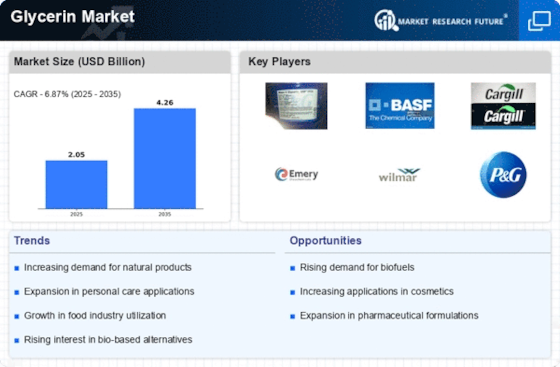
    As per Market Research Future Analysis, the Global Glycerin Market was valued at USD 2.05 Billion in 2024 and is projected to grow to USD 4.26 Billion by 2035, with a CAGR of 6.87% from 2025 to 2035. Glycerin, a versatile compound used in pharmaceuticals, personal care, and food, is gaining traction due to its unique properties and increasing demand in various sectors. The COVID-19 pandemic has further boosted the market as glycerin is a key ingredient in hand sanitizers. The Asia-Pacific region leads the market, driven by high production in countries like China, India, and Japan. However, price fluctuations and the availability of substitutes pose challenges to market growth.

    Key Market Trends & Highlights

    Market Size & Forecast

    2024 Market Size USD 2.05 Billion
    2035 Market Size USD 4.26 Billion
    CAGR 6.87%

    Market Trends

    Glycerin Market Market Drivers

    Market Growth Projections

    The Global Glycerin Market Industry is projected to experience substantial growth, with estimates indicating a market value of 2.05 USD Billion in 2024 and a potential increase to 4.26 USD Billion by 2035. This growth trajectory suggests a compound annual growth rate (CAGR) of 6.88% from 2025 to 2035, reflecting the increasing applications of glycerin across various sectors. The market's expansion is driven by rising consumer awareness, the demand for natural ingredients, and the versatility of glycerin in personal care, food, and pharmaceutical applications. These projections highlight the significant potential for glycerin in the global market.

    Pharmaceutical Industry Expansion

    The Global Glycerin Market Industry benefits from the ongoing expansion of the pharmaceutical sector, where glycerin is employed as a solvent, sweetening agent, and preservative in various formulations. The increasing prevalence of chronic diseases and the demand for effective medications drive the need for glycerin in pharmaceutical applications. As the industry evolves, glycerin's role in enhancing drug delivery systems and improving patient compliance is becoming increasingly recognized. This growth is likely to contribute to a compound annual growth rate (CAGR) of 6.88% from 2025 to 2035, indicating a robust future for glycerin in the pharmaceutical landscape.

    Emerging Markets and Economic Growth

    The Global Glycerin Market Industry is poised for growth in emerging markets, where economic development and rising disposable incomes are driving demand for glycerin-based products. Countries in Asia-Pacific and Latin America are experiencing increased consumption of personal care, food, and pharmaceutical products, leading to a higher demand for glycerin. As these regions continue to develop, the market is likely to expand, supported by a growing middle class and changing consumer preferences. This trend suggests a promising outlook for glycerin, as it becomes more integrated into the daily lives of consumers in these emerging economies.

    Sustainability and Eco-Friendly Trends

    The Global Glycerin Market Industry is witnessing a shift towards sustainability, as consumers and manufacturers alike prioritize eco-friendly products. Glycerin, being a biodegradable and renewable resource, aligns well with the growing demand for sustainable ingredients across various industries. This trend is particularly evident in personal care and food sectors, where companies are reformulating products to include glycerin as a natural alternative to synthetic additives. The increasing emphasis on sustainability is expected to drive market growth, as businesses seek to enhance their environmental credentials while meeting consumer expectations for greener products.

    Rising Demand in Personal Care Products

    The Global Glycerin Market Industry experiences a notable surge in demand due to the increasing utilization of glycerin in personal care products. Glycerin serves as a humectant, providing moisture retention in formulations such as lotions, creams, and shampoos. As consumers become more conscious of skin health and the benefits of natural ingredients, the demand for glycerin-based products is likely to rise. This trend is reflected in the projected market value, which is anticipated to reach 2.05 USD Billion in 2024. The shift towards organic and natural personal care products further enhances the growth potential of glycerin in this sector.

    Growth in Food and Beverage Applications

    The Global Glycerin Market Industry is significantly influenced by the expanding applications of glycerin in the food and beverage sector. Glycerin is utilized as a sweetener, preservative, and humectant in various food products, contributing to improved texture and moisture retention. With the increasing consumer preference for healthier food options, glycerin's role as a natural additive is becoming more prominent. This trend is expected to bolster the market, with projections indicating a growth trajectory that could see the market value reach 4.26 USD Billion by 2035. The versatility of glycerin in food applications positions it as a key ingredient in meeting evolving consumer demands.

    Market Segment Insights

    Regional Insights

    Key Companies in the Glycerin Market market include

    Industry Developments

    In July 2021, Ohio State University began working with a biodiesel producer in the state of Ohio towards the development of advanced glycerin technology. The goal of this partnership is to upgrade the value of crude glycerin in the form of polyurethanes, making them more usable in a range of industries.


    December 2022 saw the acquisition of a Conroe, Texas blending plant by Oleon; this was, however, not without a cost, with the merger costing the oleochemical giants a hefty $50 million. Merging with Oleon’s existing capabilities, Olean is now able to better supply and meet the increasing demand for glycerin across various industries. 


    At the same time, ENI and BASF were able to collaborate on projects related to the industrial chemical propanol, which can be acquired by modifying glycerin; this initiative began in July 2021 and shed value towards the glycerin byproducts by transforming it into an investment.

    In the latest announcement by the American Glycerin Producers Association in September 2023 there, a novel glycerin production plant in Texas will be opened; with a production capacity of about 100,000 tons of glycerin metric tons, this new plant will assist in catering the increased glycerin requirements across the US.

    In December 2023, ADM expanded into the global market as it missed out on becoming a pioneering agricultural processor. A capital outlay was incurred to purchase a São Paulo-based company that manufactured and sold refined glycerin. This aids in boosting the company's production capacity by 400,000 metric tons, further solidifying its strong foothold in the glycerin market.

    In July 2023, the Louis Dreyfus Company launched operations to construct a refining complex that has the ability and capacity to be located in Lampung, Indonesia. The strategic decision aids the company in seamlessly expanding its services and selling value-added products. These plans revolved around increasing glycerine refining capacity as well as extending capabilities around edible oil packaging.

    In December 2022, Oleochemical makers, which go by the name Oleon, allocated a staggering amount of 50 million dollars to blend in with existing Conroe facilities in Texas. This investment further strengthened the company’s reach in the U.S. market, further aiding them in expanding their operational capabilities around the production of glycerin.


    Future Outlook

    Glycerin Market Future Outlook

    <p>The Global Glycerin Market is projected to grow at a 6.87% CAGR from 2025 to 2035, driven by rising demand in pharmaceuticals, cosmetics, and food industries.</p>

    New opportunities lie in:

    • <p>Develop bio-based glycerin products to cater to sustainability trends. Invest in advanced glycerin extraction technologies for cost efficiency. Expand into emerging markets with tailored glycerin applications.</p>

    <p>By 2035, the Glycerin Market is poised for robust growth, reflecting evolving consumer preferences and industrial applications.</p>

    Market Segmentation

    Report Scope

    Attribute/Metric Details
    Market Size 2024 USD 2.05 Billion
    Market Size 2035 4.26 (Value (USD Billion))
    Compound Annual Growth Rate (CAGR) 6.87% (2025 - 2035)
    Base Year 2024
    Market Forecast Period 2025 - 2035
    Historical Data 2018 & 2020
    Market Forecast Units Value (USD Billion)
    Report Coverage Revenue Forecast, Market Competitive Landscape, Growth Factors, and Trends
    Segments Covered Type, Application and Region
    Geographies Covered North America, Europe, Asia Pacific, and the Rest of the World
    Countries Covered The U.S, Canada, Germany, France, the UK, Italy, Spain, China, Japan, India, Australia, South Korea, and Brazil
    Key Companies Profiled Procter & Gamble, NOW Foods, VVF L.L.C., Cargill, Dutch Glycerin Refinery (DGR), The Dow Chemical Company, Parchem fine & specialty chemicals , Avril Group, Essential Depot, Inc., Croda International Plc and others.
    Key Market Opportunities The consumers of developed regions prefer quality food, personal care and pharmaceuticals products. Middle East and Africa are one of the fastest growing market.
    Key Market Dynamics The drivers of the market are due to rise in health awareness and increase in trends of beauty products are driving the market of glycerin
    Market Size 2025 2.19 (Value (USD Billion))

    FAQs

    What industries use glycerin?

    Emulsifier and humectant in Cosmetics, Plasticizer in Packaging, Paints and Paper industry

    At what CAGR is the Global Glycerin Market predicted to grow over the forecast period?

    Glycerin Market is projected to register a CAGR of 6.87% from 2025-2035

    Which region is expected to have maximum share in the Glycerin Market?

    Asia-pacific region was the leading glycerin market with an estimated highest market size

    What are the key players of the Glycerin Market?

    Procter &amp; Gamble, NOW Foods, VVF L.L.C., Cargill, Dutch Glycerin Refinery (DGR), The Dow Chemical Company, Parchem fine &amp; specialty chemicals , Avril Group, Essential Depot, Inc., Croda International Plc and others.

    What are the drivers of the Glycerin Market?

    The drivers of the market are due to rise in health awareness and increase in trends of beauty products are driving the market of glycerin

    1. SECTION I: EXECUTIVE SUMMARY AND KEY HIGHLIGHTS
      1. | 1.1 EXECUTIVE SUMMARY
      2. | | 1.1.1 Market Overview
      3. | | 1.1.2 Key Findings
      4. | | 1.1.3 Market Segmentation
      5. | | 1.1.4 Competitive Landscape
      6. | | 1.1.5 Challenges and Opportunities
      7. | | 1.1.6 Future Outlook
    2. SECTION II: SCOPING, METHODOLOGY AND MARKET STRUCTURE
      1. | 2.1 MARKET INTRODUCTION
      2. | | 2.1.1 Definition
      3. | | 2.1.2 Scope of the study
      4. | | | 2.1.2.1 Research Objective
      5. | | | 2.1.2.2 Assumption
      6. | | | 2.1.2.3 Limitations
      7. | 2.2 RESEARCH METHODOLOGY
      8. | | 2.2.1 Overview
      9. | | 2.2.2 Data Mining
      10. | | 2.2.3 Secondary Research
      11. | | 2.2.4 Primary Research
      12. | | | 2.2.4.1 Primary Interviews and Information Gathering Process
      13. | | | 2.2.4.2 Breakdown of Primary Respondents
      14. | | 2.2.5 Forecasting Model
      15. | | 2.2.6 Market Size Estimation
      16. | | | 2.2.6.1 Bottom-Up Approach
      17. | | | 2.2.6.2 Top-Down Approach
      18. | | 2.2.7 Data Triangulation
      19. | | 2.2.8 Validation
    3. SECTION III: QUALITATIVE ANALYSIS
      1. | 3.1 MARKET DYNAMICS
      2. | | 3.1.1 Overview
      3. | | 3.1.2 Drivers
      4. | | 3.1.3 Restraints
      5. | | 3.1.4 Opportunities
      6. | 3.2 MARKET FACTOR ANALYSIS
      7. | | 3.2.1 Value chain Analysis
      8. | | 3.2.2 Porter's Five Forces Analysis
      9. | | | 3.2.2.1 Bargaining Power of Suppliers
      10. | | | 3.2.2.2 Bargaining Power of Buyers
      11. | | | 3.2.2.3 Threat of New Entrants
      12. | | | 3.2.2.4 Threat of Substitutes
      13. | | | 3.2.2.5 Intensity of Rivalry
      14. | | 3.2.3 COVID-19 Impact Analysis
      15. | | | 3.2.3.1 Market Impact Analysis
      16. | | | 3.2.3.2 Regional Impact
      17. | | | 3.2.3.3 Opportunity and Threat Analysis
    4. SECTION IV: QUANTITATIVE ANALYSIS
      1. | 4.1 Chemicals and Materials, BY Grade (USD Billion)
      2. | | 4.1.1 Refined Glycerin
      3. | | 4.1.2 Crude Glycerin
      4. | 4.2 Chemicals and Materials, BY Source (USD Billion)
      5. | | 4.2.1 Fatty Acids
      6. | | 4.2.2 Fatty Alcohols
      7. | | 4.2.3 Biodiesels
      8. | 4.3 Chemicals and Materials, BY Application (USD Billion)
      9. | | 4.3.1 Pharmaceuticals
      10. | | 4.3.2 Tobacco Humectants
      11. | | 4.3.3 Alkyd Resins
      12. | | 4.3.4 Industrial Chemicals
      13. | | 4.3.5 Food and Beverage
      14. | | 4.3.6 Polyether Polyols
      15. | | 4.3.7 Personal Care and Cosmetics
      16. | 4.4 Chemicals and Materials, BY Region (USD Billion)
      17. | | 4.4.1 North America
      18. | | | 4.4.1.1 US
      19. | | | 4.4.1.2 Canada
      20. | | 4.4.2 Europe
      21. | | | 4.4.2.1 Germany
      22. | | | 4.4.2.2 UK
      23. | | | 4.4.2.3 France
      24. | | | 4.4.2.4 Russia
      25. | | | 4.4.2.5 Italy
      26. | | | 4.4.2.6 Spain
      27. | | | 4.4.2.7 Rest of Europe
      28. | | 4.4.3 APAC
      29. | | | 4.4.3.1 China
      30. | | | 4.4.3.2 India
      31. | | | 4.4.3.3 Japan
      32. | | | 4.4.3.4 South Korea
      33. | | | 4.4.3.5 Malaysia
      34. | | | 4.4.3.6 Thailand
      35. | | | 4.4.3.7 Indonesia
      36. | | | 4.4.3.8 Rest of APAC
      37. | | 4.4.4 South America
      38. | | | 4.4.4.1 Brazil
      39. | | | 4.4.4.2 Mexico
      40. | | | 4.4.4.3 Argentina
      41. | | | 4.4.4.4 Rest of South America
      42. | | 4.4.5 MEA
      43. | | | 4.4.5.1 GCC Countries
      44. | | | 4.4.5.2 South Africa
      45. | | | 4.4.5.3 Rest of MEA
    5. SECTION V: COMPETITIVE ANALYSIS
      1. | 5.1 Competitive Landscape
      2. | | 5.1.1 Overview
      3. | | 5.1.2 Competitive Analysis
      4. | | 5.1.3 Market share Analysis
      5. | | 5.1.4 Major Growth Strategy in the Chemicals and Materials
      6. | | 5.1.5 Competitive Benchmarking
      7. | | 5.1.6 Leading Players in Terms of Number of Developments in the Chemicals and Materials
      8. | | 5.1.7 Key developments and growth strategies
      9. | | | 5.1.7.1 New Product Launch/Service Deployment
      10. | | | 5.1.7.2 Merger & Acquisitions
      11. | | | 5.1.7.3 Joint Ventures
      12. | | 5.1.8 Major Players Financial Matrix
      13. | | | 5.1.8.1 Sales and Operating Income
      14. | | | 5.1.8.2 Major Players R&D Expenditure. 2023
      15. | 5.2 Company Profiles
      16. | | 5.2.1 K glycerin (US)
      17. | | | 5.2.1.1 Financial Overview
      18. | | | 5.2.1.2 Products Offered
      19. | | | 5.2.1.3 Key Developments
      20. | | | 5.2.1.4 SWOT Analysis
      21. | | | 5.2.1.5 Key Strategies
      22. | | 5.2.2 BASF SE (DE)
      23. | | | 5.2.2.1 Financial Overview
      24. | | | 5.2.2.2 Products Offered
      25. | | | 5.2.2.3 Key Developments
      26. | | | 5.2.2.4 SWOT Analysis
      27. | | | 5.2.2.5 Key Strategies
      28. | | 5.2.3 Cargill, Incorporated (US)
      29. | | | 5.2.3.1 Financial Overview
      30. | | | 5.2.3.2 Products Offered
      31. | | | 5.2.3.3 Key Developments
      32. | | | 5.2.3.4 SWOT Analysis
      33. | | | 5.2.3.5 Key Strategies
      34. | | 5.2.4 Emery Oleochemicals (MY)
      35. | | | 5.2.4.1 Financial Overview
      36. | | | 5.2.4.2 Products Offered
      37. | | | 5.2.4.3 Key Developments
      38. | | | 5.2.4.4 SWOT Analysis
      39. | | | 5.2.4.5 Key Strategies
      40. | | 5.2.5 Wilmar International Limited (SG)
      41. | | | 5.2.5.1 Financial Overview
      42. | | | 5.2.5.2 Products Offered
      43. | | | 5.2.5.3 Key Developments
      44. | | | 5.2.5.4 SWOT Analysis
      45. | | | 5.2.5.5 Key Strategies
      46. | | 5.2.6 Procter & Gamble Co. (US)
      47. | | | 5.2.6.1 Financial Overview
      48. | | | 5.2.6.2 Products Offered
      49. | | | 5.2.6.3 Key Developments
      50. | | | 5.2.6.4 SWOT Analysis
      51. | | | 5.2.6.5 Key Strategies
      52. | | 5.2.7 Kraton Corporation (US)
      53. | | | 5.2.7.1 Financial Overview
      54. | | | 5.2.7.2 Products Offered
      55. | | | 5.2.7.3 Key Developments
      56. | | | 5.2.7.4 SWOT Analysis
      57. | | | 5.2.7.5 Key Strategies
      58. | | 5.2.8 Dow Chemical Company (US)
      59. | | | 5.2.8.1 Financial Overview
      60. | | | 5.2.8.2 Products Offered
      61. | | | 5.2.8.3 Key Developments
      62. | | | 5.2.8.4 SWOT Analysis
      63. | | | 5.2.8.5 Key Strategies
      64. | | 5.2.9 Vantage Specialty Chemicals (US)
      65. | | | 5.2.9.1 Financial Overview
      66. | | | 5.2.9.2 Products Offered
      67. | | | 5.2.9.3 Key Developments
      68. | | | 5.2.9.4 SWOT Analysis
      69. | | | 5.2.9.5 Key Strategies
      70. | 5.3 Appendix
      71. | | 5.3.1 References
      72. | | 5.3.2 Related Reports
    6. LIST OF FIGURES
      1. | 6.1 MARKET SYNOPSIS
      2. | 6.2 NORTH AMERICA MARKET ANALYSIS
      3. | 6.3 US MARKET ANALYSIS BY GRADE
      4. | 6.4 US MARKET ANALYSIS BY SOURCE
      5. | 6.5 US MARKET ANALYSIS BY APPLICATION
      6. | 6.6 CANADA MARKET ANALYSIS BY GRADE
      7. | 6.7 CANADA MARKET ANALYSIS BY SOURCE
      8. | 6.8 CANADA MARKET ANALYSIS BY APPLICATION
      9. | 6.9 EUROPE MARKET ANALYSIS
      10. | 6.10 GERMANY MARKET ANALYSIS BY GRADE
      11. | 6.11 GERMANY MARKET ANALYSIS BY SOURCE
      12. | 6.12 GERMANY MARKET ANALYSIS BY APPLICATION
      13. | 6.13 UK MARKET ANALYSIS BY GRADE
      14. | 6.14 UK MARKET ANALYSIS BY SOURCE
      15. | 6.15 UK MARKET ANALYSIS BY APPLICATION
      16. | 6.16 FRANCE MARKET ANALYSIS BY GRADE
      17. | 6.17 FRANCE MARKET ANALYSIS BY SOURCE
      18. | 6.18 FRANCE MARKET ANALYSIS BY APPLICATION
      19. | 6.19 RUSSIA MARKET ANALYSIS BY GRADE
      20. | 6.20 RUSSIA MARKET ANALYSIS BY SOURCE
      21. | 6.21 RUSSIA MARKET ANALYSIS BY APPLICATION
      22. | 6.22 ITALY MARKET ANALYSIS BY GRADE
      23. | 6.23 ITALY MARKET ANALYSIS BY SOURCE
      24. | 6.24 ITALY MARKET ANALYSIS BY APPLICATION
      25. | 6.25 SPAIN MARKET ANALYSIS BY GRADE
      26. | 6.26 SPAIN MARKET ANALYSIS BY SOURCE
      27. | 6.27 SPAIN MARKET ANALYSIS BY APPLICATION
      28. | 6.28 REST OF EUROPE MARKET ANALYSIS BY GRADE
      29. | 6.29 REST OF EUROPE MARKET ANALYSIS BY SOURCE
      30. | 6.30 REST OF EUROPE MARKET ANALYSIS BY APPLICATION
      31. | 6.31 APAC MARKET ANALYSIS
      32. | 6.32 CHINA MARKET ANALYSIS BY GRADE
      33. | 6.33 CHINA MARKET ANALYSIS BY SOURCE
      34. | 6.34 CHINA MARKET ANALYSIS BY APPLICATION
      35. | 6.35 INDIA MARKET ANALYSIS BY GRADE
      36. | 6.36 INDIA MARKET ANALYSIS BY SOURCE
      37. | 6.37 INDIA MARKET ANALYSIS BY APPLICATION
      38. | 6.38 JAPAN MARKET ANALYSIS BY GRADE
      39. | 6.39 JAPAN MARKET ANALYSIS BY SOURCE
      40. | 6.40 JAPAN MARKET ANALYSIS BY APPLICATION
      41. | 6.41 SOUTH KOREA MARKET ANALYSIS BY GRADE
      42. | 6.42 SOUTH KOREA MARKET ANALYSIS BY SOURCE
      43. | 6.43 SOUTH KOREA MARKET ANALYSIS BY APPLICATION
      44. | 6.44 MALAYSIA MARKET ANALYSIS BY GRADE
      45. | 6.45 MALAYSIA MARKET ANALYSIS BY SOURCE
      46. | 6.46 MALAYSIA MARKET ANALYSIS BY APPLICATION
      47. | 6.47 THAILAND MARKET ANALYSIS BY GRADE
      48. | 6.48 THAILAND MARKET ANALYSIS BY SOURCE
      49. | 6.49 THAILAND MARKET ANALYSIS BY APPLICATION
      50. | 6.50 INDONESIA MARKET ANALYSIS BY GRADE
      51. | 6.51 INDONESIA MARKET ANALYSIS BY SOURCE
      52. | 6.52 INDONESIA MARKET ANALYSIS BY APPLICATION
      53. | 6.53 REST OF APAC MARKET ANALYSIS BY GRADE
      54. | 6.54 REST OF APAC MARKET ANALYSIS BY SOURCE
      55. | 6.55 REST OF APAC MARKET ANALYSIS BY APPLICATION
      56. | 6.56 SOUTH AMERICA MARKET ANALYSIS
      57. | 6.57 BRAZIL MARKET ANALYSIS BY GRADE
      58. | 6.58 BRAZIL MARKET ANALYSIS BY SOURCE
      59. | 6.59 BRAZIL MARKET ANALYSIS BY APPLICATION
      60. | 6.60 MEXICO MARKET ANALYSIS BY GRADE
      61. | 6.61 MEXICO MARKET ANALYSIS BY SOURCE
      62. | 6.62 MEXICO MARKET ANALYSIS BY APPLICATION
      63. | 6.63 ARGENTINA MARKET ANALYSIS BY GRADE
      64. | 6.64 ARGENTINA MARKET ANALYSIS BY SOURCE
      65. | 6.65 ARGENTINA MARKET ANALYSIS BY APPLICATION
      66. | 6.66 REST OF SOUTH AMERICA MARKET ANALYSIS BY GRADE
      67. | 6.67 REST OF SOUTH AMERICA MARKET ANALYSIS BY SOURCE
      68. | 6.68 REST OF SOUTH AMERICA MARKET ANALYSIS BY APPLICATION
      69. | 6.69 MEA MARKET ANALYSIS
      70. | 6.70 GCC COUNTRIES MARKET ANALYSIS BY GRADE
      71. | 6.71 GCC COUNTRIES MARKET ANALYSIS BY SOURCE
      72. | 6.72 GCC COUNTRIES MARKET ANALYSIS BY APPLICATION
      73. | 6.73 SOUTH AFRICA MARKET ANALYSIS BY GRADE
      74. | 6.74 SOUTH AFRICA MARKET ANALYSIS BY SOURCE
      75. | 6.75 SOUTH AFRICA MARKET ANALYSIS BY APPLICATION
      76. | 6.76 REST OF MEA MARKET ANALYSIS BY GRADE
      77. | 6.77 REST OF MEA MARKET ANALYSIS BY SOURCE
      78. | 6.78 REST OF MEA MARKET ANALYSIS BY APPLICATION
      79. | 6.79 KEY BUYING CRITERIA OF CHEMICALS AND MATERIALS
      80. | 6.80 RESEARCH PROCESS OF MRFR
      81. | 6.81 DRO ANALYSIS OF CHEMICALS AND MATERIALS
      82. | 6.82 DRIVERS IMPACT ANALYSIS: CHEMICALS AND MATERIALS
      83. | 6.83 RESTRAINTS IMPACT ANALYSIS: CHEMICALS AND MATERIALS
      84. | 6.84 SUPPLY / VALUE CHAIN: CHEMICALS AND MATERIALS
      85. | 6.85 CHEMICALS AND MATERIALS, BY GRADE, 2024 (% SHARE)
      86. | 6.86 CHEMICALS AND MATERIALS, BY GRADE, 2024 TO 2035 (USD Billion)
      87. | 6.87 CHEMICALS AND MATERIALS, BY SOURCE, 2024 (% SHARE)
      88. | 6.88 CHEMICALS AND MATERIALS, BY SOURCE, 2024 TO 2035 (USD Billion)
      89. | 6.89 CHEMICALS AND MATERIALS, BY APPLICATION, 2024 (% SHARE)
      90. | 6.90 CHEMICALS AND MATERIALS, BY APPLICATION, 2024 TO 2035 (USD Billion)
      91. | 6.91 BENCHMARKING OF MAJOR COMPETITORS
    7. LIST OF TABLES
      1. | 7.1 LIST OF ASSUMPTIONS
      2. | | 7.1.1
      3. | 7.2 North America MARKET SIZE ESTIMATES; FORECAST
      4. | | 7.2.1 BY GRADE, 2025-2035 (USD Billion)
      5. | | 7.2.2 BY SOURCE, 2025-2035 (USD Billion)
      6. | | 7.2.3 BY APPLICATION, 2025-2035 (USD Billion)
      7. | 7.3 US MARKET SIZE ESTIMATES; FORECAST
      8. | | 7.3.1 BY GRADE, 2025-2035 (USD Billion)
      9. | | 7.3.2 BY SOURCE, 2025-2035 (USD Billion)
      10. | | 7.3.3 BY APPLICATION, 2025-2035 (USD Billion)
      11. | 7.4 Canada MARKET SIZE ESTIMATES; FORECAST
      12. | | 7.4.1 BY GRADE, 2025-2035 (USD Billion)
      13. | | 7.4.2 BY SOURCE, 2025-2035 (USD Billion)
      14. | | 7.4.3 BY APPLICATION, 2025-2035 (USD Billion)
      15. | 7.5 Europe MARKET SIZE ESTIMATES; FORECAST
      16. | | 7.5.1 BY GRADE, 2025-2035 (USD Billion)
      17. | | 7.5.2 BY SOURCE, 2025-2035 (USD Billion)
      18. | | 7.5.3 BY APPLICATION, 2025-2035 (USD Billion)
      19. | 7.6 Germany MARKET SIZE ESTIMATES; FORECAST
      20. | | 7.6.1 BY GRADE, 2025-2035 (USD Billion)
      21. | | 7.6.2 BY SOURCE, 2025-2035 (USD Billion)
      22. | | 7.6.3 BY APPLICATION, 2025-2035 (USD Billion)
      23. | 7.7 UK MARKET SIZE ESTIMATES; FORECAST
      24. | | 7.7.1 BY GRADE, 2025-2035 (USD Billion)
      25. | | 7.7.2 BY SOURCE, 2025-2035 (USD Billion)
      26. | | 7.7.3 BY APPLICATION, 2025-2035 (USD Billion)
      27. | 7.8 France MARKET SIZE ESTIMATES; FORECAST
      28. | | 7.8.1 BY GRADE, 2025-2035 (USD Billion)
      29. | | 7.8.2 BY SOURCE, 2025-2035 (USD Billion)
      30. | | 7.8.3 BY APPLICATION, 2025-2035 (USD Billion)
      31. | 7.9 Russia MARKET SIZE ESTIMATES; FORECAST
      32. | | 7.9.1 BY GRADE, 2025-2035 (USD Billion)
      33. | | 7.9.2 BY SOURCE, 2025-2035 (USD Billion)
      34. | | 7.9.3 BY APPLICATION, 2025-2035 (USD Billion)
      35. | 7.10 Italy MARKET SIZE ESTIMATES; FORECAST
      36. | | 7.10.1 BY GRADE, 2025-2035 (USD Billion)
      37. | | 7.10.2 BY SOURCE, 2025-2035 (USD Billion)
      38. | | 7.10.3 BY APPLICATION, 2025-2035 (USD Billion)
      39. | 7.11 Spain MARKET SIZE ESTIMATES; FORECAST
      40. | | 7.11.1 BY GRADE, 2025-2035 (USD Billion)
      41. | | 7.11.2 BY SOURCE, 2025-2035 (USD Billion)
      42. | | 7.11.3 BY APPLICATION, 2025-2035 (USD Billion)
      43. | 7.12 Rest of Europe MARKET SIZE ESTIMATES; FORECAST
      44. | | 7.12.1 BY GRADE, 2025-2035 (USD Billion)
      45. | | 7.12.2 BY SOURCE, 2025-2035 (USD Billion)
      46. | | 7.12.3 BY APPLICATION, 2025-2035 (USD Billion)
      47. | 7.13 APAC MARKET SIZE ESTIMATES; FORECAST
      48. | | 7.13.1 BY GRADE, 2025-2035 (USD Billion)
      49. | | 7.13.2 BY SOURCE, 2025-2035 (USD Billion)
      50. | | 7.13.3 BY APPLICATION, 2025-2035 (USD Billion)
      51. | 7.14 China MARKET SIZE ESTIMATES; FORECAST
      52. | | 7.14.1 BY GRADE, 2025-2035 (USD Billion)
      53. | | 7.14.2 BY SOURCE, 2025-2035 (USD Billion)
      54. | | 7.14.3 BY APPLICATION, 2025-2035 (USD Billion)
      55. | 7.15 India MARKET SIZE ESTIMATES; FORECAST
      56. | | 7.15.1 BY GRADE, 2025-2035 (USD Billion)
      57. | | 7.15.2 BY SOURCE, 2025-2035 (USD Billion)
      58. | | 7.15.3 BY APPLICATION, 2025-2035 (USD Billion)
      59. | 7.16 Japan MARKET SIZE ESTIMATES; FORECAST
      60. | | 7.16.1 BY GRADE, 2025-2035 (USD Billion)
      61. | | 7.16.2 BY SOURCE, 2025-2035 (USD Billion)
      62. | | 7.16.3 BY APPLICATION, 2025-2035 (USD Billion)
      63. | 7.17 South Korea MARKET SIZE ESTIMATES; FORECAST
      64. | | 7.17.1 BY GRADE, 2025-2035 (USD Billion)
      65. | | 7.17.2 BY SOURCE, 2025-2035 (USD Billion)
      66. | | 7.17.3 BY APPLICATION, 2025-2035 (USD Billion)
      67. | 7.18 Malaysia MARKET SIZE ESTIMATES; FORECAST
      68. | | 7.18.1 BY GRADE, 2025-2035 (USD Billion)
      69. | | 7.18.2 BY SOURCE, 2025-2035 (USD Billion)
      70. | | 7.18.3 BY APPLICATION, 2025-2035 (USD Billion)
      71. | 7.19 Thailand MARKET SIZE ESTIMATES; FORECAST
      72. | | 7.19.1 BY GRADE, 2025-2035 (USD Billion)
      73. | | 7.19.2 BY SOURCE, 2025-2035 (USD Billion)
      74. | | 7.19.3 BY APPLICATION, 2025-2035 (USD Billion)
      75. | 7.20 Indonesia MARKET SIZE ESTIMATES; FORECAST
      76. | | 7.20.1 BY GRADE, 2025-2035 (USD Billion)
      77. | | 7.20.2 BY SOURCE, 2025-2035 (USD Billion)
      78. | | 7.20.3 BY APPLICATION, 2025-2035 (USD Billion)
      79. | 7.21 Rest of APAC MARKET SIZE ESTIMATES; FORECAST
      80. | | 7.21.1 BY GRADE, 2025-2035 (USD Billion)
      81. | | 7.21.2 BY SOURCE, 2025-2035 (USD Billion)
      82. | | 7.21.3 BY APPLICATION, 2025-2035 (USD Billion)
      83. | 7.22 South America MARKET SIZE ESTIMATES; FORECAST
      84. | | 7.22.1 BY GRADE, 2025-2035 (USD Billion)
      85. | | 7.22.2 BY SOURCE, 2025-2035 (USD Billion)
      86. | | 7.22.3 BY APPLICATION, 2025-2035 (USD Billion)
      87. | 7.23 Brazil MARKET SIZE ESTIMATES; FORECAST
      88. | | 7.23.1 BY GRADE, 2025-2035 (USD Billion)
      89. | | 7.23.2 BY SOURCE, 2025-2035 (USD Billion)
      90. | | 7.23.3 BY APPLICATION, 2025-2035 (USD Billion)
      91. | 7.24 Mexico MARKET SIZE ESTIMATES; FORECAST
      92. | | 7.24.1 BY GRADE, 2025-2035 (USD Billion)
      93. | | 7.24.2 BY SOURCE, 2025-2035 (USD Billion)
      94. | | 7.24.3 BY APPLICATION, 2025-2035 (USD Billion)
      95. | 7.25 Argentina MARKET SIZE ESTIMATES; FORECAST
      96. | | 7.25.1 BY GRADE, 2025-2035 (USD Billion)
      97. | | 7.25.2 BY SOURCE, 2025-2035 (USD Billion)
      98. | | 7.25.3 BY APPLICATION, 2025-2035 (USD Billion)
      99. | 7.26 Rest of South America MARKET SIZE ESTIMATES; FORECAST
      100. | | 7.26.1 BY GRADE, 2025-2035 (USD Billion)
      101. | | 7.26.2 BY SOURCE, 2025-2035 (USD Billion)
      102. | | 7.26.3 BY APPLICATION, 2025-2035 (USD Billion)
      103. | 7.27 MEA MARKET SIZE ESTIMATES; FORECAST
      104. | | 7.27.1 BY GRADE, 2025-2035 (USD Billion)
      105. | | 7.27.2 BY SOURCE, 2025-2035 (USD Billion)
      106. | | 7.27.3 BY APPLICATION, 2025-2035 (USD Billion)
      107. | 7.28 GCC Countries MARKET SIZE ESTIMATES; FORECAST
      108. | | 7.28.1 BY GRADE, 2025-2035 (USD Billion)
      109. | | 7.28.2 BY SOURCE, 2025-2035 (USD Billion)
      110. | | 7.28.3 BY APPLICATION, 2025-2035 (USD Billion)
      111. | 7.29 South Africa MARKET SIZE ESTIMATES; FORECAST
      112. | | 7.29.1 BY GRADE, 2025-2035 (USD Billion)
      113. | | 7.29.2 BY SOURCE, 2025-2035 (USD Billion)
      114. | | 7.29.3 BY APPLICATION, 2025-2035 (USD Billion)
      115. | 7.30 Rest of MEA MARKET SIZE ESTIMATES; FORECAST
      116. | | 7.30.1 BY GRADE, 2025-2035 (USD Billion)
      117. | | 7.30.2 BY SOURCE, 2025-2035 (USD Billion)
      118. | | 7.30.3 BY APPLICATION, 2025-2035 (USD Billion)
      119. | 7.31 PRODUCT LAUNCH/PRODUCT DEVELOPMENT/APPROVAL
      120. | | 7.31.1
      121. | 7.32 ACQUISITION/PARTNERSHIP
      122. | | 7.32.1

    Glycerin Market Segmentation

    Market Segmentation Overview

    • Detailed segmentation data will be available in the full report
    • Comprehensive analysis by multiple parameters
    • Regional and country-level breakdowns
    • Market size forecasts by segment
    Infographic

    Free Sample Request

    Kindly complete the form below to receive a free sample of this Report

    Get Free Sample

    Customer Strories

    “I am very pleased with how market segments have been defined in a relevant way for my purposes (such as "Portable Freezers & refrigerators" and "last-mile"). In general the report is well structured. Thanks very much for your efforts.”

    Victoria Milne

    Founder
    Case Study
    Chemicals and Materials

    Compare Licence

    ×
    Features License Type
    Single User Multiuser License Enterprise User
    Price $4,950 $5,950 $7,250
    Maximum User Access Limit 1 User Upto 10 Users Unrestricted Access Throughout the Organization
    Free Customization
    Direct Access to Analyst
    Deliverable Format
    Platform Access
    Discount on Next Purchase 10% 15% 15%
    Printable Versions