

Request Free Sample ×

Kindly complete the form below to receive a free sample of this Report

* Please use a valid business email

Leading companies partner with us for data-driven Insights

clients tt-cursor
Hero Background
English
Chinese
French
Japanese
Korean
German
Spanish

Glycerin Market Trends

ID: MRFR/CnM/1764-HCR
125 Pages
Anshula Mandaokar
March 2026

Glycerin Market Research Report Information by Type (Synthetic and Natural), by Application (Food, Personal Care Products, Pharmaceuticals and others), and by Region - Forecast to 2035

Share:
Download PDF ×

We do not share your information with anyone. However, we may send you emails based on your report interest from time to time. You may contact us at any time to opt-out.

Glycerin Market Infographic
Purchase Options

Market Trends

Key Emerging Trends in the Glycerin Market

There are changing consumer tastes, technological advances, and efforts to be more environmentally friendly in the glycerin market, which is affecting the overall market landscape." The market for glycerin is seeing a lot of growth in the need for safe, bio-based goods. Glycerin is in high demand in the grocery store business. Using it as a medicinal ingredient and a beverage in drug production is becoming more popular. The trend is coming from the need for chemicals that are safe and steady for drugs.

Glycerin is becoming more and more important in many food and drink items over time. Many foods use glycerin to make them sweeter, break down things, and keep the wetness in the food. This style is popular because people want better and more natural materials.

One clear trend is the push to make glycerin that is very pure. Personal care and pharmaceuticals are two fields that need glycerin that is clean. Technology advances are helping to meet strict quality standards and the growing need for very pure glycerin. There are new goods on the market like specialty mixes, polyols, and esters. The stuff in all of these is glycerin. These goods help the market grow by being useful in many areas, as well as making glycerin more useful.

More and more people who work in the animal feed business use natural glycerin. Greasing animal food with glycerin makes it taste better and gives the animals more energy. Natural and eco-friendly goods are getting a lot of attention in the business world right now because of this trend.

A growing number of people are finding useful ways to use glycerin. Business are coming up with creative ways to use trash streams that contain glycerin to help the economy and have less of an impact on the earth.

Companies are always making new goods to meet the needs of customers whose tastes change. To meet the needs of the business world, the main goal is to make glycerin solutions that work better, last longer, and have new uses.

Author
Author Profile
Anshula Mandaokar
Team Lead - Research

Anshula Mandaokar holds an academic degree in Chemical Engineering and has been contributing to the field for more than 5 years. She has expertise in Market Research and Business Consulting and serves as a Team Lead for a reputed Market Research firm under the Chemicals and Materials domain spectrum. She has worked on multiple projects, generating explicit results in a quick turnaround time. Her understanding of data interpretation justifies her role as a leader.

Leave a Comment

FAQs

What is the current valuation of the Glycerin Market as of 2024?

<p>The Glycerin Market was valued at 2050.0 USD Million in 2024.</p>

What is the projected market valuation for the Glycerin Market in 2035?

<p>The Glycerin Market is projected to reach a valuation of 4258.52 USD Million by 2035.</p>

What is the expected CAGR for the Glycerin Market during the forecast period 2025 - 2035?

<p>The expected CAGR for the Glycerin Market during the forecast period 2025 - 2035 is 6.87%.</p>

How does the Glycerin Market perform in the Pharmaceuticals segment?

<p>The Pharmaceuticals segment of the Glycerin Market was valued between 300.0 and 650.0 USD Million.</p>

What is the valuation range for the Cosmetics segment in the Glycerin Market?

<p>The Cosmetics segment in the Glycerin Market ranges from 400.0 to 900.0 USD Million.</p>

What are the projected values for the Food and Beverages segment in the Glycerin Market?

<p>The Food and Beverages segment is projected to be valued between 500.0 and 1100.0 USD Million.</p>

What is the valuation range for the Chemical Industry in the Glycerin Market?

<p>The Chemical Industry segment is expected to range from 600.0 to 1300.0 USD Million.</p>

What are the expected values for the Glycerin Market by source?

<p>By source, the Glycerin Market is expected to be valued between 1025.0 and 2150.0 USD Million for Vegetable sources.</p>

What is the valuation range for the Food Grade purity level in the Glycerin Market?

<p>The Food Grade purity level in the Glycerin Market ranges from 650.0 to 1358.52 USD Million.</p>

How does the agricultural industry impact the glycerine market?

<p>The agricultural industry segment is valued between 25.0 and 38.0 USD Million, reflecting its role in the glycerine market.</p>

Market Summary

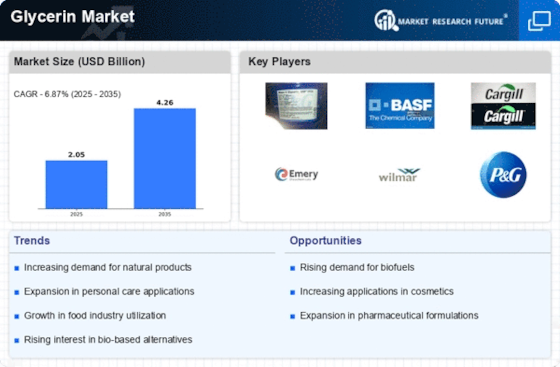
As per MRFR analysis, the Glycerin Market Size was estimated at 2050.0 USD Million in 2024. The Glycerin industry is projected to grow from 2190.88 in 2025 to 4258.52 by 2035, exhibiting a compound annual growth rate (CAGR) of 6.87% during the forecast period 2025 - 2035.

Key Market Trends & Highlights

The glycerin market is experiencing robust growth driven by sustainability and diverse applications.

  • North America remains the largest market for glycerin, driven by its extensive use in personal care and pharmaceutical products.
  • The Asia-Pacific region is emerging as the fastest-growing market, fueled by increasing demand for glycerin in food and cosmetics.
  • The personal care segment is witnessing significant expansion, with innovations in eco-friendly products enhancing market appeal.
  • Rising demand in the food industry and growth in biofuel production are key drivers propelling the glycerin market forward.

Market Size & Forecast

2024 Market Size 2050.0 (USD Million)
2035 Market Size 4258.52 (USD Million)
CAGR (2025 - 2035) 6.87%
Largest Regional Market Share in 2024 Asia-Pacific

Major Players

<p>K glycerin (US), BASF SE (DE), Cargill, Incorporated (US), Emery Oleochemicals (MY), Kraton Corporation (US), Procter & Gamble (US), Wilmar International Limited (SG), Solvay S.A. (BE), Dow Chemical Company (US)</p>

Market Trends

The Glycerin Market is currently experiencing a notable transformation, driven by various factors that influence its demand and supply dynamics. The increasing awareness regarding the benefits of glycerin in personal care and cosmetic products appears to be a primary catalyst for growth. Additionally, the food and beverage sector is increasingly utilizing glycerin as a sweetener and humectant, which further propels its market presence. Furthermore, the rise in bio-based products and sustainable practices is likely to enhance the appeal of glycerin, as consumers and manufacturers alike seek environmentally friendly alternatives. Moreover, the pharmaceutical industry is also recognizing the potential of glycerin as a solvent and preservative, which may lead to expanded applications in medicinal formulations. This diversification of uses suggests a robust future for the Glycerin Market, as it adapts to the evolving needs of various industries. The interplay between consumer preferences and regulatory frameworks could shape the trajectory of this market, indicating a period of innovation and adaptation ahead.

Sustainability Initiatives

The Glycerin Market is witnessing a shift towards sustainability, as manufacturers increasingly focus on eco-friendly production methods. This trend reflects a broader commitment to reducing environmental impact, which resonates with consumers who prioritize green products. As a result, glycerin derived from renewable sources is gaining traction, potentially reshaping market dynamics.

Expansion in Personal Care

The personal care sector is experiencing a surge in demand for glycerin, attributed to its moisturizing properties and versatility. This trend indicates a growing preference for natural ingredients in beauty products, as consumers seek formulations that are both effective and gentle on the skin. Consequently, glycerin's role in this industry is likely to expand.

Pharmaceutical Applications

The Glycerin Market is also seeing increased utilization in the pharmaceutical sector, where glycerin serves as a key ingredient in various formulations. This trend suggests a recognition of glycerin's benefits as a solvent and preservative, potentially leading to new product developments and applications in healthcare.

Glycerin Market Market Drivers

Growth in Biofuel Production

The Glycerin Market is poised to benefit from the increasing production of biofuels, particularly biodiesel. Glycerin is a byproduct of biodiesel production, and as the demand for renewable energy sources rises, so does the production of glycerin. In recent years, biodiesel production has expanded, leading to an increase in glycerin supply. This trend is expected to continue, with projections indicating that biodiesel production could reach 40 billion liters by 2027. Consequently, the Glycerin Market is likely to see a corresponding rise in glycerin availability, influencing pricing and market dynamics.

Rising Demand in Food Industry

The Glycerin Market is experiencing a notable increase in demand from the food sector. Glycerin serves as a humectant, sweetener, and preservative in various food products. The market for food-grade glycerin is projected to grow significantly, driven by the rising consumer preference for natural and organic ingredients. In 2025, the food-grade glycerin segment accounted for approximately 30% of the total glycerin market share. This trend is likely to continue as manufacturers seek to enhance product quality and shelf life, thereby contributing to the overall growth of the Glycerin Market.

Innovations in Personal Care Products

The Glycerin Market is significantly influenced by innovations in personal care and cosmetic products. Glycerin is widely used for its moisturizing properties, making it a key ingredient in lotions, creams, and other skincare formulations. The personal care segment is anticipated to grow at a compound annual growth rate of 5% from 2026 to 2031. This growth is driven by consumer awareness regarding skin health and the demand for high-quality, effective products. As manufacturers continue to innovate and introduce new formulations, the Glycerin Market is likely to expand in tandem.

Pharmaceutical Applications and Growth

The Glycerin Market is also witnessing growth due to its extensive applications in the pharmaceutical sector. Glycerin is utilized as a solvent, sweetening agent, and preservative in various medicinal formulations. The pharmaceutical segment is projected to account for around 25% of the total glycerin market by 2026. This growth is attributed to the increasing demand for liquid formulations and the rising prevalence of chronic diseases. As pharmaceutical companies continue to develop new drugs and formulations, the Glycerin Market is expected to benefit from this upward trend.

Sustainability and Eco-Friendly Products

The Glycerin Market is increasingly influenced by the shift towards sustainability and eco-friendly products. Consumers are becoming more conscious of the environmental impact of their purchases, leading to a demand for glycerin derived from renewable sources. This trend is reflected in the growing market for bio-based glycerin, which is expected to reach a valuation of 1 billion USD by 2028. As companies strive to meet consumer expectations for sustainable products, the Glycerin Market is likely to see a rise in the production and use of eco-friendly glycerin alternatives.

Market Segment Insights

By Application: Pharmaceuticals (Largest) vs. Personal Care (Fastest-Growing)

<p>In the US-<a href="https://www.marketresearchfuture.com/reports/mexico-glycerine-market-3691" target="_blank" title="mexico glycerine">Mexico glycerine</a> market, the application segment is notably diverse, with pharmaceuticals capturing the largest market share due to the rising demand for glycerine in medicines and health-related products. The other applications collectively contribute significantly, with food and beverages, cosmetics, and industrial uses also holding notable shares. Personal care is rapidly expanding due to increasing consumer awareness regarding natural ingredients, positioning it as a vital player in the market.</p>

<p>Pharmaceuticals (Dominant) vs. Personal Care (Emerging)</p>

<p>The pharmaceuticals sector stands out as the dominant application for glycerine in the US-Mexico market, primarily leveraging glycerine's properties as a solvent and humectant. This sector benefits from stringent health regulations ensuring quality and purity, leading to higher demand for pharmaceutical-grade glycerine. Conversely, the personal care segment is emerging, driven by the growing trend towards organic products and natural formulations. Glycerine's moisturizing and skin-friendly attributes make it increasingly popular in creams, lotions, and cosmetics, aligning with consumer preferences for safer, eco-friendly products.</p>

By End Use: Food Industry (Largest) vs. Cosmetic Industry (Fastest-Growing)

<p>In the glycerin market, the food industry holds the largest share, leveraging glycerin for its multifunctional properties such as a sweetener, humectant, and solvent. The cosmetic industry follows closely behind, utilizing glycerin for its effective moisturizing properties and ability to enhance product formulations. The comprehensive demand in these sectors signifies the importance of glycerin as a key ingredient, showcasing its versatility and essential role in various applications.</p>

<p>Food Industry: Dominant vs. Cosmetic Industry: Emerging</p>

<p>The food industry is the dominant segment in the glycerin market due to its extensive applications in food preservation, sweetening, and as an emulsifier in processed foods. It benefits from the growing trend toward natural and healthier products. In contrast, the cosmetic industry is marked as an emerging segment, rapidly expanding due to the increasing consumer focus on skincare and wellness. Glycerin's role as a humectant and natural moisturizer makes it indispensable in cosmetic formulations, indicating a strong growth potential driven by innovation and consumer demand for sustainable beauty solutions.</p>

By Source: Vegetable (Largest) vs. Synthetic (Fastest-Growing)

<p>In the US-Mexico glycerine market, the source segment is predominantly driven by Vegetable glycerine, which holds the largest market share. This preference is largely due to the growing demand for natural and organic products, particularly in food, cosmetics, and pharmaceuticals. Synthetic glycerine, while smaller in market share, is rapidly gaining traction due to its cost-effectiveness and availability. As consumers increasingly seek sustainable and healthier options, the market is adapting to meet these needs, leading to a dynamic competitive landscape.</p>

<p>Vegetable (Dominant) vs. Synthetic (Emerging)</p>

<p>Vegetable glycerine stands out as the dominant segment, popular for its biocompatibility and versatility in various applications such as skincare and food products. Its natural origin aligns with contemporary health trends, making it a preferred choice for health-conscious consumers. Conversely, synthetic glycerine is emerging as a strong contender, often favored in industrial applications due to its lower production costs. Manufacturers are investing in innovative processes to enhance the quality of synthetic glycerine to compete with its vegetable counterpart without compromising on purity, making it an attractive option for large-scale production.</p>

By Purity Level: Pharmaceutical Grade (Largest) vs. Food Grade (Fastest-Growing)

<p>In the glycerin market, the purity level segment showcases a diverse distribution among its key categories: Technical Grade, Pharmaceutical Grade, and Food Grade. The Pharmaceutical Grade is the largest segment due to its stringent use in medicinal applications, encompassing a wide array of health products. The Food Grade, while currently smaller in market size, has been gaining traction, driven by the increasing acceptance of glycerin in food formulations.</p>

<p>Pharmaceutical Grade (Dominant) vs. Food Grade (Emerging)</p>

<p>The Pharmaceutical Grade glycerin is characterized by its high purity and quality standards, making it essential in pharmaceuticals, personal care, and cosmetics. It commands a dominant position in the market due to its regulatory compliance and versatility in critical applications. In contrast, the Food Grade segment, while still emerging, is rapidly evolving as more food manufacturers incorporate glycerin for its humectant properties and food safety credentials. This growth is fueled by consumer demand for natural and clean-label products, pushing Food Grade glycerin into the spotlight as it expands into new applications.</p>

By Form: Liquid (Largest) vs. Semi-Solid (Fastest-Growing)

<p>In the US-Mexico glycerine market, the liquid form currently holds the largest market share, primarily due to its versatility and widespread usage across various industries such as food, pharmaceuticals, and personal care. It is favored for its ease of use, effective solubility in formulations, and consistent quality, solidifying its position as the dominant form in this market segment. Meanwhile, semi-solid glycerine is gaining traction, capturing a growing market share thanks to its specific applications in skincare and cosmetic products, where texture and stability are critical factors.</p>

<p>Form: Liquid (Dominant) vs. Semi-Solid (Emerging)</p>

<p>Liquid glycerine is characterized by its high purity levels and excellent solvency properties, which make it integral in formulations ranging from food additives to industrial lubricants. This form's dominance is supported by its widespread recognition for safety in food-grade applications. On the other hand, semi-solid glycerine is emerging as a preferred choice for many cosmetic products due to its unique texture and moisture-retaining capabilities. Manufacturers are increasingly recognizing the benefits of semi-solid forms for creams and ointments, leading to innovation and improved formulations, thus accelerating its growth in a competitive market.</p>

Get more detailed insights about Glycerin Market Research Report - Global Forecast to 2035

Regional Insights

North America : Established Market with Growth Potential

The North American glycerin market, valued at $300.0 million, is witnessing steady growth driven by increasing demand in personal care and food industries. Regulatory support for bio-based products is enhancing market dynamics, as consumers shift towards sustainable options. The region's focus on innovation and quality standards is also propelling growth, with a projected CAGR of 4% over the next few years. Leading countries like the US and Canada dominate the market, with key players such as Procter & Gamble and Cargill, Incorporated driving competition. The presence of established manufacturers and a robust distribution network further strengthen the market landscape. As companies invest in R&D, the introduction of new applications for glycerin is expected to enhance market share and meet evolving consumer preferences.

Europe : Diverse Applications Driving Growth

Europe's glycerin market, valued at €400.0 million, is characterized by diverse applications across cosmetics, pharmaceuticals, and food sectors. The region's stringent regulations on product quality and safety are acting as catalysts for market growth. Increasing consumer awareness regarding natural ingredients is also driving demand, with a projected CAGR of 5% anticipated in the coming years. Germany, France, and the UK are leading contributors to the market, with key players like BASF SE and Solvay S.A. enhancing competitive dynamics. The presence of a well-established manufacturing base and innovation in product formulations are pivotal for market expansion. As companies adapt to regulatory changes, the focus on sustainable practices is expected to further boost market potential.

Asia-Pacific : Emerging Powerhouse in Glycerin

Asia-Pacific is the largest glycerin market globally, valued at $1300.0 million, driven by rapid industrialization and increasing demand in personal care and food sectors. The region's growth is supported by favorable government policies and investments in bio-based glycerin production. With a projected CAGR of 6%, Asia-Pacific is set to maintain its dominance in the glycerin market. China and India are the leading countries, with significant contributions from companies like Wilmar International Limited and Emery Oleochemicals. The competitive landscape is marked by a mix of local and international players, enhancing market dynamics. As the region continues to innovate and expand production capabilities, the glycerin market is expected to thrive, catering to both domestic and international demands.

Middle East and Africa : Emerging Market with Growth Potential

The Middle East and Africa glycerin market, valued at $50.0 million, is emerging with growth potential driven by increasing applications in cosmetics and pharmaceuticals. The region's focus on diversifying its economy and enhancing manufacturing capabilities is fostering market development. With a projected CAGR of 4%, the glycerin market is expected to gain traction in the coming years. Countries like South Africa and the UAE are leading the market, with local players beginning to establish a foothold. The competitive landscape is evolving, with international companies exploring opportunities in the region. As investments in infrastructure and production facilities increase, the glycerin market is poised for growth, catering to both regional and global demands.

Key Players and Competitive Insights

The Glycerin Market is currently characterized by a dynamic competitive landscape, driven by increasing demand across various sectors such as food, pharmaceuticals, and personal care. Key players are actively pursuing strategies that emphasize innovation, sustainability, and regional expansion. For instance, BASF SE (DE) has been focusing on enhancing its production capabilities through technological advancements, while Cargill, Incorporated (US) is leveraging its extensive supply chain to optimize glycerin distribution. These strategies not only bolster their market positions but also contribute to a more competitive environment, as companies strive to differentiate themselves through product quality and sustainability initiatives.

In terms of business tactics, companies are increasingly localizing manufacturing to reduce lead times and enhance supply chain efficiency. The Glycerin Market appears moderately fragmented, with several key players exerting considerable influence. This structure allows for a diverse range of products and innovations, as companies compete not only on price but also on the quality and sustainability of their offerings.

In January 2026, Procter & Gamble (US) announced a partnership with a leading biotechnology firm to develop bio-based glycerin alternatives. This strategic move is significant as it aligns with the growing consumer demand for sustainable products, potentially positioning Procter & Gamble as a leader in eco-friendly glycerin solutions. The collaboration may also enhance their product portfolio, catering to environmentally conscious consumers.

In December 2025, Wilmar International Limited (SG) expanded its glycerin production facility in Malaysia, aiming to increase output by 30%. This expansion is crucial for meeting the rising global demand for glycerin, particularly in the personal care sector. By enhancing production capacity, Wilmar is likely to strengthen its market share and improve its competitive stance against other major players.

In November 2025, Dow Chemical Company (US) launched a new line of glycerin-based products designed for the food industry, emphasizing clean label ingredients. This initiative reflects a broader trend towards transparency and health-conscious consumer preferences. By introducing innovative products that meet these demands, Dow is positioning itself to capture a larger segment of the food market, which is increasingly prioritizing ingredient integrity.

As of February 2026, the Glycerin Market is witnessing trends such as digitalization and sustainability becoming central to competitive strategies. Companies are forming strategic alliances to enhance their technological capabilities and improve supply chain reliability. The shift from price-based competition to a focus on innovation and sustainability is evident, suggesting that future differentiation will hinge on the ability to deliver high-quality, eco-friendly products that meet evolving consumer expectations.

Key Companies in the Glycerin Market include

Industry Developments

In July 2021, Ohio State University began working with a biodiesel producer in the state of Ohio towards the development of advanced glycerin technology. The goal of this partnership is to upgrade the value of crude glycerin in the form of polyurethanes, making them more usable in a range of industries.


December 2022 saw the acquisition of a Conroe, Texas blending plant by Oleon; this was, however, not without a cost, with the merger costing the oleochemical giants a hefty $50 million. Merging with Oleon’s existing capabilities, Olean is now able to better supply and meet the increasing demand for glycerin across various industries. 


At the same time, ENI and BASF were able to collaborate on projects related to the industrial chemical propanol, which can be acquired by modifying glycerin; this initiative began in July 2021 and shed value towards the glycerin byproducts by transforming it into an investment.

In the latest announcement by the American Glycerin Market Producers Association in September 2023 there, a novel glycerin production plant in Texas will be opened; with a production capacity of about 100,000 tons of glycerin metric tons, this new plant will assist in catering the increased glycerin requirements across the US.

In December 2023, ADM expanded into the global market as it missed out on becoming a pioneering agricultural processor. A capital outlay was incurred to purchase a São Paulo-based company that manufactured and sold refined glycerin. This aids in boosting the company's production capacity by 400,000 metric tons, further solidifying its strong foothold in the glycerin market.

In July 2023, the Louis Dreyfus Company launched operations to construct a refining complex that has the ability and capacity to be located in Lampung, Indonesia. The strategic decision aids the company in seamlessly expanding its services and selling value-added products. These plans revolved around increasing glycerine refining capacity as well as extending capabilities around edible oil packaging.

In December 2022, Oleochemical makers, which go by the name Oleon, allocated a staggering amount of 50 million dollars to blend in with existing Conroe facilities in Texas. This investment further strengthened the company’s reach in the U.S. market, further aiding them in expanding their operational capabilities around the production of glycerin.


Future Outlook

Glycerin Market Future Outlook

The Glycerin Market is projected to grow at a 6.87% CAGR from 2024 to 2035, driven by increasing demand in pharmaceuticals, cosmetics, and food industries.

New opportunities lie in:

  • Expansion into bio-based glycerin production facilities.
  • Development of glycerin-based biodegradable packaging solutions.
  • Investment in glycerin derivatives for enhanced product formulations.

By 2035, the Glycerin Market is expected to solidify its position as a key player in sustainable product development.

Market Segmentation

Glycerin Market Form Outlook

  • Liquid
  • Solid
  • Semi-Solid

Glycerin Market Source Outlook

  • Vegetable
  • Animal
  • Synthetic

Glycerin Market End Use Outlook

  • Food Industry
  • Cosmetic Industry
  • Pharmaceutical Industry
  • Chemical Industry
  • Agricultural Industry

Glycerin Market Application Outlook

  • Pharmaceuticals
  • Cosmetics
  • Food and Beverages
  • Personal Care
  • Industrial

Glycerin Market Purity Level Outlook

  • Technical Grade
  • Pharmaceutical Grade
  • Food Grade

Report Scope

MARKET SIZE 2024 2050.0(USD Million)
MARKET SIZE 2025 2190.88(USD Million)
MARKET SIZE 2035 4258.52(USD Million)
COMPOUND ANNUAL GROWTH RATE (CAGR) 6.87% (2024 - 2035)
REPORT COVERAGE Revenue Forecast, Competitive Landscape, Growth Factors, and Trends
BASE YEAR 2024
Market Forecast Period 2025 - 2035
Historical Data 2019 - 2024
Market Forecast Units USD Million
Key Companies Profiled K glycerin (US), BASF SE (DE), Cargill, Incorporated (US), Emery Oleochemicals (MY), Kraton Corporation (US), Procter & Gamble (US), Wilmar International Limited (SG), Solvay S.A. (BE), Dow Chemical Company (US)
Segments Covered Application, End Use, Source, Purity Level, Form
Key Market Opportunities Growing demand for natural and sustainable glycerin in personal care and food industries presents significant opportunities.
Key Market Dynamics Rising demand for natural glycerin in cosmetics drives innovation and competition among manufacturers.
Countries Covered North America, Europe, APAC, South America, MEA

FAQs

What is the current valuation of the Glycerin Market as of 2024?

<p>The Glycerin Market was valued at 2050.0 USD Million in 2024.</p>

What is the projected market valuation for the Glycerin Market in 2035?

<p>The Glycerin Market is projected to reach a valuation of 4258.52 USD Million by 2035.</p>

What is the expected CAGR for the Glycerin Market during the forecast period 2025 - 2035?

<p>The expected CAGR for the Glycerin Market during the forecast period 2025 - 2035 is 6.87%.</p>

How does the Glycerin Market perform in the Pharmaceuticals segment?

<p>The Pharmaceuticals segment of the Glycerin Market was valued between 300.0 and 650.0 USD Million.</p>

What is the valuation range for the Cosmetics segment in the Glycerin Market?

<p>The Cosmetics segment in the Glycerin Market ranges from 400.0 to 900.0 USD Million.</p>

What are the projected values for the Food and Beverages segment in the Glycerin Market?

<p>The Food and Beverages segment is projected to be valued between 500.0 and 1100.0 USD Million.</p>

What is the valuation range for the Chemical Industry in the Glycerin Market?

<p>The Chemical Industry segment is expected to range from 600.0 to 1300.0 USD Million.</p>

What are the expected values for the Glycerin Market by source?

<p>By source, the Glycerin Market is expected to be valued between 1025.0 and 2150.0 USD Million for Vegetable sources.</p>

What is the valuation range for the Food Grade purity level in the Glycerin Market?

<p>The Food Grade purity level in the Glycerin Market ranges from 650.0 to 1358.52 USD Million.</p>

How does the agricultural industry impact the glycerine market?

<p>The agricultural industry segment is valued between 25.0 and 38.0 USD Million, reflecting its role in the glycerine market.</p>

  1. SECTION I: EXECUTIVE SUMMARY AND KEY HIGHLIGHTS
    1. | 1.1 EXECUTIVE SUMMARY
    2. | | 1.1.1 Market Overview
    3. | | 1.1.2 Key Findings
    4. | | 1.1.3 Market Segmentation
    5. | | 1.1.4 Competitive Landscape
    6. | | 1.1.5 Challenges and Opportunities
    7. | | 1.1.6 Future Outlook
  2. SECTION II: SCOPING, METHODOLOGY AND MARKET STRUCTURE
    1. | 2.1 MARKET INTRODUCTION
    2. | | 2.1.1 Definition
    3. | | 2.1.2 Scope of the study
    4. | | | 2.1.2.1 Research Objective
    5. | | | 2.1.2.2 Assumption
    6. | | | 2.1.2.3 Limitations
    7. | 2.2 RESEARCH METHODOLOGY
    8. | | 2.2.1 Overview
    9. | | 2.2.2 Data Mining
    10. | | 2.2.3 Secondary Research
    11. | | 2.2.4 Primary Research
    12. | | | 2.2.4.1 Primary Interviews and Information Gathering Process
    13. | | | 2.2.4.2 Breakdown of Primary Respondents
    14. | | 2.2.5 Forecasting Model
    15. | | 2.2.6 Market Size Estimation
    16. | | | 2.2.6.1 Bottom-Up Approach
    17. | | | 2.2.6.2 Top-Down Approach
    18. | | 2.2.7 Data Triangulation
    19. | | 2.2.8 Validation
  3. SECTION III: QUALITATIVE ANALYSIS
    1. | 3.1 MARKET DYNAMICS
    2. | | 3.1.1 Overview
    3. | | 3.1.2 Drivers
    4. | | 3.1.3 Restraints
    5. | | 3.1.4 Opportunities
    6. | 3.2 MARKET FACTOR ANALYSIS
    7. | | 3.2.1 Value chain Analysis
    8. | | 3.2.2 Porter's Five Forces Analysis
    9. | | | 3.2.2.1 Bargaining Power of Suppliers
    10. | | | 3.2.2.2 Bargaining Power of Buyers
    11. | | | 3.2.2.3 Threat of New Entrants
    12. | | | 3.2.2.4 Threat of Substitutes
    13. | | | 3.2.2.5 Intensity of Rivalry
    14. | | 3.2.3 COVID-19 Impact Analysis
    15. | | | 3.2.3.1 Market Impact Analysis
    16. | | | 3.2.3.2 Regional Impact
    17. | | | 3.2.3.3 Opportunity and Threat Analysis
  4. SECTION IV: QUANTITATIVE ANALYSIS
    1. | 4.1 Chemicals and Materials, BY Application (USD Million)
    2. | | 4.1.1 Pharmaceuticals
    3. | | 4.1.2 Cosmetics
    4. | | 4.1.3 Food and Beverages
    5. | | 4.1.4 Personal Care
    6. | | 4.1.5 Industrial
    7. | 4.2 Chemicals and Materials, BY End Use (USD Million)
    8. | | 4.2.1 Food Industry
    9. | | 4.2.2 Cosmetic Industry
    10. | | 4.2.3 Pharmaceutical Industry
    11. | | 4.2.4 Chemical Industry
    12. | | 4.2.5 Agricultural Industry
    13. | 4.3 Chemicals and Materials, BY Source (USD Million)
    14. | | 4.3.1 Vegetable
    15. | | 4.3.2 Animal
    16. | | 4.3.3 Synthetic
    17. | 4.4 Chemicals and Materials, BY Purity Level (USD Million)
    18. | | 4.4.1 Technical Grade
    19. | | 4.4.2 Pharmaceutical Grade
    20. | | 4.4.3 Food Grade
    21. | 4.5 Chemicals and Materials, BY Form (USD Million)
    22. | | 4.5.1 Liquid
    23. | | 4.5.2 Solid
    24. | | 4.5.3 Semi-Solid
    25. | 4.6 Chemicals and Materials, BY Region (USD Million)
    26. | | 4.6.1 North America
    27. | | | 4.6.1.1 US
    28. | | | 4.6.1.2 Canada
    29. | | 4.6.2 Europe
    30. | | | 4.6.2.1 Germany
    31. | | | 4.6.2.2 UK
    32. | | | 4.6.2.3 France
    33. | | | 4.6.2.4 Russia
    34. | | | 4.6.2.5 Italy
    35. | | | 4.6.2.6 Spain
    36. | | | 4.6.2.7 Rest of Europe
    37. | | 4.6.3 APAC
    38. | | | 4.6.3.1 China
    39. | | | 4.6.3.2 India
    40. | | | 4.6.3.3 Japan
    41. | | | 4.6.3.4 South Korea
    42. | | | 4.6.3.5 Malaysia
    43. | | | 4.6.3.6 Thailand
    44. | | | 4.6.3.7 Indonesia
    45. | | | 4.6.3.8 Rest of APAC
    46. | | 4.6.4 South America
    47. | | | 4.6.4.1 Brazil
    48. | | | 4.6.4.2 Mexico
    49. | | | 4.6.4.3 Argentina
    50. | | | 4.6.4.4 Rest of South America
    51. | | 4.6.5 MEA
    52. | | | 4.6.5.1 GCC Countries
    53. | | | 4.6.5.2 South Africa
    54. | | | 4.6.5.3 Rest of MEA
  5. SECTION V: COMPETITIVE ANALYSIS
    1. | 5.1 Competitive Landscape
    2. | | 5.1.1 Overview
    3. | | 5.1.2 Competitive Analysis
    4. | | 5.1.3 Market share Analysis
    5. | | 5.1.4 Major Growth Strategy in the Chemicals and Materials
    6. | | 5.1.5 Competitive Benchmarking
    7. | | 5.1.6 Leading Players in Terms of Number of Developments in the Chemicals and Materials
    8. | | 5.1.7 Key developments and growth strategies
    9. | | | 5.1.7.1 New Product Launch/Service Deployment
    10. | | | 5.1.7.2 Merger & Acquisitions
    11. | | | 5.1.7.3 Joint Ventures
    12. | | 5.1.8 Major Players Financial Matrix
    13. | | | 5.1.8.1 Sales and Operating Income
    14. | | | 5.1.8.2 Major Players R&D Expenditure. 2023
    15. | 5.2 Company Profiles
    16. | | 5.2.1 K glycerin (US)
    17. | | | 5.2.1.1 Financial Overview
    18. | | | 5.2.1.2 Products Offered
    19. | | | 5.2.1.3 Key Developments
    20. | | | 5.2.1.4 SWOT Analysis
    21. | | | 5.2.1.5 Key Strategies
    22. | | 5.2.2 BASF SE (DE)
    23. | | | 5.2.2.1 Financial Overview
    24. | | | 5.2.2.2 Products Offered
    25. | | | 5.2.2.3 Key Developments
    26. | | | 5.2.2.4 SWOT Analysis
    27. | | | 5.2.2.5 Key Strategies
    28. | | 5.2.3 Cargill, Incorporated (US)
    29. | | | 5.2.3.1 Financial Overview
    30. | | | 5.2.3.2 Products Offered
    31. | | | 5.2.3.3 Key Developments
    32. | | | 5.2.3.4 SWOT Analysis
    33. | | | 5.2.3.5 Key Strategies
    34. | | 5.2.4 Emery Oleochemicals (MY)
    35. | | | 5.2.4.1 Financial Overview
    36. | | | 5.2.4.2 Products Offered
    37. | | | 5.2.4.3 Key Developments
    38. | | | 5.2.4.4 SWOT Analysis
    39. | | | 5.2.4.5 Key Strategies
    40. | | 5.2.5 Kraton Corporation (US)
    41. | | | 5.2.5.1 Financial Overview
    42. | | | 5.2.5.2 Products Offered
    43. | | | 5.2.5.3 Key Developments
    44. | | | 5.2.5.4 SWOT Analysis
    45. | | | 5.2.5.5 Key Strategies
    46. | | 5.2.6 Procter & Gamble (US)
    47. | | | 5.2.6.1 Financial Overview
    48. | | | 5.2.6.2 Products Offered
    49. | | | 5.2.6.3 Key Developments
    50. | | | 5.2.6.4 SWOT Analysis
    51. | | | 5.2.6.5 Key Strategies
    52. | | 5.2.7 Wilmar International Limited (SG)
    53. | | | 5.2.7.1 Financial Overview
    54. | | | 5.2.7.2 Products Offered
    55. | | | 5.2.7.3 Key Developments
    56. | | | 5.2.7.4 SWOT Analysis
    57. | | | 5.2.7.5 Key Strategies
    58. | | 5.2.8 Solvay S.A. (BE)
    59. | | | 5.2.8.1 Financial Overview
    60. | | | 5.2.8.2 Products Offered
    61. | | | 5.2.8.3 Key Developments
    62. | | | 5.2.8.4 SWOT Analysis
    63. | | | 5.2.8.5 Key Strategies
    64. | | 5.2.9 Dow Chemical Company (US)
    65. | | | 5.2.9.1 Financial Overview
    66. | | | 5.2.9.2 Products Offered
    67. | | | 5.2.9.3 Key Developments
    68. | | | 5.2.9.4 SWOT Analysis
    69. | | | 5.2.9.5 Key Strategies
    70. | 5.3 Appendix
    71. | | 5.3.1 References
    72. | | 5.3.2 Related Reports
  6. LIST OF FIGURES
    1. | 6.1 MARKET SYNOPSIS
    2. | 6.2 NORTH AMERICA MARKET ANALYSIS
    3. | 6.3 US MARKET ANALYSIS BY APPLICATION
    4. | 6.4 US MARKET ANALYSIS BY END USE
    5. | 6.5 US MARKET ANALYSIS BY SOURCE
    6. | 6.6 US MARKET ANALYSIS BY PURITY LEVEL
    7. | 6.7 US MARKET ANALYSIS BY FORM
    8. | 6.8 CANADA MARKET ANALYSIS BY APPLICATION
    9. | 6.9 CANADA MARKET ANALYSIS BY END USE
    10. | 6.10 CANADA MARKET ANALYSIS BY SOURCE
    11. | 6.11 CANADA MARKET ANALYSIS BY PURITY LEVEL
    12. | 6.12 CANADA MARKET ANALYSIS BY FORM
    13. | 6.13 EUROPE MARKET ANALYSIS
    14. | 6.14 GERMANY MARKET ANALYSIS BY APPLICATION
    15. | 6.15 GERMANY MARKET ANALYSIS BY END USE
    16. | 6.16 GERMANY MARKET ANALYSIS BY SOURCE
    17. | 6.17 GERMANY MARKET ANALYSIS BY PURITY LEVEL
    18. | 6.18 GERMANY MARKET ANALYSIS BY FORM
    19. | 6.19 UK MARKET ANALYSIS BY APPLICATION
    20. | 6.20 UK MARKET ANALYSIS BY END USE
    21. | 6.21 UK MARKET ANALYSIS BY SOURCE
    22. | 6.22 UK MARKET ANALYSIS BY PURITY LEVEL
    23. | 6.23 UK MARKET ANALYSIS BY FORM
    24. | 6.24 FRANCE MARKET ANALYSIS BY APPLICATION
    25. | 6.25 FRANCE MARKET ANALYSIS BY END USE
    26. | 6.26 FRANCE MARKET ANALYSIS BY SOURCE
    27. | 6.27 FRANCE MARKET ANALYSIS BY PURITY LEVEL
    28. | 6.28 FRANCE MARKET ANALYSIS BY FORM
    29. | 6.29 RUSSIA MARKET ANALYSIS BY APPLICATION
    30. | 6.30 RUSSIA MARKET ANALYSIS BY END USE
    31. | 6.31 RUSSIA MARKET ANALYSIS BY SOURCE
    32. | 6.32 RUSSIA MARKET ANALYSIS BY PURITY LEVEL
    33. | 6.33 RUSSIA MARKET ANALYSIS BY FORM
    34. | 6.34 ITALY MARKET ANALYSIS BY APPLICATION
    35. | 6.35 ITALY MARKET ANALYSIS BY END USE
    36. | 6.36 ITALY MARKET ANALYSIS BY SOURCE
    37. | 6.37 ITALY MARKET ANALYSIS BY PURITY LEVEL
    38. | 6.38 ITALY MARKET ANALYSIS BY FORM
    39. | 6.39 SPAIN MARKET ANALYSIS BY APPLICATION
    40. | 6.40 SPAIN MARKET ANALYSIS BY END USE
    41. | 6.41 SPAIN MARKET ANALYSIS BY SOURCE
    42. | 6.42 SPAIN MARKET ANALYSIS BY PURITY LEVEL
    43. | 6.43 SPAIN MARKET ANALYSIS BY FORM
    44. | 6.44 REST OF EUROPE MARKET ANALYSIS BY APPLICATION
    45. | 6.45 REST OF EUROPE MARKET ANALYSIS BY END USE
    46. | 6.46 REST OF EUROPE MARKET ANALYSIS BY SOURCE
    47. | 6.47 REST OF EUROPE MARKET ANALYSIS BY PURITY LEVEL
    48. | 6.48 REST OF EUROPE MARKET ANALYSIS BY FORM
    49. | 6.49 APAC MARKET ANALYSIS
    50. | 6.50 CHINA MARKET ANALYSIS BY APPLICATION
    51. | 6.51 CHINA MARKET ANALYSIS BY END USE
    52. | 6.52 CHINA MARKET ANALYSIS BY SOURCE
    53. | 6.53 CHINA MARKET ANALYSIS BY PURITY LEVEL
    54. | 6.54 CHINA MARKET ANALYSIS BY FORM
    55. | 6.55 INDIA MARKET ANALYSIS BY APPLICATION
    56. | 6.56 INDIA MARKET ANALYSIS BY END USE
    57. | 6.57 INDIA MARKET ANALYSIS BY SOURCE
    58. | 6.58 INDIA MARKET ANALYSIS BY PURITY LEVEL
    59. | 6.59 INDIA MARKET ANALYSIS BY FORM
    60. | 6.60 JAPAN MARKET ANALYSIS BY APPLICATION
    61. | 6.61 JAPAN MARKET ANALYSIS BY END USE
    62. | 6.62 JAPAN MARKET ANALYSIS BY SOURCE
    63. | 6.63 JAPAN MARKET ANALYSIS BY PURITY LEVEL
    64. | 6.64 JAPAN MARKET ANALYSIS BY FORM
    65. | 6.65 SOUTH KOREA MARKET ANALYSIS BY APPLICATION
    66. | 6.66 SOUTH KOREA MARKET ANALYSIS BY END USE
    67. | 6.67 SOUTH KOREA MARKET ANALYSIS BY SOURCE
    68. | 6.68 SOUTH KOREA MARKET ANALYSIS BY PURITY LEVEL
    69. | 6.69 SOUTH KOREA MARKET ANALYSIS BY FORM
    70. | 6.70 MALAYSIA MARKET ANALYSIS BY APPLICATION
    71. | 6.71 MALAYSIA MARKET ANALYSIS BY END USE
    72. | 6.72 MALAYSIA MARKET ANALYSIS BY SOURCE
    73. | 6.73 MALAYSIA MARKET ANALYSIS BY PURITY LEVEL
    74. | 6.74 MALAYSIA MARKET ANALYSIS BY FORM
    75. | 6.75 THAILAND MARKET ANALYSIS BY APPLICATION
    76. | 6.76 THAILAND MARKET ANALYSIS BY END USE
    77. | 6.77 THAILAND MARKET ANALYSIS BY SOURCE
    78. | 6.78 THAILAND MARKET ANALYSIS BY PURITY LEVEL
    79. | 6.79 THAILAND MARKET ANALYSIS BY FORM
    80. | 6.80 INDONESIA MARKET ANALYSIS BY APPLICATION
    81. | 6.81 INDONESIA MARKET ANALYSIS BY END USE
    82. | 6.82 INDONESIA MARKET ANALYSIS BY SOURCE
    83. | 6.83 INDONESIA MARKET ANALYSIS BY PURITY LEVEL
    84. | 6.84 INDONESIA MARKET ANALYSIS BY FORM
    85. | 6.85 REST OF APAC MARKET ANALYSIS BY APPLICATION
    86. | 6.86 REST OF APAC MARKET ANALYSIS BY END USE
    87. | 6.87 REST OF APAC MARKET ANALYSIS BY SOURCE
    88. | 6.88 REST OF APAC MARKET ANALYSIS BY PURITY LEVEL
    89. | 6.89 REST OF APAC MARKET ANALYSIS BY FORM
    90. | 6.90 SOUTH AMERICA MARKET ANALYSIS
    91. | 6.91 BRAZIL MARKET ANALYSIS BY APPLICATION
    92. | 6.92 BRAZIL MARKET ANALYSIS BY END USE
    93. | 6.93 BRAZIL MARKET ANALYSIS BY SOURCE
    94. | 6.94 BRAZIL MARKET ANALYSIS BY PURITY LEVEL
    95. | 6.95 BRAZIL MARKET ANALYSIS BY FORM
    96. | 6.96 MEXICO MARKET ANALYSIS BY APPLICATION
    97. | 6.97 MEXICO MARKET ANALYSIS BY END USE
    98. | 6.98 MEXICO MARKET ANALYSIS BY SOURCE
    99. | 6.99 MEXICO MARKET ANALYSIS BY PURITY LEVEL
    100. | 6.100 MEXICO MARKET ANALYSIS BY FORM
    101. | 6.101 ARGENTINA MARKET ANALYSIS BY APPLICATION
    102. | 6.102 ARGENTINA MARKET ANALYSIS BY END USE
    103. | 6.103 ARGENTINA MARKET ANALYSIS BY SOURCE
    104. | 6.104 ARGENTINA MARKET ANALYSIS BY PURITY LEVEL
    105. | 6.105 ARGENTINA MARKET ANALYSIS BY FORM
    106. | 6.106 REST OF SOUTH AMERICA MARKET ANALYSIS BY APPLICATION
    107. | 6.107 REST OF SOUTH AMERICA MARKET ANALYSIS BY END USE
    108. | 6.108 REST OF SOUTH AMERICA MARKET ANALYSIS BY SOURCE
    109. | 6.109 REST OF SOUTH AMERICA MARKET ANALYSIS BY PURITY LEVEL
    110. | 6.110 REST OF SOUTH AMERICA MARKET ANALYSIS BY FORM
    111. | 6.111 MEA MARKET ANALYSIS
    112. | 6.112 GCC COUNTRIES MARKET ANALYSIS BY APPLICATION
    113. | 6.113 GCC COUNTRIES MARKET ANALYSIS BY END USE
    114. | 6.114 GCC COUNTRIES MARKET ANALYSIS BY SOURCE
    115. | 6.115 GCC COUNTRIES MARKET ANALYSIS BY PURITY LEVEL
    116. | 6.116 GCC COUNTRIES MARKET ANALYSIS BY FORM
    117. | 6.117 SOUTH AFRICA MARKET ANALYSIS BY APPLICATION
    118. | 6.118 SOUTH AFRICA MARKET ANALYSIS BY END USE
    119. | 6.119 SOUTH AFRICA MARKET ANALYSIS BY SOURCE
    120. | 6.120 SOUTH AFRICA MARKET ANALYSIS BY PURITY LEVEL
    121. | 6.121 SOUTH AFRICA MARKET ANALYSIS BY FORM
    122. | 6.122 REST OF MEA MARKET ANALYSIS BY APPLICATION
    123. | 6.123 REST OF MEA MARKET ANALYSIS BY END USE
    124. | 6.124 REST OF MEA MARKET ANALYSIS BY SOURCE
    125. | 6.125 REST OF MEA MARKET ANALYSIS BY PURITY LEVEL
    126. | 6.126 REST OF MEA MARKET ANALYSIS BY FORM
    127. | 6.127 KEY BUYING CRITERIA OF CHEMICALS AND MATERIALS
    128. | 6.128 RESEARCH PROCESS OF MRFR
    129. | 6.129 DRO ANALYSIS OF CHEMICALS AND MATERIALS
    130. | 6.130 DRIVERS IMPACT ANALYSIS: CHEMICALS AND MATERIALS
    131. | 6.131 RESTRAINTS IMPACT ANALYSIS: CHEMICALS AND MATERIALS
    132. | 6.132 SUPPLY / VALUE CHAIN: CHEMICALS AND MATERIALS
    133. | 6.133 CHEMICALS AND MATERIALS, BY APPLICATION, 2024 (% SHARE)
    134. | 6.134 CHEMICALS AND MATERIALS, BY APPLICATION, 2024 TO 2035 (USD Million)
    135. | 6.135 CHEMICALS AND MATERIALS, BY END USE, 2024 (% SHARE)
    136. | 6.136 CHEMICALS AND MATERIALS, BY END USE, 2024 TO 2035 (USD Million)
    137. | 6.137 CHEMICALS AND MATERIALS, BY SOURCE, 2024 (% SHARE)
    138. | 6.138 CHEMICALS AND MATERIALS, BY SOURCE, 2024 TO 2035 (USD Million)
    139. | 6.139 CHEMICALS AND MATERIALS, BY PURITY LEVEL, 2024 (% SHARE)
    140. | 6.140 CHEMICALS AND MATERIALS, BY PURITY LEVEL, 2024 TO 2035 (USD Million)
    141. | 6.141 CHEMICALS AND MATERIALS, BY FORM, 2024 (% SHARE)
    142. | 6.142 CHEMICALS AND MATERIALS, BY FORM, 2024 TO 2035 (USD Million)
    143. | 6.143 BENCHMARKING OF MAJOR COMPETITORS
  7. LIST OF TABLES
    1. | 7.1 LIST OF ASSUMPTIONS
    2. | | 7.1.1
    3. | 7.2 North America MARKET SIZE ESTIMATES; FORECAST
    4. | | 7.2.1 BY APPLICATION, 2026-2035 (USD Million)
    5. | | 7.2.2 BY END USE, 2026-2035 (USD Million)
    6. | | 7.2.3 BY SOURCE, 2026-2035 (USD Million)
    7. | | 7.2.4 BY PURITY LEVEL, 2026-2035 (USD Million)
    8. | | 7.2.5 BY FORM, 2026-2035 (USD Million)
    9. | 7.3 US MARKET SIZE ESTIMATES; FORECAST
    10. | | 7.3.1 BY APPLICATION, 2026-2035 (USD Million)
    11. | | 7.3.2 BY END USE, 2026-2035 (USD Million)
    12. | | 7.3.3 BY SOURCE, 2026-2035 (USD Million)
    13. | | 7.3.4 BY PURITY LEVEL, 2026-2035 (USD Million)
    14. | | 7.3.5 BY FORM, 2026-2035 (USD Million)
    15. | 7.4 Canada MARKET SIZE ESTIMATES; FORECAST
    16. | | 7.4.1 BY APPLICATION, 2026-2035 (USD Million)
    17. | | 7.4.2 BY END USE, 2026-2035 (USD Million)
    18. | | 7.4.3 BY SOURCE, 2026-2035 (USD Million)
    19. | | 7.4.4 BY PURITY LEVEL, 2026-2035 (USD Million)
    20. | | 7.4.5 BY FORM, 2026-2035 (USD Million)
    21. | 7.5 Europe MARKET SIZE ESTIMATES; FORECAST
    22. | | 7.5.1 BY APPLICATION, 2026-2035 (USD Million)
    23. | | 7.5.2 BY END USE, 2026-2035 (USD Million)
    24. | | 7.5.3 BY SOURCE, 2026-2035 (USD Million)
    25. | | 7.5.4 BY PURITY LEVEL, 2026-2035 (USD Million)
    26. | | 7.5.5 BY FORM, 2026-2035 (USD Million)
    27. | 7.6 Germany MARKET SIZE ESTIMATES; FORECAST
    28. | | 7.6.1 BY APPLICATION, 2026-2035 (USD Million)
    29. | | 7.6.2 BY END USE, 2026-2035 (USD Million)
    30. | | 7.6.3 BY SOURCE, 2026-2035 (USD Million)
    31. | | 7.6.4 BY PURITY LEVEL, 2026-2035 (USD Million)
    32. | | 7.6.5 BY FORM, 2026-2035 (USD Million)
    33. | 7.7 UK MARKET SIZE ESTIMATES; FORECAST
    34. | | 7.7.1 BY APPLICATION, 2026-2035 (USD Million)
    35. | | 7.7.2 BY END USE, 2026-2035 (USD Million)
    36. | | 7.7.3 BY SOURCE, 2026-2035 (USD Million)
    37. | | 7.7.4 BY PURITY LEVEL, 2026-2035 (USD Million)
    38. | | 7.7.5 BY FORM, 2026-2035 (USD Million)
    39. | 7.8 France MARKET SIZE ESTIMATES; FORECAST
    40. | | 7.8.1 BY APPLICATION, 2026-2035 (USD Million)
    41. | | 7.8.2 BY END USE, 2026-2035 (USD Million)
    42. | | 7.8.3 BY SOURCE, 2026-2035 (USD Million)
    43. | | 7.8.4 BY PURITY LEVEL, 2026-2035 (USD Million)
    44. | | 7.8.5 BY FORM, 2026-2035 (USD Million)
    45. | 7.9 Russia MARKET SIZE ESTIMATES; FORECAST
    46. | | 7.9.1 BY APPLICATION, 2026-2035 (USD Million)
    47. | | 7.9.2 BY END USE, 2026-2035 (USD Million)
    48. | | 7.9.3 BY SOURCE, 2026-2035 (USD Million)
    49. | | 7.9.4 BY PURITY LEVEL, 2026-2035 (USD Million)
    50. | | 7.9.5 BY FORM, 2026-2035 (USD Million)
    51. | 7.10 Italy MARKET SIZE ESTIMATES; FORECAST
    52. | | 7.10.1 BY APPLICATION, 2026-2035 (USD Million)
    53. | | 7.10.2 BY END USE, 2026-2035 (USD Million)
    54. | | 7.10.3 BY SOURCE, 2026-2035 (USD Million)
    55. | | 7.10.4 BY PURITY LEVEL, 2026-2035 (USD Million)
    56. | | 7.10.5 BY FORM, 2026-2035 (USD Million)
    57. | 7.11 Spain MARKET SIZE ESTIMATES; FORECAST
    58. | | 7.11.1 BY APPLICATION, 2026-2035 (USD Million)
    59. | | 7.11.2 BY END USE, 2026-2035 (USD Million)
    60. | | 7.11.3 BY SOURCE, 2026-2035 (USD Million)
    61. | | 7.11.4 BY PURITY LEVEL, 2026-2035 (USD Million)
    62. | | 7.11.5 BY FORM, 2026-2035 (USD Million)
    63. | 7.12 Rest of Europe MARKET SIZE ESTIMATES; FORECAST
    64. | | 7.12.1 BY APPLICATION, 2026-2035 (USD Million)
    65. | | 7.12.2 BY END USE, 2026-2035 (USD Million)
    66. | | 7.12.3 BY SOURCE, 2026-2035 (USD Million)
    67. | | 7.12.4 BY PURITY LEVEL, 2026-2035 (USD Million)
    68. | | 7.12.5 BY FORM, 2026-2035 (USD Million)
    69. | 7.13 APAC MARKET SIZE ESTIMATES; FORECAST
    70. | | 7.13.1 BY APPLICATION, 2026-2035 (USD Million)
    71. | | 7.13.2 BY END USE, 2026-2035 (USD Million)
    72. | | 7.13.3 BY SOURCE, 2026-2035 (USD Million)
    73. | | 7.13.4 BY PURITY LEVEL, 2026-2035 (USD Million)
    74. | | 7.13.5 BY FORM, 2026-2035 (USD Million)
    75. | 7.14 China MARKET SIZE ESTIMATES; FORECAST
    76. | | 7.14.1 BY APPLICATION, 2026-2035 (USD Million)
    77. | | 7.14.2 BY END USE, 2026-2035 (USD Million)
    78. | | 7.14.3 BY SOURCE, 2026-2035 (USD Million)
    79. | | 7.14.4 BY PURITY LEVEL, 2026-2035 (USD Million)
    80. | | 7.14.5 BY FORM, 2026-2035 (USD Million)
    81. | 7.15 India MARKET SIZE ESTIMATES; FORECAST
    82. | | 7.15.1 BY APPLICATION, 2026-2035 (USD Million)
    83. | | 7.15.2 BY END USE, 2026-2035 (USD Million)
    84. | | 7.15.3 BY SOURCE, 2026-2035 (USD Million)
    85. | | 7.15.4 BY PURITY LEVEL, 2026-2035 (USD Million)
    86. | | 7.15.5 BY FORM, 2026-2035 (USD Million)
    87. | 7.16 Japan MARKET SIZE ESTIMATES; FORECAST
    88. | | 7.16.1 BY APPLICATION, 2026-2035 (USD Million)
    89. | | 7.16.2 BY END USE, 2026-2035 (USD Million)
    90. | | 7.16.3 BY SOURCE, 2026-2035 (USD Million)
    91. | | 7.16.4 BY PURITY LEVEL, 2026-2035 (USD Million)
    92. | | 7.16.5 BY FORM, 2026-2035 (USD Million)
    93. | 7.17 South Korea MARKET SIZE ESTIMATES; FORECAST
    94. | | 7.17.1 BY APPLICATION, 2026-2035 (USD Million)
    95. | | 7.17.2 BY END USE, 2026-2035 (USD Million)
    96. | | 7.17.3 BY SOURCE, 2026-2035 (USD Million)
    97. | | 7.17.4 BY PURITY LEVEL, 2026-2035 (USD Million)
    98. | | 7.17.5 BY FORM, 2026-2035 (USD Million)
    99. | 7.18 Malaysia MARKET SIZE ESTIMATES; FORECAST
    100. | | 7.18.1 BY APPLICATION, 2026-2035 (USD Million)
    101. | | 7.18.2 BY END USE, 2026-2035 (USD Million)
    102. | | 7.18.3 BY SOURCE, 2026-2035 (USD Million)
    103. | | 7.18.4 BY PURITY LEVEL, 2026-2035 (USD Million)
    104. | | 7.18.5 BY FORM, 2026-2035 (USD Million)
    105. | 7.19 Thailand MARKET SIZE ESTIMATES; FORECAST
    106. | | 7.19.1 BY APPLICATION, 2026-2035 (USD Million)
    107. | | 7.19.2 BY END USE, 2026-2035 (USD Million)
    108. | | 7.19.3 BY SOURCE, 2026-2035 (USD Million)
    109. | | 7.19.4 BY PURITY LEVEL, 2026-2035 (USD Million)
    110. | | 7.19.5 BY FORM, 2026-2035 (USD Million)
    111. | 7.20 Indonesia MARKET SIZE ESTIMATES; FORECAST
    112. | | 7.20.1 BY APPLICATION, 2026-2035 (USD Million)
    113. | | 7.20.2 BY END USE, 2026-2035 (USD Million)
    114. | | 7.20.3 BY SOURCE, 2026-2035 (USD Million)
    115. | | 7.20.4 BY PURITY LEVEL, 2026-2035 (USD Million)
    116. | | 7.20.5 BY FORM, 2026-2035 (USD Million)
    117. | 7.21 Rest of APAC MARKET SIZE ESTIMATES; FORECAST
    118. | | 7.21.1 BY APPLICATION, 2026-2035 (USD Million)
    119. | | 7.21.2 BY END USE, 2026-2035 (USD Million)
    120. | | 7.21.3 BY SOURCE, 2026-2035 (USD Million)
    121. | | 7.21.4 BY PURITY LEVEL, 2026-2035 (USD Million)
    122. | | 7.21.5 BY FORM, 2026-2035 (USD Million)
    123. | 7.22 South America MARKET SIZE ESTIMATES; FORECAST
    124. | | 7.22.1 BY APPLICATION, 2026-2035 (USD Million)
    125. | | 7.22.2 BY END USE, 2026-2035 (USD Million)
    126. | | 7.22.3 BY SOURCE, 2026-2035 (USD Million)
    127. | | 7.22.4 BY PURITY LEVEL, 2026-2035 (USD Million)
    128. | | 7.22.5 BY FORM, 2026-2035 (USD Million)
    129. | 7.23 Brazil MARKET SIZE ESTIMATES; FORECAST
    130. | | 7.23.1 BY APPLICATION, 2026-2035 (USD Million)
    131. | | 7.23.2 BY END USE, 2026-2035 (USD Million)
    132. | | 7.23.3 BY SOURCE, 2026-2035 (USD Million)
    133. | | 7.23.4 BY PURITY LEVEL, 2026-2035 (USD Million)
    134. | | 7.23.5 BY FORM, 2026-2035 (USD Million)
    135. | 7.24 Mexico MARKET SIZE ESTIMATES; FORECAST
    136. | | 7.24.1 BY APPLICATION, 2026-2035 (USD Million)
    137. | | 7.24.2 BY END USE, 2026-2035 (USD Million)
    138. | | 7.24.3 BY SOURCE, 2026-2035 (USD Million)
    139. | | 7.24.4 BY PURITY LEVEL, 2026-2035 (USD Million)
    140. | | 7.24.5 BY FORM, 2026-2035 (USD Million)
    141. | 7.25 Argentina MARKET SIZE ESTIMATES; FORECAST
    142. | | 7.25.1 BY APPLICATION, 2026-2035 (USD Million)
    143. | | 7.25.2 BY END USE, 2026-2035 (USD Million)
    144. | | 7.25.3 BY SOURCE, 2026-2035 (USD Million)
    145. | | 7.25.4 BY PURITY LEVEL, 2026-2035 (USD Million)
    146. | | 7.25.5 BY FORM, 2026-2035 (USD Million)
    147. | 7.26 Rest of South America MARKET SIZE ESTIMATES; FORECAST
    148. | | 7.26.1 BY APPLICATION, 2026-2035 (USD Million)
    149. | | 7.26.2 BY END USE, 2026-2035 (USD Million)
    150. | | 7.26.3 BY SOURCE, 2026-2035 (USD Million)
    151. | | 7.26.4 BY PURITY LEVEL, 2026-2035 (USD Million)
    152. | | 7.26.5 BY FORM, 2026-2035 (USD Million)
    153. | 7.27 MEA MARKET SIZE ESTIMATES; FORECAST
    154. | | 7.27.1 BY APPLICATION, 2026-2035 (USD Million)
    155. | | 7.27.2 BY END USE, 2026-2035 (USD Million)
    156. | | 7.27.3 BY SOURCE, 2026-2035 (USD Million)
    157. | | 7.27.4 BY PURITY LEVEL, 2026-2035 (USD Million)
    158. | | 7.27.5 BY FORM, 2026-2035 (USD Million)
    159. | 7.28 GCC Countries MARKET SIZE ESTIMATES; FORECAST
    160. | | 7.28.1 BY APPLICATION, 2026-2035 (USD Million)
    161. | | 7.28.2 BY END USE, 2026-2035 (USD Million)
    162. | | 7.28.3 BY SOURCE, 2026-2035 (USD Million)
    163. | | 7.28.4 BY PURITY LEVEL, 2026-2035 (USD Million)
    164. | | 7.28.5 BY FORM, 2026-2035 (USD Million)
    165. | 7.29 South Africa MARKET SIZE ESTIMATES; FORECAST
    166. | | 7.29.1 BY APPLICATION, 2026-2035 (USD Million)
    167. | | 7.29.2 BY END USE, 2026-2035 (USD Million)
    168. | | 7.29.3 BY SOURCE, 2026-2035 (USD Million)
    169. | | 7.29.4 BY PURITY LEVEL, 2026-2035 (USD Million)
    170. | | 7.29.5 BY FORM, 2026-2035 (USD Million)
    171. | 7.30 Rest of MEA MARKET SIZE ESTIMATES; FORECAST
    172. | | 7.30.1 BY APPLICATION, 2026-2035 (USD Million)
    173. | | 7.30.2 BY END USE, 2026-2035 (USD Million)
    174. | | 7.30.3 BY SOURCE, 2026-2035 (USD Million)
    175. | | 7.30.4 BY PURITY LEVEL, 2026-2035 (USD Million)
    176. | | 7.30.5 BY FORM, 2026-2035 (USD Million)
    177. | 7.31 PRODUCT LAUNCH/PRODUCT DEVELOPMENT/APPROVAL
    178. | | 7.31.1
    179. | 7.32 ACQUISITION/PARTNERSHIP
    180. | | 7.32.1

Chemicals and Materials Market Segmentation

Chemicals and Materials By Application (USD Million, 2022-2035)

  • Pharmaceuticals
  • Cosmetics
  • Food and Beverages
  • Personal Care
  • Industrial

Chemicals and Materials By End Use (USD Million, 2022-2035)

  • Food Industry
  • Cosmetic Industry
  • Pharmaceutical Industry
  • Chemical Industry
  • Agricultural Industry

Chemicals and Materials By Source (USD Million, 2022-2035)

  • Vegetable
  • Animal
  • Synthetic

Chemicals and Materials By Purity Level (USD Million, 2022-2035)

  • Technical Grade
  • Pharmaceutical Grade
  • Food Grade

Chemicals and Materials By Form (USD Million, 2022-2035)

  • Liquid
  • Solid
  • Semi-Solid
Infographic

Free Sample Request

Kindly complete the form below to receive a free sample of this Report

Get Free Sample

Customer Strories

Compare Licence

×
Features License Type
Single User Multiuser License Enterprise User
Price $4,950 $5,950 $7,250
Maximum User Access Limit 1 User Upto 10 Users Unrestricted Access Throughout the Organization
Free Customization
Direct Access to Analyst
Deliverable Format
Platform Access
Discount on Next Purchase 10% 15% 15%
Printable Versions















