Request Free Sample ×

Kindly complete the form below to receive a free sample of this Report

* Please use a valid business email

Leading companies partner with us for data-driven Insights

clients tt-cursor
Hero Background

Ceramic Ball Market

ID: MRFR/CnM/6997-HCR
111 Pages
Anshula Mandaokar
April 2026

Ceramic Ball Market Research Report Information: By Material Type (Alumina Oxide, Zirconia, Ruby Sapphire, Silicon Nitride, Others), By Application (Bearings, Valves, Ball Screws, Grinding, Chemical Pumps, Flowmeter, Others) and By End-Use (Aerospace, Automotive, Chemical, Others) - Forecast to 2035

Share:
Download PDF ×

We do not share your information with anyone. However, we may send you emails based on your report interest from time to time. You may contact us at any time to opt-out.

Ceramic Ball Market Infographic
Purchase Options
⚠ CRITICAL SUPPLY CHAIN & PRICE VOLATILITY ALERT
Middle East Conflict Disrupts Chemical Feedstock Flows & Triggers Price Volatility Across Naphtha, LPG, Natural Gas Derivatives, Steel Feedstocks & Fertilizers — 20% of Global LNG Exports at Risk, Supply Chains Rerouting | Get Real-Time Impact Analysis, Pricing Scenarios & Alternative Sourcing Strategies

Ceramic Ball Market Summary

As per MRFR analysis, the Ceramic Ball Market Size was estimated at 6.07 USD Million in 2024. The Ceramic Ball industry is projected to grow from 7.21 in 2025 to 40.21 by 2035, exhibiting a compound annual growth rate (CAGR) of 18.76% during the forecast period 2025 - 2035.

Key Market Trends & Highlights

The Ceramic Ball Market is poised for growth driven by technological advancements and increasing demand across various sectors.

  • North America remains the largest market for ceramic balls, driven by robust industrial applications.
  • Asia-Pacific is emerging as the fastest-growing region, fueled by rapid industrialization and technological adoption.
  • The aerospace segment dominates the market, while the electronics segment is witnessing the fastest growth due to innovation.
  • Key market drivers include rising demand in the automotive sector and a growing focus on energy efficiency.

Market Size & Forecast

2024 Market Size 6.07 (USD Million)
2035 Market Size 40.21 (USD Million)
CAGR (2025 - 2035) 18.76%

Major Players

Saint-Gobain (FR), CeramTec (DE), Toshiba Materials (JP), NGK Insulators (JP), RHP Bearings (GB), Zircar Ceramics (US), Spheric Trafalgar (CA), Lily Ceramics (CN), Honsin Ceramics (CN)

Our Impact
Enabled $4.3B Revenue Impact for Fortune 500 and Leading Multinationals
Partnering with 2000+ Global Organizations Each Year
30K+ Citations by Top-Tier Firms in the Industry

Ceramic Ball Market Trends

The Ceramic Ball Market is currently experiencing a notable transformation, driven by advancements in technology and increasing demand across various industries. The versatility of ceramic balls, which are utilized in applications ranging from aerospace to automotive, suggests a broadening scope of usage. As industries seek materials that offer durability and resistance to wear, the appeal of ceramic balls appears to be on the rise. Furthermore, the growing emphasis on sustainability and eco-friendly materials may also influence the market dynamics, as manufacturers explore innovative solutions to meet environmental standards. In addition, the Ceramic Ball Market seems to be benefiting from the expansion of manufacturing capabilities and the globalization of supply chains. This interconnectedness allows for enhanced distribution and accessibility of ceramic balls, potentially leading to increased competition among suppliers. As companies strive to differentiate their products, there is a likelihood of innovation in design and functionality. Overall, the current landscape of the Ceramic Ball Market indicates a period of growth and adaptation, with various factors contributing to its evolution.

Technological Advancements

Recent innovations in production techniques are enhancing the performance characteristics of ceramic balls. These advancements may lead to improved durability and efficiency, making ceramic balls more appealing to manufacturers.

Sustainability Focus

The increasing emphasis on environmentally friendly materials is prompting manufacturers to explore sustainable alternatives in the Ceramic Ball Market. This trend could reshape product offerings and influence consumer preferences.

Global Supply Chain Integration

The integration of global supply chains is facilitating the distribution of ceramic balls across diverse markets. This interconnectedness may enhance competition and drive innovation among suppliers.

Ceramic Ball Market Drivers

Market Growth Projections

The Global Ceramic Ball Market Industry is poised for substantial growth, with projections indicating a market value of 2500 USD Million in 2024 and an anticipated increase to 4500 USD Million by 2035. This growth trajectory suggests a compound annual growth rate of 5.49% from 2025 to 2035, driven by rising demand across various sectors, including aerospace, automotive, and industrial applications. The increasing adoption of advanced materials and technologies is likely to further enhance the market's potential, positioning ceramic balls as a critical component in modern manufacturing and engineering.

Rising Demand in Aerospace Sector

The Global Ceramic Ball Market Industry is experiencing heightened demand from the aerospace sector, where ceramic balls are utilized for their lightweight and high-strength properties. The aerospace industry is increasingly adopting advanced materials to enhance fuel efficiency and performance. For instance, ceramic balls are employed in bearings and other critical components, contributing to reduced weight and improved durability. This trend is expected to drive the market's growth, with projections indicating a market value of 2500 USD Million in 2024, potentially reaching 4500 USD Million by 2035.

Expansion of Industrial Applications

The expansion of industrial applications is a notable driver for the Global Ceramic Ball Market Industry. Industries such as oil and gas, mining, and manufacturing are increasingly utilizing ceramic balls for their durability and performance under extreme conditions. For instance, ceramic balls are employed in pumps and valves, where their resistance to wear and chemical corrosion is critical. This diversification of applications is likely to contribute to the market's growth, with expectations of a compound annual growth rate of 5.49% from 2025 to 2035, reflecting the increasing reliance on ceramic materials in various industrial sectors.

Increasing Focus on Energy Efficiency

There is a growing emphasis on energy efficiency across multiple sectors, which is positively influencing the Global Ceramic Ball Market Industry. Ceramic balls, known for their low friction properties, are increasingly being used in applications that require energy-efficient solutions. For example, in industrial machinery and equipment, the use of ceramic balls can lead to significant energy savings and reduced operational costs. This trend aligns with global sustainability goals, potentially propelling the market towards a valuation of 4500 USD Million by 2035, as industries seek to adopt more sustainable practices.

Growing Applications in Automotive Industry

The automotive industry is a major driver of the Global Ceramic Ball Market Industry, as manufacturers increasingly incorporate ceramic balls into various components to enhance performance and longevity. Ceramic balls are utilized in applications such as bearings, valve seats, and fuel injectors, where their resistance to wear and corrosion is advantageous. The shift towards electric vehicles is also contributing to this trend, as these vehicles require high-performance materials to optimize efficiency. This growing demand is expected to support the market's expansion, with a projected value of 2500 USD Million in 2024.

Technological Advancements in Manufacturing

Technological innovations in the manufacturing processes of ceramic balls are significantly impacting the Global Ceramic Ball Market Industry. Advanced techniques such as additive manufacturing and precision machining are enhancing the quality and performance of ceramic balls. These advancements allow for the production of more complex geometries and improved surface finishes, which are crucial for applications in various industries, including automotive and electronics. As a result, the market is likely to witness a compound annual growth rate of 5.49% from 2025 to 2035, reflecting the increasing adoption of high-performance ceramic balls.

Market Segment Insights

By Application: Aerospace (Largest) vs. Medical Devices (Fastest-Growing)

In the Ceramic Ball Market, the application segment showcases a diverse range of industries such as aerospace, automotive, industrial equipment, medical devices, and electronics. The aerospace sector remains a dominant player, utilizing ceramic balls for their lightweight and high strength properties. Meanwhile, medical devices are emerging rapidly, driven by the increasing demand for innovative healthcare solutions that leverage advanced materials. The shift towards precision and quality in these applications exemplifies the changing dynamics of the market.

Aerospace: Dominant vs. Medical Devices: Emerging

The aerospace application of ceramic balls is characterized by stringent safety and performance requirements, making it the dominant segment in the market. Their lightweight nature, coupled with exceptional strength and resistance to thermal shock, enhances fuel efficiency in aviation systems. In contrast, the medical devices segment is emerging rapidly, spurred by technological advancements in healthcare. The need for biocompatible and high-quality materials for surgical instruments and implants drives this growth, ensuring that mechanical properties align with medical standards. Both segments showcase significant R&D efforts aimed at enhancing product performance and expanding application scopes.

By End Use: Ball Bearings (Largest) vs. Valves (Fastest-Growing)

The ceramic ball market has seen a diverse distribution among its end-use segments, with ball bearings commanding the largest share. This predominance can be attributed to their extensive application in various industries, including automotive and aerospace, where durability and performance are paramount. Valves, while currently a smaller segment, are poised for rapid growth as industries invest more in energy-efficient and sustainable technologies that require innovative valve solutions. The growth trends within the ceramic ball market show a clear trajectory towards advancements in material technology, propelling both ball bearings and valves. Demand for lightweight and high-strength components is a key driver in the automotive and industrial sectors, enhancing the adoption of ceramic balls. Additionally, as industries pursue more robust and longer-lasting materials, the valves segment is likely to accelerate due to increasing investments in infrastructure and upgrading existing systems to improve efficiency and reduce maintenance costs.

Ball Bearings (Dominant) vs. Valves (Emerging)

Ball bearings are the dominant force within the ceramic ball market, utilized extensively across various sectors for their superior load-bearing capabilities and resistance to wear. Their ability to enhance performance and reduce friction in mechanical applications positions them as a preferred choice in industries such as automotive and aerospace. Conversely, valves represent an emerging segment, driven by innovations in design that cater to the growing demand for efficient fluid control systems. This market dynamic allows ceramic valves to outperform traditional materials, particularly in applications requiring corrosion resistance and longevity. As technological advancements continue, we can expect ceramic valves to gain traction, particularly in environmentally conscious operations that prioritize sustainability and performance.

By Material Type: Alumina (Largest) vs. Zirconia (Fastest-Growing)

In the Ceramic Ball Market, the segmentation by material type reveals that Alumina holds the largest share, driven by its widespread applications in various industries such as aerospace, automotive, and manufacturing. Zirconia follows closely behind as the fastest-growing material, appealing primarily due to its exceptional strength and thermal stability, making it highly sought after in high-performance applications.

Alumina (Dominant) vs. Zirconia (Emerging)

Alumina ceramic balls are the dominant material in the market due to their excellent wear resistance and high mechanical strength, making them suitable for applications in grinding, milling, and other demanding environments. Although Alumina remains a favorite, Zirconia is emerging rapidly, known for its superior toughness and ability to withstand high temperatures. This combination of properties allows Zirconia to be increasingly used in high-stress applications, thus carving out a significant niche in the market. As industries look towards more robust and durable materials, Zirconia's growth trajectory is supported by ongoing advancements in production processes and material science.

By Size: Standard (Largest) vs. Miniature (Fastest-Growing)

In the Ceramic Ball Market, the 'Size' segment reveals a diverse range of options achieving various levels of market share. Standard ceramic balls dominate significantly, appealing to a wide audience with their practicality and versatility in numerous applications. Miniature ceramic balls, although smaller in market share, are gaining traction owing to specialized industries that require precision and compactness, highlighting a shift in consumer preferences towards more tailored products.

Standard (Dominant) vs. Miniature (Emerging)

Standard ceramic balls are characterized by their broad usage across multiple sectors such as manufacturing and automotive due to their reliability and cost-effectiveness. They are preferred for applications where size is less critical but performance is paramount. In contrast, miniature ceramic balls exemplify the shift towards precision engineering. As industries become more advanced, the need for smaller, lightweight components without compromising functionality is paramount. Miniature options cater to highly specialized applications, including medical devices and electronic components. This growth reflects an increasing demand for advanced tech solutions, positioning the miniature segment as an emerging leader in innovation.

By Production Method: Isostatic Pressing (Largest) vs. Injection Molding (Fastest-Growing)

The Ceramic Ball Market exhibits a diverse distribution among various production methods. Isostatic Pressing holds the largest market share, primarily due to its efficiency in producing high-density and high-strength ceramic balls. Following closely are Dry Pressing and Slip Casting, which cater to different applications in the industry. Injection Molding is emerging rapidly in this market, showing significant growth due to advancements in manufacturing technology that allow for more complex shapes and reduced production costs. Growth trends in the Ceramic Ball Market are largely driven by the increasing demand for high-performance materials in various sectors such as automotive, aerospace, and industrial applications. Factors such as technological advancements leading to improved production capabilities in Injection Molding and the need for lightweight and durable materials are propelling this segment. Isostatic Pressing continues to dominate due to its established presence and superior product output, while Injection Molding is quickly gaining traction as manufacturers seek to optimize production efficiency and costs.

Production Method: Isostatic Pressing (Dominant) vs. Injection Molding (Emerging)

Isostatic Pressing is recognized as the dominant production method in the Ceramic Ball Market, particularly due to its ability to produce high-density products with excellent mechanical properties. This method is widely adopted in applications requiring high precision and reliability. Its capability to consistently yield high-quality ceramic balls makes it a preferred choice among manufacturers. In contrast, Injection Molding is an emerging method that is making waves in the industry. This approach offers flexibility in design and can produce complex geometries, making it ideal for innovative applications. As the demand for customized ceramic balls grows, Injection Molding’s advantages in scalability and production speed position it as a key player in the future of the Ceramic Ball Market.

Get more detailed insights about Ceramic Ball Market

Regional Insights

North America : Stable Growth Environment

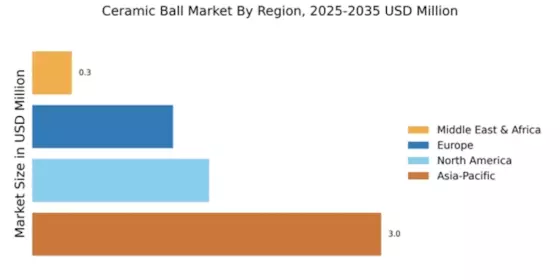
The North American ceramic ball market is projected to reach $1.52 billion by 2025, driven by increasing demand in aerospace, automotive, and industrial applications. Regulatory support for advanced materials and sustainability initiatives is fostering innovation in the sector. The region's focus on high-performance materials is expected to enhance market growth, with a notable shift towards lightweight and durable ceramic solutions. Leading countries such as the US and Canada are home to key players like Zircar Ceramics and Spheric Trafalgar. The competitive landscape is characterized by a mix of established firms and emerging players, all vying for market share. The presence of advanced manufacturing capabilities and R&D facilities further strengthens the region's position in The Ceramic Ball. Companies are investing in technology to enhance product performance and meet evolving customer needs.

Europe : Innovation and Sustainability Focus

Europe's ceramic ball market is valued at $1.21 billion, with growth driven by stringent regulations on material performance and environmental sustainability. The region is witnessing a shift towards advanced ceramic materials, particularly in the automotive and energy sectors. Regulatory frameworks are encouraging the adoption of innovative solutions, enhancing the market's appeal to manufacturers and end-users alike. Germany, France, and the UK are leading countries in this market, with key players like CeramTec and RHP Bearings. The competitive landscape is robust, with a mix of local and international firms. Companies are focusing on R&D to develop high-performance ceramic balls that meet regulatory standards and customer expectations. The emphasis on sustainability is also shaping product development, making Europe a leader in eco-friendly ceramic solutions.

Asia-Pacific : Dominant Market Leader

The Asia-Pacific region dominates the ceramic ball market with a substantial share of $3.0 billion, driven by rapid industrialization and increasing demand from sectors like electronics and automotive. Countries such as China and Japan are leading this growth, supported by favorable government policies and investments in manufacturing capabilities. The region's focus on technological advancements is also propelling market expansion, with a growing emphasis on high-performance materials. China is a key player, with companies like Lily Ceramics and Honsin Ceramics leading the charge. The competitive landscape is marked by a mix of domestic and international firms, all striving to capture market share. The presence of a robust supply chain and skilled workforce further enhances the region's competitive edge. As demand continues to rise, the Asia-Pacific market is expected to maintain its leadership position in the global ceramic ball industry.

Middle East and Africa : Emerging Market Potential

The Middle East and Africa ceramic ball market is valued at $0.34 billion, with growth potential driven by increasing industrial activities and infrastructure development. The region is witnessing a gradual shift towards advanced materials, supported by government initiatives aimed at diversifying economies. The demand for ceramic balls in sectors like oil and gas, as well as construction, is expected to rise, providing new opportunities for market players. Countries such as South Africa and the UAE are emerging as key markets, with a growing presence of local and international manufacturers. The competitive landscape is evolving, with companies focusing on establishing production facilities to cater to regional demand. As the market matures, the emphasis on quality and performance will become crucial for success in this developing region.

Ceramic Ball Market Regional Image

Key Players and Competitive Insights

The Ceramic Ball Market is currently characterized by a dynamic competitive landscape, driven by technological advancements and increasing demand across various industries, including automotive, aerospace, and electronics. Key players such as Saint-Gobain (FR), CeramTec (DE), and Toshiba Materials (JP) are strategically positioning themselves through innovation and regional expansion. For instance, Saint-Gobain (FR) has focused on enhancing its product portfolio by investing in R&D to develop high-performance ceramic balls that cater to specific industrial applications. This emphasis on innovation not only strengthens their market presence but also fosters competitive differentiation in a moderately fragmented market.In terms of business tactics, companies are increasingly localizing manufacturing to reduce lead times and optimize supply chains. The market structure appears to be moderately fragmented, with several players vying for market share. However, the collective influence of major companies like NGK Insulators (JP) and RHP Bearings (GB) is notable, as they leverage their established networks and operational efficiencies to maintain a competitive edge.

In November CeramTec (DE) announced a strategic partnership with a leading automotive manufacturer to supply advanced ceramic balls for electric vehicle applications. This collaboration is significant as it aligns with the growing trend towards electrification in the automotive sector, positioning CeramTec (DE) as a key player in a rapidly evolving market. The partnership not only enhances their product offerings but also opens new avenues for growth in the electric vehicle segment.

In October Toshiba Materials (JP) launched a new line of high-strength ceramic balls designed for use in high-temperature environments. This product introduction is crucial as it addresses the increasing demand for materials that can withstand extreme conditions, particularly in aerospace and industrial applications. By expanding their product range, Toshiba Materials (JP) is likely to capture a larger share of the market, reinforcing its competitive stance.Furthermore, in September 2025, NGK Insulators (JP) completed the acquisition of a smaller ceramic ball manufacturer, which is expected to enhance their production capabilities and broaden their market reach. This acquisition reflects a strategic move to consolidate their position in the market and leverage synergies for improved operational efficiency. Such mergers and acquisitions are indicative of the competitive strategies employed by key players to navigate the complexities of the market.

As of December current trends in the Ceramic Ball Market are increasingly defined by digitalization, sustainability, and the integration of AI technologies. Companies are forming strategic alliances to enhance their capabilities and drive innovation. The competitive landscape is shifting from traditional price-based competition to a focus on technological advancements and supply chain reliability. This evolution suggests that future differentiation will hinge on the ability to innovate and adapt to changing market demands, positioning companies for sustained success in a competitive environment.

Key Companies in the Ceramic Ball Market include

Future Outlook

Ceramic Ball Market Future Outlook

The Ceramic Ball Market is projected to grow at an 18.76% CAGR from 2025 to 2035, driven by advancements in manufacturing technologies and increasing demand across various industries.

New opportunities lie in:

  • Expansion into emerging markets with tailored ceramic ball solutions. Development of high-performance ceramic balls for aerospace applications. Strategic partnerships with automotive manufacturers for innovative ceramic components.

By 2035, the Ceramic Ball Market is expected to achieve substantial growth and diversification.

Market Segmentation

Ceramic Ball Market Size Outlook

  • Small
  • Medium
  • Large
  • Custom

Ceramic Ball Market End Use Outlook

  • Ball Bearings
  • Valves
  • Pumps
  • Seals
  • Gears

Ceramic Ball Market Application Outlook

  • Aerospace
  • Automotive
  • Industrial
  • Medical
  • Electronics

Ceramic Ball Market Coating Type Outlook

  • Uncoated
  • Coated
  • Thermal Barrier Coating
  • Wear Resistant Coating

Ceramic Ball Market Material Type Outlook

  • Alumina
  • Zirconia
  • Silicon Nitride
  • Titanium Dioxide
  • Ceramic Composites

Report Scope

MARKET SIZE 2024 6.07(USD Million)
MARKET SIZE 2025 7.21(USD Million)
MARKET SIZE 2035 40.21(USD Million)
COMPOUND ANNUAL GROWTH RATE (CAGR) 18.76% (2025 - 2035)
REPORT COVERAGE Revenue Forecast, Competitive Landscape, Growth Factors, and Trends
BASE YEAR 2024
Market Forecast Period 2025 - 2035
Historical Data 2019 - 2024
Market Forecast Units USD Million
Key Companies Profiled Saint-Gobain (FR), CeramTec (DE), Toshiba Materials (JP), NGK Insulators (JP), RHP Bearings (GB), Zircar Ceramics (US), Spheric Trafalgar (CA), Lily Ceramics (CN), Honsin Ceramics (CN)
Segments Covered Application, End Use, Material Type, Size, Coating Type
Key Market Opportunities Growing demand for high-performance materials in automotive and aerospace sectors drives Ceramic Ball Market expansion.
Key Market Dynamics Rising demand for high-performance materials drives innovation and competition in the ceramic ball market.
Countries Covered North America, Europe, APAC, South America, MEA

Market Highlights

Author
Author
Author Profile
Anshula Mandaokar LinkedIn
Team Lead - Research
Anshula Mandaokar holds an academic degree in Chemical Engineering and has been contributing to the field for more than 5 years. She has expertise in Market Research and Business Consulting and serves as a Team Lead for a reputed Market Research firm under the Chemicals and Materials domain spectrum. She has worked on multiple projects, generating explicit results in a quick turnaround time. Her understanding of data interpretation justifies her role as a leader.
Leave a Comment

FAQs

What is the projected market valuation of the Ceramic Ball Market by 2035?

<p>The Ceramic Ball Market is projected to reach a valuation of 40.21 USD Million by 2035.</p>

What was the market valuation of the Ceramic Ball Market in 2024?

<p>In 2024, the Ceramic Ball Market had a valuation of 6.07 USD Million.</p>

What is the expected CAGR for the Ceramic Ball Market during the forecast period 2025 - 2035?

<p>The expected CAGR for the Ceramic Ball Market during the forecast period 2025 - 2035 is 18.76%.</p>

Which application segments are driving growth in the Ceramic Ball Market?

<p>The Aerospace, Automotive, Industrial Equipment, Medical Devices, and Electronics segments are driving growth, with Automotive projected to reach 9.83 USD Million.</p>

What are the key materials used in the production of ceramic balls?

<p>Key materials include Alumina, Zirconia, Silicon Nitride, Titanium Dioxide, and Ceramic Composites, with Ceramic Composites expected to reach 11.39 USD Million.</p>

Who are the leading players in the Ceramic Ball Market?

Key players in the Ceramic Ball Market include Saint-Gobain, CeramTec, Toshiba Materials, and NGK Insulators.

What end-use applications are most prevalent in the Ceramic Ball Market?

Ball Bearings, Valves, Pumps, Seals, and Gears are prevalent, with Ball Bearings projected to reach 9.5 USD Million.

How does the size of ceramic balls impact their market performance?

The market performance varies by size, with Standard size expected to reach 15.4 USD Million.

What production methods are utilized in the Ceramic Ball Market?

Production methods include Isostatic Pressing, Slip Casting, Injection Molding, Dry Pressing, and Hot Pressing, with Isostatic Pressing projected to reach 9.87 USD Million.

What trends are influencing the Ceramic Ball Market in 2025?

Trends in the Ceramic Ball Market in 2025 include increased demand in aerospace and automotive applications, alongside advancements in production methods.

Download Free Sample

Kindly complete the form below to receive a free sample of this Report

Compare Licence

×
Features License Type
Single User Multiuser License Enterprise User
Price $4,950 $5,950 $7,250
Maximum User Access Limit 1 User Upto 10 Users Unrestricted Access Throughout the Organization
Free Customization
Direct Access to Analyst
Deliverable Format
Platform Access
Discount on Next Purchase 10% 15% 15%
Printable Versions
%>