
×
Request Free Sample ×

Kindly complete the form below to receive a free sample of this Report

* Please use a valid business email

Leading companies partner with us for data-driven Insights

clients tt-cursor
Hero Background
English
Chinese
French
Japanese
Korean
German
Spanish

Gin Market Trends

ID: MRFR/FnB/6478-HCR
128 Pages
Snehal Singh
October 2025

Gin Market Size, Share, Industry Trend & Analysis Research Report Information by Type (London Dry, Plymouth, Old Tom and others), By Distribution Channel (Supermarkets and Hypermarkets, Specialty Stores, And Others), And by Region (North America, Europe, Asia-Pacific, And Rest of The World) – Market Size, Share, Industry Trend & Analysis Forecast Till 2035

Share:
Download PDF ×

We do not share your information with anyone. However, we may send you emails based on your report interest from time to time. You may contact us at any time to opt-out.

Gin Market Infographic
Purchase Options

Market Trends

Key Emerging Trends in the Gin Market

Market Trends There have been notable trends in the gin demand that are indicative of changing consumer preferences and the assiduity of the spirit. The resurgence of interest in handmade and artisanal spirits is one prevalent trend driving the increase of the gin demand. Customers are becoming less interested in distinctive and premium gin immolations in favor of botanical composite decorations and a variety of taste profiles. Craft distilleries have been instrumental in this movement by launching unique gin variants that distinguish themselves in a crowded market and appeal to customers who value authenticity and artificer. Trends in gin requests have also been influenced by the growth of the mix culture. Customers are discovering inventive ways to enjoy gin outside of the conventional gin and alcohol pairings as mixology gains in popularity. As a result, there are now a plethora of seasoned gins and ready-to-drink gin blends available, giving customers easily accessible alternatives for mixing elegant drinks at home. Due to its adaptability as a foundation spirit, gin has become more popular in both home bars and mix bars, encouraging a culture of experimentation and personalization. Health and heartiness factors have influenced the market for gin, and there is also a growing need for low-calorie and low-alcohol choices. Some gin directors are creating lighter varieties that appeal to consumers who are looking for a more conscious drinking experience in response to shifting consumer trends. Non-alcoholic druthers with botanical investments and distillation have also emerged, offering choices to customers who want to experience the flavor of gin without the alcohol. The demand for ginseng has been affected by the worldwide nature of spirits' diligence, as there is an increasing fascination with local and amazing botanicals. Makers are experimenting with unusual botanicals that come from certain geographical areas, which is helping to create distinctive native gin varieties. This trend fosters a sense of connection to the source of the spirits consumers enjoy by aligning with consumer demands for genuine and regionally inspired goods. The gin request now heavily emphasizes sustainability, mirroring larger environmental initiatives. Customers' awareness of how their purchases affect the environment is waning, which encourages gin directors to adopt eco-friendly procedures. This includes initiatives like employing recyclable packaging, requiring botanicals to be sourced sustainably, and reducing the carbon footprint of the product. In today's competitive market, sustainability is not just a responsible company practice but also a key element influencing customer decisions. Another trend influencing requests is the premiumization of gin, as customers are prepared to pay a premium for distinctive and high-quality immolations. The need for a more upscale and upscale drinking experience has led to a boom in premium and ultra-premium gin products. In response, distillers are differentiating their goods and grabbing the interest of discerning customers with clever packaging, unusual botanical combinations, and limited-edition releases. The way that people find and purchase goods has changed due to the internet era, and this also applies to gin requests. E-commerce sites are becoming vital conduits for the gin trade, giving customers an easy way to browse and purchase a variety of gins and expressions. Online resources include comprehensive product details, customer feedback, and the ease of doorstep delivery, all of which enhance the availability and exposure of vibrant gin alternatives overall.

Author
Snehal Singh
Assistant Manager - Research

High acumen in analyzing complex macro & micro markets with more than 6 years of work experience in the field of market research. By implementing her analytical skills in forecasting and estimation into market research reports, she has expertise in Packaging, Construction, and Equipment domains. She handles a team size of 20-25 resources and ensures smooth running of the projects, associated marketing activities, and client servicing.

Leave a Comment

FAQs

How much is the gin market?

The gin market size was valued at USD 9468.5 Million in 2023

What is the growth rate of the gin market?

The gin market is projected to grow at a CAGR of 4.51% during the forecast period, 2024-2032.

Which region held the largest market share in the gin market?

Europe had the largest share in the market

Who are the key players in the gin market?

The key players in the market are The East India Company Ltd (U.K.), William Grant & Sons Ltd (U.K.), Ginebra San Miguel Inc. (Philippines), The Poshmakers Ltd (U.K.), Forest Dry Gin (Belgium).

Which Type led the gin market?

The London dry category dominated the market in 2023.

Which distribution channel had the largest market share in the gin market?

The supermarkets and hypermarket had the largest share in the market.

Market Summary

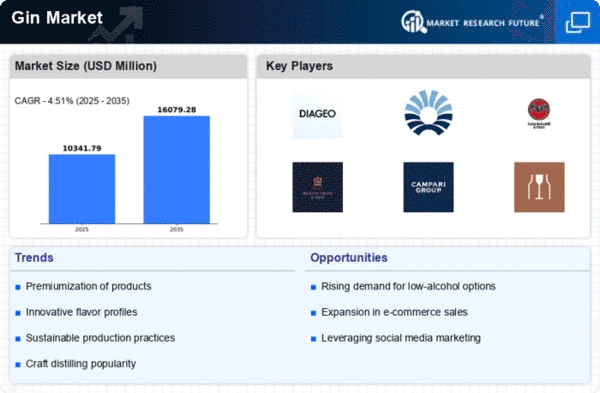
As per MRFR analysis, the Gin Market Size was estimated at 9895.5 USD Million in 2024. The Gin industry is projected to grow from 10341.99 USD Million in 2025 to 16079.28 USD Million by 2035, exhibiting a compound annual growth rate (CAGR) of 4.51 during the forecast period 2025 - 2035.

Key Market Trends & Highlights

The Gin Market is currently experiencing a dynamic evolution driven by innovation and changing consumer preferences.

  • The Craft Gin Movement continues to gain traction, particularly in North America, as consumers seek unique and artisanal products.
  • Sustainability initiatives are becoming increasingly important, influencing production practices and consumer choices across the Asia-Pacific region.
  • Flavor innovation is at the forefront, with Citrus gin maintaining its dominance while Herbal gin emerges as a rapidly growing segment.
  • The rising popularity of gin cocktails and health consciousness are key drivers, propelling the expansion of premium and flavored gin offerings.

Market Size & Forecast

2024 Market Size 9895.5 (USD Million)
2035 Market Size 16079.28 (USD Million)
CAGR (2025 - 2035) 4.51%
Largest Regional Market Share in 2024 Europe

Major Players

<p>Diageo (GB), Pernod Ricard (FR), Bacardi (BM), William Grant & Sons (GB), Campari Group (IT), Brown-Forman (US), Gordon's (GB), Tanqueray (GB), Sipsmith (GB)</p>

Market Trends

The Gin Market is currently experiencing a dynamic evolution, characterized by a growing consumer preference for premium and craft varieties. This shift appears to be driven by an increasing interest in artisanal production methods and unique flavor profiles. As consumers become more discerning, they seem to gravitate towards brands that emphasize quality ingredients and innovative distillation techniques. Additionally, the rise of mixology culture has contributed to the popularity of gin, as bartenders and enthusiasts alike explore diverse cocktail possibilities. This trend indicates a potential for sustained growth in the sector, as new entrants continue to emerge, offering distinctive products that cater to evolving tastes. Moreover, the Gin Market is witnessing a notable expansion in geographical reach, with emerging markets showing a burgeoning appetite for gin. This expansion is likely fueled by changing social norms and an increasing acceptance of spirits in various cultures. As global travel resumes, the cross-pollination of drinking habits may further enhance the market's diversity. The interplay between tradition and modernity in gin production suggests that the industry is poised for continued innovation, with brands likely to experiment with flavors and marketing strategies to capture the attention of a broader audience.

Craft Gin Movement

The craft gin movement is gaining momentum, as consumers increasingly seek out small-batch producers that prioritize quality and authenticity. This trend reflects a broader desire for unique and personalized drinking experiences, leading to a proliferation of artisanal brands.

Sustainability Initiatives

Sustainability initiatives are becoming more prevalent within the Gin Market, as brands adopt eco-friendly practices in sourcing ingredients and packaging. This shift not only appeals to environmentally conscious consumers but also aligns with global efforts to promote responsible consumption.

Flavor Innovation

Flavor innovation is a key trend, with producers experimenting with botanicals and unconventional ingredients to create distinctive offerings. This focus on unique flavor profiles caters to adventurous consumers looking for new and exciting drinking experiences.

Gin Market Market Drivers

Rising Consumer Demand

The Global Gin Industry experiences a notable surge in consumer demand, driven by the increasing popularity of gin-based cocktails and premium spirits. As of 2024, the market is valued at 9.9 USD Billion, reflecting a growing preference for artisanal and scraft gin product. This trend is particularly evident in urban areas where consumers seek unique flavor profiles and high-quality ingredients. The rise of social media platforms has also contributed to this demand, as consumers share their experiences and recommendations, further fueling interest in gin. This evolving consumer landscape suggests a robust growth trajectory for the industry.

Growth of the Cocktail Culture

The cocktail culture continues to flourish globally, significantly impacting the Global Gin Industry. Bars and restaurants are increasingly incorporating gin into their cocktail menus, showcasing its versatility and enhancing its status as a premium spirit. This trend is particularly pronounced in metropolitan areas where mixologists craft innovative gin cocktails that attract discerning consumers. The cocktail renaissance has led to a resurgence in gin consumption, contributing to the industry's growth. As the market evolves, it is anticipated that the cocktail culture will further bolster gin sales, supporting the industry's projected CAGR of 4.09% from 2025 to 2035.

Innovative Flavors and Craftsmanship

Innovation in flavors and craftsmanship plays a pivotal role in the Global Gin Industry. Distilleries are increasingly experimenting with botanicals, resulting in a diverse array of gin varieties that cater to evolving consumer tastes. For instance, the introduction of floral, fruity, and spicy gins has attracted a broader audience, enhancing the market's appeal. This trend aligns with the industry's projected growth, as the market is expected to reach 15.4 USD Billion by 2035. The emphasis on quality and creativity in gin production not only differentiates brands but also fosters a deeper connection with consumers, ultimately driving sales.

E-commerce and Digital Marketing Strategies

The Global Gin Industry is witnessing a transformation due to the rise of e-commerce and digital marketing strategies. Online platforms provide consumers with convenient access to a wide range of gin products, facilitating purchases and expanding market reach. Distilleries are leveraging social media and targeted advertising to engage with consumers, fostering brand loyalty and awareness. This shift towards digital channels is particularly relevant in the context of the growing younger demographic, who are more inclined to shop online. As e-commerce continues to evolve, it is expected to play a crucial role in driving sales and enhancing the overall market landscape.

Health Consciousness and Low-Alcohol Options

The rising health consciousness among consumers is influencing the Global Gin Industry, as individuals seek lower-alcohol and healthier beverage options. This shift has prompted distilleries to develop low-alcohol and non-alcoholic gin alternatives, appealing to a demographic that prioritizes wellness without sacrificing flavor. The introduction of these products aligns with the broader trend of mindful drinking, which is gaining traction globally. As consumers increasingly opt for lighter options, the market is likely to see a diversification of product offerings, catering to health-conscious individuals while maintaining the essence of gin.

Market Segment Insights

By Product Type: London Dry Gin (Largest) vs. Sloe Gin (Fastest-Growing)

<p>The gin market is primarily dominated by London Dry Gin, which holds the largest share due to its popularity and versatility in cocktails. Its classic flavor profile appeals to a wide range of consumers, solidifying its status as a staple in the spirits industry. Other segments like Plymouth Gin, Old Tom Gin, and Genever contribute smaller shares but play important roles in niche markets, offering unique tastes and attracting specific consumer demographics. Growth trends in the gin market showcase an increasing interest in Sloe Gin, which is currently the fastest-growing category. This surge can be attributed to changing consumer preferences toward fruit-infused spirits and a trend toward craft and artisanal products. As consumers gravitate towards premium and innovative offerings, brands are investing in unique recipes and marketing strategies to capture the emerging demand for Sloe Gin.</p>

<p>London Dry Gin (Dominant) vs. Sloe Gin (Emerging)</p>

<p>London Dry Gin stands as the dominant segment within the gin market, known for its distinctively dry flavor and myriad of botanical infusions. It is a top choice for mixologists and is often preferred in classic cocktails, which further amplifies its market presence. In contrast, Sloe Gin is an emerging segment that has garnered attention for its sweet, fruity profile derived from sloe berries. This niche category appeals particularly to younger consumers seeking novel drinking experiences and flavors. While London Dry Gin maintains its stronghold thanks to established brands, Sloe Gin's rise reflects a broader shift towards innovative products that emphasize artisanal craftsmanship and unique flavor profiles, making it a significant player in today’s evolving spirits landscape.</p>

By Flavor Profile: Citrus (Largest) vs. Herbal (Fastest-Growing)

<p>The gin market exhibits a diverse flavor profile distribution, with citrus flavors commanding the largest share among consumers. This segment is favored for its refreshing and zesty characteristics, making it a popular choice for cocktails and mixers. On the other hand, the herbal profile, while smaller in terms of market share, is rapidly gaining traction as consumers look for more nuanced and complex flavor experiences in their gin selections. This trend points toward a growing interest in artisanal and craft distilleries that emphasize unique and botanical flavors. Growth trends for the flavor profile segment are being driven by evolving consumer preferences towards quality and distinct taste experiences. The interest in herbal and floral elements in gin illustrates a shift towards natural and organic ingredients, reflecting broader health trends. Additionally, consumers are increasingly exploring innovative and premium products, which enhances the market potential for flavor diversity in gin, particularly in herbal and spicy varieties.</p>

<p>Citrus (Dominant) vs. Herbal (Emerging)</p>

<p>Citrus flavors in gin are predominant due to their crisp, refreshing quality, making them the go-to choice for both classic and contemporary gin cocktails. They provide a bright, invigorating taste that appeals to a broad demographic, facilitating easy pairings with mixers and garnishes. Meanwhile, herbal gins are emerging rapidly as consumers seek more intricate flavor profiles that evoke a sense of craftsmanship. Characterized by botanicals like rosemary, thyme, and sage, herbal gins appeal to those interested in unique experiences. As the market trends towards more sophisticated drinking preferences, herbal gins are carving out a niche that complements the existing citrus offerings, leading to innovative product releases and increased consumer exploration.</p>

By Packaging Type: Glass Bottles (Largest) vs. Plastic Bottles (Fastest-Growing)

<p>In the Gin Market, packaging types play a crucial role in consumer preference and brand differentiation. Glass bottles remain the largest segment, widely favored for their premium feel and aesthetic appeal. Meanwhile, plastic bottles are rapidly gaining ground, driven by their convenience and lower cost, making them attractive for volume sales in a competitive environment. This shift reflects broader trends in consumer behavior, with many seeking practicality without sacrificing quality. The growth of the packaging type segment is strongly influenced by changing consumer preferences, sustainability concerns, and innovative designs. The gin industry is witnessing a surge in demand for eco-friendly packaging solutions, with brands exploring biodegradable materials and refillable options. Further, the adoption of innovative bottle designs and smaller sizes is enhancing consumer engagement and attracting a younger demographic, thereby accelerating the growth of both glass and plastic packaging in the market.</p>

<p>Glass Bottles (Dominant) vs. Plastic Bottles (Emerging)</p>

<p>Glass bottles have established themselves as the dominant packaging choice in the gin market, providing a premium image that aligns with the spirit's artisanal roots. They are often associated with quality and sophistication, appealing to consumers who value aesthetics and tradition. However, the emergence of plastic bottles is noteworthy, particularly among budget-conscious and pragmatic consumers. These bottles offer advantages such as lightweight and unbreakable characteristics, making them ideal for events and casual consumption. With innovations in design aimed at eco-friendliness, plastic bottles are carving out a significant niche, indicating a shift in purchasing behavior that could reshape the competitive landscape in the future.</p>

By Distribution Channel: Supermarkets (Largest) vs. Online Retail (Fastest-Growing)

<p>The gin market is witnessing a diverse distribution channel landscape, with supermarkets holding the largest market share due to their extensive reach and customer footfall. Within supermarkets, gin benefits from prominent shelf space and organized promotions, making it accessible to consumers. Online retail, although currently smaller in overall market share, is rapidly growing as more consumers opt for the convenience of purchasing gin through e-commerce platforms, especially post-pandemic, reaffirming the shift towards digital shopping.</p>

<p>Online Retail: Fastest-Growing vs. Bars and Restaurants: Dominant</p>

<p>Online retail is emerging as a significant force in the gin market, driven by the increasing preference for convenience and home delivery options among consumers. This segment is leveraging technology to offer personalized experiences and access to a wide variety of gin brands. Contrastingly, bars and restaurants remain dominant distribution channels, fostering social experiences and brand loyalty through curated offerings of premium gins. While online retail focuses on convenience and accessibility, bars and restaurants capitalize on consumer experiences, driving premium sales and fostering brand engagement in social settings. Both segments play vital roles, catering to different consumer needs in the evolving market.</p>

By Consumer Demographics: Age Group (Largest) vs. Lifestyle (Fastest-Growing)

<p>The consumer demographics segment in the gin market reveals that the largest share is held by the 25-34 age group, which is experiencing a remarkable affinity towards gin consumption. This demographic not only influences the overall market trends but is also pivotal in shaping the brand positioning strategies of various companies. Meanwhile, the lifestyle segment is showcasing rapid growth, driven by younger consumers who seek premium products that align with their social and quality preferences.</p>

<p>Age Group: 25-34 (Dominant) vs. Lifestyle (Emerging)</p>

<p>The 25-34 age group is a dominant force in the gin market, representing a significant portion of gin enthusiasts who appreciate unique flavors and premium offerings. This demographic is well-versed in the various gin brands and often seeks out artisanal and craft options, favoring quality over quantity. Meanwhile, the lifestyle segment is emerging as a rapidly expanding consumer base, characterized by health-conscious individuals who are inclined towards experiences that align with their social status and wellness motivations. These consumers tend to favor gin cocktails in social settings, reflecting both sophistication and a desire for innovative flavors.</p>

Get more detailed insights about Gin Market Research Report - Forecast till 2035

Regional Insights

North America : Growing Market with Diverse Offerings

The North American gin market, valued at $2470.0M, is experiencing robust growth driven by a rising consumer preference for premium and craft spirits. The demand for innovative flavors and organic options is reshaping the market landscape. Regulatory support for craft distilleries and the increasing popularity of gin cocktails are significant catalysts for growth. The market is expected to continue expanding as consumers seek unique drinking experiences and brands focus on sustainability. Leading the charge in this region are the United States and Canada, where major players like Brown-Forman and Diageo are making significant investments. The competitive landscape is characterized by a mix of established brands and emerging craft distilleries. The presence of key players such as Tanqueray and Sipsmith further enhances market dynamics, as they introduce new products tailored to local tastes and preferences. The focus on quality and innovation is expected to drive market share in the coming years.

Europe : Dominant Market with Rich Heritage

Europe remains the largest gin market globally, with a valuation of €4500.0M. The region's growth is fueled by a rich heritage of gin production, coupled with a surge in consumer interest in artisanal and craft spirits. Regulatory frameworks supporting local distilleries and the rise of gin tourism are key drivers. The increasing popularity of gin-based cocktails and premium offerings is reshaping consumer preferences, leading to a dynamic market environment. The United Kingdom stands out as a leader in the European gin market, home to iconic brands like Gordon's and Tanqueray. Other countries, including Germany and France, are also witnessing significant growth, with local distilleries gaining traction. The competitive landscape is vibrant, with established players and new entrants vying for market share. The emphasis on quality, innovation, and sustainability is expected to further enhance the region's market position. "The gin market in Europe is witnessing unprecedented growth, driven by consumer demand for quality and authenticity," European Spirits Organization.

Asia-Pacific : Emerging Market with High Potential

The Asia-Pacific gin market, valued at $2300.0M, is on an upward trajectory, driven by changing consumer preferences and a growing cocktail culture. The region is witnessing an increasing demand for premium and craft gins, supported by a rise in disposable incomes and urbanization. Regulatory changes favoring local distilleries and the introduction of innovative flavors are also contributing to market growth. The gin market is expected to expand as consumers seek diverse drinking experiences and brands adapt to local tastes. Australia and Japan are leading the charge in this region, with a burgeoning craft distillery scene. Key players like Bacardi and William Grant & Sons are actively investing in the market, introducing products tailored to local preferences. The competitive landscape is evolving, with both established brands and new entrants focusing on quality and innovation. As the market matures, the emphasis on sustainability and unique flavor profiles is expected to drive further growth.

Middle East and Africa : Niche Market with Growth Opportunities

The Middle East and Africa gin market, valued at $625.5M, is a niche yet growing segment characterized by increasing interest in premium spirits. The region's growth is driven by a young population and a rising trend towards social drinking. Regulatory changes are gradually favoring the spirits industry, allowing for greater market access. The demand for unique and innovative gin products is on the rise, as consumers seek new experiences and flavors. South Africa and Nigeria are at the forefront of this market, with local distilleries gaining popularity. The competitive landscape includes both international brands and emerging local players. Key players like Campari Group are making strategic moves to capture market share. As the market evolves, the focus on quality and unique offerings is expected to drive growth. "The spirits market in the Middle East and Africa is evolving, with gin emerging as a popular choice among consumers," African Spirits Association.

Key Players and Competitive Insights

The Gin Market is currently characterized by a dynamic competitive landscape, driven by evolving consumer preferences and a growing inclination towards premium and craft offerings. Major players such as Diageo (GB), Pernod Ricard (FR), and Bacardi (BM) are strategically positioned to leverage these trends through innovation and brand diversification. Diageo (GB), for instance, has focused on expanding its portfolio with a range of artisanal gins, while Pernod Ricard (FR) emphasizes sustainability in its production processes. Bacardi (BM) has also been active in enhancing its digital marketing strategies to engage younger consumers, thereby shaping a competitive environment that prioritizes brand loyalty and consumer engagement.

In terms of business tactics, companies are increasingly localizing manufacturing to reduce costs and enhance supply chain efficiency. The market structure appears moderately fragmented, with a mix of established brands and emerging craft distilleries. This fragmentation allows for a diverse range of products, catering to various consumer segments. The collective influence of key players is significant, as they not only dominate market share but also set trends that smaller brands often follow.

In November 2025, Diageo (GB) announced the launch of a new line of organic gins, which underscores its commitment to sustainability and innovation. This strategic move is likely to attract environmentally conscious consumers and enhance brand equity in a competitive market. The introduction of organic products may also set a benchmark for other players, pushing them to adopt similar practices to remain relevant.

In October 2025, Pernod Ricard (FR) unveiled a partnership with a tech firm to integrate AI into its marketing strategies. This collaboration aims to personalize consumer experiences and optimize product recommendations. Such a move indicates a shift towards data-driven decision-making, which could enhance customer engagement and drive sales in an increasingly digital marketplace.

In September 2025, Bacardi (BM) expanded its distribution network in Asia, focusing on emerging markets where gin consumption is on the rise. This strategic expansion not only increases market penetration but also positions Bacardi (BM) to capitalize on the growing demand for premium spirits in these regions. The move reflects a broader trend of companies seeking growth opportunities in less saturated markets.

As of December 2025, the Gin Market is witnessing trends such as digitalization, sustainability, and the integration of AI technologies. Strategic alliances are becoming increasingly important, as companies collaborate to enhance their product offerings and market reach. The competitive differentiation is likely to evolve from traditional price-based competition to a focus on innovation, technology, and supply chain reliability. This shift suggests that companies that prioritize these aspects will be better positioned to thrive in the future.

Key Companies in the Gin Market include

Industry Developments

On April 10, 2024, Tanqueray, the worldwide gin brand, introduced a new craft gin that will be manufactured in limited amounts. The new gin’s fragrance and flavor will come from wild juniper and some rare citrus fruits. There is a rise in the consumption of premium and craft gins and so there is a need for gins that are fresh and new in the market for people that only need them in special occasions.

In December of 2023, the district distillery Beefeater Gin Market announced that they would be expanding their facilities in London due to the increase in demand globally. The new expansion is set to help beefeater increase the production capacity by twenty percent also is an indication of the branding strategies aimed at consolidating the company’s position in the focal international markets like the US and the Asian countries.

In the month of November 2023, a new brand “Bombay Bramble” which deals with gin infused with raspberry and blackberry was launched by Bombay sapphire. The introduction of such kind of product was focused to the market as a flavored gin aided in demand within the market primarily in the UK’s and the US’s where a demand for flavored spirits had skyrocketed.

In October 2023, Hernö Gin Market a brand-based Sweden was awarded for aged gins form at World Gin Market Awards. This award confirms Hernö Gin Market’s position in the market as a quality producing gin and emphasizes the growing trend on gins that are aged for consumers looking for distinctive and premium tastes.

In September 2023, Gin Market Mare, which is precisely a gin coming from Holland, worked with some of the first-class cocktail bars across the world to start a campaign that seeks to raise awareness of gins and cocktails made using gins infused with botanicals common in the Mediterranean region. The campaign seeks to enhance the market presence of Gin Market Mare Mediterranean taste and allow the company to expand to strategic regions like Europe and the US.

Future Outlook

Gin Market Future Outlook

<p>The Gin is projected to grow at a 4.51% CAGR from 2024 to 2035, driven by premiumization, innovative flavors, and increasing consumer interest in craft spirits.</p>

New opportunities lie in:

  • <p>Expansion of craft gin distilleries in emerging markets</p>
  • <p>Development of gin-based ready-to-drink cocktails</p>
  • <p>Partnerships with local botanicals suppliers for unique flavor profiles</p>

<p>By 2035, the gin market is expected to solidify its position as a dynamic and lucrative segment.</p>

Market Segmentation

Gin Market Product Type Outlook

  • London Dry Gin
  • Plymouth Gin
  • Old Tom Gin
  • Sloe Gin
  • Genever

Gin Market Flavor Profile Outlook

  • Herbal
  • Citrus
  • Spicy
  • Floral
  • Fruity

Gin Market Packaging Type Outlook

  • Glass Bottles
  • Plastic Bottles
  • Cans
  • Kegs
  • Pouches

Gin Market Distribution Channel Outlook

  • Online Retail
  • Supermarkets
  • Specialty Stores
  • Bars and Restaurants
  • Duty-Free Shops

Gin Market Consumer Demographics Outlook

  • Age Group
  • Gender
  • Income Level
  • Lifestyle
  • Occasion

Report Scope

MARKET SIZE 20249895.5(USD Million)
MARKET SIZE 202510341.99(USD Million)
MARKET SIZE 203516079.28(USD Million)
COMPOUND ANNUAL GROWTH RATE (CAGR)4.51% (2024 - 2035)
REPORT COVERAGERevenue Forecast, Competitive Landscape, Growth Factors, and Trends
BASE YEAR2024
Market Forecast Period2025 - 2035
Historical Data2019 - 2024
Market Forecast UnitsUSD Million
Key Companies ProfiledDiageo (GB), Pernod Ricard (FR), Bacardi (BM), William Grant & Sons (GB), Campari Group (IT), Brown-Forman (US), Gordon's (GB), Tanqueray (GB), Sipsmith (GB)
Segments CoveredProduct Type, Flavor Profile, Packaging Type, Distribution Channel, Consumer Demographics
Key Market OpportunitiesGrowing consumer preference for premium and craft Gin products presents a lucrative market opportunity.
Key Market DynamicsRising consumer preference for premium gin brands drives innovation and competition within the market.
Countries CoveredNorth America, Europe, APAC, South America, MEA

FAQs

How much is the gin market?

The gin market size was valued at USD 9468.5 Million in 2023

What is the growth rate of the gin market?

The gin market is projected to grow at a CAGR of 4.51% during the forecast period, 2024-2032.

Which region held the largest market share in the gin market?

Europe had the largest share in the market

Who are the key players in the gin market?

The key players in the market are The East India Company Ltd (U.K.), William Grant &amp; Sons Ltd (U.K.), Ginebra San Miguel Inc. (Philippines), The Poshmakers Ltd (U.K.), Forest Dry Gin (Belgium).

Which Type led the gin market?

The London dry category dominated the market in 2023.

Which distribution channel had the largest market share in the gin market?

The supermarkets and hypermarket had the largest share in the market.

  1. Executive Summary
  2. Scope of the Report
    1. Market Definition
    2. Scope of the Study
      1. Research Objectives
      2. Assumptions & Limitations
    3. Market Structure
  3. Market Research Methodology
    1. Research Process
    2. Secondary Research
    3. Primary Research
    4. Forecast Model
  4. Market Landscape
    1. Supply Chain Analysis
      1. Raw Material Suppliers
      2. Manufacturers/Producers
      3. Distributors/Retailers/Wholesalers/E-Commerce
      4. End Users
    2. Porter’s Five Forces Analysis
      1. Threat of New Entrants
      2. Bargaining Power of Buyers
      3. Bargaining Power of Suppliers
      4. Threat of Substitutes
      5. Rivalry
  5. Market Dynamics of the Global Gin Market
    1. Introduction
    2. Drivers
    3. Restraints
    4. Opportunities
    5. Challenges
  6. Global Gin Market, by Type
    1. Introduction
    2. London Dry
      1. Market Estimates & Forecast, 2024-2030
      2. Market Estimates & Forecast, by Region, 2024-2030
    3. Plymouth
      1. Market Estimates & Forecast, 2024-2030
      2. Market Estimates & Forecast, by Region, 2024-2030
    4. Old Tom
      1. Market Estimates & Forecast, 2024-2030
      2. Market Estimates & Forecast, by Region, 2024-2030
    5. Others
      1. Market Estimates & Forecast, 2024-2030
      2. Market Estimates & Forecast, by Region, 2024-2030
  7. Global Gin Market, by Distribution Channel
    1. Introduction
    2. Hypermarkets & Supermarkets
      1. Market Estimates & Forecast, 2024-2030
      2. Market Estimates & Forecast, by Region, 2024-2030
    3. Specialty Stores
      1. Market Estimates & Forecast, 2024-2030
      2. Market Estimates & Forecast, by Region, 2024-2030
    4. Others
      1. Market Estimates & Forecast, 2024-2030
      2. Market Estimates & Forecast, by Region, 2024-2030
  8. Global Gin Market, by Region
    1. Introduction
    2. North America
      1. Market Estimates & Forecast, 2024-2030
      2. Market Estimates & Forecast, by Type, 2024-2030
      3. Market Estimates & Forecast, by Distribution Channel, 2024-2030
      4. US
      5. Canada
      6. Mexico
    3. Europe
      1. Market Estimates & Forecast, 2024-2030
      2. Market Estimates & Forecast, by Type, 2024-2030
      3. Market Estimates & Forecast, by Distribution Channel, 2024-2030
      4. Germany
      5. France
      6. Italy
      7. Spain
      8. UK
      9. Rest of Europe
    4. Asia-Pacific
      1. Market Estimates & Forecast, 2024-2030
      2. Market Estimates & Forecast, by Type, 2024-2030
      3. Market Estimates & Forecast, by Distribution Channel, 2024-2030
      4. China
      5. India
      6. Japan
      7. Australia & New Zealand
      8. Rest of Asia-Pacific
    5. Rest of the World (RoW)
      1. Market Estimates & Forecast, 2024-2030
      2. Market Estimates & Forecast, by Type, 2024-2030
      3. Market Estimates & Forecast, by Distribution Channel, 2024-2030
      4. South America
      5. Middle East
      6. Africa
  9. Company Landscape
    1. Introduction
    2. Market Strategy
    3. Key Development Analysis
    4. (Expansions/Mergers & Acquisitions/Joint Ventures/New Product Developments/Agreements/Investments)
  10. Company Profiles
    1. Bacardi Limited
      1. Company Overview
      2. Financial Updates
      3. Product/Business Segment Overview
      4. Strategy
      5. Key Developments
      6. SWOT Analysis
    2. Diageo plc
      1. Company Overview
      2. Financial Updates
      3. Product/Business Segment Overview
      4. Strategy
      5. Key Developments
      6. SWOT Analysis
    3. Pernod Ricard S.A.
      1. Company Overview
      2. Financial Updates
      3. Product/Business Segment Overview
      4. Strategy
      5. Key Developments
      6. SWOT Analysis
    4. Ginebra San Miguel Inc.
      1. Company Overview
      2. Financial Updates
      3. Product/Business Segment Overview
      4. Strategy
      5. Key Developments
      6. SWOT Analysis
    5. Suntory Holdings Limited
      1. Company Overview
      2. Financial Updates
      3. Product/Business Segment Overview
      4. Strategy
      5. Key Developments
      6. SWOT Analysis
    6. William Grant & Sons Ltd
      1. Company Overview
      2. Financial Updates
      3. Product/Business Segment Overview
      4. Strategy
      5. Key Developments
      6. SWOT Analysis
    7. The Sustainable Spirit Co.
      1. Company Overview
      2. Financial Updates
      3. Product/Business Segment Overview
      4. Strategy
      5. Key Developments
      6. SWOT Analysis
    8. Boudier Gabriel Ets SA
      1. Company Overview
      2. Financial Updates
      3. Product/Business Segment Overview
      4. Strategy
      5. Key Developments
      6. SWOT Analysis
    9. Davide Campari-Milano S.p.A.
      1. Company Overview
      2. Financial Updates
      3. Product/Business Segment Overview
      4. Strategy
      5. Key Developments
      6. SWOT Analysis
    10. The East India Company Ltd
      1. Company Overview
      2. Financial Updates
      3. Product/Business Segment Overview
      4. Strategy
      5. Key Developments
      6. SWOT Analysis
    11. Forest Dry Gin
      1. Company Overview
      2. Financial Updates
      3. Product/Business Segment Overview
      4. Strategy
      5. Key Developments
      6. SWOT Analysis
    12. The Black Bottle Distillery
      1. Company Overview
      2. Financial Updates
      3. Product/Business Segment Overview
      4. Strategy
      5. Key Developments
      6. SWOT Analysis
    13. The Poshmakers Ltd
      1. Company Overview
      2. Financial Updates
      3. Product/Business Segment Overview
      4. Strategy
      5. Key Developments
      6. SWOT Analysis
    14. West End Drinks Ltd
      1. Company Overview
      2. Financial Updates
      3. Product/Business Segment Overview
      4. Strategy
      5. Key Developments
      6. SWOT Analysis
    15. Langtons Gin Ltd
      1. Company Overview
      2. Financial Updates
      3. Product/Business Segment Overview
      4. Strategy
      5. Key Developments
      6. SWOT Analysis
  11. Conclusion
  12. LIST OF TABLES
  13. Global Gin Market, by Region, 2024-2030 (USD Million)
  14. Global Gin Market, by Type, 2024-2030 (USD Million)
  15. Global Gin Market, by Distribution Channel, 2024-2030 (USD Million)
  16. North America: Gin Market, by Country, 2024-2030 (USD Million)
  17. North America: Gin Market, by Type, 2024-2030 (USD Million)
  18. North America: Gin Market, by Distribution Channel, 2024-2030 (USD Million)
  19. US: Gin Market, by Type, 2024-2030 (USD Million)
  20. US: Gin Market, by Distribution Channel, 2024-2030 (USD Million)
  21. Canada: Gin Market, by Type, 2024-2030 (USD Million)
  22. Canada: Gin Market, by Distribution Channel, 2024-2030 (USD Million)
  23. Mexico: Gin Market, by Type, 2024-2030 (USD Million)
  24. Mexico: Gin Market, by Distribution Channel, 2024-2030 (USD Million)
  25. Europe: Gin Market, by Country, 2024-2030 (USD Million)
  26. Europe: Gin Market, by Type, 2024-2030 (USD Million)
  27. Europe: Gin Market, by Distribution Channel, 2024-2030 (USD Million)
  28. Germany: Gin Market, by Type, 2024-2030 (USD Million)
  29. Germany: Gin Market, by Distribution Channel, 2024-2030 (USD Million)
  30. France: Gin Market, by Type, 2024-2030 (USD Million)
  31. France: Gin Market, by Distribution Channel, 2024-2030 (USD Million)
  32. Italy: Gin Market, by Type, 2024-2030 (USD Million)
  33. Italy: Gin Market, by Distribution Channel, 2024-2030 (USD Million)
  34. Spain: Gin Market, by Type, 2024-2030 (USD Million)
  35. Spain: Gin Market, by Distribution Channel, 2024-2030 (USD Million)
  36. UK: Gin Market, by Type, 2024-2030 (USD Million)
  37. UK: Gin Market, by Distribution Channel, 2024-2030 (USD Million)
  38. Rest of Europe: Gin Market, by Type, 2024-2030 (USD Million)
  39. Rest of Europe: Gin Market, by Distribution Channel, 2024-2030 (USD Million)
  40. Asia-Pacific: Gin Market, by Country, 2024-2030 (USD Million)
  41. Asia-Pacific: Gin Market, by Type, 2024-2030 (USD Million)
  42. Asia-Pacific: Gin Market, by Distribution Channel, 2024-2030 (USD Million)
  43. China: Gin Market, by Type, 2024-2030 (USD Million)
  44. China: Gin Market, by Distribution Channel, 2024-2030 (USD Million)
  45. India: Gin Market, by Type, 2024-2030 (USD Million)
  46. India: Gin Market, by Distribution Channel, 2024-2030 (USD Million)
  47. Japan: Gin Market, by Type, 2024-2030 (USD Million)
  48. Japan: Gin Market, by Distribution Channel, 2024-2030 (USD Million)
  49. Australia & New Zealand: Gin Market, by Type, 2024-2030 (USD Million)
  50. Australia & New Zealand: Gin Market, by Distribution Channel, 2024-2030 (USD Million)
  51. Rest of Asia-Pacific: Gin Market, by Type, 2024-2030 (USD Million)
  52. Rest of Asia-Pacific: Gin Market, by Distribution Channel, 2024-2030 (USD Million)
  53. Rest of the World (RoW): Gin Market, by Country, 2024-2030 (USD Million)
  54. Rest of the World (RoW): Gin Market, by Type, 2024-2030 (USD Million)
  55. Rest of the World (RoW): Gin Market, by Distribution Channel, 2024-2030 (USD Million)
  56. South America: Gin Market, by Type, 2024-2030 (USD Million)
  57. South America: Gin Market, by Distribution Channel, 2024-2030 (USD Million)
  58. Middle East: Gin Market, by Type, 2024-2030 (USD Million)
  59. Middle East: Gin Market, by Distribution Channel, 2024-2030 (USD Million)
  60. Africa: Gin Market, by Type, 2024-2030 (USD Million)
  61. Africa: Gin Market, by Distribution Channel, 2024-2030 (USD Million)
  62. LIST OF FIGURES
  63. Global Gin Market Segmentation
  64. Forecast Research Methodology
  65. Five Forces Analysis of the Global Gin Market
  66. Value Chain of the Global Gin Market
  67. Share of the Global Gin Market in 2022, by Country (%)
  68. Global Gin Market, by Region, 2024-2030
  69. Global Gin Market Size, by Type, 2022
  70. Share of the Global Gin Market, by Type, 2024-2030 (%)
  71. Global Gin Market Size, by Distribution Channel, 2022
  72. Share of the Global Gin Market, by Distribution Channel, 2024-2030 (%)

Gin Market Segmentation

Gin Type Outlook (USD Million, 2018-2030)

London Dry

Plymouth

Old Tom

Others

Gin Distribution Channel Outlook (USD Million, 2018-2030)

Supermarkets and Hypermarkets

Specialty Stores

Others

Gin Regional Outlook (USD Million, 2018-2030)

North America Outlook (USD Million, 2018-2030)

North America Gin by Type

London Dry

Plymouth

Old Tom

Others

North America Gin by Distribution Channel

Supermarkets and Hypermarkets

Specialty Stores

Others

US Outlook (USD Million, 2018-2030)

US Gin by Type

London Dry

Plymouth

Old Tom

Others

US Gin by Distribution Channel

Supermarkets and Hypermarkets

Specialty Stores

Others

CANADA Outlook (USD Million, 2018-2030)

CANADA Gin by Type

London Dry

Plymouth

Old Tom

Others

CANADA Gin by Distribution Channel

Supermarkets and Hypermarkets

Specialty Stores

Others

Europe Outlook (USD Million, 2018-2030)

Europe Gin by Type

London Dry

Plymouth

Old Tom

Others

Europe Gin by Distribution Channel

Supermarkets and Hypermarkets

Specialty Stores

Others

Germany Outlook (USD Million, 2018-2030)

Germany Gin by Type

London Dry

Plymouth

Old Tom

Others

Germany Gin by Distribution Channel

Supermarkets and Hypermarkets

Specialty Stores

Others

France Outlook (USD Million, 2018-2030)

France Gin by Type

London Dry

Plymouth

Old Tom

Others

France Gin by Distribution Channel

Supermarkets and Hypermarkets

Specialty Stores

Others

UK Outlook (USD Million, 2018-2030)

UK Gin by Type

London Dry

Plymouth

Old Tom

Others

UK Gin by Distribution Channel

Supermarkets and Hypermarkets

Specialty Stores

Others

ITALY Outlook (USD Million, 2018-2030)

ITALY Gin by Type

London Dry

Plymouth

Old Tom

Others

ITALY Gin by Distribution Channel

Supermarkets and Hypermarkets

Specialty Stores

Others

SPAIN Outlook (USD Million, 2018-2030)

Spain Gin by Type

London Dry

Plymouth

Old Tom

Others

Spain Gin by Distribution Channel

Supermarkets and Hypermarkets

Specialty Stores

Others

Rest Of Europe Outlook (USD Million, 2018-2030)

Rest Of Europe Gin by Type

London Dry

Plymouth

Old Tom

Others

REST OF EUROPE Gin by Distribution Channel

Supermarkets and Hypermarkets

Specialty Stores

Others

Asia-Pacific Outlook (USD Million, 2018-2030)

Asia-Pacific Gin by Type

London Dry

Plymouth

Old Tom

Others

Asia-Pacific Gin by Distribution Channel

Supermarkets and Hypermarkets

Specialty Stores

Others

China Outlook (USD Million, 2018-2030)

China Gin by Type

London Dry

Plymouth

Old Tom

Others

China Gin by Distribution Channel

Supermarkets and Hypermarkets

Specialty Stores

Others

Japan Outlook (USD Million, 2018-2030)

Japan Gin by Type

London Dry

Plymouth

Old Tom

Others

Japan Gin by Distribution Channel

Supermarkets and Hypermarkets

Specialty Stores

Others

India Outlook (USD Million, 2018-2030)

India Gin by Type

London Dry

Plymouth

Old Tom

Others

India Gin by Distribution Channel

Supermarkets and Hypermarkets

Specialty Stores

Others

Australia Outlook (USD Million, 2018-2030)

Australia Gin by Type

London Dry

Plymouth

Old Tom

Others

Australia Gin by Distribution Channel

Supermarkets and Hypermarkets

Specialty Stores

Others

Rest of Asia-Pacific Outlook (USD Million, 2018-2030)

Rest of Asia-Pacific Gin by Type

London Dry

Plymouth

Old Tom

Others

Rest of Asia-Pacific Gin by Distribution Channel

Supermarkets and Hypermarkets

Specialty Stores

Others

Rest of the World Outlook (USD Million, 2018-2030)

Rest of the World Gin by Type

London Dry

Plymouth

Old Tom

Others

Rest of the World Gin by Distribution Channel

Supermarkets and Hypermarkets

Specialty Stores

Others

Middle East Outlook (USD Million, 2018-2030)

Middle East Gin by Type

London Dry

Plymouth

Old Tom

Others

Middle East Gin by Distribution Channel

Supermarkets and Hypermarkets

Specialty Stores

Others

Africa Outlook (USD Million, 2018-2030)

Africa Gin by Type

London Dry

Plymouth

Old Tom

Others

Africa Gin by Distribution Channel

Supermarkets and Hypermarkets

Specialty Stores

Others

Latin America Outlook (USD Million, 2018-2030)

Latin America Gin by Type

London Dry

Plymouth

Old Tom

Others

Latin America Gin by Distribution Channel

Supermarkets and Hypermarkets

Specialty Stores

Others


Infographic

Free Sample Request

Kindly complete the form below to receive a free sample of this Report

Get Free Sample

Customer Strories

Compare Licence

×
Features License Type
Single User Multiuser License Enterprise User
Price $4,950 $5,950 $7,250
Maximum User Access Limit 1 User Upto 10 Users Unrestricted Access Throughout the Organization
Free Customization
Direct Access to Analyst
Deliverable Format
Platform Access
Discount on Next Purchase 10% 15% 15%
Printable Versions