Request Free Sample ×

Kindly complete the form below to receive a free sample of this Report

* Please use a valid business email

Leading companies partner with us for data-driven Insights

clients tt-cursor
Hero Background
English
Chinese
French
Japanese
Korean
German
Spanish

Gene Therapy Market Size

ID: MRFR/Pharma/6927-CR
167 Pages
Nidhi Mandole
June 2025

Gene Therapy Market Research Report: Size, Share, Trend Analysis By Vector Type (Viral Vector (Lentiviral Vectors (LVVs), Retrovirus Vectors, Adenoviral Vectors (AdVs), Adeno-associated Viral Vectors (AAVs) and Non-Viral Vector (Physical Vector, Chemical Vector), by Gene Type (Antigen, Cytokine, Tumor Suppressor, Suicide, Deficiency, Growth Factors, Receptors, and Others), By Applications (Oncological Disorders, Rare Diseases, Cardiovascular Diseases, Neurological Disorders, Infectious Diseases, and Others), by Delivery Method (In Vivo Gene Therapy and Ex Vivo Gene Therapy) and Region (North America, Europe, Asia-Pacific, Rest of the World)) - Growth Outlook & Industry Forecast 2025 To 2035

Share:
Download PDF ×

We do not share your information with anyone. However, we may send you emails based on your report interest from time to time. You may contact us at any time to opt-out.

Gene Therapy Market Infographic
Purchase Options

Gene Therapy Size

Gene Therapy Market Growth Projections and Opportunities

The gene therapy market is expected to reach USD 2.1 billion by 2032 at 6% CAGR from 2023-2032. Many factors form and advance the Gene Therapy Market. One of the main factors is the growing understanding of genetic issues and gene therapy's capacity to treat them. As logic advances, interest in creative genetic disease treatments has grown. Genetic design, delivery, and gene therapy preliminary' positive clinical findings support this trend, demonstrating its potential.

Technical advances in genetic exploration and biotechnology shape the industry. Gene therapy interventions become more accurate, effective, and safe as gene modifying tools, viral vectors, and delivery systems improve. These mechanical advances are expected to expand gene therapy applications, improve treatment outcomes, and prepare for customized genetic medicine, boosting market growth.

Medical care expenditure plans, payback arrangements, and gene treatment cost affect the acceptance of these sophisticated remedies. Gene therapies can be expensive, but medical providers and payers like them because they can reduce dependency on traditional drugs and improve patient outcomes. Financial factors influence market dynamics and gene therapy innovation. The gene therapy business is competitive because biotechnology and pharma companies are experts in genetic medicine. Serious competition drives innovation, with companies developing cures for a variety of genetic disorders, speeding delivery, and improving gene changing technologies. The range of contributions allows doctors to choose gene therapies that meet patient needs, creating a dynamic market.

Medical services sector educational campaigns raise gene therapy awareness among professionals and the public, affecting market factors. Preparing programs, instructional missions, and patient support efforts demonstrate gene therapy's capacity to transform genetic disease treatment, enabling educated decision-making for those considering high-level mediations. These motivations make gene therapy seem promising in modern medicine.

Social attitudes concerning medical services and therapeutic mediations also shape the gene therapy business. Acknowledgement of innovative and high-level medications, morality, and social perception of genetic alteration affect patient preferences and gene therapy consideration. Social factors affect medical service provider-patient communication, creating the gene therapy dynamic cycle.

Medical service foundation and availability vary geologically, adding market factors. Different districts may have different access to cutting-edge gene therapy. To reduce these differences, efforts to improve medical care foundation, raise awareness of therapeutic options, and address financial barriers will affect the global gene therapy business.

Gene Therapy Market Size Graph
Author
Author Profile
Nidhi Mandole
Senior Research Analyst

She is an extremely curious individual currently working in Healthcare and Medical Devices Domain. Nidhi is comfortably versed in data centric research backed by healthcare educational background. She leverages extensive data mining and analytics tools such as Primary and Secondary Research, Statistical Analysis, Machine Learning, Data Modelling. Her key role also involves Technical Sales Support, Client Interaction and Project management within the Healthcare team. Lastly, she showcases extensive affinity towards learning new skills and remain fascinated in implementing them.

Leave a Comment

FAQs

What is the current valuation of the Gene Therapy Market as of 2024?

<p>The Gene Therapy Market was valued at 6.12 USD Billion in 2024.</p>

What is the projected market size for the Gene Therapy Market by 2035?

<p>The market is projected to reach 41.63 USD Billion by 2035.</p>

What is the expected CAGR for the Gene Therapy Market during the forecast period 2025 - 2035?

<p>The expected CAGR for the Gene Therapy Market during 2025 - 2035 is 19.04%.</p>

Which companies are considered key players in the Gene Therapy Market?

<p>Key players include Novartis, Gilead Sciences, Spark Therapeutics, and Bluebird Bio, among others.</p>

What are the main segments of the Gene Therapy Market based on vector type?

<p>The main segments based on vector type are Viral Vector, valued at 25.0 USD Billion, and Non-Viral Vector, valued at 16.63 USD Billion.</p>

How do the different gene types perform in the Gene Therapy Market?

In 2024, Antigen and Tumor Suppressor gene types were valued at 5.5 USD Billion and 6.2 USD Billion, respectively.

What applications dominate the Gene Therapy Market?

Oncological Disorders and Rare Diseases are leading applications, valued at 5.92 USD Billion and 8.12 USD Billion in 2024.

What delivery methods are utilized in the Gene Therapy Market?

The market segments include In Vivo Gene Therapy, projected to reach 25.09 USD Billion, and Ex Vivo Gene Therapy, expected to reach 16.54 USD Billion.

What is the potential growth of the Gene Therapy Market in the coming years?

The Gene Therapy Market appears poised for substantial growth, with projections indicating a significant increase by 2035.

How does the Gene Therapy Market compare to other biopharmaceutical sectors?

The Gene Therapy Market, with its projected growth, suggests a robust position compared to other biopharmaceutical sectors, particularly in innovative treatments.

Market Summary

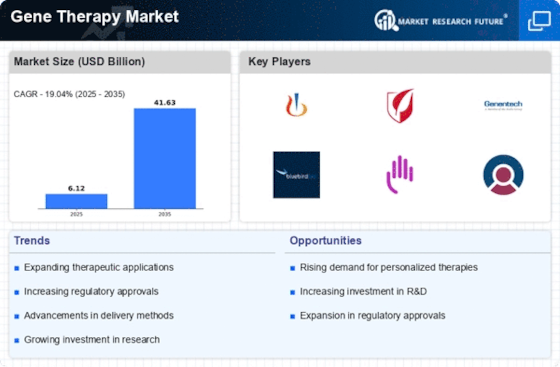
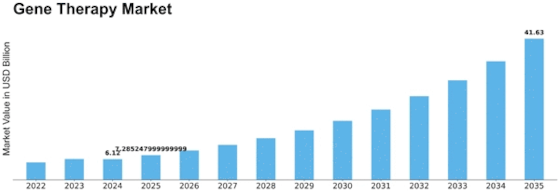
According to MRFR analysis, the Gene Therapy Market Size was valued at USD 6.12 Billion in 2024. The market is projected to grow from USD 7.285 Billion in 2025 to USD 41.63 Billion by 2035, registering a CAGR of 19.04% during the forecast period (2025–2035). North America dominated the market with the largest revenue share of 45.75% in 2024.
 
The Gene Therapy Market is expanding rapidly due to increasing prevalence of genetic disorders, rising investment in biotechnology research, and growing approvals of advanced therapies. Key trends include advancements in CRISPR and viral vector technologies, expanding clinical trials, and strong funding for precision medicine, driving innovation and commercialization of gene-based treatments globally.

Key Market Trends & Highlights

The Gene Therapy Market is poised for substantial growth driven by technological advancements and increasing demand for personalized medicine.

  • North America remains the largest market for gene therapy, driven by robust investment in research and development. The Asia-Pacific region is emerging as the fastest-growing market, fueled by increasing healthcare expenditure and innovation. Viral vector therapies dominate the market, while non-viral vector approaches are rapidly gaining traction due to their potential for safer applications. Rising prevalence of genetic disorders and regulatory support for streamlined approval processes are key drivers propelling market expansion.

Market Size & Forecast

2024 Market Size 6.12 (USD Billion)
2035 Market Size 41.63 (USD Billion)
CAGR (2025 - 2035) 19.04%
Largest Regional Market Share in 2024 North America

Major Players

Novartis (CH), Gilead Sciences (US), Spark Therapeutics (US), Bluebird Bio (US), Bristol-Myers Squibb (US), Sangamo Therapeutics (US), CRISPR Therapeutics (CH), <a href="https://www.astrazeneca.com/media-centre/press-releases/2023/astrazeneca-cell-and-gene-therapy-deal-w-cellectis.html#">AstraZeneca</a> (GB), Roche (CH)

Market Trends

The gene therapy market size expansion is currently experiencing a transformative phase, characterized by rapid advancements in technology and an increasing understanding of genetic disorders. This evolution is driven by a growing demand for innovative treatment options that address previously untreatable conditions. As research progresses, the potential for gene therapies to provide long-lasting solutions becomes more apparent, leading to heightened interest from both investors and healthcare providers. 

Regulatory bodies are also adapting to these changes, streamlining approval processes to facilitate the introduction of new therapies into the market. Moreover, the Gene Therapy Market is witnessing a surge in collaborations between biotechnology firms and academic institutions. These partnerships aim to leverage expertise and resources, fostering an environment conducive to innovation. The focus on personalized medicine is becoming more pronounced, as therapies are increasingly tailored to individual genetic profiles. 

This shift not only enhances treatment efficacy but also aligns with the broader trend towards precision healthcare. As the landscape evolves, the Gene Therapy Market appears poised for substantial growth, driven by scientific breakthroughs and a commitment to improving patient outcomes.

Increased Investment in Research and Development

Gene therapy statistics suggest that there is a notable rise in funding directed towards gene therapy research. This trend reflects a growing recognition of the potential benefits of gene-based treatments, encouraging both public and private sectors to invest in innovative solutions.

Regulatory Advancements

Regulatory agencies are streamlining approval processes for gene therapies, which may facilitate quicker access to new treatments. This trend indicates a shift towards more adaptive regulatory frameworks that can keep pace with rapid scientific advancements.

Focus on Personalized Medicine

The Gene Therapy Market is increasingly emphasizing personalized approaches to treatment. Tailoring therapies to individual genetic profiles could enhance efficacy and patient satisfaction, marking a significant shift in treatment paradigms.

Gene Therapy Market Market Drivers

Increasing Funding and Investment

The Gene Therapy Market is experiencing a surge in funding and investment from both public and private sectors. Governments and venture capitalists are recognizing the potential of gene therapies to revolutionize treatment paradigms, leading to increased financial support for research initiatives. In recent years, funding for gene therapy projects has escalated, with billions of dollars allocated to support clinical trials and product development.
 
This influx of capital is likely to enhance the pace of innovation within the Gene Therapy Market, facilitating the development of new therapies that address unmet medical needs. Moreover, partnerships between biotech firms and academic institutions are becoming more common, further driving collaborative efforts to advance gene therapy research and commercialization.

Growing Demand for Targeted Therapies

The shift towards personalized and targeted therapies is a notable driver for the Gene Therapy Market. Patients and healthcare providers are increasingly seeking treatments that are tailored to individual genetic profiles, which gene therapies can provide. This trend is supported by advancements in genomics and biotechnology, enabling the development of therapies that address specific genetic mutations.
 
As of 2025, the market for targeted therapies is projected to grow substantially, reflecting a broader movement towards precision medicine. The Gene Therapy Market is well-positioned to capitalize on this demand, as it offers innovative solutions that align with the principles of personalized healthcare. Consequently, the emphasis on targeted therapies is likely to drive further investment and research in the gene therapy sector.

Rising Prevalence of Genetic Disorders

The increasing incidence of genetic disorders is a primary driver for the Gene Therapy Market. Conditions such as hemophilia, muscular dystrophy, and cystic fibrosis are becoming more prevalent, necessitating innovative treatment options. According to recent estimates, approximately 1 in 1,500 individuals are affected by hemophilia, highlighting the urgent need for effective therapies.
 
This growing patient population is likely to propel demand for gene therapies, as traditional treatments often fall short in efficacy. The Gene Therapy Market is thus positioned to expand significantly, as healthcare providers seek advanced solutions to address these complex genetic conditions. Furthermore, the rising awareness among patients and healthcare professionals about the potential of gene therapy to provide long-term solutions is expected to further stimulate market growth.

Technological Advancements in Gene Editing

Technological innovations in gene editing techniques, such as CRISPR-Cas9 and TALENs, are transforming the Gene Therapy Market. These advancements enable precise modifications to genetic material, enhancing the efficacy and safety of gene therapies. The ability to target specific genes with high accuracy has opened new avenues for treating previously untreatable conditions.
 
As of 2025, the market for gene editing technologies is projected to reach several billion dollars, indicating robust growth potential. This surge in technological capabilities is likely to attract significant investment, fostering further research and development in the Gene Therapy Market. Consequently, the integration of these cutting-edge technologies is expected to accelerate the approval and commercialization of novel gene therapies, thereby expanding the market landscape.

Regulatory Support and Streamlined Approval Processes

Regulatory bodies are increasingly providing support for the Gene Therapy Market by streamlining approval processes for new therapies. Initiatives aimed at expediting the review of gene therapies are being implemented, which could significantly reduce the time it takes for innovative treatments to reach the market.
 
For instance, the introduction of fast-track designations and priority review pathways is encouraging companies to invest in gene therapy development. This regulatory environment is likely to foster a more favorable landscape for the Gene Therapy Market, as it enhances the likelihood of successful product launches. As a result, the combination of supportive regulations and a growing pipeline of gene therapies is expected to contribute to the overall expansion of the market.

Market Segment Insights

By Vector Type: Viral Vector (Largest) vs. Non-Viral Vector (Fastest-Growing)

In the Gene Therapy Market, the segment for vector type is predominantly led by viral vectors, which have established a strong foothold due to their efficiency and ability to deliver genetic material effectively. Non-viral vectors, while currently less dominant, are gaining traction as they offer advantages such as safety and scalability, driving a gradual shift in cell and gene therapy market dynamics. As more advancements are made in both types, the competition between them is intensifying, making the landscape increasingly complex.

Vector Type: Viral Vector (Dominant) vs. Non-Viral Vector (Emerging)

Viral vectors, including retroviruses, adenoviruses, and adeno-associated viruses, are recognized as the dominant technology in the Gene Therapy Market. They have been foundational in numerous clinical applications and trials, owing to their high efficiency in gene delivery and expression. Conversely, non-viral vectors, such as plasmid DNA and nanoparticles, are emerging due to their potential for safer applications and easier manufacturing processes. As researchers and companies innovate to enhance the delivery efficiency of non-viral systems, their adoption is anticipated to grow, marking a significant shift in the market dynamics between these two vector types.

By Gene Type: Antigen (Largest) vs. Cytokine (Fastest-Growing)

In the Gene Therapy Market, the gene types can be categorized into several segments, namely Antigen, Cytokine, Tumor Suppressor, Suicide, Deficiency, Growth Factors, Receptors, and Others. Among these, Antigen stands out as the largest segment, contributing significantly to the overall market share. Cytokines have emerged rapidly, demonstrating the fastest growth. Other gene types also show potential, but it is Antigen and Cytokine that dominate cell and gene therapy market discussions due to their substantial therapeutic implications and clinical advancements. Growth trends in the Gene Therapy Market for gene types reflect a dynamic landscape driven by advancements in biotechnology and increasing investment in research and development. The rising incidence of genetic disorders is propelling the demand for effective therapies, particularly those utilizing Antigens and Cytokines. Innovations in gene-editing technologies and increased collaboration among pharmaceutical companies are key drivers enabling these segments to thrive in the competitive market.

Gene Type: Antigen (Dominant) vs. Cytokine (Emerging)

Antigens occupy a dominant position in the Gene Therapy Market share due to their critical role in eliciting immune responses and treating various diseases. They are vital in vaccine development and cancer immunotherapy, establishing their importance in therapeutic applications. On the other hand, Cytokines represent an emerging segment, increasingly recognized for their potential in modulating immune responses and supporting tissue regeneration. Their rapid development is largely driven by advances in understanding cellular interactions and their therapeutic roles. As research evolves, the cell and gene therapy market is likely to see novel cytokine-based therapies entering the clinical landscape, thereby enhancing their position within the Gene Therapy Market.

By Application: Oncological Disorders (Largest) vs. Rare Diseases (Fastest-Growing)

Within the application segment of the Gene Therapy Market, Oncological Disorders hold the largest market share due to their complex treatment needs and research investments. This condition influences over half of the gene therapy developments as biopharmaceutical companies focus their efforts on delivering innovative therapies targeting various types of cancers. Rare Diseases, on the other hand, while smaller in market share, are seeing unprecedented growth. Their specialization and the emergence of orphan drugs are attracting significant attention, leading to rapid advancements and targeted therapies.

Oncological Disorders (Dominant) vs. Rare Diseases (Emerging)

The Oncological Disorders segment is characterized by a robust pipeline of gene therapies aimed at tackling an array of malignancies. This dominance is driven by the increasing incidence of cancer and growing public awareness about genetic factors influencing malignancies. Companies are investing heavily in gene-editing technologies and personalized medicine approaches to create innovative therapies. In contrast, the Rare Diseases segment is emerging rapidly, adapting to advancements in genetic research and patient-centric initiatives. Rare diseases often present unique challenges, requiring tailored therapies. The ascent of this segment reflects a rising commitment to treat conditions once deemed untreatable, with regulatory incentives facilitating faster development and approval processes.

By Delivery Method: In Vivo Gene Therapy (Largest) vs. Ex Vivo Gene Therapy (Fastest-Growing)

<p>In the Gene Therapy Market, In Vivo Gene Therapy holds the largest share, representing a significant portion of the overall market. This segment benefits from its straightforward application process, wherein the therapeutic agents are directly delivered into the patient's body. It is widely utilized for various genetic disorders and diseases, making it a preferred choice among healthcare providers and patients. Meanwhile, Ex Vivo Gene Therapy, where cells are modified outside the body before being reintroduced, is rapidly gaining traction and is considered the fastest-growing segment. This method allows for a more controlled approach to gene delivery, catering to a niche but expanding market as tailored therapies become more prevalent.</p>

<p>Delivery Method: In Vivo Gene Therapy (Dominant) vs. Ex Vivo Gene Therapy (Emerging)</p>

<p>In Vivo Gene Therapy is the dominant method in this segment, known for its direct application in treating genetic conditions. By delivering genetic material directly into the patient's cells, it offers simplicity and effectiveness, appealing to a broad spectrum of applications. Conversely, Ex Vivo Gene Therapy is emerging as a significant alternative, characterized by its sophisticated modification processes that promise enhanced efficacy and safety. This method is particularly favorable for cancers and rare genetic disorders, facilitating personalized treatment approaches. Its rapid growth can be attributed to advancements in technology and increasing investments in research, leading to a higher adoption rate among healthcare institutions and research facilities.</p>

Get more detailed insights about Gene Therapy Market Research Report – Forecast Till 2035

Regional Insights

North America : Leading Innovation and Investment

North America accounted for the largest share of the global Gene Therapy Market size, reaching USD 2.8 billion in 2024. The region benefits from robust investment in research and development, a strong regulatory framework, and high demand for innovative therapies.

The FDA's expedited approval processes for gene therapies have catalyzed market growth, making it a hub for biotech innovation. The United States is the primary driver of the gene market, with key players like Gilead Sciences, Spark Therapeutics, and Bluebird Bio leading the charge.

The competitive landscape is characterized by significant collaborations between biotech firms and academic institutions, fostering innovation. Canada also plays a vital role, with increasing investments in gene therapy research and development, further solidifying North America's position as a leader in this field.

Europe : Regulatory Advancements and Growth

Europe is the second-largest market for gene therapy, holding approximately 30% of the global market share. The region is witnessing significant growth driven by advancements in regulatory frameworks, such as the European Medicines Agency's (EMA) guidelines for gene therapies. These regulations are designed to streamline the approval process, encouraging innovation and investment in the sector.

Leading countries in Europe include Germany, France, and the United Kingdom, which are home to several key players like Novartis and AstraZeneca. The competitive landscape is evolving, with increasing collaborations between pharmaceutical companies and research institutions. The presence of a well-established healthcare infrastructure further supports the growth of gene therapy, making Europe a vital player in the global gene market.

Asia-Pacific : Rapid Growth and Investment

Asia-Pacific is rapidly emerging as a significant player in the gene therapy market, accounting for approximately 20% of the global market share. The region is driven by increasing investments in biotechnology, a growing patient population, and rising healthcare expenditures. Countries like China and Japan are at the forefront, with supportive government policies aimed at fostering innovation in gene therapies.

China is particularly noteworthy, with a surge in clinical trials and a growing number of biotech firms entering the gene market. Japan's advanced healthcare system and regulatory support also contribute to the region's growth. The competitive landscape is characterized by both local and international players, including CRISPR Therapeutics and Sangamo Therapeutics, which are actively pursuing partnerships to enhance their market presence.

Middle East and Africa : Emerging Market with Challenges

The Middle East and Africa (MEA) region is still in the nascent stages of the gene therapy market, holding approximately 5% of the global market share. Growth is hindered by challenges such as limited healthcare infrastructure, regulatory hurdles, and a lack of funding for research and development.

However, there is a growing interest in gene therapies, driven by increasing awareness and investment from both public and private sectors. Countries like South Africa and the UAE are beginning to invest in biotechnology, with initiatives aimed at improving healthcare access and innovation. The competitive landscape is still developing, with a few local players and international firms exploring opportunities in the region. As the healthcare infrastructure improves, the MEA region is poised for gradual growth in the gene therapy market.

Key Players and Competitive Insights

The Gene Therapy Market is currently characterized by a dynamic competitive landscape, driven by rapid advancements in technology and an increasing focus on personalized medicine. Key players such as Novartis (CH), Gilead Sciences (US), and Bluebird Bio (US) are at the forefront, leveraging their innovative capabilities to enhance treatment options for genetic disorders. Novartis (CH) has positioned itself as a leader through strategic partnerships and a robust pipeline of gene therapies, while Gilead Sciences (US) emphasizes its commitment to research and development, particularly in the area of rare diseases. Bluebird Bio (US), on the other hand, focuses on expanding its therapeutic offerings through collaborations, thereby shaping a competitive environment that is increasingly reliant on innovation and strategic alliances.
 
In terms of business tactics, companies are increasingly localizing manufacturing and optimizing supply chains to enhance efficiency and reduce costs. The Gene Therapy Market appears to be moderately fragmented, with a mix of established players and emerging biotech firms. This structure allows for a diverse range of therapeutic options, although the collective influence of major companies like Roche (CH) and Bristol-Myers Squibb (US) is significant, as they continue to invest heavily in research and development to maintain their competitive edge.
 
In August 2025, Gilead Sciences (US) announced a groundbreaking collaboration with a leading academic institution to develop next-generation gene editing technologies. This partnership is expected to accelerate the development of innovative therapies, potentially transforming treatment paradigms for genetic disorders. The strategic importance of this collaboration lies in Gilead's ability to leverage academic expertise, which may enhance its research capabilities and expedite the path to the gene market for new therapies.
 
In September 2025, Bluebird Bio (US) launched a new gene therapy product aimed at treating a rare genetic condition, following successful clinical trials. This launch not only diversifies Bluebird's portfolio but also underscores its commitment to addressing unmet medical needs. The strategic significance of this move is profound, as it positions Bluebird as a key player in the gene market, potentially increasing its market share and reinforcing its reputation for innovation.
 
In October 2025, Novartis (CH) expanded its gene therapy manufacturing capabilities by investing in a new facility in Switzerland. This strategic investment is likely to enhance production efficiency and scalability, allowing Novartis to meet growing global demand for its therapies. The implications of this expansion are substantial, as it may solidify Novartis's position as a leader in the gene therapy space, enabling it to respond swiftly to market needs and regulatory changes.
 
As of October 2025, the Gene Therapy Market is witnessing trends that emphasize digitalization, sustainability, and the integration of artificial intelligence in research and development processes. Strategic alliances are increasingly shaping the competitive landscape, fostering innovation and collaboration among key players. Looking ahead, it appears that competitive differentiation will evolve from traditional price-based competition to a focus on technological advancements, innovative therapies, and reliable supply chains, thereby enhancing patient outcomes and driving market growth.

Key Companies in the Gene Therapy Market include

Industry Developments

January 2024: Novartis AG has entered into a strategic partnership with Voyager Therapeutics, Inc., which includes an exclusive license for Voyager's TRACER capsids and related intellectual property. This collaboration will focus on developing a preclinical gene therapy candidate for Huntington's Disease (HD).

October 2023: SpliceBio, a genetic medicines company specializing in Protein Splicing to advance gene therapies, has announced an exclusive collaboration and licensing agreement with Spark Therapeutics. This partnership will leverage SpliceBio's proprietary Protein Splicing platform to develop a gene therapy for an undisclosed inherited retinal disease.

December 2023: Bluebird bio, Inc. (US) received an approval from US Food Drug and Administration for Lyfgenia representing the first cell-based gene therapies for the treatment of sickle cell disease (SCD) in patients 12 years and older.

September 2021: GenSight Biologics announced that the UK's Medicines and Healthcare Products Regulatory Agency (MHRA) has designated its gene therapy LUMEVOQ as a Promising Innovative Medicine (PIM) for the treatment of vision loss caused by Leber Hereditary Optic Neuropathy (LHON), which is caused by a confirmed G11778A mutation in the ND4 mitochondrial gene.

Future Outlook

Gene Therapy Market Future Outlook

The gene therapy market size is projected to grow at a 19.04% CAGR from 2024 to 2035, driven by advancements in gene therapy technology, increasing investments, and rising prevalence of genetic disorders.

New opportunities lie in:

  • <p>Development of personalized gene therapies targeting rare diseases.</p>
  • <p> </p>
  • <p>Expansion of partnerships with biotech firms for innovative delivery systems.</p>
  • <p>Investment in AI-driven platforms for gene therapy research and development.</p>

By 2035, the Gene Therapy Market is expected to be a pivotal sector in healthcare innovation.

Market Segmentation

Gene Therapy Market Gene Type Outlook

  • Antigen
  • Cytokine
  • Tumor Suppressor
  • Suicide
  • Deficiency
  • Growth Factors
  • Receptors
  • Others

Gene Therapy Market Application Outlook

  • Oncological Disorders
  • Rare Diseases
  • Cardiovascular Diseases
  • Neurological Disorders
  • Infectious Diseases
  • Others

Gene Therapy Market Vector Type Outlook

  • Viral Vector
  • Non-Viral Vector

Gene Therapy Market Delivery Method Outlook

  • In Vivo Gene Therapy
  • Ex Vivo Gene Therapy

Report Scope

MARKET SIZE 2024 6.12(USD Billion)
MARKET SIZE 2025 7.285(USD Billion)
MARKET SIZE 2035 41.63(USD Billion)
COMPOUND ANNUAL GROWTH RATE (CAGR) 19.04% (2025 - 2035)
REPORT COVERAGE Revenue Forecast, Competitive Landscape, Growth Factors, and Trends
BASE YEAR 2024
Market Forecast Period 2025 - 2035
Historical Data 2019 - 2024
Market Forecast Units USD Billion
Key Companies Profiled Novartis (CH), Gilead Sciences (US), Spark Therapeutics (US), Bluebird Bio (US), Bristol-Myers Squibb (US), Sangamo Therapeutics (US), CRISPR Therapeutics (CH), AstraZeneca (GB), Roche (CH)
Segments Covered Vector Type, Gene Type, Applications, Delivery Method
Key Market Opportunities Advancements in personalized medicine are driving growth in the Gene Therapy Market.
Key Market Dynamics Rising regulatory approvals and technological advancements are driving innovation and competition in the gene therapy market.
Countries Covered North America, Europe, APAC, South America, MEA

FAQs

What is the current valuation of the Gene Therapy Market as of 2024?

<p>The Gene Therapy Market was valued at 6.12 USD Billion in 2024.</p>

What is the projected market size for the Gene Therapy Market by 2035?

<p>The market is projected to reach 41.63 USD Billion by 2035.</p>

What is the expected CAGR for the Gene Therapy Market during the forecast period 2025 - 2035?

<p>The expected CAGR for the Gene Therapy Market during 2025 - 2035 is 19.04%.</p>

Which companies are considered key players in the Gene Therapy Market?

<p>Key players include Novartis, Gilead Sciences, Spark Therapeutics, and Bluebird Bio, among others.</p>

What are the main segments of the Gene Therapy Market based on vector type?

<p>The main segments based on vector type are Viral Vector, valued at 25.0 USD Billion, and Non-Viral Vector, valued at 16.63 USD Billion.</p>

How do the different gene types perform in the Gene Therapy Market?

In 2024, Antigen and Tumor Suppressor gene types were valued at 5.5 USD Billion and 6.2 USD Billion, respectively.

What applications dominate the Gene Therapy Market?

Oncological Disorders and Rare Diseases are leading applications, valued at 5.92 USD Billion and 8.12 USD Billion in 2024.

What delivery methods are utilized in the Gene Therapy Market?

The market segments include In Vivo Gene Therapy, projected to reach 25.09 USD Billion, and Ex Vivo Gene Therapy, expected to reach 16.54 USD Billion.

What is the potential growth of the Gene Therapy Market in the coming years?

The Gene Therapy Market appears poised for substantial growth, with projections indicating a significant increase by 2035.

How does the Gene Therapy Market compare to other biopharmaceutical sectors?

The Gene Therapy Market, with its projected growth, suggests a robust position compared to other biopharmaceutical sectors, particularly in innovative treatments.

  1. SECTION I: EXECUTIVE SUMMARY AND KEY HIGHLIGHTS
    1. | 1.1 EXECUTIVE SUMMARY
    2. | | 1.1.1 Market Overview
    3. | | 1.1.2 Key Findings
    4. | | 1.1.3 Market Segmentation
    5. | | 1.1.4 Competitive Landscape
    6. | | 1.1.5 Challenges and Opportunities
    7. | | 1.1.6 Future Outlook
  2. SECTION II: SCOPING, METHODOLOGY AND MARKET STRUCTURE
    1. | 2.1 MARKET INTRODUCTION
    2. | | 2.1.1 Definition
    3. | | 2.1.2 Scope of the study
    4. | | | 2.1.2.1 Research Objective
    5. | | | 2.1.2.2 Assumption
    6. | | | 2.1.2.3 Limitations
    7. | 2.2 RESEARCH METHODOLOGY
    8. | | 2.2.1 Overview
    9. | | 2.2.2 Data Mining
    10. | | 2.2.3 Secondary Research
    11. | | 2.2.4 Primary Research
    12. | | | 2.2.4.1 Primary Interviews and Information Gathering Process
    13. | | | 2.2.4.2 Breakdown of Primary Respondents
    14. | | 2.2.5 Forecasting Model
    15. | | 2.2.6 Market Size Estimation
    16. | | | 2.2.6.1 Bottom-Up Approach
    17. | | | 2.2.6.2 Top-Down Approach
    18. | | 2.2.7 Data Triangulation
    19. | | 2.2.8 Validation
  3. SECTION III: QUALITATIVE ANALYSIS
    1. | 3.1 MARKET DYNAMICS
    2. | | 3.1.1 Overview
    3. | | 3.1.2 Drivers
    4. | | 3.1.3 Restraints
    5. | | 3.1.4 Opportunities
    6. | 3.2 MARKET FACTOR ANALYSIS
    7. | | 3.2.1 Value chain Analysis
    8. | | 3.2.2 Porter's Five Forces Analysis
    9. | | | 3.2.2.1 Bargaining Power of Suppliers
    10. | | | 3.2.2.2 Bargaining Power of Buyers
    11. | | | 3.2.2.3 Threat of New Entrants
    12. | | | 3.2.2.4 Threat of Substitutes
    13. | | | 3.2.2.5 Intensity of Rivalry
    14. | | 3.2.3 COVID-19 Impact Analysis
    15. | | | 3.2.3.1 Market Impact Analysis
    16. | | | 3.2.3.2 Regional Impact
    17. | | | 3.2.3.3 Opportunity and Threat Analysis
  4. SECTION IV: QUANTITATIVE ANALYSIS
    1. | 4.1 Healthcare, BY Vector Type (USD Billion)
    2. | | 4.1.1 Viral Vector
    3. | | 4.1.2 Non-Viral Vector
    4. | 4.2 Healthcare, BY Gene Type (USD Billion)
    5. | | 4.2.1 Antigen
    6. | | 4.2.2 Cytokine
    7. | | 4.2.3 Tumor Suppressor
    8. | | 4.2.4 Suicide
    9. | | 4.2.5 Deficiency
    10. | | 4.2.6 Growth Factors
    11. | | 4.2.7 Receptors
    12. | | 4.2.8 Others
    13. | 4.3 Healthcare, BY Application (USD Billion)
    14. | | 4.3.1 Oncological Disorders
    15. | | 4.3.2 Rare Diseases
    16. | | 4.3.3 Cardiovascular Diseases
    17. | | 4.3.4 Neurological Disorders
    18. | | 4.3.5 Infectious Diseases
    19. | | 4.3.6 Others
    20. | 4.4 Healthcare, BY Delivery Method (USD Billion)
    21. | | 4.4.1 In Vivo Gene Therapy
    22. | | 4.4.2 Ex Vivo Gene Therapy
    23. | 4.5 Healthcare, BY Region (USD Billion)
    24. | | 4.5.1 North America
    25. | | | 4.5.1.1 US
    26. | | | 4.5.1.2 Canada
    27. | | 4.5.2 Europe
    28. | | | 4.5.2.1 Germany
    29. | | | 4.5.2.2 UK
    30. | | | 4.5.2.3 France
    31. | | | 4.5.2.4 Russia
    32. | | | 4.5.2.5 Italy
    33. | | | 4.5.2.6 Spain
    34. | | | 4.5.2.7 Rest of Europe
    35. | | 4.5.3 APAC
    36. | | | 4.5.3.1 China
    37. | | | 4.5.3.2 India
    38. | | | 4.5.3.3 Japan
    39. | | | 4.5.3.4 South Korea
    40. | | | 4.5.3.5 Malaysia
    41. | | | 4.5.3.6 Thailand
    42. | | | 4.5.3.7 Indonesia
    43. | | | 4.5.3.8 Rest of APAC
    44. | | 4.5.4 South America
    45. | | | 4.5.4.1 Brazil
    46. | | | 4.5.4.2 Mexico
    47. | | | 4.5.4.3 Argentina
    48. | | | 4.5.4.4 Rest of South America
    49. | | 4.5.5 MEA
    50. | | | 4.5.5.1 GCC Countries
    51. | | | 4.5.5.2 South Africa
    52. | | | 4.5.5.3 Rest of MEA
  5. SECTION V: COMPETITIVE ANALYSIS
    1. | 5.1 Competitive Landscape
    2. | | 5.1.1 Overview
    3. | | 5.1.2 Competitive Analysis
    4. | | 5.1.3 Market share Analysis
    5. | | 5.1.4 Major Growth Strategy in the Healthcare
    6. | | 5.1.5 Competitive Benchmarking
    7. | | 5.1.6 Leading Players in Terms of Number of Developments in the Healthcare
    8. | | 5.1.7 Key developments and growth strategies
    9. | | | 5.1.7.1 New Product Launch/Service Deployment
    10. | | | 5.1.7.2 Merger & Acquisitions
    11. | | | 5.1.7.3 Joint Ventures
    12. | | 5.1.8 Major Players Financial Matrix
    13. | | | 5.1.8.1 Sales and Operating Income
    14. | | | 5.1.8.2 Major Players R&D Expenditure. 2023
    15. | 5.2 Company Profiles
    16. | | 5.2.1 Novartis (CH)
    17. | | | 5.2.1.1 Financial Overview
    18. | | | 5.2.1.2 Products Offered
    19. | | | 5.2.1.3 Key Developments
    20. | | | 5.2.1.4 SWOT Analysis
    21. | | | 5.2.1.5 Key Strategies
    22. | | 5.2.2 Gilead Sciences (US)
    23. | | | 5.2.2.1 Financial Overview
    24. | | | 5.2.2.2 Products Offered
    25. | | | 5.2.2.3 Key Developments
    26. | | | 5.2.2.4 SWOT Analysis
    27. | | | 5.2.2.5 Key Strategies
    28. | | 5.2.3 Spark Therapeutics (US)
    29. | | | 5.2.3.1 Financial Overview
    30. | | | 5.2.3.2 Products Offered
    31. | | | 5.2.3.3 Key Developments
    32. | | | 5.2.3.4 SWOT Analysis
    33. | | | 5.2.3.5 Key Strategies
    34. | | 5.2.4 Bluebird Bio (US)
    35. | | | 5.2.4.1 Financial Overview
    36. | | | 5.2.4.2 Products Offered
    37. | | | 5.2.4.3 Key Developments
    38. | | | 5.2.4.4 SWOT Analysis
    39. | | | 5.2.4.5 Key Strategies
    40. | | 5.2.5 Bristol-Myers Squibb (US)
    41. | | | 5.2.5.1 Financial Overview
    42. | | | 5.2.5.2 Products Offered
    43. | | | 5.2.5.3 Key Developments
    44. | | | 5.2.5.4 SWOT Analysis
    45. | | | 5.2.5.5 Key Strategies
    46. | | 5.2.6 Sangamo Therapeutics (US)
    47. | | | 5.2.6.1 Financial Overview
    48. | | | 5.2.6.2 Products Offered
    49. | | | 5.2.6.3 Key Developments
    50. | | | 5.2.6.4 SWOT Analysis
    51. | | | 5.2.6.5 Key Strategies
    52. | | 5.2.7 CRISPR Therapeutics (CH)
    53. | | | 5.2.7.1 Financial Overview
    54. | | | 5.2.7.2 Products Offered
    55. | | | 5.2.7.3 Key Developments
    56. | | | 5.2.7.4 SWOT Analysis
    57. | | | 5.2.7.5 Key Strategies
    58. | | 5.2.8 AstraZeneca (GB)
    59. | | | 5.2.8.1 Financial Overview
    60. | | | 5.2.8.2 Products Offered
    61. | | | 5.2.8.3 Key Developments
    62. | | | 5.2.8.4 SWOT Analysis
    63. | | | 5.2.8.5 Key Strategies
    64. | | 5.2.9 Roche (CH)
    65. | | | 5.2.9.1 Financial Overview
    66. | | | 5.2.9.2 Products Offered
    67. | | | 5.2.9.3 Key Developments
    68. | | | 5.2.9.4 SWOT Analysis
    69. | | | 5.2.9.5 Key Strategies
    70. | 5.3 Appendix
    71. | | 5.3.1 References
    72. | | 5.3.2 Related Reports
  6. LIST OF FIGURES
    1. | 6.1 MARKET SYNOPSIS
    2. | 6.2 NORTH AMERICA MARKET ANALYSIS
    3. | 6.3 US MARKET ANALYSIS BY VECTOR TYPE
    4. | 6.4 US MARKET ANALYSIS BY GENE TYPE
    5. | 6.5 US MARKET ANALYSIS BY APPLICATION
    6. | 6.6 US MARKET ANALYSIS BY DELIVERY METHOD
    7. | 6.7 CANADA MARKET ANALYSIS BY VECTOR TYPE
    8. | 6.8 CANADA MARKET ANALYSIS BY GENE TYPE
    9. | 6.9 CANADA MARKET ANALYSIS BY APPLICATION
    10. | 6.10 CANADA MARKET ANALYSIS BY DELIVERY METHOD
    11. | 6.11 EUROPE MARKET ANALYSIS
    12. | 6.12 GERMANY MARKET ANALYSIS BY VECTOR TYPE
    13. | 6.13 GERMANY MARKET ANALYSIS BY GENE TYPE
    14. | 6.14 GERMANY MARKET ANALYSIS BY APPLICATION
    15. | 6.15 GERMANY MARKET ANALYSIS BY DELIVERY METHOD
    16. | 6.16 UK MARKET ANALYSIS BY VECTOR TYPE
    17. | 6.17 UK MARKET ANALYSIS BY GENE TYPE
    18. | 6.18 UK MARKET ANALYSIS BY APPLICATION
    19. | 6.19 UK MARKET ANALYSIS BY DELIVERY METHOD
    20. | 6.20 FRANCE MARKET ANALYSIS BY VECTOR TYPE
    21. | 6.21 FRANCE MARKET ANALYSIS BY GENE TYPE
    22. | 6.22 FRANCE MARKET ANALYSIS BY APPLICATION
    23. | 6.23 FRANCE MARKET ANALYSIS BY DELIVERY METHOD
    24. | 6.24 RUSSIA MARKET ANALYSIS BY VECTOR TYPE
    25. | 6.25 RUSSIA MARKET ANALYSIS BY GENE TYPE
    26. | 6.26 RUSSIA MARKET ANALYSIS BY APPLICATION
    27. | 6.27 RUSSIA MARKET ANALYSIS BY DELIVERY METHOD
    28. | 6.28 ITALY MARKET ANALYSIS BY VECTOR TYPE
    29. | 6.29 ITALY MARKET ANALYSIS BY GENE TYPE
    30. | 6.30 ITALY MARKET ANALYSIS BY APPLICATION
    31. | 6.31 ITALY MARKET ANALYSIS BY DELIVERY METHOD
    32. | 6.32 SPAIN MARKET ANALYSIS BY VECTOR TYPE
    33. | 6.33 SPAIN MARKET ANALYSIS BY GENE TYPE
    34. | 6.34 SPAIN MARKET ANALYSIS BY APPLICATION
    35. | 6.35 SPAIN MARKET ANALYSIS BY DELIVERY METHOD
    36. | 6.36 REST OF EUROPE MARKET ANALYSIS BY VECTOR TYPE
    37. | 6.37 REST OF EUROPE MARKET ANALYSIS BY GENE TYPE
    38. | 6.38 REST OF EUROPE MARKET ANALYSIS BY APPLICATION
    39. | 6.39 REST OF EUROPE MARKET ANALYSIS BY DELIVERY METHOD
    40. | 6.40 APAC MARKET ANALYSIS
    41. | 6.41 CHINA MARKET ANALYSIS BY VECTOR TYPE
    42. | 6.42 CHINA MARKET ANALYSIS BY GENE TYPE
    43. | 6.43 CHINA MARKET ANALYSIS BY APPLICATION
    44. | 6.44 CHINA MARKET ANALYSIS BY DELIVERY METHOD
    45. | 6.45 INDIA MARKET ANALYSIS BY VECTOR TYPE
    46. | 6.46 INDIA MARKET ANALYSIS BY GENE TYPE
    47. | 6.47 INDIA MARKET ANALYSIS BY APPLICATION
    48. | 6.48 INDIA MARKET ANALYSIS BY DELIVERY METHOD
    49. | 6.49 JAPAN MARKET ANALYSIS BY VECTOR TYPE
    50. | 6.50 JAPAN MARKET ANALYSIS BY GENE TYPE
    51. | 6.51 JAPAN MARKET ANALYSIS BY APPLICATION
    52. | 6.52 JAPAN MARKET ANALYSIS BY DELIVERY METHOD
    53. | 6.53 SOUTH KOREA MARKET ANALYSIS BY VECTOR TYPE
    54. | 6.54 SOUTH KOREA MARKET ANALYSIS BY GENE TYPE
    55. | 6.55 SOUTH KOREA MARKET ANALYSIS BY APPLICATION
    56. | 6.56 SOUTH KOREA MARKET ANALYSIS BY DELIVERY METHOD
    57. | 6.57 MALAYSIA MARKET ANALYSIS BY VECTOR TYPE
    58. | 6.58 MALAYSIA MARKET ANALYSIS BY GENE TYPE
    59. | 6.59 MALAYSIA MARKET ANALYSIS BY APPLICATION
    60. | 6.60 MALAYSIA MARKET ANALYSIS BY DELIVERY METHOD
    61. | 6.61 THAILAND MARKET ANALYSIS BY VECTOR TYPE
    62. | 6.62 THAILAND MARKET ANALYSIS BY GENE TYPE
    63. | 6.63 THAILAND MARKET ANALYSIS BY APPLICATION
    64. | 6.64 THAILAND MARKET ANALYSIS BY DELIVERY METHOD
    65. | 6.65 INDONESIA MARKET ANALYSIS BY VECTOR TYPE
    66. | 6.66 INDONESIA MARKET ANALYSIS BY GENE TYPE
    67. | 6.67 INDONESIA MARKET ANALYSIS BY APPLICATION
    68. | 6.68 INDONESIA MARKET ANALYSIS BY DELIVERY METHOD
    69. | 6.69 REST OF APAC MARKET ANALYSIS BY VECTOR TYPE
    70. | 6.70 REST OF APAC MARKET ANALYSIS BY GENE TYPE
    71. | 6.71 REST OF APAC MARKET ANALYSIS BY APPLICATION
    72. | 6.72 REST OF APAC MARKET ANALYSIS BY DELIVERY METHOD
    73. | 6.73 SOUTH AMERICA MARKET ANALYSIS
    74. | 6.74 BRAZIL MARKET ANALYSIS BY VECTOR TYPE
    75. | 6.75 BRAZIL MARKET ANALYSIS BY GENE TYPE
    76. | 6.76 BRAZIL MARKET ANALYSIS BY APPLICATION
    77. | 6.77 BRAZIL MARKET ANALYSIS BY DELIVERY METHOD
    78. | 6.78 MEXICO MARKET ANALYSIS BY VECTOR TYPE
    79. | 6.79 MEXICO MARKET ANALYSIS BY GENE TYPE
    80. | 6.80 MEXICO MARKET ANALYSIS BY APPLICATION
    81. | 6.81 MEXICO MARKET ANALYSIS BY DELIVERY METHOD
    82. | 6.82 ARGENTINA MARKET ANALYSIS BY VECTOR TYPE
    83. | 6.83 ARGENTINA MARKET ANALYSIS BY GENE TYPE
    84. | 6.84 ARGENTINA MARKET ANALYSIS BY APPLICATION
    85. | 6.85 ARGENTINA MARKET ANALYSIS BY DELIVERY METHOD
    86. | 6.86 REST OF SOUTH AMERICA MARKET ANALYSIS BY VECTOR TYPE
    87. | 6.87 REST OF SOUTH AMERICA MARKET ANALYSIS BY GENE TYPE
    88. | 6.88 REST OF SOUTH AMERICA MARKET ANALYSIS BY APPLICATION
    89. | 6.89 REST OF SOUTH AMERICA MARKET ANALYSIS BY DELIVERY METHOD
    90. | 6.90 MEA MARKET ANALYSIS
    91. | 6.91 GCC COUNTRIES MARKET ANALYSIS BY VECTOR TYPE
    92. | 6.92 GCC COUNTRIES MARKET ANALYSIS BY GENE TYPE
    93. | 6.93 GCC COUNTRIES MARKET ANALYSIS BY APPLICATION
    94. | 6.94 GCC COUNTRIES MARKET ANALYSIS BY DELIVERY METHOD
    95. | 6.95 SOUTH AFRICA MARKET ANALYSIS BY VECTOR TYPE
    96. | 6.96 SOUTH AFRICA MARKET ANALYSIS BY GENE TYPE
    97. | 6.97 SOUTH AFRICA MARKET ANALYSIS BY APPLICATION
    98. | 6.98 SOUTH AFRICA MARKET ANALYSIS BY DELIVERY METHOD
    99. | 6.99 REST OF MEA MARKET ANALYSIS BY VECTOR TYPE
    100. | 6.100 REST OF MEA MARKET ANALYSIS BY GENE TYPE
    101. | 6.101 REST OF MEA MARKET ANALYSIS BY APPLICATION
    102. | 6.102 REST OF MEA MARKET ANALYSIS BY DELIVERY METHOD
    103. | 6.103 KEY BUYING CRITERIA OF HEALTHCARE
    104. | 6.104 RESEARCH PROCESS OF MRFR
    105. | 6.105 DRO ANALYSIS OF HEALTHCARE
    106. | 6.106 DRIVERS IMPACT ANALYSIS: HEALTHCARE
    107. | 6.107 RESTRAINTS IMPACT ANALYSIS: HEALTHCARE
    108. | 6.108 SUPPLY / VALUE CHAIN: HEALTHCARE
    109. | 6.109 HEALTHCARE, BY VECTOR TYPE, 2024 (% SHARE)
    110. | 6.110 HEALTHCARE, BY VECTOR TYPE, 2024 TO 2035 (USD Billion)
    111. | 6.111 HEALTHCARE, BY GENE TYPE, 2024 (% SHARE)
    112. | 6.112 HEALTHCARE, BY GENE TYPE, 2024 TO 2035 (USD Billion)
    113. | 6.113 HEALTHCARE, BY APPLICATION, 2024 (% SHARE)
    114. | 6.114 HEALTHCARE, BY APPLICATION, 2024 TO 2035 (USD Billion)
    115. | 6.115 HEALTHCARE, BY DELIVERY METHOD, 2024 (% SHARE)
    116. | 6.116 HEALTHCARE, BY DELIVERY METHOD, 2024 TO 2035 (USD Billion)
    117. | 6.117 BENCHMARKING OF MAJOR COMPETITORS
  7. LIST OF TABLES
    1. | 7.1 LIST OF ASSUMPTIONS
    2. | | 7.1.1
    3. | 7.2 North America MARKET SIZE ESTIMATES; FORECAST
    4. | | 7.2.1 BY VECTOR TYPE, 2025-2035 (USD Billion)
    5. | | 7.2.2 BY GENE TYPE, 2025-2035 (USD Billion)
    6. | | 7.2.3 BY APPLICATION, 2025-2035 (USD Billion)
    7. | | 7.2.4 BY DELIVERY METHOD, 2025-2035 (USD Billion)
    8. | 7.3 US MARKET SIZE ESTIMATES; FORECAST
    9. | | 7.3.1 BY VECTOR TYPE, 2025-2035 (USD Billion)
    10. | | 7.3.2 BY GENE TYPE, 2025-2035 (USD Billion)
    11. | | 7.3.3 BY APPLICATION, 2025-2035 (USD Billion)
    12. | | 7.3.4 BY DELIVERY METHOD, 2025-2035 (USD Billion)
    13. | 7.4 Canada MARKET SIZE ESTIMATES; FORECAST
    14. | | 7.4.1 BY VECTOR TYPE, 2025-2035 (USD Billion)
    15. | | 7.4.2 BY GENE TYPE, 2025-2035 (USD Billion)
    16. | | 7.4.3 BY APPLICATION, 2025-2035 (USD Billion)
    17. | | 7.4.4 BY DELIVERY METHOD, 2025-2035 (USD Billion)
    18. | 7.5 Europe MARKET SIZE ESTIMATES; FORECAST
    19. | | 7.5.1 BY VECTOR TYPE, 2025-2035 (USD Billion)
    20. | | 7.5.2 BY GENE TYPE, 2025-2035 (USD Billion)
    21. | | 7.5.3 BY APPLICATION, 2025-2035 (USD Billion)
    22. | | 7.5.4 BY DELIVERY METHOD, 2025-2035 (USD Billion)
    23. | 7.6 Germany MARKET SIZE ESTIMATES; FORECAST
    24. | | 7.6.1 BY VECTOR TYPE, 2025-2035 (USD Billion)
    25. | | 7.6.2 BY GENE TYPE, 2025-2035 (USD Billion)
    26. | | 7.6.3 BY APPLICATION, 2025-2035 (USD Billion)
    27. | | 7.6.4 BY DELIVERY METHOD, 2025-2035 (USD Billion)
    28. | 7.7 UK MARKET SIZE ESTIMATES; FORECAST
    29. | | 7.7.1 BY VECTOR TYPE, 2025-2035 (USD Billion)
    30. | | 7.7.2 BY GENE TYPE, 2025-2035 (USD Billion)
    31. | | 7.7.3 BY APPLICATION, 2025-2035 (USD Billion)
    32. | | 7.7.4 BY DELIVERY METHOD, 2025-2035 (USD Billion)
    33. | 7.8 France MARKET SIZE ESTIMATES; FORECAST
    34. | | 7.8.1 BY VECTOR TYPE, 2025-2035 (USD Billion)
    35. | | 7.8.2 BY GENE TYPE, 2025-2035 (USD Billion)
    36. | | 7.8.3 BY APPLICATION, 2025-2035 (USD Billion)
    37. | | 7.8.4 BY DELIVERY METHOD, 2025-2035 (USD Billion)
    38. | 7.9 Russia MARKET SIZE ESTIMATES; FORECAST
    39. | | 7.9.1 BY VECTOR TYPE, 2025-2035 (USD Billion)
    40. | | 7.9.2 BY GENE TYPE, 2025-2035 (USD Billion)
    41. | | 7.9.3 BY APPLICATION, 2025-2035 (USD Billion)
    42. | | 7.9.4 BY DELIVERY METHOD, 2025-2035 (USD Billion)
    43. | 7.10 Italy MARKET SIZE ESTIMATES; FORECAST
    44. | | 7.10.1 BY VECTOR TYPE, 2025-2035 (USD Billion)
    45. | | 7.10.2 BY GENE TYPE, 2025-2035 (USD Billion)
    46. | | 7.10.3 BY APPLICATION, 2025-2035 (USD Billion)
    47. | | 7.10.4 BY DELIVERY METHOD, 2025-2035 (USD Billion)
    48. | 7.11 Spain MARKET SIZE ESTIMATES; FORECAST
    49. | | 7.11.1 BY VECTOR TYPE, 2025-2035 (USD Billion)
    50. | | 7.11.2 BY GENE TYPE, 2025-2035 (USD Billion)
    51. | | 7.11.3 BY APPLICATION, 2025-2035 (USD Billion)
    52. | | 7.11.4 BY DELIVERY METHOD, 2025-2035 (USD Billion)
    53. | 7.12 Rest of Europe MARKET SIZE ESTIMATES; FORECAST
    54. | | 7.12.1 BY VECTOR TYPE, 2025-2035 (USD Billion)
    55. | | 7.12.2 BY GENE TYPE, 2025-2035 (USD Billion)
    56. | | 7.12.3 BY APPLICATION, 2025-2035 (USD Billion)
    57. | | 7.12.4 BY DELIVERY METHOD, 2025-2035 (USD Billion)
    58. | 7.13 APAC MARKET SIZE ESTIMATES; FORECAST
    59. | | 7.13.1 BY VECTOR TYPE, 2025-2035 (USD Billion)
    60. | | 7.13.2 BY GENE TYPE, 2025-2035 (USD Billion)
    61. | | 7.13.3 BY APPLICATION, 2025-2035 (USD Billion)
    62. | | 7.13.4 BY DELIVERY METHOD, 2025-2035 (USD Billion)
    63. | 7.14 China MARKET SIZE ESTIMATES; FORECAST
    64. | | 7.14.1 BY VECTOR TYPE, 2025-2035 (USD Billion)
    65. | | 7.14.2 BY GENE TYPE, 2025-2035 (USD Billion)
    66. | | 7.14.3 BY APPLICATION, 2025-2035 (USD Billion)
    67. | | 7.14.4 BY DELIVERY METHOD, 2025-2035 (USD Billion)
    68. | 7.15 India MARKET SIZE ESTIMATES; FORECAST
    69. | | 7.15.1 BY VECTOR TYPE, 2025-2035 (USD Billion)
    70. | | 7.15.2 BY GENE TYPE, 2025-2035 (USD Billion)
    71. | | 7.15.3 BY APPLICATION, 2025-2035 (USD Billion)
    72. | | 7.15.4 BY DELIVERY METHOD, 2025-2035 (USD Billion)
    73. | 7.16 Japan MARKET SIZE ESTIMATES; FORECAST
    74. | | 7.16.1 BY VECTOR TYPE, 2025-2035 (USD Billion)
    75. | | 7.16.2 BY GENE TYPE, 2025-2035 (USD Billion)
    76. | | 7.16.3 BY APPLICATION, 2025-2035 (USD Billion)
    77. | | 7.16.4 BY DELIVERY METHOD, 2025-2035 (USD Billion)
    78. | 7.17 South Korea MARKET SIZE ESTIMATES; FORECAST
    79. | | 7.17.1 BY VECTOR TYPE, 2025-2035 (USD Billion)
    80. | | 7.17.2 BY GENE TYPE, 2025-2035 (USD Billion)
    81. | | 7.17.3 BY APPLICATION, 2025-2035 (USD Billion)
    82. | | 7.17.4 BY DELIVERY METHOD, 2025-2035 (USD Billion)
    83. | 7.18 Malaysia MARKET SIZE ESTIMATES; FORECAST
    84. | | 7.18.1 BY VECTOR TYPE, 2025-2035 (USD Billion)
    85. | | 7.18.2 BY GENE TYPE, 2025-2035 (USD Billion)
    86. | | 7.18.3 BY APPLICATION, 2025-2035 (USD Billion)
    87. | | 7.18.4 BY DELIVERY METHOD, 2025-2035 (USD Billion)
    88. | 7.19 Thailand MARKET SIZE ESTIMATES; FORECAST
    89. | | 7.19.1 BY VECTOR TYPE, 2025-2035 (USD Billion)
    90. | | 7.19.2 BY GENE TYPE, 2025-2035 (USD Billion)
    91. | | 7.19.3 BY APPLICATION, 2025-2035 (USD Billion)
    92. | | 7.19.4 BY DELIVERY METHOD, 2025-2035 (USD Billion)
    93. | 7.20 Indonesia MARKET SIZE ESTIMATES; FORECAST
    94. | | 7.20.1 BY VECTOR TYPE, 2025-2035 (USD Billion)
    95. | | 7.20.2 BY GENE TYPE, 2025-2035 (USD Billion)
    96. | | 7.20.3 BY APPLICATION, 2025-2035 (USD Billion)
    97. | | 7.20.4 BY DELIVERY METHOD, 2025-2035 (USD Billion)
    98. | 7.21 Rest of APAC MARKET SIZE ESTIMATES; FORECAST
    99. | | 7.21.1 BY VECTOR TYPE, 2025-2035 (USD Billion)
    100. | | 7.21.2 BY GENE TYPE, 2025-2035 (USD Billion)
    101. | | 7.21.3 BY APPLICATION, 2025-2035 (USD Billion)
    102. | | 7.21.4 BY DELIVERY METHOD, 2025-2035 (USD Billion)
    103. | 7.22 South America MARKET SIZE ESTIMATES; FORECAST
    104. | | 7.22.1 BY VECTOR TYPE, 2025-2035 (USD Billion)
    105. | | 7.22.2 BY GENE TYPE, 2025-2035 (USD Billion)
    106. | | 7.22.3 BY APPLICATION, 2025-2035 (USD Billion)
    107. | | 7.22.4 BY DELIVERY METHOD, 2025-2035 (USD Billion)
    108. | 7.23 Brazil MARKET SIZE ESTIMATES; FORECAST
    109. | | 7.23.1 BY VECTOR TYPE, 2025-2035 (USD Billion)
    110. | | 7.23.2 BY GENE TYPE, 2025-2035 (USD Billion)
    111. | | 7.23.3 BY APPLICATION, 2025-2035 (USD Billion)
    112. | | 7.23.4 BY DELIVERY METHOD, 2025-2035 (USD Billion)
    113. | 7.24 Mexico MARKET SIZE ESTIMATES; FORECAST
    114. | | 7.24.1 BY VECTOR TYPE, 2025-2035 (USD Billion)
    115. | | 7.24.2 BY GENE TYPE, 2025-2035 (USD Billion)
    116. | | 7.24.3 BY APPLICATION, 2025-2035 (USD Billion)
    117. | | 7.24.4 BY DELIVERY METHOD, 2025-2035 (USD Billion)
    118. | 7.25 Argentina MARKET SIZE ESTIMATES; FORECAST
    119. | | 7.25.1 BY VECTOR TYPE, 2025-2035 (USD Billion)
    120. | | 7.25.2 BY GENE TYPE, 2025-2035 (USD Billion)
    121. | | 7.25.3 BY APPLICATION, 2025-2035 (USD Billion)
    122. | | 7.25.4 BY DELIVERY METHOD, 2025-2035 (USD Billion)
    123. | 7.26 Rest of South America MARKET SIZE ESTIMATES; FORECAST
    124. | | 7.26.1 BY VECTOR TYPE, 2025-2035 (USD Billion)
    125. | | 7.26.2 BY GENE TYPE, 2025-2035 (USD Billion)
    126. | | 7.26.3 BY APPLICATION, 2025-2035 (USD Billion)
    127. | | 7.26.4 BY DELIVERY METHOD, 2025-2035 (USD Billion)
    128. | 7.27 MEA MARKET SIZE ESTIMATES; FORECAST
    129. | | 7.27.1 BY VECTOR TYPE, 2025-2035 (USD Billion)
    130. | | 7.27.2 BY GENE TYPE, 2025-2035 (USD Billion)
    131. | | 7.27.3 BY APPLICATION, 2025-2035 (USD Billion)
    132. | | 7.27.4 BY DELIVERY METHOD, 2025-2035 (USD Billion)
    133. | 7.28 GCC Countries MARKET SIZE ESTIMATES; FORECAST
    134. | | 7.28.1 BY VECTOR TYPE, 2025-2035 (USD Billion)
    135. | | 7.28.2 BY GENE TYPE, 2025-2035 (USD Billion)
    136. | | 7.28.3 BY APPLICATION, 2025-2035 (USD Billion)
    137. | | 7.28.4 BY DELIVERY METHOD, 2025-2035 (USD Billion)
    138. | 7.29 South Africa MARKET SIZE ESTIMATES; FORECAST
    139. | | 7.29.1 BY VECTOR TYPE, 2025-2035 (USD Billion)
    140. | | 7.29.2 BY GENE TYPE, 2025-2035 (USD Billion)
    141. | | 7.29.3 BY APPLICATION, 2025-2035 (USD Billion)
    142. | | 7.29.4 BY DELIVERY METHOD, 2025-2035 (USD Billion)
    143. | 7.30 Rest of MEA MARKET SIZE ESTIMATES; FORECAST
    144. | | 7.30.1 BY VECTOR TYPE, 2025-2035 (USD Billion)
    145. | | 7.30.2 BY GENE TYPE, 2025-2035 (USD Billion)
    146. | | 7.30.3 BY APPLICATION, 2025-2035 (USD Billion)
    147. | | 7.30.4 BY DELIVERY METHOD, 2025-2035 (USD Billion)
    148. | 7.31 PRODUCT LAUNCH/PRODUCT DEVELOPMENT/APPROVAL
    149. | | 7.31.1
    150. | 7.32 ACQUISITION/PARTNERSHIP
    151. | | 7.32.1

Healthcare Market Segmentation

Healthcare By Vector Type (USD Billion, 2025-2035)

  • Viral Vector
  • Non-Viral Vector

Healthcare By Gene Type (USD Billion, 2025-2035)

  • Antigen
  • Cytokine
  • Tumor Suppressor
  • Suicide
  • Deficiency
  • Growth Factors
  • Receptors
  • Others

Healthcare By Application (USD Billion, 2025-2035)

  • Oncological Disorders
  • Rare Diseases
  • Cardiovascular Diseases
  • Neurological Disorders
  • Infectious Diseases
  • Others

Healthcare By Delivery Method (USD Billion, 2025-2035)

  • In Vivo Gene Therapy
  • Ex Vivo Gene Therapy
Infographic

Free Sample Request

Kindly complete the form below to receive a free sample of this Report

Get Free Sample

Customer Strories

Compare Licence

×
Features License Type
Single User Multiuser License Enterprise User
Price $4,950 $5,950 $7,250
Maximum User Access Limit 1 User Upto 10 Users Unrestricted Access Throughout the Organization
Free Customization
Direct Access to Analyst
Deliverable Format
Platform Access
Discount on Next Purchase 10% 15% 15%
Printable Versions