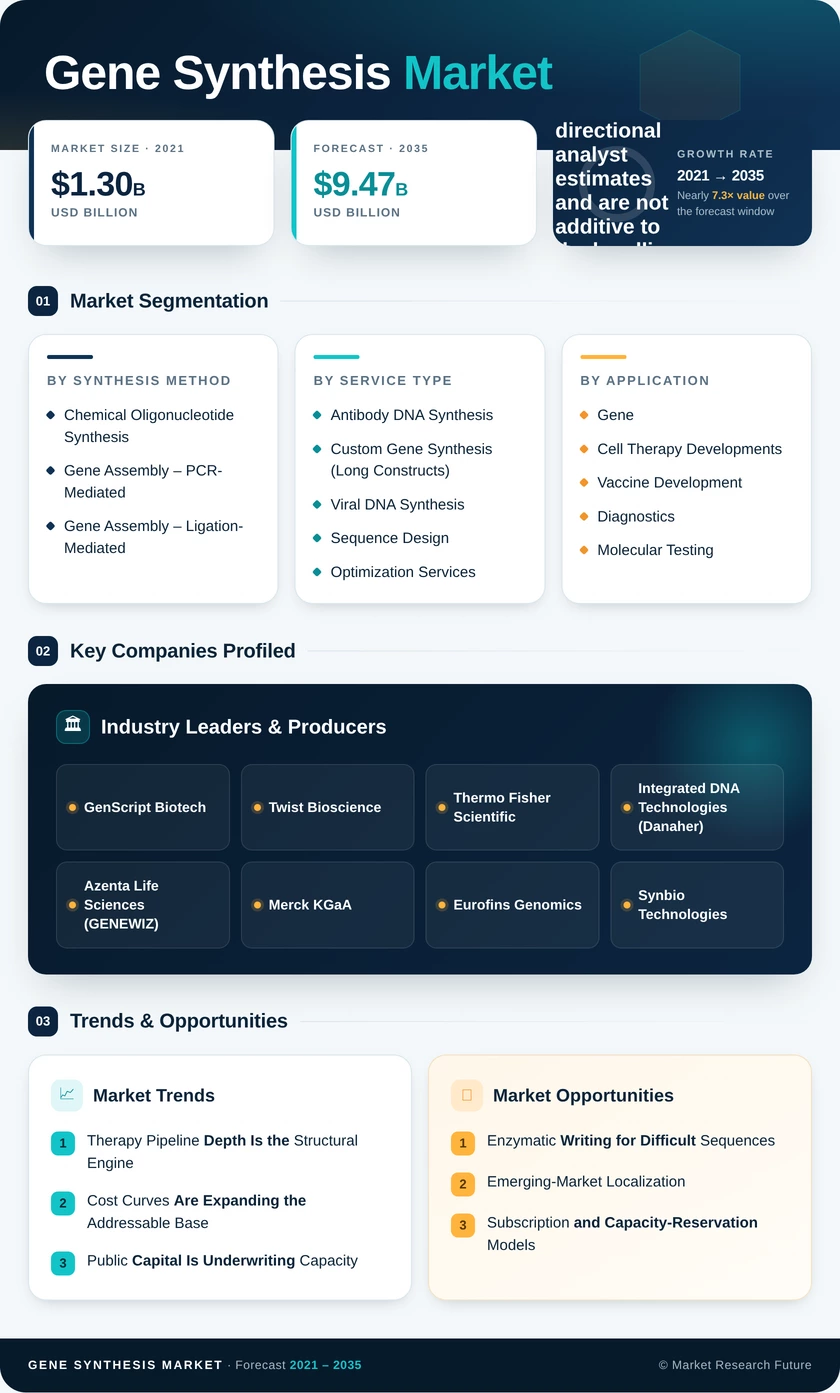
Gene Synthesis Market (2026 - 2035)

ID: MRFR/HC/10104-HCR 128 Pages Rahul Gotadki Last Updated: September 15, 2026
Gene Synthesis Market Research Report: Size, Share, Trend Analysis By Applications (Synthetic Biology, Therapeutics, Vaccines, Genetic Engineering, Agricultural Biotechnology), By Product Type (Gene Libraries, Oligonucleotides, Plasmids, Gene Fragments), By Technology (Polymerase Chain Reaction, Microarray Technology, DNA Sequencing, Automated Synthesis), By End Use (Academic Research, Pharmaceutical Companies, Biotechnology Companies, Contract Research Organizations) and By Regional (North America, Europe, South America, Asia Pacific, Middle East and Africa) - Growth Outlook & Industry Forecast 2025 To 2035
Gene Synthesis Market
Market Size
Forecast Period2026-2035
CAGR (2026-2035)15.2%
2025 Market SizeUSD 2.30 Billion
2035 Market SizeUSD 9.47 Billion
Key Players
GenScript Biotech
Twist Bioscience
Thermo Fisher Scientific
Integrated DNA Technologies
Azenta Life Sciences
Merck KGaA
Opportunities
  • Enzymatic Writing for Difficult Sequences
  • Emerging-Market Localization
  • Subscription and Capacity-Reservation Models
  1. 1 Market Summary |
    1. 1.1 Study Assumptions & Market Definition |
    2. 1.2 Scope of the Study |
    3. 1.3 Research Methodology
  2. 2 Key Report Takeaways |
    1. 2.1 By Synthesis Method |
    2. 2.2 By Service Type and Application |
    3. 2.3 By Geography
  3. 3 Market Size & Forecast (2021–2035) |
    1. 3.1 Historical Market Size (2021–2025) |
    2. 3.2 Current & Forecast Market Size (2026–2035) |
    3. 3.3 Year-over-Year Growth Analysis
  4. 4 Driver Impact Analysis |
    1. 4.1 Therapy Pipeline Depth |
    2. 4.2 Cost Curve Compression |
    3. 4.3 Public Biomanufacturing Capital |
    4. 4.4 Computational Design Demand
  5. 5 Restraints Impact Analysis |
    1. 5.1 Screening & Export-Control Compliance |
    2. 5.2 Complex Construct Failure Rates |
    3. 5.3 Price Commoditization
  6. 6 Opportunity Analysis |
    1. 6.1 Enzymatic Writing for Difficult Sequences |
    2. 6.2 Emerging-Market Localization |
    3. 6.3 Subscription & Capacity-Reservation Models |
    4. 6.4 Design-Data Monetization |
    5. 6.5 Agricultural & Industrial Biology
  7. 7 Regional Analysis |
    1. 7.1 North America | |
      1. 7.1.1 US | |
      2. 7.1.2 Canada | |
      3. 7.1.3 Mexico |
    2. 7.2 Europe | |
      1. 7.2.1 Germany | |
      2. 7.2.2 UK | |
      3. 7.2.3 France | |
      4. 7.2.4 Italy | |
      5. 7.2.5 Spain | |
      6. 7.2.6 Nordic Countries | |
      7. 7.2.7 Russia | |
      8. 7.2.8 Rest of Europe |
    3. 7.3 Asia-Pacific | |
      1. 7.3.1 China | |
      2. 7.3.2 India | |
      3. 7.3.3 Japan | |
      4. 7.3.4 South Korea | |
      5. 7.3.5 ASEAN | |
      6. 7.3.6 Rest of Asia-Pacific |
    4. 7.4 South America | |
      1. 7.4.1 Brazil | |
      2. 7.4.2 Argentina | |
      3. 7.4.3 Rest of South America |
    5. 7.5 Middle East & Africa | |
      1. 7.5.1 Saudi Arabia | |
      2. 7.5.2 UAE | |
      3. 7.5.3 South Africa | |
      4. 7.5.4 Egypt | |
      5. 7.5.5 Rest of Middle East & Africa
  8. 8 Future Outlook (2026–2035) |
    1. 8.1 Computational Design as the Front Door |
    2. 8.2 Platform Economics |
    3. 8.3 Biosecurity Governance |
    4. 8.4 Sustainability in Specification
  9. 9 Market Segmentation Analysis |
    1. 9.1 By Synthesis Method | |
      1. 9.1.1 Chemical Oligonucleotide Synthesis | |
      2. 9.1.2 Gene Assembly – PCR-Mediated | |
      3. 9.1.3 Gene Assembly – Ligation-Mediated |
    2. 9.2 By Service Type | |
      1. 9.2.1 Antibody DNA Synthesis | |
      2. 9.2.2 Custom Gene Synthesis (Long Constructs) | |
      3. 9.2.3 Viral DNA Synthesis | |
      4. 9.2.4 Sequence Design and Optimization Services | |
      5. 9.2.5 Cloning and Subcloning Services |
    3. 9.3 By Application | |
      1. 9.3.1 Gene and Cell Therapy Developments | |
      2. 9.3.2 Vaccine Development | |
      3. 9.3.3 Diagnostics and Molecular Testing | |
      4. 9.3.4 Agricultural and Industrial Biotechnology | |
      5. 9.3.5 Academic and Basic Research |
    4. 9.4 By End User | |
      1. 9.4.1 Biopharmaceutical Companies | |
      2. 9.4.2 Academic and Research Institutes | |
      3. 9.4.3 Contract Research and Manufacturing Organizations | |
      4. 9.4.4 Agricultural and Industrial Biotech Firms
  10. 10 Competitive Landscape |
    1. 10.1 Market Share Analysis (2026) |
    2. 10.2 Competitive Benchmarking Matrix |
    3. 10.3 Company Profiles | |
      1. 10.3.1 GenScript Biotech | |
      2. 10.3.2 Twist Bioscience | |
      3. 10.3.3 Thermo Fisher Scientific | |
      4. 10.3.4 Integrated DNA Technologies | |
      5. 10.3.5 Azenta Life Sciences | |
      6. 10.3.6 Merck KGaA | |
      7. 10.3.7 Eurofins Genomics | |
      8. 10.3.8 Synbio Technologies | |
      9. 10.3.9 ATUM | |
      10. 10.3.10 Telesis Bio | |
      11. 10.3.11 Ansa Biotechnologies
  11. 11 Recent News & Developments
  12. 12 Report Scope & Methodology |
    1. 12.1 Study Period & Base Year |
    2. 12.2 Data Sources |
    3. 12.3 Abbreviations
  13. 13 Detailed Sources & Citations
  14. 14 Frequently Asked Questions
  15. 15 LIST OF TABLES |
  16. TABLE 1 Global Gene Synthesis Market Size & Forecast, by Revenue (USD Billion), 2021–2035 |
  17. TABLE 2 Global Gene Synthesis Market – Year-over-Year Growth Analysis, 2021–2035 |
  18. TABLE 3 Driver Impact Analysis Matrix, 2026–2035 |
  19. TABLE 4 Restraint Impact Analysis Matrix, 2026–2035 |
  20. TABLE 5 Global Market Size, by Region, 2021–2035 (USD Billion) |
  21. TABLE 6 North America Market Size, by Country, 2021–2035 (USD Billion) |
  22. TABLE 7 Europe Market Size, by Country, 2021–2035 (USD Billion) |
  23. TABLE 8 Asia-Pacific Market Size, by Country, 2021–2035 (USD Billion) |
  24. TABLE 9 South America Market Size, by Country, 2021–2035 (USD Billion) |
  25. TABLE 10 Middle East & Africa Market Size, by Country, 2021–2035 (USD Billion) |
  26. TABLE 11 Global Market Size, by Synthesis Method, 2021–2035 (USD Billion) |
  27. TABLE 12 Global Market Size, by Service Type, 2021–2035 (USD Billion) |
  28. TABLE 13 Global Market Size, by Application, 2021–2035 (USD Billion) |
  29. TABLE 14 Global Market Size, by End User, 2021–2035 (USD Billion) |
  30. TABLE 15 North America Market Size, by Application, 2021–2035 (USD Billion) |
  31. TABLE 16 Europe Market Size, by Application, 2021–2035 (USD Billion) |
  32. TABLE 17 Asia-Pacific Market Size, by Application, 2021–2035 (USD Billion) |
  33. TABLE 18 Competitive Benchmarking Matrix, 2026 |
  34. TABLE 19 Company Profiles – Key Players |
  35. TABLE 20 Recent Developments & Strategic Announcements, 2023–2025 |
  36. TABLE 21 Report Scope & Methodology Summary |
  37. TABLE 22 Detailed Sources & Citations Index
  38. 16 LIST OF FIGURES |
  39. FIGURE 1 Market Dynamics – Drivers, Restraints, Opportunities |
  40. FIGURE 2 Industry Value Chain Analysis |
  41. FIGURE 3 Porter's Five Forces Analysis |
  42. FIGURE 4 Global Market Size Trend, 2021–2035 (USD Billion) |
  43. FIGURE 5 Year-over-Year Growth Curve, 2022–2035 |
  44. FIGURE 6 Market Share by Synthesis Method, 2025 vs 2035 |
  45. FIGURE 7 Market Share by Service Type, 2025 |
  46. FIGURE 8 Market Share by Application, 2025 vs 2035 |
  47. FIGURE 9 Market Share by End User, 2025 |
  48. FIGURE 10 Regional Revenue Share, 2025 |
  49. FIGURE 11 Regional CAGR Comparison, 2026–2035 |
  50. FIGURE 12 Asia-Pacific Country Contribution, 2025 |
  51. FIGURE 13 Competitive Landscape – Estimated Revenue Share Bands, 2026 |
  52. FIGURE 14 Supplier Positioning Matrix – Capability vs Turnaround

Segmentation Quick Reference

DimensionSub-SegmentsDominant SegmentFastest Growing Segment
By Synthesis MethodChemical Oligonucleotide Synthesis; Gene Assembly – PCR-Mediated; Gene Assembly – Ligation-MediatedChemical Oligonucleotide SynthesisGene Assembly – Ligation-Mediated
By Service TypeAntibody DNA Synthesis; Custom Gene Synthesis (Long Constructs); Viral DNA Synthesis; Sequence Design and Optimization Services; Cloning and Subcloning ServicesAntibody DNA SynthesisViral DNA Synthesis
By ApplicationGene and Cell Therapy Developments; Vaccine Development; Diagnostics and Molecular Testing; Agricultural and Industrial Biotechnology; Academic and Basic ResearchGene and Cell Therapy DevelopmentsDiagnostics and Molecular Testing
By End UserBiopharmaceutical Companies; Academic and Research Institutes; Contract Research and Manufacturing Organizations; Agricultural and Industrial Biotech FirmsBiopharmaceutical CompaniesContract Research and Manufacturing Organizations
By GeographyNorth America; Europe; Asia-Pacific; South America; Middle East & AfricaNorth AmericaAsia-Pacific


Market Segmentation Overview

By Synthesis Method

Sub-SegmentKey Trend
Chemical Oligonucleotide SynthesisCycle-time optimization and reagent reduction extend incumbent economics
Gene Assembly – PCR-MediatedAutomation of assembly steps compresses standard turnaround
Gene Assembly – Ligation-MediatedPreferred route for repeat-rich and structurally difficult constructs


Method choice increasingly follows sequence difficulty rather than supplier preference. Buyers now specify tolerance for error rate and length, and providers route the order internally to whichever chemistry clears the specification.

By Service Type

Sub-SegmentKey Trend
Antibody DNA SynthesisLarge variable-region panels ordered as single bundled projects
Custom Gene Synthesis (Long Constructs)Growth in multi-kilobase vector and pathway orders
Viral DNA SynthesisVector engineering demand tied to therapy manufacturing
Sequence Design and Optimization ServicesExpression-yield prediction bundled ahead of synthesis
Cloning and Subcloning ServicesAttached to synthesis orders to shorten downstream workflows


Service bundling is the clearest commercial trend. Providers selling only sequence are losing ground to those delivering expression-ready material with validated downstream steps included.

By Application

Sub-SegmentKey Trend
Gene and Cell Therapy DevelopmentsHigh iteration counts create recurring construct demand
Vaccine DevelopmentPlatform readiness sustains baseline ordering between outbreaks
Diagnostics and Molecular TestingDecentralized assay design broadens the buyer base
Agricultural and Industrial BiotechnologyTrait and enzyme programs move from pilot to commercial scale
Academic and Basic ResearchGrant cycles set predictable seasonal ordering rhythms


Application mix determines revenue quality. Therapy and diagnostics buyers reorder continuously, while vaccine demand remains episodic and sensitive to public health funding cycles.

By End User

Sub-SegmentKey Trend
Biopharmaceutical CompaniesShift from purchase orders to reserved-capacity agreements
Academic and Research InstitutesProcurement now conditioned on supplier screening compliance
Contract Research and Manufacturing OrganizationsFastest-growing buyer class as sponsors outsource more programs
Agricultural and Industrial Biotech FirmsRising volumes tied to regulatory clarity on gene-edited products


Buyer sophistication is rising across all four groups. Contract organizations in particular are consolidating spend with fewer suppliers to negotiate throughput guarantees rather than unit discounts.




Download PDF ×

We do not share your information with anyone. However, we may send you emails based on your report interest from time to time. You may contact us at any time to opt-out.