Request Free Sample ×

Kindly complete the form below to receive a free sample of this Report

* Please use a valid business email

Leading companies partner with us for data-driven Insights

clients tt-cursor
Hero Background
English
Chinese
French
Japanese
Korean
German
Spanish

Gel Documentation Systems Market Share

ID: MRFR/MED/5443-HCR
90 Pages
Rahul Gotadki
April 2026

Gel Documentation Systems Market Research Report Information by Product (Instruments, Accessories, Software’s), by Detection Technique (Ultraviolet, Fluorescence, Chemiluminescence), By Application (Protein Quantification, Others), By End User - Global Forecast Till 2035

Share:
Download PDF ×

We do not share your information with anyone. However, we may send you emails based on your report interest from time to time. You may contact us at any time to opt-out.

Gel Documentation Systems Market Infographic
Purchase Options

Market Share

Gel Documentation Systems Market Share Analysis

To capture and sustain market share, the Gel Documentation Systems market, an important part of life sciences and biotechnology research, relies on effective positioning strategies. In this industry, companies use a variety of strategies to differentiate themselves and address varying needs of researchers and laboratories.

A major strategy that flourish in most of these industries is product innovation. This means in a world where technology changes so rapidly one must keep up with it to remain relevant as pertains to Gel Documentation Systems. Companies get involved in researches extensively with an aim to have the latest features such as better imaging capability or create user friendly interfaces or even devices that can be interfaced with other lab equipment. The goal here is that these firms want to attract clients who are interested in cutting edge systems for their changing research needs.

Pricing also influences market share positioning significantly. Other players adopt the strategy of cost leader whereby they offer these Gel Documentation Systems at competitive prices but still maintain quality aspects. Such approach targets many customers including small scale academic institutions that have got tight budgets for investigations. Others highlight themselves as premium providers whose key emphasis is on superior quality, precision as well as reliability. This approach works well with customers who focus more on performance rather than price and therefore do not mind paying more for advanced features and greater reliability.

Another important strategy employed by companies operating within the gel documentation systems market is establishing strong partnerships and collaborations. It is common for firms to partner with academic institutions, pharmaceutical giants as well as research organizations so that they get knowledge about the changing directions in scientific exploration.# These initiatives help firms tailor solutions specific to client’s problems while gaining more brand visibility within scientific community@#@#. For instance, some may lead to exclusive distribution deals thus making the company’s presence felt across various regions.

Gaining market share calls for geographical expansion among others.@ Hence, they try entering into new markets by developing a firm distribution network or entering into partnerships with local firms. This allows firms understand the specific needs of different regions so that they can easily customize their marketing and sales approaches to meet targeted segments in a better way.

Furthermore, the Gel Documentation Systems market requires effective marketing and brand positioning. Companies have comprehensive marketing plans which range from product quality to innovation features or even excellent customer care services#@#.. Consequently, if a company is able to create a strong brand image through marketing, it can not only win new customers but also keep regular ones. Thus, in order to be distinguished among other firms operating in this area, there should be some constant and definite communication about what makes the product valuable contributing thereby to the final choice process of buyers.

For retention purposes, customer support and service are necessary factors when it comes to maintaining the market share.@ Good after-sales support service as well as training programmes coupled with prompt maintenance services enhance customer satisfaction and loyalty.# Satisfying a consumer’s needs will make them buy more from you or even recommend your product within scientific community thus enhancing your reputation as well as market share among others.


Author
Author Profile
Rahul Gotadki
Research Manager

He holds an experience of about 9+ years in Market Research and Business Consulting, working under the spectrum of Life Sciences and Healthcare domains. Rahul conceptualizes and implements a scalable business strategy and provides strategic leadership to the clients. His expertise lies in market estimation, competitive intelligence, pipeline analysis, customer assessment, etc.

Leave a Comment

FAQs

What is the projected market valuation of the Gel Documentation Systems Market by 2035?

The projected market valuation for the Gel Documentation Systems Market is expected to reach 0.5868 USD Billion by 2035.

What was the market valuation of the Gel Documentation Systems Market in 2024?

The overall market valuation of the Gel Documentation Systems Market was 0.3654 USD Billion in 2024.

What is the expected CAGR for the Gel Documentation Systems Market during the forecast period 2025 - 2035?

The expected CAGR for the Gel Documentation Systems Market during the forecast period 2025 - 2035 is 4.4%.

Which companies are considered key players in the Gel Documentation Systems Market?

Key players in the Gel Documentation Systems Market include Bio-Rad Laboratories, Thermo Fisher Scientific, and GE Healthcare, among others.

What are the main product segments in the Gel Documentation Systems Market?

The main product segments in the Gel Documentation Systems Market include Instruments, Accessories, and Software.

How did the Instruments segment perform in terms of valuation from 2024 to 2025?

The Instruments segment valuation increased from 0.15 USD Billion in 2024 to 0.24 USD Billion in 2025.

What detection techniques are utilized in the Gel Documentation Systems Market?

The detection techniques utilized in the Gel Documentation Systems Market include Ultraviolet, Chemiluminescence, and Fluorescence.

What applications are driving growth in the Gel Documentation Systems Market?

Applications driving growth in the Gel Documentation Systems Market include Protein Quantification and Nucleic Acid Quantification.

Which end-user segments are prominent in the Gel Documentation Systems Market?

Prominent end-user segments in the Gel Documentation Systems Market include Pharmaceutical & Biotechnology Companies and Academic Institutes & Research Centers.

What is the expected growth trend for the Accessories segment in the Gel Documentation Systems Market?

The Accessories segment is projected to grow from 0.1 USD Billion in 2024 to 0.16 USD Billion by 2025.

Market Summary

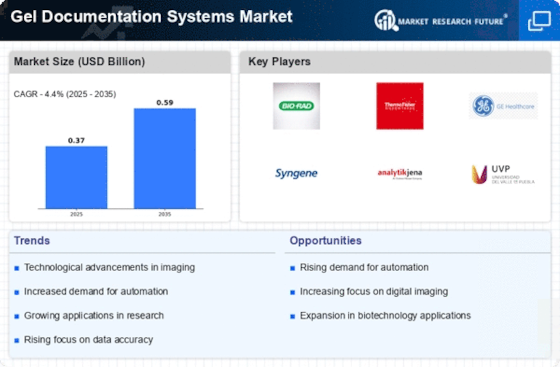
As per Market Research Future analysis, the Gel Documentation Systems Market Size was estimated at 0.3654 USD Billion in 2024. The Gel Documentation Systems industry is projected to grow from USD 0.3815 Billion in 2025 to USD 0.5868 Billion by 2035, exhibiting a compound annual growth rate (CAGR) of 4.4% during the forecast period 2025 - 2035

Key Market Trends & Highlights

The Gel Documentation Systems Market is experiencing robust growth driven by technological advancements and increasing demand for molecular biology applications.

  • North America remains the largest market for gel documentation systems, driven by extensive research activities and funding. The Asia-Pacific region is emerging as the fastest-growing market, fueled by rapid advancements in laboratory automation and technology. Instruments represent the largest segment, while accessories are witnessing the fastest growth due to rising demand for enhanced functionalities. Key market drivers include the rising demand for molecular biology applications and increased funding for research and development.

Market Size & Forecast

2024 Market Size 0.3654 (USD Billion)
2035 Market Size 0.5868 (USD Billion)
CAGR (2025 - 2035) 4.4%
Largest Regional Market Share in 2024 Americas

Major Players

Bio-Rad Laboratories (US), <a href="https://www.thermofisher.com/in/en/home/life-science/protein-biology/protein-assays-analysis/western-blotting/detect-proteins-western-blot/western-blot-imaging-analysis/ibright-systems.html?ef_id=Cj0KCQiAxJXJBhD_ARIsAH_JGjiOSwddmV5ELdfVIwMYwktwqvvvR4xTuooImmUxaQtcWnXL9tIcx7waAh8sEALw_wcB:G:s&amp;s_kwcid=AL!3652!3!772520967059!p!!g!!gel%20doc!22974799656!186525537324&amp;cid=bid_pca_ibt_r01_co_cp1359_pjt0000_bid00000_0se_gaw_nt_lgn_ins&amp;gad_source=1&amp;gad_campaignid=22974799656&amp;gbraid=0AAAAADxi_GTlzdCvZmVtCgNFgX2eDzz3C&amp;gclid=Cj0KCQiAxJXJBhD_ARIsAH_JGjiOSwddmV5ELdfVIwMYwktwqvvvR4xTuooImmUxaQtcWnXL9tIcx7waAh8sEALw_wcB">Thermo Fisher Scientific</a> (US), GE Healthcare (US), Syngene International (IN), Analytik Jena (DE), UVP, LLC (US), Cleaver Scientific (GB), Vilber Lourmat (FR), Major Science (US)

Market Trends

The Gel Documentation Systems Market is currently experiencing a notable evolution, driven by advancements in imaging technology and increasing demand for precise documentation in various scientific fields. This market encompasses a range of products designed to capture and analyze gel electrophoresis results, which are essential in molecular biology, genetics, and biochemistry. As research institutions and laboratories seek to enhance their capabilities, the integration of sophisticated software and high-resolution imaging systems appears to be a focal point. Furthermore, the growing emphasis on reproducibility and accuracy in scientific research is likely to propel the adoption of these systems, as they provide reliable data for critical experiments. In addition to technological advancements, the Gel Documentation Systems Market is influenced by the rising trend of automation in laboratories. Automated systems not only streamline workflows but also minimize human error, thereby improving the overall efficiency of research processes. Moreover, the increasing collaboration between academic institutions and commercial entities suggests a potential for innovation and development in this sector. As the market continues to evolve, it seems poised for growth, with emerging applications in fields such as clinical diagnostics and forensic analysis, which may further expand its reach and relevance in the scientific community.

Technological Advancements

The Gel Documentation Systems Market is witnessing rapid technological advancements, particularly in imaging capabilities. Enhanced resolution and sensitivity in imaging systems are enabling researchers to obtain clearer and more detailed results. This trend is likely to improve the accuracy of data interpretation, which is crucial for various applications in molecular biology and genetics.

Automation in Laboratories

The increasing trend of automation within laboratories is reshaping the Gel Documentation Systems Market. Automated systems are being integrated to streamline workflows, reduce manual intervention, and enhance reproducibility. This shift towards automation may lead to greater efficiency and reliability in experimental processes.

Collaboration Between Sectors

There appears to be a growing collaboration between academic institutions and commercial entities in the Gel Documentation Systems Market. Such partnerships may foster innovation and the development of new technologies, potentially expanding the applications of gel documentation systems in diverse fields, including clinical diagnostics and forensic science.

Gel Documentation Systems Market Market Drivers

Integration of Advanced Imaging Technologies

The Gel Documentation Systems Market is significantly influenced by the integration of advanced imaging technologies. Innovations such as high-resolution cameras and sophisticated software for image analysis are enhancing the functionality of gel documentation systems. These advancements allow for improved visualization and quantification of nucleic acids and proteins, which is essential for accurate experimental results. The market is witnessing a shift towards systems that incorporate features like real-time imaging and automated analysis, which streamline laboratory workflows. As a result, laboratories are increasingly adopting these advanced systems, leading to a projected market growth of around 7% annually. This trend indicates a clear preference for high-performance equipment that can deliver reliable and reproducible results in various research applications.

Expansion of Educational and Training Programs

The Gel Documentation Systems Market is positively impacted by the expansion of educational and training programs in life sciences. As educational institutions enhance their curricula to include more hands-on laboratory training, the demand for gel documentation systems is expected to rise. These systems are essential for teaching students the principles of molecular biology and biochemistry, providing them with practical experience in gel electrophoresis and documentation techniques. The market is projected to grow by approximately 4.5% annually, driven by the increasing number of academic programs and research initiatives that require the use of gel documentation systems. This trend highlights the critical role that these systems play in shaping the next generation of scientists and researchers.

Increased Funding for Research and Development

The Gel Documentation Systems Market is benefiting from increased funding for research and development across various sectors, including academia, pharmaceuticals, and biotechnology. Governments and private organizations are investing significantly in scientific research, which in turn drives the demand for advanced laboratory equipment, including gel documentation systems. This influx of funding is expected to enhance the capabilities of research institutions, allowing them to acquire state-of-the-art gel documentation systems that meet their evolving needs. As a result, the market is anticipated to expand, with a projected growth rate of approximately 5.5% over the next few years. This trend underscores the importance of gel documentation systems in facilitating cutting-edge research and development initiatives.

Rising Demand for Molecular Biology Applications

The Gel Documentation Systems Market is experiencing a notable increase in demand driven by the expanding applications in molecular biology. As research in genetics and genomics continues to evolve, the need for precise and reliable documentation of gel electrophoresis results becomes paramount. The market is projected to grow at a compound annual growth rate of approximately 6.5% over the next five years, reflecting the increasing reliance on these systems in academic and clinical laboratories. This growth is further fueled by the rising number of research initiatives focusing on DNA and RNA analysis, which necessitate high-quality imaging and documentation solutions. Consequently, manufacturers are innovating to enhance the capabilities of gel documentation systems, ensuring they meet the rigorous standards required in molecular biology research.

Growing Emphasis on Quality Control in Laboratories

The Gel Documentation Systems Market is increasingly shaped by the growing emphasis on quality control within laboratories. As regulatory standards become more stringent, laboratories are required to implement robust quality assurance protocols, which include accurate documentation of experimental results. Gel documentation systems play a crucial role in ensuring compliance with these standards by providing reliable imaging and data management solutions. The market is likely to see a rise in demand for systems that offer enhanced features for data integrity and traceability. This shift is expected to contribute to a market growth rate of around 6% annually, as laboratories prioritize investments in equipment that supports their quality control initiatives and enhances overall operational efficiency.

Market Segment Insights

By Product: Instruments (Largest) vs. Accessories (Fastest-Growing)

The Gel Documentation Systems Market is characterized by a diverse range of products, with Instruments holding the largest market share. This category includes essential tools such as imaging systems and electrophoresis devices, which are crucial for gel documentation. Accessories, while smaller in overall share, are rapidly gaining traction due to the increasing emphasis on optimizing lab workflows and integrating advanced technologies. As researchers look for ways to enhance their gel documentation processes, the demand for specialized accessories is growing significantly.

Instruments (Dominant) vs. Accessories (Emerging)

Instruments play a dominant role in the Gel Documentation Systems Market, representing the backbone of gel imaging technology. They encompass advanced systems capable of high-resolution imaging and digital processing, essential for accurate results in molecular biology. Conversely, Accessories are emerging as vital adjuncts, providing support tools such as gel trays, stain reagents, and imaging filters which enhance the functionality and versatility of existing instruments. This growing trend indicates a shift toward comprehensive solutions that integrate various tools, addressing specific laboratory needs and fostering innovation in the field.

By Detection Technique: Fluorescence (Largest) vs. Chemiluminescence (Fastest-Growing)

In the Gel Documentation Systems Market, the Detection Technique segment is predominantly driven by <a href="https://www.marketresearchfuture.com/reports/fluorometer-market-29673">Fluorescence</a>, which commands the largest market share due to its widespread application and reliability in various settings. This technique is favored for its sensitivity and ability to deliver high-resolution images, which makes it essential for laboratories aiming for precision and accuracy in gel documentation. Conversely, Chemiluminescence, while currently holding a smaller share, is rapidly gaining traction and is recognized as the fastest-growing detection technique. Its unique advantages in visualizing subtle signals without the need for a fluorescence tag are attracting increasing interest among researchers and scientists. The growth trends within the Detection Technique segment of the Gel Documentation Systems Market reveal a shift towards more advanced methodologies and technologies. This evolution is driven by the continuous demand for improved imaging quality and ease of use in research environments. Increasing investments in R&amp;D are further propelling the adoption of Chemiluminescence, as it enables the detection of low-abundance targets with high specificity. As the biotechnology and life sciences sectors expand, the demand for versatile detection methods is expected to increase, favoring the integration of Chemiluminescence into standard workflows alongside established methods like Fluorescence.

Detection Technique: Fluorescence (Dominant) vs. Chemiluminescence (Emerging)

Fluorescence stands as the dominant detection technique within the Gel Documentation Systems Market due to its extensive utility in various applications, including nucleic acid and protein analysis. Its inherent capabilities to offer high sensitivity and reproducibility make it a preferred choice among laboratories worldwide. The technology relies on fluorescent dyes and tags, allowing for the visualization of samples under specific light conditions, which enhances detection clarity. On the other hand, Chemiluminescence, though classified as emerging, is swiftly becoming a noteworthy contender. It harnesses the light produced from chemical reactions to detect biomolecules, providing the advantage of avoiding background noise associated with fluorescence. As research focuses on enhancing detection methods, Chemiluminescence is increasingly favored for its specificity and efficiency, positioning it as a significant player in the evolving Gel Documentation Systems Market landscape.

By Application: Protein Quantification (Largest) vs. Nucleic Acid Quantification (Fastest-Growing)

In the Gel Documentation Systems Market, the application segment showcases a clear distribution with Protein Quantification leading as the largest segment. This dominance can be attributed to the foundational role protein analysis plays in various laboratories and clinical settings. Conversely, Nucleic Acid Quantification is emerging rapidly, gaining traction particularly in research institutions focusing on genomics and molecular biology, thus marking its significance in the segment landscape.

Protein Quantification (Dominant) vs. Nucleic Acid Quantification (Emerging)

Protein Quantification stands as the dominant force within the Gel Documentation Systems Market, primarily due to its extensive applications in biochemistry and clinical diagnostics. The techniques involved are essential for protein analysis, making it integral to numerous research fields. On the other hand, Nucleic Acid Quantification is recognized as an emerging segment, driven by the surging demand for genomic research and personalized medicine. This segment benefits from advancements in technology which enhance accuracy and efficiency, positioning it as a critical player for future growth in the market.

By End User: Pharmaceutical & Biotechnology Companies (Largest) vs. Diagnostic Laboratories (Fastest-Growing)

In the Gel Documentation Systems Market, the segment of Pharmaceutical &amp; Biotechnology Companies dominates the overall market share, contributing significantly due to their extensive research and development activities. This sector utilizes gel documentation systems for various applications, including DNA analysis and protein separation, further bolstering its position as a market leader. In contrast, Diagnostic Laboratories, while currently holding a smaller market share, exhibit remarkable growth trends driven by increasing demand for precise and efficient diagnostic tools essential for various medical conditions.

Pharmaceutical &amp; Biotechnology Companies (Dominant) vs. Diagnostic Laboratories (Emerging)

The Pharmaceutical &amp; Biotechnology Companies segment is characterized by its robust funding for research activities and a continuous need for advanced gel documentation systems to support various applications, including drug development and genetic research. This segment's operational scale often allows for streamlined processes and technological integration, further solidifying its dominant market position. On the other hand, the Diagnostic Laboratories segment is emerging rapidly due to growing investments in healthcare and an increasing emphasis on precision diagnostics. These laboratories require gel documentation systems to enhance their efficiency in processing samples and delivering accurate results, making it a significant player in the evolving landscape of the Gel Documentation Systems Market.

Get more detailed insights about Gel Documentation Systems Market Research Report - Global Forecast till 2035

Regional Insights

North America : Innovation and Market Leadership

North America is the largest market for gel documentation systems, accounting for approximately 45% of the global market share. The region's growth is driven by advancements in biotechnology, increasing research activities, and stringent regulatory standards that promote high-quality laboratory practices. The demand for gel documentation systems is further fueled by the rising prevalence of genetic disorders and the need for effective diagnostic tools. The United States leads the North American market, supported by a robust presence of key players such as Bio-Rad Laboratories, Thermo Fisher Scientific, and GE Healthcare. The competitive landscape is characterized by continuous innovation and strategic partnerships among these companies, enhancing their product offerings. The region's strong research infrastructure and funding for scientific studies also contribute to its market dominance.

Europe : Regulatory Compliance and Growth

Europe is the second-largest market for gel documentation systems, holding around 30% of the global market share. The region's growth is propelled by increasing investments in life sciences and biotechnology, alongside stringent regulatory frameworks that ensure product quality and safety. The demand for gel documentation systems is also influenced by the rising number of research institutions and laboratories focusing on genetic research and diagnostics. Leading countries in Europe include Germany, France, and the UK, where key players like Analytik Jena and Vilber Lourmat are prominent. The competitive landscape is marked by a focus on innovation and compliance with EU regulations, which drive companies to enhance their product features. The presence of established research institutions further supports market growth, fostering collaboration between academia and industry.

Asia-Pacific : Rapid Growth and Adoption

Asia-Pacific is witnessing rapid growth in the gel documentation systems market, driven by increasing investments in research and development, particularly in countries like China and India. The region is expected to capture around 20% of the global market share by 2025. Factors such as rising healthcare expenditures and a growing emphasis on biotechnology research are propelling demand for advanced laboratory equipment, including gel documentation systems. China and India are the leading countries in this region, with a burgeoning number of research institutions and laboratories. The competitive landscape is evolving, with both local and international players, such as Syngene International, expanding their presence. The region's focus on enhancing research capabilities and improving healthcare outcomes is expected to further boost market growth, making it a key area for investment.

Middle East and Africa : Emerging Market with Potential

The Middle East and Africa region is gradually emerging in the gel documentation systems market, currently holding about 5% of the global market share. The growth is driven by increasing investments in healthcare infrastructure and research initiatives, particularly in countries like South Africa and the UAE. The demand for gel documentation systems is expected to rise as more laboratories are established and research activities expand in the region. South Africa is a key player in this market, with a growing number of research institutions focusing on biotechnology and genetic studies. The competitive landscape is characterized by a mix of local and international companies, with opportunities for growth as the region enhances its research capabilities. The increasing collaboration between governments and private sectors is also expected to foster market development, making it an attractive area for investment.

Key Players and Competitive Insights

The Gel Documentation Systems Market is currently characterized by a dynamic competitive landscape, driven by technological advancements and increasing demand for high-quality imaging solutions in research and clinical laboratories. Key players such as Bio-Rad Laboratories (US), Thermo Fisher Scientific (US), and GE Healthcare (US) are at the forefront, each adopting distinct strategies to enhance their market positioning. Bio-Rad Laboratories (US) emphasizes innovation in imaging technology, focusing on developing user-friendly systems that integrate seamlessly with existing laboratory workflows. Meanwhile, Thermo Fisher Scientific (US) is pursuing a strategy of regional expansion, targeting emerging markets to broaden its customer base. GE Healthcare (US) appears to be concentrating on digital transformation, leveraging data analytics to improve the functionality and efficiency of its gel documentation systems. Collectively, these strategies contribute to a competitive environment that is increasingly focused on technological differentiation and customer-centric solutions.

In terms of business tactics, companies are increasingly localizing manufacturing to reduce lead times and optimize supply chains. This approach not only enhances operational efficiency but also allows for better responsiveness to regional market demands. The Gel Documentation Systems Market is moderately fragmented, with several key players exerting influence over various segments. The collective actions of these companies indicate a trend towards consolidation, as they seek to enhance their competitive edge through strategic partnerships and collaborations.

In August 2025, Bio-Rad Laboratories (US) announced the launch of a new gel imaging system that incorporates advanced AI algorithms for image analysis. This strategic move is significant as it positions Bio-Rad at the cutting edge of technology, potentially attracting a broader customer base interested in enhanced imaging capabilities. The integration of AI not only improves the accuracy of results but also streamlines the workflow for researchers, thereby reinforcing Bio-Rad's commitment to innovation.

In September 2025, Thermo Fisher Scientific (US) expanded its manufacturing facility in India, a strategic decision aimed at increasing production capacity and meeting the growing demand in the Asia-Pacific region. This expansion is indicative of Thermo Fisher's focus on regional growth and its intent to capitalize on the burgeoning market for gel documentation systems in emerging economies. By localizing production, the company can reduce costs and improve supply chain efficiency, which is likely to enhance its competitive position.

In July 2025, GE Healthcare (US) entered into a partnership with a leading software company to develop cloud-based solutions for gel documentation systems. This collaboration is pivotal as it aligns with the ongoing trend towards digitalization in laboratory settings. By integrating cloud technology, GE Healthcare aims to provide users with enhanced data management capabilities, thereby improving the overall user experience and operational efficiency. This strategic alliance not only strengthens GE's product offerings but also positions it favorably in a market increasingly driven by digital solutions.

As of October 2025, the Gel Documentation Systems Market is witnessing trends that emphasize digitalization, sustainability, and the integration of artificial intelligence. Strategic alliances are becoming increasingly important, as companies recognize the need to collaborate to enhance their technological capabilities and market reach. Looking ahead, competitive differentiation is likely to evolve from traditional price-based competition to a focus on innovation, advanced technology, and reliable supply chains. This shift suggests that companies that prioritize research and development, alongside strategic partnerships, will be better positioned to thrive in this rapidly changing landscape.

Key Companies in the Gel Documentation Systems Market include

Industry Developments

A definitive business combination agreement has been reached between Gelesis, Inc., a biotherapeutics company developing biomimetic superabsorbent hydrogels to treat excess weight and metabolic disorders, and Capstar Special Purpose Acquisition Corp., a special purpose acquisition company sponsored by Capstar Partners, LLC affiliates and certain private funds managed by PIMCO. Gelesis hopes to revolutionize weight management with the successful beta launch of its first product, Plenity, which is developed using a unique biomimetic medicinal platform.

Researchers at the Universidad Carlos III de Madrid (UC3M) have created a system that uses computer vision techniques to analyze biomedical movies acquired by microscopy in order to characterize and describe the behavior of the cells shown in the images. These novel methods have been applied to measuring live tissues. As a result, the researchers observed that neutrophils immune cells exhibit several behaviors in the blood during inflammatory processes, one of which is linked to the development of cardiovascular disease and is induced by the Fgr protein.Intended Audience:

  • Gel Documentation System Manufacturers and Distributors
  • Pharmaceutical and Biotechnological Companies
  • Contract Research Organizations
  • Academic and Research Institutes
  • Government Associations

Future Outlook

Gel Documentation Systems Market Future Outlook

The Gel Documentation Systems Market is projected to grow at a 4.4% CAGR from 2025 to 2035, driven by technological advancements and increasing demand for efficient laboratory solutions.

New opportunities lie in:

  • <p>Integration of AI for automated image analysis Development of portable gel documentation systems Expansion into emerging markets with tailored solutions</p>

By 2035, the market is expected to achieve robust growth, reflecting evolving laboratory needs.

Market Segmentation

Gel Documentation Systems Market Product Outlook

  • Instruments
  • Accessories
  • Software

Gel Documentation Systems Market End User Outlook

  • Pharmaceutical & Biotechnology Companies
  • Academic Institutes & Research Centers
  • Diagnostic Laboratories
  • Others

Gel Documentation Systems Market Application Outlook

  • Protein Quantification
  • Nucleic Acid Quantification
  • Others

Gel Documentation Systems Market Detection Technique Outlook

  • Ultraviolet
  • Chemiluminescence
  • Fluorescence

Report Scope

MARKET SIZE 2024 0.3654(USD Billion)
MARKET SIZE 2025 0.3815(USD Billion)
MARKET SIZE 2035 0.5868(USD Billion)
COMPOUND ANNUAL GROWTH RATE (CAGR) 4.4% (2025 - 2035)
REPORT COVERAGE Revenue Forecast, Competitive Landscape, Growth Factors, and Trends
BASE YEAR 2024
Market Forecast Period 2025 - 2035
Historical Data 2019 - 2024
Market Forecast Units USD Billion
Key Companies Profiled Bio-Rad Laboratories (US), Thermo Fisher Scientific (US), GE Healthcare (US), Syngene International (IN), Analytik Jena (DE), UVP, LLC (US), Cleaver Scientific (GB), Vilber Lourmat (FR), Major Science (US)
Segments Covered Product, Detection Technique, Application, End User - Global Forecast Till 2035
Key Market Opportunities Integration of advanced imaging technologies enhances capabilities in the Gel Documentation Systems Market.
Key Market Dynamics Technological advancements and increasing demand for high-resolution imaging drive innovation in the Gel Documentation Systems market.
Countries Covered North America, Europe, APAC, South America, MEA

FAQs

What is the projected market valuation of the Gel Documentation Systems Market by 2035?

The projected market valuation for the Gel Documentation Systems Market is expected to reach 0.5868 USD Billion by 2035.

What was the market valuation of the Gel Documentation Systems Market in 2024?

The overall market valuation of the Gel Documentation Systems Market was 0.3654 USD Billion in 2024.

What is the expected CAGR for the Gel Documentation Systems Market during the forecast period 2025 - 2035?

The expected CAGR for the Gel Documentation Systems Market during the forecast period 2025 - 2035 is 4.4%.

Which companies are considered key players in the Gel Documentation Systems Market?

Key players in the Gel Documentation Systems Market include Bio-Rad Laboratories, Thermo Fisher Scientific, and GE Healthcare, among others.

What are the main product segments in the Gel Documentation Systems Market?

The main product segments in the Gel Documentation Systems Market include Instruments, Accessories, and Software.

How did the Instruments segment perform in terms of valuation from 2024 to 2025?

The Instruments segment valuation increased from 0.15 USD Billion in 2024 to 0.24 USD Billion in 2025.

What detection techniques are utilized in the Gel Documentation Systems Market?

The detection techniques utilized in the Gel Documentation Systems Market include Ultraviolet, Chemiluminescence, and Fluorescence.

What applications are driving growth in the Gel Documentation Systems Market?

Applications driving growth in the Gel Documentation Systems Market include Protein Quantification and Nucleic Acid Quantification.

Which end-user segments are prominent in the Gel Documentation Systems Market?

Prominent end-user segments in the Gel Documentation Systems Market include Pharmaceutical &amp; Biotechnology Companies and Academic Institutes &amp; Research Centers.

What is the expected growth trend for the Accessories segment in the Gel Documentation Systems Market?

The Accessories segment is projected to grow from 0.1 USD Billion in 2024 to 0.16 USD Billion by 2025.

  1. SECTION I: EXECUTIVE SUMMARY AND KEY HIGHLIGHTS
    1. | 1.1 EXECUTIVE SUMMARY
    2. | | 1.1.1 Market Overview
    3. | | 1.1.2 Key Findings
    4. | | 1.1.3 Market Segmentation
    5. | | 1.1.4 Competitive Landscape
    6. | | 1.1.5 Challenges and Opportunities
    7. | | 1.1.6 Future Outlook
  2. SECTION II: SCOPING, METHODOLOGY AND MARKET STRUCTURE
    1. | 2.1 MARKET INTRODUCTION
    2. | | 2.1.1 Definition
    3. | | 2.1.2 Scope of the study
    4. | | | 2.1.2.1 Research Objective
    5. | | | 2.1.2.2 Assumption
    6. | | | 2.1.2.3 Limitations
    7. | 2.2 RESEARCH METHODOLOGY
    8. | | 2.2.1 Overview
    9. | | 2.2.2 Data Mining
    10. | | 2.2.3 Secondary Research
    11. | | 2.2.4 Primary Research
    12. | | | 2.2.4.1 Primary Interviews and Information Gathering Process
    13. | | | 2.2.4.2 Breakdown of Primary Respondents
    14. | | 2.2.5 Forecasting Model
    15. | | 2.2.6 Market Size Estimation
    16. | | | 2.2.6.1 Bottom-Up Approach
    17. | | | 2.2.6.2 Top-Down Approach
    18. | | 2.2.7 Data Triangulation
    19. | | 2.2.8 Validation
  3. SECTION III: QUALITATIVE ANALYSIS
    1. | 3.1 MARKET DYNAMICS
    2. | | 3.1.1 Overview
    3. | | 3.1.2 Drivers
    4. | | 3.1.3 Restraints
    5. | | 3.1.4 Opportunities
    6. | 3.2 MARKET FACTOR ANALYSIS
    7. | | 3.2.1 Value chain Analysis
    8. | | 3.2.2 Porter's Five Forces Analysis
    9. | | | 3.2.2.1 Bargaining Power of Suppliers
    10. | | | 3.2.2.2 Bargaining Power of Buyers
    11. | | | 3.2.2.3 Threat of New Entrants
    12. | | | 3.2.2.4 Threat of Substitutes
    13. | | | 3.2.2.5 Intensity of Rivalry
    14. | | 3.2.3 COVID-19 Impact Analysis
    15. | | | 3.2.3.1 Market Impact Analysis
    16. | | | 3.2.3.2 Regional Impact
    17. | | | 3.2.3.3 Opportunity and Threat Analysis
  4. SECTION IV: QUANTITATIVE ANALYSIS
    1. | 4.1 Healthcare, BY Product (USD Billion)
    2. | | 4.1.1 Instruments
    3. | | 4.1.2 Accessories
    4. | | 4.1.3 Software
    5. | 4.2 Healthcare, BY Detection Technique (USD Billion)
    6. | | 4.2.1 Ultraviolet
    7. | | 4.2.2 Chemiluminescence
    8. | | 4.2.3 Fluorescence
    9. | 4.3 Healthcare, BY Application (USD Billion)
    10. | | 4.3.1 Protein Quantification
    11. | | 4.3.2 Nucleic Acid Quantification
    12. | | 4.3.3 Others
    13. | 4.4 Healthcare, BY End User (USD Billion)
    14. | | 4.4.1 Pharmaceutical & Biotechnology Companies
    15. | | 4.4.2 Academic Institutes & Research Centers
    16. | | 4.4.3 Diagnostic Laboratories
    17. | | 4.4.4 Others
    18. | 4.5 Healthcare, BY Region (USD Billion)
    19. | | 4.5.1 North America
    20. | | | 4.5.1.1 US
    21. | | | 4.5.1.2 Canada
    22. | | 4.5.2 Europe
    23. | | | 4.5.2.1 Germany
    24. | | | 4.5.2.2 UK
    25. | | | 4.5.2.3 France
    26. | | | 4.5.2.4 Russia
    27. | | | 4.5.2.5 Italy
    28. | | | 4.5.2.6 Spain
    29. | | | 4.5.2.7 Rest of Europe
    30. | | 4.5.3 APAC
    31. | | | 4.5.3.1 China
    32. | | | 4.5.3.2 India
    33. | | | 4.5.3.3 Japan
    34. | | | 4.5.3.4 South Korea
    35. | | | 4.5.3.5 Malaysia
    36. | | | 4.5.3.6 Thailand
    37. | | | 4.5.3.7 Indonesia
    38. | | | 4.5.3.8 Rest of APAC
    39. | | 4.5.4 South America
    40. | | | 4.5.4.1 Brazil
    41. | | | 4.5.4.2 Mexico
    42. | | | 4.5.4.3 Argentina
    43. | | | 4.5.4.4 Rest of South America
    44. | | 4.5.5 MEA
    45. | | | 4.5.5.1 GCC Countries
    46. | | | 4.5.5.2 South Africa
    47. | | | 4.5.5.3 Rest of MEA
  5. SECTION V: COMPETITIVE ANALYSIS
    1. | 5.1 Competitive Landscape
    2. | | 5.1.1 Overview
    3. | | 5.1.2 Competitive Analysis
    4. | | 5.1.3 Market share Analysis
    5. | | 5.1.4 Major Growth Strategy in the Healthcare
    6. | | 5.1.5 Competitive Benchmarking
    7. | | 5.1.6 Leading Players in Terms of Number of Developments in the Healthcare
    8. | | 5.1.7 Key developments and growth strategies
    9. | | | 5.1.7.1 New Product Launch/Service Deployment
    10. | | | 5.1.7.2 Merger & Acquisitions
    11. | | | 5.1.7.3 Joint Ventures
    12. | | 5.1.8 Major Players Financial Matrix
    13. | | | 5.1.8.1 Sales and Operating Income
    14. | | | 5.1.8.2 Major Players R&D Expenditure. 2023
    15. | 5.2 Company Profiles
    16. | | 5.2.1 Bio-Rad Laboratories (US)
    17. | | | 5.2.1.1 Financial Overview
    18. | | | 5.2.1.2 Products Offered
    19. | | | 5.2.1.3 Key Developments
    20. | | | 5.2.1.4 SWOT Analysis
    21. | | | 5.2.1.5 Key Strategies
    22. | | 5.2.2 Thermo Fisher Scientific (US)
    23. | | | 5.2.2.1 Financial Overview
    24. | | | 5.2.2.2 Products Offered
    25. | | | 5.2.2.3 Key Developments
    26. | | | 5.2.2.4 SWOT Analysis
    27. | | | 5.2.2.5 Key Strategies
    28. | | 5.2.3 GE Healthcare (US)
    29. | | | 5.2.3.1 Financial Overview
    30. | | | 5.2.3.2 Products Offered
    31. | | | 5.2.3.3 Key Developments
    32. | | | 5.2.3.4 SWOT Analysis
    33. | | | 5.2.3.5 Key Strategies
    34. | | 5.2.4 Syngene International (IN)
    35. | | | 5.2.4.1 Financial Overview
    36. | | | 5.2.4.2 Products Offered
    37. | | | 5.2.4.3 Key Developments
    38. | | | 5.2.4.4 SWOT Analysis
    39. | | | 5.2.4.5 Key Strategies
    40. | | 5.2.5 Analytik Jena (DE)
    41. | | | 5.2.5.1 Financial Overview
    42. | | | 5.2.5.2 Products Offered
    43. | | | 5.2.5.3 Key Developments
    44. | | | 5.2.5.4 SWOT Analysis
    45. | | | 5.2.5.5 Key Strategies
    46. | | 5.2.6 UVP, LLC (US)
    47. | | | 5.2.6.1 Financial Overview
    48. | | | 5.2.6.2 Products Offered
    49. | | | 5.2.6.3 Key Developments
    50. | | | 5.2.6.4 SWOT Analysis
    51. | | | 5.2.6.5 Key Strategies
    52. | | 5.2.7 Cleaver Scientific (GB)
    53. | | | 5.2.7.1 Financial Overview
    54. | | | 5.2.7.2 Products Offered
    55. | | | 5.2.7.3 Key Developments
    56. | | | 5.2.7.4 SWOT Analysis
    57. | | | 5.2.7.5 Key Strategies
    58. | | 5.2.8 Vilber Lourmat (FR)
    59. | | | 5.2.8.1 Financial Overview
    60. | | | 5.2.8.2 Products Offered
    61. | | | 5.2.8.3 Key Developments
    62. | | | 5.2.8.4 SWOT Analysis
    63. | | | 5.2.8.5 Key Strategies
    64. | | 5.2.9 Major Science (US)
    65. | | | 5.2.9.1 Financial Overview
    66. | | | 5.2.9.2 Products Offered
    67. | | | 5.2.9.3 Key Developments
    68. | | | 5.2.9.4 SWOT Analysis
    69. | | | 5.2.9.5 Key Strategies
    70. | 5.3 Appendix
    71. | | 5.3.1 References
    72. | | 5.3.2 Related Reports
  6. LIST OF FIGURES
    1. | 6.1 MARKET SYNOPSIS
    2. | 6.2 NORTH AMERICA MARKET ANALYSIS
    3. | 6.3 US MARKET ANALYSIS BY PRODUCT
    4. | 6.4 US MARKET ANALYSIS BY DETECTION TECHNIQUE
    5. | 6.5 US MARKET ANALYSIS BY APPLICATION
    6. | 6.6 US MARKET ANALYSIS BY END USER
    7. | 6.7 CANADA MARKET ANALYSIS BY PRODUCT
    8. | 6.8 CANADA MARKET ANALYSIS BY DETECTION TECHNIQUE
    9. | 6.9 CANADA MARKET ANALYSIS BY APPLICATION
    10. | 6.10 CANADA MARKET ANALYSIS BY END USER
    11. | 6.11 EUROPE MARKET ANALYSIS
    12. | 6.12 GERMANY MARKET ANALYSIS BY PRODUCT
    13. | 6.13 GERMANY MARKET ANALYSIS BY DETECTION TECHNIQUE
    14. | 6.14 GERMANY MARKET ANALYSIS BY APPLICATION
    15. | 6.15 GERMANY MARKET ANALYSIS BY END USER
    16. | 6.16 UK MARKET ANALYSIS BY PRODUCT
    17. | 6.17 UK MARKET ANALYSIS BY DETECTION TECHNIQUE
    18. | 6.18 UK MARKET ANALYSIS BY APPLICATION
    19. | 6.19 UK MARKET ANALYSIS BY END USER
    20. | 6.20 FRANCE MARKET ANALYSIS BY PRODUCT
    21. | 6.21 FRANCE MARKET ANALYSIS BY DETECTION TECHNIQUE
    22. | 6.22 FRANCE MARKET ANALYSIS BY APPLICATION
    23. | 6.23 FRANCE MARKET ANALYSIS BY END USER
    24. | 6.24 RUSSIA MARKET ANALYSIS BY PRODUCT
    25. | 6.25 RUSSIA MARKET ANALYSIS BY DETECTION TECHNIQUE
    26. | 6.26 RUSSIA MARKET ANALYSIS BY APPLICATION
    27. | 6.27 RUSSIA MARKET ANALYSIS BY END USER
    28. | 6.28 ITALY MARKET ANALYSIS BY PRODUCT
    29. | 6.29 ITALY MARKET ANALYSIS BY DETECTION TECHNIQUE
    30. | 6.30 ITALY MARKET ANALYSIS BY APPLICATION
    31. | 6.31 ITALY MARKET ANALYSIS BY END USER
    32. | 6.32 SPAIN MARKET ANALYSIS BY PRODUCT
    33. | 6.33 SPAIN MARKET ANALYSIS BY DETECTION TECHNIQUE
    34. | 6.34 SPAIN MARKET ANALYSIS BY APPLICATION
    35. | 6.35 SPAIN MARKET ANALYSIS BY END USER
    36. | 6.36 REST OF EUROPE MARKET ANALYSIS BY PRODUCT
    37. | 6.37 REST OF EUROPE MARKET ANALYSIS BY DETECTION TECHNIQUE
    38. | 6.38 REST OF EUROPE MARKET ANALYSIS BY APPLICATION
    39. | 6.39 REST OF EUROPE MARKET ANALYSIS BY END USER
    40. | 6.40 APAC MARKET ANALYSIS
    41. | 6.41 CHINA MARKET ANALYSIS BY PRODUCT
    42. | 6.42 CHINA MARKET ANALYSIS BY DETECTION TECHNIQUE
    43. | 6.43 CHINA MARKET ANALYSIS BY APPLICATION
    44. | 6.44 CHINA MARKET ANALYSIS BY END USER
    45. | 6.45 INDIA MARKET ANALYSIS BY PRODUCT
    46. | 6.46 INDIA MARKET ANALYSIS BY DETECTION TECHNIQUE
    47. | 6.47 INDIA MARKET ANALYSIS BY APPLICATION
    48. | 6.48 INDIA MARKET ANALYSIS BY END USER
    49. | 6.49 JAPAN MARKET ANALYSIS BY PRODUCT
    50. | 6.50 JAPAN MARKET ANALYSIS BY DETECTION TECHNIQUE
    51. | 6.51 JAPAN MARKET ANALYSIS BY APPLICATION
    52. | 6.52 JAPAN MARKET ANALYSIS BY END USER
    53. | 6.53 SOUTH KOREA MARKET ANALYSIS BY PRODUCT
    54. | 6.54 SOUTH KOREA MARKET ANALYSIS BY DETECTION TECHNIQUE
    55. | 6.55 SOUTH KOREA MARKET ANALYSIS BY APPLICATION
    56. | 6.56 SOUTH KOREA MARKET ANALYSIS BY END USER
    57. | 6.57 MALAYSIA MARKET ANALYSIS BY PRODUCT
    58. | 6.58 MALAYSIA MARKET ANALYSIS BY DETECTION TECHNIQUE
    59. | 6.59 MALAYSIA MARKET ANALYSIS BY APPLICATION
    60. | 6.60 MALAYSIA MARKET ANALYSIS BY END USER
    61. | 6.61 THAILAND MARKET ANALYSIS BY PRODUCT
    62. | 6.62 THAILAND MARKET ANALYSIS BY DETECTION TECHNIQUE
    63. | 6.63 THAILAND MARKET ANALYSIS BY APPLICATION
    64. | 6.64 THAILAND MARKET ANALYSIS BY END USER
    65. | 6.65 INDONESIA MARKET ANALYSIS BY PRODUCT
    66. | 6.66 INDONESIA MARKET ANALYSIS BY DETECTION TECHNIQUE
    67. | 6.67 INDONESIA MARKET ANALYSIS BY APPLICATION
    68. | 6.68 INDONESIA MARKET ANALYSIS BY END USER
    69. | 6.69 REST OF APAC MARKET ANALYSIS BY PRODUCT
    70. | 6.70 REST OF APAC MARKET ANALYSIS BY DETECTION TECHNIQUE
    71. | 6.71 REST OF APAC MARKET ANALYSIS BY APPLICATION
    72. | 6.72 REST OF APAC MARKET ANALYSIS BY END USER
    73. | 6.73 SOUTH AMERICA MARKET ANALYSIS
    74. | 6.74 BRAZIL MARKET ANALYSIS BY PRODUCT
    75. | 6.75 BRAZIL MARKET ANALYSIS BY DETECTION TECHNIQUE
    76. | 6.76 BRAZIL MARKET ANALYSIS BY APPLICATION
    77. | 6.77 BRAZIL MARKET ANALYSIS BY END USER
    78. | 6.78 MEXICO MARKET ANALYSIS BY PRODUCT
    79. | 6.79 MEXICO MARKET ANALYSIS BY DETECTION TECHNIQUE
    80. | 6.80 MEXICO MARKET ANALYSIS BY APPLICATION
    81. | 6.81 MEXICO MARKET ANALYSIS BY END USER
    82. | 6.82 ARGENTINA MARKET ANALYSIS BY PRODUCT
    83. | 6.83 ARGENTINA MARKET ANALYSIS BY DETECTION TECHNIQUE
    84. | 6.84 ARGENTINA MARKET ANALYSIS BY APPLICATION
    85. | 6.85 ARGENTINA MARKET ANALYSIS BY END USER
    86. | 6.86 REST OF SOUTH AMERICA MARKET ANALYSIS BY PRODUCT
    87. | 6.87 REST OF SOUTH AMERICA MARKET ANALYSIS BY DETECTION TECHNIQUE
    88. | 6.88 REST OF SOUTH AMERICA MARKET ANALYSIS BY APPLICATION
    89. | 6.89 REST OF SOUTH AMERICA MARKET ANALYSIS BY END USER
    90. | 6.90 MEA MARKET ANALYSIS
    91. | 6.91 GCC COUNTRIES MARKET ANALYSIS BY PRODUCT
    92. | 6.92 GCC COUNTRIES MARKET ANALYSIS BY DETECTION TECHNIQUE
    93. | 6.93 GCC COUNTRIES MARKET ANALYSIS BY APPLICATION
    94. | 6.94 GCC COUNTRIES MARKET ANALYSIS BY END USER
    95. | 6.95 SOUTH AFRICA MARKET ANALYSIS BY PRODUCT
    96. | 6.96 SOUTH AFRICA MARKET ANALYSIS BY DETECTION TECHNIQUE
    97. | 6.97 SOUTH AFRICA MARKET ANALYSIS BY APPLICATION
    98. | 6.98 SOUTH AFRICA MARKET ANALYSIS BY END USER
    99. | 6.99 REST OF MEA MARKET ANALYSIS BY PRODUCT
    100. | 6.100 REST OF MEA MARKET ANALYSIS BY DETECTION TECHNIQUE
    101. | 6.101 REST OF MEA MARKET ANALYSIS BY APPLICATION
    102. | 6.102 REST OF MEA MARKET ANALYSIS BY END USER
    103. | 6.103 KEY BUYING CRITERIA OF HEALTHCARE
    104. | 6.104 RESEARCH PROCESS OF MRFR
    105. | 6.105 DRO ANALYSIS OF HEALTHCARE
    106. | 6.106 DRIVERS IMPACT ANALYSIS: HEALTHCARE
    107. | 6.107 RESTRAINTS IMPACT ANALYSIS: HEALTHCARE
    108. | 6.108 SUPPLY / VALUE CHAIN: HEALTHCARE
    109. | 6.109 HEALTHCARE, BY PRODUCT, 2024 (% SHARE)
    110. | 6.110 HEALTHCARE, BY PRODUCT, 2024 TO 2035 (USD Billion)
    111. | 6.111 HEALTHCARE, BY DETECTION TECHNIQUE, 2024 (% SHARE)
    112. | 6.112 HEALTHCARE, BY DETECTION TECHNIQUE, 2024 TO 2035 (USD Billion)
    113. | 6.113 HEALTHCARE, BY APPLICATION, 2024 (% SHARE)
    114. | 6.114 HEALTHCARE, BY APPLICATION, 2024 TO 2035 (USD Billion)
    115. | 6.115 HEALTHCARE, BY END USER, 2024 (% SHARE)
    116. | 6.116 HEALTHCARE, BY END USER, 2024 TO 2035 (USD Billion)
    117. | 6.117 BENCHMARKING OF MAJOR COMPETITORS
  7. LIST OF TABLES
    1. | 7.1 LIST OF ASSUMPTIONS
    2. | | 7.1.1
    3. | 7.2 North America MARKET SIZE ESTIMATES; FORECAST
    4. | | 7.2.1 BY PRODUCT, 2025-2035 (USD Billion)
    5. | | 7.2.2 BY DETECTION TECHNIQUE, 2025-2035 (USD Billion)
    6. | | 7.2.3 BY APPLICATION, 2025-2035 (USD Billion)
    7. | | 7.2.4 BY END USER, 2025-2035 (USD Billion)
    8. | 7.3 US MARKET SIZE ESTIMATES; FORECAST
    9. | | 7.3.1 BY PRODUCT, 2025-2035 (USD Billion)
    10. | | 7.3.2 BY DETECTION TECHNIQUE, 2025-2035 (USD Billion)
    11. | | 7.3.3 BY APPLICATION, 2025-2035 (USD Billion)
    12. | | 7.3.4 BY END USER, 2025-2035 (USD Billion)
    13. | 7.4 Canada MARKET SIZE ESTIMATES; FORECAST
    14. | | 7.4.1 BY PRODUCT, 2025-2035 (USD Billion)
    15. | | 7.4.2 BY DETECTION TECHNIQUE, 2025-2035 (USD Billion)
    16. | | 7.4.3 BY APPLICATION, 2025-2035 (USD Billion)
    17. | | 7.4.4 BY END USER, 2025-2035 (USD Billion)
    18. | 7.5 Europe MARKET SIZE ESTIMATES; FORECAST
    19. | | 7.5.1 BY PRODUCT, 2025-2035 (USD Billion)
    20. | | 7.5.2 BY DETECTION TECHNIQUE, 2025-2035 (USD Billion)
    21. | | 7.5.3 BY APPLICATION, 2025-2035 (USD Billion)
    22. | | 7.5.4 BY END USER, 2025-2035 (USD Billion)
    23. | 7.6 Germany MARKET SIZE ESTIMATES; FORECAST
    24. | | 7.6.1 BY PRODUCT, 2025-2035 (USD Billion)
    25. | | 7.6.2 BY DETECTION TECHNIQUE, 2025-2035 (USD Billion)
    26. | | 7.6.3 BY APPLICATION, 2025-2035 (USD Billion)
    27. | | 7.6.4 BY END USER, 2025-2035 (USD Billion)
    28. | 7.7 UK MARKET SIZE ESTIMATES; FORECAST
    29. | | 7.7.1 BY PRODUCT, 2025-2035 (USD Billion)
    30. | | 7.7.2 BY DETECTION TECHNIQUE, 2025-2035 (USD Billion)
    31. | | 7.7.3 BY APPLICATION, 2025-2035 (USD Billion)
    32. | | 7.7.4 BY END USER, 2025-2035 (USD Billion)
    33. | 7.8 France MARKET SIZE ESTIMATES; FORECAST
    34. | | 7.8.1 BY PRODUCT, 2025-2035 (USD Billion)
    35. | | 7.8.2 BY DETECTION TECHNIQUE, 2025-2035 (USD Billion)
    36. | | 7.8.3 BY APPLICATION, 2025-2035 (USD Billion)
    37. | | 7.8.4 BY END USER, 2025-2035 (USD Billion)
    38. | 7.9 Russia MARKET SIZE ESTIMATES; FORECAST
    39. | | 7.9.1 BY PRODUCT, 2025-2035 (USD Billion)
    40. | | 7.9.2 BY DETECTION TECHNIQUE, 2025-2035 (USD Billion)
    41. | | 7.9.3 BY APPLICATION, 2025-2035 (USD Billion)
    42. | | 7.9.4 BY END USER, 2025-2035 (USD Billion)
    43. | 7.10 Italy MARKET SIZE ESTIMATES; FORECAST
    44. | | 7.10.1 BY PRODUCT, 2025-2035 (USD Billion)
    45. | | 7.10.2 BY DETECTION TECHNIQUE, 2025-2035 (USD Billion)
    46. | | 7.10.3 BY APPLICATION, 2025-2035 (USD Billion)
    47. | | 7.10.4 BY END USER, 2025-2035 (USD Billion)
    48. | 7.11 Spain MARKET SIZE ESTIMATES; FORECAST
    49. | | 7.11.1 BY PRODUCT, 2025-2035 (USD Billion)
    50. | | 7.11.2 BY DETECTION TECHNIQUE, 2025-2035 (USD Billion)
    51. | | 7.11.3 BY APPLICATION, 2025-2035 (USD Billion)
    52. | | 7.11.4 BY END USER, 2025-2035 (USD Billion)
    53. | 7.12 Rest of Europe MARKET SIZE ESTIMATES; FORECAST
    54. | | 7.12.1 BY PRODUCT, 2025-2035 (USD Billion)
    55. | | 7.12.2 BY DETECTION TECHNIQUE, 2025-2035 (USD Billion)
    56. | | 7.12.3 BY APPLICATION, 2025-2035 (USD Billion)
    57. | | 7.12.4 BY END USER, 2025-2035 (USD Billion)
    58. | 7.13 APAC MARKET SIZE ESTIMATES; FORECAST
    59. | | 7.13.1 BY PRODUCT, 2025-2035 (USD Billion)
    60. | | 7.13.2 BY DETECTION TECHNIQUE, 2025-2035 (USD Billion)
    61. | | 7.13.3 BY APPLICATION, 2025-2035 (USD Billion)
    62. | | 7.13.4 BY END USER, 2025-2035 (USD Billion)
    63. | 7.14 China MARKET SIZE ESTIMATES; FORECAST
    64. | | 7.14.1 BY PRODUCT, 2025-2035 (USD Billion)
    65. | | 7.14.2 BY DETECTION TECHNIQUE, 2025-2035 (USD Billion)
    66. | | 7.14.3 BY APPLICATION, 2025-2035 (USD Billion)
    67. | | 7.14.4 BY END USER, 2025-2035 (USD Billion)
    68. | 7.15 India MARKET SIZE ESTIMATES; FORECAST
    69. | | 7.15.1 BY PRODUCT, 2025-2035 (USD Billion)
    70. | | 7.15.2 BY DETECTION TECHNIQUE, 2025-2035 (USD Billion)
    71. | | 7.15.3 BY APPLICATION, 2025-2035 (USD Billion)
    72. | | 7.15.4 BY END USER, 2025-2035 (USD Billion)
    73. | 7.16 Japan MARKET SIZE ESTIMATES; FORECAST
    74. | | 7.16.1 BY PRODUCT, 2025-2035 (USD Billion)
    75. | | 7.16.2 BY DETECTION TECHNIQUE, 2025-2035 (USD Billion)
    76. | | 7.16.3 BY APPLICATION, 2025-2035 (USD Billion)
    77. | | 7.16.4 BY END USER, 2025-2035 (USD Billion)
    78. | 7.17 South Korea MARKET SIZE ESTIMATES; FORECAST
    79. | | 7.17.1 BY PRODUCT, 2025-2035 (USD Billion)
    80. | | 7.17.2 BY DETECTION TECHNIQUE, 2025-2035 (USD Billion)
    81. | | 7.17.3 BY APPLICATION, 2025-2035 (USD Billion)
    82. | | 7.17.4 BY END USER, 2025-2035 (USD Billion)
    83. | 7.18 Malaysia MARKET SIZE ESTIMATES; FORECAST
    84. | | 7.18.1 BY PRODUCT, 2025-2035 (USD Billion)
    85. | | 7.18.2 BY DETECTION TECHNIQUE, 2025-2035 (USD Billion)
    86. | | 7.18.3 BY APPLICATION, 2025-2035 (USD Billion)
    87. | | 7.18.4 BY END USER, 2025-2035 (USD Billion)
    88. | 7.19 Thailand MARKET SIZE ESTIMATES; FORECAST
    89. | | 7.19.1 BY PRODUCT, 2025-2035 (USD Billion)
    90. | | 7.19.2 BY DETECTION TECHNIQUE, 2025-2035 (USD Billion)
    91. | | 7.19.3 BY APPLICATION, 2025-2035 (USD Billion)
    92. | | 7.19.4 BY END USER, 2025-2035 (USD Billion)
    93. | 7.20 Indonesia MARKET SIZE ESTIMATES; FORECAST
    94. | | 7.20.1 BY PRODUCT, 2025-2035 (USD Billion)
    95. | | 7.20.2 BY DETECTION TECHNIQUE, 2025-2035 (USD Billion)
    96. | | 7.20.3 BY APPLICATION, 2025-2035 (USD Billion)
    97. | | 7.20.4 BY END USER, 2025-2035 (USD Billion)
    98. | 7.21 Rest of APAC MARKET SIZE ESTIMATES; FORECAST
    99. | | 7.21.1 BY PRODUCT, 2025-2035 (USD Billion)
    100. | | 7.21.2 BY DETECTION TECHNIQUE, 2025-2035 (USD Billion)
    101. | | 7.21.3 BY APPLICATION, 2025-2035 (USD Billion)
    102. | | 7.21.4 BY END USER, 2025-2035 (USD Billion)
    103. | 7.22 South America MARKET SIZE ESTIMATES; FORECAST
    104. | | 7.22.1 BY PRODUCT, 2025-2035 (USD Billion)
    105. | | 7.22.2 BY DETECTION TECHNIQUE, 2025-2035 (USD Billion)
    106. | | 7.22.3 BY APPLICATION, 2025-2035 (USD Billion)
    107. | | 7.22.4 BY END USER, 2025-2035 (USD Billion)
    108. | 7.23 Brazil MARKET SIZE ESTIMATES; FORECAST
    109. | | 7.23.1 BY PRODUCT, 2025-2035 (USD Billion)
    110. | | 7.23.2 BY DETECTION TECHNIQUE, 2025-2035 (USD Billion)
    111. | | 7.23.3 BY APPLICATION, 2025-2035 (USD Billion)
    112. | | 7.23.4 BY END USER, 2025-2035 (USD Billion)
    113. | 7.24 Mexico MARKET SIZE ESTIMATES; FORECAST
    114. | | 7.24.1 BY PRODUCT, 2025-2035 (USD Billion)
    115. | | 7.24.2 BY DETECTION TECHNIQUE, 2025-2035 (USD Billion)
    116. | | 7.24.3 BY APPLICATION, 2025-2035 (USD Billion)
    117. | | 7.24.4 BY END USER, 2025-2035 (USD Billion)
    118. | 7.25 Argentina MARKET SIZE ESTIMATES; FORECAST
    119. | | 7.25.1 BY PRODUCT, 2025-2035 (USD Billion)
    120. | | 7.25.2 BY DETECTION TECHNIQUE, 2025-2035 (USD Billion)
    121. | | 7.25.3 BY APPLICATION, 2025-2035 (USD Billion)
    122. | | 7.25.4 BY END USER, 2025-2035 (USD Billion)
    123. | 7.26 Rest of South America MARKET SIZE ESTIMATES; FORECAST
    124. | | 7.26.1 BY PRODUCT, 2025-2035 (USD Billion)
    125. | | 7.26.2 BY DETECTION TECHNIQUE, 2025-2035 (USD Billion)
    126. | | 7.26.3 BY APPLICATION, 2025-2035 (USD Billion)
    127. | | 7.26.4 BY END USER, 2025-2035 (USD Billion)
    128. | 7.27 MEA MARKET SIZE ESTIMATES; FORECAST
    129. | | 7.27.1 BY PRODUCT, 2025-2035 (USD Billion)
    130. | | 7.27.2 BY DETECTION TECHNIQUE, 2025-2035 (USD Billion)
    131. | | 7.27.3 BY APPLICATION, 2025-2035 (USD Billion)
    132. | | 7.27.4 BY END USER, 2025-2035 (USD Billion)
    133. | 7.28 GCC Countries MARKET SIZE ESTIMATES; FORECAST
    134. | | 7.28.1 BY PRODUCT, 2025-2035 (USD Billion)
    135. | | 7.28.2 BY DETECTION TECHNIQUE, 2025-2035 (USD Billion)
    136. | | 7.28.3 BY APPLICATION, 2025-2035 (USD Billion)
    137. | | 7.28.4 BY END USER, 2025-2035 (USD Billion)
    138. | 7.29 South Africa MARKET SIZE ESTIMATES; FORECAST
    139. | | 7.29.1 BY PRODUCT, 2025-2035 (USD Billion)
    140. | | 7.29.2 BY DETECTION TECHNIQUE, 2025-2035 (USD Billion)
    141. | | 7.29.3 BY APPLICATION, 2025-2035 (USD Billion)
    142. | | 7.29.4 BY END USER, 2025-2035 (USD Billion)
    143. | 7.30 Rest of MEA MARKET SIZE ESTIMATES; FORECAST
    144. | | 7.30.1 BY PRODUCT, 2025-2035 (USD Billion)
    145. | | 7.30.2 BY DETECTION TECHNIQUE, 2025-2035 (USD Billion)
    146. | | 7.30.3 BY APPLICATION, 2025-2035 (USD Billion)
    147. | | 7.30.4 BY END USER, 2025-2035 (USD Billion)
    148. | 7.31 PRODUCT LAUNCH/PRODUCT DEVELOPMENT/APPROVAL
    149. | | 7.31.1
    150. | 7.32 ACQUISITION/PARTNERSHIP
    151. | | 7.32.1

Healthcare Market Segmentation

Healthcare By Product (USD Billion, 2025-2035)

  • Instruments
  • Accessories
  • Software

Healthcare By Detection Technique (USD Billion, 2025-2035)

  • Ultraviolet
  • Chemiluminescence
  • Fluorescence

Healthcare By Application (USD Billion, 2025-2035)

  • Protein Quantification
  • Nucleic Acid Quantification
  • Others

Healthcare By End User (USD Billion, 2025-2035)

  • Pharmaceutical & Biotechnology Companies
  • Academic Institutes & Research Centers
  • Diagnostic Laboratories
  • Others
Infographic

Free Sample Request

Kindly complete the form below to receive a free sample of this Report

Get Free Sample

Customer Strories

Compare Licence

×
Features License Type
Single User Multiuser License Enterprise User
Price $4,950 $5,950 $7,250
Maximum User Access Limit 1 User Upto 10 Users Unrestricted Access Throughout the Organization
Free Customization
Direct Access to Analyst
Deliverable Format
Platform Access
Discount on Next Purchase 10% 15% 15%
Printable Versions
%>