
×
Request Free Sample ×

Kindly complete the form below to receive a free sample of this Report

* Please use a valid business email

Leading companies partner with us for data-driven Insights

clients tt-cursor
Hero Background
English
Chinese
French
Japanese
Korean
German
Spanish

Gas Insulated Transformer Market Analysis

ID: MRFR/EnP/5148-HCR
111 Pages
Anshula Mandaokar
February 2026

Gas Insulated Transformer Market Research Report Information By Voltage Rating (Medium, High and Extra High), By End-Use (Utility, Industrial and Commercial), By Type (Instrument Transformer and Others), By Type of Cooling (Gas Directed Air Natural Cooling, Gas Directed Air Forced Cooling and Gas Directed Water Forced Cooling), By Installation (Outdoor and Indoor), And By Region (North America, Europe, Asia-Pacific, And Rest Of The World) – Global Industry Size, Share, Growth, Trends and Forecast To 2035

Share:
Download PDF ×

We do not share your information with anyone. However, we may send you emails based on your report interest from time to time. You may contact us at any time to opt-out.

Gas Insulated Transformer Market Infographic
Purchase Options

Market Analysis

In-depth Analysis of Gas Insulated Transformer Market Industry Landscape

In gas-insulated transformers, the gas used is non-explosive and non-flammable, gets rid of everyday assessments of oil, and increases attention closer to environmental concerns. These transformers are majorly applied in medium voltage and high voltage programs along with underground buying facilities, hydroelectric energy plants, thermal power plants, chemical vegetation, and public water facilities. They are used for transmission and distribution functions to create a more reliable and secure strength system. There are various initiatives from the authorities for the development of infrastructure. Hence, the increase in demand for dependable strength leads to the growth of the market for the duration of the forecast length. The market is projected to grow at a better charge throughout the forecast, mainly because of the rise in demand for easy power technology and renewable energy assets. The gas-insulated transformer (GIT) market is prompted with the aid of numerous key market elements that form its dynamics and growth trajectory. One of the number one drivers of this market is the increasing demand for dependable and efficient electricity distribution systems. As industries and concrete regions extend, the want for sturdy electric infrastructure will become paramount. Environmental concerns also play an important function in shaping the gas-insulated transformer market. With a developing emphasis on sustainable and green practices, there is a rising demand for technology that lessens the environmental effect of energy distribution. GITs, with their hermetically sealed layout, decrease the threat of oil spills and make contributions to cleaner and safer surroundings. This component has come to be specifically tremendous as governments and international industries strive to meet stringent environmental guidelines. Moreover, improvements in era and innovation are propelling the gas-insulated transformer market ahead. Ongoing studies and improvements in sports are leading to the introduction of progressed designs and features, improving the overall performance and reliability of GITs. Manufacturers are investing in clever grid technologies and virtual solutions, integrating these transformers into the wider framework of present-day electricity distribution systems. This trend now not only complements the performance of electricity networks but also positions gas-insulated transformers as a key thing in the evolution of clever and resilient grids. In the end, the gas-insulated transformer market is trended by a combination of factors ranging from technological improvements and environmental issues to financial considerations and regulatory landscapes.


Author
Anshula Mandaokar
Team Lead - Research

Anshula Mandaokar holds an academic degree in Chemical Engineering and has been contributing to the field for more than 5 years. She has expertise in Market Research and Business Consulting and serves as a Team Lead for a reputed Market Research firm under the Chemicals and Materials domain spectrum. She has worked on multiple projects, generating explicit results in a quick turnaround time. Her understanding of data interpretation justifies her role as a leader.

Leave a Comment

FAQs

What is the projected market valuation of The Global Gas Insulated Transformer by 2035?

<p>The projected market valuation for The Global Gas Insulated Transformer is expected to reach 4.534 USD Billion by 2035.</p>

What was the market valuation of The Global Gas Insulated Transformer in 2024?

<p>The overall market valuation was 2.77 USD Billion in 2024.</p>

What is the expected CAGR for The Global Gas Insulated Transformer during the forecast period 2025 - 2035?

<p>The expected CAGR for The Global Gas Insulated Transformer during the forecast period 2025 - 2035 is 4.58%.</p>

Which companies are considered key players in The Global Gas Insulated Transformer?

<p>Key players in the market include Siemens, General Electric, Schneider Electric, Mitsubishi Electric, Hitachi Energy, ABB, Toshiba, Eaton, and Nexans.</p>

What are the projected valuations for the different voltage rating segments in The Global Gas Insulated Transformer?

<p>The projected valuations for voltage rating segments are Medium: 1.36 USD Billion, High: 1.8 USD Billion, and Extra High: 1.39 USD Billion.</p>

How does the end-use segment of The Global Gas Insulated Transformer perform?

<p>The end-use segment shows projected valuations of Utility: 2.25 USD Billion, Industrial: 1.35 USD Billion, and Commercial: 0.97 USD Billion.</p>

What are the expected valuations for the different types of gas insulated transformers?

The expected valuations for types are Instrument Transformer: 2.25 USD Billion and Others: 2.29 USD Billion.

What cooling types are projected to dominate The Global Gas Insulated Transformer?

The projected valuations for cooling types are Gas Directed Air Natural Cooling: 1.36 USD Billion, Gas Directed Air Forced Cooling: 1.8 USD Billion, and Gas Directed Water Forced Cooling: 1.39 USD Billion.

What is the market outlook for indoor versus outdoor installations in The Global Gas Insulated Transformer?

The market outlook indicates projected valuations of Outdoor: 2.25 USD Billion and Indoor: 2.29 USD Billion.

How does The Global Gas Insulated Transformer's growth compare across different segments?

The market growth appears varied across segments, with notable increases in Utility and Instrument Transformer categories.

Market Summary

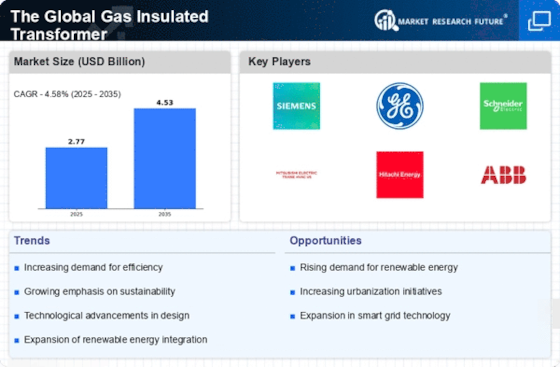
As per Market Research Future analysis, The Global Gas Insulated Transformer Market Size was estimated at 2.77 USD Billion in 2024. The Gas Insulated Transformer industry is projected to grow from 2.897 USD Billion in 2025 to 4.534 USD Billion by 2035, exhibiting a compound annual growth rate (CAGR) of 4.58% during the forecast period 2025 - 2035

Key Market Trends & Highlights

The Global Gas Insulated Transformer Market is poised for substantial growth driven by technological advancements and urbanization.

  • North America remains the largest market for gas insulated transformers, driven by increasing investments in infrastructure. The Asia-Pacific region is emerging as the fastest-growing market, fueled by rapid urbanization and industrialization. The medium voltage segment holds the largest share, while the high voltage segment is witnessing the fastest growth due to rising energy demands. Key market drivers include technological advancements in gas insulated transformers and regulatory support for modernization initiatives.

Market Size & Forecast

2024 Market Size 2.77 (USD Billion)
2035 Market Size 4.534 (USD Billion)
CAGR (2025 - 2035) 4.58%
Largest Regional Market Share in 2024 Asia Pacific

Major Players

<a href="https://www.siemens-energy.com/global/en/home/products-services/product-offerings/gas-insulated-switchgear.html">Siemens</a> (DE), General Electric (US), Schneider Electric (FR), Mitsubishi Electric (JP), Hitachi Energy (CH), ABB (CH), Toshiba (JP), <a href="https://www.eaton.com/in/en-us/catalog/medium-voltage-power-distribution-control-systems/eaton-sf6-gas-insulated-switchgear.html">Eaton</a> (IE), Nexans (FR)

Market Trends

The Gas Insulated Transformer Market is currently experiencing a notable transformation driven by advancements in technology and increasing demand for efficient energy solutions. The shift towards renewable energy sources has prompted utilities and industries to seek reliable and compact transformer solutions that can operate in limited spaces. Gas insulated transformers, known for their high reliability and low maintenance requirements, are becoming increasingly favored in urban environments where space constraints are prevalent. Furthermore, the growing emphasis on reducing carbon footprints aligns with the adoption of these transformers, as they offer enhanced performance with minimal environmental impact.

In addition to technological advancements, regulatory frameworks are evolving to support the integration of gas insulated transformers into existing power infrastructure. Governments are recognizing the need for modernized electrical grids that can accommodate the fluctuating demands of renewable energy. This has led to increased investments in upgrading aging infrastructure, thereby creating opportunities for The Global Gas Insulated Transformer Market. As the market continues to expand, stakeholders are likely to focus on innovation and sustainability, ensuring that future developments align with global energy goals and environmental standards.

Technological Advancements

The Gas Insulated Transformer Market is witnessing rapid technological innovations that enhance performance and efficiency. New materials and designs are being developed to improve insulation properties and reduce energy losses, making these transformers more effective in various applications.

Urbanization and Space Constraints

As urban areas expand, the demand for compact and efficient energy solutions grows. Gas insulated transformers are particularly suited for urban environments due to their smaller footprint and ability to operate in confined spaces, thus addressing the challenges posed by urbanization.

Regulatory Support for Modernization

Governments are increasingly implementing policies that promote the modernization of electrical grids. This regulatory support encourages the adoption of gas insulated transformers, facilitating the integration of renewable energy sources and enhancing overall grid reliability.

Gas Insulated Transformer Market Market Drivers

Urbanization and Space Constraints

Rapid urbanization is a significant driver for the Gas Insulated Transformer Market, particularly in densely populated regions. As cities expand, the need for efficient and compact electrical infrastructure becomes increasingly critical. Gas insulated transformers, known for their space-saving designs, are ideally suited for urban environments where land is at a premium. This trend is reflected in the increasing installation of these transformers in urban substations, which are projected to grow by 5% annually. The ability of gas insulated transformers to operate in confined spaces without compromising performance makes them a preferred choice for urban planners and utility companies. Consequently, the Gas Insulated Transformer Market is likely to experience heightened demand as urbanization continues to reshape energy distribution.

Regulatory Support for Modernization

Regulatory frameworks promoting modernization and sustainability are influencing the Gas Insulated Transformer Market. Governments worldwide are implementing policies aimed at reducing carbon emissions and enhancing energy efficiency. These regulations often encourage the adoption of advanced technologies, including gas insulated transformers, which offer lower environmental impact compared to traditional oil-filled transformers. The market is expected to benefit from these supportive policies, with an estimated increase in installations by 7% over the next five years. Additionally, incentives for renewable energy integration further bolster the demand for gas insulated transformers, as they facilitate the connection of renewable sources to the grid. Thus, regulatory support is a crucial factor driving growth in the Gas Insulated Transformer Market.

Growing Demand for Renewable Energy Sources

The increasing emphasis on renewable energy sources is significantly impacting the Gas Insulated Transformer Market. As countries strive to meet their renewable energy targets, the integration of wind, solar, and hydroelectric power into existing grids becomes essential. Gas insulated transformers play a vital role in this integration, providing reliable and efficient connections between renewable energy sources and the grid. The market is projected to grow by approximately 8% annually, driven by the need for robust infrastructure to support renewable energy projects. Furthermore, the ability of gas insulated transformers to operate in diverse environmental conditions enhances their appeal for renewable energy applications. This growing demand for clean energy solutions is likely to propel the Gas Insulated Transformer Market forward.

Increased Investment in Smart Grid Technologies

The shift towards smart grid technologies is a key driver for the Gas Insulated Transformer Market. As utilities invest in modernizing their infrastructure, the integration of smart technologies becomes paramount. Gas insulated transformers, with their compact design and enhanced reliability, are well-suited for smart grid applications. The market is anticipated to expand by 6% annually, fueled by investments in smart grid initiatives that aim to improve efficiency and reduce outages. These transformers facilitate real-time monitoring and control, which are essential for the effective operation of smart grids. As the global energy landscape evolves, the Gas Insulated Transformer Market is likely to benefit from the increasing focus on smart grid technologies.

Technological Advancements in Gas Insulated Transformers

The ongoing technological advancements in the Gas Insulated Transformer Market are pivotal in enhancing efficiency and reliability. Innovations such as improved insulation materials and advanced monitoring systems are being integrated into transformer designs. These developments not only increase operational lifespan but also reduce maintenance costs. The market is projected to witness a compound annual growth rate (CAGR) of approximately 6% over the next few years, driven by these technological improvements. Furthermore, the adoption of digital technologies, including IoT and AI, is expected to optimize performance and predictive maintenance, thereby attracting investments in the Gas Insulated Transformer Market. As utilities and industries seek to modernize their infrastructure, the demand for advanced gas insulated transformers is likely to surge.

Market Segment Insights

By Voltage Rating: Medium (Largest) vs. High (Fastest-Growing)

In The Global Gas Insulated Transformer Market, the voltage rating distribution is characterized by a significant presence of Medium voltage transformers, which account for the largest share. High voltage transformers are also notable for their increasing market acceptance. Extra High voltage transformers, while crucial for specialized applications, represent a smaller market segment but are integral for specific high-capacity needs. Overall, Medium and High voltage ratings dominate the landscape, driven by demand in various sectors including renewable energy and industrial applications.

Voltage Rating: Medium (Dominant) vs. High (Emerging)

Medium voltage transformers are currently the dominant players within The Global Gas Insulated Transformer Market, favored for their versatility and reliability in applications across industrial, commercial, and renewable energy sectors. High voltage transformers are emerging rapidly, gaining traction due to the increasing investments in high-capacity grid infrastructure and renewable energy projects. Their ability to manage higher voltages effectively makes them essential for modern grid demands. The ongoing transition towards cleaner energy sources further accelerates the adoption of High voltage technologies, positioning them as a significant growth area in the market.

By End-Use: Utility (Largest) vs. Industrial (Fastest-Growing)

In Gas Insulated Transformer Market, the end-use segments are primarily distributed among utility, industrial, and commercial applications. The utility segment accounts for the largest share due to its critical role in electricity transmission and distribution. Utilities are increasingly adopting gas insulated transformers for their compact design and safety in densely populated areas. The industrial and commercial segments, while smaller in comparison, are also significant due to rising industrialization and urbanization worldwide. Growth trends indicate that while the utility sector remains dominant, the industrial segment is the fastest-growing area within the market. Key drivers of growth include the push for renewable energy integration, advancements in transformer technology, and expanding industrial infrastructure. As more industries seek reliable and efficient power solutions, the demand for gas insulated transformers continues to rise in industrial applications, highlighting this segment's potential for future expansion.

Utility (Dominant) vs. Industrial (Emerging)

The utility segment of Gas Insulated Transformer Market remains dominant, driven by the necessity for efficient and reliable electricity distribution. Utilities utilize these transformers primarily for their reduced environmental footprint, safety, and ability to operate effectively in urban settings. On the other hand, the industrial segment is emerging rapidly, characterized by a growing demand for robust and compact power solutions in manufacturing processes. Industries such as renewable energy, mining, and manufacturing are increasingly integrating gas insulated transformers to enhance operational efficiency. This emerging market reflects a shift toward modernization and smart grid technologies, presenting substantial opportunities for manufacturers focused on innovative solutions.

By Type: Instrument Transformer (Largest) vs. Others (Fastest-Growing)

In Gas Insulated Transformer Market, the Instrument Transformer segment holds the largest share, reflecting its pivotal role in ensuring accurate measurements and reliable data transmission within electrical networks. This segment encompasses a variety of products designed for voltage measurement and current transformation, catering primarily to utility and grid applications. On the other hand, the 'Others' category, which includes various specialized transformers, is exhibiting rapid growth due to the increasing demand for customized solutions in niche applications, capturing attention from key industry players.

Instrument Transformer (Dominant) vs. Others (Emerging)

Instrument Transformers are essential for facilitating precise control and monitoring of electrical systems, thus maintaining stability and efficiency in the power grid. Their dominant position in the market is supported by continuous innovations, helping utilities manage growing loads and integrate renewable energy sources effectively. Conversely, the 'Others' segment, which covers a wide range of gas-insulated transformers tailored for specific applications like industrial sectors, is witnessing substantial growth. This is driven by technological advancements and the need for efficient and compact solutions that reduce space requirements and enhance operational reliability, making it an attractive choice for emerging markets.

By Type of Cooling: Gas Directed Air Natural Cooling (Largest) vs. Gas Directed Water Forced Cooling (Fastest-Growing)

In Gas Insulated Transformer Market, the segment of Gas Directed Air Natural Cooling holds the largest market share, primarily due to its efficiency and cost-effectiveness compared to other cooling types. This method is widely adopted owing to its lower operational costs and ability to maintain optimal performance in various weather conditions. On the other hand, Gas Directed Water Forced Cooling is emerging as a key player in the market, rapidly gaining traction among growing demand for higher reliability and efficiency in electrical infrastructure.

Cooling Method: Gas Directed Air Natural Cooling (Dominant) vs. Gas Directed Water Forced Cooling (Emerging)

Gas Directed Air Natural Cooling has established itself as the dominant method in the market, offering significant advantages including simplified design and decreased maintenance requirements. It leverages ambient air for cooling, making it suitable for installations where space and resources are limited. Conversely, Gas Directed Water Forced Cooling is gaining popularity as an emerging solution due to its superior cooling capabilities that can accommodate higher energy demands. This method is particularly appealing for large-scale installations, as it ensures excellent thermal performance, making it increasingly favored in modern transformer applications.

By Installation: Indoor (Largest) vs. Outdoor (Fastest-Growing)

In Gas Insulated Transformer Market, the segmentation based on installation reveals a significant skew towards indoor transformers, reflecting their dominant share in overall market distribution. Indoor transformers are preferred for their compact design and enhanced safety measures, making them suitable for urban areas where space and environmental factors are pivotal. Conversely, outdoor transformers, while currently having a smaller market share, are gaining traction due to advancements in technology and a growing preference for robust power solutions in rural and semi-urban settings.

Installation Type: Indoor (Dominant) vs. Outdoor (Emerging)

Indoor gas insulated transformers are characterized by their space-saving design and safer operation, making them particularly beneficial for densely populated urban areas. These installations provide improved aesthetic integration into infrastructure but typically require controlled environments for optimal performance. In contrast, outdoor gas insulated transformers are emerging as a preferred choice in applications where larger capacities and resilience against environmental challenges are critical. Driven by increasing demand for renewable energy and upgrades to aging power grids, outdoor installations are experiencing rapid growth, positioning them as a vital component of future energy solutions.

Get more detailed insights about Gas Insulated Transformer Market Research Report-Global Forecast till 2035

Regional Insights

North America : Innovation and Infrastructure Growth

North America is witnessing significant growth in the gas insulated transformer market, driven by increasing investments in renewable energy and modernization of aging infrastructure. The region holds approximately 35% of the global market share, making it the largest market. Regulatory support for clean energy initiatives and grid reliability is further propelling demand, particularly in states like California and Texas, which are leading in renewable energy adoption. The competitive landscape is dominated by key players such as General Electric and Siemens, who are investing heavily in R&D to enhance product efficiency and sustainability. The U.S. and Canada are the leading countries in this market, with a strong focus on technological advancements and smart grid solutions. The presence of established manufacturers and a growing emphasis on energy efficiency are expected to drive further growth in the coming years.

Europe : Sustainability and Regulatory Support

Europe is emerging as a significant player in the gas insulated transformer market, driven by stringent environmental regulations and a strong commitment to sustainability. The region accounts for approximately 30% of the global market share, making it the second largest market. The European Union's Green Deal and various national policies are catalyzing investments in clean energy infrastructure, which is expected to boost demand for gas insulated transformers in the coming years. Leading countries in this region include Germany, France, and the UK, where major players like Schneider Electric and ABB are actively involved in innovative projects. The competitive landscape is characterized by a focus on energy efficiency and reduced emissions, with companies investing in advanced technologies to meet regulatory standards. The presence of robust supply chains and a skilled workforce further enhances the region's market potential.

Asia-Pacific : Rapid Urbanization and Industrial Growth

The Asia-Pacific region is experiencing rapid urbanization and industrial growth, significantly driving the demand for Gas Insulated Transformer Market. This region holds approximately 25% of the global market share, with countries like China and India leading the charge. Government initiatives aimed at enhancing energy infrastructure and increasing electricity access are key growth drivers, alongside investments in renewable energy projects that are reshaping the energy landscape. China is the largest market in the region, with significant contributions from companies like Mitsubishi Electric and Hitachi Energy. The competitive landscape is marked by a mix of local and international players, all vying for market share in a rapidly evolving environment. The focus on smart grid technologies and energy efficiency is expected to further propel market growth, as countries strive to meet increasing energy demands while minimizing environmental impact.

Middle East and Africa : Emerging Markets and Energy Transition

The Middle East and Africa region is witnessing a gradual but steady growth in the gas insulated transformer market, driven by increasing investments in energy infrastructure and a shift towards renewable energy sources. This region holds approximately 10% of the global market share. Countries like Saudi Arabia and South Africa are leading the way, with government initiatives aimed at diversifying energy sources and enhancing grid reliability, which are crucial for economic development and energy security. In the competitive landscape, local players are emerging alongside established international companies, creating a dynamic market environment. The presence of key players such as Eaton and Toshiba is notable, as they adapt their offerings to meet regional needs. The focus on sustainable energy solutions and modernization of existing infrastructure is expected to drive further growth in this region, aligning with global energy transition goals.

Key Players and Competitive Insights

The Gas Insulated Transformer Market is currently characterized by a dynamic competitive landscape, driven by the increasing demand for efficient and reliable power transmission solutions. Key players such as Siemens (Germany), General Electric (US), and ABB (Switzerland) are at the forefront, leveraging their technological expertise and extensive portfolios to capture market share. Siemens (Germany) has positioned itself as a leader in innovation, focusing on the development of advanced gas-insulated technologies that enhance operational efficiency and reduce environmental impact. Meanwhile, General Electric (US) emphasizes strategic partnerships and collaborations to expand its global footprint, particularly in emerging markets. ABB (Switzerland) is actively pursuing digital transformation initiatives, integrating AI and IoT into its product offerings to improve performance and reliability, thereby shaping the competitive environment in the sector. The business tactics employed by these companies reflect a concerted effort to optimize supply chains and localize manufacturing processes. The market structure appears moderately fragmented, with several players vying for dominance. However, the collective influence of major companies like Mitsubishi Electric (Japan) and Hitachi Energy (Switzerland) suggests a trend towards consolidation, as these firms seek to enhance their competitive positioning through mergers and acquisitions. In August 2025, Mitsubishi Electric (Japan) announced the launch of a new line of eco-friendly gas-insulated transformers designed to meet stringent environmental regulations. This strategic move not only aligns with global sustainability goals but also positions the company as a frontrunner in the green technology space, potentially attracting environmentally conscious clients and enhancing its market share. In September 2025, Hitachi Energy (Switzerland) revealed a partnership with a leading renewable energy firm to develop integrated solutions for offshore wind farms. This collaboration underscores Hitachi's commitment to expanding its capabilities in renewable energy applications, which is increasingly vital in the current energy transition landscape. By aligning its offerings with the growing demand for sustainable energy solutions, Hitachi Energy is likely to strengthen its competitive edge. Furthermore, in July 2025, ABB (Switzerland) completed the acquisition of a regional player specializing in digital grid solutions. This acquisition is expected to enhance ABB's technological capabilities and broaden its service offerings, particularly in the digitalization of power systems. Such strategic actions reflect a broader trend of companies seeking to integrate advanced technologies into their operations, thereby improving efficiency and reliability. As of October 2025, the competitive trends in The Global Gas Insulated Transformer Market are increasingly defined by digitalization, sustainability, and the integration of AI technologies. Strategic alliances are becoming more prevalent, as companies recognize the need to collaborate to address complex challenges in the energy sector. Looking ahead, it is anticipated that competitive differentiation will evolve, shifting from traditional price-based competition to a focus on innovation, technological advancement, and supply chain reliability. This transition is likely to reshape the market dynamics, fostering a more resilient and sustainable energy infrastructure.

Key Companies in the Gas Insulated Transformer Market include

Industry Developments

April 2023- Hyosung Heavy Industries recently disclosed that it secured 3.5101 trillion won (US$2.6752 billion) in sales and 143.2 billion won (US$109.1 million) in operating profit in 2022, thanking the rise in global demand for power generation equipment. This signified a rise of 23.1 billion won (US$17.6 million) in operating profit compared to 2021. The organization anticipates continued development because of the rise in new power generation sources and escalating demand for transmission and distribution in the global power market.

May 2022: After completing all procedures to establish Arteche Hitachi Energy Instrument Transformers S.L., the replacement for Arteche Gas Insulated Transformers (AGIT), Arteche and Hitachi Energy received regulatory permission. Through this partnership, Arteche and Hitachi Energy are hastening the creation of environmentally friendly, sustainable gas insulated transformers.

Meidensha Corporation (Meiden), in September 2022, entered into a sustainability-linked loan (SLL) agreement with Sumitomo Mitsui Banking Corporation (SMBC).

An Econiq 420 kv circuit breaker was released by Hitachi Energy in August 2022.

In May 2022, Arteche and Hitachi Energy obtained regulatory authorization, thereby completing all the formalities for the taking over of Arteche Gas Insulated Transformers (AGIT) to become Arteche Hitachi Energy Instrument Transformers S.L. Consequently, both companies are fast-tracking their green gas-insulated transformers journey through the establishment of a joint venture called Arteche Hitachi Energy Instrument Transformers S.L. The development is expected to foster the wide use of renewable energy sources and sustainable, environmentally friendly gas-insulated transformers.

A range of power transformers was introduced by General Electric in January 2022 to facilitate the adoption of renewable energy sources, such as the GE-Mistral-14, which operates between 275 kV and 400 kV, two large power transformers rated at 340 MVA each and MBH Power transformer. These have been deployed in various wind farms in many countries. GE’s range encompasses various voltage levels, suitable for applications like power generation, transmission and distribution.

Pfiffner and Trench had issued a joint statement on SF6-free instrument transformers as manufacturers, As SF6 has traditionally been used for safety purposes in AIS High Voltage Instrument Transformers. Nonetheless, SF6, when leaked, is viewed as one of its kind that results in a global warming problem.

The power minister of Goa state, India, announced plans to build to state's first gas-insulated substation in November 2021, which cost around USD4.3 million. This is intended to benefit consumers residing in Davorilm, Navelim as well as Margao and Curtorim areas. Furthermore, there have been proposals to deploy GIS technology throughout the area.

Collaboratively, Meidensha Corporation joined Toshiba in June 2021 with the plan of commercializing by March 2023 new GIS solutions for gas-insulated transformers based on natural origin gases.

Future Outlook

Gas Insulated Transformer Market Future Outlook

The Global Gas Insulated Transformer Market is projected to grow at a 4.58% CAGR from 2025 to 2035, driven by urbanization, renewable energy integration, and technological advancements.

New opportunities lie in:

  • <p>Expansion into emerging markets with tailored solutions Development of smart grid-compatible transformers Investment in R&amp;D for eco-friendly insulating gases</p>

By 2035, the market is expected to achieve robust growth, reflecting evolving energy demands.

Market Segmentation

Gas Insulated Transformer Market Type Outlook

  • Instrument Transformer
  • Others

Gas Insulated Transformer Market End-Use Outlook

  • Utility
  • Industrial
  • Commercial

Gas Insulated Transformer Market Installation Outlook

  • Outdoor
  • Indoor

Gas Insulated Transformer Market Voltage Rating Outlook

  • Medium
  • High
  • Extra High

Gas Insulated Transformer Market Type of Cooling Outlook

  • Gas Directed Air Natural Cooling
  • Gas Directed Air Forced Cooling
  • Gas Directed Water Forced Cooling

Report Scope

MARKET SIZE 2024 2.77(USD Billion)
MARKET SIZE 2025 2.897(USD Billion)
MARKET SIZE 2035 4.534(USD Billion)
COMPOUND ANNUAL GROWTH RATE (CAGR) 4.58% (2025 - 2035)
REPORT COVERAGE Revenue Forecast, Competitive Landscape, Growth Factors, and Trends
BASE YEAR 2024
Market Forecast Period 2025 - 2035
Historical Data 2019 - 2024
Market Forecast Units USD Billion
Key Companies Profiled Siemens (DE), General Electric (US), Schneider Electric (FR), Mitsubishi Electric (JP), Hitachi Energy (CH), ABB (CH), Toshiba (JP), Eaton (IE), Nexans (FR)
Segments Covered Voltage Rating, End-Use, Type, Type of Cooling, Installation, Region
Key Market Opportunities Integration of renewable energy sources drives demand for advanced Global Gas Insulated Transformer solutions.
Key Market Dynamics Rising demand for energy efficiency drives innovation and competition in the gas insulated transformer market.
Countries Covered North America, Europe, APAC, South America, MEA

FAQs

What is the projected market valuation of The Global Gas Insulated Transformer by 2035?

<p>The projected market valuation for The Global Gas Insulated Transformer is expected to reach 4.534 USD Billion by 2035.</p>

What was the market valuation of The Global Gas Insulated Transformer in 2024?

<p>The overall market valuation was 2.77 USD Billion in 2024.</p>

What is the expected CAGR for The Global Gas Insulated Transformer during the forecast period 2025 - 2035?

<p>The expected CAGR for The Global Gas Insulated Transformer during the forecast period 2025 - 2035 is 4.58%.</p>

Which companies are considered key players in The Global Gas Insulated Transformer?

<p>Key players in the market include Siemens, General Electric, Schneider Electric, Mitsubishi Electric, Hitachi Energy, ABB, Toshiba, Eaton, and Nexans.</p>

What are the projected valuations for the different voltage rating segments in The Global Gas Insulated Transformer?

<p>The projected valuations for voltage rating segments are Medium: 1.36 USD Billion, High: 1.8 USD Billion, and Extra High: 1.39 USD Billion.</p>

How does the end-use segment of The Global Gas Insulated Transformer perform?

<p>The end-use segment shows projected valuations of Utility: 2.25 USD Billion, Industrial: 1.35 USD Billion, and Commercial: 0.97 USD Billion.</p>

What are the expected valuations for the different types of gas insulated transformers?

The expected valuations for types are Instrument Transformer: 2.25 USD Billion and Others: 2.29 USD Billion.

What cooling types are projected to dominate The Global Gas Insulated Transformer?

The projected valuations for cooling types are Gas Directed Air Natural Cooling: 1.36 USD Billion, Gas Directed Air Forced Cooling: 1.8 USD Billion, and Gas Directed Water Forced Cooling: 1.39 USD Billion.

What is the market outlook for indoor versus outdoor installations in The Global Gas Insulated Transformer?

The market outlook indicates projected valuations of Outdoor: 2.25 USD Billion and Indoor: 2.29 USD Billion.

How does The Global Gas Insulated Transformer's growth compare across different segments?

The market growth appears varied across segments, with notable increases in Utility and Instrument Transformer categories.

  1. SECTION I: EXECUTIVE SUMMARY AND KEY HIGHLIGHTS
    1. | 1.1 EXECUTIVE SUMMARY
    2. | | 1.1.1 Market Overview
    3. | | 1.1.2 Key Findings
    4. | | 1.1.3 Market Segmentation
    5. | | 1.1.4 Competitive Landscape
    6. | | 1.1.5 Challenges and Opportunities
    7. | | 1.1.6 Future Outlook
  2. SECTION II: SCOPING, METHODOLOGY AND MARKET STRUCTURE
    1. | 2.1 MARKET INTRODUCTION
    2. | | 2.1.1 Definition
    3. | | 2.1.2 Scope of the study
    4. | | | 2.1.2.1 Research Objective
    5. | | | 2.1.2.2 Assumption
    6. | | | 2.1.2.3 Limitations
    7. | 2.2 RESEARCH METHODOLOGY
    8. | | 2.2.1 Overview
    9. | | 2.2.2 Data Mining
    10. | | 2.2.3 Secondary Research
    11. | | 2.2.4 Primary Research
    12. | | | 2.2.4.1 Primary Interviews and Information Gathering Process
    13. | | | 2.2.4.2 Breakdown of Primary Respondents
    14. | | 2.2.5 Forecasting Model
    15. | | 2.2.6 Market Size Estimation
    16. | | | 2.2.6.1 Bottom-Up Approach
    17. | | | 2.2.6.2 Top-Down Approach
    18. | | 2.2.7 Data Triangulation
    19. | | 2.2.8 Validation
  3. SECTION III: QUALITATIVE ANALYSIS
    1. | 3.1 MARKET DYNAMICS
    2. | | 3.1.1 Overview
    3. | | 3.1.2 Drivers
    4. | | 3.1.3 Restraints
    5. | | 3.1.4 Opportunities
    6. | 3.2 MARKET FACTOR ANALYSIS
    7. | | 3.2.1 Value chain Analysis
    8. | | 3.2.2 Porter's Five Forces Analysis
    9. | | | 3.2.2.1 Bargaining Power of Suppliers
    10. | | | 3.2.2.2 Bargaining Power of Buyers
    11. | | | 3.2.2.3 Threat of New Entrants
    12. | | | 3.2.2.4 Threat of Substitutes
    13. | | | 3.2.2.5 Intensity of Rivalry
    14. | | 3.2.3 COVID-19 Impact Analysis
    15. | | | 3.2.3.1 Market Impact Analysis
    16. | | | 3.2.3.2 Regional Impact
    17. | | | 3.2.3.3 Opportunity and Threat Analysis
  4. SECTION IV: QUANTITATIVE ANALYSIS
    1. | 4.1 Energy & Power, BY Voltage Rating (USD Billion)
    2. | | 4.1.1 Medium
    3. | | 4.1.2 High
    4. | | 4.1.3 Extra High
    5. | 4.2 Energy & Power, BY End-Use (USD Billion)
    6. | | 4.2.1 Utility
    7. | | 4.2.2 Industrial
    8. | | 4.2.3 Commercial
    9. | 4.3 Energy & Power, BY Type (USD Billion)
    10. | | 4.3.1 Instrument Transformer
    11. | | 4.3.2 Others
    12. | 4.4 Energy & Power, BY Type of Cooling (USD Billion)
    13. | | 4.4.1 Gas Directed Air Natural Cooling
    14. | | 4.4.2 Gas Directed Air Forced Cooling
    15. | | 4.4.3 Gas Directed Water Forced Cooling
    16. | 4.5 Energy & Power, BY Installation (USD Billion)
    17. | | 4.5.1 Outdoor
    18. | | 4.5.2 Indoor
    19. | 4.6 Energy & Power, BY Region (USD Billion)
    20. | | 4.6.1 North America
    21. | | | 4.6.1.1 US
    22. | | | 4.6.1.2 Canada
    23. | | 4.6.2 Europe
    24. | | | 4.6.2.1 Germany
    25. | | | 4.6.2.2 UK
    26. | | | 4.6.2.3 France
    27. | | | 4.6.2.4 Russia
    28. | | | 4.6.2.5 Italy
    29. | | | 4.6.2.6 Spain
    30. | | | 4.6.2.7 Rest of Europe
    31. | | 4.6.3 APAC
    32. | | | 4.6.3.1 China
    33. | | | 4.6.3.2 India
    34. | | | 4.6.3.3 Japan
    35. | | | 4.6.3.4 South Korea
    36. | | | 4.6.3.5 Malaysia
    37. | | | 4.6.3.6 Thailand
    38. | | | 4.6.3.7 Indonesia
    39. | | | 4.6.3.8 Rest of APAC
    40. | | 4.6.4 South America
    41. | | | 4.6.4.1 Brazil
    42. | | | 4.6.4.2 Mexico
    43. | | | 4.6.4.3 Argentina
    44. | | | 4.6.4.4 Rest of South America
    45. | | 4.6.5 MEA
    46. | | | 4.6.5.1 GCC Countries
    47. | | | 4.6.5.2 South Africa
    48. | | | 4.6.5.3 Rest of MEA
  5. SECTION V: COMPETITIVE ANALYSIS
    1. | 5.1 Competitive Landscape
    2. | | 5.1.1 Overview
    3. | | 5.1.2 Competitive Analysis
    4. | | 5.1.3 Market share Analysis
    5. | | 5.1.4 Major Growth Strategy in the Energy & Power
    6. | | 5.1.5 Competitive Benchmarking
    7. | | 5.1.6 Leading Players in Terms of Number of Developments in the Energy & Power
    8. | | 5.1.7 Key developments and growth strategies
    9. | | | 5.1.7.1 New Product Launch/Service Deployment
    10. | | | 5.1.7.2 Merger & Acquisitions
    11. | | | 5.1.7.3 Joint Ventures
    12. | | 5.1.8 Major Players Financial Matrix
    13. | | | 5.1.8.1 Sales and Operating Income
    14. | | | 5.1.8.2 Major Players R&D Expenditure. 2023
    15. | 5.2 Company Profiles
    16. | | 5.2.1 Siemens (DE)
    17. | | | 5.2.1.1 Financial Overview
    18. | | | 5.2.1.2 Products Offered
    19. | | | 5.2.1.3 Key Developments
    20. | | | 5.2.1.4 SWOT Analysis
    21. | | | 5.2.1.5 Key Strategies
    22. | | 5.2.2 General Electric (US)
    23. | | | 5.2.2.1 Financial Overview
    24. | | | 5.2.2.2 Products Offered
    25. | | | 5.2.2.3 Key Developments
    26. | | | 5.2.2.4 SWOT Analysis
    27. | | | 5.2.2.5 Key Strategies
    28. | | 5.2.3 Schneider Electric (FR)
    29. | | | 5.2.3.1 Financial Overview
    30. | | | 5.2.3.2 Products Offered
    31. | | | 5.2.3.3 Key Developments
    32. | | | 5.2.3.4 SWOT Analysis
    33. | | | 5.2.3.5 Key Strategies
    34. | | 5.2.4 Mitsubishi Electric (JP)
    35. | | | 5.2.4.1 Financial Overview
    36. | | | 5.2.4.2 Products Offered
    37. | | | 5.2.4.3 Key Developments
    38. | | | 5.2.4.4 SWOT Analysis
    39. | | | 5.2.4.5 Key Strategies
    40. | | 5.2.5 Hitachi Energy (CH)
    41. | | | 5.2.5.1 Financial Overview
    42. | | | 5.2.5.2 Products Offered
    43. | | | 5.2.5.3 Key Developments
    44. | | | 5.2.5.4 SWOT Analysis
    45. | | | 5.2.5.5 Key Strategies
    46. | | 5.2.6 ABB (CH)
    47. | | | 5.2.6.1 Financial Overview
    48. | | | 5.2.6.2 Products Offered
    49. | | | 5.2.6.3 Key Developments
    50. | | | 5.2.6.4 SWOT Analysis
    51. | | | 5.2.6.5 Key Strategies
    52. | | 5.2.7 Toshiba (JP)
    53. | | | 5.2.7.1 Financial Overview
    54. | | | 5.2.7.2 Products Offered
    55. | | | 5.2.7.3 Key Developments
    56. | | | 5.2.7.4 SWOT Analysis
    57. | | | 5.2.7.5 Key Strategies
    58. | | 5.2.8 Eaton (IE)
    59. | | | 5.2.8.1 Financial Overview
    60. | | | 5.2.8.2 Products Offered
    61. | | | 5.2.8.3 Key Developments
    62. | | | 5.2.8.4 SWOT Analysis
    63. | | | 5.2.8.5 Key Strategies
    64. | | 5.2.9 Nexans (FR)
    65. | | | 5.2.9.1 Financial Overview
    66. | | | 5.2.9.2 Products Offered
    67. | | | 5.2.9.3 Key Developments
    68. | | | 5.2.9.4 SWOT Analysis
    69. | | | 5.2.9.5 Key Strategies
    70. | 5.3 Appendix
    71. | | 5.3.1 References
    72. | | 5.3.2 Related Reports
  6. LIST OF FIGURES
    1. | 6.1 MARKET SYNOPSIS
    2. | 6.2 NORTH AMERICA MARKET ANALYSIS
    3. | 6.3 US MARKET ANALYSIS BY VOLTAGE RATING
    4. | 6.4 US MARKET ANALYSIS BY END-USE
    5. | 6.5 US MARKET ANALYSIS BY TYPE
    6. | 6.6 US MARKET ANALYSIS BY TYPE OF COOLING
    7. | 6.7 US MARKET ANALYSIS BY INSTALLATION
    8. | 6.8 CANADA MARKET ANALYSIS BY VOLTAGE RATING
    9. | 6.9 CANADA MARKET ANALYSIS BY END-USE
    10. | 6.10 CANADA MARKET ANALYSIS BY TYPE
    11. | 6.11 CANADA MARKET ANALYSIS BY TYPE OF COOLING
    12. | 6.12 CANADA MARKET ANALYSIS BY INSTALLATION
    13. | 6.13 EUROPE MARKET ANALYSIS
    14. | 6.14 GERMANY MARKET ANALYSIS BY VOLTAGE RATING
    15. | 6.15 GERMANY MARKET ANALYSIS BY END-USE
    16. | 6.16 GERMANY MARKET ANALYSIS BY TYPE
    17. | 6.17 GERMANY MARKET ANALYSIS BY TYPE OF COOLING
    18. | 6.18 GERMANY MARKET ANALYSIS BY INSTALLATION
    19. | 6.19 UK MARKET ANALYSIS BY VOLTAGE RATING
    20. | 6.20 UK MARKET ANALYSIS BY END-USE
    21. | 6.21 UK MARKET ANALYSIS BY TYPE
    22. | 6.22 UK MARKET ANALYSIS BY TYPE OF COOLING
    23. | 6.23 UK MARKET ANALYSIS BY INSTALLATION
    24. | 6.24 FRANCE MARKET ANALYSIS BY VOLTAGE RATING
    25. | 6.25 FRANCE MARKET ANALYSIS BY END-USE
    26. | 6.26 FRANCE MARKET ANALYSIS BY TYPE
    27. | 6.27 FRANCE MARKET ANALYSIS BY TYPE OF COOLING
    28. | 6.28 FRANCE MARKET ANALYSIS BY INSTALLATION
    29. | 6.29 RUSSIA MARKET ANALYSIS BY VOLTAGE RATING
    30. | 6.30 RUSSIA MARKET ANALYSIS BY END-USE
    31. | 6.31 RUSSIA MARKET ANALYSIS BY TYPE
    32. | 6.32 RUSSIA MARKET ANALYSIS BY TYPE OF COOLING
    33. | 6.33 RUSSIA MARKET ANALYSIS BY INSTALLATION
    34. | 6.34 ITALY MARKET ANALYSIS BY VOLTAGE RATING
    35. | 6.35 ITALY MARKET ANALYSIS BY END-USE
    36. | 6.36 ITALY MARKET ANALYSIS BY TYPE
    37. | 6.37 ITALY MARKET ANALYSIS BY TYPE OF COOLING
    38. | 6.38 ITALY MARKET ANALYSIS BY INSTALLATION
    39. | 6.39 SPAIN MARKET ANALYSIS BY VOLTAGE RATING
    40. | 6.40 SPAIN MARKET ANALYSIS BY END-USE
    41. | 6.41 SPAIN MARKET ANALYSIS BY TYPE
    42. | 6.42 SPAIN MARKET ANALYSIS BY TYPE OF COOLING
    43. | 6.43 SPAIN MARKET ANALYSIS BY INSTALLATION
    44. | 6.44 REST OF EUROPE MARKET ANALYSIS BY VOLTAGE RATING
    45. | 6.45 REST OF EUROPE MARKET ANALYSIS BY END-USE
    46. | 6.46 REST OF EUROPE MARKET ANALYSIS BY TYPE
    47. | 6.47 REST OF EUROPE MARKET ANALYSIS BY TYPE OF COOLING
    48. | 6.48 REST OF EUROPE MARKET ANALYSIS BY INSTALLATION
    49. | 6.49 APAC MARKET ANALYSIS
    50. | 6.50 CHINA MARKET ANALYSIS BY VOLTAGE RATING
    51. | 6.51 CHINA MARKET ANALYSIS BY END-USE
    52. | 6.52 CHINA MARKET ANALYSIS BY TYPE
    53. | 6.53 CHINA MARKET ANALYSIS BY TYPE OF COOLING
    54. | 6.54 CHINA MARKET ANALYSIS BY INSTALLATION
    55. | 6.55 INDIA MARKET ANALYSIS BY VOLTAGE RATING
    56. | 6.56 INDIA MARKET ANALYSIS BY END-USE
    57. | 6.57 INDIA MARKET ANALYSIS BY TYPE
    58. | 6.58 INDIA MARKET ANALYSIS BY TYPE OF COOLING
    59. | 6.59 INDIA MARKET ANALYSIS BY INSTALLATION
    60. | 6.60 JAPAN MARKET ANALYSIS BY VOLTAGE RATING
    61. | 6.61 JAPAN MARKET ANALYSIS BY END-USE
    62. | 6.62 JAPAN MARKET ANALYSIS BY TYPE
    63. | 6.63 JAPAN MARKET ANALYSIS BY TYPE OF COOLING
    64. | 6.64 JAPAN MARKET ANALYSIS BY INSTALLATION
    65. | 6.65 SOUTH KOREA MARKET ANALYSIS BY VOLTAGE RATING
    66. | 6.66 SOUTH KOREA MARKET ANALYSIS BY END-USE
    67. | 6.67 SOUTH KOREA MARKET ANALYSIS BY TYPE
    68. | 6.68 SOUTH KOREA MARKET ANALYSIS BY TYPE OF COOLING
    69. | 6.69 SOUTH KOREA MARKET ANALYSIS BY INSTALLATION
    70. | 6.70 MALAYSIA MARKET ANALYSIS BY VOLTAGE RATING
    71. | 6.71 MALAYSIA MARKET ANALYSIS BY END-USE
    72. | 6.72 MALAYSIA MARKET ANALYSIS BY TYPE
    73. | 6.73 MALAYSIA MARKET ANALYSIS BY TYPE OF COOLING
    74. | 6.74 MALAYSIA MARKET ANALYSIS BY INSTALLATION
    75. | 6.75 THAILAND MARKET ANALYSIS BY VOLTAGE RATING
    76. | 6.76 THAILAND MARKET ANALYSIS BY END-USE
    77. | 6.77 THAILAND MARKET ANALYSIS BY TYPE
    78. | 6.78 THAILAND MARKET ANALYSIS BY TYPE OF COOLING
    79. | 6.79 THAILAND MARKET ANALYSIS BY INSTALLATION
    80. | 6.80 INDONESIA MARKET ANALYSIS BY VOLTAGE RATING
    81. | 6.81 INDONESIA MARKET ANALYSIS BY END-USE
    82. | 6.82 INDONESIA MARKET ANALYSIS BY TYPE
    83. | 6.83 INDONESIA MARKET ANALYSIS BY TYPE OF COOLING
    84. | 6.84 INDONESIA MARKET ANALYSIS BY INSTALLATION
    85. | 6.85 REST OF APAC MARKET ANALYSIS BY VOLTAGE RATING
    86. | 6.86 REST OF APAC MARKET ANALYSIS BY END-USE
    87. | 6.87 REST OF APAC MARKET ANALYSIS BY TYPE
    88. | 6.88 REST OF APAC MARKET ANALYSIS BY TYPE OF COOLING
    89. | 6.89 REST OF APAC MARKET ANALYSIS BY INSTALLATION
    90. | 6.90 SOUTH AMERICA MARKET ANALYSIS
    91. | 6.91 BRAZIL MARKET ANALYSIS BY VOLTAGE RATING
    92. | 6.92 BRAZIL MARKET ANALYSIS BY END-USE
    93. | 6.93 BRAZIL MARKET ANALYSIS BY TYPE
    94. | 6.94 BRAZIL MARKET ANALYSIS BY TYPE OF COOLING
    95. | 6.95 BRAZIL MARKET ANALYSIS BY INSTALLATION
    96. | 6.96 MEXICO MARKET ANALYSIS BY VOLTAGE RATING
    97. | 6.97 MEXICO MARKET ANALYSIS BY END-USE
    98. | 6.98 MEXICO MARKET ANALYSIS BY TYPE
    99. | 6.99 MEXICO MARKET ANALYSIS BY TYPE OF COOLING
    100. | 6.100 MEXICO MARKET ANALYSIS BY INSTALLATION
    101. | 6.101 ARGENTINA MARKET ANALYSIS BY VOLTAGE RATING
    102. | 6.102 ARGENTINA MARKET ANALYSIS BY END-USE
    103. | 6.103 ARGENTINA MARKET ANALYSIS BY TYPE
    104. | 6.104 ARGENTINA MARKET ANALYSIS BY TYPE OF COOLING
    105. | 6.105 ARGENTINA MARKET ANALYSIS BY INSTALLATION
    106. | 6.106 REST OF SOUTH AMERICA MARKET ANALYSIS BY VOLTAGE RATING
    107. | 6.107 REST OF SOUTH AMERICA MARKET ANALYSIS BY END-USE
    108. | 6.108 REST OF SOUTH AMERICA MARKET ANALYSIS BY TYPE
    109. | 6.109 REST OF SOUTH AMERICA MARKET ANALYSIS BY TYPE OF COOLING
    110. | 6.110 REST OF SOUTH AMERICA MARKET ANALYSIS BY INSTALLATION
    111. | 6.111 MEA MARKET ANALYSIS
    112. | 6.112 GCC COUNTRIES MARKET ANALYSIS BY VOLTAGE RATING
    113. | 6.113 GCC COUNTRIES MARKET ANALYSIS BY END-USE
    114. | 6.114 GCC COUNTRIES MARKET ANALYSIS BY TYPE
    115. | 6.115 GCC COUNTRIES MARKET ANALYSIS BY TYPE OF COOLING
    116. | 6.116 GCC COUNTRIES MARKET ANALYSIS BY INSTALLATION
    117. | 6.117 SOUTH AFRICA MARKET ANALYSIS BY VOLTAGE RATING
    118. | 6.118 SOUTH AFRICA MARKET ANALYSIS BY END-USE
    119. | 6.119 SOUTH AFRICA MARKET ANALYSIS BY TYPE
    120. | 6.120 SOUTH AFRICA MARKET ANALYSIS BY TYPE OF COOLING
    121. | 6.121 SOUTH AFRICA MARKET ANALYSIS BY INSTALLATION
    122. | 6.122 REST OF MEA MARKET ANALYSIS BY VOLTAGE RATING
    123. | 6.123 REST OF MEA MARKET ANALYSIS BY END-USE
    124. | 6.124 REST OF MEA MARKET ANALYSIS BY TYPE
    125. | 6.125 REST OF MEA MARKET ANALYSIS BY TYPE OF COOLING
    126. | 6.126 REST OF MEA MARKET ANALYSIS BY INSTALLATION
    127. | 6.127 KEY BUYING CRITERIA OF ENERGY & POWER
    128. | 6.128 RESEARCH PROCESS OF MRFR
    129. | 6.129 DRO ANALYSIS OF ENERGY & POWER
    130. | 6.130 DRIVERS IMPACT ANALYSIS: ENERGY & POWER
    131. | 6.131 RESTRAINTS IMPACT ANALYSIS: ENERGY & POWER
    132. | 6.132 SUPPLY / VALUE CHAIN: ENERGY & POWER
    133. | 6.133 ENERGY & POWER, BY VOLTAGE RATING, 2024 (% SHARE)
    134. | 6.134 ENERGY & POWER, BY VOLTAGE RATING, 2024 TO 2035 (USD Billion)
    135. | 6.135 ENERGY & POWER, BY END-USE, 2024 (% SHARE)
    136. | 6.136 ENERGY & POWER, BY END-USE, 2024 TO 2035 (USD Billion)
    137. | 6.137 ENERGY & POWER, BY TYPE, 2024 (% SHARE)
    138. | 6.138 ENERGY & POWER, BY TYPE, 2024 TO 2035 (USD Billion)
    139. | 6.139 ENERGY & POWER, BY TYPE OF COOLING, 2024 (% SHARE)
    140. | 6.140 ENERGY & POWER, BY TYPE OF COOLING, 2024 TO 2035 (USD Billion)
    141. | 6.141 ENERGY & POWER, BY INSTALLATION, 2024 (% SHARE)
    142. | 6.142 ENERGY & POWER, BY INSTALLATION, 2024 TO 2035 (USD Billion)
    143. | 6.143 BENCHMARKING OF MAJOR COMPETITORS
  7. LIST OF TABLES
    1. | 7.1 LIST OF ASSUMPTIONS
    2. | | 7.1.1
    3. | 7.2 North America MARKET SIZE ESTIMATES; FORECAST
    4. | | 7.2.1 BY VOLTAGE RATING, 2025-2035 (USD Billion)
    5. | | 7.2.2 BY END-USE, 2025-2035 (USD Billion)
    6. | | 7.2.3 BY TYPE, 2025-2035 (USD Billion)
    7. | | 7.2.4 BY TYPE OF COOLING, 2025-2035 (USD Billion)
    8. | | 7.2.5 BY INSTALLATION, 2025-2035 (USD Billion)
    9. | 7.3 US MARKET SIZE ESTIMATES; FORECAST
    10. | | 7.3.1 BY VOLTAGE RATING, 2025-2035 (USD Billion)
    11. | | 7.3.2 BY END-USE, 2025-2035 (USD Billion)
    12. | | 7.3.3 BY TYPE, 2025-2035 (USD Billion)
    13. | | 7.3.4 BY TYPE OF COOLING, 2025-2035 (USD Billion)
    14. | | 7.3.5 BY INSTALLATION, 2025-2035 (USD Billion)
    15. | 7.4 Canada MARKET SIZE ESTIMATES; FORECAST
    16. | | 7.4.1 BY VOLTAGE RATING, 2025-2035 (USD Billion)
    17. | | 7.4.2 BY END-USE, 2025-2035 (USD Billion)
    18. | | 7.4.3 BY TYPE, 2025-2035 (USD Billion)
    19. | | 7.4.4 BY TYPE OF COOLING, 2025-2035 (USD Billion)
    20. | | 7.4.5 BY INSTALLATION, 2025-2035 (USD Billion)
    21. | 7.5 Europe MARKET SIZE ESTIMATES; FORECAST
    22. | | 7.5.1 BY VOLTAGE RATING, 2025-2035 (USD Billion)
    23. | | 7.5.2 BY END-USE, 2025-2035 (USD Billion)
    24. | | 7.5.3 BY TYPE, 2025-2035 (USD Billion)
    25. | | 7.5.4 BY TYPE OF COOLING, 2025-2035 (USD Billion)
    26. | | 7.5.5 BY INSTALLATION, 2025-2035 (USD Billion)
    27. | 7.6 Germany MARKET SIZE ESTIMATES; FORECAST
    28. | | 7.6.1 BY VOLTAGE RATING, 2025-2035 (USD Billion)
    29. | | 7.6.2 BY END-USE, 2025-2035 (USD Billion)
    30. | | 7.6.3 BY TYPE, 2025-2035 (USD Billion)
    31. | | 7.6.4 BY TYPE OF COOLING, 2025-2035 (USD Billion)
    32. | | 7.6.5 BY INSTALLATION, 2025-2035 (USD Billion)
    33. | 7.7 UK MARKET SIZE ESTIMATES; FORECAST
    34. | | 7.7.1 BY VOLTAGE RATING, 2025-2035 (USD Billion)
    35. | | 7.7.2 BY END-USE, 2025-2035 (USD Billion)
    36. | | 7.7.3 BY TYPE, 2025-2035 (USD Billion)
    37. | | 7.7.4 BY TYPE OF COOLING, 2025-2035 (USD Billion)
    38. | | 7.7.5 BY INSTALLATION, 2025-2035 (USD Billion)
    39. | 7.8 France MARKET SIZE ESTIMATES; FORECAST
    40. | | 7.8.1 BY VOLTAGE RATING, 2025-2035 (USD Billion)
    41. | | 7.8.2 BY END-USE, 2025-2035 (USD Billion)
    42. | | 7.8.3 BY TYPE, 2025-2035 (USD Billion)
    43. | | 7.8.4 BY TYPE OF COOLING, 2025-2035 (USD Billion)
    44. | | 7.8.5 BY INSTALLATION, 2025-2035 (USD Billion)
    45. | 7.9 Russia MARKET SIZE ESTIMATES; FORECAST
    46. | | 7.9.1 BY VOLTAGE RATING, 2025-2035 (USD Billion)
    47. | | 7.9.2 BY END-USE, 2025-2035 (USD Billion)
    48. | | 7.9.3 BY TYPE, 2025-2035 (USD Billion)
    49. | | 7.9.4 BY TYPE OF COOLING, 2025-2035 (USD Billion)
    50. | | 7.9.5 BY INSTALLATION, 2025-2035 (USD Billion)
    51. | 7.10 Italy MARKET SIZE ESTIMATES; FORECAST
    52. | | 7.10.1 BY VOLTAGE RATING, 2025-2035 (USD Billion)
    53. | | 7.10.2 BY END-USE, 2025-2035 (USD Billion)
    54. | | 7.10.3 BY TYPE, 2025-2035 (USD Billion)
    55. | | 7.10.4 BY TYPE OF COOLING, 2025-2035 (USD Billion)
    56. | | 7.10.5 BY INSTALLATION, 2025-2035 (USD Billion)
    57. | 7.11 Spain MARKET SIZE ESTIMATES; FORECAST
    58. | | 7.11.1 BY VOLTAGE RATING, 2025-2035 (USD Billion)
    59. | | 7.11.2 BY END-USE, 2025-2035 (USD Billion)
    60. | | 7.11.3 BY TYPE, 2025-2035 (USD Billion)
    61. | | 7.11.4 BY TYPE OF COOLING, 2025-2035 (USD Billion)
    62. | | 7.11.5 BY INSTALLATION, 2025-2035 (USD Billion)
    63. | 7.12 Rest of Europe MARKET SIZE ESTIMATES; FORECAST
    64. | | 7.12.1 BY VOLTAGE RATING, 2025-2035 (USD Billion)
    65. | | 7.12.2 BY END-USE, 2025-2035 (USD Billion)
    66. | | 7.12.3 BY TYPE, 2025-2035 (USD Billion)
    67. | | 7.12.4 BY TYPE OF COOLING, 2025-2035 (USD Billion)
    68. | | 7.12.5 BY INSTALLATION, 2025-2035 (USD Billion)
    69. | 7.13 APAC MARKET SIZE ESTIMATES; FORECAST
    70. | | 7.13.1 BY VOLTAGE RATING, 2025-2035 (USD Billion)
    71. | | 7.13.2 BY END-USE, 2025-2035 (USD Billion)
    72. | | 7.13.3 BY TYPE, 2025-2035 (USD Billion)
    73. | | 7.13.4 BY TYPE OF COOLING, 2025-2035 (USD Billion)
    74. | | 7.13.5 BY INSTALLATION, 2025-2035 (USD Billion)
    75. | 7.14 China MARKET SIZE ESTIMATES; FORECAST
    76. | | 7.14.1 BY VOLTAGE RATING, 2025-2035 (USD Billion)
    77. | | 7.14.2 BY END-USE, 2025-2035 (USD Billion)
    78. | | 7.14.3 BY TYPE, 2025-2035 (USD Billion)
    79. | | 7.14.4 BY TYPE OF COOLING, 2025-2035 (USD Billion)
    80. | | 7.14.5 BY INSTALLATION, 2025-2035 (USD Billion)
    81. | 7.15 India MARKET SIZE ESTIMATES; FORECAST
    82. | | 7.15.1 BY VOLTAGE RATING, 2025-2035 (USD Billion)
    83. | | 7.15.2 BY END-USE, 2025-2035 (USD Billion)
    84. | | 7.15.3 BY TYPE, 2025-2035 (USD Billion)
    85. | | 7.15.4 BY TYPE OF COOLING, 2025-2035 (USD Billion)
    86. | | 7.15.5 BY INSTALLATION, 2025-2035 (USD Billion)
    87. | 7.16 Japan MARKET SIZE ESTIMATES; FORECAST
    88. | | 7.16.1 BY VOLTAGE RATING, 2025-2035 (USD Billion)
    89. | | 7.16.2 BY END-USE, 2025-2035 (USD Billion)
    90. | | 7.16.3 BY TYPE, 2025-2035 (USD Billion)
    91. | | 7.16.4 BY TYPE OF COOLING, 2025-2035 (USD Billion)
    92. | | 7.16.5 BY INSTALLATION, 2025-2035 (USD Billion)
    93. | 7.17 South Korea MARKET SIZE ESTIMATES; FORECAST
    94. | | 7.17.1 BY VOLTAGE RATING, 2025-2035 (USD Billion)
    95. | | 7.17.2 BY END-USE, 2025-2035 (USD Billion)
    96. | | 7.17.3 BY TYPE, 2025-2035 (USD Billion)
    97. | | 7.17.4 BY TYPE OF COOLING, 2025-2035 (USD Billion)
    98. | | 7.17.5 BY INSTALLATION, 2025-2035 (USD Billion)
    99. | 7.18 Malaysia MARKET SIZE ESTIMATES; FORECAST
    100. | | 7.18.1 BY VOLTAGE RATING, 2025-2035 (USD Billion)
    101. | | 7.18.2 BY END-USE, 2025-2035 (USD Billion)
    102. | | 7.18.3 BY TYPE, 2025-2035 (USD Billion)
    103. | | 7.18.4 BY TYPE OF COOLING, 2025-2035 (USD Billion)
    104. | | 7.18.5 BY INSTALLATION, 2025-2035 (USD Billion)
    105. | 7.19 Thailand MARKET SIZE ESTIMATES; FORECAST
    106. | | 7.19.1 BY VOLTAGE RATING, 2025-2035 (USD Billion)
    107. | | 7.19.2 BY END-USE, 2025-2035 (USD Billion)
    108. | | 7.19.3 BY TYPE, 2025-2035 (USD Billion)
    109. | | 7.19.4 BY TYPE OF COOLING, 2025-2035 (USD Billion)
    110. | | 7.19.5 BY INSTALLATION, 2025-2035 (USD Billion)
    111. | 7.20 Indonesia MARKET SIZE ESTIMATES; FORECAST
    112. | | 7.20.1 BY VOLTAGE RATING, 2025-2035 (USD Billion)
    113. | | 7.20.2 BY END-USE, 2025-2035 (USD Billion)
    114. | | 7.20.3 BY TYPE, 2025-2035 (USD Billion)
    115. | | 7.20.4 BY TYPE OF COOLING, 2025-2035 (USD Billion)
    116. | | 7.20.5 BY INSTALLATION, 2025-2035 (USD Billion)
    117. | 7.21 Rest of APAC MARKET SIZE ESTIMATES; FORECAST
    118. | | 7.21.1 BY VOLTAGE RATING, 2025-2035 (USD Billion)
    119. | | 7.21.2 BY END-USE, 2025-2035 (USD Billion)
    120. | | 7.21.3 BY TYPE, 2025-2035 (USD Billion)
    121. | | 7.21.4 BY TYPE OF COOLING, 2025-2035 (USD Billion)
    122. | | 7.21.5 BY INSTALLATION, 2025-2035 (USD Billion)
    123. | 7.22 South America MARKET SIZE ESTIMATES; FORECAST
    124. | | 7.22.1 BY VOLTAGE RATING, 2025-2035 (USD Billion)
    125. | | 7.22.2 BY END-USE, 2025-2035 (USD Billion)
    126. | | 7.22.3 BY TYPE, 2025-2035 (USD Billion)
    127. | | 7.22.4 BY TYPE OF COOLING, 2025-2035 (USD Billion)
    128. | | 7.22.5 BY INSTALLATION, 2025-2035 (USD Billion)
    129. | 7.23 Brazil MARKET SIZE ESTIMATES; FORECAST
    130. | | 7.23.1 BY VOLTAGE RATING, 2025-2035 (USD Billion)
    131. | | 7.23.2 BY END-USE, 2025-2035 (USD Billion)
    132. | | 7.23.3 BY TYPE, 2025-2035 (USD Billion)
    133. | | 7.23.4 BY TYPE OF COOLING, 2025-2035 (USD Billion)
    134. | | 7.23.5 BY INSTALLATION, 2025-2035 (USD Billion)
    135. | 7.24 Mexico MARKET SIZE ESTIMATES; FORECAST
    136. | | 7.24.1 BY VOLTAGE RATING, 2025-2035 (USD Billion)
    137. | | 7.24.2 BY END-USE, 2025-2035 (USD Billion)
    138. | | 7.24.3 BY TYPE, 2025-2035 (USD Billion)
    139. | | 7.24.4 BY TYPE OF COOLING, 2025-2035 (USD Billion)
    140. | | 7.24.5 BY INSTALLATION, 2025-2035 (USD Billion)
    141. | 7.25 Argentina MARKET SIZE ESTIMATES; FORECAST
    142. | | 7.25.1 BY VOLTAGE RATING, 2025-2035 (USD Billion)
    143. | | 7.25.2 BY END-USE, 2025-2035 (USD Billion)
    144. | | 7.25.3 BY TYPE, 2025-2035 (USD Billion)
    145. | | 7.25.4 BY TYPE OF COOLING, 2025-2035 (USD Billion)
    146. | | 7.25.5 BY INSTALLATION, 2025-2035 (USD Billion)
    147. | 7.26 Rest of South America MARKET SIZE ESTIMATES; FORECAST
    148. | | 7.26.1 BY VOLTAGE RATING, 2025-2035 (USD Billion)
    149. | | 7.26.2 BY END-USE, 2025-2035 (USD Billion)
    150. | | 7.26.3 BY TYPE, 2025-2035 (USD Billion)
    151. | | 7.26.4 BY TYPE OF COOLING, 2025-2035 (USD Billion)
    152. | | 7.26.5 BY INSTALLATION, 2025-2035 (USD Billion)
    153. | 7.27 MEA MARKET SIZE ESTIMATES; FORECAST
    154. | | 7.27.1 BY VOLTAGE RATING, 2025-2035 (USD Billion)
    155. | | 7.27.2 BY END-USE, 2025-2035 (USD Billion)
    156. | | 7.27.3 BY TYPE, 2025-2035 (USD Billion)
    157. | | 7.27.4 BY TYPE OF COOLING, 2025-2035 (USD Billion)
    158. | | 7.27.5 BY INSTALLATION, 2025-2035 (USD Billion)
    159. | 7.28 GCC Countries MARKET SIZE ESTIMATES; FORECAST
    160. | | 7.28.1 BY VOLTAGE RATING, 2025-2035 (USD Billion)
    161. | | 7.28.2 BY END-USE, 2025-2035 (USD Billion)
    162. | | 7.28.3 BY TYPE, 2025-2035 (USD Billion)
    163. | | 7.28.4 BY TYPE OF COOLING, 2025-2035 (USD Billion)
    164. | | 7.28.5 BY INSTALLATION, 2025-2035 (USD Billion)
    165. | 7.29 South Africa MARKET SIZE ESTIMATES; FORECAST
    166. | | 7.29.1 BY VOLTAGE RATING, 2025-2035 (USD Billion)
    167. | | 7.29.2 BY END-USE, 2025-2035 (USD Billion)
    168. | | 7.29.3 BY TYPE, 2025-2035 (USD Billion)
    169. | | 7.29.4 BY TYPE OF COOLING, 2025-2035 (USD Billion)
    170. | | 7.29.5 BY INSTALLATION, 2025-2035 (USD Billion)
    171. | 7.30 Rest of MEA MARKET SIZE ESTIMATES; FORECAST
    172. | | 7.30.1 BY VOLTAGE RATING, 2025-2035 (USD Billion)
    173. | | 7.30.2 BY END-USE, 2025-2035 (USD Billion)
    174. | | 7.30.3 BY TYPE, 2025-2035 (USD Billion)
    175. | | 7.30.4 BY TYPE OF COOLING, 2025-2035 (USD Billion)
    176. | | 7.30.5 BY INSTALLATION, 2025-2035 (USD Billion)
    177. | 7.31 PRODUCT LAUNCH/PRODUCT DEVELOPMENT/APPROVAL
    178. | | 7.31.1
    179. | 7.32 ACQUISITION/PARTNERSHIP
    180. | | 7.32.1

Energy & Power Market Segmentation

Energy & Power By Voltage Rating (USD Billion, 2025-2035)

  • Medium
  • High
  • Extra High

Energy & Power By End-Use (USD Billion, 2025-2035)

  • Utility
  • Industrial
  • Commercial

Energy & Power By Type (USD Billion, 2025-2035)

  • Instrument Transformer
  • Others

Energy & Power By Type of Cooling (USD Billion, 2025-2035)

  • Gas Directed Air Natural Cooling
  • Gas Directed Air Forced Cooling
  • Gas Directed Water Forced Cooling

Energy & Power By Installation (USD Billion, 2025-2035)

  • Outdoor
  • Indoor
Infographic

Free Sample Request

Kindly complete the form below to receive a free sample of this Report

Get Free Sample

Customer Strories

Compare Licence

×
Features License Type
Single User Multiuser License Enterprise User
Price $4,950 $5,950 $7,250
Maximum User Access Limit 1 User Upto 10 Users Unrestricted Access Throughout the Organization
Free Customization
Direct Access to Analyst
Deliverable Format
Platform Access
Discount on Next Purchase 10% 15% 15%
Printable Versions