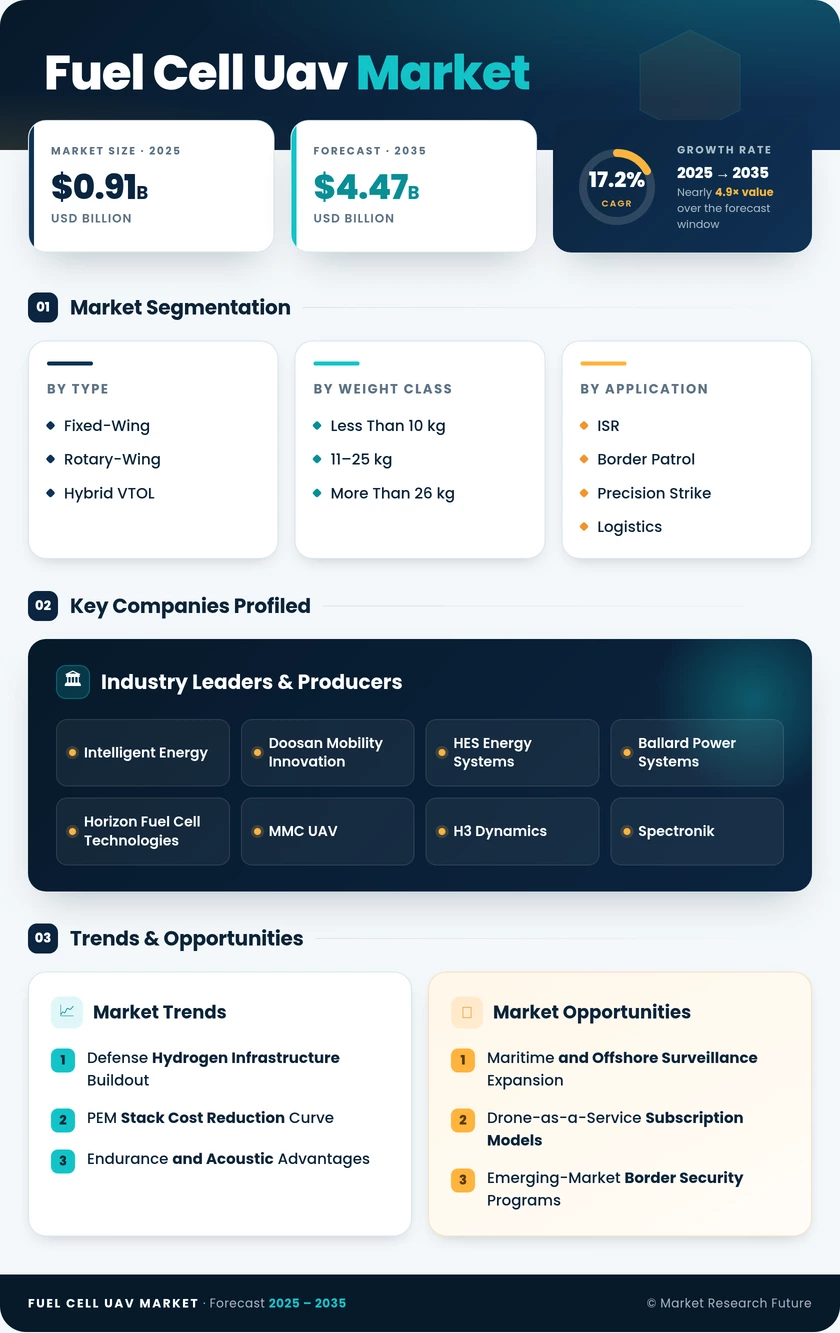
Fuel Cell UAV Market

ID: MRFR/AD/25689-HCR
128 Pages
Shubham Munde
Last Updated: June 08, 2026
Fuel Cell UAV Market Size, Share, Industry Trend & Analysis Research Report By Type (Cargo Drones, Passenger Drones, Military Drones, Racing Drones, Other), By Application (Delivery and Logistics, Military and Defense, Aerial Surveillance and Mapping, Passenger Transport, Other), By Power Output (Below 5 kW, 5-10 kW, 10-20 kW, 20-50 kW, Over 50 kW), By Propulsion System (Single-Rotor, Multi-Rotor, Fixed-Wing, Tilt-Rotor), By Autonomy Level (Semi-Autonomous, High-Autonomous, Full-Autonomous) and By Regional (North America, Europe, South America, Asia-Pacific, Middle East and Africa) - Forecast to 2035
Download PDF ×

We do not share your information with anyone. However, we may send you emails based on your report interest from time to time. You may contact us at any time to opt-out.

  1. 1 Market Overview |
    1. 1.1 Study Assumptions & Market Definition |
    2. 1.2 Scope of the Study |
    3. 1.3 Research Methodology
  2. 2 Market Summary & Key Takeaways
  3. 3 Market Dynamics |
    1. 3.1 Market Drivers Analysis | |
      1. 3.1.1 DoD Hydrogen Forward-Base Strategy | |
      2. 3.1.2 Declining PEM Stack Manufacturing Costs | |
      3. 3.1.3 Extended Flight Endurance (8–13+ Hours) | |
      4. 3.1.4 NATO Interoperability Mandates | |
      5. 3.1.5 Acoustic Stealth for ISR Missions | |
      6. 3.1.6 350/700-Bar Tank Certification Harmonization | |
      7. 3.1.7 Civilian Last-Mile Delivery Adoption |
    2. 3.2 Market Restraints Analysis | |
      1. 3.2.1 Hydrogen Storage and Refueling Infrastructure Gaps | |
      2. 3.2.2 High Upfront Acquisition Cost vs. Battery Alternatives | |
      3. 3.2.3 Limited Hydrogen Purity Standards for Aviation | |
      4. 3.2.4 Supply-Chain Concentration for MEA Components | |
      5. 3.2.5 Airworthiness Certification Complexity |
    3. 3.3 Market Opportunity Analysis | |
      1. 3.3.1 Maritime and Offshore Surveillance Expansion | |
      2. 3.3.2 Drone-as-a-Service Subscription Models | |
      3. 3.3.3 Emerging-Market Border Security Programs | |
      4. 3.3.4 Data Monetization Through Persistent ISR Feeds | |
      5. 3.3.5 Solid-Oxide Fuel Cell Hybridization for Heavy-Lift Logistics |
    4. 3.4 Industry Value Chain Analysis |
    5. 3.5 Porter's Five Forces Analysis
  4. 4 Global Fuel Cell UAV Market Size & Forecast (2021–2035) |
    1. 4.1 Historical Market Size (2021–2025) |
    2. 4.2 Current & Forecast Market Size (2026–2035) |
    3. 4.3 Market Size by Revenue (USD Billion) |
    4. 4.4 Year-over-Year Growth Analysis
  5. 5 Segmentation Analysis |
    1. 5.1 By Fuel Cell Type | |
      1. 5.1.1 Proton-Exchange-Membrane Fuel Cells | |
      2. 5.1.2 Solid-Oxide Fuel Cells | |
      3. 5.1.3 Hydrogen Fuel Cells (Other) |
    2. 5.2 By UAV Platform Type | |
      1. 5.2.1 Fixed-Wing | |
      2. 5.2.2 Rotary-Wing | |
      3. 5.2.3 Hybrid VTOL |
    3. 5.3 By Weight Class | |
      1. 5.3.1 Less Than 10 kg | |
      2. 5.3.2 11–25 kg | |
      3. 5.3.3 More Than 26 kg |
    4. 5.4 By Application | |
      1. 5.4.1 ISR | |
      2. 5.4.2 Border Patrol | |
      3. 5.4.3 Precision Strike | |
      4. 5.4.4 Logistics
  6. 6 Regional Analysis |
    1. 6.1 North America | |
      1. 6.1.1 United States | |
      2. 6.1.2 Canada | |
      3. 6.1.3 Mexico |
    2. 6.2 Europe | |
      1. 6.2.1 Germany | |
      2. 6.2.2 United Kingdom | |
      3. 6.2.3 France | |
      4. 6.2.4 Italy | |
      5. 6.2.5 Spain | |
      6. 6.2.6 Nordic Countries | |
      7. 6.2.7 Russia | |
      8. 6.2.8 Rest of Europe |
    3. 6.3 Asia-Pacific | |
      1. 6.3.1 China | |
      2. 6.3.2 India | |
      3. 6.3.3 Japan | |
      4. 6.3.4 South Korea | |
      5. 6.3.5 ASEAN | |
      6. 6.3.6 Rest of Asia-Pacific |
    4. 6.4 South America | |
      1. 6.4.1 Brazil | |
      2. 6.4.2 Argentina | |
      3. 6.4.3 Rest of South America |
    5. 6.5 Middle East & Africa | |
      1. 6.5.1 Saudi Arabia | |
      2. 6.5.2 UAE | |
      3. 6.5.3 South Africa | |
      4. 6.5.4 Egypt | |
      5. 6.5.5 Rest of MEA
  7. 7 Competitive Landscape |
    1. 7.1 Market Share Analysis (2025) |
    2. 7.2 Competitive Benchmarking Matrix |
    3. 7.3 Company Profiles | |
      1. 7.3.1 Intelligent Energy | |
      2. 7.3.2 Doosan Mobility Innovation | |
      3. 7.3.3 HES Energy Systems | |
      4. 7.3.4 Ballard Power Systems | |
      5. 7.3.5 Horizon Fuel Cell Technologies | |
      6. 7.3.6 MMC UAV | |
      7. 7.3.7 H3 Dynamics | |
      8. 7.3.8 Spectronik | |
      9. 7.3.9 Plug Power | |
      10. 7.3.10 EnergyOr Technologies
  8. 8 Future Outlook & Strategic Recommendations (2026–2035) |
    1. 8.1 Autonomous Hydrogen Operations and AI Integration |
    2. 8.2 Hydrogen Ecosystem Economics and Infrastructure Scaling |
    3. 8.3 Platform Electrification Supercycle and Defense Modernization |
    4. 8.4 ESG Reporting and Zero-Emission Fleet Mandates
  9. 9 Recent Developments & News
  10. 10 Frequently Asked Questions (FAQs)
  11. 11 Report Scope & Methodology |
    1. 11.1 Study Period & Base Year |
    2. 11.2 Data Sources & Citations |
    3. 11.3 Abbreviations
  12. 12 LIST OF TABLES |
  13. TABLE 1 Global Fuel Cell UAV Market Size & Forecast, by Revenue (USD Billion), 2021–2035 |
  14. TABLE 2 Global Fuel Cell UAV Market — Year-over-Year Growth Analysis, 2021–2035 |
  15. TABLE 3 Driver Impact Analysis — Fuel Cell UAV Market |
  16. TABLE 4 Restraints Impact Analysis — Fuel Cell UAV Market |
  17. TABLE 5 Regional Market Share Summary — Fuel Cell UAV Market, 2025 |
  18. TABLE 6 North America Fuel Cell UAV Market Size, by Country, 2021–2035 (USD Billion) |
  19. TABLE 7 Europe Fuel Cell UAV Market Size, by Country, 2021–2035 (USD Billion) |
  20. TABLE 8 Asia-Pacific Fuel Cell UAV Market Size, by Country, 2021–2035 (USD Billion) |
  21. TABLE 9 South America Fuel Cell UAV Market Size, by Country, 2021–2035 (USD Billion) |
  22. TABLE 10 Middle East & Africa Fuel Cell UAV Market Size, by Country, 2021–2035 (USD Billion) |
  23. TABLE 11 Global Fuel Cell UAV Market Size, by Fuel Cell Type, 2021–2035 (USD Billion) |
  24. TABLE 12 Global Fuel Cell UAV Market Size, by UAV Platform Type, 2021–2035 (USD Billion) |
  25. TABLE 13 Global Fuel Cell UAV Market Size, by Weight Class, 2021–2035 (USD Billion) |
  26. TABLE 14 Global Fuel Cell UAV Market Size, by Application, 2021–2035 (USD Billion) |
  27. TABLE 15 Competitive Benchmarking Matrix — Fuel Cell UAV Market, 2025 |
  28. TABLE 16 Company Profiles — Key Players, Fuel Cell UAV Market |
  29. TABLE 17 Recent Developments & Strategic Announcements, 2024–2025 |
  30. TABLE 18 Report Scope & Methodology Summary |
  31. TABLE 19 Detailed Sources and Citations |
  32. TABLE 20 North America Fuel Cell UAV Market Size, by Fuel Cell Type, 2021–2035 (USD Billion) |
  33. TABLE 21 North America Fuel Cell UAV Market Size, by UAV Platform Type, 2021–2035 (USD Billion) |
  34. TABLE 22 North America Fuel Cell UAV Market Size, by Weight Class, 2021–2035 (USD Billion) |
  35. TABLE 23 North America Fuel Cell UAV Market Size, by Application, 2021–2035 (USD Billion) |
  36. TABLE 24 Europe Fuel Cell UAV Market Size, by Fuel Cell Type, 2021–2035 (USD Billion) |
  37. TABLE 25 Europe Fuel Cell UAV Market Size, by UAV Platform Type, 2021–2035 (USD Billion) |
  38. TABLE 26 Europe Fuel Cell UAV Market Size, by Weight Class, 2021–2035 (USD Billion) |
  39. TABLE 27 Europe Fuel Cell UAV Market Size, by Application, 2021–2035 (USD Billion) |
  40. TABLE 28 Asia-Pacific Fuel Cell UAV Market Size, by Fuel Cell Type, 2021–2035 (USD Billion) |
  41. TABLE 29 Asia-Pacific Fuel Cell UAV Market Size, by UAV Platform Type, 2021–2035 (USD Billion) |
  42. TABLE 30 Asia-Pacific Fuel Cell UAV Market Size, by Weight Class, 2021–2035 (USD Billion) |
  43. TABLE 31 Asia-Pacific Fuel Cell UAV Market Size, by Application, 2021–2035 (USD Billion) |
  44. TABLE 32 South America Fuel Cell UAV Market Size, by Fuel Cell Type, 2021–2035 (USD Billion) |
  45. TABLE 33 South America Fuel Cell UAV Market Size, by UAV Platform Type, 2021–2035 (USD Billion) |
  46. TABLE 34 South America Fuel Cell UAV Market Size, by Weight Class, 2021–2035 (USD Billion) |
  47. TABLE 35 South America Fuel Cell UAV Market Size, by Application, 2021–2035 (USD Billion) |
  48. TABLE 36 Middle East & Africa Fuel Cell UAV Market Size, by Fuel Cell Type, 2021–2035 (USD Billion) |
  49. TABLE 37 Middle East & Africa Fuel Cell UAV Market Size, by UAV Platform Type, 2021–2035 (USD Billion) |
  50. TABLE 38 Middle East & Africa Fuel Cell UAV Market Size, by Weight Class, 2021–2035 (USD Billion) |
  51. TABLE 39 Middle East & Africa Fuel Cell UAV Market Size, by Application, 2021–2035 (USD Billion)
  52. 13 LIST OF FIGURES |
  53. FIGURE 1 Global Fuel Cell UAV Market Dynamics — Drivers, Restraints, and Opportunities |
  54. FIGURE 2 Fuel Cell UAV Market — Industry Value Chain Analysis |
  55. FIGURE 3 Fuel Cell UAV Market — Porter's Five Forces Analysis |
  56. FIGURE 4 Global Fuel Cell UAV Market Size Trend & Forecast (USD Billion), 2021–2035 |
  57. FIGURE 5 Fuel Cell UAV Market Share, by Fuel Cell Type, 2025 |
  58. FIGURE 6 Fuel Cell UAV Market Share, by UAV Platform Type, 2025 |
  59. FIGURE 7 Fuel Cell UAV Market Share, by Weight Class, 2025 |
  60. FIGURE 8 Fuel Cell UAV Market Share, by Application, 2025 |
  61. FIGURE 9 Fuel Cell UAV Market Share, by Region, 2025 |
  62. FIGURE 10 North America Fuel Cell UAV Market Size & Forecast (USD Billion), 2021–2035 |
  63. FIGURE 11 Europe Fuel Cell UAV Market Size & Forecast (USD Billion), 2021–2035 |
  64. FIGURE 12 Asia-Pacific Fuel Cell UAV Market Size & Forecast (USD Billion), 2021–2035 |
  65. FIGURE 13 South America Fuel Cell UAV Market Size & Forecast (USD Billion), 2021–2035 |
  66. FIGURE 14 Middle East & Africa Fuel Cell UAV Market Size & Forecast (USD Billion), 2021–2035 |
  67. FIGURE 15 Competitive Landscape — Fuel Cell UAV Market Share Analysis, 2025

Segmentation Quick Reference

DimensionSub-SegmentsDominant SegmentFastest Growing Segment
Fuel Cell TypeProton-Exchange-Membrane Fuel Cells; Solid-Oxide Fuel Cells; Hydrogen Fuel Cells (Other)Proton-Exchange-Membrane Fuel Cells (63.0% share, 2025)Solid-Oxide Fuel Cells (24.0% CAGR)
UAV Platform TypeFixed-Wing; Rotary-Wing; Hybrid VTOLFixed-Wing (49.0% share, 2025)Hybrid VTOL (22.8% CAGR)
Weight ClassLess Than 10 kg; 11–25 kg; More Than 26 kg11–25 kg (50.5% share, 2025)More Than 26 kg (24.6% CAGR)
ApplicationISR; Border Patrol; Precision Strike; LogisticsISR (53.0% share, 2025)Logistics (24.0% CAGR)
GeographyNorth America; Europe; Asia-Pacific; South America; Middle East & AfricaNorth America (38.5% share, 2025)Europe (20.4% CAGR)


Market Segmentation Overview

By Fuel Cell Type

Sub-SegmentKey Trend
Proton-Exchange-Membrane Fuel CellsAutomotive R&D spillover driving cost reduction toward USD 55/kW by 2027; dominant in tactical Group 2–3 UAV programs
Solid-Oxide Fuel CellsSOFC-PEM hybrid architectures enabling 24-hour-plus strategic reconnaissance missions
Hydrogen Fuel Cells (Other)Niche alkaline and direct-methanol variants serving research and industrial inspection applications


PEM technology maintains its commanding position through rapid cold-start capability and a mature global supply chain. SOFC is gaining traction as multi-day endurance requirements emerge in strategic defense and humanitarian logistics.

By UAV Platform Type

Sub-SegmentKey Trend
Fixed-WingHigh lift-to-drag ratios maximize hydrogen endurance; primary platform for ISR and border patrol missions
Rotary-WingHover capability essential for infrastructure inspection and precision payload delivery
Hybrid VTOLMerges vertical launch convenience with hydrogen cruise efficiency; fastest-growing platform configuration


Fixed-wing configurations continue to dominate procurement volumes. Hybrid VTOL is emerging as the preferred next-generation configuration for operators requiring both shipboard launch capability and extended-range patrol.

By Weight Class

Sub-SegmentKey Trend
Less Than 10 kgMan-portable tactical systems for squad-level reconnaissance; limited hydrogen storage constrains endurance
11–25 kgOptimal balance of stack weight, storage volume, and payload for the widest operational envelope
More Than 26 kgHeavy-lift SOFC-PEM hybrid platforms enabling cargo delivery and long-duration strategic ISR


The 11–25 kg segment addresses the broadest customer base, from military procurement to commercial infrastructure operators. Above-26 kg platforms are positioned for rapid growth as logistics applications scale.

By Application

Sub-SegmentKey Trend
ISRPersistent surveillance with acoustic stealth; largest revenue segment across military and civilian end users
Border PatrolAutonomous perimeter monitoring along extended frontiers; strong demand in North America and Asia-Pacific
Precision StrikeLoitering-munition endurance profiles benefiting from hydrogen propulsion's extended time-on-station
LogisticsHumanitarian and commercial last-mile delivery; fastest-growing application segment driven by European and Asian trials


ISR will remain the revenue anchor through 2030, but the logistics segment is closing the gap as regulatory frameworks for beyond-visual-line-of-sight cargo operations mature across Europe and Asia-Pacific.