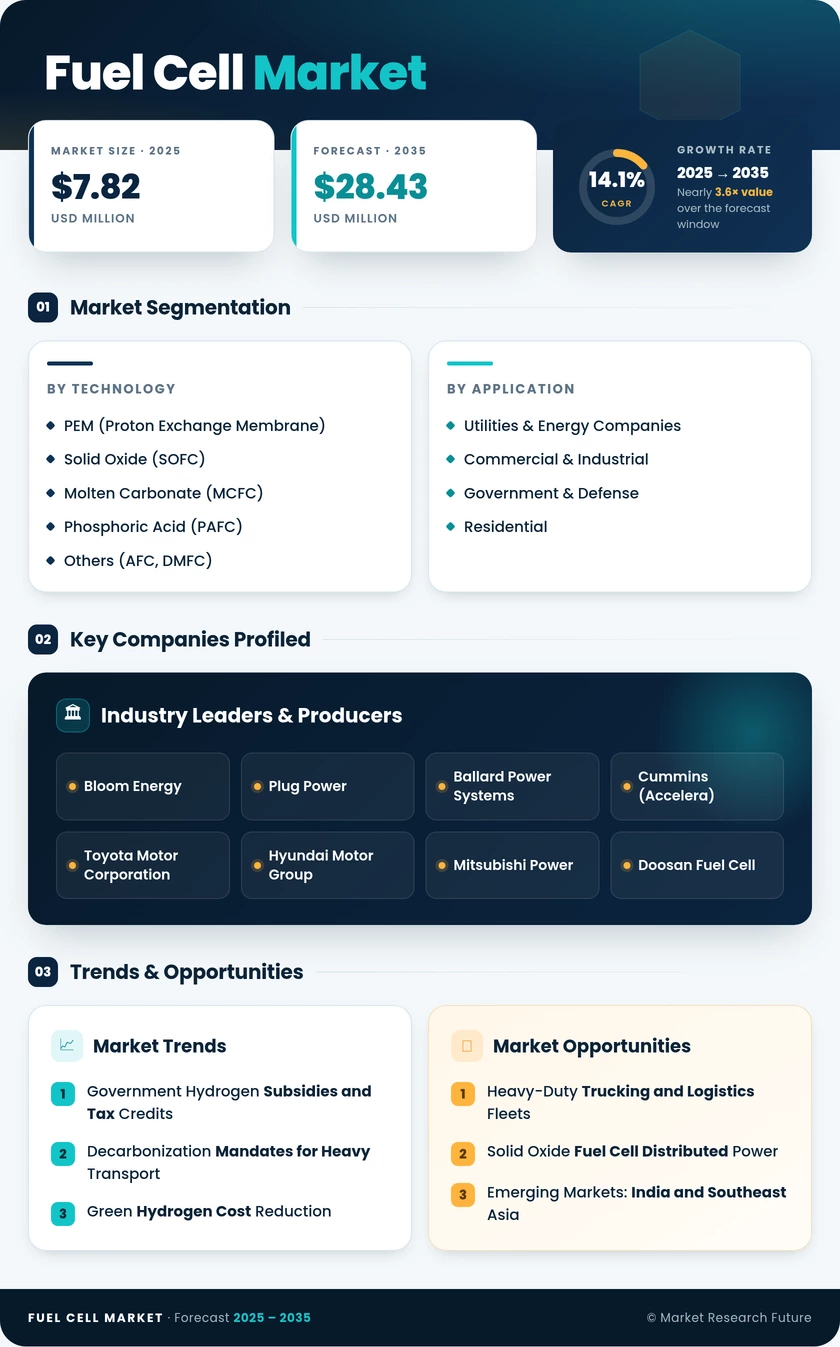
Fuel Cell Market

ID: MRFR/EnP/9477-CR
128 Pages
Anshula Mandaokar
Last Updated: June 16, 2026
Fuel Cell Market Size, Share & Growth Analysis Report By Technology (PEM (Proton Exchange Membrane), Solid Oxide (SOFC), Molten Carbonate (MCFC), Phosphoric Acid (PAFC), Others (AFC, DMFC)), By Application (Stationary Power Generation, Transportation, Portable Power), By End User (Utilities & Energy Companies, Commercial & Industrial, Government & Defense, Residential), And By Region (North America, Europe, Asia-Pacific, Middle East & Africa, and South America) – Trends & Industry Forecast to 2035
Download PDF ×

We do not share your information with anyone. However, we may send you emails based on your report interest from time to time. You may contact us at any time to opt-out.

Fuel Cell Market

Market Size

Forecast Period2026-2035
CAGR (2026-2035)14.1%
2025 Market SizeUSD 7.82 Billion
2035 Market SizeUSD 28.43 Billion

Key Players

Bloom Energy
Plug Power
Ballard Power Systems
Cummins
Toyota Motor Corporation
Hyundai Motor Group
Opportunities
  • Heavy-Duty Trucking and Logistics Fleets
  • Solid Oxide Fuel Cell Distributed Power
  • Emerging Markets: India and Southeast Asia
  1. 1 Market Overview |
    1. 1.1 Study Assumptions & Market Definition |
    2. 1.2 Scope of the Study |
    3. 1.3 Research Methodology
  2. 2 Market Summary & Key Takeaways
  3. 3 Market Dynamics |
    1. 3.1 Market Drivers Analysis | |
      1. 3.1.1 Government Hydrogen Subsidies & Tax Credits | |
      2. 3.1.2 Decarbonization Mandates for Heavy Transport | |
      3. 3.1.3 Green Hydrogen Cost Reduction | |
      4. 3.1.4 Data-Center Backup Power Demand | |
      5. 3.1.5 National Hydrogen Infrastructure Build-Out | |
      6. 3.1.6 Fuel Cell Stack Cost Learning Curves | |
      7. 3.1.7 Maritime & Aviation Decarbonization Pilots |
    2. 3.2 Market Restraints Analysis | |
      1. 3.2.1 High Platinum-Group Metal Catalyst Costs | |
      2. 3.2.2 Hydrogen Refueling Infrastructure Gaps | |
      3. 3.2.3 Electrolyzer Supply Bottlenecks | |
      4. 3.2.4 Competition from Battery-Electric Alternatives | |
      5. 3.2.5 Safety Perception & Permitting Barriers |
    3. 3.3 Market Opportunity Analysis | |
      1. 3.3.1 Heavy-Duty Trucking & Logistics Fleets | |
      2. 3.3.2 Solid Oxide Fuel Cell Distributed Power | |
      3. 3.3.3 Emerging Markets: India & Southeast Asia | |
      4. 3.3.4 Hydrogen-as-a-Service & Leasing Models | |
      5. 3.3.5 Marine & Aviation Decarbonization |
    4. 3.4 Industry Value Chain Analysis |
    5. 3.5 Porter's Five Forces Analysis
  4. 4 Global Fuel Cell Market Size & Forecast (2021–2035) |
    1. 4.1 Historical Market Size (2021–2025) |
    2. 4.2 Current & Forecast Market Size (2026–2035) |
    3. 4.3 Market Size by Revenue (USD Billion) |
    4. 4.4 Year-over-Year Growth Analysis
  5. 5 Segmentation Analysis |
    1. 5.1 By Technology | |
      1. 5.1.1 PEM (Proton Exchange Membrane) | |
      2. 5.1.2 Solid Oxide (SOFC) | |
      3. 5.1.3 Molten Carbonate (MCFC) | |
      4. 5.1.4 Phosphoric Acid (PAFC) | |
      5. 5.1.5 Others (AFC, DMFC) |
    2. 5.2 By Application | |
      1. 5.2.1 Stationary Power Generation | |
      2. 5.2.2 Transportation | |
      3. 5.2.3 Portable Power |
    3. 5.3 By End User | |
      1. 5.3.1 Utilities & Energy Companies | |
      2. 5.3.2 Commercial & Industrial | |
      3. 5.3.3 Government & Defense | |
      4. 5.3.4 Residential
  6. 6 Regional Analysis |
    1. 6.1 North America | |
      1. 6.1.1 United States | |
      2. 6.1.2 Canada | |
      3. 6.1.3 Mexico |
    2. 6.2 Europe | |
      1. 6.2.1 Germany | |
      2. 6.2.2 United Kingdom | |
      3. 6.2.3 France | |
      4. 6.2.4 Rest of Europe |
    3. 6.3 Asia-Pacific | |
      1. 6.3.1 China | |
      2. 6.3.2 Japan | |
      3. 6.3.3 South Korea | |
      4. 6.3.4 India | |
      5. 6.3.5 Rest of Asia-Pacific |
    4. 6.4 South America | |
      1. 6.4.1 Brazil | |
      2. 6.4.2 Chile | |
      3. 6.4.3 Rest of South America |
    5. 6.5 Middle East & Africa | |
      1. 6.5.1 Saudi Arabia | |
      2. 6.5.2 UAE | |
      3. 6.5.3 South Africa | |
      4. 6.5.4 Rest of Middle East & Africa
  7. 7 Competitive Landscape |
    1. 7.1 Market Share Analysis (2025) |
    2. 7.2 Competitive Benchmarking Matrix |
    3. 7.3 Company Profiles | |
      1. 7.3.1 Bloom Energy | |
      2. 7.3.2 Plug Power | |
      3. 7.3.3 Ballard Power Systems | |
      4. 7.3.4 Cummins (Accelera) | |
      5. 7.3.5 Toyota Motor Corporation | |
      6. 7.3.6 Hyundai Motor Group | |
      7. 7.3.7 Mitsubishi Power | |
      8. 7.3.8 Doosan Fuel Cell | |
      9. 7.3.9 Ceres Power | |
      10. 7.3.10 AFC Energy
  8. 8 Future Outlook & Strategic Recommendations (2026–2035) |
    1. 8.1 Gigawatt-Scale Hydrogen Hubs & Infrastructure Buildout |
    2. 8.2 AI-Optimized Fuel Cell System Management |
    3. 8.3 Electrification Supercycle & Grid-Edge Fuel Cells |
    4. 8.4 ESG Reporting & Corporate Hydrogen Commitments
  9. 9 Recent Developments & News
  10. 10 Frequently Asked Questions (FAQs)
  11. 11 Report Scope & Methodology |
    1. 11.1 Study Period & Base Year |
    2. 11.2 Data Sources & Citations |
    3. 11.3 Abbreviations
  12. 12 LIST OF TABLES |
  13. TABLE 1 Global Fuel Cell Market Size & Forecast, by Revenue (USD Billion), 2021–2035 |
  14. TABLE 2 Global Fuel Cell Market — Year-over-Year Growth Analysis, 2021–2035 |
  15. TABLE 3 Global Fuel Cell Market — Driver Impact Analysis |
  16. TABLE 4 Global Fuel Cell Market — Restraint Impact Analysis |
  17. TABLE 5 Global Fuel Cell Market Size, by Technology, 2021–2035 (USD Billion) |
  18. TABLE 6 Global Fuel Cell Market Size, by Application, 2021–2035 (USD Billion) |
  19. TABLE 7 Global Fuel Cell Market Size, by End User, 2021–2035 (USD Billion) |
  20. TABLE 8 Global Fuel Cell Market Size, by Region, 2021–2035 (USD Billion) |
  21. TABLE 9 North America Fuel Cell Market Size, by Country, 2021–2035 (USD Billion) |
  22. TABLE 10 North America Fuel Cell Market Size, by Technology, 2021–2035 (USD Billion) |
  23. TABLE 11 North America Fuel Cell Market Size, by Application, 2021–2035 (USD Billion) |
  24. TABLE 12 North America Fuel Cell Market Size, by End User, 2021–2035 (USD Billion) |
  25. TABLE 13 Europe Fuel Cell Market Size, by Country, 2021–2035 (USD Billion) |
  26. TABLE 14 Europe Fuel Cell Market Size, by Technology, 2021–2035 (USD Billion) |
  27. TABLE 15 Europe Fuel Cell Market Size, by Application, 2021–2035 (USD Billion) |
  28. TABLE 16 Europe Fuel Cell Market Size, by End User, 2021–2035 (USD Billion) |
  29. TABLE 17 Asia-Pacific Fuel Cell Market Size, by Country, 2021–2035 (USD Billion) |
  30. TABLE 18 Asia-Pacific Fuel Cell Market Size, by Technology, 2021–2035 (USD Billion) |
  31. TABLE 19 Asia-Pacific Fuel Cell Market Size, by Application, 2021–2035 (USD Billion) |
  32. TABLE 20 Asia-Pacific Fuel Cell Market Size, by End User, 2021–2035 (USD Billion) |
  33. TABLE 21 South America Fuel Cell Market Size, by Country, 2021–2035 (USD Billion) |
  34. TABLE 22 Middle East & Africa Fuel Cell Market Size, by Country, 2021–2035 (USD Billion) |
  35. TABLE 23 Competitive Benchmarking Matrix — Global Fuel Cell Market, 2025 |
  36. TABLE 24 Company Profiles — Key Players, Global Fuel Cell Market |
  37. TABLE 25 Recent Developments & Strategic Announcements, 2024–2025 |
  38. TABLE 26 Report Scope & Methodology |
  39. TABLE 27 Detailed Sources & Citations
  40. 13 LIST OF FIGURES |
  41. FIGURE 1 Global Fuel Cell Market Dynamics — Drivers, Restraints & Opportunities |
  42. FIGURE 2 Industry Value Chain Analysis — Fuel Cell Market |
  43. FIGURE 3 Porter's Five Forces Analysis — Fuel Cell Market |
  44. FIGURE 4 Global Fuel Cell Market Size Trend (USD Billion), 2021–2035 |
  45. FIGURE 5 Global Fuel Cell Market Share, by Technology (%), 2025 |
  46. FIGURE 6 Global Fuel Cell Market Share, by Application (%), 2025 |
  47. FIGURE 7 Global Fuel Cell Market Share, by End User (%), 2025 |
  48. FIGURE 8 Global Fuel Cell Market Share, by Region (%), 2025 |
  49. FIGURE 9 North America Fuel Cell Market Size Trend (USD Billion), 2021–2035 |
  50. FIGURE 10 Europe Fuel Cell Market Size Trend (USD Billion), 2021–2035 |
  51. FIGURE 11 Asia-Pacific Fuel Cell Market Size Trend (USD Billion), 2021–2035 |
  52. FIGURE 12 South America Fuel Cell Market Size Trend (USD Billion), 2021–2035 |
  53. FIGURE 13 Middle East & Africa Fuel Cell Market Size Trend (USD Billion), 2021–2035 |
  54. FIGURE 14 Competitive Landscape — Market Share Chart, 2025 |
  55. FIGURE 15 Fuel Cell Market — CAGR by Segment, 2026–2035

Segmentation Quick Reference

DimensionSub-SegmentsDominant SegmentFastest Growing Segment
By TechnologyPEM, SOFC, MCFC, PAFC, Others (AFC, DMFC)PEM (Proton Exchange Membrane)Solid Oxide (SOFC)
By ApplicationStationary Power Generation, Transportation, Portable PowerStationary Power GenerationTransportation
By End UserUtilities & Energy Companies, Commercial & Industrial, Government & Defense, ResidentialUtilities & Energy CompaniesCommercial & Industrial
By RegionNorth America, Europe, Asia-Pacific, South America, Middle East & AfricaNorth AmericaAsia-Pacific


Market Segmentation Overview

By Technology

Sub-SegmentKey Trend
PEM (Proton Exchange Membrane)Rising automotive FCEV adoption and data-center backup power deployments
Solid Oxide (SOFC)High-efficiency CHP commercialization with fuel-flexible platforms
Molten Carbonate (MCFC)Utility-scale distributed generation with integrated carbon capture
Phosphoric Acid (PAFC)Established commercial building CHP with long-duration reliability
Others (AFC, DMFC)Niche military, portable, and specialty applications


PEM technology continues to dominate global fuel cell deployments due to its versatility across transport, backup power, and portable applications. SOFC is gaining momentum as manufacturing scale-up reduces system costs and industrial end users seek higher-efficiency alternatives to conventional generation.

By Application

Sub-SegmentKey Trend
Stationary Power GenerationGrid resilience, CHP, and data-center prime/backup power
TransportationHeavy-duty trucking, bus fleets, and passenger FCEV expansion
Portable PowerMilitary field operations, telecom backup, and construction site generators


Stationary power generation remains the largest application category, benefiting from long-discharge-duration advantages over battery storage and tightening emissions mandates. Transportation is the fastest-growing application as commercial vehicle OEMs scale fuel cell electric truck and bus production.

By End User

Sub-SegmentKey Trend
Utilities & Energy CompaniesDistributed generation assets and hydrogen-to-power grid services
Commercial & IndustrialOn-site CHP for manufacturing, warehouses, and campus facilities
Government & DefenseResilient military power, government building microgrids
ResidentialMicro-CHP adoption led by Japan's ENE-FARM program


Utilities anchor end-user demand through large-scale distributed generation installations, while commercial and industrial adoption accelerates as combined heat and power economics improve under stricter carbon-pricing policies.