×
Hero Background
English
Chinese
French
Japanese
Korean
German
Spanish

French Fries Market Share

ID: MRFR/FnB/10283-HCR
128 Pages
Snehal Singh
October 2025

French Fries Market Research Report Information By Product (Fresh and Frozen), By End Use (Food Service and Retail), and By Region (North America, Europe, Asia-Pacific, and Rest Of The World) – Market Forecast Till 2035

Share:
Download PDF ×

We do not share your information with anyone. However, we may send you emails based on your report interest from time to time. You may contact us at any time to opt-out.

French Fries Market Infographic
Purchase Options

Market Share

French Fries Market Share Analysis

In the expansive world of the food industry, the French Fries market has emerged as a staple, prompting companies to implement a variety of market share positioning strategies. One prevalent strategy is differentiation, where companies aim to distinguish their French Fries from competitors by emphasizing unique qualities. For example, some companies may highlight the use of specific potato varieties or unique seasoning blends, while others may focus on offering healthier alternatives, such as baked or sweet potato fries. This differentiation strategy allows companies to carve out a niche in the market and cater to diverse consumer preferences within the broad category of French Fries.

Cost leadership is another significant market share positioning strategy in the French Fries market. Companies strive to establish themselves as leaders by offering French Fries at competitive prices without compromising on taste or quality. This often involves optimizing production processes, securing cost-effective sourcing of potatoes, and achieving economies of scale. By positioning their products as both affordable and satisfying, companies can attract a broad consumer base and secure a substantial market share.

Market segmentation is a widely employed strategy in the French Fries market. Companies identify distinct consumer segments with specific preferences and needs, tailoring their products accordingly. For instance, some products may target health-conscious consumers by offering organic or low-fat options, while others may cater to the convenience-seeking market with pre-seasoned or quick-frozen French Fries. This segmentation enables companies to address the diverse demands of the market and position themselves as leaders in specific subcategories.

Strategic collaborations and partnerships play a pivotal role in market share positioning within the French Fries industry. Companies often form alliances with fast-food chains, restaurants, or retailers to enhance the visibility and accessibility of their products. By aligning with reputable entities, businesses can leverage shared distribution networks, gain exposure to new customer bases, and reinforce their market position.

Innovation is a driving force behind market share positioning strategies in the French Fries market. Companies invest in research and development to create novel formulations, shapes, or cooking methods that set their products apart. For instance, introducing seasoned wedges, curly fries, or innovative packaging for on-the-go consumption can contribute to market differentiation and attract consumers seeking variety within the French Fries category.

Effective digital marketing and brand communication are instrumental tools for companies aiming to strengthen their market share positioning in the French Fries market. Through online platforms and social media, companies can showcase the quality, flavor, and versatility of their products. Engaging content, interactive campaigns, and promotions contribute to brand awareness and can significantly impact consumer preferences, ultimately leading to increased market share.

Geographic expansion is a strategic consideration for companies in the French Fries market. Identifying regions with a growing appetite for convenience foods and limited competition allows businesses to establish a strong presence and gain a competitive market share. Adapting product offerings to local tastes, complying with regional regulations, and building relationships with local distributors are key elements in expanding geographic reach.

Author
Snehal Singh
Assistant Manager - Research

High acumen in analyzing complex macro & micro markets with more than 6 years of work experience in the field of market research. By implementing her analytical skills in forecasting and estimation into market research reports, she has expertise in Packaging, Construction, and Equipment domains. She handles a team size of 20-25 resources and ensures smooth running of the projects, associated marketing activities, and client servicing.

Leave a Comment

FAQs

What is the current valuation of the French Fries Market as of 2024?

The French Fries Market was valued at 16.7 USD Billion in 2024.

What is the projected market valuation for the French Fries Market in 2035?

The market is projected to reach 28.57 USD Billion by 2035.

What is the expected CAGR for the French Fries Market during the forecast period 2025 - 2035?

The expected CAGR for the French Fries Market during 2025 - 2035 is 5.0%.

Which product segment had a valuation of 10.0 USD Billion in 2024?

The Frozen product segment had a valuation of 10.0 USD Billion in 2024.

What is the projected valuation for the Fresh product segment by 2035?

The Fresh product segment is projected to reach 10.5 USD Billion by 2035.

How do the Food Service and Retail segments compare in terms of market valuation in 2024?

Both the Food Service and Retail segments were valued at 8.35 USD Billion in 2024.

Market Summary

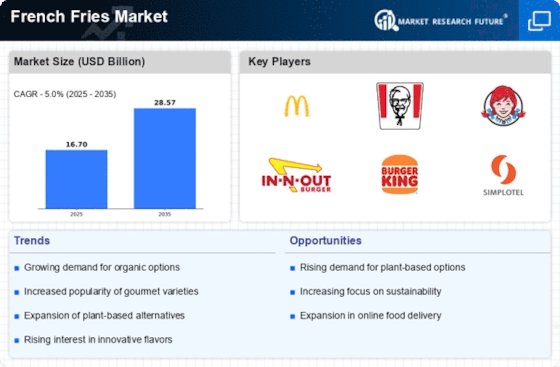
As per MRFR analysis, the French Fries Market Size was estimated at 16.7 USD Billion in 2024. The French Fries industry is projected to grow from 17.54 in 2025 to 28.57 by 2035, exhibiting a compound annual growth rate (CAGR) of 5.0 during the forecast period 2025 - 2035.

Key Market Trends & Highlights

The French Fries Market is experiencing a dynamic shift towards health-conscious and innovative offerings.

  • Health-conscious options are increasingly influencing consumer preferences in the North American market.
  • Flavor innovation is driving growth in the Asia-Pacific region, appealing to diverse palates.
  • The frozen segment remains the largest, while the fresh segment is rapidly gaining traction among health-oriented consumers.
  • Rising demand for convenience foods and the expansion of quick service restaurants are key drivers of market growth.

Market Size & Forecast

2024 Market Size 16.7 (USD Billion)
2035 Market Size 28.57 (USD Billion)
CAGR (2025 - 2035) 5.0%
Largest Regional Market Share in 2024 North America

Major Players

<p>McDonald's (US), KFC (US), Wendy's (US), In-N-Out Burger (US), Burger King (US), Simplot (US), Lamb Weston (US), McCain Foods (CA), Aviko (NL)</p>

Market Trends

The French Fries Market is currently experiencing a dynamic evolution, driven by changing consumer preferences and the increasing demand for convenience foods. As lifestyles become busier, individuals are gravitating towards quick-service restaurants and fast-food outlets that offer ready-to-eat options. This shift is further influenced by the growing trend of snacking, where French fries are often consumed as a standalone item rather than a side dish. Additionally, the rise of food delivery services has made it easier for consumers to access their favorite fried products, thereby expanding the market's reach. Moreover, the French Fries Market is witnessing a surge in innovation, with manufacturers exploring various flavors and cooking techniques to cater to diverse palates. The introduction of healthier alternatives, such as baked or air-fried options, reflects a broader trend towards health-conscious eating. This inclination towards nutritious choices does not diminish the appeal of traditional fried varieties, suggesting a potential coexistence of both segments within the market. As the landscape continues to evolve, stakeholders must remain agile to adapt to these shifting dynamics and consumer expectations.

Health-Conscious Options

There is a noticeable shift towards healthier alternatives in the French Fries Market. Consumers are increasingly seeking options that align with their dietary preferences, leading to the introduction of baked and air-fried varieties. This trend indicates a growing awareness of nutrition and wellness among consumers.

Flavor Innovation

The market is experiencing a wave of flavor innovation, with manufacturers experimenting with unique seasonings and ingredients. This trend aims to attract adventurous eaters and diversify the product offerings, enhancing the overall appeal of French fries.

Sustainability Practices

Sustainability is becoming a focal point in the French Fries Market, as consumers express a preference for products sourced from environmentally responsible practices. This trend encourages companies to adopt sustainable farming and production methods, reflecting a broader commitment to ecological stewardship.

French Fries Market Market Drivers

Health and Wellness Trends

The French Fries Market is increasingly influenced by health and wellness trends, as consumers become more conscious of their dietary choices. There is a growing demand for healthier alternatives, such as baked or air-fried French fries, which offer lower fat content compared to traditional fried options. Recent surveys indicate that nearly 30% of consumers are actively seeking healthier side dish options, prompting manufacturers to adapt their product lines accordingly. This shift towards health-conscious choices is not only reshaping consumer preferences but also encouraging innovation within the industry. As a result, the French Fries Market is likely to see a rise in the availability of healthier French fry options, catering to the evolving demands of health-focused consumers.

Innovative Flavor Profiles

The French Fries Market is witnessing a transformation through the introduction of innovative flavor profiles. As consumer palates evolve, there is a growing demand for unique and diverse flavor options beyond traditional offerings. This trend is reflected in the increasing popularity of gourmet French fries, which incorporate various seasonings, toppings, and dips. Market data indicates that specialty fries, such as truffle or spicy variants, are gaining traction, appealing to adventurous eaters. This diversification not only enhances the consumer experience but also allows restaurants and food manufacturers to differentiate their products in a competitive landscape. Consequently, the French Fries Market is likely to benefit from this trend, as innovation in flavor profiles attracts a broader customer base.

Rising Demand for Convenience Foods

The French Fries Market experiences a notable surge in demand for convenience foods, driven by the fast-paced lifestyle of consumers. As individuals increasingly seek quick meal solutions, the popularity of ready-to-eat and frozen French fries has escalated. According to recent data, the frozen French fries segment is projected to grow at a compound annual growth rate of approximately 4.5% over the next five years. This trend indicates a shift in consumer preferences towards products that offer both convenience and taste. Fast food chains and restaurants are adapting their menus to include a variety of French fry options, catering to this growing demand. Consequently, the French Fries Market is likely to witness a significant expansion as more consumers opt for convenient meal choices.

Sustainability and Ethical Sourcing

Sustainability has emerged as a critical driver within the French Fries Market, as consumers increasingly prioritize ethical sourcing and environmentally friendly practices. There is a growing awareness regarding the environmental impact of food production, leading to a demand for sustainably sourced potatoes and eco-friendly packaging. Recent studies suggest that consumers are willing to pay a premium for products that align with their values, indicating a shift towards more responsible consumption. This trend is prompting manufacturers and restaurants to adopt sustainable practices, such as reducing waste and utilizing renewable resources. Consequently, the French Fries Market is likely to experience growth as businesses that prioritize sustainability resonate with environmentally conscious consumers.

Expansion of Quick Service Restaurants

The proliferation of quick service restaurants (QSRs) plays a pivotal role in shaping the French Fries Market. As urbanization continues to rise, the number of QSRs has increased, providing consumers with easy access to French fries as a staple side dish. Recent statistics suggest that the QSR segment accounts for over 60% of the total French fries consumption. This growth is attributed to the increasing preference for fast food among younger demographics, who prioritize speed and affordability. Additionally, QSRs are innovating their offerings by introducing unique flavors and combinations, further enhancing the appeal of French fries. As a result, the French Fries Market is poised for continued growth, driven by the expansion of QSRs and their evolving menus.

Market Segment Insights

By Product: Frozen (Largest) vs. Fresh (Fastest-Growing)

<p>In the French Fries Market, the product segment reveals a significant distribution between frozen and fresh variants. Currently, frozen fries hold the largest market share, dominating retail and food service sectors due to their convenience, longer shelf life, and consistent quality. The ever-increasing consumer demand for ready-to-cook meals and snacks has bolstered the popularity of frozen fries, making them a staple in households and restaurants alike. On the other hand, fresh fries are carving out a niche in the market, appealing to health-conscious consumers and food enthusiasts who prefer freshly prepared items, thus contributing to the dynamic landscape of this segment.</p>

<p>Product: Frozen (Dominant) vs. Fresh (Emerging)</p>

<p>Frozen French fries dominate the market due to their extensive availability and consumer preference for convenience. This segment benefits from extensive distribution channels and strong branding among leading manufacturers, making frozen fries a common choice in both supermarkets and restaurants. Fresh fries, while currently less prevalent, are rapidly emerging in popularity as consumers seek healthier options and gourmet experiences. This trend is driven by an increasing interest in organic and locally sourced products, catering to the sophisticated palate. Chefs and food establishments are also embracing fresh fries for their ability to enhance menu offerings, indicating a promising growth trajectory.</p>

By End Use: Food Service (Largest) vs. Retail (Fastest-Growing)

<p>In the French Fries Market, the segmentation by end use indicates a significant preference for food service, which holds the largest market share. This segment comprises restaurants, cafes, and fast-food outlets where French fries are a staple menu item, contributing to consistent demand. Retail, while smaller in comparison, is experiencing noteworthy growth as consumers opt to prepare French fries at home for convenience and cost savings. This dynamic leads to a competitive landscape between the two segments as they vie for consumer preferences.</p>

<p>Food Service (Dominant) vs. Retail (Emerging)</p>

<p>The Food Service segment is characterized by its dominant presence within the French Fries Market, driven by the high frequency of consumption in dining establishments. Restaurants and fast-food chains utilize frozen and pre-prepared French fries, capitalizing on speed and quality to enhance customer satisfaction. Conversely, the Retail segment is emerging rapidly as a formidable player, driven by rising consumer trends for at-home dining. With more households investing in air fryers and other cooking appliances, packaged French fries are becoming increasingly popular. This segment focuses on offering various products to meet diverse consumer preferences, balancing convenience with quality.</p>

Get more detailed insights about French Fries Market Research Report-Global Forecast till 2035

Regional Insights

North America : Market Leader in Consumption

North America is the largest market for French fries, accounting for approximately 45% of global consumption. The region's growth is driven by a high demand for fast food, convenience, and the increasing popularity of frozen and ready-to-eat products. Regulatory support for food safety and quality standards further enhances market stability. The U.S. is the primary contributor, followed by Canada, which holds about 10% of the market share. The competitive landscape is characterized by major players such as McDonald's, KFC, and Wendy's, which dominate the fast-food sector. The presence of established brands like Lamb Weston and McCain Foods ensures a robust supply chain. Innovations in product offerings, including healthier options and diverse flavors, are also shaping consumer preferences, making the market dynamic and competitive.

Europe : Emerging Market with Growth Potential

Europe is witnessing a growing demand for French fries, holding approximately 30% of the global market share. The region's growth is fueled by increasing consumer preference for convenience foods and the expansion of fast-food chains. Regulatory frameworks promoting food quality and sustainability are also significant drivers. Countries like France and the Netherlands are leading the market, with France alone accounting for about 12% of the total market share. The competitive landscape in Europe features key players such as Aviko and McCain Foods, which are known for their innovative product lines. The market is characterized by a mix of local and international brands, with a strong emphasis on quality and sustainability. The rise of food delivery services and changing consumer habits are further influencing market dynamics, making Europe a vibrant hub for French fries consumption.

Asia-Pacific : Rapid Growth in Emerging Markets

Asia-Pacific is rapidly emerging as a significant market for French fries, currently holding about 15% of the global market share. The growth is driven by urbanization, rising disposable incomes, and changing dietary preferences towards Western-style fast food. Countries like China and India are at the forefront, with China representing the largest market in the region, contributing approximately 8% to the global share. The competitive landscape is evolving, with both local and international players vying for market share. Major fast-food chains like KFC and McDonald's are expanding their presence, while local brands are also gaining traction. The increasing availability of frozen and processed food products is further enhancing market growth, making Asia-Pacific a key player in The French Fries Market.

Middle East and Africa : Untapped Market with Potential

The Middle East and Africa region is an emerging market for French fries, currently holding about 10% of the global market share. The growth is driven by increasing urbanization, a young population, and a rising trend towards fast food consumption. Countries like South Africa and the UAE are leading the market, with South Africa accounting for approximately 5% of the total market share. The competitive landscape is characterized by a mix of local and international players, with fast-food chains expanding their footprint in urban areas. The presence of key players like KFC and local brands is shaping the market dynamics. Additionally, the growing trend of food delivery services and changing consumer preferences towards convenience foods are expected to drive further growth in this region.

Key Players and Competitive Insights

Leading market players are investing heavily in research and development in order to expand their product lines, which will help the French Fries Market, grow even more. Market participants are also undertaking a variety of strategic activities to expand their global footprint, with important market developments including new product launches, contractual agreements, mergers and acquisitions, higher investments, and collaboration with other organizations. To expand and survive in a more competitive and rising market climate, French Fries industry must offer cost-effective items.

Manufacturing locally to minimize operational costs is one of the key business tactics used by manufacturers in the global French Fries industry to benefit clients and increase the market sector. In recent years, the French Fries industry has offered some of the most significant advantages to medicine. Major players in the French Fries Market, including McCain Foods Limited, J.R. Simplot Company, Lamb Weston, Farm Frites International B.V., Aviko, Ore-Ida, Cascadian Farm Organics, Alexia Foods, Checkers Rally’s, and Arby’s IP Holder, are attempting to increase market demand by investing in research and development operations.

The company Lamb Weston Holdings Inc. (Lamb Weston) produces and markets frozen potato goods. Fries, sweet potato fries, various potato goods and appetisers make up the company's product line. Products from Lamb Weston are available straight, sliced, diced, and mashed, among other forms. Lamb Weston, Lamb Weston Supreme, Lamb Weston Private Reserve, Lamb Weston Colossal Crisp, Lamb Weston Stealth Fries, Lamb Weston Seasoned, Lamb Weston Crispy on Delivery, and Sweet Things are some of the brand names under which the company sells its goods.

Distributors, mass merchants, supermarket and specialty retailers, foodservice distributors, educational institutions, regional chain restaurants, individual restaurants, and convenience stores are among the recipients of its product distribution. In addition to the United States, the corporation also conducts business in Singapore, Australia, China, Mexico, Canada, and Japan.

The J. R. Simplot Co. is a food and agricultural enterprise. It is engaged in the distribution, frozen food processing, seed production, and fertiliser manufacture industries. Simplot provides products for plant fertilisation and maintenance, crop protection, crop nutrition, seed, specialised goods, frozen, canned, and fresh food items. The company also provides liquid and dry industrial products, as well as turf colourants, spray adjuvants, soil surfactants, turf and ornamental plant management products, turf fertilisers, controlled-release fertilisers, fertilisers for tees and greens, organic fertilisers, herbicide combinations, chemicals, supplies, and animal health and agricultural products.

The company offers a variety of services, including pest control, feedlot management, reproductive options for dairy and beef cattle producers, bespoke application and sampling, crop advice, organic agriculture, and Simplot smart farms. It conducts business in North America, the Asia-Pacific region, and Europe. Simplot's U.S. headquarters are in Boise, Idaho.

Key Companies in the French Fries Market market include

Industry Developments

January 2022 An Individual Quick Freezing processing line has been added by Kenyan food processing company Simplifine in order to create frozen French fries..

January 2021 Aviko, a chip and value-added potato product maker located in the Netherlands, has introduced a line of frozen potatoes including New Super Crunch Julienne Fries and New Bistro Garlic & Herb Wedges. The frozen, gluten-free New Super Crunch Julienne Fries are french fries.

Future Outlook

French Fries Market Future Outlook

<p>The French Fries Market is projected to grow at a 5.0% CAGR from 2024 to 2035, driven by increasing consumer demand and innovative product offerings.</p>

New opportunities lie in:

  • <p>Expansion of plant-based French fry options to cater to health-conscious consumers.</p>
  • <p>Development of automated fryers for quick-service restaurants to enhance efficiency.</p>
  • <p>Introduction of gourmet French fry varieties with unique seasonings and toppings.</p>

<p>By 2035, the French Fries Market is expected to solidify its position as a key player in the global food industry.</p>

Market Segmentation

French Fries Market End Use Outlook

  • Food Service
  • Retail

French Fries Market Product Outlook

  • Fresh
  • Frozen

Report Scope

MARKET SIZE 202416.7(USD Billion)
MARKET SIZE 202517.54(USD Billion)
MARKET SIZE 203528.57(USD Billion)
COMPOUND ANNUAL GROWTH RATE (CAGR)5.0% (2024 - 2035)
REPORT COVERAGERevenue Forecast, Competitive Landscape, Growth Factors, and Trends
BASE YEAR2024
Market Forecast Period2025 - 2035
Historical Data2019 - 2024
Market Forecast UnitsUSD Billion
Key Companies ProfiledMarket analysis in progress
Segments CoveredMarket segmentation analysis in progress
Key Market OpportunitiesAdoption of plant-based and healthier alternatives in the French Fries Market presents significant growth potential.
Key Market DynamicsRising consumer demand for healthier options drives innovation in French fries production and preparation methods.
Countries CoveredNorth America, Europe, APAC, South America, MEA

FAQs

What is the current valuation of the French Fries Market as of 2024?

The French Fries Market was valued at 16.7 USD Billion in 2024.

What is the projected market valuation for the French Fries Market in 2035?

The market is projected to reach 28.57 USD Billion by 2035.

What is the expected CAGR for the French Fries Market during the forecast period 2025 - 2035?

The expected CAGR for the French Fries Market during 2025 - 2035 is 5.0%.

Which product segment had a valuation of 10.0 USD Billion in 2024?

The Frozen product segment had a valuation of 10.0 USD Billion in 2024.

What is the projected valuation for the Fresh product segment by 2035?

The Fresh product segment is projected to reach 10.5 USD Billion by 2035.

How do the Food Service and Retail segments compare in terms of market valuation in 2024?

Both the Food Service and Retail segments were valued at 8.35 USD Billion in 2024.

  1. SECTION I: EXECUTIVE SUMMARY AND KEY HIGHLIGHTS
    1. EXECUTIVE SUMMARY
      1. Market Overview
      2. Key Findings
      3. Market Segmentation
      4. Competitive Landscape
      5. Challenges and Opportunities
      6. Future Outlook
  2. SECTION II: SCOPING, METHODOLOGY AND MARKET STRUCTURE
    1. MARKET INTRODUCTION
      1. Definition
      2. Scope of the study
    2. RESEARCH METHODOLOGY
      1. Overview
      2. Data Mining
      3. Secondary Research
      4. Primary Research
      5. Forecasting Model
      6. Market Size Estimation
      7. Data Triangulation
      8. Validation
  3. SECTION III: QUALITATIVE ANALYSIS
    1. MARKET DYNAMICS
      1. Overview
      2. Drivers
      3. Restraints
      4. Opportunities
    2. MARKET FACTOR ANALYSIS
      1. Value chain Analysis
      2. Porter's Five Forces Analysis
      3. COVID-19 Impact Analysis
  4. SECTION IV: QUANTITATIVE ANALYSIS
    1. Food, Beverages & Nutrition, BY Product (USD Billion)
      1. Fresh
      2. Frozen
    2. Food, Beverages & Nutrition, BY End Use (USD Billion)
      1. Food Service
      2. Retail
    3. Food, Beverages & Nutrition, BY Region (USD Billion)
      1. North America
      2. Europe
      3. APAC
      4. South America
      5. MEA
  5. SECTION V: COMPETITIVE ANALYSIS
    1. Competitive Landscape
      1. Overview
      2. Competitive Analysis
      3. Market share Analysis
      4. Major Growth Strategy in the Food, Beverages & Nutrition
      5. Competitive Benchmarking
      6. Leading Players in Terms of Number of Developments in the Food, Beverages & Nutrition
      7. Key developments and growth strategies
      8. Major Players Financial Matrix
    2. Company Profiles
      1. McDonald's (US)
      2. KFC (US)
      3. Wendy's (US)
      4. In-N-Out Burger (US)
      5. Burger King (US)
      6. Simplot (US)
      7. Lamb Weston (US)
      8. McCain Foods (CA)
      9. Aviko (NL)
    3. Appendix
      1. References
      2. Related Reports
  6. LIST OF FIGURES
    1. MARKET SYNOPSIS
    2. NORTH AMERICA MARKET ANALYSIS
    3. US MARKET ANALYSIS BY PRODUCT
    4. US MARKET ANALYSIS BY END USE
    5. CANADA MARKET ANALYSIS BY PRODUCT
    6. CANADA MARKET ANALYSIS BY END USE
    7. EUROPE MARKET ANALYSIS
    8. GERMANY MARKET ANALYSIS BY PRODUCT
    9. GERMANY MARKET ANALYSIS BY END USE
    10. UK MARKET ANALYSIS BY PRODUCT
    11. UK MARKET ANALYSIS BY END USE
    12. FRANCE MARKET ANALYSIS BY PRODUCT
    13. FRANCE MARKET ANALYSIS BY END USE
    14. RUSSIA MARKET ANALYSIS BY PRODUCT
    15. RUSSIA MARKET ANALYSIS BY END USE
    16. ITALY MARKET ANALYSIS BY PRODUCT
    17. ITALY MARKET ANALYSIS BY END USE
    18. SPAIN MARKET ANALYSIS BY PRODUCT
    19. SPAIN MARKET ANALYSIS BY END USE
    20. REST OF EUROPE MARKET ANALYSIS BY PRODUCT
    21. REST OF EUROPE MARKET ANALYSIS BY END USE
    22. APAC MARKET ANALYSIS
    23. CHINA MARKET ANALYSIS BY PRODUCT
    24. CHINA MARKET ANALYSIS BY END USE
    25. INDIA MARKET ANALYSIS BY PRODUCT
    26. INDIA MARKET ANALYSIS BY END USE
    27. JAPAN MARKET ANALYSIS BY PRODUCT
    28. JAPAN MARKET ANALYSIS BY END USE
    29. SOUTH KOREA MARKET ANALYSIS BY PRODUCT
    30. SOUTH KOREA MARKET ANALYSIS BY END USE
    31. MALAYSIA MARKET ANALYSIS BY PRODUCT
    32. MALAYSIA MARKET ANALYSIS BY END USE
    33. THAILAND MARKET ANALYSIS BY PRODUCT
    34. THAILAND MARKET ANALYSIS BY END USE
    35. INDONESIA MARKET ANALYSIS BY PRODUCT
    36. INDONESIA MARKET ANALYSIS BY END USE
    37. REST OF APAC MARKET ANALYSIS BY PRODUCT
    38. REST OF APAC MARKET ANALYSIS BY END USE
    39. SOUTH AMERICA MARKET ANALYSIS
    40. BRAZIL MARKET ANALYSIS BY PRODUCT
    41. BRAZIL MARKET ANALYSIS BY END USE
    42. MEXICO MARKET ANALYSIS BY PRODUCT
    43. MEXICO MARKET ANALYSIS BY END USE
    44. ARGENTINA MARKET ANALYSIS BY PRODUCT
    45. ARGENTINA MARKET ANALYSIS BY END USE
    46. REST OF SOUTH AMERICA MARKET ANALYSIS BY PRODUCT
    47. REST OF SOUTH AMERICA MARKET ANALYSIS BY END USE
    48. MEA MARKET ANALYSIS
    49. GCC COUNTRIES MARKET ANALYSIS BY PRODUCT
    50. GCC COUNTRIES MARKET ANALYSIS BY END USE
    51. SOUTH AFRICA MARKET ANALYSIS BY PRODUCT
    52. SOUTH AFRICA MARKET ANALYSIS BY END USE
    53. REST OF MEA MARKET ANALYSIS BY PRODUCT
    54. REST OF MEA MARKET ANALYSIS BY END USE
    55. KEY BUYING CRITERIA OF FOOD, BEVERAGES & NUTRITION
    56. RESEARCH PROCESS OF MRFR
    57. DRO ANALYSIS OF FOOD, BEVERAGES & NUTRITION
    58. DRIVERS IMPACT ANALYSIS: FOOD, BEVERAGES & NUTRITION
    59. RESTRAINTS IMPACT ANALYSIS: FOOD, BEVERAGES & NUTRITION
    60. SUPPLY / VALUE CHAIN: FOOD, BEVERAGES & NUTRITION
    61. FOOD, BEVERAGES & NUTRITION, BY PRODUCT, 2024 (% SHARE)
    62. FOOD, BEVERAGES & NUTRITION, BY PRODUCT, 2024 TO 2035 (USD Billion)
    63. FOOD, BEVERAGES & NUTRITION, BY END USE, 2024 (% SHARE)
    64. FOOD, BEVERAGES & NUTRITION, BY END USE, 2024 TO 2035 (USD Billion)
    65. BENCHMARKING OF MAJOR COMPETITORS
  7. LIST OF TABLES
    1. LIST OF ASSUMPTIONS
    2. North America MARKET SIZE ESTIMATES; FORECAST
      1. BY PRODUCT, 2025-2035 (USD Billion)
      2. BY END USE, 2025-2035 (USD Billion)
    3. US MARKET SIZE ESTIMATES; FORECAST
      1. BY PRODUCT, 2025-2035 (USD Billion)
      2. BY END USE, 2025-2035 (USD Billion)
    4. Canada MARKET SIZE ESTIMATES; FORECAST
      1. BY PRODUCT, 2025-2035 (USD Billion)
      2. BY END USE, 2025-2035 (USD Billion)
    5. Europe MARKET SIZE ESTIMATES; FORECAST
      1. BY PRODUCT, 2025-2035 (USD Billion)
      2. BY END USE, 2025-2035 (USD Billion)
    6. Germany MARKET SIZE ESTIMATES; FORECAST
      1. BY PRODUCT, 2025-2035 (USD Billion)
      2. BY END USE, 2025-2035 (USD Billion)
    7. UK MARKET SIZE ESTIMATES; FORECAST
      1. BY PRODUCT, 2025-2035 (USD Billion)
      2. BY END USE, 2025-2035 (USD Billion)
    8. France MARKET SIZE ESTIMATES; FORECAST
      1. BY PRODUCT, 2025-2035 (USD Billion)
      2. BY END USE, 2025-2035 (USD Billion)
    9. Russia MARKET SIZE ESTIMATES; FORECAST
      1. BY PRODUCT, 2025-2035 (USD Billion)
      2. BY END USE, 2025-2035 (USD Billion)
    10. Italy MARKET SIZE ESTIMATES; FORECAST
      1. BY PRODUCT, 2025-2035 (USD Billion)
      2. BY END USE, 2025-2035 (USD Billion)
    11. Spain MARKET SIZE ESTIMATES; FORECAST
      1. BY PRODUCT, 2025-2035 (USD Billion)
      2. BY END USE, 2025-2035 (USD Billion)
    12. Rest of Europe MARKET SIZE ESTIMATES; FORECAST
      1. BY PRODUCT, 2025-2035 (USD Billion)
      2. BY END USE, 2025-2035 (USD Billion)
    13. APAC MARKET SIZE ESTIMATES; FORECAST
      1. BY PRODUCT, 2025-2035 (USD Billion)
      2. BY END USE, 2025-2035 (USD Billion)
    14. China MARKET SIZE ESTIMATES; FORECAST
      1. BY PRODUCT, 2025-2035 (USD Billion)
      2. BY END USE, 2025-2035 (USD Billion)
    15. India MARKET SIZE ESTIMATES; FORECAST
      1. BY PRODUCT, 2025-2035 (USD Billion)
      2. BY END USE, 2025-2035 (USD Billion)
    16. Japan MARKET SIZE ESTIMATES; FORECAST
      1. BY PRODUCT, 2025-2035 (USD Billion)
      2. BY END USE, 2025-2035 (USD Billion)
    17. South Korea MARKET SIZE ESTIMATES; FORECAST
      1. BY PRODUCT, 2025-2035 (USD Billion)
      2. BY END USE, 2025-2035 (USD Billion)
    18. Malaysia MARKET SIZE ESTIMATES; FORECAST
      1. BY PRODUCT, 2025-2035 (USD Billion)
      2. BY END USE, 2025-2035 (USD Billion)
    19. Thailand MARKET SIZE ESTIMATES; FORECAST
      1. BY PRODUCT, 2025-2035 (USD Billion)
      2. BY END USE, 2025-2035 (USD Billion)
    20. Indonesia MARKET SIZE ESTIMATES; FORECAST
      1. BY PRODUCT, 2025-2035 (USD Billion)
      2. BY END USE, 2025-2035 (USD Billion)
    21. Rest of APAC MARKET SIZE ESTIMATES; FORECAST
      1. BY PRODUCT, 2025-2035 (USD Billion)
      2. BY END USE, 2025-2035 (USD Billion)
    22. South America MARKET SIZE ESTIMATES; FORECAST
      1. BY PRODUCT, 2025-2035 (USD Billion)
      2. BY END USE, 2025-2035 (USD Billion)
    23. Brazil MARKET SIZE ESTIMATES; FORECAST
      1. BY PRODUCT, 2025-2035 (USD Billion)
      2. BY END USE, 2025-2035 (USD Billion)
    24. Mexico MARKET SIZE ESTIMATES; FORECAST
      1. BY PRODUCT, 2025-2035 (USD Billion)
      2. BY END USE, 2025-2035 (USD Billion)
    25. Argentina MARKET SIZE ESTIMATES; FORECAST
      1. BY PRODUCT, 2025-2035 (USD Billion)
      2. BY END USE, 2025-2035 (USD Billion)
    26. Rest of South America MARKET SIZE ESTIMATES; FORECAST
      1. BY PRODUCT, 2025-2035 (USD Billion)
      2. BY END USE, 2025-2035 (USD Billion)
    27. MEA MARKET SIZE ESTIMATES; FORECAST
      1. BY PRODUCT, 2025-2035 (USD Billion)
      2. BY END USE, 2025-2035 (USD Billion)
    28. GCC Countries MARKET SIZE ESTIMATES; FORECAST
      1. BY PRODUCT, 2025-2035 (USD Billion)
      2. BY END USE, 2025-2035 (USD Billion)
    29. South Africa MARKET SIZE ESTIMATES; FORECAST
      1. BY PRODUCT, 2025-2035 (USD Billion)
      2. BY END USE, 2025-2035 (USD Billion)
    30. Rest of MEA MARKET SIZE ESTIMATES; FORECAST
      1. BY PRODUCT, 2025-2035 (USD Billion)
      2. BY END USE, 2025-2035 (USD Billion)
    31. PRODUCT LAUNCH/PRODUCT DEVELOPMENT/APPROVAL
    32. ACQUISITION/PARTNERSHIP

French Fries Market Segmentation

French Fries Product Outlook (USD Billion, 2018-2032)

Fresh

Frozen

French Fries End-use Outlook (USD Billion, 2018-2032)

Food Service

Retail

French Fries Regional Outlook (USD Billion, 2018-2032)

North America Outlook (USD Billion, 2018-2032)

French Fries by Product

Fresh

Frozen

French Fries End-use Outlook (USD Billion, 2018-2032)

Food Service

Retail

US Outlook (USD Billion, 2018-2032)

French Fries by Product

Fresh

Frozen

French Fries End-use Outlook (USD Billion, 2018-2032)

Food Service

Retail

Canada Outlook (USD Billion, 2018-2032)

French Fries by Product

Fresh

Frozen

French Fries End-use Outlook (USD Billion, 2018-2032)

Food Service

Retail

Europe Outlook (USD Billion, 2018-2032)

French Fries by Product

Fresh

Frozen

French Fries End-use Outlook (USD Billion, 2018-2032)

Food Service

Retail

Germany Outlook (USD Billion, 2018-2032)

French Fries by Product

Fresh

Frozen

French Fries End-use Outlook (USD Billion, 2018-2032)

Food Service

Retail

France Outlook (USD Billion, 2018-2032)

French Fries by Product

Fresh

Frozen

French Fries End-use Outlook (USD Billion, 2018-2032)

Food Service

Retail

UK Outlook (USD Billion, 2018-2032)

French Fries by Product

Fresh

Frozen

French Fries End-use Outlook (USD Billion, 2018-2032)

Food Service

Retail

Italy Outlook (USD Billion, 2018-2032)

French Fries by Product

Fresh

Frozen

French Fries End-use Outlook (USD Billion, 2018-2032)

Food Service

Retail

Spain Outlook (USD Billion, 2018-2032)

French Fries by Product

Fresh

Frozen

French Fries End-use Outlook (USD Billion, 2018-2032)

Food Service

Retail

Rest Of Europe Outlook (USD Billion, 2018-2032)

French Fries by Product

Fresh

Frozen

French Fries End-use Outlook (USD Billion, 2018-2032)

Food Service

Retail

Asia-Pacific Outlook (USD Billion, 2018-2032)

French Fries by Product

Fresh

Frozen

French Fries End-use Outlook (USD Billion, 2018-2032)

Food Service

Retail

China Outlook (USD Billion, 2018-2032)

French Fries by Product

Fresh

Frozen

French Fries End-use Outlook (USD Billion, 2018-2032)

Food Service

Retail

Japan Outlook (USD Billion, 2018-2032)

French Fries by Product

Fresh

Frozen

French Fries End-use Outlook (USD Billion, 2018-2032)

Food Service

Retail

India Outlook (USD Billion, 2018-2032)

French Fries by Product

Fresh

Frozen

French Fries End-use Outlook (USD Billion, 2018-2032)

Food Service

Retail

Australia Outlook (USD Billion, 2018-2032)

French Fries by Product

Fresh

Frozen

French Fries End-use Outlook (USD Billion, 2018-2032)

Food Service

Retail

Rest of Asia-Pacific Outlook (USD Billion, 2018-2032)

French Fries by Product

Fresh

Frozen

French Fries End-use Outlook (USD Billion, 2018-2032)

Food Service

Retail

Rest of the World Outlook (USD Billion, 2018-2032)

French Fries by Product

Fresh

Frozen

French Fries End-use Outlook (USD Billion, 2018-2032)

Food Service

Retail

Middle East Outlook (USD Billion, 2018-2032)

French Fries by Product

Fresh

Frozen

French Fries End-use Outlook (USD Billion, 2018-2032)

Food Service

Retail

Africa Outlook (USD Billion, 2018-2032)

French Fries by Product

Fresh

Frozen

French Fries End-use Outlook (USD Billion, 2018-2032)

Food Service

Retail

Latin America Outlook (USD Billion, 2018-2032)

French Fries by Product

Fresh

Frozen

French Fries End-use Outlook (USD Billion, 2018-2032)

Food Service

Retail


Infographic

Free Sample Request

Kindly complete the form below to receive a free sample of this Report

Get Free Sample

Customer Strories

Compare Licence

×
Features License Type
Single User Multiuser License Enterprise User
Price $4,950 $5,950 $7,250
Maximum User Access Limit 1 User Upto 10 Users Unrestricted Access Throughout the Organization
Free Customization
Direct Access to Analyst
Deliverable Format
Platform Access
Discount on Next Purchase 10% 15% 15%
Printable Versions