
Request Free Sample ×

Kindly complete the form below to receive a free sample of this Report

* Please use a valid business email

Leading companies partner with us for data-driven Insights

clients tt-cursor
Hero Background
English
Chinese
French
Japanese
Korean
German
Spanish

FPGA Security Market Trends

ID: MRFR/SEM/6293-CR
153 Pages
Ankit Gupta
Last Updated: January 13, 2026

FPGA Security Market Size, Share and Research Report By Configuration (Low-end FPGA, Mid-Range FPGA, and High-End FPGA), By Node Size (Less than 28nm, 28-90 nm, and More than 90nm), By Technology (SRAM, Flash, and Antifuse), By Application (FPGA Synthesis Flow, Applied Cryptography, Algorithmic Cryptographic Security, and Others), And By Region (North America, Europe, Asia-Pacific, And Rest Of The World) –Industry Forecast Till 2035

Share:
Download PDF ×

We do not share your information with anyone. However, we may send you emails based on your report interest from time to time. You may contact us at any time to opt-out.

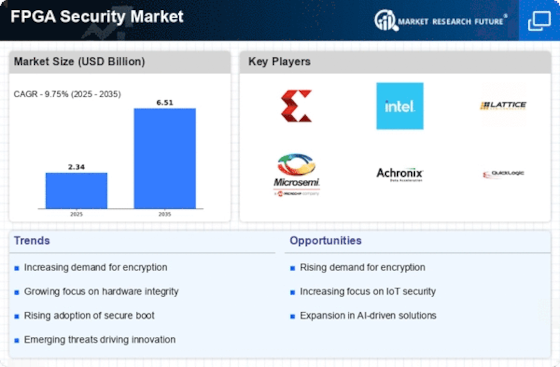
FPGA Security Market Infographic
Purchase Options

Market Trends

Key Emerging Trends in the FPGA Security Market

The FPGA (Field-Programmable Gate Array) security market is witnessing significant shifts and advancements in response to the escalating concerns regarding cybersecurity threats, intellectual property protection, and data integrity. FPGAs, which offer reconfigurability and high-performance computing capabilities, are increasingly deployed in critical applications spanning industries such as aerospace, defense, telecommunications, and IoT (Internet of Things). As we delve into the market trends of FPGA security, several key factors emerge that are shaping its trajectory.

One prominent trend in the FPGA security market is the growing emphasis on securing the hardware fabric against a myriad of cyber threats, including reverse engineering, tampering, side-channel attacks, and malicious modifications. With the proliferation of sophisticated cyberattacks and the increasing complexity of FPGA-based systems, there is a heightened awareness among organizations regarding the need to implement robust security measures at the hardware level. Security features such as bitstream encryption, device authentication, secure boot, and hardware-based cryptographic accelerators are becoming essential requirements for FPGA vendors and system integrators, enabling them to safeguard sensitive data and intellectual property against unauthorized access and manipulation.

Moreover, regulatory compliance requirements and industry standards are driving the adoption of security-enhanced FPGAs across various sectors. Industries such as aerospace and defense, automotive, healthcare, and finance are subject to stringent regulations pertaining to data privacy, confidentiality, and integrity. As a result, organizations are increasingly seeking FPGAs with built-in security features that comply with industry standards such as ISO 26262, DO-254, HIPAA, and PCI DSS. FPGA vendors are responding to these market demands by incorporating security functionalities into their products and obtaining certifications to validate the effectiveness of their security implementations, thereby addressing the evolving needs of customers in regulated industries.

Another significant trend shaping the FPGA security market is the integration of hardware security modules (HSMs) and trusted platform modules (TPMs) with FPGAs to enhance cryptographic capabilities and secure key management. HSMs and TPMs provide secure storage, generation, and processing of cryptographic keys and sensitive data, enabling secure communication, authentication, and encryption within FPGA-based systems. By embedding HSM and TPM functionalities directly into FPGAs, manufacturers can streamline the development process, reduce system complexity, and mitigate the risk of security breaches associated with external hardware modules, thereby enhancing the overall security posture of FPGA-based applications.

Furthermore, the advent of AI (Artificial Intelligence) and machine learning technologies is driving innovation in FPGA security, enabling proactive threat detection, adaptive security policies, and real-time anomaly detection capabilities. AI-powered security solutions leverage advanced algorithms to analyze massive datasets, identify patterns, and detect suspicious behavior indicative of cyber threats or unauthorized activities. FPGA-based accelerators and inference engines enable the deployment of AI algorithms directly within FPGA devices, providing low-latency, high-throughput processing capabilities for security applications such as intrusion detection, malware analysis, and threat hunting. As organizations seek to bolster their cyber defenses against evolving threats, AI-enabled FPGA security solutions are poised to play a pivotal role in enhancing situational awareness and threat mitigation capabilities.

Additionally, the COVID-19 pandemic has underscored the importance of securing remote work environments, cloud-based applications, and IoT devices, driving the demand for secure and resilient FPGA-based solutions. With the rapid adoption of telecommuting, virtual collaboration tools, and digital transformation initiatives, organizations are increasingly reliant on FPGA-based systems to support mission-critical operations and ensure business continuity. Secure remote access, secure boot, and secure firmware updates are among the key security requirements driving the adoption of FPGA-based solutions in remote work environments, enabling organizations to protect their assets, data, and infrastructure from cyber threats and vulnerabilities.


Author
Author Profile
Ankit Gupta
Team Lead - Research

Ankit Gupta is a seasoned market intelligence and strategic research professional with over six plus years of experience in the ICT and Semiconductor industries. With academic roots in Telecom, Marketing, and Electronics, he blends technical insight with business strategy. Ankit has led 200+ projects, including work for Fortune 500 clients like Microsoft and Rio Tinto, covering market sizing, tech forecasting, and go-to-market strategies. Known for bridging engineering and enterprise decision-making, his insights support growth, innovation, and investment planning across diverse technology markets.

Leave a Comment

FAQs

What is the current valuation of the FPGA Security Market as of 2024?

<p>The FPGA Security Market was valued at 2.34 USD Billion in 2024.</p>

What is the projected market size for the FPGA Security Market in 2035?

<p>The market is projected to reach 6.513 USD Billion by 2035.</p>

What is the expected CAGR for the FPGA Security Market during the forecast period 2025 - 2035?

<p>The expected CAGR for the FPGA Security Market during 2025 - 2035 is 9.75%.</p>

Which companies are considered key players in the FPGA Security Market?

<p>Key players in the market include Xilinx, Intel, Lattice Semiconductor, Microsemi, Achronix, QuickLogic, Nallatech, Efinix, and Silexica.</p>

How does the market segment for Configuration perform in terms of valuation?

<p>The Configuration segment includes Low-end FPGAs valued at 0.5 to 1.3 USD Billion, Mid-range FPGAs at 0.8 to 2.1 USD Billion, and High-end FPGAs at 1.04 to 3.113 USD Billion.</p>

What are the valuation ranges for different Node Sizes in the FPGA Security Market?

<p>Node Sizes are valued as follows: Less than 28nm at 0.7 to 1.8 USD Billion, 28-90 nm at 1.0 to 2.5 USD Billion, and More than 90nm at 0.64 to 2.18 USD Billion.</p>

What technologies are included in the FPGA Security Market and their valuations?

The Technology segment includes SRAM valued at 0.93 to 2.54 USD Billion, Flash at 0.78 to 2.08 USD Billion, and Anti-fuse at 0.63 to 1.73 USD Billion.

What applications are driving growth in the FPGA Security Market?

Applications include FPGA synthesis flow valued at 0.7 to 1.9 USD Billion, Applied cryptography at 0.8 to 2.2 USD Billion, and Algorithmic cryptographic security at 0.54 to 1.5 USD Billion.

What factors contribute to the growth of the FPGA Security Market?

Factors contributing to growth include advancements in technology, increasing demand for security solutions, and the expanding application of FPGAs across various industries.

How does the FPGA Security Market compare to other technology markets?

The FPGA Security Market, with a valuation of 2.34 USD Billion in 2024, is poised for substantial growth, potentially reaching 6.513 USD Billion by 2035, indicating a robust trajectory.

Market Summary

As per Market Research Future analysis, the FPGA Security Market Size was estimated at 2.34 USD Billion in 2024. The FPGA Security industry is projected to grow from 2.568 USD Billion in 2025 to 6.513 USD Billion by 2035, exhibiting a compound annual growth rate (CAGR) of 9.75% during the forecast period 2025 - 2035

Key Market Trends & Highlights

The FPGA Security Market is experiencing robust growth driven by increasing cybersecurity threats and the demand for customized solutions.

  • The market is witnessing a rising demand for custom security solutions, particularly in North America, which remains the largest market. Integration of advanced encryption techniques is becoming a standard practice, especially in the fast-growing Asia-Pacific region. Collaboration between hardware manufacturers and cybersecurity firms is enhancing the overall security landscape in the FPGA sector. The increasing cybersecurity threats and the adoption of IoT devices are major drivers propelling the growth of low-end FPGAs and 28-90nm segments.

Market Size & Forecast

2024 Market Size 2.34 (USD Billion)
2035 Market Size 6.513 (USD Billion)
CAGR (2025 - 2035) 9.75%
Largest Regional Market Share in 2024 North America

Major Players

Xilinx (US), Intel (US), Lattice Semiconductor (US), Microsemi (US), Achronix (US), QuickLogic (US), Nallatech (GB), Efinix (US), Silexica (DE)

Market Trends

The FPGA Security Market is currently experiencing a notable evolution, driven by the increasing demand for secure and reliable hardware solutions across various industries. As organizations become more aware of the vulnerabilities associated with traditional computing architectures, the focus on field-programmable gate arrays (FPGAs) as a means to enhance security measures appears to be gaining traction. This shift is largely attributed to the flexibility and adaptability that FPGAs offer, allowing for customized security implementations tailored to specific applications. Furthermore, the integration of advanced encryption techniques and secure boot processes within FPGA designs suggests a proactive approach to mitigating potential threats. In addition, the growing emphasis on compliance with stringent regulatory standards is likely to propel the FPGA Security Market forward. Industries such as aerospace, automotive, and telecommunications are increasingly adopting FPGAs to meet these requirements, thereby enhancing their overall security posture. The collaboration between FPGA manufacturers and cybersecurity firms indicates a trend towards developing comprehensive solutions that address both hardware and software vulnerabilities. As the landscape continues to evolve, the FPGA Security Market is poised for further growth, driven by innovation and the need for robust security frameworks.

Rising Demand for Custom Security Solutions

The FPGA Security Market is witnessing a surge in demand for tailored security solutions. Organizations are increasingly seeking customizable options that can be adapted to their specific needs, allowing for enhanced protection against emerging threats. This trend reflects a broader shift towards personalized security measures in various sectors.

Integration of Advanced Encryption Techniques

The incorporation of sophisticated encryption methods within FPGA designs is becoming more prevalent. This trend indicates a proactive stance towards safeguarding sensitive data and ensuring secure communications. As threats evolve, the need for robust encryption solutions within FPGAs is likely to intensify.

Collaboration Between Hardware and Cybersecurity Firms

There is a growing trend of partnerships between FPGA manufacturers and cybersecurity companies. This collaboration aims to create comprehensive security solutions that address both hardware vulnerabilities and software threats. Such alliances are expected to enhance the overall security framework within the FPGA Security Market.

FPGA Security Market Market Drivers

Adoption of IoT Devices

The proliferation of Internet of Things (IoT) devices is significantly influencing the FPGA Security Market. With billions of connected devices expected to be in use, the potential for security vulnerabilities increases exponentially. FPGAs can provide the necessary security features to safeguard these devices, ensuring data integrity and confidentiality. The IoT security market is anticipated to grow at a compound annual growth rate of over 25%, highlighting the urgent need for effective security solutions. This trend indicates that the FPGA Security Market is poised to capitalize on the increasing demand for secure IoT implementations.

Advancements in FPGA Technology

Technological advancements in FPGA design and manufacturing are propelling the FPGA Security Market forward. Innovations such as increased processing power, reduced power consumption, and enhanced integration capabilities are making FPGAs more appealing for security applications. These advancements enable the development of sophisticated security algorithms that can be implemented directly on the hardware level, providing superior protection against threats. As the technology continues to evolve, the FPGA Security Market is expected to benefit from the growing adoption of FPGAs in various sectors, including telecommunications, automotive, and defense.

Increasing Cybersecurity Threats

The rise in cybersecurity threats has become a pivotal driver for the FPGA Security Market. As organizations face an escalating number of cyberattacks, the demand for robust security solutions has surged. FPGAs offer customizable security features that can be tailored to specific threats, making them an attractive option for businesses seeking to protect sensitive data. According to recent data, the cybersecurity market is projected to reach over 300 billion dollars by 2025, indicating a substantial opportunity for FPGA security solutions. This trend suggests that as threats evolve, the FPGA Security Market will likely expand to meet the growing need for advanced protection mechanisms.

Regulatory Compliance Requirements

Regulatory compliance is becoming increasingly stringent across various sectors, driving the need for enhanced security measures within the FPGA Security Market. Organizations are required to adhere to regulations such as GDPR and HIPAA, which mandate robust data protection strategies. FPGAs can facilitate compliance by providing customizable security solutions that meet specific regulatory requirements. As companies strive to avoid hefty fines and reputational damage, the demand for FPGA-based security solutions is likely to rise. This trend suggests that the FPGA Security Market will continue to grow as businesses prioritize compliance in their security strategies.

Growing Demand for Edge Computing Solutions

The shift towards edge computing is influencing the FPGA Security Market as organizations seek to process data closer to the source. This trend reduces latency and bandwidth usage, but it also introduces new security challenges. FPGAs can play a crucial role in securing edge devices by providing real-time data processing and encryption capabilities. The edge computing market is projected to grow significantly, with estimates suggesting it could reach over 15 billion dollars by 2025. This growth indicates a substantial opportunity for the FPGA Security Market to develop tailored solutions that address the unique security needs of edge computing environments.

Market Segment Insights

By Configuration: Low-end FPGA (Largest) vs. Mid-range FPGA (Fastest-Growing)

<p>In the FPGA Security Market, the distribution of market share among configuration segments reveals a clear hierarchy. Low-end FPGAs dominate the market, capturing the largest share due to their cost-effectiveness and suitability for basic security applications. Mid-range FPGAs are increasingly gaining traction, accounting for a significant portion of the market as they offer enhanced performance without a substantial increase in price. High-end FPGAs, while critical for high-security applications, occupy a smaller share compared to the other two categories, primarily due to their higher pricing and specialized nature.</p>

<p>Low-end FPGA (Dominant) vs. High-end FPGA (Emerging)</p>

<p>Low-end FPGAs are widely recognized for their adaptability in various applications, making them a staple in the FPGA Security Market. They are favored for projects that require basic security functionalities, which contribute to their dominant position. High-end FPGAs, on the other hand, represent an emerging segment characterized by advanced capabilities in handling complex security tasks. While they are not as widely adopted due to their cost and the specialized nature of their applications, increasing cyber threats are pushing demand for these powerful devices as organizations seek robust solutions to enhance security measures. The contrast between low-end and high-end FPGAs illustrates a critical defining line in the market: affordability versus performance.</p>

By Node Size: Less than 28nm (Largest) vs. 28-90nm (Fastest-Growing)

<p>In the FPGA Security Market, the node size segment exhibits a varied distribution, with 'Less than 28nm' commanding the largest market share. This segment benefits from advancements in technology that allow for enhanced performance and security features in FPGAs. In contrast, the '28-90nm' node size is gaining traction due to its versatility and cost-effectiveness, making it a popular choice among manufacturers looking to balance price and performance. As a result, while 'Less than 28nm' remains dominant, '28-90nm' is quickly catching up. The growth trends within this segment are primarily driven by the increasing demand for high-performance security solutions in various applications. As industries adopt more sophisticated technologies, the need for FPGAs with smaller node sizes becomes critical. The '28-90nm' range is particularly poised for rapid growth due to its adaptability to different security requirements and emerging trends in cybersecurity. This dynamic shift suggests that while current preferences favor smaller node sizes, the evolving market landscape may see '28-90nm' emerging as a leading choice for many applications in the coming years.</p>

<p>Less than 28nm (Dominant) vs. 28-90nm (Emerging)</p>

<p>The 'Less than 28nm' node size is characterized by its high performance and efficiency, making it the dominant choice in the FPGA Security Market. FPGAs in this category offer superior processing power and enhanced security features, which are critical for applications requiring robust data protection. This dominance is underpinned by increasing investments in cutting-edge technologies that leverage smaller node sizes for optimized performance. Conversely, the '28-90nm' segment is emerging as a significant contender, positioning itself as a versatile solution for manufacturers. Its ability to provide a balance between cost and functionality makes it particularly appealing, especially in industries that demand reliable security without the premium associated with smaller node sizes. Together, these segments reflect a competitive landscape where both performance and economics play crucial roles.</p>

By Technology: SRAM (Largest) vs. Flash (Fastest-Growing)

<p>The FPGA Security Market showcases diverse technology segments, with SRAM holding the largest market share due to its established reliability and speed, appealing to demanding applications in security. Flash technology is emerging quickly, capturing attention for its non-volatility, making it suitable for secure applications that require data retention without power. Together, these segments illustrate the dynamic landscape of FPGA technologies in the security domain, driving innovation and competition among key players. Growth trends indicate that SRAM's dominance is bolstered by its long-standing presence in the market. In contrast, Flash is gaining momentum as advancements in embedded systems position it as a top choice for new security applications. Additionally, increasing demand for secure mobile and IoT devices accelerates the adoption of Flash technology, highlighting a significant shift towards hybrid solutions that integrate the best attributes of both SRAM and Flash.</p>

<p>Technology: SRAM (Dominant) vs. Flash (Emerging)</p>

<p>SRAM technology is recognized as the dominant player in the FPGA Security Market, valued for its high speed and low latency, which are critical for performance-sensitive applications. Its robustness in security applications is undisputed, providing a reliable solution for data integrity and protection against unauthorized access. Conversely, Flash technology is positioned as the emerging alternative, rapidly gaining popularity due to its advantages in energy efficiency and non-volatile data storage. This makes Flash particularly appealing for systems that require data retention during power outages or portable devices. The growing trend for secure IoT devices further enhances Flash's appeal as it complements SRAM by providing a balanced solution that meets diverse application needs.</p>

By Application: FPGA Synthesis Flow (Largest) vs. Applied Cryptography (Fastest-Growing)

<p>In the FPGA Security Market, the application segment is led by the FPGA synthesis flow, which represents the largest share. This segment focuses on efficient design processes that enhance the performance of field-programmable gate arrays. Meanwhile, applied cryptography emerges as a significant player, emphasizing protection mechanisms in digital communications and data integrity. The remaining categories, including algorithmic cryptographic security and others, play supportive roles but do not dominate market dynamics as these two key segments do. Growth trends indicate that as security threats evolve, there is a rising demand for FPGA solutions that incorporate advanced cryptographic techniques. The adaptability of FPGAs in handling complex security algorithms positions applied cryptography as a fast-growing application, driven by the increasing need for secure data processing in various industries. Continued innovation and demand for security enhancements will further stimulate the growth of these applications in the FPGA market.</p>

<p>FPGA Synthesis Flow (Dominant) vs. Applied Cryptography (Emerging)</p>

<p>The FPGA synthesis flow leads the market due to its critical role in streamlining the design and implementation of security protocols within FPGAs. This process optimizes the utilization of FPGA resources and ensures reliable performance for security applications. On the other hand, applied cryptography is emerging as a crucial area, gaining traction as organizations prioritize data protection and encryption. The integration of cryptographic algorithms within the FPGA framework allows for enhanced security features, making applied cryptography a key focus for future developments. These two segments represent contrasting phases of market maturity, with the FPGA synthesis flow being well-established and applied cryptography rapidly evolving to meet contemporary security needs.</p>

Get more detailed insights about FPGA Security Market Research Report- Global Forecast till 2035

Regional Insights

North America : Innovation and Leadership Hub

North America is the largest market for FPGA security, holding approximately 45% of the global share. The region's growth is driven by increasing demand for secure and efficient computing solutions across various sectors, including defense, telecommunications, and automotive. Regulatory support for advanced technologies and cybersecurity initiatives further catalyze market expansion. The U.S. government’s focus on enhancing national security through technology investments plays a crucial role in this growth. The competitive landscape in North America is robust, featuring key players such as Xilinx, Intel, and Microsemi. These companies are at the forefront of innovation, developing advanced FPGA solutions that address security vulnerabilities. The presence of leading technology firms and a strong research ecosystem fosters collaboration and accelerates product development. This dynamic environment positions North America as a leader in the FPGA security market.

Europe : Emerging Market with Potential

Europe is witnessing significant growth in the FPGA security market, accounting for approximately 30% of the global share. The region's demand is driven by increasing cybersecurity threats and the need for secure data processing in industries such as finance, healthcare, and automotive. Regulatory frameworks, including the EU Cybersecurity Act, are enhancing the focus on secure technology solutions, thereby propelling market growth. The emphasis on digital transformation across European nations further supports this trend. Leading countries in Europe include Germany, the UK, and France, where companies like Silexica and Nallatech are making strides in FPGA security. The competitive landscape is characterized by a mix of established players and innovative startups, fostering a vibrant ecosystem. Collaborations between industry and academia are also prevalent, driving advancements in FPGA technology and security solutions. This collaborative approach is essential for addressing the evolving security challenges in the region.

Asia-Pacific : Rapidly Growing Technology Sector

Asia-Pacific is emerging as a significant player in the FPGA security market, holding around 20% of the global share. The region's growth is fueled by rapid technological advancements, increasing investments in smart manufacturing, and the rising adoption of IoT devices. Countries like China and Japan are leading this growth, supported by government initiatives aimed at enhancing cybersecurity and technological innovation. The demand for secure FPGA solutions is expected to rise as industries increasingly prioritize data protection and system integrity. China, Japan, and South Korea are at the forefront of this market, with numerous local and international players competing for market share. Companies such as Achronix and Efinix are expanding their presence in the region, focusing on developing tailored FPGA security solutions. The competitive landscape is dynamic, with a mix of established firms and emerging startups driving innovation. This competitive environment is crucial for meeting the growing demand for secure technology solutions in Asia-Pacific.

Middle East and Africa : Emerging Frontier for Technology

The Middle East and Africa (MEA) region is gradually emerging in the FPGA security market, currently holding about 5% of the global share. The growth is primarily driven by increasing investments in technology infrastructure and a rising awareness of cybersecurity threats. Governments in the region are beginning to implement regulations that promote secure technology adoption, which is expected to catalyze market growth. The demand for FPGA security solutions is anticipated to rise as industries such as finance and telecommunications expand their digital capabilities. Leading countries in the MEA region include the UAE and South Africa, where there is a growing interest in advanced technology solutions. The competitive landscape is still developing, with a mix of local and international players entering the market. Companies are focusing on building partnerships and collaborations to enhance their offerings. This emerging market presents significant opportunities for growth as the region continues to invest in technology and security solutions.

Key Players and Competitive Insights

Leading market players are investing heavily in research and development to expand their product lines, which will help the FPGA security market grow even more. There are some strategies for action that market participants are implementing to increase their presence around the world's global footprint, with important market developments including new product launches, contractual agreements and acquisitions, higher investments, and collaboration with other organizations. To expand and survive in a more competitive and rising market climate, the FPGA security industry must offer cost-effective items.

Manufacturing locally to minimize operational costs is one of the key business tactics manufacturer use in the global FPGA security industry to benefit clients and increase the market sector. In recent years, the FPGA security industry has offered some of the most significant technological advancements. Major players in the FPGA security market, including Xilinx Inc., Microchip Technology Inc., Achronix Semiconductor Corporation, Cypress Semiconductor Corporation, Texas Instruments Incorporated, Lattice Semiconductor, Intel Corporation, Financial Overview, Quicklogics Corp., and Teledyne Technologies Inc., and others are attempting to grow market demand by investing in research and development operations.

AMD has significantly accelerated innovation in graphics, visualization, and high-performance computing. Billions of people worldwide utilize AMD technology daily to improve their lives, careers, and leisure activities. Top Fortune 500 businesses and leading-edge institutions for scientific research are included in this. AMD staff members focus primarily on developing flexible, high-performance solutions that stretch the bounds of what is possible. When AMD was established as a Silicon Valley start-up in 1969, hundreds of employees were enthusiastic about creating cutting-edge semiconductor devices at the company's inception.

AMD has become a worldwide company defining the standard for modern computing thanks to several key industry firsts and substantial technological advancements.

In June AMD announced the addition of two new, workload-optimized processors to its array of 4th Gen EPYCTM CPUs. By leveraging the new "Zen 4c" core architecture, the AMD EPYC 97X4 cloud native-optimized data center CPUs advance the EPYC 9004 Series of processors by offering the thread density and scale necessary for leading-edge cloud native computing.

Microchip Technology, Inc. is an industry-recognized pioneer in embedded control systems that are intelligent, networked, and secure. With its user-friendly development tools and a broad choice of products, customers can create the finest designs possible, lowering risk while reducing total system cost and time to market. In the industrial, automotive, consumer, aerospace and defense, communications, and computer industries, the company's products are used by more than 125,000 clients. Microchip's headquarters in Chandler, Arizona, offers superb technical support, dependable shipping, and premium goods.

In January 2023, Microchip Technology Inc. announced its first radiation-tolerant commercial off-the-shelf (COTS) power device, the MIC69303RT 3A Low-Dropout (LDO) Voltage Regulator. The MIC69303RT, a revolutionary high current and low voltage power management solution targeted at LEO and other space applications, is an example.

Key Companies in the FPGA Security Market include

Industry Developments

March 2023: Texas Instruments (TI) announced that LITEON Technology had chosen TI's highly integrated C2000TM real-time microcontrollers (MCUs) and Gallium Nitride (GaN) field effect transistor (FET) for their newest high-performance server PSU for the North American market. A TMS320F28003x C2000 real-time MCU and TI's LMG3522R030 GaN FET are used in the recently commercialized PSU, which offers a power density of over 95 W/in3 and satisfies 80 Plus Titanium criteria.

March 2023: Microchip Technology created its flight-ready RT PolarFire® FPGA with the development kit and interfaces to enable the evaluation of design concepts based on actual in-flight electrical and mechanical properties.

Future Outlook

FPGA Security Market Future Outlook

The FPGA Security Market is projected to grow at a 9.75% CAGR from 2025 to 2035, driven by increasing cybersecurity threats and demand for secure hardware solutions.

New opportunities lie in:

  • Development of advanced encryption algorithms for FPGA devices.
  • Integration of AI-driven security protocols in FPGA architectures.
  • Expansion into emerging markets with tailored FPGA security solutions.

By 2035, the FPGA Security Market is expected to be robust, reflecting substantial growth and innovation.

Market Segmentation

FPGA Security Market Node Size Outlook

  • Less than 28nm
  • 28-90 nm
  • More than 90nm

FPGA Security Market Technology Outlook

  • SRAM
  • Flash
  • Anti-fuse

FPGA Security Market Application Outlook

  • FPGA synthesis flow
  • Applied cryptography
  • Algorithmic cryptographic security
  • Others

FPGA Security Market Configuration Outlook

  • Low-end FPGA
  • Mid-range FPGA
  • High-end FPGA

Report Scope

MARKET SIZE 2024 2.34(USD Billion)
MARKET SIZE 2025 2.568(USD Billion)
MARKET SIZE 2035 6.513(USD Billion)
COMPOUND ANNUAL GROWTH RATE (CAGR) 9.75% (2025 - 2035)
REPORT COVERAGE Revenue Forecast, Competitive Landscape, Growth Factors, and Trends
BASE YEAR 2024
Market Forecast Period 2025 - 2035
Historical Data 2019 - 2024
Market Forecast Units USD Billion
Key Companies Profiled Xilinx (US), Intel (US), Lattice Semiconductor (US), Microsemi (US), Achronix (US), QuickLogic (US), Nallatech (GB), Efinix (US), Silexica (DE)
Segments Covered Configuration, Node Size, Technology, Application, Region
Key Market Opportunities Integration of advanced encryption techniques enhances security in the FPGA Security Market.
Key Market Dynamics Rising demand for enhanced security features in Field Programmable Gate Arrays drives innovation and competitive dynamics.
Countries Covered North America, Europe, APAC, South America, MEA

FAQs

What is the current valuation of the FPGA Security Market as of 2024?

<p>The FPGA Security Market was valued at 2.34 USD Billion in 2024.</p>

What is the projected market size for the FPGA Security Market in 2035?

<p>The market is projected to reach 6.513 USD Billion by 2035.</p>

What is the expected CAGR for the FPGA Security Market during the forecast period 2025 - 2035?

<p>The expected CAGR for the FPGA Security Market during 2025 - 2035 is 9.75%.</p>

Which companies are considered key players in the FPGA Security Market?

<p>Key players in the market include Xilinx, Intel, Lattice Semiconductor, Microsemi, Achronix, QuickLogic, Nallatech, Efinix, and Silexica.</p>

How does the market segment for Configuration perform in terms of valuation?

<p>The Configuration segment includes Low-end FPGAs valued at 0.5 to 1.3 USD Billion, Mid-range FPGAs at 0.8 to 2.1 USD Billion, and High-end FPGAs at 1.04 to 3.113 USD Billion.</p>

What are the valuation ranges for different Node Sizes in the FPGA Security Market?

<p>Node Sizes are valued as follows: Less than 28nm at 0.7 to 1.8 USD Billion, 28-90 nm at 1.0 to 2.5 USD Billion, and More than 90nm at 0.64 to 2.18 USD Billion.</p>

What technologies are included in the FPGA Security Market and their valuations?

The Technology segment includes SRAM valued at 0.93 to 2.54 USD Billion, Flash at 0.78 to 2.08 USD Billion, and Anti-fuse at 0.63 to 1.73 USD Billion.

What applications are driving growth in the FPGA Security Market?

Applications include FPGA synthesis flow valued at 0.7 to 1.9 USD Billion, Applied cryptography at 0.8 to 2.2 USD Billion, and Algorithmic cryptographic security at 0.54 to 1.5 USD Billion.

What factors contribute to the growth of the FPGA Security Market?

Factors contributing to growth include advancements in technology, increasing demand for security solutions, and the expanding application of FPGAs across various industries.

How does the FPGA Security Market compare to other technology markets?

The FPGA Security Market, with a valuation of 2.34 USD Billion in 2024, is poised for substantial growth, potentially reaching 6.513 USD Billion by 2035, indicating a robust trajectory.

  1. SECTION I: EXECUTIVE SUMMARY AND KEY HIGHLIGHTS
    1. | 1.1 EXECUTIVE SUMMARY
    2. | | 1.1.1 Market Overview
    3. | | 1.1.2 Key Findings
    4. | | 1.1.3 Market Segmentation
    5. | | 1.1.4 Competitive Landscape
    6. | | 1.1.5 Challenges and Opportunities
    7. | | 1.1.6 Future Outlook
  2. SECTION II: SCOPING, METHODOLOGY AND MARKET STRUCTURE
    1. | 2.1 MARKET INTRODUCTION
    2. | | 2.1.1 Definition
    3. | | 2.1.2 Scope of the study
    4. | | | 2.1.2.1 Research Objective
    5. | | | 2.1.2.2 Assumption
    6. | | | 2.1.2.3 Limitations
    7. | 2.2 RESEARCH METHODOLOGY
    8. | | 2.2.1 Overview
    9. | | 2.2.2 Data Mining
    10. | | 2.2.3 Secondary Research
    11. | | 2.2.4 Primary Research
    12. | | | 2.2.4.1 Primary Interviews and Information Gathering Process
    13. | | | 2.2.4.2 Breakdown of Primary Respondents
    14. | | 2.2.5 Forecasting Model
    15. | | 2.2.6 Market Size Estimation
    16. | | | 2.2.6.1 Bottom-Up Approach
    17. | | | 2.2.6.2 Top-Down Approach
    18. | | 2.2.7 Data Triangulation
    19. | | 2.2.8 Validation
  3. SECTION III: QUALITATIVE ANALYSIS
    1. | 3.1 MARKET DYNAMICS
    2. | | 3.1.1 Overview
    3. | | 3.1.2 Drivers
    4. | | 3.1.3 Restraints
    5. | | 3.1.4 Opportunities
    6. | 3.2 MARKET FACTOR ANALYSIS
    7. | | 3.2.1 Value chain Analysis
    8. | | 3.2.2 Porter's Five Forces Analysis
    9. | | | 3.2.2.1 Bargaining Power of Suppliers
    10. | | | 3.2.2.2 Bargaining Power of Buyers
    11. | | | 3.2.2.3 Threat of New Entrants
    12. | | | 3.2.2.4 Threat of Substitutes
    13. | | | 3.2.2.5 Intensity of Rivalry
    14. | | 3.2.3 COVID-19 Impact Analysis
    15. | | | 3.2.3.1 Market Impact Analysis
    16. | | | 3.2.3.2 Regional Impact
    17. | | | 3.2.3.3 Opportunity and Threat Analysis
  4. SECTION IV: QUANTITATIVE ANALYSIS
    1. | 4.1 Semiconductor & Electronics, BY Configuration (USD Billion)
    2. | | 4.1.1 Low-end FPGA
    3. | | 4.1.2 Mid-range FPGA
    4. | | 4.1.3 High-end FPGA
    5. | 4.2 Semiconductor & Electronics, BY Node Size (USD Billion)
    6. | | 4.2.1 Less than 28nm
    7. | | 4.2.2 28-90 nm
    8. | | 4.2.3 More than 90nm
    9. | 4.3 Semiconductor & Electronics, BY Technology (USD Billion)
    10. | | 4.3.1 SRAM
    11. | | 4.3.2 Flash
    12. | | 4.3.3 Anti-fuse
    13. | 4.4 Semiconductor & Electronics, BY Application (USD Billion)
    14. | | 4.4.1 FPGA synthesis flow
    15. | | 4.4.2 Applied cryptography
    16. | | 4.4.3 Algorithmic cryptographic security
    17. | | 4.4.4 Others
    18. | 4.5 Semiconductor & Electronics, BY Region (USD Billion)
    19. | | 4.5.1 North America
    20. | | | 4.5.1.1 US
    21. | | | 4.5.1.2 Canada
    22. | | 4.5.2 Europe
    23. | | | 4.5.2.1 Germany
    24. | | | 4.5.2.2 UK
    25. | | | 4.5.2.3 France
    26. | | | 4.5.2.4 Russia
    27. | | | 4.5.2.5 Italy
    28. | | | 4.5.2.6 Spain
    29. | | | 4.5.2.7 Rest of Europe
    30. | | 4.5.3 APAC
    31. | | | 4.5.3.1 China
    32. | | | 4.5.3.2 India
    33. | | | 4.5.3.3 Japan
    34. | | | 4.5.3.4 South Korea
    35. | | | 4.5.3.5 Malaysia
    36. | | | 4.5.3.6 Thailand
    37. | | | 4.5.3.7 Indonesia
    38. | | | 4.5.3.8 Rest of APAC
    39. | | 4.5.4 South America
    40. | | | 4.5.4.1 Brazil
    41. | | | 4.5.4.2 Mexico
    42. | | | 4.5.4.3 Argentina
    43. | | | 4.5.4.4 Rest of South America
    44. | | 4.5.5 MEA
    45. | | | 4.5.5.1 GCC Countries
    46. | | | 4.5.5.2 South Africa
    47. | | | 4.5.5.3 Rest of MEA
  5. SECTION V: COMPETITIVE ANALYSIS
    1. | 5.1 Competitive Landscape
    2. | | 5.1.1 Overview
    3. | | 5.1.2 Competitive Analysis
    4. | | 5.1.3 Market share Analysis
    5. | | 5.1.4 Major Growth Strategy in the Semiconductor & Electronics
    6. | | 5.1.5 Competitive Benchmarking
    7. | | 5.1.6 Leading Players in Terms of Number of Developments in the Semiconductor & Electronics
    8. | | 5.1.7 Key developments and growth strategies
    9. | | | 5.1.7.1 New Product Launch/Service Deployment
    10. | | | 5.1.7.2 Merger & Acquisitions
    11. | | | 5.1.7.3 Joint Ventures
    12. | | 5.1.8 Major Players Financial Matrix
    13. | | | 5.1.8.1 Sales and Operating Income
    14. | | | 5.1.8.2 Major Players R&D Expenditure. 2023
    15. | 5.2 Company Profiles
    16. | | 5.2.1 Xilinx (US)
    17. | | | 5.2.1.1 Financial Overview
    18. | | | 5.2.1.2 Products Offered
    19. | | | 5.2.1.3 Key Developments
    20. | | | 5.2.1.4 SWOT Analysis
    21. | | | 5.2.1.5 Key Strategies
    22. | | 5.2.2 Intel (US)
    23. | | | 5.2.2.1 Financial Overview
    24. | | | 5.2.2.2 Products Offered
    25. | | | 5.2.2.3 Key Developments
    26. | | | 5.2.2.4 SWOT Analysis
    27. | | | 5.2.2.5 Key Strategies
    28. | | 5.2.3 Lattice Semiconductor (US)
    29. | | | 5.2.3.1 Financial Overview
    30. | | | 5.2.3.2 Products Offered
    31. | | | 5.2.3.3 Key Developments
    32. | | | 5.2.3.4 SWOT Analysis
    33. | | | 5.2.3.5 Key Strategies
    34. | | 5.2.4 Microsemi (US)
    35. | | | 5.2.4.1 Financial Overview
    36. | | | 5.2.4.2 Products Offered
    37. | | | 5.2.4.3 Key Developments
    38. | | | 5.2.4.4 SWOT Analysis
    39. | | | 5.2.4.5 Key Strategies
    40. | | 5.2.5 Achronix (US)
    41. | | | 5.2.5.1 Financial Overview
    42. | | | 5.2.5.2 Products Offered
    43. | | | 5.2.5.3 Key Developments
    44. | | | 5.2.5.4 SWOT Analysis
    45. | | | 5.2.5.5 Key Strategies
    46. | | 5.2.6 QuickLogic (US)
    47. | | | 5.2.6.1 Financial Overview
    48. | | | 5.2.6.2 Products Offered
    49. | | | 5.2.6.3 Key Developments
    50. | | | 5.2.6.4 SWOT Analysis
    51. | | | 5.2.6.5 Key Strategies
    52. | | 5.2.7 Nallatech (GB)
    53. | | | 5.2.7.1 Financial Overview
    54. | | | 5.2.7.2 Products Offered
    55. | | | 5.2.7.3 Key Developments
    56. | | | 5.2.7.4 SWOT Analysis
    57. | | | 5.2.7.5 Key Strategies
    58. | | 5.2.8 Efinix (US)
    59. | | | 5.2.8.1 Financial Overview
    60. | | | 5.2.8.2 Products Offered
    61. | | | 5.2.8.3 Key Developments
    62. | | | 5.2.8.4 SWOT Analysis
    63. | | | 5.2.8.5 Key Strategies
    64. | | 5.2.9 Silexica (DE)
    65. | | | 5.2.9.1 Financial Overview
    66. | | | 5.2.9.2 Products Offered
    67. | | | 5.2.9.3 Key Developments
    68. | | | 5.2.9.4 SWOT Analysis
    69. | | | 5.2.9.5 Key Strategies
    70. | 5.3 Appendix
    71. | | 5.3.1 References
    72. | | 5.3.2 Related Reports
  6. LIST OF FIGURES
    1. | 6.1 MARKET SYNOPSIS
    2. | 6.2 NORTH AMERICA MARKET ANALYSIS
    3. | 6.3 US MARKET ANALYSIS BY CONFIGURATION
    4. | 6.4 US MARKET ANALYSIS BY NODE SIZE
    5. | 6.5 US MARKET ANALYSIS BY TECHNOLOGY
    6. | 6.6 US MARKET ANALYSIS BY APPLICATION
    7. | 6.7 CANADA MARKET ANALYSIS BY CONFIGURATION
    8. | 6.8 CANADA MARKET ANALYSIS BY NODE SIZE
    9. | 6.9 CANADA MARKET ANALYSIS BY TECHNOLOGY
    10. | 6.10 CANADA MARKET ANALYSIS BY APPLICATION
    11. | 6.11 EUROPE MARKET ANALYSIS
    12. | 6.12 GERMANY MARKET ANALYSIS BY CONFIGURATION
    13. | 6.13 GERMANY MARKET ANALYSIS BY NODE SIZE
    14. | 6.14 GERMANY MARKET ANALYSIS BY TECHNOLOGY
    15. | 6.15 GERMANY MARKET ANALYSIS BY APPLICATION
    16. | 6.16 UK MARKET ANALYSIS BY CONFIGURATION
    17. | 6.17 UK MARKET ANALYSIS BY NODE SIZE
    18. | 6.18 UK MARKET ANALYSIS BY TECHNOLOGY
    19. | 6.19 UK MARKET ANALYSIS BY APPLICATION
    20. | 6.20 FRANCE MARKET ANALYSIS BY CONFIGURATION
    21. | 6.21 FRANCE MARKET ANALYSIS BY NODE SIZE
    22. | 6.22 FRANCE MARKET ANALYSIS BY TECHNOLOGY
    23. | 6.23 FRANCE MARKET ANALYSIS BY APPLICATION
    24. | 6.24 RUSSIA MARKET ANALYSIS BY CONFIGURATION
    25. | 6.25 RUSSIA MARKET ANALYSIS BY NODE SIZE
    26. | 6.26 RUSSIA MARKET ANALYSIS BY TECHNOLOGY
    27. | 6.27 RUSSIA MARKET ANALYSIS BY APPLICATION
    28. | 6.28 ITALY MARKET ANALYSIS BY CONFIGURATION
    29. | 6.29 ITALY MARKET ANALYSIS BY NODE SIZE
    30. | 6.30 ITALY MARKET ANALYSIS BY TECHNOLOGY
    31. | 6.31 ITALY MARKET ANALYSIS BY APPLICATION
    32. | 6.32 SPAIN MARKET ANALYSIS BY CONFIGURATION
    33. | 6.33 SPAIN MARKET ANALYSIS BY NODE SIZE
    34. | 6.34 SPAIN MARKET ANALYSIS BY TECHNOLOGY
    35. | 6.35 SPAIN MARKET ANALYSIS BY APPLICATION
    36. | 6.36 REST OF EUROPE MARKET ANALYSIS BY CONFIGURATION
    37. | 6.37 REST OF EUROPE MARKET ANALYSIS BY NODE SIZE
    38. | 6.38 REST OF EUROPE MARKET ANALYSIS BY TECHNOLOGY
    39. | 6.39 REST OF EUROPE MARKET ANALYSIS BY APPLICATION
    40. | 6.40 APAC MARKET ANALYSIS
    41. | 6.41 CHINA MARKET ANALYSIS BY CONFIGURATION
    42. | 6.42 CHINA MARKET ANALYSIS BY NODE SIZE
    43. | 6.43 CHINA MARKET ANALYSIS BY TECHNOLOGY
    44. | 6.44 CHINA MARKET ANALYSIS BY APPLICATION
    45. | 6.45 INDIA MARKET ANALYSIS BY CONFIGURATION
    46. | 6.46 INDIA MARKET ANALYSIS BY NODE SIZE
    47. | 6.47 INDIA MARKET ANALYSIS BY TECHNOLOGY
    48. | 6.48 INDIA MARKET ANALYSIS BY APPLICATION
    49. | 6.49 JAPAN MARKET ANALYSIS BY CONFIGURATION
    50. | 6.50 JAPAN MARKET ANALYSIS BY NODE SIZE
    51. | 6.51 JAPAN MARKET ANALYSIS BY TECHNOLOGY
    52. | 6.52 JAPAN MARKET ANALYSIS BY APPLICATION
    53. | 6.53 SOUTH KOREA MARKET ANALYSIS BY CONFIGURATION
    54. | 6.54 SOUTH KOREA MARKET ANALYSIS BY NODE SIZE
    55. | 6.55 SOUTH KOREA MARKET ANALYSIS BY TECHNOLOGY
    56. | 6.56 SOUTH KOREA MARKET ANALYSIS BY APPLICATION
    57. | 6.57 MALAYSIA MARKET ANALYSIS BY CONFIGURATION
    58. | 6.58 MALAYSIA MARKET ANALYSIS BY NODE SIZE
    59. | 6.59 MALAYSIA MARKET ANALYSIS BY TECHNOLOGY
    60. | 6.60 MALAYSIA MARKET ANALYSIS BY APPLICATION
    61. | 6.61 THAILAND MARKET ANALYSIS BY CONFIGURATION
    62. | 6.62 THAILAND MARKET ANALYSIS BY NODE SIZE
    63. | 6.63 THAILAND MARKET ANALYSIS BY TECHNOLOGY
    64. | 6.64 THAILAND MARKET ANALYSIS BY APPLICATION
    65. | 6.65 INDONESIA MARKET ANALYSIS BY CONFIGURATION
    66. | 6.66 INDONESIA MARKET ANALYSIS BY NODE SIZE
    67. | 6.67 INDONESIA MARKET ANALYSIS BY TECHNOLOGY
    68. | 6.68 INDONESIA MARKET ANALYSIS BY APPLICATION
    69. | 6.69 REST OF APAC MARKET ANALYSIS BY CONFIGURATION
    70. | 6.70 REST OF APAC MARKET ANALYSIS BY NODE SIZE
    71. | 6.71 REST OF APAC MARKET ANALYSIS BY TECHNOLOGY
    72. | 6.72 REST OF APAC MARKET ANALYSIS BY APPLICATION
    73. | 6.73 SOUTH AMERICA MARKET ANALYSIS
    74. | 6.74 BRAZIL MARKET ANALYSIS BY CONFIGURATION
    75. | 6.75 BRAZIL MARKET ANALYSIS BY NODE SIZE
    76. | 6.76 BRAZIL MARKET ANALYSIS BY TECHNOLOGY
    77. | 6.77 BRAZIL MARKET ANALYSIS BY APPLICATION
    78. | 6.78 MEXICO MARKET ANALYSIS BY CONFIGURATION
    79. | 6.79 MEXICO MARKET ANALYSIS BY NODE SIZE
    80. | 6.80 MEXICO MARKET ANALYSIS BY TECHNOLOGY
    81. | 6.81 MEXICO MARKET ANALYSIS BY APPLICATION
    82. | 6.82 ARGENTINA MARKET ANALYSIS BY CONFIGURATION
    83. | 6.83 ARGENTINA MARKET ANALYSIS BY NODE SIZE
    84. | 6.84 ARGENTINA MARKET ANALYSIS BY TECHNOLOGY
    85. | 6.85 ARGENTINA MARKET ANALYSIS BY APPLICATION
    86. | 6.86 REST OF SOUTH AMERICA MARKET ANALYSIS BY CONFIGURATION
    87. | 6.87 REST OF SOUTH AMERICA MARKET ANALYSIS BY NODE SIZE
    88. | 6.88 REST OF SOUTH AMERICA MARKET ANALYSIS BY TECHNOLOGY
    89. | 6.89 REST OF SOUTH AMERICA MARKET ANALYSIS BY APPLICATION
    90. | 6.90 MEA MARKET ANALYSIS
    91. | 6.91 GCC COUNTRIES MARKET ANALYSIS BY CONFIGURATION
    92. | 6.92 GCC COUNTRIES MARKET ANALYSIS BY NODE SIZE
    93. | 6.93 GCC COUNTRIES MARKET ANALYSIS BY TECHNOLOGY
    94. | 6.94 GCC COUNTRIES MARKET ANALYSIS BY APPLICATION
    95. | 6.95 SOUTH AFRICA MARKET ANALYSIS BY CONFIGURATION
    96. | 6.96 SOUTH AFRICA MARKET ANALYSIS BY NODE SIZE
    97. | 6.97 SOUTH AFRICA MARKET ANALYSIS BY TECHNOLOGY
    98. | 6.98 SOUTH AFRICA MARKET ANALYSIS BY APPLICATION
    99. | 6.99 REST OF MEA MARKET ANALYSIS BY CONFIGURATION
    100. | 6.100 REST OF MEA MARKET ANALYSIS BY NODE SIZE
    101. | 6.101 REST OF MEA MARKET ANALYSIS BY TECHNOLOGY
    102. | 6.102 REST OF MEA MARKET ANALYSIS BY APPLICATION
    103. | 6.103 KEY BUYING CRITERIA OF SEMICONDUCTOR & ELECTRONICS
    104. | 6.104 RESEARCH PROCESS OF MRFR
    105. | 6.105 DRO ANALYSIS OF SEMICONDUCTOR & ELECTRONICS
    106. | 6.106 DRIVERS IMPACT ANALYSIS: SEMICONDUCTOR & ELECTRONICS
    107. | 6.107 RESTRAINTS IMPACT ANALYSIS: SEMICONDUCTOR & ELECTRONICS
    108. | 6.108 SUPPLY / VALUE CHAIN: SEMICONDUCTOR & ELECTRONICS
    109. | 6.109 SEMICONDUCTOR & ELECTRONICS, BY CONFIGURATION, 2024 (% SHARE)
    110. | 6.110 SEMICONDUCTOR & ELECTRONICS, BY CONFIGURATION, 2024 TO 2035 (USD Billion)
    111. | 6.111 SEMICONDUCTOR & ELECTRONICS, BY NODE SIZE, 2024 (% SHARE)
    112. | 6.112 SEMICONDUCTOR & ELECTRONICS, BY NODE SIZE, 2024 TO 2035 (USD Billion)
    113. | 6.113 SEMICONDUCTOR & ELECTRONICS, BY TECHNOLOGY, 2024 (% SHARE)
    114. | 6.114 SEMICONDUCTOR & ELECTRONICS, BY TECHNOLOGY, 2024 TO 2035 (USD Billion)
    115. | 6.115 SEMICONDUCTOR & ELECTRONICS, BY APPLICATION, 2024 (% SHARE)
    116. | 6.116 SEMICONDUCTOR & ELECTRONICS, BY APPLICATION, 2024 TO 2035 (USD Billion)
    117. | 6.117 BENCHMARKING OF MAJOR COMPETITORS
  7. LIST OF TABLES
    1. | 7.1 LIST OF ASSUMPTIONS
    2. | | 7.1.1
    3. | 7.2 North America MARKET SIZE ESTIMATES; FORECAST
    4. | | 7.2.1 BY CONFIGURATION, 2025-2035 (USD Billion)
    5. | | 7.2.2 BY NODE SIZE, 2025-2035 (USD Billion)
    6. | | 7.2.3 BY TECHNOLOGY, 2025-2035 (USD Billion)
    7. | | 7.2.4 BY APPLICATION, 2025-2035 (USD Billion)
    8. | 7.3 US MARKET SIZE ESTIMATES; FORECAST
    9. | | 7.3.1 BY CONFIGURATION, 2025-2035 (USD Billion)
    10. | | 7.3.2 BY NODE SIZE, 2025-2035 (USD Billion)
    11. | | 7.3.3 BY TECHNOLOGY, 2025-2035 (USD Billion)
    12. | | 7.3.4 BY APPLICATION, 2025-2035 (USD Billion)
    13. | 7.4 Canada MARKET SIZE ESTIMATES; FORECAST
    14. | | 7.4.1 BY CONFIGURATION, 2025-2035 (USD Billion)
    15. | | 7.4.2 BY NODE SIZE, 2025-2035 (USD Billion)
    16. | | 7.4.3 BY TECHNOLOGY, 2025-2035 (USD Billion)
    17. | | 7.4.4 BY APPLICATION, 2025-2035 (USD Billion)
    18. | 7.5 Europe MARKET SIZE ESTIMATES; FORECAST
    19. | | 7.5.1 BY CONFIGURATION, 2025-2035 (USD Billion)
    20. | | 7.5.2 BY NODE SIZE, 2025-2035 (USD Billion)
    21. | | 7.5.3 BY TECHNOLOGY, 2025-2035 (USD Billion)
    22. | | 7.5.4 BY APPLICATION, 2025-2035 (USD Billion)
    23. | 7.6 Germany MARKET SIZE ESTIMATES; FORECAST
    24. | | 7.6.1 BY CONFIGURATION, 2025-2035 (USD Billion)
    25. | | 7.6.2 BY NODE SIZE, 2025-2035 (USD Billion)
    26. | | 7.6.3 BY TECHNOLOGY, 2025-2035 (USD Billion)
    27. | | 7.6.4 BY APPLICATION, 2025-2035 (USD Billion)
    28. | 7.7 UK MARKET SIZE ESTIMATES; FORECAST
    29. | | 7.7.1 BY CONFIGURATION, 2025-2035 (USD Billion)
    30. | | 7.7.2 BY NODE SIZE, 2025-2035 (USD Billion)
    31. | | 7.7.3 BY TECHNOLOGY, 2025-2035 (USD Billion)
    32. | | 7.7.4 BY APPLICATION, 2025-2035 (USD Billion)
    33. | 7.8 France MARKET SIZE ESTIMATES; FORECAST
    34. | | 7.8.1 BY CONFIGURATION, 2025-2035 (USD Billion)
    35. | | 7.8.2 BY NODE SIZE, 2025-2035 (USD Billion)
    36. | | 7.8.3 BY TECHNOLOGY, 2025-2035 (USD Billion)
    37. | | 7.8.4 BY APPLICATION, 2025-2035 (USD Billion)
    38. | 7.9 Russia MARKET SIZE ESTIMATES; FORECAST
    39. | | 7.9.1 BY CONFIGURATION, 2025-2035 (USD Billion)
    40. | | 7.9.2 BY NODE SIZE, 2025-2035 (USD Billion)
    41. | | 7.9.3 BY TECHNOLOGY, 2025-2035 (USD Billion)
    42. | | 7.9.4 BY APPLICATION, 2025-2035 (USD Billion)
    43. | 7.10 Italy MARKET SIZE ESTIMATES; FORECAST
    44. | | 7.10.1 BY CONFIGURATION, 2025-2035 (USD Billion)
    45. | | 7.10.2 BY NODE SIZE, 2025-2035 (USD Billion)
    46. | | 7.10.3 BY TECHNOLOGY, 2025-2035 (USD Billion)
    47. | | 7.10.4 BY APPLICATION, 2025-2035 (USD Billion)
    48. | 7.11 Spain MARKET SIZE ESTIMATES; FORECAST
    49. | | 7.11.1 BY CONFIGURATION, 2025-2035 (USD Billion)
    50. | | 7.11.2 BY NODE SIZE, 2025-2035 (USD Billion)
    51. | | 7.11.3 BY TECHNOLOGY, 2025-2035 (USD Billion)
    52. | | 7.11.4 BY APPLICATION, 2025-2035 (USD Billion)
    53. | 7.12 Rest of Europe MARKET SIZE ESTIMATES; FORECAST
    54. | | 7.12.1 BY CONFIGURATION, 2025-2035 (USD Billion)
    55. | | 7.12.2 BY NODE SIZE, 2025-2035 (USD Billion)
    56. | | 7.12.3 BY TECHNOLOGY, 2025-2035 (USD Billion)
    57. | | 7.12.4 BY APPLICATION, 2025-2035 (USD Billion)
    58. | 7.13 APAC MARKET SIZE ESTIMATES; FORECAST
    59. | | 7.13.1 BY CONFIGURATION, 2025-2035 (USD Billion)
    60. | | 7.13.2 BY NODE SIZE, 2025-2035 (USD Billion)
    61. | | 7.13.3 BY TECHNOLOGY, 2025-2035 (USD Billion)
    62. | | 7.13.4 BY APPLICATION, 2025-2035 (USD Billion)
    63. | 7.14 China MARKET SIZE ESTIMATES; FORECAST
    64. | | 7.14.1 BY CONFIGURATION, 2025-2035 (USD Billion)
    65. | | 7.14.2 BY NODE SIZE, 2025-2035 (USD Billion)
    66. | | 7.14.3 BY TECHNOLOGY, 2025-2035 (USD Billion)
    67. | | 7.14.4 BY APPLICATION, 2025-2035 (USD Billion)
    68. | 7.15 India MARKET SIZE ESTIMATES; FORECAST
    69. | | 7.15.1 BY CONFIGURATION, 2025-2035 (USD Billion)
    70. | | 7.15.2 BY NODE SIZE, 2025-2035 (USD Billion)
    71. | | 7.15.3 BY TECHNOLOGY, 2025-2035 (USD Billion)
    72. | | 7.15.4 BY APPLICATION, 2025-2035 (USD Billion)
    73. | 7.16 Japan MARKET SIZE ESTIMATES; FORECAST
    74. | | 7.16.1 BY CONFIGURATION, 2025-2035 (USD Billion)
    75. | | 7.16.2 BY NODE SIZE, 2025-2035 (USD Billion)
    76. | | 7.16.3 BY TECHNOLOGY, 2025-2035 (USD Billion)
    77. | | 7.16.4 BY APPLICATION, 2025-2035 (USD Billion)
    78. | 7.17 South Korea MARKET SIZE ESTIMATES; FORECAST
    79. | | 7.17.1 BY CONFIGURATION, 2025-2035 (USD Billion)
    80. | | 7.17.2 BY NODE SIZE, 2025-2035 (USD Billion)
    81. | | 7.17.3 BY TECHNOLOGY, 2025-2035 (USD Billion)
    82. | | 7.17.4 BY APPLICATION, 2025-2035 (USD Billion)
    83. | 7.18 Malaysia MARKET SIZE ESTIMATES; FORECAST
    84. | | 7.18.1 BY CONFIGURATION, 2025-2035 (USD Billion)
    85. | | 7.18.2 BY NODE SIZE, 2025-2035 (USD Billion)
    86. | | 7.18.3 BY TECHNOLOGY, 2025-2035 (USD Billion)
    87. | | 7.18.4 BY APPLICATION, 2025-2035 (USD Billion)
    88. | 7.19 Thailand MARKET SIZE ESTIMATES; FORECAST
    89. | | 7.19.1 BY CONFIGURATION, 2025-2035 (USD Billion)
    90. | | 7.19.2 BY NODE SIZE, 2025-2035 (USD Billion)
    91. | | 7.19.3 BY TECHNOLOGY, 2025-2035 (USD Billion)
    92. | | 7.19.4 BY APPLICATION, 2025-2035 (USD Billion)
    93. | 7.20 Indonesia MARKET SIZE ESTIMATES; FORECAST
    94. | | 7.20.1 BY CONFIGURATION, 2025-2035 (USD Billion)
    95. | | 7.20.2 BY NODE SIZE, 2025-2035 (USD Billion)
    96. | | 7.20.3 BY TECHNOLOGY, 2025-2035 (USD Billion)
    97. | | 7.20.4 BY APPLICATION, 2025-2035 (USD Billion)
    98. | 7.21 Rest of APAC MARKET SIZE ESTIMATES; FORECAST
    99. | | 7.21.1 BY CONFIGURATION, 2025-2035 (USD Billion)
    100. | | 7.21.2 BY NODE SIZE, 2025-2035 (USD Billion)
    101. | | 7.21.3 BY TECHNOLOGY, 2025-2035 (USD Billion)
    102. | | 7.21.4 BY APPLICATION, 2025-2035 (USD Billion)
    103. | 7.22 South America MARKET SIZE ESTIMATES; FORECAST
    104. | | 7.22.1 BY CONFIGURATION, 2025-2035 (USD Billion)
    105. | | 7.22.2 BY NODE SIZE, 2025-2035 (USD Billion)
    106. | | 7.22.3 BY TECHNOLOGY, 2025-2035 (USD Billion)
    107. | | 7.22.4 BY APPLICATION, 2025-2035 (USD Billion)
    108. | 7.23 Brazil MARKET SIZE ESTIMATES; FORECAST
    109. | | 7.23.1 BY CONFIGURATION, 2025-2035 (USD Billion)
    110. | | 7.23.2 BY NODE SIZE, 2025-2035 (USD Billion)
    111. | | 7.23.3 BY TECHNOLOGY, 2025-2035 (USD Billion)
    112. | | 7.23.4 BY APPLICATION, 2025-2035 (USD Billion)
    113. | 7.24 Mexico MARKET SIZE ESTIMATES; FORECAST
    114. | | 7.24.1 BY CONFIGURATION, 2025-2035 (USD Billion)
    115. | | 7.24.2 BY NODE SIZE, 2025-2035 (USD Billion)
    116. | | 7.24.3 BY TECHNOLOGY, 2025-2035 (USD Billion)
    117. | | 7.24.4 BY APPLICATION, 2025-2035 (USD Billion)
    118. | 7.25 Argentina MARKET SIZE ESTIMATES; FORECAST
    119. | | 7.25.1 BY CONFIGURATION, 2025-2035 (USD Billion)
    120. | | 7.25.2 BY NODE SIZE, 2025-2035 (USD Billion)
    121. | | 7.25.3 BY TECHNOLOGY, 2025-2035 (USD Billion)
    122. | | 7.25.4 BY APPLICATION, 2025-2035 (USD Billion)
    123. | 7.26 Rest of South America MARKET SIZE ESTIMATES; FORECAST
    124. | | 7.26.1 BY CONFIGURATION, 2025-2035 (USD Billion)
    125. | | 7.26.2 BY NODE SIZE, 2025-2035 (USD Billion)
    126. | | 7.26.3 BY TECHNOLOGY, 2025-2035 (USD Billion)
    127. | | 7.26.4 BY APPLICATION, 2025-2035 (USD Billion)
    128. | 7.27 MEA MARKET SIZE ESTIMATES; FORECAST
    129. | | 7.27.1 BY CONFIGURATION, 2025-2035 (USD Billion)
    130. | | 7.27.2 BY NODE SIZE, 2025-2035 (USD Billion)
    131. | | 7.27.3 BY TECHNOLOGY, 2025-2035 (USD Billion)
    132. | | 7.27.4 BY APPLICATION, 2025-2035 (USD Billion)
    133. | 7.28 GCC Countries MARKET SIZE ESTIMATES; FORECAST
    134. | | 7.28.1 BY CONFIGURATION, 2025-2035 (USD Billion)
    135. | | 7.28.2 BY NODE SIZE, 2025-2035 (USD Billion)
    136. | | 7.28.3 BY TECHNOLOGY, 2025-2035 (USD Billion)
    137. | | 7.28.4 BY APPLICATION, 2025-2035 (USD Billion)
    138. | 7.29 South Africa MARKET SIZE ESTIMATES; FORECAST
    139. | | 7.29.1 BY CONFIGURATION, 2025-2035 (USD Billion)
    140. | | 7.29.2 BY NODE SIZE, 2025-2035 (USD Billion)
    141. | | 7.29.3 BY TECHNOLOGY, 2025-2035 (USD Billion)
    142. | | 7.29.4 BY APPLICATION, 2025-2035 (USD Billion)
    143. | 7.30 Rest of MEA MARKET SIZE ESTIMATES; FORECAST
    144. | | 7.30.1 BY CONFIGURATION, 2025-2035 (USD Billion)
    145. | | 7.30.2 BY NODE SIZE, 2025-2035 (USD Billion)
    146. | | 7.30.3 BY TECHNOLOGY, 2025-2035 (USD Billion)
    147. | | 7.30.4 BY APPLICATION, 2025-2035 (USD Billion)
    148. | 7.31 PRODUCT LAUNCH/PRODUCT DEVELOPMENT/APPROVAL
    149. | | 7.31.1
    150. | 7.32 ACQUISITION/PARTNERSHIP
    151. | | 7.32.1

Semiconductor & Electronics Market Segmentation

Semiconductor & Electronics By Configuration (USD Billion, 2025-2035)

  • Low-end FPGA
  • Mid-range FPGA
  • High-end FPGA

Semiconductor & Electronics By Node Size (USD Billion, 2025-2035)

  • Less than 28nm
  • 28-90 nm
  • More than 90nm

Semiconductor & Electronics By Technology (USD Billion, 2025-2035)

  • SRAM
  • Flash
  • Anti-fuse

Semiconductor & Electronics By Application (USD Billion, 2025-2035)

  • FPGA synthesis flow
  • Applied cryptography
  • Algorithmic cryptographic security
  • Others
Infographic

Free Sample Request

Kindly complete the form below to receive a free sample of this Report

Get Free Sample

Customer Strories

Compare Licence

×
Features License Type
Single User Multiuser License Enterprise User
Price $4,950 $5,950 $7,250
Maximum User Access Limit 1 User Upto 10 Users Unrestricted Access Throughout the Organization
Free Customization
Direct Access to Analyst
Deliverable Format
Platform Access
Discount on Next Purchase 10% 15% 15%
Printable Versions