×
Hero Background
English
Chinese
French
Japanese
Korean
German
Spanish

Food Antifoaming Agents Market Trends

ID: MRFR/FnB/4051-HCR
110 Pages
Snehal Singh
October 2025

Food Antifoaming Agents Market Research Information by Type (Water, Silicone, Oil-Based), Application (Beverages, Bakery & Confectionery, Dairy, Oils & Fats, Others), By Region (North America, Europe, Asia Pacific, And Row) – Forecast Till 2035

Share:
Download PDF ×

We do not share your information with anyone. However, we may send you emails based on your report interest from time to time. You may contact us at any time to opt-out.

Food Antifoaming Agents Market Infographic
Purchase Options

Market Trends

Key Emerging Trends in the Food Antifoaming Agents Market

The food antifoaming agents market is experiencing notable trends that reflect the evolving landscape of the food and beverage industry, where managing foam and improving processing efficiency are critical aspects. Antifoaming agents, also known as defoamers, play a crucial role in preventing or reducing foam formation during food processing and manufacturing. One prominent trend in the food antifoaming agents market is the increasing demand for clean-label and natural ingredients. Consumers are becoming more discerning about the ingredients in their food, and the demand for antifoaming agents derived from natural sources is growing. This trend aligns with the broader movement towards clean-label products, prompting manufacturers to seek antifoaming solutions that meet clean-label criteria and address the rising consumer preference for transparency and natural ingredients.

Moreover, the food and beverage industry is witnessing a surge in the use of antifoaming agents in various applications, from dairy processing to brewing and frying. The demand for processed and convenience foods has led to increased foam-related challenges in manufacturing, requiring effective antifoaming solutions. In the dairy sector, antifoaming agents are used to control foam during processes like milk pasteurization and cheese production. Similarly, in brewing, antifoaming agents help prevent excessive foam formation during fermentation and packaging. The versatility of antifoaming agents in addressing foam-related issues across different food processing applications is a key driver for market growth.

Additionally, the global expansion of the food industry is influencing the food antifoaming agents market, with manufacturers catering to diverse regional preferences and regulatory requirements. As food production and processing become more globalized, antifoaming agents must comply with various food safety and regulatory standards. Manufacturers are adapting their formulations and products to meet regional specifications, ensuring that antifoaming agents are suitable for use in different food and beverage applications worldwide. This globalization trend highlights the need for versatile antifoaming solutions that can address diverse foam-related challenges across the global food industry.

Sustainability is emerging as a significant trend in the food antifoaming agents market, with consumers and manufacturers prioritizing environmentally friendly practices. Sustainable sourcing of raw materials, eco-friendly production processes, and the development of biodegradable antifoaming agents are becoming key considerations. This sustainability trend aligns with the broader industry movement towards responsible and ethical practices, emphasizing the importance of reducing the environmental impact of food production.

Furthermore, the market is witnessing innovation in antifoaming agent formulations to cater to specific industry needs. Manufacturers are exploring advanced technologies and novel ingredients to improve the effectiveness and versatility of antifoaming agents. Customized formulations for different food applications, such as low-foaming agents for sensitive processes or heat-stable agents for frying applications, are gaining attention. This innovation trend is driven by the need for antifoaming solutions that can address the evolving challenges and requirements of modern food processing.

The foodservice sector is also contributing to the growth of the food antifoaming agents market, with an increasing demand for solutions that improve the efficiency of commercial kitchens. Antifoaming agents play a crucial role in preventing excessive foam during cooking processes, such as frying and boiling, ensuring consistent and high-quality food preparation. The foodservice industry's emphasis on operational efficiency and consistent product quality is driving the adoption of antifoaming agents in various culinary applications.

Author
Snehal Singh
Assistant Manager - Research

High acumen in analyzing complex macro & micro markets with more than 6 years of work experience in the field of market research. By implementing her analytical skills in forecasting and estimation into market research reports, she has expertise in Packaging, Construction, and Equipment domains. She handles a team size of 20-25 resources and ensures smooth running of the projects, associated marketing activities, and client servicing.

Leave a Comment

FAQs

What is the growth rate of the food antifoaming agents market?

The growth rate of the market is 5.92%.

What is the crucial segment of the food antifoaming agents market?

The oil-based food antifoaming agents is a crucial segment with the highest demand.

Who are key players of the food antifoaming agents market?

Ashland LLC (U.S.), Evonik Industries AG (Germany), BASF SE (Germany), Air Products and Chemicals, Inc. (U.S.), Ecolab Inc. (U.S.), Wacker Chemie AG (Germany), Dow Corning Corporation (U.S.), Elementis Plc. (U.K), HiMedia Laboratories Pvt. Ltd. (India), and Kemira OYJ (Finland) are key players of the food antifoaming agents market.

Which region can dominate in the global food antifoaming agents market?

North America can dominate in the global food antifoaming agents market till 2030.

Market Summary

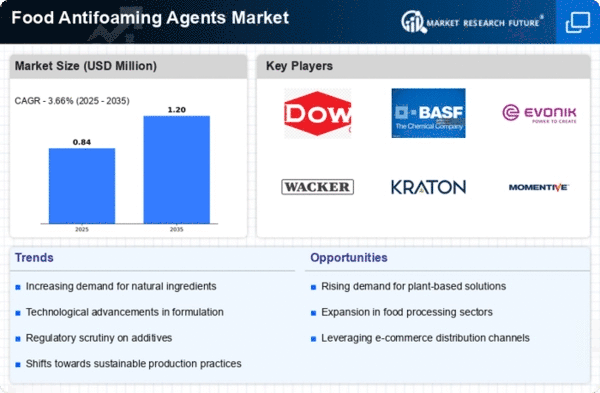
As per MRFR analysis, the Food Antifoaming Agents Market Size was estimated at 0.806 USD Million in 2024. The Food Antifoaming Agents industry is projected to grow from 0.845 in 2025 to 1.2 by 2035, exhibiting a compound annual growth rate (CAGR) of 3.66 during the forecast period 2025 - 2035.

Key Market Trends & Highlights

The Food Antifoaming Agents Market is experiencing a dynamic shift driven by evolving consumer preferences and regulatory standards.

  • The market is witnessing a rising demand for processed foods, particularly in North America, which remains the largest market.
  • There is a notable shift towards natural alternatives in food antifoaming agents, especially in the Asia-Pacific region, recognized as the fastest-growing market.
  • Dairy products continue to dominate the market segment, while the bakery segment is emerging as the fastest-growing area for antifoaming agents.
  • Key market drivers include increasing production efficiency and rising health consciousness among consumers, influencing the overall growth trajectory.

Market Size & Forecast

2024 Market Size 0.806 (USD Million)
2035 Market Size 1.2 (USD Million)
CAGR (2025 - 2035) 3.66%
Largest Regional Market Share in 2024 North America

Major Players

<p>Dow Chemical Company (US), BASF SE (DE), Evonik Industries AG (DE), Wacker Chemie AG (DE), Kraton Corporation (US), Momentive Performance Materials Inc. (US), Shin-Etsu Chemical Co., Ltd. (JP), Clariant AG (CH), Solvay SA (BE)</p>

Market Trends

The Food Antifoaming Agents Market is currently experiencing a notable evolution, driven by the increasing demand for processed food products and the need for improved production efficiency. These agents play a crucial role in minimizing foam formation during food processing, which can adversely affect product quality and yield. As manufacturers strive to enhance their operational processes, the incorporation of effective antifoaming solutions has become essential. Furthermore, the growing awareness regarding food safety and quality standards is prompting companies to invest in advanced formulations that ensure compliance with regulatory requirements. This trend indicates a shift towards more sophisticated and tailored antifoaming agents that cater to specific applications within the food industry. In addition, the Food Antifoaming Agents Market is witnessing a rise in the adoption of natural and organic alternatives. Consumers are increasingly inclined towards products that align with their health-conscious preferences, leading manufacturers to explore plant-based and biodegradable options. This shift not only addresses consumer demands but also reflects a broader movement towards sustainability within the food sector. As the market continues to evolve, it appears that innovation and adaptability will be key drivers in shaping the future landscape of food antifoaming agents, ensuring that they meet both functional and environmental expectations.

Rising Demand for Processed Foods

The Food Antifoaming Agents Market is influenced by the growing consumption of processed foods. As food manufacturers seek to enhance production efficiency, the need for effective antifoaming solutions becomes increasingly critical. These agents help maintain product quality and optimize yield during processing.

Shift Towards Natural Alternatives

There is a noticeable trend towards the use of natural and organic antifoaming agents in the Food Antifoaming Agents Market. This shift is driven by consumer preferences for healthier options, prompting manufacturers to explore plant-based solutions that align with sustainability goals.

Regulatory Compliance and Quality Standards

The Food Antifoaming Agents Market is shaped by stringent food safety regulations and quality standards. Manufacturers are investing in advanced formulations to ensure compliance, which is likely to drive innovation and the development of tailored antifoaming solutions.

Food Antifoaming Agents Market Market Drivers

Market Growth Projections

The Global Food Antifoaming Agents Market Industry is poised for substantial growth, with projections indicating an increase from 4.72 USD Billion in 2024 to 10.2 USD Billion by 2035. This growth trajectory suggests a compound annual growth rate of 7.3% from 2025 to 2035, reflecting the increasing adoption of antifoaming agents across various food sectors. Factors such as rising demand for processed foods, advancements in food technology, and stringent regulatory standards are likely to drive this market expansion. The anticipated growth underscores the critical role of antifoaming agents in ensuring product quality and safety in the food industry.

Growth of the Beverage Industry

The beverage industry is a key driver of the Global Food Antifoaming Agents Market Industry, as the production of various beverages often involves processes that generate foam. Antifoaming agents are essential in maintaining product quality and consistency, particularly in carbonated drinks, juices, and dairy products. As the beverage sector continues to expand, fueled by rising consumer demand for innovative and diverse drink options, the need for effective antifoaming solutions is likely to increase. This growth trend is expected to contribute to the overall market expansion, aligning with the industry's projected growth trajectory over the next decade.

Rising Demand for Processed Foods

The Global Food Antifoaming Agents Market Industry experiences a surge in demand for processed foods, driven by changing consumer lifestyles and preferences. As more consumers seek convenience, the processed food sector is projected to grow significantly. This trend is expected to contribute to the market's expansion, with the industry valued at 4.72 USD Billion in 2024. Antifoaming agents play a crucial role in enhancing the quality and stability of these products, ensuring a smooth texture and preventing unwanted foaming during production. Consequently, manufacturers are increasingly incorporating these agents to meet consumer expectations and maintain product integrity.

Consumer Awareness and Health Trends

Increasing consumer awareness regarding health and wellness is shaping the Global Food Antifoaming Agents Market Industry. As consumers become more health-conscious, there is a growing demand for food products that are not only safe but also free from harmful additives. This trend encourages manufacturers to utilize natural and safe antifoaming agents, which can enhance product appeal. The shift towards healthier food options is likely to drive innovation in the formulation of antifoaming agents, ensuring they meet consumer expectations. This evolving landscape may further contribute to the market's growth, as companies adapt to changing consumer preferences.

Technological Advancements in Food Production

Technological advancements in food production processes are influencing the Global Food Antifoaming Agents Market Industry. Innovations in manufacturing techniques, such as high-pressure processing and advanced emulsification methods, necessitate the use of effective antifoaming agents to optimize production efficiency. These advancements not only improve product quality but also reduce waste, thereby enhancing profitability for manufacturers. As the industry evolves, the demand for specialized antifoaming solutions is likely to increase, further driving market growth. The anticipated compound annual growth rate of 7.3% from 2025 to 2035 underscores the importance of these technological developments in shaping the future of the market.

Regulatory Compliance and Food Safety Standards

The Global Food Antifoaming Agents Market Industry is significantly influenced by stringent regulatory compliance and food safety standards. Governments worldwide are implementing rigorous regulations to ensure food safety, which includes the use of approved food additives like antifoaming agents. Compliance with these regulations is essential for manufacturers to maintain market access and consumer trust. As a result, companies are increasingly investing in high-quality antifoaming agents that meet safety standards, thereby driving market growth. The industry's projected growth to 10.2 USD Billion by 2035 reflects the critical role of regulatory frameworks in shaping market dynamics and encouraging innovation.

Market Segment Insights

By Application: Dairy Products (Largest) vs. Bakery (Fastest-Growing)

<p>In the Food Antifoaming Agents Market, the application segment showcases a diverse distribution, with <a href="https://www.marketresearchfuture.com/reports/dairy-market-11483" target="_blank">dairy</a> products achieving the largest share. This segment is significantly impacted by the high demand for dairy-based products such as cheese, yogurt, and milk, which rely on antifoaming agents to enhance their production processes. Beverages and fats and oils also contribute to this market; however, their shares remain less dominant compared to dairy and bakery applications. The bakery sector is emerging as the fastest-growing application, spurred by the increasing consumer preference for baked goods and the rise of artisanal bread. Factors such as innovation in baking techniques and the introduction of new product lines are pushing the demand for antifoaming agents, which help maintain texture and quality in these products. The need for clean-label ingredients in processed foods is also driving growth, particularly in the <a href="https://www.marketresearchfuture.com/reports/confectionery-market-16095" target="_blank">confectionery</a> segment, as manufacturers seek to improve product appeal without compromising on ingredient quality.</p>

<p><a href="https://www.marketresearchfuture.com/reports/dairy-market-11483" target="_blank">dairy</a> Products (Dominant) vs. Bakery (Emerging)</p>

<p>Dairy products remain the dominant segment in the Food Antifoaming Agents Market due to their essential role in the production of various goods such as milk, cheese, and yogurt. These products generate significant foam during processing, necessitating the use of antifoaming agents to ensure quality and consistency. On the other hand, the bakery segment is increasingly recognized as an emerging player, driven by ultra-convenience trends and the growing popularity of gluten-free and organic baked goods. As consumers look for clean-label options, manufacturers in the bakery sector are adopting innovative antifoaming solutions to enhance the sensory qualities of their offerings without artificial additives. The competition in this space is becoming more dynamic, with bakeries focusing on quality and originality to cater to an evolving market landscape.</p>

By Formulation Type: Emulsifiers (Largest) vs. Surfactants (Fastest-Growing)

<p>In the Food Antifoaming Agents Market, Emulsifiers hold a significant share and are recognized as the largest segment by formulation type. Their ability to stabilize food products by preventing the formation of foam and controlling texture has solidified their market presence. On the other hand, Surfactants are rapidly gaining traction as the fastest-growing segment due to their versatile applications and rising demand in food processing, contributing to their increasingly notable market share.</p>

<p>Emulsifiers (Dominant) vs. Surfactants (Emerging)</p>

<p>Emulsifiers play a dominant role in the Food Antifoaming Agents Market, typically used to enhance the mouthfeel and stability of food products. They offer reliable and consistent performance, ensuring that foaming does not impact product quality. Meanwhile, Surfactants are an emerging category, known for their efficient foaming control and versatility in applications. These compounds are becoming increasingly favored due to innovations in food technology, emphasis on cleaner labels, and consumer preference for natural ingredients. The adaptability of surfactants to various food formulations makes them a significant player in driving future market growth as they cater to evolving consumer demands.</p>

By End Use: Food Processing (Largest) vs. Food Service (Fastest-Growing)

<p>The Food Antifoaming Agents Market is predominantly influenced by the Food Processing sector, which holds a significant share in the overall market. This segment benefits from a strong demand for high-quality processed foods, which require the versatile use of antifoaming agents to enhance product consistency and shelf life. Conversely, the Food Service segment, while smaller, is witnessing rapid growth due to increasing consumer demand for dining experiences and ready-to-eat meals. This growth is particularly notable as establishments strive to achieve better food quality without compromising on presentation or taste. Market dynamics indicate that food processing remains the leader in terms of consumption, driven by technological innovations and the need for efficiency within production lines. However, the food service industry is evolving quickly, propelled by trends like increased takeout services and a focus on reducing food waste through the improved use of antifoaming agents. As restaurants and catering services expand their offerings, there is a corresponding rise in the need for effective foaming control solutions, making this sector a key player in the market's future growth trajectory.</p>

<p>Food Processing (Dominant) vs. Food Packaging (Emerging)</p>

<p>The Food Processing segment stands out as the dominant player in the Food Antifoaming Agents Market, characterized by its extensive application across various types of food production. This segment primarily focuses on maintaining the quality and stability of food products by preventing foam formation during processing. On the other hand, the Food Packaging segment is emerging as a relevant market force, driven by innovations aimed at extending the shelf life of packaged goods while enhancing product appeal. Antifoaming agents are becoming crucial in this sector as they help in minimizing foaming during the packaging of liquid foods, thereby improving overall packing efficiency. As sustainability becomes a core objective, the need for biodegradable and effective antifoaming agents in food packaging is projected to increase, making it a segment with great potential.</p>

By Source: Plant-Based (Largest) vs. Synthetic (Fastest-Growing)

<p>The Food Antifoaming Agents Market shows a diverse distribution in its source segment, with Plant-Based agents holding the largest market share. This source type is favored for its natural origin and compatibility with organic food products. Synthetic antifoaming agents, although not holding the largest share, are witnessing rapid growth due to their effectiveness and cost efficiency, catering specifically to industrial applications, which is driving their increased adoption in the market. Looking at growth trends, the market is seeing emerging consumer preferences shifting towards Plant-Based products, influenced by a rise in health-conscious eating and sustainability initiatives. In contrast, Synthetic agents are growing quickly, driven by cost advantages and performance efficiency in food processing sectors. The combination of these trends indicates a dynamic shift in the Food Antifoaming Agents Market, adapting to consumer demands and industry requirements.</p>

<p>Plant-Based (Dominant) vs. Synthetic (Emerging)</p>

<p>In the Food Antifoaming Agents Market, Plant-Based agents are recognized as the dominant source due to their sustainable profile and consumer preference for natural ingredients. These agents, derived from renewable resources, align with the increasing demand for clean-label products and organic certification in the food industry. On the other hand, Synthetic antifoaming agents are emerging rapidly, characterized by their superior performance and economic benefits. They are particularly favored in large-scale food processing applications, where effectiveness and reliability are paramount. The competition between these two sources highlights a robust market landscape, with consumers and manufacturers navigating between health and performance metrics.</p>

By Functionality: Foam Control (Largest) vs. Stabilization (Fastest-Growing)

<p>In the Food Antifoaming Agents Market, the Foam Control functionality holds the largest share, primarily driven by the widespread need to manage excessive foam in food processing operations. This functionality is integral to various applications, ensuring product stability and quality. On the other hand, Stabilization has emerged as the fastest-growing segment, gaining traction due to the increasing demand for consistency in food textures and formulations. This shift reflects changing consumer preferences towards quality and performance in food products.</p>

<p>Foam Control: Dominant vs. Stabilization: Emerging</p>

<p>Foam Control functionality stands out as the dominant segment in the Food Antifoaming Agents Market, renowned for its critical role in minimizing foam in diverse food processes. It addresses challenges related to foam formation during cooking, blending, and packaging, thereby enhancing production efficiency and product quality. Conversely, Stabilization is identifying itself as an emerging segment, highlighted by its vital role in maintaining desirable textures in food products. As consumers lean towards products that exhibit consistent texture, its demand is surging, driven by innovations in food manufacturing that prioritize quality and sensory experiences.</p>

Get more detailed insights about Food Antifoaming Agents Market Research Report– Forecast till 2035

Regional Insights

North America : Market Leader in Antifoaming Agents

North America holds a significant 35% share of the Food Antifoaming Agents market, driven by increasing food production and stringent food safety regulations. The demand for high-quality food products has led to a surge in the use of antifoaming agents to enhance product quality and shelf life. Regulatory bodies are also promoting the use of safe and effective additives, further boosting market growth. The United States and Canada are the leading countries in this region, with major players like Dow Chemical Company and Momentive Performance Materials Inc. dominating the market. The competitive landscape is characterized by innovation and strategic partnerships among key players, ensuring a steady supply of advanced antifoaming solutions to meet the growing demand in the food industry.

Europe : Regulatory Framework Drives Growth

Europe accounts for 25% of the Food Antifoaming Agents market, supported by robust regulatory frameworks that ensure food safety and quality. The increasing demand for processed foods and beverages is a key driver, as manufacturers seek to improve product consistency and reduce production costs. Regulations from the European Food Safety Authority (EFSA) encourage the use of safe additives, fostering market expansion. Germany, France, and the UK are the leading countries in this region, with companies like BASF SE and Evonik Industries AG playing pivotal roles. The competitive landscape is marked by innovation and sustainability initiatives, as firms strive to develop eco-friendly antifoaming agents. This focus on sustainability aligns with consumer preferences for natural and safe food products.

Asia-Pacific : Emerging Market with Growth Potential

Asia-Pacific holds a 15% share of the Food Antifoaming Agents market, driven by rapid urbanization and increasing disposable incomes. The growing food and beverage industry in countries like China and India is a significant growth driver, as manufacturers seek to enhance product quality and efficiency. Regulatory bodies are gradually implementing standards to ensure food safety, which is expected to further boost market demand. China and India are the leading countries in this region, with a rising number of local and international players entering the market. Companies like Shin-Etsu Chemical Co., Ltd. and Wacker Chemie AG are expanding their presence, focusing on innovative solutions to cater to the diverse needs of the food industry. The competitive landscape is evolving, with an emphasis on product development and strategic collaborations to capture market share.

Middle East and Africa : Niche Market with Growth Challenges

The Middle East and Africa represent a small 1% share of the Food Antifoaming Agents market, facing challenges such as limited food processing infrastructure and regulatory hurdles. However, the region is witnessing gradual growth due to increasing investments in food production and processing facilities. As consumer awareness of food quality rises, the demand for antifoaming agents is expected to grow, albeit slowly. Countries like South Africa and the UAE are leading the market, but the presence of key players is limited compared to other regions. Local manufacturers are beginning to emerge, focusing on cost-effective solutions to meet the needs of the food industry. The competitive landscape is still developing, with opportunities for growth as the market matures and regulatory frameworks improve.

Key Players and Competitive Insights

The Food Antifoaming Agents Market is currently characterized by a dynamic competitive landscape, driven by increasing demand for food processing efficiency and product quality. Key players such as Dow Chemical Company (US), BASF SE (DE), and Evonik Industries AG (DE) are strategically positioned to leverage innovation and sustainability in their operations. Dow Chemical Company (US) focuses on developing bio-based antifoaming agents, which aligns with the growing consumer preference for environmentally friendly products. Meanwhile, BASF SE (DE) emphasizes partnerships with food manufacturers to enhance product formulations, thereby strengthening its market presence. Evonik Industries AG (DE) is investing in digital transformation initiatives to optimize its supply chain and improve customer engagement, which collectively shapes a competitive environment that prioritizes innovation and responsiveness to market needs.

In terms of business tactics, companies are increasingly localizing manufacturing to reduce lead times and enhance supply chain efficiency. The market structure appears moderately fragmented, with several players vying for market share. However, the collective influence of major companies like Wacker Chemie AG (DE) and Momentive Performance Materials Inc. (US) is notable, as they continue to expand their product offerings and geographic reach, thereby intensifying competition.

In November 2025, Wacker Chemie AG (DE) announced the launch of a new line of silicone-based antifoaming agents specifically designed for the dairy industry. This strategic move is significant as it addresses the unique challenges faced by dairy processors, such as maintaining product quality and consistency. By tailoring solutions to specific industry needs, Wacker Chemie AG (DE) enhances its competitive edge and positions itself as a leader in specialized applications.

In October 2025, Momentive Performance Materials Inc. (US) entered into a strategic partnership with a leading food processing company to co-develop innovative antifoaming solutions. This collaboration is indicative of a broader trend where companies are seeking synergies to accelerate product development and market entry. Such partnerships not only enhance technological capabilities but also expand market access, thereby fostering a more collaborative competitive landscape.

In September 2025, Evonik Industries AG (DE) unveiled a new digital platform aimed at providing real-time data analytics for food manufacturers. This initiative reflects the growing importance of digitalization in the Food Antifoaming Agents Market, as companies seek to leverage data for improved decision-making and operational efficiency. By integrating advanced analytics into their offerings, Evonik Industries AG (DE) positions itself at the forefront of technological innovation in the sector.

As of December 2025, current competitive trends indicate a strong emphasis on sustainability, digitalization, and technological integration. Strategic alliances are increasingly shaping the landscape, allowing companies to pool resources and expertise. The shift from price-based competition to a focus on innovation and supply chain reliability is evident, suggesting that future differentiation will hinge on the ability to deliver high-quality, sustainable solutions that meet evolving consumer demands.

Key Companies in the Food Antifoaming Agents Market market include

Industry Developments

Future Outlook

Food Antifoaming Agents Market Future Outlook

<p>The Food Antifoaming Agents Market is projected to grow at a 3.66% CAGR from 2024 to 2035, driven by increasing demand for processed foods and advancements in food technology.</p>

New opportunities lie in:

  • <p>Development of plant-based antifoaming agents for health-conscious consumers.</p>
  • <p>Expansion into emerging markets with tailored product offerings.</p>
  • <p>Investment in R&D for innovative formulations enhancing performance and sustainability.</p>

<p>By 2035, the market is expected to achieve robust growth, reflecting evolving consumer preferences and technological advancements.</p>

Market Segmentation

Food Antifoaming Agents Market Source Outlook

  • Plant-Based
  • Synthetic
  • Animal-Based

Food Antifoaming Agents Market End Use Outlook

  • Food Processing
  • Food Packaging
  • Food Service

Food Antifoaming Agents Market Application Outlook

  • Beverages
  • Dairy Products
  • Bakery
  • Confectionery
  • Fats and Oils

Food Antifoaming Agents Market Functionality Outlook

  • Foam Control
  • Stabilization
  • Texture Improvement

Food Antifoaming Agents Market Formulation Type Outlook

  • Emulsifiers
  • Surfactants
  • Polymers
  • Silicones

Report Scope

MARKET SIZE 20240.806(USD Million)
MARKET SIZE 20250.845(USD Million)
MARKET SIZE 20351.2(USD Million)
COMPOUND ANNUAL GROWTH RATE (CAGR)3.66% (2024 - 2035)
REPORT COVERAGERevenue Forecast, Competitive Landscape, Growth Factors, and Trends
BASE YEAR2024
Market Forecast Period2025 - 2035
Historical Data2019 - 2024
Market Forecast UnitsUSD Million
Key Companies ProfiledDow Chemical Company (US), BASF SE (DE), Evonik Industries AG (DE), Wacker Chemie AG (DE), Kraton Corporation (US), Momentive Performance Materials Inc. (US), Shin-Etsu Chemical Co., Ltd. (JP), Clariant AG (CH), Solvay SA (BE)
Segments CoveredApplication, Formulation Type, End Use, Source, Functionality
Key Market OpportunitiesGrowing demand for plant-based food antifoaming agents driven by consumer health consciousness and sustainability trends.
Key Market DynamicsRising demand for plant-based food products drives innovation in food antifoaming agents formulation and application.
Countries CoveredNorth America, Europe, APAC, South America, MEA

FAQs

What is the growth rate of the food antifoaming agents market?

The growth rate of the market is 5.92%.

What is the crucial segment of the food antifoaming agents market?

The oil-based food antifoaming agents is a crucial segment with the highest demand.

Who are key players of the food antifoaming agents market?

Ashland LLC (U.S.), Evonik Industries AG (Germany), BASF SE (Germany), Air Products and Chemicals, Inc. (U.S.), Ecolab Inc. (U.S.), Wacker Chemie AG (Germany), Dow Corning Corporation (U.S.), Elementis Plc. (U.K), HiMedia Laboratories Pvt. Ltd. (India), and Kemira OYJ (Finland) are key players of the food antifoaming agents market.

Which region can dominate in the global food antifoaming agents market?

North America can dominate in the global food antifoaming agents market till 2030.

  1. Statistical Modelling and Forecast
  2. Industry Insights and Validation
    1. Data Sources
      1. Business Trends
      2. Product Type Trends
      3. Product Application Trends
    2. Industry Ecosystem Analysis
    3. Industry Impact forces
      1. Growth Drivers
      2. Industry Pitfalls
    4. Growth Potential
    5. Porter’s Analysis
    6. PESTEL Analysis
      1. Water-based
      2. Silicone-based
      3. Oil-based
      4. Beverages
      5. Bakery & Confectionery
      6. Dairy & Frozen
  3. Food Antifoaming Agents Market Regional Insights
    1. Food Antifoaming Agents Market Volume Share by
    2. Region, 2022 & 2030.
    3. North America
    4. A Market Estimates & Forecast, 2022-2030
    5. B Market Estimates &
    6. Forecast, by Type, 2022-2030
    7. C Market Estimates & Forecast, by Application, 2022-2030
      1. U.S.
      2. Canada
    8. & Forecast, 2022-2030
    9. & Forecast, by Application, 2022-2030
    10. & Forecast, by Type, 2022-2030
    11. Mexico
    12. Market Estimates & Forecast, 2022-2030
  4. Market Estimates & Forecast, by Application, 2022-2030
    1. Europe
    2. A Market Estimates & Forecast, 2022-2030
    3. B Market Estimates
    4. & Forecast, by Type, 2022-2030
    5. C Market Estimates & Forecast, by Application,
    6. Germany
    7. Market Estimates & Forecast, 2022-2030
  5. Market Estimates & Forecast, by Type,
  6. Market Estimates & Forecast, by Application, 2022-2030
    1. & Forecast, by Type, 2022-2030
    2. France
    3. Market Estimates & Forecast, 2022-2030
  7. U.K
  8. Market Estimates & Forecast, 2022-2030
  9. Market Estimates
  10. Market Estimates & Forecast, by Application,
  11. Market Estimates & Forecast, by Type,
  12. Market Estimates & Forecast, by Application, 2022-2030
    1. & Forecast, by Type, 2022-2030
    2. Asia Pacific
    3. A Market Estimates & Forecast, 2022-2030
  13. Italy
  14. Market Estimates & Forecast, 2022-2030
  15. Market Estimates
  16. Market Estimates & Forecast, by Application,
    1. B Market Estimates & Forecast, by Type,
  17. C Market Estimates & Forecast, by Application, 2022-2030
    1. & Forecast, by Type, 2022-2030
    2. India
    3. Market Estimates & Forecast, 2022-2030
  18. China
  19. Market Estimates & Forecast, 2022-2030
  20. Market Estimates
  21. Market Estimates & Forecast, by Application,
  22. Market Estimates & Forecast, by Type,
  23. Market Estimates & Forecast, by Application, 2022-2030
    1. & Forecast, by Type, 2022-2030
    2. RoW
    3. Estimates & Forecast, 2022-2030
    4. & Forecast, by Application 2022-2030
    5. Chapter 7 Competitor Profile
    6. Chemicals, Inc. (U.S.)
    7. Business Overview
    8. Financial Data
    9. Product Landscape
    10. Key Developments
    11. Business Strategy
    12. SWOT Analysis
    13. Ecolab Inc. (U.S.)
    14. Business Overview
    15. Financial Data
    16. Product Landscape
    17. Key Developments
    18. Business Strategy
    19. SWOT Analysis
    20. Wacker Chemie AG (Germany)
    21. Pvt. Ltd. (India)
    22. Business Overview
    23. Financial Data
    24. Product Landscape
    25. Key Developments
    26. Business Strategy
    27. SWOT Analysis
    28. Kemira OYJ (Finland)
    29. Business Overview
    30. Financial Data
    31. Product Landscape
    32. Key Developments
    33. Business Strategy
    34. SWOT Analysis
    35. Data
    36. Tables
    37. TABLE
  24. Japan
  25. Market Estimates & Forecast, 2022-2030
  26. Market Estimates
  27. Market Estimates & Forecast, by Application,
  28. Market
  29. Market Estimates & Forecast, by Type, 2022-2030
  30. Market Estimates
    1. Ashland LLC (U.S.)
      1. Business Overview
      2. Financial Data
      3. Product Landscape
      4. Key Developments
      5. Business Strategy
      6. SWOT Analysis
    2. Evonik Industries AG (Germany)
      1. Business Overview
      2. Financial Data
      3. Product Landscape
      4. Key Developments
      5. Business Strategy
      6. SWOT Analysis
    3. BASF SE (Germany)
      1. Business Overview
      2. Financial Data
      3. Product Landscape
      4. Key Developments
      5. Business Strategy
      6. SWOT Analysis
    4. Air Products and
      1. Business Overview
      2. Financial Data
      3. Product Landscape
      4. Key Developments
      5. Business Strategy
      6. SWOT Analysis
    5. Dow Corning Corporation (U.S.)
      1. Business Overview
      2. Financial Data
      3. Product Landscape
      4. Key Developments
      5. Business Strategy
      6. SWOT Analysis
    6. Elementis Plc. (U.K)
      1. Business Overview
      2. Financial Data
      3. Product Landscape
      4. Key Developments
      5. Business Strategy
      6. SWOT Analysis
    7. HiMedia Laboratories
  31. PESTLE ANALYSIS – U.S.
  32. PESTLE ANALYSIS- CANADA
  33. PESTLE ANALYSIS- CHINA
  34. PESTLE ANALYSIS- FRANCE
  35. PESTLE ANALYSIS-
    1. U.K.
    2. TABLE
  36. KEY SUPPLIERS OF FOOD ANTIFOAMING AGENTS
  37. GLOBAL MARKET FOR FOOD ANTIFOAMING AGENTS,
    1. BY TYPE, (2022-2030), USD MILLION
  38. GLOBAL MARKET FOR FOOD ANTIFOAMING AGENTS, BY APPLICATION,
    1. (2022-2030), USD MILLION
  39. GLOBAL FOOD ANTIFOAMING AGENTS SALES AND GROWTH RATE (2022-2030)
    1. USD MILLION
    2. TABLE
  40. GLOBAL MARKET FOR FOOD ANTIFOAMING AGENTS TOP 5 COUNTRIES
  41. GLOBAL MARKET FOR FOOD ANTIFOAMING AGENTS
    1. TOP COMPANIES-USD MILLION
  42. NORTH AMERICAN MARKET FOR FOOD ANTIFOAMING AGENTS, BY TYPE,
    1. (2022-2030) USD MILLION
  43. NORTH AMERICAN MARKET FOR FOOD ANTIFOAMING AGENTS, BY APPLICATION,
    1. (2022-2030), USD MILLION
  44. EUROPEAN MARKET FOR FOOD ANTIFOAMING AGENTS, BY TYPE, (2022-2030)
    1. USD MILLION
    2. TABLE
  45. EUROPEAN MARKET FOR FOOD ANTIFOAMING AGENTS, BY APPLICATION, (2022-2030), USD
    1. MILLION
    2. TABLE
  46. APAC MARKET FOR FOOD ANTIFOAMING AGENTS, BY TYPE, (2022-2030) USD MILLION
  47. APAC MARKET
    1. FOR FOOD ANTIFOAMING AGENTS, BY APPLICATION, (2022-2030), USD MILLION
  48. REST OF THE
  49. WORLD MARKET FOR FOOD ANTIFOAMING AGENTS, BY TYPE, (2022-2030) USD MILLION
  50. REST OF THE
  51. WORLD MARKET FOR FOOD ANTIFOAMING AGENTS, BY APPLICATION, (2022-2030), USD MILLION
  52. COMPETITIVE
    1. LANDSCAPING BASED ON FINACIALS DURING THE YEAR 2022 
    2. Charts & Figures
  53. LIST OF FIGURES
    1. FIGURE 1
  54. RESEARCH METHODOLOGY
    1. FIGURE
  55. PRIMARY DATA ANALYSIS APPROACH
  56. SECONDARY DATA ANALYSIS APPROACH
  57. TRENDS IN FOOD ANTIFOAMING AGENTS IMPORTS
    1. FIGURE
  58. GROWTH RATE IN FOOD ANTIFOAMING AGENTS IMPORTS 2022
  59. FOOD ANTIFOAMING AGENTS IMPORTS MARKET SHARE
    1. BY TOP 5 IMPORTERS (2022)
  60. TRENDS IN FOOD ANTIFOAMING AGENTS EXPORTS 2022
  61. GROWTH RATE FOOD ANTIFOAMING
    1. AGENTS EXPORTS 2022
    2. FIGURE
  62. FOOD ANTIFOAMING AGENTS EXPORTS MARKET SHARE BY TOP 5 EXPORTERS (2022)
  63. VALUE CHAIN
    1. ANALYSIS
    2. FIGURE
  64. COST ANALYSIS: FOOD ANTIFOAMING AGENTS
  65. PORTER’S FIVE FORCES ANALYSIS
  66. GLOBAL MARKET
    1. FOR FOOD ANTIFOAMING AGENTS TRENDS BY TYPE
  67. GLOBAL MARKET FOR FOOD ANTIFOAMING AGENTS
    1. TRENDS BY APPLICATION
    2. FIGURE
  68. FINANCIALS

Food Antifoaming Agents Market Segmentation

Market Segmentation Overview

  • Detailed segmentation data will be available in the full report
  • Comprehensive analysis by multiple parameters
  • Regional and country-level breakdowns
  • Market size forecasts by segment
Infographic

Free Sample Request

Kindly complete the form below to receive a free sample of this Report

Get Free Sample

Customer Strories

Compare Licence

×
Features License Type
Single User Multiuser License Enterprise User
Price $4,950 $5,950 $7,250
Maximum User Access Limit 1 User Upto 10 Users Unrestricted Access Throughout the Organization
Free Customization
Direct Access to Analyst
Deliverable Format
Platform Access
Discount on Next Purchase 10% 15% 15%
Printable Versions